
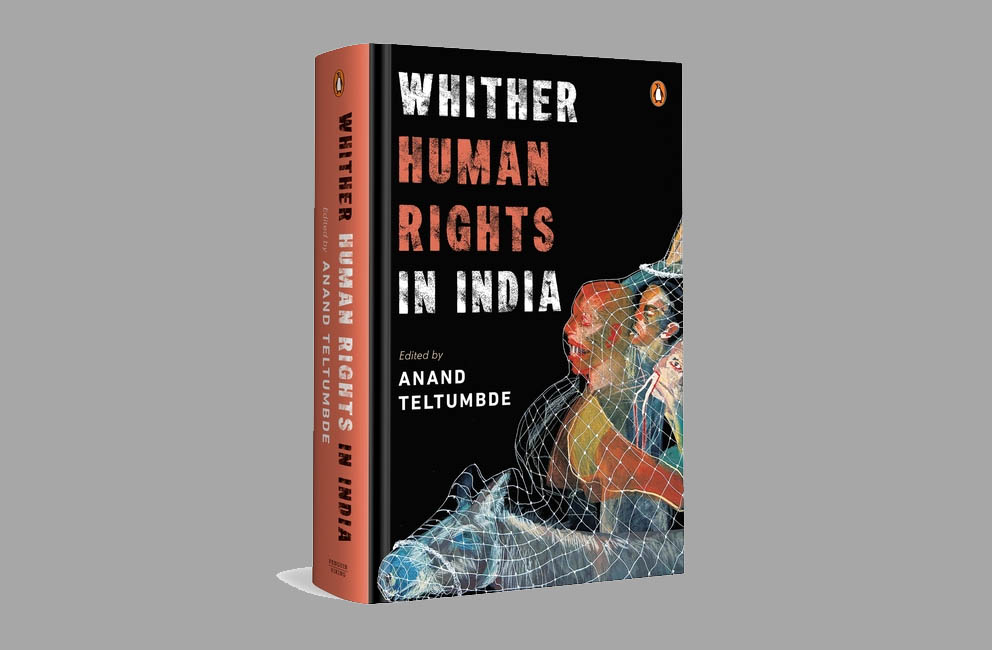
‘Whither Human Rights in India,’ edited by Anand Teltumbde, is a critical and outstanding collection of essays navigating India’s human rights landscape, exploring diverse arenas Ike majoritarianism, state violence, systemic inequality (Dalits, Adivasis, Muslims), judicial issues, hate speech, and threats to vulnerable groups..
Resurrecting the outlook of Father Stan Swamy and Prof. G. N. Saibaba, Whither Human Rights in India is both a chronicle of resistance and a call to reshape the future of democracy and human dignity.
Reviews highlight it as imperative for understanding the struggles of minorities, the role of activist scholars (like contributors Harsh Mander, Teesta Setalvad), and the impact of laws like the UAPA on activists.
It is an illustrative and lucid anthology that provides a panoramic view and an unwavering critical analysis of the aggravating crisis in human rights in India, offering profound research on systemic failures and the ongoing fight for justice.
Principally, the book is a comprehensive exploration of how the devastation of human rights over the parts decade are not just a continuation of past patterns but symbolise a crucial departure or rupture, manifesting a new fascist paradigm which will make it an arduous task for future generation s to stand up against to restore past rights.
The essays trace the historical and ideological roots of India’s human rights evolution. They explore how colonial past and constitutional ideals grossly contradict current realities. Critiques analyse the rise of majoritarian politics, state violence, and impunity, especially against minorities.
The book scrutinizes the judiciary, hate speech, “bulldozer justice,” and development models. Features contributions from leading voices like Teesta Setalvad, Harsh Mander, Gautam Navlakha, and Kalpana Kannabiran.
The book addresses the persecution of activists (like the book’s editor, Anand Teltumbde under laws like the UAPA.
In a most illustrative and congeal manner the chapters of the book encompass the unprecedented destruction of human rights during the tyranny of BJP rule.
The first part includes seven papers that give a clear theoretical cognitive on vital spheres lie state violence, impunity, ‘Urban Naxal narrative, the hate speech epidemic persecution engineered by the constitutional executive, controversial supreme court rulings, growing inequality, and the superstructure of New India promoted by BJP, the Gujarat model and the ‘bulldozer justice.’
The second part features nine papers, documenting violations on minority communities like Muslims and Christians.
Introduction by Author
Teltumbde gives a most comprehensive introduction where he explores the evolution of human rights in India from the Colonial days of the British rule, linking it with the rise of British liberalism. He examined the contradictions of British imperialism with liberalism as well as the percolating of liberal ideas and catalysed social reforms that addressed oppressive practices. He chronicled the events that orchestrated the wave of human rights in the Freedom struggle and why World War 2 became a turning point in the global recognition of human rights, with creation of United Nations. Teltumbde has appraised the Indian Constitution of 1950 that secured important rights, praising India’s dedication to preserving human rights in that era.
Pertinent and positive that Tetumbde exposes the glaring loopholes in late prime minister Jawaharlal Nehru’s policies, who he described as fostering caste discrimination as well as inequality to engineer a largely undemocratic social order, promoting even Preventive Detention and toppling the elected government of Sheikh Abdula h in Kashmir and the Elected Communist party in Kerala.
Anand makes an intensive exploration of the gradual deterioration of human rights in periods like Indo-China War, Emergency, and events under the Congress regimes that were the precursor-sponsored rise of BJP neo-fascism was bitterly critical of the regimes of Indira Gandhi and Rajiv Gandhi, supressing workers and student movements. He scrutinized how the 1991 economic reforms although boosted private enterprise and consumer freedom, escalated economic equality, displaced large populations and marginalised the poor due to privatisation, and linked those aberrations with informalisation of labour and commercialisation of services like healthcare and education that engineered a new era of human rights violations.
Teltumbde recounted the Babri Masjid demolition orchestrating communal polarisation and widespread violence and the transition to the 202 Gujarat agenda, with the gruesome Godhra carnage. In the main Teltumbde navigated how in essence the state’s actions stood in stark contrast to the lofty ideals of the constitution.
Anand finally explored and evaluated the making and fabric of fascism in India under Narendra Modi He reflected the role played by the media. He elaborated how Modi regime viewed civil society as an enemy, mercilessly framing activists and dissenters as threats to national security. Teltumde chronicled events symbolising the multidimensional assault on human rights, like Pulwama action, Citizenship amendment act, abrogating article 370 in Kashmir, criminalising human rights organisations, extensive use of colonial era laws like UPA.etc.
In his conclusion of the introduction, he diagnoses a return to the ancient Brahmanical order, stripping al human rights. He expresses fear of the silence and indifference of the Indian public on Modi’s regime and relentless propaganda that conceal the truth.
Chapters in the Volume
Kalpana Kannabiran examines how state actions over seven decades have reinforced impunity and aggression.
Ajay Gudavarthy and G Vijay navigate targeting of activists as anti-Hindu and terrorist to supress resistance of civil society.
Mihir Desai explores the Supreme Court’s failures to safeguard constitutional rights over the lats decade.
Subbhas Gatade draws similarities of the bulldozing of Muslim homes with Israeli demolitions in Gaza.
Teesta Setalvad diagnoses the reactionary character of the ‘Gujarat Model’, evaluating it as facade to engineer corporate welfare and communal polarisation.
Gautam Navlakaha recollects life serving a sentence as an undertrial prisoner, revealing how special laws are designed to undermine the principle of innocence until proven guilty, denying bail to prisoners making them languish for years.
Harsh Mander touches on the escalation of hate speech, vilifying Muslims as traitors.
Aakar Patel explores the persecution of Muslims, tracing it to the ideological roots of the BJP, describing Modi’s regime as one mercilessly promoting nationalism.
Vineeth Srivastav characterises Modi’s regime as fascist, which fuses rhetoric nationalism, religious identity and anti-elitism to trigger Hindu nationalism. He lucidly analyses Fascist underpinnings exploring how the cult of Modi, the normalisation of Hindu nationalism, the mockery of constitutional values, the power of propaganda, the dominance of mob mentality, the revival of religious myths, as national narratives and ‘bulldozer justice’, are a testament to New India’s transformation into a fascist society. This new India’s characterised by a fascist revival of a mythic past as well as a dynamic relationship of the state, corporate interests and highly mediated cultural nationalism, bolstering ultra-nationalism with crony capitalism.
Anand Teltumbde investigates the organised erosion of Dalit rights, in the backdrop of the marinization of constitutional protection.
Vernon Gonzalves chronicles the systematic extinguishing of prisoners’ rights under Modi.
Lancy Lobo describes the Violence unleashed on Christians, with anti-conversion laws enforced to attack on Christians.
Irfan Engineer covers the escalating violence and discrimination of Muslims under Modi’s rule.
Mahruk Edenwala exposes the failure of child protection laws, particularly in aftermath of NRC.
Bittu KR analyses the restriction on rights of the LGBTQIA for living freely and equally.
(The author is a freelance journalist)
Related:
Ritwik Ghatak transcended realms unexplored to reinvent art of Indian revolutionary film making
Iconoclast: Path breaking biography of BR Ambedkar projects his human essence