
For the sixth time in a week, mobile internet services were suspended in parts of central Delhi as student protests continued at Jantar Mantar over alleged irregularities in the NEET examination process. The repeated shutdowns, ordered by authorities citing public safety and prevention of offences, have intensified concerns over the growing use of internet restrictions as a tool for managing public demonstrations.
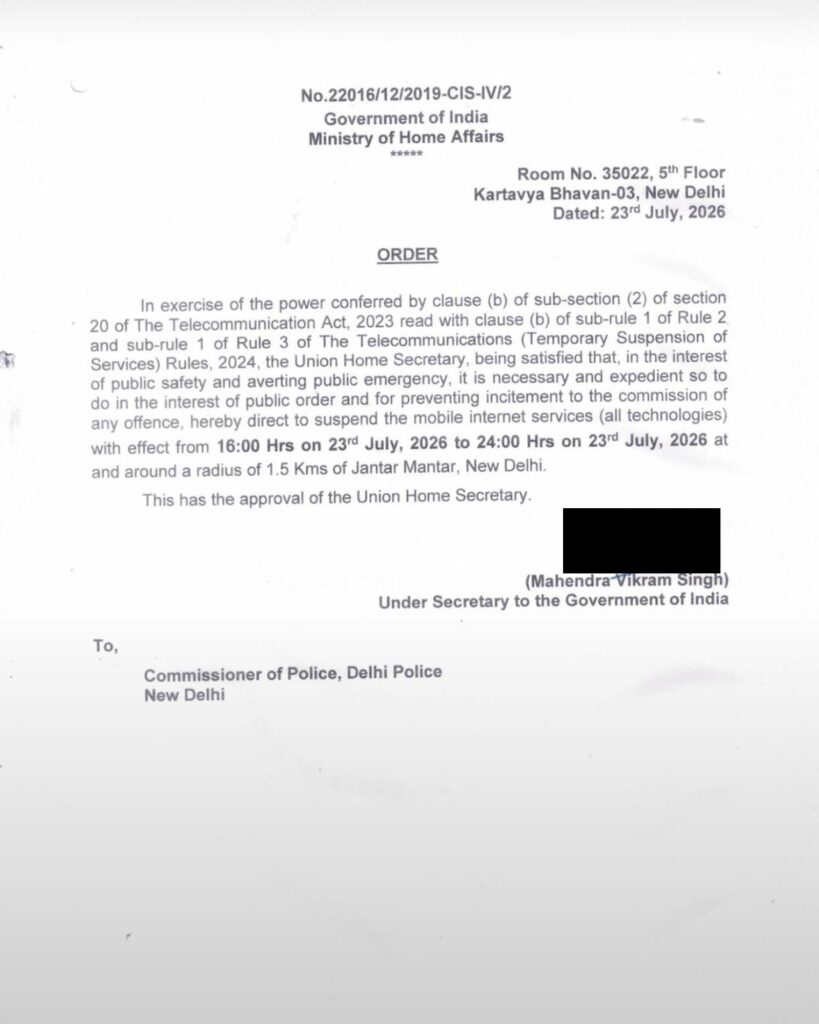
As per the notification provided, the Ministry of Home Affairs (MHA) directed telecom service providers to suspend mobile internet access in areas within a 1.5-kilometre radius of Jantar Mantar on July 23. The order cited “public emergency”, “public safety” and the need to prevent “incitement to the commission of any offence” as grounds for restricting connectivity. The suspension, initially scheduled to remain in force until 4 pm, was later extended till midnight.
However, the disruption was not confined to the protest site. Areas including Mandi House, located nearly two kilometres from Jantar Mantar, also reported connectivity issues despite not being the centre of the demonstrations. According to The Indian Express, the shutdown affected office-goers, residents, businesses and commuters who happened to be in the area.
The consequences were immediate. Digital payments through UPI stopped working for several small businesses, forcing shopkeepers and street vendors to depend on cash transactions. App-based transport services, online communication platforms and navigation services were also affected. A roadside tea vendor told The Indian Express that his business suffered because customers were unable to make digital payments.
The latest shutdown came days after similar restrictions were imposed on July 20, when the student-led “Chalo Sansad” march was organised near Jantar Mantar during the opening of Parliament’s Monsoon Session. The march, called by the Cockroach Janta Party (CJP), sought to highlight concerns over alleged NEET irregularities, examination accountability and student distress. Notably, the July 20 notification for internet shutdown had not been made public on the same day.
Authorities refused permission for the march, imposed prohibitory restrictions under Section 163 of the Bharatiya Nagarik Suraksha Sanhita (BNSS), and deployed heavy security around central Delhi. Routes leading towards Parliament were sealed, while metro stations including Patel Chowk, Rajiv Chowk and Janpath were temporarily closed.
Challenge before Delhi High Court
The legality of the shutdowns has now been challenged before the Delhi High Court. A public interest litigation filed by the Software Freedom Law Centre, India (SFLC.in) has questioned the mobile internet suspension orders issued by the MHA on July 17, 20, 22 and 23 around Jantar Mantar.
As reported by LiveLaw, the petition argues that the orders are unconstitutional, disproportionate and fail to meet the safeguards prescribed under the Telecommunications Act, 2023 and the Telecommunications (Temporary Suspension of Services) Rules, 2024.
The petition contends that the authorities relied on vague references to “public emergency” and “public safety” without disclosing specific material demonstrating an imminent threat that justified cutting internet access. It argues that the government failed to establish why a complete suspension of mobile internet was necessary or whether less restrictive alternatives were considered.
Relying on the Supreme Court’s decision in Anuradha Bhasin v. Union of India (2020), the plea states that restrictions on internet access must satisfy the principles of legality, necessity and proportionality. The judgment had held that indefinite internet shutdowns were impermissible and that any restriction must be subject to judicial scrutiny and periodic review.
The petition also challenges the lack of public disclosure of the suspension orders, arguing that affected citizens cannot effectively challenge restrictions if the basis for such orders remains inaccessible. It has sought directions requiring authorities to publish shutdown orders before or at the time of enforcement and has demanded production of official records, including file notings, intelligence inputs and Review Committee proceedings.
Under the Telecommunications (Temporary Suspension of Services) Rules, 2024, internet suspension orders can ordinarily be issued only by the Union Home Secretary or State Home Secretary, with limited exceptions allowing an officer of Joint Secretary rank to act in unavoidable circumstances. Such orders are also subject to review mechanisms.
The Delhi shutdowns have once again brought into focus the difficult balance between maintaining public order and protecting constitutional freedoms. While authorities argue that temporary internet restrictions prevent misinformation, mobilisation of violence and security threats, critics maintain that broad shutdowns risk becoming a disproportionate response to peaceful public assembly.
The issue is no longer limited to a single protest site. It raises a fundamental question for a digital democracy: when citizens gather to exercise their rights to peaceful assembly and expression, can the State respond by cutting off a basic channel through which people communicate, organise and access information?
Related:
Youth Uprising: A protest, a brute crackdown, a continuing countrywide response
Mumbai stands with students, but the state pushes back
The exam crisis that became a battle for accountability
A deleted tweet, an NSA order, and the shadow of past crackdowns