
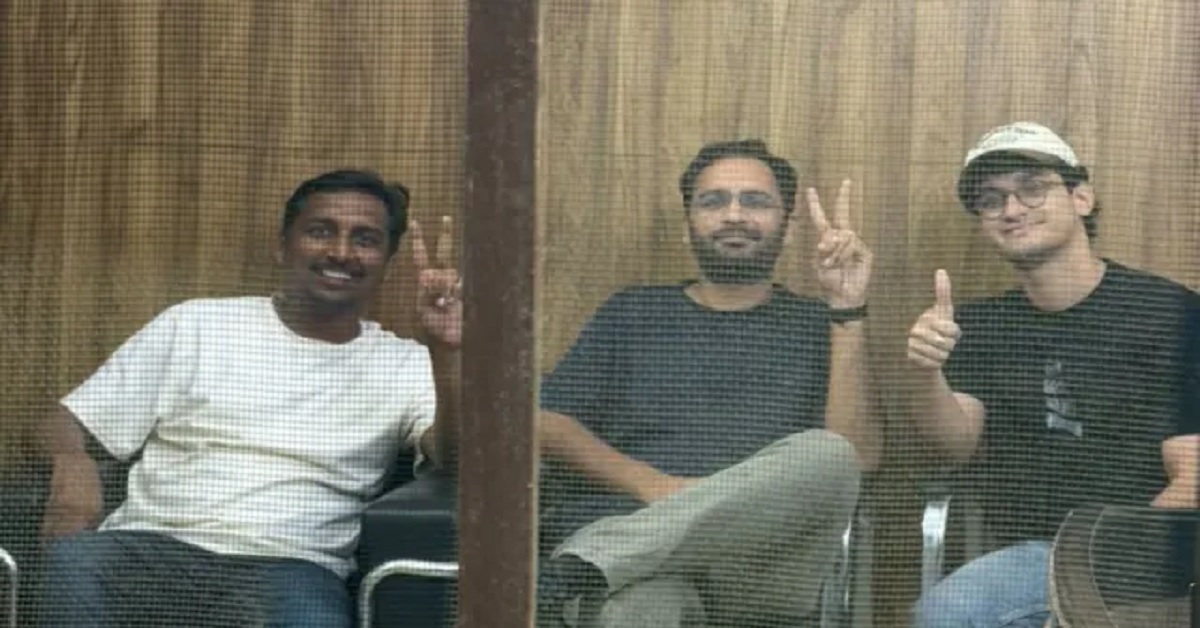
Two leaders of the Cockroach Janta Party (CJP), Saurav Das and Ashutosh Ranka, have been remanded to five days of judicial custody by a Special Executive Magistrate (SEM) in Delhi after attempting to enter Jantar Mantar on October 13, a day after the site was de-notified as a designated protest venue. A third leader, Ajinkya Shinde, has been released on a personal bond.
The three were among 14 CJP members who allegedly climbed over a locked gate and barricades to enter the area, unfurled the national flag and raised slogans demanding the resignation of Chief Election Commissioner Gyanesh Kumar. The protest was part of the CJP’s continuing agitation over alleged irregularities in the Special Intensive Revision (SIR) of electoral rolls and the functioning of the Election Commission of India (ECI).
Cockroaches with the Tiranga sneaked into Jantar Mantar early this morning before they were picked up by Delhi Police.
@AshutoshRanka, @SauravDassss, @AjinkyaCJP along with other team members have been detained.
You cannot denotify the resistance, @narendramodi https://t.co/x7B40akCVO
— Abhijeet Dipke (@abhijeet_dipke) October 13, 2026
The Delhi Police has justified the arrests by citing alleged trespass, obstruction, breach of bond conditions and repeated attempts to disturb public peace. But the sequence of events is significant: after Jantar Mantar was stripped of its designated protest status, activists attempting to demonstrate there were detained, and two were sent to judicial custody under preventive proceedings. The case raises questions about the increasingly coercive response to political mobilisation and dissent in the capital, particularly when the protest concerns the functioning of a constitutional institution and the exercise of a fundamental right.
Waving the Tricolour at Jantar Mantar in a peaceful protest is not a crime. Jailing youth for it is an act of cowardice.
Students. Youth. Journalists. The INDIA bloc. Different banners, one cause. All protests are one: citizens demanding their constitutional rights.
Jantar Mantar belongs to the people of India. We will reclaim it.
— Rahul Gandhi (@RahulGandhi) October 14, 2026
SEM orders five-day judicial custody
In an order dated October 14, Special Executive Magistrate Mahesh Kumar Meena remanded Das and Ranka to five days of judicial custody under preventive proceedings initiated under the Bharatiya Nagarik Suraksha Sanhita (BNSS). The order records that notice under Section 130 BNSS was to be issued to the two respondents and that the matter would be listed for further inquiry on October 19.
The order relies on the account presented by Sub-Inspector Mohit Bhati, who alleged that CJP members entered the area through premises associated with the Janata Dal (United) office at around 9 am on October 13, raised slogans and created a disturbance. The police also alleged that the group had used social media to mobilise people to assemble at Jantar Mantar despite its denotification.
The SEM recorded that preventive proceedings had previously been initiated against the leaders following their detention on October 10, when they arrived in Delhi for a proposed protest. They were subsequently released after furnishing personal and surety bonds of Rs 50,000 each, undertaking to maintain peace and good behaviour for one year.
According to the police, the leaders’ subsequent mobilisation and their October 13 entry into the area violated those undertakings. The SEM accepted the material placed before it as sufficient to proceed with preventive action. The order also cited the absence of what it described as “sound surety” as a reason for remanding Das and Ranka to judicial custody.
Jantar Mantar denotified as protest site
The arrests followed the Delhi Police’s decision to denotify Jantar Mantar as a designated protest site. The order was issued on October 11, following recommendations from a committee constituted by the Union Ministry of Home Affairs, as reported by Hindustan Times. The decision came amid denial of permission to protest to left parties, CJP, opposition parties and student groups demanding accountability from the ECI over the SIR exercise.
Detailed reports may be read here, here, here and here.
According to the police account cited in media reports, 14 CJP members entered the area on October 13 by climbing over a locked gate after approaching through premises associated with the JD(U) office. Videos shared by the group show members carrying the Tricolour and raising slogans, including “Inquilab Zindabad” and “Gyanesh Kumar Isteefa Do”, before police personnel detained them.
The police have alleged that the group surveyed the area in advance to identify an entry route and that some members jostled with officers attempting to stop them. These allegations remain distinct from any final determination of criminal liability. As reported by Hindustan Times, the Delhi Police told the Delhi High Court that the denotification followed consideration of alternative venues where citizens could exercise their democratic rights without compromising public safety. The authorities have identified Ramlila Ground, Burari Ground and CBD Ground in Shahdara as alternative protest locations. However, naming alternative venues does not, by itself, establish that the right to protest remains practically accessible.
CJP alleges denial of access to lawyers
The Delhi Police has registered two cases in connection with the October 13 incident, according to Hindustan Times. One was registered at Connaught Place police station and the other at Parliament Street police station. Reported allegations include disobedience of an order promulgated by a public servant, trespass and criminal conspiracy. The police described the leaders as having made repeated attempts to disturb public peace and violate the law. It also said their social media activity, which allegedly encouraged others to participate in similar actions, had been taken into consideration.
Delhi police lied in front of court today that a call was given for other protesters to join at Jantar Mantar yesterday.
Absolutely false! No public call was ever made.
I feel bad that police has to act on orders from “top”- itni wafadari!
— Ratna Singh (@whattalawyer) October 14, 2026
Before the remand order was passed, CJP legal affairs head Ratna Singh alleged that Das, Ranka and Shinde had been denied access to their lawyers until late on Tuesday night. In posts on X, Singh said the leaders had been moved to Parliament Street Police Station during the early hours of October 14 and were expected to be produced before the SEM. Singh further alleged that lawyers and volunteers had been prevented from meeting the detained activists despite repeated attempts.
#BREAKING: Delhi Police arrests Saurav Das, Ashutosh Ranka, and Ajinkya Shinde at Parliament Street Police Station in today’s Jantar Mantar case.
Trespass, bond violation, obstruction of public official’s duty, etc.
They’ll be produced before the SCM Court in the morning. A possibility of Judicial Custody (JC) in the Tihar Jail is possible.
They were not allowed to meet their lawyers till late at night. They were brought to Parliament Street PS at 3 AM in a private van.
Despite these illegal actions, their spirits are high.
@Cockroachisback
— Ratna Singh (@whattalawyer) October 13, 2026
Rahul Gandhi backs CJP leaders
The remand has drawn criticism from opposition leaders. Leader of Opposition in the Lok Sabha Rahul Gandhi said that waving the national flag during a peaceful protest was not a crime and described jailing young people for doing so as an “act of cowardice”.
“Students. Youth. Journalists. The INDIA bloc. Different banners, one cause. All protests are one: citizens demanding their constitutional rights. Jantar Mantar belongs to the people of India. We will reclaim it,” Gandhi said in a post on X.
CJP founder Abhijeet Dipke also condemned the remand, questioning whether unfurling the Tricolour had become an offence and accusing the government of using coercive tactics against dissent.
The last time I remember Indians being jailed for waving the Tiranga at a public place was under colonial rule, when foreign rulers saw us as inferior and treated us as such.
— Abhijeet Dipke (@abhijeet_dipke) October 14, 2026
VIDEO | Delhi: CJP founder Abhijeet Dipke arrives in Delhi and says, “Is unfurling the Tricolour in this country a crime? Ashutosh and Saurav have been sent to jail for five days. Why? Because they went to Jantar Mantar and unfurled the Tricolour. The last time this happened was when the British ruled us. During British rule, freedom fighters who unfurled the Tricolour in public places were arrested and jailed. Narendra Modi is doing something similar.”
(Full video available on PTI Videos – https://t.co/bIyFWTfmBd)
— Press Trust of India (@PTI_News) October 14, 2026
Aam Aadmi Party chief Arvind Kejriwal questioned whether waving India’s national flag could be treated as a crime, while Trinamool Congress MP Abhishek Banerjee and DMK chief M.K. Stalin also condemned the action.
We, and many generations before us, have fought strongly for our democratic rights. We must continue to do so.
I strongly condemn the arrest of Ashutosh and Saurav of the CJP. These moments are about us all, pledging and standing up to fight unitedly to protect our great democracy. This is an attempt to intimidate and silence an entire generation. This is unacceptable.
We must never surrender our constitutional rights.This murdering of democracy is happening in many parts of the country. At this moment, 14,000 of our people in Bengal are facing the brunt of police and political atrocities.
A government that has forgotten that ‘it is of the people, by the people, for the people’ is nearing its end.
To the millions of young people I say: Your Didi is with you – today and forever! Let us stand together and save our Mother India.
Jai Hind!
Vande Mataram!
Joy Bangla!— Mamata Banerjee (@MamataOfficial) October 14, 2026
🇮🇳💙🇮🇳💙🇮🇳💙🇮🇳💙🇮🇳💙🇮🇳💙🇮🇳💙🇮🇳💙🇮🇳💙🇮🇳💙🇮🇳💙🇮🇳💙🇮🇳💙🇮🇳💙🇮🇳💙🇮🇳💙🇮🇳💙🇮🇳💙🇮🇳💙🇮🇳💙🇮🇳💙🇮🇳
— Derek O’Brien | ডেরেক ও’ব্রায়েন (@derekobrienmp) October 14, 2026
Is waving our own flag in our own country a crime? This is absolutely ridiculous
— Arvind Kejriwal (@ArvindKejriwal) October 14, 2026
How many protestors can this government detain? How many young voices can the BJP silence?
The more young people they jail, the more ordinary citizens, with no political affiliation, will take to the streets and show them the true power of the people!
Solidarity with @AshutoshRanka and @SauravDassss! The DMK stands ready to provide them with all necessary legal representation and support. ✊🏾
#CJP #GyaneshKumarMustGo
— M.K.Stalin (@mkstalin) October 14, 2026
Related:
Vote for Democracy seeks answers from ECI and TCS on ECI’s electoral database access and security
Barricades and detentions fail to stop Delhi protesters marching against CEC
Protest Denied, Dissent Policed: India’s crackdown on those challenging the Election Commission
Bihar adds 14 lakh voters after SIR, questions remain over those excluded from 2025 assembly polls
Why Majoritarianism today is the single most acute threat to democracy