
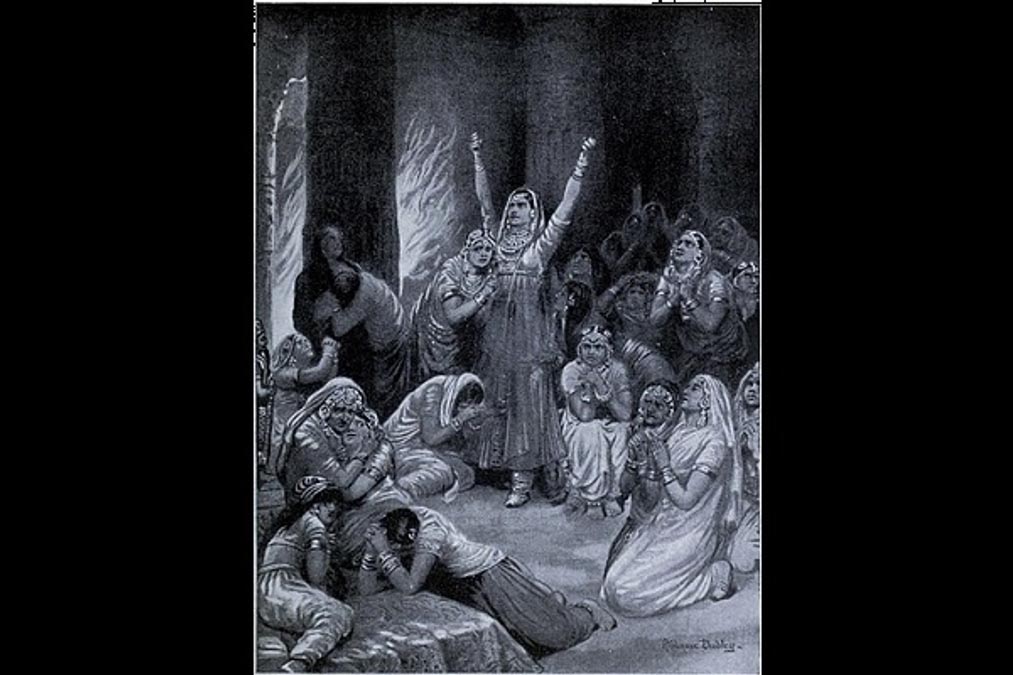
Jauhars were wartime tragedies, not a (regular) social practice unlike Sati. The women who undertook them were not merely hapless victims; many were administrators, rulers and warriors who exercised political and personal agency. Nor was Jauhar exclusively a Hindu phenomenon: Muslim and Sikh women also took similar measures in circumstances of war and threatened captivity. Such incidents were neither routine nor rampant. One of the latest recorded instances of such mass suicide in early modern India occurred in 1776, when the Jat queens of Bharatpur reportedly took their lives following the fall of Deeg Fort. Swara Bhaskar’s “apologists” and the Hindutva media that have politically capitalised on her statement are, despite their opposing ideological positions, united by the same privilege: the privilege of historical ignorance, endowed by the machinery of sensationalism.
A country of 1.48 billion people, confronting questions of unemployment, economic opportunity, human development, inequality, institutional accountability, caste and communal issues and human rights, is spending enormous public attention on the actions of women who lived centuries ago. There is something deeply revealing about the manner in which Brahminical elites evoke Rajput or Muslim history to gain media attention, employ them to duel against each other and keep public focus away from current issues.
This is not an argument that history is unimportant. Quite the opposite. History matters precisely because it deserves to be understood properly, with context, evidence and respect for the people who lived it.
But history should not become a substitute for governance. As I have argued previously in SabrangIndia, the political manufacture and amplification of historical controversies can serve as a convenient substitute for difficult questions about governance and accountability. When citizens are encouraged to fight over competing versions of the past, attention can move away from the performance of the state in the present. When History Substitutes Governance: Hindutva’s Politics of Manufacturing Pasts . By shifting the goalpost from the Government’s misrule to the choices of 13th-century Rajput women, who ultimately benefit from Swara’s intervention is hardly a riddle.
- Main Wapas Aunga and Padmaavat: Same Tragedies, Different Reactions
Padmaavat and Main Wapas Aunga are two films. Their interpretations belong to their respective directors and makers. Neither represents the viewpoint of the communities whose victims they portray.
The scene from Main Wapas Aunga showing the character played by Dolly Ahluwalia slitting throats of her daughters and female relatives, is a reminder of the events from Toha Khalsa involving Sikh women during Partition-era riots. The movie was loved by the so-called liberals and this painful scene drew empathy.
Historian Saquib Salim remarked “Recently a movie, ‘Main Vaapas Aaunga’ was released & admired by people on the left liberal spectrum for getting everything correct.” He also wrote, “What I cannot understand is how come the same set of people think that committing Jauhar was bad but slitting the throat was alright.”
It is ironic that the same set of people who empathise with the 20th century Sikh women of Partition-era and the extreme steps taken by them, simultaneously dismiss similar choices made by the 13th century Rajput women by invoking modern yardsticks of feminism.
This accentuates caste-based prejudice against the people of Rajput origin within sections of the so-called liberal discourse, while also betraying an erosion of the very liberal ethos that claims to oppose such prejudice and discrimination. This is the double standard that deserves scrutiny. If a woman facing the threat of sexual violence and captivity can be understood historically as an agent who made an extreme decision under extreme circumstances at Toha Khalsa, why must the Rajput woman who confronted a comparable threat century earlier necessarily be imagined as a passive victim without agency?
Hence, this article strives to educate both Hindutva rabble-rousers and Bhaskar’s apologists about Jauhar and related medieval tragedies.
- Rajput’s Jauhar to Samurai’s Jigai: Not Unique events
A few days back, Kshatriya Parishad, a New Delhi based Rajput organization issued a statement titled “Our Memory of Jauhar Is No Political Tool”. Condemning the usage of Jauhar for communal polarisation, it recounted certain instances of Jauhars involving Muslim women.
In 1682, the Mughal prince Muhammad Azam Shah (who would later become Emperor) entrusted the safety of his wife, Jahanzeb Banu Begum, to Rao Aniruddh Hada of Bundi. However, when a huge Maratha army had surrounded Jahanzeb Banu’s camp, she called upon Aniruddh Hada and confided that if their small army failed and capture seemed inevitable, she would kill herself.
Historian K. S. Lal, in Twilight of the Sultanate (1963, p. 269), records that “Jauhar was prevalent both in the north and the south. During Timur’s invasion Muslim women also performed Jauhar when Bhatnir was sacked.”
In 1301, Muslim Mongol soldiers of Allaudin Khilji led by Muhammad Shah (called Mahimashahi by Hammīra-Mahākāvya ) rebelled against the Sultan and along with their families took refuge in Ramthambore, ruled by Chauhan rajput Hammirdeva. During the siege of Ranthambore, when Hammīra offered him an opportunity to leave the besieged fort with his family, Muhammad Shah returned home and killed the members of his household rather than allow them to fall into enemy hands. Michael Bednar has interpreted this episode as potentially representing a Muslim equivalent of Jauhar. The same narrative subsequently describes Hammīra’s wives performing Jauhar before the final battle.
Jauhar among Rajput women had a similar analogy in Jigai among medieval Samurai women of Japan. While Rajput and Samurai women gave names to these events, such wartime suicides were ubiquitous part of medieval history. The fall of Deeg Fort in 1776, caused all three Jat queens of Raja Ranjit Singh of Bharatpur, commit suicide to evade capture.
Far from being a Hindu-Muslim phenomenon, Jauhar and its similar instances were unique to all warrior communities across the world. On the other hand, sedentary and mercantile Hindu communities like Brahmans or Banias never saw such instances unlike Muslim women because they were not viewed as political threats.
- Rajput Queens Hapless Sans Agency? Or, rulers and Warriors.
Karnawati Hada, widow of Rana Sanga, was the de facto ruler of Mewar for her last seven years and was associated with the defence of Chittor during its siege by Gujarat forces. Her eventual participation in Jauhar after the defeat of the fort cannot simply be reconciled with the image of a woman who possessed no political agency.
Jawahirdevi, another widow of Rana Sanga, is remembered as having died fighting on the battlefield.
Rani Durgavati Chandel, widow of Dalpat Shah of Garha-Katanga, personally led her forces against the Mughals. When defeat became unavoidable and capture appeared imminent, she chose death rather than surrender.
Another Rajput ruler, Karnavati of Garhwal provides an illuminating contrast. The widow of Mahipat Shah Parmar successfully resisted Mughal forces, defeated a Mughal commander and negotiated with the Mughal emperor. She did not take her own life because her circumstances were different: she had not reached a situation in which capture appeared inevitable.
Noted Ambedkarite and Human Rights activist Vidyabhushan Rawat writes “Well, I would like to state a few points here about how the liberals or so-called Brahmanical feminists are missing the point. There are numerous examples of Rajput women fighting bravely for their territories in Rajasthan itself and leading from the front. It is not merely in Rajasthan; we have examples elsewhere too, including Uttarakhand, where people still remember Tilu Rauteli and her bravery.”
These women discussed above, were widows who went on to administer their kingdoms and command their armies for years after the deaths of their husbands. If, as some of Swara Bhaskar’s apologists argue, Sati and Jauhar were essentially the same practice, then a simple question follows: why did these women not commit Sati upon their husbands’ deaths? Why did they continue to rule, administer their territories and lead their armies, only to die later in the context of warfare and impending capture?
Conclusion:
The above examples discussed in this article are absent from the narration of those dominating the discourse on either side. This reinforces the fact that those driving and controlling the discourse on the subject on both sides, clearly lack any genuine scholarship and authority on it.
It also deserves an analysis as to why only Muslim and Rajput histories are subjected to such repeated controversies by those dominating the political and intellectual ecosystems. Why are Brahmin and Maratha history left out? Why are not the crimes of Peshwas in North India discussed? Why is Shivaji’s imposition by Hindutva in Uttarakhand and Bihar over their own local history not questioned?
The Brahmin elite’s strong dominance across public institutions and influential platforms is an incontrovertible fact. However, it is barely debated how such dominance fosters a sense of authority and arrogance over how the histories, identities and narratives on non-Brahmin communities are framed, discussed and controlled. The right-wing Brahmin intellectual appropriation of Jauhar as a vehicle for anti-Muslim discourse is, in turn, complemented by an allegedly liberal Brahmin tendency to belittle or de-legitimise Rajput history and memory. The growing tendency to superficially compare these medieval Rajput women (without knowing their own historical roles) against Rani Lakshmibai, an 18th-century figure living in a very different historical context, and consequently diminish them, reflects that very assertion.
Lastly, the selective usage of medieval Muslim or medieval Rajput history is a deliberation to alienate these two communities — using one community’s history against the other, while those employing them and presenting their ignorant opinions on public platforms garner social and political benefits without any responsibility. However, it also damages the nation at large – as it helps, the Government keep citizens diverted to dodge accountability on tangible current issues affecting all citizens across India.
Related:
RSS ideologues ‘wrong’; Sati wasn’t product of ‘Muslim’ rule, it existed in ancient India too
Bollywood epic Padmavaat has emerged out of the mists of legend to divide Indian society