
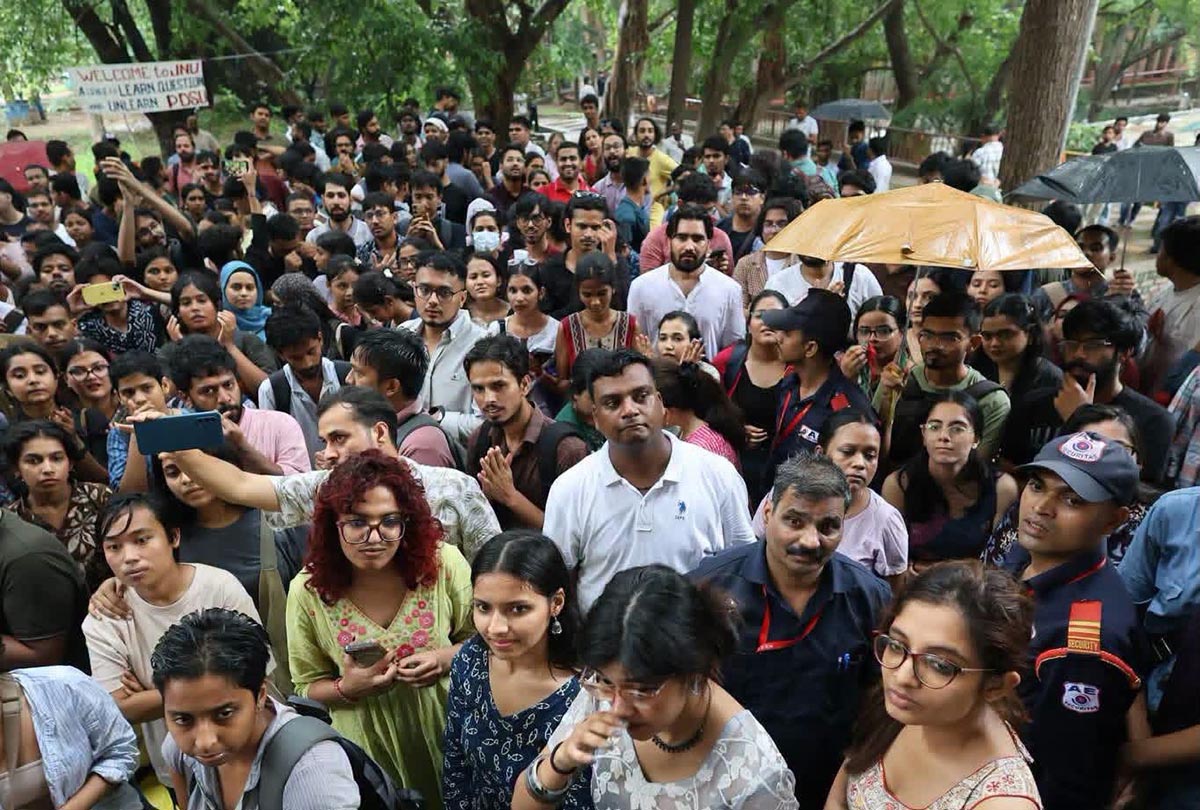
What was supposed to be a book discussion inside Jawaharlal Nehru University’s School of Social Sciences auditorium instead unfolded outdoors on Monday, in the rain, amid competing slogans and protests. The subject was Fractured Communities: Adivasi Histories and the Politics of Power, a recently published book by former JNU student Umar Khalid. The event, organised by the Jawaharlal Nehru University Students’ Union (JNUSU) to mark the International Day of the World’s Indigenous Peoples, had originally been scheduled for August 10 from 3 pm at the SSS-I auditorium. A day before the event, however, JNU cancelled the auditorium booking, citing “non-disclosure of the full facts” about the programme.
The students’ union did not cancel the discussion. Instead, it moved it outside the School of Social Sciences-II building. According to The New Indian Express, students and faculty gathered in substantial numbers despite the change of venue, while the programme was disrupted by protests from members of the Akhil Bharatiya Vidyarthi Parishad (ABVP). The episode has since become about far more than a cancelled auditorium. It has raised questions about who gets to determine what can be discussed inside a university, how far administrative control over campus spaces can extend, and whether a book — even one written by a jailed political figure — can be treated as an object of academic inquiry independently of the controversies surrounding its author.
The cancellation came at the last minute
The JNU administration announced on August 9 that the booking of the SSS-I auditorium had been cancelled. Its explanation was brief. In a post on its official X account, the university said that JNU was a “democratic and decentralised institution” and that the permission had originally been granted by the Dean of the School of Social Sciences. It then said the booking stood cancelled because of the “non-disclosure of the full facts” concerning the programme scheduled for August 10. But the administration did not publicly specify what information had allegedly been withheld.
That omission lies at the heart of the controversy. Documents relating to the booking showed that the programme had gone through the formal process. The requisition described it as a “Public Talk for Adivasi Diwas (Book Discussion)” and identified the date, time and auditorium. The booking was subsequently approved by the Dean of the School of Social Sciences on August 7.
The organisers therefore questioned why an event that had gone through the university’s own booking procedure could be cancelled two days later on the ground that its “full facts” had not been disclosed.
Professor Avinash Kumar, who had submitted the requisition for the auditorium, was particularly categorical. “The stated reason for the cancellation of the booking of the SSS auditorium is false,” he said, according to Hindustan Times report. Kumar maintained that the Dean had been fully informed that the event was going to discuss Khalid’s book and that the requisition had been prepared in the format suggested by the Dean himself.
His question was simple: if the university did not know what the event was about, why was the auditorium booking approved in the first place?
Kumar also challenged the administration to disclose the actual rule under which the booking had been unilaterally withdrawn. He pointed out that the book itself emerged from Khalid’s doctoral research at JNU and asked why the university could not permit a discussion of a thesis for which it had itself awarded him a PhD.
‘They cancelled the room, not the discussion’
The JNUSU saw the cancellation as something much larger than a dispute over paperwork. In a statement, the union called the decision “arbitrary and authoritarian” and accused the administration of attempting to suppress academic discussion and dissent, according to Indian Express report.
Its argument was that book discussions are not merely social events; they are a basic part of academic life. A university, the union maintained, should be a space where students can encounter controversial arguments, question them, disagree with them and debate them — rather than one where subjects are removed from discussion because of the identity or political status of their author.
The union was particularly scathing about the administration’s explanation that “full details” had not been disclosed. According to the JNUSU, the Dean himself had instructed the organisers on how the auditorium requisition should be made. It therefore described the stated reason as a pretext for what it considered censorship. The union’s position was summed up in its response: “cancelling a room does not cancel a conversation.” And that is precisely what happened.
Gopika Babu, vice-president of the JNUSU, said the large turnout was a response to what she described as pressure from the administration and the ABVP. “Despite all threats of the admin-ABVP nexus, the students gathered in large numbers to assert campus democracy,” she said, reported The New Indian Express.
Babu described debate, dissent and discussion as central to JNU’s institutional character, arguing that the outdoor gathering demonstrated that “JNU stays alive in this spirit”. She also framed the event as an expression of solidarity with Umar Khalid and other political prisoners awaiting trial, while accusing the university administration of pursuing what she described as a “casteist” agenda.
“JNU stood in solidarity with Umar Khalid today, and through him, in solidarity with umpteen other political prisoners languishing in jail without trial,” Babu said. She further described the gathering as a response to what she called the “empty threats” of ABVP members.
JNUSU president Aditi also criticised the administration’s decision, saying, “I condemn the way the administration tried stealing our classrooms. We’ll continue to have such events on the campus.”
The statements underline how the cancellation transformed the character of the event. What began as an academic discussion around Fractured Communities became, after the auditorium was withdrawn, a visible contest over who controls the university’s physical and intellectual spaces. The administration had cancelled the venue. The students’ response was to occupy another space and continue the discussion. In that sense, the outdoor gathering became a message of its own: the withdrawal of institutional permission could change where the conversation happened, but it could not determine whether the conversation happened at all.
The discussion goes ahead — outside
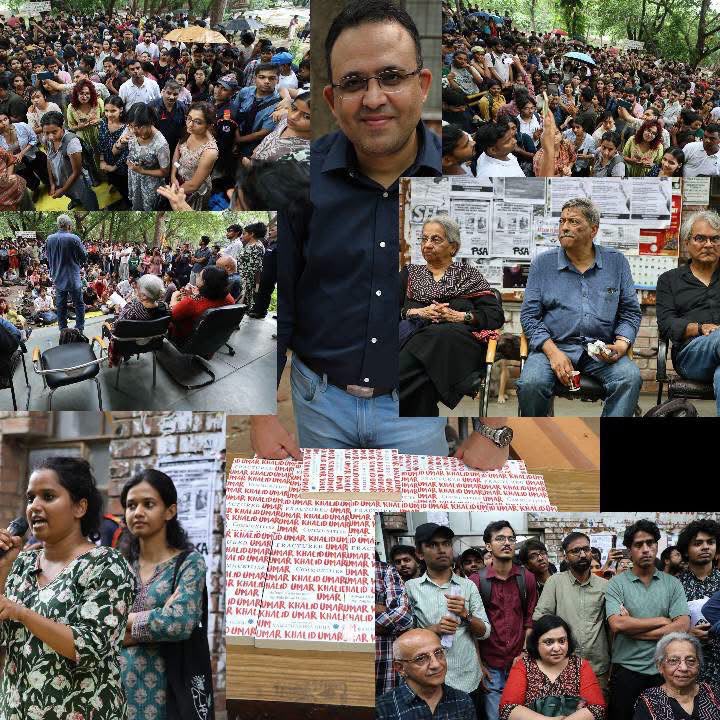
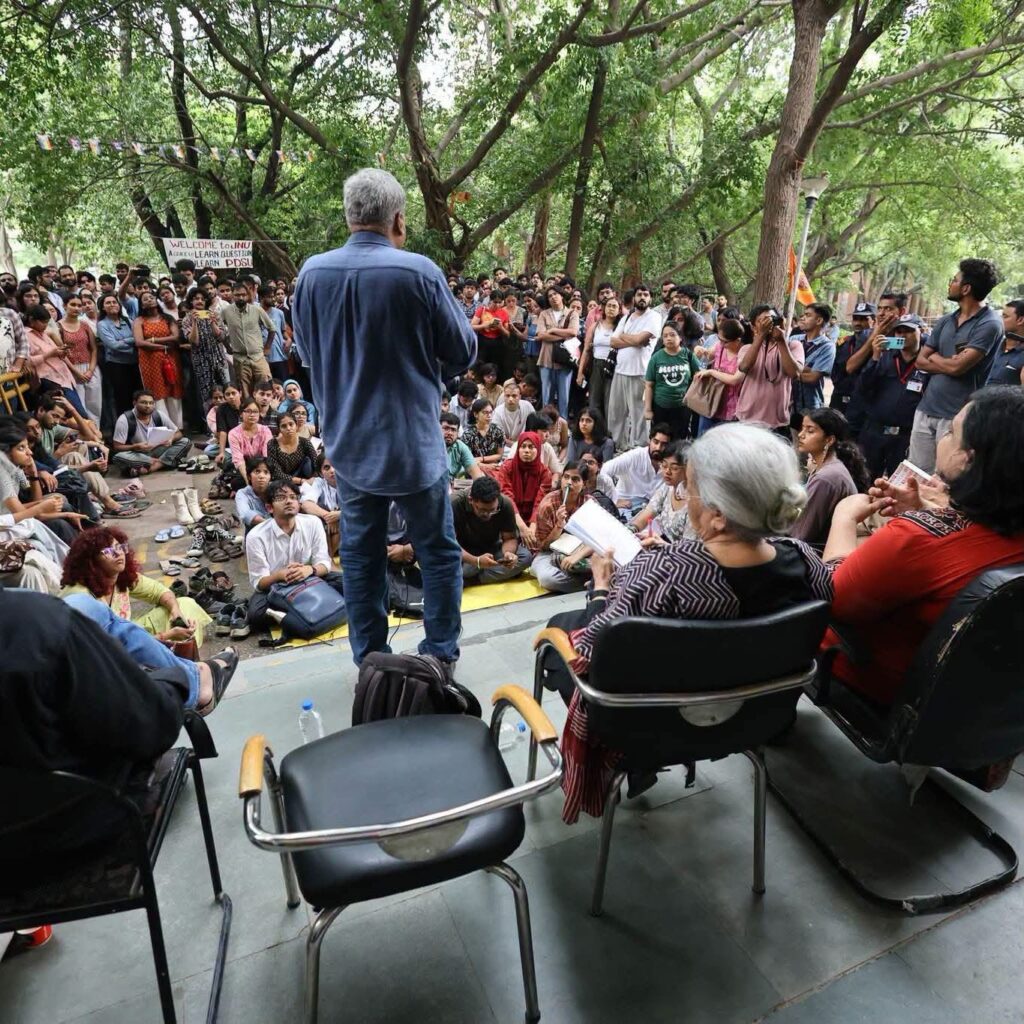
On Monday afternoon, the organisers gathered outside the SSS-II building. The event began around the scheduled time and attracted students, teachers and visitors from outside JNU. The New Indian Express reported that the discussion proceeded despite the cancellation, while Rediff reported that students and teachers attended the outdoor programme from around 3 pm.
The weather itself became almost symbolic. Students gathered in the open despite the rain, listening to speakers discuss the book, its methodology and the history it attempts to recover.
The panel included historian Uma Chakravarti, Professor Prabhu Mahapatra, writer and journalist Shuddhabrata Sengupta, and scholar Banojyotsana Lahiri. The discussion focused on Fractured Communities, rather than turning exclusively into a political meeting about Khalid’s incarceration. Panellists discussed the book’s academic method and its treatment of Adivasi history, while copies of the book were also sold at the venue.
For some students, the fact that the book was written by Khalid was itself a reason to read it rather than a reason to prevent its discussion. JNU student Aniket, who bought a copy at the event, told The Hindu that he wanted to read the thesis to understand how Khalid viewed the world and, importantly, to study how an academic thesis was written. He contrasted that with what he described as a contemporary academic environment increasingly affected by plagiarism and AI-generated material. The sentiment captures an important distinction in the controversy: reading a book is not the same thing as endorsing its author. A university’s academic culture depends precisely on the ability to examine arguments without requiring prior agreement with the person who made them.
Then came the slogans
The outdoor discussion was not free from confrontation. ABVP members protested the programme and raised slogans against Khalid. The New Indian Express reported slogans including “Umar Khalid ko fansi do”, while The Times of India also reported that the event was disrupted by ABVP members who entered the gathering and raised slogans.
The protests reflected the political fault line surrounding Khalid himself. Khalid has been in custody since September 2020 in connection with the case concerning the alleged larger conspiracy behind the February 2020 Northeast Delhi riots. He faces charges under the Unlawful Activities (Prevention) Act (UAPA) among other provisions and continues to contest the allegations against him. The trial against him has not started since the past 6 years.
The case against him highlights both the prolonged incarceration and the continuing litigation over bail. In July 2026, a Delhi court rejected fresh bail applications by Khalid and Sharjeel Imam, saying it was bound by an earlier Supreme Court order. The question of his imprisonment therefore inevitably hangs over any public discussion of his work. But that also makes the distinction between the author and the academic work more significant.
View this post on Instagram
What exactly is Fractured Communities?
The controversy risks obscuring what the event was actually supposed to discuss. Fractured Communities: Adivasi Histories and the Politics of Power is based on Khalid’s doctoral thesis, submitted to JNU’s Centre for Historical Studies in July 2018. He was subsequently awarded his PhD.
The book examines Adivasi societies in the Singhbhum region of present-day Jharkhand under British rule, including questions of indigenous agency, local governance, resistance and the politics of colonial power. Khalid himself wrote in The Indian Express in July that the thesis had been written years before its publication as a book and that he had never expected the work to acquire the political significance it now carries. He described the thesis as an engagement with history, propaganda and the use of power in shaping narratives.
The book’s publisher, Juggernaut, describes it as an archival study of Singhbhum’s tribal societies and a critique of historical accounts that flatten differences within communities. Its subject, therefore, is not the 2020 Delhi riots, Khalid’s UAPA case or contemporary electoral politics. It is a work of history. That distinction matters.
The irony of JNU cancelling a discussion on a JNU-approved thesis
Perhaps the sharpest contradiction in the episode lies here. The book at the centre of the dispute is not an anonymous political pamphlet being brought onto campus without institutional connection. It is derived from a doctoral thesis that Khalid submitted to JNU. The university examined that research. Academic processes assessed it. He was awarded a PhD.
And now, the university found itself cancelling the venue for a public discussion of the work. That does not automatically establish that the cancellation was censorship. JNU is entitled to regulate the use of its buildings and to require organisers to comply with institutional procedures. Its stated position is that the organisers failed to disclose complete information about the programme.
But the administration has not publicly identified what those allegedly undisclosed facts were. And that is where the explanation becomes difficult to assess. If the problem was procedural, the university could have identified the missing information and explained why it warranted cancellation rather than correction. Instead, the auditorium was cancelled immediately before the programme. That left the organisers, and the wider university community, to infer the reason.
Students question the double standard
The controversy has also acquired another layer because of a separate dispute involving an ISKCON programme at JNU. The JNUSU had previously objected to a programme involving an ISKCON representative at the university’s Central Library, titled “Empowering Youth for a Brighter Future”. The union had questioned the permission granted for religious programming on campus.
After the Umar Khalid book discussion was cancelled, the union revived the comparison, accusing the administration of adopting different standards for different events. That comparison remains contested, but it raises a broader question: what should the standard for campus events actually be?
If the concern is procedural compliance, the same rules should apply regardless of whether an event features a religious organisation, a political speaker, a controversial academic or a jailed activist. If the concern is the content of an event, the university should say so openly and identify the applicable rule. What becomes dangerous for an academic institution is a system in which apparently neutral procedural requirements can be invoked selectively, without clearly explaining what triggered their application.
Not everyone attending supported the event uncritically
The outdoor discussion also exposed an important criticism from within the student movement itself. Kranthi Kumar, president of the Birsa Ambedkar Phule Students’ Association, told The Hindu that while his organisation opposed the incarceration of political prisoners and the suppression of dissent, it also agreed with concerns about the composition of the panel. The criticism was that a discussion centred on Adivasi histories did not include members of Adivasi communities on the panel.
That objection complicates the binary framing of the controversy. It is entirely possible to oppose the cancellation of a discussion while simultaneously questioning who gets to speak about Adivasi history. In fact, that is precisely the kind of disagreement a university ought to be capable of accommodating.
The larger question: what is a university for?
The most consequential aspect of the JNU episode may therefore not be Umar Khalid at all. It is the question of whether universities can remain spaces where controversial scholarship is examined without the discussion itself being treated as an endorsement. There is a fundamental difference between giving someone a platform to promote a political position and allowing students to read and debate a published academic work.
There is also a difference between disagreeing with a thesis and preventing people from discussing it. A university does not become democratic because its administration describes it as one. It becomes democratic when disagreement can occur without the institution deciding in advance which questions are legitimate.
JNU’s own explanation invokes its character as a “democratic and decentralised institution”. But democracy on a university campus cannot simply mean administrative discretion. It must also include intellectual pluralism, transparency in decision-making and the ability of students and faculty to question institutional decisions. In this case, the administration cancelled the auditorium.
The students responded by taking the discussion outside. They were joined by faculty members, students from other institutions and others who wanted to hear the debate. The rain did not stop the event. Neither did the cancellation. And that may be the most telling image from the entire episode: a university discussion that the administration could remove from a room, but could not remove from the campus. Because once a university begins treating the discussion of a controversial scholar’s work as something that must be administratively contained, the question is no longer merely what Umar Khalid wrote. It becomes who gets to decide what students are allowed to read, discuss and question.
Related:
July 2026: A dissent that was brutally put down, a crackdown after the protest ended
Permission to Protest? Why the right to dissent needs no licence