
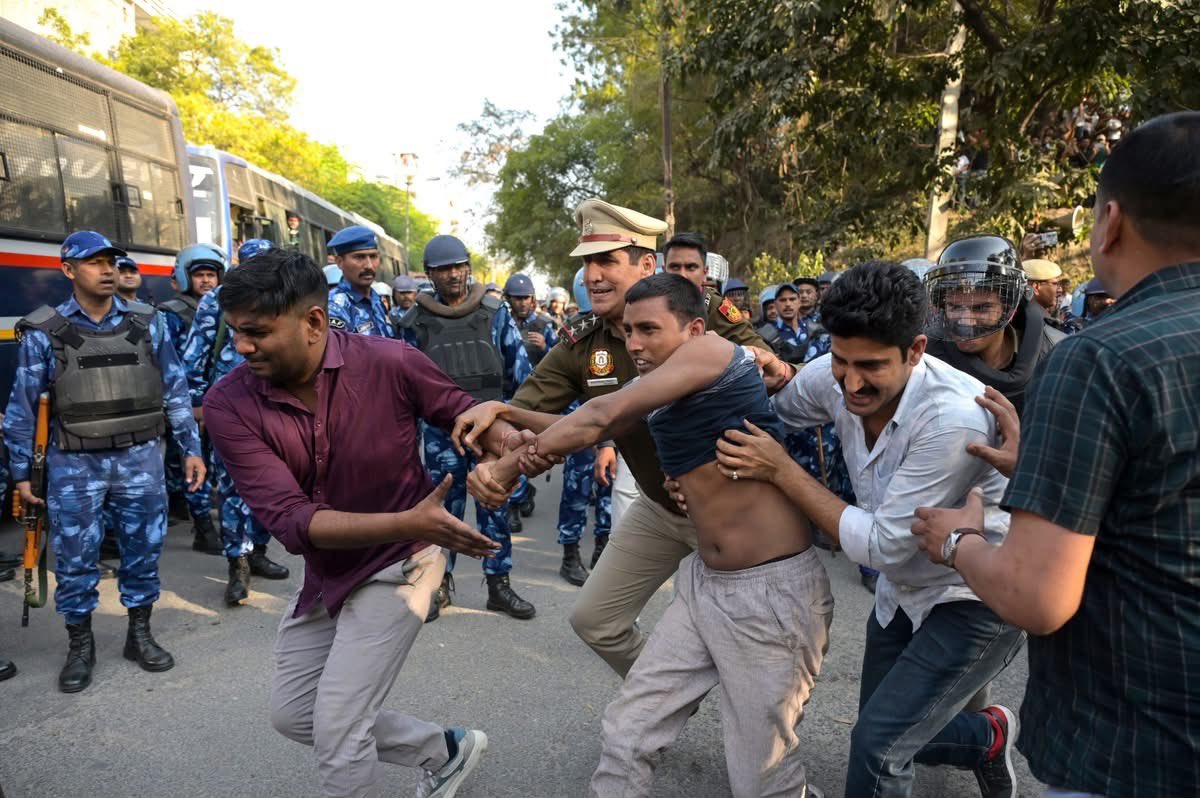
JNU students and Delhi Police clashed as students led by their elected representatives sought to march to the Ministry of Education, demanding implementation of UGC equity regulations, restoration of funding and resignation of Vice-Chancellor Shantisree Dhulipudi Pandit on Thursday, February 26.
Next day, today, Friday 27, fourteen of hundreds of protesting students from the Jawaharlal Nehru University (JNU) were sent to Tihar Jail after the late night brutal lathi charge by the Delhi police, attacking a student protest and long march aimed to march towards the Ministry of Education yesterday. Protesters have been demanding the resignation of Vice Chancellor (VC) JNU Ms Pandit who had made derogative remarks against Dalits and Blacks recently and also the restoration of the UGC Guidelines of 2026.
On Thursday (February 26), Jawaharlal Nehru University Students’ Union (JNUSU), along with other student organisations, organised a “long march” from the university to the Ministry of Education in Delhi. Students alleged that soon after their march began, Delhi Police lathi-charged them near the main gate of the campus. They said several students were detained and taken to the Kapashera and Sagarpur police stations. Videos and photographs that surfaced on social media showed that many students, including women, were injured in the police action.
The students’ march began around 3 pm from Sabarmati Dhaba inside the campus. Students joined the rally in large numbers, including members of JNUSU, All India Students’ Association (AISA), Students’ Federation of India (SFI), Democratic Students’ Federation (DSF), National Students’ Union of India (NSUI), All India Students’ Federation (AISF) and other student bodies.
You can cut all the flowers but you cannot keep spring from coming
14 JNU students sent to TIHAR JAIL
the state’s cowardice is on full display. They think iron bars break spirit, they are WRONG
fight against BJP & Shantishri’s casteist regime will only INTENSIFY#JNU #jnusu pic.twitter.com/qJTC3DamOD— Anjali (@anjali__27) February 27, 2026
जेएनयू में हज़ारों छात्र जब यूजीसी रेगुलेशन के पक्ष में और जातिवादी वाईस चांसलर की बर्खास्तगी की माँग के साथ शिक्षा मंत्रालय की तरफ़ बढ़े।
तब पूरी सरकार में कंपकंपी मच गई। दिल्ली पुलिस ने छात्रों के हाथ से बाबा साहब भीम राव अंबेडकर की तस्वीर छीन ली, हाथों में अपने… pic.twitter.com/2JyjjTrb8m— Dhananjay (@SathiDhananjay) February 26, 2026
This protest began amid heavy deployment of security forces, including Delhi Police, across the campus. The main gate was completely barricaded to prevent the students from moving forward.
Before the march started, JNUSU president Aditi Mishra had told The Wire: “Our call today was directed at the Ministry of Education. We are demanding that the UGC Equity Regulations be implemented on the lines of the Rohith Act. We are also demanding the resignation of our Vice-Chancellor, Shantisree Dhulipudi Pandit, over her remark that ‘Blacks and Dalits are permanently drugged with victimhood’. We believe such a statement is unacceptable. We are also asking for the restoration of funds [to JNU and other universities], because continuous financial cuts are weakening public universities and affecting students directly.”
She had then added, “What we are seeing instead is a heavy police security presence. The university has been turned into what feels like a cantonment, with barricades placed every few metres, the Rapid Action Force deployed and water cannons and tear gas kept ready. FIRs are being filed against students simply for protesting.”
Despite the heavy police and security force presence and the main gate of the JNU being sealed off, the students remained firm on continuing their march. Around 4 pm, students moved the barricades placed outside the main gate and attempted to proceed with their march. Soon after this, police began detaining students participating in the march. During the process, scuffles broke out between them and the police.
The allegations of brutality included male persons, accused of masquerading as men in uniform assaulting women with pins and other weapons in gendered violence. Hundreds of police, paramilitary and other personnel were brought in to simply “handle a student’s protest.”
It was the obstruction of free movement by the Delhi Police who blocked and locked the JNU gates that began the altercation and thereafter police repression.
Danish, joint secretary, JNUSU, said, “We called for a peaceful march from JNUSU to the Ministry of Education. However, Delhi Police blocked JNU gates, putting locks on them. Around 500 to 700 policemen were deployed with heavy barricading, lathis, tear gas and water cannons. When students broke the locks and marched, the police launched a brutal lathi charge.
“Many students were hurt. Women students were dragged and their clothes torn. They [police] detained at least fifty of us and took us to Kapashera Police Station. Even now, many students, including me, are injured but have not received any first aid. There were also people in civil dress beating students brutally alongside the police. Students are still protesting at the main gate, and the police continue to beat them.”
Dhananjay, former JNUSU President speaks of this police brutality here

On Sunday, 22 February, a “Samta Rally” was organised on the JNU campus to protest against alleged anti-Dalit remarks made by Vice-Chancellor Shantishree Pandit. At the march, students demanded implementation of the new University Grants Commision (UGC) equity guidelines, and asked for the Vice-Chancellor to resign and issue a public apology for her statements.
However, after that march, tensions escalated and clashes broke out between two student groups. Left student organisations and JNUSU members accused members of the Rashtriya Swayamsevak Sangh (RSS) offshoot, student body Akhil Bharatiya Vidyarthi Parishad (ABVP), of pelting stones during the confrontation.
On Monday (February 23), the university administration registered a case against JNUSU office bearers over the “Samata Rally” and the alleged violence during the previous night’s protest Thereafter, JNUSU announced another march, and that was the one to be held on 26 February.
The Jawaharlal Nehru University Teachers’ Association (JNUTA) also condemned the police action, describing it as brutal use of force against students at the JNU gate.
In a statement issued on today February 26, JNUTA said several students, including women, were injured and many detained, including two JNUSU office bearers. It raised concerns over reports that women detainees were taken to undisclosed locations and alleged that they faced further mistreatment in custody.
JNUTA said the police action appeared to be aimed at preventing students from exercising their democratic right to march to the Ministry of Education, and demanded the immediate release of all detained students, action against the officials involved and the withdrawal of police personnel from the campus gates.
The text of the JNUTA statement issued by Surajit Mazumdar (President) and Meenakshi Sundriyal (Secretary) reads:
“The JNUTA strongly condemns the brutal use of force by the Delhi Police against JNU students and the detention of several of them, including two JNUSU Office bearers. Reports indicate that several students, including women, have been severely injured in the police action at the JNU gate in which even the laws prohibiting male policemen from acting against women were brazenly flouted. The JNUTA is also extremely concerned at the wellbeing of those detained. There are several women among them and they have been taken to unconfirmed locations that are far away from the campus. Reports are also coming of them being subjected to further police beatings while in custody.
The police action today, and they also came armed with weapons, had the sole objective of preventing come what may the students from exercising their democratic right to march to the Ministry of Education. Prohibition of such marches, and then prosecuting those who march, and use of excessive force against them, have become part of the standard routine for the Delhi Police. In the process, it has become an instrument of not law enforcement but of authoritarianism and the curbing of constitutionally guaranteed democratic rights.
The JNUTA knows that the bankrupt JNU Administration led by the VC cannot be expected to discharge its duty as guardian of the students’ interests. After all, it is its own actions that have led to the current situation. The continuing refusal to act against her and even today’s police action, however, raises serious questions about whether her infamous casteist remarks and other actions in fact have the endorsement of the Ministry of Education. Is it that the Ministry did not want to answer the uncomfortable questions it would have had to face from JNU students?
The JNUTA demands immediate release of all the detained students and strict action against the police officials reponsible for transgressing the laws they are themselves bound by while enforcing them. The Police which is still at the campus gates must also leave immediately. We appeal to JNU teachers to remain vigilant and speak up against this violence and onslaught on democracy.”
Just a few days ago former JNUSU President, Dhananjay filed a complaint against the VC with the NCST. This may be read here.
Related:
JNU: Former JNUSU President complains against Vice Chancellor’s casteist & racist remarks
The Double Stage on Campus: Caste, crisis & UGC equity regulations (2026) controversy