
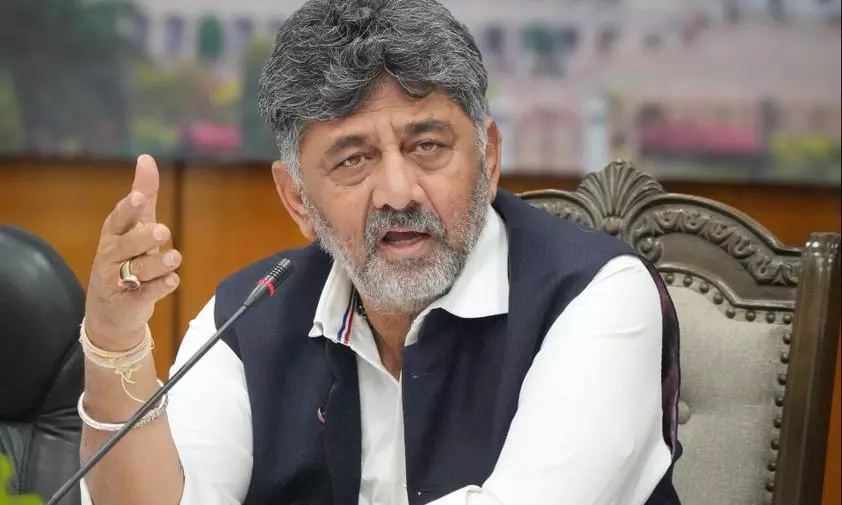
Karnataka Chief Minister D.K. Shivakumar has written to Chief Election Commissioner Gyanesh Kumar seeking adequate time for verification and strict adherence to the prescribed procedure during the Special Intensive Revision (SIR) of electoral rolls in the state.
In his letter dated August 25, 2026, Shivakumar said the SIR exercise had thrown up figures that required “serious attention”. According to the letter, Karnataka has 5.54 crore electors, of whom nearly 1.08 crore have been placed in the category of Absent, Shifted, Dead, Duplicate and Others (ASDDO).
The Chief Minister further pointed to the situation after publication of the draft electoral roll on August 24. He said verification notices were expected to be issued to roughly 43.8 lakh electors over “logical discrepancies” or absence of a link to the 2002 electoral roll.
In Bengaluru alone, according to the letter, 46.88 lakh electors have been placed under the ASDDO category. Shivakumar said the combined figures translated into about 1.5 crore voters in Karnataka facing possible deletion unless they submit claims for continuation or fresh inclusion.
Concern over voters marked absent or shifted
The Chief Minister said a significant number of voters categorised as “Absent” could be genuine electors who were unable to submit their enumeration forms because they were away from home when Booth Level Officers (BLOs) visited.
He cited work, health and other legitimate reasons as possible circumstances that could have prevented electors from being present during the verification exercise.
Shivakumar also raised concerns regarding voters who had shifted residence. According to him, electors who moved to a different polling station were not given an opportunity to submit enumeration forms at their new residence during the BLOs’ house-to-house visits.
Their names, he said, were consequently deleted from the electoral roll at their previous addresses.
Urban mobility could affect polling-station mapping
The letter specifically highlighted the implications of movement within cities. In Bengaluru and other urban areas, Shivakumar said even moving across the street could result in a change of polling station.
He argued that this could leave lakhs of genuine voters facing disenfranchisement under the “Absent” and “Shifted” categories and require them to file Form 6 for inclusion.
He also pointed to another category of voters who may not receive notices because notices are being sent only to electors identified under “logical discrepancy” and “unmapped” categories.
Such voters, the Chief Minister said, may not even be aware that their names have been deleted from the electoral roll.
‘Mobility should not translate into disenfranchisement’
Shivakumar said the issue was particularly significant in a society where individuals and families routinely move between neighbourhoods, cities, towns and villages for employment, marriage and other reasons.
“Mobility should not translate into disenfranchisement,” he said in the letter.
He also stressed the potential impact on poorer and marginalised citizens, who may move frequently and may not readily possess or have access to documents required to establish their eligibility.
The Chief Minister said the SIR exercise should protect the voting rights of every eligible citizen while maintaining the accuracy and integrity of the electoral roll.
ECI has dual responsibility, says Shivakumar
The Karnataka Chief Minister said the Election Commission has a dual responsibility: preparing accurate electoral rolls while ensuring that no genuine and eligible voter is excluded.
According to Shivakumar, these objectives were not inherently conflicting and could both be achieved if adequate time and proper procedures were provided.
On this basis, he urged the ECI to consider four specific measures during the ongoing revision.
Demand to extend claims and objections period
The first request was for an extension of the claims and objections period.
Shivakumar said the period should be sufficiently long to enable genuine electors whose names were absent from the draft roll, including those placed in the ASDDO category, to ascertain their status and file claims through Form 6.
He referred to Paragraph 11.3.1 of the 2023 Manual, stating that it permits the Election Commission to extend the prescribed period by notification.
The Chief Minister also pointed out that there was no election due in Karnataka in the near future and argued that an extension was therefore “eminently feasible”.
Ward Committees and Gram Sabhas should be convened
The second request concerned implementation of the prescribed verification procedure.
Shivakumar asked that the Chief Electoral Officer specifically direct District Election Officers to convene Ward Committee meetings in urban areas and Gram Sabhas in rural areas, with adequate advance publicity.
At these meetings, he said, the draft roll should be read out and omissions and errors identified.
He referred to Paragraph 11.2.4(vi) of the 2023 Manual in this regard.
The Chief Minister noted that the CEO’s demarche, or letter, dated August 20, 2026, referred to the relevant provision but did not specifically direct that such meetings be convened.
According to Shivakumar, merely referring to the provision could result in “pro forma compliance” rather than creating an effective mechanism for identifying and correcting errors.
Three to four weeks sought for voters facing verification
The third demand related to the time available to voters facing verification over logical discrepancies or the absence of a link to the 2002 electoral roll.
Shivakumar described the proposed period of roughly 45 days for issuing notices and disposing of such cases as highly compressed. He said giving an elector approximately one week to respond, followed by a second notice, could place an unreasonable burden on working people, migrants and elderly citizens. The problem, he said, could become more difficult where voters are required to obtain documents or travel in order to respond to the verification process.
The Chief Minister therefore requested that each elector be given a minimum of three to four weeks to respond and furnish the necessary documents. He said this would ensure a meaningful opportunity for electors to establish their eligibility before any adverse decision was taken.
More Additional EROs and DEOs sought
The fourth request concerned the administrative machinery responsible for processing claims, objections and applications.
Shivakumar acknowledged that the ECI had appointed Additional Electoral Registration Officers (Additional EROs) to deal with the large volume of objections and applications expected to come for inclusion. However, he said the additional manpower would remain inadequate given the enormous workload and limited time available. He warned that unrealistic deadlines combined with insufficient manpower could result in avoidable errors and unfair exclusions.
The Chief Minister consequently asked the ECI to consider appointing Additional District Election Officers (Additional DEOs) in districts recording high numbers of ASDDO cases and logical discrepancies.
Karnataka offers administrative and logistical support
The Karnataka government, Shivakumar said, was ready to provide all possible assistance to the Election Commission.
This would include mobilising the local administration for Gram Sabha and Ward Committee meetings, undertaking widespread publicity to reach affected voters, and providing any other coordination or logistical support required by the Commission.
The offer comes against the backdrop of the large number of electors identified for further verification and the corresponding requirement for voters to understand their status and exercise their opportunity to file claims.
CM seeks roll that voters can trust
Concluding his letter, Shivakumar said the objective should be an electoral roll that the people of Karnataka can trust.
He said such a roll should ensure that every eligible citizen is included, every ineligible entry is removed, and no citizen is deprived of the franchise merely because of inadequate time, information or an opportunity to establish eligibility.
The letter was addressed to Chief Election Commissioner Gyanesh Kumar at the Election Commission of India in New Delhi.
The Chief Minister’s intervention therefore centres on four issues: extending the claims and objections period, enforcing the prescribed local verification process, giving affected electors substantially more time to respond, and strengthening the manpower available to process the large volume of cases generated by the SIR exercise.
The Letter forwarded to ECI dated 25.08.2026 can be read here
Related:
ECI revises Maharashtra SIR schedule, final voter list to be published on November 4
SIR 2025-26: Dismantling the very Idea of India?
21 Opposition parties to CJI: SIR process is irregular and illegal, must be suspended
SIR and the Making of a Stateless Citizen? | R. Rajagopal Speaks Out | Teesta Setalvad