
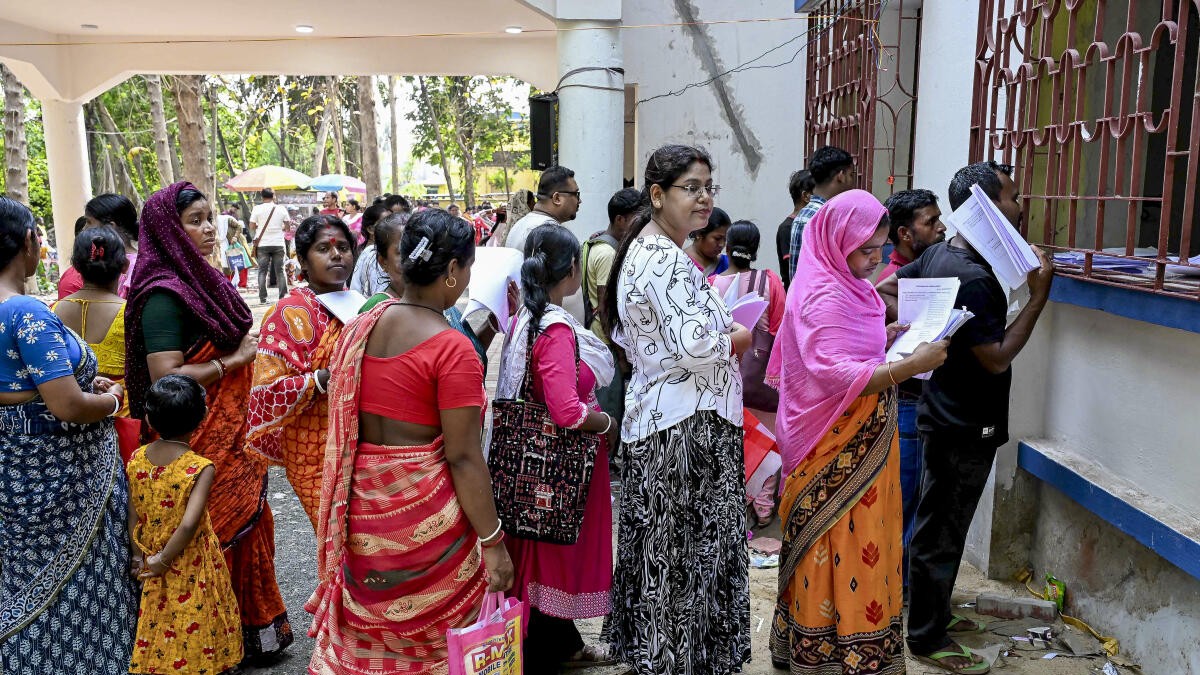
The Karnataka government has unveiled new—and limited purpose —rules for issuing Permanent Resident Certificates (PRCs), balancing pressure from activists opposing the Special Intensive Revision (SIR) of electoral rolls with the political interests of the ruling Congress. The PRC is one of the documents required to ‘establish eligibility’ under the SIR process.
For months, anti-SIR campaigners have urged the state government to ensure that eligible voters are not excluded from electoral rolls by simplifying the issuance of PRCs, caste certificates and family certificates—documents recognised by the Election Commission of India (ECI) for SIR verification.
However, Revenue Minister Priyank Kharge said the state had written to the ECI over a month ago seeking recognition of Karnataka’s family certificate, but the Commission has yet to respond.
Obtaining caste certificates also remains difficult despite government claims. Applicants must still produce several documents relating to their father’s lineage, making the process particularly challenging for marginalized communities. As a result, lakhs of applications remain pending, casting doubts on Chief Minister D.K. Shivakumar’s assertion that 5.4 crore of Karnataka’s 5.5 crore voters already possess caste certificates.
People-Friendly PRC Rules, but…
Initially, the government had instructed Panchayat Development Officers (PDOs) to issue ordinary residence certificates through Gram Panchayat offices. Activists have pointed out that these certificates would not satisfy SIR requirements because they did not establish permanent residence. Following sustained criticism, the government has now introduced fresh guidelines and eligibility criteria for issuing Permanent Resident Certificates through a significantly simplified process.
Thus, the revised rules represent an important victory for anti-SIR activists and are considerably more citizen-friendly than the earlier framework.
Applicants may establish permanent residence through criteria such as ten years of residence in Karnataka, ten years of schooling in the state, or ownership of immovable property. To prove these conditions, they may submit Aadhaar, ration cards, revenue records, electoral rolls and similar documents. The guidelines also empower officials to conduct local inquiries, seek reports from village accountants and even consider oral testimony as supporting evidence.
Perhaps most significantly, applications cannot be rejected solely because a particular document is missing. Authorities must provide written reasons for any rejection, introducing greater transparency and accountability into the process.
Taken together, the new rules are clearly more inclusive than their predecessors.
Read SabrangIndia’s analyses of the Karnataka government’s intervention here.
The Bigger Question: Will the ECI accept them?
The central question, however, is whether Permanent Resident Certificates issued under such a simplified and inclusive framework will actually be accepted under the SIR process.
The answer is far from certain.
Lessons from West Bengal
The West Bengal example, along with the ECI’s approach and directives regarding such inclusiveness makes it clear that the ECI will not permit this level of inclusiveness.
When the Union government initiated the SIR process in Bihar, the Trinamool Congress government in West Bengal proactively simplified the issuance of domicile certificates in July 2025 to make them easier for citizens to obtain.
However, once SIR began in West Bengal, the BJP objected to domicile certificates issued after July 2025, arguing that they should not be accepted. The Election Commission subsequently subjected those certificates to additional scrutiny and, according to the author, later declined to accept domicile certificates altogether before issuing fresh notices even to applicants who had previously submitted them.
Only after widespread protests led by Chief Minister Mamata Banerjee did the Commission agree to accept domicile certificates again, but with several additional conditions.
Hence, through its February 8 order, the ECI asserted that:
- domicile certificates conform strictly to West Bengal’s Government Order dated November 2, 1999;
- they be issued only by the designated competent authority; and
- Electoral Registration Officers independently verify that every prescribed procedure had been followed before accepting them.
Verification was reportedly assigned to Micro Observers.
With regard to domicile certificates, West Bengal’s Government Order dated November 2, 1999, is available here:
The order prescribes limited eligibility criteria for obtaining a domicile certificate and requires that, in addition to documentary evidence, every applicant undergo verification of citizenship and police verification before the certificate can be issued. This calibration and aggressive re-assertions by the ECI demonstrate how the Commission did not accept the simplified certification process introduced by the West Bengal government. The process may be read about here.
What this could mean for Karnataka
Since the same Election Commission oversees electoral process across India, the Karnataka’s simplified PRC rules may face similar scrutiny. In that case, only PRCs issued in accordance with standards accepted by the Commission—not merely under Karnataka’s revised procedures—would qualify for SIR.
This creates fundamental contradiction: the more citizen-friendly the PRC rules become, the less likely they are to satisfy the requirements of the SIR process. This, then, again underlines the very nature and orientation of the SIR, which is designed as an exclusionary mechanism rather than an inclusive one.
For now, attention will turn to how the Election Commission responds to Karnataka’s new rules.
Moreover, the state government itself has indicated, though indirectly, that the revised PRC rules are intended solely to address SIR requirements and do not create any broader legal rights. Existing rules, it says, will continue to apply in all other contexts.
The ECI, meanwhile, is under no obligation to accept Karnataka’s amendments. As it did in West Bengal, it could reject them altogether or impose additional verification requirements through its own officials.
With the Supreme Court having upheld the Commission’s broad authority in such matters, Karnataka’s battle over PRCs is far from over.
‘Logical Discrepancies’ remain a concern
The author further notes that Karnataka’s Chief Electoral Officer has rejected demands from civil society groups and the state government to suspend the use of “Logical Discrepancy” criteria in the state. The CEO has already identified six categories of logical discrepancies in Karnataka and has indicated that more could emerge once completed Enumeration Forms are received.
For anti-SIR activists, and the campaign in general, this demands greater vigilance, avoidance of premature celebration and a continued and intensification of the struggle, both in positioning and manoeuvre
Related:
To Karnataka’s Anti-SIR Movement: A note of caution and concern
Anti-SIR Activists Beware: A mere Residential Certificate does not satisfy SIR requirements
The Biopolitical Anatomy of Hindutva Fascism: Part II: SIR, EVMs and the Judiciary