
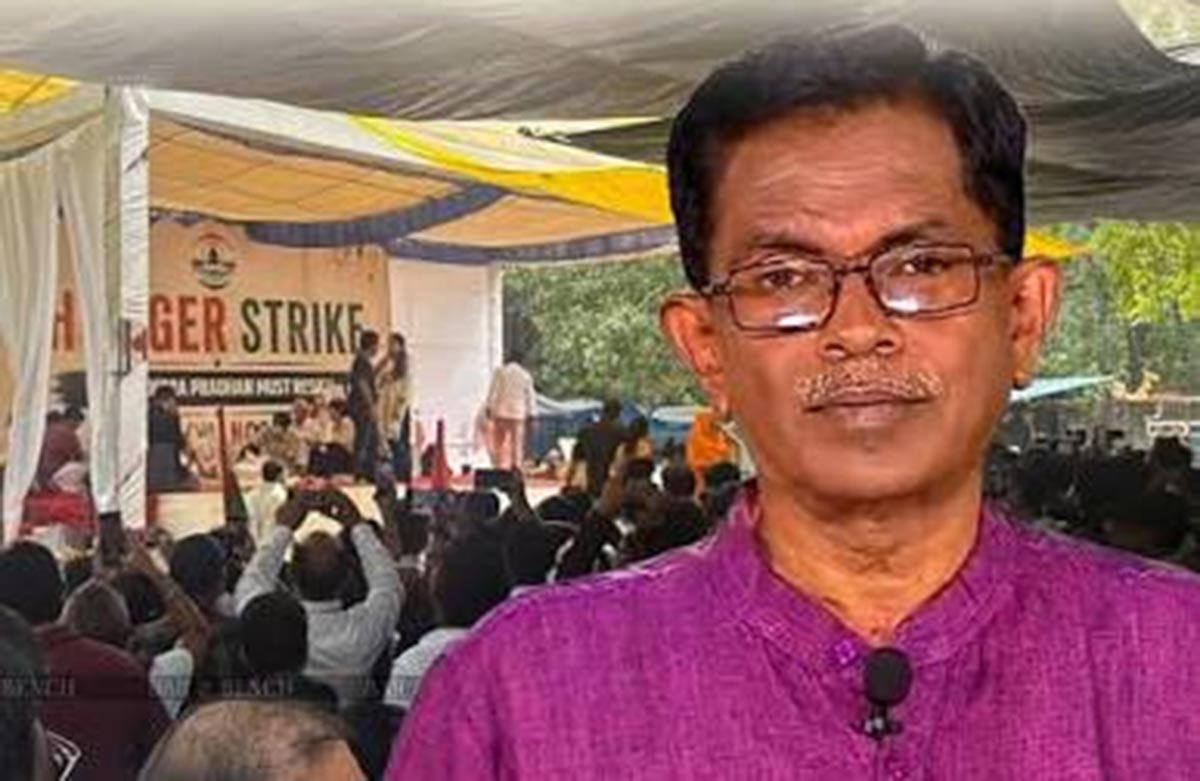
On August 10, the Additional Chief Judicial Magistrate (ACJM), Thiruvananthapuram, granted regular bail to right-wing activist T.G. Mohandas, who was arrested a day earlier over alleged remarks made in videos concerning student protesters and women participating in protests at Jantar Mantar in New Delhi.
The order was passed by Additional Chief Judicial Magistrate Sri. Mithun Gopi G.S. in Crl.MP No. 1/2026 in Crime No. 95/2026, T.G. Mohandas v. State of Kerala.
The court noted the non-issuance of a notice under Section 35(3) of the Bharatiya Nagarik Suraksha Sanhita (BNSS) before the arrest. It also took into account the recovery and seizure of electronic devices allegedly connected with the case, Mohandas’s cooperation with the investigation, and his age and health condition.
The prosecution had raised concerns that he could abscond, influence witnesses or interfere with the investigation. The court held that these concerns could be addressed by imposing conditions while granting bail.
Case concerns videos on Jantar Mantar protests
The case relates to videos uploaded on the YouTube channel “Pathrika”, in which Mohandas allegedly made statements concerning protests at Jantar Mantar.
According to the prosecution, the statements were made with the intention of disturbing public peace and tranquillity and inciting riots. It was further alleged that the content was capable of creating fear and anxiety among protesters and contained remarks insulting womanhood and violating the dignity of women.
The FIR alleges that Mohandas spoke about beating and “shooting dead” student protesters. It also alleges that he made remarks referring to women protesters as women who “enjoyed rape”. The prosecution told the court that around 16 complaints had been made against him in connection with the alleged statements.
According to The Hindu, the videos led to complaints from student and youth organisations and subsequent police action.
Alleged remarks about shooting protesters and sexual violence
According to The Hindu, Mohandas, a former head of the BJP’s State intellectual cell, had spoken in a YouTube video about how he would respond to the Jantar Mantar protest if he were in control of the situation. The report said he spoke of imposing a curfew in the area around Jantar Mantar, directing protesters to disperse and then using force against those who remained.
In the video, he described a sequence involving shooting protesters and subsequently taking bodies to hospitals. In another video, he allegedly made remarks concerning women participating in protests and referred to leftist, secular, democratic and proletarian women in the context of gang rape. The videos generated public reactions and led to demands for legal action.
The Rashtriya Swayamsevak Sangh subsequently distanced itself from the remarks. K.B. Sreekumar, Saha Prantha Karyavah of the RSS in South Kerala, said the comments represented Mohandas’s personal views and that he was not an RSS office-bearer at any level. He also said the organisation did not agree with the views.
Cyber police register case
The Thiruvananthapuram City Cyber Police registered the case under several provisions.
According to Live Law, Mohandas was booked under Section 66 of the Information Technology Act, Section 120(o) of the Kerala Police Act, and Sections 79, 353(1) (b) and 351(3) of the Bharatiya Nyaya Sanhita.
However, the police case included Sections 192 and 353(1) (b) of the BNS, along with Section 66 of the Information Technology Act and Section 120(o) of the Kerala Police Act.
On August 9, a team of cyber police officers searched Mohandas’s residence at Mattancherry before taking him into custody. The seized electronic devices were subsequently produced before the court.
Defence challenges arrest and alleges political motivation
During the bail hearing, counsel for Mohandas challenged both the allegations and the necessity of his arrest. According to Live Law, the defence argued that the case was politically motivated, referring to Mohandas’s association with the BJP and RSS and the alleged political affiliation of the complainant. The defence also submitted that there were no exceptional circumstances requiring immediate arrest.
The principal procedural objection was that the police had not issued a notice under Section 35(3) BNSS before arresting him.
The defence argued that, in the circumstances, Mohandas could have been directed to appear before the investigating officer instead of being immediately taken into custody.
Section 35(3) notice becomes central issue
Section 35 of the BNSS deals with circumstances in which police may arrest a person without a warrant. Sub-section (3) provides for issuance of a notice requiring the person to appear before the police officer where immediate arrest is not considered necessary.
The court examined whether the investigating agency had sufficient grounds to dispense with this procedural requirement. The prosecution argued that a notice was not necessary because there was a possibility that Mohandas could abscond or interfere with digital evidence. According to the prosecution, the investigating officer had recorded concerns about possible destruction, tampering or manipulation of electronic evidence. The prosecution also relied on the number of complaints received against Mohandas and the nature of the allegations while opposing the bail application.
Court rejects general apprehension of absconding
The court did not accept that the material before it established a sufficient possibility of Mohandas evading the investigation or absconding. A significant factor considered by the court was that the police had been able to locate him at his known residential address and conduct a search there.
The court observed, as reported by Live Law:
“The fact that the investigating agency was able to locate the accused at his known residential address and conduct a search there, is, in the circumstances, inconsistent with such apprehension.”
The court further held that a general apprehension that evidence might be destroyed, tampered with or manipulated could not, without circumstances demonstrating an immediate need for arrest, by itself justify dispensing with the statutory safeguard under Section 35(3) BNSS.
The court also noted that the remand report did not contain specific material supporting the apprehension that Mohandas would influence the complainant.
Electronic devices already recovered
The recovery of electronic devices was another factor considered by the court.
Since the allegations concern videos uploaded on YouTube, the electronic material formed part of the investigation. However, the court noted that the devices allegedly used in connection with the offence had already been recovered, seized and produced before it. This was relevant to the prosecution’s contention that Mohandas needed to remain in custody to prevent destruction or interference with digital evidence. The court found that there was no need for custodial interrogation at that stage.
It also considered Mohandas’s cooperation with the investigation and his age and health condition.
Court says arrest procedure was not justified
After examining the material placed before it, the court concluded that there was no justification for the investigating agency to dispense with the statutory requirement of issuing notice under Section 35(3) BNSS.
The court’s conclusion was based on the circumstances before it, including the ability of the police to locate Mohandas at his known residence, the recovery of the electronic devices and the absence of specific material showing that he was likely to abscond or interfere with the investigation.
The court said:
“Mere apprehension of destruction, tampering or manipulation of evidence, in the absence of circumstances indicating an immediate necessity for arrest, cannot by itself justify dispensing with the statutory safeguard contemplated under Section 35(3) of the BNSS.”
The court added that the same reasoning applied to the alleged apprehension that Mohandas could influence the complainant, as no specific material supporting that apprehension was disclosed in the remand report.
Court takes age, health and cooperation into account
The court also considered Mohandas’s age and health condition while deciding whether continued detention was necessary and along with these circumstances, the court took note of his cooperation with the police investigation and the recovery of the articles allegedly connected with the case.
The court ultimately held that the prosecution’s concerns regarding possible absconding, influencing witnesses or interference with the investigation could be addressed through appropriate bail conditions.
It concluded:
“The apprehensions expressed by the prosecution regarding the possibility of the accused absconding, influencing witnesses, or interfering with the investigation can be adequately addressed by imposing stringent conditions while enlarging the accused on bail.”
The court further observed:
“Having regard to the totality of the facts and circumstances of the case, including the non-issuance of notice under Section 35(3), the recovery of the articles, the cooperation extended by the accused with the police investigation, as well as the age and health condition of the accused, this Court is of the considered opinion that the further detention of the accused in judicial custody is not warranted at this stage” as Live Law reported
Student and youth organisations had sought action
Notably, youth and student organisations held protest marches to Mohandas’s residence demanding legal action. Leaders of the Students Federation of India and the All-India Students Federation also filed complaints. The delay in police action had also led to criticism of the State government, according to the report.
The RSS response came amid the controversy surrounding the remarks, with its South Kerala functionary stating that Mohandas’s comments were his personal views and did not represent the organisation.
Related:
Brinda Karat seeks review of SC verdict in Thakur-Verma hate speech case
Nazia Elahi Khan faces multiple FIRs over alleged hate speech
Hate Speech Before the Supreme Court: From judicial activism to institutional closure