
The July 20 crackdown by the Delhi police and Rapid Action Force on the “Sansad Chalo” student-led march has triggered a strong (and much required) legal community responses to police action against protesters in recent years. What began as a student mobilisation demanding accountability over the NEET examination crisis has now become a larger constitutional confrontation over the State’s treatment of dissent.
Detailed may be read here, here, here and here.
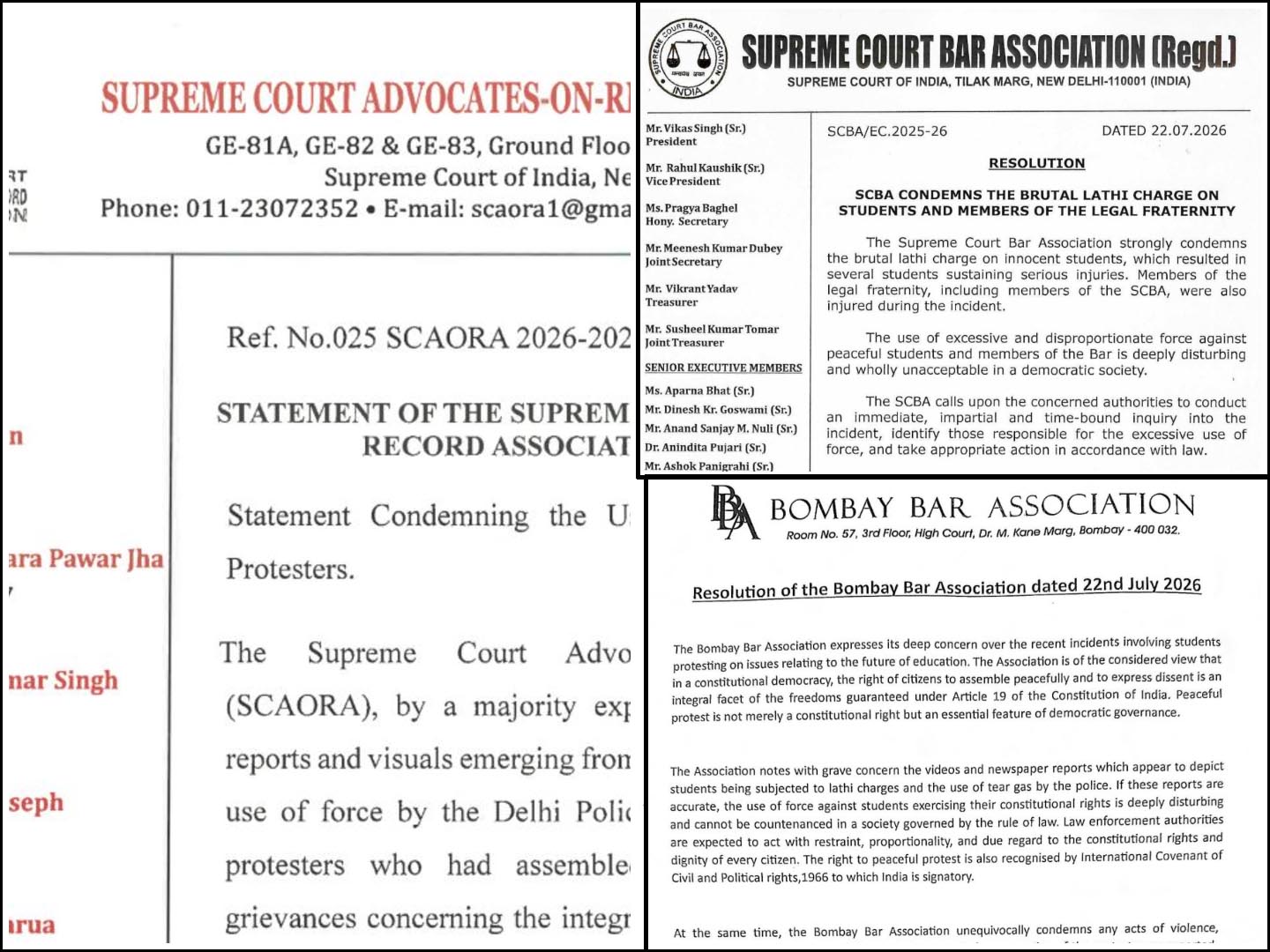
Across the country, senior advocates, bar associations and hundreds of lawyers have condemned the alleged police violence against students, describing the crackdown as an assault on the fundamental freedoms of speech, assembly and democratic participation. More than 650 lawyers, along with the Supreme Court Bar Association (SCBA), Supreme Court Advocates-on-Record Association (SCAORA) and Bombay Bar Association (BBA), have demanded accountability and an independent inquiry into allegations of disproportionate force.
The legal fraternity’s intervention is significant because the issue is not merely whether individual protesters were injured—it concerns whether the machinery of the State crossed constitutional limits while responding to a citizens’ movement. Allegations of lathi charges, use of force against women and minors, assault on journalists and lawyers, and the filing of criminal cases against protesters have raised serious questions about whether policing measures were aimed at maintaining public order or suppressing dissent.
The Delhi High Court’s order directing preservation of CCTV footage, videography, PCR records and other material connected with the incident marks an important judicial safeguard. By ensuring that evidence is not lost, altered or rendered unavailable, the Court has kept open the possibility of meaningful scrutiny of the allegations.
The Delhi Police has defended its actions by alleging violence and vandalism by sections of protesters. However, the broader constitutional question remains: when citizens—particularly students—take to the streets to demand accountability from institutions, can the State answer dissent with force?
Proceedings before the Delhi High Court on excessive force by Police
On July 22, a Division Bench of Chief Justice Devendra Kumar Upadhyaya and Justice Tejas Karia issued notice on multiple PILs alleging excessive force by the Delhi Police, and directed preservation of all CCTV footage, videography, PCR logs and related records connected with the July 20 incident. The Union Government and Delhi Police have been granted four weeks to respond, reported LiveLaw.
The development is crucial because the allegations before the Court centre on the manner in which State force was deployed against protesters and whether established safeguards governing crowd control were followed. While the Court has not expressed any opinion on the merits of the allegations or the authenticity of the videos relied upon by the petitioners, the direction to preserve evidence marks an important judicial safeguard. In cases involving alleged police excesses, where the State machinery itself is accused of violating citizens’ rights, the availability of independent and contemporaneous records becomes essential for ensuring accountability.
Petitioners allege force far beyond constitutional limits: Appearing before the Court, Senior Advocate N. Hariharan argued that students assembled at Jantar Mantar were exercising rights protected under Articles 19 and 21 when police allegedly resorted to force that was not regulatory but punitive. He alleged that protesters were beaten with lathis fitted with nails, struck with electric batons, fired upon with pellets, and that more than ninety protesters sustained injuries. Equally significant were the procedural violations alleged before the Court.
According to the petitioners, police neither issued lawful proclamations directing dispersal nor followed the established legal sequence requiring warnings before force is used. Hariharan argued that any force deployed against assemblies must remain proportionate and strictly necessary—not punitive. He also sought an independent investigation, arguing that the Delhi Police could not credibly investigate allegations against its own officers.
Senior Advocate Gopal Sankaranarayanan submitted that his legal team had examined approximately 130 videos documenting the crackdown. He alleged that several persons using force lacked identification badges and referred to footage purportedly showing Additional DCP Sandeep Lamba striking a woman protester. Relying upon the Supreme Court’s judgment in Ramlila Maidan Incident v. Home Secretary, he argued that police had ignored settled constitutional safeguards governing dispersal of peaceful assemblies.
Senior Advocate Vikas Singh, President of the Supreme Court Bar Association, argued that the march had been publicly announced well in advance and remained peaceful for nearly twenty days. Referring to Section 149 BNSS, he reminded the Court that the law itself obligates police officers to use “as little force” and inflict “as little injury” as possible while dispersing assemblies.
Police defend crackdown: Representing the Delhi Police and the Union Government, Additional Solicitor General (ASG) S.V. Raju defended the police response, arguing that the petitions presented a selective account of the July 20 events and relied heavily on social media videos whose authenticity, according to him, could not be presumed.
The ASG contended that the protests had escalated into violence, with sections of the crowd allegedly engaging in stone-pelting, vandalism and attacks on police personnel. He submitted that police officers had also sustained injuries and that public and private property had been damaged during the march. According to the police, the situation required intervention to restore public order.
Raju further argued that the petitioners had suppressed material facts and relied upon edited or potentially manipulated recordings circulating online. Describing the petitions as “publicity petitions” with alleged ulterior motives, he questioned whether such matters should be entertained under the Court’s public interest jurisdiction.
The ASG also challenged the maintainability of the PILs, arguing that persons claiming to have suffered injuries or assault should approach appropriate criminal remedies, including seeking directions from a Magistrate under Section 156(3) of the Code of Criminal Procedure, rather than directly approaching the High Court.
He further relied upon the imposition of prohibitory orders under Section 163 of the Bharatiya Nagarik Suraksha Sanhita (BNSS), arguing that authorities had acted within the legal framework while managing the assembly.
Court refuses to reduce allegations to individual complaints: The Bench, however, appeared reluctant to accept that allegations involving widespread claims of police excess could simply be treated as individual grievances requiring separate FIRs. Responding to the State’s argument, the Court observed: “Is it a case of some isolated incidents? Perhaps not. If it was an unlawful assembly, as you say, there is law on how to deal with it. If these issues are raised in a PIL, how can you say every individual should lodge an FIR?”
The observation was significant because it recognised that allegations involving the conduct of State authorities affecting a large number of citizens may raise broader constitutional questions beyond individual criminal complaints.
The Bench also referred to the Supreme Court’s judgment in Anita Thakur v. State of Jammu & Kashmir, where the Court held that allegations of excessive use of force by authorities resulting in violations of fundamental rights can be examined through public law remedies. The reference reinforced that judicial review of State action is not barred merely because individual criminal remedies may also exist.
It is crucial to highlight here that the matter has been listed for September 11—more than seven weeks after the July 20 crackdown. This issue does not concern a private dispute or a concluded incident; they involve allegations of State violence against citizens exercising their constitutional right to protest, questions of police accountability, and the legality of the force used by law-enforcement agencies. These are issues that go to the heart of constitutional governance and demand urgent judicial scrutiny. Every passing week without substantive consideration delays accountability, prolongs uncertainty for those allegedly injured, and weakens the constitutional promise of timely judicial protection against abuse of State power.
Before the evidence came judicial scrutiny
The judiciary’s initial response to the allegations also became the subject of public debate. Before the Delhi High Court agreed to hear the PILs and ordered preservation of crucial evidence, an earlier request for urgent listing before it had reportedly been met with the oral observation: “Don’t drag Court into all this.”
A day later, Advocate Narendra Mishra orally mentioned before the Supreme Court a letter representation addressed to the Chief Justice concerning the alleged police excesses during the July 20 protests. Responding to the mention, the Court reportedly observed: “Don’t waste our time, don’t waste your time.”
When counsel stated that he possessed videos documenting the police action, the Court is also reported to have remarked: “We are not interested in videos; we don’t have time to watch.”
Subsequently, Chief Justice of India Surya Kant, on July 24, clarified in open court that media reports stating he had refused to list a petition were “completely false.” As reported by LiveLaw, the CJI explained that no writ petition had, in fact, been filed before the Supreme Court at that stage. What had been placed before him was only a letter representation sent by a lawyer, which, in the absence of a formally instituted petition, could not be treated as a writ petition. He criticised sections of the media for reporting otherwise and described such reporting as “irresponsible and reckless.”
That clarification is important. It corrects the record on the procedural position before the Supreme Court: the Court was not declining to list a duly instituted writ petition because none had yet been filed. However, the clarification does not entirely answer the broader constitutional concern that followed the oral exchange in open court. It is pertinent to highlight here that the CJI bench did not use its suo-moto powers to take cognizance of the case. The issue is not merely whether a petition had been formally instituted, but the language employed when serious allegations of State violence were first brought to the Court’s attention.
The allegations related to the use of force by State authorities against citizens exercising their fundamental rights, including claims of excessive police violence, injuries to protesters, assault on women and restrictions on the exercise of rights under Article 19. Even where a formal petition is absent, constitutional courts are often the first institutions to which citizens turn when alleging abuse of State power.
A constitutional court’s legitimacy rests not only on its eventual judgments but also on the confidence it inspires that allegations of fundamental rights violations—particularly against the State—will receive careful and impartial consideration. The concern raised by many observers was therefore not procedural alone, but institutional: whether the Court’s initial response reflected the constitutional seriousness of the allegations being placed before it.
That concern becomes even more pronounced when contrasted with the Delhi High Court’s subsequent order directing preservation of CCTV footage, videography and other contemporaneous records. The preservation of evidence does not validate the allegations, but it acknowledges that they are sufficiently serious to warrant judicial examination. If preserving evidence is necessary to determine whether constitutional limits were crossed, then the allegations themselves plainly merit careful scrutiny rather than summary dismissal.
Ultimately, the question extends beyond one oral exchange. It concerns the role of constitutional courts when allegations of excessive State force emerge. In a constitutional democracy, judicial engagement at such moments is not merely procedural—it is integral to maintaining public confidence that the exercise of State power will remain subject to constitutional accountability.
The Court also hears an NIA probe plea
In a parallel development, the Delhi High Court agreed to hear a separate PIL seeking transfer of the investigation into the protests to the National Investigation Agency. Filed by former Akhil Bharat Hindu Mahasabha office-bearer Satish Kumar Aggarwal, the petition alleges that the movement was not genuinely student-led but part of a broader conspiracy involving foreign-funded organisations, opposition political leaders and anti-national elements, reported LiveLaw.
The petition questions the participation of Sonam Wangchuk, refers to his alleged international associations, names several opposition leaders and seeks transfer of all Delhi Police investigations to the NIA. On July 24, the said appeal as dismissed by the bench after holding that “We can’t decide on NIA investigation. It’s the Centre’s job.”
The bar stands with the students
Perhaps the most significant institutional response to the July 20 crackdown has come not from political parties or civil society organisations, but from India’s legal community. In an unusually broad and coordinated intervention, senior advocates, bar associations and hundreds of lawyers across the country have publicly questioned the legality and proportionality of the Delhi Police’s actions, framing the issue as one that strikes at the heart of India’s constitutional commitment to free expression, peaceful assembly and the rule of law.
In a joint public statement signed by more than 650 lawyers, including Senior Advocates Indira Jaising, Raju Ramachandran, Chander Uday Singh, Sanjay Hegde, Huzefa Ahmadi, Rebecca M. John, Nandita Rao, Sanjay Parikh, Anjana Prakash, Jayant Bhushan, Shadan Farasat, Warisha Farasat, Sumita Hazarika, Sanjay Ghose and advocates Prashant Bhushan, Vrinda Grover, along with hundreds of other members of the Bar, the signatories condemned what they described as the use of violence against peaceful student protesters.
The statement characterised the police action as “an attack on the principles of free expression, human dignity and the right to dissent,” arguing that young people demanding accountability over repeated examination failures were met not with dialogue or democratic engagement but with force. Reports by LiveLaw stated that expressing solidarity with those allegedly “harmed, intimidated and traumatised” during the crackdown, the lawyers called for an impartial inquiry and urged constitutional authorities to ensure that those responsible for any excessive use of force are held accountable.
Importantly, the statement situates the issue within a broader constitutional framework rather than treating it as an isolated law-and-order incident. It reminds the State that peaceful protest is a democratic right, not a privilege granted at the discretion of the executive, and argues that Parliament must remain accessible to the voices of citizens, observing that it “is not an ivory tower that should be beyond the reach of its citizens.” The intervention reflects a rare consensus across different ideological and professional strands of the legal community that allegations of police brutality against peaceful demonstrators warrant independent scrutiny rather than dismissal.
The condemnation has not been confined to individual lawyers. Both the Supreme Court Bar Association (SCBA) and the Supreme Court Advocates-on-Record Association (SCAORA) have separately issued statements calling for an independent inquiry into allegations of excessive police force during the protests. Senior Advocate Kapil Sibal has also publicly criticised the police response and supported the demand for an impartial investigation, adding further weight to calls for accountability from within the legal profession.
Adding to these interventions, Senior Advocate Vikas Singh, who is also the President of the Supreme Court Bar Association, addressed a detailed representation to the Prime Minister’s Office and the Union Home Ministry, seeking a time-bound judicial inquiry headed by a sitting or former Supreme Court judge into the police action. Singh alleged that the use of force extended beyond protesters to lawyers, journalists, medical volunteers, women and minors. Referring to reports published by The Wire, Newslaundry, Scroll and independent journalists, he argued that the police action appeared to violate the principles governing crowd control under the Bharatiya Nagarik Suraksha Sanhita (BNSS) and the Delhi Police Manual, including allegations of lathi blows above the waist and officers operating without visible identification badges. He also sought the suspension of the Delhi Police Commissioner pending an independent inquiry, arguing that repeated examination failures had left students with few democratic avenues other than peaceful protest.
The complete SCBA resolution may be read here.
The complete SCAORA resolution may be read here.
Bombay Bar Association: Democratic engagement cannot be replaced by force
The Bombay Bar Association (BBA) has also issued one of the most detailed institutional responses to the events of July 20, placing the controversy squarely within the framework of constitutional rights and democratic governance.
In a statement issued by its President, Senior Advocate Nitin Thakker, the Association described the issues raised by the protesting students concerning repeated examination irregularities and the future of India’s education system as matters of “immense public importance” with far-reaching consequences for the country’s youth.
Referring to videos and media reports of the police action, reported LiveLaw, the BBA observed that if reports depicting lathi charges, tear gas and the use of force against students were accurate, such conduct “cannot be countenanced in a society governed by the rule of law.” It stressed that law-enforcement authorities are expected to act with restraint, proportionality and due regard for the constitutional rights and dignity of every citizen, particularly when dealing with assemblies involving students exercising their democratic rights.
The Association reaffirmed that the right to peaceful assembly and peaceful dissent forms an integral part of the freedoms guaranteed under Article 19 of the Constitution, observing that peaceful protest is “not merely a constitutional right but an essential feature of democratic governance.” At the same time, it unequivocally condemned any incidents of violence, vandalism or destruction of public or private property by any section of protesters, emphasising that constitutional freedoms must always be exercised peacefully and responsibly.
Notably, the BBA also expressed concern over what it described as intimidatory measures, including the use of force and the registration of criminal cases against protesters, cautioning that such responses risk undermining democratic participation rather than facilitating resolution of public grievances.
Calling for a constructive resolution, the Association urged both the Government and student representatives to move away from confrontation and towards “open, sincere and meaningful dialogue”, arguing that concerns affecting the educational futures of millions of students deserve substantive engagement rather than a purely law-and-order response. In doing so, the BBA reinforced an emerging consensus within the legal community that constitutional democracies are strengthened not by suppressing dissent, but by responding to it through accountability, dialogue and adherence to the rule of law.
The statement may be read below.
Bombay High Court lawyers challenge restrictions on protest, call police action unconstitutional
In a joint statement issued on July 24, 141 advocates practising before the Bombay High Court condemned the police action against protesters at Shivaji Park, Mumbai, and demanding the withdrawal of prohibitory orders restricting public assemblies. The advocates criticised the detention of protesters, including minors, who had gathered in support of the student-led agitation at Jantar Mantar, Delhi, over alleged examination irregularities and demanded greater accountability from authorities.
The lawyers said that the apparent basis for the police action was the absence of permission to hold a protest at Chaityabhoomi. However, they argued that the lack of prior permission cannot become a justification for suppressing the constitutional right to peaceful assembly.
The statement emphasised that the right to assemble peacefully under Article 19(1)(b) of the Constitution is not dependent upon the State’s discretion to permit dissent. “This freedom is rendered meaningless if under the guise of ‘regulation’ and ‘reasonable restrictions’, all protests are prohibited,” the advocates stated, reported Hindustan Times.
The signatories included several prominent senior advocates, including Janak Dwarkadas, Navroz Seervai, Gayatri Singh, Mihir Desai, Haresh Jagtiani, Yug Mohit Chaudhry and Dinyar Madon, who urged the Mumbai Police Commissioner to withdraw prohibitory orders issued under the Maharashtra Police Act, 1951.
The lawyers also questioned the legality and transparency of the orders issued on July 3 and July 20, which imposed restrictions on assemblies, processions and the use of loudspeakers. They argued that orders affecting fundamental rights on such a wide scale require adequate publicity and cannot be invoked retrospectively to justify arrests or force against citizens.
“Prohibitory orders of such scale and import, which on their plain terms require to be given widespread publicity, cannot be passed surreptitiously and thereafter be pressed into service for strong armed action by law enforcement authorities,” the statement said as per the Hindustan Times report.
The advocates further raised concerns over what they described as a pattern of mass detentions and reliance on prohibitory powers without sufficient accountability. They argued that repeated use of restrictive orders creates a situation where citizens are forced to approach already burdened courts simply to challenge restrictions on basic democratic freedoms.
Referring to constitutional jurisprudence on assembly restrictions, the lawyers noted that authorities must demonstrate specific reasons for curtailing fundamental rights and must adopt the least restrictive measures necessary to address any genuine public order concerns. They argued that the police orders appeared to fall short of these requirements, thereby limiting meaningful judicial review.
The intervention adds another layer to the growing legal challenge against the manner in which authorities have responded to student protests. While legal bodies across the country have differed in their assessment of the protests, a significant section of the legal fraternity has focused on a common constitutional concern: that regulation of public assemblies cannot become a mechanism for preventing dissent or converting the requirement of permission into a blanket veto over the right to protest.
Lawyers gather at Supreme Court to read the Preamble in solidarity with students
In a symbolic assertion of constitutional values, a group of advocates assembled on the lawns of the Supreme Court on July 23 to collectively recite the Preamble to the Constitution under the banner “Save Democracy, Save Constitution”, expressing solidarity with students protesting the alleged NEET examination irregularities and condemning the authorities’ response to the demonstrations.
The gathering took place during the Court’s lunch recess and was led by Senior Advocates Indira Jaising and Dr. S. Muralidhar, with Senior Advocate Vikas Singh, President of the Supreme Court Bar Association, also in attendance. Several other senior members of the Bar, including Anand Grover, Anjana Prakash, Sanjay Ghose, Shadan Farasat, Arundhati Katju, Mahalakshmi Pavani, Nandita Rao, P.V. Surendranath, Manali Singhal, Sangeetha Bharti, P.V. Dinesh, Jayant Thakur and Advocate Vrinda Grover, participated alongside a large number of young lawyers. Many carried copies of the Constitution and the Indian tricolour while collectively reciting the Preamble, reaffirming the constitutional commitments to justice, liberty, equality and fraternity, reported LiveLaw.
Addressing the media after the event, Indira Jaising said the gathering was intended to stand “with the students” and to remind the judiciary of its constitutional responsibility to protect fundamental rights.
“We are here to stand with the students. We are here to stand on the side of justice… This concerns the rights of students, and it is the duty of lawyers to stand before the Supreme Court and demand justice for them. The role and function of the Supreme Court of India is to dispense justice.”
Several Supreme Court advocates assemble at the Court lawns to recite the Preamble to the Constitution as part of the ‘Save Democracy, Save Constitution’ campaign amidst the student protests in the national capital.#SupremeCourt pic.twitter.com/CxT7DSOPav
— Live Law (@LiveLawIndia) July 23, 2026
Bar Council of India breaks ranks, backs State narrative
In contrast to the widespread concern expressed by senior advocates and bar associations over the alleged use of excessive force against students, the Bar Council of India (BCI) adopted a markedly different position, issuing a public appeal that largely echoed the State’s narrative surrounding the protests.
In a press statement titled “An Appeal to the Intellectuals of the Country”, BCI Chairman Manan Kumar Mishra alleged that the student movement had been “hijacked” by anti-national and anti-social elements and claimed that foreign adversaries were attempting to destabilise India by exploiting students’ grievances. The statement urged lawyers, teachers, intellectuals and parents to intervene to prevent young people from being “misled” into participating in unlawful activities.
The BCI went considerably further than calling for peace or restraint. Without placing any supporting material in the public domain, it alleged that foreign governments, including Pakistan, China and Bangladesh, were orchestrating coordinated social media campaigns to mislead Indian youth. It also claimed that “experts in stone pelting” had been brought from Jammu and Kashmir and other States to attack police personnel, and referred to an unnamed political leader allegedly receiving foreign funds to destabilise the country.
The statement did not cite any official investigation, intelligence findings or judicial determination supporting these serious allegations. Instead, it presented them as part of a broader narrative portraying the protests as a coordinated conspiracy rather than a student movement arising from concerns over repeated examination irregularities.
Notably, the BCI’s intervention made no reference to the widely circulated videos of alleged police violence, the injuries reported by protesters, or the allegations of excessive force now under consideration before the Delhi High Court. Nor did it acknowledge the growing demands from large sections of the legal fraternity for an independent inquiry into police conduct.
This position stands in sharp contrast to statements issued by the Supreme Court Bar Association, the Supreme Court Advocates-on-Record Association, the Bombay Bar Association, and more than 650 lawyers, all of whom have emphasised constitutional protections for peaceful protest while calling for accountability wherever excessive force is established.
The divergence is significant. As the statutory body responsible for regulating the legal profession, the BCI’s intervention carries institutional weight. Rather than focusing on the constitutional questions raised by allegations of police excess or emphasising the rule of law through an impartial inquiry, its statement primarily advances claims of foreign conspiracy and anti-national influence—claims that, at the time of its release, had not been substantiated through any publicly available investigation or judicial finding.
In doing so, the BCI has positioned itself apart from much of the organised legal community, which has framed the events of July 20 primarily as a question of constitutional accountability, police restraint and the protection of democratic dissent, rather than one of national security.
“Anti-social and anti-national elements have entered this so-called student protests,” says Bar Council of India Chairperson & BJP Rajya Sabha MP Manan Kumar Mishra.
“Anti-social and anti-national forces have hijacked their agitation,” he says on #CJPMovement
He says… pic.twitter.com/WsNPwlHZV4
— Live Law (@LiveLawIndia) July 23, 2026
From a law-and-order issue to a constitutional reckoning
The developments following the July 20 crackdown have raised questions that extend beyond the immediate events of the protest. The legal proceedings now concern the manner in which State authorities exercise force against citizens and the safeguards that must govern such action.
The central issues before the courts are whether the police response was proportionate, whether established procedures for dispersing assemblies were followed, and whether allegations of excessive force by law-enforcement personnel require independent examination.
The proceedings also raise questions about accountability when allegations are made against State authorities themselves. If citizens allege violations of their fundamental rights during the exercise of democratic freedoms, the availability of an effective and impartial mechanism to examine those claims becomes essential.
The Delhi High Court’s direction to preserve CCTV footage, videography and other records ensures that the facts surrounding the incident can be assessed on the basis of evidence. The response from bar associations and hundreds of lawyers further reflects the broader concern that the handling of protests must remain within constitutional limits. At its core, the controversy is about the balance between maintaining public order and ensuring that the exercise of State power remains subject to constitutional scrutiny.
Related:
Youth Uprising: A protest, a brute crackdown, a continuing countrywide response
Mumbai stands with students, but the state pushes back
The exam crisis that became a battle for accountability