
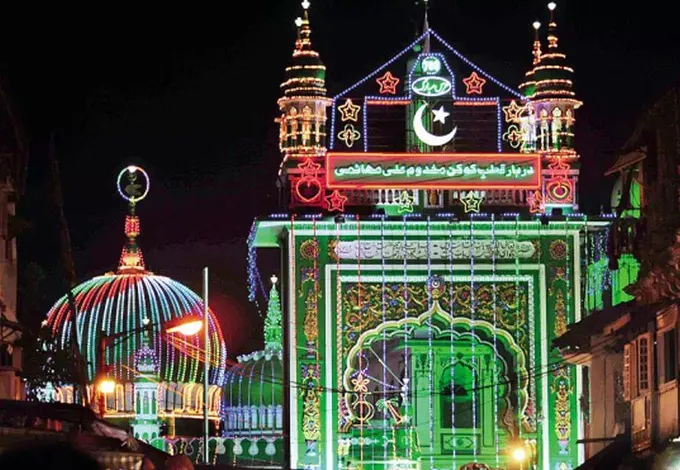
I saw quite a few processions going towards the Mahim dargah in Mumbai for the annual Urs celebration of the Muslim saint last evening. A lot of colour, not noisy, and the streets near the dargah were teeming with people and the eateries looked so tempting.
The interesting part was that in the front of the processions were bullock carts in keeping with the tradition , unlike some other processions where they use mechanized vehicles. This makes our streets so lively, of course mostly we have bad traffic jams and things are bad. But these old traditions lend much colour to the otherwise drab lives of common people. In the West they have given up these traditions long ago, the streets are too sanitized, too orderly.
A Sandal Procession (Sandal Sharif) is a Sufi Islamic ritual where devotees carry fragrant sandalwood (Sandal/Chandan) paste in plates, often with incense, to anoint the tombs (dargahs) or walls of mosques belonging to Muslim saints during Urs (death anniversary) celebrations. It is a display of devotion, purity, and unity, sometimes integrated with local traditions, there is Hindu Muslim unity, the Mahim police station takes the lead in the organization.
Some people may scoff at the idea animals on the streets which they think should be reserved for their cars, forgetting that motor cars are big polluters and impose such heavy social costs.
With all the faults, traditionally Indians have a good relationship with domestic animals, on some days the bullocks are worshipped decorated, not burdened on the day of Pola in Maharashtra and there are similar days in other states.
Westerners with all their sophistication in certain matters had had a pretty unfriendly, even hostile relationship with animals like in bull fighting which involve so much violence and though horse racing appeals to so many people, it involves much cruelty to the animal which we never get to see.
As coincidence would have it I saw a fairly interesting film at Alliance Francaise earlier this week which showed a woman, the protagonist, who realizes the need to treat the bulls kindly in bull sports.
In the film Animal, the first local woman to enter the ring with the young men who tempt, chase and are chased by local bulls starts to see things from the bulls’ perspective as bulls go “rogue” and started goring and stamping the locals in the dark of night, long after the audience — mostly tourists — for some events has left.
The Camargue style of bullfighting is non-fatal, a lot less bloody and far and away a more humane and “even” contest and is thus referred to as “bull racing” by the locals, who enter the ring — basically unarmed and on foot — and try to snatch cash-prize tokens attached to the bull’s scalp.
But as experts point every year, approximately 180,000 bulls are killed in bullfights around the world, with many more killed or injured in bull fiesta events. Bullfighting is already banned by law in many countries including Argentina, Canada, Colombia, Cuba, Denmark, Italy and the United Kingdom.
Although legal in Spain, some Spanish cities, have outlawed the practice of bull fighting.
(From Vidyadhar Date’s page on Facebook)
Mahim Durgah, a Sufi Saint and a Mumbai police ritual
A colonial practice, this ritual of Mumbai’s top police officers walking to durgahs with an offering every year has continued –despite the serious fissures between the police administration and Mumbai’s (then Bombay’s Muslim minority) during the post-Babri Masjid demolitions in December 1992 and January 1993. Sections of an otherwise acclaimed police force were accused, and found by the Justice BN Srikrishna Commission of being guilty of deep anti-minority biases. The practice of officers offering the ceremonial chadar has continued and this year. Each year, as Urs begins at Mahim Dargah, in December, a scene plays out on the streets of Mumbai with a police band at the front, uniformed officers behind and senior police officers carrying a green chadar as they walk towards the 600-year-old shrine of Hazrat Makhdoom Ali Mahimi.
After Independence, while most government departments quietly shed the ceremonial and religious practices they had inherited from the British era a few exceptions endured, particularly at dargahs such as Mahim, and Dongri’s Rehman Shah Ba.
What is the legacy of the Mahim Dargah?
The Indian Express reports that the Mahim Dargah of Hazrat Makhdoom Ali Mahimi is one of Mumbai’s oldest and most historically revered Islamic shrines, with a lineage going back over 600 years. Long before Mumbai grew into a metropolis, this coastal dargah functioned as a spiritual anchor for sailors, traders, scholars and communities along the western coast. The saint himself was of Arab descent; his ancestors are believed to have arrived in India around AD 860 (AH 252) after fleeing the persecution of Hajjaj ibn Yusuf, the much-feared governor of Basra. Born roughly five centuries later in India, Makhdoom Ali Mahimi received rigorous training in Islamic law and theology and was eventually appointed the faqih, or law officer, for the Muslim community of Mahim. He passed away in 1431, and soon after his death, the local community built a mosque and shrine in his honour. Over the centuries, that shrine evolved into one of Mumbai’s most significant pilgrimage centres.
Related: