
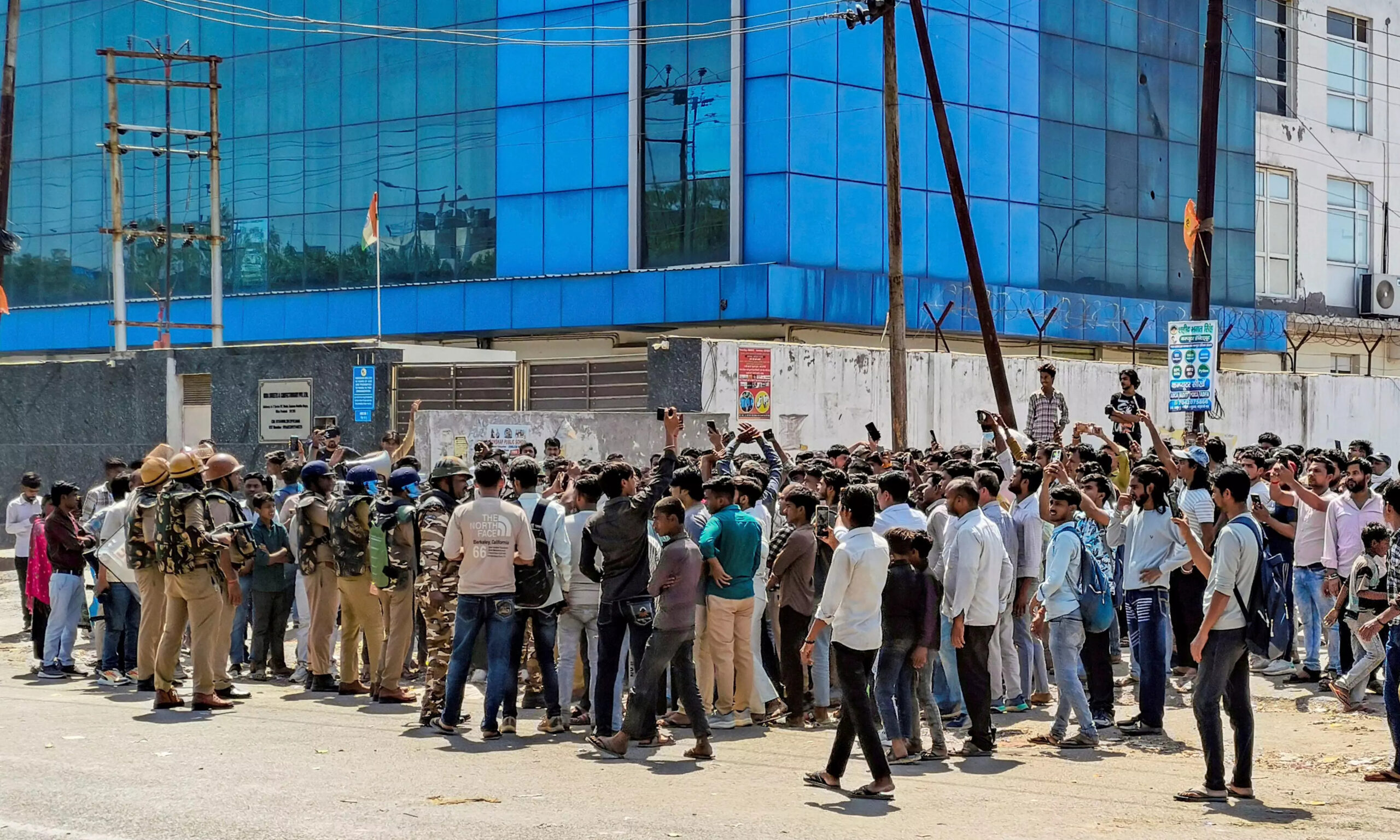
The Uttar Pradesh Police have invoked the stringent National Security Act (NSA), 1980 against journalist Satyam Verma and student activist Aakriti Choudhary in connection with the April 13 violence during workers’ protests in Noida, escalating concerns over the criminalisation of labour solidarity, dissent and civil rights activism. The move, announced through a press release issued by the Gautam Buddh Nagar Police Commissionerate media cell and reported by The Wire, came a day after bail hearings for the two accused were argued before the Surajpur court, where defence lawyers had challenged both the legality of the arrests and the absence of substantive evidence linking them to violence.
According to the police statement, both Verma and Choudhary were allegedly associated with “Mazdoor Bigul Dasta” and had played a “significant role” in the violence, arson and disruption that accompanied the workers’ protest. Police further claimed that the two attempted to disturb public order by “provoking” workers in different areas and circulating inflammatory material. Senior police officers, quoted in report by The Times of India, cited CCTV footage, electronic evidence, intelligence inputs and social media activity as the basis for invoking the NSA, a preventive detention law that permits incarceration for up to one year without trial on grounds related to national security or maintenance of public order.
The use of the NSA against the two has, however, triggered strong criticism from lawyers, labour rights groups, civil liberties organisations and campaigners associated with the Campaign for the Release of Workers and Activists of Noida (CaRWAN), who have termed the move an attempt to indefinitely prolong incarceration after the prosecution allegedly failed to establish concrete evidence during bail proceedings. Supreme Court advocate Ali Zia Kabir Choudhary, representing several accused in the matter, told The Wire that neither the accused nor their legal teams had been formally provided documents explaining the grounds on which the NSA was invoked. He pointed out that under constitutional safeguards, including Article 22 concerning protection against arrest and detention; the arrested persons are entitled to be informed of the grounds of detention.
“The only detail we have is the police press release. No papers have been supplied. In court we argued that there is not a single piece of evidence showing that Satyam or others called for violence,” Choudhary said while speaking to The Wire, adding that in Verma’s case, police had allegedly failed to show that he was even part of any WhatsApp groups cited during arguments. He further alleged that the prosecution relied largely on unrelated photographs and chats involving persons who were not arrested.
Timing of NSA invocation raises concerns
CaRWAN, in a statement issued on May 13 and cited by The Wire, questioned the timing of the NSA charges, noting that the law was invoked only after the prosecution faced difficulty during bail hearings. The collective stated that during the hearing, defence counsel highlighted the “emptiness of the charges” and the “illegality of the arrests,” while prosecutors allegedly failed to present substantial incriminating material against either Verma or Choudhary. The group argued that the accused had already spent over a month in judicial custody and that the sudden invocation of the NSA appeared designed solely to ensure continued detention.
The police crackdown follows weeks of unrest linked to industrial workers’ protests in Noida and Greater Noida. As reported by Hindustan Times, the demonstrations began on April 10 after the Haryana government announced a substantial increase in minimum wages for workers, prompting labourers in Noida’s industrial belt to demand similar hikes, better overtime compensation and improved working conditions. While protests remained largely peaceful in the initial days, violence broke out on April 13 across several industrial sectors, during which factories were allegedly vandalised, vehicles torched and police personnel injured in incidents of stone pelting.
Following the violence, the Uttar Pradesh Police launched a sweeping crackdown. Multiple FIRs, various reports place the number between seven and fifteen, were registered across police stations including Phase II and Sector 63. According to The Indian Express, hundreds of people were detained in the aftermath, while at least 60 individuals remain incarcerated on charges ranging from rioting and criminal conspiracy to attempt to murder. Police have consistently maintained, including in statements carried by The Hindu and Hindustan Times, that the violence was not spontaneous but orchestrated by an “organised syndicate of outsiders.”
Activists, students and scholars among those arrested
The arrests have drawn particular attention because many of those booked are students, researchers, labour organisers and activists rather than industrial workers themselves.
Satyam Verma, a 60-year-old journalist based in Lucknow, was arrested on April 17. According to The Indian Express, Verma previously worked with the news agency Univarta and has been associated with Janchetna Books and Jagaruk Nagrik Manch. He has also written for the labour publication Mazdoor Bigul, after which the organisation “Mazdoor Bigul Dasta” is allegedly named. Friends and supporters quoted in The Indian Express described him as a writer, translator and editor deeply engaged with labour rights and progressive literature. He is also the son of noted historian and academic Lal Bahadur Verma.
Civil rights groups have strongly disputed police claims portraying Verma as a “main conspirator.” CaRWAN stated in comments carried by The Times of India and The Wire that Verma was not present in Noida during the protests and had reportedly not visited the city in over a decade. His associates argue that the prosecution has attempted to criminalise ideological affiliations rather than establish any direct role in violence.
Aakriti Choudhary, 25, a postgraduate in history from Delhi University’s Daulat Ram College and an aspiring PhD scholar, was detained by plainclothes officers at Noida’s Botanical Garden Metro Station on April 11 — two days before the violence erupted. The Hindu reported that police initially claimed she was detained for disturbing public order, but later alleged that subsequent investigation uncovered evidence linking her to organising the protests.
Her father, Arun Choudhary, associated with the CPI(M) mouthpiece Ganashakti, questioned in comments to The Indian Express how someone detained before April 13 could be charged with orchestrating violence that occurred later. He defended his daughter’s participation in labour solidarity campaigns and criticised attempts to equate Left political beliefs with criminality. Defence lawyers similarly noted, according to Hindustan Times, that during proceedings prosecutors allegedly presented a book recovered from her residence as evidence of “Left-wing ideology.”
Concerns over criminalisation of ideology and dissent
It has been argued that the prosecution’s case increasingly appears to rely on political profiling rather than direct evidence of criminal conduct. Rajnish Yadav, counsel for Choudhary and other accused, told The Indian Express that the activists had merely participated in solidarity efforts, including speeches and street plays supporting workers demanding fair wages. He compared their participation to broader solidarity movements seen during the farmers’ protests.
The police have also arrested several other young activists and students. Among them is Aditya Anand, a 28-year-old NIT Jamshedpur graduate employed at Genpact, arrested from Tiruchirappalli on April 18. According to The Indian Express, police allege he delivered “provocative” speeches and organised marches during the protests. His family, however, portrayed him as a socially conscious engineer deeply engaged in labour rights issues and associated with the Naujawan Bharat Sabha.
Another accused, Himanshu Thakur, a 24-year-old history postgraduate from Hansraj College and a NET-qualified PhD aspirant, was arrested from Delhi’s Shalimar Bagh on allegations of coordinating protests and instigating crowds. His family told The Indian Express that he was the sole earning member of the household who supplemented family income through freelance translation work while advocating for students’ and women’s rights.
Families of working-class accused have also described devastating economic consequences following the arrests. The Indian Express reported that Amit Kumar, a 19-year-old worker from Prayagraj earning ₹8,000 a month in Noida, and Pankaj Kumar, a mason from New Ashok Nagar, are among those whose detention has reportedly pushed already vulnerable families into debt and unemployment.
Questions over misuse of the NSA
The use of the NSA in Uttar Pradesh has long been controversial. In April 2021, an investigation by The Indian Express reported that the Allahabad High Court had raised concerns over the apparent misuse of the law after red-flagging 94 out of 120 habeas corpus petitions involving NSA detentions. Similarly, Newslaundry reported in 2022 that police proposals seeking NSA sanctions in communal violence cases had invoked conspiracy narratives such as “land jihad.”
It must be pointed out that the NSA, unlike ordinary criminal law, allows preventive detention through executive orders without the procedural protections of a regular criminal trial. Human rights advocates have repeatedly warned that the law is frequently deployed to circumvent bail and prolong incarceration where ordinary criminal charges may not withstand judicial scrutiny. The invocation of the NSA in the Noida workers’ protest case has therefore intensified concerns regarding the shrinking space for labour organising, student activism and political dissent.
Related:
When Protest becomes a “Threat”: Inside the Supreme Court hearing on Sonam Wangchuk’s NSA detention