
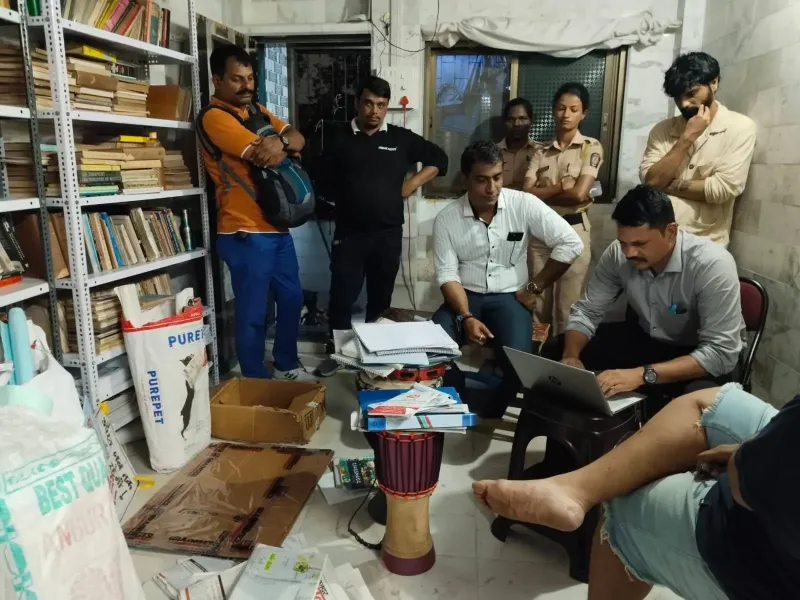
A symbolic act of solidarity with Palestinian children has triggered a controversial police operation in Mumbai, with activists alleging that the Bandra police searched the home of a young volunteer for more than nine hours, examined her books and personal belongings, seized mobile phones and detained people present at the residence.
The incident, which took place on September 18 and continued into the early hours of September 19, followed a September 15 kite-flying event organised in solidarity with children in Gaza. The event formed part of the Global Gaza Kite Weekend, an international campaign in which participants flew kites to draw attention to the situation of Palestinian children.
According to the citizens’ collective Indian People in Solidarity with Palestine (IPSP), police personnel arrived at the residence of Harshada Borade, a student, artist and volunteer associated with the group. The organisation alleged that some personnel were in plain clothes and initially did not provide identification, a warrant or written notice explaining the basis for the intervention.
Borade told media organisations that as many as 15 police personnel were present at one point. The search reportedly began at around 5.30 pm and continued until approximately 2.30 am. Scroll reported that five activists who were at the residence were allegedly prevented from leaving while the search was underway, while a sixth person was questioned at Bandra police station and released later that evening.
The allegations go beyond a prolonged search. Borade told Hindustan Times that police examined books, personal diaries and other belongings at her home, while two people accompanying her allegedly had their phones taken and subsequently returned. The group said that books relating to Bhagat Singh and Savitribai Phule were among the material examined by the police.
Borade has also alleged that two friends who were present at the residence were handcuffed, that their phones were confiscated and that officers checked the data stored on the devices. These allegations have also been reported by The Times of India, which said Borade claimed the search lasted from around 5 pm on September 18 until the early hours of September 19.
The police subsequently prepared a panchnama, a record of the observations and material documented during a search. According to IPSP, the panchnama linked the police action to the September 15 kite-flying campaign and recorded material found at Borade’s residence. What makes the episode particularly concerning is the apparent disconnect between the nature of the activity and the intensity of the police response. The activists were participating in a public campaign involving kites, Palestinian flags and posters as a symbolic expression of solidarity with children in Gaza. The police, however, have said that the organisers had not obtained permission for the gathering and that they were investigating the people involved after videos of the event appeared on social media.
Speaking to Hindustan Times, police officials said they had identified videos showing people flying kites and displaying pro-Palestine posters near Otters Club in Bandra West. They said the participants had not obtained permission and were not cooperating with police teams, following which the people involved were questioned and their homes searched for material, including books and other items.
A senior police official subsequently said that an inquiry was underway “as per the procedures established by law” and maintained that nobody had been illegally detained. The police, however, did not immediately clarify whether the searches were principally connected to the alleged absence of permission for the gathering, the display of pro-Palestine material, or both.
The question here is not merely whether police may investigate an event for which they believe permission was required. The more fundamental issue is how far the State can intrude into a citizen’s home, personal belongings, communications and associations in response to an act of political expression. A search of a private residence lasting more than nine hours, coupled with the alleged examination of books and personal diaries and the seizure and inspection of mobile phones, raises serious questions about proportionality, procedural safeguards and the constitutional protection of privacy and freedom of expression. Those questions become particularly significant when the underlying activity consisted of a symbolic act of solidarity rather than an allegation of violence.
IPSP has described the police action as an assault on democratic rights and civil liberties and alleged that it violated Borade’s right to privacy and freedom of expression. The organisation has demanded action against the personnel involved. Siasat reported the group’s allegation that the search was conducted without a warrant or other written authorisation and that those present were intimidated and, in some cases, allegedly manhandled. The latest reporting has also highlighted the absence, so far, of an FIR against Borade. The Times of India reported on September 21 that Mumbai Police were gathering information and conducting an inquiry, while DCP (West Zone-2) Mohit Garg said the matter was being examined in accordance with established procedures.
The episode therefore raises an uncomfortable question about the threshold at which political expression begins to attract coercive State scrutiny. Flying a kite, displaying a Palestinian flag or possessing books by Bhagat Singh or Savitribai Phule cannot, by itself, establish criminality. If the police believe that an offence was committed during the September 15 gathering, the basis for that belief, the specific offence under investigation and the legal authority for the subsequent searches and seizures ought to be capable of being clearly articulated.
The concern is particularly acute because a police investigation cannot become a substitute for procedural safeguards. Nor should the absence of immediate criminal charges leave citizens uncertain about why their homes were searched, why their personal belongings were examined or why their phones were taken. At the heart of the controversy is therefore not simply a kite-flying event in Bandra. It is the question of how a democratic State responds to dissent, political expression and solidarity with a foreign people, and whether the exercise of police power remains bounded by legality, necessity and proportionality.
The Mumbai Police have said that an inquiry is underway. That inquiry must consequently address not only what the activists did on September 15, but also what legal basis authorised the subsequent searches, whether the required procedural safeguards were followed, what material the police were actually investigating, why personal books and belongings were examined, and under what authority mobile phones were seized and accessed. Until those questions are answered transparently, the nine-hour search of a young activist’s home following a symbolic act of solidarity will continue to raise serious concerns about the expanding reach of police power into the private sphere and the space available for peaceful political expression in Mumbai.
Related:
Women journalists who were attacked prevented from reporting, protest attacks
“If I Believe in Democracy, How Can I Give Up Hope?”| Umar Khalid: 2,190 Days | Banojyotsna | Teesta
Anatomy of a Censoring Mob Threatened by Book Reading in Public
Deaths, Denials and Delayed Action: The Balaghat crisis