
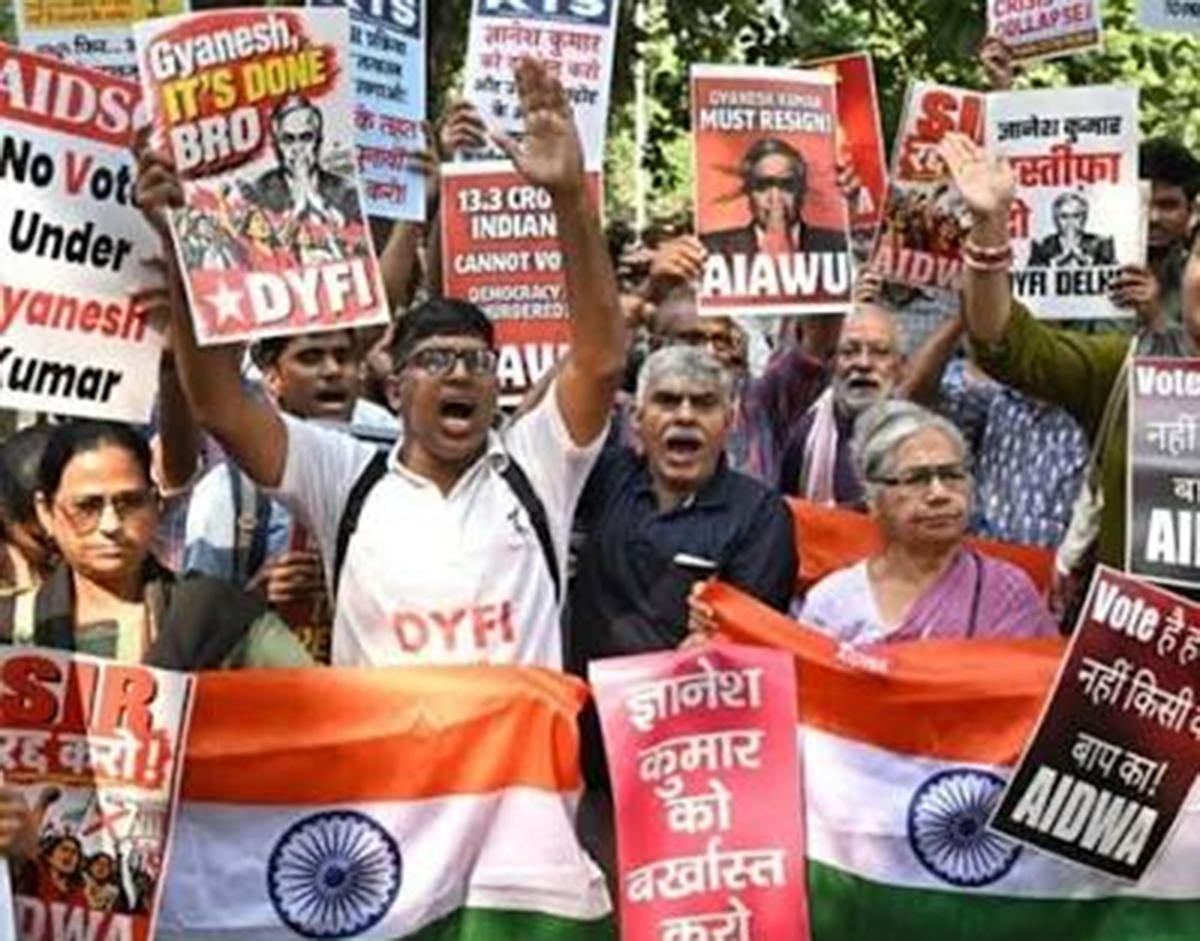
On Friday, October 23, central Delhi witnessed a gathering that was as much about the right to vote as it was about the right of ordinary people to claim ownership of their democracy. Hundreds of protesters marched from Bhai Vir Singh Marg towards the Election Commission of India (ECI) headquarters, carrying the national flag and raising demands against the Special Intensive Revision (SIR) of electoral rolls. Farmers, workers, students, women’s organisations, youth groups and civil society members came together under the banner of the nationwide People Against SIR mobilisation.
Hundreds of people marched from Bhai Vir Singh Marg to the ECI headquarters in New Delhi at the joint call of farmers’, workers’, women’s, youth and student organisations and civil society groups, demanding the removal and prosecution of Chief Election Commissioner Gyanesh Kumar, halt to the SIR process, revocation of legal immunity for the Election Commission, and other demands.
— CPI (M) (@cpimspeak) October 23, 2026
Visuals from Gurudwara Bangla Sahib Road | Large numbers of protesters gathered on October 23 for the ‘People Against SIR’ march, demanding the scrapping of SIR and the resignation of CEC.
#VoteChori #ECI #India https://t.co/jcmiqgvOML
— The Wire (@thewire_in) October 23, 2026
“We are peaceful; they are accusing us of being anarchic. The lathi is in their hand. The tear gas is in their hand, and they are attacking us and making us sign peace bonds,” says CPI(M) leader Brinda Karat while criticising the Modi government and the Delhi Police at the nationwide protest against the SIR in Delhi on Friday.
@khushimehrotraa from the ground.
Follow Newslaundry for more updates.
— newslaundry (@newslaundry) October 23, 2026
VIDEO | Delhi: Several protesters detained during a march against the Special Intensive Revision (SIR) of electoral rolls in central Delhi. The protesters were heading towards the Election Commission of India (ECI) headquarters to protest against the alleged deletion of voters. https://t.co/XrcaoYnGpQ
— Press Trust of India (@PTI_News) October 23, 2026
“Whether it’s Kashmir or Kanyakumari, people are coming out.” CPI National Secretary Annie Raja says the spirit of Jantar Mantar has spread beyond Delhi, with citizens taking to the streets across the country amid protests over the Election Commission and restrictions on demonstrations.
Follow DeKoder for more updates.
#JantarMantar #Modi #RightToProtest #ECI #SIR #GyaneshKumar #DelhiProtest #DelhiPolice
— DeKoder (@DeKoderAI) October 23, 2026
“This is a very important moment for Indian democracy”
Economist @Jayati1609 to @_sabahgurmat outside the Bangla Sahib gurdwara in central Delhi as protesters gather in 88 cities in 18 states in response to a call from 143 organisations, according to the website https://t.co/aU0gDRQ53k
— Article 14 (@Article14live) October 23, 2026
“Citizens elect a government to govern. There has to be empathy,” says Ashish Joshi, a former civil servant at the nationwide protest against the SIR in Delhi on Friday, called by various civil society organisations.
@AkankhyaAk72623 from the ground.
Follow Newslaundry for live updates.
— newslaundry (@newslaundry) October 23, 2026
Several protesters were detained by Delhi Police during the ‘People Against SIR’ march in central Delhi on October 23.
#VoteChori #ECI #India https://t.co/9EBPnDMunH
— The Wire (@thewire_in) October 23, 2026
Hundreds of people marched from Bhai Vir Singh Marg to the ECI headquarters in New Delhi at the joint call of farmers’, workers’, women’s, youth and student organisations and civil society groups, demanding the removal and prosecution of Chief Election Commissioner Gyanesh Kumar, halt to the SIR process, revocation of legal immunity for the Election Commission, and other demands.
— CPI (M) (@cpimspeak) October 23, 2026
The protest has begun!
We won’t let go our right to vote and the right to protest for it!
Our’s is a democratic country and we will ensure that spirit remains alive! https://t.co/i9fbDX2zGR
— AISA (@aisa_official_) October 23, 2026
“Until we get Gyanesh Kumar’s resignation, we won’t back off. We are not afraid to be detained.” Says the protester while being detained.
@khushimehrotraa talks to detainees at the ongoing protest in central Delhi against CEC Gyanesh Kumar.
Follow Newslaundary for more updates.
— newslaundry (@newslaundry) October 23, 2026
‘Ab Har Sadak Jantar Mantar’: Protests Resume in Delhi.
@Saurabh_Unmute
Watch Full Ground Report on The Red Mike’s YouTube channel. https://t.co/vQe8mWkJ8K
— The Red Mike (@TheRedMike) October 23, 2026
There was no single face around which the protest revolved, no one leader whose presence defined its purpose. Instead, the streets filled with people who had come to assert a collective right: to vote, to question the institution entrusted with protecting that right, and to resist an electoral process they fear could exclude legitimate voters. The significance of the mobilisation lay precisely in this coming together, in citizens refusing to leave the defence of electoral democracy to political parties, prominent activists or a handful of familiar public figures.
The march was organised at the joint call of 143 organisations, with protests reported across 88 cities in 18 states, according to the mobilisation’s organisers. The breadth of participation underlined how the concerns surrounding SIR have travelled beyond election administration and become a question of democratic participation, accountability and the security of the franchise.
A march to the Election Commission, a confrontation with the police
In Delhi, protesters assembled around Gurudwara Bangla Sahib and marched towards the ECI headquarters near Patel Chowk. Carrying the Tricolour, they demanded the immediate scrapping of SIR, the removal and prosecution of Chief Election Commissioner Gyanesh Kumar, and the repeal of the 2023 law governing the appointment of Election Commissioners, which protesters have criticised for providing legal protection to members of the Election Commission.
ले तिरंगा निकल पड़े हैं मेरे देश के लोग…
लोकतंत्र बचा लेंगे मेरे देश के लोग!हमारी 3 बड़ी मांगें:
• ज्ञानेश कुमार को तुरंत बर्खास्त करो!
• फर्जी SIR प्रक्रिया तुरंत रद्द करो!
• चुनाव आयोग का 2023 का काला कानून वापस लो!चलो… आज इस ऐतिहासिक ‘नागरिक मार्च’ का हिस्सा बनें और लोकतंत्र की रक्षा करें! ✊
Jantar Mantar | Voter List Errors | Gyanesh Kumar | SIR | ELection Commission
— Bharat Jodo Abhiyaan (@withbharatjodo) October 23, 2026
यह लड़ाई चुनाव आयोग को सत्ता का ‘खिलाड़ी’ नहीं, लोकतंत्र का निष्पक्ष ‘अंपायर’ बनाए रखने की है।
MARCH TOWARDS THE ELECTION COMMISSION
#GyaneshKumarMustGo https://t.co/8m7mYFNasf
— Yogendra Yadav (@_YogendraYadav) October 23, 2026
Carrying the tricolour, protesters march towards the Election Commission’s office near Patel Chowk but were stopped by police amid a heavy security presence. https://t.co/RQGDF8HmeI
— Neha Bora Team (@NehaAisa) October 23, 2026
Members of different organisations stage a protest against CEC Gyanesh Kumar in New Delhi on October 23.
Photo credit: @shashiskashyap https://t.co/shFBLeCmIc
— The Hindu (@the_hindu) October 23, 2026
Activist Anjali Bharadwaj speaks to Maktoob as “People Against SIR” march head towards the ECI headquarters
Watch: https://t.co/0S5c3HGiDE
— Maktoob (@MaktoobMedia) October 23, 2026
Visuals shared by Scroll.in and others showed police detaining protesters in central Delhi, while some demonstrators climbed onto police buses in an attempt to prevent them from leaving with those detained. Police buses carrying demonstrators were also seen moving away from the area outside Bangla Sahib Gurudwara.
Police detain protestors who had gathered in central Delhi, demanding the resignation of CEC Gyanesh Kumar.
Several other protestors climbed atop buses to stop them from driving away.
@priyali_dhingra reports https://t.co/69YltXLCgi
— Scroll.in (@scroll_in) October 23, 2026
VIDEO | Delhi: Several protesters detained during a march against the Special Intensive Revision (SIR) of electoral rolls in central Delhi. The protesters were heading towards the Election Commission of India (ECI) headquarters to protest against the alleged deletion of voters. https://t.co/XrcaoYnGpQ
— Press Trust of India (@PTI_News) October 23, 2026
Several protesters were detained by Delhi Police during the ‘People Against SIR’ march in central Delhi on October 23.
#VoteChori #ECI #India https://t.co/9EBPnDMunH
— The Wire (@thewire_in) October 23, 2026
Delhi Police again detained members of the Disha Students’ Organization and other protestors near Bangla Sahib Gurudwara who were protesting to reclaim Jantar Mantar.
#ScrapSIR #JantarMantar https://t.co/xx4wSrkMSF
— Scientifically Correct ☭ (@AadeshSpeaking) October 23, 2026
The people are not waiting for someone to lead them
One of the most striking features of Friday’s mobilisation was the refusal to make the movement dependent on any one individual. As protesters were detained, the question of what would happen if prominent participants were taken away was put to CJP’s Ashutosh Ranka by PTI.
His response captured the spirit of the gathering: “We are not leaders; we are custodians of this platform that the people of this country have given us.” He added that the movement would continue whether its participants were in jail or outside, and that it would change and evolve as necessary.
VIDEO | Delhi: When asked how the movement would continue if its leaders were detained, CJP’s Ashutosh Ranka says, “The movement will continue. We are not leaders; we are custodians of this platform that the people of this country have given us, and we are just trying to do our best. The movement will continue whether we are in jail or outside. We have learnt a lot about ourselves and how the regime operates. We will, of course, change and evolve as necessary.”
— Press Trust of India (@PTI_News) October 23, 2026
The statement spoke to something visible on the streets that day. The mobilisation was not simply an event organised around speeches delivered by recognised leaders. It was a collective assertion by people who had come to occupy democratic space themselves. Students stood alongside farmers and workers; women’s organisations marched alongside civil society groups; familiar public figures shared the streets with citizens whose names might never appear in a news report.
The absence of a single commanding face did not mean an absence of political conviction or organisation. Rather, the joint call of 143 organisations created a platform on which different groups could bring their concerns together without surrendering the movement to one personality. Its strength lay in the possibility that people could participate in the struggle without waiting for permission from a leader, or for a prominent figure to tell them when to act.
Delhi: AISF and AIYF members are marching towards Jantar Mantar from Gol Dak Khana against SIR, demanding the resignation of Chief Election Commissioner Gyanesh Kumar https://t.co/aWyRz0Fnhg
— IANS (@ians_india) October 23, 2026
“Tell him that Adani and Ambani and these four people do not run this country. We are not their slaves. They have snatched away all our voting rights and other rights. They will beat us like animals, and we are not even supposed to raise our voices?” asks a protester during today’s People Against SIR march.
— Maktoob (@MaktoobMedia) October 23, 2026
When Jantar Mantar is barricaded, the streets become the site of protest
Friday’s march also carried a message about the shrinking space for public demonstrations in the national capital. As protesters gathered around Bangla Sahib and moved towards the Election Commission, the invocation of Section 163 and the subsequent detentions became part of the confrontation over the right to dissent.
The ‘People Against SIR’ is marching through central Delhi towards the Election Commission headquarters amid heavy security, protesting against CEC Gyanesh Kumar and the Special Intensive Revision of electoral rolls.
Watch: https://t.co/LKjhU018H9
— Maktoob (@MaktoobMedia) October 23, 2026
In a statement shared from Himachal Pradesh, advocate Prashant Bhushan’s message, relayed by another account, captured the resolve of protesters confronting restrictions on public assembly: “If you barricade Jantar Mantar, the whole of Delhi will become Jantar Mantar.” The statement went on to warn that attempts to suppress protests in Delhi could spread the call for resistance across the country.
हर गली, हर गांव जंतर मंतर। @pbhushan1 हिमाचल प्रदेश में ” #SIR रद्द करो” के नारों के साथ पालमपुर के सड़कों में रैली में । जंतर मंतर को बैरिकेड करोगे तो पूरी दिल्ली जंतर मंतर । और दिल्ली को 163 से कुचलने की कोशिश करोगे , तो पूरा देश जंतर मंतर। लोकतंत्र को लोकतंत्र ही बचाएगा। https://t.co/DtZhpOAK7p
— Nikhil Dey (@nikhilmkss) October 23, 2026
The message resonated with a mobilisation that was not confined to one gathering point. Anti-SIR protests were reported in Bengaluru, where demonstrators assembled around Infantry Road and the War Memorial on Brigade Road, as well as in Mumbai, where university students took to the streets demanding the CEC’s resignation.
Anti-SIR protests have begun across Bengaluru, demanding the resignation of CEC Gyanesh Kumar. Protesters have gathered at Infantry Road and War Memorial, Brigade Road.
Live updates: https://t.co/TYV40G47EB https://t.co/hI5Q7xL9Z1
— The Wire (@thewire_in) October 23, 2026
Mumbai University students protest demanding resignation of CEC Gyanesh Kumar
Video by: Anurag Ahire
LIVE updates: https://t.co/nwsrbWQEkC https://t.co/5ES10N0d4R
— The Indian Express (@IndianExpress) October 23, 2026
Anti-SIR fire spreads scross Bengaluru as protesters demand scrapping of SIR, resignation of CEC
Answering the People Against SIR nationwide call, protesters have taken to the streets across Bengaluru demanding the resignation of CEC Gyanesh Kumar, with visuals of protests at Infantry Road and the War Memorial on Brigade Road, among many other places, being shared.
— Maktoob (@MaktoobMedia) October 23, 2026
The spread of the protests gave concrete meaning to the call that the defence of democracy could not be confined to a designated protest ground. People were asserting that their constitutional rights did not begin and end at a barricade, and that the demand for electoral accountability could be raised in cities and towns far beyond the capital.
Related:
Barricades and detentions fail to stop Delhi protesters marching against CEC
Jantar Mantar shut to protest, CJP leaders sent to jail, Delhi police invoke ‘breach of peace’
‘Chalo Delhi’: Thousands march to Supreme court against ‘Vote Chori’, demand Gyanesh Kumar’s removal
Protest Denied, Dissent Policed: India’s crackdown on those challenging the Election Commission