
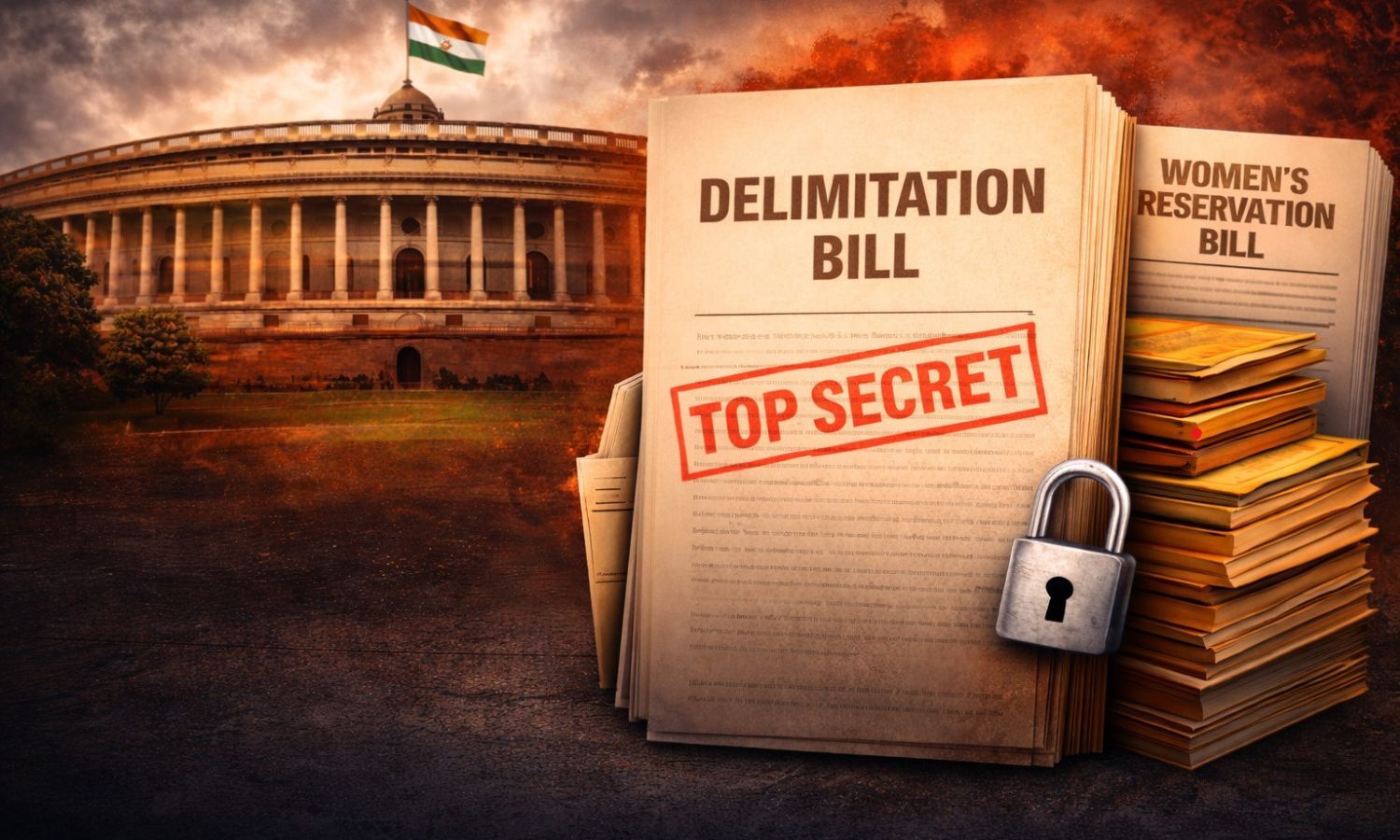
Experts and citizens have publicly expressed their concerns on the manner in which the Delimitation Bill and the amendment to the Women’s Reservation law have been hurriedly and secretly tabled before Parliament.
One of the statements reads:
“We are writing to express our deep concern about the complete lack of transparency regarding the draft legislations proposed to be taken up during the 3-day special extension of the Budget Session of Parliament scheduled to be held from April 16 to 18, 2026. As per media reports, the cabinet has cleared 3 bills to ostensibly pave the way for 33% reservation for women in the Lok Sabha and state assemblies from 2029 – an amendment to the Women’s Reservation Act (Nari Shakti Vandan Adhiniyam), a Delimitation Bill and a separate bill to extend the quota to Union Territories. The draft legislations reportedly include a proposal for a uniform 50% increase in seats in the Lok Sabha and state assemblies, raising the Lok Sabha’s strength from 543 to 816 and total assembly seats from 4,123 to 6,186.
“The laws will fundamentally re-shape India’s electoral democracy and impact every voter in the country. Given the far-reaching ramifications of these legislations, it is shocking that the citizens of the country have been kept completely in the dark about the contents of the bills, their implications and the rationale for bringing these constitutional and legislative amendments. Information about the proposed laws is reaching people only through media reports based on “sources”. This is a flagrant violation of peoples’ fundamental right to information and the principles laid out in the Pre-legislative Consultation Policy.
“The Pre-legislative Consultation Policy adopted by the Union Government in 2014 mandates placing draft legislations in the public domain for at least 30 days, inviting public comments and making a summary of feedback/comments received available on the concerned ministry’s website prior to sending it for Cabinet approval. It also requires that wide publicity be given to the consultation process and the draft legislation through print and electronic media, or in such other manner considered necessary to reach the affected people.
“Given the tremendous impact the three legislations proposed to be taken up in the upcoming session of Parliament will have on our democracy, we demand that the government:
- make the text of the draft bills public immediately and ensure wide dissemination through various modes, and in multiples languages;
- put the draft bills through robust public consultation in line with the Pre-legislative Consultation Policy.
“While we wholeheartedly support reservation for women in legislature, and many of us have been part of campaigns demanding the same, we strongly oppose the secretive, non-democratic manner in which the proposed legislations are being brought. It is a profound irony and a grave disservice to the democratic process to introduce legislation for women’s empowerment while simultaneously excluding women from the conversation. A reform of such historic magnitude deserves transparent debate, public scrutiny and the inclusion of diverse voices to ensure it truly empowers people, rather than being rushed through in the midst of ongoing state elections as a political tool.”
This statement has been endorsed by:
- Anjali Bhardwaj, Transparency activist, Delhi
- Prof. Ganesh Devy
- Prof Santosh Mehrotra, Visiting Prof, Centre for Economic and Social Studies, Telangana
- Aditi Mehta, IAS Retd, Rajasthan
- Amitabha Pande, Constitutional Conduct Group, Uttar Pradesh
- Kamal Malhotra, Head, United Nations (retired), Delhi
- Ashish Joshi, IP&TAFS (retd), Former Civil Servant , Additional Secretary Equivalent Uttarakhand
- Kamal Kant Jaswal, Former Secretary to the Government of India, Haryana
- Zoya Hasan, Professor Emerita, Delhi
- Teesta Setalvad, Citizens for Justice and Peace, Maharashtra
- Paranjoy Guha Thakurta, Haryana
- V. Ramani, IAS (Retd.), Maharashtra
- Harshavardhan Hegde, Doctor, Delhi
- Ashok Sharma, IFS (retd.), Uttar Pradesh
- Balveer Arora, Centre for Multilevel Federalism ISS, Delhi
- Yamini Aiyar, Delhi
- Niraja G. Jayal, Retired academic, Delhi
Related:
Delimitation: Strengthening democracy or rigging the game?
What the 2026 delimitation process has in store for Indian Muslims