
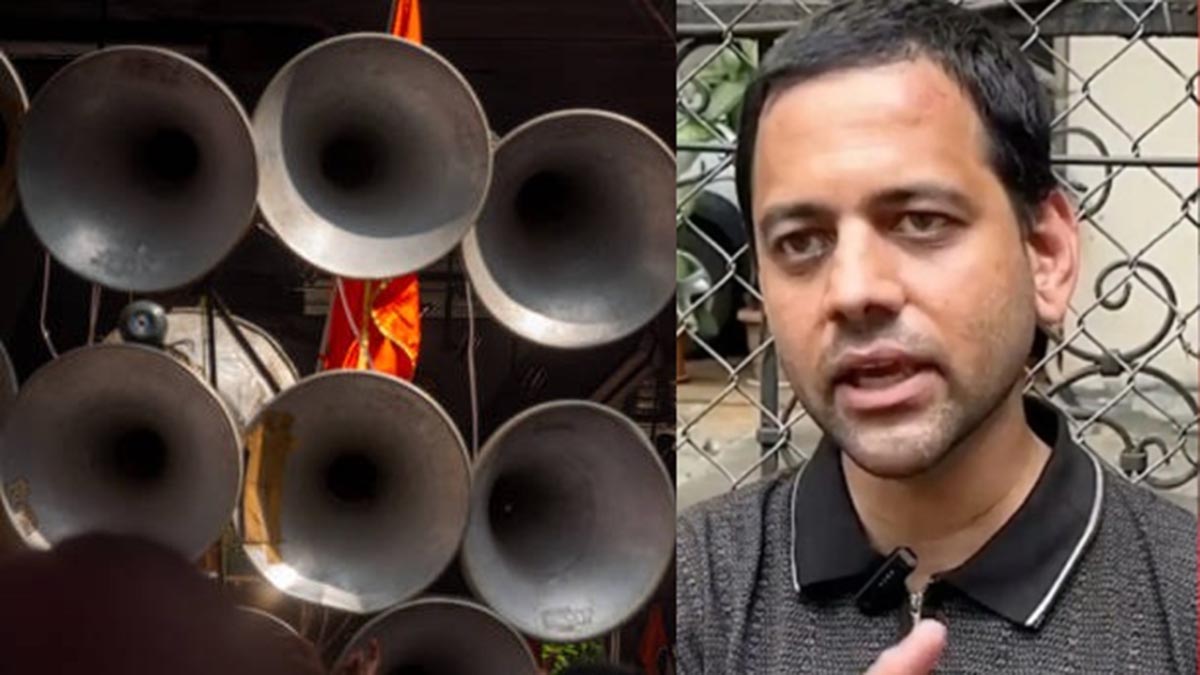
On September 3, Vidyanand Bapat was speaking to the media on Tilak Road in Pune when a man approached him and slapped him on camera. Bapat, a 37-year-old Pune resident who works at a BPO, had in less than two weeks become one of the most recognisable voices in the city’s growing campaign against high-decibel DJ systems and amplified sound during religious festivals.
The assault was not an isolated disagreement over music. It was the latest and most disturbing episode in a controversy that has exposed a larger question: who gets to decide how much noise a religious celebration can impose on everyone else?
The Indian Express reported that Bapat was attacked while giving a live interview, with the assault captured on camera. Pune Police Commissioner Amitesh Kumar said the accused had been arrested and that a cognisable, non-bailable case would be registered. Bapat was subsequently provided police protection.
JUST IN: Footage shows Vidyanand Bapat being slapped while giving a byte to TV9 Marathi in Pune earlier today. A man approached and allegedly hit Bapat as he spoke to the channel, after which others joined in. Raising your voice on civic issues shouldn’t invite a mob. pic.twitter.com/x3CxMKB0vU
— Varad Bhatkhande | Journalist (@VaradBhatkhande) September 3, 2026
A protest was held at Kalakar Katta on Fergusson College Road in Shivajinagar, Pune, demanding justice for Santosh Pandit and Vidyanand Bapat.
Citizens and activists gathered under the banner of Jagruk Punekar, raising slogans and calling for justice for both individuals.… pic.twitter.com/Uqzz2pdn1v
— Punekar News (@punekarnews) September 4, 2026
From one voice at a civic meeting to a statewide debate
The controversy began on August 24, when the Pune Municipal Corporation held its preparatory meeting for Ganeshotsav, scheduled to begin on September 14. Among several hundred people present, Bapat was reportedly the only person to object to the use of DJs and dhol systems. His argument was straightforward: the festival should not become a source of excessive noise, traffic disruption and public inconvenience. He invoked the history of Ganeshotsav, pointing out that when Lokmanya Tilak popularised the public festival, DJ systems obviously did not exist. He argued that amplified music was neither intrinsic to the festival nor necessary for its celebration.
I don’t want publicity only! I am perfectly okay if the alley dogs don’t know who I am.
What I want is a solution to the problems citizens are actually enduring. This isn’t about getting attention, it’s about getting things fixed. He is talking in crystal clear terms.
Our…— Shilpa Godbole (@godbole_shilpa) August 30, 2026
The response was hostile. Bapat was shouted down and eventually escorted out by the police as tensions rose. But footage of the confrontation circulated widely on social media, transforming an otherwise ordinary civic meeting into a national talking point. The controversy was then amplified by Marathi television.
ABP Majha brought Bapat face-to-face with BJP Pune city president Dheeraj Ghate. During the debate, Bapat calmly explained his position on noise pollution. Ghate reportedly mocked him, asking who even knew Bapat in his neighbourhood. The exchange subsequently went viral. Within days, television channels, YouTube platforms and social-media personalities were interviewing Bapat. He repeatedly made the same argument, drawing on Sanskrit texts, the Mahabharata, Greek and Latin literature and his own rationalist worldview. His fluency in Marathi, Sanskrit, Hindi and English and his refusal to be provoked made him a social-media sensation.
The real issue is not whether festivals should be celebrated
The debate has sometimes been presented as a conflict between religious devotees and people opposed to Ganeshotsav. That is a misleading frame. Bapat has not argued against Ganeshotsav. Neither have many of the citizens who have subsequently joined the campaign.
At a Goodluck Chowk gathering, protesters explicitly said that their objection was to excessive noise from DJs, loudspeakers, dhol-tasha systems and other high-intensity sound equipment — not to Ganeshotsav itself. Hindustan Times reported similar assertions from participants who said the restrictions should apply to every religious celebration, irrespective of religion.
Hundreds gathered at Goodluck Chowk in Pune on Friday, protesting Santosh Pandit’s arrest and demanding answers over the 1am police action. Protesters also expressed solidarity with Vidyanand Bapat, who was assaulted while speaking against high-decibel DJs. pic.twitter.com/SxfuX6TNs7
— Varad Bhatkhande | Journalist (@VaradBhatkhande) September 4, 2026
A constitutional democracy does not give religious expression a licence to override the rights of everyone around it. Freedom of religion does not mean freedom from regulation. Public celebrations take place in shared civic spaces, and their exercise necessarily has to coexist with the rights of residents, children, elderly people, patients, workers, motorists and others. The question, therefore, should not be whether Ganeshotsav is important. It plainly is. The question is why excessive noise has been allowed to become synonymous with celebration in the first place.
The numbers make the argument harder to dismiss
The College of Engineering, Pune has measured noise levels on Lakshmi Road during Ganesh immersion for roughly 25 years. With the exception of the pandemic years, readings have consistently exceeded 80 decibels. The levels recorded in recent years were particularly stark: 105.2 decibels in 2022, 101.3 in 2024 and 94.8 in 2025.
The Union Environment Ministry’s prescribed limits are substantially lower. In residential areas, the permissible limit is 55 decibels during the day and 45 at night. Even commercial areas have limits of 65 and 55 decibels respectively.
For years, the state has known that noise levels during major processions can far exceed permissible standards. The more uncomfortable question is: why has enforcement remained so inconsistent?
The politics of noise
Several Ganesh mandal representatives and BJP leaders initially opposed Bapat’s position and defended DJs and dhol during the festival. Yet once the issue gained significant public support, political leaders began positioning themselves on the side of noise control. BJP leader and Maharashtra Higher and Technical Education Minister Chandrakant Patil appealed to Punekars not to overuse DJs and laser beams. Bengaluru South MP Tejasvi Surya similarly welcomed citizen mobilisation around clean air and reduced noise. Neither, however, publicly challenged the BJP’s local leadership that had been supporting the use of DJs.
Chief Minister Fadnavis adopted an equally cautious position at the BJP state executive meeting in Pune on August 31, calling for festivals to be celebrated in a “cultured” manner without directly taking a clear position on the DJ controversy. That changed somewhat after the assault.
On September 4, Fadnavis described DJ noise as being comparable to the sound of an earthquake and called for a return to more traditional forms of Ganeshotsav. Hindustan Times reported that he also argued that consensus and dialogue were necessary to reduce the use of such systems. But there is an obvious political contradiction here. If excessive noise is genuinely harmful, the state does not need to wait for a viral citizen campaign or an assault before taking a firm position. The legal framework already exists.
Solapur shows that another model is possible
Pune is not the first Maharashtra city to confront this issue. Solapur has moved towards a DJ-free Ganeshotsav, with the campaign emerging from citizen mobilisation rather than merely being imposed from above. The effort followed growing concern about the health and civic consequences of high-decibel celebrations.
The campaign acquired particular force following accounts of two incidents in 2025 involving the alleged health consequences of excessive festival noise. A citizen who objected to loud music during Shiv Jayanti reportedly suffered permanent hearing loss after being forced to sit near speakers, while another young man reportedly suffered a fatal heart attack after dancing to loud DJ music during a procession. The resulting campaign brought together lawyers, doctors, senior citizens and students and reportedly collected tens of thousands of signatures. Solapur demonstrates that religious celebration and restraint do not have to be opposites.
The movement is now larger than Bapat
Bapat may have become the face of the Pune controversy, but the demand predates him. The campaign against DJs has been building for several years. In 2023, Sunil Mane, an Ambedkarite and former journalist who is now associated with the NCP (Sharad Pawar), petitioned against DJ use during Ambedkar Jayanti processions, Hindustan Times reported.
By August 30, hundreds of people had gathered at Goodluck Chowk despite the cancellation of a proposed march by Sakal Hindu Samaj, as per the report of Free Press Journal. One participant told reporters that elderly residents and heart patients were particularly affected by the noise. Another directly warned the BJP leadership that voters who had supported the party could change their political loyalties if they felt their concerns were being ignored.
Nagpur has moved from appeals to enforcement
Nagpur Police have imposed restrictions on high-powered DJ systems, customised sound trucks, multi-speaker systems and other high-intensity amplified equipment under Section 163 of the Bharatiya Nagarik Suraksha Sanhita. The order, effective from September 3 to November 1, covers multiple festivals, including Ganeshotsav, Eid, Navratri, Durga Puja, Dussehra and Diwali. Importantly, systems operating within permissible noise limits are not covered by the prohibition.
Nagpur has also restricted high-intensity laser and beam lights on public-safety grounds, citing the possibility of temporary visual impairment for motorists and consequent accidents. The city has simultaneously created a mechanism through which citizens can report noise pollution, upload evidence and track complaints, with the system reportedly requiring action within 30 minutes and providing for escalation if no response is recorded.
The state must protect dissent, not merely condemn violence after the fact
The assault on Bapat should not become another moment when political leaders condemn violence only after it has occurred while ignoring the conditions that allow intimidation to flourish. Bapat was not attacked while obstructing a procession. He was attacked while speaking to journalists.
His position could be challenged. His arguments could be criticised. His understanding of tradition could be disputed. His demand for a ban could be opposed. But none of these disagreements legitimises physical violence.
The Maharashtra Andhashraddha Nirmoolan Samiti, while condemning the assault, warned that allowing violence to replace argument creates a dangerous precedent: if people become afraid to speak about noise pollution, they may eventually become afraid to speak about corruption, superstition, pollution or injustice more broadly. NCP (SP) chief Sharad Pawar similarly said that assaulting someone for exercising the right to express an opinion amounts to an attack on democracy. He also backed restrictions on DJs and loudspeakers and pointed to Solapur and other districts as examples.
Former MLC Sandip Joshi has supported a complete ban on DJs and laser systems and described the assault on Bapat as an act of cowardice. He has been campaigning for restrictions beyond the immediate festive period. But BJP city president Dayashankar Tiwari and MLA Pravin Datke have opposed the restrictions. Datke questioned why restrictions were being imposed during Hindu festivals, while the BJP maintained that the leaders were speaking in their individual capacities.
Related:
3,404 SIR Forms Found at Kharghar Xerox Shop: CJP, VFD and BCS demands answers from Maharashtra SEC