
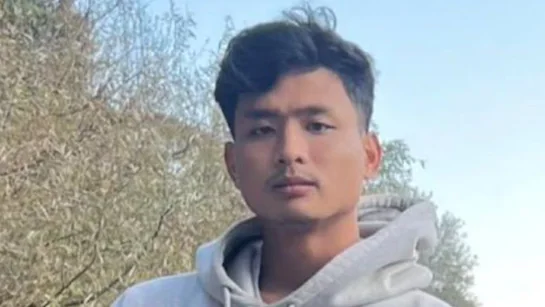
A young man, only 24, from one hill state, north-eastern Tripura, enrolled in an MBA course in another hill state, Uttarakhand is stabbed to death in Dehradun 21 days ago and news of this only comes out four days ago, on December 26. That is only because after failed treatment at in the Graphic Era hospital in Dehradun, a chosen destination of elites from Delhi, he dies of the brute stab injuries. For sixteen days he battled for his life. His name is Anjel Chakma. His brother, Michael with him that day standing near a shop said that the group of young men who had literally lynched Anjel – he had suffered brute stab injuries to his head and spine—had hurled racial slurs, calling them ‘Chinese’ and ‘momo’ before the attack. Anjel’s last words, before the fatal attack was, “I am not Chinese, I am an Indian.”
There has been outrage at official complicity and silence, that no FIR was filed for days after the attack. Social media Zindabad. CM Pushkar Dhani (BJP) called Anjel Chakma’s father and publicised the conversation on X. There has been outrage at the prevalent concealment of the crime itself till it resulted in death. Yet, Dehradun’s Senior Superintendent of Police, Ajai Singh has been quick to state on Monday, December 22 that “there is no evidence, prima facie, of racial attack.” The clear lapses and subsequent outrage include a three-day delay in registering the First Information Report (FIR), the refusal by the Selakui police station personnel to register the complaint on multiple occasions, the failure of the police to invoke appropriate sections of the law at the initial stage, and attempts by senior police officials to dilute the crime by portraying it as a fight while ignoring elements of racial abuse.
But should not we, as Indians, ask ourselves, if we are not inherently racist, casteist and communal? Students or professionals, Delhi, Kolkatta, Degradun, Bengaluru, Chennai or Mumbai, who hail from any of the seven states in the north-east face, have faced and have always faced attacks, ostracisation and slurs. I can give examples from the 1980s from the university of Mumbai, 32 years later from 2012, when 3,000 migrant and gig workers tried to flee Chennai, Benagluru and Pune over threats and attacks. Or in between before and after. When this inherent othering was seen in brute communal attacks, first against groups, then against individuals. Muslims, Sikhs, Christians. The civilizationally sanctioned othering of our Dalits, the everyday rape and killings of Dalit women is a reality that crept on to news pages only after the 1990s somehow. Though it has existed forever. Angel Chakma’s brute killing is no worse than Mohammad Aklaq’s (Dadri, 2015) or Surekha and Priyanka Bhotmage (Khairlanji, 2006). Listing or mapping these could run like a gruesome litany, Indian calendar of hate.
Such manifest attacks after humiliation, (1980s, 2006, 2012) however elicited a seminally different response from officialdom. Or mostly. Things were attempted to be brought back on track by an overall adherence to the “rule of law” and “principles of equality and non-discrimination underlined in the Indian Constitution.” Despite gross lapses (Nellie 1983, Delhi, Kanpur 1984, Bombay 1992-1993, Gujarat 2002) in official response the veneer that society accepted or adopted was one worn by the state. A clear and conscience driven adherence to the Indian Constitution. Even if substantive justice or reparation was never quite done. We were, until 2014, a constitutional republic in the shaping and making.
Something sharply changed then, however.
No regime or administration –until 2014 –was headed by outliers who brazenly signalled to cops and officials that “those who are violent” can be identified by “their clothes” or attire. Those holding constitutional posts did not legitimise terms that slur or stigmatise particular groups or communities. Today this is par for the course. We did not have heads of state(s) that proudly espoused sectarian divide and privilege. It is this, the prevalent and dominant a politics ideologically powered on stratification and othering that has brought out the worst in us.
There are enough of us Indians who are civilizationally brutalized into othering that welcome the prevailing, politically endorsed politics of hate and violence that results in Anjel’s tragic demise. Enough in the populace to cheer the hate-leaders on. Even as those very institutions of constitutional governance, naively constructed to act as check on the executive running awry, fail us, fail India seminally.
As 2026 beckons, the rest of us Indians face a stark challenge. To meet this mob cheering hate cheerleaders, head on. To demonstrate, creatively with numbers that there are enough –and more– on our side too. Scared, scattered, maybe. Those that have forever battled stratification and divide from centuries back. Reclaim our homes, streets, schools, neighbourhoods. Do this with stories, songs, protests, meetings, marches. On beaches, parks and highways. Never mind if the panchayats, assemblies, parliament take a while. To ensure not just that we have no Anjels, no Priyanka, no Junaids whose lives are taken before they have begun to really live. And to most of all break the shackles of all imprisonments free.
Related:
Peaceful street protest in Mumbai condemns Christmas-time attacks on Christians across India
Not Merry, Not Free: What the attacks on Christmas say about India’s shrinking pluralism
Jharkhand: Another case of mob lynching of Muslim man
Rising Menace: Mob lynchings escalate as vulnerable Muslims and minors face grave danger