
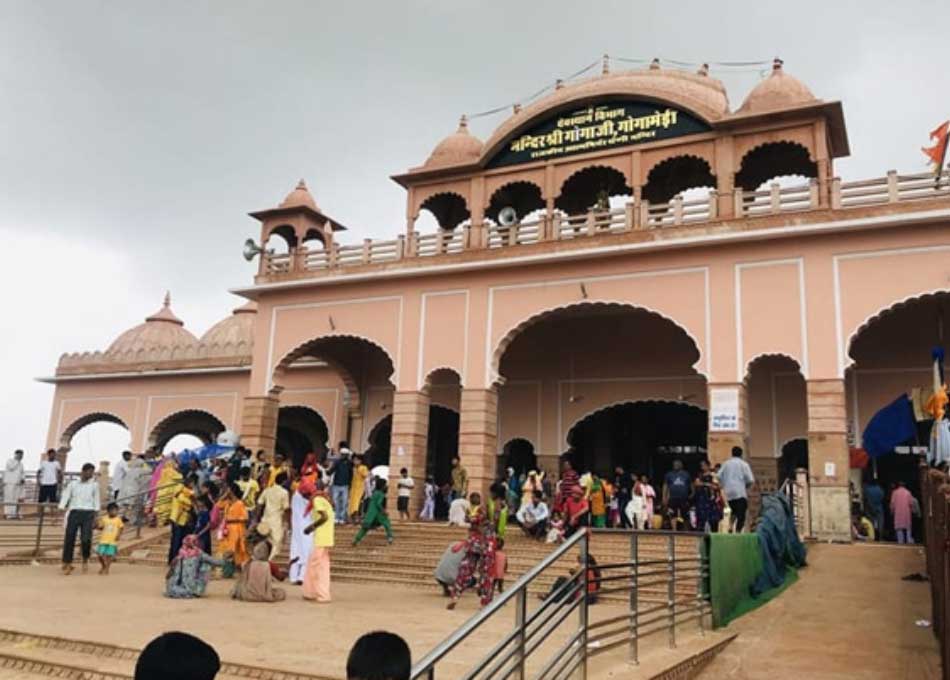
Gogamedi, a Shared Sacred Geography Under Siege
Located in the Hanumangarh district of northern Rajasthan, near the fringes of the Thar Desert, Gogamedi is not merely a pilgrimage site but a living archive of north-western India’s syncretic past. The shrine, popularly known as Gogamedi, is dedicated to Gogaji Chauhan, also revered as Jaharveer Gogga, a 11th century medieval Rajput warrior-saint whose veneration cuts across religious boundaries. For centuries, Gogamedi has drawn Hindu and Muslim devotees alike—peasants, pastoralists, warriors, and traders—making it one of the rare sacred spaces in Rajasthan where religious identity has historically been secondary to lineage, memory, and shared devotion.
It is precisely this inclusive character that has recently come under strain. On January 26 this year, Riddhima Sharma, a Jaipur-based social media influencer, visited Gogamedi and posted videos and statements that were widely perceived as communal and inflammatory. Circulated extensively on social media, the content appeared to question the legitimacy of Muslim participation at the shrine and deployed a language of exclusion alien to Gogamedi’s lived traditions. The episode led to public confrontations at the site and drew condemnation from local devotees and Rajput organisations like Kshatriya Parishad , who accused Sharma of attempting to communalise a shrine historically rooted in Hindu–Muslim coexistence.
What unfolded at Gogamedi was not an isolated provocation by an individual influencer. It was symptomatic of a broader political project—one that seeks to recast shared folk shrines into narrowly defined, Brahminical Hindu spaces, erasing inconvenient histories and displacing long-standing custodial communities. Gogamedi, with its Rajput genealogy and Muslim priesthood, stands as a stubborn obstacle to this project. Hindutva, the political project that this country is under siege currently from, is both Brahmanical and exclusivist.
Gogamedi, Gogaji Chauhan, and the Rajput Custodianship of a Shared Cult
Gogaji Chauhan, also known as Jaharveer Gogga, occupies a distinctive place in north-western India’s folk-historical memory.
To understand why Gogamedi resists easy communal categorisation, one must return to the figure of Gogaji Chauhan himself. Remembered in bardic traditions, oral epics, and folk memory as a protector of pastoralists and farmers, Gogaji was a Chauhan Rajput chief of Jangaldesh or Dadarewa (present-day Churu district) and a contemporary of Mahmud of Ghazni as per historians like Dasarath Sharma, RC Temple and sources like Kayamkhan Raso and Jain text Shrawak-Viatudi-Atichar. These historical references tell us that he was a feudal under the Imperial Chauhans of Rajasthan and the region he ruled, from Fazilka in Haryana to Dadrewa in Churu was called Chayalwara, after the Chauhan subclan – Chayal, to which he belonged.
During the era of Firoz Shah Tughlaq, many Chayal chiefs embraced Islam under the influence of Sufis, one of which was Dadrewa’s Raja Karamchand Chauhan, who became Kayamkhan. His and his brother’s descendants, collectively called Kayamkhanis, have produced excellent soldiers to this day, including many who have been awarded Vir Chakras and Sena Medals. The cities of Jhunjhunu and Fatehpur (near Sikar) were founded by Nawab Mohammad Khan and Nawab Fateh Khan – both Kayamkhani rulers.
Hence, unlike Sanskritic deities absorbed into Brahminical ritual hierarchies, Gogaji belongs to the world of historical figures turned folk hero-saints—figures whose authority emerged from martial ethics, local sovereignty, and popular reverence rather than scriptural sanction.
A crucial, often deliberately obscured fact is that the chief priests of Gogamedi have historically been Muslim Rajputs of the Chayal (Chauhan) lineage, regarded as descendants of Gogaji himself. Their presence is not a later “accommodation” but intrinsic to the shrine’s history. In Rajasthan’s folk religious landscape, lineage frequently outweighs doctrinal religion, and Gogamedi exemplifies this logic. The priesthood here is hereditary, tied to blood and ancestry rather than to Brahminical ritual qualifications.
Gogamedi is also part of a wider constellation of shrines associated with the five Panchpirs of Rajasthan, all of whom are remembered in regional tradition as Rajput warrior-saints – some of them are Pabuji Rathore, Mehaji Mangliya, Ramdevji Tomar and Harbuji Sankhla. In each of these shrines, custodianship has historically remained with the saint’s own descendants, irrespective of whether they identify today as Hindu or Muslim. This pattern unsettles modern communal frameworks but makes perfect sense within the pre-colonial social world of the region.
Far from being a marginal or neglected site, Gogamedi has repeatedly served as a space of political and social convergence. In June 2025, the town hosted a meeting attended by members of BAMCEF (an Ambedkarite organization) and its Rajput offshoot-wing KMM, with participation from both Hindu and Muslim Rajputs. These gatherings underscored Gogamedi’s continuing role as a node of Rajput solidarity cutting across religious lines—an aspect rarely acknowledged in mainstream narratives.
The shrine’s inclusive ethos was also formally recognised by the princely state. In 1911, Maharaja Ganga Singh Rathore of Bikaner undertook the renovation of the Gogamedi complex. Importantly, this was a vital act of historical preservation. Ganga Singh ensured that the Muslim priests of Chayal Chauhan ancestry were accorded due respect by Hindu devotees, granted state patronage, and paid for their maintenance as descendants of Gogaji Chauhan. The Bikaner ruler’s intervention reinforced the shrine’s syncretic and Rajput-centric character.
Gogamedi, therefore, is not simply a symbol of abstract Hindu–Muslim harmony. It occupies a unique socio-political position, binding Hindu Rajputs and Muslim Rajputs—particularly Kayamkhanis—into a shared sacred and historical universe. Any attempt to communalise the shrine necessarily threatens this fragile but enduring bond.
Influencer Politics, Brahminical Assertion, and the Targeting of a Rajput Shrine
Against this historical backdrop, the actions of Riddhima Sharma acquire a sharper political meaning. Sharma is not a local devotee shaped by Gogamedi’s traditions but a Brahmin influencer from Jaipur, whose social media persona is built around performative religiosity and viral provocation. Her intervention at Gogamedi was not an innocent act of devotion but an intrusion into a space structurally and historically divorced from Brahminical authority. What was at stake was more than a generic Hindu–Muslim tension.
The language deployed, and the specific focus on Muslim priests, pointed towards an attempt to engineer fissures between Hindu Rajputs and Muslim Rajputs, particularly Kayamkhanis, who have long been integral to the region’s political and social fabric. By questioning Muslim custodianship, such interventions seek to delegitimise Rajput lineage-based authority and replace it with a Brahmin-centred religious hierarchy.
This is a familiar pattern. Across north India, shared folk shrines—whether associated with warrior-saints, pastoral deities, or local pirs—are increasingly being targeted for “purification”. The process typically involves reframing the shrine within a Sanskritic idiom, introducing Brahmin priests, marginalising hereditary custodians, and reinterpreting history to align with a homogenised and Brahminised Hindu identity. Gogamedi’s resistance to this process lies precisely in its Rajput genealogy and Muslim priesthood, which together obstruct the consolidation of Brahminical socio-political supremacy.
Seen in this light, the Gogamedi episode is less about one influencer’s statements and more about a struggle over power, memory, and control. Control over the shrine implies control over donations, narratives, and regional influence. Displacing Muslim Rajput priests would not only communalise the site but also dismantle a long-standing Rajput polity in the region—one that has historically operated outside Brahminical mediation.
The backlash therefore, should not be read as a mere defensive reflex. It represents a conscious assertion that Gogamedi belongs to a non-Brahminical, lineage-based sacred order, and that attempts to hijack the Gogaji cult into a Brahminical socio-political structure amount to historical distortion and cultural aggression.
Conclusion: Defending Gogamedi Is Defending History Itself
The controversy surrounding Gogamedi is a reminder that India’s religious past is far messier, richer, and more plural than contemporary political projects allow. Shrines like Gogamedi survived precisely because they resisted rigid boundaries—between Hindu and Muslim, between priest and warrior, between devotion and lineage. To communalise such spaces is not to “protect” tradition but to falsify it.
What is unfolding at Gogamedi today is a test case.
Will shared sacred spaces be allowed to exist on their own historical terms, or will they be forcibly assimilated into a homogenised religious order that privileges one caste and one narrative over all others? Defending Gogamedi is not merely about preserving harmony; it is about defending the right of history to remain complex, uncomfortable, and inclusive. In that sense, the struggle over Gogamedi is not peripheral.
It goes to the heart of how India chooses to remember itself.
Related:
गोगामेड़ी: राजपूत–मुस्लिम परंपरा और उस पर होते सांप्रदायिक दावे