
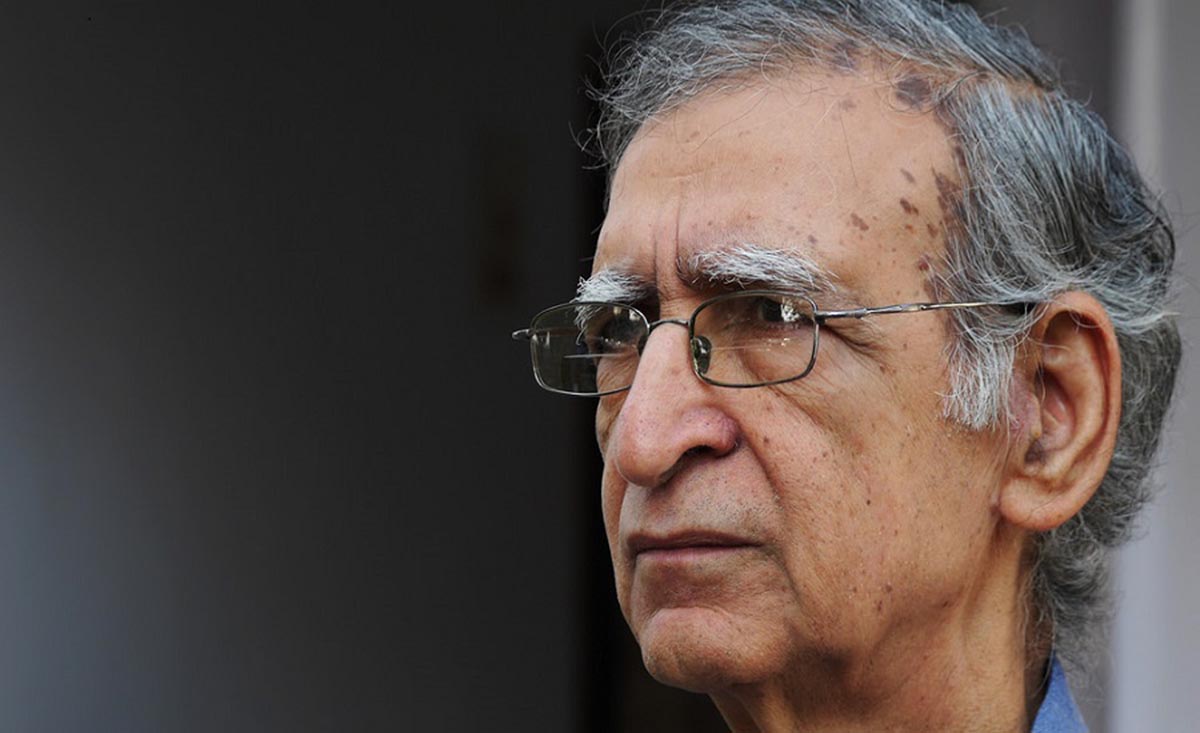
Born on August 25, 1945 Dr Ram Puniyani turns 81 today. After 27 years at the Bombay Indian Institute of Technology (IIT), for the past decades he has been engaged in lecturing and training activists and citizens on the issue of secularism. More recognised for his singular target, Hindu communalism, Puniyani has authored several books and articles on the subject.
Ram Puniyani as he is known, has crisscrossed the country holding training workshops on communal harmony, the historical growth of Hindu communalism etc. He is currently the chairperson of the Centre for Study of Society and Secularism (CSSS) founded by the late, Dr Asghar Ali Engineer.
The far Hindu right’s tortured bid to appropriate Dr Babasaheb Ambedkar, the architect of India’s constitution evolved into a book by Puniyani, first exclusively featured on Sabrangindia on the eve of Constitution Day (November 26, 2016) on November 18 that year. The book, Ambedkar, Hindutva and RSS has been widely used by activists especially in Maharashtra. The excerpt may be read here. Another article by him exposing the hypocrisy and authoritarianism behind the Hindu right’s obsessive vegetarianism may be read here. In this article, apart from other historically significant details, Puniyani points out that Hitler who unleashed the biggest ever pogroms in history of modern times was a vegetarian! Significantly, Puniyani drew the connection in the anti-Buddhist (pro Brahmanism) stance of the supremacist Hindu right in their attempts to denigrate Emperor Asoka in this article that may be read here.
In March 2019, Dr Ram Puniyani was the subject of threats to his life from right wing goons; this too was exclusively covered by us at Sabrangindia and may be referred to here. Ram Puniyani had then written to the then Mumbai Police Commissioner about receiving threats and even met the Mumbai Jt CP with a delegation of other citizens. Reports may be read here and here. He was then granted round the clock protection.
A brief bibliography of his pamphlets and books, as medical professional and secular activist doyen (sourced from Wikipedia) is impressive:
- Clinical Hemorheology: New Horizons(New Age International, 1996), Applied Clinical Hemorheology (with Hideyuki Nimi, Quest Publications, 1998)
- The Other Cheek: Minorities under Threat(Media House, 2000), Second Assassination of Gandhi (University of Leicester, 2002),
- Communalism: What is False: What is True(with Khalid Azam, Bombay Sarvoda Friendship Center, 2002)
- Communal Politics: Facts Versus Myths(2003)
- Communalism: Illustrated Primer(Safdar Hashmi Memorial Trust and J&P Publications, 2004)
- Hindu Extreme Right-Wing Groups : Ideology and Consequences(Media House, 2004)
- Fascism of Sangh Parivar(Media House, 2004)
- Religion, Power and Violence: Expression Of Politics In Contemporary Times, (SAGE, 2005)
- Contours of Hindu Rashtra: Hindutva, Sangh Parivar And Contemporary Politics(Kalpaz, 2006)
- Indian Democracy, Pluralism and Minorities(Global Media, 2006)
- The Politics behind Anti-Christian Violence(compilation of investigation committee reports, Media House, 2006) Terrorism: Facts versus Myths (Pharos Media, 2007)
Several secular national parties have conducted workshops conducted by Dr Ram Puniyani. As stated by the CSSS today on the occasion of Dr Puniyani turning 81:
“Dr. Ram Puniyani’s strength was that developing a deep understanding about the root causes of communal conflict and violence, he could explain it even to the grassroot activists in a language and manner they could easily understand. His central point would be that what appears superficially as violence between the followers of two religions has deeper roots and causes. Communal identities and conflicts appeared in India during colonial period and as a result of colonial exploitation of India and their divide and rule policy. India was transitioning from feudalism to introduction of capitalist mode of production controlled by the colonial power. Religion based communal identities emerged as a result, and were encouraged by the British rulers. The communal elite supported the British rulers and sought their patronage for a greater share vis-à-vis the rival community. This struggle for greater share within the colonial governance framework resulted in deepening communal identities and in violent conflicts. To simplify this complex process, while addressing workshops, Dr. Ram Puniyani would enact with his word power the feudal rulers and their culture, the transition to colonial rule by his typical “rail, mail and jail” allegory. He argued that the feudal classes, which were being increasingly weakened due to introduction of capitalist mode of production by the colonial rulers resorted to communal identity politics. He used humour and constantly engaged the participants of the workshop in a conversational mode. The participants would return with an enriched understanding of the root causes of communalism and communal nationalism. He would end his two-day presentation with the shared and composite culture of India and shared secular nationalism. The rise of Sangh Parivar’s fascist ideology was just not against the minorities, but also against all the socially and economically marginalised communities, viz. the Dalits, women, the working class, and the farmers.”
Dr Puniyani is the recipient pf several prestigious awards – Indira Gandhi Award for national integration, the Communal Harmony Award, which is awarded by National Communal Harmony Foundation under the Ministry of Home Affairs, Mukundan Menon Award for Journalism, just to name a few.
SabrangIndia and Citizens for Justice and Peace (CJP) take the opportunity of his 81st birthday to wish only more such dedicated proselytising from the gentle Dr Ram Puniyani.
–Editors
Related:
Nationalism | Religion | Hate | Violence | History : Ram Puniyani with Teesta Setalvad