
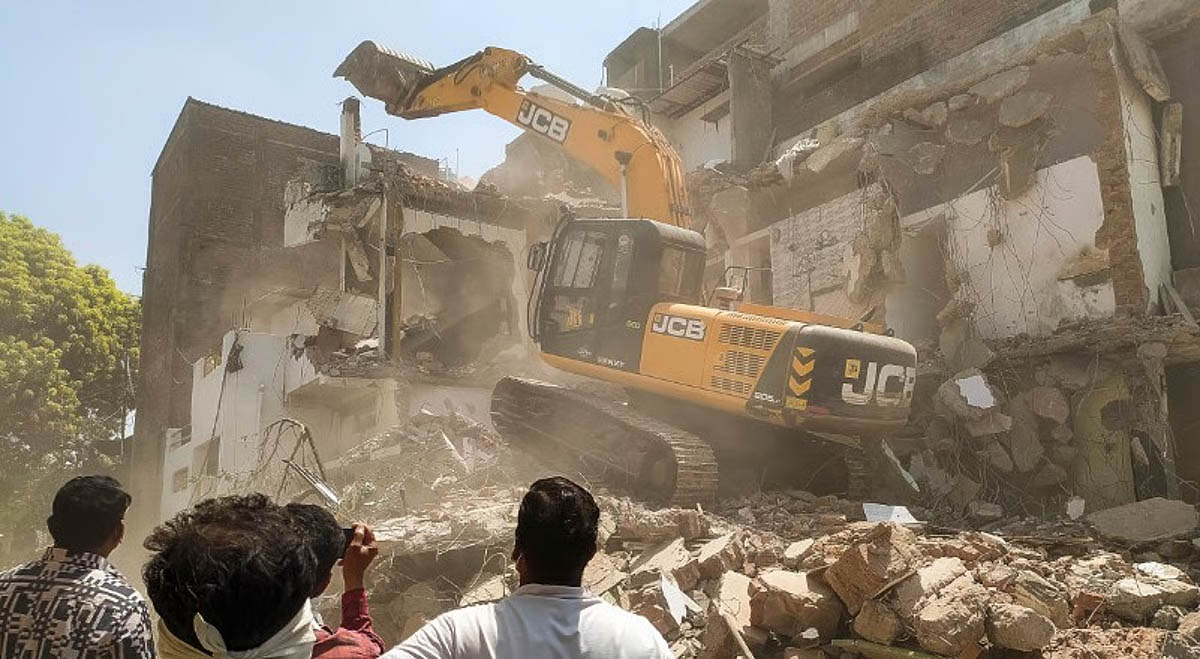
In a sharp intervention that could reshape the legal boundaries of demolition drives linked to criminal allegations, the Nagpur bench of the Bombay High Court has asked the Nagpur Municipal Corporation (NMC) whether it intends to rebuild the demolished residence of riot accused Fahim Khan or compensate the family for the loss.
Hearing a petition filed by Khan’s 69-year-old mother, Mehrunissa Shamim Khan, a division bench of Justices Anil Kilor and Raj Wakode observed that the demolition appeared, prima facie, to have been carried out without adhering to binding procedural safeguards laid down by the Supreme Court of India. The civic body has been directed to file a clear response by March 4 stating whether it will reconstruct the structure or offer monetary compensation.
The question posed by the bench was pointed: if due process was not followed, how will the State repair the damage?
The Demolition: Swift action, lasting consequences
Fahim Khan, 38, was arrested following communal violence that broke out on March 17, 2025 in Nagpur’s Mahal area. The unrest followed alleged inflammatory remarks concerning the tomb of Mughal emperor Aurangzeb in Chhatrapati Sambhajinagar.
Within days of Khan’s arrest, the NMC issued notices under the Maharashtra Regional and Town Planning Act and demolished his three-storey residence in Sanjaybagh Colony on March 25, 2025. Although an urgent plea was moved before the high court and a stay was granted by a bench led by Justice Nitin Sambre, the structure had already been razed by the time the interim protection came into effect.
The demolition left the family without shelter. They have maintained that no meaningful opportunity to respond was provided and that the property had secured necessary permissions as early as 2003, with no objections raised for over two decades.
Khan, who had contested the 2024 Lok Sabha election against Union minister Nitin Gadkari, denies the riot allegations and claims the action was arbitrary. Of the more than 120 persons arrested in the riots case, a majority have since been granted bail or anticipatory bail.
Supreme Court’s anti-demolition safeguards
The high court proceedings turn crucially on a November 13, 2024 judgment of the Supreme Court of India delivered by a bench led by former Chief Justice Bhushan Gavai. In that ruling, the apex court categorically held that demolitions cannot be used as a punitive measure merely because a person is accused in a criminal case.
The Supreme Court mandated:
- Issuance of prior notice,
- A minimum of 15 days to respond,
- Strict adherence to statutory procedure independent of criminal proceedings.
Detailed report may be read here.
Counsel for the petitioner argued that the March 21, 2025 notice violated these safeguards and that the demolition amounted to unconstitutional executive overreach.
Notably, during earlier hearings, Nagpur Municipal Commissioner Abhijeet Chaudhari tendered an unconditional apology before the high court, stating that officials were unaware of the Supreme Court’s specific directions governing demolitions in such contexts.
More Than One House: A constitutional test
While the immediate dispute concerns a single property, the implications extend far beyond Sanjaybagh Colony.
The court’s framing of the issue — rebuild or compensate — shifts the discourse from mere procedural lapse to state accountability. If the demolition is ultimately found to have violated Supreme Court guidelines, the remedy may not be limited to declaratory relief. Reconstruction or financial compensation would signal judicial willingness to impose tangible consequences for executive overreach.
The case also reopens the broader national debate around so-called “bulldozer action,” where demolition drives have followed criminal accusations, particularly in communally sensitive contexts. Courts across the country have repeatedly underscored that urban planning enforcement cannot morph into retributive punishment.
At stake are foundational constitutional principles:
- Article 14 — equality before the law and protection against arbitrary state action,
- Article 21 — protection of life and personal liberty, which judicial interpretation has long held to include the right to shelter and dignity,
- The doctrine of due process, which restrains executive discretion.
If municipalities are permitted to demolish properties immediately after arrests without strict procedural compliance, the line between law enforcement and punishment blurs dangerously.
The March 4 hearing will likely determine whether the NMC acknowledges procedural violations and what corrective mechanism it proposes. The court may require compensation, order reconstruction, or lay down further guidelines to ensure compliance with Supreme Court directions.
Whatever the outcome, the case is poised to become a benchmark in assessing the enforceability of anti-bulldozer jurisprudence. A clear order mandating restoration or compensation would reinforce that constitutional safeguards are not advisory — they are binding. Conversely, a weak remedy could dilute the deterrent effect of the Supreme Court’s 2024 ruling.
Related:
When the Rule of the Bulldozer Outpaces the Rule of Law: One year after this landmark judgment
Bulldozer Justice: you can’t just roll in with bulldozers and demolish homes overnight: SC
“Bulldozer barbarism”: Demolition drive in Surat after stones thrown at Ganesh pandal