
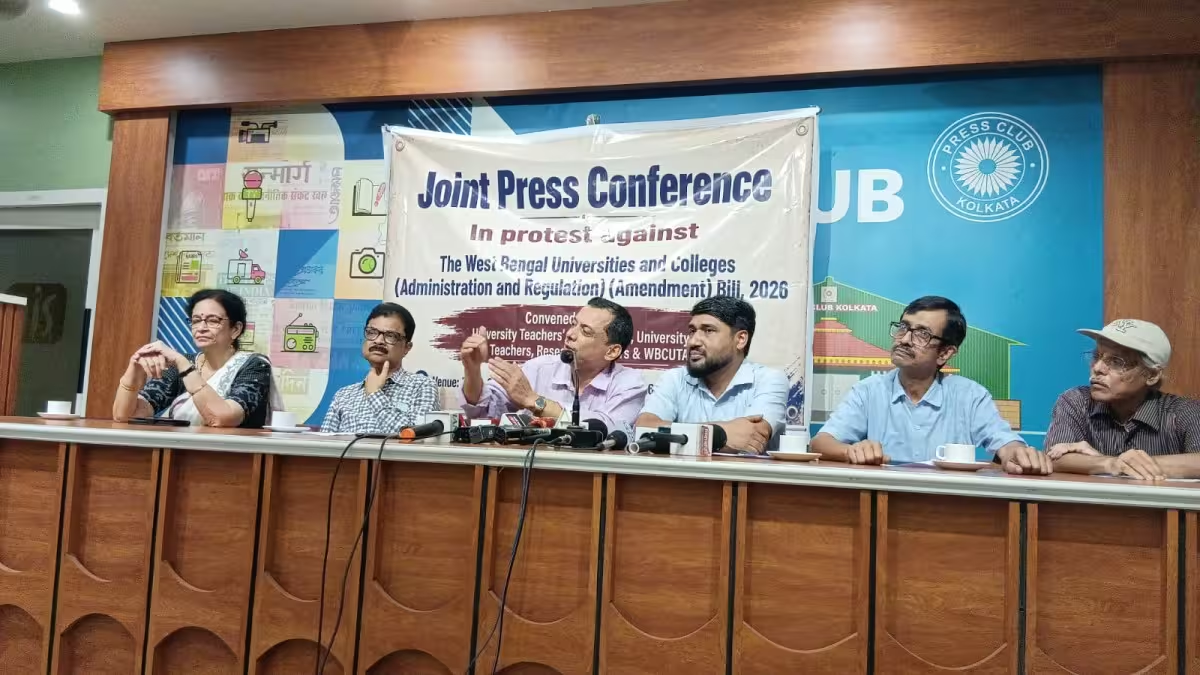
Senior academics from across various institutions in West Bengal and other states have, in a recently writer, open letter written to the Governor of West Bengal, R.N.Ravi appealing him to desist giving consent to the West Bengal Universities and Colleges (Administration and Regulation) (Amendment) Bill, 2026, which, in their view will affect functioning and autonomy. The bill was passed in the Assembly on 10 September 2026. It would allow transfer of academic and non-academic staff between various state universities.
The Open letter may be read below:
To
The Hon’ble Governor of West Bengal Lok Bhavan, Kolkata
Your Excellency,
We are senior academics from various institutions in West Bengal and elsewhere in India. We are writing to express our deep concern about the West Bengal Universities and Colleges (Administration and Regulation) (Amendment) Bill, 2026. The bill was passed in the Assembly on 10 September 2026. It would allow transfer of academic and non-academic staff between various state universities.
The reasons for our concern are both academic and procedural. The crucial academic issues are as follows:
- Each university is a distinct organic entity with its own rationale, structure and programmes of It appoints its faculty in accord with these factors. To move staff from one institution to another would impair the structural balance of both institutions and hamper their teaching and research programmes. Such programmes cannot be readily revised or interchanged.
- Taught courses and research orientation programmes are planned by and for particular teachers and would be impeded if they were transferred. Research work would be no less affected. A university has specialized faculty who attract fresh researchers in that field. Laboratory and library facilities are developed to provide for those special If those faculty members are transferred, young research students would be left without resort. The material resources would lie unused or underused, while the human resources – i.e., the relevant faculty – would be underemployed at a new institution.
- Major research funding is invariably linked to the assurance of expert faculty members as Principal Investigators. No funder would agree to fund a project without this assurance. Interdisciplinary and multi-institutional projects would be especially On the other hand, the presence of core senior faculty in the field ensures a succession of projects, creating a node of research excellence. This is the case with many of our older universities. Transfer of faculty would impair the working of these research nodes.
- At this point of time, even those older universities are impoverished of resources, material and human. Hundreds of posts are lying This is a particularly bad moment to deplete them of their remaining faculty.
- We are anxious that the new universities should be developed productively, but this cannot be done by sporadic transfer of faculty from elsewhere. At present, all or most of the new universities are grossly lacking in staff, infrastructure and facilities. Some of them have no full-time teachers at all. These needs must be met with due planning and sufficient funding, with extensive recruitment of permanent staff at all Unless this is done, a handful of teachers brought in on transfer would be left to operate in a vacuum.
- A more fundamental issue must also be Any such move would spell the end of academic autonomy. All the universities would be brought under centralized administrative control. They could no longer develop freely, each according to its bent. Academic productivity would suffer seriously if university faculty felt they could no longer control their own affairs. This is an intangible factor, but its importance cannot be overstated. We would particularly request you to consider this earnest appeal, made based on our lifetime’s experience.
Needless to say, there would also be endless procedural problems in coordinating the different terms of employment at various universities. Above all, there is the fundamental issue of whether faculty originally appointed to non-transferable posts could be subjected to this radical change in their terms of employment. We are not expanding on these legal and administrative issues as we wish to stress the dire academic consequences of the change.
In short, it is our strong opinion that this change, if implemented, would severely affect the functioning of the older and more established universities without material benefit to the new ones. We earnestly appeal to you to consider our arguments and refrain from giving your consent to the bill.
Yours faithfully
(Names in alphabetical order)
Amita Chatterjee, Professor Emerita, Jadavpur University, and former Vice-Chancellor, Presidency University
Amitava Raychaudhuri, former Palit Professor of Physics, University of Calcutta and former Director, Harish-Chandra Research Institute (DAE), Prayagraj
Anup Sinha, former Professor of Economics, Indian Institute of Management, Calcutta
Anupam Basu, Raja Ramanna Professor, Jadavpur University; former Professor of Computer Science and Engineering, Indian Institute of Technology, Kharagpur; former Director, National Institute of Technology, Durgapur
Ashok Ranjan Thakur, former Vice-Chancellor, West Bengal State University and Maulana Abul Kalam Azad University of Technology
Partha Chatterjee, former Director, Centre for Studies in Social Sciences, Calcutta
Partha P. Majumdar, Emeritus Professor, Indian Statistical Institute, and former National Science Chair
Sabyasachi Basu Ray Chaudhury, former Vice-Chancellor, Rabindra Bharati University
Sabyasachi Bhattacharya, Professor Emeritus, former Director and Distinguished Professor, Tata Institute of Fundamental Research
Samaresh Bhattacharya, Former Professor, Department of Chemistry, Jadavpur University and recipient of Shanti Swarup Bhatnagar prize
Sobhanlal Datta Gupta, former S.N. Banerjee Professor of Political Science, University of Calcutta
Siddhartha Datta, former Professor of Chemical Engineering and former Pro-Vice-Chancellor, Jadavpur University
Sukanta Chaudhuri, Professor Emeritus, Jadavpur University Supriya Chaudhuri, Professor Emerita, Jadavpur University
Related:
I AM MALALA! Afghanistan or Ahmedabad why are fundamentalists wary of the right to education?