
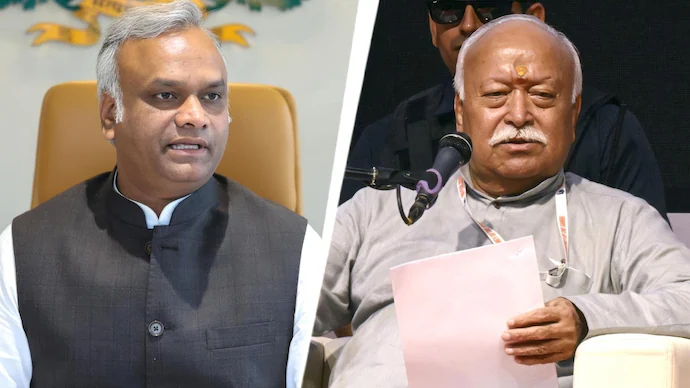
A recent announcement/decision by Karnataka’s Home Minister, Priank Kharge has generated huge comment and discussion. Taking on the otherwise secretive functioning’s of the far right and hugely financed behemoth, the RSS, that celebrates its centenary year this ongoing g year, Kharge has requested, in a politely worded communication that the RSS disclose its registration details, pay taxes, comply with the law and Constitution.
Kharge went public with this intention last week and today made public a detailed letter that he posted on ‘X’, the afternoon of Monday June 15. In this post, addressing the RSS Supremo, Mohan Bhagwat, the Karnataka’s home minister around 4 p.m., said, “My letter will reach you shortly. However, I thought it was important to draw your attention to this matter early. Firstly, congratulations to the RSS on completing 100 years. An organisation that claims over 60,000 shakhas and crores of swayamsevaks must also uphold transparency and constitutional accountability. As per RSS’ highest and most important decision-making body Akhil Bharatiya Pratinidhi Sabha’s 2025–26 Karnataka report, the RSS has 4,127 daily shakhas, 1,389 weekly milans, 60 monthly mandalis, 2,194 Samajotsavas with 19.61 lakh participants and held 562 route marches with 2.21 lakh uniformed participants in the state. With such scale and influence, the RSS must clarify its legal status, registration, office bearers, funding, expenditure, taxation and permissions for public activities. If citizens, labour, NGOs, trusts, temples and companies are expected to register, disclose and comply with the law, why should the RSS remain exempt? In its centenary year, the RSS must responsibly abide by the Constitution and register, disclose, pay applicable taxes and function transparently within the Constitution.” The letter is signed off by Priyank Kharge, Minister for Home, Information Technology & Biotechnology and e-Governance and has created ripples already.
Dear Shri Mohan Bhagwat ji,
My letter will reach you shortly. However, I thought it was important to draw your attention to this matter early.
——————————-Firstly, congratulations to the RSS on completing 100 years.
An organisation that claims over 60,000 shakhas and crores of… pic.twitter.com/IZy4oeKdMp
— Priyank Kharge / ಪ್ರಿಯಾಂಕ್ ಖರ್ಗೆ (@PriyankKharge) June 15, 2026
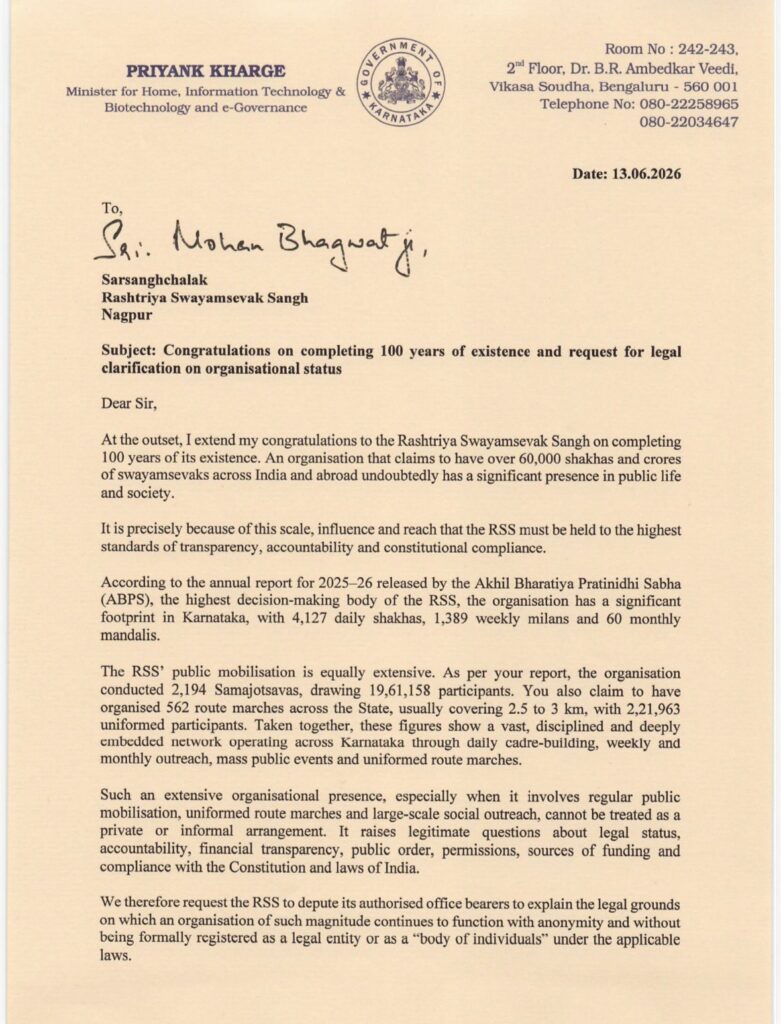
The text of the letter may be read below:
Date: 13.06.2026
To,
Shri Mohan Bhagwat
Sarsanghchalak Rashtriya Swayamsevak Sangh Nagpur
Subject: Congratulations on completing 100 years of existence and request for legal clarification on organisational status
Dear Sir,
At the outset, I extend my congratulations to the Rashtriya Swayamsevak Sangh on completing 100 years of its existence. An organisation that claims to have over 60,000 shakhas and crores of swayamsevaks across India and abroad undoubtedly has a significant presence in public life and society.
It is precisely because of this scale, influence and reach that the RSS must be held to the highest standards of transparency, accountability and constitutional compliance.
According to the annual report for 2025-26 released by the Akhil Bharatiya Pratinidhi Sabha (ABPS), the highest decision-making body of the RSS, the organisation has a significant footprint in Karnataka, with 4,127 daily shakhas, 1,389 weekly milans and 60 monthly mandalis.
The RSS’ public mobilisation is equally extensive. As per your report, the organisation conducted 2,194 Samajotsavas, drawing 19,61,158 participants. You also claim to have organised 562 route marches across the State, usually covering 2.5 to 3 km, with 2, 21,963 uniformed participants. Taken together, these figures show a vast, disciplined and deeply embedded network operating across Karnataka through daily cadre-building, weekly and monthly outreach, mass public events and uniformed route marches.
Such an extensive organisational presence, especially when it involves regular public mobilisation, uniformed route marches and large-scale social outreach, cannot be treated as a private or informal arrangement. It raises legitimate questions about legal status, accountability, financial transparency, public order, permissions, and sources of funding and compliance with the Constitution and laws of India.
We therefore request the RSS to depute its authorised office bearers to explain the legal grounds on which an organisation of such magnitude continues to function with anonymity and without being formally registered as a legal entity or as a “body of individuals” under the applicable laws.
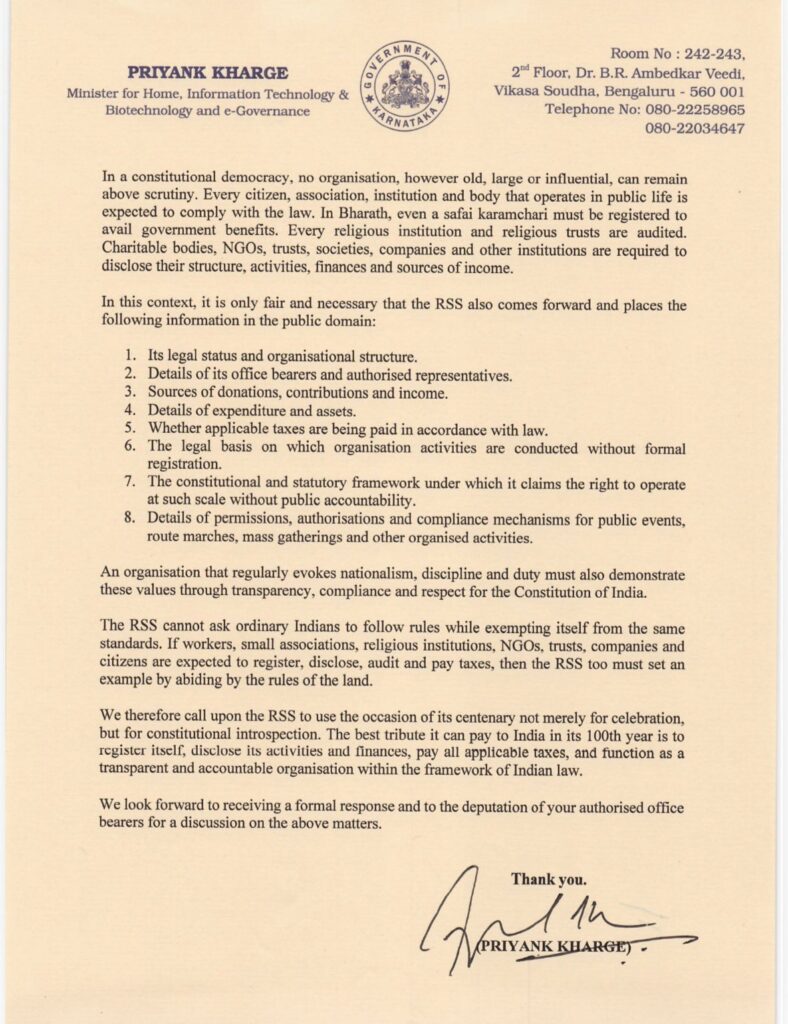
In a constitutional democracy, no organisation, however old, large or influential, can remain above scrutiny. Every citizen, association, institution and body that operates in public life is expected to comply with the law. In Bharath, even a safai karamchari must be registered to avail government benefits. Every religious institution and religious trusts are audited. Charitable bodies, NGOs, trusts, societies, companies and other institutions are required to disclose their structure, activities, finances and sources of income.
In this context, it is only fair and necessary that the RSS also comes forward and places the following information in the public domain:
- Its legal status and organisational structure.
- Details of its office bearers and authorised representatives.
- Sources of donations, contributions and income.
- Details of expenditure and assets.
- Whether applicable taxes are being paid in accordance with law.
- The legal basis on which organisation activities are conducted without formal registration.
- The constitutional and statutory framework under which it claims the right to operate at such scale without public accountability.
- Details of permissions, authorisations and compliance mechanisms for public events, route marches, mass gatherings and other organised activities.
An organisation that regularly evokes nationalism, discipline and duty must also demonstrate these values through transparency, compliance and respect for the Constitution of India.
The RSS cannot ask ordinary Indians to follow rules while exempting itself from the same standards. If workers, small associations, religious institutions, NGOs, trusts, companies and citizens are expected to register, disclose, audit and pay taxes, then the RSS too must set an example by abiding by the rules of the land.
We therefore call upon the RSS to use the occasion of its centenary not merely for celebration, but for constitutional introspection. The best tribute it can pay to India in its 100th year is to register itself, disclose its activities and finances, pay all applicable taxes, and function as a transparent and accountable organisation within the framework of Indian law.
We look forward to receiving a formal response and to the deputation of your authorised office bearers for a discussion on the above matters.
Thank you.
PRIYANK KHARGE.
The RSS Supremo was quoted by social media users in a video stating that Responding to a query during a program in #Thrissur, Mohan Bhagwat said the RSS has always functioned openly and never operated in secrecy. “We are not secretive; we are working on open ground. Our shakhas are held in public spaces, our karyakartas live in localities, and people see them daily. We have enormous outreach programs, including Hindu Sammelans in every block this year,” he stated.
Mohan Bhagwat emphasized that the Sangh has faced similar challenges since its inception. “After 10–15 years of starting Sangh, we had to face all these things. We are used to it. If they don’t happen, we feel something is amiss,” he remarked, adding that the organization was born out of “public will” during British rule. He pointed out that the RSS had been banned twice in the past, but the bans were lifted, once through a court order and once through satyagraha.
“Government knows Sangh is there. Our constitution was submitted to the government in the 1950s. Nobody told us to register. Hindu Dharma is not registered. Many things are not registered. So why should I respond? All this is politics. Nothing serious,” Bhagwat said.
The RSS chief accused political opponents of attempting to “hamper Sangh work” and “create doubts in the minds of people,” but insisted such efforts would fail, as “people know us.”
Related:
Appeal by Adivasi-Mulvasi leaders to Jharkhandis: Protect Birsa Munda’s legacy from the RSS
Womens Reservation Bill 2026: Women’s Rights & the RSS
Denigration of martyrs like Bhagat Singh, Rajguru, Sukhdev – a peep into RSS archives