
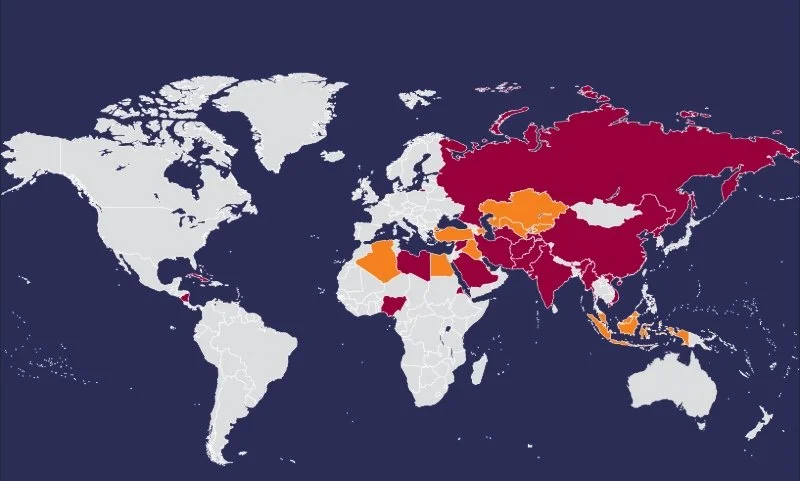
The weekend saw the release of the 2026 Annual Report of the U.S. Commission on International Religious Freedom (USCIRF). While the US government as an entity I facing widespread criticism for its violation of international law, humanitarian principles and more in the ongoing war launched with Israel against Iran, the USCIRF, is an independent, bipartisan advisory body and while its recommendations are not automatic policy, its reports do shape policy conversations, public understanding, and the terms of international scrutiny.
Excerpts from the India section of the 2026 Annual Report:
“In 2025, religious freedom conditions in India continued to deteriorate as the government introduced and enforced new legislation targeting religious minority communities and their houses of worship. Several states undertook efforts to introduce or strengthen anti-conversion laws to include harsher prison sentences. Indian authorities also facilitated widespread detention and illegal expulsion of citizens and religious refugees and tolerated vigilante attacks against religious minority communities.
“Throughout the year, Hindu nationalist mobs across several states harassed, incited, and instigated violence against Muslims and Christians with impunity. In March, violence erupted in Maharashtra after a hard-line Hindu nationalist group, the Vishwa Hindu Parishad (VHP), called for the removal of the tomb of Aurangzeb, a 17th-century Mughal ruler. Subsequent riots injured dozens of people and resulted in a curfew, fuelled by rumours from Bharatiya Janata Party (BJP) officials that Qur’ans were desecrated in VHP-led protests. In June, a Hindu nationalist mob attacked 20 Christian families in Odisha after they refused to convert to Hinduism. The attacks, which did not prompt police intervention, left eight people injured and hospitalised.
“In April, three gunmen attacked a group of predominantly Hindu tourists in the Muslim-majority territory of Kashmir, killing 26 people. The perpetrators reportedly asked the victims to recite the Kalma, an Islamic verse, and killed those who were unable to do so. The attack sparked a five-day conflict between India and Pakistan and intensified anti-Muslim sentiment in India, including targeted attacks. Muslims were reportedly killed in Karnataka and Uttar Pradesh in alleged hate crimes following the attack.
“In Uttar Pradesh, self-professed members of a Hindu nationalist group reportedly shot and killed a Muslim restaurant worker, vowing to avenge those killed in the Kashmir attack. The Indian government also seized the aftermath of the attack to justify deportations of religious minorities it considers “illegal” migrants.
“In May, Indian authorities detained 40 Rohingya refugees, including 15 Christians, all of whom were transported into inter-national waters near the coast of Burma and forced to swim to the Burmese shore with nothing more than life vests. In July, Indian authorities expelled hundreds of Bengali-speaking Muslims from Assam to Bangladesh despite being Indian citizens. Officials from the ruling BJP accused those expelled of being Muslim “infiltrators” from Bangladesh, threatening India’s national identity. To further facilitate the crackdown in alleged “illegal migration,” the government passed a new set of rules and orders for the Foreigners Act in September.
“The order expands the authority of Foreigner Tribunals to issue arrest warrants and send those suspected of being “foreigners” to holding centres without due process.
Throughout the year, the government also continued to target houses of worship to bring them under state control.
“In May, India’s Parliament passed the Waqf Bill, which adds non-Muslims to the boards that manage Waqf land endowments that are traditionally staffed by Muslims. These endowments include religious sites, such as mosques, seminaries, and graveyards. In response to the bill, deadly protests erupted in the state of West Bengal, leaving three people dead. In September, the Supreme Court suspended key provisions of the bill, including one in which the government can decide whether a disputed property is Waqf or not. The court further limited the number of non-Muslim members of the federal board to four. The same month, Uttarakhand’s legislative assembly passed the State Authority for Minority Education (USAME) Act, which dissolves the Madrasa Board and brings madrasas and other educational institutions for Sikhs, Buddhists, Jains, Parsis, and Christians under state control.
The USCIRF has made the following recommendations to the US government:
- Designate India as a “country of particular concern,” or CPC, for engaging in and tolerating systematic, ongoing, and egregious religious freedom violations, as defined by the International Religious Freedom Act (IRFA);
- Press India to allow US government entities such as USCIRF and the U.S. Department of State to conduct in-country assessments of religious freedom conditions;
- Impose targeted sanctions on individuals and entities, such as India’s Research and Analysis Wing and the Rashtriya Swayamsevak Sangh (RSS), for their responsibility and tolerance of severe violations of religious freedom by freezing those individuals’ or entities’ assets and/or barring their entry into the United States;
- Link future U.S. security assistance and bilateral trade policies with India to improvements in religious freedom; and
- Enforce Section 6 of the Arms Export Control Act to halt arms sales to India based on continued acts of intimidation and harassment against S. citizens and religious minorities.
The U.S. Congress should:
- Reintroduce and pass the Transnational Repression Reporting Act of 2024 to require the annual reporting of acts of transnational repression by the Indian government targeting religious minorities in the United
Related:
USCIRF signals alarm in India’s ‘Increased Transnational Targeting’ of religious minorities
USCIRF recommends India be designated Country of Particular Concern for third straight year!