
The irony of history is that no matter how determined the victors of the present may be to rewrite it, such efforts invariably set in motion a chain of events that end up contradicting the doctored narrative itself. Despite the immense political power accumulated by the ruling BJP and the Sangh Parivar over the last twelve years (2014-2026), and despite sustained attempts at selective readings of history—spanning academic discourse to popular retellings—they have lost the most crucial battle of all: the battle of legitimacy. This is precisely because the very history the Sangh has sought to rewrite has produced a reality in which the BJP can claim no stalwart of the freedom movement as its own, forcing it instead to appropriate the legacy of Sardar Patel—a lifelong and committed Congressman. Earlier efforts—placing Savarkar’s portrait in Parliament, invoking his name in key speeches by the Prime Minister, and even the recent reference to the RSS in the Independence Day address—have only invited closer scrutiny over the participation of the Sangh Parivar, especially the RSS which recently celebrated its Hundred yeas anniversary.
The rule of law, public trust in institutions and leaders, and the capacity to enforce accountability are all fruits of the trees planted during the freedom struggle. It is politically obvious that all political parties need some moral claim to have contributed to cultivation of these values in the Indian polity. Even many regional parties adopt icons from the Freedom Struggle to claim their legitimacy unless they themselves are resultants of some churn in the 80s or 90s. Examples include DMK adopting Periyar, or the Lohiaite socialist parties of North India. After all, fundamentalist and exclusivist religious nationalism cannot be the source of legitimacy forever.
And, it is also natural that the Congress, and even the Communists, do not have a need to constantly reiterate their contributions; these are etched into collective memory, passed down through generations from Telangana to Jammu and Kashmir, and from Assam to Maharashtra. This, however, is not the case with the Sangh Parivar. For this reason, the political power amassed by the BJP has been repeatedly deployed to weave itself into history. This article examines, with meticulous sincerity, not judgment, the nature and extent of the RSS’s contribution to the freedom struggle.
The Rashtriya Swayamsevak Sangh (RSS)—founded in 1925—presents a particularly complex and paradoxical case. Its existence spanned the zenith of Mahatma Gandhi’s satyagraha campaigns, the agonising political negotiations for self-rule, and the brutal culmination of Partition. Tracking the role of the RSS in the first quarter-century of its formation (1925 to 1950) reveals an organisation that was preoccupied not with overthrowing the colonial power, but with unifying the Hindu populace through quasi-military training and ideological purification, often drawing direct inspiration from Europe’s most destructive authoritarian movements.[1] This examination, drawing on existing extensive scholarship often overlooked by those who seek to whitewash the history of Hindu nationalism, finds the RSS’s contribution to the core anti-colonial struggle to be negligible, if not actively counterproductive, substituting nationalist action for communal consolidation and ideological emulation of colonial systems, albeit unknowingly.[2]
As one of the most important constituents of the current Indian ruling establishment, if not the most important, celebrates 100 years of its existence and now looks to have international influence via lobbying, it is important to examine whether it indeed was what it claims to have been.
I. The Foundation: 1925–1940
The RSS was established on the day of Vijayadashami (Dussehra) in 1925 by Dr. Keshav Baliram Hedgewar, a Telugu Brahmin doctor from Nagpur.[3] Hedgewar’s belief was that the fragmentation and deep social divisions among Hindus were the primary reasons for what he deemed a thousand years of foreign subjugation of the subcontinent.[4] The antidote he envisioned was a rigorous system of training focused on ‘character-building’ (chaaritya nirman), aimed at forging a disciplined cadre of men who would unify the highly pluralistic country and serve as a model for other Indians.[5]
The RSS’s foundational ideology was inextricably linked to the Hindu Mahasabha, sharing the core philosophy of Hindutva as propounded by V.D. Savarkar.[6] Savarkar, whose literary flourish and often ‘merciless and blunt’ prose provided ideological groundwork, defined the nation not by pluralistic geography but by religious and cultural unity, articulating a vision of Hindu Rashtra.[7] Indeed, the close symbiotic relationship between the Mahasabha and the RSS led the colonial government itself to view the Sangh as almost the youth wing of the Mahasabha in its early decades.[8] The Hindu Mahasabha formally commended the activities of the RSS in 1932.[9]
Hedgewar, despite having been involved in the revolutionary movement during his student days in Calcutta and having participated in the Congress movement in 1921, came to reject mainstream politics. As his views progressed, Hegdewar’s hypothesis about the reasons for subjugation of Indian subcontinent region (this in his mind was Hindu society) by Islamic invasions and British colonialism also took shape.[10]
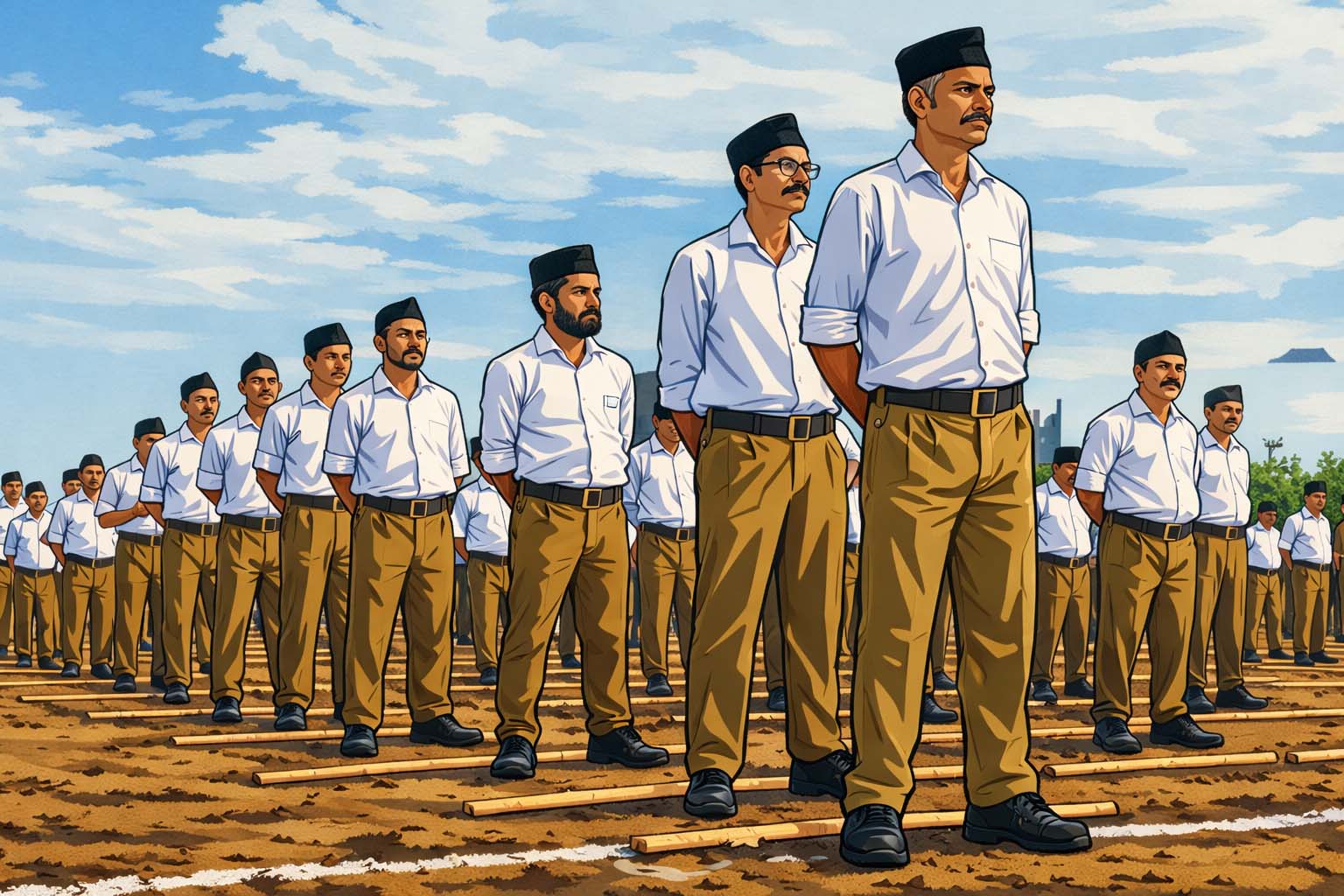
He felt that in the disintegrated state of the country, only a Hindu organisation based on brotherhood and patriotism could secure independence.[11] The RSS focused heavily on establishing daily mandatory assemblies called shakhas, which involved physical exercise, military drills, and weapons training using the lathi (wooden staff).[12]
Critically, writer Nilanjan Mukhopadhyay notes that Hedgewar’s strategy explicitly demanded organisational distance from the core political struggle led by the Indian National Congress. When the Civil Disobedience Movement was launched in 1930, Hedgewar reluctantly participated in a satyagraha in his individual capacity for nine months. However, he intentionally kept the organisation and its members away from the movement. He worried that the RSS’s organisational work would suffer. The prohibition on direct political involvement was a strong message to members desiring action, as the RSS sought to attain the ideal of Hindu Rashtra through man-making and training, believing this goal required no ‘external stimuli’ such as agitations, which were categorized as morally corrupting or rajasik (valorous agitation).[13]
The Shadow of European Fascism: An Analogy
Compounding the RSS’s distance from the anti-colonial movement was its startling admiration for European fascism and Nazism. B.S. Moonje, Hedgewar’s political mentor, was particularly enamoured by these movements. After meeting Benito Mussolini in Italy in 1931, Moonje lauded the fascist youth group, the Opera Nazionale Balilla, for its contribution to Italy’s “military regeneration”.[14] He declared India needed such an institution for the “military regeneration of the Hindus” and believed the realisation of organising Hindus could only occur if India had “a Hindu as a Dictator like…Shivaji of Old or Mussolini or Hitler”.[15] British intelligence reports, assessing the RSS as early as 1933, warned that the Sangh hoped to be to future India what the “Fascist” were to Italy and the “Nazi” to Germany.[16]
The RSS mirrored this emphasis on racial exclusivity in its internal doctrine. M.S. Golwalkar, writing later, expressed admiration for Nazi Germany’s racial policies, specifically the purging of Jews to maintain “racial and cultural purity”. Academic Shamshul Islam notes that Savarkar even suggested that Indian Muslims might have to “play the part of German Jews”.[17] The RSS doctrine asserted that Hindus were the rightful inhabitants and that non-Hindus, categorized as invaders or guests, must fully assimilate or be forced to “live at its mercy”.[18] This emphasis on creating a unified ‘national race’ and preparing cadres through rigorous training, divorced from the anti-colonial movement, positioned the RSS against internal pluralism.
Ironically, this ideological leaning toward a militaristic, exclusionary nationalism aligns functionally with the founding principles of the Zionist project in Palestine. The Zionist project prioritised establishing “Strict communal and Jewish-centred colonies”, perceiving the indigenous Palestinians as an obstacle to national goals. The core Zionist strategy was converting settlement into the main thrust of nationalism, involving demographic control and the extraction of land and jobs.[19]
II. The Era of Acquiescence: 1940–1947
The second phase began with the ascension of Madhav Sadashiv Golwalkar as Sarsanghchalak in 1940. Golwalkar, who had demonstrated an inclination towards spiritual pursuits, placed the highest priority on the continuity of the shakha system and its character-building mission.[20] He was reluctant to engage in direct political action, fearing it would derail the primary task of building the Hindu Rashtra through man-making.[21]
This political aloofness defined the RSS during the Quit India Movement of 1942, the most powerful mass uprising against the British Raj. While many youth were mobilized into the RSS during World War II, the organisation maintained strict neutrality from the movement itself.[22]
The strategic non-participation was openly acknowledged by the British government. A Bombay Home Department report stated that the Sangh had “scrupulously kept itself within the law, and in particular, has refrained from taking part in the disturbances that broke out in August, 1942”.[23] Consequently, the Home Department concluded that the RSS did not represent an “immediate menace to law and order”.[24] This passive collaboration, or active non-opposition, enabled the RSS to focus entirely on its communal project while the Congress bore the full weight of British repression.[25]
During this period, Golwalkar codified the RSS’s exclusionary vision in Bunch of Thoughts. The extensive focus on ‘character-building’ within this work reaffirmed the ideological commitment to identity politics, analysing the forces that united Hindus and separated them from other communities. Golwalkar’s teachings defined nationalism narrowly, rejecting the individualistic principles of democracy and tracing the foundations of modern democracy solely to self-interest and materialism, which he labelled a rakshasi paddhati (demonic system).[26]
The militaristic aspect of the RSS’s character-building served its divisive mission in the run-up to Independence. Between 1942 and 1948, some RSS members in Sindh, for example, received training in handling bombs and hand grenades.[27] This training was primarily organized to address the perceived internal enemy, the Muslim community.[28]
The ideological framework of the RSS during this time strongly embraced the concept of a pure racial nation, justifying the organization’s militant focus.[29] The organisational template used centralized, hierarchical authority, mirroring the disciplinary and militaristic approach necessary for the physical control and consolidation.[30]
III. Partition, Assassination, and Suppression: 1947–1950
The Partition of British India in 1947 fundamentally undermined the RSS’s central goal of a unified territory (Akhand Bharat).[31] Despite this failure, energies were actively channelled into the resultant communal violence, with some members even participating in the partition violence.[32] Renowned Constitutional Law Scholar and Lawyer AG Noorani notes that even Jawaharlal Nehru wrote letters to both Sardar Vallabhbhai Patel and Govind Ballabh Pant about the violent activities of RSS and the need to curb such actions, even as Partition violence was being perpetuated.[33]
The RSS’s rhetoric and actions stood in direct opposition to the path of pluralism championed by Gandhi, who described the RSS as a “communal body with a totalitarian outlook”.[34]
The inevitable crisis arrived on January 30, 1948, with the assassination of Mahatma Gandhi. The killer, Nathuram Godse, had been an RSS member, though he claimed to have left the organisation in 1938.[35] Godse and his co-conspirator, Narayan Apte, ran the virulent communal magazine Agrani (later Hindu Rashtra), which fiercely criticised Gandhi and Nehru for allegedly neglecting Hindu interests.[36] Godse was intrinsically a part of the RSS’s “extended family” at the time of the murder.[37]
A police report cited a meeting attended by Golwalkar in December 1947 where the discussion included proposals to ‘assassinate the leading persons of the Congress in order to terrorise the public.[38]
On February 4, 1948, the Government of India declared the RSS an “unlawful association”.[39] The ban was prompted by the widespread “suspicion of RSS involvement in the assassination of Mahatma Gandhi” and the alleged creation of an environment conducive to “anti-Muslim violence.” Golwalkar was detained on February 3, 1948.[40] Jawaharlal Nehru explicitly criticised the RSS’s “real objectives” as being contrary to the spirit of the Constitution and characterized its activities as “anti-national and often subversive and violent.”[41]
Paradoxically, the RSS responded to the ban by resorting to its first mass agitation, using the Gandhian principle of non-violent resistance (satyagraha) that it had previously shunned as mere politics.[42] The organisation fought for legitimacy, eventually entering into rigorous negotiations with the government.
The ban was lifted on July 11, 1949, contingent upon the RSS adopting a constitution.[43] The RSS pledged in its draft constitution that the organisation would remain “aloof from politics and is devoted to social and cultural fields only”.[44] The government also demanded that the organisation declare allegiance to the national flag and commit to scrutiny of its accounts.[45] Despite these formal concessions for institutional survival, Golwalkar later assured his followers that the organization had “given up nothing” of its core principles, characterizing the required clarification as a mere governmental imposition.[46] The conclusion of this period saw the RSS severely tarnished but ideologically intact, prepared to continue its project of Hindu Rashtra from within the framework of the new Indian state.
The RSS spearheaded exclusivity through its doctrine of Hindutva. Golwalkar’s insistence that non-Hindus, including Muslims and Christians, were “foreigners” who must assimilate or reside at the mercy of the “national race”,[47] finds a direct counterpart in extremist imperative to manage and control the presence of the local ‘other’. Golwalkar’s explicit praise for Nazi Germany’s efforts to maintain racial purity provided a chilling template for dealing with internal minorities.[48]
Moonje’s vision of a Hindu dictator and his emulation of fascist military youth camps defined the RSS’s organizational goal as military regeneration and defence against the “aggressiveness” of non-Hindus. This training was vital for executing communal violence during Partition.[49]
Ironically again, post-1967, the RSS openly celebrated Israel’s “aggressive Zionist militarism” as a symbol of Hindu resurgence, confirming the organisation’s ideological alignment with exclusionary, militant ethnic nationalism as a valid path to realizing “historical destiny”.[50]
The RSS utilised the concept of historical reclamation, asserting that Hindus were the original inhabitants of a territory and that others were invaders, providing the rationale for their subjugation.[51] This ideological framework, rooted in exclusionary and racialist models of nation-building, clearly positions the RSS’s function in its first 25 years as parallel not to a unified anti-colonial front, but to a determined project preparing for ethnic hegemony in the post-imperial era.
Conclusion
RSS’ contribution to the freedom movement, therefore, was negligible. That is said multiple times. What also becomes clear from the above discussion is that the current brute force religious nationalism it espouses or effectuates has seeds in how it saw itself as the harbinger of Hindu nationalism that also spoke with a positive attitude about the then fascist ideologies. However, the most important takeaway from the above discussion is that the if the origins of RSS have any effect on the RSS today (which they obviously do but since we are doing this analysis in a sincere and non-judgmental paradigm), and therefore on the country today—such effects are not positive or inclusive but are exclusionary, virulently communal and dangerous to the idea of India—a secular, diverse and vibrant people’s democracy. If the origins do not have any effect on the RSS, then it does not make sense for the high constitutional and political functionaries of India to “yap” about RSS as if it is an organisation worth its salt.
(The author is part of the legal research team of the organisation)
[1] Pieter Friedrich, Saffron Fascists: India’s Hindu Nationalist Rulers (2020) 49
[2] Jyotirmaya Sharma, Terrifying Vision 49
[3] Walter Andersen and Shridhar D Damle, Messengers of Hindu Nationalism: How the RSS Reshaped India (C Hurst & Co (Publishers) Ltd, 2019) 14; Nilanjan Mukhopadhyay, The RSS Icons of the Indian Right (Westland Publications Private Limited, 2019) 11.
[4] Ibid.
[5] Ibid.
[6] M.S. Golwalkar, Bunch of Thoughts (Vikram Prakashan 1966) 85.
[7] Vikram Sampath, Savarkar Echoes from a Forgotten Past, 1883–1924 (Penguin 2019) 482;
[8] Vikram Sampath, Savarkar: A Contested Legacy, 1924-1966 (Penguin 2020) 390
[9] Pralay Kanungo, RSSs Tryst with Politics 47
[10] Pralay Kanungo, RSSs Tryst with Politics 43.
[11] Jyotirmaya Sharma, Terrifying Vision 216
[12] Walter K Andersen and Shridhar D Damle, Messengers of Hindu Nationalism: How the RSS Reshaped India (Routledge 2019) 91; Pralay Kanungo, RSSs Tryst with Politics 89
[13] Nilanjan Mukhopadhyay, The RSS Icons of the Indian Right 295; Pralay Kanungo, RSSs Tryst with Politics 41
[14] Nilanjan Mukhopadhyay, The RSS Icons of the Indian Right 44
[15] Ibid
[16] Ibid
[17] Shamsul Islam, RSS, School Texts and the Murder of Mahatma Gandhi: The Hindu Communal Project (Sage Publications 2008) 87
[18] Devanura Mahadeva, RSS: The Long and Short of It (2022) 24
[19] lan Pappe, A History of Modern Palestine: One Land, Two Peoples (2nd edn, Cambridge University Press 2006) 54, 41.
[20] Nilanjan Mukhopadhyay, The RSS Icons of the Indian Right 110
[21] Ibid
[22] Nilanjan Mukhopadhyay, The RSS Icons of the Indian Right 109
[23] Walter Andersen and Shridhar D Damle, Messengers of Hindu Nationalism 51
[24] Pralay Kanungo, RSSs Tryst with Politics 84
[25] Nilanjan Mukhopadhyay, The RSS Icons of the Indian Right 110
[26] Jyotirmaya Sharma, Terrifying Vision 24
[27] Jyotirmaya Sharma, Terrifying Vision 163
[28] Jyotirmaya Sharma, Terrifying Vision 58, 130
[29] Jyotirmaya Sharma, Terrifying Vision 26
[30] AG Noorani, The RSS: A Menace to India (LeftWord Books 2019) 101
[31] Walter Andersen and Shridhar D Damle, Messengers of Hindu Nationalism 8.
[32] AG Noorani, The RSS: A Menace to India (LeftWord Books 2019) 146
[33] AG Noorani, RSS:Menace to India 128
[34] Partha Banerjee, In the Belly of the Beast: The Hindu Supremacist RSS and BJP of India (Ajanta 1998) 162
[35] Dhirendra K Jha, ‘Historical Records Expose the Lie That Nathuram Godse Left the RSS’ (Caravanmagazine.in2020) <https://caravanmagazine.in/reportage/historical-record-expose-lie-godse-left-rss> accessed 8 December 2025.
[36] Vikram Sampath, Savarkar: A Contested Legacy 468
[37] Devanura Mahadeva, RSS: The Long and Short of It (2022) 46
[38] Jyotirmaya Sharma, Terrifying Vision 121
[39] Walter K Andersen and Shridhar D Damle, The RSS: A View to the Inside (Penguin Viking 2018) 6
[40] Hartosh Singh Bal, ‘How MS Golwalkar and Vallabhbhai Patel Ensured the RSS’s Survival after Gandhi’s Assassination’ (Caravanmagazine.in30 January 2019) <https://caravanmagazine.in/extract/gandhi-assassination-rss-vallabhbhai-golwalkar> accessed 8 December 2025.
[41] Noorani, RSS:A Menace to India, 9.
[42] Ibid 215
[43] Noorani (n 31) 146
[44] Jyotirmaya Sharma, Terrifying Vision 196; Walter K Andersen and Shridhar D Damle, RSS A View to the Inside 196
[45] A G Noorani, The RSS A Menace to India 560.
[46] Ibid 582
[47] Devanura Mahadeva. RSS: The Long and Short of It, 26
[48] M S Golwalkar, We or Our Nationhood Defined (Bharat Publications 1939) 87
[49] Noorani, RSS: A Menace to India, 108
[50]Sumantra Bose, ‘Why India’s Hindu Nationalists Worship Israel’s Nation-State Model’ <https://theconversation.com/why-indias-hindu-nationalists-worship-israels-nation-state-model-111450> accessed 14 December 2025; The Wire ‘Israeli Diplomats Forged Deep Ties with Hindu Right Wing from Early ’60s, Documents Reveal – the Wire’ (The Wire10 March 2024) <https://thewire.in/diplomacy/israeli-diplomats-forged-deep-ties-with-hindu-right-wing-from-early-60s-documents-reveal> accessed 15 December 2025.
[51] Vikram Sampath, Savarkar Echoes from a Forgotten Past 472
Related:
RSS: The Flag, the Funds and The Missing Transparency
November 26: How RSS mourned the passage of India’s Constitution by the Constituent Assembly