
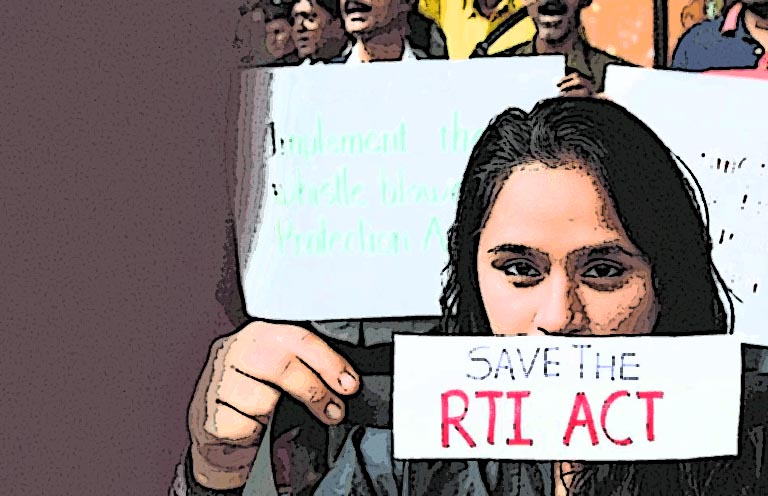
“It all started with a small pamphlet that said “Janne ka haq, jeene ka haq” (Right to information, right to life). Members of SNS (Satark Nagarik Sangathan) would distribute pamphlets to raise awareness about the new law in the Basti,” Vandana, who goes by her first name, recounts how the Right to Information Act, 2005 (RTI) helped her daughter get admission into a private school in Delhi.
“When I came to Delhi, my daughter was very young and we wanted to get her admitted into a private school through the EWS (Economically Weaker Section) quota. We tried to get her into the nearby school, but did not receive an admission call. Later, we filed an RTI to enquire about the admission. Finally, after a year, we got the admission call. I believe it was the pressure of the RTI application that made the school take my daughter in, otherwise very often, the quotas in private schools are not filled. This was during the early days of the law. My daughter got a good education, later joined college and is now working at a hospital. Magar yeh sab na hota agar yeh kanoon na hota” (all this would not have been possible without this law), she added.
Twenty years later, Vandana works as a mobiliser at the Satark Nagarik Sangathan (SNS), a citizen’s group working to promote transparency, going door to door in over 10 bastis, distributing pamphlets that read “Janne ka haq, jeene ka haq” (right to information, right to life).
Most RTI users at Lal Gumbad basti and nearby Savitrinagar – both working class areas in Delhi’s Panchsheel Park, describe the law as their lifeline. “The RTI has been most extensively used by people at the grassroots level as a tool to seek accountability for basic rights and entitlements such as pension, ration, community toilets, construction of roads, drains, school admissions and so on.” says Amrita Johri, social activist and member of SNS.
“Our research suggested that every year nearly 6 million RTIs are filed which makes the Indian law the most extensively used law globally,” she added.
The extensive use of the RTI by the ordinary person is directly linked to the history of the Right to Information movement, which was a decades long movement led by the Mazdoor Kisan Shakti Sangathan (MKSS) that finally culminated in the Right to Information Act in 2005. MKSS was formed in 1990 with the objective of addressing the issues of the workers, small and marginal farmers who formed the bulk of the population in five blocks of Ajmer, Rajsamand (then Udaipur), Pali and Bhilwara districts. In struggling against non-payment of minimum wages on government and contract works, the MKSS systematically arrived at the conclusion that transparency of records of work and wages were essential, in order to use ‘truth’ to fight injustice.
“Iss kanoon ko laane ke peechhe sabse badha haath gaao ke mazdooro, mahilaao ka hai. Jab ki woh mahilaye padhi likhi nahi thi, magar unhe maaloom tha ki yeh unke haq ki ladhai hai. Unn mahilaao ke wajaah se, meri beti ko achhi shiksha mili” (the fight to bring this act was mainly led by the rural workers and women. The women who participated in the struggle were not literate, but they were aware that it is a struggle for their rights. It is because of these women that my daughter got a good education), adds Vandana.
Twenty Years of undoing the RTI
The recent Digital Personal Data Protection Rules (DPDPR), 2025 (enacted as the DPDP Act, 2023) has amended Section 8 (1) (j) of the Right to Information Act, 2005 through Section 44 (3). Section 8(1)(j) of the RTI 2005 disallowed access to “personal information, the disclosure of which has no relationship to any public activity or interest, unless the Central Public Information Officer or the State Public Information Officer, is satisfied that the larger public interest justifies the disclosure of such information.”
The DPDPR amendment removes the public interest test stated in the original law, creating a blanket exemption for all ‘personal data.’ There is a lack of clear demarcation between the ‘personal’ and the ‘public’ that shrouds this act, through what is seen as its deliberate ambiguity. The serious concerns raised by RTI users and activists include the hurried way in which this act was passed in the parliament.
Shailesh Gandhi, a former Chief Information Commissioner and member of National Campaign for People’s Right to Information (NCPRI) comments, “The personal has not been defined in this law, most information relates to a person in some manner, and in the case of a blanket exemption any relevant information can be denied,” he further added, “this is the death of the RTI but it is not catching enough attention because the amendment is put under the DPDPR.”
Addressing the same issue of the lack of a defined ‘personal’ domain of information, activist Nikhil Dey, one of the founders of MKSS, in a meeting on the RTI amendment organised by SNS, stated that the RTI has no contention with the Right to Privacy, however there is a key difference between ‘private’ data and ‘personal’ data, which the amendment refuses to distinguish.
Many further attest that even before the recent amendment, the RTI which had been essential for the right to life and livelihood for many, has been systemically hollowed out over the past 20 years. Several governments have attempted to amend the law multiple times.
In 2006, a year after its enactment, an amendment was proposed to the law. File noting, that documented how key legislative decisions were reached was sought to be removed from the ambit of the RTI. This triggered protests that ran across universities as many considered access to file noting to be important for enabling legislative transparency for citizens. Eventually the amendment proposal was dropped.
In 2019, an amendment altered the statutory framework by removing the earlier fixed tenure, and instead providing that “the term of office, salaries, allowances and other conditions of service of the Chief Information Commissioner and their State counterparts shall be such as may be prescribed by the Central Government.”
Similarly, under Section 21(1) of the Digital Personal Data Protection Act, 2023, “the Board is empowered to appoint such officers and employees as it may deem necessary for the efficient discharge of its functions, but only with the previous approval of the Central Government,” thereby placing veto powers of appointment under executive discretion.
“This law should be called the ‘right to deny information.’ It compromises the Puttaswamy judgement of 2017,” adds Shailesh Gandhi.
Ashok Kumar, a member of the SNS, talks about his experience of filing an RTI post the 2019 amendment. Kumar had filed an RTI enquiring about the salaries of Safai Karamcharis (sanitation workers) working in public toilets in Delhi, their medium of payment and Provident Fund, if any. He was denied information citing 8(1)j, as the information sought fell under the ambit of ‘personal information.’ “I have been filing RTIs since 2005, and before the 2019 amendment, I would receive proper information on similar applications. But the quality of answers has been deteriorating each year,” he added.
Perpetual vacancies in the posts of Chief Information Commissioner (CIC) has also been a worrying trend, weakening the law substantially. The absence of a Chief Information Commissioner has serious ramifications for the effective functioning of the ICs since the RTI Act envisages a critical role for the CIC, including superintendence, management and direction of the affairs of the information commission. According to a report by SNS, assessments have shown that a large number of RTI applications come from the urban poor and from rural households seeking information about their basic entitlements. In this context, the report points out that the practice of returning a very large number of appeals and complaints without passing any orders becomes extremely problematic. It also creates an apprehension that this is perhaps a way of frustrating information seekers in a bid to reduce backlogs, since many people, especially the poor and marginalised, would feel discouraged and often give up if their appeal/complaint is returned. Over 95% of the cases returned by the CIC were not resubmitted to the commission.
Aruna Roy and Nikhil Dey, founders of MKSS in an interview by The Hindu Centre for Politics and Public Policy said, “The stories of hope still exist. However, now the anger of being stonewalled, and being frustrated by delay and denial is becoming the dominant discourse. In many cases, even when information is extracted or procured, the system is getting immune to demands of accountability. There is also now a creeping atmosphere of fear.”
Activists state that the anxiety around the need to amend the law points to the power it gives to the people, to ask questions and hold their elected representatives accountable. RTI activists have repeatedly pointed out that in a feudal political setup with entrenched hierarchies, where government officials and babus form the higher echelons of the system, the act of questioning by a Dalit, a woman, or any marginalised person, frustrates the old status quo.
“What has upset the government most about the RTI is common people using it to question the state. As part of our research we often do interviews with government officials about their experience and one thing we constantly hear is that ‘ab toh koi bhi hamse sawal poochh sakta hai, jo moongfali bechta hai woh bhi’ (now anyone can ask us questions, even the one who sells peanuts).” says Johri.
Roy and Dey further added in the same interview, “Those who had lived in an era before the RTI saw the unfolding of the wonder of what real citizenship could mean. To ask a question, and expect an answer from people occupying positions of power was a new and incredulous feeling. When these stories were reported, it was with the wonder of ‘speaking truth to power’, and power being forced to respond. It became clear that the RTI was actually the sharing of power.”
What do RTI users say?
Users say responses have become more ambiguous, and evasive. Many residents across colonies who used to receive pension under the old age pension scheme and the Delhi Pension to Women in Distress scheme state that they have not been receiving the pension amount of Rs. 2500 for months. Testimonials of those who asked about their pension through RTIs, show the nature of responses applicants have received in the past couple of months. The anonymous applicants will be addressed as Applicant A and B.
Applicant A, filed an RTI seeking information about her widow pension which she had not received for months. The application lists five queries, out of which questions regarding the name of the public officer responsible for the pension is not answered, instead the address of a complaint office is provided. The response to the query states that the pension is under process due to lack of funds. The application further enquired, “Within what time limit is a complaint regarding pension supposed to be resolved by the department as per rules? Please provide a copy of the relevant order/circular/notification/guidelines related to this” This also received no response.
Applicant B, who filed an RTI enquiring about old age pension used the same question template and received the same response citing lack of funds.
Shanti, a resident of Lal Gumbad camp, who goes by her first name, had filed an RTI application to enquire about her husband’s pension of Rs. 2500, which had been halted for four months. The response to the enquiry, yet again cited lack of funds due to which the pension was not being transferred.
“Hamare pati pehle mistry ka kaam karte the. Magar unko saas lene mein dikkat hone lagi, woh zyada chal phir nahi pate, kaam pe nahi jaa pate. Pension ke bina hamara ghar nahi chal pata” (My husband was earlier a mason. But he has respiratory problems, so he can’t walk long distances. Without the pension it is very difficult to make ends meet), said Shanti about her husband’s deteriorating health and the importance of the pension.
Veena, another resident who goes by her first name, had filed an RTI in 2024 to ask about the widow pension that she was entitled to. While she did receive Rs. 20,000 promised to families living Below Poverty Line after the death of the primary breadwinner under the Delhi Family Benefit Scheme, after filing an RTI; she is yet to receive the monthly pension amount of Rs 2500. “Pension approved dikha raha hai, magar paise nahi aa rahe. Fund ki kami hai toh fund kab aayega, yeh pata nahi” (it shows that the pension has been approved, but the funds are not available. If there is a shortage of funds when will the funds be provided, this no one knows), added Suman, who helped Veena file the RTI.
Suman, a volunteer with SNS from the basti who has been helping residents file RTI applications since 2012, says “If someone has stopped receiving the pension amount due to lack of funds, is it not the government’s responsibility to inform its citizens about when the issue would be solved. Instead, people are given vague answers, and stalled indefinitely. In this case, both Veena and Shanti have asked about their own pension. Instead, if we were to file an RTI to ask for a list of all the people with pensions pending in this area, we will be denied that information citing the amendment. ”
“Budget shortages will be affecting lakhs of people across the city. This refusal to let people organise and demand collective data will disable the ability of marginalised people to come together and fight the system,” added Amrita.
When systemic issues are treated as individual grievances rather than system level failures it reveals the larger failure of the legislative machinery. In implementing this, the government intends to deal with each citizen rather than people coming together, mobilising and collectively representing their struggles.
How the amendment discourages collective monitoring
Is sanshodhan ka sabse zyada prabhav un logo pe padhega jo zameeni sthar par aate hai, jinko ration, pension, shiksha, inn zaroorato ke liye RTI ka sahara milta tha” (this amendment majorly effects the people at the grassroots level, who takes the support of the RTI for needs like ration, pension and education), said Vandana.
While RTIs could not fix policy level issues, it had become a powerful tool to challenge local level corruption. In many cases, even when people did not receive adequate responses through RTI, the issue that made applicants file it was addressed. RTI users thus view information as a means to secure their rights and material needs.
On January 9, in a meeting on 20 years of RTI, activist Anjali Bharadwaj spoke about the immense role of the act in unearthing local level corruptions within the system, citing the corruption in the Public Distribution System (PDS) exposed through the RTI. Women who had not been receiving ration for months filed an RTI to seek copies of sale and stock registers which revealed that while the ration in their name had reached the ration shops, they were told that there was no ration for them. Post the DPDPR amendment activists anticipate that such registers will become inaccessible for people since they carry personal information like the names of people, their signatures, their addresses and so on, making collective scrutiny difficult.
A key impact of the RTI was that it enabled collective monitoring. Activists say that the kind of documents that could be accessed earlier — the sale registers, list of beneficiaries and so on — can no longer be retrieved through the implementation of this amendment. With the new amendment’s greater emphasis on protection of ‘personal data’, such information has been deliberately concealed from the public domain. The proactive disclosure that formed the edifice of the RTI collapses with this amendment in place.
Some RTI applicants have alleged that they received calls from local authorities for raising complaints. A resident, who had filed an RTI regarding ration said under the condition of anonymity, “ration daftar se phone aaya tha, unhone poochha aapne complaint kyu daali. RTI daalte hai toh sarkaari daftar unko call karke dhamkati hai.” (We received a call from the ration office; they asked why I had filed an RTI. Sometimes, when people file an RTI, they receive calls from the offices responsible for their issues and are intimidated).
The new DPDPR amendment’s treatment of the term ‘data fiduciary’ alters its conventional definition. By the new definition, anyone who collects data becomes a data fiduciary. Very often, unions and NGOs aid workers file RTIs, and organise to build pressure on the right authorities. This is where organisational support becomes crucial and collectives such as MKSS, SNS and others help people seek transparency. Unions and organisations work with a large mass of personal data, and thus, are brought under the ambit of a ‘data fiduciary’ through this amendment.
The DPDPR imposes substantial financial penalties for non-compliance by Data Fiduciaries. The highest penalty up to Rs. 250 crore applies to failure of a Data Fiduciary to maintain reasonable security safeguards. Any other violation of the Act or Rules by a Data Fiduciary may attract penalties up to Rs. 50 crore. Such hefty fines creates a fear of breaching the law, rendering RTI activists, and collectives vulnerable to punitive action. The state has a centralised control over the collection of data, as one of the biggest collectors of data in the country is the government itself. By this logic, the amendment should put curbs on the government’s ability to collect and use information. However, it gives it unchecked powers.
Writer and activist, Sunil Kumar explained that there are very few legislative and institutional safeguards for workers in the country and the RTI is one of the few measures through which rights can be sought. Very often, the RTI responses take time and effort, which many workers cannot afford. He further added, “A woman told me that after her contractor abused her, she decided to look for work elsewhere and did not even go back to collect the wages. Workers often do not have the time or support to demand their rights, or file RTI on their own.”
RTI activists have been routinely targeted, attacked and often killed for seeking accountability since 2005. According to the Commonwealth Human Rights Initiative (CHRI), 68 RTI activists have been killed between 2005 and 2017. Users and activists have faced frequent harassment, intimidation and threats, discouraging the use of the law.
The undoing of a law, that is described as a lifeline for so many people, will not only impact individuals and their immediate material needs but would define the larger ecosystem in which rights are sought and enacted.
(Samra Iqbal is currently a Young India Fellow at Ashoka University. She recently completed her undergraduate studies in English literature from St. Stephen’s College, Delhi University. She is also a freelance journalist and has previously covered stories for The Frontline, The Quint and Maktoob Media; Tulip Banerjee is a master’s student of journalism at AJK MCRC Jamia Millia Islamia. She has previously reported for The Leaflet and Maktoob Media)
Related:
Repeal recent amendments to the RTI act, 2005: Justice A.P Shah in an Open Letter
Vacancies, Backlogs, and increased governmental involvement: How the RTI Act has lost its glory!
India’s RTI Act struggles to survive as backlog, lack of staff persists