
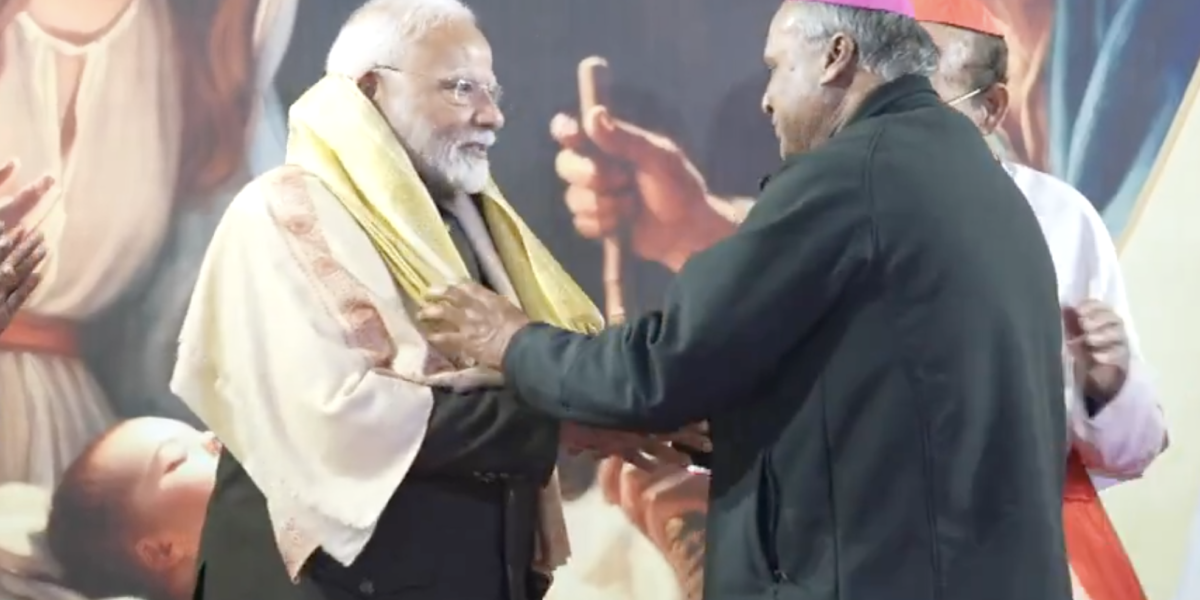
On Christmas day, prime minister Narendra Modi is scheduled to visit a cathedral in New Delhi which attracts hundreds of people of all faiths who come perhaps to feel the joy and peace associated with the child Jesus, or just out of curiosity to see the biggest celebration in the Christian calendar.
It is interesting that the Bharatiya Janata Party (BJP) government ‘s calendar lists 25 December as Good Governance Divas in memory of the late prime minister Atal Behari Vajpayee who too was born on Christmas day. In Uttar Pradesh, the Yogi Adityanath government has made attendance compulsory in schools, and erring staff may face stern action.
For the Modi visit, security is the top priority. Last Christmas, so as not to disturb the day for the faithful, a special table with a portrait of Jesus had been put up, a candle lit before it. A choir of young people sang familiar carols, and the senior clergy lined up to exchange formal pleasantries with the guest. Modi apparently also spoke to the Cathedral gardener, giving him some horticultural advice.
It will be much the same this year, and if all goes well, Modi will have told the world that he loves the Christians of Bharat, and they in turn love him even more. The new vice president of India, C.P. Radhakrishnan, was the guest of honour at the annual Christmas dinner by the Catholic Bishops Conference of India. The vice president in turn hosted the Bishops, and many more, at a lunch at his official residence, assuring the gathering that religious minorities were safe in India. Radhakrishnan called Jesus’s message a “beacon of compassion.”
In Raipur, however, the Catholic archbishop, Victor Henry Thakur, was very worried. He sent a letter to local churches, schools and other institutions urging caution, “In the light of the call for Chhattisgarh Bandh tomorrow, I feel and suggest that all our churches, presbyteries , convents and institutions should seek protection in writing from the local police. Please consider my suggestion because it seems to have been planned just before the Christmas, as it was the case at Kandhamal in Odisha.”
The Bishop was referring to the Christmas eve violence in the Kandhamal district of Odisha in 2007 where markets were set afire, women molested and Christians made to flee into nearby forests. A few months later in 2008, Kandhamal erupted again, with some 70,000 people displaced, 400 churches and institutions destroyed and some 4,500 houses burnt. A Catholic nun was gang-raped and paraded naked, the police as usual escorting the gangs.
In distant Left front-ruled Kerala, Rashtriya Swayamsevak Sangh (RSS) groups were coercing schools, teachers and parents not to participate in any Christmas activity. The schools buckled under the pressure. State education minister V. Sivankutty said school managements had returned money pooled in by students for the year-end celebrations under pressure from groups associated with the RSS.
Sivankutty said that the RSS was trying to replicate its “North Indian” model of “othering” minorities in Kerala and added that the state government would resist all such attempts.
“The government will resist any attempt to transform schools into stifling compartments of religious segregation by any fundamentalist group. Imbibing secular and democratic values at a young age lays the ground for a humane and secular society,” he said.
The hate and targeting of Christians in the country
The hate and targeting in the country is however as real as the suffocating fog in the national capital.
Every big and small Christian group has written to the Union home minister, Amit Shah, with copies marked to the Prime Minister’s Office (PMO )on X, urging him to ensure that police and administration in states, metropolitan cities and the countryside ensure that troublemakers are contained. Letters were sent on behalf of the Catholic Bishops Conference of India, the Evangelical Fellowship of India, the United Christian Forum and the Bombay Catholic Sabha.
No letters were sent to Mohan Bhagwat at the RSS headquarters, till reports last came in. Hate was absolutely normalised. As was violence, the police was silent, or complicit.
Cadres therefore have been going on with business as usual, tilak on the forehead, a lathi in the hand, abuses and threats on the lips. Women leaders are leading from the front, and in Jabalpur could be seen manhandling a visually challenged woman attending a prayer service. The BJP leader said she was checking if forcible conversions were going on in the place.
The most obscene of such violence took place in Chhattisgarh’s Kanker district, on 15 December, a dispute over the burial of Rajman Salam’s father led to clashes. Hardline Hindu groups objected to the use of an ancestral graveyard for the Christian convert, resulting in injuries and police intervention. A little earlier, mobs vandalised a prayer hall in Bastar over similar burial rights, causing multiple injuries.
In Madhya Pradesh, targeted attacks disrupted Christmas prayer meetings in several areas. On December 10, in Jabalpur, a mob assaulted Christians during a service, accusing them of forced conversions under anti-conversion laws. Similar disruptions occurred in Bhopal and Indore, where prayer gatherings were halted by vigilantes, leading to arrests of pastors rather than the attackers.
In Uttar Pradesh, on December 5, a church in Lucknow was vandalised, with worshippers beaten and literature destroyed. These incidents reflect a coordinated effort to intimidate Christians during their festival season, often justified by claims of illegal conversions.
In Rajasthan, the utterly weaponised anti conversion law has triggered a spike in persecution, with mobs attacking churches and homes. On December 12, in Jaipur, a prayer meeting was raided, resulting in injuries to women and children.
The Evangelical Fellowship of India (EFI) sent a letter to Chhattisgarh Chief Minister Vishnu Deo Sai on the Amabeda village tensions following a burial dispute. The letter detailed continuing threats and called for protection of Christian rights.
Christians groups have this year documented over 700 incidents of violence till November this year , noting 334 incidents from January to July 2025, including 107 cases of threats and harassment, and 116 false accusations and arrests. EFI’s Religious Liberty Commission reported physical violence in 42 incidents and worship disruptions in 29 cases.
Statistics reveal the scale of the problem. In 2024, UCF recorded 834 incidents of violence, averaging 69.5 per month, a sharp increase from 127 in 2014. EFI verified 640 cases that year, including 255 threats, 129 arrests, 76 physical assaults, and gender-based violence in 17 instances. By November 2025, UCF documented 706 incidents, with EFI projecting over 700 for the year. Compared to 2024, 2025 shows a 10-15% rise, driven by hate speech and vigilante actions in states like Uttar Pradesh (95 incidents by July) and Chhattisgarh (86).
Arrests of pastors and Christians have intensified in 2025, particularly in Uttar Pradesh and Chhattisgarh. In Uttar Pradesh, at least 12 pastors were arrested by August on false conversion charges, often after mob attacks where victims are detained.
On 20 July, in Bhilai, Chhattisgarh, six pastors were arrested during a disrupted service and beaten in custody. Five more pastors faced assaults in jail in August, with documented evidence ignored. In September, in Mangaluru, Karnataka, arrests followed stabbings by Hindu activists, but charges targeted Christians. Between 2020 and 2023, over 855 were detained nationwide on conversion allegations.
A sustained hate campaign drives this violence, portraying Christians as threats to Hindu culture. Anti-Christian propaganda has caused a 500% surge in attacks over the decade. In 2025, hate speech events targeted minorities, framing conversions as invasions. Elected officials’ rhetoric emboldens mobs, leading to calls for genocide in Chhattisgarh. Social media spreads messages inciting violence. It remains a Christmas under threat.
The writer is a former editor, member of the National Integration Council and past president, All India Catholic Union.
Note- This article was updated on December 24, 2025 on 10:32am.
Courtesy: The Wire