
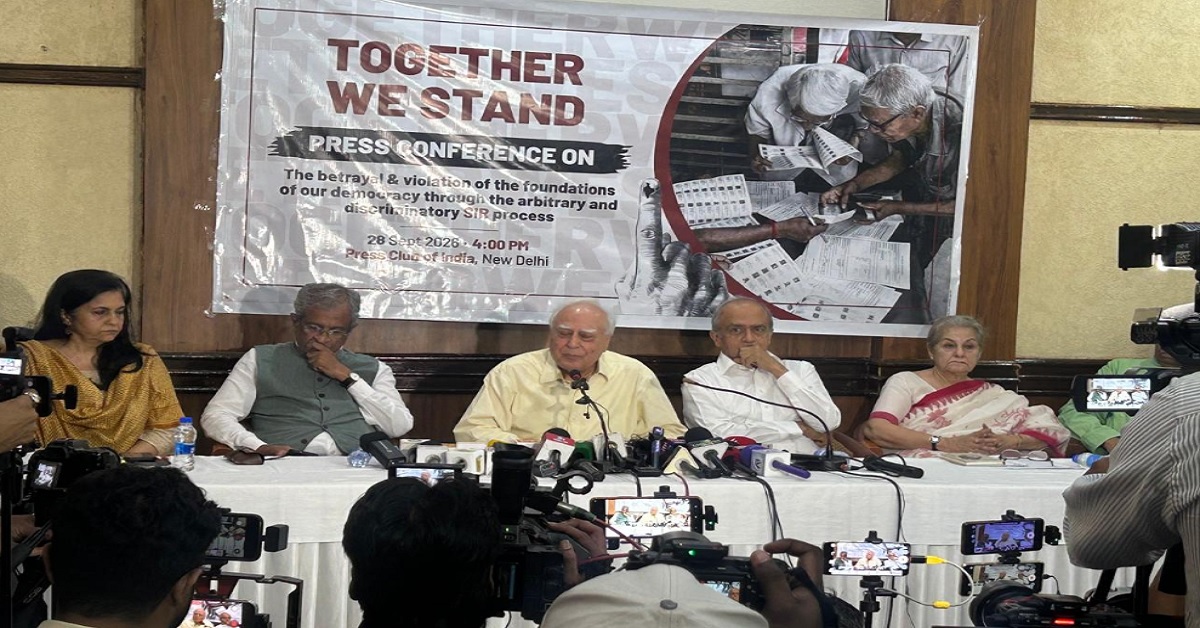
The intensifying controversy over the Election Commission of India’s Special Intensive Revision (SIR) of electoral rolls reached the Press Club of India on September 28, with a broad group of senior lawyers, former judges, activists and public figures demanding that the exercise be rolled back and that the poll panel face greater scrutiny over how decisions affecting millions of voters have been taken.
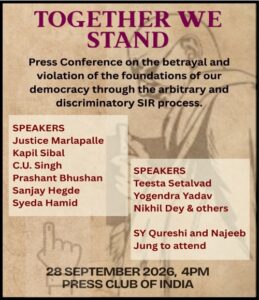
The press conference brought together Justice Marlapalle, senior advocate and Rajya Sabha MP Kapil Sibal, senior advocate C.U. Singh, advocate Prashant Bhushan, senior advocate Sanjay Hegde, Syeda Hamid, Teesta Setalvad, Yogendra Yadav, Nikhil Dey and others. Former Chief Election Commissioner S.Y. Quraishi and former Delhi Lieutenant Governor Najeeb Jung were also to attend.
Their eight-point charter went beyond a demand to halt SIR. It sought restoration of voters removed from the rolls, a return to the pre-SIR electoral rolls for forthcoming elections, public verification of deletions, access to the ECI’s internal records, institutional reform and an independent examination of alleged wrongdoing.
At the heart of the demands was a simple proposition: a citizen already on the electoral roll should not lose the right to vote through an opaque administrative process and then be left to prove that the deletion was wrong.
प्रेस कॉन्फ़्रेंस शुरू होने जा रहा है. pic.twitter.com/rVkbZyJlWV
— Anzar Afaque (@AnzarAfaque) September 28, 2026
ज्ञानेश कुमार को जाना पड़ेगा, लोकतंत्र के साथ बहुत खिलवाड़ हो गया ।
प्रेस कॉन्फ़्रेंस में बोले सुप्रीम कोर्ट के वकील @pbhushan1 pic.twitter.com/4nfP48Xs3D— Anzar Afaque (@AnzarAfaque) September 28, 2026
ज्ञानेश कुमार और SIR पर प्रेस कॉन्फ़्रेंस के लिए प्रेस क्लब पहुंचे सुप्रीम कोर्ट के वकील कपिल सिब्बल, पूर्व चुनाव आयुक्त SY क़ुरैशी, दिल्ली के पूर्व एलजी नजीब जंग pic.twitter.com/yE057pVGCa
— Anzar Afaque (@AnzarAfaque) September 28, 2026
From Bihar to Bengal: SIR has become a national electoral controversy
The SIR began in Bihar and was subsequently extended to other States. In May 2026, the Supreme Court upheld the ECI’s power to conduct the Bihar SIR under Article 324 of the Constitution read with Section 21(3) of the Representation of the People Act, 1950. The Court held that the exercise had a legitimate connection with maintaining accurate and legally valid electoral rolls. That judgment, however, has not ended the disputes over how SIR is being implemented.
The scale of the exercise has itself become a major point of concern. An investigation published by The Indian Express reported that the national rollout of SIR had struck more than 13 crore names from draft voter rolls across 30 States and Union Territories. The newspaper also reported that Election Commissioners Sukhbir Singh Sandhu and Vivek Joshi had formally objected, on record, at least 14 times over a ten-month period to different steps connected with the electoral-roll revision.
West Bengal has become the most contentious example. The Indian Express reported that the ECI had told the Supreme Court that 27.16 lakh voters were deleted during the SIR process, while 38.20 lakh appeals had been filed against deletions and inclusions. As of September 18, only 1.02 lakh of those appeals had been disposed of, leaving more than 37 lakhs pending.
IE also reported that the ECI’s affidavit did not provide a complete break-up of how many appeals had been filed by deleted voters seeking restoration and how many had been filed against voters whose inclusion had been upheld.
The controversy intensified after reports revealed that Election Commissioner Sukhbir Singh Sandhu had questioned who authorised the filing of more than 16 lakh appeals against voters whose inclusion had been upheld by judicial officers. The Indian Express reported that Sandhu had specifically asked who had authorised those appeals and who had filed them on behalf of the Commission. The report said that neither Sandhu, nor Election Commissioner Vivek Joshi, nor the then Chief Electoral Officer of West Bengal had been informed about the basis or process of filing the appeals. It is against this backdrop that the demands raised acquire significance.
Articles exposing the non-transparency in functioning of the Election Commission of India (ECI) may be read here, here and here.
Restore the rolls before asking citizens to defend their vote
The first demand raised at the press conference was unequivocal: the ECI should roll back SIR across the country and restore every elector removed from the rolls as they existed before the exercise. The group further demanded that forthcoming elections be conducted on the basis of the pre-SIR rolls, subject to a summary revision where necessary.
This is not simply a dispute over electoral data. A deletion can determine whether a citizen is able to participate in an election at all. The burden of correcting an erroneous deletion can also fall disproportionately on people who have limited access to official portals, documentation or administrative assistance.
The campaigners therefore want the starting presumption restored: existing electors should remain on the rolls unless their removal is established through a transparent and publicly verifiable process.
Put the electoral roll to a public audit
The second demand calls for a public social audit of electoral rolls at the level of the gram sabha, ward sabha or polling booth. The demand draws on procedures contained in the ECI’s own electoral roll framework, but seeks to make public verification meaningful rather than merely procedural. BLOs and EROs should be present, voters should be able to identify wrongful deletions, and corrections should be possible immediately.
The demand is particularly relevant where the affected voter may not know that their name has been removed until they attempt to exercise their franchise.
Instead of making the citizen discover and challenge an invisible administrative decision, the proposed mechanism would bring the verification process into the public domain. The campaigners want this to become a permanent safeguard, not an arrangement limited to the present SIR.
Open the SIR files
A substantial part of the demands concerns information that remains within the ECI’s institutional machinery. The group called for the Commission to publish the complete documentary trail behind SIR, including the files relating to the decision to conduct the exercise in each phase, minutes of Commission meetings, objections by Election Commissioners and Deputy Election Commissioners, criteria used for classifications such as “logical discrepancy” and “VIP”, changes to the BLO application, communications between the ECI, Chief Electoral Officers and Electoral Registration Officers, relevant WhatsApp communications, and the complete log and source code of ECINet.
It also specifically sought disclosure of the decision-making record behind the filing of more than 16 lakh appeals against voters whose inclusion had been upheld in West Bengal. This demand has force in light of the reported internal questions within the Commission over those appeals and over aspects of the technological systems being used for electoral administration.
The issue is therefore not simply whether the ECI has followed a procedure. It is whether the public can inspect the institutional record necessary to understand who decided what, on what material, using which criteria and with what safeguards.
Sibal questions whether the Commission can speak through one voice
Kapil Sibal, speaking on the electoral-roll controversy, questioned decisions that he said appeared to have been taken by the Chief Election Commissioner without the involvement of the full Commission.
“If a decision is taken by a single Chief Election Commissioner, it is certainly not a decision of the Election Commission,” Sibal said.
He called for earlier election-related decisions to be annulled and argued that electoral rolls should be based on the list existing before the June 24 notification. He also questioned the practicality of the door-to-door verification exercise in Delhi.
“Enough is enough,” Sibal said, calling on the youth, the press and citizens to stand together to defend democratic institutions.
VIDEO | Delhi: On the Election Commission’s decisions and electoral roll revision, Rajya Sabha MP Kapil Sibal says, “If a decision is taken by a single Chief Election Commissioner, it is certainly not a decision of the Election Commission. The earlier election-related decisions… pic.twitter.com/XiIVbqk24E
— Press Trust of India (@PTI_News) September 28, 2026
Resignation, impeachment and a new appointments mechanism
The demands also directly target the institutional architecture of the Election Commission. The group called for CEC Gyanesh Kumar to resign and, failing that, for impeachment proceedings to begin. It also demanded repeal of the Chief Election Commissioner and Other Election Commissioners Act, 2023, arguing for an appointment’s mechanism free from executive control. Another demand seeks removal of the statutory immunity from civil and criminal proceedings available to serving and former Election Commissioners. These demands shift the debate from the immediate conduct of SIR to the independence and accountability of the institution responsible for conducting elections.
What happens to those excluded from welfare?
Another demand focuses on a consequence that can extend beyond the ballot box. The campaigners called for restoration of welfare benefits to Indians who were allegedly denied such benefits because their names were removed from electoral rolls.
The demand reflects a broader concern about the consequences of treating electoral databases as authoritative markers in other administrative processes. If an erroneous deletion affects access to welfare or other public entitlements, the harm is no longer confined to the loss of an opportunity to vote.
An independent inquiry into SIR
The final demand calls for an independent and credible inquiry into the constitutionality and legality of decisions taken under Gyanesh Kumar and into the design, implementation and consequences of SIR.
The proposed inquiry would examine the conduct of the CEC, other Election Commissioners, officials and third parties, including whether any act or omission resulted in wrongful disenfranchisement or breach of official duty.
This demand is significant because the controversy is no longer confined to whether SIR is legally permissible in principle. The Supreme Court has already upheld the ECI’s power to conduct the Bihar exercise.
The questions now being raised concern how that power is exercised, how voters are protected against wrongful exclusion, how decisions are recorded and whether the institution can be held accountable when its processes are challenged.
The eight demands announced at the Press Club therefore amount to a call for far more than a procedural correction. They seek to place electoral-roll revision under public scrutiny, restore those who may have been wrongfully excluded and force the Election Commission to disclose the administrative and technological machinery through which electoral inclusion and exclusion are being decided. At stake is not merely the accuracy of a database. It is the question of who gets to remain on the electoral roll, who bears the burden when the State gets that decision wrong, and whether the machinery deciding those questions can itself be subjected to meaningful public accountability.
The official press statement may be read here:
Related:
A chargesheet against the ECI’s “All Is Well” defence
Assam: ‘No to SIR!’ Complete the pending NRC!
Judgement delivered, paradox prevails: every voter a citizen, but what is the fate of 51.8 million excluded?
SC greenlights SIR, upholds ECI’s power to revise electoral rolls
The Bihar Verdict 2025: How an election was engineered before votes were cast