
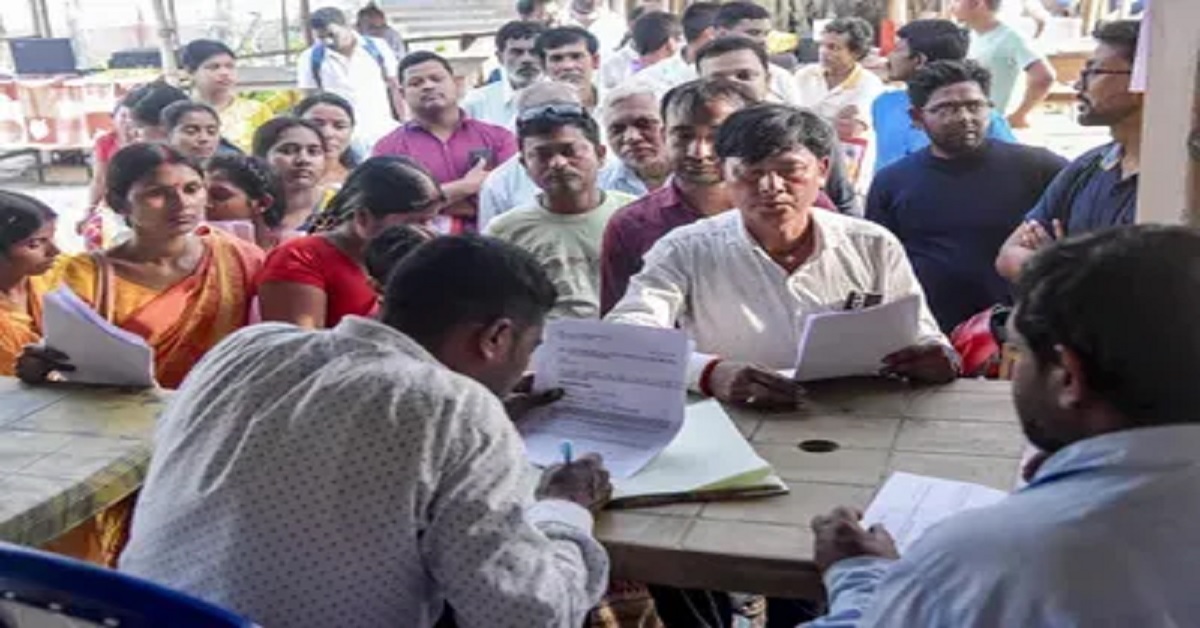
Election Commission’s data shows a clear gap between requests to delete names from West Bengal’s electoral rolls and applications to add them. Most Form 7 deletion requests resulted in removal, while a much smaller share of Form 6 applications resulted in inclusion. Separately, many voters appealing against their deletion continue to await decisions, with tribunal judges reporting problems in issuing notices, obtaining documents and providing copies of orders.
Most decided Form 7 requests resulted in deletion
The Wire examined annexures R/1 and R/2 of the Election Commission of India’s counter-affidavit in proceedings brought by Prasenjit Bose. The data covered claims and objections received between December 17, 2025, and August 7, 2026. Form 7 can seek deletion from the electoral roll, including through an objection by another person; Form 6 concerns inclusion. Of the 6,39,049 Form 7 applications, 5,72,330 resulted in deletions and 14,506 were rejected. Together, these decisions accounted for 91.83% of the applications received. Almost every decided request—about 97.5%—resulted in removal.
The Form 6 figures were different. Of 34,13,481 applications, 7,07,606 resulted in additions, 14,079 were separately recorded as accepted, and 7,26,660 were rejected. The analysis also identified 4,86,395 applications marked unprocessed. An application marked accepted is distinct from a name recorded as actually added to the roll.
The share of all applications resulting in an actual roll change was more than four times higher for Form 7 than for Form 6. The figures show how many applications reached a recorded outcome, but do not show how long each application took to decide.
Large gaps across constituencies
Dabgram-Fulbari recorded 16,514 deletions from 16,559 Form 7 requests, compared with 1,056 additions from 31,976 Form 6 applications. Bagda recorded 15,307 deletions from 15,561 requests and 4,826 additions from 29,831 applications. These were the two largest totals of completed Form 7 deletions in the analysis, followed by Sonarpur Uttar with 9,354.
Rajganj recorded 3,866 deletions from 3,891 requests, but only 143 additions from 18,528 inclusion applications. Just ten deletion requests were rejected in Dabgram-Fulbari, three in Bagda and one in Rajganj.
Chopra recorded 948 deletions from 954 requests, while only 28 names were added from 28,701 inclusion applications. It also recorded 1,570 rejected inclusion applications and 3,600 unprocessed claims.
Several other constituencies recorded few additions compared with the applications received. Kaliaganj added 24 names from 14,477 applications and had 5,191 unprocessed claims. Basanti added 54 from 12,195; Swarupnagar 71 from 12,106; Madhyamgram 115 from 17,717; and Islampur 439 from 16,767. Noapara added 187 names from 17,403 applications, with 9,249 marked unprocessed. These were the recorded outcomes for the period examined; they were not final decisions on every application.
The gap remained when the comparison was limited to applications that had been allowed or rejected. In Chopra, only 1.75% of those inclusion applications succeeded. Kalyani recorded 585 additions and 6,097 refusals, giving an inclusion rate of 8.75% among those outcomes. It recorded 9,063 deletions and only 21 rejected deletion requests.
Nakashipara recorded 934 additions against 9,339 refusals, alongside 3,214 deletions and eight rejected deletion requests. Matigara-Naxalbari recorded 2,264 additions against 9,754 refusals, while 8,491 deletion requests succeeded and 55 were rejected. The data records these differences but does not provide the reasons for every decision.
Border seats and areas with large Scheduled Caste populations
Across the 24 district units analysed, none recorded a higher share of successful inclusion applications than successful deletion requests. Uttar Dinajpur recorded additions from 8.16% of inclusion applications and deletions from 96.11% of deletion requests. The corresponding figures were 8.21% and 98.59% in Jalpaiguri, and 10.58% and 87.71% in Murshidabad.
The gap also appeared in districts with higher inclusion rates. Jhargram recorded 52.16% for inclusion and 62.52% for deletion; Kolkata South 42.91% and 85.91%; and Purbo Medinipur 42.20% and 66.70%.
In 43 constituencies classified as border seats, 30.62% of inclusion applications had been decided, and 34.70% of those decided cases were allowed. For deletion requests, 95.37% had been decided and 99.67% were allowed. These seats recorded 6.28 additions and 10.57 deletions for every thousand electors on the pre-SIR roll.
Non-border constituencies recorded 9.76 additions and 6.92 deletions per thousand electors. Among decided applications, the reported approval rates were 51.83% for inclusion and 96.96% for deletion. Thus, non-border seats recorded more additions than deletions, even though deletion requests had a much higher approval rate.
A similar gap appeared in 31 constituencies where Scheduled Castes made up at least 40% of the population. Of the inclusion applications, 31.19% had been decided and 36.82% of those were allowed. For deletion requests, 95.52% had been decided and 99.67% were allowed. These constituencies recorded 6.12 additions and 13.76 deletions per thousand electors.
Across the lowest and highest Scheduled Caste population bands, additions fell from 12.62 to 6.12 per thousand electors, while deletions rose from 5.74 to 13.76. The analysis noted that several of these constituencies also fall in border areas and the Matua belt. The figures therefore do not show a separate effect attributable to caste composition alone.
In constituencies with larger minority populations, the reported gap concerned inclusion. Additions fell from 9.89 per thousand electors in areas with low minority populations to 7.14 where minorities made up at least 60%. The analysis did not find a similar concentration of Form 7 deletions in Muslim-majority seats.
Low registration among young voters
Age-wise figures in the Commission’s affidavit, reported by The Hindu, showed low registration among young adults. Against a projected population of 22,26,101 people aged 18 or 19, only 5,23,229 were registered—23.5%.
Registration was reported at 70.3% for people aged 20–29, 92.7% for those aged 30–39 and 99.9% for those aged 50–59. The final roll of about 6.45 crore represented 84.9% of the State’s projected adult population of 7.59 crore, within a projected total population of 10.40 crore.
For people aged 60–69 and 70–79, the ratios were 104.5% and 109.1%. These figures compare electoral entries with population projections, rather than an exact population count. The low registration rate among young adults is not a count of young voters deleted during SIR.
The Hindu reported the case of Faruk Kazi, a 19-year-old labourer in Rejinagar, who registered in 2025 but could not vote in the Assembly election after his name was excluded. He had linked his entry to his grandfather Hossain Ali in the 2002 roll because his parents registered later. His parents and elder brother remained on the revised roll. When the report was published, his tribunal appeal was undecided, putting his participation in the October 6 by-election in doubt as well.
Appeals remain largely undecided
The Form 6 and Form 7 figures are one part of the wider revision process. Other concerns voters whose cases went before judicial officers and who later appealed against the decisions.
On February 20, the Supreme Court invoked Article 142 to bring judicial officers into the verification exercise. Officers from West Bengal, Odisha and Jharkhand examined unresolved cases under arrangements made through the Calcutta High Court.
On March 10, the Court directed the creation of an appellate mechanism. Nineteen single-member tribunals were established later that month. The Hindu reported that they began functioning around April 13. An April 16 Supreme Court direction provided for successful appellants to be included through supplementary lists.
Assembly polling began on April 23. According to the same report, only 136 names had been cleared by then. Two tribunal judges later resigned for personal reasons and were replaced.
In its September 18 submission to the Supreme Court, the Commission said 38.31 lakh appeals had been filed: 22.21 lakh challenged deletions, while 16.10 lakh challenged inclusion and sought removal of names. Only 1.26 lakh appeals had been disposed of by September 10.
That disposal figure covers both categories and does not indicate how many voters were restored. A later Hindu report described 22.21 lakh deletion appeals as pending, but the material cited does not provide separate disposal figures for each category.
Fresh enrolment drive and pending tribunal cases
The Commission’s October 1 letter to Chief Electoral Officers instructed Booth Level Officers (BLOs) to compare current rolls with pre-SIR rolls, identify people whose names were missing, visit them and help eligible voters apply through Form 6.
A senior Commission official told The Hindu that cases already before Bengal’s appellate tribunals would be treated differently because they were under adjudication. Voters with pending tribunal appeals would therefore continue through that process, while other eligible people could seek enrolment through Electoral Registration Officers. The report said Form 6 applications were to be cleared within one or two months.
Before the October 6 by-elections in Nandigram and Rejinagar, West Bengal Congress leaders said more than 6,000 appeals in Nandigram and 12,000 in Rejinagar remained pending. They said these voters could miss another election.
As reported by The Times of India, Pradesh Congress president Shubhankar Sarkar and the party’s SIR committee chairperson Prasenjit Bose asked the Commission to provisionally restore the 22.21 lakh appellants until their cases were decided or treat their appeals as Form 6 applications before the respective Electoral Registration Officers. The reports cited did not record acceptance of either proposal.
Judges report problems with the appeal portal
Judges of more than a dozen of the 19 tribunals discussed problems with the appeal system at an August 11 meeting. The minutes were sent to the Election Commission and the Chief Justice of the Calcutta High Court, according to The Indian Express.
The judges reported that the Commission’s portal lacked a common system for serving notices, obtaining additional documents, holding virtual hearings and giving appellants copies of orders. Some judges had approved a notice format in May, but it had still not been implemented by August.
Where documents were incomplete or did not match the enumeration form, tribunals had no proper mechanism to seek further material. Individual tribunals were trying to communicate through District Magistrates and District Election Officers, but the minutes recorded poor responses.
The portal also did not allow a disposed appeal to be reopened when a judicial direction or another reason required it. This was a problem with reopening proceedings on the portal, separate from the question of restoring a voter’s name.
Appellants could neither download tribunal orders nor obtain certified copies through the portal, the judges said. This made it difficult for them to obtain the reasons for a decision. The minutes also recorded uncertainty over the handling and digitisation of physical appeals submitted to district authorities.
An April 6 Supreme Court order had referred to appeals being submitted through ECINET or at designated district and sub-divisional offices, which were required to digitise and upload them promptly. An April 1 order had required tribunals to revisit records and communicate reasons.
The August meeting followed an earlier warning. On May 22, a tribunal judge wrote to the Calcutta High Court Chief Justice that the lack of a notice mechanism was slowing disposal. The judge also alleged that incorrect disposal figures were being circulated to the press through unnamed Commission sources without explaining the administrative difficulties.
The Indian Express said it sought responses from the Commission and the High Court’s Registrar General on October 1 but received none by publication. Its account documents repeated complaints; it does not establish whether every problem recorded in August remained unresolved in October.
Deletions at different stages of SIR
The report Inside the Special Intensive Revision (SIR), prepared by Citizens for Justice and Peace (CJP) and Vote for Democracy (VFD), records several stages of exclusion and verification in Bengal. At the stage it examined, it recorded a draft electorate of 7,08,16,630 and cumulative deletions of 63,66,952, including removals before the draft and further deletions before the final roll.
It separately recorded 60,06,675 cases under adjudication. Those cases were still pending at that point and were not all confirmed deletions. Later reporting on 27.16 lakh deletions following judicial scrutiny described a subsequent stage, taking the reported overall figure to nearly 91 lakhs.
The Hindu reported that 58,20,898 names were excluded from the December 16, 2025, draft roll under the Absent, Shifted, Dead and Duplicate (ASDD) categories. Its rounded breakdown was 24.16 lakh marked dead, 32.65 lakh shifted or absent, and 1.38 lakh duplicates.
Separately, 31,68,424 people were identified as “unmapped”, meaning they could not be linked to the 2002 electoral roll. Approximately 1.36 crore were flagged for “logical discrepancies”. Notices and hearings followed, but around 60 lakh cases remained unresolved when the final roll was published on February 28.
The CJP–VFD report describes discrepancies involving fathers’ names, ages, family relationships and entries linking more than six children to one person. It also reports difficulties with Bengali names transliterated into English and with matching current details to older records.
The report recounts the Supreme Court’s January 19 directions to display discrepancy lists locally, allow submissions through authorised representatives, provide additional time and enable affected people to be heard. Its account of the February 24 order explains that supplementary lists could follow the February 28 final roll, with subsequently included voters treated as part of that roll.
Voters describe spelling and family-record problems
Several voters interviewed by The Hindu said differences in names or family records had led to exclusion despite their attending hearings or supplying documents.
Imamuddin Sheikh, 53, an elected panchayat member in Rejinagar, said his father Wahab Sheikh appeared as Kalu Sheikh in the 2002 roll. Kalu was his father’s nickname, he said, and the EPIC number matched. Nevertheless, Imamuddin’s name was deleted.
Najmatara Khatoon, a 29-year-old Anganwadi worker in Samserganj, said her father’s name appeared as Abdul Haq Sheikh in the old roll and Abdul Haq elsewhere. She said she attended a hearing and submitted documents but was excluded. Both she and Imamuddin approached the tribunal. Khatoon also said local officials questioned her nationality when she sought help.
Md. Mojahar Hossain, a 39-year-old teacher who served as a BLO in Samserganj, said six other people were linked to his father in the old records, although he had one sister and three brothers. His father’s surname was also recorded as “Hosen” instead of “Hossain”, despite a matching EPIC number. His three brothers remained on the roll, while he, his sister and his father were excluded. He said three other teachers at his school who had performed BLO duties also lost their entries.
Md. Alauddin Sheikh, 47, who contested an election in 2021, described deletions affecting his brothers and their wives despite their attending hearings. He alleged political targeting, but the newspaper account did not independently establish that allegation.
Md. Shamim Akhtar, a 49-year-old retired Indian Air Force Wing Commander in Entally, said both his and his father’s names appeared in the 2002 roll. His case nevertheless went under adjudication in February, and his name was missing from a March supplementary list. He said he received neither a hearing nor an explanation of how to resolve the problem.
In Medinipur, 24-year-old student S.K. Riaz said a discrepancy in his father’s name affected the family’s entries. Their cases remained unresolved despite repeated visits to officials when they spoke to the newspaper.
VFD: Earlier findings on mapping and documentation
The CJP–VFD report cites a December 2025 SABAR Institute study examining unmapped voters. The 20 constituencies with the highest proportions of unmapped voters reportedly had an average Muslim population of 13.75%, while the 20 with the lowest proportions averaged around 40%.
Full report can be accessed here
It also describes documentation difficulties faced by Matua families, particularly in North 24 Parganas and Nadia, and reports pressure on members of the community to apply through the Citizenship (Amendment) Act route. These findings concern mapping and documentation at an earlier stage and are separate from the later Form 6 and Form 7 results.
The report records complaints about tight deadlines, digital uploading problems, language barriers and the workload of teachers and Anganwadi workers carrying out BLO duties alongside their regular work. Its Bengal accounts include the reported deaths by suicide of Rinku Tarafdar in Nadia and Shantimoni Ekka in Jalpaiguri, discussed in the context of work-related pressure.
It also records deaths and distress among voters facing documentation problems. Broader death estimates in the report are attributed to political leaders and are not an independently verified official total. The accounts do not establish a single cause for every reported death.
Ask for public access to revision records
An April 11, 2025, memorandum to the Election Commission, reported by SabrangIndia, called for public access to electoral rolls and revision records. Coordinated through VFD and endorsed by 83 individuals, it followed a three-hour national consultation and an earlier notice issued in July 2024.
The memorandum sought searchable past and present electoral rolls showing additions and deletions; booth-wise Form 17C records and aggregate vote counts; searchable revision records in Forms 9, 10, 11, 11A and 11B; public inspection of EVM source code; disclosure and independent technical oversight of Symbol Loading Unit contents; and a revised VVPAT system in which voters would manually deposit slips in a separate box, with all slips counted and results based on those records.
Signatories included M.G. Devasahayam, Madhav Deshpande, Harish Karnick, Justices D. Hariparanthaman and B.G. Kolse Patil, Aruna Roy, E.A.S. Sarma, Venkatesh Nayak, Anjali Bhardwaj and Teesta Setalvad. The accompanying campaign raised concerns about Commission independence, enforcement of the Model Code of Conduct and unexplained changes to electoral rolls. Its demand for searchable revision records would allow the public to examine additions, deletions and the steps taken before those decisions.
Separately, a September investigation by The Indian Express reported 14 objections raised by two Election Commissioners over ten months, including restricted ECINET access for officers responsible for electoral rolls. The Commission subsequently announced a committee, including an independent expert, to examine the system and its compliance with the law.
The Supreme Court’s March 10 order had also recorded technical difficulties faced by judicial officers and called for prompt repairs and logistical support. The later tribunal minutes set out specific problems with notices, documents and access to decisions while large numbers of appeals remained undecided.
Related
A chargesheet against the ECI’s “All Is Well” defence
Assam: ‘No to SIR!’ Complete the pending NRC!
Judgement delivered, paradox prevails: every voter a citizen, but what is the fate of 51.8 million excluded?
SC greenlights SIR, upholds ECI’s power to revise electoral rolls
The Bihar Verdict 2025: How an election was engineered before votes were cast