
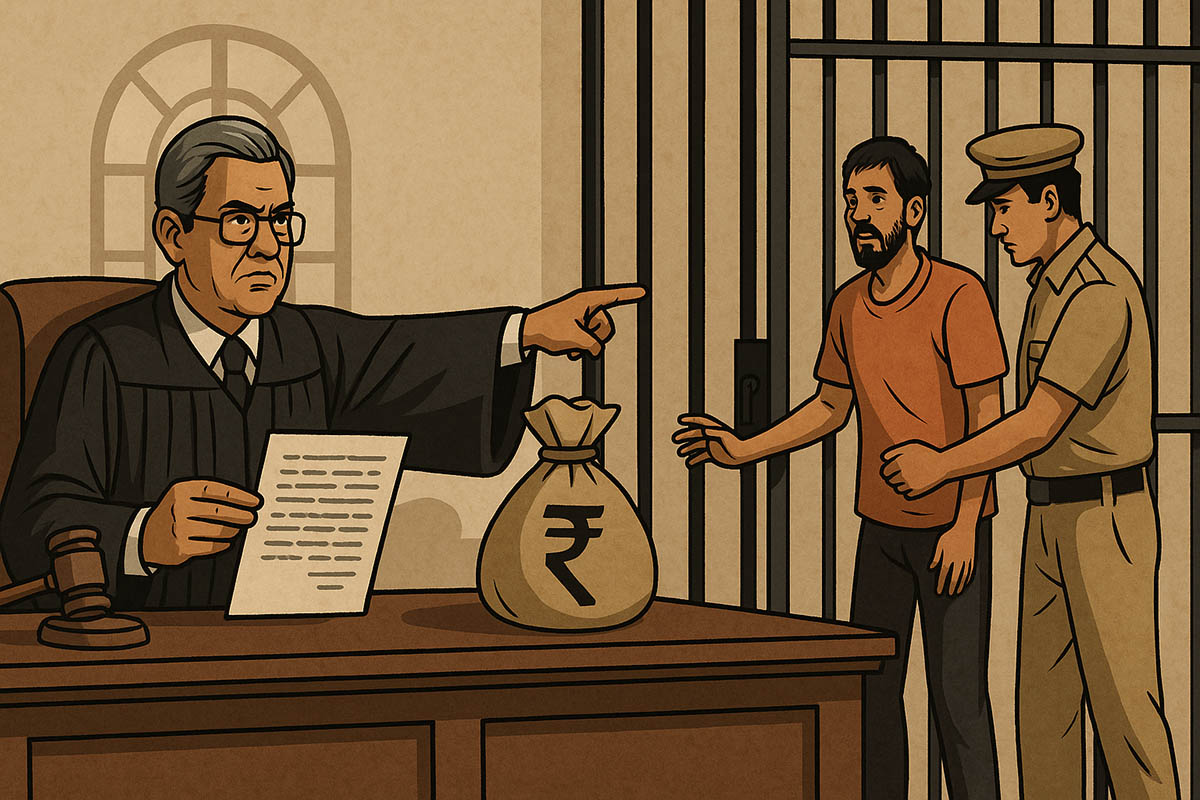
In a stinging affirmation of the constitutional guarantee of personal liberty, the Patna High Court has directed the State of Bihar to pay ₹2 lakh to a man who remained in jail for six days despite a valid judicial order directing his release. Through an oral judgment, delivered on November 13, exposing deep structural failures in Bihar’s prison administration, the Patna High Court has held that a Gaya jail inmate was illegally detained for six days despite a valid release order, thereby suffering a “clear breach of his fundamental right to life and personal liberty” under Article 21 of the Constitution. The Court awarded ₹2,00,000 in compensation, to be recovered from the responsible official, and directed the Inspector General (IG) of Prisons and Correctional Services to issue state-wide corrective guidelines within two weeks.
The Division Bench of Justice Rajeev Ranjan Prasad and Justice Sourendra Pandey delivered the ruling in a criminal writ petition filed by Neeraj Kumar @ Neeraj Singh, who had remained in the Central Jail, Gaya, even after securing bail in a case under Sections 30(a) and 37 of the Bihar Prohibition and Excise Act, 2016.
Release order issued on September 29 — but prisoner not released
Neeraj Kumar’s ordeal began after the Special Excise Judge issued a release warrant on September 29, 2025, which was promptly sent to the Superintendent of the Central Jail, Gaya. Yet, instead of being released, he continued to languish in custody. The Court meticulously reconstructed the timeline:
- The petitioner was arrested in Sarbahda P.S. Case No. 91/2025 and lodged in Central Jail, Gaya.
- He was granted bail on September 23, 2025.
- A release warrant dated September 29, 2025 was issued by the Exclusive Special Excise Judge, Gaya, directing that he be released unless required in another case.
- The jail acknowledged receipt of this release order.
Yet, the petitioner remained confined.
Instead of complying with the bail order, the Jail Superintendent relied on an earlier production warrant issued by the Chief Judicial Magistrate, Buxar, in connection with an unrelated theft case under Section 303(2) of the Bhartiya Nyay Sanhita. Significantly, the production warrant had fixed the production date as September 4, 2025—well before the release warrant arrived, and long expired by the time the petitioner’s liberty was at stake.
The High Court noted that the jail authorities had been corresponding with police officials for “vehicle with adequate force” to take the accused to Buxar, but at no point had they secured a fresh production warrant after the earlier one lapsed, even though both Section 304 and Section 305 of the Bhartiya Nagrik Suraksha Sanhita, 2023 allowed such recourse.
The Bench held unequivocally:
“…once the date fixed in the production warrant expired and the order of release had already reached in the hand of the Superintendent of Central Jail, Gaya Jee, he had no option but to release the petitioner.” (Para 3)
Instead, the jail kept him confined “for 18 days even after release without there being any order of a competent court,” as initially observed by the Court. Later, after accounting for a virtual production on October 4, the Bench narrowed the illegal period to five days—still an admitted constitutional violation.
IG Prisons Called to Court; Durga Puja holiday excuse rejected
On November 12, 2025, disturbed by what it termed “disturbing features” of the case, the Court summoned the IG, Prisons. Appearing online, the IG attempted to justify the delay, arguing that the non-release “occasioned due to the intervening Durga Puja holidays.”
The Bench rejected this outright, pointing out that:
- In-charge courts function even during holidays,
- The petitioner’s virtual production on October 4 occurred during Puja holidays, disproving the justification,
- The delay reflected not an isolated lapse but a habitual administrative practice.
The Court recorded that upon being confronted, the IG “immediately realised” and conceded:
“Yes, there is an illegal detention for at least five days.” (Para 6)
Court observes systemic violations across Bihar
The Bench expressed grave concern that such illegal detentions were not unique to this jail.
Justice Prasad observed: “There being an admitted position that it is a case of unauthorized detention of the petitioner from 29.09.2025 until 04.10.2025 and this practice is going on without drawing much attention of the Department, this Court being a Constitutional Court cannot remain a silent spectator.” (Para 7)
The Court’s warning was not limited to the Gaya jail, but directed at the State’s entire prison administration.
On Compensation: Court rejects ‘tokenism’, Cites Rudul Sah and Delhi High Court precedent
When asked to suggest a reasonable compensation amount, the IG proposed ₹10,000—a suggestion the Bench considered wholly inadequate.
The petitioner’s counsel demanded serious compensation, arguing that monetary relief must reflect the gravity of an Article 21 violation and citing:
- K.K. Pathak v. Ravi Shankar Prasad (2019), where the Patna High Court held that compensation for constitutional wrongs must be recovered from erring officials;
- Pankaj Kumar Sharma v. GNCTD (2023), where the Delhi High Court awarded ₹50,000 for only half an hour of illegal detention;
- Arvind Kumar Gupta v. State of Bihar (2025), where ₹1 lakh each was awarded for unauthorized police custody.
The Bench quoted extensively from Rudul Sah v. State of Bihar (1983), reaffirming that denying compensation would amount to “lip service” to fundamental rights.
After weighing these precedents, the Court held:
“Having considered the entire materials and the submissions as recorded hereinabove, we are of the considered opinion that a consolidated amount of Rs.2,00,000/- (Rupees Two Lakhs) would be a reasonable amount which may be awarded to the petitioner by way of compensation for his unauthorized detention by the Jail Superintendent, Central Jail, Gaya Jee.” (Para 11)
Crucially, the Court reiterated the principle that public money cannot bear the burden of unconstitutional action:
“The Respondent State of Bihar shall pay the compensation amount of Rs.2,00,000/- (Rupees Two Lakhs) to the petitioner within one month from today. Following the settled principle as discussed in the case of K.K. Pathak (supra), we direct that the amount so paid to the petitioner shall be realized from the erring official in accordance with law.” (Para 12)
State-wide Reform Direction: Mandatory guidelines in two weeks
Recognising the systemic implications, the Court issued a sweeping administrative directive:
- The IG, Prisons must issue uniform guidelines to all Jail Superintendents in Bihar,
- These guidelines must ensure strict compliance with release orders and constitutional guarantees,
- They must be issued within two weeks.
“Since we have come to know that this practice is going on in other jurisdictions of the Jail Superintendents in the State, the I.G., Prisons and Correctional Services is directed to issue appropriate guidelines to all the Jail Superintendents in the State of Bihar requiring them to strictly abide by the Constitutional Mandate and order of the Court without any exception. Such guideline shall be issued within a period of two weeks from today.” (Para 12)
The writ petition was accordingly allowed.
The complete judgement may be read here.
Related:
A Terror Case Without Evidence: Allahabad High Court’s ‘heavy heart’ acquittal After 28 Years