
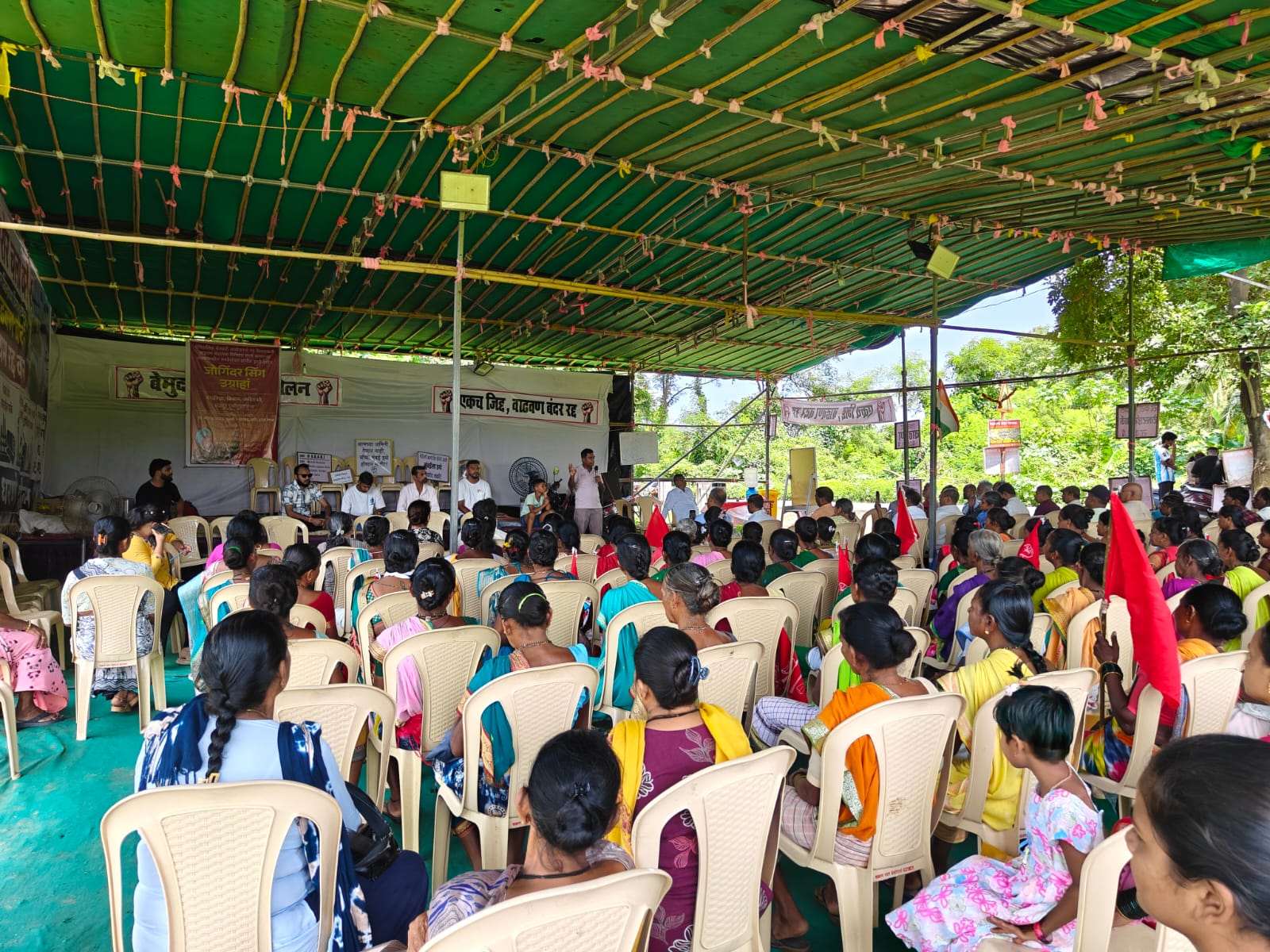
Pointing to the serious impact of climate change becoming serious in the coastal areas, building such massive port projects will have far-reaching consequences for both food security and health said the National Alliance of People’s Movements (NAPM) that has, after a series of interactions with local communities, demanded that the Vadhavan Port project be scrapped immediately. On the contrary, says the collective, the project threatens the livelihoods of fisherfolk, Adivasi lands, agriculture and orchards, the sea, and coastal biodiversity.
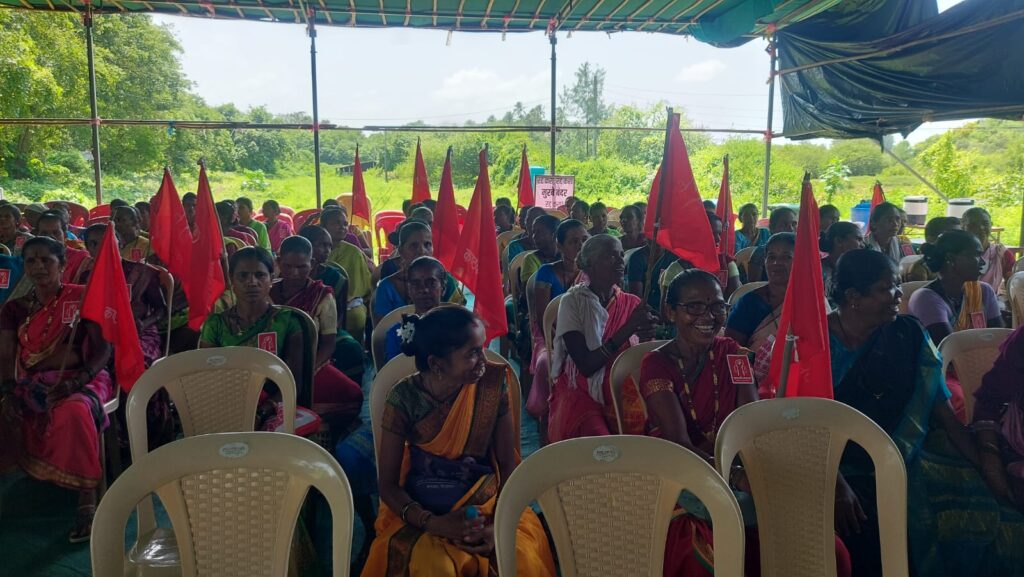
On September 19t and 20 2026, representatives of NAPM from Maharashtra and several other states across the country met and interacted with fisherfolk, Adivasis, farmers, die-makers, landless people, workers, and other affected communities in the Vadhavan area.
The Vadhavan Port project proposes to reclaim approximately 1,448 hectares of the sea to create land. In addition, large areas of land will be required for roads, railways, and other associated infrastructure. Chief Minister Devendra Fadnavis has publicly stated that Vadhavan Port will transform Maharashtra’s economy, turn Palghar into a “Fourth Mumbai,” and create lakhs of jobs. But the fisherfolk, Adivasis, farmers, die-makers, and other local communities protesting along the Vadhavan coast do not want a form of development that destroys their lives and livelihoods.
The proposal for a port in the Vadhavan area had been questioned earlier as well on environmental grounds. Today, various agencies of the Union and State governments are taking the project forward. Yet the environmental and social concerns raised earlier remain unresolved, even as the scale of the project has expanded many times over. The experience of JNPT and other ports must be studied – including the traffic, urbanisation, pollution, impacts on fishing, and expansion of infrastructure that they have brought to coastal areas – and an independent assessment of the overall impacts of Vadhavan must be carried out. The damage already witnessed elsewhere should serve as a grave warning.
“We do not want a Fourth Mumbai. Our sea, our farms, our forests and our villages must remain as they are!”
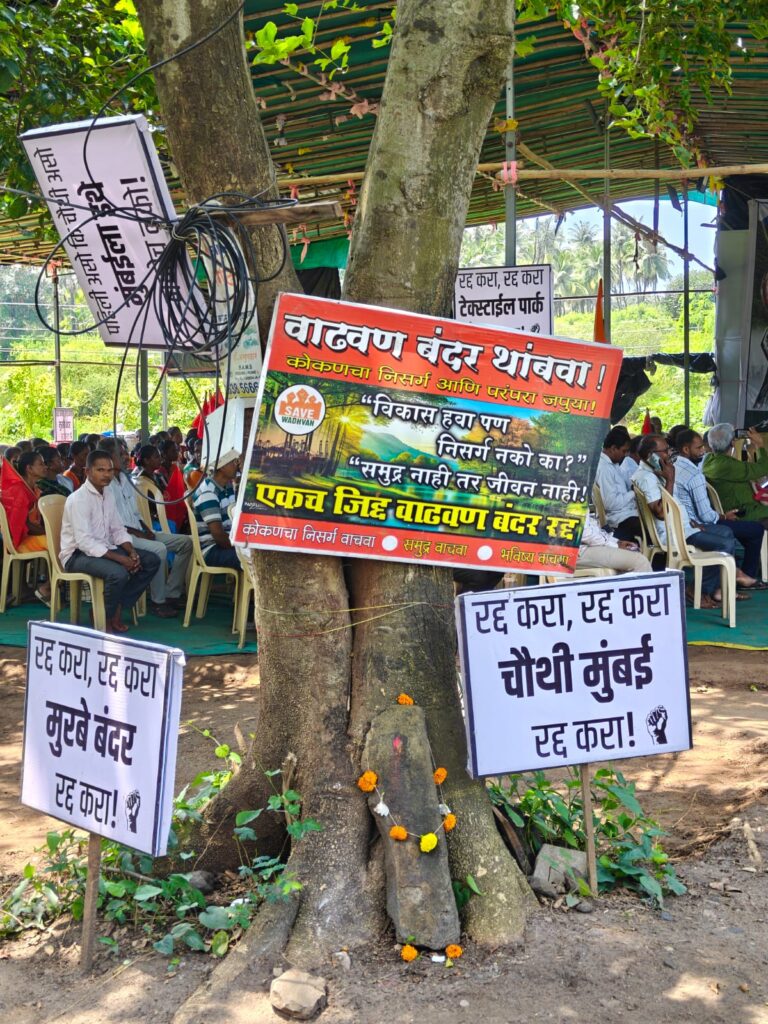
With this demand, communities across the area have united under the leadership of the Vadhavan Bandar Virodhi Sangharsh Samiti to oppose the port. Beyond the port itself, the project entails approximately 1,448 hectares of marine reclamation, over 10 kilometres of breakwater, large-scale dredging, road and rail connectivity, storage and logistics infrastructure, and industrial and commercial development. In other words, this is a project that will transform the entire coastline. In NAPM’s view, this is not a chain of development, but a chain of destruction. The government speaks of an investment of Rs. 76,220 crore and the creation of lakhs of jobs. But alongside government agencies, major international port, terminal, logistics, and dredging operators are participating in this project. Who, then, will count the cost to the generations-old livelihoods of local fisherfolk, Adivasis, farmers, and small producers?
According to government studies, the 16 fishing villages in the project area are home to 20,809 fisherfolk belonging to 5,333 households. Fishing is the principal livelihood of these communities. Skill training or compensation of a few lakh rupees cannot replace the sea for a fisher. Traditional fishing, local fish resources – including lobster – and the entire economy built around them must be protected. Vadhavan lies within the ecologically sensitive Dahanu region. The cumulative impacts of massive marine reclamation, dredging, and the breakwater on sea currents, sediment movement, fishing grounds, and tidal ecosystems must be examined seriously.
A fundamental question remains: Have the traditional knowledge of local communities, their lived experience of the sea, and data on local biodiversity been adequately reflected in these studies?
If mangrove areas are affected, marine ecosystems could be destroyed. Such ecosystems are nearly impossible to recreate elsewhere, making their protection and conservation critically important. The impacts of sourcing material for Vadhavan’s reclamation and associated infrastructure – including quarrying in hilly areas, impacts on Adivasi areas, and deforestation – must also be taken into account. Cutting down a forest in one place and planting trees in another district cannot compensate for the loss of that ecosystem.
Official information indicates that private land, Adivasi land, forest land, and government land will be required for the roads and railways connecting the port. The impact of the project will therefore not remain confined to the port area. For Adivasi communities, land cultivated over generations is the very basis of survival. We cannot accept taking away these lands in the name of development – blasting hills, cutting forests, and dumping reclamation material, and calling this “development.”
It is misleading to present Vadhavan as simply a “container port.” According to official documents, it is a deep-draft major port with the capacity to handle bulk chemical and crude cargo in addition to containers. Under the Central Pollution Control Board’s classification, ports, harbours, jetties, and dredging operations fall under the Red Category, while ports handling only containers fall under the Orange Category.
Government documents claim a sea depth of 20 metres. However, the local Sangharsh Samiti says that measurements taken at low tide found the depth to be lower. Activists say that although this issue was raised during the public hearing, no satisfactory response was provided.
The NAPM has demanded:
—Put a halt to the Vadhavan Port project immediately.
—Immediately halt tree-felling and all related infrastructure works.
—-Conduct an independent and transparent cumulative impact assessment, with the participation of local fisherfolk, Adivasis, farmers, and women.
—-Independently re-measure the depth of the sea, including verification of the claim of a 20-metre depth. The exercise must be public and conducted in the presence of local communities.
—-Protect the generations-old livelihoods of fisherfolk. Traditional fishing must not be destroyed in the name of compensation or alternative employment.
—Protect Adivasi land and forests, and safeguard all their legal rights, including rights under PESA.
—-Protect the local ecosystem instead of afforestation in distant districts as compensation for the destruction of local forests.
—-Instead of imposing uncontrolled urbanization in the name of a “Fourth Mumbai,” establish schools, colleges, hospitals, healthcare services, and employment opportunities based on the needs of the local people.
Finally, the statement issued by NAPM states that the people’s movement at Vadhavan is not a struggle against one port alone. It is a struggle to defend the coastline, fisherfolk and Adivasi communities, agriculture, forests, and biodiversity.
“The people of Vadhavan do want development – they want schools, a college, hospitals and doctors; they want markets for their agriculture and horticulture; fisherfolk need facilities and fair prices; and young people need dignified employment in their own region.
“NAPM stands firmly with the Vadhavan Bandar Virodhi Sangharsh Samiti and with the fisherfolk, Adivasis, and local communities fighting this project. We reject a model of development built by destroying the sea, forests, land, and livelihoods.NAPM appeals to people’s movements across the country to express their solidarity with the sit-in protest that has now continued for the past 48 days.”
NAPM has been part of this struggle, which has continued for several decades, from the very beginning. Medha Patkar, the late Thomas Kocherry, Rambhau Patil, N. D. Koli and many other activists have stood with this struggle over the years.
The statement has been issued by Sanjay Mangala Gopal, Suniti S. R – National Convenors (from Maharashtra), Sujay More, Sirat Satpute, Maharashtra State Convenors. The Solidarity Team Members include Prasad Chacko, Ahmedabad; Pranjali Tripathi, Jaipur; Adv. Mini Mathew, Bandra; Siddharth Chakravarti, Bengaluru; Sakshi Samant, Thane; Nandkumar Pawar, Mumbai; Ramesh Koli, Uran; Mangesh Koli, Uran; Mayur Koli, Uran; Dhananjay Shinde; Rajshree Shinde, Mumbai
Related:
Dahanu locals reject JNPT survey that pushes for a new port at Vadhavan
Maharashtra’s fishing community fights to protect its ‘golden belt’ coast
50,000 strong Adivasi, farmers march from Charoti to Palghar, hold indefinite dharna for land rights