
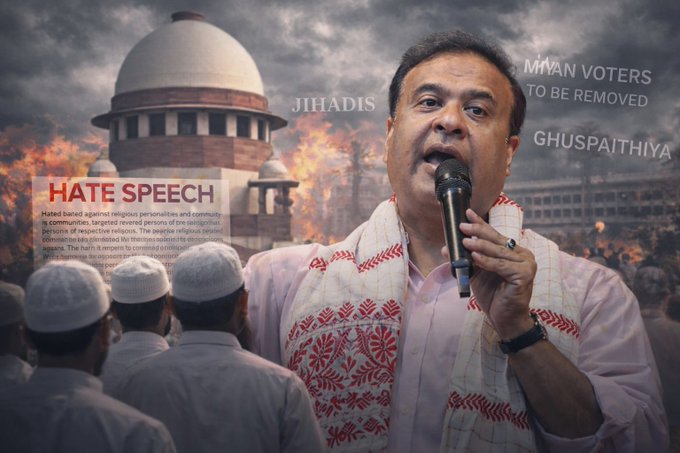
The Supreme Court is now seized of a cluster of petitions that collectively raise one of the most consequential constitutional questions of recent years: what limits, if any, does the Constitution place on the public speech of those who wield State power?
At the centre of this legal moment is Assam Chief Minister Himanta Biswa Sarma, whose public utterances over the last five years—now exhaustively catalogued before the Court—are alleged to represent not isolated political rhetoric but a sustained pattern of communal vilification, exclusionary exhortation, and legitimisation of social and economic discrimination against Muslims, particularly Bengali-origin Muslims in Assam.
The petitions—filed by the Communist Party of India (Marxist), CPI leader Annie Raja, a group of twelve citizens comprising former IAS, IFS officers, diplomats, academics and civil society actors, and Islamic clerics’ body Jamiat Ulema-i-Hind—seek criminal accountability, independent investigation, and for the first time, judicially enforceable standards governing the speech of constitutional functionaries.
“Point Blank Shot”, “No Mercy”: The video that triggered urgency
The immediate trigger for the CPIM and Annie Raja petitions is a video uploaded on February 7, 2026, from the official X (formerly Twitter) handle of BJP Assam.
The video depicts Chief Minister Sarma firing a gun at animated images of two men shown within a crosshair, portrayed as Muslims. As the gun discharges, the figures are struck repeatedly. The visuals are overlaid with phrases such as “Point blank shot” and “No mercy”, culminating in slogans that read:
- “Foreigner-free Assam”
- “Community, land, roots first”
- “Why did you go to Pakistan”
- “No forgiveness for Bangladeshis”
The video ends with a stylised, cowboy-like portrait of the Chief Minister himself.
Although the video was deleted following widespread outrage, the petition stresses that it continues to circulate widely, amplified by unofficial accounts and political messaging networks. The petition describes it as the most explicit and violent crystallisation of an already entrenched political narrative, one that frames an entire community as legitimate targets of exclusion and hostility.
Urgent mentioning before the Supreme Court
Senior Advocate Nizam Pasha mentioned the CPIM and Annie Raja petitions before Chief Justice of India Surya Kant, seeking urgent listing.
“We seek urgent intervention of this Court with respect to disturbing speeches made by the sitting Chief Minister of Assam. Complaints have been filed, but no FIRs have been registered,” Pasha submitted, as per LiveLaw, specifically referring to the February 7 video and earlier speeches.
The Chief Justice remarked that electoral seasons increasingly see political disputes entering constitutional courts, observing that “part of the elections is fought inside the Supreme Court.” However, the Court indicated that it would examine the matter and grant a date.
Details of the petition filed by the CPIM
- Not an Isolated Video: A five-year pattern of exclusionary speech
Crucially, the petitions insist that the February 7 video cannot be viewed in isolation.
The CPIM petition places before the Court a detailed chronology stretching from 2021 to February 2026, documenting a steady escalation in the Chief Minister’s public rhetoric. These include statements that allegedly:
- Conflate illegal immigration with Muslim identity
- Repeatedly deploy the slur “Miya” to refer to Bengali-speaking Muslims
- Call for denial of land, employment, transport, and livelihoods
- Advocate social and economic boycott framed as “civil disobedience”
- Encourage harassment through electoral roll objections
- Suggest removal of voting rights for members of a religious community
One of the most striking passages cited urges citizens to create conditions in which Muslims “cannot stay in Assam” by denying them rickshaws, shops, vehicles and land. Another openly exhorts supporters to short-pay rickshaw pullers belonging to the targeted community so that they are compelled to leave.
The petition argues that when such statements emanate from the head of the elected executive, they do not remain rhetorical—they acquire coercive force, shaping behaviour on the ground.
- From Speech to Social Harm: “Acting on the CM’s directions”
What distinguishes these petitions from earlier hate speech challenges is the emphasis on documented social consequences.
The CPIM petition cites reports of daily-wage workers being harassed, rickshaw pullers being deliberately underpaid, and individuals being confronted and asked to vacate neighbourhoods for being “Bangladeshi Muslims.” In several instances, videos circulating online allegedly show perpetrators explicitly stating that they are acting in accordance with the Chief Minister’s directions.
The petition warns that this marks a dangerous constitutional threshold: the translation of executive rhetoric into informal, decentralised enforcement by citizens, blurring the line between State authority and vigilante conduct.
- Immigration, NRC and the charge of deliberate conflation
A central legal argument advanced is that the Chief Minister’s rhetoric deliberately collapses the distinction between illegal immigration and Muslim identity.
The CPIM petitions point out that immigration is religion-neutral under Indian law, and that NRC data demonstrates that a majority of those excluded were non-Muslims. The selective focus on Muslims, therefore, is argued to expose the communal intent underlying the speeches.
What is framed publicly as demographic anxiety or border security, the petition contends, operates in effect as religious profiling and collective punishment, incompatible with Articles 14, 15 and 21.
- Constitutional oath and misfeasance in public office
The CPIM petition anchors its challenge in the constitutional oath taken by ministers to uphold sovereignty, integrity, fraternity and equality.
Relying on decisions such as Manoj Narula v Union of India, State of Maharashtra v SS Chavan and Daulatmal Jain, the petition argues that repeated, deliberate use of State authority to stigmatise and exclude a community constitutes misfeasance in public office and a breach of constitutional trust.
The petition further invokes the Supreme Court’s continuing mandamus in the hate speech batch (Qurban Ali, Shaheen Abdulla), which mandates suo motu registration of FIRs in cases attracting Sections 153A, 153B, 295A and 505 IPC (now reflected in the Bharatiya Nyaya Sanhita). The complete absence of FIRs, despite repeated complaints, is characterised as systemic executive impunity.
- Reliefs Sought: FIRs, SIT, transfer of investigation
Given that the alleged offender is a sitting Chief Minister, the petition seeks:
- Mandatory registration of FIRs under the BNS
- Constitution of an independent Special Investigation Team
- Transfer of all related investigations to an independent authority
The petition argues that State and Central agencies cannot reasonably be expected to act independently when the subject of investigation occupies the apex of political power.
Other petitions filed
- A Parallel Constitutional Question: Who regulates the speech of the powerful?
Running alongside the CPIM petition is a broader writ petition filed by twelve citizens—former civil servants, diplomats, academics and public intellectuals—which raises a distinct but connected constitutional concern: the complete absence of standards governing the public speech of constitutional authorities.
As per LiveLaw, this petition highlights not only the Assam CM’s remarks on “Miya Muslims,” “flood jihad,” “love jihad,” and voter removal, but also similar patterns across states and offices—references to “land jihad,” “infiltrators,” “anti-nationals,” and exhortations to “avenge history.”
The petition argues that while individual statements may fall short of statutory hate speech thresholds, their cumulative effect corrodes constitutional morality, erodes fraternity, and legitimises discriminatory governance.
Drawing on Navtej Singh Johar, Joseph Shine, and Government of NCT of Delhi, the petition contends that constitutional morality must operate as a restraint on those who exercise public power.
“Holders of public office are not ordinary speakers,” the petition emphasises. Their words carry the imprimatur of the State, shape administrative behaviour, and have a chilling effect on vulnerable communities—even absent explicit incitement.
The petition seeks declaratory relief that official speech must conform to constitutional values, and urges the Court to lay down guidelines that regulate conduct without curtailing free speech. Detailed report may be read here.
- Jamiat Ulema-i-Hind: Hate speech, disguised and normalised
Jamiat Ulema-i-Hind has reinforced these concerns by flagging Sarma’s January 27 statement that four to five lakh “Miya voters” would be removed during electoral roll revision.
According to the report of LiveLaw, the clerics’ body argues that many such utterances function as disguised hate speech, escaping prosecution due to selective enforcement and unchecked police discretion.
Relying on India Hate Lab data, Jamiat notes a 74% rise in hate speech incidents in 2024, with nearly 98% targeting Muslims, and links this surge to rising hate crimes against minorities.
A Common Grievance: Police inaction and the charge of selective enforcement
Across petitions, a common grievance emerges: law enforcement’s pick-and-choose approach.
While FIRs are swiftly registered against minorities, complaints against powerful public officials remain unattended. This, the petitioners argue, violates Article 14 and hollow out the rule of law.
Invoking Lalita Kumari, Tehseen Poonawalla, Pravasi Bhalai Sangathan and Kaushal Kishore, petitioners urge the Court to exercise its powers under Article 142 to impose binding accountability mechanisms.
A constitutional crossroads
Taken together, these petitions force the Supreme Court to confront a profound constitutional dilemma:
- Can holders of constitutional office weaponise speech without consequence?
- Does repetitive exclusionary rhetoric itself constitute unconstitutional governance?
- Can constitutional morality be judicially enforced against executive speech?
- When does silence and inaction by institutions become complicity?
With judgment reserved in the broader hate speech matter, the Assam CM petitions may well shape the next doctrinal chapter on hate speech, executive accountability, and the constitutional limits of political power.
Related:
The Politics of Processions: How the Sanatan Ekta Padyatra amplified hate speech in plain sight
CJP urges NCM action against hate speech campaign vilifying Bengali Muslims as ‘Infiltrators’
‘Islamophobia dominates Indian hate speech’: Equality Labs report on Facebook India