
Following my blog on why the Eiffel Tower authorities should take all the blame for giving in to the Swaminarayan sadhus’ bizarre demand to “invisibilise” women, including its female staff, during their visit to the internationally renowned Paris tourist centre on September 5, an interesting comment by one of the top academics drew my attention to something I vaguely knew about one of India’s most powerful and richest religious sects.
Sent as a personal message, Prof Ghanshyam Shah drew my attention to the fact that, at one point, the sect’s top sadhus had declared that they were not Hindus during a case in the Supreme Court. He further told me that its temples once did not allow “untouchables” to enter.
Nothing unusual, I thought, for a groundbreaking study, supported by an Ahmedabad-based Dalit rights NGO, Navsarjan Trust, “Understanding Untouchability”, had found the widespread prevalence of untouchability in 1,589 Gujarat villages it surveyed. It said that more than 90 per cent of rural Dalits reported facing “no entry” in temples during religious ceremonies. The 2009 survey became such an eyesore for the state government that the latter sponsored a parallel study to counter the Navsarjan claim.
I looked it up, and sources told me that the case was Sastri Yagnapurushdasji and Others v. Muldas Bhudardas Vaishya and Another. It so happened that in 1947, the Province of Bombay passed the Bombay Harijan Temple Entry Act—later superseded by the Bombay Hindu Places of Public Worship (Entry-Authorisation) Act, 1956—to eradicate untouchability by legally granting Dalits (then referred to as Harijans) the right to enter and worship in all Hindu public places of worship on equal terms.
Following the law’s passage, leaders and followers (satsangis) of one of the major Swaminarayan sects, operating from Ahmedabad, filed a suit seeking a permanent injunction to prevent non-satsangi Dalits—those not initiated into the spiritual teachings of Swaminarayan—from entering their temples.
The sect’s argument for exempting its temples from the social reform legislation was that the Swaminarayan faith, or Swaminarayan sampradaya, was an entirely separate and distinct religion, not part of the Hindu religion. Hence, the Bombay temple-entry laws—which applied specifically to “Hindu” places of public worship—did not apply to Swaminarayan temples.
The case, which began in Ahmedabad, went up to the Supreme Court, whose Constitution Bench, led by Chief Justice P.B. Gajendragadkar, ruled on January 14, 1966, that the Swaminarayan sect was an integral part of the Hindu religion. The court observed that Hinduism, unlike prophetic, monotheistic religions, does not depend on a single founder, a single holy book, or a uniform dogma. It described Hinduism as a broad, inclusive “way of life” capable of accommodating diverse theological views, reform movements, and sub-traditions. It went on to trace the theological foundation of Swaminarayan (Sahajanand Swami) to the Vishishtadvaita philosophy of Ramanuja. It noted that the sect accepts the authority of foundational Hindu scriptures—the Vedas, the Upanishads, the Bhagavad Gita, and the Bhagavata Purana—and worships traditional Hindu deities alongside its founder. Consequently, internal reforms or distinct sectarian practices did not sever it from the Hindu fold.
The court held that freedom of religion under Articles 25 and 26 cannot override constitutional mandates aimed at ending social evils like untouchability. Article 25(2)(b) specifically preserves the state’s power to provide for social welfare and reform by opening Hindu religious institutions to all classes and sections of Hindus.
Therefore, Swaminarayan temples fall squarely within the scope of public Hindu temples, making it unlawful to bar Dalit Hindus from entry.
Sources tell me that neither BAPS nor the Maninagar group, the two largest branches of the sect, were parties to the litigation, and that the case was fought by followers and sadhus of the original Swaminarayan sampradaya—specifically the Northern Gadi, centred at the Shri Nar Narayan Dev Temple in Kalupur, Ahmedabad.
Yet, despite claims of equality before God, the fact is that historical and sociological evidence suggests that Dalits (formerly untouchables) faced significant exclusion and separate worship practices within the Swaminarayan framework, and BAPS was no exception between the late 19th and mid-20th centuries.
While BAPS and “modern” Swaminarayan organisations emphasise spiritual equality, there have been several ways in which caste distinctions were enforced.
The primary ethical manual for all Swaminarayan followers—including BAPS—is the Shikshapatri, was written the 19th century. The Shikshapatri no doubt sought to initiate followers across caste lines and preached against outward notions of pollution in bhakti, yet it explicitly accommodated traditional Varnashrama Dharma. It referred to Slokas 17–20 and 91 in order to instruct followers not to abandon the duties and ritual observances of their own caste. In fact, there were ritual purity rules which dictated that touching members of the “lowest castes” (antyaja or outcastes) caused ritual impurity requiring purificatory bathing.
An authoritative interpretation of Shikshapatri published by the temple authorities under the title “The Epistle of Precepts” states that the caste system is “designed for effective organisation and management of society. It provides a distribution of manpower for various necessary jobs.” Comparing it with “White collar/Blue collar separation of the work force in the West”, the write-up insists that it is “enforced by birth”, and that depending on “one’s past karmas”, one is “born to endure the miseries or pleasures arising from a particular caste”. It adds: “If the caste system and the duties for each caste were followed then there is no doubt that we could return the former glory of ‘Rama Rajya’. The caste system is in no way a burden and needs to be preserved.”
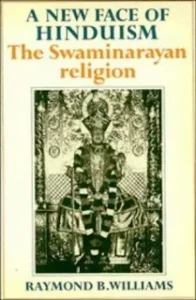
Because caste rules prevented low-caste followers from worshipping alongside upper-caste Patidars and Brahmins in major temples, the sampradaya is said to have historically addressed Dalit devotion by building separate shrines or requiring external worship. Sociologist Raymond Brady Williams is cited for documenting that in parts of Gujarat (such as Chhani near Vadodara), separate temples were maintained specifically for Dalit devotees, where they could manage and perform rituals themselves without entering dominant-caste shrines. Further, early colonial observers and 19th-century commentators noted that while untouchables were inducted as disciples, social conservatism among dominant-caste followers led them to build segregated shrines or sit outside during satsang assemblies.
It is within this framework that BAPS (or, for that matter, the Maninagar Gadi) never claimed to be non-Hindu. Unlike the orthodox Ahmedabad litigants in the 1948-1966 Yagnapurushdasji case—or groups like the Ramakrishna Mission, which in the 1980s famously petitioned courts for non-Hindu minority status under Article 30 to protect its schools—BAPS never made any legal, institutional, or theological claim of being a separate, non-Hindu religion.
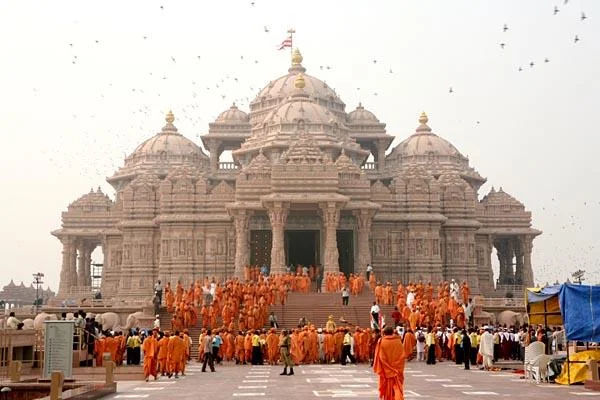
Instead, BAPS took the opposite approach, establishing itself as an assertive, global champion of classical Hindu identity, identifying itself as a “socio-spiritual Hindu organisation” rooted in Vedic Sanatana Dharma, whatever that may mean. Today, its literature, constitutional charters, and global temples—such as the Akshardham complexes in Delhi, Gandhinagar, and Robbinsville, New Jersey—are officially branded as Hindu mandirs and centres of Hindu culture.
In fact, sources insist that BAPS protagonists have sought to justify the claim that the assertion “We are not Hindu” was primarily an expedient legal defence, not an authentic theological shift.
The 1948-1966 court plaint (Sastri Yagnapurushdasji v. Muldas Bhudardas Vaishya), originally filed on January 12, 1948, in the Civil Court at Ahmedabad, explicitly argued that the religion of the Swaminarayan sect was “distinct and separate from the Hindu religion”, just to bypass the Bombay Harijan Temple Entry Act.
Further, BAPS never sought to endorse the “non-Hindu minority” legal trend that prevailed across India during the mid-to-late 20th century, when several prominent Hindu-origin organisations filed official court petitions seeking status as distinct, non-Hindu religious minorities to protect their institutions from state control or social legislation—something the Ramakrishna Mission in West Bengal, as well as the Lingayats in Karnataka, did.
Yet, for a long time, in BAPS, while non-Brahmin dominant castes (predominantly Patidars) made up much of the sadhu leadership, Dalits were not accepted into the ascetic order. Dalit satsangis, it was claimed, historically observed customary caste restrictions as part of their caste duty (dharma), resulting in a virtual absence of Dalit ascetics. It was only beginning in the 1980s and 1990s, under Pramukh Swami Maharaj, that BAPS formally began breaking this precedent by initiating sadhus from Dalit and Adivasi backgrounds and integrating them into full temple rituals and sanctum priesthood.
And what is the Dalit status today in BAPS temples? Sources tell me that while officially there are no caste-based restrictions on Dalits in its temples, neither BAPS nor any other Swaminarayan Gadi publishes an official caste census of its monastic order. Doctrinally, the sects maintain that upon taking initiation (diksha), a sadhu renounces their worldly identity and pre-monastic caste.
However, detailed field studies and academic documentation by sociologists and historians such as Raymond Brady Williams, Rachel Dwyer, David Hardiman, and Ghanshyam Shah provide some idea, stating that while BAPS formally ended caste-based exclusions for monastic initiation in the late 20th century, the actual proportion of Dalit and Adivasi sadhus is estimated to be well under 1%—representing a tiny handful of individuals out of more than 1,100 to 1,200 living sadhus. And most of the marginalised-community inductions into the sadhu order have come from Adivasi (tribal) communities in eastern and southern Gujarat, rather than Dalits. Adivasis, in the caste-based structure of Hinduism, do not fall under the “untouchables” category.
As for other Swaminarayan sects—the Vadtal and Ahmedabad Gadi (the original sampradaya)—the proportion of those wearing saffron robes is effectively 0%. Patidars overwhelmingly rank across almost all Swaminarayan sects and are heavily concentrated among dominant landowning and mercantile castes—estimated by sociologists to make up 60% to over 80% of the sadhus, while Brahmins and Banias comprise most of the remaining portion of the ascetic order.
In several Swaminarayan establishments, the low-caste candidates who entered the monastic path were permanently relegated to the status of parshads (also called palas or bhagats). They wore white clothes, performed manual labour, and were barred from receiving full saffron renunciation (bhagwati diksha).
As for BAPS, in the 1980s–1990s, as part of its expanded youth initiatives, there was tribal/backward-class outreach. At the 1981 Swaminarayan bicentenary mega event in Ahmedabad, Pramukh Swami initiated a massive cohort of young, educated men into the monastic order, beginning a formal systematisation of the training pipeline, which included initiating youths from backward-class and tribal (Adivasi) backgrounds into saffron robes, granting them new ascetic names and the sacred thread.
According to Williams, Pramukh Swami “abolished for BAPS the caste-related category of ascetics permanently in white”. From that period onwards, the parshad (white-clad) status in BAPS ceased to be an indicator of lower caste. Instead, it became a mandatory, temporary probationary phase (typically lasting one to three years) that every novice—regardless of caste or social background—must undergo before taking full saffron vows.
David Hardiman, a prominent subaltern historian and sociologist of modern Gujarat and Professor Emeritus of History at the University of Warwick, noted in “Class Base of the Swaminarayan Sect” (Economic and Political Weekly, 1988) that while the Swaminarayan Sampradaya historically served as an ideological vehicle for the upwardly mobile Kanbi/Patidar agrarian elite, the sect incorporated lower-caste and Adivasi groups through moral reform (temperance, vegetarianism), which structurally limited Dalits from rising into spiritual leadership or ascetic power within dominant institutions.
I would like to end with the following observation by Prof Ghanshyam Shah in “Untouchability in Rural India”, co-authored with Harsh Mander, Sukhadeo Thorat, et al.:
“While the evidence … suggests that the more blatant and extreme forms of untouchability appear to have declined, discrimination continues and is most prevalent in the religious and personal spheres.”
Further:
“Removal of untouchability was on their agenda; it was however primarily confined to removing the taboo of physical touch rather than socio-economic discrimination and inequality.”
Courtesy: CounterView