
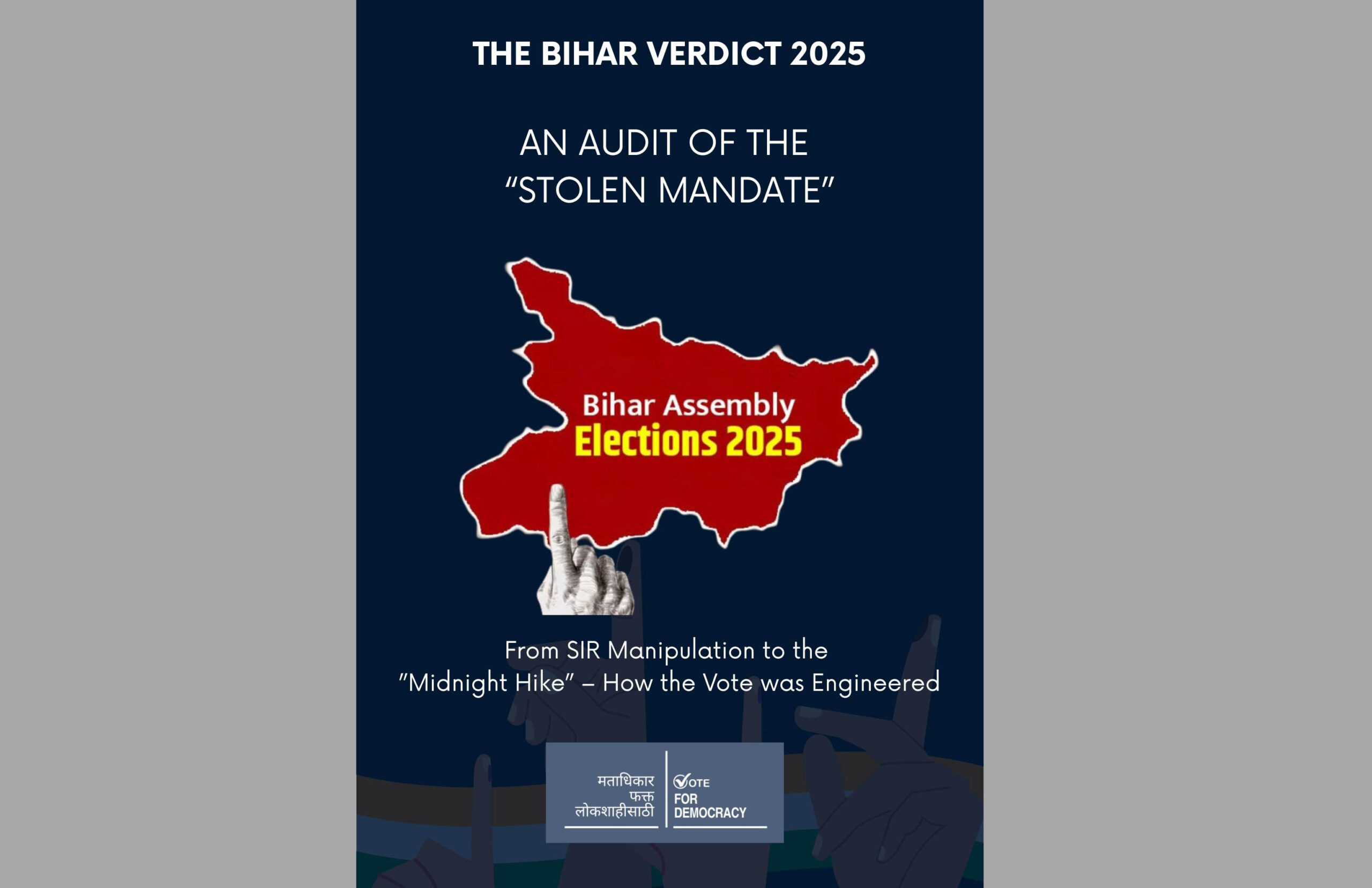
In a functioning democracy, elections are meant to be moments of collective decision-making—when citizens, through the simple act of voting, determine their political future. However, what happens when that choice is quietly taken away long before polling day arrives?
A detailed audit titled “The Bihar Verdict 2025”, curated by Vote for Democracy (VFD), Maharashtra, suggests that this is precisely what unfolded in the 2025 Bihar Legislative Assembly elections. Drawing exclusively from official Election Commission of India (ECI) data, statutory provisions, constitutional norms, and documented inconsistencies, the report presents a disturbing account of how India’s most fundamental democratic exercise was methodically hollowed out—before, during, and after polling.
What emerges is not a story of sporadic irregularities or administrative error, but of systemic electoral engineering, carried out through opaque voter roll revisions, statistical impossibilities, data suppression, and post-poll manipulation—raising urgent questions about the credibility of India’s electoral institutions.
The said report has been authored and compiled by Vote for Democracy (VFD), Maharashtra under the guidance of experts MG Devasahayam (IAS (Retd) and Founder, Forum for Electoral Integrity), Dr Pyara Lal Garg, (Former Dean, Faculty of Medical Sciences, Panjab University, Chandigarh) and Professor Harish Karnick, (Computer Science Expert) and Madhav Deshpande, (Computer Science Expert).
The Electoral ‘Ambush’: An unprecedented Special Intensive Revision
At the centre of the report is the Special Intensive Revision (SIR) of electoral rolls, notified by the ECI on June 24, 2025, just months before the Assembly election. While electoral rolls are periodically revised, the timing, scale, and opacity of this exercise make it extraordinary.
Bihar’s rolls had already undergone continuous revision since 2003, with a Special Summary Revision completed in January 2025. There was, therefore, no apparent administrative necessity for another sweeping revision so close to elections. Yet the ECI undertook precisely that—without recording reasons, disclosing empirical justification, or publishing a transparent methodology.
The report argues that this move violated statutory safeguards under the Representation of the People Act, 1950 and the Registration of Electors Rules, 1960, while also undermining constitutional guarantees under Articles 14, 19, 21, 325, and 326. Most alarmingly, the SIR reversed a core principle of electoral democracy: the presumption of inclusion of citizens on the voter roll.
Instead, the revision effectively placed the burden of proof on voters themselves, subjecting them to what the report describes as a citizenship-style verification exercise, without any legislative sanction.
Mass disenfranchisement hidden in plain sight
The consequences of the SIR were immediate and devastating. According to official ECI figures:
- On June 24, 2025, Bihar had 7.89 crore registered voters.
- By the Draft Roll of 1 August 2025, this number had dropped to 7.24 crore—a deletion of 65.69 lakh voters.
- The Final Roll published on September 30, 2025 stood at approximately 7.42 crore electors.
Yet, the report finds that only 3.66 lakh voters were ultimately found to be ineligible. The sheer scale of deletions—nearly twenty times higher than justified exclusions—points not to routine correction but to deliberate disenfranchisement.
The most shocking phase occurred between 21 and 25 July 2025, when over 21.27 lakh voters were deleted in just three days. During this period alone:
- 5.44 lakh voters were marked as ‘dead’,
- 14.24 lakh as ‘permanently shifted’, and
- those marked ‘untraceable’ increased by an astonishing 809% overnight.
Despite the SIR being justified as a means to remove “foreigners” from the rolls, not a single foreign national was identified.
As the report notes, such numbers defy administrative logic and statistical probability, pointing instead to algorithmic or bulk deletions, carried out without genuine field verification.
The ‘rectification’ that didn’t add up
Following public criticism, the ECI claimed to have undertaken a process of rectification, stating that approximately 17 lakh objections or applications were received. However, the final numbers tell a different story.
The report documents that around 22 lakh entries were modified—far exceeding the number of applications claimed. Even after accounting for these corrections, the voter roll should have mathematically settled at approximately 7.38 crore electors. Instead, the ECI declared 7.42 crore voters, leaving an unexplained surplus of 3.24 lakh electors.
No reconciliation statement, independent audit, or transparent explanation has been provided for this discrepancy—raising serious concerns about the integrity of the final roll itself.
When the rolls kept changing after elections were notified
Electoral law and convention require voter rolls to be effectively frozen once elections are notified, to ensure certainty and fairness. Yet, the report shows that in Bihar, the rolls continued to change even after notification.
- On October 6, 2025, the electorate stood at 7.43 crore.
- By poll day, it had risen to 7.46 crore.
In just ten days, 3.34 lakh voters were added, including a sudden and unexplained spike in young voters—an impossibility given eligibility timeline.
The sanctity of the voter roll, the report argues, was thus compromised at the most critical stage of the electoral process.
Structural rigging and data suppression
Manipulation was not confined to voter rolls alone. The report details a sharp increase in polling booths—from 77,462 in the 2024 Lok Sabha elections to 90,740 in Bihar 2025—without a corresponding expansion in remote or riverine areas, raising questions about constituency engineering.
Equally troubling was the Election Commission’s progressive withdrawal of transparency. Constituency-wise turnout figures and final votes polled before counting—data routinely published in earlier elections—were withheld. Instead, fragmented district-level data was released, making independent verification virtually impossible.
Institutional capture at the grassroots
At the ground level, the report highlights the deployment of 1.8 lakh ‘Jeevika Didis’ as poll volunteers—women who were also beneficiaries of state welfare schemes involving cash transfers. This, the report argues, blurred the line between welfare delivery and election administration, undermining the neutrality of the electoral machinery.
The imbalance in Booth Level Agents (BLAs) further compounded the problem. While the ruling alliance deployed over 91,000 agents, the opposition averaged just 1.55 agents per booth, creating vast unmonitored spaces within polling stations.
Poll-day violations and the ‘midnight hike’
Polling and counting days were marked by a series of disturbing incidents: CCTV failures, VVPAT slips found discarded on roads, unauthorised vehicles near strong rooms, and the transportation of approximately 6,000 voters from Haryana through special trains, allegedly facilitated with free tickets.
But the most consequential intervention came after polling had ended. On 12 November 2025, official data recorded a uniform 0.18% increase in voter turnout—identical for both men and women across phases. This “midnight hike” added 1,34,145 votes, altering outcomes in around 20 constituencies.
In 21 seats, victory margins ranged from zero to just 15 votes, yet no automatic VVPAT recount was ordered.
More than a Bihar story
“The Bihar Verdict 2025” concludes with a stark warning: what happened in Bihar is not an isolated aberration. It represents a new mode of electoral manipulation, executed not through visible violence or overt coercion, but through administrative opacity, legal sleight of hand, and data control.
At stake is not merely the outcome of one state election, but the constitutional promise of universal adult suffrage itself.
As the report makes clear, when voters disappear from rolls, when numbers defy arithmetic, and when transparency is treated as expendable, democracy itself becomes the casualty.
The complete report may be accessed here: https://votefordemocracy.org.in/wp-content/uploads/2026/01/260113-FINAL-THE-BIHAR-VERDICT.pdf
Presentation: https://votefordemocracy.org.in/wp-content/uploads/2026/01/THE-BIHAR-VERDICT-2025-ppt.pdf
Related:
VFD’s rebuttal of the Fadnavis’ Claims on Electoral Manipulation Allegations
Vote for Democracy (VFD) releases report on the conduct of General Election 2024
The Stolen Franchise: Why the Election Commission cannot escape accountability
Major Irregularities in 2024 Maharashtra Vidhan Sabha Polls; Vote for Democracy