
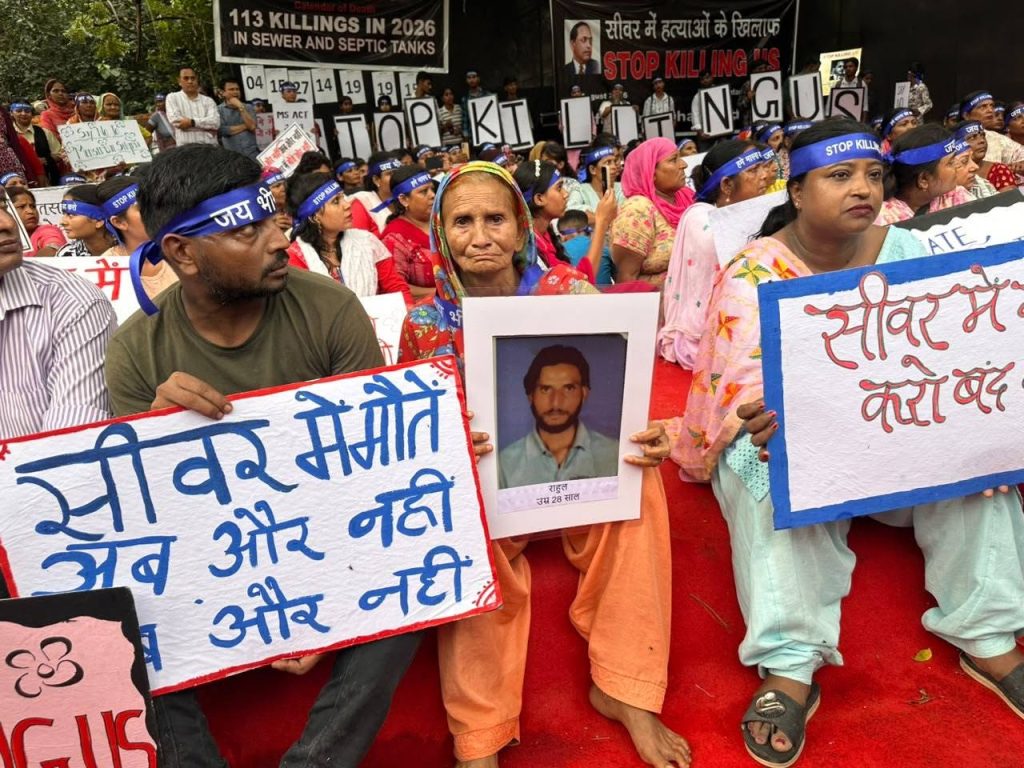
India has progressed technologically, legislated against manual scavenging, and constitutionally abolished untouchability. Yet, in the twenty-first century, caste still determines who enters a sewer. The persistence of manual scavenging is therefore not merely a relic of an orthodox society, it is a stark reflection of the stereotypes we continue to carry and the failure of State instrumentalities to eradicate what the law has already prohibited.
According to the data compiled by the Safai Karamchari Andolan, a civil society organisation working against Manual Scavenging – 101 sanitation workers have died cleaning sewers and septic tanks across India during the first 188 days of 2026, amounting to one death every 45 hours. The capital of India, Delhi NCR is alone accounted for 12 deaths. However, what constitutes a greater violation of human rights is the under-reporting of these deaths by the central government in order to evade liability. In an April 2026 through a release of the Press Information Bureau (PIB), the Ministry of Social Justice and Empowerment stated that, according to the National Commission for Safai Karamcharis, 317 sanitation workers had died due to hazardous cleaning of sewers and septic tanks between 2021 and 2025, the same release says that 89,248 sewer/septic tank workers had been profiled and validated under NAMASTE scheme. The State’s own numbers reveal a troubling contradiction: thousands of workers are recognised as performing hazardous sanitation work, yet the deaths arising from it remain strikingly few on paper. How, then, are these deaths being counted?
The state justifies this under-reporting by drawing a distinction between “cleaning human excreta” vs “accidents during the hazardous cleaning of sewers and septic tanks”, but for the worker who enters a sewer and never comes out, there is no such distinction. The major question that we as a society should ask is that when a person dies while manually cleaning a sewer, does the legal classification matter more than the death?
If carefully scrutinised, we can find that the section 2(d) of the Prohibition of Employment as Manual Scavengers Act, 2013 separately defines “hazardous cleaning”, whereas section 7 expressly prohibits employing or engaging a person for hazardous cleaning of a sewer or septic tank, and under Sec 33, the act doesn’t merely prohibit hazardous cleaning, it also says that local authorities and other agencies have a duty to use modern technology for cleaning sewers and septic tanks. The emphasis, therefore, should not merely be on providing protective gear to those entering these hazardous spaces, but on completely eliminating the need for human beings to enter them in the first place. Yet, despite the legislative mandate and technological alternatives, State instrumentalities continue to remain criminally silent.
In the case of Safai Karamchari Andolan & Ors. v. Union of India (2014), the Court recognised sewer deaths and directed compensation of Rs. 10 lakhs to the families of deceased workers, which was enhanced to Rs. 30 lakhs in Balram Singh v. Union of India (2023)
The documentary Kakkoos filmed in Tamil Nadu, a state which is said to have the highest number of Manual Scavengers, brings out another disturbing reality: the existence of legislation prohibiting dry latrines has not eliminated the conditions that continue to force people to manually handle human excreta. However, the practice extends far beyond the cleaning of latrines.
Garbage collectors, for instance, are often required to handle human excreta when waste from households of medical patients is disposed of in polythene bags and subsequently has to be removed by hand. In schools without adequate water or sanitation facilities, children may defecate and leave, leaving cleaners to remove the excreta with their bare hands. Yet, such workers are often not recognised as manual scavengers. Kakkoos therefore exposes the gap between the legal understanding of manual scavenging and the lived reality of those who, in one way or another, are compelled to handle human excreta.
However, the danger does not end with the indignity of the work. Manual scavengers are routinely exposed to hazardous gases such as hydrogen sulphide, carbon monoxide, ammonia and methane, with prolonged exposure causing respiratory and visual impairment, seizures and, in severe cases, death. Constant contact with human and animal excreta further exposes them to infections such as leptospirosis. Yet, for a community already pushed to the margins by caste and poverty, access to healthcare remains limited. The physical and mental toll of such work, coupled with poor living conditions and, in some cases, dependence on alcohol as a means of coping, only deepens a cycle of vulnerability that the State has a responsibility to break.
Manual scavenging, thus, is not only a blatant violation of the human rights bestowed upon an individual by virtue of birth, but also raises serious questions about social practices continued in society in the name of “tradition”. The practice is deeply rooted in the caste hierarchy, where a birth-given identity has historically determined the occupation and social position of an individual.
Yet, despite Article 17 of the Constitution abolishing untouchability in 1949, manual scavengers continue to remain among the most disadvantaged communities within the Dalit population, historically placed at the lowest rungs of the caste hierarchy as “Atishudras”. The fact that a birth-assigned tag can continue to determine who performs such inhumane work, decades after constitutional abolition, is perhaps the starkest illustration of the distance between what the law promises and what society continues to practice.
(The author is a law student at BMS College of Law, Bangalore)
Related:
Manual scavenger deaths: How effective is the law in preventing them?
Supreme Court bans manual scavenging in metro cities
Manual scavenger deaths: How effective is the law in preventing them?