
This paper applies the theoretical concepts of the “scene” and the “obscene,” developed in my earlier work on caste and “schizophrenic modernity”, to analyse the dispute over the University Grants Commission (Promotion of Equity in Higher Education Institutions) Regulations, 2026. Notified on January 13, 2026 and stayed by the Supreme Court on January 29, the regulations have become a site for a real contest over the visibility and invisibility of caste in modern India. Based on the scene/obscene dialectic, developed through Foucauldian theory, the concept of hegemony from Gramsci and the critical insights of Anand Teltumbde and Gopal Guru, this paper argues that the UGC controversy represents the schizophrenic condition of caste in contemporary India, where a constitutional official frame of formal renunciation of caste discrimination coexists with a social obscene of reproducing the hierarchy of caste. The protests by upper-caste students, the ambivalence of the state, the intervention by the judiciary and the protests by Dalit students in turn are all indicative of the struggles over the demarcation between the visible and the speakable, and the invisible and the unspeakable. Through a close reading of the provisions of the regulations, the arguments made before the Supreme Court, the violence on the Delhi University campus and the politics of the ruling party, this paper shows how the scene/obscene dialectic helps to disclose the deep structure of the persistence of caste in modern institutions.
Introduction: The Campus as Double Stage
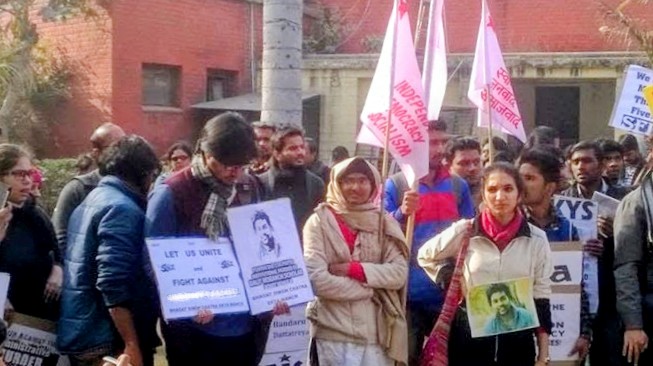
The University Grants Commission, on January 13, 2026, notified the Promotion of Equity in Higher Education Institutions Regulations, a broad set of rules intended to counter caste discrimination in Indian universities. Within two weeks, the Supreme Court stayed the regulations, observing that they showed “complete vagueness” and might have “dangerous impacts” to “divide society.” In the meantime, and in the weeks that followed, Indian universities, particularly Delhi University, witnessed protests and counter-protests, violence, allegations of assault, cross-FIRs and, subsequently, a month-long ban on all demonstrations. SabrangIndia’s detailed story on the nationwide protests may be read here and here.
This debate goes beyond a simple policy debate. It is a point at which the underlying contradictions of caste in contemporary India have come face-to-face with the national arena. In my previous work, I introduced the concept of “schizophrenic modernity”, a condition in which a public official theatre of constitutional equality coexists with a dynamic social obscenity, wherein the hierarchy of caste is reinscribed through intimate sociability, bodily practices and moments of violence. The UGC controversy makes this schizophrenia explicit.
To gain a full understanding of the stakes, it is imperative to consult two scholars whose work helps to illuminate the underlying structure of this dispute. Anand Teltumbde’s work on the “camouflaged” presence of caste provides a framework for understanding how caste functions within modern institutions as a hidden system of social capital and exclusion, rather than as a visible ritualized hierarchy. Gopal Guru’s work on the scene/obscene dialectic of knowledge production, along with his imperative to theorize from the location of the obscene, supplies the methodological key to centering the Dalit experience in this argument. Together, they enrich and expand my Foucauldian-Gramscian framework, locating it within the particular intellectual traditions of Dalit Studies.
The article uses the framework to provide a thorough argument about the controversy. Part I will evaluate the rules as a scene of extending the constitutional scene into the obscene. Part II will locates the upper-caste reaction as a manifestation of “camouflaged” caste, as well as Gopal Guru’s reading of hegemonic denial. Part III will discuss the role of the Supreme Court as a moment of definitional politics. Part IV will analyse campus violence as a manifestation of obscene eruption, according to Teltumbde’s framework. Part V will evaluate the schizophrenic stance of the state. Part VI will explore Dalit counter-mobilizations as a moment of forcing the obscene back into the scene, according to Guru’s imperative to theorise from the location of the obscene. The conclusion will consider what this controversy tells us about the underlying architecture of caste power.
I. The Regulations: Extending the Scene into the Obscene
The UGC Equity Regulations 2026 have their roots in a specific set of events: a petition to the Supreme Court jointly filed by the mothers of Rohith Vemula and Payal Tadvi, both of whom took their own lives in the aftermath of alleged caste-based harassment on their respective college campuses. Vemula, a Dalit PhD scholar at the University of Hyderabad, died in 2016; Tadvi, a tribal medical student in Mumbai, died in 2019. Their deaths have been seen as symptomatic of the failure of institutional mechanisms to protect marginalised students.
Statistics shown by the UGC to a parliamentary committee show a 118.4% increase in reported cases of caste-based harassment over five years, from 173 in 2019-20 to 378 in 2023-24. Journalist Anil Chamadia said that this increase “is not merely about numbers; it is directly linked to growing awareness among marginalised students and the protection given to dominant caste ideologies.” When first-generation Dalit students enter universities in greater numbers, the dominant castes may resent their presence, leading to increased harassment.
The regulations created a complex administrative machinery for equity. They mandated that every higher education institution set up an Equal Opportunity Centre (EOC) to monitor policies for the disadvantaged. Equity Committees, mandated to include representatives from Scheduled Castes (SC), Scheduled Tribes (ST), Other Backward Classes (OBC), women and persons with disabilities, were tasked with complaints. Institutions were mandated to set up “equity squads” for constant surveillance, establish 24/7 hotlines and ensure time-bound redressal of grievances, committees were to meet within 24 hours of a complaint and submit a report within 15 days. Failure to comply would invite severe punishment, including withdrawal of UGC funding, exclusion from schemes, or suspension of degree programs.
Notably, the regulations introduced protection for the first time for OBCs, besides SC/ST students, faculty and staff. The concept of “caste-based discrimination” in Clause 3(c) was articulated as discrimination “only on the basis of caste or tribe against the members of the Scheduled Castes (SC), Scheduled Tribes (ST) and Other Backwards Classes (OBC).”
Based on the current framework, the regulations can be understood as an effort to operationalize the constitutional ban on caste discrimination as a pervasive social order. While the Constitution bans caste discrimination at the level of abstract jurisprudence, the regulations aimed to create capillary structures—committees, squads, helplines—that would penetrate the intimate spaces of caste discrimination: the classroom, the hostel, the mentor-mentee relationship and social networks. They aimed to make visible the everyday humiliations, exclusions and violence against Dalit students, which the “obscene” had hitherto made invisible.
As a UGC functionary explained, “The regulations aimed to institutionalize anti-discrimination policies rather than have a piecemeal approach and thus provide ‘marginalised students with an official platform to raise their concerns, which was often lacking before.’” This is the role of the scene: to make grievances speakable, visible, and actionable. The obscene, on the other hand, is that which is unspeakable, the casteist remark that is reduced to “just a joke,” the exclusion that is reduced to “personal preference,” the hostility that is reduced to “academic rigor.”
II. The Upper-Caste Backlash: Camouflaged Caste and the Hegemony of Denial
The regulations didn’t just face criticism; they walked into a firestorm. Upper-caste students, faculty and a chorus of social media voices came out swinging almost immediately. Protests erupted at Delhi University, Lucknow University and right outside the UGC office. But if you listen closely to what the protesters are actually saying, something interesting emerges. Their words reveal how privilege dresses itself up as fairness when its back is against the wall. To really understand what’s happening here, we need two thinkers: Anand Teltumbde and his idea of “camouflaged” caste, and Gopal Guru with his insights about who gets to theorise and whose experience counts as real.
Teltumbde: When Caste Puts on a New Suit
In The Persistence of Caste (2010), Teltumbde makes a deceptively simple argument that cuts through a lot of confusion. Caste hasn’t disappeared in modern India; it’s just changed its clothes. It no longer marches around in religious robes, declaring Brahmins superior and Dalits polluted. Instead, it’s dressed itself in the respectable attire of modernity. It speaks the language of merit, efficiency and professionalism, all while quietly reproducing hierarchy through who knows whom, who gets recommended for jobs, who feels comfortable in academic spaces.
This is exactly what we’re seeing in the UGC controversy. The upper-caste protesters aren’t defending traditional caste ideology. You won’t hear them argue that Brahmins are naturally smarter or that untouchability was ordained by the gods. That would be too obvious, too easy to counter. Instead, they’ve wrapped themselves in the language of universalism, due process, and merit. They’re not defending privilege, they’re defending fairness. Or so they claim. This is caste in camouflage, operating through the very discourses that supposedly left it behind.
Teltumbde argues this camouflage isn’t accidental. It’s caste’s survival strategy, its “genius,” he calls it, though he means it darkly. Caste is plastic. It can take any form religious, secular, modern, global while never losing its core purpose: maintaining graded inequality. If you go looking for caste in its traditional avatar, you’ll declare it dead. You’ll miss its vibrant new incarnations entirely.
The protesters who warn of “complete chaos” and insist that “victim can be anyone on campus” aren’t defending old caste. They’re defending its new form as common sense, as the natural order of things, as what any reasonable person would think. They are, in Teltumbde’s framework, caste’s latest incarnation.
Guru: Why the Obscene Matters
Gopal Guru gives us the other lens we need. In The Cracked Mirror (2012), written with Sundar Sarukkai, Guru makes a provocative argument about how knowledge itself is structured by caste. Upper-caste “theorists,” he argues, have historically occupied what he calls the “scene”, the privileged space of abstraction, theory and universal claims. Dalit-Bahujan thinkers, meanwhile, have been confined to the “obscene”, the messy, particular, experiential realm that supposedly isn’t fit for theory. Guru calls for “epistemic humility”, a willingness to theorize from the site of the obscene, to take seriously the knowledge that comes from lived experience of caste.
The UGC controversy plays out this dynamic in real time. The upper-caste protesters occupy the scene. They speak the language of due process, safeguards against false accusations, and the danger of dividing society. Their discourse presents itself as neutral, rational, concerned with everyone’s good. And the Dalit experience that made these regulations necessary in the first place, the 115 suicides, the daily humiliations, the systematic exclusion gets pushed into the obscene. It becomes merely anecdotal, particular and insufficiently theoretical.
When protesters claim that “victim can be anyone,” they’re not just describing reality. They’re prescribing how reality should be seen. They’re demanding that the scene remain blind to the actual direction of caste violence. The universal category of “anyone” erases the particular vulnerability of Dalit students. The scene refuses to see what the obscene knows.
The Hegemony of Denial in Action
Listen to Alokit Tripathi, a DU PhD student who told PTI the rules would create “complete chaos.” His concern? The burden of proof would shift to the accused, with “no safeguards for those wrongly accused.” And then this: “The definition of victim is already predetermined. Victim can be anyone on campus.”
This is Teltumbde’s camouflaged caste, speaking in perfect accent. The historically privileged group positions itself as potential victim. The structural violence documented in the 2007 Thorat Committee report on AIIMS, where Dalit students faced “avoidance, non-cooperation and discouragement” from faculty and peers simply vanishes. The actual power relations on campus, where faculty and administration remain overwhelmingly upper-caste, where informal networks quietly reproduce privilege all of it erased from the frame.
And its Guru’s hegemonic denial too. The universal “anyone” neutralizes the particular. The scene refuses to see.
The Myth That Won’t Die
Then there’s the false complaint narrative. It came up everywhere. Petitioners told the Supreme Court that without a provision penalizing malicious complaints, grievance mechanisms would become weapons. One counsel painted a vivid hypothetical: imagine a fresher who resists ragging from a Scheduled Caste senior. The senior files a false caste discrimination complaint. The fresher, without anticipatory bail under the SC/ST Act, could be imprisoned, his career ending on his “first day, first month and first year.”
As a Feminism in India analysis pointed out, this script is borrowed straight from Men’s Rights Activists. When women get legal protection, men declare the laws will be misused for petty revenge. When Dalits get protection, savarnas shout exactly the same thing. These narratives do something specific: they drag remedial measures from the societal and historical to the personal. They diminish systemic violence by obsessing over hypothetical misuse.
Now, to be clear: no legal mechanism is immune to misuse. But the exclusive focus on this possibility, without a whisper of concern for the actual violence Dalit students face daily, reveals what the narrative is really doing. It positions the upper-caste subject as the true victim, the one most at risk from a system supposedly designed to protect the vulnerable. This is Gramsci’s “common sense” at work. The dominant group’s experience gets naturalized as universal. The subordinate group’s experience becomes questionable, particular and obscene.
The Battle over Naming
The fiercest fight was over words. Clause 3(c) defined caste-based discrimination specifically as discrimination against SC/ST/OBC communities. Petitioners called this “completely exclusive.” It created, they argued, a “hierarchy of protection.” They pointed to Clause 3(e), a broader provision prohibiting discrimination on grounds of “religion, race, caste, gender, place of birth, disability, or any of them.” Why have both? Why was 3(c) necessary if 3(e) already existed?
The answer cuts to the heart of the matter. Clause 3(e) gives you formal equality, discrimination is wrong, period, and whosoever does it to whomever. Clause 3(c) recognizes substantive equality, the understanding that caste violence in India has direction. It flows historically and structurally from dominant castes to oppressed castes. As the Supreme Court observed in the Sukanya Shantha case, the Constitution itself is “the greatest testament against historical injustices done against the marginalised castes.” Substantive equality requires that “the law must endeavour to correct historical injustices.”
To refuse this naming, to insist on a “neutral” definition that ignores historical directionality is to push the actual structure of caste violence into the obscene. It is to demand that the scene remain blind to what it doesn’t want to see. The petitioners’ call for an “inclusionary” definition is, from this perspective, a demand for comfort. A demand that the scene not be forced to confront the asymmetrical reality it obscures.
III. The Supreme Court: Definitional Politics on the Scene
The Supreme Court’s interim stay of the regulations on January 29, 2026, did more than halt a policy. It laid bare what’s really at stake in this battle over the scene and the obscene. The Court’s questions, its concerns, even its well-intentioned interventions, all of them reveal how difficult it is for institutions to see what they’ve trained themselves not to see.
What Troubled the Court
The bench, led by Chief Justice Surya Kant, was genuinely worried. They weren’t wrong to be, regulations with “very sweeping consequences” deserve scrutiny. After 75 years of trying to build a caste-less society, the Chief Justice observed, policy that appeared “regressive” and might “divide society” gave him pause. You can hear the sincere concern in his words: after all this time, after everything we’ve tried, are we moving backwards?
Justice Bagchi focused on Clause 3 (c). Wasn’t it redundant alongside Clause 3(e)? Shouldn’t we measure these definitions against the constitutional vision of Article 15, the promise that the state shall not discriminate against any citizen? There was also worry about ragging, which one counsel described as the most common form of discrimination on campus. Why didn’t the regulations address that?
Then came the question that revealed everything. The Chief Justice asked whether the regulations covered caste-based discrimination “by reserved categories that are better situated than other reserved groups.” When counsel confirmed there was no such protection, the Chief pressed further: “Has anybody examined this aspect?”
Why the Scene Can’t See
From where we’re sitting, with Teltumbde and Guru as our guides, this question is illuminating. Not because it’s wrong to ask, in the abstract, it’s perfectly reasonable. But because of what it reveals about how the scene sees the world?
The question assumes symmetry. It imagines a level playing field where power flows in multiple directions, where a student from a “better situated” reserved category might discriminate against someone from a “lesser situated” one. And yes, theoretically, this could happen. Caste is complicated. Graded inequality means there are hierarchies among oppressed castes too, some OBCs are better positioned than some SCs, some SCs than some STs.
But here’s the thing about forests and trees. To focus on this internal hierarchy while ignoring the fundamental asymmetry between oppressed castes as a whole and the dominant castes that have historically controlled every institution—that’s not nuance. That’s blindness. The question “what about discrimination by reserved categories” sounds sophisticated. It sounds like careful, balanced thinking. But its function is to distract, to make the scene appear complex while actually preserving its refusal to see the main structure of violence.
The Court’s concern about “dividing society” works similarly. It assumes a unity that the regulations would disrupt. But as the Feminism in India analysis put it, “Their remark that the regulations might ‘divide society’ are a stark reminder of how those in privilege view the world around them. The fractures already exist, they have been put in place to sustain those at the top of the food chain.” The regulations didn’t create division. They simply named it. And naming division, for those who benefit from not seeing it, always feels like violence.
Jaising’s Attempt
Senior Advocate Indira Jaising tried to bridge this gap. Appearing for the petitioners in the original Vemula-Tadvi case, the case that had made these regulations necessary in the first place, she argued that the Court couldn’t consider this matter in isolation. There were directions in the Abeda Salim Tadvi proceedings that had to be honoured. The regulations, she insisted, existed “to create an inclusive society.” She tried to show how Clause 3(c) and Clause 3(e) worked together, not against each other. But opposing counsel kept interrupting. The connections she tried to draw kept getting lost.
Jaising reminded the Bench that the 2012 Regulations had been repealed. If the Court stayed the new ones, there would be nothing. A vacuum. The Court heard her and used its powers under Article 142 to direct that the 2012 Regulations continue in force until further orders. A practical solution, perhaps. But also a telling one: better the old framework, however inadequate, than the new one that actually named names.
The Warning
The Chief Justice ended with a warning to the petitioners: don’t turn this “into a political issue.” The instruction itself is revealing. It positions the Court as a neutral arbiter standing above politics, while the petitioners’ mobilization, their insistence that caste violence is real and must be addressed is framed as potentially illegitimate, as dragging law into the muck of politics.
But here’s what this framing misses: the Court’s own observations were deeply political. The question about reverse discrimination. The concern for the general category. The worry about dividing society. These aren’t neutral positions. They’re the scene’s attempt to manage the boundary between what can be seen and what must remain invisible, what can be spoken and what must stay unspeakable. They’re the scene’s way of preserving existing power relations while sincerely believing it’s just being reasonable.
The scene doesn’t see itself as political. That’s its power. It experiences its own perspective as simply how any reasonable person would see things. The obscene, by contrast, is always marked, always particular, always suspect. The Court’s warning not to make it political is, from this perspective, the most political gesture of all. It’s the scene telling the obscene: stay in your place. Let us decide what counts as real.
IV. The Campus: Violence and Its Representation
The confrontation at Delhi University on February 13, 2026 and its aftermath, brought something into sharp focus that the legal arguments had kept at a distance. The campus became a stage where the obscene, the violence that usually stays in the shadows, whispered about in hostels, experienced in everyday humiliations erupted into plain sight. And then, just as quickly, the scene moved to push it back into invisibility.
What Happened at Arts Faculty
The day started as a demonstration in support of the UGC regulations, organized by the All India Forum for Equity and backed by AISA, the left-wing students’ association. But by the time it ended, the Arts Faculty had become a battleground. Members of the ABVP, the RSS-affiliated student organization, were there too. The two sides faced off, and things turned ugly.
A YouTuber who identifies as a Brahmin journalist came forward with a harrowing account. She claimed she was assaulted and subjected to rape threats by what she described as “a mob of nearly 500 people.” According to her, the crowd turned on her after asking about her caste. She recounted: “The girls around me whispered rape threats in my ears just because I am a Brahmin; ‘aaj tu chal, tera nanga parade niklega,’ is what they said.”
But that’s not the only version of events. AISA activists and another journalist on the scene offered a different picture. They said the woman had made casteist remarks, had shoved another woman to the ground, had provoked the crowd. The Delhi Police, as they often do in such situations, registered cross-FIRs at the Maurice Nagar police station. Both sides got to file complaints. Both sides got to be victims. Sections related to molestation, assault and criminal intimidation were invoked. The official record would show that something happened, but not what, or why, or who bore responsibility.
When the Obscene Surfaces
This is exactly the kind of moment Teltumbde writes about in The Persistence of Caste. In his analysis of the Khairlanji massacre, he argues that violence against Dalits in contemporary India isn’t some leftover from a premodern past. It’s a modern phenomenon, the obscene erupting into visibility when the established order faces a genuine challenge.
Think about what happened at the Arts Faculty. The rape threats, whether whispered or shouted. The casteist remarks, whoever initiated them. The physical confrontation. None of this looks like the old spectacles of sovereign power, where kings or landlords publicly punished those who transgressed. This is different. This is clandestine, community-sanctioned violence, emerging in the chaos of a protest, later revealed through competing media narratives and activist accounts. It’s an attempt to violently reassert a crumbling local hegemony to remind certain people of their place.
Teltumbde puts it plainly: “The violence against Dalits is not a relic of the past but a contemporary phenomenon, rooted in the challenge that Dalit assertion poses to the social order. When Dalits refuse to accept their subordinate position—when they own land, seek education, assert their rights—the dominant castes respond with violence to restore the ‘common sense’ of hierarchy.”
This is what the UGC regulations represented: a challenge to the campus’s caste order. And the violence at Arts Faculty regardless of which account you believe, regardless of who struck first was the obscene striking back. It was an attempt to restore common sense, to remind everyone that some things don’t change.
The Ban
Four days later, on February 17, Delhi University imposed a month-long ban on all public meetings, processions and demonstrations. The official reason cited “information received indicating that unrestricted public gatherings… may lead to obstruction of traffic, threats to human life, and disturbance of public peace.” The order prohibited assemblies of five or more people, the shouting of slogans and the carrying of hazardous materials.
The vice-chancellor made a public appeal. He urged teachers and students to “maintain trust in the judicial process.” He emphasised that “social harmony is the greatest thing.”
On the surface, this is reasonable. After violence, a cooling-off period. After confrontation, a return to order. The university administration performs its proper role: neutral arbiter, guardian of peace, defender of harmony.
But as Mithuraj Dhusiya, an associate professor at Hansraj College, pointed out, the ban may be using “traffic concerns as a pretext to curb mobilisations over issues such as appointments… and the recent suspensions of teachers.” In other words, the official scene of administrative order becomes a mechanism for silencing the obscene eruption into visibility. Don’t protest. Don’t gather. Don’t shout. Trust the process. Have faith in the institutions.
The Double Stage
What the campus revealed in these weeks was its nature as a double stage. On the visible scene, everything is proper. The university issues statements. The police file cross-complaints. The vice-chancellor appeals for harmony. The ban is justified by traffic concerns and public safety. The official discourse is one of neutrality, balance, procedural correctness.
But beneath this scene, operating in the shadows, is the obscene of caste violence and its contestation. The whispered rape threats. The casteist remarks shouted in the heat of confrontation. The student organizations mobilizing along caste lines. The informal networks through which ABVP coordinates its response. The everyday humiliations that never make it into police reports. All of this operates off-stage, invisible to the official record, yet determining everything that happens on it.
The university, like the state more broadly, manages the boundary between scene and obscene. It decides what becomes visible and what remains hidden. It frames some things as political and therefore suspect, other things as administrative and therefore neutral. It preserves existing power relations while sincerely believing it’s just keeping the peace.
The obscene erupted at Arts Faculty on February 13. For a moment, it was visible. Then the scene moved quickly to push it back into invisibility. The ban. The appeal for harmony. The trust in the judicial process. All the familiar mechanisms for managing the boundary, for ensuring that what must not be seen stays unseen.
V. The State: Schizophrenia Institutionalized
The ruling BJP’s response to the controversy reveals something deeper than political calculation, though calculation is certainly part of it. What we see is the Indian state caught in a contradiction it cannot resolve, speaking out of both sides of its mouth because it is itself split down the middle. Anand Teltumbde has spent years analysing this condition, and his framework helps us understand what’s really going on.
The State’s Caste Character
In Republic of Caste: Thinking Equality in the Time of Neoliberal Hindutva (2018), Teltumbde makes an argument that should be obvious but somehow still needs saying. The Indian state is not some neutral arbiter floating above society, untouched by caste. It is itself constituted by caste relations. Its institutions, its personnel, its everyday practices all are shaped by the caste order. This is why the state can simultaneously enact progressive laws and fail to implement them. This is why it can speak the language of equality while quietly reproducing hierarchy.
The UGC controversy is a perfect illustration. Through the University Grants Commission, the state produced genuinely progressive regulations aimed at protecting Dalit, Tribal, and OBC students from the violence they face on campus. This was the state acting in its constitutional identity, the identity that promises substantive equality, that acknowledges historical injustice, that tries to make things right.
But then the Supreme Court stayed those regulations and the political leadership welcomed the stay. The same state that created the protections now celebrated their suspension. Two voices, coming from the same body. This is not hypocrisy in the simple sense. This is a deeper split—between what the state formally commits to and what it actually is.
The Forward-Backward Dilemma
The Indian Express captured this dilemma well in its reporting. The BJP, over the last decade, has worked hard to expand its base beyond the upper castes that traditionally supported it. Since the 1990s, upper-caste communities in northern, western and central India have preferred the BJP, while OBCs, SCs, and STs tended toward Congress or regional parties. But under Narendra Modi, the party has made serious inroads into these communities, through higher representation in candidate lists and ministerial positions, through appointing Dalits and Tribals to top constitutional posts like President and Vice-President, through linking Hindutva issues to caste optics.
As Seshadri Chari, former editor of the RSS-linked magazine The Organiser, put it: “The BJP’s Ram Temple, Article 370 and other issues were basically an expression of cultural nationalism… However, the Opposition continued to come out with strategies to counter it. The Congress has recently decided to counter the BJP’s Hindutva cultural nationalism by playing on the caste fault line. The BJP has answered this by putting its core agendas within a caste framework.”
This is the context in which the UGC regulations landed. They put the government in a genuine quandary. An ABVP insider noted that even some pro-Hindutva influencers—like author Anand Ranganathan—have been critical of the BJP on this count. “The Congress’s criticism does not matter that much,” the insider said, “but such voices are taken seriously by common middle-class supporters of the BJP and the Sangh.”
The dilemma is real. If the government supports the regulations, it risks alienating the upper-caste base that still forms the core of its support. If it opposes them, it undermines its carefully cultivated image as a party that cares about OBC and Dalit interests. There is no clean solution, only management of the contradiction.
Two Voices, One State
Watch how the state speaks in this controversy. Union Education Minister Dharmendra Pradhan offered what was described as a “blanket assurance”, the regulations would not be misused, and no one would face harassment. This is the constitutional voice, affirming protection, promising fairness, addressing the scene.
But simultaneously, the government welcomed the Supreme Court stay that suspended the regulations. The ABVP national organizing secretary, Ashish Chauhan, explained that the organization had welcomed the stay because “some words were unclear,” adding that “the groups to be protected need protection” while “other groups should not fear any misuse.”
This is the political voice, addressing the obscene. It acknowledges the anxieties simmering among the upper-caste base. It reassures them that their fears are heard. It frames the stay not as a defeat for equality but as a clarification, a fine-tuning, a protection against misuse.
Two voices, speaking from the same state, to different audiences, about the same regulations. They cannot be reconciled because the state itself cannot be reconciled, split between its constitutional identity and its actual embeddedness in caste society. This is what Teltumbde means when he says the state is not above caste but constituted by it. It cannot simply decide to be neutral. It speaks out of both sides of its mouth because it has two mouths.
The Ambedkar Parallel
Outlook India drew a parallel that’s worth sitting with. When B.R. Ambedkar proposed the Hindu Code Bill in parliament, he faced “aggressive resistance” that reflected, in the magazine’s words, “an attempt to preserve a conservative social order rather than uphold constitutional values.” When Jawaharlal Nehru eventually withdrew the bill, the mouthpiece of the Arya Mahila Hitkarini Mahaparishad celebrated it as the “victory of divine forces over demonic forces.”
Then as now, reforms aimed at addressing structural inequality were framed as attacks on tradition. Then as now, they were called divisive, threatening to social harmony. Then as now, the state retreated in the face of upper-caste mobilization.
The parallel is instructive because it shows how little has changed. The specific issues are different—the Hindu Code Bill addressed women’s rights within family law, the UGC regulations address caste discrimination in higher education. But the underlying dynamic is the same. The constitutional promise of equality collides with the social reality of hierarchy. And when that collision happens, the state, constituted as it is by that hierarchy finds ways to manage the collision without resolving it.
Nehru withdrew the bill. The Supreme Court stayed the regulations. Different times, different institutions, same outcome. The state speaks its two voices, and the obscene continues its work, mostly unseen.
VI. Dalit Counter-Mobilisation: Forcing the Obscene into Visibility
Against all of this, the Court’s blindness, the state’s split voice, the violence on campus, the ban on protest, Dalit students, activists and their allies keep organising. They keep forcing the obscene into visibility. This is not just activism. It is, in Guru’s terms, theorizing from below. In Teltumbde’s, it is counter-hegemonic assertion.
Guru: Knowledge from the Obscene
In The Cracked Mirror, Guru makes a claim that cuts deep. Dalit experience is not raw material waiting to be processed by upper-caste theorists into proper knowledge. It is itself a site of knowledge production. The people who have been pushed into the obscene see things that the people on the scene cannot. Not because they’re smarter, but because of where they stand.
“The experience of humiliation is not just an object of analysis but a source of critical insight,” Guru writes. “Those who have been pushed into the obscene have a perspective on the scene that those who occupy it cannot access. Theorizing from the obscene is not a supplement to mainstream theory but a challenge to its very foundations.”
Think about what this means. The mothers’ petition. The Dalit student protests. The work of scholars like Anil Chamadia. These are not just people demanding things. They are producing knowledge. They are refusing to let Dalit experience be dismissed as anecdotal, as merely personal, as insufficiently theoretical. They are insisting that the scene confront what it has worked so hard to exclude.
The Mothers who wouldn’t disappear
The UGC regulations exist because of this struggle. They exist because Radhika Vemula and Abeda Tadvi, mothers of Rohith Vemula and Payal Tadvi, filed a joint petition in the Supreme Court. They didn’t have to do that. They could have grieved privately, quietly, the way the scene prefers. Instead, they dragged the reality of campus discrimination into the national eyes cape.
Their lawyers submitted a number: 115 students took their own lives between 2004 and 2024. Many of them Dalit. The UGC itself filed an affidavit in October 2023 admitting that caste discrimination against Dalit students was not some “unfounded presumption” but an actual, documented reality.
The mothers’ petition made visible what the obscene had rendered invisible. The suicides. The daily humiliations. The institutional failures that everyone knew about but no one named. The regulations were the state’s response, inadequate, contested, and now stayed, but a response nonetheless. Forced visibility produces results, even if those results are then rolled back.
Refusing to Disappear Again
The Supreme Court stayed the regulations. DU banned protests. The scene did what it always does: tried to push the obscene back into invisibility. But organizations like AISA keep mobilizing. Students keep protesting. They refuse to let the obscene return to comfortable darkness.
Feminism in India put it plainly: “The decision to halt the regulations is just another attempt at denying basic dignity to Dalits and keeping the caste system in place.” The counter-protests are an answer to this. They say: we saw what you tried to hide. We’re not going to un-see it just because you’re uncomfortable.
Teltumbde: Why Mobilisation Matters
Teltumbde, writing about the protests after the Khairlanji massacre, captures what’s at stake in this kind of mobilization. He says the protests weren’t really about getting justice for one family, though that mattered too. They were about something bigger: forcing the state and society to confront the reality of caste violence that the official scene works so hard to deny. They were an attempt to shatter the hegemony of denial, to make the obscene visible.
The same is true here. The mobilizations around the UGC regulations are not just about supporting a particular policy. They’re about the fundamental question of whether caste will be permitted to continue its hidden work, or whether it will be forced into visibility and thereby into contestation.
What the Numbers Mean
Anil Chamadia pointed to something striking: reported discrimination cases went up by 118.4%. The scene might look at this and see a problem, too many complaints, too much disruption. But Chamadia sees it differently. The increase, he says, is “directly linked to growing awareness among marginalised students.”
When Dalit students enter universities in larger numbers. When they refuse to accept humiliation silently. When they organise and protest and demand accountability. The obscene gets forced into visibility. The numbers go up. And then the backlash comes, the violence, the protests bans, and the Supreme Court stays. This is the dynamic Teltumbde describes. Dalit assertion provokes upper-caste violence, which provokes further Dalit mobilization. The boundary between scene and obscene becomes a site of continuous struggle.
The Intellectual Work
None of this happens in a vacuum. The “growing awareness” Chamadia talks about is produced, in part, by the intellectual work of scholars like Guru and Teltumbde themselves. They have given language to experiences that were previously suffered in silence. They have provided theoretical frameworks, like the scene/obscene dialectic that help people understand their situation and act upon it.
This is what Guru means by theorising from the obscene. Not just describing oppression. Producing the conceptual tools for overcoming it. Dalit students now have a vocabulary for naming what they experience. They have legal categories, “caste discrimination,” “hostile environment,” “institutional failure” that were forged through decades of struggle. They have frameworks that help them see that their individual humiliation is not just personal bad luck but structural violence.
The UGC controversy is, in part, a testament to the success of this intellectual project. The backlash is real, the violence is real, the stay is real. But so is the visibility. So is the mobilisation. So is the refusal to disappear.
The obscene keeps erupting. The scene keeps trying to push it back. That struggle—unequal, ongoing, with no guaranteed outcome—is where we are.
VII. Theoretical Synthesis: The Controversy as Exemplar of Caste’s Schizophrenic Modernity
The UGC controversy illustrates every dimension of our theoretical framework, now enriched by the insights of Teltumbde and Guru:
| Concept | Manifestation in UGC Controversy |
| Official Scene | The UGC Regulations 2026, framed as constitutional implementation of equality, with visible bureaucratic mechanisms (Equity Committees, helplines, squads). The Supreme Court as arbiter of constitutional meaning. The university administration performing neutrality and order. |
| Social Obscene | The everyday caste discrimination that necessitated the regulations—the 115 suicides, the harassment documented in the Thorat Committee report, the “avoidance, non-cooperation and discouragement” Dalit students face. The informal networks through which upper-caste students mobilize. The casteist remarks and threats that occur off-camera. |
| Camouflaged Caste (Teltumbde) | Upper-caste opposition framed in the language of universalism, due process, and merit rather than ritual hierarchy. The claim that “victim can be anyone” as a way of erasing structural asymmetry. |
| Hegemony of Denial | The “reverse discrimination” framing; the narrative of false complaints that centres upper-caste vulnerability; the erasure of structural violence from public discourse. |
| Theorizing from the Obscene (Guru) | The contest over Clause 3(c)—whether caste discrimination can be defined as only against SC/ST/OBC, or must be “inclusionary.” The struggle over whether the scene will be permitted to see the directionality of caste violence. |
| State’s Schizophrenia | BJP’s dilemma between upper-caste base and OBC/Dalit outreach; Education Minister’s dual assurances; the government welcoming the Supreme Court stay while formally supporting the regulations. |
| Counter-Hegemonic Assertion | The mothers’ Supreme Court petition; Dalit student protests; AISA mobilization; the intellectual work of scholars naming the reality of discrimination. |
| The University as Double Stage | DU’s protest ban, performing neutral order while effectively silencing those who would make the obscene visible; the campus as site of both formal education and informal caste reproduction. |
| Obscene Eruption | The February 13 violence at Arts Faculty; the rape threats; the casteist slurs; the confrontation that forced the campus’s hidden tensions into visible conflict. |
The controversy reveals that caste’s modernity is not defined by its disappearance but by its strategic disaggregation. Power flows by maintaining the split between a disavowing public scene and a vibrant private obscene. The UGC regulations attempted to extend the scene’s reach into the obscene, to make the state’s power felt in the intimate spaces where caste actually lives. The backlash was the obscene defending itself, refusing to be illuminated.
The Supreme Court’s intervention, staying the regulations, questioning their definitional logic suspended the outcome. But the dialectic continues. Every protest, every counter-protest, every legal argument, every editorial, is a skirmish on the boundary between scene and obscene. And as our framework teaches us, that boundary is where power does its most important work.
Conclusion: The Dialectic’s Latest Act
The UGC controversy is not an isolated policy dispute. It never was. It is the latest act in the long drama of caste’s schizophrenic modernity—the permanent, unresolved tension between a constitutional scene that promises equality and a social obscene that quietly, persistently reproduces hierarchy.
The regulations did not emerge from nowhere. They came from a specific genealogy of struggle. The mothers of Rohith Vemula and Payal Tadvi, who could have grieved in private and instead filed a joint petition in the Supreme Court. The 115 student suicides between 2004 and 2024, many of them Dalit, each one a story the scene preferred not to see. The 118 percent increase in reported discrimination, which the scene reads as disruption but which really measures growing awareness, growing refusal to suffer in silence. The regulations were an attempt to create mechanisms that would penetrate the obscene, that would make visible what the scene had rendered invisible. They were an attempt—flawed, contested, but genuine—to fulfil the constitutional promise of substantive equality.
The backlash revealed the power of the obscene. It was not organized in any formal sense, not announced in advance, not easy to document. That is precisely its strength. Upper-caste students mobilized through informal networks, through what Teltumbde calls “social capital”, the connections that operate off-stage, invisible to the official record. They framed themselves as victims, as the truly vulnerable ones. And they succeeded. They convinced the Supreme Court that regulations designed to protect Dalit students actually threatened “social harmony.” The narrative of false complaints, of reverse discrimination, of the general category as the real victim—this is the hegemony of denial operating at full capacity. This is what Teltumbde means by “camouflaged” caste, what Guru analyses as the scene’s epistemic violence. It does not need to defend hierarchy openly. It only needs to make hierarchy invisible, to make the structures that produce vulnerability disappear, to make the vulnerable look like the powerful.
The state, caught between its constitutional obligations and its political base, did what it always does in such moments. It spoke with two voices. One voice assured the constitutional audience that protections would remain, that no one would be harassed. The other voice, quieter but more decisive, welcomed the judicial stay that rescued the government from its dilemma. Two voices, same state. The schizophrenia is not a bug; it is the feature.
The campus revealed itself as a double stage. On the visible scene, the university administration performed neutrality, issuing statements, filing cross-FIRs, appealing for harmony, banning protests in the name of traffic. Beneath this scene, the obscene did its work: the confrontation at Arts Faculty, the whispered rape threats, the casteist remarks, the informal mobilization along caste lines. And when the obscene erupted into visibility on February 13, the scene moved quickly to push it back. The protest ban was not about traffic. It was about management. It was about re-establishing the boundary.
And throughout, Dalit students, activists, and intellectuals continued the work of forcing the obscene into visibility. They organized, protested, theorised and refused to let the moment pass. This is what Guru calls “theorizing from the obscene”, not supplementing mainstream theory but challenging its foundations. This is what Teltumbde analyses as counter-hegemonic assertion and not just demanding inclusion but shattering the terms of exclusion. It is the work of breaking the double stage.
The Supreme Court will hear the matter again in March 2026. Whatever it decides, the controversy has already revealed something fundamental about the architecture of caste power in contemporary India. It has shown that the boundary between “scene” and “obscene” is not natural. It is political. It is constantly contested, constantly renegotiated. It has shown that the struggle for caste equality is, at its heart, a struggle over visibility. Over what can be seen, what can be spoken, what can be named. Over who gets to define reality.
As long as the schism persists, as long as the official scene disavows what the social obscene reproduces, caste will endure in its schizophrenic modern form. It will adapt, mutate, camouflage itself. It will learn new languages, wear new clothes, inhabit new institutions. But its very adaptability is also its vulnerability. Each time it is forced into visibility, each time the obscene is dragged into the scene, the possibility of transformation opens. Each eruption is also an opportunity.
The project of annihilation, as Ambedkar envisioned it, requires nothing less than the demolition of the double stage. Not just reforming the scene. Not just documenting the obscene. But destroying the architecture that keeps them separate. The UGC controversy is one battle in that long war. Not the first, not the last. But a battle nonetheless.
Teltumbde writes that “caste’s genius lies in its plasticity.” He is right. But plasticity cuts both ways. What can adapt can also be broken. What can mutate can also be killed. Each moment of forced visibility is a wound. The question is whether enough wounds can be inflicted, enough times, in enough places, to bring the whole structure down?
Guru teaches us that this struggle must be waged not only on the streets and in the courts but in the realm of theory itself. Theorising from the obscene, centering Dalit experience, refusing the scene’s abstractions, insisting on the specificity of caste violence is not a supplement to political work. It is political work. It is the work of producing the conceptual tools that make visible what the scene works so hard to hide. This article has attempted to contribute to that project, using the tools of Foucault and Gramsci while remaining grounded in the intellectual traditions of Dalit Studies. The scene/obscene dialectic, enriched by Teltumbde’s analysis of camouflage and Guru’s insistence on theorizing from below, offers a framework for understanding not only this controversy but the broader condition of caste in contemporary India.
The double stage still stands. Its foundations hold, for now. But they are cracking. Every protest, every petition, every act of theorising from below is another crack. The question is not whether the structure will fall—all structures fall, eventually. The question is whether we will be the ones to bring it down, and what we will build in its place.
(The author teaches history at Shivaji College, University of Delhi. He can be reached at skandpriya@shivaji.du.ac.in)
References
Chamadia, Anil. Interview with University World News, 2026.
Feminism in India. “What The 2026 UGC Regulations Revealed About Caste, Merit and Savarna Victimhood.” February 9, 2026.
Guru, Gopal, and Sundar Sarukkai. The Cracked Mirror: An Indian Debate on Experience and Theory. Oxford University Press, 2012.
The Hindu. “As SC stays UGC equity rules, protection to marginalised castes came from a Constitutional promise to end ‘historical oppression’.” January 30, 2026.
Hindustan Times. “Protests, counter-FIRs, now a ban at DU: Campus on the boil over UGC rules against caste discrimination | Explained.” February 16, 2026.
India Today. “Travesty of UGC Campus Rules 2026: They turn a protective shield into a deadly sword.” January 29, 2026.
The Indian Express. “As UGC row simmers, why BJP dilemma over ‘forward vs backward’ has deepened.” February 18, 2026.
Outlook India. “The Socio-Cultural Debate Over the UGC’s Equity Regulations.” February 16, 2026.
Supreme Court Observer. “Supreme Court stays 2026 UGC equity regulations.” January 29, 2026.
Teltumbde, Anand. The Persistence of Caste: The Khairlanji Murders and India’s Hidden Apartheid. Zed Books, 2010.
Teltumbde, Anand. Dalits: Past, Present and Future. Routledge, 2016.
Teltumbde, Anand. Republic of Caste: Thinking Equality in the Time of Neoliberal Hindutva. Navayana, 2018.
Thorat Committee Report on AIIMS Discrimination, 2007.
University World News. “New rules aim to tackle campus-based caste discrimination.” January 20, 2026.
University Grants Commission (Promotion of Equity in Higher Education Institutions) Regulations, 2026. The Gazette of India.
Zee News. “Delhi University enforces 30-day curbs on protests after UGC unrest.” February 17, 2026.
Related:
The Double Stage: Caste’s Schizophrenic Modernity between Spectacle and Shadow
The Elephant in the Mud: Crisis of Identity Politics and BSP