
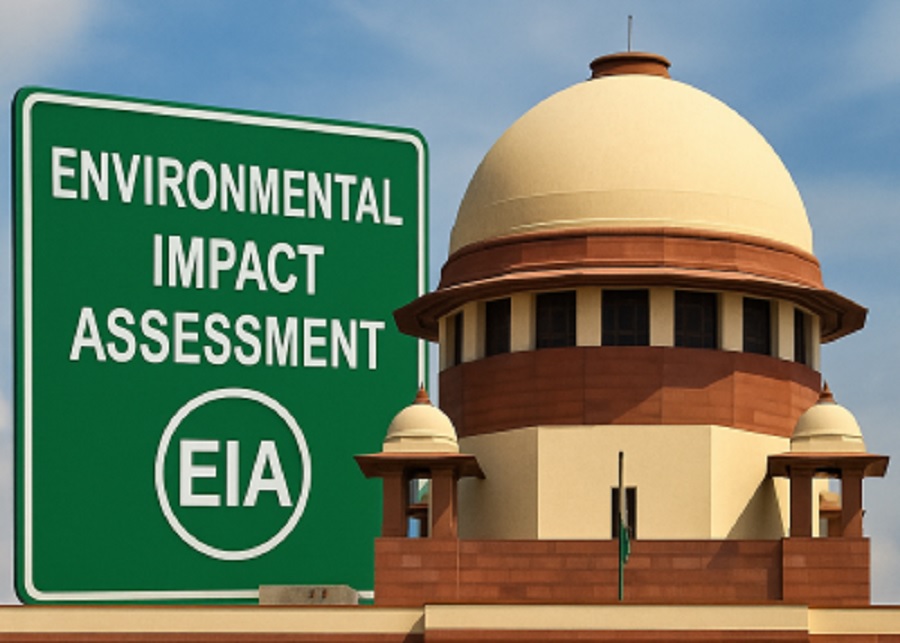
“The review judgment is an innocent expression of opinion.” is not a line from a critique by a lawyer at a discussion on the November Vanshakti judgement, in a review, by the Supreme Court which set aside its own 2-judge bench judgement that banned post-facto environmental clearances. It is a remark by the dissenting judge Justice Ujjal Bhuyan in the review judgement. It aptly captures the amount of trust placed on the executive to act sparingly in terms of granting post facto environmental clearances i.e., granting environment clearance after a unit has been put up/ started construction instead of before such event.
For a country that saw the Bhopal Gas Tragedy and many such incidents where lack of regulation resulted in massive loss of human life and toll on victims that exists to date, this turnaround is rather surprising. That too, for it to have triggered by a judgement of the Supreme Court, an institution that has been a guardian of environment from the T.N. Godavarman Thirumulpad v. Union of India case, where tree-felling and non-forestry activity in forests across the country was stopped by an order of the Supreme Court to the Niyamgiri hills case where indigenous Dongria Kondh tribe successfully fought against Vedanta Aluminium’s bauxite mining project, using the Forest Rights Act (FRA) 2006 to assert their cultural and religious rights over the sacred hills.[1]
Background: Tracing the Origins of “Prior” Clearance
To appreciate the magnitude of the conflict between the May 2025 and November 2025 Vanashakti judgments, it is essential to situate the dispute within the broader evolution of environmental constitutionalism in India.
In the wake of the 1972 Stockholm Conference and the catastrophic Bhopal Gas Tragedy of 1984, India developed a legal regime grounded in the “Precautionary Principle.” Interpreted by the Supreme Court as part of Article 21 (the Right to Life), this principle requires that environmental protection measures must anticipate, prevent, and address sources of environmental degradation before any damage occurs.
The principal mechanism for implementing this principle is the Environment Impact Assessment (EIA) Notification. Introduced in 1994 and updated in 2006, the EIA framework mandates that certain industrial and infrastructure projects must secure “prior” Environmental Clearance (EC) before any construction begins. The underlying rationale is that any environmental harm, such as deforestation or wetland destruction, is often irreversible. If assessments are conducted post-construction, they serve merely as a bureaucratic formality, failing to achieve the goal of sustainable development.
However, a significant gap has emerged between this normative ideal and the realities of India’s rapid industrialization, ready crony land grab. Successive governments, prioritising the “Ease of Doing Business,” began to grant “ex post facto” (retrospective) clearances to projects that had already commenced operations unlawfully. This practice created a moral hazard—companies found it cheaper to violate the law and pay penalties later than to undergo the rigorous and time-consuming process of prior assessment. The Vanashakti litigation originated when the Ministry of Environment, Forest and Climate Change (MoEFCC) attempted to formalize this practice through a 2017 Notification and a 2021 Office Memorandum (OM), thereby turning what was intended as amnesty into a standard procedure.
The May 2025 Judgment: The Normative Firewall
On May 16, 2025, a two-judge bench consisting of Justice Abhay S. Oka and Justice Ujjal Bhuyan delivered a judgment that aimed to uphold the “Rule of Law” over economic expediency.
Textualist Rigidity and the “Anathema” of Retrospection
The May judgment adopted a strict and literal interpretation of the EIA Notification 2006, holding that the requirement for “prior” EC is mandatory. Relying on precedents such as Common Cause v. Union of India (2017) and Alembic Pharmaceuticals v. Rohit Prajapati (2020), the bench emphasised that ex post facto clearances are “completely alien to environmental jurisprudence” and constitute an “anathema” to the EIA framework. Permitting operations without prior assessment, the Court reasoned, effectively condones violations. If EC is eventually denied after construction, the environmental harm is already irreversible; if granted, the “precautionary principle” is rendered meaningless.
The Sanctity of Executive Undertakings
The Court also scrutinised the legal history of the 2017 Notification, which had offered a six-month “amnesty” window for violators. When challenged before the Madras High Court, the Union Government had assured the court that this was a “one-time measure.” The May bench found that the subsequent 2021 OM—which perpetuated the amnesty indefinitely—breached this judicial undertaking. The Court held that the executive cannot renege on its assurance to the court, striking down the 2021 OM as arbitrary and violative of Article 14.[2]
Rejection of Monetary Regularisation
The May judgment explicitly rejected the notion that penalties under the “Polluter Pays Principle” could substitute for prior compliance. It noted that while Section 15 of the Environment (Protection) Act, 1986 provides for penalties, it does not authorize the regularization of illegal structures. As a result, the Court held that even if penalties are paid, illegal constructions lacking prior clearance must be halted and demolished. The bench stressed that the “Polluter Pays Principle” cannot be twisted into a license to pollute.[3]
The November 2025 Review: The Pragmatic Recalibration
In a dramatic turnaround just six months later, a three-judge Review Bench led by Chief Justice B.R. Gavai (with Justice Bhuyan dissenting) set aside the May judgment.
The “Per Incuriam” Doctrine and the Battle of Precedents
The Review Bench invoked the doctrine of per incuriam—rendered in ignorance of binding law—to overturn the May judgment. The majority held that the May Bench had failed to consider coordinate bench decisions in Electrosteel Steels Ltd. (2021)[4], Pahwa Plastics (2022)[5], and D. Swamy (2023)[6].
The May Bench had relied on Common Cause and Alembic to assert that ex-post facto EC is illegal. The Review Bench argued that while Alembic described such clearances as “anathema,” it ultimately allowed industries to continue operating after paying fines.
The Review Bench interpreted the relief granted in Alembic (allowing the industry to operate) as the binding principle of law, whereas the May Bench considered the relief as an exceptional measure under Article 142, treating the prohibition on retrospective EC as binding law.
Ultimately, by prioritising Electrosteel—which stated that the Environment Protection Act “does not prohibit” ex post facto clearance—over the strict reading of Common Cause, the Review Bench found the May judgment erroneous for ignoring the more recent “balanced approach” adopted by the Court.[7]
2. The Doctrine of “National Assets” and Sunk Costs
Economic consequences were a decisive factor in the Review Judgment. The Court accepted the Union’s argument that the May judgment would require the demolition of “national assets” valued at over ₹20,000 crore.[8]
The Court cited specific examples such as the AIIMS hospital in Odisha (962 beds) and the greenfield airport in Vijayanagar as projects facing potential demolition.[9]
The Review Bench further argued that demolishing these large-scale projects would cause more environmental damage (from dust and debris) than allowing them to remain operational. The Court rhetorically questioned whether demolishing effluent treatment plants would truly benefit environmental protection.[10] This reasoning, in effect, used environmental concerns to justify non-enforcement of environmental law.
Statutory Flexibility
Contrary to the May judgment, the Review Bench held that Section 15 of the Environment Protection Act does not mandate demolition. The Act, according to the Review Bench, allows for flexibility, and the executive can “amend or modify” notifications as needed.[11] Thus, the 2021 OM was not seen as violating the “one-time” judicial undertaking but as a valid exercise of executive power, especially as it was issued following directions from the National Green Tribunal (NGT).
Analytical Critique: The Erosion of Certainty
The rapid shift between the Vanshakti verdicts reveals a deep schism within India’s environmental constitutionalism. While the Review Judgment saved billions in investment, it set a precarious precedent that undermines the rule of law in three key areas.
The Inversion of Stare Decisis (Precedent)
The main issue with the Review Judgment is its handling of precedent. Justice Bhuyan’s dissent pointed out that Electrosteel and Pahwa—relied on by the Review Bench—were two-judge bench decisions, as was Common Cause, which formed the foundation of the May judgment and offered a comprehensive interpretation of the EIA Notification.
The Review Bench declared the May judgment per incuriam for not following Electrosteel, but the dissent argued that Electrosteel itself was per incuriam for disregarding the binding principle established in Common Cause.[12]
The Review Bench’s position—that the relief granted in Alembic (allowing industries to continue) constitutes binding laws jurisprudentially problematic. The Supreme Court often uses its extraordinary powers under Article 142 to grant case-specific relief while maintaining a contrary legal principle. By elevating discretionary relief to binding precedent, the Review Judgment effectively legalises violations, signaling to lower courts that statutory prohibitions on retrospective clearance can be ignored when economic stakes are high.
The Institutionalisation of Fait Accompli
The Review Judgment entrenches the doctrine of Fait Accompli in Indian law, suggesting that violations on a sufficiently large scale become practically irreversible.
By explicitly referencing the ₹20,000 crore investment as a justification for recall, the Court signaled that the “Right to Environment” is subordinate to the “Right to Investment.” This creates a dangerous incentive for developers to proceed with construction and heavy investments before obtaining clearance, believing that courts will hesitate to order the destruction of “national assets.”
Moreover, the reasoning that demolition itself would cause pollution effectively shields all large-scale illegal infrastructure from enforcement. The further along illegal construction is, the more “environmentally damaging” it becomes to remove, thus guaranteeing its persistence. This undermines the “Precautionary Principle,” which is based on prevention rather than after-the-fact remediation.
Simply put, if the municipality of a city refrains from demolishing the encroachment buildings on banks of lakes, the city will be prone to flood and is exposed to more vulnerabilities than before. Vanshakti II judgement fully fails to engage with this very obvious and basic logic.
Conclusion: From Gatekeeper to Toll Collector
The shift from the May judgment to the November Review marks a transformation in the Supreme Court’s role in environmental governance. The May judgment sought to act as a Gatekeeper, upholding the “Prior Clearance” requirement to prevent environmental degradation before it occurs. In contrast, the Review Judgment recasts the Court as a Toll Collector, allowing violations to continue in exchange for fines and remedial actions.
While the Review Judgment provides a practical solution to the immediate issue of “stranded assets” such as the Odisha AIIMS and the Vijayanagar Airport, it causes enduring harm to the credibility of India’s environmental regulatory regime. It endorses the executive’s strategy of “dilution by notification,” where statutory mandates are weakened to accommodate industrial needs. Most significantly, it undermines the finality of Supreme Court judgments, implying that even environmentally protective verdicts can be recalled if the economic arguments are persuasive enough.
For developers, the message is unambiguous: compliance is optional, so long as one can afford the cost of post-facto forgiveness.
Amen.
(The author is part of the legal research team of the organization)
[1] Orissa Mining Corporation Ltd vs Ministry Of Environment & Forest &Ors, Writ Petition (Civil) No. 180 of 2011
[2] Para 30, Vanshakti v. Union of India 2025 INSC 718 (Vanshakti I)
[3] Para 27, Vanshakti I
[4] Electrosteel Steels Limited v. Union of India and Others (2023) 6 SCC 615
[5] Pahwa Plastics Private Limited and Another v. Dastak NGO and Others (2023) 12 SCC 774
[6] D. Swamy v. Karnataka State Pollution Control Board and Others (2023) 20 SCC 469
[7] Para 55.1, CREDAI vs. Vankshakti 2025 INSC 1326 (Vanshakti II)
[8] Para 108, Vanshakti II (CJI Gavai)
[9] Paras 109, 110, Vanshakti II (CJI Gavai)
[10] Para 7 (VIII), Vanshakti II (Justice K. Vinod Chandran)
[11] Para 75, Vanshakti II (CJI Gavai)
[12] Para 20, Vanshakti II (Justice Bhuyan)
Related:
Strengthening indigenous communities means protection of the environment