
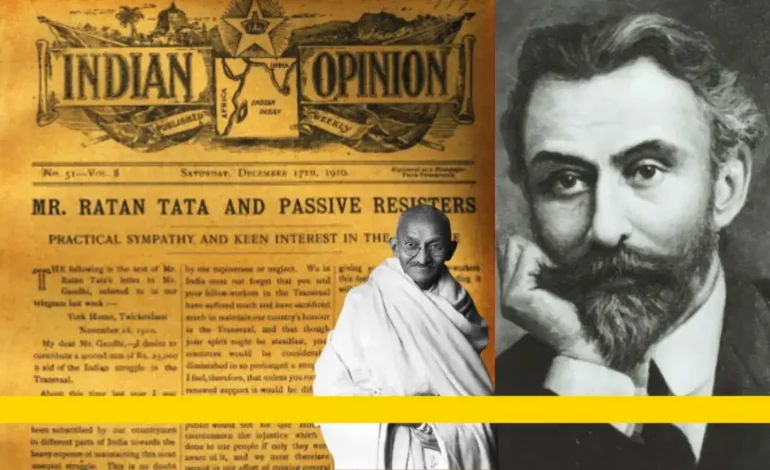
The relationship between political movements and economic power has often been marked by suspicion, compromise, or uneasy dependence. Yet, the story of Mahatma Gandhi and the House of Tata offers a strikingly different possibility—one where wealth strengthened a democratic struggle without seeking to command it, and where financial support became an act of public trust rather than private influence.
In this exclusive series, writer and researcher Anu Jain revisits Mahatma Gandhi’s closest political and personal relationships, uncovering the conversations, collaborations, and ethical dilemmas that shaped both the man and the movement he came to lead.
Long before Gandhi’s celebrated associations with Jamnalal Bajaj or G.D. Birla, it was the Tata family that quietly intervened at a defining moment in his South African struggle. Their support arrived not as an attempt to shape his politics, but as an affirmation of the moral courage and disciplined non-violence that lay at the heart of satyagraha. Gandhi, in turn, transformed this extraordinary generosity into a lesson in public accountability, insisting that every contribution—whether from a wealthy industrialist or an ordinary worker—was a sacred trust to be used with absolute transparency.
This five-part series explores the remarkable individuals who stood alongside Gandhi in different ways, revealing how their relationships illuminate the ethical architecture of India’s freedom movement. Together, they demonstrate that Gandhi’s greatest achievement was not merely mobilising people, but creating a moral framework within which power, wealth, and public service could coexist without surrendering to one another.
Read on to discover the unique relationship that Mahatma Gandhi shared with Sir Ratan Tata and the House of Tata.
The story of Mohandas Karamchand Gandhi’s relationship with wealth, power and big business did not begin in the grand palatial houses of Indian industrialists during the height of the freedom struggle. Its foundation was forged much earlier, in the dust and heat of South Africa. There, the practical, everyday demands of running a resistance movement forced a young lawyer to confront a difficult reality. He understood that money is dangerous, yet entirely necessary. Long before he formally introduced his famous philosophy of trusteeship, the idea that the wealthy should act as custodians holding riches in trust for the public good, Gandhi was already experimenting with a radical political economy built on voluntary poverty, absolute accountability, and a deep scepticism of large-scale charity.

Even in the pages of his early South African newspaper, Indian Opinion, Gandhi was fascinated by how people used power and wealth. In 1905, he published biographical sketches of global figures like Leo Tolstoy, Abraham Lincoln and Florence Nightingale, praising their moral courage. Alongside these global icons, he highlighted an Indian pioneer, the industrialist Jamsetji Nusserwanji Tata. Gandhi admiringly wrote that the elder Tata “never looked to self-interest… nor did he ever take distinctions of caste or race into consideration… the Parsis, the Muslims, the Hindus, all were equal to him” (Gandhi, 1905). This observation was a vital prelude. It revealed Gandhi’s early belief that capital, if guided by an ethical compass, could be a force for social uplift rather than an instrument of colonial or class domination.
Crucible of South Africa
By 1908, Gandhi’s experiments in truth were facing a brutal trial. The satyagraha movement in South Africa had entered its hardest phase. As Gandhi later detailed in his history, Satyagraha in South Africa, peaceful resistance required massive financial commitments (Gandhi, 1928). When the white minority government threw striking Indian labourers and merchants into prison, their families back home were left with nothing. The movement had to feed, clothe and house these dependants for months at a time. Concurrently, Indian Opinion, the print lifeline of the struggle,was running out of money, yet its printing presses had to keep moving to document the community’s resistance.
To house the families of prisoners, Gandhi had helped establish the Phoenix Settlement, a communal farm dedicated to simple, austere living. While the residents grew their own food, they were not entirely self-sufficient. Paper, ink, transport, and basic medicine still required hard cash. Gandhi’s ideal of simplicity did not completely eliminate material needs; it simply disciplined them.

As the months dragged on, donor fatigue set in. The local Indian merchant community, which had funded the initial phases of the protest, was financially exhausted by continuous government fines and business closures. By late 1909, the financial strain was critical. Sailing back from London in November after failing to win concessions from British officials, a deeply stressed Gandhi wrote a letter to his nephew, Maganlal Gandhi. He insisted that Indian Opinion must be saved at all costs: even if they were reduced to printing a single page on a hand-press, the paper could not die (Gandhi, 1909). To Gandhi, the death of the newspaper would signal a moral retreat.
Lifeline from Bombay
On November 30, 1909, Gandhi stepped off the ship at Cape Town, bracing for bad news. Instead, he received a telegram that changed everything. Sir Ratanji Tata, the younger son of Jamsetji Tata, had sent a massive donation of 25,000 rupees to support the South African satyagraha. In 1909, this was a staggering fortune, equivalent to millions today.
The timing was miraculous. Gandhi openly admitted that this single act saved Indian Opinion and breathed new life into the struggle. But Ratan Tata’s intervention was not a random act of impulsive charity. It was a deliberate, principled political statement. Tata was a close ally of the moderate Indian nationalist leader Gopal Krishna Gokhale. He preferred constitutional reforms and disciplined, peaceful public action. What drew Tata to Gandhi was the pure ethical character of the South African movement.

In a letter to Gokhale accompanying the money, Ratan Tata expressed his deep admiration for the “undaunted and determined stand” of the regular people in the Transvaal (Tata, 1909). He wrote of his profound respect for everyday labourers who chose prison over loss of dignity, and their disciplined refusal to resort to violence. For Tata, this was not standard philanthropy. It was a wealthy captain of industry endorsing the moral stamina of the working class.
Gokhale immediately understood the power of this gesture. Labelling it “timely help,” he publicised the donation across India. The effect was immediate and cascading. Inspired by Tata, other wealthy patrons stepped forward: J. B. Petit in Bombay, Dr. Pranjivan Mehta in Rangoon, and Indian diaspora communities from London to Zanzibar sent funds. Tata’s money had legitimised a distant, experimental struggle, making it a unified cause for the global Indian identity.
The Sacred Trust
The way Gandhi managed this sudden wealth is just as revealing as the donation itself. In his autobiography, Gandhi argued that public money must be treated as a “sacred trust,” demanding far stricter accounting than personal wealth (Gandhi, 1927). Every single rupee had to be tracked, recorded, and publicly justified.
“Public money ought to be treated with greater care than our own. A trustee has no right to waste a single farthing of the funds explicitly placed in his custody.” M. K. Gandhi
Even with a full bank account, Gandhi refused to let luxury creep into the Phoenix Settlement. When some residents suggested using the Tata funds to build more comfortable housing and buy better provisions, Gandhi firmly refused. He believed that the self-imposed discipline of hardship was essential to the spiritual strength of satyagraha. To make life easy would ruin the movement’s moral edge.
Gandhi personally monitored the printing room of Indian Opinion, ensuring that paper and ink were never wasted. Whether a donation came from a millionaire industrialist in Bombay or a single copper coin from a poor indentured labourer, it was meticulously recorded in the ledger books. Transparency was non-negotiable. Furthermore, Gandhi remained deeply wary of becoming dependant on a few wealthy patrons. Even with Tata’s backing, he continued to collect small, pennies-worth subscriptions from the community, ensuring the movement stayed rooted in the masses.
Respectful Distance
The relationship between Mahatma Gandhi and Ratan Tata offers a starkly different model of engagement compared to Gandhi’s later, legendary friendships with other Indian tycoons.

Unlike Bajaj or Birla, Ratan Tata never became a personal disciple of Gandhi. There are no records of late-night heart-to-heart chats or long weekends at the ashram between them. Their interactions were handled through letters and intermediaries like Gokhale.
This distance was intentional and respectful. Tata did not try to control the movement or use his money to buy influence, and Gandhi never asked him to abandon his factories. When Gandhi returned to India in 1915, this pattern of respectful boundary-keeping continued with Ratan’s successor, J.R.D. Tata.
A natural ideological friction always existed between them. Gandhi was sceptical of heavy, assembly-line industrialisation, famously advocating for decentralised, village-based economies centred around the spinning wheel (charkha). The Tatas, conversely, were building India’s modern industrial infrastructure with massive steel plants, hydroelectric projects, and aviation lines. Yet, this economic disagreement never turned into bitterness. Gandhi sought to morally transform capitalism from the outside; the Tatas sought to humanise it from within.
Dawn of Independence
This deep, quiet respect survived the decades, lasting all the way to Gandhi’s final moments. On January 30, 1948, when a fanatic’s bullets ended the Mahatma’s life in New Delhi, the shockwaves travelled across the globe. J.R.D. Tata, who was away in Europe at the time, felt the loss deeply. In a private, poignant letter written from Switzerland to his colleague Ardeshir Dalal on February 6, 1948, J.R.D. reflected on the tragedy.
“I was horrified, as you all must have been, at the news of Gandhiji’s assassination,” J.R.D. Tata wrote. “It is a World tragedy but who knows whether his paying the ultimate price may not in the end have done more for the cause of peace, tolerance and communal harmony for which he gave his life than he would have achieved by remaining alive… I hope however, that the grief and anger caused by Gandhi’s murder amongst the great mass of the people of India and the realisation of the righteousness and soundness of what he stood for, will keep… the extremists from further mischief” (Tata, 1948).
J.R.D.’s words did not echo standard Congress party slogans. True to the Tata tradition, his letter viewed Gandhi through the lens of national stability, civic sanity, and moral order. Even in death, the industrialist recognised the Mahatma not just as a political figure, but as an indispensable moral anchor for a fragile, newborn nation.
The Moral Compass

In the grand tapestry of Indian nationalism, the intersection of Mahatma Gandhi and the House of Tata stands out as a unique experiment in political morality. It proves that the relationship between wealth and social activism does not always have to be corrupt, transactional, or compromising.
If Jamnalal Bajaj represented total surrender to Gandhi’s austere lifestyle, and G.D. Birla represented a continuous political negotiation with it, the Tatas represented something completely different: an honest recognition of Gandhi’s moral authority without the need to enter his personal circle. The historic 1909 donation remains a powerful historical example of how capital, when guided by clear ethics, can defend and sustain a grassroots struggle without trying to dictate its terms. Ultimately, Gandhi and Tata showed the world a rare, beautiful equilibrium, proving that money and morality can work together to transform a society, provided both sides respect the clean, uncompromising lines of a sacred trust.
Make sure to check back tomorrow for the next part of the series as we bring attention to how unwavering loyalty, financial sacrifice, and a shared dedication to rural upliftment forged an extraordinary bond between Gandhi and Jamnalal Bajaj.
To read more articles from this series, click here.
Anu Jain is a Doctoral Scholar at Jamia Millia Islamia, New Delhi. Her research examines the intersection of Gandhian philosophy and Gender with a particular focus on the crucial role of Elected Women Representatives (EWRs).
Courtesy: The AIDEM