
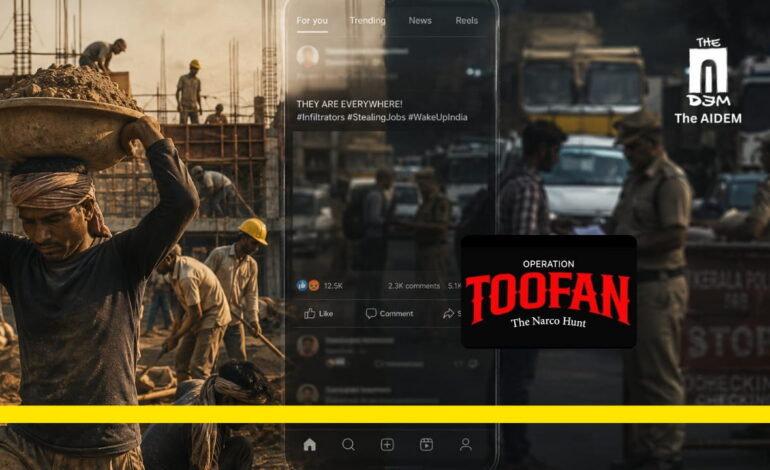
In this article, Vijeesh M and TN Divakaran draw attention to a subtle and troubling shift in Kerala society’s public discourse: how migrant workers, particularly in the context of anti-drug campaigns and social media narratives, can become associated with suspicion and social anxiety. The issue is not the legitimacy of addressing crime or substance abuse, but the danger of allowing isolated incidents and selective representations to transform an entire community into a perceived threat. At its core, the article explores how a society economically dependent on migrant labour negotiates questions of belonging, identity, and the making of “outsiders.”
Since its launch in early June of 2026 by the newly elected Kerala government, Operation Toofan: The Narco Hunt has received widespread public support and rapidly emerged as Kerala’s most visible anti-drug campaign, with videos of raids, arrests, and drug seizures dominating social media. Presented as a comprehensive response to the growing circulation of narcotics and synthetic drugs, Operation Toofan claims enforcement measures with preventive interventions.
Alongside coordinated operations by the police and excise departments, the campaign expectedly engages schools, parents, and civil society organisations in awareness and prevention efforts. Within a short period, thousands of arrests have been made and large quantities of narcotics and banned tobacco products have been seized in the state.

Few would disagree that substance abuse poses serious challenges and requires intervention. Yet the significance of Operation Toofan extends beyond its official objectives. Like many contemporary policing campaigns, it has developed a parallel life online. Reports of inspections, arrests, and searches circulate across social media platforms and news ecosystems alike, where they are viewed, shared, and commented upon by thousands of users. It is within this digital circulation that a more complex social narrative begins to emerge.
A closer look at hundreds of the images and videos associated with Operation Toofan in digital platform reveals a striking pattern. One place appears repeatedly: Perumbavoor. And within these representations, one group appears with particular frequency: interstate migrant workers.
Perumbavoor occupies a unique position in Kerala’s social landscape. Over the last three decades, this town in Ernakulam district has become one of the state’s most important hub of migrant workers. The presence of workers from Assam, West Bengal, Bihar, Odisha, and several other states have become indispensable to its industries, construction sector, workshops, restaurants, and numerous other economic activities. The studies suggest that the migrant population in and around the town runs into lakhs, earning Perumbavoor the popular label of Kerala’s migrant capital.

Yet Perumbavoor’s significance extends well beyond its economic role. Over time, it has come to occupy a symbolic place in Kerala’s public imagination. Debates surrounding migration, demographic change, public safety, labour, and law and order frequently converge on the town. Perumbavoor has become a site onto which broader anxieties about social transformation are projected.
Long before the launch of Operation Toofan, these anxieties had already found expression on social media. Numerous pages devoted to local news, public affairs, and neighbourhood issues regularly circulated photographs, videos, and reels portraying migrant workers through recurring themes of drug use, alleged criminality, sex work, unhygienic living conditions, and urban disorder. Individually, such posts appeared to document isolated incidents.
Collectively, however, they constructed a recurring visual narrative in which Perumbavoor itself was imagined as a city under threat, with migrant workers positioned as its principal source of decline. These representations often extended beyond the town, inviting viewers to imagine Perumbavoor as a warning about Kerala’s future if migration remained unchecked.
Operation Toofan entered an already established visual landscape and supplied it with a continuous stream of new images. Videos of police inspections in migrant settlements, searches of labour camps, checking of buses occupied significantly by migrant workers, arrests, and drug seizures rapidly circulated across various platforms. Existing accounts intensified their coverage, while new influencer pages also began producing content centered on the campaign. In some instances, the act of filming migrant settlements itself was framed as civic responsibility or courageous reporting, and such content was subsequently circulated and amplified across platforms.

The issue is not whether illegal activities exist. Drug use and trafficking are social problems that cut across communities, classes, and regions. Nor is the issue whether law enforcement should intervene. The more important question is how these interventions are represented and understood once they enter the digital public sphere.
Social media rarely reward complexity. Videos are edited into short, dramatic formats designed to maximise attention, while captions emphasise danger, urgency, and confrontation. Background music, visual effects, and selective framing transform routine enforcement activities into highly emotional spectacles. Within these compressed narratives, the broader realities of migration and the lives of migrant workers disappear. Questions about labour conditions, housing arrangements, wage insecurity, social exclusion, and economic dependence receive little attention. Instead, what remains visible is a simplified image of the migrant worker, repeatedly associated with surveillance, suspicion, and disorder. The comment sections beneath many of these contents reveal how such associations are reinforced. Alongside support for anti-drug measures are comments that directly connect migrant workers with crime, insecurity, and social decline. While these views are far from universal, the constant repetition of similar visual narratives gives them greater credibility. Images begin to function as evidence, and repeated exposure gradually transforms isolated incidents into general assumptions about entire populations.
What is equally important is what remains unseen. As claimed operation Toofan is not structured solely around raids and arrests. Officially, the campaign combines enforcement with awareness programs involving schools, parents, community organisations, and government agencies. The stated objective is not merely to identify offenders, but to address substance abuse as a broader social problem.
Yet the visibility of the campaign appears highly uneven in Perumbavoor. During the period the contents get widespread appreciation is the inspections, raids, and arrests than images of awareness sessions, community engagement, counselling initiatives, or preventive programs. This selective visibility has important consequences. Drug use is a complex social issue that cannot be addressed through punitive measures alone. Long-term responses require education, rehabilitation, public health interventions, and community participation. However, when enforcement becomes the dominant public image of a campaign, the problem itself begins to appear as something that can be solved primarily through surveillance and control.
This dynamic is particularly significant because migrant workers already occupy a vulnerable social position within Kerala. They are essential to the functioning of the state’s economy, yet they often remain socially peripheral. Many live in segregated housing clusters, work in demanding conditions, and have limited access to political representation. Linguistic differences, mobility, and weak institutional support make it difficult for them to challenge narratives constructed about them. As a result, they become highly visible to systems of surveillance while remaining relatively invisible within public debates about their own lives.

The visibility produced by Operation Toofan therefore operates unevenly. While the campaign targets drug-related activities, the public images generated by it often concentrate on particular spaces and populations. Over time, this can produce a feedback loop, as the Kozhikode city and rural police stepped-up surveillance in migrant workers settlements across the district recently. Increased surveillance in migrant-dense areas generates more images. More images generate greater public attention. Greater attention strengthens the perception that these areas are inherently problematic. The result is not simply the policing of crime, but the production of places and populations that become permanently associated with suspicion.

Perumbavoor illustrates this process clearly. The town’s association with migrant labour has increasingly merged with public concerns about law and order. In the digital environment, where visual content travels faster than context, these associations acquire new strength. A police raid becomes a reel. A reel becomes a viral post. A viral post becomes a widely shared narrative about who constitutes a threat. Through repetition, suspicion acquires the appearance of common sense.
There is a broader irony here. Kerala’s economy depends heavily on migrant workers. From construction sites and manufacturing units to hotels and service industries, migrant labour has become indispensable to everyday economic life. Yet the same workers who sustain these sectors frequently appear in public discourse not as contributors, but as subjects of concern. This reveals a deeper contradiction within Kerala’s development model: economic dependence does not automatically translate into social acceptance.

Operation Toofan was launched to address the problem of drugs. But its public afterlife raises larger questions about migration, belonging, and representation. How are particular communities made visible through policing? How does social media shape public perceptions of crime? And why do certain groups become recurring symbols of social anxiety?
Perumbavoor is not merely a geographical location where these questions arise. It has become a symbolic city in Kerala’s imagination, a place where fears about migration, crime, and social order converge. Operation Toofan did not create these anxieties. Yet the campaign has made visible the ways in which they circulate and acquire legitimacy.

The danger lies not only in misrepresentation but in normalisation. When suspicion is repeated often enough, it begins to appear natural. Migrant workers cease to be seen primarily as workers, neighbors, or residents. Instead, they become symbols within a larger narrative about risk and security.
In that sense, the most important story emerging from Operation Toofan may not simply be about drugs. It may be about how certain populations come to be recognised as the most visible suspects in Kerala’s public imagination.
Courtesy: The AIDEM