
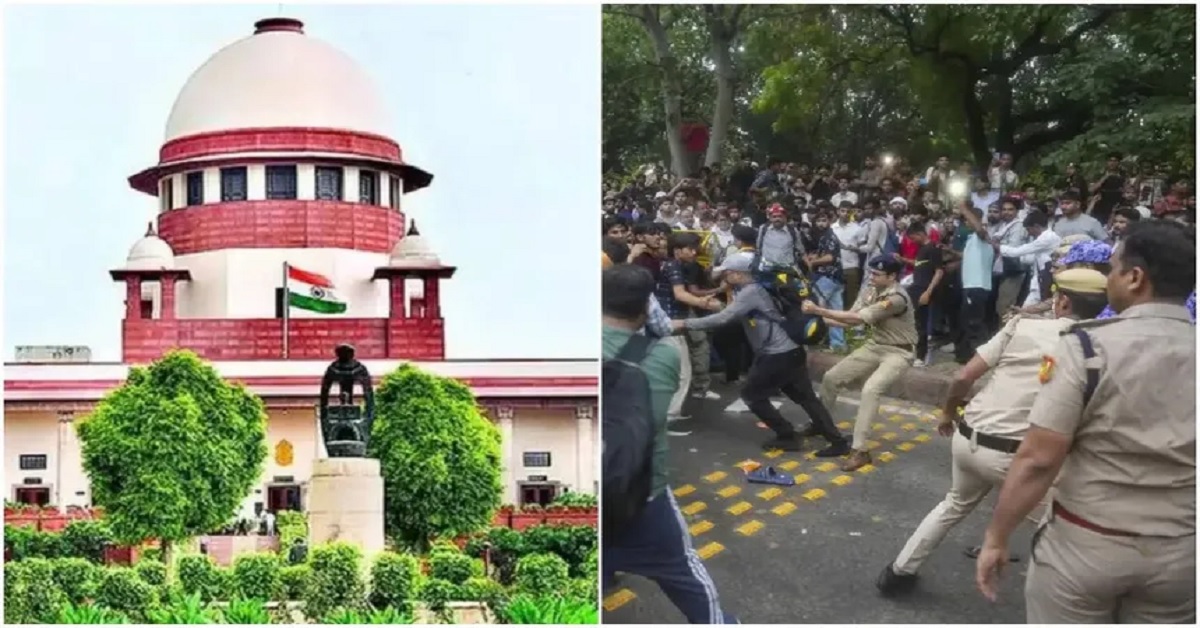
The Supreme Court’s interim order of July 28 in the batch of petitions concerning police action during the nationwide student protests is, at one level, a judicial acknowledgement that allegations of police excess cannot simply be left to the ordinary investigative process. The Court recognised that the petitions disclose a prima facie case for an “independent and impartial investigation”, indicated that it may constitute a Special Investigation Team (SIT) under the supervision of a retired Supreme Court judge, directed preservation of crucial electronic evidence, restrained the publication of protesters’ personal information, and granted limited protection against coercive action.
Yet the order is equally notable for what it leaves untouched. While expressing sufficient doubt about the conduct of law enforcement to contemplate an independent investigation, the Court simultaneously permits the same police machinery to continue investigating protesters under the FIRs already registered. It further conditions its interim protection upon the absence of “criminal antecedents”, effectively creating two classes of protesters for the purposes of constitutional relief. Read closely, the order reveals not merely judicial caution but an unresolved constitutional contradiction that lies at the heart of the litigation.
From a challenge to police violence in Delhi to a nationwide constitutional controversy
The hearing itself reflected how dramatically the litigation has expanded since the events at Delhi’s Jantar Mantar on July 20. What began as petitions concerning police action in the national capital has evolved into a challenge to policing practices across multiple States. The Bench, comprising Chief Justice Surya Kant, Justice Joymalya Bagchi and Justice V. Mohana, heard petitions alleging police brutality in Delhi, Bihar, Maharashtra, Assam, Uttar Pradesh, Madhya Pradesh, West Bengal and Kerala, alongside petitions filed on behalf of injured police personnel, journalists and individual protesters. The order correspondingly issues notice not only to the Union and the Government of NCT of Delhi but also to the Chief Secretaries of the seven States where similar allegations have arisen, making it clear that any eventual investigation may extend well beyond Delhi.
The courtroom exchanges demonstrated that the litigation had also moved beyond disputes over individual incidents. As reported by LiveLaw, Senior Advocate Gopal Sankaranarayanan argued that the issue before the Court was systemic rather than episodic, referring to alleged departures from established crowd-control protocols, the deployment of plain-clothes police personnel and the need for an investigation independent of the very agencies accused of violence. Senior Advocate Shyam Divan drew attention to allegations of electronic shock batons, assaults on women protesters and threats allegedly issued by police personnel. Senior Advocate Shadan Farasat highlighted the continued detention of minors in Bihar despite the State’s announcement that cases would be withdrawn, reported LiveLaw. Advocate Prashant Bhushan referred to the petition of Junaid Malik, who alleged illegal detention, harassment and police action against his family. On the other side, Solicitor General Tushar Mehta accepted that allegations concerning injuries to students required serious examination but maintained that “anti-social elements” had infiltrated the protests and that hundreds of police personnel had themselves suffered injuries.
It was against this backdrop that the Chief Justice repeatedly observed that the Court was confronted with two competing narratives, each accusing the other of serious violence. The question, therefore, was not simply whether police had used excessive force or whether protesters had attacked police personnel, but whether either version could be accepted without an investigation independent of those directly involved. That concern ultimately shaped the Court’s reasoning.
The Court’s recognition of a prima facie case is constitutionally significant
The order carefully records the allegations placed before the Court. It refers to the alleged use of pellet guns causing severe injuries, including the loss of eyesight of one student, the deployment of rubber bullets, electronic batons and nail-studded lathis, assaults by police personnel both in uniform and in civilian dress, and attacks on members of the media. At the same time, it records allegations that police personnel suffered serious injuries owing to stone-pelting and violence allegedly perpetrated by protesters or anti-social elements. Rather than accepting either version, the Court concludes that the material placed before it establishes a “compelling case” for an independent and impartial investigation capable of addressing both sets of allegations. This finding carries greater constitutional significance than the interim directions themselves.
Ordinarily, investigations conducted by the police are presumed to possess institutional legitimacy. Constitutional courts do not lightly transfer investigations or contemplate court-monitored inquiries. Such departures occur only where the Court concludes that confidence in the ordinary investigative process has been sufficiently undermined. The very logic behind an SIT is that the institutional mechanisms ordinarily entrusted with criminal investigation may not command public confidence in exceptional circumstances. The Court’s observation that an independent investigation may be necessary is therefore, in itself, a recognition that the allegations against law enforcement cannot simply be left to the agencies whose conduct has come under challenge. That premise, however, sits uneasily with the operative directions that follow.
The order simultaneously questions and preserves the ordinary criminal process
Despite concluding that the allegations disclose a prima facie case warranting an independent investigation, the Court expressly permits Delhi and all concerned States to continue investigating the FIRs already registered in connection with the protests. The only restriction imposed is that “no coercive measures” shall be taken against protesting students, subject to an important qualification discussed later.
“(iv) The NCT of Delhi and other States may proceed with the investigation of the FIRs registered; however, no coercive measures shall be taken against the protesting students. Such protection, nonetheless, shall not be extended to the persons with criminal antecedents.” (Para 8)
This aspect of the order deserves closer attention than it has received. The Court does not stay the FIRs; it does not transfer the investigations or direct that future investigative steps be undertaken by an independent agency. Instead, the police authorities whose conduct is alleged to require independent scrutiny continue to exercise the full range of investigative powers available under criminal law. Statements may still be recorded, electronic devices may still be seized and examined, witnesses may still be questioned, forensic reports may still be prepared, and charge-sheets may continue to take shape.
The Court thus creates a constitutional arrangement in which two investigations are expected to proceed simultaneously: one, a proposed independent inquiry into police conduct; the other, the ordinary police investigation into the conduct of protesters. The order never explains how these two processes are to coexist.
This is not merely a procedural curiosity. Criminal investigations shape the evidentiary record. They determine which witnesses are examined, what evidence is collected, how events are reconstructed and ultimately which narrative enters the criminal justice system. If the Court considers the neutrality of the ordinary investigative process sufficiently doubtful to contemplate an independent investigation, it is difficult to understand why that same process should continue exercising authority over the protesters arising out of the same sequence of events. The contradiction is never confronted.
“No coercive measures” does not suspend the coercive force of criminal process
The Court’s direction that no coercive measures shall be taken against protesting students has understandably attracted public attention. Yet, as a matter of constitutional law, the protection is considerably narrower than it first appears. Orders restraining coercive action ordinarily operate against arrest or similarly drastic steps. They do not suspend investigation itself. Nor do they prevent repeated summons, compulsory appearances before investigating officers, seizure of electronic devices, extraction of digital data, surveillance, examination of social media activity or the continuing collection of evidence. The distinction is significant in cases concerning political protest.
The chilling effect upon constitutional freedoms is produced not only by arrest but by the criminal process itself. A protester compelled to repeatedly appear before investigating agencies, surrender personal devices or remain subject to an ongoing criminal investigation continues to bear the burden of state action irrespective of whether arrest is immediately threatened. The Court therefore restrains one manifestation of coercion while leaving intact the broader investigative machinery through which coercion may continue to operate.
If the purpose of the interim order is to ensure that constitutional rights remain meaningful while allegations of police excess are independently examined, it is not immediately apparent why the continuation of the ordinary criminal process should remain unaffected.
The exception for “criminal antecedents” undermines the logic of constitutional protection
Perhaps the most constitutionally troubling aspect of the order is the qualification that protection against coercive action shall not extend to persons with criminal antecedents. The same qualification also governs the release of detained children.
The order does not explain what constitutes a criminal antecedent. Nor does it distinguish between previous convictions and pending criminal cases. However, that omission is significant. In practice, the expression “criminal antecedents” is routinely employed by investigating agencies to refer not only to persons previously convicted of offences but also to individuals against whom criminal proceedings are pending or FIRs have previously been registered. For those engaged in political mobilisation, this distinction assumes particular importance.
Student leaders, trade union organisers, civil rights activists and political workers frequently accumulate criminal cases because they repeatedly participate in demonstrations. Many such prosecutions culminate in acquittal or remain pending for years without adjudication. The mere existence of previous criminal proceedings therefore cannot be equated with criminality. Yet the Court’s formulation effectively permits previous executive allegations to determine the scope of present constitutional protection.
The result is that the protesters most likely to have prior experience with the criminal justice system, precisely because they have participated in earlier movements, become least likely to receive interim judicial protection. This sits uneasily with first principles of constitutional law- the presumption of innocence does not disappear because an individual has previously been named in an FIR. Nor are the guarantees of Articles 19 and 21 reserved only for first-time protesters. Constitutional rights do not fluctuate according to the number of criminal cases the State has chosen to register against a citizen. The Court’s order, however unintentionally, risks producing precisely that consequence.
The Court’s instinctive turn towards an SIT also deserves scrutiny
The Court’s indication that it may constitute a Special Investigation Team headed by a retired Supreme Court judge has naturally been welcomed as evidence of judicial seriousness. It is also entirely consistent with an increasingly familiar pattern in Indian constitutional adjudication. Whenever allegations involve politically sensitive policing, communal violence, custodial abuse or failures of ordinary investigation, constitutional litigation frequently culminates in demands for an SIT.
The institutional appeal of this mechanism is obvious. It reassures the public that the investigation will not remain entirely within the control of the executive while allowing the Court to maintain supervisory distance. Yet experience also warrants caution. An SIT is not itself a constitutional remedy. It is only an investigative mechanism.
Indian constitutional history is replete with court-monitored investigations that have extended over years, produced little by way of institutional accountability or concluded long after the immediate constitutional crisis had passed. Judicial supervision has not invariably translated into meaningful prosecutions, as one may understand with the SIT on Manipur violence. Nor have SITs consistently addressed questions of command responsibility, systemic policing failures or institutional reform. They frequently identify individual culpability while leaving broader structures of power untouched.
The Supreme Court’s growing reliance on SITs also reflects a deeper institutional tendency. Faced with allegations of executive misconduct, the Court increasingly responds by creating new investigative mechanisms rather than directly interrogating the legality of executive action or crafting structural constitutional remedies. An SIT may well uncover facts. It does not necessarily answer the constitutional questions that those facts reveal.
If the present litigation ultimately results only in another prolonged investigation, without examining the legality of protest policing, the use of force, surveillance practices, deployment of plain-clothes personnel or the repeated invocation of criminal law against dissent, the constitutional significance of the proceedings may prove considerably narrower than their immediate political importance.
Preserving evidence is necessary, but accountability requires more
Among the strongest features of the order are its directions preserving CCTV footage, drone recordings, body-camera footage, wireless communication records and PCR logs, alongside the prohibition on publishing protesters’ personal information. These directions recognise the centrality of digital evidence in contemporary protest litigation and respond to legitimate concerns regarding surveillance and the destruction of electronic records.
They are undoubtedly important; but they are also procedural safeguards. They preserve the possibility of accountability without guaranteeing accountability itself. The harder constitutional question remains unresolved. If the Court has already concluded that there exists a prima facie case warranting an independent investigation because the allegations against the police cannot be left to the ordinary investigative process, should that conclusion not also have consequences for the criminal investigations being conducted by the same police authorities?
The July 28 order does not answer that question. Instead, it reflects a familiar pattern in constitutional adjudication. The Court acknowledges serious allegations of state excess, preserves evidence, contemplates an independent investigation and grants carefully calibrated interim relief, but stops short of disrupting the ordinary machinery of criminal administration. Meanwhile, the more enduring constitutional issue, however, lies elsewhere. The order proceeds on the premise that police conduct is sufficiently doubtful to justify independent scrutiny, while simultaneously leaving the architecture of criminalisation almost entirely intact.
The complete order may be read here.
Detailed reports on the protests and the state violence may be read here, here, here, here and here.
Related:
From Feeding Students to Fighting in the Supreme Court: The story of Mohammad Junaid Malik
A deleted tweet, an NSA order, and the shadow of past crackdowns
Youth Uprising: A protest, a brute crackdown, a continuing countrywide response
Mumbai stands with students, but the state pushes back