
Timeline of the NEET Paper leak
The National Eligibility Entrance Test (NEET) 2026 was conducted on May 3, 2026, however, it is set to be re-conducted in June. Let’s look at the timeline of events that led to this redo.
Before the May 3 exam, the NTA said the exam was conducted under “full security protocol”, including GPS-tracked paper transport, biometric verification, AI-assisted CCTV monitoring, and 5G jammers at centres. The test was conducted across 551 Indian cities and at 14 overseas centres, with nearly 23 lakh candidates having registered. On the night of May 3, when Suthar (a chemistry teacher from Sikar, Rajasthan) was discussing the NEET questions with his students, he came across a PDF document that went viral a day before the exam. That document had all the chemistry questions that appeared in the actual exam. It further contained ninety of the biology questions that were asked in the exam. Following this discovery, Suthar informed the Rajasthan police and the NTA.
Now, the probe starts. One of the first breakthroughs in the investigation came when Rajasthan Police’s Special Operations Group arrested the alleged mastermind from Dehradun on May 7. A day later, four more persons, all NEET aspirants from Dehradun, were arrested and brought to Sikar for further interrogation. Among the five, the police said that the counsellor is accused of selling the leaked question paper to aspirants as a “Guess Paper.” He had allegedly received it from someone in Kerala, and it was suspected he managed to obtain probable questions of the examination paper even before it was sent for printing. The NTA escalated the matter to Central Bureau of Investigation (CBI) for “independent verification and necessary action.”
The Rajasthan Police inquiry linked the suspected document to an MBBS student from Churu who was at the time studying at a medical college in Kerala. It was quickly spread through NEET aspirants who shared it with each other. The probe also revealed that the material was widely shared through encrypted messaging apps and social media, with some recovered chats reportedly carrying the “forwarded many times” label, suggesting that the questions may have reached a large number of students before the exam. The guess paper was sold to students at rates between Rs 20,000 and Rs 2 lakh, with some media reports indicating charges as high as Rs 5 lakh. By the night before the exam, copies were allegedly circulating for around Rs 30,000 each.
On May 12, nine days after the conduct of the examination, the NTA officially cancelled NEET UG 2026 “in the interest of students” and to protect the credibility of the national examination system. However, the probe continued.
In order to understand how structural and rooted the corruption in the national examination system is, it is imperative to look at the findings that followed the probe. On May 13, the Federation of All India Medical Association (FAIMA) moved the Supreme Court challenging the “systemic failure” of the NTA in conducting NEET-UG 2026. The petition sought directions to replace or fundamentally restructure the NTA and to conduct a fresh NEET-UG 2026 examination under judicial supervision, including digital encryption and locking of question papers, a transition to a digital test model, and publication of centre-wise results for detection of statistical anomalies and organised malpractice.
Prahlad Vittal Rao Kulkarni, identified as the alleged kingpin and a domain expert in chemistry from Latur who had for years served on panels involved in setting the NEET question paper, was arrested on May 15, for allegedly exploiting his access to confidential material. He allegedly hosted special coaching classes at his house in the last week of April and dictated questions to a select students. On May 16, the CBI arrested Manisha Gurunath Mandhare, a biology lecturer who was part of the NTA’s paper-setting committee for the NEET exam held on May 3. The arrest was made on the basis of questioning of P V Kulkarni and other accused in the paper leak case. She was allegedly involved in the examination process and appointed by the NTA as an expert with complete access to the Botany and Zoology question papers. Mandhare is alleged to have mobilised prospective NEET examination candidates in April 2026 through Manisha Wagmare of Pune (she was arrested on May 14) and conducted special coaching classes for students at her home, dictating leaked questions and collecting lakhs of rupees as fee. Most of these questions tallied with the questions that appeared in the examination on May 3. The CBI on May 22 arrested Manisha Sanjay Havaldar. She had been appointed by the NTA as an expert to set the question paper for the physics section. Investigators found that she allegedly shared several Physics questions with co-accused Manisha Mandhare in April 2026.
There were several other arrests made by the CBI in relation to this from States such as Rajasthan, Delhi, Haryana.
On May 21, NTA Director General Abhishek Singh appeared before the Parliamentary Standing Committee on Education, Women, Children, Youth and Sports. Singh told the committee that the agency does not view the NEET exam as having been “leaked.” Even when Opposition members pressed for answers, NTA officials stuck to their position that the CBI is investigating, and they would only call it a leak if the CBI finished its probe and confirmed it. On questions from MPs about how the NEET paper was leaked, Singh said it was “not leaked through their system“. Several MPs asked him then how did the paper get leaked and what was the need to cancel the exam and hold a re-test. He had no answer and insisted that CBI was looking into the matter. Some opposition MPs demanded that the probe report be presented before the panel, but BJP members objected, saying the CBI is an independent body and should be allowed to do its work.
On May 29, the NTA informed the Supreme Court that it was all set to conduct NEET UG in digital testing mode from the next year instead of the pen and paper mode. The NTA’s affidavit stated to the Supreme Court in relation to the several petitions (including the aforesaid FAIMA petition) that the transition will be implemented from the next examination cycle in consultation with the Ministry of Health and Family Welfare thereby bringing all major NTA examinations onto the digital testing platform. Regarding the June 21 re-examination, the NTA told the Court that the re-examination scheduled on June 21, will be conducted under a further strengthened SOP framework and with multi-layer authentication.
This paper leak saga shows how deeply percolated corruption is in Indian educational system is. Students who work tirelessly for months and even years are failed by the system consistently. It erodes the faith public has in the government in conducting something as rudimentary as exams. The repercussions of such failures are tragic and extremely disheartening. The next section shall deal with the distress such failures cause to the students and the extreme steps that they are forced to take.
Aftermath, Young Lives lost
NEET is the biggest exam in terms of number of applicants in India, and is mandatory for anyone who aims to take admission in medical courses. In the hope of becoming doctors, students spend years preparing for the exam in extremely competitive and burdensome environments. Therefore, when the news of its cancellation was out, the consequences were tragic.
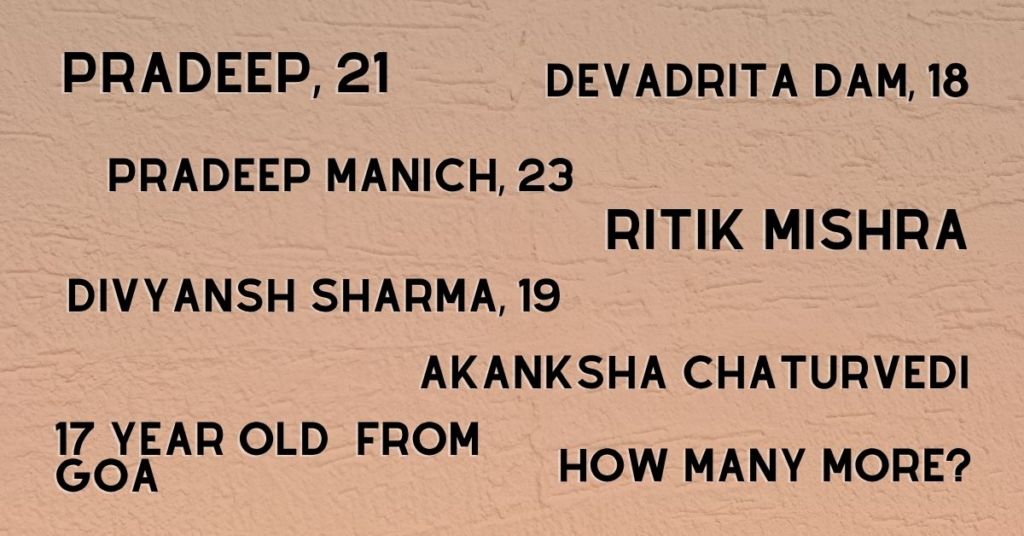
Pradeep, 21, had taken the exam twice before but failed to secure the needed marks. This time, the moment he walked out of the examination hall, he hugged his father and said, “Papa, this time I have become a doctor.” He had spent lakhs of rupees and countless hours preparing for the exam. As per the answer key of the exam conducted on May 3, Pradeep was securing a seat in a government medical college with ease. However, the news of cancellation put him in so much despair that he died by suicide. Pradeep Manich, 23, was a labourer’s son who had been living in a rented accommodation in Sikar away from his home. Reportedly, his family had sold their land and taken loans to fund his coaching and expenses for NEET. After his third attempt, the news of the paper leak and re-examination left him hopeless and disillusioned. He was devastated and he hanged himself days after the exam. Akanksha Chaturvedi had been preparing for the medical entrance exam in Nagpur and reportedly suffered from severe depression triggered by the cancellation, and ultimately, died by suicide. Her suicide note said, ” I no longer have the courage to take the NEET exam again. I was scoring good marks in my first attempt, but now there is no guarantee that I will perform well again.” Her father, a farmer, worked as a cook in Nagpur, and also put himself in financial debt to support her dreams of becoming a doctor. In Uttar Pradesh’s Lakhimpur Kheri, 21 years old Ritik Mishra died by suicide after reportedly distressed by the cancellation of the examination. Further, a 17 years old boy from Goa district took his life after the cancellation owing to academic stress and concerns over balancing studies with his passion for hockey.
19 years old Divyansh Sharma from Sikar tells how impactful such re-examinations are psychologically. Sharma says that when students spend one or two years preparing and the paper gets leaked, it feels devastating. He made it clear that beyond financial loss, the greatest cost is time. Talking about his own experience, he said Sikar (a hub for competitive exams preparation) as an emotionally draining environment, filled with overcrowded hostels, endless classes, and routines built entirely around mock tests and revision. The competition is so intense that students study throughout the entire day. When news breaks that an exam will be held again due to a leak, it kills motivation. He also points out that the psychological challenge is significant, as students begin to doubt whether they can replicate their previous level of performance. Devadrita Dam, an 18 years old aspirant from Gurgaon, had been genuinely hopeful after the exam because the paper seemed easier compared to previous years. In the week following the exam, she was finally reconnecting with friends after months of social isolation that the exam forces under the guise of rigour of preparation. Then her best friend sent her a message saying the paper had been cancelled. She initially assumed it was a joke, but her uncle called to confirm the news. She broke down crying at the thought of having to go through the entire process again. According to Dam, the leak has seriously shaken students’ faith in the system.
These heart-breaking stories show how disproportionately the cancellation of exams affected students who came from lower income families. And how, the system failed the students by not being able to conduct an exam of such importance with honesty and transparency.
Owing to these incidents in light of systemic failure of the education system towards its students, there were protests as legitimate expression of anguish by students. On May 12, National Students’ Union of India (NSUI) staged a massive protest at Shastri Bhawan. Protestors were seen climbing the barricades at Shastri Bhawan to show their disappointment and anger. Characteristically Delhi Police detained several protestors. This was the same day the NTA officially confirmed the exam’s cancellation showing that the students were in the streets within hours of the announcement. A couple of days later on May 16, NSUI staged a massive protest outside the NTA headquarters in Delhi under the banner of the “NTA Halla Bol” campaign. The protestors rightly pointed out the suicides that took place owing to NTA’s failure that led to the re-examination.
Further, IYC activists took out a protest march from Teen Murti Circle towards the Education Minister’s residence holding posters and banners. However, they were stopped by police barricades and some protestors had been detained as well. Members of the All India Students’ Association (AISA) staged a demonstration demanding accountability for recurring examination irregularities outside the Ministry of Education on June 1. These protestors were also later detained by Police. On May 31 in Bhopal and on June 1 in Bhubaneswar, torchlight marches were organised outside the residence of Dharmendra Pradhan demanding his resignation over the paper leak issue. Moreover, On June 6, IYC President Uday Bhanu Chib led thousands in a protest in Haryana. Protesters faced water cannons and even barricades and police lathis. Despite of such protests the mainstream media has remained silent on both the fronts, raising voice against the government that allowed such a leak to happen, and it has remained silent on these protests by not covering their plight, anguish and courage to protest against such failures. And whenever such protests are shown, the lens is partisan— a political battle between Congress and BJP. Instead of putting the plight of the students at the centre of its coverage, the narrative is completely shifted to party politics. The response by the State that included, barricading, detention, shooting water guns, reflect how the state has increasingly collapsed the distinction between disruption and dissent. A detailed report on the mainstream media’s cold shoulder and on the protests that happened nationwide can be read here.
Repeated Leaks
It is imperative to note that the NEET exam was earlier leaked just two years ago! The 2024 NEET examination had an unusually high number of top rankers. Further, many students received scores that appeared mathematically impossible. This raised the concerns of paper being leaked. The CBI in pursuance of these allegations of paper leak arrested 40 individuals. The government’s initial posture was flat denial. When Dharmendra Pradhan took charge as Education Minister in June 2024, he told reporters that “there is no corruption or paper leak in NEET-UG 2024.” This position was maintained even as police in multiple states were making arrests and producing evidence to the contrary.
Subsequently, the matter reached the Supreme Court. The Court said there would be no re-examination, ruling that the data on record was not enough to show a systematic leak. However, the Court stated that there was a paper leak, though it found it localised to the areas of Hazaribagh and Patna. It simultaneously acknowledged serious weaknesses within the NTA and insisted on structural reform to prevent such instances from repeating. Following this, a committee namely Dr. K. Radhakrishnan Committee was setup. The Court specifically directed the committee to examine the viability of comprehensive CCTV surveillance, surprise inspections, secure transportation systems, digital tracking, and stricter identity verification mechanisms. The court also directed the Ministry of Education to monitor implementation through a Steering Committee. The Radhakrishnan committee submitted its report in October 2024 to the central government, that contained several recommendations to prevent future leaks. These included a shift to digital testing to eliminate the vulnerabilities of physical paper handling, biometric verification, AI-based surveillance, encrypted digital question delivery, and multi-stage examination formats. In January 2025, the Centre told the Supreme Court that it would implement all these corrective measures as suggested by the committee.
Now, the question that crops up is, what did the government do? Unsurprisingly, the answer is nothing. Despite recommendations by the K. Radhakrishnan committee after the 2024 controversy, the examination continued under the same manner as before. The NTA has immense structural problems that facilitates such leaks and other issues commonly faced by students (some problems are left unaddressed by the committee itself). The National Testing Agency was established in 2017 without parliamentary debate, public consultation, or a statutory foundation. It operates as a society registered under the Societies Registration Act, 1860 rather than as a body created by legislation. Its memorandum of association (a basic charter that any registered organisation is expected to publish) has never appeared on its website, unlike comparable bodies such as the CBSE. The agency’s financial workings are equally opaque. While institutions like the UPSC and AIIMS publish detailed annual reports with budget allocations and expenditure data, the NTA has simply stated on its website that because the number of exams it conducts varies each year, it is “difficult to maintain Head-wise/Exam-wise Budget.” For an agency that collects fees from over two crore candidates annually and outsources significant work to private contractors, this opacity raised eyebrows to say the least.
The biggest problem that NTA has is its outsourcing tendencies. The NTA contracts out some of its most consequential functions such as setting up exam centres, managing physical security, capturing biometric data, to other parties. This problem needs to understood in tandem with the fact that it coordinates with a network of private actors that has no published standards of governing and nobody knows how those actors are selected, supervised, or held accountable. The result has been visible in examination halls where power cuts lasted over an hour or even when students were handed out rainwater-soaked answer sheets. Nothing about the process of setting question papers is publicly known. The qualifications required of paper setters, the processes they follow, and the safeguards against conflicts of interest is simply not disclosed. The CBSE publishes a detailed document specifying exactly these things, including the duties of “secrecy officers” responsible for maintaining confidentiality through the examination process. The NTA has no equivalent. This goes on to show how much opacity is present in the entire process of conducting the examinations– from setting of papers to the conduct of exam on the final day. In toto, it is a centralised body that works with near zero accountability. In such a setting, bluntly, lapses are inevitable.
NOT JUST NTA OR NEET
However, the problem in the examination framework of India is by no means limited to the NTA but runs much deeper.
In May 2026, the Central Board of Secondary Education declared Class 12 results. There was a drop in passing percentage this year by 3 points. Consequently, students wanted to check their answer sheets and see what went wrong. However, it was found that, students were receiving wrong answer sheets. Evaluators were marking blurred, illegible scans. Pages had gone missing. This year marked On-screen marking’s (OSM) first use by CBSE. The promise of OSM was quite handsome. In OSM, answer sheets are scanned, digitised, and uploaded to a secure portal. Examiners log in remotely and mark on their screens, this marking is then auto-tabulated by the system. CBSE had, in fact, conceived of OSM back in 2014 but shelved the idea because of logistical difficulties. Cut to 2026, CBSE announced its plan on using OSM. During mandatory mock evaluation sessions on February 26, 2026, teachers reported portal access failures, slow system performance, and errors in teacher data on the registration portal. Knowing all this, and instead of going for a phased launch of the technology, CBSE still decided to rollout the technology all at once, for nearly 1 crore answer scripts. In a March 16 circular, CBSE warned Class 10 and 12 evaluators of legal action for sharing “misleading” information about the marking process on social media and declared that evaluation is confidential, therefore, it should not be discussed.
Once the results were out, students who accessed their answer sheets via the OSM verification portal found pages scanned so poorly that not a single line was legible yet the examiner had marked them. On various Reddit and X posts, students described evaluators placing red ticks and numerical scores on images that were, functionally, blank. These problems gained traction when Vedant Shrivastava posted his Physics answer sheet on X. When he checked his answer script he found out that someone else’s answer sheet was marked instead of his. There was a clear difference in handwriting. CBSE eventually admitted the error and issued the correct scanned copy, but only after Vedant’s post had gone viral.
I am a CBSE Class 12 student.
After receiving unexpectedly low marks in Physics, we applied for photocopies of my answer sheets through the CBSE reevaluation process.
Today we received the copies.
And I am shattered because the Physics answer sheet uploaded by CBSE is not mine
— VEDANT (@VEDANTSHRIV17) May 23, 2026
Along the same vein, Sanjana, found that every page of her Chemistry answer booklet belonged to a completely different person. CBSE later acknowledged it had “discarded around 30 answer sheets due to issues like unclear images and duplicate entries” without re-scanning them, this means some students were potentially evaluated on nothing whatsoever.
I applied for CBSE revaluation. The scanned copy of my chemistry sheet I received does not match my handwriting or written responses.
For reference, I am attaching my English answer sheet, which clearly reflects my actual handwriting. pic.twitter.com/laINaEMAP3— Sanjana (@Sanjanaopxe) May 25, 2026
These issues could largely be pinned to the vendor who was responsible for the application the of OSM technology. The company entrusted with building and running the OnMark digital evaluation platform for CBSE is Coempt Edu Teck Private Limited, a Hyderabad based education technology firm. It was formerly known as Globarena Technologies Private Limited, and it had in the past made grave errors in technological applications. Those errors had led to several suicides as well.
If this company had such discouraging past, how did it manage to get the tender? The inconsistencies in floating of three tenders before finally settling with Coempt Edu Teck was first reported in the Hindustan Times. Later, Sarthak Sidhant, a 17 years old Class 12 student from Jharkhand showed gave a breakdown of the requirements were consistently to grant then tender were changed several times in a way that made Coempt eligible for it. He spent days readings official CBSE bidding documents on the Central Public Procurement Portal, and tracked changes across three successive versions of the tender. He published his findings in a blog post, these findings reveal the deep percolated corruption in the system that allowed Coempt to bag the tender.
The original Request for proposal (RFP) contained three specific clauses that would disqualify a vendor for poor past performance. These clauses were entirely removed from the revised RFP. A company with Coempt’s track record would have been eliminated at the gate under the original standards. Further, the minimum revenue threshold was set at ₹50 crore in an earlier version of the tender. It was pointed out that Coempt, would not to meet this threshold therefore, the same was revised in ways that made the company eligible. Capability Maturity Model Integration levels (these are standard benchmarks for software development capabilities) were also reportedly adjusted in the new tenders. The tender was first issued in February 2025. After the initial process failed to move forward, it was re-issued in May 2025, then again. Each iteration, Sidhant alleged, brought the eligibility criteria closer to Coempt’s actual profile. The cybersecurity standards required of the vendor were also scaled back across each of these successive drafts.
Furthermore, Nisarg Adhikari, a 19 years old ethical hacker broke into CBSE’s OSM portal and found several vulnerabilities. He found out numerous flaws that could allow anyone with basic technical knowledge to bypass OTP authentication, impersonate examiners, reset passwords, and even alter marks scored by students! This demonstrates how poorly the OSM was developed and deployed. The entire process of implementing OMS was marred with corruption that rewarded incompetence.
Across the 18 lakh who appeared for Class 12 board exams this year, there is now an uncertainty about the integrity of their results. Even students who scored well and were not directly affected by the visible failures have no guarantee that their marks accurately reflect their performance. This is the case because the system that produced those marks has been publicly demonstrated to be insecure and badly managed. The Board had twelve years to plan OSM after first conceiving it in 2014. It chose to deploy it overnight. It awarded the contract 74 days before exams began. It accepted security certificates covering other people’s systems. It threatened teachers who raised concerns with legal action
The response to these revelations
Instead of any of this being on the front page, it was a teenager that cracked the story open. Several right-wing social media accounts started heckling Vedant (student who received the wrong physics answer script) as anti-national. He was also derogatorily called as a Pakistani. Among those who amplified this heckling was Ashok Shrivastav, a journalist and primetime anchor at Doordarshan News. Shrivastav posted a screenshot of Vedant’s profile location (which showed South Asia) and commented “Did Pakistanis also appear for CBSE exams?!!”
A journalist at a taxpayer-funded national broadcaster took a grievance from a student who had received the wrong answer sheet, checked the geolocation setting of his fresh social media account, and concluded that the most plausible explanation was Pakistani subterfuge.
This shows the levels that Indian Media has stooped down to. Vedant and his family were inundated with abuse. They were called “Pakistani agents,” “anti-national,” “Soros agents,” and members of the “Deep State.” 17 years old who had spent the year studying for his boards, who had done nothing more than post proof of an institutional failure affecting his own marks, was now managing a mental health crisis on top of everything else.
This response is not exclusive to Vedant, even Nisarg and Sarthak who did a commendable job in showing the truth behind the tender allocation and the various infirmities of the present OSM system were treated with the same vitriolic response. The logic of this rhetoric works like this. Any complaint about a government system is, by definition, motivated by hostility to India. Anyone motivated by hostility to India is acting on behalf of India’s enemies. Pakistan is the most convenient enemy. Therefore, any complaint = Pakistani.
CONSTITUTONAL DIMENSIONS
The right to life under Article 21, as interpreted through Unnikrishnan and subsequent decisions, encompasses the right to education. The judiciary has consistently read Article 21 expansively to include not just bare survival but the conditions necessary for a dignified human existence. Access to a fair, uncorrupted examination is not peripheral to this right. For millions of students, particularly those from lower-income families who cannot afford private alternatives or second attempts, NEET and CBSE board exams are the singular pathway to a livelihood and a dignified future. When those pathways are sabotaged by institutional negligence and structural corruption, the right to a dignified life is contravened. The suicides that followed the 2026 NEET cancellation are the most extreme indictment of this constitutional violation. Moreover, paper leak that was facilitated by state appointed officials violated the right to equality. It gave an undue advantage to some candidates over others who attempted the examination honestly. Two candidates sit for the same exam. One has seen the questions. One has not. They are not equal before that paper, and the State made them unequal. The Supreme Court’s commitment to protecting the integrity of competitive examinations was further reinforced in a 2015 decision (Tanvi Sarwal v. Central Board of Secondary Education) involving the CBSE, where the Court directed that a fresh all-India medical entrance examination be held after concluding that widespread use of electronic devices had compromised the process beyond repair.
The Public Examinations (Prevention of Unfair Means) Act, 2024 represents the legislature’s acknowledgment that examination fraud is a criminal offence. It contravenes the foundational principles of constitution such as equal treatment of everyone. The Act criminalises question paper leakage, unauthorised access to confidential material, organised distribution networks, impersonation, and digital facilitation of cheating. It extends liability beyond individual bad actors to service providers, vendors, printing contractors, and institutional officers, making negligence and collusion equally punishable. The existence of this statute makes the State’s failure 2026 constitutionally indefensible. The legislature had already recognised, through this law, that paper leaks violate the foundational conditions of fair competition. That recognition maps directly onto the Article 14 guarantee of substantive equality. When the executive arm of the State allowed an institutional architecture that permitted paper setters with unrestricted access to confidential material to operate without oversight. It significantly increased the chances of such leaks, and in turn, increased the chances of constitutional violations as written above.
The way the State responded to the protests that broke out in response of these constitutional violations are quite telling. The Supreme Court has recognised in multiple decisions that the right to protest is implied in Article 19 and that the State must make genuine arrangements for dissent to be heard rather than suppressed. When Delhi Police detained students within hours of the cancellation announcement, when water cannons were deployed in Haryana, when IYC marchers were stopped before they could reach the Education Minister’s residence, the State directly prevented public accountability. The restrictions that Article 19(2) permits on these freedoms must be reasonable and proportionate. Treating students the way they were treated for protesting the loss of an examination they spent years preparing for fails any honest proportionality test.
References for this analysis may be found here.
(The programme research team also consists of interns; this resource has been worked on by Hamzah Patel)
Related:
Equity on Hold: Supreme Court’s interim stay of the UGC Regulations, 2026
CBSE tries to promote RSS ideologues with essay competitions
Failings of Indian Legal Education System