A republic under protest

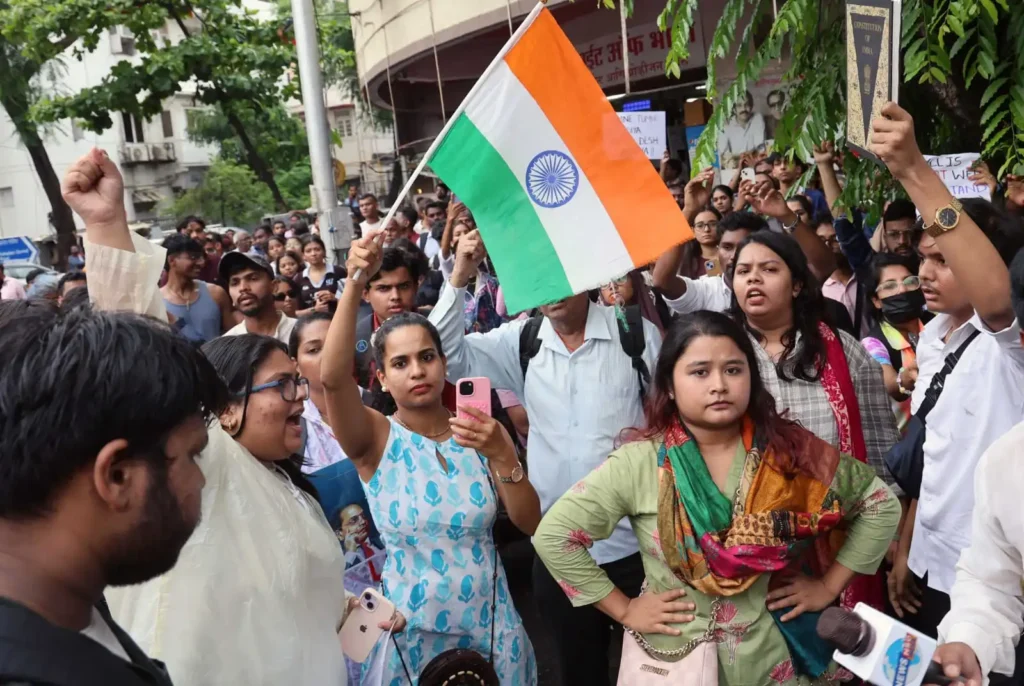
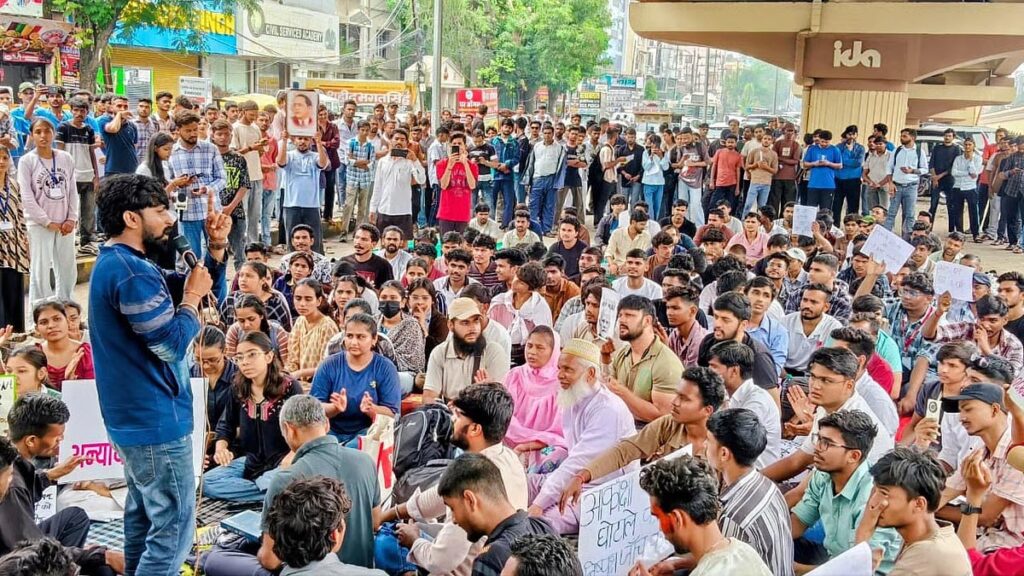
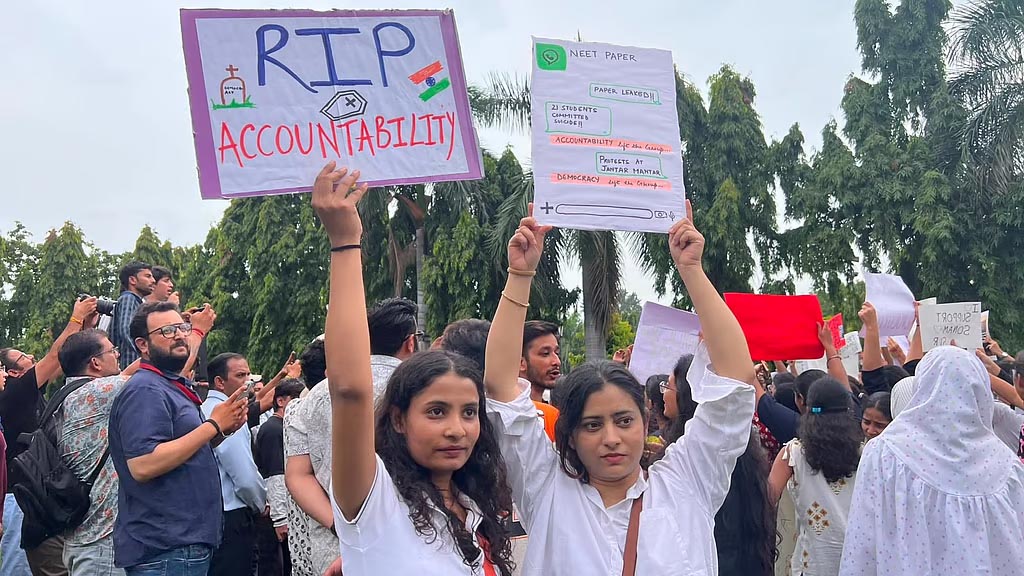
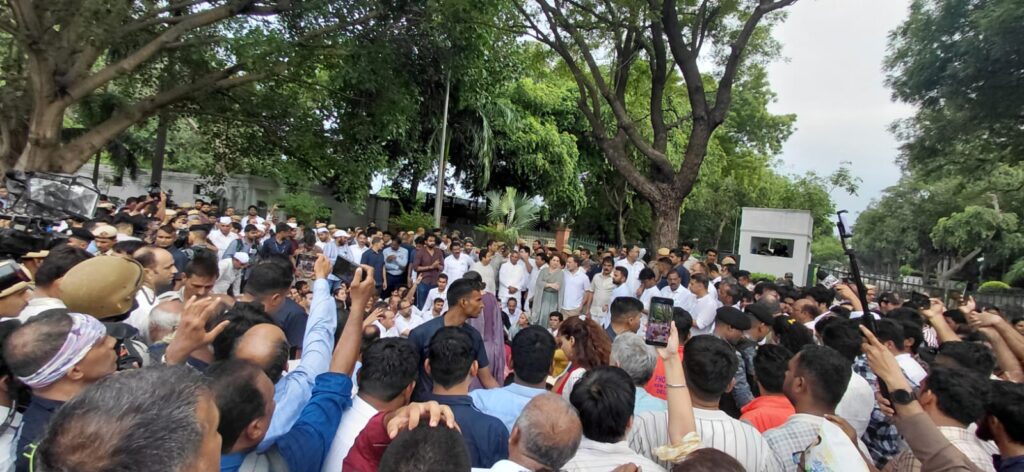
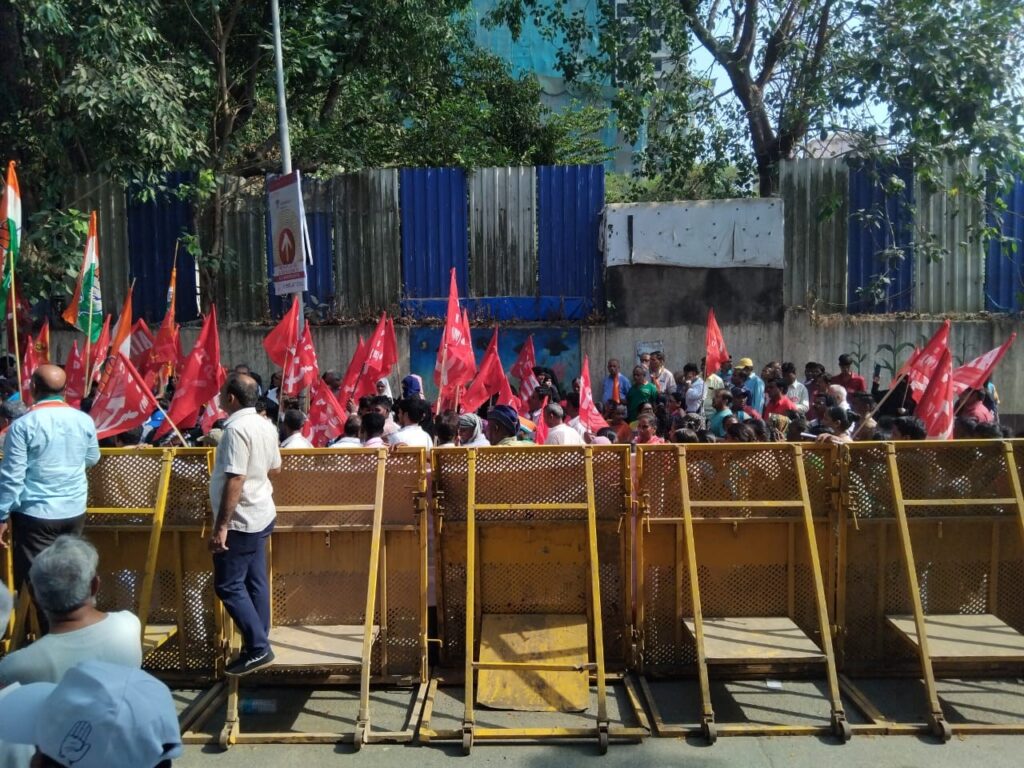
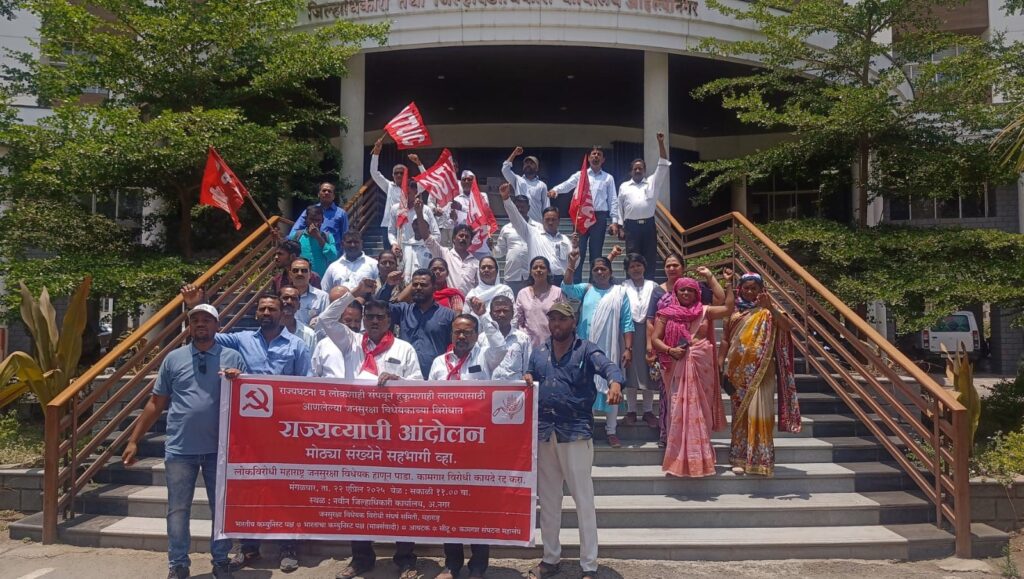
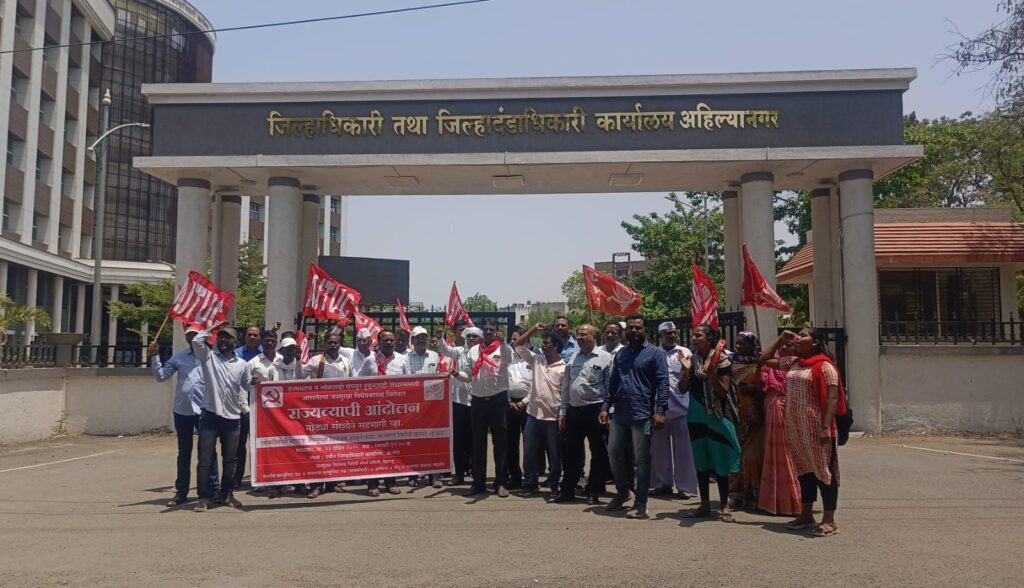
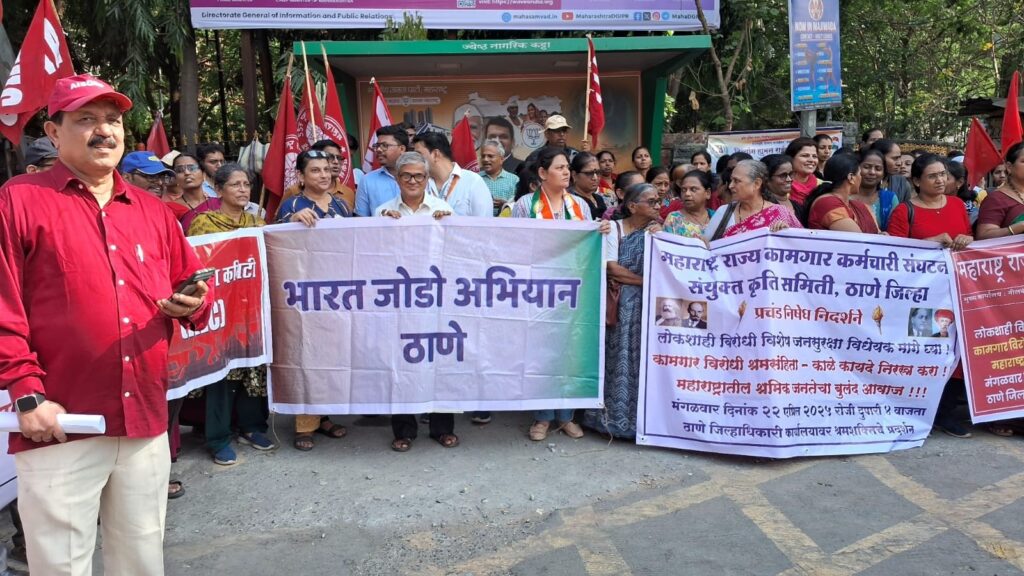
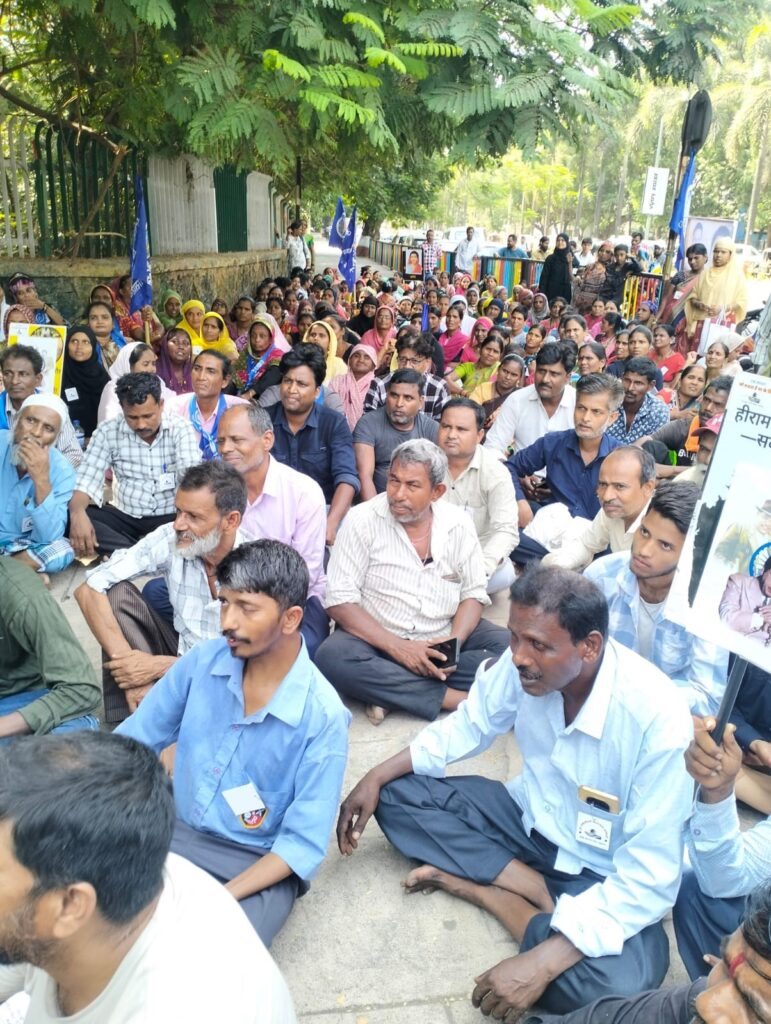
Across campuses, workplaces and streets, citizens demanding accountability are facing police force, arrests, surveillance and punitive laws—revealing an increasingly fraught battle over the constitutional right to protest.

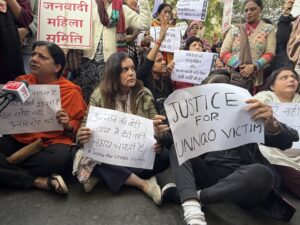
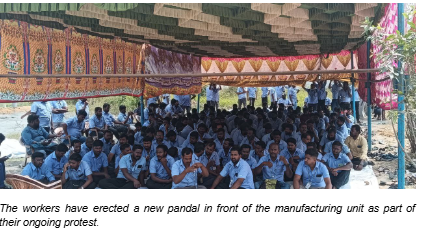
Allahabad HC quashes NSA detention of Aakriti Chaudhary, questions ‘concocted’ State narrative in Noida workers’ protest case

The Allahabad High Court has quashed the National Security Act (NSA) detention of 25-year-old Delhi University history graduate and activist Aakriti Chaudhary, after finding serious inconsistencies in the State’s account of her arrest and alleged role in the violence during the Noida workers’ protests.

A Bench comprising Justices Atul Sreedharan and Achal Sachdev allowed Chaudhary’s habeas corpus petition and held that the detention was founded on what the Court described as a “concocted story” by the State. The Court directed that she be released immediately if her custody was not required in any other case. The Court also directed the Noida authorities to pay her ₹5 lakh in compensation. The detailed order is awaited.

However, Bar & Bench has reported that Chaudhary is likely to remain in custody for the time being because she has not yet secured bail in the other criminal cases registered in connection with the Noida workers’ agitation. The judgment comes after the Bench subjected the State's version of Chaudhary's arrest and alleged involvement in the violence to close scrutiny, particularly the chronology of her arrest and the notices issued under the Bharatiya Nagarik Suraksha Sanhita (BNSS).

Court questions sequence of arrest and BNSS notices

During the hearing, the State told the Court that Chaudhary had been arrested at 10:56 a.m. on April 12, 2026 and that a notice under Section 130 of the BNSS had been issued to her. The State's case was that Chaudhary had instigated protesters to engage in stone-pelting and arson. The Bench, however, questioned whether the procedure prescribed under the BNSS had actually been followed.

Justice Sreedharan specifically asked whether Chaudhary had first been served a notice under Section 126. The State acknowledged that no such notice had been issued and that the notice under Section 130 had instead been served. The Court then examined the chronology of the documents and the General Diary (GD) entry. Justice Sreedharan questioned how a notice could have been prepared after Chaudhary had already been arrested.

As reported by LiveLaw, the Court observed in court: “Ab ismei GD entry dekhiye, usko arrest karliya fir notice banaya.”

The Bench further pointed to the apparent inconsistency between the arrest record and the notice, observing that the record indicated that Chaudhary had already been arrested before the notice was prepared. The Court's questioning went to the heart of the legality of the detention: whether the State had followed the statutory sequence required before taking the drastic step of arrest and subsequently placing Chaudhary under preventive detention.

‘Whatever violence has happened is after her arrest’

The Court also closely examined the State's claim that Chaudhary had played a role in instigating the violence during the workers' protest. The State relied on the events surrounding the workers' mobilisation and alleged that Chaudhary had encouraged protesters to resort to violence, including stone-pelting and arson. But the Bench drew attention to the chronology of events.

According to the State's own account, people had gathered for the protest on April 11. Justice Sreedharan pointed out that the significant violence relied upon by the prosecution occurred only later.

Yani 11 ko koi violence nahi tha. Whatever violence has happened is after her arrest,” the Court observed, according to LiveLaw.

The observation was significant because the State's case depended on establishing Chaudhary's connection to the violence. If she had already been arrested before the violence that formed the basis of the allegations, the Court was evidently questioning how the State could attribute subsequent acts of violence to her.

Where is the video evidence?

The Bench had already expressed concern about the evidentiary basis of the State's allegations during the previous hearing. On September 1, the Court had specifically asked the Uttar Pradesh government to produce video footage showing Chaudhary allegedly instigating protesters to throw stones or set vehicles on fire. The State sought additional time to obtain and produce the footage. The Court refused.

Justice Sreedharan noted that Chaudhary had already spent approximately five months in custody and said, “I won't give time. She has been in jail for 5 months.”

The Bench had also warned that if the record ultimately showed an arbitrary exercise of power, costs could be imposed on the officials concerned. The issue resurfaced during the final hearing when the State relied upon witness statements that allegedly named Chaudhary. The Bench, however, sought something more specific: where was the material showing that she had actually instigated the violence?

The Court also questioned the State's reliance on the chargesheet, asking where the witnesses had specifically implicated her and where the videographic evidence demonstrated the alleged acts of instigation.

From workers' protest to NSA detention

Chaudhary's detention stems from the Noida workers' protests of April 2026, which began over demands for higher wages and improved working conditions and later escalated into violence, arson and clashes with the police. The protests began peacefully but turned violent on April 13. Police subsequently arrested a large number of workers and activists and registered multiple criminal cases.

Chaudhary, a Delhi University history graduate and activist, was among those arrested. The Uttar Pradesh government subsequently invoked the NSA against her and journalist and activist Satyam Verma on May 13. The police alleged that the two had played a significant role in the violence and disruption associated with the workers' agitation.

At the time, Gautam Buddh Nagar Police Commissioner Laxmi Singh claimed that the police had “strong electronic and videographic evidence” against Chaudhary, Verma and others arrested in connection with the protests. The police's version was that the violence was not spontaneous but part of a wider organised effort.

Detailed report may be read here and here.

Related:

Noida Protest 2026: A labour uprising the state refused to understand

No ‘Pakistan conspiracy’ in Noida labour unrest: Fact-finding report

NSA slapped on journalist, DU scholar in Noida workers’ protest case amid allegations of crackdown on dissent


Maharashtra’s schools are struggling to survive as students protest, infrastructure crumbles and Marathi-medium institutions disappear

For years, Maharashtra’s education system has been showing signs of a crisis that has been difficult to ignore but remarkably easy for governments and political parties to treat as a mosaic of only isolated problems. Teacher shortages, deteriorating school infrastructure, disappearing Marathi-medium schools, inadequate facilities in tribal and residential schools, the relocation and proposed closure of low-enrolment schools, and the growing involvement of private entities in public education are not new developments. They are different symptoms of a deeper and sustained failure to ensure that every child has meaningful access to a well-staffed, adequately funded and accessible public school. The brazen shift towards privatisation is at the core of this shift.

Dalit, Adivasi, rural and economically disadvantaged communities have repeatedly raised these concerns, often from the sharpest end of the crisis. For children in remote villages and tribal settlements, the loss of a neighbourhood school can mean a long and unsafe journey to another village. For students in government and municipal schools, a vacant teacher's post can mean months or years without instruction in crucial subjects. For children living in government hostels and Ashram schools, inadequate sanitation, food, security and medical facilities can turn access to education into a question of basic safety and dignity. Moreover, for families seeking education in Marathi, the steady weakening of Marathi-medium institutions raises questions about whether the State is preserving meaningful choice or allowing an entire public education network to wither.

The Maharashtra media and even some sections of the “national legacy media” have reported these failures repeatedly, but largely as separate episodes: a school without teachers here, a dangerous building there, a protest over toilets or hostels elsewhere, a proposed school merger or closure, a dispute over Marathi-medium education, or a new policy promising modernisation. The result has been a fragmented public conversation about what is, in reality, a connected and longstanding crisis. These issues crucial to access and participation in a democracy have never been the subject of a sustained media campaign. Successive governments have announced schemes, reviews, reforms and infrastructure programmes, while the underlying questions of staffing, access, funding and accountability have remained.

What is equally striking is how little political space this crisis has occupied as a sustained issue. Despite Maharashtra's large network of government, Zilla Parishad and municipal schools, and despite repeated concerns raised by teachers, parents, educationists and marginalised communities, the condition of public schooling has rarely been made a central political question. Opposition parties have criticised individual decisions, school closures or government policies, but the broader deterioration of the public education system has not consistently been treated as a major political issue.

It was against this backdrop that the recent School Thik Karo campaign brought the condition of government schools into a more concentrated public spotlight. The campaign led by Cockroach Janta Party convenor Abhijeet Dipke has sought to document basic deficiencies in schools across Maharashtra and place them before the public. Its significance lies in something larger: it has attempted to connect problems that have too often been reported, protested and debated separately. The crisis, however, predates the campaign by years.

The evidence is now difficult to dismiss as a series of isolated incidents. Maharashtra's own education data records schools without electricity, internet connectivity, functional computers, accessible toilets and adequate teaching staff. Students have protested because teachers are missing. Adivasi students have gone on hunger strike over hostel conditions. Parents and activists have opposed school closures, mergers and relocations. Marathi-medium schools have steadily declined. Teachers are being pulled away from classrooms for non-academic duties, including prolonged election-related work. At the same time, governments have explored cluster schools, school adoption and Public-Private Partnership models even as large parts of the public system continue to struggle with basic infrastructure and vacancies.

This is therefore not simply a story about a few poorly maintained schools, nor is it only about the latest government policy or the latest student protest. It is a story about what happens when the State's responsibility to provide public education is repeatedly addressed through piecemeal interventions while the structural weaknesses of the system remain.

Maharashtra now speaks the language of a “modern”, digital and future-ready education system. However, before asking whether its schools are ready for artificial intelligence, coding, smart classrooms and digital learning, there is a more basic question to answer: are its schools adequately staffed, safely accessible, properly equipped and capable of providing every child with a meaningful education? The answer emerging from the experiences of students, teachers, parents, marginalised communities and the State's own data is far more troubling than the language of modernisation suggests.

Justice Varale questions education spending as Marathi-medium schools face closure

Mumbai records drop in number of Marathi schools despite govt promoting language | Mumbai News - The Indian Express

Nothing exposes Maharashtra state’s education policy priorities more than what was highlighted by a Supreme Court Judge recently.

Speaking about the condition of Marathi-medium schools weeks ago, Supreme Court Justice P.B. Varale on Saturday, August 22, reportedly questioned the State’s spending priorities, saying that even a fraction of the funds earmarked for the Nashik Kumbh Mela could have helped prevent the closure of hundreds of Marathi-medium schools. The Times of India reported that Justice Varale made the remarks during an event at his former school in Nashik.

Justice Varale reportedly referred to the Maharashtra government’s proposed expenditure on Kumbh infrastructure and a corridor project, while clarifying that he did not oppose such spending. However, he questioned whether a small portion of the allocation could instead have been directed towards education. He said that 0.1% of the Kumbh allocation, amounting to around Rupees 32 Crore, could have helped save more than 100–150 Marathi-medium schools from closure, according to the report.

The Maharashtra government has informed the Union government that a comprehensive development plan of Rupees 22,425.39 Crore has been approved for the 2027 Nashik Simhastha Kumbh Mela. The plan was approved at a meeting of the Apex Committee chaired by the Chief Minister on March 13, 2026, with the Kumbh scheduled to begin in October 2026.

Justice Varale also drew attention to the condition of residential schools, particularly ashramshalas catering to students from marginalised communities. Referring to reports of three girl students at an ashramshala who died after allegedly being bitten by snakes while sleeping on the floor, he reportedly said that the overall condition of several residential schools remained “pathetic”.

His remarks also pointed to a broader concern over the State’s changing budgetary priorities. Justice Varale reportedly observed that the share of the budget allocated to education, which had earlier ranged between 8% and 12%, had declined.

Modern education system cannot be built on disappearing schools

Perhaps the most significant development in Maharashtra’s education story is that students and their families are increasingly refusing to remain passive recipients of policy. Adivasi students have gone on hunger strike, Dharashiv students have sat outside the Zilla Parishad CEO’s office, villagers have locked a school in protest over teacher shortages, parents have challenged school relocations, and activists have documented failures in school infrastructure.

The protests differ in geography and immediate demand, but they share a common message: children and their families are being asked to accept gaps in a system that the State continues to describe as modern, inclusive and future-ready. Educationist Prabhu Mohapatra, commenting on the wider rise in student protests, told PTI that students were increasingly asserting themselves as stakeholders in education policy and that the protests reflected concerns over infrastructure, teacher availability and the quality of learning.

That assertion of agency may be the most important shift in Maharashtra’s education story. Students are not demanding luxury. They are demanding teachers, safe school buildings, functioning toilets, drinking water, adequate classrooms, accessible schools and the ability to continue learning in their own language. They are asking for the basic conditions necessary for education, and for the State to treat those conditions not as discretionary benefits but as public obligations. Maharashtra now has two competing narratives about education.

The first is the official narrative: smart classrooms, artificial intelligence, coding, digital platforms, teacher training, modernisation and a “mission mode” transformation of the education system. The second is emerging from classrooms, villages, hostels and protests: missing teachers, inadequate infrastructure, unsafe or unsuitable accommodation, inaccessible schools, unreliable or disputed data, and institutions facing closure or merger. Both realities have to be confronted.

The government can legitimately point to improvements and new initiatives, and its officials have disputed some of the broader allegations concerning infrastructure. But the State’s own U-DISE data, the Centre’s Project Approval Board review, the Bombay High Court’s intervention and repeated student and parent protests point to structural weaknesses that cannot be resolved through announcements alone.

The decline of Marathi-medium schools makes the problem even more consequential. This is not simply an infrastructure crisis; it is also a question of what kind of public education Maharashtra intends to preserve. If Marathi is to be protected, Marathi-medium schools cannot merely be celebrated symbolically. They must be adequately funded, staffed, upgraded and made capable of providing quality education without forcing parents to abandon the language in which their children have been studying.

If a school has low enrolment, the first question should therefore not automatically be how soon it can be closed. The more fundamental question is why enrolment is falling in the first place.

Is the school inadequately staffed? Are its buildings and facilities deteriorating? Are teachers being diverted to non-teaching duties? Is the school too far from where families now live? Has urban redevelopment displaced the community it once served? Are parents choosing other schools because the Marathi-medium option is perceived to offer poorer infrastructure or fewer opportunities? Has the medium of instruction itself become stigmatised? In addition, crucially, could targeted investment reverse the decline?

These questions become particularly urgent when the children affected are poor, rural, tribal or dependent on Marathi-medium government schools. For such families, the closure of a neighbourhood school is not simply an administrative restructuring. It can mean longer journeys, additional transport costs, greater dependence on private education and, in some cases, the eventual withdrawal of children from school altogether. And where closure is genuinely unavoidable, the State must be able to answer a more basic question: where exactly will every child go?

The Maharashtra government has now promised a time-bound transformation of the education system. The measure of that transformation, however, should not be the number of schemes announced, platforms launched, classrooms labelled “smart” or meetings conducted. It should be visible in the ordinary conditions in which children actually study.

It should mean a functioning fan in a classroom, a usable toilet, clean drinking water, adequate teachers, a safe hostel, a working computer, a laboratory that has actually been built and equipped, and a school that remains within reasonable reach of the children it serves. It should also mean a Marathi-medium school that is not forced to fight simply to survive.

Until these become ordinary features rather than exceptional achievements, the phrase “modern education system” will remain more aspiration than reality. A State cannot credibly claim to be building the schools of the future while allowing existing schools to become inaccessible, under-resourced or disappear altogether.

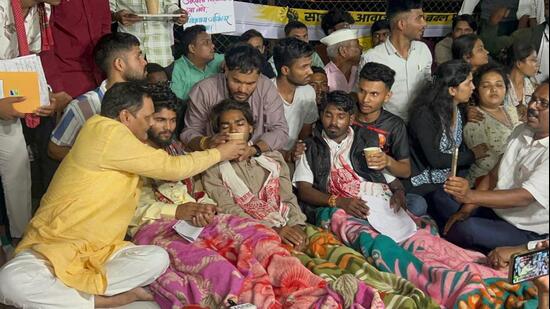
August 2026: Students on hunger strike for the right to study

[caption id="" align="alignnone" width="550"]17-day tribal students' hunger strike ends after Maharashtra govt agrees to demands | Hindustan Times 17-day indefinite hunger strike by tribal students at Manjari tribal hostel ended on Saturday after tribal development minister Ashok Uike met protesters and provided written assurances on their demands. Image: Hindustan Times[/caption]

The latest and perhaps most revealing episode came from Maharashtra's Adivasi student community. In August 2026, tribal students in Pune and elsewhere in Maharashtra began protesting against a range of issues concerning government hostels and Ashram schools. Six students continued a hunger strike at the Adivasi Government Boys Hostel near the Hadapsar-Manjari border.

The immediate trigger was a Government Resolution issued on August 14, 2026, imposing a maximum age of 30 years for admission to tribal hostels. But the students' demands went far beyond the age restriction.

The protest also brought allegations about the treatment of female students into focus. On August 24, Leader of Opposition in the Lok Sabha Rahul Gandhi wrote to Chief Minister Devendra Fadnavis raising concerns about the conditions described to him by tribal students. He alleged that hostels were unsafe and lacked adequate food, sanitation and medical care, and referred to claims that female students returning after an extended absence were subjected to pregnancy and other medical tests.

The Hindu also reported on August 24, the protesting students demanded the withdrawal of the August 14 Government Resolution and a revised order based on the earlier November 11, 2011 framework, with allowances linked to inflation. They sought greater protection for students living in tribal hostels and Ashram schools, ₹1 crore insurance cover for tribal students, ₹1 crore compensation for the families of three tribal girls who died following a snake-bite incident in Gadchiroli, a safe and properly equipped hostel for female students in Pune, and immediate filling of vacant posts including peons, security guards and sanitation workers.

The scale of dependence on these hostels is itself significant. As The Indian Express reported on August 26, the Tribal Development Department runs 490 government hostels across Maharashtra, accommodating between 58,000 and 60,000 students every year. The government ultimately backed down on the immediate issue. On August 25, following discussions with tribal legislators and MPs, Tribal Development Minister Ashok Uike announced that the 30-year age limit had been scrapped and that there would be no age restriction for admission to Adivasi hostels. The Indian Express reported that the decision came a day after Rahul Gandhi had raised the matter with Fadnavis. The government therefore acted. However, it acted after 13 days of hunger strike.

That sequence matters. It raises the question of how many of the other problems raised by the students — safety, sanitation, staffing, food, medical care and financial support — will require another protest before they receive sustained attention.

July 2026: “We need teachers, not promises”

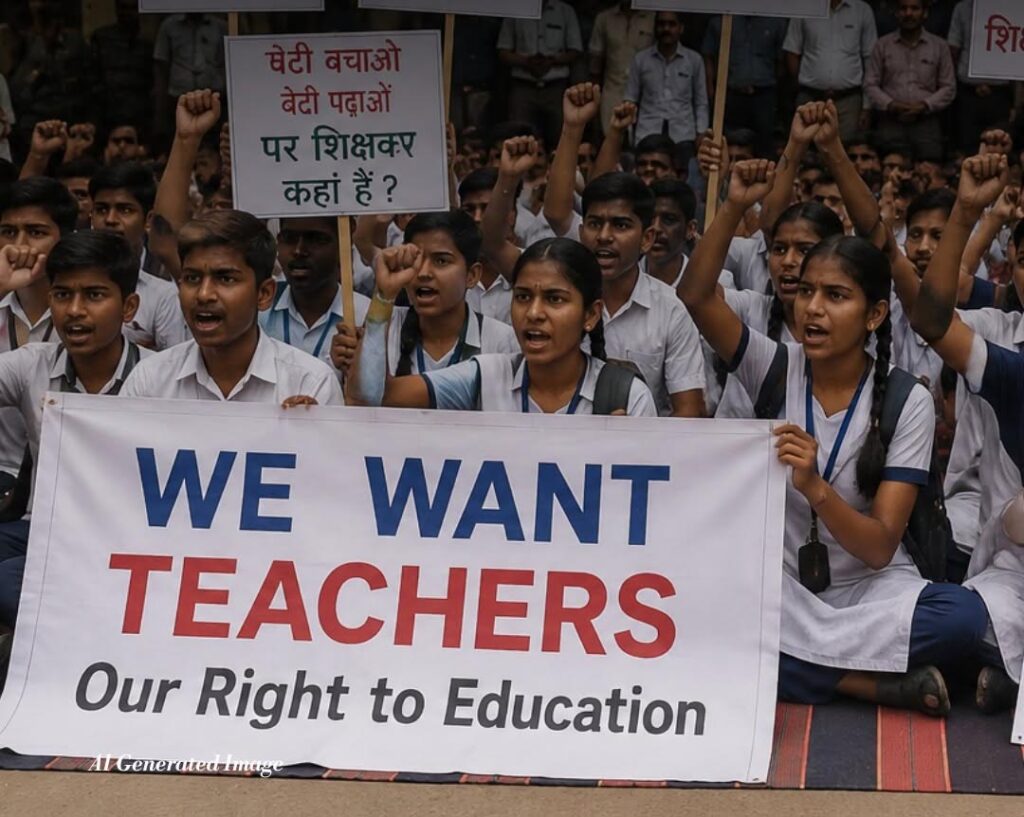
The same pattern was visible in Dharashiv. On July 31, India Today reported that Class 10 students of a Zilla Parishad secondary school in Sonari village had begun an indefinite sit-in outside the Zilla Parishad Chief Executive Officer's office demanding regular secondary-school teachers. Their complaint was not new. According to the protesting students, several teaching and staff posts had remained vacant for nearly four years. Repeated representations had allegedly failed to produce concrete action. A day before the sit-in, villagers had locked the school to draw attention to the shortage.

Students particularly objected to primary-school teachers being used to teach secondary classes, arguing that students preparing for the SSC examination required qualified subject teachers. The protest carried an especially pointed message. Students invoked the government's “Beti Bachao, Beti Padhao” campaign and asked, in effect: what does saving the girl child mean if she is then denied the teachers required to complete her education? They also invoked Dr B.R. Ambedkar's call to “Educate, Organise and Agitate”.

They said they had already approached the Zilla Parishad CEO, Education Officer, District Collector and Superintendent of Police on July 28, but claimed that no effective action followed.

This is not merely a question of staffing. For a Class 10 student, a missing teacher is not an abstract administrative vacancy. It can mean an incomplete syllabus, inadequate preparation for a board examination and, for poorer families, pressure to pay for private tuition that they may not be able to afford. Moreover, the state already knows that teacher shortages are a wider problem.

The Government’s own data exposes the gap

On July 17, the findings emerging from the Ministry of Education's U-DISE 2025-26 data provided that Maharashtra had 108,139 schools, 21.6 million students and 750,272 teachers. But 3,201 schools had no electricity connection at all. Another 10,938 had electricity connections that were not functional. A further 23,855 schools had no internet connectivity. Of the 90,419 schools that had computer facilities, computers were functional in only 84,530. That left 23,609 schools without operational computer systems.

The contradiction is hard to miss. The state is speaking increasingly about artificial intelligence, coding, smart classrooms and digital learning. Yet thousands of its schools are still struggling with the infrastructure required to switch on a computer, let alone build a digital classroom. The problem goes beyond technology. U-DISE data showed that 9,269 schools were single-teacher schools, catering to 179,104 students. More than 32,000 schools lacked separate toilets for children with disabilities, while 16,341 did not have ramps with railings.

There were 2,019 unusable girls' toilets and 3,280 unusable boys' toilets, with the data attributing the problem to issues including water, maintenance and pending repairs. Another 3,932 schools lacked playgrounds and 1,099 lacked a library or book bank. Only 13,550 schools had digital libraries, leaving 94,589 without one. These figures matter because they are not merely the claims of opposition parties or activists; they come from the government's own education database.

Teachers are being asked to do more with less

Teachers have also described the consequences of this system. Vijay Kombe, president of the Maharashtra State Primary Teachers' Committee, told ETV Bharat that schools continued to face shortages of basic items such as mats, desks and benches. He said local-government schools lacked dedicated cleaning staff and that teachers in some places were consequently forced to clean classrooms and toilets, sometimes with students' help.

Kombe also claimed that more than 75 per cent of primary schools run by local self-government bodies lacked headmasters, leaving teachers to combine administrative duties with classroom teaching. He criticised the staffing arrangement in low-enrolment schools, under which one primary teacher may have to manage multiple classes, while one teacher may be required to teach all subjects for Classes 6 to 8.

There is, however, an important official counterpoint. Divisional Deputy Director of Education Rajesh Kankal said drinking-water facilities were available in more than 100,000 schools, while more than 107,000 had hand-washing facilities and more than 102,000 conducted annual health check-ups. He said the administration was working to rectify the remaining shortcomings. The issue, therefore, is not that Maharashtra has no facilities.

It is that the existence of facilities in the majority of schools does not erase the thousands of schools where they are absent, dysfunctional or inaccessible. For a child attending one of those schools, the state-wide average offers little comfort.

SIR extension keeps teachers away from classrooms

The extension of the Special Intensive Revision (SIR) of electoral rolls in Maharashtra has prolonged the deployment of teachers as Booth Level Officers (BLOs) and support staff, affecting regular classroom teaching, unit tests and other academic activities. Teachers who were expected to return to schools by August 8 had been assigned election-related duties until August 17, with house visits, voter verification and form-related work continuing even as schools prepare for examinations and work to complete the syllabus.

The timing has added to existing pressures on schools. Unit tests scheduled for August and periodic assessments meant to track students’ learning are being affected, while teachers are also required to cover new textbooks introduced for Standards III, IV and VI under the National Education Policy. In some government and civic schools, more than 70% of teaching staff has reportedly been deployed for SIR-related work, leaving schools with reduced staff and, in some cases, forcing them to operate for only half the day. Teachers and school heads have said the prolonged absence is making it difficult to complete teaching and conduct examinations as scheduled.

The impact extends beyond teachers formally appointed as BLOs, with other teaching and non-teaching employees being assigned to assist with the exercise. In one school, Headmaster Tanaji Mane said three teachers initially appointed as BLOs were later joined by teaching and non-teaching staff who were relieved of their regular duties. Data cited by Progressive Teachers Association president Tanaji Kamble from Mumbai’s Ghatkopar East constituency reportedly showed that 184 of 283 BLOs were from the Education Department, including 157 teachers. Teachers have also faced pressure to report for election duties, with police notices reportedly issued to some who failed to do so. Educationists and teacher representatives have consequently questioned whether such prolonged deployment is compatible with the State’s responsibility to ensure uninterrupted schooling.

The issue ultimately raises a larger question about how election-related administrative work is being balanced against children’s right to regular education. Teachers have described the SIR process as continuous and demanding, while educationists have warned that prolonged absence from classrooms can disrupt learning, assessments and syllabus completion. With the electoral exercise continuing even as the academic year progresses, teacher organisations have suggested using trained personnel from other departments or other mechanisms for election work instead of repeatedly drawing teachers away from schools. The concern is not simply about teachers’ workload, but about what happens to students when the people responsible for teaching them are routinely pulled away from the classroom.

Detailed report may be read here.

The Centre's review makes the picture worse

The Ministry of Education's Project Approval Board raised similar concerns while examining Maharashtra's Samagra Shiksha plan for 2026-27. Of 22,416 eligible upper-primary, secondary and higher-secondary schools, 21,009 did not have ICT laboratories. Another 4,286 lacked smart classrooms. Nearly 60 per cent of primary and upper-primary schools had fewer than 30 students each, while 7,186 schools had only one teacher.

The Union also noted that more than 4,300 villages did not have a secondary school within the prescribed distance and more than 6,500 villages lacked access to a higher-secondary school. More than 80 per cent of approved science laboratories had not been completed, while toilets sanctioned for children with special needs remained pending. The teacher vacancy figures were equally concerning; around 17% of secondary teaching posts and 25% of higher-secondary posts were vacant.

The Centre approved ₹2,494.17 crore under Samagra Shiksha for Maharashtra for 2026-27 and directed the state to complete pending infrastructure and digital projects in “mission mode”. The Maharashtra government, for its part, said most sanctioned ICT laboratories were under installation and would be completed by the end of the year.

But this creates an uncomfortable policy contradiction. The government is being asked to modernise schools while it has not yet completed the basics.

Then there is the question of closing schools

Perhaps the most consequential issue is not what is missing from schools, but what happens when the state decides a school is no longer viable. In April 2026, the Maharashtra government issued two Government Resolutions declaring 433 primary schools and 324 secondary schools ineligible for grant-in-aid. The schools were directed to apply under the Maharashtra Self-Financed Schools Act, 2012. If they failed to do so, their recognition could be cancelled, effectively leading to closure. The Bombay High Court intervened.

On April 29, 2026, the Kolhapur Bench held that the government's action could not proceed against the petitioner schools without giving them an opportunity to be heard. As The Hindu reported on May 19, the court found that the resolutions violated principles of natural justice and directed that the petitioner institutions be removed from the list. Nevertheless, the court's observations went beyond procedure.

The bench noted that the affected schools were predominantly Marathi-medium institutions, particularly in villages. It pointed out the contradiction in the state's position: on the one hand, Maharashtra was insisting that Marathi be given greater importance; on the other, the government's action could result in the closure of Marathi-medium schools.

The judges also asked questions that should have been at the centre of the government's decision before the resolutions were issued: Could the students actually be accommodated in nearby schools? Would the medium of instruction continue? What would happen in villages where alternative schools were not available? What would happen to teaching and non-teaching staff? Could teachers be absorbed elsewhere? And could poor families be expected to bear the consequences of the shift to self-financed education?

The court concluded that these considerations had not been adequately addressed and directed the state to conduct hearings before taking action. That intervention is crucial because it exposes the danger of treating school closure as a mere question of numbers. A school with fewer students is not automatically a redundant school as it may be the only school within walking distance, or the only affordable school, or the only school teaching in the child's language. And if it disappears, the state's responsibility does not disappear with it.

2023: From school closures to “adoption”: A changing model of public education

The debate over low-enrolment schools cannot be separated from another policy shift: the growing role being given to private entities in the management and development of government schools. Maharashtra has increasingly presented private participation as a means of improving infrastructure and educational quality, even as questions remain about why the State is unable to adequately fund and maintain its own public-school system.

In September 2023, the Maharashtra government introduced an “Adopt a School” scheme under the National Education Policy’s Vidyanjali initiative. As reported by the Times of India on September 19, 2023, the scheme allowed private and public sector entities to adopt government schools for five or 10 years. The State proposed making more than 62,000 government schools available for adoption. Corporate entities could use Corporate Social Responsibility (CSR) funds for activities ranging from repairs, maintenance and painting to improving sanitation, health, enrolment and the use of technology.

Dalit groups strongly protested this move towards privatisation that would deny access to Dalit, Adivasi and OBC students especially in rural areas.

The financial commitments were substantial yet no audit of the scheme or the implementation have ever been held, nor demanded. According to the government resolution reported by The Times of India, entities adopting schools in “A” and “B” category municipal corporations, including Mumbai and Pune, were required to commit ₹2 crore for five years or ₹3 crore for 10 years. For “C” category municipal corporations, the amounts were ₹1 crore and ₹2 crore respectively, while other schools could be adopted for ₹50 lakh for five years or ₹1 crore for 10 years. The Business Standard, reporting on September 18, 2023, said the funds could be used for school-building repairs, painting, and toilets, infrastructure and sports equipment.

The government insisted that the scheme was not privatisation. In December 2023, then School Education Minister Deepak Kesarkar told the Hindustan Times that a major corporate house had expressed interest in adopting around 5,000 schools and stressed that the objective was to improve infrastructure and amenities, not to privatise schools. The government resolution also permitted an adopting entity to add its name to the existing school name for the duration of the agreement, although the original name was to be retained.

The distinction between “adoption” and privatisation, however, becomes more complicated when viewed alongside the State’s broader education policy. In July 2026, Frontline reported that Maharashtra was expanding public-private partnership models in school education, including the operation of five English-medium schools of the Pune Municipal Corporation through a PPP arrangement. The report said the same organisation that had previously operated the schools using CSR funds was subsequently awarded a contract worth ₹12 crore annually by the Pune civic administration. Frontline also reported concerns over proposals to hand over land reserved for Mumbai municipal schools to private entities under PPP arrangements.

This raises a fundamental question about the direction of public education. If private organisations are initially invited to improve government schools through CSR and are later given contracts to operate schools using public funds, the State’s role can gradually shift from being the primary provider of education to financing or facilitating private participation in its delivery. The issue is therefore not simply whether private money can improve a school building. It is who ultimately controls public educational assets, who determines priorities and whether access to education remains governed primarily by public obligations rather than the interests or capacities of private partners.

The question becomes particularly important in the context of Maharashtra’s low-enrolment and cluster-school policies. In September 2023, Mid-Day reported that the State had identified 14,783 schools with 20 or fewer students for consolidation into cluster schools. The proposed restructuring was expected to affect 1,85,467 students and 29,707 teachers. The government argued that very small schools could not provide adequate infrastructure, qualified teachers or opportunities for social interaction, and pointed to successful cluster models in Panshet and Toranmal.

Teachers and education activists, however, warned that consolidation could push students to travel longer distances and increase the risk of dropouts, particularly in rural and remote areas. Their concern was especially significant for young children, girls and students from economically weaker families for whom daily travel to a distant school may itself become a barrier to attendance.

The State subsequently sought to reassure critics. In July 2025, Deputy Chief Minister Eknath Shinde told the Maharashtra legislature, as reported by ET Education, that schools would not be closed merely because of low enrolment. He said the government would make adjustments to ensure that such schools continued functioning and that teachers would be redeployed only after appropriate adjustments were made. Yet the same report noted that around 18,000 schools had fewer than 20 students.

The policy trajectory therefore remains difficult to reconcile. On one side, the government says low-enrolment schools will not be shut and that every child must continue to have access to education. On the other, cluster models, school consolidation and private participation are being promoted as solutions to the perceived financial and infrastructural limitations of the existing public-school network.

The issue is not that private participation is inherently harmful, nor that every small school must necessarily remain open regardless of circumstances. The concern is whether the State is addressing the reasons behind low enrolment and poor infrastructure before declaring a school inefficient, relocating its students or inviting private entities to take over functions that should ordinarily be part of public educational provision.

A government school is not merely a building that can be repaired through CSR funding or managed through a contractual arrangement. It is part of the public infrastructure through which the State fulfils its constitutional obligation to provide education. When schools are under-resourced, the answer cannot automatically be to reduce the State’s responsibility by transferring greater functions to private actors. The more important question is whether Maharashtra is investing sufficiently in making its public schools viable before concluding that they need to be consolidated, adopted or operated through PPP models.

Marathi schools: Declining enrolment or a policy-created cycle?

The decline of Marathi-medium education in Maharashtra is particularly troubling because it cannot simply be reduced to a story of parents “choosing English”. The numbers in Mumbai are stark. According to BMC data cited by ThePrint on July 24, 2025, the number of Marathi-medium schools in Mumbai fell from 460 in 2019-20 to 421 in 2025-26 — a loss of 39 schools. Around 50,000 students had moved elsewhere from the 2019-20 academic session onwards.

The longer-term numbers are even more striking. Mid-Day, reporting on May 4, 2025, said Mumbai had 413 Marathi-medium schools in 2010-11, 368 in 2014-15 and only 262 by 2023-24. That is not a temporary fluctuation, but rather a sustained decline.

The government has attributed the decline largely to parental preference for English-medium education. Parents do indeed have reasons to make that choice. English is widely perceived as providing better access to higher education, employment and social mobility. But educators and activists argue that parents are also responding to the relative quality and visibility of the schools being offered to them. As ThePrint reported in July 2025, educators pointed to inadequate infrastructure in Marathi-medium schools and alleged that English-medium institutions received greater preference when it came to development.

Deepak Pawar of the School Education Action Coordination Committee argued that Marathi-medium schools should be upgraded without changing their medium to English. Teachers cited in the report similarly described a communication gap with middle-class families and said some Marathi-medium schools had modern facilities such as Atal Tinkering Labs and robotics labs, but that efforts to publicise and develop these came only after enrolment had already begun to collapse. The important point here is thus, if the state allows a school to deteriorate, then points to falling enrolment as evidence that the school is no longer viable, it risks creating a self-fulfilling cycle. One cannot ignore the vicious cycle of how poor infrastructure erodes parental confidence, leading to declining enrolment, reduced allocation of teachers and resources, and a further deterioration of schools, creating a cycle that ultimately pushes schools towards closure. The final closure can then be presented as the inevitable consequence of “parental preference”. But inevitability is not the same as neutrality.

The fate of one of Mumbai's oldest Marathi schools

The uncertainty surrounding Dadar's Nabar Guruji Vidyalaya brought this crisis into sharp relief. In May 2025, Mid-Day reported that the Marathi-medium school, which dates back to the 1940s, was facing an uncertain future amid falling admissions. Thirty-five students had appeared for its SSC examination that year, but only 17 students remained in Classes 9 and 10 for the new academic year. The management clarified that it had not decided to close the school.

Trustee Satish Rama Nayak said the institution remained financially capable of functioning because it offered free education and teachers' salaries were supported through government grants. The difficulty was the collapse in enrolment and its impact on the teacher-student ratio. Nayak also described a social transformation.

Parents who had themselves studied in Marathi-medium schools were increasingly choosing English-medium or CBSE schools for their children, sometimes even taking loans to pay for them. That is the other side of the story. It would be too simplistic to blame the government for every parent who chooses English. But it is equally simplistic to blame parents for the disappearance of Marathi-medium schools without asking why government and aided Marathi schools have not been made equally attractive, well-equipped and aspirational.

As Sushil Shejule of the Marathi Abhyas Kendra told ThePrint, the decline had been visible for years and, despite the availability of data, neither governments nor political parties had taken meaningful action.

The irony of Marathi's “classical language” status

In October 2024, Marathi received classical-language status from the Union government. Maharashtra has also repeatedly asserted the importance of Marathi in public life and education. The Maharashtra Compulsory Teaching and Learning of Marathi Language in Schools Act, 2020 made Marathi compulsory in schools across the state, including CBSE and ICSE schools. Yet the institutions that actually provide education through Marathi continue to shrink.

The Mid-Day report of May 2025 placed the decline against precisely this backdrop: Marathi had acquired classical-language status, but one of Mumbai's oldest Marathi-medium schools was struggling with falling admissions. The contradiction was also noticed by the Bombay High Court in its April 2026 intervention.

The state cannot convincingly claim to protect Marathi while allowing the network of Marathi-medium schools, particularly those serving poorer and rural families, to become increasingly fragile. Protecting a language is not merely about official resolutions, signboards or declarations. It also means ensuring that a child who wants, or needs, to study in that language has a functioning school in which to do so.

Mumbai's municipal schools: when “repair” means displacement

The infrastructure problem becomes even more complicated when schools are declared unsafe and children are moved elsewhere. In December 2025, Outlook reported on the closure and relocation of Mumbai municipal schools, including New Mahim Municipal School. Students were shifted from August 2025 to another municipal school operating from a few rooms on the first floor of a residential building.

According to the report, the replacement premises lacked a playground, proper drinking-water facilities and adequately supplied toilets. The concern raised by parents and activists was not that unsafe buildings should continue to operate. A genuinely dangerous school building cannot be defended in the name of access to education. The concern was about what children were being offered after their school was shut.

When a school has to close because its building is unsafe, the replacement should provide an equivalent educational environment. It should be sufficiently close to the children’s homes, have adequate classrooms, functional toilets and drinking-water facilities, and provide children with access to a playground. Parents and children should also have a say in decisions that directly affect their education. For Marathi-medium schools, relocation should not result in the loss of the medium of instruction. These are not peripheral concerns. They determine whether a “relocation” actually amounts to continued and meaningful access to education.

When official records themselves threaten to erase students

Another warning emerged in January 2026. On January 10, ETV Bharat reported discrepancies between Aadhaar-linked records and UDISE Plus data that had left thousands of students classified as “invalid”, “not provided”, “under verification” or “out of school”. The report said that of 2,14,68,288 students registered in the relevant Maharashtra UDISE Plus data, 5,78,433 were listed with invalid Aadhaar details and 4,98,759 had not provided Aadhaar details. Another 69,688 were shown as out of school. Educationists warned that such discrepancies could have consequences for school enrolment figures and, consequently, teacher deployment and funding. The concern was particularly acute for Marathi-medium schools.

Rajan Mahadeshwar, principal of Govandi's Jagruti Vidyamandir, told ETV Bharat that his school had 430 students actually registered, while the UDISE system showed only 380 because 50 were marked invalid or pending verification. He feared that an artificially reduced enrolment could eventually affect the school's viability. Officials disputed the extent of the danger.

Divisional Deputy Director Rajesh Kankal said only around five per cent of students in numerous schools did not have Aadhaar updated and said he did not expect grant-in-aid schools to face major problems. Yet the larger policy concern remains valid: when funding, staffing and school viability are increasingly linked to enrolment data, the accuracy of that data becomes an educational rights issue. A child should not become statistically invisible because a database has failed to correctly reflect their presence in a classroom.

The state is promising a transformation

The government has not remained silent. On August 22, 2026, Deputy Chief Minister Eknath Shinde held a detailed review meeting with School Education Minister Dada Bhuse and senior officials. As Deccan Herald reported on August 23, Shinde directed the Education Department to prepare a clear, comprehensive and time-bound action plan to modernise schools and bring about “real, visible and qualitative improvements”.

The proposed plan includes teacher training, capacity building, greater involvement of education experts and experienced teachers, health check-ups, nutrition, a review of the Mid-Day Meal Scheme and attention to students' mental and emotional well-being. The state has also expanded digital education initiatives. Digital Learning reported on August 4 that the Vinoba Digital Education platform had been expanded to 45,000 government schools across 25 districts, reaching more than 31 lakh students and nearly 1.3 lakh teachers.

These initiatives may be useful. However, the timing of the government's August review is telling. It came after weeks in which government-school conditions had repeatedly been placed in the public eye — including through the “School Thik Karo” campaign launched in Maharashtra by Cockroach Janta Party convenor Abhijeet Dipke.

On August 15, Telangana Today reported that Dipke had launched the campaign in Hingoli after inspecting a Zilla Parishad school where he alleged that toilets lacked water, windows were broken and students lacked adequate benches. He said the campaign would document basic facilities in government schools across Maharashtra. The campaign itself is not a substitute for institutional inspection or government monitoring. Its allegations must therefore be independently verified before being treated as established facts.

But its very existence points to a troubling question: Why are political and citizen campaigns increasingly having to inspect schools to make basic educational infrastructure visible?

When will policy on public education, access and representation actually be formulated with the stakeholders? Who are the stakeholders? They are communities that demand education for the young, the most marginalised and teachers who form the other crucial arc. All the policies hurriedly formulated are however top heavy and solely the creation of bureaucrats and politicians, often concealing blatant private interests.

This is not democracy but public policy turned on its head.


Related:

Six-year-old detained during Patna teacher aspirants’ protest, parents allege police assault

Water Cannons Instead of Answers: Bihar’s recruitment crisis and the state’s crackdown on protest

Amnesty Investigation finds unlawful and deadly force against CJP-led protesters in Delhi and Siwan

August 11, 2026: A decade plus of students challenging a regime that seeks to control thought & ideas

Maharashtra SIR extension keeps teachers away from classrooms as unit tests face delays

After NEET protests ended, the battle moved online: Women protesters face threats, doxing and criminalisation


Six-year-old detained during Patna teacher aspirants’ protest, parents allege police assault

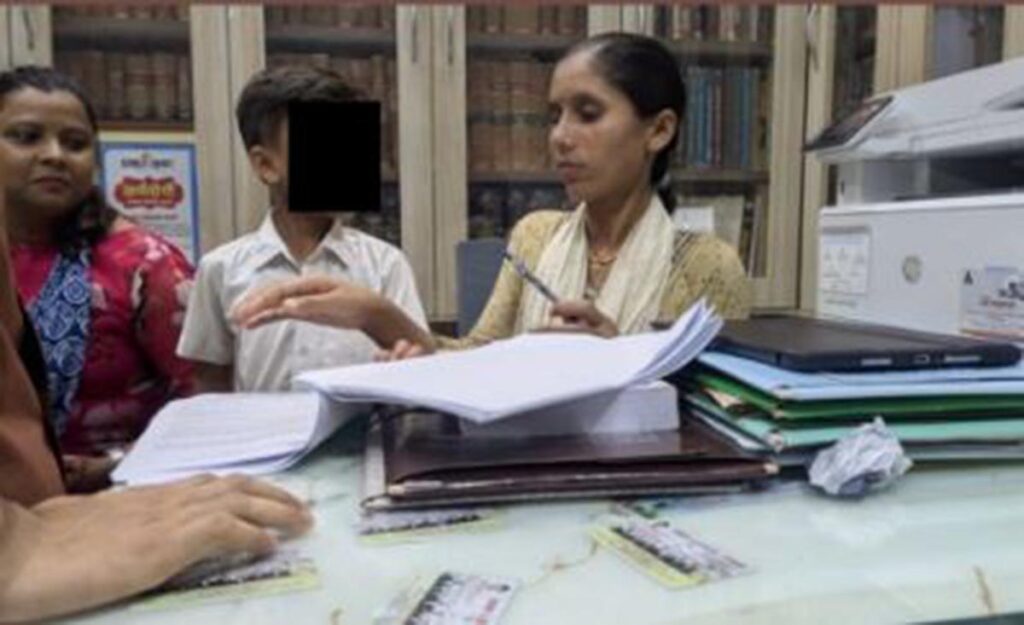
A six-year-old boy who joined his parents at a protest by teacher aspirants in Patna on August 25 was taken to a police station along with his parents, with the family alleging that they were assaulted and kept there for several hours. Aditya Kumar had joined his parents, Ranjit Kumar, 30, and Munni Kumari, 28, at Dak Bungalow Chowk, where teacher aspirants had gathered as part of a protest over the Bihar Public Service Commission's proposed Teacher Recruitment Examination-4 (TRE-4).

According to his parents, Aditya was interested in joining the protest because he believed students were facing injustice. The couple decided to accompany him rather than prevent him from participating. The family travelled to Dak Bungalow Chowk by auto rickshaw and remained together during the demonstration.

Patna Police, however, have denied that the child was detained, saying he was rescued from a potentially dangerous situation at the protest site and later handed over safely to his family. The incident was reported by The Wire, which spoke to the child's parents and the police.

Police say child was rescued

The Patna Police, in a press release issued on August 26, rejected social media claims that the child had been detained. According to the police, protesters had moved towards a restricted area and attempted to break through or remove barricades. Police said that amid the situation, they spotted a child at the protest site and intervened to protect him from the crowd and the possibility of a stampede. The police said the child was subsequently handed over to his family “safe and sound”. The family's account differs.

Ranjit and Munni told The Wire that police first attempted to take Aditya away during the protest. According to them, media persons present at the spot intervened, following which the child was allowed to remain with them. Someone later gave Aditya a tricolour, which he began waving. When some protesters climbed onto a police bus that had reportedly been brought to detain protesters, Aditya also climbed onto the bus and continued waving the national flag. Ranjit said he subsequently took his son and attempted to leave the protest site.

According to him, police approached them and told him that his wife was waiting for him. He and Aditya followed the police and were subsequently placed in an ambulance along with Munni. The family says they were initially told they would be taken home. Instead, they were taken to the Kotwali police station, which is around 500 metres from Dak Bungalow Chowk.

Family alleges assault at police station

[caption id="attachment_49070" align="alignnone" width="696"] Image: The Wire[/caption]

The parents have alleged that they were kept at the police station for several hours and assaulted by police personnel. Ranjit told The Wire that he and his wife were taken into a small room where around six police personnel were present, including four women police officers. He alleges that police personnel assaulted both him and his wife.

According to his account, officers instructed female personnel on how to beat Munni. He alleges that officers stepped on her legs and that he was beaten on the soles of his feet and hands with a baton. He also alleged that he was pushed to the ground, struck on his back and hit below the waist. Ranjit said the alleged assault lasted around 15 minutes.

They treated us as if we were hardened criminals,” he told The Wire.

Munni separately alleged that police kicked her in the abdomen despite her having undergone a Caesarean-section delivery. Ranjit said he pleaded with the police to stop assaulting his wife.

The police have denied the allegations. Kotwali SHO Ajay Kumar told The Wire that no assault took place inside the police station. Responding to questions about injury marks on Munni's body, he said the injuries could have been sustained during the protest itself.

Aditya kept asking about his parents

According to his father, Aditya himself was not assaulted at the police station. Ranjit said the child was offered biscuits and chocolates but refused them. Instead, he repeatedly asked to be allowed to stay with his parents. He also questioned police about why his parents had been beaten after seeing their injuries, according to Ranjit. The family says Aditya remained calm despite the situation.

His father told The Wire that the six-year-old has previously shown an interest in participating in protests. Aditya had also participated in an RJD-organised march in Patna on August 19, according to his parents.

Ranjit also claimed that Aditya's actions during the August 25 protest had attracted police attention. According to him, police had lathi-charged protesters during the demonstration and some teacher aspirants suffered head injuries. Ranjit said Aditya asked in front of media persons who had ordered the lathi-charge. He further alleged that when a police officer was leaving the protest site, Aditya questioned him about where he was going after the alleged incident. According to Ranjit, police later asked the parents at the police station why their child had been asking about the injured protesters and the lathi-charge.

Mother taken to hospital

Munni reportedly became unwell while at the police station and complained of anxiety. Ranjit said he informed the police, who brought water for her. According to the family, she was subsequently taken to New Gardiner Road Hospital, a government hospital located around 500 metres from the police station. Munni told The Wire that two women police personnel accompanied her to the hospital.

She alleged that she was advised not to tell the doctor that she had been beaten at the police station. According to Munni, she did not tell the doctor about the alleged assault because she felt intimidated in the presence of police personnel. She was treated at the hospital and given a prescription. Munni alleges that the police took the prescription, telling her that it would later be given to her husband. She says the prescription was never returned.

The SHO denied the allegation that police had taken the prescription, saying that such a document normally remains with the patient. After her treatment, Munni was taken back to the police station. The family says they were finally released at around 8 pm and reached their home at around 9 pm.

Ranjit has further alleged that before their release, he and his wife were made to sign a written document. According to him, the document stated that strict action could be taken if Aditya participated in a protest in the future. He also claims that it stated that police could summon the parents for questioning at any time. Ranjit said he did not know the full contents of the document he had signed. The family also alleges that police instructed them not to speak about what had happened inside the police station.

Protest over TRE-4

The protest was organised by teacher aspirants who are opposed to changes announced by the Bihar Public Service Commission for the upcoming TRE-4 examination. Under the new pattern, the examination is to be conducted in two stages, while negative marking will continue in objective examinations. The protesting aspirants have demanded that the examination instead be conducted as a single examination and without negative marking.

On August 25, they began marching from Gandhi Maidan towards Chief Minister Samrat Choudhary's residence. The protesters broke through police barricades during the march and reached Dak Bungalow Chowk, where police action followed. Aditya joined the protesters there with his parents.

Family now fears police harassment

Ranjit and Munni are a working-class couple. Ranjit has studied until Class 4 and works as a daily-wage labourer, earning around Rs 500 a day. Munni works as a domestic worker. The family lives in a single rented room. Aditya is their only child and studies in Class 1 at a private school. According to his parents, he enjoys Mathematics, Hindi and English and keeps a copy of the Constitution. The family says the events of August 25 have left them fearful of further police action. Ranjit told The Wire that he has stopped going to work for several days because he fears that police could arrest or assault him again. The family also says they did not eat or sleep properly after returning home that night. Munni said they kept wondering what they had done wrong. The family is now reportedly avoiding staying at home because of fears of police harassment.

Advocate Shivnandan Bharti, who is planning to file a writ petition concerning the incident, has described it as a case of illegal detention and questioned why the child was not simply handed over to his parents if the police intervention was solely for his safety.

Related:

Water Cannons Instead of Answers: Bihar’s recruitment crisis and the state’s crackdown on protest

Amnesty Investigation finds unlawful and deadly force against CJP-led protesters in Delhi and Siwan

Inside the SSP’s Office: Allegations of beatings, torture & police impunity against farmer leaders in Meerut, UP

Address Discrimination & Hate Crimes India told: CERD, UN


Water Cannons Instead of Answers: Bihar’s recruitment crisis and the state’s crackdown on protest

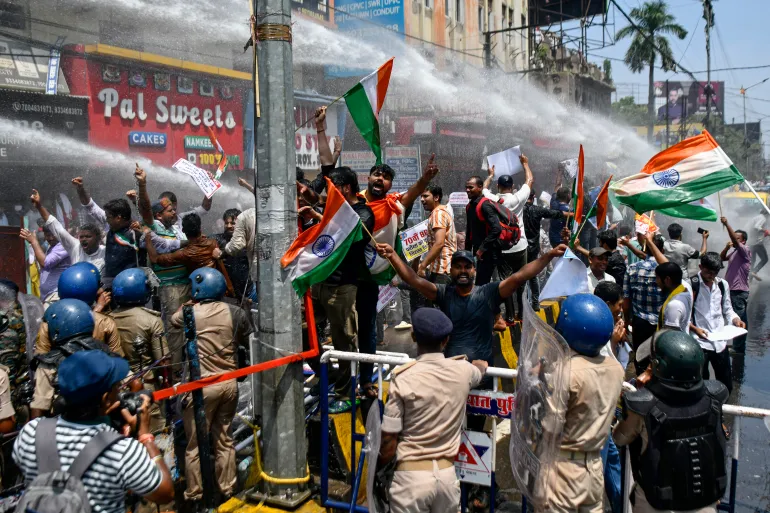
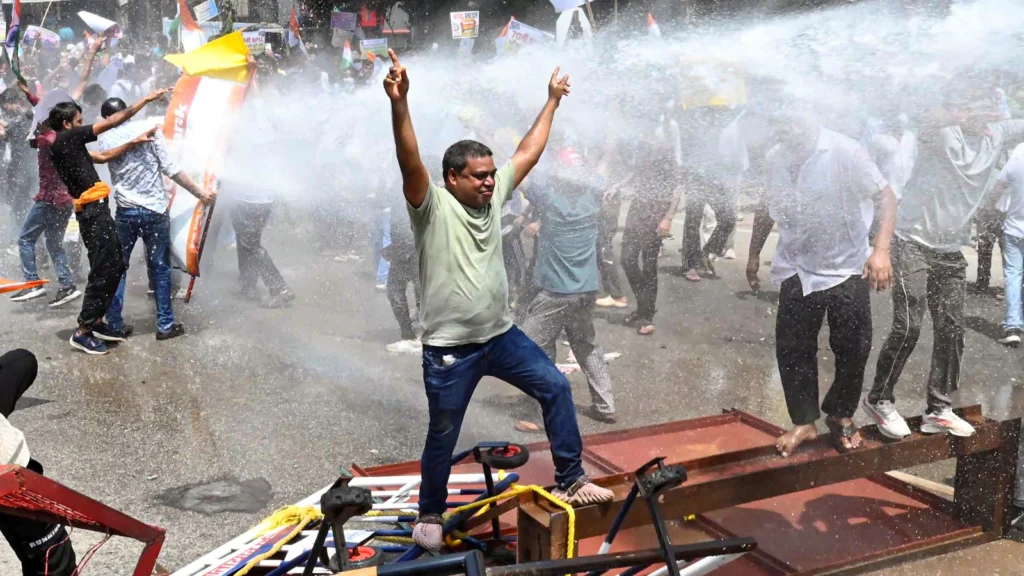
The streets of Patna once again became the site of a confrontation between Bihar’s students and the State on August 25, as hundreds of protesting job aspirants marched towards the residence of Chief Minister Samrat Choudhary. What began as a mobilisation around recruitment examinations ended in clashes, barricade-breaking, water-cannon deployment, a lathi-charge and detentions.

But to reduce the events to a story of “students versus police” would obscure the larger crisis. The agitation is rooted in a much deeper and longstanding grievance over recruitment delays, examination irregularities, alleged paper leaks, the changing format of competitive examinations and a lack of confidence in the State’s recruitment machinery.

The violence on August 25 is therefore not an isolated law-and-order episode. It is the latest flashpoint in a protest movement that has been building for weeks — and one that has also produced disturbing allegations of excessive and abusive use of State power.

A protest over jobs, examinations and a system students no longer trust

Students have been holding a sit-in at Patna’s Gardanibagh since August 18. More than a dozen student and youth organisations have joined the agitation, with demands extending across the Bihar Public Service Commission (BPSC), Bihar Staff Selection Commission (BSSC), teacher recruitment and other government examinations.

At the centre of the immediate dispute is the fourth Teacher Recruitment Examination, or TRE-4. Students want the examination to be conducted in a single stage rather than the proposed preliminary-and-main format. They are also demanding the removal of negative marking, greater transparency in recruitment examinations and 100% domicile-based recruitment in government jobs and teacher appointments.

The scale of the recruitment opportunity is significant. The BPSC announced that TRE-4 would cover 32,388 teaching posts. According to The Indian Express, the proposed examination is expected to be held in December 2026 or January 2027, with applications scheduled from September 1 to September 30.  Students have also demanded cancellation of the 70th BPSC examination over alleged irregularities and a paper leak. The BPSC has rejected these allegations, saying that material circulated online was fake. It has also denied allegations of discrimination against Hindi-medium candidates..

Protester Vikas Bhatt, speaking to the media, pointed to the long delays in recruitment for posts such as librarians and the absence of regular examination calendars for several recruitment bodies. The New Indian Express reported his allegation that some recruitment processes announced through the BSSC had remained pending for years. The question confronting the Bihar government is consequently not merely whether students are willing to accept its assurances. It is whether the State has given them sufficient reason to trust those assurances.

The August 25 confrontation

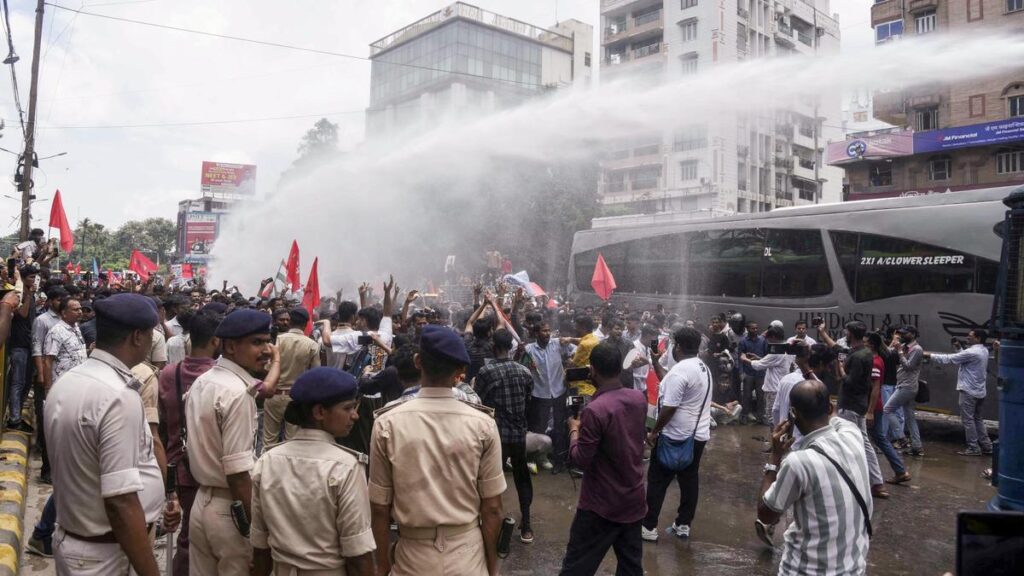
On August 25, more than 1,500 students backed by 17 student organisations marched from the JP Roundabout near Gandhi Maidan under a call to “gherao” the Chief Minister’s residence, according to The Indian Express.  Police had erected barricades at Dak Bungalow Chowk to prevent the protesters from proceeding further. Students pushed through the barricades, leading to a confrontation with the police. The State responded with water cannons and a lathi-charge. Several students were detained. Two police personnel were also injured in the confrontation, according to The Telegraph, which reported that around 25 students were detained and later released without formal charges.

Other reports said students threw stones and that a police officer and a woman constable were injured. The violence cannot be ignored or excused: protesters who attack police personnel or damage public property must be held accountable through lawful procedures. But that does not settle the question of the State’s response.

A democratic government does not acquire unlimited authority merely because a protest becomes disorderly. The use of force must remain lawful, necessary and proportionate. The existence of barricades and a restricted area cannot by itself transform every protesting student into a threat requiring a coercive response.

The images from Patna — students facing lines of police personnel and water cannons — are particularly stark because the protesters were not demanding an overthrow of the constitutional order. They were demanding jobs, recruitment dates, examination reforms and accountability.

[caption id="attachment_49016" align="alignnone" width="770"] Image courtesy: Sachin Kumar / AFP[/caption]

[caption id="attachment_49017" align="alignnone" width="696"] Image courtesy: PTI[/caption]

When the language of the State becomes dismissive

The confrontation was preceded by another controversy that exposed the widening distance between the administration and the protesters. BPSC Examination Controller Rajesh Kumar Singh, while responding to questions about the agitation, quoted the Hindi proverb: “Haathi chale bazaar, kutta bhaunke hazaar.” Protesters interpreted the remark as comparing them to barking dogs.

Singh subsequently expressed regret and said the statement had been taken out of context. But the Bihar government went further and suspended him following the controversy, according to The New Indian Express.  The suspension is significant. An official responsible for an examination system under intense public scrutiny cannot afford to speak about protesting candidates in language that can reasonably be understood as contemptuous or humiliating. Even if the proverb was not intended literally, the choice of language was extraordinarily insensitive given the circumstances. There is an important democratic principle here: the State must not dehumanise the citizen before it attempts to manage the protest. The students are not an inconvenience to be ignored until the barricades have to be erected. They are citizens raising grievances against institutions that exercise enormous power over their futures.

A much darker story lies behind the August protests

The allegations surrounding police conduct in Bihar go beyond what happened on August 25. A public hearing convened by the Bihar unit of the People's Union for Civil Liberties (PUCL) on August 22 documented testimonies concerning police action during protests between July 21 and July 27.

According to the account published by Counterview, the hearing recorded 19 direct testimonies and allegations spanning physical assault, illegal detention, custodial torture, raids on homes, sexual violence against women protesters and other forms of intimidation. The allegations were made by protesters and activists and should be independently investigated rather than treated as established judicial findings.  The allegations are deeply disturbing. PUCL's public hearing reportedly documented claims of targeted lathi-charges, police firing, the use of firearms, custodial abuse and violations during arrests and detention. Some testimonies also alleged that women were subjected to misogynistic abuse and physical assault.

There were also allegations concerning raids on homes. According to the report of the hearing, families claimed that police entered residences at night, assaulted residents, damaged property and subjected women to degrading treatment.

These are not allegations that a democratic government can simply dismiss as the inevitable excesses of policing. If even a fraction of these claims is true, the matter goes far beyond “crowd control”. It becomes a question of systemic abuse of police power. The PUCL hearing also raised allegations of discriminatory treatment of Muslims, Scheduled Caste persons, women and activists associated with CPI(ML), as well as allegations involving minors being detained without being produced before the appropriate authorities within legally prescribed timelines. These claims require independent verification and, if substantiated, prosecution and institutional accountability.

Even lawyers allegedly became targets

Perhaps the most alarming allegations concern those attempting to provide legal assistance to protesters. According to the PUCL public hearing account, two PUCL lawyer-members who were providing pro bono assistance to detained protesters were themselves allegedly confined and booked on charges that included liquor consumption and obstructing police duties. They were reportedly handcuffed and paraded in public.

If independently established, such conduct would strike at the heart of the right to legal representation and the functioning of the criminal justice system. Lawyers representing arrested protesters cannot be treated as extensions of the protest movement merely because they are providing legal assistance. A State that intimidates legal aid provider’s risk transforming access to justice itself into a casualty of protest policing.

PUCL has consequently demanded an independent investigation into police action between July 21 and July 27, including allegations of illegal detention, custodial torture, use of firearms and the alleged targeting of its lawyer-members. It has also sought withdrawal of 64 FIRs filed against protesting students and compensation for those injured in firing in Siwan. These demands should not be dismissed as political rhetoric. They warrant an impartial investigation capable of establishing what actually happened.

Detailed report may be read here.

The State cannot answer institutional failure with police power

The central contradiction in Bihar is difficult to miss. The students are protesting because they believe recruitment processes are unreliable. The government's response has been to insist that their concerns have been addressed while simultaneously deploying a large police presence to prevent them from marching.

On August 25, the government announced the launch of Vidyarthi Sahyog Shivir, student support camps to be held on the fourth Tuesday of every month, along with an online grievance portal and helpline 1100. The stated purpose is to allow students to place their grievances directly before government officials.  Dialogue is welcome. But a grievance mechanism cannot become a substitute for substantive accountability.


Related:

Maharashtra: After backlash, govt. moves to withdraw FIRs against student protesters but questions remain

Youth Uprising: A protest, a brute crackdown, a continuing countrywide response

Mumbai stands with students, but the state pushes back

The exam crisis that became a battle for accountability

Brute Police Action: Mumbai’s crackdown on protestors in solidarity with CJP & Student Groups, AISF, SFI & AISA


Amnesty Investigation finds unlawful and deadly force against CJP-led protesters in Delhi and Siwan

One month after the July 20 “Chalo Sansad” march led by the Cockroach Janata Party (CJP), Amnesty International has published a detailed digital investigation into the police response, alleging that Indian security forces used unlawful and, in some instances, potentially lethal force against protesters.

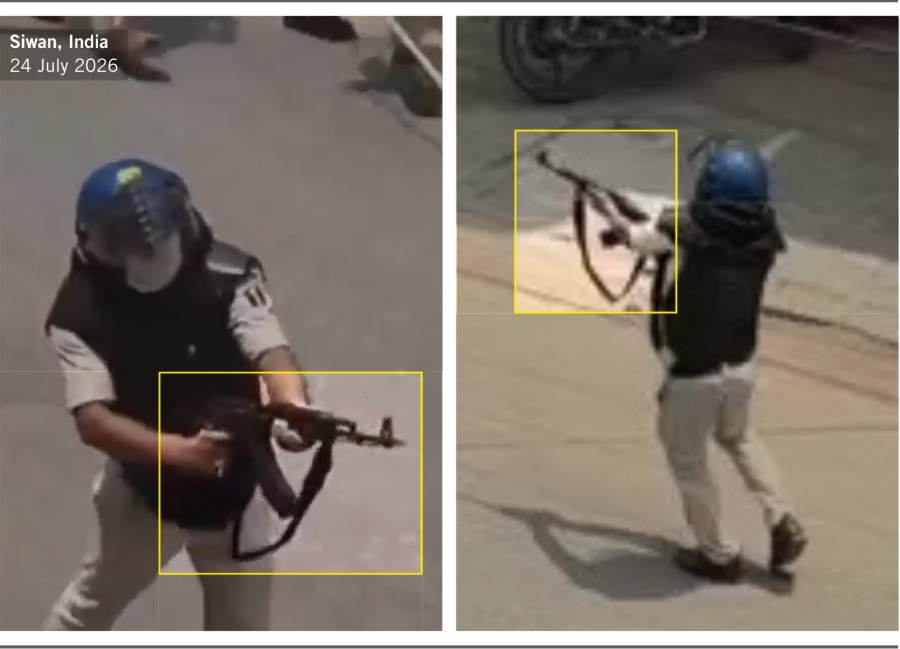
The investigation, released on August 26, draws on witness testimony as well as video and photographic material examined and verified by Amnesty International’s Evidence Lab. According to the organisation, its findings show the use of pellet-firing shotguns, tear gas launchers and grenades, batons, electric shock devices and firearms against protesters between July 20 and July 24 in Delhi and Siwan, Bihar. Amnesty says the manner in which these weapons were deployed breached international human rights standards as well as domestic policing guidelines.

The findings directly challenge the Delhi Police’s public account of the crackdown. Delhi Police had denied allegations of disproportionate force and described its handling of the protest as “professional”, including before the Supreme Court. Amnesty, however, says the evidence it verified contradicts that version of events.

For Amnesty International India Chair Aakar Patel, the episode represents something more serious than a conventional crowd-control operation. He described the authorities’ response as beginning with restrictions on communication, movement and assembly before escalating into what he called unnecessary or excessive force against peaceful protesters, including children. The organisation has characterised the response as “state-sanctioned violence masked as crowd control” and has pointed to the absence of accountability a month later as evidence of continuing impunity.

Evidence of pellet firing

[caption id="" align="alignnone" width="1200"]CRPF 'verifying' reports of pellet guns used against protesters in Delhi: official - The Hindu Image: The Hindu[/caption]

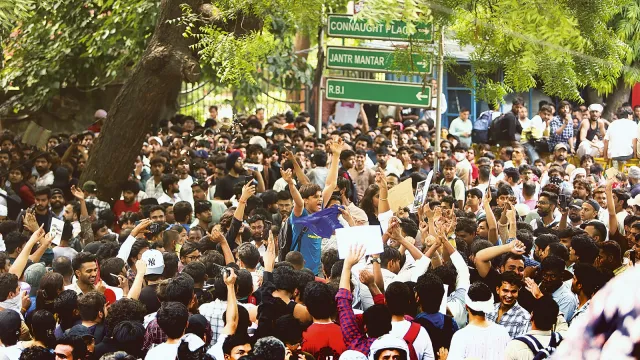
One of the most serious findings concerns the use of shotguns capable of firing pellet ammunition. Amnesty’s Evidence Lab verified 17 videos filmed in central Delhi on July 20, covering areas around Jantar Mantar, Sansad Marg and Connaught Place, as well as two videos from Siwan in Bihar recorded on July 24. The Delhi footage was found to show personnel belonging to the Delhi Police, Rapid Action Force (RAF) and Central Reserve Police Force (CRPF).

Two videos verified by Amnesty show an RAF officer firing a shotgun into a crowd at the Connaught Place–Sansad Marg intersection. Two other verified videos show protesters near the same location with injuries consistent with birdshot wounds. Amnesty also verified CCTV footage showing two RAF officers carrying shotguns elsewhere in the area.

The significance of the finding lies in the nature of the ammunition. Birdshot consists of multiple small metal pellets and is inherently inaccurate, Amnesty says, creating a serious risk not only to the intended target but also to bystanders. The organisation states that birdshot has been associated with deaths and blindness in other contexts and argues that it has no legitimate place in law enforcement.

A protester interviewed by Amnesty described being struck from behind while attempting to flee. According to the testimony, the individual sustained approximately 25 to 30 pellet wounds and required hospital treatment. The protester said doctors confirmed that the injuries were caused by pellets and that the incident had left extensive scarring.

The alleged absence of a warning is also significant. India’s Bureau for Police Research and Development guidelines recommend that security forces warn protesters before deploying less-lethal or lethal force. International standards similarly require law-enforcement agencies to exhaust non-violent means wherever possible and issue a clear warning before resorting to force when circumstances permit. Amnesty says the protester it interviewed reported receiving no warning before the pellet firing.

The allegations had previously been rejected by Delhi Police, which described reports of pellet injuries as “Fake News” and called them “completely false and misleading”. The police also warned that legal action could be taken against those allegedly spreading rumours.

However, the Amnesty investigation comes alongside other reporting cited in the organisation’s findings. The Hindu reported that an RAF unit fired two ballistic cartridges loaded with plastic pellets on the evening of July 20 on the orders of a Deputy Commissioner of Police. An internal CRPF inquiry reportedly found that RAF personnel had fired at least seven rounds containing metal pellets. An RTI response cited by The Hindu indicated that at least ten people were injured by pellets during the protests.

Tear gas used against protesters

[caption id="" align="alignnone" width="927"] Image: Amnesty[/caption]

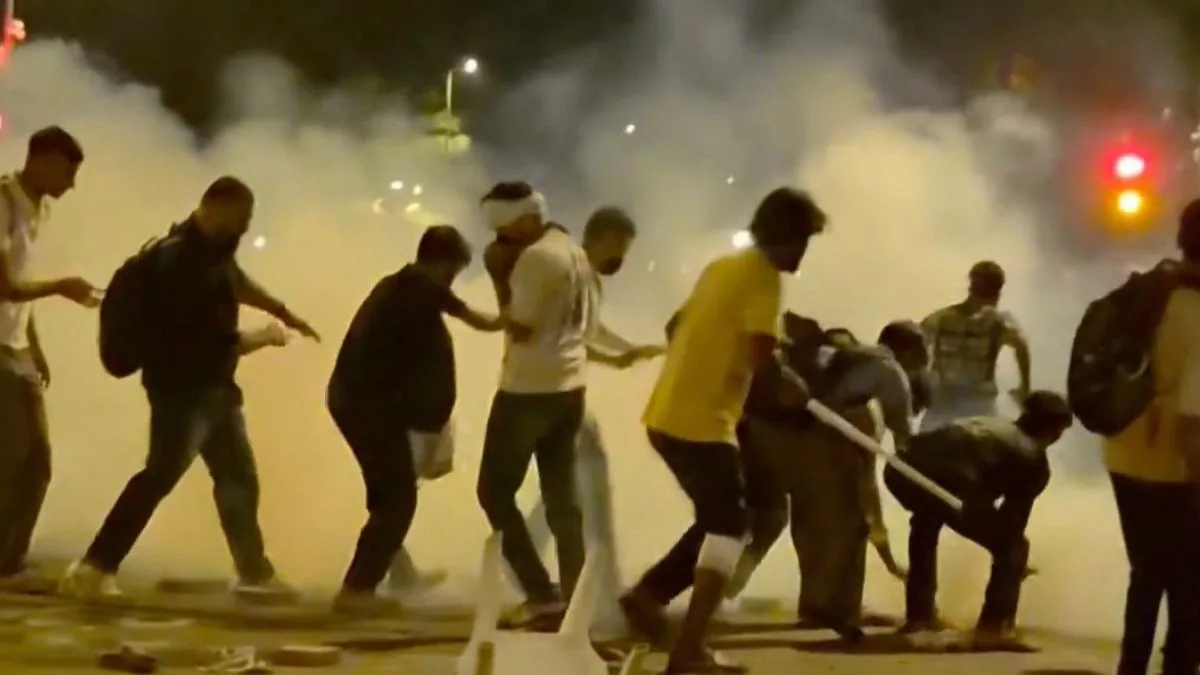
Amnesty’s investigation also raises concerns about how tear gas was deployed. One verified video shows a tear gas grenade landing close to a group of protesters and exploding with a heavy blast. Amnesty says another verified sequence showed the grenade exploding immediately after landing near protesters, with one person attempting to escape before being thrown to the ground.

Eyewitnesses told Amnesty that tear gas grenades were fired directly towards protesters rather than being launched at an angle above their heads. The organisation says this is inconsistent with UN guidance on less-lethal weapons. More fundamentally, Amnesty argues that the use of tear gas should be restricted to situations involving widespread and serious violence. While acknowledging that there were isolated incidents of protesters throwing stones, it says the available evidence does not indicate violence on a scale that would meet that threshold.

This distinction is crucial. Crowd-control powers are not unlimited simply because a protest becomes difficult to manage. The question is whether the force used is necessary and proportionate to the threat actually posed. Amnesty’s findings suggest that, in several instances, the authorities crossed that line.

Lathis, including against peaceful protesters

Teargas and lathi-charges as CJP protesters storm into central Delhi, Abhijeet Dipke detained

The investigation further documents what Amnesty describes as frequent misuse of long, flexible batons, or lathis. The organisation verified eight videos showing Delhi Police and RAF personnel striking protesters, including a young boy who, according to Amnesty, offered no provocation or resistance. In some instances, officers allegedly struck people indiscriminately across different parts of their bodies. One verified video shows a man who had been knocked to the ground being repeatedly struck while he was unable to move or pose an apparent threat.

Amnesty notes that the UN Special Rapporteur on Torture has described such long flexible batons as inherently cruel, inhuman or degrading because they can deliver greater kinetic force than conventional batons, increasing the risk of serious injury. The investigation also identifies another accountability concern: the presence of plain-clothes men participating in beatings.

In at least two verified videos, men in plain clothes—including some wearing black helmets marked “Delhi Police”—are seen beating protesters with lathis. Uniformed officers appear to escort them towards the crowd but do not intervene, according to Amnesty. The organisation also points to the apparent absence of visible identification such as name tags or badge numbers, which it says violates the principle that law-enforcement officials must be identifiable during encounters involving the use of force.

Electric shock weapons under scrutiny

Amnesty also verified a video showing an RAF officer using an electric shock baton against a peaceful protester. The organisation argues that direct-contact electric shock devices cause severe pain without necessarily incapacitating a person and that there are less harmful alternatives available to law enforcement. Amnesty, together with the UN Special Rapporteur on Torture, has called for their complete prohibition because of the risks of severe suffering, psychological harm, lasting disability and, in cases of prolonged use, death.

The finding therefore adds another layer to the concerns raised by the report: the issue is not simply the quantity of force used, but the choice of weapons and methods deployed against people participating in an assembly.

An assault rifle in Siwan

[caption id="attachment_49008" align="alignnone" width="900"] Image: Amnesty[/caption]

Perhaps the most alarming footage examined by Amnesty comes not from Delhi but from Siwan, Bihar. Two videos filmed on July 24 and verified by Amnesty show a state police officer firing an AK-type assault rifle towards protesters. Amnesty notes that such firearms are designed to kill and, under international standards governing assemblies, may only be used where there is an imminent threat of death or serious injury to a specific individual and only as an absolute last resort. The organisation says it found no evidence that such a threat existed in the incident examined.

The report says authorities have made no public commitment to investigate or prosecute officers involved in the alleged use of firearms, birdshot, tear gas, lathis and electric shock weapons. Amnesty is calling for a prompt, impartial and effective investigation, with the findings made public. It has specifically demanded an immediate end to the deployment of birdshot ammunition and direct-contact electric shock devices.

The crackdown began before the first baton was raised

The Amnesty investigation also places the use of force within the wider restrictions imposed on the “Chalo Sansad” march. Authorities denied permission for the march, imposed an internet shutdown around the proposed protest areas, prohibited gatherings of more than five people, closed several Delhi Metro stations and erected barricades across central Delhi.

Amnesty argues that these measures themselves raise serious freedom-of-assembly concerns. Under international human rights law, peaceful assemblies are not supposed to depend on prior permission. Where notification requirements exist, their purpose should be to allow authorities to facilitate an assembly rather than provide a mechanism for restricting it. The organisation further argues that the prohibitory orders effectively amounted to a blanket ban on the march and failed the requirements of legality, necessity and proportionality. It reaches a similar conclusion regarding the blanket internet shutdown imposed around the protest.

This is an important aspect of Amnesty’s findings. The report does not examine the July 20 violence simply as an isolated confrontation between protesters and police. It places the physical use of force within a broader sequence of restrictions—communication blackouts, movement restrictions, barricading, transport disruption and prohibitory orders—that had already narrowed the space for protest.

More than 400 injured

The scale of the confrontation was substantial. According to Delhi Police, more than 400 people, including police personnel and protesters, were injured. Amnesty also notes that at least three people were injured in Siwan, including a bystander who was shot and sustained a bullet wound to the neck. The report's findings therefore raise questions extending beyond individual incidents captured on camera. If hundreds were injured during the police response, and if independently verified footage shows the deployment of weapons in circumstances Amnesty considers unlawful, the central question becomes one of institutional accountability: who authorised the force, who carried it out, who monitored it, and who is responsible for investigating it? A month after the events, Amnesty says there has been no public commitment from the authorities to investigate or prosecute officers involved.

Amnesty places the July events against the longer history of pellet-gun use by Indian authorities. The organisation has previously documented extensive injuries, including blindness and deaths, linked to the use of birdshot-loaded shotguns for crowd control in Jammu and Kashmir. A committee established by the Ministry of Home Affairs in 2016 to consider alternatives recommended restricting the use of such weapons to the “rarest of rare cases”, although it did not recommend a complete prohibition.

In 2018, the UN Office of the High Commissioner for Human Rights called on India to end the use of pellet-firing shotguns for crowd control in Jammu and Kashmir. A petition seeking to decommission the use of pellet-firing shotguns by law-enforcement agencies for policing assemblies was also filed before the Supreme Court in July 2026. The Delhi allegations therefore revive a longstanding question about whether weapons that have caused severe and sometimes permanent injuries in crowd-control situations should be used at all.

From “crowd control” to accountability

The central thrust of Amnesty International’s investigation is ultimately about the limits of state power. The State unquestionably has a responsibility to protect people, maintain public order and respond to violence. But policing a protest does not give authorities an unrestricted licence to use force. International standards require force to be lawful, necessary and proportionate, with lethal force reserved for exceptional circumstances involving an imminent threat to life or serious injury.

Amnesty’s evidence raises questions on each of those fronts. Its investigation alleges pellet firing into crowds, tear gas deployed directly at protesters, repeated baton strikes against people who were not resisting, the use of an electric shock device against a peaceful protester and the firing of an assault rifle in Siwan. It also documents restrictions on communication and assembly before and during the protest.

The significance of the report lies not merely in its catalogue of weapons. It is the combination of restriction, force and apparent absence of accountability that makes the findings particularly troubling. The Delhi Police has maintained that its handling of the protest was professional. Amnesty’s investigation reaches a sharply different conclusion, backed by 19 videos it says its Evidence Lab verified across Delhi and Siwan, alongside witness testimony and photographic evidence.

The complete report may be viewed here.


Related:

From the violence of 2024 to the Bakri Eid tensions of 2026, a fact-finding report examines Mira Road’s deepening communal fault lines

Bihar: Not just Delhi, Patna, Siwan too saw brute police violence against demonstrating students: PUCL

Inside the SSP’s Office: Allegations of beatings, torture & police impunity against farmer leaders in Meerut, UP

‘Wherever You Go, We are watching’: Second threat letter to Kashmiri Pandits


Forced pregnancy tests for Adivasi women students in Maharashtra’s hostels, Rahul Gandhi registers strong protest

“I was shocked to learn that female students returning after an extended absence must undergo pregnancy tests and a range of other medical tests to prove their ‘fitness’,” Rahul Gandhi today wrote in a letter to Chief Minister Devendra Fadnavis, strongly condemning the practice and calling it a humiliation that presumes them guilty and attacks their humanity. Gandhi, the Leader of the Opposition in the Lok Sabha also released the communication on social media. He urged the Chief Minister to personally meet the protesting students, hear their grievances, and resolve the issues immediately. The six students on hunger strike are Shweta Girnak, 26; Nikita Mechkar, 22; Sharad Thokal, 26; Vijay Bhandble, 25; Rahul Dhanwe, 26; and Rajaram Padvi, 20. He urged the Chief Minister to personally meet the protesting students, hear their grievances, and resolve the issues immediately.

In the letter, Rahul Gandhi said that tribal students across the state had been protesting for more than ten days. “Many Adivasi students come from remote villages and depend on government hostels to study in the cities. A new rule bars anyone over 30 from these hostels, excluding many who are still completing their studies or preparing for exams,” he stated. He added that hostels for these students are unsafe as they reportedly lack food, sanitation and medical care. Incidents of snakebites have also been reported. “I was shocked to learn that female students returning after an extended absence must undergo pregnancy tests and a range of other medical tests, to prove their ‘fitness’. It is a humiliation that presumes them guilty until they prove otherwise. This rule is an attack on their dignity and their humanity,” he said.

Adivasi students across Maharashtra started their protest after the BJP-led state government introduced a government resolution (GR) on Aug 4, which fixed the age limit for staying in hostels at 26. However, after the decision sparked protests, the GR was revised on August 14 and the age limit was increased to 30. The students, however, are demanding complete withdrawal of the GR, besides seeking better facilities at hostels run by the Tribal Development Department across the state. They are also demanding immediate recruitment of aspirants from tribal community for 12,500 vacant posts which they claim have been stuck for a long time.

In his letter to Mr. Fadnavis, Mr. Gandhi followed up on interactions with students in Pune during the Chhatron ki Gunj (echoes of students) programme last Saturday. He said students from across Maharashtra had told him about hostel rules that “strip them of their dignity and shut off their path to education”.

Mr. Gandhi expressed particular concern over facilities for women, saying female students returning after an extended absence were required to undergo pregnancy tests and other medical examinations to establish their “fitness”. “It is a humiliation that presumes them guilty until they prove otherwise,” he said, describing the requirement as an “attack on their dignity and their humanity”. Mr. Gandhi also flagged a rule barring those above 30 from hostel accommodation, saying it excluded many students still completing their studies or preparing for examinations.

He also alleged that hostels were unsafe and often lacked food, sanitation and medical care, with students suffering injuries and deaths, including from snake bites.

“These students are not asking for charity. They are demanding what is theirs by right,” Mr. Gandhi said, urging Mr. Fadnavis to hear the students’ concerns and resolve them immediately.

Earlier in the day, the party had sought a special committee to probe the deaths of tribal children allegedly due to malnutrition in Madhya Pradesh and of tribal girls following snakebite in Maharashtra and demanded action against officials found responsible.

Adivasi Congress chief Vikrant Bhuria also called for a safety audit of tribal hostels, citing alleged lapses in facilities in the two States. Addressing a press conference here, Mr. Bhuria claimed that 22 children from the Baiga tribal community had died of malnutrition and related diseases in the Balaghat district of Madhya Pradesh. He alleged that a nutritional meal delivered to households had been discontinued for six months and that the nearest primary health centre was 20 km away. Vaccination coverage in the area was also below 80%, he claimed. “I had asked in the Madhya Pradesh Legislative Assembly how much budget was allocated for preventing malnutrition in the State’s tribal blocks and projects from 2020 to 2025, and how much of it was spent. The response was extremely concerning. The government said malnourished children are given a nutritional meal worth only ₹12 per day,” he said.

On Maharashtra, Bhuria alleged that more than 70 girls at a tribal hostel in Gadchiroli were made to sleep on the floor in a single room. Six girls were hospitalised following a snakebite incident, of whom three died, he claimed.

Mr. Bhuria said students protesting in Nashik were continuing their hunger strike, demanding better facilities at tribal hostels. He sought a probe into the Balaghat deaths and action against officials found responsible.

Related:

Bihar: Not just Delhi, Patna, Siwan too saw brute police violence against demonstrating students: PUCL

Maharashtra: After backlash, govt. moves to withdraw FIRs against student protesters but questions remain

Youth Uprising: A protest, a brute crackdown, a continuing countrywide response

Mumbai stands with students, but the state pushes back


After NEET protests ended, the battle moved online: Women protesters face threats, doxing and criminalisation

The NEET-UG 2026 protests may have formally ended after the resignation of Union Education Minister Dharmendra Pradhan and assurances from the government on examination reforms, but the conflict surrounding the movement did not disappear. Instead, the focus shifted from the original demand for accountability over the alleged paper leak to the protesters themselves — particularly young women who became visible faces of the agitation.

In the days after the Cockroach Janata Party (CJP)-led protests concluded, several women protesters alleged that they became targets of coordinated online harassment, rape threats, doxing campaigns, morphed images, character attacks and demands for their arrest. What began as a debate over slogans raised during demonstrations transformed into a larger controversy over whether women participating in public dissent were being punished not only for their political expression but also for refusing traditional expectations of silence and conformity.

The aftermath of the protests saw several women participants alleging that their visibility as protesters made them targets of coordinated online attacks, with personal information being circulated, threats issued and attempts made to undermine their credibility and character.  The developments that followed also brought several legal questions before the Supreme Court, with petitions challenging alleged police excesses during the protests, seeking clarity on the withdrawal of FIRs against students, raising concerns over surveillance practices and demanding accountability for the use of force against demonstrators.

Detailed reports on the withdrawal of FIRs may be read here, here and here.

The protests that triggered a national confrontation

The NEET-UG 2026 protests began after allegations of a question paper leak and irregularities in the medical entrance examination created widespread anger among students. The movement, initially amplified through social media under the banner of the satirical Cockroach Janata Party (CJP), eventually grew into a nationwide student mobilisation.

The protests gained momentum after three student activists associated with the All India Students’ Association (AISA), namely Neha, Manish and Aameen and activist Sonam Wangchuk joined the agitation and observed a prolonged hunger strike at Delhi’s Jantar Mantar. Student organisations and youth groups demanded accountability, reforms in examination systems and action against those responsible for compromising the integrity of competitive examinations.

The movement reached its peak during the July 20 "Chalo Sansad" march, when clashes broke out between protesters and police in New Delhi. Student groups and civil liberties advocates alleged that security forces responded with excessive force, including the use of tear gas, pellet guns and repeated baton charges to disperse demonstrators. Petitioners before the Supreme Court alleged that several students suffered pellet injuries, while videos circulating on social media appeared to show protesters with bleeding head wounds allegedly caused by lathi blows. Protesters also alleged that some batons used during the operation had metal nails or studs attached, an allegation that has since been raised before the Supreme Court and is part of the ongoing proceedings. Similar allegations emerged from Bihar, where student activists claimed that police resorted to firing during demonstrations. One incident in Siwan drew particular attention after a police constable allegedly fired an AK-47 rifle towards protesters; the constable was subsequently suspended, although protesters have continued to demand accountability from senior officers. Police authorities have maintained that force was used only after demonstrators attempted to breach security arrangements and denied allegations of unlawful or excessive action.

Detailed reports may be read here, here, here and here.

The agitation eventually concluded after the Union government accepted several key demands, including the resignation of Education Minister Dharmendra Pradhan on July 25. The government also announced that criminal cases registered against many student protesters during the demonstrations would be reviewed, with FIRs against students who had not been accused of serious acts of violence proposed to be withdrawn. However, the selective withdrawal of cases became another point of contention, with petitioners arguing that the criminal process had been used to deter participation in the protests and demanding greater transparency and accountability in the registration and withdrawal of FIRs.

Meanwhile, the end of the protest did not end the controversy. Instead, a new battle emerged — over the treatment of protesters after the demonstrations.

Women protesters become the centre of backlash

One of the most striking features of the aftermath was the disproportionate targeting of women who had participated in the protests. Several women who became recognisable faces of the movement alleged that they were subjected to misogynistic attacks, including rape threats, sexualised comments, fabricated allegations and attempts to publicly shame them.

A report by ThePrint noted that women protesters across Delhi, Mumbai and Kolkata became targets of social media campaigns after the protests ended. Images of women were allegedly cropped, altered or circulated with calls to identify them and take action against them. The report highlighted that although protesters of different genders participated in raising slogans during demonstrations, women were specifically singled out afterwards.

The pattern, activists argued, reflected a familiar method of discrediting women in public movements — shifting attention from their political arguments to their appearance, morality, personal lives and character. Women protesters said that rather than addressing the issues raised by the movement, online campaigns focused on portraying them as irresponsible, immoral or deserving of punishment.

Rhiya Ahir: From protest symbol to target of online attacks

One of the most visible examples was Rhiya Ahir, a Mumbai-based actor and model whose image of standing in front of a police vehicle carrying detained protesters went viral during the demonstrations. The photograph turned her into one of the recognisable faces of the movement. However, according to Rhiya, the public attention soon transformed into online abuse.

Speaking to ANI, as reported by LiveMint, Rhiya said she approached the Maharashtra Police cyber cell after allegedly facing harassment and defamatory content online. She stated that while criticism was part of democratic expression, attacks targeting her dignity and personal reputation crossed the line.

Everyone has the right to express their opinion, but no one has the right to degrade someone, malign their reputation, attack their dignity publicly, or make statements suggesting that a person does not have the right to live,” she said.

Rhiya also clarified that the movement was not organised for any political party, religion or individual but was about issues affecting students.

A detailed report by ThePrint described how women protesters became targets of online campaigns involving alleged fake images, sexualised misinformation and calls for police action. The report quoted Rhiya alleging that fabricated images of her were circulated along with false claims about her personal life and profession. She argued that when critics could not challenge the substance of the protest, they shifted towards attacking the character of women participants.

“If you cannot attack the cause, attack the character”

The backlash against women protesters was described by many activists as part of a broader pattern seen during previous movements, including the protests against the Citizenship Amendment Act and the farmers’ agitation. Alt News co-founder Mohammed Zubair, speaking to ThePrint, pointed out that similar tactics had been used earlier — including spreading misleading videos, manipulated images and personal attacks to delegitimise protesters.

The focus on women, activists argued, was not accidental. Women participating in political protests often face a different form of scrutiny. Their clothing, language, relationships and personal choices become subjects of public debate in ways that male protesters frequently do not experience.

A protester quoted by ThePrint said: “Patriarchy becomes a rather perfect tool when it comes to attacking women, because if you cannot attack the cause, you attack the character.”

This raised a larger question: whether women’s participation in democratic protest continues to be judged through expectations of “acceptable” behaviour rather than constitutional rights.

The apology controversy: A minor protester caught between forgiveness and criminal action

The moral policing and attacks on women for using abusive slogans against Prime Minister Narendra Modi further intensified the backlash against women protesters. On July 31, Prime Minister Modi posted a video message saying he had forgiven students who had used abusive language against him during the protests. He described them as “misled children” and said the focus should be on guiding them rather than punishing them.

The Prime Minister's remarks also betrayed a deeply paternalistic view of women's place in political protest. Declaring that he could forgive youngsters for abusing him, Narendra Modi nevertheless singled out women, saying it was a "culture shock" that they had used abusive language. The outrage, then, was not directed at the abuse itself but at the fact that women had dared to express anger in a manner that defied conventional expectations of femininity. Such framing reduces women protesters to custodians of culture, holding them to standards of civility and respectability that are rarely imposed on men. Rather than confronting the grievances that drove thousands of students to the streets, the remarks shifted the conversation to whether women had behaved as society expects them to. That distinction is not incidental—it reflects the persistence of gendered expectations in India's political discourse, where women are often judged less for what they demand than for how they choose to demand it. Predictably, according to The News Minute, several women protesters said that online abuse against them continued despite the Prime Minister’s message.

The case of the 15-year-old protester who was accused of using abusive language against Prime Minister Narendra Modi became one of the most distasteful examples. During the protest, a video surfaced showing the teenager at the protest site shouting and repeating vulgar profanities directed at PM Modi while expressing her frustration. Once it went viral, the video took a life of its own.

A Zero FIR against her was initially registered in Noida and later transferred to Delhi. The allegations invoked provisions of the Bharatiya Nyaya Sanhita (BNS), including sections relating to intentional insult, statements allegedly causing public mischief and defamation.

Even after there came a video of the teenager apologising publicly went viral after Prime Minister Modi’s remarks urging society to forgive young protesters. In the video, the girl expressed regret for her comments, said she had been influenced by the atmosphere around her and described the incident as her “first and last mistake”.

Only a 15-year-old minor girl, she said that she continued receiving rape threats and sexually explicit messages from unknown accounts and phone numbers. The teenager told IANS that people threatened her with rape and continued targeting her even after her apology. She also alleged that police continued searching for her despite the apology. However, the controversy did not end with her apology.

According to The News Minute, the teenager alleged that she continued receiving rape threats and abusive messages despite publicly apologising. She said unknown accounts sent sexually explicit material and threatened violence against her. As per the report of The Print, the child had to stop going to school, and had to shift out of her house along with her single mother.

The episode highlighted a contradiction at the centre of the debate: while public discussions focused heavily on the language used by protesters, there was comparatively less attention on the gendered abuse directed towards young women who participated in the movement.

On August 5, Hindustan Times reported that the complainant in the case against the teenager withdrew the complaint, stating that she no longer wished to pursue the matter after the Prime Minister had forgiven the protesters. Lawyer Smriti Singh, who had filed the complaint, said that the FIR was initially registered against multiple girls and that she decided not to continue the matter.

When gender meets religion

Beyond the cases involving slogans and online criticism, several women activists alleged that their participation itself had triggered police scrutiny. One such case involved JNU Students’ Union leader Danish Ali.

According to Maktoob Media, Danish alleged that Madhya Pradesh Police visited her family home after her participation in the NEET protests and questioned her relatives despite no FIR being registered against her. She said police contacted her father and advised him to ask her to focus on studies instead of activism. Danish alleged that she was singled out because of her Muslim identity.

Coming from a Muslim community, with the peak Islamophobia in the country, my family is concerned,” she told Maktoob. She questioned why police action was directed towards her when several other activists had participated in the same protest.

A similar concern was raised by Amreen Shaikh, an organiser of the NEET protest in Goa. According to Maktoob Media, Shaikh was summoned by Goa Police for questioning after helping organise a demonstration that had received official permission. She alleged that during questioning, police asked whether she would take responsibility if a “bomb blast” occurred during the protest.

She said officers also questioned her about her father, his business and foreign travel history. Shaikh said she struggled to understand why questions unrelated to the education protest were raised. She alleged that her identity as a Muslim woman had contributed to the scrutiny she faced.

Although she was not named as an accused, she said the police action and online harassment caused significant mental distress. The FIRs associated with the protest invoked provisions of the Bharatiya Nyaya Sanhita relating to unlawful assembly and related offences.

Vismaya Mohanlal and dissent

The backlash against protesters also extended to celebrities and public figures who expressed support for student demonstrators. Actor Vismaya Mohanlal, daughter of Malayalam superstar Mohanlal, faced online criticism after expressing support for students protesting over the NEET paper leak. According to Indulge Express, Vismaya responded to criticism by saying she stood by her views and believed democracy required citizens to question those in power.

She stated: “We should always be allowed to question and be heard. We should always have dialogue instead of force, and I don't think your politics should ever supersede your humanity.”

She clarified that her position was not aligned with any political party and that her concern was based on humanitarian principles. Her comments triggered online backlash, with some social media users calling for a boycott of her debut film. Filmmaker Major Ravi defended her position, saying her comments reflected concern for students rather than political affiliation.

Shradha Singh: Online misogyny after becoming a face of the movement

Another woman who became a target after the protests was content creator Shradha Singh. According to The News Minute, Singh’s seven-second Instagram video recorded alongside Rapid Action Force personnel became a subject of controversy after it was amplified by television channels and social media accounts.

She alleged that she was invited to participate in a television discussion under the impression that she would be allowed to explain her position, but instead found herself in a confrontational debate where she faced criticism. Speaking to BBC Hindi, as reported by TNM, Singh said she felt humiliated during the programme but chose not to react emotionally because millions of people were watching. She later spoke about the sexualised abuse directed at her online.

She said comments under her social media posts included degrading remarks targeting her dignity and character. Singh contrasted this experience with her time at the protest site, saying she had stood among hundreds of men without facing harassment but had experienced severe abuse from people online. She appealed for greater attention towards misogynistic online attacks against women protesters.

Gendered backlash: When women become the issue

If the protests challenged the government's handling of the NEET crisis, the backlash exposed the deeply gendered nature of political dissent in India. Women who stood at the forefront of the movement were not merely criticised for their politics—they were punished for their visibility. Instead of engaging with their demands, detractors sought to discredit them through misogyny. Their clothing was dissected, their professions questioned, their morality policed, sexual rumours manufactured, morphed images circulated, rape threats issued and calls made for their arrest. The objective was unmistakable: to shift the conversation from what women were saying to whether they deserved to be heard at all.

This is a familiar script in Indian protest politics. When a movement proves difficult to defeat on its merits, its women are turned into the battleground. Their political agency is recast as moral transgression; their dissent reduced to questions of character and respectability. The message is clear—women may participate in public life, but only so long as they remain within the boundaries of acceptable femininity. The moment they speak too loudly, lead too visibly or challenge authority too forcefully, they cease to be citizens exercising constitutional rights and become subjects of public moral scrutiny.

The outrage over abusive slogans exemplified this selective moralism. For weeks, public debate fixated on the language used by a handful of protesters, while allegations of excessive police force—including pellet guns fired at students, lathi blows to the heads of demonstrators, and reports of live ammunition being used against protesters in Bihar—struggled to command comparable attention. The disproportionate focus on slogans effectively displaced the central questions the movement had raised: whether the state had responded lawfully and proportionately, and whether those responsible for violence against students would ever be held accountable.

The Prime Minister's response only reinforced that imbalance. While PM Modi declared that he could forgive youngsters for abusing him, he singled out women, saying it was a "culture shock" that women had used abusive language. The implication was difficult to ignore. Abuse itself was not the singular concern; it became uniquely shocking when it came from women. By holding women protesters to a higher standard of civility than men, the remarks echoed a deeply paternalistic expectation that women must remain composed, respectful and restrained—even when confronting injustice. In doing so, the country's highest political office did not simply comment on the protests; it reinforced the patriarchal logic that women in politics are judged less by the legitimacy of their demands than by whether they conform to society's expectations of femininity. In the end, the conduct of women became a bigger controversy than the conduct of the state.

From online abuse to institutional response: Legal aid emerges as protesters seek protection

As allegations of harassment, intimidation and threats against student protesters continued to emerge, political organisations and civil society groups began creating support mechanisms for those facing legal and online challenges.

The Indian Youth Congress (IYC)v launched a nationwide legal helpline under its “Chhatron Ki Goonj” campaign to assist students who claimed they were facing threats, intimidation and online abuse following their participation in the NEET protests. According to The New Indian Express, the helpline was created to receive complaints from students alleging harassment connected with their participation in demonstrations. The organisation said complaints would be reviewed and that legal and organisational assistance would be provided wherever required.

IYC president Uday Bhanu Chib said young Indians had a constitutional right to question the government and raise their voices without fear. The organisation specifically referred to cases involving women protesters, including Rhiya Yadav and Shradha Singh, who had spoken publicly about online abuse. The launch of the helpline highlighted a growing concern: that the consequences of participating in a public protest were extending beyond the protest sites into private lives, families and digital spaces.

A broader crackdown narrative: arrests, FIRs and continuing protests

While the Jantar Mantar protest ended after assurances from the government, several state-level demonstrations continued. In Bihar, students returned to the streets demanding the release of protesters arrested during earlier demonstrations.

According to The Times of India, hundreds of students and youth activists gathered in Patna demanding that the government honour its promise to withdraw cases and release detained students. The protesters alleged that many students had not returned home despite government assurances.

They demanded:

  • a verified list of released and detained protesters;
  • withdrawal of criminal cases;
  • accountability for alleged police excesses.

The demonstrations were dispersed by police using water cannons after protesters attempted to march towards the Chief Minister’s residence. The police maintained that action was taken only after protesters attempted to enter restricted areas.

Supreme Court intervenes: FIRs, surveillance and police action under scrutiny

The aftermath of the NEET protests reached the Supreme Court, where multiple petitions challenged alleged police excesses during the July 20 “Chalo Sansad” march and subsequent demonstrations.

The petitions raised serious allegations, including:

  • use of excessive force against protesters;
  • alleged use of pellet guns;
  • baton charges;
  • injuries suffered by students;
  • alleged assault of journalists and lawyers;
  • detention of minors;
  • surveillance and collection of protesters’ personal data.

The Supreme Court bench comprising Chief Justice of India Surya Kant, Justice Joymalya Bagchi and Justice V Mohana clarified that States were free to withdraw FIRs against student protesters if permitted under law. The clarification came after petitioners pointed out that the Court’s earlier order allowing investigations to continue could affect the government’s commitment to withdraw cases against protesters.

The Court also clarified that the phrase “criminal antecedents” used in its earlier order would refer only to serious and heinous offences, after concerns were raised that students with minor cases could face difficulties. According to LiveLaw, Solicitor General Tushar Mehta informed the Court that the government remained committed to addressing cases against student protesters but that criminal law procedures did not provide a simple mechanism for “withdrawing FIRs”.

Possible legal routes included filing closure reports, seeking withdrawal of prosecution or approaching courts for quashing proceedings. Senior Advocate Vrinda Grover argued that withdrawing cases individually would be complicated, particularly where FIRs involved large numbers of unidentified persons. One Patna FIR, she pointed out, named thousands of unidentified individuals, raising concerns that such broad FIRs could potentially be used against students.

The Supreme Court also examined allegations of excessive police action during the protests. Petitioners alleged that security forces used disproportionate force against demonstrators, including pellet guns and other crowd-control measures.

Senior Advocate Gopal Sankaranarayanan argued that accountability must extend to senior officials responsible for authorising police action. He urged the Court to examine how security forces were permitted to use such methods against civilian protesters.

The petitioners also alleged the use of:

  • pellet guns;
  • shock batons;
  • sticks with nails;
  • force against women protesters;
  • detention of minors.

The Court directed authorities to preserve relevant evidence, including:

  • CCTV footage;
  • drone recordings;
  • body camera footage;
  • videography;
  • wireless communication records;
  • PCR logs.

The Court also directed authorities not to disclose protesters’ personal information and digital data while the matter remained under consideration. Chief Justice Surya Kant observed that police officers responsible for excessive force should not receive undue protection. At the same time, the Court noted that genuine criminal acts committed during protests could not be ignored merely because they occurred in the context of demonstrations. The matter was listed for further hearing on August 18.

Detailed report on the proceedings before the Supreme Court may be read here.

Tamil Nadu keeps the anti-NEET movement alive

Although the nationwide agitation lost momentum after the resignation of the Union Education Minister, resistance to NEET remained alive in Tamil Nadu, where opposition to the examination has long been rooted in questions of social justice and federalism rather than administrative reform alone. As reported by The News Minute, Members of the Ban NEET Movement under the Anti-NEET Federation launched an indefinite hunger strike in Chennai, demanding the complete abolition of the examination. Protesters argued that NEET continues to privilege students with access to costly coaching while placing first-generation learners, rural students and those from economically weaker backgrounds at a structural disadvantage. They also renewed demands for education to be shifted from the Concurrent List to the State List, contending that states should have greater autonomy over admissions and education policy. The movement once again invoked the memory of S. Anitha, whose death in 2017 transformed the anti-NEET campaign into a larger struggle against educational inequality and the centralisation of policy.

Beyond NEET: The democratic questions remain

What began as a demand for accountability over an examination leak ultimately evolved into a far broader test of India's democratic institutions. The movement forced difficult questions that remain unanswered: How far can the state go in policing dissent? When does crowd control become excessive force? Can criminal law be used to discourage political participation? Why are women who protest subjected to uniquely gendered abuse? And who is held accountable when constitutional rights are allegedly violated in the name of maintaining public order?

The legal battle is far from over. The Supreme Court's scrutiny of police action, FIRs, surveillance and the preservation of evidence signal that the questions raised by the protests have outlived the demonstrations themselves. Whether those proceedings result in meaningful accountability will shape not only the legacy of the NEET movement but also the boundaries of the right to protest in the New India.

Equally enduring is the lesson the protests offered about gender and dissent. For many women, participation in the movement meant confronting not only the coercive power of the state but also orchestrated campaigns of misogyny, intimidation and character assassination. Their experiences underscored a troubling reality: in India, women who claim political space are still expected to defend their morality before their message is heard.

The NEET protests may have ended, but the questions they raised continue to reverberate. The movement is no longer only about a competitive examination or an alleged paper leak. It has become a referendum on the state's response to dissent, the shrinking space for democratic protest, and whether young citizens can challenge authority without being met with criminal prosecution, excessive force or targeted harassment.


Related:

#STOPKILLINGUS Protest at Jantar Mantar on August 4 against GOI’s “cover-up” of Manual Scavenging deaths

The Supreme Court’s Uneasy Middle Path on Protest Policing

Law fraternity rallies behind student protesters, condemns Delhi police crackdown

Permission to Protest? Why the right to dissent needs no licence

Ken-Betwa protest exposes the cost of state-led displacement

May-June 2026: Youth Congress nationwide protests challenge education system collapse under Modi government, media gives cold shoulder?


One Death Every Few Days, Zero Accountability: Sanitation workers protest at Jantar Mantar

For more than three decades, India has had laws prohibiting manual scavenging. For nearly three years, it has had a central scheme promising the complete mechanisation of sanitation work. The Supreme Court has repeatedly declared that no human being should be made to enter a sewer or septic tank, enhanced compensation for sewer deaths, and even directed a complete ban on manual sewer cleaning in six metropolitan cities. Yet sanitation workers continue to die inside toxic pits.

On August 4, hundreds of safai karmacharis (sanitation workers), families of those who died cleaning sewers and septic tanks, Members of Parliament, students, writers and civil society groups assembled at Jantar Mantar in New Delhi under the banner of the Safai Karmachari Andolan (SKA). Their demand was strikingly simple: that Prime Minister Narendra Modi publicly acknowledge the government's failure to stop these deaths, apologise to the country, and end what they described as a continuing cycle of preventable killings.

The demonstration, organised under the slogan #STOPKILLINGUS, was not merely another protest against unsafe labour conditions. It was an indictment of a system that activists argue has normalised caste-based hazardous labour while simultaneously understating its human cost. As reported by Newsreel Asia, Protesters carried placards reading "Stop Killing Us! Stop Hiding Our Deaths!" and "PM Break Your Silence!" while submitting a memorandum accusing the Union government of concealing the true scale of sewer and septic tank deaths.

The missing dead

At the centre of the protest lies a stark dispute over numbers. According to documentation compiled by the Safai Karmachari Andolan, 593 people died while cleaning sewers and septic tanks between January 2021 and July 2026. However, the Union government's response in Parliament acknowledged only 332 deaths during roughly the same period. That leaves 261 deaths unaccounted for, according to SKA.

The memorandum submitted to the Prime Minister posed a direct question:

"How did 593 deaths become 332? Where have you hidden the remaining 261 persons who were killed?"

According to the organisation's records:

  • 2021: 47 deaths
  • 2022: 93 deaths
  • 2023: 102 deaths
  • 2024: 117 deaths
  • 2025: 121 deaths
  • January–July 2026: 113 deaths, including 15 in July alone

The trend demonstrates not improvement but escalation. SKA National Convenor Bezwada Wilson said that despite more than four decades of campaigning against manual scavenging, sanitation workers continue to be sent into sewers and septic tanks in violation of law, reported Newsreel Asia.

"If the government does not immediately stop these killings," he warned, "the community will have no option but to organise a nationwide chakka jam."

Not accidents, but illegal deaths

The language used by the movement is deliberate. The memorandum repeatedly rejects the official description of these incidents as workplace accidents. "These deaths are not accidents. They are caused by illegally employing and forcing workers to get inside septic tanks and underground sewer drains."

The organisation argues that every such death violates Articles 14, 17 and 21 of the Constitution—equality before law, abolition of untouchability and the right to life. SKA National Leader Deepthi Sukumar argued that the persistence of these deaths reflects not only administrative negligence but the continuing reality of caste discrimination. "Because those dying are Dalits, the government does not seem to care," she said, reported The Hindustan Gazette.

Rajya Sabha MP Manoj Kumar Jha described the deaths as "a matter of national shame", while CPI(ML) MP Sudhama Prasad criticised the Modi government’s “Manuvadi mindset,” accused the government of attempting to hide fatalities instead of preventing them, reported The Hindustan Gazette. Congress MP Karamveer Baudh assured protesters that the issue would be raised in Parliament.

The human cost behind the statistics

Behind every disputed statistic is a family still waiting for accountability. Forty-two-year-old Satyawati travelled to Jantar Mantar carrying memories dating back to March 20, 2009. Her brother-in-law, Ashok Kumar, worked for the Municipal Corporation of Delhi collecting garbage. "He left home for work but never returned," she recalled, reported Hindustan Times.

According to Satyawati, the family later received a phone call informing them that Ashok had been sent to clean a septic tank in Delhi's Narela and died inside it. Seventeen years later, she says, nothing has changed. Her family's story mirrors hundreds of others represented at the protest—families for whom compensation has often remained inadequate, prosecutions rare, and justice elusive.

The report by Hindustan Times also shared the story of another participant, Paleram, a 60-year-old daily wage worker from Rohini who migrated from Haryana, described entering septic tanks for nearly twenty-five years with almost no training or protective equipment. He began as a sweeper earning ₹50 a day before switching to septic tank cleaning because it paid marginally more.

"The only training I received was being told to climb down the slippery iron handles and clean," he said, reported Hindustan Times. After recently fracturing his leg while slipping inside a septic tank, he continues working because there are few alternatives. "Sometimes NGOs give us gloves. Otherwise we go inside wearing almost nothing."

These accounts expose the gap between official claims of mechanisation and the everyday realities faced by sanitation workers.

The caste system beneath the sewer

The protest repeatedly foregrounded what scholars and activists have argued for decades: manual scavenging is not merely an occupational hazard but a caste-based institution. A doctoral researcher studying caste and occupation at Ambedkar University observed that while governments celebrate cleanliness campaigns, the workers responsible for maintaining sanitation infrastructure remain among the least protected.

CPI(M) leader Brinda Karat, who joined the demonstration, remarked that sanitation workers remain invisible both in life and in death. "They are invisible when they are alive, and when they die, the government behaves as though they never existed," reported Hindustan Times.

Manoj Kumar Jha similarly argued that the overwhelming concentration of Dalits in sanitation work reflects centuries of structural exclusion rather than individual occupational choice.

NAMASTE and the mechanisation gap

India has formally attempted to abolish manual scavenging for decades. The first national legislation prohibiting manual scavenging came in 1993. It was replaced by the Prohibition of Employment as Manual Scavengers and their Rehabilitation Act, 2013, which criminalised the employment of manual scavengers, prohibited hazardous cleaning of sewers and septic tanks without adequate safeguards, and promised rehabilitation. Yet enforcement has remained weak.

No meaningful record of widespread prosecutions exists under the earlier legislation. The 2013 law itself has been criticised for leaving significant ambiguities, including failing to clearly define what constitutes adequate protective equipment and allowing hazardous sewer work under certain conditions. Government data has also remained contested.

The 2011 Census recorded more than 2.6 million dry latrines, while the Socio-Economic Caste Census identified over 180,000 households dependent on manual scavenging as a livelihood. The Safai Karmachari Andolan has consistently argued that the real number of manual scavengers exceeds one million. They have also repeatedly identified the Indian Railways as one of the country's largest employers of sanitation workers engaged in manual cleaning through contractual arrangements.

Detailed report on how employement of sanitary workers in Indian Railway tracks is a problem may be read here.

In July 2023, the Union government launched the National Action for Mechanised Sanitation Ecosystem (NAMASTE), promising to eliminate hazardous manual sewer cleaning through mechanisation. According to government announcements, the programme was allocated ₹349.73 crore. Three years later, SKA argues that sanitation work remains overwhelmingly dependent on human entry into septic tanks and sewers. The organisation therefore describes the scheme as having failed to achieve its primary objective. Its memorandum asks the government to officially acknowledge this failure and fundamentally redesign the programme.

The Supreme Court's growing frustration

On July 27, the Supreme Court sharply criticised state governments for failing to prevent sewer deaths despite repeated judicial directions. Hearing the long-pending public interest litigation filed by Dr Balram concerning manual scavenging and sewer cleaning, a Bench comprising Justices Aravind Kumar and Vipul M. Pancholi expressed serious concern over continuing fatalities.

Senior Advocate K. Parameshwar, appearing as amicus curiae, informed the Court that deaths had continued despite its landmark 2023 judgment and subsequent monitoring orders. Referring to data placed before Parliament, he submitted that 54 sewer deaths were officially recorded in 2024 and 46 deaths in 2025, with Maharashtra, Tamil Nadu, Rajasthan, Gujarat and Uttar Pradesh among the affected states.

Detailed reports on the judgments may be read here, here and here.

The Court responded by issuing show-cause notices to the Chief Secretaries of five states, asking why contempt proceedings should not be initiated for failing to comply with its earlier directions.

As reported by LiveLaw, Justice Aravind Kumar made the Court's frustration unmistakably clear: "If deaths have occurred subsequent to our orders, we are going to summon your Chief Secretaries... We are making it very clear that we are going to initiate suo motu contempt... This can't go on... We will fix the responsibility. Somewhere it has to stop."

The Bench noted that despite repeated directions issued since October 2023, including enhanced compensation of ₹30 lakh for sewer deaths and the January 2025 ban on manual sewer cleaning in six metropolitan cities, fatalities continued "in larger numbers", indicating that the Court's orders had failed to translate into administrative action.

A detailed look into the jurisprudence governing manual scavenging, researched consistently by Citizens for Justice and Peace, can be accessed here.

A demand for political accountability

The memorandum submitted by SKA asks for more than compensation. It demands:

  • A national apology from the Prime Minister.
  • Disclosure of the actual number of sewer and septic tank deaths.
  • Immediate elimination of manual entry into sewers.
  • A Parliamentary Standing Committee to investigate continuing fatalities.
  • A time-bound national plan to eliminate sewer and septic tank deaths.

The memorandum also notes that similar representations were submitted to the Prime Minister's Office in March 2025 and March 2026, yet received no response.

The memorandum to the PM is attached below:

An old practice the law still has not ended

The protest at Jantar Mantar exposed more than the continuing existence of manual scavenging. It highlighted the widening gap between constitutional guarantees, legislative promises, judicial directives and everyday governance.

Every sewer death occurring after the 2013 Act, after the launch of the NAMASTE Scheme, and after repeated Supreme Court orders raises difficult questions about implementation rather than legislative intent. When governments continue to describe these fatalities as isolated workplace accidents while workers are illegally sent into toxic pits without adequate protection, accountability shifts from individual contractors to the institutions responsible for regulation and enforcement.

For families like Satyawati's, whose wait for justice has stretched across seventeen years, the demand is no longer simply for compensation. It is for official acknowledgement that these deaths are neither inevitable nor accidental, but the foreseeable consequence of a system that continues to rely on caste-based labour despite laws enacted to abolish it. Until that acknowledgement is matched by enforcement, mechanisation and prosecution, every new sewer death will remain not only a labour rights failure but also a constitutional one.


Related:

Supreme Court bans manual scavenging in metro cities

Breaking the cruel cycle of oppression: one more judgment against manual scavenging in India

SC asks Union, state to eradicate manual scavenging completely, ensure compensation, rehabilitation and education

Manual Scavenging: Why the gov’t’s conscience is not clean about the Swachh Bharat Mission

Caste-based prison work is authoritarian, colonial said SC striking down discriminatory State Prison Manuals

Manual scavenger deaths: How effective is the law in preventing them?

Everyday Atrocity: Mapping the normalisation of violence against Dalits and Adivasis in 2025


Stop armed attacks on peaceful protesters: CJP and AIUFWP

jamia

In wake of back-to-back instances of armed men discharging their weapons on peaceful protesters, first outside Jamia Milia Islamia University (JMIU) and then at Shaheen Bagh, where a majority of the protesters are women, Citizens for Justice and Peace (CJP) and All India Union of Forest Working People (AIUFWP) have come together in solidarity with the peaceful protesters.

We reiterate that protesting peacefully is a constitutional right of every Indian irrespective of their religion, caste, gender or ethnicity. Let us not forget that Article 19 of the Constitution confers not just powers of free speech (Article 19(1) (a) and association (Article 19(1) (c) but also the right to assemble peacefully without arms (Article 19(1) (b).

However, of late, many people affiliated with right-wing supremacist organisations, including the ideological progenitors of the ruling disposition, have made a series of derogatory, hateful and inflammatory statements against these protesters. The statements are designed to incite violence against a group of people who have remained steadfastly committed to non-violence!

The attacks on the protesters, as well as the inflammatory speeches that incited these attacks, violate several serious sections of the law. Hate speech violates Section 153 (a) (b) (c) and Section 505 of the Indian Penal Code (IPC), as well as Section 295 of the Criminal Procedure Code (CRPC). These speeches and violent attacks also violate Section 307 (attempt to murder) and Section 120-B (Criminal Conspiracy) of the Indian Penal Code.

Both, CJP and AIUFWP, have been at the forefront of several peaceful movements where people have come together to demand their rights. The most notable among these was our campaign to restore Forest Rights to Adivasis and Forest Workers in line with the provisions of the Forest Rights Act 2006. This movement was led by several women human rights defenders, many of whom were incarcerated by a vengeful regime only because they peacefully protested a violation of their rights.

We therefore express solidarity with our sisters in Shaheen Bagh, the students who are holding peaceful protests in university campuses across the country and the countless activists and ordinary people who are exercising their democratic right to protest what they feel is unjust and unconstitutional.

We also urge the government to take all necessary measures to ensure that peaceful protesters are not harmed in any way. Finally, we demand that the perpetrators of hate speech and the resulting violence be dealt with to the full extent of the law. 


#STOPKILLINGUS Protest at Jantar Mantar on August 4 against GOI’s “cover-up” of Manual Scavenging deaths

The Safai Karmachari Andolan (SKA) has announced that it is organising a demonstration on Tuesday, August 4, 2026 at 3 p.m. at Jantar Mantar in New Delhi to protest against continued government apathy towards sewer and septic tank deaths across country and its attempts to fudge the actual data.

In a press release issued today, August 3, the SKA has raised the following key issues:

A staggering 593 persons have been killed in sewer and septic tanks, from January 2021 to date (July 2026) but Government has reported only 332 such deaths to the parliament. The SKA has demanded to know

  • Why the remaining 261 deaths are being concealed.
  • SKA data shows 47 deaths in 2021, 93 in 2022, 102 in 2023, 117 in 2024 and 121 sewer and septic tank deaths in 2025.
  • This year alone, 2026, in just 7 months from January to July 2026, 113 persons have been killed in sewer and septic tanks all over the country.
  • In the month of July 2026 itself, 15 persons were killed.

Strongly criticising the dismissive and arrogant attitude of the government that, the SKA alleges is “concealing figures”, the SKA also states that this attitude extends to labelling these figures of lives lost as “mere workplace accidents.” Instead of taking policy decisions outlines clearly in the 2013 law to abolish the abhorrent practice, the SKA states that “the government is only focussed on obscuring the truth.”

Hence, women, youth, workers engaged in cleaning sewer and septic tanks and families of those who were killed, will gather at Jantar Mantar on August 4, 2026 at 3 p.m. to demand that the Prime Minister should accept full responsibility for "these deaths and to constitute a Parliamentary Standing Committee inquiry into these killings. Government should present a timebound national plan for the immediate stop to sewer and septic tank deaths.”

Read Citizens for Justice   & Peace’s legal primer on the laws periodically passed to abolish this abhorrent practice –that remain grossly unimplemented—here and here. More on the efficacy of a law to ban a practice where, tragically, local government bodies remain the main practioneers/ offencers may be read here.


The Supreme Court's Uneasy Middle Path on Protest Policing

The Supreme Court's interim order of July 28 in the batch of petitions concerning police action during the nationwide student protests is, at one level, a judicial acknowledgement that allegations of police excess cannot simply be left to the ordinary investigative process. The Court recognised that the petitions disclose a prima facie case for an "independent and impartial investigation", indicated that it may constitute a Special Investigation Team (SIT) under the supervision of a retired Supreme Court judge, directed preservation of crucial electronic evidence, restrained the publication of protesters' personal information, and granted limited protection against coercive action.

Yet the order is equally notable for what it leaves untouched. While expressing sufficient doubt about the conduct of law enforcement to contemplate an independent investigation, the Court simultaneously permits the same police machinery to continue investigating protesters under the FIRs already registered. It further conditions its interim protection upon the absence of "criminal antecedents", effectively creating two classes of protesters for the purposes of constitutional relief. Read closely, the order reveals not merely judicial caution but an unresolved constitutional contradiction that lies at the heart of the litigation.

From a challenge to police violence in Delhi to a nationwide constitutional controversy

The hearing itself reflected how dramatically the litigation has expanded since the events at Delhi's Jantar Mantar on July 20. What began as petitions concerning police action in the national capital has evolved into a challenge to policing practices across multiple States. The Bench, comprising Chief Justice Surya Kant, Justice Joymalya Bagchi and Justice V. Mohana, heard petitions alleging police brutality in Delhi, Bihar, Maharashtra, Assam, Uttar Pradesh, Madhya Pradesh, West Bengal and Kerala, alongside petitions filed on behalf of injured police personnel, journalists and individual protesters. The order correspondingly issues notice not only to the Union and the Government of NCT of Delhi but also to the Chief Secretaries of the seven States where similar allegations have arisen, making it clear that any eventual investigation may extend well beyond Delhi.

The courtroom exchanges demonstrated that the litigation had also moved beyond disputes over individual incidents. As reported by LiveLaw, Senior Advocate Gopal Sankaranarayanan argued that the issue before the Court was systemic rather than episodic, referring to alleged departures from established crowd-control protocols, the deployment of plain-clothes police personnel and the need for an investigation independent of the very agencies accused of violence. Senior Advocate Shyam Divan drew attention to allegations of electronic shock batons, assaults on women protesters and threats allegedly issued by police personnel. Senior Advocate Shadan Farasat highlighted the continued detention of minors in Bihar despite the State's announcement that cases would be withdrawn, reported LiveLaw. Advocate Prashant Bhushan referred to the petition of Junaid Malik, who alleged illegal detention, harassment and police action against his family. On the other side, Solicitor General Tushar Mehta accepted that allegations concerning injuries to students required serious examination but maintained that “anti-social elements” had infiltrated the protests and that hundreds of police personnel had themselves suffered injuries.

It was against this backdrop that the Chief Justice repeatedly observed that the Court was confronted with two competing narratives, each accusing the other of serious violence. The question, therefore, was not simply whether police had used excessive force or whether protesters had attacked police personnel, but whether either version could be accepted without an investigation independent of those directly involved. That concern ultimately shaped the Court's reasoning.

The Court's recognition of a prima facie case is constitutionally significant

The order carefully records the allegations placed before the Court. It refers to the alleged use of pellet guns causing severe injuries, including the loss of eyesight of one student, the deployment of rubber bullets, electronic batons and nail-studded lathis, assaults by police personnel both in uniform and in civilian dress, and attacks on members of the media. At the same time, it records allegations that police personnel suffered serious injuries owing to stone-pelting and violence allegedly perpetrated by protesters or anti-social elements. Rather than accepting either version, the Court concludes that the material placed before it establishes a "compelling case" for an independent and impartial investigation capable of addressing both sets of allegations. This finding carries greater constitutional significance than the interim directions themselves.

Ordinarily, investigations conducted by the police are presumed to possess institutional legitimacy. Constitutional courts do not lightly transfer investigations or contemplate court-monitored inquiries. Such departures occur only where the Court concludes that confidence in the ordinary investigative process has been sufficiently undermined. The very logic behind an SIT is that the institutional mechanisms ordinarily entrusted with criminal investigation may not command public confidence in exceptional circumstances. The Court's observation that an independent investigation may be necessary is therefore, in itself, a recognition that the allegations against law enforcement cannot simply be left to the agencies whose conduct has come under challenge. That premise, however, sits uneasily with the operative directions that follow.

The order simultaneously questions and preserves the ordinary criminal process

Despite concluding that the allegations disclose a prima facie case warranting an independent investigation, the Court expressly permits Delhi and all concerned States to continue investigating the FIRs already registered in connection with the protests. The only restriction imposed is that "no coercive measures" shall be taken against protesting students, subject to an important qualification discussed later.

“(iv) The NCT of Delhi and other States may proceed with the investigation of the FIRs registered; however, no coercive measures shall be taken against the protesting students. Such protection, nonetheless, shall not be extended to the persons with criminal antecedents.” (Para 8)

This aspect of the order deserves closer attention than it has received. The Court does not stay the FIRs; it does not transfer the investigations or direct that future investigative steps be undertaken by an independent agency. Instead, the police authorities whose conduct is alleged to require independent scrutiny continue to exercise the full range of investigative powers available under criminal law. Statements may still be recorded, electronic devices may still be seized and examined, witnesses may still be questioned, forensic reports may still be prepared, and charge-sheets may continue to take shape.

The Court thus creates a constitutional arrangement in which two investigations are expected to proceed simultaneously: one, a proposed independent inquiry into police conduct; the other, the ordinary police investigation into the conduct of protesters. The order never explains how these two processes are to coexist.

This is not merely a procedural curiosity. Criminal investigations shape the evidentiary record. They determine which witnesses are examined, what evidence is collected, how events are reconstructed and ultimately which narrative enters the criminal justice system. If the Court considers the neutrality of the ordinary investigative process sufficiently doubtful to contemplate an independent investigation, it is difficult to understand why that same process should continue exercising authority over the protesters arising out of the same sequence of events. The contradiction is never confronted.

"No coercive measures" does not suspend the coercive force of criminal process

The Court's direction that no coercive measures shall be taken against protesting students has understandably attracted public attention. Yet, as a matter of constitutional law, the protection is considerably narrower than it first appears. Orders restraining coercive action ordinarily operate against arrest or similarly drastic steps. They do not suspend investigation itself. Nor do they prevent repeated summons, compulsory appearances before investigating officers, seizure of electronic devices, extraction of digital data, surveillance, examination of social media activity or the continuing collection of evidence. The distinction is significant in cases concerning political protest.

The chilling effect upon constitutional freedoms is produced not only by arrest but by the criminal process itself. A protester compelled to repeatedly appear before investigating agencies, surrender personal devices or remain subject to an ongoing criminal investigation continues to bear the burden of state action irrespective of whether arrest is immediately threatened. The Court therefore restrains one manifestation of coercion while leaving intact the broader investigative machinery through which coercion may continue to operate.

If the purpose of the interim order is to ensure that constitutional rights remain meaningful while allegations of police excess are independently examined, it is not immediately apparent why the continuation of the ordinary criminal process should remain unaffected.

The exception for "criminal antecedents" undermines the logic of constitutional protection

Perhaps the most constitutionally troubling aspect of the order is the qualification that protection against coercive action shall not extend to persons with criminal antecedents. The same qualification also governs the release of detained children. 

The order does not explain what constitutes a criminal antecedent. Nor does it distinguish between previous convictions and pending criminal cases. However, that omission is significant. In practice, the expression "criminal antecedents" is routinely employed by investigating agencies to refer not only to persons previously convicted of offences but also to individuals against whom criminal proceedings are pending or FIRs have previously been registered. For those engaged in political mobilisation, this distinction assumes particular importance.

Student leaders, trade union organisers, civil rights activists and political workers frequently accumulate criminal cases because they repeatedly participate in demonstrations. Many such prosecutions culminate in acquittal or remain pending for years without adjudication. The mere existence of previous criminal proceedings therefore cannot be equated with criminality. Yet the Court's formulation effectively permits previous executive allegations to determine the scope of present constitutional protection.

The result is that the protesters most likely to have prior experience with the criminal justice system, precisely because they have participated in earlier movements, become least likely to receive interim judicial protection. This sits uneasily with first principles of constitutional law- the presumption of innocence does not disappear because an individual has previously been named in an FIR. Nor are the guarantees of Articles 19 and 21 reserved only for first-time protesters. Constitutional rights do not fluctuate according to the number of criminal cases the State has chosen to register against a citizen. The Court's order, however unintentionally, risks producing precisely that consequence.

The Court's instinctive turn towards an SIT also deserves scrutiny

The Court's indication that it may constitute a Special Investigation Team headed by a retired Supreme Court judge has naturally been welcomed as evidence of judicial seriousness. It is also entirely consistent with an increasingly familiar pattern in Indian constitutional adjudication. Whenever allegations involve politically sensitive policing, communal violence, custodial abuse or failures of ordinary investigation, constitutional litigation frequently culminates in demands for an SIT.

The institutional appeal of this mechanism is obvious. It reassures the public that the investigation will not remain entirely within the control of the executive while allowing the Court to maintain supervisory distance. Yet experience also warrants caution. An SIT is not itself a constitutional remedy. It is only an investigative mechanism.

Indian constitutional history is replete with court-monitored investigations that have extended over years, produced little by way of institutional accountability or concluded long after the immediate constitutional crisis had passed. Judicial supervision has not invariably translated into meaningful prosecutions, as one may understand with the SIT on Manipur violence. Nor have SITs consistently addressed questions of command responsibility, systemic policing failures or institutional reform. They frequently identify individual culpability while leaving broader structures of power untouched.

The Supreme Court's growing reliance on SITs also reflects a deeper institutional tendency. Faced with allegations of executive misconduct, the Court increasingly responds by creating new investigative mechanisms rather than directly interrogating the legality of executive action or crafting structural constitutional remedies. An SIT may well uncover facts. It does not necessarily answer the constitutional questions that those facts reveal.

If the present litigation ultimately results only in another prolonged investigation, without examining the legality of protest policing, the use of force, surveillance practices, deployment of plain-clothes personnel or the repeated invocation of criminal law against dissent, the constitutional significance of the proceedings may prove considerably narrower than their immediate political importance.

Preserving evidence is necessary, but accountability requires more

Among the strongest features of the order are its directions preserving CCTV footage, drone recordings, body-camera footage, wireless communication records and PCR logs, alongside the prohibition on publishing protesters' personal information. These directions recognise the centrality of digital evidence in contemporary protest litigation and respond to legitimate concerns regarding surveillance and the destruction of electronic records.

They are undoubtedly important; but they are also procedural safeguards. They preserve the possibility of accountability without guaranteeing accountability itself. The harder constitutional question remains unresolved. If the Court has already concluded that there exists a prima facie case warranting an independent investigation because the allegations against the police cannot be left to the ordinary investigative process, should that conclusion not also have consequences for the criminal investigations being conducted by the same police authorities?

The July 28 order does not answer that question. Instead, it reflects a familiar pattern in constitutional adjudication. The Court acknowledges serious allegations of state excess, preserves evidence, contemplates an independent investigation and grants carefully calibrated interim relief, but stops short of disrupting the ordinary machinery of criminal administration. Meanwhile, the more enduring constitutional issue, however, lies elsewhere. The order proceeds on the premise that police conduct is sufficiently doubtful to justify independent scrutiny, while simultaneously leaving the architecture of criminalisation almost entirely intact. 

The complete order may be read here

[viewpdf 48626]


Detailed reports on the protests and the state violence may be read herehereherehere and here

Related:

Maharashtra: After backlash, govt. moves to withdraw FIRs against student protesters but questions remain

Governments begin rolling back cases against protesters, but questions over violence, arrests and accountability remain

From Feeding Students to Fighting in the Supreme Court: The story of Mohammad Junaid Malik

A deleted tweet, an NSA order, and the shadow of past crackdowns

Youth Uprising: A protest, a brute crackdown, a continuing countrywide response

Mumbai stands with students, but the state pushes back

The exam crisis that became a battle for accountability

Brute Police Action: Mumbai’s crackdown on protestors in solidarity with CJP & Student Groups, AISF, SFI & AISA


Maharashtra: After backlash, govt. moves to withdraw FIRs against student protesters but questions remain

In some relief for hundreds of students and young protesters across Maharashtra, the state government says it has begun the process of withdrawing police cases registered in connection with the recent NEET protests. Chief Minister Devendra Fadnavis, who also holds the Home portfolio, on July 28 directed the Home Department to initiate the statutory process for withdrawing the FIRs while instructing police not to take coercive action against those named in the cases. While the move marks a shift in the Maharashtra government's position after it had earlier defended police action during the largely peaceful demonstration, several among the protesting groups are sceptical as to how soon and how pro-actively the process of withdrawal of cases actually will be. Will it follow the closure of investigation of the FIR at the police station itself or compel those booked to make countless trips to courts before the state (read police and government) informs them of non prosecution, a form of harassment in itself? In Mumbai alone, there are at least 1,000 persons named in 20 FIRs lodged by the police!

Detailed report on actions taken by Maharashtra police against student protesters may be read here, here and here.

According to The Indian Express, the Chief Minister's directions have also been communicated to the Director General of Police, with officials indicating that, broadly, there would be no detentions, no police visits to the homes of those named in the FIRs and no coercive measures while the government works through the legal process for withdrawing the cases.

The protests, held largely on July 23 and 24 across Mumbai, Pune and Nagpur, were organised in solidarity with the brute police action against student protesters and youth led-Cockroach Janata Party's (CJP) agitation at Delhi's Jantar Mantar over alleged irregularities in the NEET examination and demands for the resignation of former Union Education Minister Dharmendra Pradhan. According to PTI, most of the cases registered in Maharashtra relate to allegations of unlawful assembly and violations of prohibitory orders.

By the time the withdrawal process was announced, Mumbai Police had registered around 20 FIRs across police stations including Worli, Dadar, Sion, Mahim and Shivaji Park, with more than 1,000 students, youth and protesters booked under bailable offences such as unlawful assembly and violations of prohibitory orders under the Bharatiya Nagarik Suraksha Sanhita (BNSS). Hundreds of those booked later received notices, many delivered through WhatsApp, directing them to appear before investigating officers.

According to Hindustan Times, Fadnavis directed the Home Department to begin the process of withdrawing cases against participants in the CJP protests, fulfilling one of the key assurances given after the party suspended its nationwide agitation. However, government officials stressed that the announcement does not automatically terminate the FIRs.

"Once an FIR is registered, the government cannot suo motu withdraw the case. It can only initiate the process for withdrawal, which has to be completed in accordance with the legal procedure and requires scrutiny as well as court approval," a senior official told Hindustan Times.

Officials told The Indian Express that while such cases are ordinarily withdrawn after a chargesheet has been filed and the prosecution seeks permission from the court, the government is also examining whether filing closure reports may be legally feasible in some cases. They emphasised that the Chief Minister's announcement by itself does not bring the investigations to an end.

The government's decision follows sustained pressure from student organisations, opposition parties and the CJP, which had repeatedly warned that it would resume nationwide protests if governments failed to honour assurances to withdraw all FIRs against peaceful demonstrators. Earlier, the Bihar and Assam governments had also announced the withdrawal of cases registered against participants in the CJP-led protests.

Despite the government's announcement, confusion has continued on the ground. According to The Free Press Journal, Mumbai Police have maintained that investigation procedures cannot be halted until they receive formal legal instructions. Police officials said they are still required to record statements of accused persons and witnesses, conduct panchnamas and complete other statutory procedures because the FIRs remain legally in force.

The decision to withdraw the cases followed representations by a joint delegation of the All India Students' Federation (AISF), which met the Director General of Police and the Mumbai Police Commissioner seeking an end to police action against peaceful protesters. While welcoming the government's decision, AISF has maintained that the struggle will continue until every FIR, notice and legal proceeding against student protesters is withdrawn.

AISF Mumbai President Aamir Kazi told The Free Press Journal that students continued to receive calls and notices from police even after the government's announcement, creating fear and uncertainty. He said the Director General of Police advised the organisation to submit a representation to the Mumbai Police Commissioner requesting that no further notices be issued and that students not be summoned to police stations while the withdrawal process is underway.

Student organisations have also alleged that police action continued despite the government's announcement. According to The Free Press Journal, members of the Harsha Disha student organisation said that beginning around 9:30 a.m. on July 28, several students who had participated in the protests received FIR notices through WhatsApp. In a statement, the organisation accused the Mumbai Police and the BJP-led government of attempting to intimidate students and discourage future protests, and urged the CJP to continue its agitation until every FIR is withdrawn and police officials allegedly responsible for violence against protesters are held accountable.

Officials further indicated that the current government resolution authorising withdrawal of such cases remains valid until July 31. As several investigations are still underway and many chargesheets may not be filed before then, an extension of the resolution is likely to be considered. Police officials said the sooner chargesheets are completed, the sooner the formal withdrawal process can begin.

The issue has also played out differently in other states. The West Bengal government stated that it would not take coercive action against students but clarified that this protection would not extend to persons with criminal antecedents, citing the Supreme Court's order. The state said that one police case had been registered, in which 16 people were arrested before subsequently securing bail. Six additional cases remain pending on complaints filed by journalists alleging they were assaulted during the protests.

In Kerala, the Congress-led government has directed the Home Department to examine the demand for withdrawal of cases after the Leader of the Opposition wrote to the Chief Minister seeking similar relief for protesters.

Detailed report may be read here.

Meanwhile, the CJP has expressed concern over the Supreme Court's observation permitting investigations in existing FIRs to continue. The organisation argued that the direction was inconsistent with the assurances allegedly given by governments that cases against peaceful protesters would be withdrawn. CJP leader Saurav Das said the executive retained the power to withdraw the FIRs, as demonstrated by Bihar and Assam, and called for complete transparency in the process.


The Maharashtra government's announcement comes in the backdrop of the Supreme Court's earlier direction that no coercive action be taken against student protesters across states and that any detained minors be released immediately. Even as the state has publicly committed to withdrawing the FIRs, the legal process remains ongoing, meaning students may continue to receive notices and be required to participate in investigation procedures until the statutory process is completed and the courts formally approve the withdrawal of the cases.


Related:

A deleted tweet, an NSA order, and the shadow of past crackdowns

Youth Uprising: A protest, a brute crackdown, a continuing countrywide response

Mumbai stands with students, but the state pushes back

The exam crisis that became a battle for accountability

Brute Police Action: Mumbai’s crackdown on protestors in solidarity with CJP & Student Groups, AISF, SFI & AISA


Governments begin rolling back cases against protesters, but questions over violence, arrests and accountability remain

Nearly three days after the Cockroach Janta Party (CJP) suspended its nationwide agitation following “negotiations with the Union government”, the assurances made during those talks show some signs of materialising on the ground. In some states, at least, Bihar and Assam, ruled by the Bharatiya Janata Party (BJP) have formally announced that they will withdraw criminal cases against protesters, release those arrested or detained during the demonstrations and refrain from taking any further legal action. Until this happens however, critics remain sceptical. No such reassurances were/are however forthcoming from West Bengal, Delhi and Maharashtra, states also with the same dispensation in power. Hence, protesting student organisations and protest leaders insist that the movement remains active until every detainee is released and every FIR is withdrawn.

In a sense, the developments may mark a significant de-escalation after one of the country's largest youth-led protest movements in recent years. Little moves for pinning individual or collective accountability on RAF/Police/Paramilitary inflicted violence have been witnessed though. This leaves unresolved questions about accountability of the state during peaceful protest.

Bihar: first state to formally withdraw cases

The Bihar Home Department on Monday issued a notification announcing that no punitive, retaliatory or other adverse legal action would be taken against anyone who participated in protests before 6 p.m. on July 26.

The government said it would immediately begin the legal process of withdrawing all FIRs, criminal complaints and show-cause notices linked to the demonstrations. Everyone arrested or detained in connection with those cases would be released, while the government also assured that no future action would be taken against protesters covered by the order. Past experiences of activists and protests movements however reveal many a slip between the cup on the lip: at the height of agitations when public anger and attention is trained on the issue being agitated, the state appears to “concede to its overreach;” once public attention –notoriously fickle shifts—the demeanour of the state hardens. It then becomes a herculean task to ensure that these promises are kept.

Be that as it may, the “prompt” announcement of case withdrawals this time came after sustained pressure from the Cockroach Janta Party (CJP), the All India Students' Association (AISA) and several student organisations, which had accused governments of reneging on commitments made during negotiations that led to the suspension of nationwide protests.

Neha Bora: "The movement will not stop"

AISA national president and JNU PhD scholar Neha Bora confirmed that Bihar's notification followed a meeting between student representatives and Bihar Director General of Police Vinay Kumar.

Posting on X, Bora wrote: "Order of release of arrested students and withdrawal of cases has been notified following our meeting with Bihar DGP."


However, she made clear that the notification alone would not end the agitation. Calling dissent a constitutional right rather than a crime, she said AISA would continue monitoring implementation of the government's assurances until every detained student had been released. Even after welcoming Bihar's notification, Bora maintained that AISA's planned statewide protest on July 30 would remain in place until the government fully implements its commitments. At a press conference in Patna, Bora declared:

"Jab tak har arrested student protestor riha nahi hota, movement rukne wala nahi. The right to dissent is a constitutional right, not a crime. No government can take that away."


Assam follows with similar assurance

Hours later, the Assam government issued a similar press note. The state acknowledged that five criminal cases had been registered and 13 people arrested during the protests but announced that it would begin withdrawing those cases "as per law" while expediting the release of everyone arrested. The government further stated that it would initiate no further legal proceedings against those involved in the protests and would treat the matter as closed once the process is completed.

The Assam government's announcement has also raised hopes for Monjur Rahman, Ashraful Islam and Abdul Kashem, the three young men arrested after allegedly attempting to organise a solidarity protest. As reported by The Wire, their families have maintained that the protest never even took place. With Assam now promising to withdraw protest-related cases and release those arrested, it remains to be seen whether their cases will also be withdrawn.

Bengal remains the key test

West Bengal is now the principal state where protesters continue to await a similar announcement. According to ThePrint, senior police officials indicated that while the government is examining the possibility of withdrawing protest-related cases, FIRs lodged by private complainants—including journalists alleging assault during the demonstrations—would likely require separate legal examination.

Meanwhile, The Hindu reported that Kolkata Police arrested two more people on Monday in connection with the July 24 Esplanade violence, taking the total number of arrests to sixteen. Responding to the developments, the Cockroach Janta Party publicly appealed to Chief Minister Suvendu Adhikari to honour the assurances allegedly given during negotiations with Union ministers J.P. Nadda and Jitendra Singh by releasing all arrested protesters and withdrawing every pending FIR.

CJP says Delhi calm, updates expected from three states

Providing the latest organisational update in a video statement, CJP spokesperson Ratna Singh said the party expects official updates regarding FIR withdrawals and the release of detainees from West Bengal, Delhi and Maharashtra shortly. She added that, according to information received by the organisation, no fresh FIRs have been registered and no new detentions have taken place in Delhi since the agreement. Ratna also said the organisation had raised concerns with authorities over allegations that members of one particular community were being selectively targeted and harassed for participating in the protests.

According to her, officials assured CJP that clear instructions would be communicated to all police officers to prevent any such discrimination. She further disclosed that she had received complaints from Goa regarding the alleged harassment of a protest organiser and had requested the concerned authorities to examine the matter. The update was shared through her official post on X, where she wrote:

Update on FIR withdrawals and the release of detained/arrested individuals: We expect updates from West Bengal, Delhi, and Maharashtra shortly, and we will share them as soon as we receive them. Yesterday, we were informed that there are currently no fresh FIRs being registered or detentions taking place in Delhi. I also raised concerns that members of one particular community were allegedly targeted and harassed for participating in the protest. We were assured that clear instructions would be communicated to all officers to ensure this does not happen. As of now, there are no fresh FIRs in Delhi. I was also contacted regarding a similar issue in Goa, where an organiser is allegedly facing harassment. I have requested the concerned authorities to look into the matter.


Agreement must be honoured

The government notifications followed a public warning from the Cockroach Janta Party earlier on July 27. Addressing the media, CJP spokesperson Ashutosh Ranka accused governments of violating the understanding reached after the Jantar Mantar protests by continuing arrests in Bihar and West Bengal while allegedly detaining volunteers in Delhi. He warned that unless FIRs were withdrawn immediately and governments stopped initiating fresh criminal proceedings, the organisation would be forced to resume nationwide protests.

Later that night, CJP spokesperson Saurav Das announced that government representatives, including Delhi Police officials, had met party leaders and shown them Bihar's official notification confirming withdrawal of cases. Das said the organisation had also expressed concern over possible harassment of protesters across states and claimed that authorities assured them that appropriate instructions would be issued to prevent any retaliatory action.

Rajya Sabha MP Kapil Sibal, who has been advising the organisation, said he would continue providing legal assistance to protesters. Alongside pressing governments to withdraw criminal proceedings, CJP announced a nationwide legal support initiative. The organisation has launched a public fundraising campaign to support injured protesters and those facing criminal proceedings. It has also established legal aid cells across India, with Kapil Sibal pledging ₹1 crore towards legal assistance while urging lawyers across districts to volunteer.

Additionally, CJP announced the launch of the Sakshi Portal, where photographs and videos documenting alleged police excesses during the protests can be uploaded for legal documentation.

Allegations of excessive force continue

Despite governments beginning to withdraw cases, allegations against police remain widespread. Ratna Singh alleged that volunteer lawyers are already assisting detainees in Assam, West Bengal and Bihar. She claimed that eleven people had been arrested in Kolkata, ten of whom belonged to the Muslim community, and alleged that stringent legal provisions were being considered against them.

She further alleged police brutality in Patna, Siwan and Chhapra, claiming that protesters had been booked under serious charges including attempted murder while cases had been registered against nearly 5,000 unidentified persons.

Following visits to detainees in Beur Jail, Neha Bora also alleged that arrested students described being abused, threatened with fake encounters and questioned about their religion and caste while in police custody. She further claimed that some detainees were labelled "terrorists" and "Naxalites." Jail officials, however, assured her that students would receive all necessary assistance during their detention.

A fragile truce

While governments appear to be stepping back from criminal prosecution under public pressure, the violence witnessed during the protests remains an important part of the story. According to Bihar Police, 694 people were detained during the demonstrations. Of these, 339 students, women and minors were released after verification, while 355 individuals accused of involvement in violent incidents were produced before courts. Police stated that 91 personnel, including the Superintendents of Police of Siwan and Sitamarhi, sustained injuries during clashes. Authorities also reported that 14 police vehicles were damaged and one government vehicle was set ablaze.

One of the most controversial moments of the protests occurred in Bihar's Siwan district, where Constable Abhishek Kumar was captured on video firing an AK-47 rifle into the air while attempting to disperse demonstrators. Bihar Police suspended the constable and ordered a departmental inquiry, confirming that four rounds were fired but stating that no injuries resulted from the incident.

Police action also extended into the digital space. According to ThePrint, Delhi Police approached X and Meta seeking removal of social media posts considered abusive towards Prime Minister Narendra Modi and other political leaders, describing the exercise as part of routine monitoring.

In Madhya Pradesh, content creator Yashpal Soni was booked over an Instagram reel allegedly containing abusive remarks directed at former Union Education Minister Dharmendra Pradhan and the BJP. Meanwhile, Kolkata Police registered a complaint after BJP leader Keya Ghosh alleged that actor Sreelekha Mitra displayed defamatory caricatures of the Prime Minister during a protest rally.

Detailed report may be read here.

For now, the immediate confrontation appears to be easing. Bihar and Assam stated that they will implement these commitments that student organisations say, formed the basis of the agreement reached with the Union government. Delhi, according to CJP, has not seen any fresh FIRs or detentions since the understanding was reached, while West Bengal and Maharashtra are expected to announce their positions shortly. Yet protest leaders insist the movement is far from over.

Both CJP and AISA say they will continue monitoring implementation of the government's assurances until every arrested protester has been released, every pending FIR withdrawn and all allegations of harassment addressed.

The rollback of criminal proceedings may have reduced immediate tensions, but it does not resolve the deeper questions exposed by the protests: the limits of police force, accountability for violence committed during demonstrations, the treatment of detainees, and the balance between maintaining public order and safeguarding the constitutional right to peaceful dissent.

Other detailed reports may be read hereherehere and here.


Related:

A deleted tweet, an NSA order, and the shadow of past crackdowns

Youth Uprising: A protest, a brute crackdown, a continuing countrywide response

Mumbai stands with students, but the state pushes back

The exam crisis that became a battle for accountability

Brute Police Action: Mumbai’s crackdown on protestors in solidarity with CJP & Student Groups, AISF, SFI & AISA


July 2026: A dissent that was brutally put down, a crackdown after the protest ended

The resignation of Dharmendra Pradhan has come. The protest has, for now, ended. But the State's response to the movement has not been resolved. Across the country, students and young protesters who took to the streets over examination paper leaks and demanded accountability were met not only with political resistance, but with FIRs, arrests, detention, police force and surveillance. Some were injured. Some were taken into custody. Some found themselves facing criminal cases that, according to reports, were filed even after the Centre had assured protesters that they would not be subjected to FIRs. Now, with the political crisis seemingly settled, the cases remain—and in some places, the police are reportedly waiting for the government's nod to withdraw them.

That contradiction lies at the heart of what comes next. The resignation may have answered one political demand, but it does not answer what happened to the protesters who were arrested. It does not account for the FIRs filed against them. It does not explain why cases were registered despite the Centre's assurance that there would be none. And it does not settle the allegations of excessive police force, including the reported use of pellet guns, or the injuries sustained during the crackdown. Nor does it address what happened after the crowds dispersed.

The protests of India’s youth, especially in Delhi, the capital and Bihar were especially brutal. The use of pellet guns, steel lathis and visuals and videos of brazen sexual assault by policing personnel against female protesters are now a household story and have generated outrage and demands for accountability and action.

[caption id="attachment_48576" align="alignnone" width="640"] Image: Gajendra Yadav / The Indian Express[/caption]

Though the protests have ended, for now, police cases have not been withdrawn. Notices were issued. Families were drawn into the process. Protesters were detained and, in some cases, sent to judicial custody. Facial-recognition technology was deployed around protest sites. Muslim protesters and volunteers reported police action that, in some instances, allegedly extended to their families. Across different states, the response to dissent increasingly moved beyond the street and into the criminal justice system, the home and the private lives of those who had participated.

This is why the aftermath cannot be reduced to the resignation of a minister or the withdrawal of a protest. The more difficult questions remain. What happens to the FIRs filed against protesters after the Centre's assurance that there would be none? Why are police reportedly waiting for government approval to withdraw cases that should, according to that assurance, never have been registered? Who will account for the arrests and detentions that have already taken place? Who will investigate allegations of police brutality and excessive force? And what happens to those who were injured, who were under surveillance or drawn into cases simply for being part of a movement that challenged the government? The political confrontation may have ended. The State's actions during and after it still demand answers.

The Centre's assurance and the FIRs that followed

Among the final demands put forward by the Cockroach Janata Party (CJP) before it called off the agitation was the withdrawal of all FIRs and cases registered against protesters during the movement. The demand was significant because it recognised that, beyond the immediate political questions of examination reforms and ministerial accountability, hundreds of students and young protesters had already been drawn into the criminal justice system. Following assurances from the Centre that protest-related cases would not continue and that FIRs against protesters would be withdrawn, the CJP announced the suspension of its agitation.

[caption id="attachment_48577" align="alignnone" width="696"] Image: NDTV[/caption]

To date however, there is no confirmation that these assurances have resulted in real action.

Yet the events on the ground tell a more complicated story. Reports from across the country show that FIRs had already been registered, protesters had been arrested, and many had been remanded to judicial custody before the political settlement was reached. According to reporting cited by Maktoob Media, more than 400 protesters were arrested and sent to jail, while police released photographs and posters of identified protesters in several districts. The report noted that these arrests came despite the Union government's assurance that no cases related to the protests would be registered in NDA-ruled states. In Patna, at least 87 people were reportedly remanded in an FIR connected to the Bihar Bandh, while Prabhat Khabar, as cited in the same compilation, reported that 190 people had been arrested and sent to jail. In Chhapra, four FIRs were reportedly registered and 56 people arrested, while 25 people were arrested in Siwan.

The Centre's assurance and the events on the ground therefore sit uneasily alongside each other. If peaceful participation in the protests was never meant to attract criminal proceedings, why were FIRs registered against protesters at all? And if, as reported by The Times of India, the Delhi Police are now awaiting government approval to withdraw these cases, it raises another question: why should people who were peacefully exercising their constitutional rights have had to pass through the criminal justice system in the first place?

As per Indian Express, Mumbai Police registered 15 FIRs against nearly 1,500 people in connection with demonstrations supporting the agitation. Police data accessed by the newspaper showed that among 301 people named in seven FIRs, more than half were aged 25 or younger, with one in five between 18 and 20. Around one-third of those named were women. The offences included unlawful assembly and disobedience of lawful orders. The Indian Express also reported the case of a 20-year-old student who said he had been recording a protest from a sweet shop after attending his coaching class. He was taken to a police station and later struggled to determine whether an FIR had actually been registered against him. The uncertainty surrounding his legal status became a form of pressure in itself.

This does not diminish the importance of withdrawing the FIRs. On the contrary, their withdrawal is necessary where protesters have been booked solely for participating in peaceful demonstrations. But the withdrawal of cases cannot be the end of the conversation. It must also be accompanied by an examination of how and why peaceful protesters were criminalised despite the Centre's assurance and despite the constitutional guarantee of the right to assemble and protest peacefully.

This distinction is important. Where individuals committed acts of violence, attacked police personnel or damaged public property, those allegations must be investigated on their own merits. But participation in a peaceful protest is not, by itself, a crime. The criminal law must distinguish between acts of violence and the exercise of democratic rights. That distinction is essential if the constitutional right to protest is to have any real meaning. This is the point at which the FIR becomes more than a legal instrument. It becomes a mechanism through which the State can impose a cost on dissent even without securing a conviction. The consequences begin before the court has spoken.

From tear gas and barricades to alleged pellet injuries in Delhi

The use of force in Delhi adds another dimension to the story. The march towards Parliament on July 20 became a defining moment in the State's response to the movement, with police action involving barricading and crowd-control measures, including tear gas, followed by allegations that pellet guns were used.

[caption id="attachment_48578" align="alignnone" width="696"] Image: The Hindu[/caption]

The Hindu reported that at least four of approximately 80 protesters injured during the police action sustained pellet-gun injuries, according to a source at Lady Hardinge Medical College. Delhi Police denied using pellet guns and called the claims false and misleading, while allegations focused on the Rapid Action Force. The RAF, reported The Print, has accepted using excessive force.

The Hindu's analysis notes that the Ministry of Home Affairs has maintained that pellet guns should be used only as a last resort after other crowd-control measures, including warnings, tear-smoke and PAVA shells, have failed to disperse a violent crowd. The July 20 incident therefore raises the question of whether the safeguards governing their use were followed. That question becomes particularly important when the protesters are students and when there is no established finding that the crowd posed a threat requiring such a weapon.

The debate over pellet guns is not new. The Hindu's reporting recalls how the government explored alternatives following the injuries caused during the unrest in Kashmir, including PAVA shells, stun-lac rounds, acoustic devices and plastic bullets. Yet pellet guns remained part of the security forces' arsenal. The weapon's continued use has been criticised because of its capacity to cause permanent eye injuries and other serious harm.

[caption id="" align="alignnone" width="1200"]CJP protest: Tear gas shells fired, internet cut as fresh violence erupts near Jantar Mantar; ACP among cops injured Image: https://www.thestatesman.com[/caption]

The United Nations Human Rights Office's 2020 guidance on less-lethal weapons went further, stating that metal pellets fired from shotguns should never be used because multi-projectile weapons are inherently inaccurate and generally cannot meet the principles of necessity and proportionality.

The Delhi episode therefore requires a transparent investigation into what happened, which forces were deployed, what weapons were used, who authorised their use and whether the response was proportionate to the threat. The same principle that applies to protesters must apply to the State: evidence must determine responsibility.

The State's response did not stop at the barricades

The crackdown also moved into the realm of surveillance. The Daily Pioneer reported that Delhi Police deployed four facial-recognition units around the Jantar Mantar protest site. Police said the systems were intended to identify wanted criminals, absconders and history-sheeters rather than ordinary protesters, and that the cameras were connected to the Delhi Police database.

The police explanation is relevant, but it does not resolve the broader civil-liberties question. When facial-recognition systems are deployed around a political demonstration, citizens may reasonably wonder whether participation itself is being recorded and monitored. The difference between surveillance intended to identify wanted criminals and surveillance that chills ordinary political participation must be clearly maintained. Without adequate safeguards, a protest site can become a space where citizens exercise their democratic rights while simultaneously being subjected to technologies of identification.

[caption id="" align="alignnone" width="1200"]CJP Protest: Questions Raised Over Delhi Police's AI Surveillance At Jantar Mantar Image: ETV Bharat[/caption]

The effect may be subtle, but it can be powerful. A young person who knows that their face may be scanned may think twice before attending a demonstration. A student who has already seen fellow protesters arrested may decide not to return. A citizen who fears being identified may choose silence over participation. The State does not need to prohibit protest outright to weaken the right to protest. It only needs to make participation feel dangerous.

According to The Times of India, Delhi Police have initiated action against social media posts that allegedly contained abusive or derogatory language directed at Prime Minister Narendra Modi during the CJP-led agitation. Several social media platforms have reportedly received notices seeking the removal of such content, with most of the flagged videos, posts and comments already taken down. The report further states that police teams are continuing to monitor online content, issuing fresh notices as new posts emerge and directing platforms to remove them promptly.

The police have maintained that the action is limited to content containing abusive language and is aimed at enforcing the law. At the same time, the move illustrates how the State's response to the protests has expanded beyond physical demonstrations into the digital spaces where political mobilisation, criticism and debate increasingly take place. While speech that falls foul of the law may legitimately invite legal scrutiny, sustained monitoring of online expression linked to a protest also raises broader questions about the extent to which digital speech surrounding political dissent is being policed in the aftermath of the agitation.

Viewed alongside the registration of FIRs, arrests, surveillance measures and police action during the protests, the scrutiny of online content suggests that the State's response has not been confined to restoring public order at protest sites. It has continued into the spaces where the protest is remembered, discussed and documented.

The Muslim protester and the question of unequal policing

The allegations involving Muslim protesters and volunteers add another layer of concern to the story. It is important to be precise here: the available reporting does not establish a universal policy of targeting Muslims, and individual allegations must be independently verified. But the number and nature of the reported incidents are serious enough to raise questions about whether Muslim citizens have been disproportionately exposed to police scrutiny and coercion.

[caption id="attachment_48579" align="alignnone" width="696"] Image: Instagram[/caption]

One of the most striking cases concerns Muhammad Junaid, a volunteer who was reportedly involved in distributing food and water to protesters. According to reporting cited from Scroll, Junaid alleged that police action extended to his family while authorities were looking for him. His relatives were reportedly detained or questioned, and documents were allegedly seized, while police denied taking action against his family. The allegation is significant not simply because it concerns one individual. It raises the possibility that the pressure of policing can extend beyond the person who participated in a protest and reach those around them.

The reported targeting of families is especially troubling because it changes the nature of State pressure. When a person is arrested for an alleged offence, the State is at least claiming to act against that individual. When police action allegedly reaches parents, siblings, spouses or in-laws, the message becomes broader. It suggests that the consequences of dissent may not be confined to the person who chose to protest.

A similar concern emerged in reports concerning five Muslim students returning from Jantar Mantar towards Jamia Millia Islamia. According to The Siasat Daily, the students were taken to a police station and later released after activists and a reporter questioned the police action. The students alleged that they had been picked up without explanation and threatened with a case when they questioned the detention, while the police position was reportedly that the action amounted to verification. Again, these incidents require independent scrutiny rather than sweeping conclusions.

[caption id="attachment_48580" align="alignnone" width="1024"] Image: The Wire[/caption]

But the pattern is difficult to ignore when placed alongside the case of three young Muslim men in Assam. The Wire reported that Monjur Rahman, Ashraful Islam and Abdul Kashem were arrested after allegedly attempting to organise a peaceful protest in solidarity with the wider movement. Their families said they had sought permission for the demonstration and that the proposed protest had not even taken place. The men were nevertheless booked under serious provisions, including Section 152 of the BNS, while their families disputed the allegations. The central question is not whether every action against a Muslim protester is necessarily communal. The more fundamental question is whether the State is applying the same standards of suspicion, surveillance and force to citizens regardless of their religious identity. That is the test of equal citizenship; and it is a test that must be answered through evidence, transparency and accountability.

Moreover, in Assam, advocate Ariful Islam was remanded to judicial custody until August 7 after being detained by the police for more than 24 hours. According to lawyer and Congress spokesperson Aman Wadud, who represented him in court, Islam was not participating in the protest but was near the site in his advocate's uniform, carrying his Bar Council identity card and copies of the Bharatiya Nyaya Sanhita (BNS) and Bharatiya Nagarik Suraksha Sanhita (BNSS). As reported by Maktoob Media, Wadud alleged that despite identifying himself as a practising lawyer, Islam was booked under Section 152 of the BNS and remanded to judicial custody. Wadud also pointed to the contradiction between the arrest and the Union government's assurance that cases against peaceful protesters would be withdrawn, describing the police action as arbitrary and unconstitutional.

West Bengal and the Invocation of the Goonda Act

The legal response to the protests also escalated beyond the filing of FIRs. In West Bengal, the State government invoked the West Bengal Public Safety and Control of Anti-Social Activities Act, 2026, commonly known as the Goonda Act, for the first time since its enactment in connection with violence during the Kolkata protest march.

Announcing the decision in the Assembly, Chief Minister Suvendu Adhikari said around 70 people identified from the protest had "nothing to do with the student movement" and alleged that they had participated solely to create disorder. Seven FIRs were registered in connection with the violence, and police arrested 11 people, including 10 Muslims. The Chief Minister also condemned the reported attacks on journalists during the demonstration, stating that the law had been invoked to ensure "exemplary punishment" for those responsible.

[caption id="attachment_48581" align="alignnone" width="696"] Image: PTI[/caption]

The invocation of the legislation is significant because of the extraordinary powers it confers on the State. The Act allows authorities to order preventive detention for up to one year without trial, issue externment orders requiring individuals to leave specified districts and attach property allegedly connected to unlawful activities. Its constitutional validity is currently under challenge before the Calcutta High Court, with Opposition parties and civil rights groups arguing that its broad preventive detention provisions are susceptible to political misuse and could be used to suppress dissent.

The government has defended its decision by maintaining that the law is being applied not against peaceful protesters but against individuals accused of orchestrating violence and attacking police personnel and journalists. According to the State, shoes, bottles and other objects were thrown at security personnel and members of the media, while the police exercised restraint despite alleged attempts to provoke a stronger response.

Student organisers, however, dispute that account. The Students' Federation of India (SFI) condemned the attacks on journalists but alleged that "agent provocateurs" linked to the BJP had infiltrated the demonstration to derail the protest and discredit the movement. As reported by Maktoob Media, SFI leaders also accused the Kolkata Police of using tear gas and batons against peaceful demonstrators and alleged that several student protesters sustained injuries. They further called for an independent investigation, claiming that video footage showed individuals allegedly associated with the BJP participating in the violence.

The competing narratives surrounding the Kolkata violence underscore the importance of an impartial investigation. Those responsible for attacking journalists, police personnel or damaging public property must be identified and prosecuted on the basis of evidence. At the same time, the decision to invoke a preventive detention law with sweeping powers in the context of a political protest inevitably raises wider questions about proportionality, necessity and the extent to which extraordinary legislation should be used in situations involving public demonstrations.

The arrests also drew further scrutiny because 10 of the 11 people arrested were Muslims. Responding to these reports, CJP spokesperson Ratna Singh said the party had received information that protesters had been detained by police in both Assam and West Bengal and that many of those detained were allegedly Muslims. She stated that if those reports were accurate, any targeting of individuals on the basis of religion would be unlawful and deeply concerning. While these allegations remain contested, they add to broader concerns raised elsewhere during the protests regarding whether policing and criminal proceedings were being applied uniformly across communities.

Bihar and the problem of the government's promise

Bihar presents perhaps the clearest example of why the Centre's assurance requires greater scrutiny. The State witnessed serious incidents during the Bihar Bandh, including allegations of stone-pelting and damage to public property, and those incidents must be investigated. The legitimacy of a protest does not provide immunity to anyone who commits violence. At the same time, the State's response must remain proportionate and individualised.

[caption id="attachment_48582" align="alignnone" width="696"] Image: Times of India[/caption]

The Hindu reported that police opened fire using AK-47 in Siwan after protesters allegedly continued throwing stones, with at least three protesters injured and police officers also reportedly hurt. The said police officer was later suspended. Scroll separately reported that police opened fire in Jehanabad after protesters allegedly damaged the gate of the district magistrate's residence and threw stones, while more than 100 people were reportedly arrested. These incidents demonstrate why accountability cannot be one-sided. Those who attacked police officers or damaged property must be investigated, but allegations of excessive police force must also be independently examined. The same principle applies to the FIRs.

The political language around protest is changing

The legal and physical response to dissent has also been accompanied by increasingly charged political language. The Hindu reported that BJP state president Shamik Bhattacharya described protesters involved in a West Bengal rally as "anti-nationals" amid allegations of violence, while an FIR was also registered against actor Sreelekha Mitra over an allegedly objectionable poster depicting Prime Minister Narendra Modi. The reporting also documented competing allegations about violence and attacks on journalists during the protest.

There is no question that violence, vandalism and attacks on journalists must be investigated. Political speech does not provide immunity from criminal law. But the use of labels such as "anti-national" has consequences beyond rhetoric. It can transform the public understanding of dissent from a democratic right into a security threat. Once protesters are framed as threats rather than citizens, stronger State intervention becomes easier to justify. That is why political language matters. The difference between calling someone a protester and calling them an anti-national is not merely semantic. One recognises a citizen exercising a political right. The other places that citizen outside the boundaries of legitimate dissent.

The protest has ended; the questions have not

The resignation of Dharmendra Pradhan may have brought the immediate political confrontation to a close, but it has not resolved the questions raised by the State's response to the protests. Those questions extend far beyond whether the FIRs against protesters will eventually be withdrawn. They concern the use of force against demonstrators, including allegations of excessive police action and the reported use of pellet guns. They concern the registration of FIRs despite assurances that protest-related cases would not continue, the arrests and judicial custody that followed, and reports that police are now awaiting government approval before withdrawing those cases. They concern the deployment of facial-recognition technology and the monitoring of online speech long after protesters had left the streets. They concern the invocation of extraordinary laws such as West Bengal's Goonda Act, allegations that Muslim protesters and volunteers were disproportionately targeted, and the political language that increasingly sought to portray demonstrators as "anti-nationals", "outsiders" or agents of disorder rather than citizens exercising a democratic right.

[caption id="attachment_48584" align="alignnone" width="696"] Image: PTI[/caption]

None of these developments can be viewed in isolation. Taken together, they reveal a broader pattern in which the State's response to dissent extended well beyond maintaining public order. The protest moved from the streets into police stations, courtrooms, surveillance systems and social media platforms. What began as a movement demanding accountability for failures in the education system became, in many instances, a test of how far the State would go in policing dissent and political opposition.

This does not mean that acts of violence, attacks on journalists or damage to public property should go unpunished. Those responsible must be identified and prosecuted on the basis of evidence. But the same standard of accountability must apply to the State. Allegations of excessive force must be independently investigated. The circumstances surrounding injuries sustained during police action must be examined. The use of facial-recognition technology and expanded digital surveillance at protest sites requires greater transparency. The decision to register FIRs despite public assurances demands an explanation. And allegations of selective targeting, including those involving Muslim protesters and their families, cannot simply be dismissed without an impartial inquiry.

The end of a protest cannot mark the end of accountability. Withdrawing FIRs, if that is ultimately done, would provide relief to many protesters, but it would not answer the larger questions raised by the State's conduct during and after the movement. A democracy is measured not only by its willingness to hear dissent but also by the limits it places on its own exercise of power. Those limits are precisely what the protests have placed under scrutiny, and they remain unresolved long after the streets have emptied.

Other detailed reports may be read here, herehere and here.


Related:

A deleted tweet, an NSA order, and the shadow of past crackdowns

Youth Uprising: A protest, a brute crackdown, a continuing countrywide response

Mumbai stands with students, but the state pushes back

The exam crisis that became a battle for accountability

Brute Police Action: Mumbai’s crackdown on protestors in solidarity with CJP & Student Groups, AISF, SFI & AISA


Permission to Protest? Why the right to dissent needs no licence

There is a sort of absurdity buried in the everyday practice of Indian public life i.e., to protest against the state, one must first ask the state for permission. The demonstrator against a police excess must approach the very police station whose conduct is in question; the villager objecting to a land acquisition must seek the district magistrate's leave, when the magistrate is the acquiring authority; the student aggrieved by a university's decision must obtain the vice-chancellor's clearance to hold a dharna (sit-in) at the gate. The right that is supposed to speak against power is, at its very threshold, made to genuflect before power. This essay argues that the constitutional right to protest and the administrative regime of protest permissions cannot coexist without one hollowing out the other, and that the two must be prised apart. The state may retain, indeed, must retain, the power to police violence. But it cannot retain a prior gatekeeping power over who may assemble, where, and when. That power is not a "reasonable restriction" on the right to protest and rather it is a substitute for it.

Colonial hangover and Constitutional Rights

Article 19 (1) (b) of the Constitution guarantees to every citizen the right "to assemble peaceably and without arms." The clause reads as a right, not as a licence. It was drafted by people, Ambedkar, Patel, Munshi, Ayyar, who had themselves been the objects of a Raj-era regime that criminalised assembly. The very provisions still used to disperse and pre-empt protests today, Section 144 of the erstwhile Code of Criminal Procedure (now Section 163 of the Bharatiya Nagarik Suraksha Sanhita), the police licensing powers under the various state Police Acts are in their bones, colonial. Section 144 traces back to 1861, drafted in the wake of 1857 by a colonial administration whose interest in "public order" was frankly the order of a foreign occupation. These provisions survived the constitutional transition without the searching examination they deserved, and they now sit comfortably under a rights charter they were never meant to serve.

The Constitution does permit "reasonable restrictions" on the right to assemble under Article 19(3), in the interests of the sovereignty and integrity of India or public order. But a "restriction" is not the same as a "permission requirement". A restriction operates on conduct: it says you may not throw stones, you may not carry arms, you may not incite violence. A permission requirement operates on the right itself: it says you may not exercise the right at all unless an official first agrees that you may. The Supreme Court has repeatedly said, most memorably in S. Rangarajan v. P. Jagjivan Ram (1989), that any restriction on Article 19 rights must have a "proximate and direct nexus" with the mischief sought to be prevented — it cannot be a "remote, conjectural or far-fetched" apprehension. Permission regimes fail this test by design: they treat every citizen who wishes to assemble as a presumptive threat, requiring them to disprove a danger that has not yet materialised.

The Two Justifications, and Why Both Collapse

The defenders of permission regimes offer, essentially, two justifications. The first is the protection of the rights of others, the commuter's right to move, the shopkeeper's right to trade, the resident's right to quiet. The second is the maintenance of law and order i.e., the fear that assemblies will turn violent, that competing groups will clash, that the police force will be overwhelmed. Both, on inspection, dissolve into arguments not for permission but against protest itself.

Rights vs. Rights

Consider the first. The claim that protests must not disturb the rights of others rests on a strange picture of what protest is for. A protest that inconveniences no one, that is safely tucked into a fenced enclosure at Jantar Mantar or a designated "protest ground" three kilometres from any centre of power, is not a protest in any meaningful sense. It is theatre performed to an empty house. The whole point of assembly, historically and philosophically, is to make a claim visible by making it felt. The villagers whose lands are being acquired for a highway that serves urban commuters cannot articulate their grievance more powerfully than by sitting on that very highway for a day. The disruption is not incidental to their message; it is their message. It says that the road that will be built at the cost of our fields is not, at this moment, more important than our objection. It forces the commuter, who would otherwise pass through obliviously, to briefly inhabit the same inconvenience the villager is being asked to inhabit permanently.

This is what Judith Butler calls the "performative" dimension of assembly: bodies gathered in public space are themselves a form of political speech, prior to and independent of any slogan they might shout. Hannah Arendt, in The Human Condition, argued that the political is precisely what appears in public space[1]; to deny appearance is to deny the political. And the Indian tradition, from Gandhi's satyagraha onwards, has never pretended that legitimate protest is unobtrusive. The Salt March was illegal. The Champaran movement violated orders. If we take seriously the idea that Article 19(1)(b) protects a right of political appearance, then some measure of disruption to others is not a defect of the right. It is constitutive of it. Rights, as Ronald Dworkin put it, are trumps against ordinary utilitarian calculations; the fact that a protest inconveniences many does not, without more, defeat the right of the few to hold it.

None of this collapses into a licence for anything. A protest that blocks an ambulance, that occupies a road indefinitely for months, that targets private homes to intimidate, these can be regulated by ordinary law. What cannot be sustained is the conversion of the possibility of such conduct into a prior permission regime that treats every citizen as a suspect.

Law and order

The second justification is maintenance of law and order. The claim is that assemblies produce violence, and that permission regimes let police pre-position resources, prevent clashes between rival groups, and generally keep the peace. But we need to see what the argument actually asks the police to do. It does not ask them to act against violence when it occurs; it asks them to decide, in advance, which ideas and which groups are dangerous enough to be denied assembly. This is not policing conduct; this is policing politics. The right against prior restraint, which the Supreme Court has recognised in the context of speech at least since Brij Bhushan v. State of Delhi (1950), applies with equal force here. The state may punish what has gone wrong; it may not pre-emptively silence what has not yet happened.

If violence is genuinely apprehended, the police already have every tool they need. They can be present. They can intervene. They can arrest. The Supreme Court in IN Re Ramlila Maidan Incident v. Home Secretary (2012), examining the midnight crackdown on Baba Ramdev's sleeping supporters, held emphatically that even where a gathering has become legally impermissible, the state's response must be proportionate and cannot substitute brute force for lawful procedure. The Court's reasoning cut both ways: as the state cannot use disproportionate force to disperse, it cannot use disproportionate suspicion to pre-empt.

The "Overwhelmed Police" Objection

The most sophisticated version of the law-and-order argument is the resource one i.e., what if bad-faith actors mobilise many small protests at once precisely to stretch the police thin, creating openings for genuine disorder elsewhere? The objection deserves a serious answer, and there are at least four.

First, this is a factual worry that assumes a policing infrastructure of the 1970s. The contemporary Indian state has surveillance capacities, CCTV networks, social media monitoring, drone reconnaissance, cell phone tower triangulation, that make coordinated deceptive mobilisation far harder to pull off than the objection assumes. If anything, the state's problem today is an excess of pre-emptive information, not a deficit.

Second, this risk already exists under the permission regime. Permissions are routinely violated, spontaneous gatherings routinely occur, and the police already deal with more assemblies than they have formally licensed. The permission requirement does not solve the "stretched thin" problem; it merely gives the state an additional charge to file against organisers after the fact. The regime is redundant to the risk it claims to address.

Third, if a society genuinely has the political conditions for the kind of mass simultaneous mobilisation the objection imagines enough anger, enough distrust of the police, enough coordination against the state, then the answer is not more suppression. Suppression is what produces such conditions in the first place. Every serious student of political violence, from has documented that closed political systems, where legitimate outlets for grievance are shut down, are the ones that eventually explode. The permission regime is a pressure cooker with no whistle. Detangling protest from permission is not a concession to disorder; it is one of the surest ways to prevent the disorder that comes from bottled dissent.

Fourth, and most fundamentally, laws should not be framed around their most extreme abuses. The law of contract is not written for the fraudster, though fraudsters exist; the law of property is not written for the thief. To write the law of assembly around the imagined tactician who orchestrates diversionary protests is to write it for a caricature, and then to impose that caricature's costs on every ordinary citizen who wishes to hold a candlelight vigil. Law-making is not a war between extremes; it is a negotiation between the ever-armed police and the sometimes-angry protester, and it must give the ordinary citizen the benefit of a presumption of good faith.

What the Indian Courts have actually said

Indian constitutional jurisprudence is more sympathetic to this argument than the daily practice of policing suggests. In Himat Lal K. Shah v. Commissioner of Police, Ahmedabad (1973), a Constitution Bench struck down a police rule that required prior permission for public meetings on public streets, holding that while the state may regulate the manner of assembly, it cannot vest an official with uncanalised discretion to refuse it altogether. In Mazdoor Kisan Shakti Sangathan v. Union of India (2018), the Court reaffirmed the right to peaceful protest as fundamental and directed the police to formulate guidelines that did not effectively extinguish it. Even Amit Sahni v. Commissioner of Police (2020), the Shaheen Bagh judgment, which held that public roads cannot be occupied "indefinitely", was careful to note that the right to protest is constitutionally protected and that the state's response must respect it, the Court's concern was with duration and specific location, not with the existence of the assembly.

This is not to say that the Supreme Court or Judiciary shares the philosophy of this article in its entirety. In all the three judgements mentioned above, the court’s stance was that the police could regulate protests but not arbitrarily and such regulation included permission regime. It needs emphasis here that discussions on state’s power to curb freedoms and the right of citizens cannot be expected to have outright support from institutions of state like the judiciary.

What is important here therefore is the through-line in these judgments i.e., a recognition that Article 19 (1) (b) is a right, not a licence to be dispensed. Yet the ground-level practice i.e., station house officers refusing permissions on vague "law and order" grounds, proceeds as though the right did not exist. There is a wide gulf between the constitutional as lived at a police thana (local police station), and the gulf is filled by permission.

Detangling: A Constitutional Proposal

Detangling protest from permission does not mean abolishing all regulation. It means inverting the default setting as we see today. The right to assemble should be presumed; the state's role should be to facilitate it and to intervene against specific unlawful conduct when and only when it occurs. Notification, telling the police in advance that an assembly is planned, so they may be present, is compatible with a rights regime. Permission, the police deciding whether the assembly may occur at all, is not.

This is not a radical proposition. It is what Article 19 (1) (b) already says, if we take its language seriously. The word "peaceably" in the clause is a description of the protected assembly; it is not a condition precedent that some official must certify. A peaceable assembly is protected because it is peaceable; if it ceases to be so, the ordinary criminal law applies. There is no constitutional space, between these two propositions, for a permission regime that treats peaceable citizens as presumptively dangerous.

Ambedkar warned, in his final speech to the Constituent Assembly, against the "grammar of anarchy" i.e., the use of unconstitutional methods when constitutional ones are open. It is worth completing his thought. Constitutional methods only remain open if they remain actually available. A right to protest that can be exercised only with the state's permission, only in the state's chosen enclosure, only for the state's chosen duration, is not a constitutional method. It is a courtesy. Ambedkar's grammar of anarchy takes hold precisely when the grammar of the Constitution has been quietly replaced by the grammar of the licence. Detangling protest from permission is not a departure from Ambedkar’s warning but actually a condition of its fulfilment.

(The author is part of the legal research team of the organisation)


[1] Hanna Arendt, The Public and Private Realm, The Human Condition, Page 59, University of Chicago Press (1998)


Related:

Defectors & Democracy: A critique of the Tenth Schedule of the Indian Constitution

The what’s & why’s of Data Centres and how are they hijacking the India Story

Himalayan Courts: Young folds & new cracks in environmental jurisprudence


Law fraternity rallies behind student protesters, condemns Delhi police crackdown

The July 20 crackdown by the Delhi police and Rapid Action Force on the “Sansad Chalo” student-led march has triggered a strong (and much required) legal community responses to police action against protesters in recent years. What began as a student mobilisation demanding accountability over the NEET examination crisis has now become a larger constitutional confrontation over the State’s treatment of dissent.

Detailed may be read here, here, here and here.

Across the country, senior advocates, bar associations and hundreds of lawyers have condemned the alleged police violence against students, describing the crackdown as an assault on the fundamental freedoms of speech, assembly and democratic participation. More than 650 lawyers, along with the Supreme Court Bar Association (SCBA), Supreme Court Advocates-on-Record Association (SCAORA) and Bombay Bar Association (BBA), have demanded accountability and an independent inquiry into allegations of disproportionate force.

The legal fraternity’s intervention is significant because the issue is not merely whether individual protesters were injured—it concerns whether the machinery of the State crossed constitutional limits while responding to a citizens’ movement. Allegations of lathi charges, use of force against women and minors, assault on journalists and lawyers, and the filing of criminal cases against protesters have raised serious questions about whether policing measures were aimed at maintaining public order or suppressing dissent.

The Delhi High Court’s order directing preservation of CCTV footage, videography, PCR records and other material connected with the incident marks an important judicial safeguard. By ensuring that evidence is not lost, altered or rendered unavailable, the Court has kept open the possibility of meaningful scrutiny of the allegations.

The Delhi Police has defended its actions by alleging violence and vandalism by sections of protesters. However, the broader constitutional question remains: when citizens—particularly students—take to the streets to demand accountability from institutions, can the State answer dissent with force?

Proceedings before the Delhi High Court on excessive force by Police

On July 22, a Division Bench of Chief Justice Devendra Kumar Upadhyaya and Justice Tejas Karia issued notice on multiple PILs alleging excessive force by the Delhi Police, and directed preservation of all CCTV footage, videography, PCR logs and related records connected with the July 20 incident. The Union Government and Delhi Police have been granted four weeks to respond, reported LiveLaw.

The development is crucial because the allegations before the Court centre on the manner in which State force was deployed against protesters and whether established safeguards governing crowd control were followed. While the Court has not expressed any opinion on the merits of the allegations or the authenticity of the videos relied upon by the petitioners, the direction to preserve evidence marks an important judicial safeguard. In cases involving alleged police excesses, where the State machinery itself is accused of violating citizens’ rights, the availability of independent and contemporaneous records becomes essential for ensuring accountability.

Petitioners allege force far beyond constitutional limits: Appearing before the Court, Senior Advocate N. Hariharan argued that students assembled at Jantar Mantar were exercising rights protected under Articles 19 and 21 when police allegedly resorted to force that was not regulatory but punitive. He alleged that protesters were beaten with lathis fitted with nails, struck with electric batons, fired upon with pellets, and that more than ninety protesters sustained injuries. Equally significant were the procedural violations alleged before the Court.

According to the petitioners, police neither issued lawful proclamations directing dispersal nor followed the established legal sequence requiring warnings before force is used. Hariharan argued that any force deployed against assemblies must remain proportionate and strictly necessary—not punitive. He also sought an independent investigation, arguing that the Delhi Police could not credibly investigate allegations against its own officers.

Senior Advocate Gopal Sankaranarayanan submitted that his legal team had examined approximately 130 videos documenting the crackdown. He alleged that several persons using force lacked identification badges and referred to footage purportedly showing Additional DCP Sandeep Lamba striking a woman protester. Relying upon the Supreme Court's judgment in Ramlila Maidan Incident v. Home Secretary, he argued that police had ignored settled constitutional safeguards governing dispersal of peaceful assemblies.

Senior Advocate Vikas Singh, President of the Supreme Court Bar Association, argued that the march had been publicly announced well in advance and remained peaceful for nearly twenty days. Referring to Section 149 BNSS, he reminded the Court that the law itself obligates police officers to use "as little force" and inflict "as little injury" as possible while dispersing assemblies.

Police defend crackdown: Representing the Delhi Police and the Union Government, Additional Solicitor General (ASG) S.V. Raju defended the police response, arguing that the petitions presented a selective account of the July 20 events and relied heavily on social media videos whose authenticity, according to him, could not be presumed.

The ASG contended that the protests had escalated into violence, with sections of the crowd allegedly engaging in stone-pelting, vandalism and attacks on police personnel. He submitted that police officers had also sustained injuries and that public and private property had been damaged during the march. According to the police, the situation required intervention to restore public order.

Raju further argued that the petitioners had suppressed material facts and relied upon edited or potentially manipulated recordings circulating online. Describing the petitions as “publicity petitions” with alleged ulterior motives, he questioned whether such matters should be entertained under the Court’s public interest jurisdiction.

The ASG also challenged the maintainability of the PILs, arguing that persons claiming to have suffered injuries or assault should approach appropriate criminal remedies, including seeking directions from a Magistrate under Section 156(3) of the Code of Criminal Procedure, rather than directly approaching the High Court.

He further relied upon the imposition of prohibitory orders under Section 163 of the Bharatiya Nagarik Suraksha Sanhita (BNSS), arguing that authorities had acted within the legal framework while managing the assembly.

Court refuses to reduce allegations to individual complaints: The Bench, however, appeared reluctant to accept that allegations involving widespread claims of police excess could simply be treated as individual grievances requiring separate FIRs. Responding to the State’s argument, the Court observed: “Is it a case of some isolated incidents? Perhaps not. If it was an unlawful assembly, as you say, there is law on how to deal with it. If these issues are raised in a PIL, how can you say every individual should lodge an FIR?”

The observation was significant because it recognised that allegations involving the conduct of State authorities affecting a large number of citizens may raise broader constitutional questions beyond individual criminal complaints.

The Bench also referred to the Supreme Court’s judgment in Anita Thakur v. State of Jammu & Kashmir, where the Court held that allegations of excessive use of force by authorities resulting in violations of fundamental rights can be examined through public law remedies. The reference reinforced that judicial review of State action is not barred merely because individual criminal remedies may also exist.

It is crucial to highlight here that the matter has been listed for September 11—more than seven weeks after the July 20 crackdown. This issue does not concern a private dispute or a concluded incident; they involve allegations of State violence against citizens exercising their constitutional right to protest, questions of police accountability, and the legality of the force used by law-enforcement agencies. These are issues that go to the heart of constitutional governance and demand urgent judicial scrutiny. Every passing week without substantive consideration delays accountability, prolongs uncertainty for those allegedly injured, and weakens the constitutional promise of timely judicial protection against abuse of State power.

Before the evidence came judicial scrutiny

The judiciary's initial response to the allegations also became the subject of public debate. Before the Delhi High Court agreed to hear the PILs and ordered preservation of crucial evidence, an earlier request for urgent listing before it had reportedly been met with the oral observation: "Don't drag Court into all this."

A day later, Advocate Narendra Mishra orally mentioned before the Supreme Court a letter representation addressed to the Chief Justice concerning the alleged police excesses during the July 20 protests. Responding to the mention, the Court reportedly observed: "Don't waste our time, don't waste your time."

When counsel stated that he possessed videos documenting the police action, the Court is also reported to have remarked: "We are not interested in videos; we don't have time to watch."

Subsequently, Chief Justice of India Surya Kant, on July 24, clarified in open court that media reports stating he had refused to list a petition were "completely false." As reported by LiveLaw, the CJI explained that no writ petition had, in fact, been filed before the Supreme Court at that stage. What had been placed before him was only a letter representation sent by a lawyer, which, in the absence of a formally instituted petition, could not be treated as a writ petition. He criticised sections of the media for reporting otherwise and described such reporting as "irresponsible and reckless."

That clarification is important. It corrects the record on the procedural position before the Supreme Court: the Court was not declining to list a duly instituted writ petition because none had yet been filed. However, the clarification does not entirely answer the broader constitutional concern that followed the oral exchange in open court. It is pertinent to highlight here that the CJI bench did not use its suo-moto powers to take cognizance of the case. The issue is not merely whether a petition had been formally instituted, but the language employed when serious allegations of State violence were first brought to the Court's attention.

The allegations related to the use of force by State authorities against citizens exercising their fundamental rights, including claims of excessive police violence, injuries to protesters, assault on women and restrictions on the exercise of rights under Article 19. Even where a formal petition is absent, constitutional courts are often the first institutions to which citizens turn when alleging abuse of State power.

A constitutional court's legitimacy rests not only on its eventual judgments but also on the confidence it inspires that allegations of fundamental rights violations—particularly against the State—will receive careful and impartial consideration. The concern raised by many observers was therefore not procedural alone, but institutional: whether the Court's initial response reflected the constitutional seriousness of the allegations being placed before it.

That concern becomes even more pronounced when contrasted with the Delhi High Court's subsequent order directing preservation of CCTV footage, videography and other contemporaneous records. The preservation of evidence does not validate the allegations, but it acknowledges that they are sufficiently serious to warrant judicial examination. If preserving evidence is necessary to determine whether constitutional limits were crossed, then the allegations themselves plainly merit careful scrutiny rather than summary dismissal.

Ultimately, the question extends beyond one oral exchange. It concerns the role of constitutional courts when allegations of excessive State force emerge. In a constitutional democracy, judicial engagement at such moments is not merely procedural—it is integral to maintaining public confidence that the exercise of State power will remain subject to constitutional accountability.

The Court also hears an NIA probe plea

In a parallel development, the Delhi High Court agreed to hear a separate PIL seeking transfer of the investigation into the protests to the National Investigation Agency. Filed by former Akhil Bharat Hindu Mahasabha office-bearer Satish Kumar Aggarwal, the petition alleges that the movement was not genuinely student-led but part of a broader conspiracy involving foreign-funded organisations, opposition political leaders and anti-national elements, reported LiveLaw.

The petition questions the participation of Sonam Wangchuk, refers to his alleged international associations, names several opposition leaders and seeks transfer of all Delhi Police investigations to the NIA. On July 24, the said appeal as dismissed by the bench after holding that "We can't decide on NIA investigation. It's the Centre's job."

The bar stands with the students

Perhaps the most significant institutional response to the July 20 crackdown has come not from political parties or civil society organisations, but from India's legal community. In an unusually broad and coordinated intervention, senior advocates, bar associations and hundreds of lawyers across the country have publicly questioned the legality and proportionality of the Delhi Police's actions, framing the issue as one that strikes at the heart of India's constitutional commitment to free expression, peaceful assembly and the rule of law.

In a joint public statement signed by more than 650 lawyers, including Senior Advocates Indira Jaising, Raju Ramachandran, Chander Uday Singh, Sanjay Hegde, Huzefa Ahmadi, Rebecca M. John, Nandita Rao, Sanjay Parikh, Anjana Prakash, Jayant Bhushan, Shadan Farasat, Warisha Farasat, Sumita Hazarika, Sanjay Ghose and advocates Prashant Bhushan, Vrinda Grover, along with hundreds of other members of the Bar, the signatories condemned what they described as the use of violence against peaceful student protesters.

The statement characterised the police action as "an attack on the principles of free expression, human dignity and the right to dissent," arguing that young people demanding accountability over repeated examination failures were met not with dialogue or democratic engagement but with force. Reports by LiveLaw stated that expressing solidarity with those allegedly "harmed, intimidated and traumatised" during the crackdown, the lawyers called for an impartial inquiry and urged constitutional authorities to ensure that those responsible for any excessive use of force are held accountable.

Importantly, the statement situates the issue within a broader constitutional framework rather than treating it as an isolated law-and-order incident. It reminds the State that peaceful protest is a democratic right, not a privilege granted at the discretion of the executive, and argues that Parliament must remain accessible to the voices of citizens, observing that it "is not an ivory tower that should be beyond the reach of its citizens." The intervention reflects a rare consensus across different ideological and professional strands of the legal community that allegations of police brutality against peaceful demonstrators warrant independent scrutiny rather than dismissal.

The condemnation has not been confined to individual lawyers. Both the Supreme Court Bar Association (SCBA) and the Supreme Court Advocates-on-Record Association (SCAORA) have separately issued statements calling for an independent inquiry into allegations of excessive police force during the protests. Senior Advocate Kapil Sibal has also publicly criticised the police response and supported the demand for an impartial investigation, adding further weight to calls for accountability from within the legal profession.

Adding to these interventions, Senior Advocate Vikas Singh, who is also the President of the Supreme Court Bar Association, addressed a detailed representation to the Prime Minister's Office and the Union Home Ministry, seeking a time-bound judicial inquiry headed by a sitting or former Supreme Court judge into the police action. Singh alleged that the use of force extended beyond protesters to lawyers, journalists, medical volunteers, women and minors. Referring to reports published by The Wire, Newslaundry, Scroll and independent journalists, he argued that the police action appeared to violate the principles governing crowd control under the Bharatiya Nagarik Suraksha Sanhita (BNSS) and the Delhi Police Manual, including allegations of lathi blows above the waist and officers operating without visible identification badges. He also sought the suspension of the Delhi Police Commissioner pending an independent inquiry, arguing that repeated examination failures had left students with few democratic avenues other than peaceful protest.

The complete SCBA resolution may be read here.

[viewpdf 48547]

The complete SCAORA resolution may be read here.

[viewpdf 48548]

Bombay Bar Association: Democratic engagement cannot be replaced by force

The Bombay Bar Association (BBA) has also issued one of the most detailed institutional responses to the events of July 20, placing the controversy squarely within the framework of constitutional rights and democratic governance.

In a statement issued by its President, Senior Advocate Nitin Thakker, the Association described the issues raised by the protesting students concerning repeated examination irregularities and the future of India's education system as matters of "immense public importance" with far-reaching consequences for the country's youth.

Referring to videos and media reports of the police action, reported LiveLaw, the BBA observed that if reports depicting lathi charges, tear gas and the use of force against students were accurate, such conduct "cannot be countenanced in a society governed by the rule of law." It stressed that law-enforcement authorities are expected to act with restraint, proportionality and due regard for the constitutional rights and dignity of every citizen, particularly when dealing with assemblies involving students exercising their democratic rights.

The Association reaffirmed that the right to peaceful assembly and peaceful dissent forms an integral part of the freedoms guaranteed under Article 19 of the Constitution, observing that peaceful protest is "not merely a constitutional right but an essential feature of democratic governance." At the same time, it unequivocally condemned any incidents of violence, vandalism or destruction of public or private property by any section of protesters, emphasising that constitutional freedoms must always be exercised peacefully and responsibly.

Notably, the BBA also expressed concern over what it described as intimidatory measures, including the use of force and the registration of criminal cases against protesters, cautioning that such responses risk undermining democratic participation rather than facilitating resolution of public grievances.

Calling for a constructive resolution, the Association urged both the Government and student representatives to move away from confrontation and towards "open, sincere and meaningful dialogue", arguing that concerns affecting the educational futures of millions of students deserve substantive engagement rather than a purely law-and-order response. In doing so, the BBA reinforced an emerging consensus within the legal community that constitutional democracies are strengthened not by suppressing dissent, but by responding to it through accountability, dialogue and adherence to the rule of law.

The statement may be read below.

[viewpdf 48546]

Bombay High Court lawyers challenge restrictions on protest, call police action unconstitutional

In a joint statement issued on July 24, 141 advocates practising before the Bombay High Court condemned the police action against protesters at Shivaji Park, Mumbai, and demanding the withdrawal of prohibitory orders restricting public assemblies. The advocates criticised the detention of protesters, including minors, who had gathered in support of the student-led agitation at Jantar Mantar, Delhi, over alleged examination irregularities and demanded greater accountability from authorities.

The lawyers said that the apparent basis for the police action was the absence of permission to hold a protest at Chaityabhoomi. However, they argued that the lack of prior permission cannot become a justification for suppressing the constitutional right to peaceful assembly.

The statement emphasised that the right to assemble peacefully under Article 19(1)(b) of the Constitution is not dependent upon the State’s discretion to permit dissent. “This freedom is rendered meaningless if under the guise of ‘regulation’ and ‘reasonable restrictions’, all protests are prohibited,” the advocates stated, reported Hindustan Times.

The signatories included several prominent senior advocates, including Janak Dwarkadas, Navroz Seervai, Gayatri Singh, Mihir Desai, Haresh Jagtiani, Yug Mohit Chaudhry and Dinyar Madon, who urged the Mumbai Police Commissioner to withdraw prohibitory orders issued under the Maharashtra Police Act, 1951.

The lawyers also questioned the legality and transparency of the orders issued on July 3 and July 20, which imposed restrictions on assemblies, processions and the use of loudspeakers. They argued that orders affecting fundamental rights on such a wide scale require adequate publicity and cannot be invoked retrospectively to justify arrests or force against citizens.

“Prohibitory orders of such scale and import, which on their plain terms require to be given widespread publicity, cannot be passed surreptitiously and thereafter be pressed into service for strong armed action by law enforcement authorities,” the statement said as per the Hindustan Times report.

The advocates further raised concerns over what they described as a pattern of mass detentions and reliance on prohibitory powers without sufficient accountability. They argued that repeated use of restrictive orders creates a situation where citizens are forced to approach already burdened courts simply to challenge restrictions on basic democratic freedoms.

Referring to constitutional jurisprudence on assembly restrictions, the lawyers noted that authorities must demonstrate specific reasons for curtailing fundamental rights and must adopt the least restrictive measures necessary to address any genuine public order concerns. They argued that the police orders appeared to fall short of these requirements, thereby limiting meaningful judicial review.

The intervention adds another layer to the growing legal challenge against the manner in which authorities have responded to student protests. While legal bodies across the country have differed in their assessment of the protests, a significant section of the legal fraternity has focused on a common constitutional concern: that regulation of public assemblies cannot become a mechanism for preventing dissent or converting the requirement of permission into a blanket veto over the right to protest.

Lawyers gather at Supreme Court to read the Preamble in solidarity with students

In a symbolic assertion of constitutional values, a group of advocates assembled on the lawns of the Supreme Court on July 23 to collectively recite the Preamble to the Constitution under the banner "Save Democracy, Save Constitution", expressing solidarity with students protesting the alleged NEET examination irregularities and condemning the authorities' response to the demonstrations.

The gathering took place during the Court's lunch recess and was led by Senior Advocates Indira Jaising and Dr. S. Muralidhar, with Senior Advocate Vikas Singh, President of the Supreme Court Bar Association, also in attendance. Several other senior members of the Bar, including Anand Grover, Anjana Prakash, Sanjay Ghose, Shadan Farasat, Arundhati Katju, Mahalakshmi Pavani, Nandita Rao, P.V. Surendranath, Manali Singhal, Sangeetha Bharti, P.V. Dinesh, Jayant Thakur and Advocate Vrinda Grover, participated alongside a large number of young lawyers. Many carried copies of the Constitution and the Indian tricolour while collectively reciting the Preamble, reaffirming the constitutional commitments to justice, liberty, equality and fraternity, reported LiveLaw.

Addressing the media after the event, Indira Jaising said the gathering was intended to stand "with the students" and to remind the judiciary of its constitutional responsibility to protect fundamental rights.

"We are here to stand with the students. We are here to stand on the side of justice... This concerns the rights of students, and it is the duty of lawyers to stand before the Supreme Court and demand justice for them. The role and function of the Supreme Court of India is to dispense justice."


Bar Council of India breaks ranks, backs State narrative

In contrast to the widespread concern expressed by senior advocates and bar associations over the alleged use of excessive force against students, the Bar Council of India (BCI) adopted a markedly different position, issuing a public appeal that largely echoed the State's narrative surrounding the protests.

In a press statement titled "An Appeal to the Intellectuals of the Country", BCI Chairman Manan Kumar Mishra alleged that the student movement had been "hijacked" by anti-national and anti-social elements and claimed that foreign adversaries were attempting to destabilise India by exploiting students' grievances. The statement urged lawyers, teachers, intellectuals and parents to intervene to prevent young people from being "misled" into participating in unlawful activities.

The BCI went considerably further than calling for peace or restraint. Without placing any supporting material in the public domain, it alleged that foreign governments, including Pakistan, China and Bangladesh, were orchestrating coordinated social media campaigns to mislead Indian youth. It also claimed that "experts in stone pelting" had been brought from Jammu and Kashmir and other States to attack police personnel, and referred to an unnamed political leader allegedly receiving foreign funds to destabilise the country.

The statement did not cite any official investigation, intelligence findings or judicial determination supporting these serious allegations. Instead, it presented them as part of a broader narrative portraying the protests as a coordinated conspiracy rather than a student movement arising from concerns over repeated examination irregularities.

Notably, the BCI's intervention made no reference to the widely circulated videos of alleged police violence, the injuries reported by protesters, or the allegations of excessive force now under consideration before the Delhi High Court. Nor did it acknowledge the growing demands from large sections of the legal fraternity for an independent inquiry into police conduct.

This position stands in sharp contrast to statements issued by the Supreme Court Bar Association, the Supreme Court Advocates-on-Record Association, the Bombay Bar Association, and more than 650 lawyers, all of whom have emphasised constitutional protections for peaceful protest while calling for accountability wherever excessive force is established.

The divergence is significant. As the statutory body responsible for regulating the legal profession, the BCI's intervention carries institutional weight. Rather than focusing on the constitutional questions raised by allegations of police excess or emphasising the rule of law through an impartial inquiry, its statement primarily advances claims of foreign conspiracy and anti-national influence—claims that, at the time of its release, had not been substantiated through any publicly available investigation or judicial finding.

In doing so, the BCI has positioned itself apart from much of the organised legal community, which has framed the events of July 20 primarily as a question of constitutional accountability, police restraint and the protection of democratic dissent, rather than one of national security.


From a law-and-order issue to a constitutional reckoning

The developments following the July 20 crackdown have raised questions that extend beyond the immediate events of the protest. The legal proceedings now concern the manner in which State authorities exercise force against citizens and the safeguards that must govern such action.

The central issues before the courts are whether the police response was proportionate, whether established procedures for dispersing assemblies were followed, and whether allegations of excessive force by law-enforcement personnel require independent examination.

The proceedings also raise questions about accountability when allegations are made against State authorities themselves. If citizens allege violations of their fundamental rights during the exercise of democratic freedoms, the availability of an effective and impartial mechanism to examine those claims becomes essential.

The Delhi High Court’s direction to preserve CCTV footage, videography and other records ensures that the facts surrounding the incident can be assessed on the basis of evidence. The response from bar associations and hundreds of lawyers further reflects the broader concern that the handling of protests must remain within constitutional limits. At its core, the controversy is about the balance between maintaining public order and ensuring that the exercise of State power remains subject to constitutional scrutiny.


Related:

Youth Uprising: A protest, a brute crackdown, a continuing countrywide response

Mumbai stands with students, but the state pushes back

The exam crisis that became a battle for accountability

Brute Police Action: Mumbai’s crackdown on protestors in solidarity with CJP & Student Groups, AISF, SFI & AISA


Youth Uprising: A protest, a brute crackdown, a continuing countrywide response

The student-led protests against examination irregularities, alleged paper leaks and failures in India’s competitive examination system have moved beyond the streets of Delhi, transforming into a nationwide mobilisation marked by solidarity marches, sit-ins and demonstrations across several states.

The turning point came on July 20, when thousands of protesters attempting to march towards Parliament from the Jantar Mantar area were met with heavy police deployment, barricading, tear gas and allegations of baton charges. The crackdown, which left several protesters injured and resulted in multiple FIRs, intensified anger among students and civil society groups, triggering demonstrations in states including Bihar, Goa, Himachal Pradesh, Punjab, Haryana, Maharashtra and Kerala.

What began as a demand for accountability over examination failures has now expanded into a wider confrontation over the State’s response to peaceful protest, the right to dissent and the question of whether young citizens raising concerns about their future are being met with dialogue or coercion?

July 20 Delhi crackdown becomes catalyst for nationwide mobilisation

The march towards Parliament on July 20 was organised after weeks of protests demanding accountability over alleged irregularities in competitive examinations. Thousands of students, young aspirants and supporters gathered in Delhi, seeking answers over examination failures and demanding accountability from the Union Education Ministry.

However, the march was stopped by security forces deployed across central Delhi. According to reports by The Indian Express, protesters faced multiple layers of barricading, tear gas deployment and police action as they attempted to move towards Parliament.

Detailed report may be read here.

The aftermath of the crackdown was visible across the protest site — injured protesters returned with bandaged heads and limbs, volunteers rebuilt damaged arrangements at Jantar Mantar, and several participants alleged excessive use of force. Speaking to The Indian Express, several protesters who returned to Jantar Mantar after hospitalisation described injuries sustained during the police action. Some alleged being beaten despite being unable to move, while others claimed that women protesters were also subjected to force.

The police, however, maintained that action was taken after “clashes broke out” and “protesters allegedly breached security arrangements”. Delhi Police subsequently registered multiple FIRs relating to allegations of violence, damage to public property and attacks on security personnel.

Injured protesters return, movement expands at Jantar Mantar

Despite the crackdown, protesters returned to Jantar Mantar the following day. The Indian Express reported that several protesters who had spent the night in hospitals returned to the protest site, some walking with injuries and fresh bandages. Participants described their return as an act of resistance against what they viewed as an attempt to suppress their demands.

[caption id="attachment_48490" align="alignnone" width="1024"] Image: Sajjad Husaain / AFP[/caption]

The protest site also became a space of collective support. Volunteers arranged food, water, medical assistance and other necessities. Poetry sessions, solidarity gatherings and community support activities continued through the night. The return of protesters after police action demonstrated that the crackdown had not ended the mobilisation. Instead, it became a rallying point for solidarity actions across India.

Solidarity protests spread across states

  • Kerala: Candlelight vigils and student solidarity gatherings

Kerala witnessed solidarity demonstrations as the student movement in Delhi drew support from youth groups, civil society organisations and citizens across the state. In Kochi, people from different sections of society gathered for a midnight candlelight protest expressing solidarity with students protesting alleged examination irregularities and demanding accountability from the Union Education Ministry. Participants carried placards and candles, raising concerns over the impact of examination failures on students’ futures.

The gathering at Kochi reflected the broader character of the movement outside Delhi — unlike the large-scale marches in the national capital, several protests in Kerala took the form of peaceful vigils and symbolic demonstrations. Participants said they were joining the mobilisation because they could not travel to Delhi but wanted to register their opposition to alleged failures in the examination system.

[caption id="attachment_48491" align="alignnone" width="1024"] Image: IANS[/caption]

Similar expressions of solidarity were reported from other parts of Kerala, including Thrissur, where activists issued statements criticising examination irregularities and the pressure faced by students. The groups argued that repeated disruptions in competitive examinations had created uncertainty among lakhs of aspirants and demanded accountability from those responsible.

Unlike Bihar and Delhi, where protesters faced direct police action, no major confrontation between police and protesters was reported in Kerala. The state’s experience therefore represented another dimension of the nationwide mobilisation — a movement sustained not only through street confrontations but also through public gatherings, vigils and expressions of civic solidarity.

  • Ladakh: Leh Apex Body and Kargil Democratic Alliance extend solidarity with student protests

The student-led protests over examination irregularities and the police crackdown in Delhi also received support from Ladakh, with the Leh Apex Body (LAB) and the Kargil Democratic Alliance (KDA) expressing solidarity with the ongoing agitation. Leaders from the two major civil society groups of Ladakh visited the Cockroach Janta Party (CJP) protest site at Jantar Mantar on July 21 and extended support to the students’ demand for accountability in the examination system.

[caption id="attachment_48492" align="alignnone" width="696"] Image: PTI[/caption]

According to a report by PTI carried by ThePrint, the delegation included KDA leaders Asgar Karbalai and Sajjad Kargili, along with Leh Apex Body representatives Chhering Dorjey Lakruk, Mohammadi Shafi, Ashraf Barcha and Dechan Chamba. They met CJP founder Abhijeet Dipke and other protesters at the protest site, conveying solidarity over allegations of competitive examination irregularities and concerns regarding the future of students.

The KDA and LAB linked the students’ concerns with a wider question of institutional accountability. Speaking to PTI, KDA representative Sajjad Kargili said the alleged paper leak issue was a serious concern and that people in Ladakh shared the demand for a transparent and accountable education system.

  • Bihar: Tear gas, water cannons and lathi-charge against student march

Bihar saw one of the strongest reactions from authorities after student groups organised demonstrations in solidarity with the Delhi protests. Students under the banner of the All India Students’ Association (AISA) organised a march towards the Raj Bhavan in Patna, demanding accountability over examination irregularities and the resignation of Union Education Minister Dharmendra Pradhan.

According to reports by Times of India, the march was stopped near Gandhi Maidan and JP Golambar, where police deployed water cannons, tear gas shells and baton charges to disperse protesters.

[caption id="attachment_48493" align="alignnone" width="696"] Image: ANI[/caption]

The police action in Patna came shortly after the Delhi crackdown, with protesters also raising objections to the force used against demonstrators in the national capital. CPI (ML) Liberation MLA Sandeep Sourav, who participated in the protest, criticised the handling of the demonstrations and accused authorities of attempting to suppress student voices.

The events in Bihar reinforced concerns among student groups that peaceful demonstrations over public issues were increasingly being addressed through law-and-order measures rather than dialogue.

  • Goa: Solidarity march followed by FIR over alleged procedural violations

Goa witnessed a solidarity march in Panaji supporting the student-led mobilisation. Hundreds of protesters gathered for a candlelight march from the Miramar area to Azad Maidan, organised by Goa-based NGO Uzwaad. Participants raised concerns over examination failures and demanded accountability for students affected by alleged paper leaks and cancellations.

[caption id="attachment_48495" align="alignnone" width="516"] Image: Instagram / goanewshub_gnh[/caption]

However, police later registered an FIR against unknown protesters, alleging unlawful assembly and stating that the gathering had taken place without prior permission from authorities. The case reflected a recurring issue seen across several states — the use of procedural requirements governing public assemblies as the basis for legal action against demonstrations. While authorities have argued that permissions are necessary for maintaining public order, activists have questioned whether such provisions are being applied disproportionately against peaceful protests.

  • Himachal Pradesh: Government joins protest demanding accountability

In Himachal Pradesh, the protest took the form of a political demonstration, with Chief Minister Sukhvinder Singh Sukhu joining Congress leaders in a sit-in outside the Governor’s residence. According to The Hindu, Congress leaders described the protest as an expression of solidarity with students and accused the Union government of failing to protect the interests of young aspirants facing examination-related uncertainty.

[caption id="attachment_48496" align="alignnone" width="550"] Image: Deepak Sansta / Hindustan Times[/caption]

Sukhu demanded accountability from the central government and called for the resignation of Union Education Minister Dharmendra Pradhan. He also criticised the detention of opposition leaders during protests in Delhi, arguing that action against elected representatives and students raised concerns about democratic freedoms.

  • Punjab and Haryana: Opposition protests and preventive detentions

In Punjab, Congress leaders held a demonstration outside Lok Bhawan in Chandigarh, expressing solidarity with protesting students. The protest was led by former minister Balbir Singh Sidhu and former Punjab Assembly Speaker Rana K.P. Singh, who criticised the handling of examination-related grievances and demanded accountability.

[caption id="attachment_48497" align="alignnone" width="830"] Image: ANI[/caption]

In Haryana, Congress leaders attempting to reach Haryana Lok Bhawan were detained by police. According to The Hindu, Haryana Congress leaders said they were protesting alongside students and demanding a transparent examination system and protection of democratic rights.

  • Karnataka and other southern states: Political mobilisation expands

The protests also spread to Karnataka, Tamil Nadu and Telangana, where opposition parties and student groups organised demonstrations over examination irregularities.

Reports by Deccan Herald provided that Congress workers held protests in Bengaluru and other cities, with some leaders facing police detention during demonstrations.

[caption id="attachment_48498" align="alignnone" width="798"] Image: Times of India[/caption]

In Tamil Nadu and Telangana, political parties also expressed support for student demands, arguing that repeated examination controversies required structural reforms rather than temporary responses.

  • Maharashtra: Solidarity protests in Mumbai and Pune followed by FIRs against demonstrators

Maharashtra emerged as one of the key centres of solidarity mobilisation after the student protests in Delhi intensified following the July 20 police crackdown. Demonstrations were reported in Mumbai and Pune, with protesters demanding accountability over alleged examination irregularities and expressing support for the nationwide student movement.

In Mumbai, supporters of the Cockroach Janta Party (CJP) held demonstrations at multiple locations, including Azad Maidan and Shivaji Park. The protests focused on demands for a transparent examination system and accountability over alleged failures in the conduct of competitive examinations. The Indian Express reported that Azad Maidan became a gathering point for citizens and activists supporting the CJP-led agitation, with protesters raising demands including the resignation of Union Education Minister Dharmendra Pradhan over the NEET-UG paper leak controversy.

[caption id="attachment_48499" align="alignnone" width="696"] Image: Amit Chakravarty / The India Express[/caption]

The mobilisation also saw participation from political leaders. Shiv Sena (UBT) chief Uddhav Thackeray had earlier extended support to the agitation and demanded that the Union Education Minister step down, arguing that accountability was necessary following repeated concerns over examination management.

In Pune, thousands gathered near the Dr Babasaheb Ambedkar Garden outside the District Collectorate on July 20 in support of the movement. According to The Indian Express, the demonstration remained peaceful and concluded without any reported confrontation with police. Protesters raised concerns over the NEET-UG paper leak and other examination-related issues affecting students.

However, the State response in Mumbai quickly shifted towards legal action. The Mumbai Police registered an FIR against organisers of a Shivaji Park protest, citing that the demonstration had taken place without prior permission. The case was registered under provisions relating to unlawful assembly.

[caption id="attachment_48500" align="alignnone" width="696"] Image: Ganesh Shirsekar / The Indian Express[/caption]

Subsequently, Mumbai Police registered multiple FIRs connected with CJP-related demonstrations across the city. Reports stated that cases were filed across several police stations, including against hundreds of protesters, on allegations of unauthorised gatherings and violations of law-and-order provisions.

The police action in Maharashtra reflected a wider pattern visible across states after the July 20 Delhi crackdown — while protesters sought to expand a public conversation on examination failures and institutional accountability, authorities relied heavily on restrictions, permission requirements and criminal proceedings to regulate demonstrations.

Detailed report may be read here.

Maharashtra chief minister, Devendra Fadnavis was reported ‘warning’ protesters who indulged in violence and ‘unlawful demonstrations. Independent media and social media reports from Mumbai, Pune and elsewhere in the state however showed clear “orders” to police authorities to criminalise democratic and peaceful actions, with FIRs and notices being issued across Maharashtra. Report may be read here.

[video width="478" height="850" mp4="https://sabrangindia.in/wp-content/uploads/2026/07/Mumbai-Dadar-.mp4"][/video]


Madhya Pradesh: Indore students join nationwide mobilisation against exam failures and Delhi crackdown

The student-led mobilisation that began at Delhi’s Jantar Mantar found a strong echo in Madhya Pradesh, particularly in Indore, where hundreds of students took to the streets demanding accountability over examination irregularities and condemning the police action against protesters in the national capital. Indore, one of central India’s major education hubs with a large population of competitive exam aspirants, emerged as an important centre of solidarity after the July 20 crackdown in Delhi.

On July 22, more than 1,000 students, coaching faculty members and local residents gathered at Bhanwarkuan in Indore, a well-known student area, to protest against the alleged NEET paper leak and demand the resignation of Union Education Minister Dharmendra Pradhan. According to reports by The Times of India and Navbharat Times, the demonstration was organised in solidarity with the Jantar Mantar protesters after Delhi Police used force during the “Chalo Sansad” march on July 20.

[caption id="attachment_48502" align="alignnone" width="696"] Image: Free Press Journal[/caption]

The protest in Indore was not an isolated reaction to the Delhi events. Students had already been mobilising locally over examination-related concerns. Earlier in July, hundreds of students had marched to the Indore Collectorate after a prolonged protest, raising demands linked to alleged NEET irregularities and wider failures in the examination system. Reports by Free Press Journal noted that some students shaved their heads as a mark of protest and staged a sit-in outside the Collectorate, accusing authorities of failing to respond to their concerns.

  • Rajasthan: From Sikar’s torch march to wider student solidarity

Rajasthan, a state with one of India’s largest competitive examination ecosystems, also witnessed significant mobilisation in support of the student protests. Student groups and activists in the state linked their demonstrations to concerns over examination integrity, alleged paper leaks and the demand for accountability from education authorities.

In Sikar, a major coaching hub for medical and competitive examinations, students, activists and members of the Cockroach Janta Party (CJP) organised a torch march protesting alleged NEET irregularities and demanding the resignation of Union Education Minister Dharmendra Pradhan. The march began from Piprali Circle and culminated at CLC Chowk, with participants carrying placards and raising slogans demanding a transparent investigation into alleged examination failures. The Times of India reported that the protest included student representatives, activists and local political figures, who called for reforms in the examination system and accountability for those responsible.

[caption id="attachment_48503" align="alignnone" width="1024"] Image: The New Indian Express[/caption]

The protests in Sikar carried particular significance because the city has long been recognised as a centre for NEET and other competitive examination preparation. Students there argued that repeated controversies around entrance examinations had created uncertainty among aspirants who spend years preparing for highly competitive tests.

Earlier, Jaipur had also witnessed mobilisation linked to the broader campaign. Reports by The Times of India noted that CJP had announced demonstrations in Jaipur highlighting issues including alleged paper leaks, examination irregularities, unemployment concerns and failures in the education system.

Opposition joins protests as Parliament witnesses disruption

The protests also entered Parliament, where opposition parties raised the issue of police action against students. According to reports by The Times of India, parliamentary proceedings were disrupted for the second consecutive day as opposition MPs protested over the treatment of demonstrators.

Congress leaders accused the government of avoiding accountability, while opposition parties demanded discussion on examination failures and alleged police excesses. Outside Parliament, Congress leader Rahul Gandhi led a protest near the Prime Minister’s residence along with party leaders and MPs. The protest resulted in police intervention, with Gandhi and other leaders being removed from the site.

[video width="478" height="850" mp4="https://sabrangindia.in/wp-content/uploads/2026/07/Rahul-Gandhi-Video.mp4"][/video]

International solidarity emerges as protests draw attention beyond India

The student-led protests also received expressions of solidarity outside India, with demonstrations and public gatherings organised in several countries after the police crackdown on protesters in Delhi.

In the United States, activists from the advocacy group Hindus for Human Rights held demonstrations in New York and San Jose, expressing support for the protesting students and raising concerns over the treatment of demonstrators in India. According to TOI reports, protesters gathered near the statue of Mahatma Gandhi at Union Square in New York and in San Jose, carrying placards supporting the student movement and demanding accountability over examination irregularities.

Similar solidarity actions were reported outside Indian diplomatic missions in London and Dublin, where participants called for engagement with protesters and urged authorities to address concerns raised by students rather than respond through coercive measures.

The overseas demonstrations reflected how the controversy around examination failures and the subsequent police action had travelled beyond India’s borders. The international response also highlighted the wider attention generated by the July 20 crackdown, with images and accounts of injured students, tear gas deployment and clashes near Parliament circulating globally.

A nationwide pattern: Solidarity grows, but so does state desperation

Across states, the nature of protests differed — from candlelight vigils in Kerala to confrontations with police in Bihar and legal action in Goa and Maharashtra. However, a common thread emerged: the movement expanded because protesters viewed the examination crisis as part of a larger question of institutional accountability.

The State response also varied. In some places, authorities allowed peaceful gatherings (mostly in opposition governed states); in others, protests were met with barricades, force, detentions and criminal cases. The spread of protests across India demonstrated that the July 20 crackdown did not end the mobilisation. Instead, it transformed a Delhi-based demonstration into a national conversation about education, governance and the democratic space available for dissent.

The Constitution protects the right to freedom of speech and peaceful assembly under Articles 19(1)(a) and 19(1)(b), subject to reasonable restrictions. The challenge for the State is to maintain public order without treating dissent itself as a disruption. The events following July 20 demonstrate a recurring tension in India’s democracy: whether public anger, particularly from young citizens, will be addressed through engagement and accountability or managed primarily through policing.

The return of injured protesters to the streets and the spread of solidarity demonstrations across states suggest that the crackdown did not silence the movement. Instead, it transformed a Delhi protest into a nationwide debate over education, accountability and the democratic right to demand answers.

Related:

The exam crisis that became a battle for accountability

India–US trade deal faces mounting resistance as farmers intensify protests

From Protest to Petition: Maharashtra’s Public Safety Act in the dock

May-June 2026: Youth Congress nationwide protests challenge education system collapse under Modi government, media gives cold shoulder?

Noida Protest 2026: A labour uprising the state refused to understand

NSA slapped on journalist, DU scholar in Noida workers’ protest case amid allegations of crackdown on dissent


Brute Police Action: Mumbai’s crackdown on protestors in solidarity with CJP & Student Groups, AISF, SFI & AISA

The Mumbai Police’s response to the solidarity protests has turned a student-led mobilisation over examination failures into a confrontation over the State’s handling of dissent. In the days following the police action against protesters during the student organisations and CJP’s “Chalo Sansad” march in Delhi, Mumbai saw a significant police crackdown — hundreds of protesters, including students and activists, were detained, multiple FIRs were registered, and fresh prohibitory orders were issued barring assemblies of five or more persons across the city.

Demonstrations in areas including Chaityabhoomi, Dadar and Shivaji Park were met with heavy police deployment, barricading and preventive action. While the police maintained that the gatherings were unauthorised and necessary measures were taken to prevent breaches of peace, protesters alleged that peaceful demonstrations were being criminalised through detentions and legal proceedings.

The movement of youth, that began with a call from the newly formed Cockroach Janata Party (CJP) has been amplified from the start by youth with no affiliation, youth associated with the CPI’s All India Students Federation, CPI-M’s SFI and AISA. Begun as as a youth-led protest against alleged irregularities in competitive examinations, including the NEET-UG controversy, has expanded into a broader demand for accountability, education reforms and responsibility from authorities over repeated failures affecting students. The events in Mumbai have now shifted attention to a larger question: whether administrative restrictions and criminal law are being used proportionately to regulate public protest.

Detailed piece on the Delhi protest and the excessive state action may be read here.

Mumbai Police impose prohibitory orders amid protests

On July 20, the Mumbai Police issued orders prohibiting assemblies of five or more persons in public places across the city from July 23 to August 6. The order also restricted processions, use of loudspeakers, musical instruments and other forms of public gatherings, citing apprehensions of breach of peace and disturbance to public tranquillity.

According to a report by The Economic Times, the restrictions were imposed shortly after a protest organised by the Sharad Pawar-led Nationalist Congress Party (SP) outside Mumbai University against the police action during the Student-CJP’s march to Parliament and Wangchuk’s removal from Jantar Mantar.

The police order invoked concerns of maintaining public order, but the timing of the restrictions, coming immediately after protests against police action in Delhi, raised concerns among civil society groups over whether broad preventive measures were being used to restrict constitutionally protected forms of dissent. The restrictions were imposed under the jurisdiction of the Mumbai Police Commissioner and remained applicable from midnight of July 23 until August 6.

Chaityabhoomi protests: Hundreds detained, FIRs registered

On July 20, hundreds of students and activists gathered near Chaityabhoomi in Dadar to express solidarity with the CJP movement and protest against alleged examination irregularities and the handling of Wangchuk’s hunger strike.

According to The Indian Express, the protest was organised under the banner of Mumbai Against Suppression of Students (MASS), with participation from student organisations including the Students’ Federation of India (SFI), All India Students’ Federation (AISF), Aamchi Padhai Aamchi Ladai and other youth groups. Protesters demanded accountability over alleged NEET irregularities and the resignation of Education Minister Dharmendra Pradhan.

Police barricaded roads leading towards Chaityabhoomi and detained protesters attempting to reach the site. Organisers claimed that around 200 people were detained and taken to different police stations, including Sion, Dadar, Mahim and Worli.


Image: freepressjournal.in

The police, however, maintained that no permission had been granted for the protest. Deputy Commissioner of Police Mahendra Pandit stated that since the gathering proceeded despite denial of permission, action under law was being initiated.

The detentions were criticised by protesters, who alleged that peaceful demonstrators were prevented from exercising their right to assemble. Several participants told the media that they were detained despite carrying placards and raising slogans peacefully.

A protester quoted by The Indian Express said that students were demanding accountability over repeated examination failures and alleged that instead of addressing their concerns, authorities were detaining those raising questions.

FIRs against protesters and organisers

Following the protests, Mumbai Police registered multiple FIRs against demonstrators. The Indian Express reported that cases were registered against more than 900 people in connection with protests across Mumbai, including the largest FIR at Shivaji Park Police Station where over 600 protesters were named.

The FIRs invoked provisions of the Bharatiya Nyaya Sanhita (BNS) and Bharatiya Nagarik Suraksha Sanhita (BNSS) relating to unlawful assembly, disobedience of orders issued by public servants and obstruction of officials performing their duties. The police said they were examining CCTV footage, drone visuals and videos recorded during demonstrations to identify more participants.

Separately, Scroll reported that Mumbai Police registered three FIRs against more than 50 protesters following a solidarity demonstration near Chaityabhoomi. The cases invoked provisions relating to unlawful assembly, violation of prohibitory orders and offences under the Maharashtra Police Act.

The police argued that the protests were unauthorised and that restrictions were already in place. Protesters, however, questioned whether requiring prior permission could become a mechanism to prevent any inconvenient public mobilisation.


Image: indianexpress.com

Shivaji Park protest and political participation

The police action followed an earlier gathering at Shivaji Park on July 19, where hundreds assembled after Wangchuk’s removal from Jantar Mantar. The protest saw participation from Shiv Sena (UBT) president Uddhav Thackeray, who expressed solidarity with the movement and criticised the government’s handling of the agitation.

The Mumbai Police registered a case against organisers of the Shivaji Park gathering, stating that no permission had been granted for the demonstration. The Indian Express reported that the FIR was registered for alleged unlawful assembly. Police also registered cases linked to earlier demonstrations near Mantralaya and the Press Club, including against political workers and activists.

Notices issued to some detainees, while others await intimation

Following the detentions during the Mumbai protests, the legal status of several participants remained unclear. Those detained at Kalachowki Police Station were issued notice intimations under Section 35(3) of the Bharatiya Nagarik Suraksha Sanhita (BNSS), requiring them to comply with procedural requirements, though they were not called to the police station on the day of issuance.

Meanwhile, detainees taken to Worli Police Station had not received any such notices at the time of reporting. The absence of uniform communication regarding the legal status of those detained has added to concerns among protesters and organisers over the manner in which preventive action was carried out.

A heavy police presence was also reported near the water tank area close to Byculla railway station, with police vehicles stationed in the vicinity, indicating continued monitoring and deployment following the protests.

Claims of suppression and the constitutional question

The escalation in Mumbai followed the Delhi Police action during the CJP’s “Chalo Sansad” march on July 20, where protesters attempting to move towards Parliament were dispersed using tear gas and batons. The Delhi action became a flashpoint, with videos circulating online showing police using force against demonstrators.

In Mumbai, organisations involved in the supportive protests, criticised the detentions, stating on social media that peaceful protest was a democratic right and accusing authorities of attempting to suppress a youth movement. The organisation’s founder Abhijeet Dipke also apologised to injured supporters following clashes in Delhi and alleged that protesters, including women participants, faced excessive force.

The Maharashtra government, however, defended police action. Chief Minister Devendra Fadnavis said peaceful protests were constitutionally protected but argued that demonstrations without permission or those involving violence could not be accepted. He also alleged that some groups had attempted to use the agitation for unrelated political purposes, as per the Mid-Day report.

Political protests over police action

The police response itself became a subject of protest. The Sharad Pawar-led NCP (SP) organised a demonstration outside Mumbai University, condemning the action against CJP protesters in Delhi and Mumbai. Party leaders demanded the resignation of Education Minister Dharmendra Pradhan over alleged examination failures and paper leaks.

According to reports carried by Telangana Today, NCP (SP) leaders accused authorities of suppressing democratic dissent and warned that youth movements would continue if accountability was not addressed.

A widening conflict over protest rights

The police response in Mumbai has brought into focus a familiar pattern in the State's approach to dissent: administrative restrictions, preventive policing and criminal proceedings deployed before protests can fully unfold. While authorities have justified their actions on grounds of maintaining public order and enforcing permission requirements, the cumulative effect of prohibitory orders, mass detentions, extensive police deployment and multiple FIRs has been to significantly curtail public assembly.

At the heart of the issue is not simply whether permission was obtained for individual protests, but whether procedural requirements are increasingly being used to make the exercise of the constitutional right to peaceful assembly contingent on executive approval. When preventive detention, criminal prosecution and citywide restrictions become the primary response to peaceful mobilisation, the space for democratic dissent inevitably narrows.

What began as a youth-led movement demanding accountability for repeated failures in India's examination system has, through the State's response, become a wider test of democratic freedoms. The questions raised by students over examination integrity now sit alongside equally pressing questions about whether governments are responding to public criticism through engagement or through policing. As solidarity protests continue to attract criminal cases and heightened surveillance, the debate is no longer confined to education reforms—it is increasingly about whether constitutional rights can be meaningfully exercised when peaceful protest itself is treated as a law-and-order threat.

Related:

The exam crisis that became a battle for accountability

India–US trade deal faces mounting resistance as farmers intensify protests

From Protest to Petition: Maharashtra’s Public Safety Act in the dock

May-June 2026: Youth Congress nationwide protests challenge education system collapse under Modi government, media gives cold shoulder?

Noida Protest 2026: A labour uprising the state refused to understand

NSA slapped on journalist, DU scholar in Noida workers’ protest case amid allegations of crackdown on dissent


Ken-Betwa protest exposes the cost of state-led displacement

The Madhya Pradesh government’s response to the ongoing protests against the Ken-Betwa Link Project has once again brought into focus a familiar question surrounding large infrastructure projects in India: when communities challenge displacement and demand accountability, does the State respond through dialogue or through force?

On July 19, police authorities detained activist Amit Bhatnagar after he completed 14 days of an indefinite hunger strike at Kupi village in Chhatarpur district. Around 150 protesters were also removed from the site and transported in buses. The action effectively ended a fortnight-long agitation led by villagers opposing alleged irregularities in land acquisition, rehabilitation and compensation under the ₹44,605-crore Ken-Betwa river-linking project.

While the administration claimed that Bhatnagar was moved to hospital due to concerns over his deteriorating health and that protesters were removed because rising water levels made the site unsafe, the manner in which the State dealt with a peaceful protest has raised concerns over the shrinking space for democratic dissent.


The detention came merely a day after Delhi Police removed climate activist Sonam Wangchuk from his hunger strike site at Jantar Mantar, creating a broader debate over how governments respond to prolonged peaceful protests.

A hunger strike met with detention instead of dialogue

According to The Indian Express, Bhatnagar had been fasting since July 3, demanding a fresh review of compensation records, rehabilitation measures and alleged irregularities in land acquisition proceedings.

The activist, who has worked extensively on displacement and rehabilitation issues in Bundelkhand, became the face of the movement involving villagers from Daudhan, Palkhua, Sukwaha and neighbouring settlements affected by the proposed Daudhan reservoir.

Despite the seriousness of the allegations raised by protesters, the State’s immediate response was not the constitution of an independent inquiry or a transparent public hearing but the removal of protesters from the site. The police maintained that Bhatnagar was not arrested but “detained” and shifted to hospital considering his health condition.

Chhatarpur Additional Superintendent of Police Aditya Patle told The Indian Express: “Bhatnagar has not been arrested. He was on a fast for two weeks, and taking his health into account, we detained him and took him to the local hospital for treatment.”

However, the distinction between arrest and detention does little to address the larger democratic concern: whether the State can forcibly end a peaceful protest merely because it becomes politically inconvenient or uncomfortable.

A hunger strike is a recognised form of non-violent protest, historically used by social movements to draw attention to administrative failures. The State’s obligation in such circumstances is not merely to preserve order but also to engage with the grievances that compel citizens to undertake such extreme forms of protest.

“Safety” argument versus allegations of forced removal

The administration justified the action by citing heavy rainfall and rising water levels in the Barana river. Speaking to The Hindu, Chhatarpur Collector Parth Jaiswal said that the protest site had become unsafe due to increasing water levels and that the presence of women, children and elderly persons required intervention. However, protesters questioned whether safety concerns were being used as a justification to dismantle a movement raising serious questions about rehabilitation and compensation.

Videos from the site showed police personnel removing protesters, including women, from the river area. Demonstrators alleged that women were dragged away and that force was used during the removal.

While authorities denied allegations of assault, the incident raises a larger concern: whether administrative concern for safety can become a pretext for suppressing public assembly and collective resistance.

A democratic State cannot treat citizens raising grievances against displacement merely as a law-and-order problem.

Compensation allegations demand independent scrutiny

The core of the protest lies in allegations that the rehabilitation process for affected families has been opaque and unfair. Speaking to The Indian Express before his detention, Bhatnagar alleged: “The government has not been fair and transparent in its land acquisition process. There are many irregularities in the disbursement of compensation.”

He alleged that records of Gram Sabha proceedings across villages including Ratiya, Kari, Khatwani, Palkhua, Naiyyapur, Khajuri and Sukwaha contained identical language, raising doubts over whether genuine consultations had taken place.

Such allegations assume significance because Gram Sabha participation is not merely a procedural requirement in tribal areas. Under the Panchayats (Extension to Scheduled Areas) Act, 1996 (PESA), local communities have a statutory role in decisions affecting their land and resources.

If Gram Sabha proceedings were merely reduced to paperwork, as alleged by protesters, it would undermine the very purpose of participatory governance. Bhatnagar also alleged irregularities in compensation payments in Kharihani village, claiming that while around ₹11 crore had been sanctioned for houses, nearly ₹8 crore was allegedly paid to individuals who either had no connection with the village or had migrated decades ago. He further alleged that genuinely affected families had been excluded from compensation lists. These claims require transparent investigation rather than dismissal as political opposition.

The State’s defence: protesters are not genuine beneficiaries

The administration, however, has rejected these allegations. According to The Indian Express, Chhatarpur Collector Parth Jaiswal claimed that only about 10% of protesters were directly affected by the Ken-Betwa project, while the remaining participants were linked to grievances concerning other projects in neighbouring Panna district.

The Collector also denied any irregularities in Gram Sabha records and said compensation paid in Kharihani was linked to agricultural land ownership and not residential status.

However, the administration’s argument that some protesters are not directly affected does not by itself answer the concerns raised by those who are affected.

Large infrastructure projects often, and rightly, generate collective resistance involving displaced families, neighbouring communities, environmental groups and civil society organisations. Limiting participation only to those whose names appear in official displacement lists risks ignoring broader social and ecological impacts.

Tribal rights and the question of consent

The controversy assumes greater importance because many protesting communities belong to tribal areas. Opposition leader Umang Singhar alleged that affected villagers were not properly consulted and that Social Impact Assessments and Gram Sabha processes were not conducted meaningfully.

Speaking to The Hindu, Singhar alleged that multiple Gram Sabha records contained identical language and questioned whether tribal communities had genuinely participated in decisions affecting their land. The issue strikes at the heart of the constitutional promise of decentralised governance. For communities facing displacement, compensation is not merely a financial transaction. Land represents livelihood, identity, cultural connection and social security. A rehabilitation package cannot substitute for meaningful participation before decisions are taken.

Environmental costs ignored in the development narrative

The issue and reason for protest around Ken-Betwa is not limited to compensation. The project has also faced criticism because significant portions of the project area fall within the ecological landscape of the Panna National Park and Tiger Reserve. Environmental groups have raised concerns regarding forest loss, biodiversity impacts and the consequences of altering river ecosystems.

The larger question is whether environmental approvals and rehabilitation measures are being treated as substantive safeguards or merely as procedural hurdles before construction begins. The events at Kupi village reflect a larger pattern in India’s development disputes: communities displaced by highways, dams, mining projects and industrial corridors frequently find themselves fighting not only for compensation but also for recognition.

The State’s duty in such conflicts is not restricted to acquiring land and completing projects. It includes ensuring transparency, protecting constitutional freedoms and creating mechanisms where affected citizens can challenge decisions without facing coercive action. The detention of Amit Bhatnagar and removal of protesters may have cleared the protest site, but it has not resolved the questions raised by the movement.

The central issue remains: can development projects claim legitimacy when the voices of those who bear the greatest social and environmental costs are addressed through police action rather than democratic engagement?


Related:

India–US trade deal faces mounting resistance as farmers intensify protests

From Protest to Petition: Maharashtra’s Public Safety Act in the dock

May-June 2026: Youth Congress nationwide protests challenge education system collapse under Modi government, media gives cold shoulder?

Noida Protest 2026: A labour uprising the state refused to understand

NSA slapped on journalist, DU scholar in Noida workers’ protest case amid allegations of crackdown on dissent


India–US trade deal faces mounting resistance as farmers intensify protests

Farmers' organisations across northern India have intensified their opposition to the proposed India–US trade agreement, organising motorcycle rallies, toll plaza demonstrations and district-level protests while warning that any pact opening India's agriculture and dairy sectors to greater American access would jeopardise farmers' livelihoods, food security and the country's economic sovereignty.

According to The Hindu, farmer groups under the banner of the Desh Bachao Morcha, an umbrella platform comprising unions from several states, organised coordinated motorcycle rallies across Punjab, Haryana and Himachal Pradesh. Similar demonstrations were also held in Uttar Pradesh and Uttarakhand as part of a nationwide mobilisation against the proposed trade agreement.

Farmer leaders have argued that the proposed agreement extends far beyond the import and export of a handful of commodities. They contend that negotiations could encompass agriculture, dairy, industry, digital trade, services, investment, energy, intellectual property rights and broader market access, making it a far-reaching economic arrangement with potentially significant implications for multiple sectors.

A major concern raised by the protesting organisations is the lack of transparency surrounding the negotiations. As reported by The Hindu, Desh Bachao Morcha coordinator Sarwan Singh Pandher questioned why the complete text of the proposed agreement had not been placed in the public domain, arguing that stakeholders were being asked to accept an arrangement whose full implications remained unknown.

Farmer leaders have repeatedly warned that the United States has long sought greater access to India's agricultural and dairy markets. According to them, any reduction in import duties or easing of market restrictions could expose Indian farmers, particularly small and marginal cultivators, to competition from heavily subsidised American agricultural producers, adversely affecting domestic agriculture, dairy farming and small-scale industries.

The organisations have urged the Union government to prioritise the interests of farmers, agricultural labourers, small traders and domestic industries over external trade commitments. They have also called upon the Centre to safeguard India's food and economic sovereignty by refraining from entering into any agreement that they believe could undermine rural livelihoods.

The protests have brought together a broad coalition of farmer organisations across states. The Hindu reported that Punjab witnessed participation from groups including the Kisan Mazdoor Morcha, the Samyukt Kisan Morcha (Non-Political), the Azad Kisan Morcha, the Bharatiya Kisan Mazdoor Sangharsh Organisation and the Bharatiya Kisan Union (Boka Singh Mansa). In Haryana, organisations such as BKU (Chaduni), Kisan Mazdoor Sangharsh Morcha Haryana and BKU Shaheed Bhagat Singh joined the demonstrations, while farmer groups in Uttar Pradesh, Uttarakhand and Himachal Pradesh also staged coordinated protests.

Warning of an escalation if their concerns remain unaddressed, farmer leaders announced that the ongoing mobilisation would culminate in a large "Maha Rally" in New Delhi on July 21.

The agitation gathered further momentum during Prime Minister Narendra Modi's visit to Punjab, with several organisations staging demonstrations and raising black flags while reiterating demands for a statutory guarantee of Minimum Support Price (MSP). As reported by The Hindu, activists of the Kisan Mazdoor Sangharsh Committee (KMSC) burned an effigy of the Central government near Amritsar's Golden Gate, accusing the Centre of pursuing policies that favour corporate interests over farmers and agricultural workers.

KMSC leaders also alleged that district president Salwinder Singh Jania had been placed under house detention to prevent his participation in the protests, warning that such actions would only strengthen the ongoing agitation. They further demanded that the Prime Minister publicly explain how the proposed India–US trade agreement would benefit Indian farmers and agricultural labourers, insisting that any policy encouraging greater corporate control over agriculture was unacceptable.

The organisations simultaneously reiterated their long-standing demand for a legal guarantee of MSP, describing it as indispensable for protecting farmers against fluctuating market prices and ensuring stable agricultural incomes.

Beyond the trade agreement, protesters also criticised the Punjab government's land pooling policy, alleging that it could facilitate the acquisition of fertile agricultural land for commercial development at the expense of cultivators. Farmer leaders asserted that they would continue resisting the policy until it was withdrawn.

The Kisan Mazdoor Morcha also organised district-level protests across Punjab during the Prime Minister's visit. According to The Hindu, Sarwan Singh Pandher stated that the organisation would simultaneously raise issues relating to farm loan waivers, the proposed trade agreement, the release of Bandi Singhs, Punjab's representation in the Bhakra Beas Management Board and the state's riparian rights over river waters.

Separately, The Indian Express reported that thousands of farmers affiliated with the Bharatiya Kisan Union (Rajewal) organised a large bike and car rally from Mohali to Chandigarh, with more than 500 motorcycles, cars and jeeps participating in the procession. The demonstration witnessed participation from all 23 districts of Punjab, prompting extensive traffic diversions and heightened security arrangements across Chandigarh and adjoining areas.

Addressing the gathering, BKU (Rajewal) president Balbir Singh Rajewal described the proposed India–US Free Trade Agreement as the farmers' foremost concern, arguing that Indian agriculture would struggle to compete with heavily subsidised agricultural producers in developed economies if the agreement were finalised. He warned that sectors such as agriculture, dairy, poultry and allied rural industries could suffer severe economic consequences.

The rally also highlighted broader concerns affecting Punjab's agrarian economy. BKU leaders drew attention to deteriorating groundwater quality and increasing contamination by heavy metals, citing health concerns and referring to data indicating the growing burden of cancer in the state. They further accused political parties of remaining preoccupied with electoral politics while neglecting structural challenges confronting farmers, including land acquisition policies, resource management and the proposed trade agreement.

Following the rally, representatives submitted separate memorandums to the Prime Minister, through the Punjab Governor, and to the Punjab Chief Minister, outlining both national and state-specific demands and seeking immediate government intervention.

The protests continued to expand over the following days. As reported by Deccan Chronicle, the Samyukt Kisan Morcha (Non-Political) organised demonstrations at more than forty toll plazas across Punjab, allowing vehicles to pass without collecting toll charges as a symbolic act of protest against both the Punjab government's land pooling policy and the proposed India–US trade agreement.

Farmer leaders participating in the toll plaza demonstrations alleged that the amended land pooling policy sought to transfer fertile agricultural land to corporate interests while simultaneously expressing concern that the proposed trade agreement would adversely affect agriculture, dairy and poultry sectors. They demanded that these sectors be excluded entirely from any future trade pact and warned that the agitation would intensify if both the Centre and the Punjab government failed to address their concerns. Taken together, the protests represent one of the most recent coordinated farmer mobilisations, combining opposition to the proposed India–US trade agreement with broader demands concerning MSP, agricultural policy, land acquisition, indebtedness and rural governance.


Related:

Indian Agriculture: Between the 2026 Union budget & US-India trade deal, a huge setback for Indian farmers

“₹4 a Kilo for a Crop That Costs ₹20 to Grow”: Nashik’s onion farmers erupt in protest over deepening price crisis

February 12: Workers and Farmers Forge a Historic Axis of Resistance Across India

Indian Agriculture: Between the 2026 Union budget & US-India trade deal, a huge setback for Indian farmers


Despite ASI’s warning protesters in Bharuch march to collector to ‘preserve original identity’ of Bharuch mosque

In a further mobilisation to “lay claims” to the 700 year-old Jama Masjid, some persons, claiming to be “followers of the 12th century saint Chakradhar Swami took out a rally in Bharuch on June 15 and handed over a memorandum to the district collector demanding the “preservation of original identity” of the 700-year-old Jama Masjid – claiming that it was an ancient Jain temple and the birthplace of the saint who had moved to Maharashtra later. The Indian Express had reported on the ASI’s written missive to protect the Mosque under threat on June 12.

The protesters foot march happened days after the Archaeological Survey of India (ASI), which protects the mosque, wrote to the district administration to not allow any “large gathering” on June 10, even as the campaign was building up. However, under the banner of temple Shri Chakradhar Swami National Heritage Conservation Committee and several Jain organisations, a march was organised from Hostel ground to the district collectorate, covering nearly a kilometre.

Apart from Gujaratis, several followers of Chakradhar Swami from Amravati and other districts in Maharashtra participated along with local residents, holding placards and banners. Among the participants was Bhavesh Patel, who was released on bail after his conviction in the Ajmer Dargah blast case of 2007 investigated by the National Investigation Agency. Patel had by then become a self-styled godman, assuming the name of “Swami Muktanand” reported Indian Express.

Protesters handed a memorandum to Bharuch Collector Navnath Gavhane and demanded preservation of the monument to its original structure. The memorandum states that a drive was carried out to create public awareness in Gujarat and Maharashtra by the followers of Chakradhar Swami from May 18-23. Signatures of over 35,000 were taken, along with their mobile phone numbers.

Muktanand Swami alias Bhavesh Patel of Bharuch said, “The Jama Masjid has its origin in the birthplace of an ancient Jain temple, and the birthplace of Swami Chakradhar of Maharashtra. The Islamic rulers had converted the monument into a mosque. The Masjid is presently under the possession of the ASI. We have come to know that the rules and regulations of the ASI are not followed, as some people are involved in making changes in the existing structure. Actions should be taken against those who are involved in alterations or changes made to the historically protected monument.”

Quick to set the record straight, however Bharuch district collector Dr. Navnath Gavhane said, “There is no law-and-order situation. District Superintendent of Police, District magistrate office and ASI (Archaeological Survey of India) officials are maintaining it. We have appealed to people to refrain from making any generalised comments about the monument or believing in rumours and misunderstandings. The ASI is a competent authority to decide about the monument.”

Over the past decades, far right groups have been consistently mobilising to “re-claim” Mosques and Dargahs in campaigns that threaten the cultural and religious rights of the religious minority.

Related:

ASI, Gujarat: Will Bharuch’s 700 year old Jama Masjid be the next target of right-wing saffron grab and terror?

Bhojshala Judgment: MP High Court declares Dhar site a Saraswati Temple, ends Namaz rights at complex


May-June 2026: Youth Congress nationwide protests challenge education system collapse under Modi government, media gives cold shoulder?

Though not widely covered by India’s electronic media and scantily by newspapers, close to a dozen protests by youth organisations dominated by the Youth Congress (IYC), its NSUI units and leadership have taken place in several cities and towns including the national capital, New Delhi. Kick-started after the NEET paper leak row, these protests were amplified into calls against an education system that had "collapsed" under the BJP-led NDA government. Social media posts showed visuals of these NSUI/IYC protests from Bhopal to Bhubhaneshwar, Delhi to Guwahati, Amravati to Ahmedabad, Jodhpur to Ranchi; however, there has been a relevant cold silence on commercial or mainstream media.

On June 6, Saturday, when a huge concentration of media attention was on the “Cockroach” gathering at Jantar Mantar, the IYC President , Uday Bhanu Chib, led thousands in a protest in Haryana. Protesters faced water cannons and even barricades and police lathis, demonstrating a vibrant protest, again ignored by ‘mainstream’ media.

IYC and NSUI launched district and state-wide protests all over the country following the May 3 NEET UG (Undergraduate) cancellation that left hundreds of thousands of students in distress and limbo, some even taking their own lives.

It is not a coincidence that a day earlier, on May 15, 2026 a controversial remark by Chief Justice of India (CJI) Surya Kant, during a hearing on fraudulent degrees when he criticised the behaviour of “unemployed youths, journalists and activists comparing them to “cockroaches” led to widespread outrage. The very next day not only did the Youth Congress launch its large protest in the capital, but a young Indian, living in Boston, Abhijeet Dipke gave the call for the launch of the Cockroach Janata Party (CJP) that resonated among the young!

[caption id="attachment_47322" align="alignnone" width="696"] Image: IYC/X[/caption]

The NEET UG (Undergraduate) 2026 examination was held on May 3 across 551 Indian cities and 14 international locations for over 22 lakh candidates. It was subsequently cancelled on May 12 following allegations of an orchestrated paper leak. The examination has now been rescheduled for June 21 with improved security arrangements. At least seven student suicides linked to the NEET-UG 2026 examination were reported in May alone, highlighting the intense psychological pressure faced by candidates. The distress has been attributed to the sudden cancellation of the exam and ongoing uncertainty over a re-test, against the backdrop of widespread paper leak allegations impacting over 2.2 million aspirants.

[caption id="attachment_47323" align="alignnone" width="696"] Image: IYC/X[/caption]

Senior Congress leader and Leader of the Opposition Rahul Gandhi said the party would continue to press for accountability. Speaking after a protest in New Delhi, he called for “a secure and transparent system” to prevent future leaks. Politically, Congress has mobilised protests across several states through its student wing, the National Students’ Union of India (NSUI), and the Indian Youth Congress (IYC). Demonstrations have included marches, candlelight vigils and symbolic protests, with leaders alleging that the issue reflects deeper institutional failures. Indian Youth Congress president Uday Bhanu Chib who was even detained and jailed by the Delhi police on instructions of the Modi government in February 2026, has been leading from the front: he has referred to reports of student distress and suicides, calling for greater accountability from the government. In February 2026, Uday Bhan Chib, who hails from Jammu had led shirtless protests against the Modi government for the national shame that arose out of the AI international summit especially related to the showcasing of a Chinese innovation by a an Indian commercial university as “Indian.” This time round, NSUI president Vinod Jakhar led protests in multiple cities, including Hyderabad and in Guwahati in Assam, where he been detained by police.

This uproar over the NEET paper leak followed by the institutional scams within the National testing agency (NTA) also attracted parliamentary scrutiny. On May 21, National Testing Agency (NTA) Director General Abhishek Singh was summoned to appear before the Parliamentary Standing Committee on Education, Women, Children, Youth and Sports to discuss the paper leak investigation and possible examination reforms. Committee members expressed serious concern regarding weaknesses in the examination process, including computer-based testing infrastructure, exam frequency, and institutional accountability. Officials informed the panel that a CBI probe is ongoing to identify vulnerabilities and reinforce the system. Committee Chairman and senior Congress leader Digvijaya Singh remarked that all Committee members were “very concerned” about the matters discussed.

Beyond street mobilisations, the Congress has mounted an aggressive media and social media campaign. Over weeks from mid-May 2026 onwards, party leaders have repeatedly raised the issue in press briefings, accusing the Modi government of failing to protect the interests of students and job aspirants. Leader of the Opposition (LOP), Rahul Gandhi has personally met students affected by the NEET paper leak and those who have raised concerns over the CBSE evaluation system. Senior leaders and party units are regularly posting on social media demanding Dharmendra Pradhan's resignation.

Reuters  reported on May 16 itself that the Delhi Police detained Indian Youth Congress party supporters protesting against Union Education Minister Dharmendra Pradhan regarding the NEET paper leak and the statements made by him concerning students at near Teen Murti Circle, on May 16, 2026 in New Delhi, India. Holding posters, banners and party flags, IYC activists took out a protest march from Teen Murti Circle towards the education minister’s residence before they were stopped by police barricades. The protesters alleged that repeated paper leaks had shaken the confidence of students and exposed serious lapses in the country’s examination system.

[caption id="attachment_47324" align="alignnone" width="696"] Image: IYC/X[/caption]

Livemint, Millenium Post  also covered the May 16 protests reporting that several members, including IYC president Uday Bhanu Chib, were detained during the protest. The protesting Youth Congress alleged that the education system had "collapsed" under the BJP-led NDA government.

[caption id="attachment_47325" align="alignnone" width="696"] Image: IYC/X[/caption]

At a separate protest in Bengaluru, Congress general secretary Randeep Surjewala criticised the government’s handling of the examination system, alleging administrative failures. The demonstration was attended by Karnataka Chief Minister Siddaramaiah and other state leaders.

Though Congress has taken a lead, the controversy has drawn responses from other opposition parties as well. In West Bengal, leaders from the Trinamool Congress joined protests calling for a court-monitored investigation. Party MP Sagarika Ghose criticised the Centre’s response to the issue.

In Bihar, Rashtriya Janata Dal leader Tejashwi Yadav said the leak allegations pointed to what he described as an “organised network,” a claim the government has not commented on.

Meanwhile, youth organisations linked to regional parties, including the Samajwadi Party in Uttar Pradesh, have also held demonstrations.

On May 24, Newsmill reported that members of the Tamil Nadu Youth Congress organised a protest march towards Lok Bhavan in Chennai on May 24, condemning the alleged leak of the NEET UG 2026 examination paper and calling for the abolition of the national medical entrance test, which they claim favours affluent students.

At that protest, the Indian Youth Congress National Secretary Joshua Gerard led the demonstration and criticised the National Eligibility cum Entrance Test (NEET), citing repeated paper leaks and systemic inequality. He stated, “Every year, 22-24 lakhs youngsters write the NEET exam and in the last 12 years, more than 5 times that papers have been leaked. We strongly condemn this, and we demand that NEET exams be banned across India. It is against poor people…the tuition centres charge around Rs 1-2 lakh every year. NEET ensures that only rich people can become doctors in this country.” Gerard further warned of escalated protests if the examination is not banned, saying, “If it is not banned, we will organise gheraos across every assembly in India.”


[caption id="attachment_47329" align="alignnone" width="696"] Image: IYC/X[/caption]

The protest occurred amid widespread anger over the NEET UG 2026 paper leak. On the same day, May 24, the Rouse Avenue Court in Delhi placed accused Shubham Khairnar in judicial custody until June 6, following his presentation by the Central Bureau of Investigation (CBI) earlier that day.

May 13, May 21

The Hindu and The New Indian Express reported on protests by the IYC first on May 13 in Kalaburagi and thereafter in Bengaluru on May 21.

In the first protest, members of the Youth Congress Unit, condemned the irregularities in the NEET-UG examination, members of the Youth Congress unit staged a protest outside the Deputy Commissioner’s office in Kalaburagi on Wednesday criticising the National Testing Agency (NTA) over the question paper leak and demanding its abolition. The protesters burnt tyres, displayed placards and raised slogans against the Union government and Prime Minister Narendra Modi over the conduct of national-level examinations.

[caption id="attachment_47330" align="alignnone" width="696"] Image: Arjun Kulkarni/ The Hindu[/caption]

Addressing the protesters, Kalaburagi District Youth Congress president Shakeel Ahmed Saradagi stated that repeated controversies surrounding the NEET-UG examination have undermined the credibility of the country’s examination system causing anxiety among lakhs of students aspiring to pursue medical education. Drawing attention to the scandal and controversy surrounding the 2024 NEET-UG examination and the fresh paper leak in 2026, he said that the paper leak has recurred for the second time in three years, accusing the NTA of repeatedly failing to conduct examinations transparently and securely, thereby compromising the interests of honest students.

Mr. Saradagi pointed out that such, repeated and systemic irregularities in centralised examinations are recurring because of the growing commercialisation of education and demanded that the Union government dissolve the NTA and establish a more accountable and transparent mechanism for conducting competitive examinations.

The protesters said that repeated paper leaks and examination irregularities have eroded public trust in the examination process and cautioned that such lapses can seriously undermine the faith of students in the country’s education system.

[caption id="attachment_47333" align="alignnone" width="682"] Image: IYC/X[/caption]

In Bengaluru, on May 21, twelve days later, a march to Lok Nayak Bhawan was organised. Addressing the media national general secretary Nigam Bhandary alleged that during the BJP-led NDA tenure at the Centre, the question paper was leaked 89 times, adding to the misery of the students. Speaking to the media before the protest, national general secretary Nigam Bhandary alleged that during the BJP-led NDA tenure at the Centre, the question paper was leaked 89 times, adding to the misery of the students. “The Centre has pushed the students into an inferno, as four students had committed suicide. The paper leaks have happened only in states ruled by the BJP,” he alleged.

May 29

Even on May 29, the Indian Youth Congress (IYC) and the National Students' Union of India (NSUI) organised demonstrations across several states, with youth leaders leading mashal juloos (torchlight marches) and protest rallies in multiple cities. IYC president Uday Bhanu Chib was present at a protest campaign from Goa on 29 May. The agitation then continued, and is still continuing in Mumbai, Maharashtra, Telangana, Assam, Haryana, Madhya Pradesh, Jharkhand, Rajasthan, Chhattisgarh, Gujarat, Chandigarh and Punjab before concluding in Tamil Nadu on June 20. The NSUI has simultaneously been conducting protests and student outreach programmes across major cities and state capitals.

June 2

On June 2, Youth Congress protests took place outside Lok Bhavan in Ranchi, Jharkand over NEET-UG paper leak. The Youth Congress members congregated near Lok Bhavan and raised slogans against the BJP government at the Centre reported PTI.  Protesters alleged that irregularities in examinations have increased manifold under the BJP regime. After the NEET "paper leak", mismanagement was found in the examination conducted by the CBSE, they claimed.

"In the last 10 years, there have been 89 incidents of paper leaks in the country, and re-examinations took place 48 times. It is very shameful," Jharkhand Youth Congress President Kumar Gaurav told reporters. He claimed that the paper leak affected students and many of them committed suicide, causing distress to their families.

"We demand justice for the families who lost their sons or daughters. But the BJP government remains silent on this. The Youth Congress demands the resignation of Union Education Minister Dharmendra Pradhan," he said. Gaurav also announced that if their demand was not considered, they will intensify the protest and stage demonstrations outside the houses of BJP MPs and MLAs in Jharkhand.

The same day, June 2, a protest march, titled “Yuva Aakrosh Morcha,” was organised by Mumbai Youth Congress president Zeenat Shabrin and led by Youth Congress national president Uday Bhanu Chib, reported Mid-Day. This protest, in Dadar, Central Mumbai –starting from the symbolic Chaityabhoomi and culminating at the Shivaji Park was also against alleged paper leaks and examination irregularities in NEET and CBSE exams, demanding accountability and the resignation of Union Education Minister Dharmendra Pradhan. The march was halted midway and several protesters detained. Reported the Mid-day.

Senior Congress leaders, including Congress Working Committee member and former minister Naseem Khan, MLA Bhai Jagtap, and AICC secretary Sachin Sawant, participated in the protest, along with hundreds of students, youth workers, and party activists.

June 4

Two days later, in another corner of the country, capital of the north-eastern state of Assam, Guwahati saw protests on the same issue. Assam Pradesh Youth Congress (APYC) president and MLA Zubair Anam Mazumder was allegedly manhandled by the police during a protest outside Rajiv Bhawan there over alleged “systemic failures”, “repeated paper leaks”, and “widespread mismanagement” plaguing major national examinations, including NEET and CBSE. The Indian Youth Congress president Uday Bhanu Chib joined APYC during the protest to demand justice and accountability for students. Here too, the protesters demanded the resignation of the Union education minister Dharmendra Pradhan, alleging that paper leaks and scandals in crucial exams happened during his tenure like never before. The protest was led by Mazumder, and vice-presidents Rakesh Chakraborty, among others. “The immaturity and incompetence of the BJP government and the education minister have repeatedly exposed their lack of accountability towards students,” Chakraborty said. During the protest, Mazumder was allegedly manhandled by the police, while an effigy of Pradhan was burned. Chakravarty warned that if such irregularities and negligence towards students’ futures continue, the protests will intensify.
They alleged that certain coaching centres grew with the support of the BJP government, as well as intermediaries and organised groups, who were interfering in these exams, affecting the education of millions of students. The alleged relationship between the National Testing Agency (NTA) and the BJP was criticised for jeopardizing students’ futures.

[caption id="attachment_47348" align="alignnone" width="696"] Image: IYC/X[/caption]

The Economic Times reported on June 3 the announcements by the Indian Youth Congress (IYC) has announced plans to intensify its nationwide agitation over alleged irregularities in competitive examinations and renewed its demand for the removal of Union Education Minister Dharmendra Pradhan.

The youth wing of the Congress said on that date it would launch a fresh phase of protests across several states, including torchlight marches, student outreach programmes, demonstrations and gheraos, alleging that repeated examination controversies have undermined students' faith in the education system. According to an official statement, IYC president Uday Bhanu Chib will visit multiple states to lead the campaign, which is scheduled to cover Maharashtra, Telangana, Assam, Haryana, Madhya Pradesh, Jharkhand, Rajasthan, Chhattisgarh, Gujarat, Punjab and Tamil Nadu, among others. "The students of this country deserve jobs, justice and accountability. Instead, they have been given paper leaks, uncertainty and a broken examination system," IYC in-charge Manish Sharma said in the statement. He said the organisation would continue its protests "until accountability is fixed and those responsible are removed".

Chib accused the government of failing to address concerns raised by students and alleged that examination leaks and irregularities had adversely affected the future of young aspirants. "We are now intensifying this movement across the country.

We will not stop until Prime Minister Narendra Modi is forced to sack Dharmendra Pradhan," he said. The IYC said the next phase of its campaign would include torchlight marches, "Halla Bol" marches, student interaction programmes, district-level mobilisation drives and protests outside the residences of BJP leaders and chief ministers.

The Union Education Ministry has previously maintained that measures have been taken to strengthen examination processes and improve transparency in recruitment and entrance tests. The latest announcement comes amid continuing political debate over the conduct of public examinations and recruitment tests, an issue that has triggered protests by opposition parties and student groups in recent years.

Meanwhile, independent media reported that IYC National Secretary and National Chairman of Social Media Manu Jain said the campaign represented “the anger, frustration and resistance of an entire generation”. “Through social media, AI-driven campaigns and ground mobilisation, we are building a national movement demanding jobs, justice and accountability,” he said. The organisation also launched a dedicated digital platform inviting young people to register themselves as part of the campaign. The IYC said it would continue raising issues related to unemployment, examination paper leaks and corruption “in every street, every campus and every corner of India”.


Related:

Abolish ‘discriminatory and imbalanced’ NEET exam: Justice A.K. Rajan Committee 2021

Campuses in Revolt: How the UGC Equity Stay and Criminalised Dissent Have Ignited Student Protests Across India

NEET 2024 Row: Supreme Court cancels grace marks, orders re-test for affected students

Students, organisations protest as allegations against NEET examinations pile up


“₹4 a Kilo for a Crop That Costs ₹20 to Grow”: Nashik’s onion farmers erupt in protest over deepening price crisis

A major farmers’ protest erupted in Maharashtra’s Nashik district on May 26, as onion cultivators blocked stretches of the Mumbai–Agra National Highway to protest the continuing collapse in onion prices and what they described as the government’s failure to protect farmers from mounting financial ruin.

The agitation, organised under the banner of the Kanda Utpadak Shetkari Kranti Mahamorcha, drew large participation from onion growers across Nashik — one of India’s largest onion-producing regions — and was supported by leaders of the opposition Maha Vikas Aghadi (MVA), including Rohit Pawar, Harshvardhan Sapkal and Ambadas Danve.

Demonstrations by different lots of farmers in a few thousands at the APMC’s procurement offices across districts culminated in a 10,000-strong blockade on the highway with several thousand being detained/arrested by the police. Apart from the protesting farmers, Opposition leaders who stood with protesting farmers in support were also detained. Harshvardhan Sakpal, President of the Maharashtra Pradesh Congress Committee (MPCC), Rohit Pawar, Member of Vidhan Sabha (MLA) from Karjat from the NCP-Sharad Pawar (NCP-SP) and Ambadas Danve, former Leader of the Opposition in the State Assembly from Shiv Sena-Udhav Thackeray.

According to a report published by Rural Voice, nearly 1,500 farmers gathered in Chandwad town and temporarily blocked traffic on the highway while demanding remunerative prices for onions amid a steep crash in market rates. Farmers argued that the current prices being offered in markets are far below their production costs and have pushed cultivators into severe distress. The report noted that onion wholesale inflation has remained negative since March 2025, while retail inflation has stayed negative since May 2025, reflecting a prolonged decline in prices that has sharply reduced farmer earnings.

Across several other media reports, farmers repeatedly highlighted the widening gap between cultivation costs and market returns. The New Indian Express reported that onion growers were demanding procurement at ₹32 per kilogram while prevailing market prices in parts of Maharashtra had reportedly crashed to as low as ₹4–6 per kilogram. Farmers and opposition leaders argued that the current rates are insufficient even to recover the cost of seeds, fertilisers, labour, storage and transport.

The immediate trigger for the protest was the Centre’s announcement of onion procurement through NAFED and NCCF at revised rates of approximately ₹1,580 per quintal. Farmer groups rejected the procurement price as grossly inadequate. Speaking during the protest, several cultivators stated that onion production itself costs roughly ₹1,800–2,000 per quintal, making the government’s procurement rate economically unviable. The Hindu quoted one farmer saying that cultivators were “not even able to recover the cost of production after selling onions.”

Farmer organisations demanded that procurement prices be increased substantially, with various groups seeking rates between ₹2,400 and ₹3,000 per quintal. Protesters also called for compensation for farmers who had already sold onions at distress prices over recent months. Reports in National Herald, Mid-Day and The Times of India noted that growers additionally demanded expanded procurement operations across onion-producing talukas, direct intervention in markets, and stronger implementation of price deficiency payment schemes.

The protest also reflected growing anger over repeated export restrictions imposed on onions over the past several years. Farmers alleged that unstable export policies and sudden government interventions had weakened India’s onion trade and severely damaged farmer incomes. According to The Hindu, opposition leaders argued that international markets, including Bangladesh, had increasingly reduced onion imports from India due to inconsistent export policies.

The demonstrations quickly escalated into a large-scale highway blockade. Multiple media outlets, including The Times of India and The Economic Times, reported that protesters marched from the Chandwad APMC to the Mumbai–Agra highway, blocking traffic for nearly 90 minutes to two hours. Long queues of vehicles formed on both sides of the road as farmers raised slogans, dumped onions onto the highway and wore garlands made of onions as a symbol of their distress.

Some protesters also distributed Melody toffees during the agitation in a symbolic political gesture directed at the Prime Minister after recent public attention around the confectionery brand. The Economic Times reported that protesters sarcastically remarked that if onions were promoted in the same way, perhaps their prices too would rise.

Police later intervened and detained several protesters and opposition leaders, including Harshvardhan Sapkal (INC) Rohit Pawar (NCP-SP), and Ambadas Danve (SS-UBT). According to The Times of India, more than 300 police personnel, including riot control units, were deployed to manage the situation. The report stated that over 50 protesters were detained under provisions of the Bombay Police Act before being released later.

While authorities alleged that some protesters attempted to deflate the tyres of stranded vehicles, opposition leaders claimed they had instructed demonstrators not to target ambulances, public transport or ordinary civilians. Nevertheless, the confrontation underscored the intensity of frustration among onion growers, many of whom say they have been trapped in recurring cycles of debt, price crashes and policy uncertainty.

Importantly, the Nashik protests are not an isolated flashpoint. They reflect a broader agrarian crisis that has repeatedly surfaced in Maharashtra’s onion economy over the past decade. Farmers participating in the agitation argued that while the costs of cultivation have steadily increased due to fertilisers, pesticides, labour, transport and storage expenses, government interventions have largely focused on controlling consumer prices rather than ensuring farmer incomes.

Several farmer leaders warned that continuing distress sales and unstable pricing policies could intensify indebtedness and deepen the agrarian crisis across onion-producing regions of Maharashtra. As protests spread beyond Nashik into areas including Sambhaji Nagar and Solapur, the demonstrations have once again drawn national attention to the fragile economics of onion cultivation — a sector where even minor policy shifts can determine whether farmers survive a season or sink further into debt.


Related:

Noida Protest 2026: A labour uprising the state refused to understand

NSA slapped on journalist, DU scholar in Noida workers’ protest case amid allegations of crackdown on dissent

JNU Students Lathi-charged, Injured, first detained during protest over V-C remarks, UGC Equity guidelines, now Jailed

2025 in Protest: Across issues, across India


Noida Protest 2026: A labour uprising the state refused to understand

The protests that engulfed Noida and Greater Noida in April 2026 were among the most significant labour uprisings witnessed in India’s industrial belts in recent years. For several days, factory workers across electronics units, garment export factories, mobile manufacturing plants, automobile ancillary industries, pharmaceutical units, and textile facilities occupied roads, blocked industrial routes, halted production lines, and confronted police personnel in scenes that dramatically disrupted one of North India’s most important manufacturing corridors.

Yet from the start of the protests in April 2026, the state attempted to reduce the protests into something smaller, narrower, and more criminal than they actually were. What was unfolding in Noida was not merely a law-and-order disturbance. It was not an irrational outbreak of mob violence. Nor was it simply a reaction to one wage notification.

It was the culmination of years of accumulated distress inside India’s industrial economy. The protests represented the eruption of long-suppressed anger over stagnant wages, forced overtime, unsafe working conditions, contractual exploitation, rising inflation, arbitrary deductions, labour insecurity, and the collapse of institutional mechanisms through which workers could negotiate with employers.

For perhaps the first time in years, the invisible workforce powering India’s manufacturing economy forced itself into national visibility. In addition, the state responded not with dialogue or labour mediation — but with policing, criminalisation, conspiracy narratives, mass FIRs, detentions, and coercive force.

That response revealed something fundamental about the contemporary Indian political economy: labour unrest is increasingly treated not as a democratic or industrial issue but as a security threat.

The industrial glory of Noida was built on invisible and disposable labour

For more than two decades, Noida and Greater Noida have been projected by governments, investors, and industry bodies as symbols of India’s industrial transformation — sprawling manufacturing corridors representing export growth, technological expansion, and integration into global supply chains. Electronics assembly plants, garment export units, pharmaceutical industries, footwear factories, automobile ancillary hubs, and mobile-phone manufacturing facilities turned the region into one of North India’s most important industrial belts.

Political speeches, investment summits, and corporate campaigns repeatedly celebrated Noida as evidence of India’s emergence as a global manufacturing destination under initiatives such as “Make in India.” But beneath this image of industrial modernity existed a vast labour regime built upon invisibility, insecurity, and disposability.

The industrial economy of Noida depended overwhelmingly on migrant labourers arriving from Bihar, eastern Uttar Pradesh, Jharkhand, Bengal, Odisha, Assam, and other economically distressed regions. These workers migrated not because industrial employment guaranteed stability, but because rural economies increasingly offered little possibility of survival amid agrarian distress, shrinking agricultural incomes, indebtedness, and chronic unemployment.

Once inside Noida’s industrial ecosystem, many workers entered conditions defined by insecurity, overcrowding, exhausting work schedules, and near-total absence of bargaining power. As The Times of India reported during the protests, large numbers of workers employed across electronics factories, garment units, footwear industries, and ancillary manufacturing facilities earned roughly between ₹11,000 and ₹13,000 per month despite routinely working extended shifts. Workers and labour organisers told the newspaper that shifts regularly stretched beyond eight hours, often reaching 10–12 hours during periods of intense production demand.

Several workers alleged that overtime had effectively become compulsory. According to accounts cited in The Indian Express, workers frequently began shifts early in the morning and returned late at night after exhausting factory schedules, leaving little time for sleep, recovery, or family life. In many factories, labourers alleged that refusal to comply with overtime expectations risked threats, penalties, or removal from work rosters.

The wage structure itself revealed the depth of economic exploitation. Even before deductions, monthly wages barely sustained survival within NCR’s rapidly rising cost of living. After accounting for rent, transport, food, electricity, and remittances sent back to families in villages, many workers reportedly retained almost nothing by the end of the month.

Contract labour became the central mechanism of industrial control

One of the clearest realities exposed by the Noida protests was that the industrial economy of NCR no longer functions primarily through stable, direct employment. Instead, it increasingly operates through a vast contract labour regime that allows industries to maximise production while minimising accountability.

The modern factory system in Noida is built not merely on low wages, but on deliberately structured insecurity.

Across electronics factories, garment export units, footwear industries, pharmaceutical facilities, automobile ancillary plants, and mobile-phone assembly units, workers repeatedly stated during the protests that they were employed not directly by companies but through contractors, labour suppliers, manpower agencies, and intermediaries who controlled recruitment, attendance, wages, discipline, and dismissals. Reports by Hindustan Times described these intermediaries as effectively functioning as “shop-floor fixers” operating between management and labour.

This structure was not incidental to industrial production. It became central to the organisation of industrial power. The contractor system served several purposes simultaneously:

  • insulating companies from direct legal liability,
  • fragmenting workers into unstable categories,
  • weakening collective bargaining,
  • discouraging unionisation,
  • and ensuring labour remained permanently replaceable.

Workers repeatedly described how insecurity itself became a mechanism of industrial discipline, as reported by The Wire.

Many alleged they had no written contracts and could be removed from work without explanation. Others stated that labourers were routinely terminated before they became eligible for statutory protections, bonuses, provident fund benefits, or wage increments. Accounts documented in reports by The Indian Express and labour organisers covering the protests suggested that the fear of sudden dismissal had become normalised inside factories.

The figures cited during the protests were staggering:

  • 58.2% of workers reportedly had no written employment contract,
  • 51.7% lacked social security protections,
  • over 47% were not entitled to paid leave.

These numbers revealed something fundamental about Noida’s industrial economy: Insecurity was not exceptional. It had become structural.

Even inside formally organised manufacturing systems linked to major domestic and international supply chains, workers increasingly existed in conditions resembling informal labour.

Reports emerging during the protests, including coverage by Scroll and labour-rights commentators, repeatedly highlighted how contractualisation fragmented workers inside the same factory. Workers performing identical labour often belonged to different employment categories depending on the contractor through whom they were hired. This meant different wage structures, different entitlements, and different levels of vulnerability despite identical work on the same production lines. The contractor system therefore did more than reduce labour costs. It actively prevented worker solidarity.

Workers alleged that attendance systems were manipulated, overtime compensation arbitrarily reduced, and deductions imposed without transparency. Multiple reports documented complaints regarding deductions for aprons, uniforms, slippers, safety equipment, and even questionable “ITI diploma” schemes that workers believed either did not exist or offered no meaningful educational benefit.

Several workers reportedly told journalists and labour organisers that raising complaints about overtime, wage deductions, or conditions could lead to immediate removal from work rosters. This fear was economically devastating for migrant workers. For labourers supporting families in villages while surviving in rented industrial settlements around Noida, losing employment could immediately trigger hunger, debt, or eviction.

As per The Caravan, women workers faced particularly severe vulnerabilities inside this structure. Reports by independent media platforms and labour groups documenting the protests described complaints regarding overcrowded and unhygienic toilets, inadequate sanitation facilities, and dismissive responses from supervisors when concerns were raised. Contractual insecurity also made reporting harassment or abuse significantly more difficult because workers feared retaliation or dismissal.

The Noida protests therefore exposed how contractualisation had fundamentally transformed industrial relations in India. The contractor system was no longer merely a labour arrangement. It had become the primary architecture through which industrial discipline, labour suppression, and economic control were maintained across India’s manufacturing economy.

Inflation turned low wages into a survival crisis

The immediate economic context behind the protests was critical. By early 2026, industrial workers across the NCR region were already under immense financial pressure. The energy crisis triggered by geopolitical tensions in West Asia and disruptions around the Strait of Hormuz sharply increased fuel prices across India. LPG costs surged, transport became more expensive, and food inflation intensified dramatically.

For workers already surviving on stagnant wages, the consequences were devastating. Indian Express and The New Indian Express repeatedly documented workers explaining how monthly wages no longer covered basic survival expenses. Rent alone reportedly consumed one-third to half of monthly income for many migrant labourers living in overcrowded industrial settlements around Noida and Greater Noida.

One worker described returning to cooking on a wood-fired chulha because LPG cylinders had become unaffordable. Others explained that after paying rent and transport expenses, almost nothing remained for food, healthcare, or family support.

The protests therefore emerged from material desperation. This was not abstract labour dissatisfaction. Workers were confronting the collapse of subsistence itself. The erosion of real wages had become impossible to ignore. Even as industrial productivity increased and companies expanded production, workers experienced declining purchasing power and worsening living conditions. The industrial economy demanded more labour from workers while giving them less capacity to survive. That contradiction produced explosive anger.

Haryana’s wage hike triggered an explosion that was already building

The immediate trigger for the Noida uprising came from neighbouring Haryana. After sustained labour unrest and wage-related mobilisation across industrial centres such as Manesar, Gurugram, and Faridabad, the Haryana government announced a substantial increase in minimum wages in April 2026. As per The Hindu, the revised wage rates reportedly increased minimum pay for unskilled workers from roughly ₹11,000–11,300 to more than ₹15,000 per month.

The announcement spread rapidly through worker WhatsApp groups, labour settlements, contractor networks, factory dormitories, and informal worker circles across Noida and Greater Noida. Its political impact was immediate. Workers across industrial belts in Uttar Pradesh began directly comparing their wages with those offered in neighbouring Haryana for nearly identical work.

The question emerging inside factories was devastatingly simple: Why were workers producing for the same industrial economy being paid thousands less simply because they worked across a state border?

This comparison carried enormous political force because Noida, Greater Noida, Gurugram, Manesar, and Faridabad do not function as isolated industrial regions. They form part of an interconnected NCR manufacturing ecosystem where labour, contractors, and production networks constantly move across state boundaries. Workers assembling electronics, garments, automobile components, footwear products, or mobile phones in Noida often performed labour nearly identical to workers employed in factories in Manesar or Gurugram. Yet wage structures differed dramatically.

Coverage by Scroll, and worker testimonies documented by independent labour-rights groups highlighted how workers increasingly viewed this disparity as evidence of deliberate labour suppression rather than economic necessity. The comparison with Haryana transformed workplace dissatisfaction into political anger. Workers and labour organisers reportedly argued that industrial competitiveness in Uttar Pradesh increasingly depended upon keeping labour cheaper, more weakly protected, and less organised than neighbouring states.

This was one of the most important dimensions of the protests. The Noida unrest rapidly became about far more than a single wage revision. It exposed a broader development model in which states compete for industrial investment by suppressing labour costs, expanding contractualisation, weakening collective bargaining structures, and maintaining a permanently insecure workforce.

The collapse of labour institutions left workers with only the streets

One of the deepest structural causes behind the unrest was the collapse of institutional labour negotiation mechanisms. Historically, industrial disputes in India were mediated through trade unions, labour commissioners, conciliation systems, industrial tribunals, and collective bargaining processes. Those systems have steadily weakened.

Reports by Article 14 and others repeatedly noted that workers today possess very few effective institutional avenues through which grievances can be meaningfully addressed. The weakening of trade unions combined with the expansion of contract labour fragmented workers and undermined collective organising.

As a result, workers increasingly felt that no institutional mechanism existed through which employers or the state would seriously engage with their grievances. This is crucial to understanding the escalation in Noida. The unrest did not emerge because workers suddenly became violent or irrational. It emerged because institutional channels for labour negotiation had been systematically hollowed out.

Workers turned to the streets because the structures historically meant to mediate industrial conflict had largely collapsed. The tragedy is that the state itself helped weaken these institutions — and then responded to the resulting unrest through coercion instead of reconstruction.

 Labour Codes deepened worker anxiety and distrust

The protests also unfolded against the backdrop of the implementation of the four Labour Codes in late 2025. The Codes covering wages, industrial relations, occupational safety, and social security were promoted as reforms intended to modernise labour regulation and improve ease of doing business. But workers and labour scholars increasingly viewed them differently.

Many feared that the reforms weakened labour protections while expanding managerial power and flexibility.

Labour economist K.R. Shyam Sundar noted in The Indian Express that the new framework created uncertainty regarding working-hour limits and increased executive discretion in labour regulation. Workers repeatedly alleged that “flexibility” effectively meant longer hours, increased overtime pressure, and weaker enforcement of labour standards.

The old Factories Act imposed clearer restrictions on daily working hours and spread-over limits. Critics argued that the new framework diluted these protections under the language of reform. Importantly, many workers reportedly expected the Labour Codes to improve wages and standardise protections after their implementation in November 2025. When these expectations were not realised, frustration deepened dramatically. Workers increasingly perceived labour reform not as protection but as deregulation in favour of industrial capital.

The critical appraisal of the new labour codes may be read here.

The state reframed a labour crisis as a security threat

Perhaps the most alarming feature of the Noida protests was how rapidly the Uttar Pradesh government transformed what was fundamentally a labour and economic crisis into a security operation. From the very beginning, the state appeared far more willing to investigate conspiracy than exploitation.

Instead of foregrounding the actual grievances driving workers onto the streets — stagnant wages, inflation, contractual exploitation, unpaid overtime, unsafe working conditions, arbitrary dismissals, and collapsing labour protections — the official response increasingly shifted toward the language of destabilisation, subversion, and law-and-order threat.

As reported across The Hindu, senior officials and police authorities repeatedly suggested that “outside forces” and organised conspirators were responsible for the unrest.

Chief Minister Yogi Adityanath publicly suggested that “urban naxalites” and disruptive actors were attempting to provoke industrial instability. Simultaneously, sections of the police and administration alleged that Pakistani social media handles had amplified misinformation surrounding the protests.

This framing was not politically neutral. It fundamentally altered the meaning of the protests themselves. Workers demanding dignified wages and humane working conditions were no longer treated primarily as citizens articulating economic grievances. They were increasingly portrayed as potential instruments of destabilisation.

The implication was deeply dangerous: Large-scale labour mobilisation itself became suspicious. The state effectively suggested that worker anger on such a scale could not emerge organically from economic suffering and structural exploitation. Instead, unrest had to be explained through hidden instigators, ideological infiltration, foreign amplification, or organised conspiracy. This reflected a broader political tendency increasingly visible across India — the securitisation of democratic dissent.

Economic protest was not treated as evidence of policy failure, labour distress, or institutional collapse. It was reframed as a threat to public order and industrial stability. This shift carried enormous consequences.

Once labour unrest was classified as a security problem rather than a social or economic issue, coercive policing became easier to justify while structural questions about wages, labour protections, and exploitation were pushed into the background.

Coverage and commentary emerging during the protests in Scroll.in repeatedly warned that this narrative erased workers’ own political agency. The implication was that workers themselves were incapable of collectively resisting exploitation unless manipulated by hidden actors.

Historically, this has been one of the most common methods used by states to delegitimise labour movements. By converting economic anger into conspiracy, governments avoid confronting the structural conditions that produced the unrest in the first place.

The tragedy of the Noida response was that it prevented any serious political engagement with the actual realities workers were describing: impossible living costs, wage stagnation, contractor exploitation, unsafe workplaces, and the collapse of labour negotiation mechanisms. The more the state emphasised conspiracy, the less it spoke about labour. And that silence revealed the deeper priorities underlying the response.

Detailed report on fact finding on Noida protest may be read here.

Police repression became the state’s primary language

As the protests intensified around April 13, the state moved decisively away from negotiation and toward coercive suppression. What began as labour unrest was increasingly met with the machinery of criminal law, mass policing, surveillance, and punitive force.

Reports emerging from Noida and Greater Noida in Hindustan Times described widespread lathi charges, raids, detentions, arrests, and sweeping FIRs filed against workers and unnamed persons allegedly involved in the protests. Workers and activists repeatedly alleged that police intervention escalated confrontations that had initially been localised and economically driven.

Instead of functioning as mediators attempting to reduce tensions, police operations increasingly appeared designed to demonstrate overwhelming state control. The scale of criminalisation was extraordinary.

According to reports emerging during the crackdown from The Indian Express, police registered cases against thousands of unnamed persons under serious penal provisions including rioting, unlawful assembly, destruction of property, and attempt to murder. Entire working-class neighbourhoods reportedly came under fear and surveillance.

Workers described police raids in labour settlements late at night. Families reportedly searched desperately for detained relatives without clear information regarding where they had been taken. Independent reports and labour-rights accounts alleged that minors and uninvolved persons were also picked up during police operations conducted across industrial localities.

Accounts emerging from detention facilities and Kasna jail raised serious constitutional concerns. Lawyers, labour organisers, and civil-rights activists cited in reports by Scroll.in alleged violations of Articles 21 and 22 of the Constitution, including arbitrary detentions, denial of timely legal access, failures to promptly inform families, and procedural irregularities surrounding arrests.

What was particularly striking was the collective nature of the crackdown. The policing increasingly resembled punitive action directed not only at specific accused individuals but at labour communities themselves. Fear spread rapidly through worker settlements across Noida and Greater Noida. The message being communicated by the state was unmistakable: Collective resistance would invite overwhelming coercive force.

This was especially significant because the protests themselves emerged from the collapse of institutional labour mediation mechanisms. Workers had already reached a point where they felt trade unions, labour departments, and industrial dispute systems no longer meaningfully addressed their grievances. The state’s response to this institutional collapse was not reconstruction of dialogue, rather it was criminalisation.

The criminalisation of labour solidarity was equally significant

The crackdown did not remain confined to workers physically present at protest sites. Very quickly, the focus of police action expanded toward labour organisers, student activists, writers, independent voices, and individuals publicly expressing solidarity with workers. What made this phase of the crackdown especially alarming was that the state increasingly appeared to treat labour organising itself as suspicious political activity.

The shift became particularly visible through the arrests and prosecutions that followed the April 13 protests. As reported by The Indian Express, police repeatedly alleged that the unrest had not emerged organically from worker anger but had instead been orchestrated by an “organised syndicate of outsiders.” Authorities claimed that labour organisers and activists associated with groups such as Mazdoor Bigul Dasta played a “significant role” in provoking violence, disrupting public order, and inciting workers.

This narrative became central to the state’s justification for the crackdown. Among the most prominent cases was that of Aditya Anand, a 28-year-old BTech graduate from National Institute of Technology Jamshedpur and an employee at Genpact, whom police described as a “mastermind” behind the Noida protests. As reported by The Indian Express, Anand was arrested from Tiruchirappalli in Tamil Nadu on April 18 and later linked by Haryana Police to separate labour unrest and violence in Manesar that had occurred four days before the Noida protests.

Police alleged that Anand delivered “provocative speeches,” organised marches, and encouraged workers to block roads. He was booked under multiple serious provisions, including rioting, unlawful assembly, assault on public servants, criminal conspiracy, and attempt to murder. Yet the details emerging about Anand’s background complicated the state’s narrative considerably.

His family described him not as a violent conspirator but as someone deeply engaged with labour issues and social movements. His younger brother told The Indian Express that Anand had rejected job opportunities abroad, including in Sweden, because he wanted to remain in India and work on issues affecting ordinary people. The family stated that he had long been associated with labour concerns and youth activism linked to the Naujawan Bharat Sabha, the organisation historically associated with Bhagat Singh.

The symbolism here was politically significant. A labour activist speaking publicly about workers’ rights was increasingly being framed through the language of criminal conspiracy and organised disorder. The crackdown intensified further in May when authorities invoked the stringent National Security Act against two accused linked to the protests: Aakriti Chaudhary, a 25-year-old history graduate from Delhi University, and former journalist Satyam Verma.

The use of the NSA marked a dramatic escalation. Preventive detention laws of this nature are generally associated with threats to national security or public order of an exceptional nature. Their invocation against individuals associated with labour protests and worker solidarity immediately raised concerns among civil-rights groups and labour organisations.

According to The Indian Express, police alleged that Chaudhary and Verma were active members of Mazdoor Bigul Dasta and had played “significant roles” in violence, arson, and disorder during the protests. But the accounts emerging from families and lawyers sharply challenged this narrative.

Aakriti Chaudhary’s father reportedly stated that she had been picked up from Botanical Garden Metro station on April 11 — two days before the violence on April 13 — raising serious questions about the chronology of the allegations against her. Her family argued that she had merely participated in activities supporting workers’ rights.

Her father, who works with Ganashakti, the CPI mouthpiece, told The Indian Express: “I’m proud that my daughter was raising her voice for workers’ rights. She is the Bhagat Singh of today.”

Similarly, advocates representing other accused argued that students and social workers had merely expressed solidarity with workers through speeches, meetings, and street plays — activities traditionally associated with democratic protest movements.

The case of Satyam Verma was equally revealing. Verma, a journalist and editor associated with writings on Bhagat Singh and anti-colonial political history, was arrested from his residence in Lucknow. Friends and associates described him as a long-time journalist, translator, and intellectual engaged with labour and democratic issues rather than violent mobilisation. Other arrests followed a similar pattern.

Himanshu Thakur, a 24-year-old history postgraduate from Hansraj College and a NET-qualified scholar, was accused of instigating crowds and coordinating violence. His family described him as someone involved in student activism, translation work, and social causes, including protests relating to student deaths during the Delhi flooding crisis.

What became increasingly visible through these arrests was a larger pattern: The state was collapsing the distinction between labour organising, political solidarity, and criminal conspiracy.

This distinction mattered enormously. Instead of recognising collective labour mobilisation as a democratic response emerging from exploitation, inflation, contractual insecurity, and wage stagnation, authorities increasingly personalised the unrest through narratives centred on masterminds, infiltrators, and ideological actors.

This framing effectively erased workers’ own political agency. The implication was that workers themselves could not independently organise resistance after years of economic distress and labour exploitation. Their anger had to be explained through manipulation by “outsiders.” Historically, states confronting labour unrest have often relied upon precisely this strategy.

Worker mobilisation is reframed not as a consequence of material exploitation but as evidence of political contamination or organised subversion. The consequences of such a framework extend far beyond one protest. Once labour solidarity itself becomes suspicious, the democratic space available for workers to organise, negotiate, document abuses, and collectively assert rights begins shrinking dramatically. This was what made the Noida crackdown especially significant. The issue was no longer merely how the state handled one industrial protest.

The deeper question was whether independent labour mobilisation itself was increasingly being treated as illegitimate within India’s contemporary industrial order — particularly when it challenged industrial profitability, disrupted production, or exposed the inequalities hidden beneath the language of economic growth and “Make in India” industrial success.

Detailed report on state crackdown on dissent may be read here.

Noida was one of the most important labour protests in contemporary India

The importance of Noida cannot be overstated. The protests formed part of a broader wave of labour unrest across industrial regions including Manesar, Surat, Panipat, Barauni, Faridabad, and other manufacturing hubs.

Across sectors and geographies, workers raised remarkably similar demands:

  • living wages,
  • overtime compensation,
  • social security,
  • dignified working conditions,
  • stable employment,
  • humane working hours.

This convergence revealed a national labour crisis. Noida exposed the widening contradiction at the centre of India’s economic model: expanding industrial growth and rising productivity alongside deepening worker insecurity and stagnant real wages. Most importantly, the protests revealed the limits of governing labour through precarity, exhaustion, fear, and suppression.

The interim wage hikes announced after the unrest only reinforced this reality. The government responded meaningfully only after workers paralysed industrial movement and disrupted production. That fact alone is a profound indictment of the existing labour regime.

Noida was not merely an industrial disturbance. It was a warning from the workforce sustaining India’s manufacturing economy — a warning that an industrial system built on insecurity, wage suppression, informalisation, and coercion cannot indefinitely maintain social peace.


Related:

Cracks in Indian Environment Jurisprudence: An examination of High Courts of central India

Documents Cannot Decide Democracy: How CJP is training communities to navigate the SIR process

NSA slapped on journalist, DU scholar in Noida workers’ protest case amid allegations of crackdown on dissent

Caged Voices, Silenced Truths: FSC’s expansive indictment of India’s press freedom crisis

Workers Cry for Justice!


NSA slapped on journalist, DU scholar in Noida workers’ protest case amid allegations of crackdown on dissent

The Uttar Pradesh Police have invoked the stringent National Security Act (NSA), 1980 against journalist Satyam Verma and student activist Aakriti Choudhary in connection with the April 13 violence during workers’ protests in Noida, escalating concerns over the criminalisation of labour solidarity, dissent and civil rights activism. The move, announced through a press release issued by the Gautam Buddh Nagar Police Commissionerate media cell and reported by The Wire, came a day after bail hearings for the two accused were argued before the Surajpur court, where defence lawyers had challenged both the legality of the arrests and the absence of substantive evidence linking them to violence.

According to the police statement, both Verma and Choudhary were allegedly associated with “Mazdoor Bigul Dasta” and had played a “significant role” in the violence, arson and disruption that accompanied the workers’ protest. Police further claimed that the two attempted to disturb public order by “provoking” workers in different areas and circulating inflammatory material. Senior police officers, quoted in report by The Times of India, cited CCTV footage, electronic evidence, intelligence inputs and social media activity as the basis for invoking the NSA, a preventive detention law that permits incarceration for up to one year without trial on grounds related to national security or maintenance of public order.

The use of the NSA against the two has, however, triggered strong criticism from lawyers, labour rights groups, civil liberties organisations and campaigners associated with the Campaign for the Release of Workers and Activists of Noida (CaRWAN), who have termed the move an attempt to indefinitely prolong incarceration after the prosecution allegedly failed to establish concrete evidence during bail proceedings. Supreme Court advocate Ali Zia Kabir Choudhary, representing several accused in the matter, told The Wire that neither the accused nor their legal teams had been formally provided documents explaining the grounds on which the NSA was invoked. He pointed out that under constitutional safeguards, including Article 22 concerning protection against arrest and detention; the arrested persons are entitled to be informed of the grounds of detention.

The only detail we have is the police press release. No papers have been supplied. In court we argued that there is not a single piece of evidence showing that Satyam or others called for violence,” Choudhary said while speaking to The Wire, adding that in Verma’s case, police had allegedly failed to show that he was even part of any WhatsApp groups cited during arguments. He further alleged that the prosecution relied largely on unrelated photographs and chats involving persons who were not arrested.

Timing of NSA invocation raises concerns

CaRWAN, in a statement issued on May 13 and cited by The Wire, questioned the timing of the NSA charges, noting that the law was invoked only after the prosecution faced difficulty during bail hearings. The collective stated that during the hearing, defence counsel highlighted the “emptiness of the charges” and the “illegality of the arrests,” while prosecutors allegedly failed to present substantial incriminating material against either Verma or Choudhary. The group argued that the accused had already spent over a month in judicial custody and that the sudden invocation of the NSA appeared designed solely to ensure continued detention.

The police crackdown follows weeks of unrest linked to industrial workers’ protests in Noida and Greater Noida. As reported by Hindustan Times, the demonstrations began on April 10 after the Haryana government announced a substantial increase in minimum wages for workers, prompting labourers in Noida’s industrial belt to demand similar hikes, better overtime compensation and improved working conditions. While protests remained largely peaceful in the initial days, violence broke out on April 13 across several industrial sectors, during which factories were allegedly vandalised, vehicles torched and police personnel injured in incidents of stone pelting.

Following the violence, the Uttar Pradesh Police launched a sweeping crackdown. Multiple FIRs, various reports place the number between seven and fifteen, were registered across police stations including Phase II and Sector 63. According to The Indian Express, hundreds of people were detained in the aftermath, while at least 60 individuals remain incarcerated on charges ranging from rioting and criminal conspiracy to attempt to murder. Police have consistently maintained, including in statements carried by The Hindu and Hindustan Times, that the violence was not spontaneous but orchestrated by an “organised syndicate of outsiders.”

Activists, students and scholars among those arrested

The arrests have drawn particular attention because many of those booked are students, researchers, labour organisers and activists rather than industrial workers themselves.

Satyam Verma, a 60-year-old journalist based in Lucknow, was arrested on April 17. According to The Indian Express, Verma previously worked with the news agency Univarta and has been associated with Janchetna Books and Jagaruk Nagrik Manch. He has also written for the labour publication Mazdoor Bigul, after which the organisation “Mazdoor Bigul Dasta” is allegedly named. Friends and supporters quoted in The Indian Express described him as a writer, translator and editor deeply engaged with labour rights and progressive literature. He is also the son of noted historian and academic Lal Bahadur Verma.

Civil rights groups have strongly disputed police claims portraying Verma as a “main conspirator.” CaRWAN stated in comments carried by The Times of India and The Wire that Verma was not present in Noida during the protests and had reportedly not visited the city in over a decade. His associates argue that the prosecution has attempted to criminalise ideological affiliations rather than establish any direct role in violence.

Aakriti Choudhary, 25, a postgraduate in history from Delhi University’s Daulat Ram College and an aspiring PhD scholar, was detained by plainclothes officers at Noida’s Botanical Garden Metro Station on April 11 — two days before the violence erupted. The Hindu reported that police initially claimed she was detained for disturbing public order, but later alleged that subsequent investigation uncovered evidence linking her to organising the protests.

Her father, Arun Choudhary, associated with the CPI(M) mouthpiece Ganashakti, questioned in comments to The Indian Express how someone detained before April 13 could be charged with orchestrating violence that occurred later. He defended his daughter’s participation in labour solidarity campaigns and criticised attempts to equate Left political beliefs with criminality. Defence lawyers similarly noted, according to Hindustan Times, that during proceedings prosecutors allegedly presented a book recovered from her residence as evidence of “Left-wing ideology.”

Concerns over criminalisation of ideology and dissent

It has been argued that the prosecution’s case increasingly appears to rely on political profiling rather than direct evidence of criminal conduct. Rajnish Yadav, counsel for Choudhary and other accused, told The Indian Express that the activists had merely participated in solidarity efforts, including speeches and street plays supporting workers demanding fair wages. He compared their participation to broader solidarity movements seen during the farmers’ protests.

The police have also arrested several other young activists and students. Among them is Aditya Anand, a 28-year-old NIT Jamshedpur graduate employed at Genpact, arrested from Tiruchirappalli on April 18. According to The Indian Express, police allege he delivered “provocative” speeches and organised marches during the protests. His family, however, portrayed him as a socially conscious engineer deeply engaged in labour rights issues and associated with the Naujawan Bharat Sabha.

Another accused, Himanshu Thakur, a 24-year-old history postgraduate from Hansraj College and a NET-qualified PhD aspirant, was arrested from Delhi’s Shalimar Bagh on allegations of coordinating protests and instigating crowds. His family told The Indian Express that he was the sole earning member of the household who supplemented family income through freelance translation work while advocating for students’ and women’s rights.

Families of working-class accused have also described devastating economic consequences following the arrests. The Indian Express reported that Amit Kumar, a 19-year-old worker from Prayagraj earning ₹8,000 a month in Noida, and Pankaj Kumar, a mason from New Ashok Nagar, are among those whose detention has reportedly pushed already vulnerable families into debt and unemployment.

Questions over misuse of the NSA

The use of the NSA in Uttar Pradesh has long been controversial. In April 2021, an investigation by The Indian Express reported that the Allahabad High Court had raised concerns over the apparent misuse of the law after red-flagging 94 out of 120 habeas corpus petitions involving NSA detentions. Similarly, Newslaundry reported in 2022 that police proposals seeking NSA sanctions in communal violence cases had invoked conspiracy narratives such as “land jihad.”

It must be pointed out that the NSA, unlike ordinary criminal law, allows preventive detention through executive orders without the procedural protections of a regular criminal trial. Human rights advocates have repeatedly warned that the law is frequently deployed to circumvent bail and prolong incarceration where ordinary criminal charges may not withstand judicial scrutiny. The invocation of the NSA in the Noida workers’ protest case has therefore intensified concerns regarding the shrinking space for labour organising, student activism and political dissent.


Related:

JNU Students Lathi-charged, Injured, first detained during protest over V-C remarks, UGC Equity guidelines, now Jailed

UGC Guidelines 2026: AISA Protest at Delhi University followed by sexual abuse allegations amid police presence

When Protest becomes a “Threat”: Inside the Supreme Court hearing on Sonam Wangchuk’s NSA detention

Solidarity with protests of locals against projects facilitating coal transportation (Goa to Karnataka): NAPM

‘We Were Promised Rehabilitation’: Gurugram’s oldest Dalit settlement bulldozed after decade long battle; police violently beat and detain residents for protesting


UP: Women protest installation of prepaid smart electricity metres in several districts

Local media and social media reports show widespread protests by women, across several districts in Uttar Pradesh have erupted over the installation of prepaid smart electricity meters. Protesting women have alleged that the move will increase costs and burden low-income households.

Residents have also accused the state power department of pushing the rollout as part of a broader privatisation drive, while protestors have demanded a halt to the installations until their concerns about billing transparency and affordability are addressed. Protests have been witnessed in Ferozabad, Lucknow, Meerut, Agra, Kanpur, Haamirpur, Banda and Hapur indicating w widespread public backlash on the question. Protesters allege that these metres have been programmed to run fast leading to inflated electricity bills. Due to the protests, installation of these pre-paid smart metres has been temporarily suspended or stopped.

Officials have acknowledged growing resistance in multiple areas, with demonstrations continuing in towns and villages as authorities attempt to manage the escalating situation.


Related:

Villagers in UP claim their bills have doubled due to smart meters throw them in protest


India: Left at the forefront, opposition & people protests US-Israel attacks on Iran

Delhi, Kashmir, Lucknow, Hyderabad, widespread demonstrations and protests broke out all over India at the US-Israel’s strikes against Iran, actions that clearly violated international law; Iran and the US were in the midst of negotiations and dialogue when the US-led by President Donald Trump launched strikes on Saturday February 28. Scenes of extreme distraught and sloganeering were also witnessed in New Delhi, Bihar, Jharkhand, and Telangana, where protesters, holding Khamenei's posters, voiced their anger against the US and Israeli military actions.

Within the country, India, opposition to the US-Israeli war has not only come from left parties, but also mainstream opposition. The Indian National Congress (INC), India’s main opposition party, said in a statement on Sunday, March 1 “The targeted use of force to destabilize the leadership and governing structures of the sovereign state-whether in Iran or earlier in Venezuela-signals a disturbing revival of regime change doctrines and coercive unilateralism.” INC leaders called the Indian government’s failure to issue condemnation against the assassination of Khamenei “shameful and political cowardice.”

Chief of the Congress Parliamentary Party (CPP), Sonia Gandhi in a powerfully worded Op-Ed in The Indian Express On Tuesday, March 3, was damning. Titled, Government’s silence on killing of Iran leader is not neutral, it is abdication, the article states, “India has long invoked the ideal of vasudhaiva kutumbakam — the world is one family. That civilisational ethos is not a slogan for ceremonial diplomacy; it implies a commitment to justice, restraint and dialogue, even when doing so is inconvenient.”

Most vocal, in action and deed, have been the left, the Communist parties in India also issued condemnation to Israeli-US aggression and demanded the Indian government to take a proactive stand against the war. Besides, the left parties organized protests in different parts of the country to oppose the Israeli-US aggression against Iran and demanded the Indian state take a clear stand in support of UN Charter and international law. The protesters urged people to “stand against the attack” and express solidarity with the Iranian people.

Shia Muslims take to the streets in protest

Ordinary people, Shia Muslims and masses of people took to the streets in anti-war demonstrations in Srinagar and Kargil in the north, to Hyderabad and Chennai in the south. One of the largest demonstrations was recorded in the northern city of Lucknow, the capital of India’s largest state Uttar Pradesh. The Hindistan Times, The New Indian Express and The Hindu have reported these protests.

On February 28 and March 1, the US and Israel launched coordinated strikes on Tehran in what they called a pre-emptive attack — Operation Epic Fury and Operation Lion's Roar respectively.

Khamenei was killed at his workplace in the early hours of Sunday, and Iran’s Tasnim News Agency and state television confirmed this. Thereafter, Iran declared 40 days of national mourning and launched retaliatory missile and drone strikes, targeting 27 American military sites according to the IRGC.

[caption id="attachment_46509" align="alignnone" width="480"] Left parties protesting at the Jantar Mantar against the US-Israel attack on Iran and the killing of Ayatollah Ali Khamenei, the Supreme Leader of the Islamic Republic. | Image courtesy: The New Indian Express[/caption]

Delhi

On Tuesday, March 3, it was the left parties that held a protest at Jantar Mantar against the US-Israel attack on Iran and the killing of Ayatollah Ali Khamenei, the Supreme Leader of the Islamic Republic, accusing the Union government of maintaining silence on the issue.

At the protest, Communist Party of India (Marxist) leader Brinda Karat said that through the protest they were raising their voice against United States President Donald Trump’s “imperialist bullying” and against “Zionist Israel’s aggression”. Brinda Karat also questioned Prime Minister Narendra Modi’s visit to Israel a day before the strike on Iran.

“Why is Narendra Modi silent regarding Trump’s imperialist aggression towards Iran? Why is he quiet about the attack carried out on Iran? Holding the bloodstained hands of Netanyahu of Israel, he said this is the voice of the people of India. Which people’s voice is this? Did you go to Israel to offer support? Moreover, within 24 hours, there was an attack on Iran. Did you go there to give India’s approval stamp to it?” Karat said. She added that India’s foreign policy is guided by certain principles and that Modi should view foreign relations from the perspective of national sovereignty.

All leaders in the protest have also urged people to express solidarity with Iranians.

“The silence of the government over (U.S. President Donald) Trump’s imperialist hooliganism, the attack on Iran... Why is Narendra Modi quiet,” asked CPI(M) leader Brinda Karat. “He held (Israel Prime Minister Benjamin) Netanyahu’s bloodied hands and said it is the voice of the people of India... How is this the voice of the people? You went to Israel to help a genocide,” she said. Ms. Karat said the attack on Iran came within 24 hours of Prime Minister Modi’s return from Israel. “Did you go there to give a stamp of approval,” she asked.

“We are raising our voices against the bullying of the U.S. and Zionist Israel,” she said, adding that Mr. Modi should look at foreign relations from the perspective of national sovereignty. “You (Mr. Modi) have bowed to Trump, and (are) silent over the issue. This is pro-imperialist foreign policy,” she said.

“We demand that the government of India take steps to stop the war and restore peace... Modi ji was in Israel, the war started after he returned. It is our responsibility to ensure India has no role in this war,” Mr. Bhattacharya said.

He said the war will “impact India” as many Indians work in West Asian countries. “Iran is an ancient civilisation with friendly and cultural relations. This has happened with Palestine, and now with Iran. It is clear Iran is ready to fight back,” he said, adding that the people of India stand with Iran. In the context of Modi’s visit to Israel, he said the Indian government must immediately take steps to stop the war and work towards peace.

“We know that Modi ji went to Israel. He came back and the war started. Therefore, it is our responsibility to ensure that there is no partnership with India in this war. In Iran, we saw that the Supreme Leader was assassinated. The Supreme Leader of Iran is not only the leader of Iran but also a religious leader for the Shia community worldwide,” he said. These Left leaders alleged that the United States was “shedding crocodile tears in the name of women”.

“We saw that in Iran, women are fighting for their freedom. In the same Iran, more than 100 girls were killed in a primary school. America and Israel did it. Thousands have lost their lives in the last four days in Iran. This war will have a severe impact on India after Iran, as many Indians work in West Asian countries,” Bhattacharya said.

In Delhi, the Imam of Shia Jama Masjid, Maulana Mohd Ali Mohsin Taqvi, warned of a dangerous new precedent. "Every person in favour of justice and sovereignty of a country is deeply saddened today. The world is about to witness worse days. The President of any country can be abducted; any country's leadership can be killed with bombs. It was Iran today, tomorrow it may be Türkiye, Saudi Arabia."

Taqvi described Khamenei as "a simple man and a major scholar of the Islamic world who never bowed in front of the oppressors", and announced a condolence gathering at the mosque.

The Iranian Embassy in New Delhi lowered its flag to half-mast. The J&K Shia Association stated: "We mourn the martyrdom of the family members of Imam Khamenei. Our prayers are with the Leader and the people of Iran."

Hyderabad

The CPI-M also held protests at Hyderabad, capital of Telangana against the US-Israel attacks on Iran. On Monday, March 2, the CPI-M organised a protest rally at Sundarayya Vignana Kendra here, condemning the attacks by the United States and Israel on Iran. At the protest rally, addressing the gathering, CPI(M) Politburo member B V Raghavulu alleged that the US had turned into an “international terrorist force” by carrying out aggressive actions against several countries. Raising slogans against American imperialism and war hysteria, party activists expressed solidarity with the Iranian people. CPI-M State Secretary John Wesley, also accused the US of destabilising nations, destroying economies and violating international law, citing attacks on Gaza, Iran, Cuba and Venezuela. He also criticised the union government for remaining silent on the attacks and questioned Prime Minister Narendra Modi’s stance, calling for intensified protests to pressure the Centre.

Besides, CPI(M) leaders R. Arun Kumar, T. Jyothi, M. Eshwarayya and several state and mass organisation leaders participated in the protest.

Protest rally, mourning over death of Iran’s Khamenei in Hyderabad’s old quarters

Meanwhile, also in Hyderabad, Shiite muslims mourn the death Iran's Supreme Leader Ayatollah Ali Khamenei during a demonstration against US and Israel forces attack on Iran, organized by Tanzeem-e-Jafferi from Mazaar-e-Ibne Khatoon, Purani Haveli, in Hyderabad on Sunday, the very next day after the Us-Israel attacks.

A wave of grief spilt onto the streets of Hyderabad’s old quarters as the news of the death of Iranian Supreme Leader Ali Hosseini Khamenei spread in the morning. By afternoon, summoned by social media messages, hundreds of men, women and children in black turned up near the grave of Ibne Khatoon. Some men wailed as they addressed their gathering, while others shouted “Shahdat, shahadat” (martyrdom, martyrdom); reported The Hindu.

“The U.S. is mistaken if it thinks Iran is finished with this bomb attack. Iran is alive, and we are with Iran. America murdabad,” shouted one speaker as reported by The Hindu. “He is our spiritual leader. That is why there is so much grief. That’s why I have turned up here,” Mujahid, a resident of Dar ul Shifa. The protest in the afternoon was organised by Tandem-e-Jafferi.

Later in the evening, post-Iftaar, there were two similar protests in the locality with hundreds of other protesters and grief-stricken residents marching beating their chest with their right arm. The protest started from Ibadan Khan and culminated near Alawa-e-Sartouq in Darulshifa at 8 p.m..The Dar ul Shifa area is an old quarter with many residents living from the time Hyderabad was designed and built.

The Hindu also recalled how Hyderabad has cultural ties to Iran that go back to the foundation of the city. One of the architects of Hyderabad, Mir Momin, an Iranian emigre, who became the prime mover during the rule of Mohammed Quli Qutb Shah in the 1590s, called the city, ‘Isfahan-e-Nau’ or a new Isfahan, the Iranian city known for its architecture. Incidentally, Iranian city of Isfahan was hit by the American missiles on Saturday.

Kashmir

The Times of India reported on widespread protests in Kashmir against killing of Iran’s supreme leader Ayatollah Khamenei in US‑Israel strike.

[caption id="attachment_46510" align="alignnone" width="400"] Source: TIMESOFINDIA.COM | Mar 1, 2026, 09.44 AM IST[/caption]

In several parts of Kashmir, especially Srinagar, the US-Israel killing of the Iranian supreme leader Ayatollah Ali Khamenei in a joint US-Israel strike, led to widespread protests. Hundreds of demonstrators, particularly from Shia-majority areas, took to the streets, marching peacefully while raising anti-US and anti-Israel slogans, as reported by news agency PTI. Gatherings were seen at Srinagar’s Lal Chowk and the capital’s Saida Kadal area. Protests also were observed at Budgam, Bandipora, Anantnag and Pulwama. In some locations, the police had reportedly used lathi charge against protesters. In Budgam district, hundreds of women and children joined marches shouting slogans against Israel and US.

Omar Abdullah, the chief minister of Jammu and Kashmir, urged protesters to remain calm and “avoid any actions that could lead to tension or unrest”. Demonstrations were also reported in Sonawari, Bandipora, and Baramulla, where men and women marched peacefully carrying portraits of Khamenei, raising black flags, and leading traditional lamentation processions known as Nauha.

Former J&K Chief Minister Mehbooba Mufti and Kashmir's chief cleric Mirwaiz Umar Farooq also condemned the strikes.

Lucknow, Aligarh, Meerut, Bhopal, Raipur, Ajmer, Ludhiana

In Uttar Pradesh’s Lucknow, protesters chanted slogans against the US and Israel. "They kept deceiving with talks and threatened about war, but our leader did not get afraid and did not bow," one demonstrator told ANI. "A thousand Khameneis will rise. Trump cannot win easily."A leader of India's Shia community leader Syed Samar Kazmi said: "He was killed only because he raised his voice for the killings in Palestine while the world was silent."

'Try America in the World Court'

All India Imam Association President Sajid Rashidi demanded international accountability: "America has killed Iran's Supreme Commander Ayatollah Ali Khamenei. They should be tried in the World Court and convicted. America does whatever it wants, whenever it wants."The Shia community has declared a three-day mourning, during which people will wear black, hoist black flags at their homes and organise special prayers, Abbas added.

In Aligarh, it is reported that a large number of people gathered near the Aligarh Muslim University (AMU) and held a demonstration against the attack on Khamenei.The protesters, who were joined by many students from the AMU, submitted a memorandum addressed to the president of India, demanding that India express its clear protest against the brutal killing of dozens of schoolchildren in Iran by the US military.

Former AMU student leader Mehboob Alam told reporters, “Ayatollah Khamenei was not only the spiritual leader of the Shia community but also the voice of all those who stood against the imperialist forces posing a serious threat to world peace. His death is a grave loss to humanity.” In western Uttar Pradesh, around 200 km away in Muzaffarnagar, thousands of Shia Muslims marched with Khamenei’s photographs from Kidwai Nagar to Fakharshah Chowk, and submitted a memorandum to the district magistrate addressed to the president of India.

In Meerut, also in western UP, members of the Shia sect, including women and children, staged protests at Abdullahpur, Railway Road, Mansabiya and Zaidi Farm, mourning the killing of Iran’s supreme leader. Prayer meetings were also held at the Imam Bargah Panjetani and Darbar-e-Hussaini in Zaidi Farm.

A similar protest was witnessed in Jhansi, where a large number of Shia Muslims gathered at Masjid-e-Imamiya in Mewatipura to mourn the killing of Khamenei, calling it an attack on world peace. Cleric Haider Zaidi told the media, “Our community opposes any form of oppression. The military action (in Iran) is a form of bullying and against humanity. We will continue to raise our voice in a non-violent manner.” Reports of protests also came from Ambedkar Nagar, Rampur, Barabanki, Shahjahanpur and Ghaziabad.

In Bhopal, a mass condolence meeting and protest were held by Shia Muslims to mourn and condemn Khamenei's death reported The Indian Express. The condolence prayers were held at the Shia Mosque in Bhopal’s Karond area, where Imam Syed Bankar Hussain and prominent religious leader Syed Azhar Hussain Rizwi said Khamenei’s “martyrdom” in the holy month of Ramadan and his contributions to Islam would be remembered. After the meeting, more than 100 members of the community took out a protest march, raising slogans against the United States and Israel.

Punjab, which has a small Muslim population, saw protests and effigies being burnt in Ludhiana. Shahi Imam Maulana Mohammad Usman Rahmani Ludhianvi, who led the protest, demanded that the central government declare a week-long national mourning.Rehmani urged Muslims worldwide to unite against such challenges, terming Khamenei a great martyr and condemning his killing in the strongest terms.

The Shia community in Ajmer also announced the observance of a three day mourning over the killing of Khamenei, said The Indian Express. The announcement was made by Syed Asif Ali, a community leader, who appealed to members of the Shia community to observe mourning and refrain from celebrations during the period. Media reports also said that condolence meetings were also organised at Dargah in Dorai and Taragarh in Ajmer, where members of the community offered prayers and expressed grief over the incident.

Alipur, Karnataka

The most unique form of mourning was reported in Alipura town, 75 km from Bengaluru turned gloomy and declared a three-day mourning. Located in Karnataka’s Chikkaballapur district of Karnataka where Khamenei once visited, observed silence, and shops and commercial establishments voluntarily closed.

Residents of the town, Alipur, located in Karnataka’s Gauribidanur taluk, speaking to The New Indian Express, emphasised the region’s deep spiritual, cultural, and educational ties with Iran. They said the area is also known as ‘Mini Iran’ or ‘Baby Iran’ for boasting a 25,000-strong Shia population. To voice protest against Khamenei’s killing, the residents carried out a march wearing black dresses on Sunday. Some were seen sobbing in grief while holding onto the photo of Khamenei. Also, shops in Alipur shut their shutters to mark their protest. Locals recalled that Khamenei himself visited Alipur in 1981-82 to inaugurate a hospital built with Iranian government support. Many from this town have been to Iran to pursue education, and some are still stranded in Iran. Many locals also run businesses in Tehran. Media reported how the district police deployed additional force and also held meetings with local Muslim community leaders. Chikkaballapur Superintendent of Police Kushal Chouksey visited the village. “The Shia Muslim population is about 90 per cent, and the rest are Hindu families. We have held a meeting with Anjuman-e-Jafaria Committee members. They held a prayer after the procession in which 3,000 people participated. The situation is under control, and the protests were peaceful,” Chouksey told media.

Related:

Hegemony by might: Gaza, Iran and the failures of nuclear power politics

Iran war: from the Middle East to America, history shows you cannot assassinate your way to peace

Israel bombs Iran, targets nuclear facilities, military leaders, scientists; US claims it’s not involved


JNU Students Lathi-charged, Injured, first detained during protest over V-C remarks, UGC Equity guidelines, now Jailed

JNU students and Delhi Police clashed as students led by their elected representatives sought to march to the Ministry of Education, demanding implementation of UGC equity regulations, restoration of funding and resignation of Vice-Chancellor Shantisree Dhulipudi Pandit on Thursday, February 26.

Next day, today, Friday 27, fourteen of hundreds of protesting students from the Jawaharlal Nehru University (JNU) were sent to Tihar Jail after the late night brutal lathi charge by the Delhi police, attacking a student protest and long march aimed to march towards the Ministry of Education yesterday. Protesters have been demanding the resignation of Vice Chancellor (VC) JNU Ms Pandit who had made derogative remarks against Dalits and Blacks recently and also the restoration of the UGC Guidelines of 2026.

On Thursday (February 26), Jawaharlal Nehru University Students’ Union (JNUSU), along with other student organisations, organised a “long march” from the university to the Ministry of Education in Delhi. Students alleged that soon after their march began, Delhi Police lathi-charged them near the main gate of the campus. They said several students were detained and taken to the Kapashera and Sagarpur police stations. Videos and photographs that surfaced on social media showed that many students, including women, were injured in the police action.

The students’ march began around 3 pm from Sabarmati Dhaba inside the campus. Students joined the rally in large numbers, including members of JNUSU, All India Students’ Association (AISA), Students’ Federation of India (SFI), Democratic Students’ Federation (DSF), National Students’ Union of India (NSUI), All India Students’ Federation (AISF) and other student bodies.


This protest began amid heavy deployment of security forces, including Delhi Police, across the campus. The main gate was completely barricaded to prevent the students from moving forward.

Before the march started, JNUSU president Aditi Mishra had told The Wire: “Our call today was directed at the Ministry of Education. We are demanding that the UGC Equity Regulations be implemented on the lines of the Rohith Act. We are also demanding the resignation of our Vice-Chancellor, Shantisree Dhulipudi Pandit, over her remark that ‘Blacks and Dalits are permanently drugged with victimhood’. We believe such a statement is unacceptable. We are also asking for the restoration of funds [to JNU and other universities], because continuous financial cuts are weakening public universities and affecting students directly.”

She had then added, “What we are seeing instead is a heavy police security presence. The university has been turned into what feels like a cantonment, with barricades placed every few metres, the Rapid Action Force deployed and water cannons and tear gas kept ready. FIRs are being filed against students simply for protesting.”

Despite the heavy police and security force presence and the main gate of the JNU being sealed off, the students remained firm on continuing their march. Around 4 pm, students moved the barricades placed outside the main gate and attempted to proceed with their march. Soon after this, police began detaining students participating in the march. During the process, scuffles broke out between them and the police.

The allegations of brutality included male persons, accused of masquerading as men in uniform assaulting women with pins and other weapons in gendered violence. Hundreds of police, paramilitary and other personnel were brought in to simply “handle a student’s protest.”

It was the obstruction of free movement by the Delhi Police who blocked and locked the JNU gates that began the altercation and thereafter police repression.

Danish, joint secretary, JNUSU, said, “We called for a peaceful march from JNUSU to the Ministry of Education. However, Delhi Police blocked JNU gates, putting locks on them. Around 500 to 700 policemen were deployed with heavy barricading, lathis, tear gas and water cannons. When students broke the locks and marched, the police launched a brutal lathi charge.

“Many students were hurt. Women students were dragged and their clothes torn. They [police] detained at least fifty of us and took us to Kapashera Police Station. Even now, many students, including me, are injured but have not received any first aid. There were also people in civil dress beating students brutally alongside the police. Students are still protesting at the main gate, and the police continue to beat them.”

Dhananjay, former JNUSU President speaks of this police brutality here

https://www.youtube.com/watch?v=9KxU1XQZrXs

On Sunday, 22 February, a “Samta Rally” was organised on the JNU campus to protest against alleged anti-Dalit remarks made by Vice-Chancellor Shantishree Pandit. At the march, students demanded implementation of the new University Grants Commision (UGC) equity guidelines, and asked for the Vice-Chancellor to resign and issue a public apology for her statements.

However, after that march, tensions escalated and clashes broke out between two student groups. Left student organisations and JNUSU members accused members of the Rashtriya Swayamsevak Sangh (RSS) offshoot, student body Akhil Bharatiya Vidyarthi Parishad (ABVP), of pelting stones during the confrontation.

On Monday (February 23), the university administration registered a case against JNUSU office bearers over the “Samata Rally” and the alleged violence during the previous night’s protest Thereafter, JNUSU announced another march, and that was the one to be held on 26 February.

The Jawaharlal Nehru University Teachers’ Association (JNUTA) also condemned the police action, describing it as brutal use of force against students at the JNU gate.

In a statement issued on today February 26, JNUTA said several students, including women, were injured and many detained, including two JNUSU office bearers. It raised concerns over reports that women detainees were taken to undisclosed locations and alleged that they faced further mistreatment in custody.

JNUTA said the police action appeared to be aimed at preventing students from exercising their democratic right to march to the Ministry of Education, and demanded the immediate release of all detained students, action against the officials involved and the withdrawal of police personnel from the campus gates.

The text of the JNUTA statement issued by Surajit Mazumdar (President) and Meenakshi Sundriyal (Secretary) reads:

“The JNUTA strongly condemns the brutal use of force by the Delhi Police against JNU students and the detention of several of them, including two JNUSU Office bearers. Reports indicate that several students, including women, have been severely injured in the police action at the JNU gate in which even the laws prohibiting male policemen from acting against women were brazenly flouted. The JNUTA is also extremely concerned at the wellbeing of those detained. There are several women among them and they have been taken to unconfirmed locations that are far away from the campus. Reports are also coming of them being subjected to further police beatings while in custody.

The police action today, and they also came armed with weapons, had the sole objective of preventing come what may the students from exercising their democratic right to march to the Ministry of Education. Prohibition of such marches, and then prosecuting those who march, and use of excessive force against them, have become part of the standard routine for the Delhi Police. In the process, it has become an instrument of not law enforcement but of authoritarianism and the curbing of constitutionally guaranteed democratic rights.

The JNUTA knows that the bankrupt JNU Administration led by the VC cannot be expected to discharge its duty as guardian of the students' interests. After all, it is its own actions that have led to the current situation. The continuing refusal to act against her and even today's police action, however, raises serious questions about whether her infamous casteist remarks and other actions in fact have the endorsement of the Ministry of Education. Is it that the Ministry did not want to answer the uncomfortable questions it would have had to face from JNU students?

The JNUTA demands immediate release of all the detained students and strict action against the police officials reponsible for transgressing the laws they are themselves bound by while enforcing them. The Police which is still at the campus gates must also leave immediately. We appeal to JNU teachers to remain vigilant and speak up against this violence and onslaught on democracy.”

Just a few days ago former JNUSU President, Dhananjay filed a complaint against the VC with the NCST. This may be read here.


Related:

JNU: Former JNUSU President complains against Vice Chancellor’s casteist & racist remarks

The Double Stage on Campus: Caste, crisis & UGC equity regulations (2026) controversy

UGC Guidelines 2026: AISA Protest at Delhi University followed by sexual abuse allegations amid police presence


UGC Guidelines 2026: AISA Protest at Delhi University followed by sexual abuse allegations amid police presence

What began as a mobilisation demanding the restoration of the stayed UGC Social Equity Regulations at the University of Delhi has now spiralled into a deeply polarised anti-caste confrontation — one in which allegations of sexualised abuse against women student leaders have revealed the face of persistent and prevalent caste discrimination on campus. Meanwhile an obviously right-wing YouTuber has made claims of “mob-assault” during the protest.

At the centre of the controversy are two distinct but intertwined developments:

  1. AISA women leaders alleging verbal sexual abuse and threats inside and outside a police station. There are videos of this abuse circulating online
  2. YouTuber Ruchi Tiwari claiming she was attacked by a mob of nearly 500 people while covering the protest.

As FIRs have been registered and political leaders have entered the fray, the struggle has increasingly shifted from what happened on campus to who controls the narrative of victimhood.

The Protest: UGC equity regulations and campus tensions

The protest on February 13 was organised by the All India Students’ Association (AISA) and allied groups demanding implementation of the University Grants Commission’s (Promotion of Equity in Higher Education Institutions) Regulations, 2026.

The regulations — intended to strengthen safeguards against caste discrimination affecting SC, ST and OBC students — were recently stayed by the Supreme Court of India, which observed prima facie concerns of vagueness, particularly in the definitional scope of caste-based discrimination, and directed that the 2012 framework would remain in force pending further hearings.

Details may be read here.

Students supporting the regulations have emphatically argued they are essential to address structural caste bias within higher education. Opponents –many who have led aggressive and violent protests against their implementation --claim certain provisions are “vulnerable to misuse.”

This mobilisation was framed as part of a broader “Adhikar” campaign asserting dignity and institutional accountability.

The Flashpoint: Ruchi Tiwari’s presence and the confrontation

According to reports in The Print, tensions escalated when Ruchi Tiwari, who runs the YouTube channel Breaking Opinion, arrived at the site to cover the protest.

Tiwari describes herself as an “independent ground reporter”. Her channel, which has over 59,000 subscribers and more than 460 uploaded videos, frequently features a privileged caste lens depicting confrontational campus coverage, particularly around reservation, caste debates and identity politics. One of her recent YouTube Shorts is titled: “They want reservation but say don’t indulge in casteism.”

She has alleged that before she could begin reporting, individuals began calling out her name, asking her full identity and caste, after which a crowd surrounded and assaulted her. In statements to ANI (an agency that has increasingly been called out for its right-wing bias) , she claimed nearly 500 people attacked her, that she was held by the neck and arms, subjected to rape threats, and that there was an attempt to push her into a vehicle with its door open — which she described as an attempted abduction and “mob lynching.”

Videos online show pushing and scuffling. However, the full sequence remains disputed.

AISA’s Counter-Version: Provocation, altercation and selective framing

AISA has rejected Tiwari’s allegations as “false and motivated.”

According to statements cited by The Print, AISA leaders allege that the confrontation began when Tiwari engaged in provocative questioning and allegedly made casteist remarks referencing the Mahad Satyagraha led by Dr. B.R. Ambedkar. AISA further claims she harassed a Dalit journalist named Naveen and attempted to snatch his camera.

Some circulating videos, according to AISA, show Tiwari striking Naveen and later pushing or punching AISA activist Anjali during the confrontation. Another clip shows activists holding Tiwari while attempting to escort her toward police presence.

AISA has argued that several clips being widely shared omit audio or preceding events and therefore reshape public perception.

It is at this point, AISA claims, that the narrative began to shift — from a protest demanding caste equity to a viral storyline of a “woman journalist attacked by Left mobs.”

Statement of Communist Party of India -Marxist Leninist- Liberation:

The Police Station Incident: Allegations of sexualised abuse

The most serious allegations, however, concern what happened later at Maurice Nagar Police Station.

AISA leaders Anjali and Neha allege that when they went to file complaints, a right-wing mob gathered outside the police station premises. According to AISA, the crowd swelled from dozens to hundreds, shouting slogans and issuing rape and death threats.

AAP MP Sanjay Singh publicly condemned the episode on X, sharing a video and alleging that in the presence of police personnel, AISA women leaders were abused with explicit insults directed at their mother and were told to “remove their clothes.”


Singh questioned how such an incident could occur in the national capital and linked it to broader concerns about women’s safety. He alleged that the targeting of the two women leaders was connected to their vocal advocacy for marginalised communities.

AISA has termed the episode “state-sponsored hooliganism,” alleging that activists were effectively confined inside a room for hours while threats were issued outside. Anjali was reportedly taken for a medico-legal examination.

Delhi Police, according to ANI, has registered two FIRs — one based on Tiwari’s complaint and another based on a complaint by a female AISA student — under sections relating to assault, voluntarily causing hurt, wrongful restraint and common intention under the Bharatiya Nyaya Sanhita.


ABVP, DUSU and administrative responses

The Akhil Bharatiya Vidyarthi Parishad (ABVP) has maintained that Tiwari was present in her professional capacity and was attacked for asking questions. Its Delhi state secretary described the episode as an attack on media freedom and characterised Left-affiliated campus politics as violent.

Aryan Maan, President of the Delhi University Students' Union, condemned the alleged assault on Tiwari and called for a fair and impartial investigation. DUSU leaders have stated that violence has no place in campus politics.

Meanwhile, Vice-Chancellor Yogesh Singh described the incident as a matter of concern and urged the university community to maintain social harmony. He confirmed having spoken with student and teacher groups as well as police authorities.


The Larger Question: When violence becomes a narrative weapon

What unfolded at Delhi University is no longer simply a dispute about who pushed whom in a scuffle.

It is a case study in how protests over caste equity are rapidly reframed into spectacles of disorder; how women activists alleging sexualised abuse must compete for credibility against viral video clips; and how digital ecosystems determine which injury becomes the “real” one.

At stake is not merely the credibility of AISA or the veracity of Ruchi Tiwari’s claims. It is the deeper question of whose victimhood travels faster, and why.

When allegations of rape threats and sexualised slurs inside or outside a police station struggle to command sustained outrage — while a competing claim of assault dominates headlines within hours — it reveals something structural about public discourse. Gendered abuse against politically inconvenient women often dissolves into “partisan noise.” Caste-based mobilisation is quickly recast as mob aggression. And campus politics becomes content.

This is not to prejudge the outcome of the FIRs. Due process must determine individual liability. But focusing exclusively on the procedural neutrality of “both sides have filed complaints” risks obscuring the larger asymmetry: narrative power in the digital age is unevenly distributed.

A protest demanding the restoration of equity regulations meant to protect SC, ST and OBC students has been displaced by a battle over viral footage. The structural issue — caste discrimination in higher education — has receded behind the spectacle of confrontation.

This shift is not accidental.


Related:

Campuses in Revolt: How the UGC Equity Stay and Criminalised Dissent Have Ignited Student Protests Across India

The stay of UGC Equity Regulations, 2026: The interim order, the proceedings, and the constitutional questions raised

Higher Education: How Centre is Undermining State Autonomy & Politicising UGC

‘Diluted Existing Rules’: Rohith Vemula, Payal Tadvi’s Mothers Slam UGC’s Draft Equity Regulations

Academic Freedoms at Risk: Federalism and autonomy challenged by UGC’s VC appointment guidelines


2025 in Protest: Across issues, across India

The year 2025 was marked by sustained public mobilisation across India, reflecting a wide range of social, economic, environmental, and political concerns. Rather than being defined by a single nationwide movement, the year saw protests emerge in diverse locations and sectors, often in response to specific policy decisions, administrative actions, or prolonged governance failures. These mobilisations were shaped by local contexts but were connected by shared demands for accountability, participation, and protection of rights.

Protest in 2025 was neither exceptional nor episodic. It formed part of the routine functioning of a democratic society in which citizens repeatedly turned to collective action when institutional mechanisms proved inadequate or unresponsive. From workers and farmers to students, environmental defenders, and religious minorities, different groups asserted their claims through peaceful assemblies, strikes, marches, sit-ins, and, at times, confrontational resistance.

Farmers returned to the streets years after the repeal of the farm laws because core demands remained unaddressed. Workers mobilised because new labour regimes threatened job security and social protection. Students protested because universities were being reshaped without consultation, autonomy, or academic rationale. Indigenous communities resisted development projects that endangered land, forests, rivers, and cultural survival. Women-led care workers demanded recognition of labour that the state depends upon but refuses to formalise. LGBTQIA+ communities marched not for symbolic inclusion, but for tangible civil rights denied through legislative inaction.

Equally significant was the geographic spread of these protests. They were not confined to metropolitan centres or politically oppositional states. Demonstrations occurred in border regions, hill states, conflict zones, university towns, industrial belts, forest villages, and district headquarters. This dispersion reflected a deeper reality: that the pressures producing dissent were systemic rather than sectoral.

The State’s response formed a critical backdrop to these mobilisations. Increasingly, protest was governed through prohibitory orders, preventive detentions, mass registration of FIRs, denial of permissions, barricading of public spaces, internet restrictions, and aggressive policing. Laws originally framed as exceptional—such as national security statutes or public safety legislation—were routinely invoked against demonstrators, students, and organisers. The language of governance shifted decisively from negotiation to control.

This year-ender documents these protests chronologically, treating each mobilisation as a distinct political event rooted in its own context. It does not seek to romanticise dissent or frame protest as crisis, but to record how public action functioned as a means of negotiation, contestation, and constitutional engagement throughout the year.

January 2025: Fragmented beginnings, shared democratic anxiety

1. Universities push back against the draft UGC regulations, 2025

January opened with Indian universities acting as early warning systems for democratic erosion. Students and faculty across campuses mobilised against the Draft UGC Regulations, 2025, which proposed fundamental changes to the governance of higher education. The regulations sought to centralise power in the hands of the Union government by altering Vice-Chancellor appointment processes, diluting academic qualifications, and legitimising the induction of non-academic ‘industry experts’ into university leadership.

Left-leaning Students’ Federation of India (SFI) organised marches, classroom boycotts, public readings of the draft regulations, and discussions highlighting how these changes threatened institutional autonomy. Faculty associations warned that the proposals undermined peer review, disciplinary expertise, and the principle of universities as self-governing communities. The protests framed higher education as a constitutional public good linked to equality and freedom of thought, rather than as a market-driven enterprise.

2. Trade Unions place economic justice at the centre of the budget debate

Parallel to campus mobilisations, organised labour intervened in the Union Budget process. Ten Central Trade Unions (CTUs) submitted a joint memorandum to the Union Finance Minister ahead of the 2025–26 Budget. The memorandum foregrounded unemployment, inflation, contractualisation of labour, and the erosion of social security.

Workers demanded the filling of vacant public sector posts, expansion of MGNREGA to 200 days with enhanced wages, introduction of an urban employment guarantee, restoration of the Old Pension Scheme, and a halt to privatisation and disinvestment. The memorandum underscored that fiscal policy choices have direct constitutional implications for the right to livelihood and social justice.

3. Farmers reclaim Republic Day as a site of constitutional assertion

On January 26, farmers once again occupied public space through tractor rallies organised by the Samyukta Kisan Morcha across northern and central India. The rallies reiterated unresolved demands following the repeal of the farm laws, including a legal guarantee of Minimum Support Price, loan waivers, compensation for families of deceased protesters, and withdrawal of criminal cases against farmer leaders.

By mobilising on Republic Day, farmers deliberately linked their demands to constitutional promises of dignity, equality, and economic justice. The presence of tractors in urban centres challenged narratives of growth that marginalise agrarian distress.

February 2025: Labour, pensions, and the crisis of secure employment

1. Nationwide government employees’ protests against the new pension scheme

Throughout February, government employees across states organised coordinated demonstrations demanding the restoration of the Old Pension Scheme (OPS). Rallies, organised by 10 central trade unions and independent sectoral federations and associations, were held in state capitals, district headquarters, and outside secretariats, with participation from teachers, clerical staff, engineers, health workers, and employees of public sector undertakings. Protesters argued that the New Pension Scheme (NPS), which links retirement benefits to market performance, fundamentally undermines the principle of social security.

Many participants highlighted that deductions from salaries over decades no longer translated into guaranteed post-retirement income. Retired employees spoke publicly about sharp reductions in expected pensions, while younger workers expressed anxiety about their future in the absence of defined benefits. The protests framed pensions not as a fiscal burden, but as deferred wages and a constitutional obligation of the welfare state.

State governments responded unevenly. While some engaged in negotiations, others invoked prohibitory orders and restricted assemblies. The persistence of these protests throughout the month underscored the depth of discontent among salaried public servants.

2. Trade Union mobilisation against the four Labour Codes

February also saw intensified mobilisation against the four Labour Codes passed earlier but yet to be fully implemented. Central trade unions organised gate meetings, factory-level demonstrations, and citywide rallies in industrial belts and banking centres. Workers argued that the Codes diluted protections relating to job security, union recognition, collective bargaining, and workplace safety.

Union leaders warned that provisions allowing longer working hours, simplified retrenchment processes, and reduced inspection mechanisms would institutionalise precarity. The protests connected labour law reform to broader economic trends—privatisation, contractualisation, and informalisation—arguing that the Codes formalised employer dominance.

Police presence was heavy in several cities, and union leaders were briefly detained during demonstrations. Despite this, protests continued across the month, signalling organised labour’s refusal to accept the Codes without substantive revision.

3. Education sector protests in Kerala against draft UGC Regulations

In Kerala, February witnessed sustained protests by teachers and academics against the Draft UGC Regulations. Under the banner of the All India Save Education Committee, faculty members organised marches, seminars, and symbolic actions including the public burning of draft copies. These protests explained in detail how the regulations threatened academic autonomy by centralising appointments and diluting qualification norms.

Speakers at the protest warned that universities would be transformed into administratively controlled entities, undermining peer review and disciplinary expertise. The protests framed education as a constitutional instrument of social justice rather than a market-driven service. The sustained nature of the protests reflected deep concern within the academic community.

4. Samsung workers continue sit-in against union suppression in Tamil Nadu 

Workers at Samsung India Electronics Limited’s Kancheepuram facility continued a sit-in protest that entered its fifteenth day on February 19, following the suspension of three office-bearers of the Samsung India Workers Union (SIWU). The union alleged that the suspensions were retaliatory and aimed at weakening collective bargaining.

The protest centred on two demands: reinstatement of the suspended union leaders and an end to the company’s reliance on contract labour. Workers accused the management of acting without due process, including suspending leaders without issuing show-cause notices.

Family members of workers joined the protest, underscoring the broader social impact of the labour dispute. The union announced plans to escalate the agitation if negotiations failed, including serving a strike notice.

The standoff highlighted ongoing tensions in India’s manufacturing sector over unionisation, labour rights, and state labour department intervention.

March 2025: Gendered labour and environmental resistance

1. Anganwadi and ASHA workers’ indefinite secretariat protest in Kerala

March marked one of the most sustained women-led protests of the year. Thousands of Anganwadi and ASHA workers gathered outside the Kerala Secretariat, launching an indefinite sit-in. These workers—central to nutrition delivery, maternal health, vaccination, and disease surveillance—demanded minimum wages of ₹21,000, recognition as government employees, pension benefits, and retirement security.

Protesters detailed long working hours, expanding responsibilities, and stagnant honorariums that failed to reflect their workload. Many women spoke of debt, health issues, and the absence of social protection despite decades of service. The protest highlighted how the welfare state relies on feminised labour while refusing formal recognition.

Negotiations with the government remained inconclusive, and police barricading restricted movement around protest sites. The sit-in continued through the month, becoming a focal point of labour resistance.

2. University of Hyderabad students defend the Kancha Gachibowli Forest

Students at the University of Hyderabad organised sustained protests against the proposed auction of the Kancha Gachibowli forest for commercial development. Marches, sit-ins, poster campaigns, and night-long vigils framed the forest as an ecological commons vital to the city’s environmental health.

Protesters demanded transparency, environmental impact assessments, and public consultation. They warned that urban expansion without ecological safeguards would exacerbate climate vulnerability. The protests linked environmental protection to democratic planning and the right to the city.

April 2025: Preventive Laws and the Criminalisation of Dissent

1. Statewide Mobilisation Against the Maharashtra Special Public Safety Bill

April saw widespread protests across Maharashtra against the proposed Maharashtra Special Public Safety Bill. Civil liberties organisations, lawyers’ collectives, farmers’ unions, student groups, and political parties organised district-level marches and public meetings. Protesters warned that the Bill’s vague definitions would enable preventive detention of activists without adequate judicial oversight.

Legal experts explained provisions clause by clause at protest sites, transforming demonstrations into spaces of constitutional education. The protests stressed that normalising preventive laws erodes the presumption of innocence and chills democratic participation.

Despite heavy police presence and restrictions on assemblies, protests continued throughout the month, forcing public debate on the Bill’s implications.

May 2025: Indigenous Land, Development, and Militarisation

1. Protests against the Siang upper multipurpose project in Arunachal Pradesh

Indigenous communities in Arunachal Pradesh organised continuous protests against the proposed 11,000 MW Siang Upper Multipurpose Project. Under the Siang Indigenous Farmers’ Forum, villagers held sit-ins, road blockades, and village assemblies opposing displacement and ecological destruction.

Resistance intensified following the deployment of armed forces to facilitate survey work. Protesters described the move as intimidation, particularly in the absence of free, prior, and informed consent under the Forest Rights Act. Women led many of the protests, asserting custodianship over land, rivers, and cultural heritage.

The movement framed development as a political choice rather than a neutral necessity, demanding community consent as a binding requirement.

2. Tamil Nadu sugarcane farmers demand higher FRP and revival of SAP

Sugarcane farmers in Tamil Nadu held protests in Chennai demanding a Fair and Remunerative Price (FRP) of ₹5,500 per tonne and the reinstatement of the State Advisory Price (SAP) by scrapping the revenue sharing formula introduced in 2018. The agitation was led by the Tamil Nadu Sugarcane Farmers Association (TNSFA), affiliated to the All India Kisan Sabha.

Farmers argued that the Union government’s announced FRP of ₹3,550 per tonne for the 2025 season was insufficient to cover rising input costs. They reiterated demands for implementation of the M.S. Swaminathan Commission’s recommendation of MSP at C2+50, warning that current pricing policies were accelerating the decline of sugarcane cultivation in the state.

The protest also highlighted long-pending dues of ₹1,217 crore owed by private sugar mills for procurements between 2013 and 2017. Farmers accused mills of delaying payments despite legal obligations under the Sugar Control Order, 1966, and demanded immediate disbursal of arrears.

Additionally, farmers called for the reopening of closed cooperative sugar mills, citing mismanagement and policy failures. They argued that reviving these mills would not only ensure fair procurement prices but also provide rural employment and stabilise the sugar economy in Tamil Nadu.

June 2025: Rights, Recognition, and the Limits of Constitutional Morality

1. Pride marches as claims to substantive citizenship

June 2025 marked a significant shift in the character of Pride marches across India. Held in Delhi, Mumbai, Bengaluru, Kolkata, Chennai, Hyderabad, and several smaller cities, Pride this year unfolded in the immediate aftermath of the Supreme Court’s refusal to recognise same-sex marriage, with the Court deferring responsibility to Parliament. This context fundamentally shaped the tone of the marches.

Participants framed Pride not as a celebration alone, but as a protest against legislative inertia. Placards, speeches, and manifestos articulated concrete demands: civil unions, inheritance and succession rights, joint adoption, medical decision-making authority, spousal benefits, and protection from discrimination in housing and employment. Protesters repeatedly emphasised that the absence of legal recognition translated into material precarity—particularly for queer persons estranged from natal families or excluded from informal social safety nets.

The marches also reflected generational differences within the movement. Older activists spoke of decades lost to criminalisation under Section 377 and warned against courts retreating from their role as protectors of minority rights. Younger participants highlighted intersections with caste, class, disability, and religion, arguing that queer exclusion compounds existing vulnerabilities.

Police presence was visible but restrained in most cities, though organisers reported heightened surveillance and bureaucratic hurdles in securing permissions. The marches collectively underscored a central contradiction: constitutional morality invoked in judgments remains hollow without legislative and administrative follow-through.

2. Mass mobilisation at Azad Maidan against Maharashtra Special Public Safety Bill 

Thousands gathered at Mumbai’s Azad Maidan on June 30 to protest the proposed Maharashtra Special Public Safety Bill, 2024, which critics described as a sweeping law aimed at curbing dissent. The protest brought together people’s movements, Left parties, and opposition formations under the Maha Vikas Aghadi (MVA), marking one of the largest coordinated mobilisations against the Bill.

The demonstration was organised primarily by the CPI(M) and CPI, with participation from trade unions, student organisations, farmers’ groups, and civil liberties collectives. Leaders from the Shiv Sena (UBT), Congress, and NCP (Sharad Pawar faction) attended, signalling a broad political consensus against the proposed legislation.

Addressing the gathering, CPI(M) state secretary Ajit Nawale characterised the protest as a decisive stand against what organisers viewed as an authoritarian expansion of state power. Protesters travelled from across Maharashtra, responding to calls to oppose provisions that allegedly allow for preventive action against vaguely defined threats to public order.

With the Bill expected to be tabled in the monsoon session of the Assembly, the mobilisation underscored growing concerns about legal frameworks that, according to critics, could be used to target activists, political opponents, and marginalised communities under the guise of public security.

July 2025: Mass Mobilisation and the Convergence of Long-Standing Struggles

1. Adivasi resistance to Forest Department overreach in Chhattisgarh

In July, Adivasi communities across Chhattisgarh intensified protests against forest department actions that curtailed Community Forest Resource (CFR) rights recognised under the Forest Rights Act (FRA), 2006. Large rallies were held in Bastar, Surguja, Dantewada, and Kanker districts, drawing participation from village councils and grassroots organisations.

Protesters detailed how administrative circulars and evictions undermined Gram Sabha authority. Marches culminated in district headquarters, where memoranda were submitted demanding withdrawal of orders that violated statutory rights. The protests were marked by repeated assertions of the constitutional principle that development and conservation cannot proceed by dispossessing Indigenous communities.

Police monitored demonstrations closely, and in some areas, prohibitory orders were imposed. Despite this, mobilisation continued throughout the month, reflecting deep-rooted resistance to bureaucratic encroachment.

2. Nationwide Bharat Bandh of July 9

On July 9, a nationwide Bharat Bandh called jointly by Central Trade Unions (CTUs) and the Samyukta Kisan Morcha brought together workers and farmers in one of the largest coordinated actions of the year. Banking services, transport networks, coal mining operations, steel plants, and manufacturing units were disrupted across multiple states.

The bandh opposed the implementation of the four Labour Codes, privatisation of public sector undertakings, rising unemployment, and inflation. Protesters emphasised that economic policy was being formulated without democratic consultation, disproportionately burdening workers and small producers.

Heavy police deployment, detentions of union leaders, and prohibitory orders were reported in several cities. Nevertheless, participation remained significant, underscoring the scale of economic discontent.

3. Protests by terminated school staff in West Bengal

July also saw repeated marches by thousands of teaching and non-teaching staff in West Bengal who lost employment following judicial scrutiny of recruitment irregularities. Protesters described themselves as “untainted” and demanded differentiated accountability rather than blanket termination.

Demonstrations in Kolkata included long marches, sit-ins, and symbolic actions highlighting the human cost of administrative failure. Families spoke of financial distress, interrupted education of children, and social stigma. The protests raised difficult questions about governance failures and the limits of punitive institutional responses.

4. Bipartisan protests over arrest of Two Keralite nuns in Chhattisgarh 

Protests intensified in Kerala and New Delhi following the arrest of two Catholic nuns—Sister Vandana Francis and Sister Preeta Mary—at Durg railway station in Chhattisgarh on July 25, on charges of kidnapping, human trafficking, and forced conversion. The arrests were made following a complaint by a Bajrang Dal member, triggering widespread outrage among religious groups, civil society, and political leaders across party lines.

The protests assumed a rare bipartisan character, with Members of Parliament from both the United Democratic Front (UDF) and the Left Democratic Front (LDF) publicly denouncing the arrests outside Parliament. Leaders alleged that the charges were fabricated and reflected a broader pattern of targeting minorities, while also criticising the role played by right-wing groups in precipitating police action.

As protests gathered momentum, Kerala Chief Minister Pinarayi Vijayan wrote to Prime Minister Narendra Modi demanding justice for what he described as the “unfair incarceration” of the nuns. Senior leaders from Left parties, including Brinda Karat and Annie Raja, travelled to Chhattisgarh to engage with local authorities and affected families. Opposition leaders in Kerala linked the arrests to a wider climate of hostility toward Christians in BJP-ruled states.

The Union Minister of State for Minority Affairs stated that the matter was sub judice, while noting efforts by BJP leaders to engage with church authorities. Despite these assurances, protests continued, reflecting broader anxieties over religious freedom, misuse of criminal law, and the growing role of non-state actors in triggering arrests related to alleged conversions.

August 2025: Electoral Integrity, Labour Precarity, and Agrarian Anxiety

1. Protests over electoral roll revisions and voter deletions

August 2025 saw sustained and coordinated protests across Delhi, Maharashtra, Bihar, Karnataka, Telangana, and West Bengal over alleged irregularities in electoral roll revisionsOpposition parties, civil society groups, student organisations, and independent election watchdogs mobilised demonstrations outside offices of the Election Commission of India (ECI) and district election authorities.

The immediate trigger for these protests was the publication of revised electoral rolls in several constituencies that showed large-scale deletions of voters, particularly from urban poor settlements, minority-dominated neighbourhoods, migrant worker colonies, and informal housing clusters. Protesters argued that many deletions were carried out without due notice, verification, or accessible grievance redress mechanisms.

Demonstrations included marches, sit-ins, submission of memoranda, and symbolic actions such as mock voter registration drives to highlight procedural opacity. Legal activists addressed gatherings, explaining how disenfranchisement—whether intentional or through administrative negligence—directly undermines the basic structure of electoral democracy.

Police responses varied by region. In Delhi and Mumbai, heavy barricading and preventive detentions were reported, while in smaller towns protests were dispersed citing prohibitory orders. The protests foregrounded electoral integrity as a constitutional concern rather than a partisan issue.

2. Prolonged agitations by sanitation and municipal workers

Across several cities in August, sanitation workers intensified protests against privatisation, contractualisation, and delayed wages. In Chennai, Hyderabad, Gurugram, and parts of Uttar Pradesh, municipal workers staged sit-ins outside civic offices, undertook hunger strikes, and halted sanitation services for limited periods.

Workers detailed chronic issues: employment through contractors despite performing perennial civic functions, absence of social security benefits, hazardous working conditions, and lack of compensation for occupational injuries. Many protesters belonged to marginalised caste communities, underlining the intersection of caste and labour precarity.

Municipal authorities responded with threats of termination, police complaints, and selective negotiations. Arrests of protest leaders and forcible dispersal of sit-ins were reported in some cities. The protests highlighted the contradiction between celebrating cleanliness initiatives and eroding the rights of those who perform essential sanitation labour.

3. Farmers’ mobilisation against trade policy and import liberalisation

A joint platform of the Samyukt Kisan Morcha (SKM) and ten central trade unions across Punjab, Haryana, Rajasthan, and parts of Maharashtra organised rallies in August opposing trade agreements and import policies perceived to expose Indian agriculture to volatile global markets. Tractor rallies, village-level meetings, and district marches were held to articulate concerns over declining crop prices and rising input costs.

Farmers warned that tariff reductions and import liberalisation disproportionately harm small and marginal cultivators while benefiting large agribusiness interests. Protest speeches frequently referenced the unresolved demands from earlier farmers’ movements, including legal guarantees for Minimum Support Price (MSP).

Police presence remained significant, particularly near state borders, reflecting continued state sensitivity to agrarian mobilisation.

4. Farmers push back against scrapping of import duty on Raw Cotton 

The All India Kisan Sabha (AIKS) strongly condemned the Union government’s decision to scrap the 11% import duty on raw cotton between August 19 and September 30, 2025, a move notified by the Central Board of Indirect Taxes and Customs (CBIC). According to the CPI(M)-affiliated farmers’ organisation, the temporary removal of the duty would lower the price of imported cotton, thereby exerting downward pressure on domestic cotton prices at a crucial point in the agricultural cycle.

AIKS highlighted that the timing of the decision was particularly damaging, as cotton farmers across major producing regions had already completed sowing and incurred substantial input costs in anticipation of remunerative prices. With harvesting approaching, any decline in prices would directly impact farm incomes. Cotton-growing regions, the organisation noted, are already marked by chronic agrarian distress, indebtedness, and a history of farmer suicides, conditions that could be further aggravated by this policy shift.

The organisation also drew attention to what it described as a contradiction between the decision and the Prime Minister’s Independence Day speech, in which assurances were made about safeguarding farmers’ interests. AIKS argued that India’s inability to protect its textile sector amid tariff measures imposed by the United States had resulted in domestic farmers bearing the burden of global trade pressures, despite being the weakest actors in the supply chain.

Citing data from the Commission for Agricultural Costs and Prices (CACP), AIKS pointed out that cotton farmers were already receiving minimum support prices far below the C2+50 formula recommended by the Swaminathan Commission. The organisation further underscored the stark disparity between state support to cotton farmers in India and the United States, warning that continued concessions under external pressure could extend similar policy measures to other crops. AIKS called for a united nationwide agitation to compel the government to reverse the decision.

September 2025: Incarceration, representation, and regional discontent

1. Families of political prisoners protest prolonged undertrial detention

In September, families of activists and students incarcerated under stringent national security and anti-terror laws organised prolonged sit-ins and demonstrations at Jantar Mantar and in several state capitals. Many detainees had spent years in custody without commencement or completion of trial.

The protests were marked by testimonies from parents, spouses, and siblings who described the financial strain, psychological trauma, and social isolation caused by prolonged incarceration. Lawyers addressing the gatherings highlighted systemic issues: repeated denial of bail, delayed filing of chargesheets, and the normalisation of long-term undertrial detention.

Placards and speeches reframed the issue as one of constitutional rights rather than individual guilt or innocence. Police permitted the protests but maintained heavy surveillance, occasionally restricting movement citing security concerns.

2. Protests against media narratives and communalisation in Kashmir

In Srinagar and other parts of the Kashmir Valley, residents organised protests against national television channels accused of communalising incidents of violence and erasing local contexts. “Godi media hai hai!”- this is what a crowd of locals chanted today as they gathered around ABP News anchor Chitra Tripathi in Srinagar’s Lal Chowk during a protest to condemn the Pahalgam attack. Demonstrators gathered near press clubs and public squares, holding placards demanding ethical journalism and accountability.

These protests took place under intense surveillance, with movement restrictions imposed intermittently. Participants argued that misrepresentation in national media contributes to stigma, collective punishment, and further securitisation of civilian life in the region.

3. Intensification of the Ladakh movement for statehood and safeguards

September marked an escalation in the Ladakh movement demanding statehood and constitutional protections under the Sixth Schedule. Youth-led marches, hunger strikes, and shutdowns were organised across Leh and Kargil districts.

Protesters argued that prolonged central administration without elected representation had led to policy decisions taken without local consent, particularly regarding land, environment, and employment. Heavy security deployment, clashes, and reports of casualties deepened regional alienation and drew national attention to unresolved autonomy questions.

October 2025: Universities, autonomy, and administrative centralisation

1. Panjab University students’ shutdown over democratic deficit

In October, students at Panjab University enforced a complete shutdown of academic activities protesting delays in Senate elections and increasing centralisation of decision-making. Sit-ins, teach-ins, and marches were organised within and outside the campus.

Students argued that prolonged administrative control without elected bodies undermined institutional autonomy and student representation. Faculty members expressed solidarity, framing the issue as symptomatic of broader governance trends affecting public universities.

Police presence remained restrained, but university authorities initiated disciplinary proceedings against protest leaders. Similar, smaller protests were reported in other central universities, indicating a wider crisis of institutional democracy.

2. Dalit settlement demolished in Gurugram 

Residents of Premnagar Basti in Gurugram protested after large-scale demolitions razed most of the 45-year-old Dalit settlement. Families alleged forced evictions carried out despite legal protections and promises of rehabilitation.

The demolitions followed long-standing litigation initiated by local commercial interests. Protesters argued that the action violated constitutional protections and land acquisition laws.

Police action against protesting residents drew sharp criticism, reigniting debates over urban evictions and housing rights.

November 2025: Public health crisis, environmental breakdown, and faith under threat

1. Mass protests against lethal air pollution in North India

November 2025 saw sustained public protests across Delhi and the National Capital Region as air quality deteriorated to hazardous levels, with Air Quality Index readings remaining in the ‘severe’ category for extended periods. Residents, environmental groups, parents’ associations, and medical professionals mobilised protests demanding urgent state intervention to address the public health emergency.

Demonstrations were held outside government offices, pollution control bodies, and public squares. Protesters highlighted the failure of short-term emergency measures and criticised policy inertia despite recurring annual crises. Doctors and health experts participating in protests warned of irreversible harm to children, the elderly, and those with pre-existing respiratory conditions.

Placards and public statements framed air pollution not as an environmental issue alone but as a violation of the right to life and health. Protesters demanded long-term structural solutions, including regulation of industrial emissions, vehicular pollution control, agricultural stubble management through state-supported alternatives, and accountability of enforcement agencies. Police presence remained visible but protests were largely peaceful, reflecting broad public consensus on the gravity of the crisis.

2. Flash protest at Lalbagh against Hebbal–Silk board tunnel project

On November 15, student and environmental collectives held a flash protest inside Bengaluru’s Lalbagh Botanical Gardens opposing the proposed 17-km twin tunnel road project between Silk Board and Hebbal. The protest was led by the All India Students Association (AISA) and Fridays For Future–Karnataka, who described the project as an expensive and environmentally hazardous intervention being pushed forward without adequate scrutiny or public consultation.

Protesters alleged that the Karnataka government was advancing the multi-crore tunnel project despite expert warnings and unresolved gaps in the Detailed Project Report (DPR). They highlighted that the estimated cost of the project—between ₹17,000 and ₹20,000 crore—would make it one of the most expensive transport infrastructure initiatives in the state. Activists questioned the prioritisation of such expenditure at a time when metro fares were being increased on the grounds of funding shortages, arguing that the tunnel would primarily benefit a limited section of private vehicle users.

A central concern raised during the protest was the absence of a mandatory Environmental Impact Assessment (EIA). According to the organisers, no comprehensive geological, hydrological, or biodiversity studies had been conducted, despite the tunnel passing beneath ecologically sensitive zones. Environmental groups warned that large-scale underground drilling could destabilise soil layers, disrupt groundwater flow, and worsen Bengaluru’s already severe flooding and drainage problems.

The protest also drew political attention, with Leader of the Opposition in the Karnataka Legislative Assembly, R. Ashok, accusing the Congress-led state government of damaging the environment in the name of development. Speaking at a separate event near Sankey Lake, he alleged that the project was proceeding without approvals from key departments, including the Environment, Archaeology, and Forest Departments. Together, the protests and political interventions highlighted growing public concern over transparency, environmental governance, and urban planning priorities in Bengaluru.

3. Workers’ and farmers’ protests mark five years of the 2020 Farmers’ Protest

On November 26, hundreds of thousands of workers and farmers across India participated in coordinated protests to mark the fifth anniversary of the 2020 farmers’ agitation. Rallies and demonstrations were reported in over 500 districts following a joint call by the Samyukta Kisan Morcha (SKM) and Central Trade Unions (CTUs), making it one of the largest nationwide mobilisations of 2025.

The immediate trigger for the protests was the notification of the four Labour Codes on November 21, which trade unions opposed as anti-worker and detrimental to long-established labour protections. Workers from coal mines, railways, ports, refineries, textile mills, banks, and other sectors organised rallies, strikes, and workplace protests, with demonstrators in several locations burning copies of the labour code notifications as a symbolic rejection of the reforms.

Farmers joined the protests in large numbers, staging demonstrations at local, district, and state administrative headquarters in solidarity with workers and to press their own unresolved demands. SKM linked the mobilisation to the earlier farmers’ movement that forced the repeal of the three farm laws in 2021, while also highlighting the government’s failure to fulfil its commitment to provide a legal guarantee for Minimum Support Price (MSP), a key promise made at the time of the withdrawal of the protests.

The November 26 actions also carried constitutional significance, as the date coincides with Constitution Day. Protesters accused the BJP-led central government of undermining constitutional values through labour reforms, majoritarian politics, and policies that marginalise religious minorities. The participation of student unions, women’s organisations, agricultural workers, and civil society groups reflected a convergence of labour, agrarian, and democratic rights concerns across the country.

4. Goa mobilises against Coal Transportation corridors 

People’s movements in Goa, supported by the National Alliance of People’s Movements, organised mass protests against infrastructure projects facilitating coal transportation through the state. Protesters warned that rail, road, and port expansions threatened Goa’s ecology and livelihoods.

Demonstrations demanded the halting of port expansion, railway double-tracking, and denotification of rivers declared national waterways. Activists argued that public hearings had been ignored.

The Chalo Lohia Maidan protest highlighted sustained resistance to projects perceived as prioritising corporate interests over environmental protection.

December 2025: Workers’ rights, environmental resistance, and targeted violence

1. ASHAs, Anganwadi and midday meal workers’ day-and-night agitation in Hubballi 

December opened with a significant mobilisation of women workers in Hubballi, Karnataka, where hundreds of Accredited Social Health Activists (ASHAs), Anganwadi workers, and midday meal workers launched an indefinite day-and-night agitation outside the office of Union Minister Pralhad Joshi. Workers travelled from Vijayapura, Bagalkot, Belagavi, Gadag, Haveri, Dharwad, and Uttara Kannada districts to participate in the protest, converging at Chitaguppi Park adjacent to the minister’s office.

The protest was centred on long-pending demands for regularisation of services, improved honoraria, and recognition as workers rather than volunteers or part-time staff. Protest leaders highlighted that despite performing essential public health, nutrition, and education-related work, ASHAs and Anganwadi workers remain excluded from basic labour protections, social security benefits, and fair wages.

As negotiations with officials failed to yield immediate results, protesters spent the night in the open, continuing their agitation into the following day. Trade union leaders, including representatives from Akshara Dasoha Noukarara Sangha, CITU, and the Anganwadi Workers Association, addressed the gathering, framing the struggle as one for dignity of labour and gender justice. The agitation was suspended only after assurances were given by both State and Central Ministers, including an offer for dialogue in Delhi, underscoring the persistence required even to secure negotiations.

2. Violent clashes over Amera Coal Mine expansion in Surguja, Chhattisgarh 

On December 3, tensions escalated sharply in Chhattisgarh’s Surguja district as villagers protested against the proposed expansion of the Amera coal extension mine operated by South Eastern Coalfields Limited (SECL) in Lakhanpur block. Residents alleged that attempts were being made to expand mining operations without lawful land acquisition, consent, or adequate compensation, threatening agricultural land, water sources, and residential areas.

When villagers attempted to prevent officials and workers from accessing the mine site, clashes broke out between protesters and police personnel deployed at the location. According to reports, villagers used sticks, axes, and slingshots, while police resorted to force to control the crowd. Around 40 police personnel sustained injuries, and several villagers were also hurt during the confrontation.

The protest reflected deep-seated anger over extractive projects proceeding without community consent, particularly in tribal and rural areas. Villagers demanded an immediate halt to mining activities until land acquisition was carried out lawfully and livelihood concerns were addressed. The incident highlighted the volatility of resource conflicts and the consequences of bypassing participatory decision-making processes.

3. Farmers’ ‘Rail Roko’ protest against Electricity (Amendment) Bill in Punjab 

On December 5, farmers and farm labourers in Punjab, under the banner of the Kisan Mazdoor Morcha (KMM), staged a statewide ‘symbolic rail roko’ agitation to protest the draft Electricity (Amendment) Bill, 2025, and the installation of prepaid smart meters. Railway tracks were blocked at several locations, including near Amritsar, for a few hours.

Protesters argued that the proposed amendments would adversely affect the agriculture sector by increasing electricity costs and exposing farmers to market-driven tariff regimes. Farmer leaders accused the Centre of ignoring their concerns and warned that the policy would deepen agrarian distress. Several farmer leaders were reportedly detained by police ahead of the protest, though farmers continued to mobilise in large numbers.

The agitation was framed as part of a broader resistance to policy decisions perceived as undermining rural livelihoods. Farmer unions warned of escalating protests, including the removal of smart meters, if demands were not addressed.

4. Anganwadi workers’ statewide strikes in Andhra Pradesh and sit-ins in Tamil Nadu 

Between December 10 and 12, over one lakh Anganwadi workers in Andhra Pradesh went on a statewide strike, while workers in Tamil Nadu organised sit-ins and protests in Chennai demanding improved working conditions and recognition as full-time government employees. Clad in pink saris to symbolise unity, Anganwadi workers and helpers gathered in large numbers, raising slogans and submitting memoranda to authorities.

Key demands included twelve days of menstrual leave annually, twelve months of maternity leave, substantial pay hikes, travel allowances, and regularisation of services. Workers highlighted the contradiction of being classified as part-time employees while routinely working more than eight hours a day for meagre honoraria. Police removed protesters from protest sites in Chennai, underscoring the constrained space for collective bargaining.

The protests foregrounded gendered labour exploitation within state-run welfare schemes and drew attention to the emotional, physical, and economic toll on women workers delivering essential services.

5. Protests against threats to the Aravalli Hills in Rajasthan (December 23)

On December 23, protests intensified across Rajasthan against a new definition of the Aravalli hills accepted by the Supreme Court, which activists and Opposition leaders warned could leave over 90 per cent of the range vulnerable to mining and construction. Demonstrations were held in cities including Jodhpur, Udaipur, and Sikar, with protesters demanding environmental protection and review of the decision.

Clashes were reported in some locations, with police resorting to baton charges and detentions. Environmentalists, lawyers, and local communities argued that the revised definition threatened not only ecological balance but also the livelihoods and cultural sites of tribal and rural populations residing below the 100-metre elevation threshold.

The protests drew on decades-long histories of environmental resistance in the Aravalli region and framed the issue as a struggle to protect a fragile ecological heritage from renewed extractive pressures.

6. Kerala Protests After Attack on Children’s Christmas Carol Group 

Widespread protests erupted in Kerala after an alleged attack on a children’s Christmas carol group in Palakkad by an RSS-BJP worker. The incident, involving physical assault and damage to instruments, triggered condemnation from political parties and church authorities.

Youth organisation DYFI announced district-wide protest carols, framing the response as a defence of communal harmony. Political leaders across parties criticised attempts to justify the attack. Police arrested the accused, who was already facing charges under the Kerala Anti-Social Activities Act. The incident came amid heightened concern over communal violence in the state.

7. Protests against Christmas-time violence targeting Christian communities 

Between December 24 and 26, Christian communities and civil rights groups organised protests and solidarity gatherings across multiple cities in response to a wave of violence, intimidation, and disruptions targeting churches and worshippers during the Christmas period. Incidents included vandalism at Raipur’s Magneto Mall and disruptions of worship services in Jabalpur and Delhi’s Lajpat Nagar.

prominent silent protest was held in Mumbai’s Goregaon West, organised by the Samvidhan Jagar Yatra Samiti and the Bombay Catholic Sabha. Participants held placards invoking constitutional values and freedom of religion, deliberately avoiding slogans to underscore the dignity and gravity of the protest.

Organisers described the attacks as part of a broader pattern threatening the constitutional right to freedom of conscience and worship. The protests demanded accountability, protection for religious minorities, and an end to impunity for perpetrators.

8. Women protest outside Delhi High Court over bail in Unnao Rape Case (December)

Women’s groups staged protests outside the Delhi High Court following its decision to grant conditional bail to former BJP MLA Kuldeep Singh Sengar in the Unnao rape case. Protesters expressed fear for the survivor’s safety and criticised the suspension of sentence in a case involving grave violence.

The survivor and her family publicly voiced distress and loss of faith in the justice system, stating their intention to approach the Supreme Court. Demonstrators demanded accountability and reversal of the bail order.

Police issued warnings to disperse, but protests continued over several days. Women’s rights activists described the agitation as a response to systemic failures in protecting survivors of sexual violence.

Following sustained public pressure, the Central Bureau of Investigation announced it would challenge the bail order, underscoring the impact of protest on institutional responses.

9. Nationwide gig workers’ strike against unsafe work conditions

The year closed with escalating mobilisation by gig and platform workers across India. Following a digital protest on December 25 that saw tens of thousands of workers log off delivery apps, unions announced a nationwide strike on December 31 under the banner of the Indian Federation of App-Based Transport Workers.

Workers demanded the removal of 10-minute delivery models, restoration of earlier payout structures, transparency in algorithmic management, grievance redress mechanisms, and social security benefits. Union leaders highlighted unsafe working conditions, income instability, and intimidation of workers through account deactivations and deployment of bouncers near warehouses.

The strike underscored the growing collective strength of gig workers and marked a significant moment in the evolution of labour resistance within the platform economy.

Conclusion: Protest as the moral record of a year

The protests of 2025, as documented month by month, form a cumulative moral and political record of India’s democratic life. Far from isolated eruptions, these mobilisations reflected sustained citizen engagement across issues of livelihood, environment, identity, labour, and governance.

Throughout the year, people protested not only against specific policies but against patterns of exclusion, neglect, and impunity. Farmers demanded economic justice, workers resisted precarity, students defended institutional autonomy, Adivasi communities protected land and forests, minorities asserted the right to live and worship without fear, and urban residents claimed the right to clean air and dignified survival.

Importantly, 2025 demonstrated that protest in India is adaptive. When streets were policed or permissions denied, dissent moved to courts, documentation, digital spaces, and symbolic action. When large mobilisations were curtailed, smaller local protests sustained democratic pressure. This adaptability reflects a deep-rooted commitment to constitutional values rather than episodic outrage.

The year also revealed the costs of dissent—surveillance, arrests, delayed justice, and social stigmatisation. Yet these pressures did not extinguish public mobilisation. Instead, they underscored the centrality of protest as a corrective mechanism when institutional responsiveness falters.

This year-ender records protest as democratic labour: the continuous work undertaken by citizens to make constitutional promises meaningful. In doing so, it affirms that the strength of a democracy is measured not by the absence of conflict, but by the presence of people willing to publicly contest injustice, month after month, across the country.

Related:

Defending Citizenship, On the Ground | CJP Assam 2025

A Cultural Burden: The ascending hierarchy of caste warfare and the crisis of the Indian republic

From Fringe to Framework: How AHP’s hate ecosystem reconfigured law, society, and electoral politics

2025: On the ground, the bulldozer still arrives before the rule of law


Campuses in Revolt: How the UGC Equity Stay and Criminalised Dissent Have Ignited Student Protests Across India

When a student at Allahabad University was arrested and warned for uttering the word “Brahmanvaad”, the message was unmistakable: in today’s university, critique itself can be treated as a crime. A term long embedded in academic, sociological, and constitutional discourse was transformed overnight into a provocation warranting police action. This was not an aberration, nor a matter of hurt sentiments. It was a signal moment—one that revealed how quickly Indian universities are sliding from spaces of inquiry into zones of ideological enforcement.

What followed has only deepened that concern. Across campuses, students protesting the Supreme Court stay on UGC (Promotion of Equity in Higher Education Institutions) Regulations, 2026 have faced intimidation, surveillance, violence, and criminal process. Instead of debate, there has been policing. Instead of institutional introspection, securitisation. And instead of engagement with the substance of caste discrimination, there has been an aggressive narrowing of what may even be spoken.

Together, these developments mark a dangerous convergence: the criminalisation of speech, the judicial suspension of equity safeguards, and the shrinking of democratic space within institutions meant to nurture critical thought.


A judicial stay that did not calm campuses—but exposed a fault line

The immediate trigger for nationwide student mobilisation was the Supreme Court’s decision to stay the UGC Equity Regulations 2026, observing that the framework appeared “too sweeping” and required closer scrutiny. The stay was framed as a neutral act of caution. On campuses, it was experienced as something else entirely: a sudden withdrawal of long-awaited recognition.

As reported by India Today, students argued that the regulations were halted before they could even be tested. No implementation, no data, no demonstrated misuse—only a speculative fear that accountability mechanisms might be abused. The contrast was striking. In a legal system where far-reaching executive actions are often allowed to operate while constitutional challenges remain pending for years, a framework designed to protect marginalised students was frozen at inception.

The context matters. The 2026 regulations did not emerge in a vacuum. They were the product of years of litigation, including the long-pending petition filed by the mothers of Rohith Vemula and Payal Tadvi, both of whom died by suicide after alleged caste-based harassment. Over time, the Supreme Court itself sought reports, monitored compliance, and pressed for reform. A Parliamentary Standing Committee reviewed the draft regulations in late 2025, recommending substantive changes—many of which were incorporated.

Yet, at the very first hearing after notification, the framework was stayed.

For students already navigating hostile campuses, the implication was stark: caste discrimination may be acknowledged rhetorically, but meaningful institutional safeguards remain deeply contested.

Campuses Respond: Different languages, the same demand for justice

The response to the stay has varied across universities, shaped by institutional histories and student politics. But taken together, protests at JNU, BHU, and Delhi University reveal a shared insistence that equity cannot remain a matter of administrative goodwill.

JNU: The defence of ideological space

At Jawaharlal Nehru University, students organised torchlight processions demanding immediate implementation of the regulations and renewed calls for a statutory Rohith Act—a central anti-discrimination law for higher education.

Placards and slogans opposing Brahmanism and Manusmriti dominated the march. Defending the language used, JNUSU representatives told PTI that the slogans were ideological critiques, not attacks on any caste group—an important distinction grounded in established free-speech jurisprudence. Political critique, even when sharp or unsettling, lies at the heart of constitutional democracy.

Student leaders also raised a pointed question: why was extraordinary urgency shown in staying these regulations when countless cases involving civil liberties remain pending for years? The warning from the campus was clear—if justice is indefinitely deferred within universities, it will not remain confined there.


BHU: Evidence, reports, and institutional failure

At Banaras Hindu University, the protest took a different form. Hundreds of SC, ST, and OBC students marched carrying letters, official reports, and citations, demanding Equal Opportunity Centres, Equity Committees, transparency in grievance redressal, and public disclosure of compliance.

As reported by India Today, students cited the Thorat Committee Report (2007) and the IIT Delhi study (2019), both of which document systemic discrimination and its links to mental health crises, dropouts, and suicides. The emphasis here was not symbolic resistance but institutional accountability.

A heavy police presence and alert proctorial boards accompanied the march—an unsettling reminder of how quickly claims of discrimination are met with securitisation rather than reform.

Delhi University: From regulation to law

At Delhi University, Left-backed student groups led an “Equity March” through North Campus, framing the issue as a legislative and constitutional question. According to The Times of India, speakers argued that without statutory backing, grievance mechanisms remain fragile, easily diluted, and subject to withdrawal.

The demand for the Rohith Act surfaced repeatedly—reflecting a growing consensus that enforceable rights, not discretionary guidelines, are essential to address structural caste discrimination.

Violence, policing, and the price of naming caste

Even as students mobilised, reports of violence and intimidation surfaced from multiple campuses. As per reports, a BHU student allegedly being beaten by upper-caste peers for sharing a poster supporting the UGC protests in a WhatsApp group. At Allahabad University, students discussing equity regulations were reportedly attacked, with allegations pointing to ABVP-linked groups.

Most chilling was the Allahabad University episode itself: students allegedly assaulted, and one student arrested or warned for speech alone. If the use of the word “Brahminism”—a staple of academic critique—can invite police action, the boundary between maintaining order and enforcing ideological conformity has all but vanished.

For many protesters, these incidents crystallised the argument for equity regulations: without enforceable safeguards, marginalised students are left vulnerable not just to bureaucratic neglect, but to physical and legal harm.


Faculty Unease and the Limits of the Framework

Faculty responses have complicated the picture rather than resolved it. The JNUTA noted that the regulations fail to address the deep-rooted and systemic nature of discrimination. At protest gatherings, faculty speakers acknowledged these limitations—pointing to the absence of punitive provisions, excessive power vested in principals, and the exclusion of elite institutions like IITs and IIMs.

Yet the consensus among many educators was striking: even an imperfect framework represented a rare institutional acknowledgment that caste discrimination exists on campuses. To halt it before implementation was not correction—it was erasure.

Media silence, political quiet, and democratic erosion

A recurring concern across protests has been the muted response of large sections of the mainstream media and the conspicuous absence of sustained parliamentary debate. Students questioned how a nationwide mobilisation demanding discrimination-free campuses could unfold without political engagement at the highest levels.

When speech is criminalised, safeguards are stayed, and violence is normalised or ignored, trust in democratic institutions begins to fracture—not through apathy, but through lived experience.

More Than a Regulation: A test of university democracy

As highlighted by the incidents above, the battle over the UGC Equity Regulations has outgrown the regulations themselves. It has become a test of whether universities will remain spaces of critique or instruments of control; whether caste can be named without punishment; and whether equality will be treated as a constitutional obligation or an administrative inconvenience.

When students are arrested for words, protections are suspended before they are tried, and dissent is met with force rather than reason, the crisis is no longer confined to campuses. It speaks to the health of the republic itself.

The question now confronting India’s universities is no longer about guidelines or committees. It is about whether democracy—messy, uncomfortable, and argumentative—still has a place in the classroom.

.Related:

Hate Speech Before the Supreme Court: From judicial activism to institutional closure

When Protest becomes a “Threat”: Inside the Supreme Court hearing on Sonam Wangchuk’s NSA detention

Another Campus, Another Death: Student suicides continue unabated across India

My birth is my fatal accident, remembering Rohith Vemula’s last letter

‘Diluted Existing Rules’: Rohith Vemula, Payal Tadvi’s Mothers Slam UGC’s Draft Equity Regulations

The stay of UGC Equity Regulations, 2026: The interim order, the proceedings, and the constitutional questions raised


When Protest becomes a “Threat”: Inside the Supreme Court hearing on Sonam Wangchuk’s NSA detention

As the Supreme Court continues to hear the habeas corpus challenge to the preventive detention of Ladakh-based social activist, educationist, and climate campaigner Sonam Wangchuk, the Union Government has advanced an extraordinary case: that Wangchuk’s speeches sought to inspire Ladakhi youth by invoking protest movements in Nepal, Bangladesh, Sri Lanka, and the Arab Spring, thereby posing a grave threat to public order and national security in a sensitive border region.

Wangchuk was detained on September 26, 2025, under the National Security Act, 1980 (NSA), following weeks of protests in Ladakh demanding statehood and Sixth Schedule protection—a movement that later spiralled into violence, leading to the deaths of four civilians.

A Bench of Justice Aravind Kumar and Justice P. B. Varale is hearing the Article 32 habeas corpus petition filed by Wangchuk’s wife, Dr Gitanjali Angmo, which challenges the legality of his continued detention. Proceedings have been closely tracked by LiveLaw and other media.

Union’s core defence

  1. Court’s review is procedural, not substantive

Opening arguments for the Union, Solicitor General Tushar Mehta emphasised that judicial scrutiny in preventive detention matters is narrowly circumscribed. The Court, he argued, is not entitled to examine whether the detention was “justified”, but only whether statutory and constitutional procedures were followed so as to ensure fairness to the detenue.

Mehta relied on established precedent to submit that once the detaining authority records subjective satisfaction, courts must exercise restraint.

He further underscored the “inbuilt safeguards” within the NSA:

  • The District Magistrate’s detention order must be confirmed by the State Government; and
  • The detenue has a right to make a representation before an Advisory Board headed by a former High Court judge.

Crucially, Mehta pointed out that Wangchuk has not independently challenged either the confirmation order or the Advisory Board’s opinion, a submission clearly aimed at narrowing the scope of judicial interference.

  1. Dispute Over Supply of Materials: Union calls allegations an “afterthought”

Responding to the petitioner’s contention that four video clips relied upon in the detention order were not supplied to Wangchuk, Mehta rejected the claim as factually incorrect and a belated fabrication.

According to the Union, the service of the detention order itself took nearly four hours, during which a senior police officer personally went through each page of the grounds and the video material, a process that was videographed.

“The DIG Ladakh sits with him, shows him every page, every clip, and asks if he is satisfied. He answers in the affirmative,” Mehta told the Court, offering to place the recording on record if required.

  1. “Borrowed satisfaction” argument rejected

When the Bench raised the argument that the detention order was based on borrowed or mechanically reproduced material, Mehta countered that this misunderstands the nature of preventive detention.

He argued that a District Magistrate is not expected to personally witness each incident but is entitled—indeed required—to rely on inputs placed before him by law enforcement agencies to arrive at subjective satisfaction.

“What the authority must assess is the speech as a whole,” Mehta said, warning against isolating references to non-violence or Gandhian philosophy while ignoring the allegedly inflammatory core.

  1. Union alleges “hope for riot-like situation” in Ladakh

The centrepiece of the Union’s case lies in its reading of Wangchuk’s speeches. According to Mehta, Wangchuk deliberately invoked foreign protest movements to emotionally mobilise young people in Ladakh—a region that shares borders with volatile and geopolitically sensitive areas.

He referred to Wangchuk’s alleged references to:

  • Nepal’s youth-led protests,
  • Political upheavals in Bangladesh and Sri Lanka, and
  • The Arab Spring, where multiple governments were overthrown following mass unrest.

“What is the relevance of Nepal and Ladakh?” Mehta asked. “You are not addressing Gen-Z in isolation—you are hoping for a Nepal-like situation.”

The Solicitor General dismissed Wangchuk’s invocation of Mahatma Gandhi as a rhetorical façade. “Gandhi was resisting an imperial power. He was not instigating violence against his own democratic government,” Mehta argued.

  1. Alleged security concerns and references to self-immolation

The Union further alleged that Wangchuk attempted to create distance between civilians and Indian security forces by lamenting the deployment of armed personnel in Ladakh.

“Security forces become ‘they’, and the people become ‘we’—this is dangerous in a border region,” Mehta submitted.

The most serious allegation concerned Wangchuk’s references to self-immolation, drawn from the Arab Spring narrative.

“This is an invitation to bloodshed,” Mehta claimed, arguing that such examples could incite impressionable youth to extreme and irreversible acts.

Petitioner’s response

  1. Non-consideration of crucial exculpatory material

On behalf of the petitioner, Senior Advocate Kapil Sibal mounted a systematic dismantling of the detention order in earlier hearings.

Sibal argued that the September 24 speech, in which Wangchuk broke his hunger strike and publicly appealed for peace after violence erupted, was the most proximate and relevant material—yet was never placed before the detaining authority.

Its suppression, he argued, vitiates the very foundation of subjective satisfaction, particularly when the speech was publicly available and known to authorities.

  1. Failure to supply relied-upon materials violates Article 22(5)

Sibal further submitted that four key videos, explicitly relied upon in the detention order, were never supplied to Wangchuk along with the grounds of detention, in violation of Article 22(5) of the Constitution and Section 8 of the NSA.

Without access to the complete material, Wangchuk was denied the right to make an effective representation—not merely before the Advisory Board, but also before the government itself.

  1. Section 5A cannot rescue a composite detention order

Rejecting the Union’s reliance on Section 5A of the NSA, Sibal argued that the provision applies only where distinct and independent grounds of detention exist.

Here, he said, the detention rests on a single composite ground, stitched together through selective videos, stale FIRs, and allegedly distorted interpretations.

Relying on Attorney General of India v. Amratlal Prajivandas (1994), Sibal submitted that a chain of events cannot be artificially severed to salvage an otherwise unlawful detention.

  1. Stale FIRs, copy-paste orders, and non-application of mind

Sibal also pointed out that:

  • Several FIRs relied upon date back to 2024,
  • Many are against unknown persons, and
  • Even the FIR registered after the Ladakh violence does not name Wangchuk.

He further demonstrated that the District Magistrate reproduced the Superintendent of Police’s recommendation verbatim, betraying a mechanical exercise of power rather than independent application of mind.

  1. Allegations of anti-army rhetoric and plebiscite “completely false”

Addressing allegations that Wangchuk discouraged civilians from assisting the Indian Army during wartime, Sibal said the claim was entirely false, arising from mistranslation or deliberate distortion.

He quoted Wangchuk as urging Ladakhis not to mix political grievances with national defence, and to stand by the country during any external conflict.

Similar distortions, Sibal argued, were made regarding:

  • Alleged support for plebiscite, and
  • Claims of disrespect toward a Hindu goddess—both of which he described as manufactured narratives, widely debunked by fact-checkers.

Health, custody, and court-ordered medical care

Amidst these proceedings, concerns over Wangchuk’s health have also engaged the Court’s attention.

On January 29, the Supreme Court directed that Wangchuk be examined by a specialist gastroenterologist at a government hospital, after he complained of persistent stomach pain during his detention.

He was subsequently taken to AIIMS Jodhpur on January 31, where he underwent medical tests. While jail authorities claimed he had been examined 21 times, the Court accepted that specialist care was warranted and sought a report by February 2.

Voices Outside Court: Gitanjali Angmo speaks

Speaking to The News Minute at the Mathrubhumi International Festival of Letters in Thiruvananthapuram, Dr Gitanjali Angmo framed her husband’s detention as an attempt to silence a sustained and principled critique of how Ladakh is being governed after the abrogation of Article 370. She suggested that Sonam Wangchuk’s insistence on environmental safeguards and public participation in decision-making had increasingly placed him at odds with a governance model driven by centralised authority rather than local consent.

Dr Angmo emphasised that Ladakh’s demands for statehood and Sixth Schedule protection were neither sudden nor radical, but rooted in the region’s fragile ecology, high-altitude geography, and distinct cultural identity. With temperatures plunging to sub-zero levels and ecosystems highly vulnerable to disruption, she argued that policies designed for the rest of India cannot be mechanically applied to Ladakh without severe consequences for both people and environment.

She cautioned against what she described as a “one-size-fits-all” approach to governance, warning that excessive centralisation risks erasing India’s constitutional commitment to diversity and federal balance. India, she noted, has historically functioned as a plural federation, united not by uniformity but by accommodation of difference—a principle she fears is being steadily undermined.

Rejecting any suggestion that Wangchuk’s activism was anti-national, Dr Angmo characterised his work as firmly anchored in constitutional values and long-term national interest. She alleged that his speeches were selectively excerpted and stripped of context, while his repeated appeals for peace and unity were ignored, creating a distorted narrative that portrayed dissent as a security threat.

In Dr Angmo’s account, the case transcends the legality of one preventive detention and raises a deeper question about the health of Indian democracy. When region-specific political demands and environmental concerns are met with the extraordinary power of preventive detention, she suggested, it signals a troubling intolerance for dissent—particularly from India’s geographic and political margins.

A growing constitutional unease

As the hearings unfold, the case has come to symbolise a broader constitutional tension: the use of preventive detention laws against political dissent, particularly in regions demanding greater autonomy and constitutional safeguards.

At its core lies a troubling question—can references to global protest movements, stripped of context and divorced from subsequent calls for peace, justify the extraordinary power of preventive detention?

Wangchuk, notably, was detained two days after publicly calling for calm, breaking his fast, and dissociating himself from violence. The leap from that moment to the conclusion that he posed an imminent threat to national security remains at the heart of the Court’s scrutiny.

In a constitutional democracy, where preventive detention is meant to be the exception rather than the rule, the outcome of this case may well define the line between legitimate security concerns and the impermissible criminalisation of dissent.

Further hearings are awaited.

Orders of the said case may be read below.

[viewpdf 45821]

[viewpdf 45822]


Related:

How the Centre used a ‘Draconian’ law to silence Sonam Wangchuk and Ladakh’s aspirations

A victory for Ladakh’s voices: Sonam Wangchuk and Ladakhi activists break 16-day fast as union government agrees to renew talks on demands

Centre cancels FCRA licence of Sonam Wangchuk’s NGO, cites violations including study on ‘sovereignty’

Gen‑Z’s furious stand for Ladakh statehood, centre blames Sonam Wangchuk for violence incitement


Peaceful street protest in Mumbai condemns Christmas-time attacks on Christians across India

Amid growing reports of attacks, intimidation, and disruptions targeting Christian communities during the Christmas season across several states, a peaceful protest was held on Friday, December 26, evening in Mumbai’s Goregaon West to condemn what organisers described as a “systematic assault on constitutional freedoms.”

The peaceful gathering of about 100 people was organised by the Samvidhan Jagar Yatra Samiti (SJYS)  in collaboration with The Bombay Catholic Sabha (BCS), one of the city’s oldest Catholic lay organisations. The protest took place outside Hotel Ratna on S.V. Road, drawing community members, civil society representatives, and concerned citizens who stood silently with placards denouncing hate and religious violence.

[gallery size="medium" td_select_gallery_slide="slide" ids="45248,45247,45249"]

“An attack on the Constitution itself”

Organisers said the protest was not merely about individual incidents, but about a broader pattern of hostility against Christians during one of their most significant religious periods.

“Such attacks are not isolated law-and-order issues. They strike at the heart of our Constitution — at the freedom of conscience, the right to profess and practise religion, and the right to worship without fear,” wrote Dolphy D’Souza, spokesperson of the Bombay Catholic Sabha, while inviting people to join the protest. President BCS Norbert Mendonca said it was the beginning of a systematic campaign on the issue. Norbert Mendonca, president, BCS said that this was the start of a campaign on the issue.

Placards at the site referenced constitutional values, religious freedom, and the need for state accountability, while deliberately avoiding slogans or speeches, underscoring the silent and dignified nature of the protest.

Among the prominent faces present were Prof Arvind Nigle, Sridhar Shelar and Iqbal Shaikh, convenors of SJYS, former corporator, Shiv Sena (UBT), Samir Desai and Teesta Setalvad, human rights activist.

[gallery size="medium" td_select_gallery_slide="slide" ids="45250,45251,45252"]

Passersby stop, read, respond

What made the protest particularly striking was the spontaneous engagement it drew from the public. Women on scooters slowed down, pedestrians stopped mid-walk, commuters paused to read the placards, and several expressed solidarity with the cause.

[gallery size="medium" td_select_gallery_slide="slide" ids="45253,45254,45255"]

According to organisers, many passersby quietly acknowledged the protesters, some offering words of encouragement, others simply folding their hands or nodding in approval. The peaceful street protest of the demonstrators appeared to invite reflection rather than confrontation — a deliberate choice, organisers said, in a climate increasingly marked by polarising rhetoric.

Photographs from the protest capture these moments: about a 100 citizens standing still in a bustling Mumbai street withmessages against hate, as some passerby seemed visibly moved by the gravity of the issue.

Christmas season under shadow

Over the past week, multiple reports from different parts of the country have documented disruptions of Christmas prayers, vandalism of churches, intimidation of worshippers, and threats issued in the name of preventing “forced conversions.” Christian groups have warned that such actions are becoming increasingly normalised, often occurring with little immediate intervention.

Detailed reports of these attacks may be read here and here.

Friday’s protest sought to draw attention to this pattern, emphasising that religious freedom is not a concession granted by the state, but a fundamental right guaranteed to every citizen. The organisers stressed that the protest was as much a call to citizens as it was to authorities.


Related:

Free Speech in India 2025: What the Free Speech Collective report reveals about a year of silencing

The ‘Shastra Poojan’ Project: How the ritual of weapon worship is being recast as a tool of power and hate propaganda

Kerala: Protests erupt after RSS-BJP man’s alleged attack on children’s Christmas carol group in Palakkad

MP, Odisha, Delhi, Rajasthan: Right-wing outfits barge into 2 churches ahead of Christmas, attack vendors selling X’mas goodies, tensions run high


Protest outside Delhi HC gate over bail in Unnao rape case, survivor's mother asks for maximum punishment

Women staged a protest outside the Delhi high court on Friday amid outrage over the court’s December 19 decision to grant conditional bail to expelled Bharatiya Janata Party (BJP) leader Kuldeep Singh Sengar in the Unnao rape case. Outrage had been mounting since earlier this week when the verdict was pronounced. Details of the conditional bail and temporary suspension of sentence may be read here. Dozens of protesters gathered near the court premises, raising slogans and expressing opposition to the bail order.


These protests have taken place amid grave concerns expressed by the Unnao rape survivor and her family over the suspension of the BJP politician, Sengar’s jail term. Responding to the high court order, the survivor told Hindustan Times, “I am extremely upset by what has happened today in the court.” She also said she felt “extremely unsafe” after learning about the bail conditions granted to Sengar.

Additionally, speaking to ANI news agency on Friday, the victim’s mother expressed strong objection to the bail, saying, “His bail should be rejected... We will knock on the doors of the Supreme Court. We have lost faith in the high court... If we don't get justice in the Supreme Court, we will go to another country... The person guilty of my husband's murder should be hanged immediately.”

It is only after this determined expression of the need for justice, public outrage and protests from December 21-24 that the Central Bureau of Investigation (CBI), announced its late evening decision on December 25, 2025 to appeal this suspension of sentence and bail to Sengar, BJP leader and former MLA.

Photographs shared by the news agency showed security personnel asking protesters to put an end the demonstration immediately, warning that legal action would be taken if they did not disperse within five minutes. Women’s rights activist Yogita Bhayana, who was present at the protest, said, “Women across India are deeply hurt that the sentence of a rapist has been overturned. This happened in this very court. So, we will seek justice from the same place where the injustice occurred,” ANI reported.

[caption id="attachment_45241" align="alignnone" width="300"] Image: @yogitabhayana / X[/caption]

Yet another protester told ANI, “On what grounds was Kuldeep Sengar granted bail, when it was declared that he had committed rapes and murders? If a life sentence was given to him, then why is he out?... We demand that the rapist should go behind bars so women feel safe.”

Kuldeep Sengar was convicted and sentenced to life imprisonment in December 2019 for the rape of a 17-year-old girl in Uttar Pradesh’s Unnao in 2017. On Tuesday, the Delhi High Court suspended the expelled Bharatiya Janata Party (BJP) leader’s life sentence, noting that he had already served more than the maximum punishment prescribed under the Protection of Children from Sexual Offences (POCSO) Act.

An earlier protest in the capital was also met with forcible eviction by the Delhi police.


CRPF Intimidation?

The court’s judgement has triggered fresh fears within the survivor’s family, despite the order barring Sengar from coming within a five-kilometre radius of her. The survivor’s family has also been granted protection by the Central Reserve Police Force (CRPF). However, controversy has also been generated over the politicisation of this para-military protection including political interference, when earlier this week, the survivor and her family were trying to travel by road to Delhi to meet with advocates. According to an interview played out on social media she told activist and supporter Yogita Bhayana that initially the CRPF tried actively to prevent her travelling to Delhi for legal advice and redressal and only when she raised her voice in objection “was she allowed.” This raises serious questions on the active monitoring and interference in witness protection ordered by the court especially since the para-military forces like the CRPF come under the union home ministry.

Listen to the video on this tweet

The survivor cited past incidents to explain her concerns, saying, “He is a powerful man. He would get his men to do his dirty work for him. When my car met with an accident in which two of my relatives and my lawyer died in 2019, Sengar didn’t do it himself. His henchmen did. Now that he is out, we are all unsafe.”

Now 24, the survivor is a resident of Delhi. Following the grant of conditional bail to Sengar, she has been provided court-ordered protection and is accompanied by five to 11 Central Reserve Police Force (CRPF) personnel at all times. However, her mother has said that security cover provided to her and her three children until March this year (2025) was subsequently withdrawn.

Related:

Delhi HC grants bail pending appeal to Unnao rape convict Kuldeep Singh Sengar

Unnao rape case: Kuldeep Singh Sengar convicted

Ex-BJP MLA Kuldeep Sengar, brother convicted in Unnao rape survivor’s father’s death


Kerala: Protests erupt after RSS-BJP man’s alleged attack on children’s Christmas carol group in Palakkad

Kerala saw widespread protests that erupted following an alleged attack on a children’s Christmas carol by an RSS-BJP worker at Kalandithara, Pudussery, in Palakkad district of Kerala on Sunday (December 21, 2025) night reported The Hindu.

Clearly emboldened by some recent poll gains by the Bharatiya Janata Party (BJP) in local elections in the state, RSS-BJP worker Aswin Raj allegedly assaulted the children who participated in the carol and damaged their musical instrument. The band used by the carol group belonged to the CPI (M) area committee. The state police have promptly arrested Mr. Raj following a complaint.

This attack on Christians follows a ghastly incident of lynching of a Muslim migrant labour in Kerala on December 13. Reports of this may be read here.

Protest carols by DYFI

In a strong condemnation of the attack, the Democratic Youth Federation of India (DYFI) –affiliated to the CPI-M- has announced that it would organise protest carols across the district. All 2,500 DYFI units celebrate through protest carols, the youth organisation said. Challenging the RSS and the BJP to prevent or disrupt the protest carols, the DYFI warned that it would “respond in an appropriate manner.”

In a questionable reaction, the BJP State vice-president C. Krishnakumar justified the attack, claiming that the carol was organised by the CPI (M) area committee and that the participants were intoxicated. He alleged that the members of the carol group had “deliberately attempted to create trouble.” The BJP leader’s remarks have drawn sharp criticism. Describing Krishnakumar as “the Praveen Togadia of Palakkad,” the DYFI said he had “exposed his true communal face.”

Meanwhile, Palakkad Bishop Mar Peter Kochupurackal condemned the attack, saying he hoped that “those responsible will handle the matter legally.”

The Congress—at loggerheads with the CPI-M otherwise, has described the attack as the BJP’s “natural response to its failure to secure the expected support from the Christian community” in the recent civic body elections. It termed the incident “an attack on communal harmony” and demanded that those responsible be brought to book.

The police said Mr. Raj was already facing charges under the Kerala Anti-Social Activities (Prevention) Act (KAAPA). He has now been booked under various sections, including those relating to causing hurt and promoting communal violence.

Related:

MP, Odisha, Delhi, Rajasthan: Right-wing outfits barge into 2 churches ahead of Christmas, attack vendors selling X’mas goodies, tensions run high

No right to live, or die: Christians in Chhattisgarh, and India under attack

‘Brutal intimidation of Christians’ all India condemned: Bombay Catholic Sabha


Solidarity with protests of locals against projects facilitating coal transportation (Goa to Karnataka): NAPM

The National Alliance of People’s Movements (NAPM) expresses its full solidarity with the people and communities of Goa, standing up against coal handling and transportation and related mega infrastructure through the small state. NAPM notes that recent Government of India announcements have confirmed the concerns of people that the three linear projects of electrical transmission, road widening, and double tracking of railways, and the Sagarmala programme, are designed to facilitate corridors, which further the transportation of coal from Mormugao Port to Hospet in Karnataka, which is part of the larger initiative of steel corridors in Karnataka and development corridors that are being set up all over the country.

There is evidence that the Government is now going ahead full steam to pander to the advancement of these corridors, which have no demonstrated benefit to people at large, whether in Goa or in Karnataka. For a small state like Goa to have to lose its resources and become a ‘corridor’ towards the Corridor, spells complete disaster. Its air, waters, its rivers, its agriculture, its fishing and fish-drying spaces, its forests, its peoples’ health and livelihoods, are all under threat from coal dust and infrastructure being set up to make coal transportation through the port, roads, railways and waterways of Goa possible.   

The NAPM has also condemned the questionable legal architecture systematically introduced to facilitate these plans that enable corporate expansionism, even as existing laws and regulations around environmental protection, social impacts, land acquisition and rehabilitation are being violated.

In a statement issued yesterday, the NAPM has also joined the active people’s movements of Goa and Karnataka in resisting the reduction of the region to a coal transportation and corridors hub, and in their struggles to safeguard the ecology, livelihoods and people’s well-being, for current and future generations.

Goans have been demanding the de-notification of the rivers of Goa, which have been declared as National Waterways under the National Waterways Act, 2016. Similarly protesters have been demanding stoppage of the railway double-tracking project and return of lands acquired through draconian legislation.

NAPM further calls for an immediate halt to port expansion, by respecting the will of the people as even articulated in the public hearings in Mormugao taluka.

The people of Goa held a Chalo Lohia Maidan mass protest on Sunday November 9 in Goa.


Related:

NAPM condemns Delhi authorities for deserting over 700 Dhobi Ghat residents

NAPM condemns Delhi authorities for deserting over 700 Dhobi Ghat residents


'We Were Promised Rehabilitation': Gurugram's oldest Dalit settlement bulldozed after decade long battle; police violently beat and detain residents for protesting

October 8, 2025, Gurugram, Haryana: On Wednesday in Gurugram's Sector 12, on Old Delhi Road, homes were razed down after residents were forcibly dragged out by a massive police force, in yet another case of demolition and forced evictions in India following the 2024 Supreme Court judgement that deemed them "totally unconstitutional".

The Premnagar Basti, also known as the Chick-Chatai Wali Basti, is an at least 45-year-old settlement of BPL migrant labourers, most of which has now been destroyed. 86 of the 250 or so jhuggi-jhopdis that made up the urban village remain protected, entitled to rehabilitation in a 2-decade old low-income housing project called the Ashiana Scheme, as per the state government.

[caption id="attachment_44171" align="alignnone" width="696"] A bulldozer tears through homes in Gurugram’s Premnagar settlement during a demolition drive, leaving behind collapsed bamboo and brick structures. October 2025/MOULI SHARMA[/caption]

Unlike many similar demolitions of marginalised populations' homes, the demolition of the Premnagar Basti was initiated not for the purpose of clearing public land, but at the behest of local industrialist Gulaab Singh. In 2013, the Central Market Welfare Association (CMWA) of the market complex opposite the basti filed a lawsuit against the Haryana government and its urban development authority, Haryana Shehri Vikas Pradhikaran (HSVP), complaining that the very existence of the Premnagar Basti was affecting their business adversely. Singh is the president of this association, and also the owner of the Sector 12 market complex.

The same year that the CMWA filed the lawsuit demanding Premnagar's demolition, the Right to Fair Compensation and Transparency in Land Acquisition, Rehabilitation and Resettlement Bill was passed in Parliament, repealing 1894's Land Acquisition Act such that every acquisition would require the government to pay compensation to its occupants, or rehabilitate them. Essentially, it meant that there is no such thing in Indian law as a 'legal forced eviction' or a 'legal forced demolition'.

The act was enforced the following year in 2014, but the CMWA's case was temporarily dismissed by the Punjab and Haryana High Court at the time, as the occupied land in question was not public property at all, but disputed private property that the government had been attempting to acquire for three decades.

[caption id="attachment_44170" align="alignnone" width="696"] Residents and onlookers gather as police and earthmovers carry out the demolition in Gurugram’s Sector 12, displacing scores of families. October 2025/MOULI SHARMA[/caption]

Premnagar's impending demolition has terrorised its residents through much of the last decade, ever since HSVP acquired the land in the mid 2010s (HSVP's present estate officer, Rakesh Saini, alongside GMDA Nodal Officer and Town Planner R.S. Batth declined comment on the exact date, or any other technical or legal details). Wednesday marked the end of a decade long battle, despite the fact that till date, not a single family has been rehabilitated or compensated by the HSVP as required by the 2013 Act.

In fact, the Ashiana Scheme apartments in sector 47, where the HSVP now promises to house 86 families currently protected from demolition, have sat empty for 15 years. These flats are in a state of utter disrepair, with the HSVP having failed to allot even one of 1,088 flats since the project's completion in 2010. In 2023, the HSVP announced that these flats would be demolished! The land was set to be resold for high-end commercial use, which the HSVP felt better suited its 'premium value'; just this year, it was announced that they would not be demolished after all, and Rs. 9 crores  were then allotted for their repair!

[caption id="attachment_44169" align="alignnone" width="696"] A dilapidated bathroom sink in Sector 47's abandoned Ashiana Scheme apartments where the HSVP has promised to rehabilitate '86' families—without committing to the same in writing—much like it had done to 204 families in 2018, 118 of whose homes are now going to be bulldozed.  April 2025/MOULI SHARMA[/caption]

In the High Court's final judgement regarding Premnagar given in January earlier this year, 204 families had been marked as eligible for rehabilitation in these inhospitable Ashiana Scheme apartments. Now, this number has arbitrarily shrunk to 86, and not a single allotment letter has been given to any of them either.

The demolition drive, which employed the use of a massive armed police force, water cannons, detention vans and a bulldozer—blocking Old Delhi Road for regular commuters through the hours of 10 and 6—was overseen by GMDA's Nodal Officer for 'removal of illegal encroachments', R. S. Batth, a somewhat notorious figure for his attempts at internet fame—through the act of demolition itself.

Batth's Instagram account, @r_s_batth_dtp, consists largely of vertical short-form videos of himself overseeing various demolition drives in addition to participation in Savarna religious events, with the former ranging from the destruction of street food vendor stalls to the huts and homes of slum dwellers. Batth has built a loyal Instagram following, with over 2,71,000 followers and at least 6 fan pages, and a corresponding internet infamy within less than a year of taking office, seemingly entirely at the cost of Gurugram's urban poor.

[caption id="attachment_44168" align="alignnone" width="696"] Children of the Premnagar Basti protest on Old Delhi Road with handmade posters. The first (left) reads, "We should be given a place to stay," and the second (right) reads, "We are being wronged." At the end of the demolition drive, these posters could be found crushed to the ground, covered in dirt. October 2025/MOULI SHARMA[/caption]

On the 8th of October, as sick children were dragged from their homes and men and women beaten with sticks as they were made to watch their homes being razed to the ground, Batth could be seen recording videos of requesting victims of demolition to have tea or water to calm themselves down. These videos, along with closeups of bulldozer action, were then quickly uploaded to his Instagram page, receiving applause from his following.

Surprisingly though, there are forms of attention that Batth does not in fact, enjoy. When reporters from Sabrang India asked him about the legality of the demolition with reference to the 2013 Act, how, if at all, he planned to rehabilitate the people whose homes he'd demolished as constitutionally required, or why the 120 remaining families earlier promised rehabilitation were suddenly dropped from the list. Batth declined comment on each question, and requested that 'technical questions' be directed to HSVP's Estate Officer, Rakesh Saini instead.

"I am not questioning your legal knowledge. Please ask all these technical questions to the Estate Officer and not me," said Batth. Saini himself also declined comment on the matter, saying that he would prefer if the matter were discussed with him privately instead.

Interestingly, both authorities also failed to answer how many homes it was that they'd set out to demolish. "It is not possible to say the exact number," said Saini. "It is somewhere around a hundred and fifty."

[caption id="attachment_44167" align="alignnone" width="696"] Residents of a protected house, no. 86 of 86 houses whose families the HSVP now promises rehabilitation, sit outside the home with the official list of protected homes in case the bulldozers move toward them. October 2025/MOULI SHARMA[/caption]

Barring the 86 protected homes, marked out by yellow spray paint on bamboo walls and notices pasted everywhere the eye could see, at least 170 homes would have been planned to be demolished. Till the evening, 50 or so homes were destroyed by the Haryana government, with many families not even being permitted to retrieve their belongings.

"That is 50 year’s worth of possessions," said Reema Devi, resident of one such home, weeping on the street with her granddaughters beside her. "They expect us to get rid of it in a day."

"This is all the fault of Mukesh Sharma," she then added. The BJP MLA had campaigned around Premnagar intensely, promising an end to the battle for Premnagar which had begun during Congress' tenure." He promised us this wouldn't happen. That we would be rehabilitated within two months of his taking office," said Reema Devi.

While Sharma has never since revisited Premnagar,  nor had he replied to the petition sent to him by residents of the basti informing him of the unjust processes of demolition being carried out over there and seeking remedy for the same, he has come very close: On 25th September, Sharma visited the popular Sheetla Mata Mandir merely 2km away from the Premnagar basti, to inaugurate a new building within the temple, and to ensure that no one would sell meat within a four-hundred metre radius of it. These achievements are boasted of on his very own website, mukeshsharma.in.

[caption id="attachment_44166" align="alignnone" width="768"] Haryana MLA Mukesh Sharma, who won from Ward 6—in which the Premnagar Basti falls—recently visited Gurugram's famous Sheetla Mata Mandir to ensure that meat would not be sold within 400 metres of the temple, and inaugurate a new building for it. Meanwhile, he hasn't yet responded to the basti residents' petition demanding review of the matter of their rehabilitation.  September 2025/MUKESHSHARMA.IN, NAVODAY TIMES[/caption]

The following day, the police and demolition authorities were set to return to finish their incomplete task of razing over a hundred more homes, but as of 9th October, at time of writing, no further action is taking place. It seems as if now that Batth's videos have gone viral, the urgency to 'clean up' the streets of Gurugram has ceased.

The homes of a few poor Dalit families have little value to the incumbent government beyond cheap publicity stunts and monkey-fights with the opposition; Congress' mayoral candidate, alongside their advocate, Abhay Jain were both present at the sight of demolition and spoke vehemently against the drive, requesting that the government at least 'let Diwali pass' in peace for the families, most of whom make livings through artisan work and seasonal employment. Both left immediately after the police lathi-charged the basti's protesting crowd, gathered protectively around the urban village.

[caption id="attachment_44165" align="alignnone" width="696"] As police begin to lathi charge the basti residents gathered outside to protest the demolition, a policeman grabs a nearby religious flag of Hindu God Ram to repurpose as a weapon. October 2025/MOULI SHARMA[/caption]

"At this point, I don't understand anything. I don't know what to do," said Muskan, an 18-year-old preparing to become a software engineer, who was one of the key voices among the basti's youth who have been fighting the demolition threats since the judgment of January 16.

"After today, it feels like nothing we can do matters."

Muskan was among many young women who very nearly escaped violent detention as police forcefully cleared the homes on the outer periphery of the basti. Her friend, a young girl named Shivani was among five people falsely imprisoned without food or water in a detention van outside for the entire duration of the demolition drive, which continued from early afternoon till the evening. Four of these five detainees were women.

"We did nothing. We weren't violent, we weren't obstructing anything.  We just asked them not to raze our homes," said Shivani from behind the grills of the detention van. All the detainees were released past sunset.

[caption id="attachment_44164" align="alignnone" width="696"] Shivani (left) was one of five people arbitrarily detained from the demolition site, four of whom were women. She claimed that none of them protested violently or caused any disturbance to the police except protesting the demolition. October 2025/MOULI SHARMA[/caption]

For now, the 86 families marked for rehabilitation wait in limbo — their allotted homes in the Ashiana Scheme still locked, decaying, and unfit for habitation. With no timeline or written assurance from the HSVP, uncertainty looms large. Many fear that once the media attention fades, their protection too will quietly dissolve, leaving them next in line for eviction.

(The author is a scholar of religion at Jamia Millia Islamia and a freelance journalist from New Delhi. Additional fieldwork by Vishnu Khanawalia, a reporter and activist from New Delhi.)


Protests across Maharashtra denounce the Public Security Act as unconstitutional and anti-democratic

A wave of protests swept across Maharashtra today as opposition parties, civil society organizations, and grassroots groups came together to denounce the recently passed Maharashtra Public Security Bill, branding it a “Public Oppression Bill.” Demonstrations took place in Mumbai, Pune, Kolhapur, Solapur, Palghar, Beed, Hingoli, Dhule, Gadchiroli, Gondia, and several other districts, marking one of the largest coordinated state-wide agitations in recent years.

Ever since the introduction and passage of the controversial law, a unique alliance of people’s organisations and opposition political parties have come together, on four separate occasions to protest this law that spells doom for free expression, the right to protest and dissent. In April 2025 and then again in July 2025, there have been protests around this legislation.

Pune: Call to resist “state repression”

In Pune, under the leadership of Supriya Sule (MP), National Working President of the NCP (Sharad Pawar faction), a mass gathering was organized at the Babasaheb Ambedkar Memorial near Pune Station. City NCP president Prashant Jagtap called on citizens to resist the law, warning that it empowers the state to directly imprison dissenters and silence public opposition.

[gallery size="large" td_select_gallery_slide="slide" ids="43455,43456,43457,43458,43459,43460,43461"]

Mumbai: Opposition Action Committee leads joint protest

In Mumbai, the Janasuraksha Bill Opposition Action Committee led a protest at Chhatrapati Shivaji Maharaj Maidan, Dadar, from 4–8 pm. The meeting was chaired by Com. Prakash Reddy (CPI) and attended by leaders across the political spectrum:

  • Congress – Dhananjay Shinde
  • NCP (Sharad Pawar faction) – Rupesh Khandke
  • CPI(M) – Com. Shailendra Kamble
  • CPI – Com. S.K. Rege, Amir Kazi, Com. Nana Parab
  • Peasants and Workers Party – Com. Rajendra Korde
  • Hum Bharat Ke Log – Feroze Mithiborwala
  • CPI(ML) – Com. Vijay Kulkarni
  • APCR – Shakir Shaikh, Adv. Inamdar
  • Autonomous women’s organisations and civil liberty activists from Forum against Oppression of Women among others.

A message of solidarity was also sent by MLA Sachin Ahir (Shiv Sena–UBT). Multiple people’s organisations pledged participation.

[gallery size="large" td_select_gallery_slide="slide" ids="43462,43463,43464,43465,43466,43467,43468"]

Loh and Rural Maharashtra: Constitution and democracy defended

In Loh, a demonstration began with floral tributes at the statue of Dr. B.R. Ambedkar, followed by slogans:

  • “Long Live the Constitution”
  • “Repeal the Anti-People Public Security Act”
  • “Down with the Fadnavis-Shinde-Ajit Pawar Government”

Leaders including Com. Rameshwar Pawal (CPI-M), Milind Sawant (Congress), Rameshwar Bahirat (Shiv Sena–UBT), and Bhai U.R. Thombal (Shetkari Kamgar Paksha) condemned the Act as an assault on democratic rights. Protesters reminded that 10 lakh signatures and over 1.24 lakh written objections were submitted to the Governor, but the government still “bulldozed” the Bill through the Assembly.

[gallery size="large" td_select_gallery_slide="slide" ids="43470,43471,43472,43473"]

Other District Actions

  • Kolhapur: Maha Vikas Aghadi held a sit-in at the Collector’s office, led by Congress’s Harshvardhan Sapkal and district leaders; a memorandum was submitted.

  • Solapur: Protesters burnt an effigy of the Act in a symbolic rejection.

[gallery size="large" td_select_gallery_slide="slide" ids="43474,43475,43476,43477"]

  • Manchar: A large gathering under MVA banner denounced the Act.

  • Palghar district: Demonstrations were staged at Dahanu, Palghar, Vasai, Wada, Vikramgad, Jawhar, and Mokhada.

[gallery size="large" td_select_gallery_slide="slide" ids="43479,43480"]

  • Beed, Shevgaon (Ahmednagar), Hingoli, Dhule, Gadchiroli, Gondia: District-level agitations with party workers and civil society activists submitting memoranda.

[gallery size="large" td_select_gallery_slide="slide" ids="43481,43482,43483,43484,43485,43486,43487,43488,43489,43490,43491,43492,43493,43494,43495,43496,43497,43498,43499,43500,43501,43502"]


Opposition’s Stand

Across locations, including Shahada, Nandurbar, Shambhajinagar and Satara, western Maharashtra, speakers reiterated that the MSPS Act violates Articles 14, 19, and 21 of the Constitution, criminalises dissent, and grants unchecked powers to the state. They demanded its immediate repeal, warning that Maharashtra risks becoming a “police state.”

Slogan on everyone’s lips was: Not Public Security, but Public Oppression Bill!”

Related:

Azad Maidan erupts in protest as Maharashtra set to enact sweeping law aimed at silencing dissent

From Sindhudurg to Mumbai, Maharashtra erupts in protest against repressive public safety bill

Maharashtra Rises in Protest: State-wide agitation against draconian Maharashtra Public Safety Bill on April 22


Power, Patronage, and Protest: The Making of AMUSU’s Opportunism

A former student of AMU

[Note: Before proceeding, I should situate myself: I studied Literature at AMU between 2015–2018 and lived in one of its hostels. This is not to claim privileged insight, but to underline that my reflections come from lived proximity rather than distant observation.]

The recently aborted student protest at Aligarh Muslim University (AMU)—ostensibly about reviving the Students’ Union (AMUSU) rather than resisting the fee hike—offers a troubling yet instructive window into the nature of campus politics at AMU.

A Legitimate Beginning

At the outset, it must be remembered that the agitation began on a legitimate plank: the arbitrary and unjustified fee hike. For many students from modest backgrounds, AMU’s subsidized education is their only ladder to upward mobility. Their resistance was therefore natural and justified. The protest was marked by determination and—crucially—visible leadership from female students who camped at Bab-e-Syed. Their resilience forced the administration to roll back the hike to 20%.

But soon, the focus shifted.

The Twist

Before engaging with this shift, a brief background is essential. AMUSU—short for Aligarh Muslim University Students’ Union—was, in principle, meant to bridge the administration and the student community by offering effective representation. In practice, however, its history paints a sorry picture.

Supporters romanticise AMUSU as a “nursery for leadership,” pointing to names like Azam Khan and Arif Mohammad Khan. Yet, since 2017, when the University suspended it on the flimsy pretext of law and order, AMU has remained without an elected student body. The suspension was arbitrary and undemocratic, contradicting the very spirit of a university as a space for debate, dissent, and contrarian thought.

Reality, however, diverges sharply from the romanticism. Over the past decade, AMUSU has drifted far from its founding purpose. Most office-bearers—barring rare exceptions—have been academic underperformers or regional strongmen who treated the Union as a launchpad for failed political careers or as a network for contracts, patronage, and admissions. Regionalism thrived through collusion with faculty members from their own provinces, while the welfare of the broader student body remained a mere veneer. Unsurprisingly, AMUSU enjoys little respect among ordinary students.

Against this backdrop, the fee hike protest had nothing to do with AMUSU elections. Yet, seeing a readymade platform for mobilization, the AMUSU lobby opportunistically inserted itself. For a few days, they kept the rollback of fees as the visible agenda and AMUSU revival as a secondary one. But when their chances dimmed, anxiety set in. Their desperation

was rooted in past failures—one prominent activist had even approached the Supreme Court with a contempt petition citing the Lyngdoh Committee, only to have it dismissed in July 2025, a fact he concealed from fellow students. With the fee protest gaining momentum, the lobby saw its golden chance: a mass movement they could never build on their own was suddenly available to hijack.

How AMUSU Aspirants Hijacked the Fee-Hike Protest

Sections of students who had long lobbied for AMUSU elections—despite lacking credibility among peers—seized the protest as a platform to advance their agenda. History shows that AMUSU has ceased to represent students in any meaningful sense. Much like Ambedkar’s critique of Indian villages as “sink of localism, a den of ignorance, narrow mindedness, caste and communalism,” AMUSU has degenerated into a den of factionalism, patronage, and regressiveness.

Rather than critiquing, confronting and exposing systemic issues—declining academic standards, nepotistic faculty and administrative recruitments, inbreeding in admissions, or entrenched elites’ dominance—the AMUSU camp staged hunger strikes and moral dramas, allegedly under the blessings of a Law professor and the Eastern UP faction. These theatrics were less about student welfare and more about arm-twisting the administration.

Gender Insensitivity and Hypocrisy

Equally glaring is the hypocrisy. The same AMUSU hopefuls who now cloak themselves in the language of student rights were absent when female students were mishandled by the Proctorial team during protests over electricity shortages. Their selective silence exposes a deep gender insensitivity. Worse, when the fee hike protesters—mostly girls—refused to be co-opted, they were abused, branded “dalals,” and smeared on social media.

A movement that cannot respect women within its own ranks stands discredited- and rightly so.

The Deal with the Administration: Regional Politics at Play

Perhaps the most disturbing development was the timing of the administration’s assurance to the hunger striker: elections in December, after semester exams. This timing was no coincidence. By then, most outstation students—from Bihar, Bengal, the Kerala, and Kashmir

—would have left, leaving the electoral field to Western UP students and their Azamgarh allies.

Why not hold elections in August–September, when all students are present? Neither the administration nor the hunger striker offered a convincing answer. Their silence reeks of sub- regional opportunism.

What Went Off the Agenda?

Equally telling is what disappeared from the protesters led by hunger striker’s list of demands:

  1. School fee hikes—despite RTE 2009 and the active role of Ahmadi School students— were quietly dropped, even though they had kept Centenary Gate closed till 19 August
  2. Administrative accountability—the demand for replacing the Proctor, Director (Schools), and Controller of Exams was abandoned. The moment students pressed for the removal of the long-serving ad hoc Controller (a local appointee with entrenched clout), the entire protest was abruptly called off before sunrise on 19

This sequence exposes the deeper malaise: protests shaped less by genuine grievances than by the compulsions of entrenched elites.

The Larger Picture: Opportunism of the Muslim Elite

This episode raises uncomfortable questions not only about AMU but about India’s Muslim elites more broadly:

  1. Why do entrenched cliques, clouts, lobbies monopolize university offices and student bodies?
  2. Why is regional dominance—particularly of Western UP and Azamgarh—normalized, while voices from other provinces are systematically muted?
  • Why do organizations like SIO or IYF remain silent on nepotism, gender insensitivity, or ad hoc appointments, yet selectively speak up when AMUSU’s revival is at stake?

The answer is crude opportunism. These elites are less invested in reform than in safeguarding their own hegemony.

Conclusion

The August 2025 AMU protests reveal a painful truth: genuine student concerns—fee hikes, gender justice, transparent governance, fair examinations—were eclipsed by the opportunism of a narrow faction bent on reviving AMUSU for self-interest.

The December election timeline, the abandonment of school fee issues, the silence on the ad hoc   appointments of high administrative officers/directors that too from within the internal teachers , and the abuse of female protesters expose the agitation for what it was: a cynical power       play.   Far      from sacrifice,               the    hunger    strike    was    political theatre. And the administration, complicit through opaque bargains, stands equally discredited.

In the end, one is left asking: was this agitation ever meant to empower students, or was it always designed to pressure the Hon’ble Supreme Court, which heard the case of VC’s appointed on 18 August 2025; the Petitioners, too, in the said case are insiders; and protect sub-regional dominance?

The anatomy of this protest leaves little doubt: AMUSU and the AMU administration mirror each other’s failures. Together, they embody what is wrong with entrenched elite politics of Muslims—visionless, opportunistic, and hostile to the aspirations of common students.

(The author of this article known to the Editors chooses to remain anonymous)


Protest decision of Union Government to Scrap 11% Import Duty on Raw Cotton: AIKS

The All India Kisan Sabha (AIKS) has condemned the decision of the RSS-BJP led union government to scrap the 11% import duty on raw cotton. The decision, notified by the Central Board of Indirect Taxes and Customs (CBIC) is valid from August 19 until September 30, 2025. According to the AIKS, this decision will result in a reduction in the price of imported cotton which, in turn, will push prices of domestic cotton downwards. Small cotton producers in India cannot compete with large, industrial-scale cotton farmers of the United States who have historically received massive government subsidies.

According to the CPI-M affiliated mass organisation of farmers, the AIKS, the immediate impact of this decision will be particularly severe as farmers in most cotton-growing areas have already sown their crops almost two months back and have sunk significant costs in anticipation of getting remunerative prices for their produce. This move to scrap import duties comes at a particularly bad time as farmers prepare to harvest their crop. Cotton-growing regions of India are notorious for agrarian distress and death by suicides by farmers. The latest policy decision will further push cotton farmers into indebtedness and aggravate the economic distress.

The statement also states that it is ironic that this anti farmer decision was followed by Prime Minister Modi’s Independence Day speech in which he said that he is “standing like a wall against any adverse policy that could impact Indian farmers, fisherfolk and cattle keepers” and “India will never compromise the interests of Indian farmers, fisherfolk and cattle keepers”. Modi’s consistent pro imperialist policies couldn’t ensure the protection of India’s interests in the tariff war initiated by Trump. The US has declared a more than 50% tariff on India’s textile exports. To manage the situation, Modi has decided to punish Indian cotton farmers who are the weakest links in the global supply chain.

Finally, the AIKS states that “the neoliberal era has witnessed the squeezing of Indian cotton farmers from the input and output side by the state-capital nexus. In his 11 year tenure as the prime minister, Modi never gave MSP to the cotton farmers at the recommended rate of C2+50. For instance, the Commission for Agricultural Costs and Prices (CACP) announced MSP for cotton in the 2025 Kharif season is Rs.7710 per quintal. If the C2+50 formula was used, it would have been Rs.10075 per quintal. To put it in a simpler way, Indian cotton farmers are currently receiving Rs.2365 less per quintal as MSP. This itself is a clear betrayal of the farmers. If the cotton price is further declining, it will be outright looting of the farmers.”

“The duplicity of US lobbying with the Indian government to reduce state support to the Indian cotton farmers is well documented. It has been estimated that, in the US, government subsidies are as high as 12 per cent of the total value of production of cotton while in India, government support to cotton farmers is about 2.37 per cent of the value of production. This massive disparity in levels of state support is at the core of the advantage US cotton farmers have over cotton producers in developing countries.”

It is the massive disparity in levels of government support and the large difference in scale of production of farmers in the US and India combine to put Indian farmers at a huge disadvantage, explains the statement by the AIKS released by its President, Ashok Dhawale and General Secretary, Vijoo Krishnan.

The AIKS also points out that it is crucial to remember that the US government is putting pressure on India to similarly open Indian markets to other farm products from the US. Unless farmers make it clear to the Indian government that such anti-farmer decisions will not be tolerated, it is likely that the Modi government will succumb to the US pressure and take such decisions for other crops as well. Hence, the AIKS has called upon all farmers to come together and launch an intense agitation to force the government to reverse this decision.

Related:

A Silent Emergency: Farmer suicides surge in Maharashtra amid apathy, debt, and systemic collapse

As 30 crore workers, farmers join July 9 strike against govt.’s policies, will there be media coverage of the shut down?

TN: Sugarcane Farmers Protest, Demand Better FRP, Reintroduction of SAP

Farmers’ leader detained forcefully on Constitution Day as protests for delivering guarantee on legal MSP intensify

Unseasonal Rains: Over 80 Dead, Huge Damage to Crops, Orchards; AIKS Demands Ex-Gratia

Gene-edited rice sparks alarms: Scientists back activists, warn of hidden dangers


Azad Maidan erupts in protest as Maharashtra set to enact sweeping law aimed at silencing dissent

Azad Maidan turned into a powerful site of resistance today, June 30, as thousands gathered under the banner of people’s movements, left parties, to oppose the Maharashtra Special Public Safety Bill, 2024. The protest was also supported by the opposition parties, that is the Maha Vikas Aghadi (MVA). With the bill expected to be tabled in the monsoon session of the Assembly, the protest marked one of the most unified public mobilisations in recent years against what is widely perceived as a legal weapon against dissent.

The mobilisation was, in large part, organised by the Communist Party of India (Marxist) and the Communist Party of India, with support from people’s organisations. Key MVA constituents—the Shiv Sena (Uddhav Balasaheb Thackeray), Indian National Congress, and the Nationalist Congress Party (Sharad Pawar faction) turned out in support. The turnout reflected a broad political front, including working-class organisations, students, farmers’ unions, and civil liberties groups.

State Secretary of the CPI (M), Dr. Ajit Nawale, had issued an open call for participation across Maharashtra, urging district units to treat this as a “decisive stand against authoritarianism.” Protesters arrived from across the state—by bus, train, and private vehicles—responding to the call to defend democratic rights.

Opposition and civil society leaders stand together

Several prominent leaders stood in solidarity at the protest. Shiv Sena (UBT) leader Uddhav Thackeray, Supriya Sule of the NCP (SP), CPI state secretary and labour organiser Subhash Lande and senior social activist Ulka Mahajan joined demonstrators at Azad Maidan, expressing serious concern about the implications of the bill.

[gallery td_select_gallery_slide="slide" ids="42519,42520,42521,42522,42523,42524,42525,42526,42535"]

These leaders and activists highlighted how the Bill, under the pretext of “public safety,” could be used to suppress dissent, criminalise activism, and target opposition voices. They noted that terms such as “radical Left-wing organisations” and “urban Naxal” remain undefined and dangerously broad in the amended draft, leaving space for arbitrary interpretation.

Other speakers also pointed out that the bill’s provisions—such as unchecked powers to evict communities (Section 9), seize properties (Section 10), and deny lower court remedies (Section 12)—mirror the most draconian aspects of laws like the UAPA and NSA.

From every corner of Maharashtra, a message of resistance

The crowd was a mix of students, youth, farmers, trade unionists, and senior citizens. Red flags and protest banners filled the grounds of Azad Maidan. Many held up pamphlets circulated by the organising groups, breaking down the bill’s most dangerous provisions and urging complete withdrawal—not mere amendments. Visuals from the ground show the scale and intensity of the crowd gathered at the ground. Protesters emphasised that the Joint Committee’s amendments are superficial and leave intact the state’s power of surveillance, to prosecute, and punish under vaguely defined offences (Detailed report on earlier protests may be viewed here)

Backdrop: The Bill’s imminent passage in the Monsoon Session

The Maharashtra government had invited public comments and criticisms on the Bill, to be submitted by April 1. Among thousands of others, Citizens for Justice and Peace had also submitted an elaborate critique. This may be read here. The protest coincides with the start of the Maharashtra Assembly’s monsoon session, where the revised Maharashtra Special Public Safety Bill is likely to be introduced. Although the Joint Committee proposed some changes—such as limiting the bill’s applicability to organisations and raising the investigation officer’s rank—rights groups and opposition parties have argued that these are cosmetic changes that do not alter the repressive core of the legislation.

The continued use of ideological terms, the lack of statutory definitions, and the shielding of officials from prosecution (Sections 14 and 15) have all been flagged as severe threats to constitutional safeguards. The committee’s refusal to hold public hearings with those who submitted objections has also drawn sharp criticism.

The joint coalition of activists, people’s organisations and the left front have strongly critiqued the published ‘report of the Joint Committee.’ Citizens for Justice and Peace presents its critique here:

Note on Joint Committee Report on the Maharashtra Special Public Safety Bill, 2024: Superficial amendments, structural repression intact

June 30, 2025

What has been termed as the Joint Committee’s report on the Maharashtra Special Public Safety Bill, 2024 (Assembly Bill No. 33), appears to be a clear whitewash of the actual discussions that took place with members of the Opposition over five sittings since the Committee was formed. The obvious motive of this government is not even to record or allow the dissent and voices that were raised by members of the Opposition (Maha Vikas Aghadi) on key aspects of the Bill which includes definitions, seizure and arrest powers, superintendence of investigations, constitution of the Advisory Board and also the denial of one tier of justice, the district courts for first appeals.

Fundamentally, the very insistence of this regime and administration for the passage of a fourth law to ostensibly counter terrorism (or Naxal-caused terror) when Maharashtra already has the Maharashtra Control of Organised Crimes Act (MCOCA) since 1999, the Unlawful Practices (Prevention) Act since its inception –first 1967 and post 2004 with multiple amendments since it’s a central law—and finally the 2023 Bharatiya Nyaya Samhita (BNS) Sections 113-119 that have incorporated all draconian sections of the UAPA in everyday criminal law. [The justification, therefore that ‘other states have such a law’ is nullified by the facts: these states had enacted these legislations before the UAPA in amended form applied to the entire country and also the BNS, 2023.]

What can be the reasons (or the motive) to bring in a fourth such legislation when the above stringent provisions are already in force? Except to use it as a sword over the heads of activists (political and social), writers, dissenters, political opponents—in fact any person/s who are “inconvenient” to the regime or administration? A fourth law with draconian provisions will make bail impossible!

The press note by the government on behalf of the Committee clearly reveal that the discussions and deliberations notwithstanding, the attitude of the state government has not changed and the final Bill (in few form) when it will be tabled, will continue to be riddled with core constitutional defects.

Changes outlined in the Press Note June 26, 2025 on “Committee’s Findings:

The changes made are cosmetic, rhetorical, and deliberately evasive. The bill retains its unconstitutional structure, vague terminology, and legal architecture that allows for the criminalisation of dissent, targeting of political opponents, and violation of fundamental rights.

Despite widespread opposition, extensive written objections, and participation from multiple political formations and civil society organisations, the Committee has made only three formal amendments:

  1. Rewording the objective clause to target “radical Left-wing organisations or similar organisations”;
  2. Recasting the composition of the Advisory Board;
  3. Raising the investigating officer’s rank from Sub-Inspector to Deputy Superintendent of Police.

None of these changes address the key concerns raised regarding the need for multiplicity of counter terror laws, wide definitions, unchecked executive power, procedural violations, denial of legal remedy, and institutional impunity. This report, therefore, must be categorically rejected. The bill remains a direct attack on India’s constitutional order.

I. Title and Objective: Politically weaponised language, vague in law

Original title:

“A Bill to provide for the more effective prevention of certain unlawful acts of persons and organizations…”

Amended title:

“A Bill to effectively prevent certain illegal activities of radical Left-wing organisations or similar organisations…”

Analysis:

  • The rewording does not narrow the scope. It simply replaces generic terms with ideologically charged and undefined phrases.
  • The inclusion of “radical Left-wing organisations or similar organisations” is deliberately vague. No legal definition of “radical” is provided. The phrase “similar organisations” creates infinite elasticity, allowing any ideological formation—even peaceful or democratic—to be labelled a threat. [Note: Radical Right-Wing Organisations have escaped all consideration or mention!]
  • The justification for this framing lies in the invocation of “urban Naxalism”—a politically loaded term with no statutory definition. Its continued use codifies the state’s ideological hostility to dissent.

Conclusion: This amendment intensifies the bill’s politically motivated purpose. Here is not a law to main peace or law and order, but a tool to terrorise and silent dissent. It reinforces a narrative in which civil society actors, trade unions, student groups, and political opponents can be branded as subversive. The bill’s objective remains a tool of ideological surveillance, not a legitimate legal safeguard. 

II. Advisory Board: Erosion of judicial independence

Original Clause 5(2):

The Advisory Board was to comprise individuals who “are or have been judges of a High Court or are eligible for appointment.”

Amended Clause:

Now allows appointment of:

  • Retired High Court Judges
  • Retired District Judges
  • Government Advocates of the High Court

Analysis:

  • This amendment is a deliberate dilution of judicial independence.
  • Government advocates are functionaries of the executive. Their inclusion on a body meant to evaluate the legality of state actions obliterates the principle of neutral oversight.
  • Retired district judges do not carry the constitutional status or independence of High Court judges.
  • The executive retains unchecked power to choose pliant members, turning the Advisory Board into a formal rubber stamp.

Conclusion: The Advisory Board, which was supposed to serve as a procedural check, has now been structurally compromised. The amendment institutionalises executive capture of oversight mechanisms. 

III. Investigating Officer Rank: Cosmetic bureaucratic adjustment

Original Clause 15(1):

Police officers not below the rank of Sub-Inspector to investigate offences under the Act.

Amended Clause:

Investigation restricted to officers of the rank of Deputy Superintendent of Police or above.

Analysis:

  • Raising the rank of the investigating officer is an administrative change. It does not alter the grounds, process, or criteria of investigation.
  • The real issue is not who conducts the investigation, but what can be investigated.
  • The law allows vague, subjective interpretation of terms like “association,” “support,” or “membership” of radical groups.
  • The UAPA and NSA demonstrate that higher rank officers have been equally complicit in abuse and arbitrary arrests.

Conclusion: This amendment is a public relations manoeuvre, not a safeguard. It creates the illusion of due process while leaving arbitrary detention and criminalisation of dissent fully operational.

IV. Structural defects the Committee has deliberately ignored

The most dangerous provisions of the original bill, identified in detailed submissions by multiple groups including CJP, remain untouched. The committee has not even acknowledged, let alone amended, the following especially:

Section 2(f): Overbroad definition of “Unlawful Activity”

  • No revision made.
  • The section allows any form of protest, critique, or public mobilisation to be interpreted as a threat to public order.

Section 9: Arbitrary eviction and property seizure

  • District Magistrates and Police Commissioners retain absolute powers to seize properties and evict residents from notified areas.
  • Only a vague promise of “reasonable time” to vacate is offered to women and children.

Section 10(1): Confiscation of moveable property

  • No legal safeguards introduced.
  • Entire homes, records, belongings, and finances can be seized on executive suspicion.

Section 12: Bar on district-level legal remedy

  • Individuals can only approach the High Court or Supreme Court to challenge state action.
  • This provision deliberately denies access to justice for economically weaker citizens and violates the principle of accessible legal redress.

Sections 14 & 15: Blanket immunity to officials

  • Officers and magistrates acting under the law are granted total immunity, even when they violate constitutional rights.
  • No mechanisms for accountability or independent review have been introduced.

Conclusion: The bill continues to function as an extra-constitutional regime. It merges preventive detention, ideological policing, and property seizure into a legal framework shielded from public accountability and judicial review.

V. Committee’s Ideological Closing Statement: Criminalising youth and dissent

The report ends with a “recommendation” urging the state to act against the “growing attraction” of youth to Naxalism and to implement policies to “discourage” them and “bring them into the mainstream.”

Analysis:

  • This ideological framing reinforces that the law is designed to monitor, control, and neutralise student movements, political education, and grassroots activism.
  • The state’s role is redefined not as a guarantor of rights, but as a censor of ideas.

Conclusion: The bill is not preventive security legislation. It is a state doctrine against dissent, designed to criminalise political education, intellectual opposition, and mobilisation.

This report must be rejected in its entirety!

The Joint Committee has failed in its legislative duty to protect constitutional values. It has whitewashed a draconian bill under the guise of minor technical amendments. What remains is a legal instrument of political repression.

The bill:

  • Treats opposition as extremism
  • Treats mobilisation as subversion
  • Treats dissent as treason

This is a dangerous precedent. Not just that the Maharashtra government has reduced the functioning of a democratically set up Committee with Members of the Opposition in the State Assembly to tokenism but is proceeding –riding roughshod over critiques of such a law—with a statute that will have dangerous consequences. If enacted, it will be used to target civil society, demolish protest movements, paralyse unions, and intimidate the political opposition across Maharashtra.

Note prepared by Team Citizens for Justice and Peace


Related:

Maharashtra Unites: State-wide protests to take place against controversial MSPS Bill on April 22

Understanding the Maharashtra Special Public Security (MSPS) Bill, 2024 | Threat to Civil Liberties?

Maharashtra’s redrafted Public Security Bill narrows scope — but concerns about suppression of dissent persist

CJP sends objections against Maharashtra Special Public Security Bill, 2024, citing grave threats to civil liberties

Press Release: Experts warn, Maharashtra Special Public Security Bill a threat to civil liberties


TN: Sugarcane Farmers Protest, Demand Better FRP, Reintroduction of SAP

Sugarcane farmers of Tamil Nadu recently held a protest in Chennai on demands including a fair and remunerative price (FRP) of Rs 5,500 per tonne and state advisory price (SAP) of Rs 4,000 per tonne by withdrawing the revenue sharing formula (RSF) introduced in 2018 by the state government.

The farmers have also been demanding the implementation of M S Swaminathan Commission recommendation to ensure a minimum support price (MSP) to protect the farmers from increasing input costs.

The Tamil Nadu Sugarcane Farmers Association (TNSFA) accused the policies of the Union government for the reduction in sugarcane cultivation and sugar production.

The other major demands included revamping of cooperative sugar mills and disbursal of Rs 1,217 crore due to farmers from 24 private sugar mills for sugarcane procurement during 2014-17.

INCREASE FRP AND SCRAP RSF

The farmers organisations have been demanding an MSP of C2+50% of C2 for all agricultural products. The Union government has recently announced an FRP of Rs 355 per quintal (Rs 3,550 per tonne), for 10.25% sugar recovery rate, which the sugarcane farmers association has termed insufficient.

The TNSFA, affiliated to the All-India Kisan Sabha (AIKS), has been demanding a minimum of Rs 5,500 per tonne, even though the Union government has claimed to have increased by FRP by 4.41%.

Speaking with Newsclick, D Raveendran, general secretary, TNSFA, said, “We are demanding an FRP of Rs 5,500 per tonne for a 9.5% sugar recovery rate. The state government should scrap the RSF and reintroduce the SAP and ensure Rs 4,000 per tonne as promised”.

The ruling Dravida Munnetra Kazhagam (DMK) had promised to announce Rs 4,000 as SAP during the 2021 Assembly election campaign.

DISBURSE SAP DUES

The sugarcane farmers face the task of being tricked by mills which procure sugarcane from them, by inordinately delaying the payment.

In a detailed memorandum submitted to the Director of Sugar, government of Tamil Nadu, during the protest, the association has demanded the distribution of Rs 1,217 crore for sugar procurement by private sugar mills for four seasons of 2013-14, 2014-15, 2015-16 and 2016-17.

The association has won a legal battle for a share in profit from the procurers as per Section 5A of the Sugar Control Order, 1966. The association has urged the director to expedite the implementation of the order.

REOPEN CLOSED MILLS

Several cooperative and public sector sugar mills are closed due to mismanagement and wrong policies of the successive state governments, besides several private mills are closed citing losses. The association accused some mills of betraying the farmers despite their financial stability.

“The state government must reopen several cooperative mills across the state to ensure the farmers receive a fair deal for procurement and increase the sugarcane cultivation. This will ensure employment in the government sector and the welfare of the farmers”, Raveendran said.

Courtesy: Newsclick


From Sindhudurg to Mumbai, Maharashtra erupts in protest against repressive public safety bill

A day of resolute resistance unfolded across Maharashtra on April 22, 2025, as citizens, civil society organisations, and political parties came together for a coordinated state-wide agitation demanding the immediate withdrawal of the Maharashtra Special Public Security Bill (MSPS), 2024. With over 78 protests held across 36 districts—from remote tehsils to urban collectorates—the message was unambiguous: the people reject what they describe as a draconian and anti-democratic law.

In Sindhudurg, a formal memorandum was submitted to the District Collector by Shri Bhaskar Kasar, representing the coordinated anti-bill movement. Addressed to DM Walawalkar, the memorandum called for the scrapping of the MSPS Act, citing its unconstitutional overreach and misuse of the term ‘public security’ to suppress dissent and target marginalised communities.

In Nanded, members of the Jan Suraksha Vidhayak Virodhi Samiti staged a Satyagraha, sitting in peaceful protest under a banner demanding the immediate withdrawal of the Bill. Community leaders and activists took turns addressing the gathering, warning of the chilling implications of this law for citizens' rights and democratic discourse.

Symbolic acts of protest also marked the day’s events. In a striking demonstration held in Goregaon (West), protesters staged a dharna to denounce what they called the “insidious intention of the State” in introducing a bill “mischievously titled” as a Jan Suraksha (Public Security) Act. One protester commented that “even canines have understood the threat to democracy,” referencing the presence of a protest dog draped in a sloganed banner—a biting visual critique of the government’s attempt to silence criticism.

At Beed district, part of the Chhatrapati Sambhaji Nagar (Aurangabad) division, a mass sit-in was held outside the Collector’s Office. People’s movements and Left front parties jointly led the action, warning that the Bill aims to usher in an era of “autocratic rule” by robbing citizens of their constitutionally guaranteed freedoms. Placards and speeches throughout the day declared: “Under the guise of Jan Suraksha, they are snatching away our right to speak, to organise, to protest. This is not security—this is suppression.”

In Raigad, parallel protests took place both at the District Collector’s Office and the Tehsildar’s Office in Uran.

While Mumbai’s Bandra Collectorate saw a gathering of progressive groups rallying under the slogan: “Awaken, progressive society of Mumbai! Join the protest against the anti-people Maharashtra Public Security Act on April 22nd at 3 PM in front of the Bandra Collector’s Office. Scrap the Jan Suraksha Act. Inquilab Zindabad!”

In Nanded, the Jan Suraksha Vidhayak Virodhi Samiti held a Satyagraha demanding the scrapping of the Maharashtra Public Security Bill 2024. Protesters gathered under a large tent bearing banners that read “Jan Suraksha Vidhayak Radd Karo”, asserting that the law was aimed at silencing dissent and eroding constitutional freedoms.

Speeches were delivered by Comrade Sanjay Nangare (Shiv Sena UBT), Adv. Avinash Magre (Congress), Dr. Amol Phadke (Congress), and Dattatray Funde (Swabhimani Shetkari Sanghatana), all sharply criticising the Bill’s provisions and the threat they pose to democracy. A memorandum was submitted to Tehsildar Prashant Sangade during the demonstration.

Key attendees included Com. Adv. Subhash Lande (CPI), Bhagwanrao Gaikwad, Babanrao Pawar, Dattatray Are, Vaibhav Shinde, Ram Lande, Vishnu Gore, Balasaheb Mhaske, Ashok Najan, Adv. Afroz Shaikh, Babulal Sayyed, Geeta Thorve, Anjali Bhujbal, Mrs. Sable, and others.

In Thane, members of the Bharat Jodo Abhiyan and the Maharashtra State Workers' Union (Thane district) staged a protest outside the District Collector’s office, decrying the Maharashtra Public Security Bill 2024 as anti-democratic and anti-worker.

The diverse and decentralised nature of these protests reflects the intensity of opposition to the MSPS Bill across Maharashtra.

Critics of the Bill have raised serious constitutional and legal objections. The Maharashtra Special Public Security Bill, 2024 allows the state to declare any organisation “unlawful” for acting against the “security of the state” or “public order”—terms that remain undefined and dangerously vague. The Bill gives sweeping powers to the police, including warrantless searches and seizures, extended pre-trial detention, and immunity from prosecution. It also empowers the government to seize the property of those accused, even before conviction, and criminalises ‘support’ to unlawful organisations in ways that can encompass mere association, speech, or financial transactions.

Legal experts and rights defenders have warned that the legislation mirrors the most repressive features of central laws like the UAPA and the erstwhile TADA, but with weaker procedural safeguards. It also bypasses judicial scrutiny by allowing the executive to set up “Public Security Councils” to take punitive action. These measures, protestors argue, are not about ensuring safety but about consolidating power and shrinking democratic space.

As the protests continue to gather momentum and testimonies of resistance pour in from across the state, the message is clear: the people of Maharashtra are not willing to cede their rights in the name of a security paradigm that criminalises dissent.


Related:


Maharashtra Rises in Protest: State-wide agitation against draconian Maharashtra Public Safety Bill on April 22

Understanding the Maharashtra Special Public Security (MSPS) Bill, 2024 | Threat to Civil Liberties?

CJP sends objections against Maharashtra Special Public Security Bill, 2024, citing grave threats to civil liberties

Press Release: Experts warn, Maharashtra Special Public Security Bill a threat to civil liberties

Maharashtra Special Public Security Bill: Bogey of “urban naxals” invoked to legitimise clamping down of dissent?


Maharashtra Rises in Protest: State-wide agitation against draconian Maharashtra Public Safety Bill on April 22

On April 22, 2025, a coordinated and widespread agitation will take place across the state of Maharashtra under the banner of the Maharashtra Public Safety Bill Anti-Conflict Committee. The protests demand the complete withdrawal and repeal of the Maharashtra Special Public Safety Bill, 2024, a controversial legislative proposal that has drawn criticism from civil society, legal experts, and political parties for its sweeping powers and potential for misuse.

For the past six weeks, an unprecedented coordination effort has been underway, uniting left parties, progressive organisations, human rights groups, and people’s movements across the state. This united front—comprising the CPI, CPI(M), Shetkari Kamgar Paksh, CPIML, Lal Nishan Party, Satyashodhak Communist Party, Shramik Mukti Dal, Citizens for Justice and Peace (CJP), PUCL, and Sarvahara Jan Andolan, among others—has culminated in this planned day of state-wide action. Major opposition parties including the Maha Vikas Aghadi and its constituents—Shiv Sena (Uddhav Balasaheb Thackeray), Indian National Congress, and NCP (Sharad Pawar)—have also publicly extended their support to these protests.

Thousands of pamphlets have been disseminated across the state, particularly those authored by CJP, outlining the bill’s draconian provisions and urging citizens to join the resistance. The agitation on April 22 will span virtually every major district in Maharashtra, covering district collectorates, tehsil and taluka offices, and important public squares. In Mumbai, demonstrators will gather outside the Collectorate in Bandra. In Pune, protests will take place at the Collectorate and in Ambegaon and Junnar. In Nagpur, the protest will take place around Samvidhan Chowk. Thane district will see action at the Collector’s Office, as well as in Vikramgad, Dahanu, Talasari, Jawhar, and Palghar tehsils. Additional protest locations in Thane include Shahapur tehsil.

Planned protests across Maharashtra

On April 22, widespread demonstrations, dharnas, and sit-ins will be held at government offices, district collectorates, and tehsil headquarters across multiple districts of the state. The key protest sites include:

  • Mumbai – At the Collector’s Office, Bandra
  • Pune – Collectorate and Ambegaon, Junnar offices
  • Nashik – Collectorate and Tehsildar Offices in Surgana, Kalwan, Dindori, Chandwad, Peth, Trimbak, Nandgaon, Malegaon, Malegaonshahar, and Niphad
  • Thane – Vikramgad, Dahanu, Talasari, Jawhar, Palghar, Shahapur Tehsildar’s Office and District Collectorate
  • Ahmednagar (Ahilyanagar) – Collectorate, Sangamner Provincial Office, Shevgaon Tehsil Office
  • Nagpur – Samvidhan Chowk
  • Wardha – Collector’s Office
  • Amravati – Collector’s Office and Tehsildar’s Office
  • Chhatrapati Sambhaji Nagar – Divisional Commissioner’s Office
  • Jalna – Collector’s Office and Partur Provincial Office
  • Nanded, Satara, Sangli, Jalgaon, Solapur, Dhule, Chandrapur, Akola, Gondiya, Bhandara – Collector’s Offices
  • Parbhani – Collector’s Office and Tehsil Offices at Shelu, Manawat, Pathri, and Purna
  • Buldhana – Tehsildar Offices at Khamgaon, Malkapur, Sangrampur
  • Gadchiroli – Tehsildar’s Office, Armori
  • Raigad – Uran Tehsildar’s Office
  • Kolhapur District – Protests coordinated by the Left Front at multiple locations: Collector’s Office, Ichalkaranji, Gadhinglaj, Kagal, Ajra, Radhanagari, Bhudargad, and Shahuwadi Tehsildar’s Offices

These demonstrations are expected to bring together thousands of protestors, including workers, farmers, students, lawyers, and community organisers. The agitation has witnessed an unprecedented unification of ideological and political forces.

Attk on social political movements threa their survival n existence CPI
Democratic Freedoms Threatened, Right to ques govt policies curtailed CPI
Poster of 22 april protest
Threat to Inde Media Free Speech CPI one
Vague Definitions Open Door for Authorities’ Abuse threaten Funda Freedoms CPI TWO
Vague Definitions Open Door for Authorities’ Abuse threaten Funda Freedoms CPI

Concerns about the bill

The scale and intensity of the agitation reflect the deep concern that the Maharashtra Special Public Safety Bill, 2024 poses a grave threat to democratic freedoms and civil liberties. Although framed by the state as a public safety initiative, the bill has been widely criticised for granting the government extensive powers to enable surveillance, detain, and suppress dissent. Civil liberties groups, including CJP and other rights organisations, warn that the legislation empowers the state to criminalise peaceful protest and legitimate political expression under vague definitions of “unlawful activity.”

Incidentally, the Maharashtra government had invited public comments and criticisms on the Bill, to be submitted by April 1. Among thousands of others, Citizens for Justice and Peace had also submitted an elaborate critique. This may be read here.

Problematic sections

The Advisory Board envisaged under Section 5 is also problematic. Unlike earlier legal frameworks which mandated sitting or retired High Court judges, this Bill allows for individuals merely qualified to be appointed judges, diluting judicial independence and creating scope for politically aligned appointments.

The Bill also provides for arbitrary seizure and eviction powers. Section 9 empowers District Magistrates or Police Commissioners to take over any notified area and evict its residents with little to no legal oversight. Section 10 further extends this to allow the confiscation of moveable property, which could be used to cripple individuals or organisations financially.

Perhaps most shockingly, Section 12 bars those detained under this law from seeking redress in district courts, forcing them to approach only the High Court or Supreme Court. This effectively removes a critical layer of legal protection for common citizens and disproportionately affects the poor and marginalised who may lack the means to access higher courts.

Finally, Sections 14 and 15 grant blanket immunity to police officers and bureaucrats, even in cases where they are found to have abused the law. This creates a culture of impunity, with no accountability for misuse or excesses.

A direct threat to Constitutional freedoms

Legal experts and rights groups assert that the MSPS Bill poses a serious threat to several constitutional rights, including:

  • Article 19 – Freedom of speech, assembly, and association
  • Article 21 – Right to life and personal liberty
  • Article 14 – Right to equality before the law

By granting unchecked powers to the executive and removing essential judicial safeguards, the Bill represents an alarming shift toward authoritarian governance. The concerns raised go beyond legal technicalities—this is a battle to preserve the democratic ethos of Maharashtra and, by extension, India.

In response, this April 22 protest will serve as a powerful expression of public resistance. It is not just a symbolic protest, but a collective demand for the preservation of democracy, civil liberties, and constitutional values in Maharashtra. The coming together of political parties, civil society groups, and grassroots organisations is a rare but urgent show of unity against legislation that threatens to fundamentally alter the relationship between the state and its citizens.

Related:

Understanding the Maharashtra Special Public Security (MSPS) Bill, 2024 | Threat to Civil Liberties?

CJP sends objections against Maharashtra Special Public Security Bill, 2024, citing grave threats to civil liberties

Press Release: Experts warn, Maharashtra Special Public Security Bill a threat to civil liberties

Maharashtra Special Public Security Bill: Bogey of “urban naxals” invoked to legitimise clamping down of dissent?


Protests over Waqf (Amendment) Act escalate into violence in West Bengal; Calcutta HC intervenes

The violence that erupted in Murshidabad, West Bengal, in early April 2025, was a direct result of growing unrest linked to the Waqf (Amendment) Act, 2024, which had sparked protests across various parts of the state. Initially, the protests were peaceful demonstrations against the Act, which critics argue undermines the autonomy of Muslim religious endowments. However, on April 8, 2025, the situation escalated, with the protests quickly turning violent, particularly in the districts of Suti, Dhulian, and Jangipur. Tensions allegedly reached a breaking point following Friday prayers on April 11, when protesters clashed with security forces, leading to stone pelting, vandalism, and widespread destruction of public property.

The violence resulted in the tragic deaths of three individuals, including a father-son duo, who were found brutally stabbed in their home, and a young protester who succumbed to bullet wounds inflicted during clashes with the police. None of the deceased – Ijaz Ahmed, a student, and a father and son of one Das family, Haragovinda and Chandan – were actively instigating violence or part of any political outfit, as their friends and neighbours claimed, and yet they were killed. The escalation of violence saw public outrage and large-scale disruptions, with protesters blocking roads, attacking police vehicles, and intensifying confrontations with security personnel. Despite the assurances from West Bengal's Chief Minister Mamata Banerjee that the law would not be implemented in the state, the unrest continued to spread, further exacerbating the already sensitive political situation.

In response to the deteriorating law-and-order situation, the Calcutta High Court intervened on April 12, 2025, following a petition filed by BJP leader Suvendu Adhikari. The court directed the deployment of Central Armed Police Forces (CAPF) to restore order in Murshidabad and other affected areas. The court’s intervention highlighted the inability of local authorities to handle the violent protests effectively, leading to heightened concerns over the implications of the Waqf Amendment Act and the potential long-term consequences of the violence on the region’s communal harmony. The Murshidabad incident, along with the subsequent unrest in various districts, underscores the complex intersection of religion, politics, and law in India, further fuelling a sense of uncertainty among the state’s population.

Calcutta High Court orders deployment of central forces in Murshidabad

In an urgent hearing convened on April 12, the Calcutta High Court directed the deployment of Central Armed Police Forces (CAPF) in West Bengal’s Murshidabad district, following violent clashes during protests against the recently enacted Waqf Amendment Act. The unrest, which has left at least three people dead, prompted swift judicial intervention in response to a plea moved by Bharatiya Janata Party (BJP) leader Suvendu Adhikari.

Chief Justice T.S. Sivagnanam constituted a special division bench comprising Justices Soumen Sen and Raja Basu Chowdhury to hear the matter. The petition, filed by Adhikari and lawyer Tarun Jyoti, sought the immediate deployment of central forces in view of the escalating violence and deteriorating law and order in the region.

During the hearing, the court was informed that the protests in Murshidabad — particularly in areas like Jangipur and Dhulian — had descended into chaos, with violent mobs clashing with the police, pelting stones, setting police vehicles on fire, and injuring several personnel. The violence also disrupted railway services, as protestors damaged infrastructure and blocked tracks, leading to the cancellation and diversion of multiple trains. A railway crossing gate between Dhulianganga and Nimtita was also vandalised.

Acknowledging the gravity of the situation, the bench criticised the inadequacy of the state government’s response, stating that the measures undertaken so far were insufficient to contain the violence. “Action had to be taken on a war footing to arrest the rioters,” the court observed, as per the Scroll. It added that had central forces been deployed earlier, the escalation of violence could potentially have been avoided.

The High Court made it unequivocally clear that constitutional courts could not remain passive observers in the face of such internal disturbances. “Constitutional courts cannot be a mute spectator and embroil itself in technical defences when the safety and security of the people are at danger,” the bench remarked, as quoted by Bar and Bench.

Accordingly, the court directed the deployment of CAPF in Murshidabad district, with instructions that the forces coordinate closely with the state’s civil administration to restore peace and normalcy. Significantly, the bench clarified that this direction was not limited solely to Murshidabad — should similar situations arise in other districts, the central forces must be promptly deployed there as well.

In addition, the High Court instructed both the West Bengal government and the Union government to file detailed reports outlining the steps taken to manage the situation. The matter has been posted for further hearing on April 17, 2025.

The protests stem from widespread discontent with the Waqf Amendment Act, 2024, which was passed by Parliament on April 4 and received Presidential assent on April 5, coming into effect on April 8. The law introduces sweeping changes to the original Waqf Act of 1995, including amendments to 44 sections. Among its controversial provisions are the inclusion of non-Muslims on Waqf boards, restrictions on property donations, and changes to the functioning of Waqf tribunals — measures that many critics argue significantly dilute the autonomy of Muslim religious endowments and increase governmental control.

Despite the state government’s assertion that the plea was politically motivated and that law enforcement agencies had already taken adequate measures — including the deployment of six companies of the Border Security Force (BSF) — the High Court found that the reality on the ground indicated otherwise. It noted the persistence of unrest in multiple districts, underlining the need for urgent and coordinated action.

The full order may be viewed here.

[viewpdf 41160]

Incidentally, Murshidabad has more than 66 percent Muslim population, as per the 2011 census, and TMC bagged all three parliamentary seats in 2024, including Jangipur at the epicentre of the weekend’s violence. Of the district's 22 assembly seats, TMC has 20; the party controls all 26 Panchayat Samitis and nearly all of the 250 Gram Panchayats. Out of eight Municipalities of the district, TMC has seven, and the one that is left out – Domkal – is run by a TMC-appointed administrator. With such a heavy police domination, representatives of the party in power in the state do have questions to answer.

The Congress, the All India Majlis-e-Ittehadul Muslimeen (AIMIM), and other parties have already approached the Supreme Court to challenge the constitutional validity of the amended legislation. Meanwhile, the situation in parts of West Bengal remains tense, with Murshidabad emerging as an epicentre of the protests and related violence.

Arrests mount amid continued tensions

The situation in West Bengal’s Murshidabad district remained tense but relatively calm on April 13 following days of violent protests against the controversial Waqf Amendment Act. According to PTI, the West Bengal Police confirmed that 12 more individuals were arrested overnight in connection with the unrest, raising the total number of arrests to 150. Officials stated that prohibitory orders were still in effect and internet services had been suspended in the affected areas.

Police officers, quoted anonymously, reported that areas like Suti, Dhulian, Samserganj, and Jangipur—previously at the epicentre of the unrest—were under close surveillance and had seen no fresh outbreaks of violence. “Raids continued through the night, and 12 more people were taken into custody,” said one officer, as per the Hindustan Times. “The situation is currently peaceful.”

The protests began on April 8 and intensified after Friday prayers on April 11. Even as Chief Minister Mamata Banerjee had stated on April 10 that the amended Waqf Act would not be implemented in West Bengal, violence struck again in the state. “I know you are aggrieved because of the enactment of the Waqf Act,” said CM Banerjee, as per Times of India.Have faith, nothing will happen in Bengal by which one can divide and rule.”

On April 11, violent protests erupted in West Bengal’s Murshidabad district following Friday prayers, primarily centred around opposition to the Waqf (Amendment) Act. Protesters argue that the Act has been imposed without sufficient consultation or consideration of the socio-economic priorities of the community, such as employment and healthcare. Tensions escalated when large gatherings defied prohibitory orders and blocked National Highway-12 from Dakbanglo More in Shamsherganj to Sajur More in Suti. Police reports indicate that the situation turned violent after stones were hurled at a police van, resulting in injuries to at least ten personnel. Security forces resorted to lathi charge and later used tear gas to control the situation. In some instances, officers were forced to take shelter in nearby mosques.

Fresh violence erupted in Dhulian under the Samserganj block on April 12. Police confirmed that one person suffered a bullet injury during the clash, though senior officials said they were still verifying the full details. The unrest also disrupted public infrastructure. Protesters damaged a railway crossing gate between Dhulianganga and Nimtita, forcing the cancellation and diversion of several trains, according to Eastern Railway officials.

In total, at least 18 police personnel were injured, and scores of civilians, including women and children, have been displaced. The district administration suspended internet services and imposed prohibitory orders under Section 163 of the BNSS, equivalent to Section 144 of the CrPC, to contain the situation.

In response, the state administration had deployed six companies of the Border Security Force (BSF).

Political fallout and government response

The political fallout has been swift. BJP leaders, including Suvendu Adhikari and state president Sukanta Majumdar, criticised the Trinamool Congress government for allegedly soft-pedalling on violence by "a section of minorities." Majumdar asserted that a future BJP government would crush such "vandalism" within minutes and accused the current regime of appeasement politics.

Chief Minister Mamata Banerjee responded by stating that the Waqf (Amendment) Act would not be implemented in West Bengal, asserting that the state government would not allow any attempt to "divide and rule". She urged for unity and calm, but her remarks did little to quieten the situation on the ground.

Opposition parties, particularly the Bharatiya Janata Party (BJP), were quick to capitalise on the unrest. Adhikari also alleged that over 400 Hindus were displaced and forced to flee to Malda district out of fear. He described the violence as "jihadist terror" and accused the Trinamool Congress (TMC) government of indulging in "appeasement politics", further fuelling communal polarisation.

Current situation and outlook

The Murshidabad violence is a grim reminder of the fragility of communal harmony in politically polarised and socio-economically marginalised regions. The protests highlight growing discontent within sections of the Muslim community, who feel unheard in national policymaking. At the same time, the BJP’s sharp rhetoric and the high-pitched calls for action raise concerns about communal profiling and the danger of deepening divides.

As of April 13, 150 people have been arrested, and no fresh incidents have been reported. Police are conducting continuous raids, and security personnel are maintaining a tight vigil in the affected areas. However, the damage has already been done. Markets were looted, homes vandalised, and families displaced. Videos have emerged of victims recounting how mobs entered their homes and destroyed property, as residents now demand a permanent BSF presence in these vulnerable areas.


The State’s response has been reactive rather than proactive. The Chief Minister’s refusal to implement the law appears more a political manoeuvre than a principled stand. Meanwhile, the High Court’s intervention underscores a judicial acknowledgement of the failure of local law enforcement.

Ultimately, the incident points to a confluence of legislative opacity, administrative failure, and political opportunism, turning a policy dispute into a tragic episode of communal violence. It is also essential to highlight here that West Bengal will be seeing Lok Sabha elections in 2026, Murshidabad might not just be a law-and-order flashpoint but a symbol of a larger crisis in India's secular fabric.

It is essential to note here that a different angle has also emerged regarding the violence in Murshidabad, with the locals of the area saying that there was a presence of unidentified young men during the violence who were not from the area. Several residents recounted that a group of boys, aged around 15 to 18, dressed in black hoodies and armed with rods and sticks, appeared just before the unrest broke out. “These were not our boys,” one person said, adding that both Hindu and Muslim youth from the locality had been working together to safeguard nearby temples. This observation has fuelled concerns that the violence may not have been entirely organic, but instead instigated by external elements with a vested interest in disrupting communal harmony. This lesser-reported aspect of the violence is now being brought to light by residents of the area. Questions are now being raised about who these young men were, who brought them into the area, and what their intentions were—an angle that demands serious attention amid the rush to communalise the incident.


A political fault-line exposed

The recent eruption of violence in Murshidabad, West Bengal, over the amended Waqf Act lays bare the volatile intersection of religion, law, and politics that continues to define India's communal landscape. The April 11 unrest, which claimed three lives and left scores injured, has reignited political tensions ahead of the 2026 Assembly elections. At the centre of the conflict is the controversial Waqf (Amendment) Act, passed by the Union government — a piece of legislation that critics, including West Bengal Chief Minister Mamata Banerjee, have denounced as a deliberate attempt to sow division and inflame religious sensitivities.

Banerjee, in a strongly worded statement, reaffirmed that Bengal would not implement the amended law. Urging for calm, she cautioned against “irreligious behaviour in the name of religion” and accused unnamed political actors of weaponising faith for electoral gain. Emphasising that the legislation was passed by the union — not the state — she distanced her government from the violence and warned of legal action against those spreading misinformation. Her message was unequivocal: the Waqf Amendment is not only unconstitutional but dangerously incendiary, and the Union government must be held accountable for its fallout.

The Bharatiya Janata Party (BJP), however, presented a starkly different narrative. State leaders alleged that Hindu families were being driven out of Murshidabad’s Dhulian area, citing “religious persecution” and accusing the TMC of “appeasement politics.” Leader of the Opposition Suvendu Adhikari claimed that over 400 Hindus had fled across the Ganga, while state BJP president Sukanta Majumdar criticised TMC MPs for remaining silent in the face of the crisis. Their rhetoric, framing the incident as the outcome of the TMC’s so-called minority appeasement, was in line with the BJP’s broader electoral messaging in Bengal.

Amid this escalating blame game, both the Congress and the Left mounted a scathing critique of the TMC and BJP, accusing them of exploiting the unrest for political gain. Congress MP Adhir Ranjan Chowdhury accused the state administration of being “asleep at the wheel,” while the CPI(M) condemned the police for being “mute spectators” and demanded Army deployment.

Caught in the middle of these political crossfires are the people of Murshidabad — whose lives have been turned upside down. Even if claims of a mass exodus remain unverified, the devastation on the ground is undeniable. Homes have been vandalised, shops looted, property destroyed, and public trust shattered. Three people have died, civilians and police personnel have been injured, and daily life has come to a standstill in many parts of the district. Children have missed school, local businesses have suffered, and fear has spread across communities. As politicians argue over narratives, it is ordinary citizens who continue to pay the highest price.

The violence in Murshidabad is more than a law-and-order issue — it is a stark reminder of how religious identity continues to be manipulated in Bengal’s political theatre. As national and regional parties jostle to control the narrative, what gets lost is the constitutional promise of justice, accountability, and equal protection under the law — regardless of religion.

Detailed story on the previous incident of violence in Murshidabad may be read here.


Related:

Amid rumours blaming Muslims, drunk café owner Siddharth Singh arrested for vandalising Veer Tejaji idol in Jaipur

In Congress-ruled Himachal, Hindutva goons ask minorities to leave state, saying ‘Don’t pollute Himachal’

Mob violence, police torture justifiable practices feel a significant section of India’s police: Study

22 arrested, internet suspended as Murshidabad recovers from Waqf Act protest violence


22 arrested, internet suspended as Murshidabad recovers from Waqf Act protest violence

Twenty-two individuals have been arrested following violent protests in West Bengal’s Murshidabad district against the newly enacted Waqf (Amendment) Act, police confirmed on April 9, 2025. The administration stated that the situation is now under control, with prohibitory orders under Section 163 of the Bharatiya Nagarik Suraksha Sanhita (BNSS)—equivalent to the old Section 144 of the CrPC—remaining in place around the Raghunathganj and Suti police station areas until 6 pm on April 10. Internet services in the Jangipur sub-division will remain suspended until 6 pm on April 11.

A heavy police deployment, including the Rapid Action Force, continues to maintain vigil across sensitive areas, particularly in and around Jangipur town, where the worst of the violence unfolded on April 8. Authorities have also intensified patrolling and naka-checking to prevent further unrest.

How the violence unfolded

The violence erupted on the afternoon of April 8, 2025, in Omarpur, under Raghunathganj police limits, when hundreds of protesters blocked National Highway-12 (NH-12) demanding a rollback of the Waqf (Amendment) Act, 2025. Clashes began after police attempted to disperse the crowd, leading to widespread stone-pelting and arson. At least five police vehicles were vandalised—two of which were set ablaze—and a firearm was reportedly snatched from a policeman.

According to official reports, nine people, including four police personnel, were injured in the violence. The mob allegedly shattered windows of vehicles and ransacked shops and houses near the protest site. Protesters refused to clear the highway despite repeated police warnings. In response, police resorted to lathi-charges and tear gas to disperse the crowd and regain control.

Government measures and public safety

In response to the unrest, Murshidabad District Magistrate Rajarshi Mitra passed an executive order imposing restrictions under Section 163 BNSS, prohibiting gatherings of five or more people in areas where there is a perceived threat to public order. State Home Secretary Nandini Chakraborty later issued an order suspending internet services in the entire Jangipur region until April 11 to prevent the spread of misinformation and communal tension.

Superintendent of Police Ananda Roy, who visited the violence-hit areas, confirmed detentions and ongoing operations to identify more suspects. “Some policemen were injured, including a deputy superintendent. Legal proceedings will follow against those involved in the violence and rumour-mongering,” he said, as per Hindustan Times.

Political fallout and divided reactions

The incident has sparked sharp political reactions. West Bengal Governor C V Ananda Bose condemned the violence and urged the state government to take "bold action" against those disturbing law and order. “Attempts to disturb public peace must be crushed with an iron hand,” he said, as per Times of India.

The opposition BJP was quick to blame the Mamata Banerjee-led state government for "minority appeasement" and deteriorating law and order. BJP state president Sukanta Majumdar claimed "violent Islamist mobs" were behind the riots and accused the administration of suppressing the truth by suspending internet services. He further alleged that Hindus were being targeted under the garb of protests.

Congress leader Adhir Ranjan Chowdhury held both the BJP and TMC responsible, accusing them of politicising the issue for communal gain. He criticised the police for their excessive force and demanded a more sensitive approach in a region where over 70 percent of the population is Muslim. Chowdhury warned against stoking further unrest in Murshidabad’s communally fragile landscape.

In contrast, Siddiqullah Chowdhury, a senior TMC leader and state minister, criticised the police crackdown. “Even during the Left rule, police never baton-charged minorities. If there was violence, action must be taken against the guilty. But lathi-charging an entire rally is unacceptable,” he said.

The Waqf (Amendment) Act and its wider impact

The Waqf (Amendment) Act, 2025—passed by the Lok Sabha and the Rajya Sabha after extended debates and signed into law by President Droupadi Murmu—officially came into effect on April 8. The law aims to allegedly modernise the governance of Waqf properties by enhancing transparency, ensuring better coordination between Waqf boards and local authorities, and safeguarding heritage assets.

However, it has been met with opposition from several Muslim organisations and political parties, who argue that the new provisions, especially the inclusion of non-Muslim members in Waqf boards, amount to undue interference in religious affairs. The opposition has labelled the law "anti-democratic" and accused the union of undermining the rights of religious minorities.

The Murshidabad incident is the most violent among a string of protests that have taken place in West Bengal and other states like Tamil Nadu. As per a report of Mint, BJP leaders circulated unverified videos allegedly showing protesters rejecting the Indian Constitution—claims that have been strongly contested by local groups.

Conclusion: Calm returns, but tensions linger

As of April 9, the police report that normalcy has been restored, with traffic on NH-12 resuming and no further incidents reported. However, prohibitory orders and internet restrictions continue to ensure preventive security. Authorities have promised strict legal action against those who instigated violence and against anyone spreading misinformation online.

The political and communal overtones of the protest continue to reverberate across West Bengal, revealing the deep polarisation around religious legislation. While the law has been enacted, the resistance to it—and the state’s handling of dissent—signals that tensions are far from resolved in Murshidabad and beyond.

Related:

Mob violence, police torture justifiable practices feel a significant section of India’s police: Study

A Judgement of Conscience: Bombay High Court orders SIT Probe into alleged fake encounter in Badlapur

Supreme Court slams UP police for criminalising civil disputes, calls it a ‘complete breakdown of rule of law’

Amid rumours blaming Muslims, drunk café owner Siddharth Singh arrested for vandalising Veer Tejaji idol in Jaipur

In Congress-ruled Himachal, Hindutva goons ask minorities to leave state, saying ‘Don’t pollute Himachal’


Black Armbands, State Crackdown: UP targets Muslims for peaceful protest against Waqf Act

On March 28, 2025—Jumat-ul-Vida, the last Friday of Ramzan—hundreds of Muslims in Muzaffarnagar, Uttar Pradesh, wore black armbands during congregational prayers to register a peaceful and symbolic protest against the newly passed Waqf (Amendment) Act, 2024. At the time of the protest, the Act was a bill. The bill has now been passed by both the houses of the Parliament, with Lok Sabha passing it on April 2, 2025 and Rajya Sabha on April 3, 2025, and has received the assent of the President of India.

This protest was in line with an open call by the All India Muslim Personal Law Board (AIMPLB) urging Muslims across the country to express their opposition to the Act by donning black armbands. While similar demonstrations occurred without incident in other states, including Karnataka and Bihar—where even ministers participated—Uttar Pradesh responded with an unprecedented show of state power and repression. The administration has accused hundreds of Muslim men in Muzaffarnagar of “disrupting peace” and “inciting the public,” even though there were no reports of violence, disruption, or unlawful assembly during or after the prayers.

The Charges: Disrupting peace by wearing armbands

On April 5, the City Magistrate of Muzaffarnagar issued notices under Section 130 of the Indian Civil Defence Code to more than 300 Muslims, accusing them of “inciting the general public and endangering law and order.” The sole basis for this accusation, as per the notice, was that they wore black armbands inside the mosque while offering prayers—a constitutionally protected form of expression.

The notices demand that each of the accused appear in court on April 16, 2025 and furnish a surety bond of ₹2 lakh, failing which further legal consequences may follow. The language of the notice makes sweeping and speculative claims, stating that “it is believed that in the future, the respondents may incite the general public and spread misinformation,” thereby justifying pre-emptive action against individuals who have not violated any law.

This use of Section 130—a preventive provision meant to maintain peace in times of actual threat—is being grossly misapplied here to punish individuals for peaceful, symbolic dissent. The invocation of such provisions in the absence of any violence or disorder raises serious questions about the arbitrary use of executive power to criminalise protest.

Lack of evidence, arbitrary targeting

What makes the state’s action even more alarming is the complete absence of individualised inquiry or due process. Notices have been issued not only to those who participated in the protest, but also to people who weren’t even present or aware of the protest.

According to Maktoob Media, Naeem Tyagi, principal of Madrasa Mahmudiya, is among those who received a notice. He categorically stated that he did not wear a black armband and only learned of the protest after arriving at the mosque. "Thousands came for Friday prayers—some wore armbands, many did not. No slogans were raised. There was no demonstration, no speech, no incident," he said.

Similarly, Shabbir, a resident of Sarwat village, received a notice and has declared his intention to challenge it in court. “If MPs can wear black clothes to protest inside Parliament, how is our peaceful action at a mosque any different?” he questioned, as per a report in Maktoob Media. Shabbir also noted that some people listed in the notices haven’t lived in the village for years—suggesting a blanket, communalised approach rather than a lawful, fact-based response.

The local police, when contacted by journalists, failed to offer any explanation or legal justification for their actions and instead disconnected calls—a disturbing reflection of the lack of transparency and accountability that surrounds this crackdown.

Selective policing and disproportionate response

The administration’s action in Muzaffarnagar cannot be seen in isolation. It comes in the context of heightened policing and surveillance across Muslim-majority districts in Uttar Pradesh. Following the passage of the Waqf Amendment Act in Parliament, alerts were issued in districts such as Lucknow, Moradabad, Rampur, Bareilly, Meerut, Amroha, Aligarh, Firozabad, and Shamli, and large contingents of police and paramilitary forces were deployed. Flag marches were conducted by senior police and administrative officers to “maintain peace.”

This alleged militarised response to a symbolic protest smacks of disproportion and is deeply telling of the communal mind-set that governs state action in Uttar Pradesh. In other parts of the country—such as Karnataka—people peacefully offered Eid prayers wearing black armbands, including elected officials and government representatives. States in cities such as Delhi, Mumbai, Lucknow, Bhopal, Kolkata, Jaipur, Ranchi, Nuh, and Coimbatore, and in smaller towns like Baran, Tonk, Bhagwanpur, Mandya, Belagavi, and Bidar, scores of Muslim men and clerics were seen with black bands tied to their sleeves—a show of unity and political expression from a community often vilified for its protest. No such action was taken against them. Only in Uttar Pradesh was this peaceful and silent protest by Muslims was met with threats, intimidation, and legal coercion.

The Act, the right to dissent and the criminalisation of Muslim expression

The Waqf (Amendment) Act, 2024, introduced by Minority Affairs Minister Kiren Rijiju, has sparked nationwide concern among citizens. The Act, which got the President’s assent on April 6, claims to “streamline administration” and “increase transparency,” but many have argued that it allows greater state control over Waqf properties and undermines the autonomy of religious endowments managed by the Muslim community.

Opposition to the Act is not only legitimate but rooted in constitutional freedoms. Protest—particularly peaceful protest—is a cornerstone of democratic expression. To wear a black armband is a time-honoured form of dissent. It has been used globally—from the Vietnam War protests in the US to anti-CAA movements in India—as a non-violent signal of disagreement with state policy.

Criminalising this form of protest by branding it a security threat is not only constitutionally untenable, but morally bankrupt and politically motivated. Additionally, this is not an isolated incident. It fits a larger pattern in many BJP ruled states, especially the state of Uttar Pradesh, where Muslims have routinely been penalised for protest—whether it was the anti-CAA movement, the Friday prayers after incidents of lynching, or even expressions of solidarity with global Muslim causes. Protesters have been met with FIRs, house demolitions, mass arrests, and police violence, while calls for violence from other quarters are often ignored or legitimised.

Remarkably, this show of peaceful resistance came even as state agencies in some BJP-ruled states issued veiled threats and warnings.  In Sambhal, Uttar Pradesh, local police had earlier warned that offering Eid prayers on public pavements could result in revocation of arms licences or passports. Nonetheless, young men in the town were seen participating in the armband protest during Friday prayers, stitching their own bands or using pieces of cloth—demonstrating that grassroots mobilisation continues despite intimidation.

In Bhopal, clerics clarified that the black armband protest was strictly tied to Jumat-ul-Vida, not Eid, to avoid conflating it with religious celebrations. Bhopal Qazi Syed Mustak Ali Nadvi reiterated that the AIMPLB had called for a solemn, prayerful protest—not for confrontation or public disruption.

As per ANI, Maulana Khalid Rasheed Farangi Mahali, who led the Friday prayers at Aishbagh Eidgah in Lucknow, joined the protest by wearing a black armband himself. Addressing the community, he reiterated the Board’s concerns, stating that the now passed legislation was not in the interest of Muslims and urging Parliament to withdraw it

The current episode in Muzaffarnagar is another stark reminder of how law is used as a tool of political repression, especially against Muslims in the state. The government’s message is clear: any form of Muslim political expression, however peaceful, is suspect. Dissent is not just discouraged—it is actively punished.

A silent resistance with powerful symbolism

Despite the limited time between the announcement and the day of prayer, participation was widespread. In many mosques, the Friday khutbah (sermon) included references to the implications of the now passed legislation, which the Board and its supporters believe poses a grave threat to the autonomy and sanctity of religious endowments managed under Waqf. At Delhi’s historic Jama Masjid, hundreds of worshippers participated in the armband protest. A worshipper there remarked that the turnout might have been even higher had senior clerics like Imam Ahmed Bukhari publicly endorsed the call.

Prominent figures in the community did, however, lend their weight to the demonstration. In Lucknow, Maulana Khalid Rasheed Farangi Mahali, Imam of Aishbagh Eidgah and chairman of the Islamic Centre of India, led Alvida prayers while wearing a black armband. He reiterated the community’s concerns and appealed for justice not just regarding the Act but also in the context of Palestinian suffering, which was observed in tandem with International Quds Day—another global protest against Israeli occupation.

The AIMPLB had clarified that their call for protest was intended specifically for Jumu’atul Wida and not for Eid, although some Eid congregations across the country did see black armband-wearing worshippers as well. In historic locations such as Jama Masjid in Delhi, hundreds joined the protest in silence, reflecting both unity and urgency in the face of what the Board described as a legislative attack on community assets.

“Today’s protest is a message to Parliament that Indian Muslims are united in their opposition to this Bill. We are deeply worried about its consequences on our mosques, madrasas, dargahs, and graveyards,” said Maulana Mahali, as per a report in The Hindu.

In public statements and on social media, the Board has described the Act as “controversial, discriminatory, and damaging,” and warned that it would pave the way for the state to arbitrarily appropriate or interfere in the functioning of Waqf institutions under the guise of reform and transparency.

AIMPLB spokesperson S.Y.R. Ilyas hailed the response to the black armband protest as a sign of growing political awareness within the Muslim community. “We issued the call very late, but the overwhelming turnout reflects the desperation of the community to protect its institutions. This is only the beginning,” he said, as per Free Press Journal.

The protest was part of AIMPLB’s broader strategy to mobilise constitutional and democratic resistance to the Act. The Board’s 31-member Action Committee has resolved to continue using peaceful and lawful methods to oppose the recently passed amendments, which they have labelled as “controversial, discriminatory, and damaging”.

On social media, the AIMPLB declared the Act to be a “sinister conspiracy” designed to strip the Muslim community of its historical religious and charitable properties—mosques, Eidgahs, madrasas, graveyards, dargahs, khanqahs, and more. In its official statement, the Board called upon every Muslim to treat resistance to the Act as a collective responsibility, urging them to take part in silent yet visible protest.


Beyond Armbands: Solidarity with Palestine and political resistance

In addition to the black armbands, some worshippers also carried Palestinian flags and placards, expressing solidarity with residents of Gaza and aligning the protest with broader concerns about justice and human rights. The overlap with Quds Day, observed globally on the last Friday of Ramzan to protest Israeli actions in Palestine, added to the emotional and political tenor of the day.

Meanwhile, the AIMPLB’s campaign to oppose the Waqf Act has not been limited to symbolic gestures. In recent months, it has organised multi-party dharnas in Patna and New Delhi, drawing support from political parties like the Rashtriya Janata Dal (RJD). Leaders such as Lalu Prasad Yadav and Tejashwi Yadav have publicly backed the protests, amplifying the message that the legislation is viewed not just as a communal issue, but as a constitutional and democratic concern.

Conclusion: A call for accountability and Constitutionalism

In an age where peaceful protest is frequently met with surveillance, criminalisation, or suppression—particularly when it comes from Muslims—the success of the black armband demonstration is both symbolic and substantial. It shows that people across the country are willing to unite in the defence of their institutions and rights.

The UP-government’s action against black armband protesters is legally unsound, constitutionally indefensible, and morally reprehensible. It undermines the very principles of democracy by punishing individuals not for what they did, but for who they are and what they might do in the future. It reflects a regime that is less interested in public order and more invested in silencing minority dissent through intimidation and fear.

The judiciary must intervene to uphold the constitutional rights of those targeted and ensure that the right to peaceful protest is protected. Civil society, too, must speak out and stand in solidarity with the victims of this arbitrary state action. If wearing a black band in protest is a crime in today’s India, then democracy itself is in peril.


Related:

Uttarakhand HC orders unsealing of Madrassa, SC steps in to hear Jamiat’s petition against Dhami govt’s crackdown against Madrassa

CJP submits objections to Maharashtra Special Public Security Bill, 2024 over serious threats to civil liberties

SC: Recent judgment in the Imran Pratapgarhi case, what are police powers under section 173 (3) BNS?

Was the Waqf Beneficial for Muslim Society?


Mass Deforestation, Protests, Detentions: Supreme Court halts Telangana’s reckless tree felling at Kancha Gachibowli, questions permissions

The Supreme Court’s intervention in the Kancha Gachibowli land dispute on April 3, 2025 has cast a harsh spotlight on the Telangana government’s aggressive push for urban development at the cost of environmental destruction. Taking suo-moto cognisance of the large-scale tree felling, the top court halted all activities in the 400-acre area and demanded answers from the state government. A bench comprising Justices B.R. Gavai and A.G. Masih found the extent of deforestation “alarming,” with images showing peacocks and deer fleeing as heavy machinery flattened the land. The court questioned the government’s urgency, lack of environmental clearances, and disregard for statutory forest land identification processes, warning that the state’s Chief Secretary would be held personally liable for non-compliance.

The Telangana government’s handling of the situation has been marked by opacity, brute force, and suppression of dissent. Despite the Hyderabad Central University’s historical claim over the land and the petitions pending to be heard by Constitutional Courts, the Congress-led administration bulldozed ahead with its plans, using police to clamp down on protests. Students and environmental activists were detained for attempting to join the agitation, while the government dismissed the outcry as “misinformation” and "political opportunism." Meanwhile, the opposition BRS, led by K.T. Rama Rao, has accused Chief Minister Revanth Reddy’s administration of hypocrisy, recalling Congress’s past stance on Aarey forest in Mumbai. Yet, even Congress’s student wing, NSUI, has taken a cautious approach, criticising the government’s failure to secure the land while stopping short of outright opposition.

The administration’s justifications—promises of Rs 50,000 crore in investments and five lakh jobs—fail to address the reckless environmental destruction underway. Officials insist that the land is not classified as forest, yet the Supreme Court’s observations suggest otherwise, raising concerns about procedural violations and potential contempt of court. The government’s relentless push for rapid development, without transparency or public consultation, has turned the issue into a flashpoint of governance failure. Now, with the highest court stepping in, the Telangana government finds itself cornered—forced to defend its actions in what has become a battle between unchecked urbanisation and judicial oversight.

Supreme Court proceedings on Kancha Gachibowli tree felling on April 3, 2025

Post-Lunch Developments: Expressing shock over the large-scale deforestation in the Kancha Gachibowli area of Hyderabad, the Supreme Court issued an immediate order halting all development activities in the region. The bench, comprising Justice B.R. Gavai and Justice A.G. Masih, took suo-moto cognisance of the matter on the same day and directed that no activity, except measures to protect the remaining trees, should take place until further notice.

The court strongly emphasised compliance, warning that any violation of its directive would lead to the personal liability of the Chief Secretary of Telangana. To ensure transparency, the bench ordered the Chief Secretary to submit a detailed affidavit addressing the following concerns:

  1. What was the compelling urgency that necessitated the developmental activities, including large-scale tree removal, in the disputed area?
  2. Did the state government obtain the mandatory Environmental Impact Assessment (EIA) certification before commencing the project?
  3. Were the requisite permissions from forest authorities or any other relevant local bodies obtained before felling the trees?
  4. What was the rationale behind including specific officers in the committee constituted by the Telangana government, particularly those who seemingly have no role in identifying forest areas?
  5. What is the state government’s plan for the felled trees?

Earlier in the day, the court had passed an interim order staying further tree felling and directed the Telangana High Court’s Registrar (Judicial) to conduct an on-site inspection and submit a report by 3:30 PM. When the case was resumed at 3:45 PM, the Supreme Court reviewed the report and found it to be deeply alarming. The inspection revealed that large-scale deforestation was underway, with heavy machinery such as JCBs being used to clear hundreds of acres. The court also noted images showing peacocks and deer fleeing from the destruction, suggesting that the area was an active habitat for wildlife.

Referring to its previous orders in the Ashok Kumar Sharma, IFS (Retd) & Ors. v. Union of India & Ors case, the court emphasised on its March 4 directive that held state Chief Secretaries personally accountable for the failure to constitute statutory committees tasked with identifying forest lands. It also cited its February 3 order in the same case, which prohibited states from reducing forest cover without providing compensatory afforestation land. The court was particularly critical of the Telangana government’s actions, questioning why the deforestation was carried out with such urgency when the statutory process to determine forest land status had not even begun.

Senior Advocate Gaurav Agarwal, representing the State of Telangana, argued before the Supreme Court that the disputed land did not fall under the category of forest. However, the bench remained unconvinced. Justice B.R. Gavai pointedly questioned whether the government had obtained the necessary permissions for tree felling, emphasising that the classification of the land was secondary to the legal requirements for environmental clearances.

"Forest or not, did you secure the requisite approvals before cutting down the trees?" Justice Gavai asked, as per a report in LiveLaw, expressing dismay over the rapid deforestation. "Clearing 100 acres in just two to three days is alarming… We must remind you of a simple principle—no matter how powerful, no one is above the law."

Meanwhile, Senior Advocate Gopal Sankaranarayanan, appearing on behalf of certain intervenors, informed the bench that students protesting the destruction were being detained, highlighting the Telangana government’s heavy-handed approach in suppressing opposition to the project.

Morning proceedings and initial stay order: In the morning session, the Supreme Court had issued an interim order staying the tree-felling activities in Kancha Gachibowli, acting on an urgent oral mention by Senior Advocate K. Paremeshwar, the amicus curiae in the broader forest conservation case (TN Godavarman matter).

The bench took cognisance of media reports highlighting rapid deforestation over the extended weekend, suggesting that authorities had deliberately accelerated the process to avoid public scrutiny. The reports further indicated that the forest area housed at least eight species of scheduled wildlife. Concerned by these developments, the court ordered an immediate site inspection by the Telangana High Court’s Registrar (Judicial), directing that an interim report be submitted by 3:30 PM on the same day.

The directive was communicated to the Telangana High Court’s Registrar (Judicial) by the Supreme Court’s Registrar (Judicial) to ensure prompt compliance. Additionally, the court instructed the Chief Secretary of Telangana to prevent any further tree felling until further orders were issued.

As per Live Law, the order was dictated as follows:

"News reports indicate extensive deforestation is taking place in the Kancha Gachibowli forest. A vast number of trees are reportedly being felled, and it appears that authorities have taken advantage of the long weekend to expedite the destruction. Reports also suggest that the area is home to multiple scheduled wildlife species. We direct the Registrar (Judicial) of the Telangana High Court to conduct an immediate site visit and submit an interim report by 3:30 PM today. The Registrar (Judicial) of this court is directed to communicate this order forthwith. Furthermore, the Chief Secretary of Telangana shall ensure that no further tree felling is permitted in Kancha Gachibowli until this court issues further directions."

During the hearing, Senior Advocate Dr. Abhishek Manu Singhvi, appearing for the Telangana government, informed the court that the Telangana High Court was also hearing a related matter. In response, the Supreme Court clarified that while it was taking suo-moto cognisance of the issue, it had not placed any restrictions on the proceedings before the High Court.

The Supreme Court's strong intervention signals its deep concern over environmental degradation and the failure of state authorities to adhere to legal and procedural safeguards before undertaking large-scale deforestation. The matter is expected to be closely monitored in the coming days.

Telangana High Court proceedings on Kancha Gachibowli forest case

Hearing on April 3, 2025: On Thursday, the Telangana High Court extended its interim order directing a status quo concerning the large-scale felling of trees in the Kancha Gachibowli forest area, located near the Hyderabad Central University (HCU) campus. The bench, comprising Acting Chief Justice Sujoy Paul and Justice Renuka Yara, also granted the State government time until April 7, 2025 to submit its counter affidavit in the matter. The court’s intervention followed an earlier directive issued on April 2, wherein it had explicitly restrained the State from taking any coercive steps until further deliberations. During the said hearing, the court was informed that the Supreme Court had also taken cognisance of the matter earlier in the day and had required for a site inspection to take place.

Senior Advocate Dr. Abhishek Manu Singhvi, representing the Telangana government, argued that the Supreme Court’s directive requiring a site inspection should not be misinterpreted as a restriction on the High Court’s jurisdiction to proceed with the case. He contended that the land in question had been subject to litigation for decades, yet no claims or legal documents had ever categorised it as a forest. According to him, the absence of such claims over the last 30 years underscored that the area was never formally recognised as forest land. Singhvi further claimed that several institutions in the vicinity, including a botanical garden and a golf course, demonstrated the region’s long-standing allocation for non-forest purposes. He insisted that the land had been assigned to a private entity nearly 20 years ago, and the State’s actions were in line with established policies.

In response, Senior Advocate S. Niranjan Reddy, appearing for the Vata Foundation, strongly refuted the State’s assertions. He informed the court that despite the Supreme Court’s order staying tree felling, the destruction had continued until Thursday morning. Reddy submitted an interim application (IA) containing newspaper reports and timestamped photographic evidence substantiating his claim. Additionally, he alerted the court to alleged police repression, revealing that a student who had been documenting the tree felling through video recordings was detained at a local police station. Reddy emphasised that the petitioners were now shielded by the Supreme Court’s intervention but urged the High Court to scrutinise the State’s conduct in its upcoming hearing on April 7.

Another counsel representing a student union underscored the alarming pattern of police atrocities against students peacefully protesting the destruction. He further argued that the land in question belonged to the University of Hyderabad, strengthening the case against its allocation for commercial IT development. Acknowledging these submissions, the High Court directed the State’s legal representatives to formally respond to these serious allegations and scheduled the matter for further hearing on April 7.

The High Court’s order summarised the joint submission made by Senior Advocate Singhvi and the Advocate General, wherein they requested that the matter be heard on April 7 to allow the State sufficient time to file a counter affidavit. The court recorded that the petitioners had no objection to this timeline, provided that the interim relief against tree felling remained in place. Senior Advocate Niranjan Reddy reiterated that since the Supreme Court had already imposed a stay, the High Court should simply proceed with the scheduled hearing on April 7. The court accepted these arguments and directed the State to file its response to all interim applications submitted by the petitioners.

Hearing on April 2, 2025: On Wednesday, the Telangana High Court had imposed a temporary stay on the felling of trees in the disputed Kancha Gachibowli land. The matter was heard following an urgent plea against the Telangana government’s issuance of a Government Order (GO) that sought to alienate 400 acres of green cover for the development of IT infrastructure.

The matter arose from a petition filed by the environmental non-profit Vata Foundation, which challenged a contentious government order facilitating the alienation of 400 acres of green land in the region for IT infrastructure development. The petitioners argued that the GO violated the Forest Conservation Act, 1980, and demanded that all government actions undertaken pursuant to the order be annulled. They further urged the court to designate the land as a ‘National Park.’ Additionally, the court heard a similar Public Interest Litigation (PIL) filed by retired scientist Kalapala Babu Rao, who sought equivalent relief.

The Vata Foundation’s plea asserted that the land, which had remained untouched for centuries, was home to 237 bird species, spotted deer, wild boars, star tortoises, snakes, and ancient rock formations and lakes. The petitioners contended that the Telangana State Industrial Infrastructure Corporation (TSIIC), which acquired the land in 2012, issued the GO in 2024 intending to divert the land for commercial purposes. The rapid deforestation prompted the petitioners to approach the High Court, highlighting that the area also encompassed land belonging to the University of Hyderabad, which needed urgent protection.

The court had originally scheduled the matter for April 7 but was forced to intervene earlier after the petitioners reported that 40 JCB machines had been deployed for large-scale tree felling. Following urgent lunch motion requests, the High Court took up the matter on April 2 and imposed a stay.

During the hearing, Senior Advocate L. Ravichander, appearing for the petitioner Kalapala Babu Rao, highlighted the blatant disregard for judicial precedents by the Telangana government. He pointed out that the government’s actions flouted two crucial Supreme Court judgments—T.N. Godavarman Thirumulpad v. Union of India and Ashok Kumar Sharma v. Union of India & Others—which mandated the identification and preservation of forests, including areas not officially designated as such but qualifying under the dictionary definition. He further argued that the region’s unique rock formations, estimated to be nearly 2 billion years old, harboured rare flora and exotic bird species that warranted urgent protection.

Conversely, the State’s Advocate General A. Sudharshan Reddy dismissed the petitioners’ case as being based solely on “Google images” rather than official records. He argued that the government held clear revenue records indicating that the land had always been designated for industrial use. Attempting to trivialise the issue, he remarked that if the presence of peacocks, mongooses, and snakes were to determine forest status, then large parts of Hyderabad, including the city’s golf course, should also be declared forests. The High Court, however, refused to accept this line of reasoning and reiterated the need for a thorough examination of the matter.

Union government’s intervention

The Union Ministry of Environment, Forest & Climate Change officially intervened in the contentious clearing of 400 acres of forest land in Kancha Gachibowli, Hyderabad, which has been earmarked for auction by the Telangana government. Expressing serious concern over the alleged large-scale deforestation and environmental damage, the ministry has demanded an immediate factual report from the State government regarding the ongoing developments on April 2, 2025.

In a formal communication addressed to the Additional Chief Secretary (Forests) of Telangana on Wednesday, Assistant Inspector General of Forests S. Sundar stated that the ministry had been alerted to reports of "illegal felling and removal of vegetation" in the Kancha Gachibowli area. The Telangana Industrial Infrastructure Corporation Limited (TGIIC), the entity responsible for the land’s auction, was identified as carrying out these activities. The letter noted that widespread news coverage in both print and digital media had highlighted concerns over ecological destruction, particularly regarding harm to the region’s wildlife, water bodies, and distinctive rock formations.

Further amplifying the gravity of the situation, the letter revealed that the Union Minister for Environment, Forest & Climate Change, Bhupender Yadav, had received multiple representations from Members of Parliament and various public representatives, urging immediate action to prevent irreversible environmental damage.

In light of these alarming concerns, the ministry directed the Telangana government to submit a detailed factual report on the matter without delay. Additionally, the State was instructed to initiate legal proceedings as per the relevant statutes, including the Indian Forest Act, the Wildlife Protection Act, and the Van (Sanrakshan Evam Samvardhan) Adhiniyam, among other applicable laws. The letter also stressed the necessity of ensuring strict adherence to judicial directives issued by courts and tribunals concerning forest conservation and land protection.

Reacting to the Union’s intervention, Union Minister for Coal and Mines G. Kishan Reddy publicly expressed his gratitude to Bhupender Yadav for taking decisive action in the matter. Reddy emphasised that the Union’s response was a crucial step towards ensuring governmental accountability, preventing further environmental degradation, and safeguarding the region’s green cover. He further remarked that the intervention would help ensure that all actions related to the disputed land remain within legal boundaries and undergo the necessary scrutiny through proper consultation processes.

Environmental devastation and rising concerns

Student groups and environmental activists have warned that the destruction of the Kancha Gachibowli Forest will have dire ecological consequences. Researcher Arun Vasireddy, in a report on the area's environmental significance, highlighted that deforestation in Kancha Gachibowli Forest could lead to a rise in local temperatures by 1 to 4 degrees Celsius, worsening heat conditions in the Gachibowli region. As Hyderabad’s IT corridor continues to expand, activists argue that the loss of such a crucial green space will further degrade air quality, threaten biodiversity, and contribute to climate instability.

Despite mounting protests, the state government has shown little willingness to engage with environmental concerns, opting instead for heavy-handed police action against students and journalists alike.

Congress government’s crackdown on student protest at University of Hyderabad

The University of Hyderabad (UoH) has erupted in protest as students launched an indefinite boycott of classes, condemning the Telangana government’s decision to auction 400 acres of Kancha Gachibowli through the TGIIC for the development of an IT park. The protests gained momentum amid allegations of state overreach, police repression, and environmental destruction.

According to Akash Kumar, vice president of the UoH Students’ Union, students are being forcibly restricted within the campus premises by the police, preventing them from taking their protest to the streets. “The ongoing deforestation by TGIIC is leading to irreversible ecological damage. Kancha Gachibowli is home to diverse flora and fauna, and we demand an immediate halt to these reckless land-clearing activities. We have launched an indefinite strike today and will continue until the deforestation stops,” Kumar stated while conversing with reporters of The Hindustan Times. He further demanded the removal of the heavy police presence and the more than 50 earthmoving machines that have been systematically razing down the land.

Protesting students emphasised that Kancha Gachibowli is not merely an empty piece of land but an ecological hotspot that harbours over 734 plant species, 220 bird species, and vulnerable wildlife, including the Indian Star Tortoise. The land’s unique rock formations and lakes contribute to the biodiversity of the region, and its destruction for an IT park is seen as an act of environmental vandalism.

Despite widespread public outrage, TGIIC has persisted with the clearing activities since Sunday. The Telangana police, on the other hand, attempted to whitewash their role by releasing a statement on Monday denying the use of force. According to their version, students were not subjected to lathi charges but had instead “attacked officials and workers with sticks and stones.” On Monday and Tuesday, the state police detained 55 students in what has been described as a preventive measure, later releasing 53 of them. However, as per Telangana Today, two students—B. Rohit Kumar and Erram Naveen Kumar—were arrested and remanded to judicial custody, having been booked under multiple sections related to criminal trespassing and rioting.

Escalation of State Repression: Police brutality and arbitrary detentions

As protests entered their fourth consecutive day on April 2, 2025, the situation on campus turned increasingly tense. Students and faculty members, led by the University of Hyderabad Teachers’ Association and the Joint Action Committee, intensified their agitation, rallying inside the campus and condemning both the government’s actions and the university administration’s inaction. However, in a move reminiscent of authoritarian crackdowns on student movements, the state responded with force.

On Tuesday, police had resorted to lathi charges as demonstrators attempted to march towards the main gate. Several students sustained injuries as scuffles broke out at the East Campus, further fuelling resentment against the state’s heavy-handed tactics. Videos circulating on social media show police officers beating students and forcibly dragging them away, despite peaceful protest being a fundamental democratic right.

NSUI-HCU General Secretary Prabhakar Singh spoke to the media and lambasted the university administration for what he called “facilitating” police brutality. “The administration has completely failed us. They enabled the police to enter the campus and allowed JCB machines to continue their destruction. They have not even disclosed the details of the executive council meeting held on March 20, which would have clarified their stance on the land issue,” he said.

The demonstrations have united an unusual mix of political and student groups. Left-wing and Dalit-Bahujan student organisations, along with the Akhil Bharatiya Vidyarthi Parishad (ABVP), the BJP’s student wing, are all opposing the auction. Student unions from institutions such as Jawaharlal Nehru University (JNU) and Osmania University have also extended their support. Meanwhile, the Congress’s student wing, the National Students’ Union of India (NSUI), has taken a more neutral stance, criticising the university’s failure to protect the land while advocating for discussions on securing its ownership.

A Legacy of Encroachments: The larger struggle for campus land

For many within the university community, this battle is not just about the 400 acres at Kancha Gachibowli but about a continued history of state encroachments on university land. Over the years, multiple projects have chipped away at the university’s territory, including the establishment of the IIIT campus, Gachibowli Stadium, a bus depot, a power station, a school, and even a shooting range. “The state has systematically grabbed land from the university for years. Now, this last remaining stretch, which we consider part of our campus, is also being taken away,” said a protesting student, as per the Hindustan Times.

The faculty and students fear that if this land is lost, the university’s expansion will be severely hampered, undermining its status as an Institution of Eminence. More importantly, they stress that the encroachment of green spaces in favour of commercial ventures sets a dangerous precedent, where corporate interests are prioritised over public welfare and environmental sustainability.

While the Telangana government continues to claim sole ownership of the 400-acre land, its narrative has been met with stiff resistance. The state maintains that a survey conducted on July 19, 2024, in the presence of university officials, confirmed that the University of Hyderabad holds no legal claim to the land. However, the university administration has refuted these claims, stating that no such survey ever took place. The institution insists that it has been repeatedly requesting the state for proper demarcation, only to be ignored.

Regardless of the state’s legal claims, protesting students claim that the issue at hand is not mere ownership but environmental conservation and academic autonomy. The land is an irreplaceable green lung for Hyderabad’s IT corridor and must be preserved rather than handed over to corporate interests.

As the protests persist, students remain resolute in their demands: immediate withdrawal of police forces and bulldozers from the campus vicinity, a written assurance from the university administration that it will fight for the land’s legal registration under its name, and transparency in land-related documents and executive decisions.

Journalist detained amid crackdown on protest coverage

Bharat Rashtra Samithi (BRS) working president K.T. Rama Rao has strongly criticised the Congress-led Telangana government for allegedly detaining a journalist covering the ongoing student protests at the University of Hyderabad. KTR condemned the police action, describing it as an excessive use of state power to silence dissent. He accused the government of suppressing press freedom and stifling critical voices. “The draconian police overreach in Telangana is alarming! Journalists are being detained & dissenting voices arrested. This blatant suppression of free speech & expression is unacceptable. And Rahul Gandhi goes to town preaching about democracy and free speech The double standards is beyond sickening.,” he stated in a post on X (formerly Twitter).

The detained journalist, identified as Sumit, was documenting the arrests of students protesting the destruction of greenery on the university campus. He later posted a video on social media showing his detention by the police, sparking outrage among press freedom advocates. BRS spokesperson Krishank also slammed the Congress government, arguing that arresting a journalist for doing their job was an attack on the fundamental role of the media in a democracy.

Political opposition intensifies

Bharat Rashtra Samithi (BRS) working president and former Telangana minister K.T. Rama Rao has called on Congress leader Rahul Gandhi to intervene in the ongoing land dispute at the University of Hyderabad. Citing Gandhi’s past opposition to the destruction of Mumbai’s Aarey forest, KTR questioned the Congress’s silence on deforestation in Telangana.

Amidst growing tensions, Telangana police on April 1 had detained several BJP leaders, including MLAs Payal Shankar and Dhanpal Suryanarayana Gupta, as they attempted to join student protests at the university. The BJP has escalated the matter at the national level, with Telangana BJP president G. Kishan Reddy, Union Minister Bandi Sanjay, and BJP MPs meeting Union Education Minister Dharmendra Pradhan in Delhi to seek his intervention.

KTR, in a series of posts on X, accused the Congress-led state government of suppressing student voices, harming the environment, and even displacing wildlife. He alleged that police were preventing BRS leaders, including himself, from visiting the protest site. Drawing a comparison, he recalled how Rahul Gandhi was given full security and access when he visited Hyderabad Central University twice during K. Chandrashekar Rao’s tenure to support justice for Rohith Vemula. “Why this hypocrisy, Rahul Ji? What is your government trying to hide from the world?” KTR asked.

There have been no social media posts from senior Congress leaders regarding the issue. Leaders such as Rahul Gandhi, Jairam Ramesh, and Priyanka Gandhi have not made any public statements about the protests, arrests, detentions, or the deforestation.

Telangana government defends land auction and development plans

Despite the mounting opposition, the Telangana government is pushing ahead with its plans. Heavy machinery has been deployed to level the land, removing trees and shrubbery over the past few days. Chief Minister A. Revanth Reddy has defended the project, arguing that developing the 400-acre site will spur economic growth, attract investments worth ₹50,000 crore, and generate five lakh jobs. He dismissed opposition leaders as “cunning foxes” attempting to obstruct progress.

On March 31, Telangana’s Revenue Minister Ponguleti Srinivas Reddy had asserted that the state holds full legal ownership of the land. “We took possession of this land after winning legal battles in both the high court and the Supreme Court. Not a single inch belongs to Hyderabad Central University. Any attempt to dispute this is contempt of court,” he declared.

Deputy Chief Minister Mallu Bhatti Vikramarka, an alumnus of the university, clarified that HCU had long assumed the land was under its jurisdiction. He explained that when the Telugu Desam Party (TDP) government allocated 400 acres to a private firm in the past, an alternative 397-acre plot in Gopanpally was provided to the university in exchange.

Accompanied by fellow HCU alumnus and IT Minister Sridhar Babu, Bhatti presented evidence of agreements signed between the university’s former registrar and state revenue officials. Sridhar Babu assured that the auction and development would not harm the ecosystem, including landmarks like Peacock Lake and Mushroom Rock, and that students would continue to have access to these sites.

The ministers also accused opposition parties, particularly the BRS, of spreading misinformation by using old images—such as pictures of a dead deer—to mislead students. TGIIC and Chief Minister’s Office (CMO) officials stated that revenue records confirm the 400-acre plot is not classified as forest land, countering BJP claims that it falls under a protected zone. Officials further revealed that a survey was conducted in July 2024 with the consent of the university registrar, and boundary demarcations were finalised in the presence of university and government officials.

Background: The 400-acre land dispute at Hyderabad University

The 400-acre land parcel at the centre of the controversy is part of the approximately 2,500 acres originally allocated to the University of Hyderabad (Hyderabad Central University) when it was established through an Act of Parliament in 1974. The undivided Andhra Pradesh government had granted this land, which was then a remote area about 20 km from Hyderabad’s city centre. Over the years, with the expansion of Hyderabad’s financial district, the land has become highly valuable, particularly due to the growth of the IT sector and corporate developments.

Located in survey number 25 of Kanche Gachibowli village, Serilingampally mandal, Ranga Reddy district, the land is now surrounded by key institutions, including the university, the International Institute of Information Technology (IIIT), the Indian School of Business (ISB), and major technology campuses such as Microsoft.

In January 2004, following the successful hosting of the 2003 Afro-Asian Games at the nearby Gachibowli sports complex, the then Chandrababu Naidu-led government allotted these 400 acres to IMG Academies Bharat Private Limited for the development of sports facilities. However, the project never took off, leading to the cancellation of the allotment in November 2006 by Naidu’s successor, Y.S. Rajasekhara Reddy. The land was subsequently transferred to the state’s youth advancement, tourism, and culture department.

IMG challenged the cancellation in court, resulting in a prolonged legal battle that lasted nearly two decades. When the Revanth Reddy-led government came to power in December 2023, it pursued the case aggressively. In March 2024, the Telangana High Court ruled in favour of the state government. IMG then appealed to the Supreme Court, but the petition was dismissed in May 2024. Following the court’s decision, the Telangana government formally took possession of the land.

In June 2024, the TGIIC submitted a proposal to utilise the 400-acre plot for IT and commercial projects. Subsequently, on July 1, 2024, the revenue department officially transferred the land to TGIIC, paving the way for its auction and development.


Related:

Supreme Court slams Prayagraj demolitions, awards Rs. 10 lakh compensation to each six victims for violation of due process

Adivasi Land Rights Erosion: The effects of the 2023 Forest Conservation Amendment Act

Record number of forest diversion took place in 2023 amidst decline in spend of CAMPA funds, MoEF data reveals

With less than two weeks for polling, how concerned are national parties on land and forest rights for Adivasis?


Assam: Journalist Dilwar Hussain Mozumdar detained for 12 hours, arrested after covering protest against an alleged recruitment scam involving key BJP leaders

The Assam government has come under heavy criticism following the arrest of senior journalist Dilwar Hussain Mozumdar, who was taken into custody by the state police late on Tuesday night after being detained for nearly 12 hours. On March 25, Mozumdar, the chief reporter at The CrossCurrent, a Guwahati-based digital news portal known for its investigative reporting, was arrested under various charges, including alleged violations of the Scheduled Caste and Scheduled Tribe (Prevention of Atrocities) Act. His arrest is widely being viewed as a blatant attack on press freedom and an attempt to silence critical reporting.

Arbitrary detention and arrest

As per multiple media reports, Mozumdar was covering a protest organised by the youth wing of the Assam Jatiya Parishad (AJP), which was demonstrating against an alleged recruitment scam at the Assam Co-operative Apex Bank (ACAB). The protest was directed at the involvement of key political figures, including Assam Chief Minister Himanta Biswa Sarma, who serves as the bank's director, and BJP MLA Biswajit Phukan, the bank’s chairman.

While carrying out his journalistic duties, Mozumdar questioned the bank’s managing director, Dambaru Saikia, about the allegations. A video clip later released by The CrossCurrent shows Mozumdar attempting to engage Saikia, who then invited him to his office. However, once inside, Saikia allegedly asked him to convince the protesters to leave—a demand Mozumdar rightfully refused, asserting his role as an independent journalist. Shortly after exiting the bank premises, he received a call from the Pan Bazar police station, instructing him to report immediately. Upon arrival, he was detained without any explanation for nearly half a day.

During his detention, Mozumdar’s family had alleged that they were denied access to him, and his diabetic medication, along with iftar provisions during Ramadan, was initially withheld. It was only after repeated insistence from fellow journalists that his wife was allowed to meet him late at night. At around midnight, as per Hindustan Times, the police finally revealed that he had been arrested under the SC/ST (Prevention of Atrocities) Act based on an unspecified complaint. The arrest slip, given to his wife, lacked the complainant's name and specific details of the alleged offence, further fuelling suspicions of a politically motivated crackdown.

Manufactured charges to suppress journalism

The police later claimed that a security guard at the bank, a member of the Bodo community, had lodged a complaint against Mozumdar for allegedly making derogatory remarks. The FIR reportedly cited a single sentence attributed to Mozumdar: “Boro jati hoi tumi besi kora” (being from the Bodo tribe, you do too much). This claim has been widely ridiculed as an excuse to criminalise a journalist for asking uncomfortable questions about alleged financial mismanagement at the bank.

The flimsy nature of the allegations, combined with the prolonged detention without justification, indicates that this is not about protecting any community but about intimidating the press. The selective application of the SC/ST Act in this case is particularly disturbing, as it appears to be a tool for silencing a journalist rather than ensuring justice for marginalised communities. This kind of misuse only serves to delegitimise important legal protections meant to safeguard oppressed groups.

Widespread condemnation and protests

Mozumdar’s arrest has sparked widespread outrage among journalists, civil society groups, and opposition political parties. The Guwahati Press Club held an emergency meeting condemning the arrest, with members wearing black badges in solidarity. Prominent journalists and activists have decried the Assam government’s actions as an egregious assault on press freedom.

Senior journalist Sushanta Talukdar pointed out that Mozumdar’s “biggest crime” was attempting to present a balanced report by seeking answers from the bank’s management. The Editors' Guild of India issued a strong statement condemning the arrest, highlighting that such actions reinforce the growing perception that press freedom is under siege in India. The Press Club of India (PCI) also denounced the police’s refusal to inform Mozumdar’s family and colleagues about the reasons for his detention, calling it a grave infringement of constitutional rights under Article 19(1)(a).

Political leaders have also spoken out against the arrest. AJP president Lurinjyoti Gogoi called it an attempt to establish “Jungle Raj” in Assam, while the Assam Pradesh Congress Committee described it as a direct attack on press freedom. The North East Media Forum urged Chief Minister Sarma to intervene and prevent the misuse of the SC/ST Act to settle political scores.

A pattern of media suppression

Press freedom is not a privilege—it is a cornerstone of democracy, and its systematic erosion threatens the very foundation of civil liberties in India. The detention and arrest of Dilwar Hussain Mozumdar is a dangerous escalation in the Assam government’s hostility towards independent journalism. It sends a chilling message to other reporters: question the state at your own peril. If Mozumdar is not released unconditionally, it will set a troubling precedent where fabricated charges can be used to silence journalists, ultimately eroding democratic accountability.

The fact that Mozumdar had previously reported on irregularities at ACAB raises serious questions about whether this was a pre-planned action to silence a journalist who had become inconvenient for the government. Notably, earlier this month, the Assam Cooperation Department had ordered an inquiry into the bank’s alleged financial mismanagement following a complaint sent to the Central Vigilance Commission. Instead of addressing these allegations transparently, the government appears to be prioritising retribution against those who expose them.


Related:

‘High-Handed, violation of the SC orders’: Bombay HC pulls up Nagpur Civic Body for demolishing homes of accused in communal violence

Comedian Kunal Kamra faces state-sponsored intimidation over satirical remarks on Deputy CM Eknath Shinde

KIIT Suicide Case: Nepalese student’s harassment complaint ignored for 11 months before tragic suicide


Arresting dissent: Punjab Government’s U-turn on farmer protests, protest site bulldozed, farmer leaders detained

In a controversial move, the Punjab Police cleared the Shambhu and Khanauri border protest sites on the evening of March 20, abruptly dismantling a demonstration that had lasted over 13 months. The crackdown came just hours after Punjab’s state authorities had reportedly assured farmer leaders that no such action was being planned. The operation, which included detaining the movement’s key leaders, Sarvan Singh Pandher and Jagjit Singh Dallewal amongst many others, has drawn sharp criticism, raising questions about the Aam Aadmi Party (AAP) government’s changing stance on the farmers' agitation and the role of economic pressures in shaping its decisions.

The Arrests: a pre-planned action to neutralise leadership

Kisan Mazdoor Morcha (KMM) leader Sarvan Singh Pandher and Samyukta Kisan Morcha (Non-Political) leader Jagjit Singh Dallewal were detained while they were en-route back to their respective protest sites after a meeting with the union government in Chandigarh. The meeting, which involved Union Ministers Piyush Goyal, Shivraj Singh Chouhan, and Pralhad Joshi, ended inconclusively as the Union had dismissed the farmers’ data supporting their demand for a Minimum Support Price (MSP) law.

The Punjab police, which had been trailing the farmer leaders since their departure from the meeting, acted swiftly as soon as they entered the state. Dallewal, who has been on a hunger strike since November 2023, was detained from his ambulance near Zirakpur, while Pandher was taken into custody in Mohali. Other farmer leaders, including Abhimanyu Kohar, Kaka Singh Kotra, and Manjit Singh Rai, were also detained and transported to separate locations. The decision to apprehend them away from the protest sites was a calculated move by the authorities to prevent an immediate backlash at the encampments.

A government under pressure: The industrial factor behind the crackdown

Until recently, the Punjab government had refrained from using force against the protesting farmers, despite multiple rounds of failed negotiations. However, the tide turned after former chief minister, Arvind Kejriwal, who was in Punjab at the time, reportedly received strong pushback from industrialists in Ludhiana. Traders and business leaders warned that the prolonged blockade at Shambhu and Khanauri was causing significant economic disruptions,  potentially jeopardising AAP’s chances in the upcoming Ludhiana West Assembly by-elections.

On the night of March 20, top functionaries of the Punjab government and AAP had met industry leaders, after which the decision to remove the protest sites was finalised. As per a report of the Tribune, this sequence of events suggests that economic interests played a pivotal role in the sudden shift in Punjab’s handling of the protests. Rather than standing firm in support of the farmers, as it had done in the past, the AAP government chose to prioritise the concerns of businesses over the demands of agricultural workers, effectively betraying a constituency that had largely supported the party in previous elections.

Police operation: dispersal under the cover of darkness

By late Wednesday, the police moved in with a heavily coordinated strategy. As per multiple media reports, over 7,000 officers from various districts, along with riot control vehicles, water cannons, and cranes, were deployed to execute the operation. Authorities also cut off electricity at both protest sites, forcing officers to use torches for visibility. Protesters at the Khanauri site reported that they had no means to communicate as internet services had been curtailed, preventing them from sharing images or videos of the police action.

Despite the heavy police presence, farmers initially remained defiant. However, faced with overwhelming numbers, many eventually boarded buses voluntarily, while others were forcibly removed. As per the report of The Indian Express, Patiala Deputy Inspector General of Police Mandeep Singh Sidhu addressed the protesters, stating, “We are over 3,000, and you are only a few hundred. We have to clear the sites, come what may.”

Political reactions: AAP faces backlash for its 'betrayal'

The opposition wasted no time in condemning the AAP government for its actions. Congress MP Amarinder Singh Raja Warring accused both the Punjab and union governments of deliberately isolating Punjab’s farmers. Former Chief Minister Charanjit Singh Channi and Union Minister of State Ravneet Singh Bittu also criticised the heavy-handed approach, with Bittu questioning why AAP, which had earlier claimed to stand with the farmers, had now turned against them.

Interestingly, while political leaders criticised the crackdown, industrialists hailed it. A report of The Tribune provided that Badish Jindal, president of the World MSME Forum, described the police action as a “welcome step,” arguing that punishing the farmers for disrupting business was necessary. This contrast in reactions further underscores the economic motivations behind the Punjab government’s sudden crackdown.

The farmers’ perspective: broken trust and continued struggle

For the protesting farmers, the crackdown represents a deep betrayal. Their demands—including a legal guarantee for MSP, debt waivers, and pensions for farm labourers—have been repeatedly dismissed or delayed by the union government. Despite over a year of protests, the union government has yet to take decisive action. Instead of meaningful engagement, the latest negotiations ended with the union questioning the legitimacy of the farmers’ financial estimates, while a next round of talks was scheduled for May 4.

A report in the Hindustan Times suggests that, the Punjab government’s narrative that the farmers should protest in Delhi rather than in Punjab, has also been met with scepticism. When the Punjab Finance Minister Harpal Singh Cheema defended the police action by stating that the protests were hurting Punjab’s economy, farmers pointed out that their grievances were ignored even when they attempted to engage in talks. The real issue, they argue, is not the location of the protests but the government’s unwillingness to implement structural reforms that would secure their livelihoods.

What beholds the future of the farmers’ movement?

The Punjab government’s crackdown may have cleared the protest sites, but it has also ignited a deeper resentment among farmers, whose trust in AAP has been severely shaken. Far from ending the movement, the heavy-handed action could strengthen resistance in the coming months, especially with crucial negotiations looming. If the government believes that force and industry-backed coercion will silence the demands of Punjab’s farmers, history suggests otherwise.

This episode underscores a troubling pattern: when economic and electoral pressures mount, governments—regardless of their professed allegiance to farmers—quickly abandon them in favour of more influential interests. By choosing to align with industrialists over the agrarian community, the AAP government has not only exposed its shifting priorities but has also set a dangerous precedent where dissent is managed through suppression rather than dialogue.

Related:

Fight far from over: Punjab farmers bring State to a standstill with Bandh amid hunger strike, a chakka jam, disruptions in road and rail transport

Farmers Declare Punjab Bandh on Dec 30 amid Deteriorating Health of Dallewal

Candlelight protests in Greater Noida demand immediate release of jailed farmers

SKM: Condemns the arrest of farmers of Greater Noida

Farmers’ leader detained forcefully on Constitution Day as protests for delivering guarantee on legal MSP intensify

Adverse impact of climate change? 43% of farmers found half of their standing crops damaged


TN: Samsung Workers Continue Protest, Accuse Management of Vindictive Action

Labour unrest in the Samsung India Electronics Limited (SIEL) manufacturing facility in Kancheepuram is continuing, with workers holding a sit-in protest that entered its 15th day on February 19, 2025. The protest was launched after the management suspended three office-bearers of the Samsung India Workers Union (SIWU) affiliated to the Centre of Indian Trade Unions (CITU).

The workers are protesting, citing two major issues, namely, the suspension of three union office-bearers on ‘false’ charges and against the company using contract workers in the manufacturing process.

The workers set up a new protest pandal (tent) in front of the manufacturing unit on February 18, as they gear up for a series of agitation programmes against the “illegal measures” of the management and the “inaction” of the labour department of the government of Tamil Nadu.

Family Members Join Protest

On February 17, the workers of SIEL, along with their family members, held a protest in Kancheepuram after the management failed to break the deadlock even after 14 days of the sit-in protest.

The three office-bearers were suspended after they attempted to meet the managing director of the South Korean electronics major during the lunch hour break to appraise him of the “anti-worker policies” pursued by the Indian management.

“After turning away the office-bearers with the promise of arranging a meeting with the MD within 15 days, the management suspended the three office-bearers on February 4 without any show cause notice or enquiry”, E Muthukumar, president, SIWU, and a CITU leader told this reporter.

The union has decided to hold a protest in front of the SIPCOT unit on February 20 and serve a strike notice on February 21, if the talks scheduled on February 19 do not bring any positive outcome.

Attempts to ‘Weaken the Union’

The action of the management to suspend the office-bearers of the union, which was registered by the state labour welfare department after a 38-day strike and 212 days of legal battle, is to weaken the union and form a puppet union, the workers allege.

The management has been accused of forcing the workers, reinstated after the strike, to join the ‘puppet union’ formed by the management by deserting the CITU-affiliated one.

“The management has been compelling the workers to leave the CITU union and join the management-sponsored union. It has even opened an office for their puppet union. This shows their utter disregard to the existing laws”, Muthukumar said.

The union also accused the management of issuing show cause notices to 39 workers alleging that they plan to suspend 15 workers in their “attempt to weaken the union.”

3 Memoranda Submitted to Labour Department

The CITU has submitted three memoranda to the Assistant Commissioner of Labour against the “illegal actions” of SIEL. The management backtracked from the promises made while the previous strike was withdrawn in September 2024, it said.

The management took back the last batch of workers who joined the strike only after 45 days following the withdrawal of the strike, against their promise made in the talks held with the union facilitated by the labour department.

The management also failed to revise the wages within the stipulated time, internally transferred 40 workers and continued to force the workers to desert CITU, all against the promises made, the union alleged.

“The company is now engaging contract workers in the manufacturing process which is against the Factories Act. Even though the labour commissioner has issued a show cause notice, the management has not submitted any explanation. This shows that they do not respect the law of the land”, Muthukumar added.

Labour Welfare Department Faces Criticism

The labour welfare department of the government of Tamil Nadu has come under strong criticism for their “lethargic handling” of the disputes, particularly in the automobile hub across Chennai and Kancheepuram districts.

“The government of Tamil Nadu and the labour welfare department are acting in favour of the big corporates, betraying the interests of the workers. The police too joined hands by resorting to illegal detention of the workers and union leaders during the previous strike. The DMK government must change its policies to ensure the rights of the workers are protected”, Muthukumar said.

Courtesy: Newsclick


Crackdown on Student Dissent: Jamia Millia Islamia’s heavy-handed response to peaceful protests

Fourteen students from Jamia Millia Islamia (JMI) were detained by the Delhi Police early Thursday morning, February 13, following three days of protest against show-cause notices issued to student activists by the university. The detentions occurred just hours after the university administration suspended six students, accusing them of vandalising university property.

The protest, which had been ongoing since February 10, was triggered by the administration’s disciplinary action against students who participated in a December 2024 demonstration marking the fifth anniversary of the Citizenship Amendment Act (CAA) protests and the brutal police crackdown on JMI students in 2019. Protesters argued that the show-cause notices were a blatant attempt to silence student activism on campus.

University’s allegations and student denials

In a statement, the JMI administration accused the protesters of damaging university property, including the central canteen and the security advisor’s office, as well as defacing walls with slogans. The administration further alleged that the protesters carried “contraband objects” and disrupted academic activities.

Official statement of JMI

A handful of students called for a protest, unlawfully gathering in the academic block since the evening of 10 Feb 2025. Since then, they have not only disturbed the peaceful conduct of classes in the academic block of the university but also prevented other students from accessing the Central Library, attending classes at a time when mid semester exams are about to begin at JMI campus.

These handful of students have in the last two days vandalised university property, including the central canteen and also broken the gate of the security advisor forcing the JMI administration to take action. They have violated other university rules and found carrying objectionable contraband items. The university administration taking a strong view of the damage to university property and defacement of the wall and the obstruction of the classes, has taken preventive measures so that the university continues to conduct classes and other academic activities as normal.

Despite the University administration has given open offer to discuss their demands in the committee, they refused to listen and talk to the administration including supervisor, head and Dean.

Taking preventive measures, today morning the university administration and the Proctorial team removed the students from the site of the protest and they have been evicted from the campus. The police have been requested to maintain law and order situation.”

However, students have vehemently denied these allegations, calling them an excuse to suppress dissent. A student speaking to The Hindustan Times refuted the administration’s claims, stating, “I visited the canteen during the day, and everything was intact. There was no damage whatsoever.”

Despite the administration’s claim that the police never entered the campus, multiple students recounted being forcibly evicted by security guards and subsequently handed over to the police. Students alleged that their phones were snatched, preventing them from contacting anyone during the detentions.

Detention and alleged police brutality

As per multiple media reports, around 5:30 am on Thursday, security personnel dragged sleeping protesters from their site near the central canteen before handing them over to the Delhi Police. The detained students were then taken to multiple police stations across South East Delhi, including Bawana, Badarpur, and Fatehpur Beri. They were held in custody for nearly nine hours before being released at 3:00 pm.

Several students accused the police of manhandling them and confiscating their phones. Uthara UR, a 22-year-old MA Sociology student, told The Hindustan Times reporters that “Our protest was peaceful. I was asleep when I was carried away by security guards. We were not allowed to call anyone. The police took our phones and treated us like criminals.”

The police, however, denied allegations of misconduct. Deputy Commissioner of Police (Southeast) Ravi Kumar Singh claimed that the detentions were carried out lawfully after the university administration brought the students outside campus.

The Broader Context: systematic repression at JMI

The protest stemmed from mounting frustration over what students describe as the systematic suppression of dissent at JMI. The administration has repeatedly cracked down on activism, issuing prohibitive guidelines against demonstrations and public gatherings. A 2022 office memorandum effectively banned student protests by mandating prior administrative approval for any gathering of more than five people. Student organisations argue that this rule is being weaponised to curtail freedom of expression and even basic academic discussions on campus.

Tensions escalated in December 2024 when the administration issued show-cause notices to students who participated in a candlelight march commemorating the 2019 CAA protests. This march, led by leftist student groups such as the Students’ Federation of India (SFI) and the All India Students’ Association (AISA), was met with disciplinary action. Protesters demanded the immediate withdrawal of these notices, viewing them as a continuation of the administration’s efforts to erase Jamia’s long-standing culture of student activism.

Student unions argue that the administration’s actions are not only undemocratic but also hypocritical. While citing academic disruptions as justification for the crackdown, JMI itself has failed to conduct student union elections for nearly two decades, effectively depriving students of institutional representation.

Condemnation from rights groups and student organisations

The response to the administration’s actions has been swift and critical. The All India Forum for Right to Education (AIFRTE), a coalition of students, teachers, and democratic organisations, issued a strong statement condemning what it called an “undemocratic intervention by police and university administration in the democratic struggles of students.” It demanded the immediate and unconditional revocation of all suspensions and disciplinary actions.

The detained students, once released, were met with an outpouring of solidarity from fellow students. Hundreds gathered on Thursday evening, defying administrative warnings, to continue their protest. AISA, in a statement, declared, “This day will go down in Jamia’s history as both a day of shame and resistance.” Protesters have given the administration a 24-hour ultimatum to withdraw all disciplinary actions or face intensified demonstrations.

An escalating crackdown on student dissent

JMI’s actions fit into a broader pattern of increasing authoritarianism on Indian campuses, where student voices are being systematically stifled. From the 2019 police brutality against Jamia students during the anti-CAA movement to the present crackdown on peaceful protest, the administration has repeatedly acted in a manner that prioritises control over democratic engagement.

The university’s latest disciplinary measures not only violate fundamental rights to protest and assemble but also undermine the spirit of academic freedom. By branding student activism as misconduct and deploying police force against its own students, JMI is sending a clear message: dissent will not be tolerated.

As the administration continues its repressive tactics, the question remains—how far will it go to silence its students? And more importantly, how long will the students of Jamia, and the wider academic community, allow this erosion of campus democracy to continue?


Related:

India’s Hate Speech Crisis: 1,165 cases recorded in 2024, up 74.4% from 2023

DU 2025 crackdown: Students detained, allegedly tortured

BHU students granted bail 17 days after Manusmriti protest arrests

BHU students arrested for allegedly trying to burn Manusmriti remain in jail as advocates push for removal of false charges

Muslim student denied exam for wearing beard in Ahmedabad: A disturbing reflection of rising intolerance


BHU students granted bail 17 days after Manusmriti protest arrests

Thirteen students who were arrested on charges of attempting to burn the Manusmriti at Banaras Hindu University (BHU) were granted bail on January 11, 2025. The following day, on Sunday, the students organised a press conference under the banner of the Bhagat Singh Students Morcha at Paradkar Bhawan in Maidagin. It is to be noted that the arrested students were The arrested individuals—Mukesh Kumar, Sandeep Jaiswal, Amar Sharma, Arvind Pal, Anupam Kumar, Lakshman Kumar, Avinash, Arvind, Shubham Kumar, Adarsh, Ipsita Agarwal, Siddhi Tiwari, and Katyayani B. Reddy.

During the event, advocate Prem Prakash Singh Yadav criticised the arrests, stating that the detention of the students was entirely illegal. As per the report of Amar Ujala, Advocate Yadav alleged that their incarceration violated Supreme Court guidelines and fundamental human rights. Advocate Yadav further highlighted discrepancies in the police records, pointing out that while three female students were apprehended on the evening of December 25, the first information report (FIR) misleadingly listed the arrest date as December 26. He assured that legal action against the officers involved in the arrest would be pursued.

Akanksha Azad, the president of the Bhagat Singh Students Morcha, addressed the press, emphasising the organisation’s long-standing commitment to fighting for democratic rights and challenging the unjust policies of the BHU administration over the past decade. She recalled an incident from the previous year, where the university and district administration allegedly shielded the accused in a gang rape case involving an IIT-BHU student. She stated that the Morcha’s persistent efforts had led to the arrest of all three perpetrators, which had exposed their organisation to retaliation. Azad argued that the recent arrests in the Manusmriti case were a part of this vendetta by the authorities.

Civil society representative SP Rai questioned the university’s apparent contradiction, noting that while BHU grants fellowships for research on the Manusmriti, it penalises discussions around the text within its premises. Rai expressed solidarity with the students, affirming that civil society stands firmly by their side. Several activists and supporters, including Ipsita, Siddhi, Katyayani, Sandeep, and Mukesh, also participated in the press conference.

The Bhagat Singh Students Morcha had announced plans for another press conference to further address the fabricated charges levelled against the students. Advocate Prem Prakash Yadav reiterated that the allegations were baseless and made with malicious intent.

Background of the incident

The arrests of 13 individuals, including three women, associated with the Bhagat Singh Students Morcha (BSM), stem from an incident at Banaras Hindu University (BHU) on December 26, 2024. The BSM, a Marxist student organisation, had convened a discussion on December 25 to observe Manusmriti Dahan Divas, commemorating Dr. B.R. Ambedkar’s symbolic burning of the Manusmriti in 1927 as a stand against caste discrimination. This event, held at the Arts Faculty, was disrupted by university officials and security personnel, leading to a confrontation. The students were accused of planning to burn copies of the Manusmriti and were forcibly detained.

The following day, an FIR (No. 523/2024) was filed against 13 BSM members by BHU Security Officer Omprakash Tiwari and Assistant Security Officer Hasan Abbas Zaidi. The FIR alleged that the students engaged in violent and disruptive activities, including pushing and assaulting security staff, during their gathering near the Arts Faculty Square. Among those arrested were nine current students and four alumni. They were charged under multiple sections of the Bharatiya Nyaya Sanhita (BNS), 2023, including assault or use of criminal force to deter a public servant, outraging religious feelings through deliberate acts, rioting and attempting to commit culpable homicide.

The complaint had alleged that on December 25, a group of 20–25 BSM members gathered near the Arts Faculty at 5:30 PM with the intent to burn the Manusmriti. When approached by security personnel, the students reportedly misbehaved, assaulted guards, and caused injuries to two women security staff, Shipra Mishra and Shikha Mishra, who were hospitalised at the BHU Trauma Centre. The FIR further claims the students’ actions disrupted public harmony.

The arrested individuals were taken into custody by the Lanka Police Station. They were subsequently sent to 14-day judicial custody by the Varanasi District Court and are currently held at District Jail, Chaukaghat.

Reports from students had alleged significant misconduct during their detention. It is claimed that participants were physically assaulted, their clothing torn, and personal belongings damaged. The Proctorial Board and police allegedly issued threats, warning of repercussions for their academic and professional futures. Detainees were held overnight without access to legal counsel and reportedly beaten in custody, sustaining injuries.

As they were transported to the jail, the students protested by chanting slogans such as “Manusmriti Murdabad,” “Inquilab Zindabad,” “Jai Bhim,” and “Stop violence against students,” underscoring their resistance to what they described as state repression. The charges against the 13 individuals carried a maximum sentence of 10 years in prison.

A detailed report may be read here.


Related:

BHU students arrested for allegedly trying to burn Manusmriti remain in jail as advocates push for removal of false charges

13 BHU students arrested and interrogated by ATS over allegation of burning Manusmriti

Sexual assault at BHU: Dalit student alleged abuse, assault and attempts of forced sex against another student in hostel

IIT-BHU gangrape: 3 accused arrested, at least 2 associated with BJP IT cell of Varanasi


Across campuses, workplaces and streets, citizens demanding accountability are facing police force, arrests, surveillance and punitive laws—revealing an increasingly fraught battle over the constitutional right to protest.

Allahabad HC quashes NSA detention of Aakriti Chaudhary, questions ‘concocted’ State narrative in Noida workers’ protest case

The Allahabad High Court has quashed the National Security Act (NSA) detention of 25-year-old Delhi University history graduate and activist Aakriti Chaudhary, after finding serious inconsistencies in the State’s account of her arrest and alleged role in the violence during the Noida workers’ protests.

A Bench comprising Justices Atul Sreedharan and Achal Sachdev allowed Chaudhary’s habeas corpus petition and held that the detention was founded on what the Court described as a “concocted story” by the State. The Court directed that she be released immediately if her custody was not required in any other case. The Court also directed the Noida authorities to pay her ₹5 lakh in compensation. The detailed order is awaited.

However, Bar & Bench has reported that Chaudhary is likely to remain in custody for the time being because she has not yet secured bail in the other criminal cases registered in connection with the Noida workers’ agitation. The judgment comes after the Bench subjected the State's version of Chaudhary's arrest and alleged involvement in the violence to close scrutiny, particularly the chronology of her arrest and the notices issued under the Bharatiya Nagarik Suraksha Sanhita (BNSS).

Court questions sequence of arrest and BNSS notices

During the hearing, the State told the Court that Chaudhary had been arrested at 10:56 a.m. on April 12, 2026 and that a notice under Section 130 of the BNSS had been issued to her. The State's case was that Chaudhary had instigated protesters to engage in stone-pelting and arson. The Bench, however, questioned whether the procedure prescribed under the BNSS had actually been followed.

Justice Sreedharan specifically asked whether Chaudhary had first been served a notice under Section 126. The State acknowledged that no such notice had been issued and that the notice under Section 130 had instead been served. The Court then examined the chronology of the documents and the General Diary (GD) entry. Justice Sreedharan questioned how a notice could have been prepared after Chaudhary had already been arrested.

As reported by LiveLaw, the Court observed in court: “Ab ismei GD entry dekhiye, usko arrest karliya fir notice banaya.”

The Bench further pointed to the apparent inconsistency between the arrest record and the notice, observing that the record indicated that Chaudhary had already been arrested before the notice was prepared. The Court's questioning went to the heart of the legality of the detention: whether the State had followed the statutory sequence required before taking the drastic step of arrest and subsequently placing Chaudhary under preventive detention.

‘Whatever violence has happened is after her arrest’

The Court also closely examined the State's claim that Chaudhary had played a role in instigating the violence during the workers' protest. The State relied on the events surrounding the workers' mobilisation and alleged that Chaudhary had encouraged protesters to resort to violence, including stone-pelting and arson. But the Bench drew attention to the chronology of events.

According to the State's own account, people had gathered for the protest on April 11. Justice Sreedharan pointed out that the significant violence relied upon by the prosecution occurred only later.

Yani 11 ko koi violence nahi tha. Whatever violence has happened is after her arrest,” the Court observed, according to LiveLaw.

The observation was significant because the State's case depended on establishing Chaudhary's connection to the violence. If she had already been arrested before the violence that formed the basis of the allegations, the Court was evidently questioning how the State could attribute subsequent acts of violence to her.

Where is the video evidence?

The Bench had already expressed concern about the evidentiary basis of the State's allegations during the previous hearing. On September 1, the Court had specifically asked the Uttar Pradesh government to produce video footage showing Chaudhary allegedly instigating protesters to throw stones or set vehicles on fire. The State sought additional time to obtain and produce the footage. The Court refused.

Justice Sreedharan noted that Chaudhary had already spent approximately five months in custody and said, “I won't give time. She has been in jail for 5 months.”

The Bench had also warned that if the record ultimately showed an arbitrary exercise of power, costs could be imposed on the officials concerned. The issue resurfaced during the final hearing when the State relied upon witness statements that allegedly named Chaudhary. The Bench, however, sought something more specific: where was the material showing that she had actually instigated the violence?

The Court also questioned the State's reliance on the chargesheet, asking where the witnesses had specifically implicated her and where the videographic evidence demonstrated the alleged acts of instigation.

From workers' protest to NSA detention

Chaudhary's detention stems from the Noida workers' protests of April 2026, which began over demands for higher wages and improved working conditions and later escalated into violence, arson and clashes with the police. The protests began peacefully but turned violent on April 13. Police subsequently arrested a large number of workers and activists and registered multiple criminal cases.

Chaudhary, a Delhi University history graduate and activist, was among those arrested. The Uttar Pradesh government subsequently invoked the NSA against her and journalist and activist Satyam Verma on May 13. The police alleged that the two had played a significant role in the violence and disruption associated with the workers' agitation.

At the time, Gautam Buddh Nagar Police Commissioner Laxmi Singh claimed that the police had “strong electronic and videographic evidence” against Chaudhary, Verma and others arrested in connection with the protests. The police's version was that the violence was not spontaneous but part of a wider organised effort.

Detailed report may be read here and here.

Related:

Noida Protest 2026: A labour uprising the state refused to understand

No ‘Pakistan conspiracy’ in Noida labour unrest: Fact-finding report

NSA slapped on journalist, DU scholar in Noida workers’ protest case amid allegations of crackdown on dissent


Maharashtra’s schools are struggling to survive as students protest, infrastructure crumbles and Marathi-medium institutions disappear

For years, Maharashtra’s education system has been showing signs of a crisis that has been difficult to ignore but remarkably easy for governments and political parties to treat as a mosaic of only isolated problems. Teacher shortages, deteriorating school infrastructure, disappearing Marathi-medium schools, inadequate facilities in tribal and residential schools, the relocation and proposed closure of low-enrolment schools, and the growing involvement of private entities in public education are not new developments. They are different symptoms of a deeper and sustained failure to ensure that every child has meaningful access to a well-staffed, adequately funded and accessible public school. The brazen shift towards privatisation is at the core of this shift.

Dalit, Adivasi, rural and economically disadvantaged communities have repeatedly raised these concerns, often from the sharpest end of the crisis. For children in remote villages and tribal settlements, the loss of a neighbourhood school can mean a long and unsafe journey to another village. For students in government and municipal schools, a vacant teacher's post can mean months or years without instruction in crucial subjects. For children living in government hostels and Ashram schools, inadequate sanitation, food, security and medical facilities can turn access to education into a question of basic safety and dignity. Moreover, for families seeking education in Marathi, the steady weakening of Marathi-medium institutions raises questions about whether the State is preserving meaningful choice or allowing an entire public education network to wither.

The Maharashtra media and even some sections of the “national legacy media” have reported these failures repeatedly, but largely as separate episodes: a school without teachers here, a dangerous building there, a protest over toilets or hostels elsewhere, a proposed school merger or closure, a dispute over Marathi-medium education, or a new policy promising modernisation. The result has been a fragmented public conversation about what is, in reality, a connected and longstanding crisis. These issues crucial to access and participation in a democracy have never been the subject of a sustained media campaign. Successive governments have announced schemes, reviews, reforms and infrastructure programmes, while the underlying questions of staffing, access, funding and accountability have remained.

What is equally striking is how little political space this crisis has occupied as a sustained issue. Despite Maharashtra's large network of government, Zilla Parishad and municipal schools, and despite repeated concerns raised by teachers, parents, educationists and marginalised communities, the condition of public schooling has rarely been made a central political question. Opposition parties have criticised individual decisions, school closures or government policies, but the broader deterioration of the public education system has not consistently been treated as a major political issue.

It was against this backdrop that the recent School Thik Karo campaign brought the condition of government schools into a more concentrated public spotlight. The campaign led by Cockroach Janta Party convenor Abhijeet Dipke has sought to document basic deficiencies in schools across Maharashtra and place them before the public. Its significance lies in something larger: it has attempted to connect problems that have too often been reported, protested and debated separately. The crisis, however, predates the campaign by years.

The evidence is now difficult to dismiss as a series of isolated incidents. Maharashtra's own education data records schools without electricity, internet connectivity, functional computers, accessible toilets and adequate teaching staff. Students have protested because teachers are missing. Adivasi students have gone on hunger strike over hostel conditions. Parents and activists have opposed school closures, mergers and relocations. Marathi-medium schools have steadily declined. Teachers are being pulled away from classrooms for non-academic duties, including prolonged election-related work. At the same time, governments have explored cluster schools, school adoption and Public-Private Partnership models even as large parts of the public system continue to struggle with basic infrastructure and vacancies.

This is therefore not simply a story about a few poorly maintained schools, nor is it only about the latest government policy or the latest student protest. It is a story about what happens when the State's responsibility to provide public education is repeatedly addressed through piecemeal interventions while the structural weaknesses of the system remain.

Maharashtra now speaks the language of a “modern”, digital and future-ready education system. However, before asking whether its schools are ready for artificial intelligence, coding, smart classrooms and digital learning, there is a more basic question to answer: are its schools adequately staffed, safely accessible, properly equipped and capable of providing every child with a meaningful education? The answer emerging from the experiences of students, teachers, parents, marginalised communities and the State's own data is far more troubling than the language of modernisation suggests.

Justice Varale questions education spending as Marathi-medium schools face closure

Mumbai records drop in number of Marathi schools despite govt promoting language | Mumbai News - The Indian Express

Nothing exposes Maharashtra state’s education policy priorities more than what was highlighted by a Supreme Court Judge recently.

Speaking about the condition of Marathi-medium schools weeks ago, Supreme Court Justice P.B. Varale on Saturday, August 22, reportedly questioned the State’s spending priorities, saying that even a fraction of the funds earmarked for the Nashik Kumbh Mela could have helped prevent the closure of hundreds of Marathi-medium schools. The Times of India reported that Justice Varale made the remarks during an event at his former school in Nashik.

Justice Varale reportedly referred to the Maharashtra government’s proposed expenditure on Kumbh infrastructure and a corridor project, while clarifying that he did not oppose such spending. However, he questioned whether a small portion of the allocation could instead have been directed towards education. He said that 0.1% of the Kumbh allocation, amounting to around Rupees 32 Crore, could have helped save more than 100–150 Marathi-medium schools from closure, according to the report.

The Maharashtra government has informed the Union government that a comprehensive development plan of Rupees 22,425.39 Crore has been approved for the 2027 Nashik Simhastha Kumbh Mela. The plan was approved at a meeting of the Apex Committee chaired by the Chief Minister on March 13, 2026, with the Kumbh scheduled to begin in October 2026.

Justice Varale also drew attention to the condition of residential schools, particularly ashramshalas catering to students from marginalised communities. Referring to reports of three girl students at an ashramshala who died after allegedly being bitten by snakes while sleeping on the floor, he reportedly said that the overall condition of several residential schools remained “pathetic”.

His remarks also pointed to a broader concern over the State’s changing budgetary priorities. Justice Varale reportedly observed that the share of the budget allocated to education, which had earlier ranged between 8% and 12%, had declined.

Modern education system cannot be built on disappearing schools

Perhaps the most significant development in Maharashtra’s education story is that students and their families are increasingly refusing to remain passive recipients of policy. Adivasi students have gone on hunger strike, Dharashiv students have sat outside the Zilla Parishad CEO’s office, villagers have locked a school in protest over teacher shortages, parents have challenged school relocations, and activists have documented failures in school infrastructure.

The protests differ in geography and immediate demand, but they share a common message: children and their families are being asked to accept gaps in a system that the State continues to describe as modern, inclusive and future-ready. Educationist Prabhu Mohapatra, commenting on the wider rise in student protests, told PTI that students were increasingly asserting themselves as stakeholders in education policy and that the protests reflected concerns over infrastructure, teacher availability and the quality of learning.

That assertion of agency may be the most important shift in Maharashtra’s education story. Students are not demanding luxury. They are demanding teachers, safe school buildings, functioning toilets, drinking water, adequate classrooms, accessible schools and the ability to continue learning in their own language. They are asking for the basic conditions necessary for education, and for the State to treat those conditions not as discretionary benefits but as public obligations. Maharashtra now has two competing narratives about education.

The first is the official narrative: smart classrooms, artificial intelligence, coding, digital platforms, teacher training, modernisation and a “mission mode” transformation of the education system. The second is emerging from classrooms, villages, hostels and protests: missing teachers, inadequate infrastructure, unsafe or unsuitable accommodation, inaccessible schools, unreliable or disputed data, and institutions facing closure or merger. Both realities have to be confronted.

The government can legitimately point to improvements and new initiatives, and its officials have disputed some of the broader allegations concerning infrastructure. But the State’s own U-DISE data, the Centre’s Project Approval Board review, the Bombay High Court’s intervention and repeated student and parent protests point to structural weaknesses that cannot be resolved through announcements alone.

The decline of Marathi-medium schools makes the problem even more consequential. This is not simply an infrastructure crisis; it is also a question of what kind of public education Maharashtra intends to preserve. If Marathi is to be protected, Marathi-medium schools cannot merely be celebrated symbolically. They must be adequately funded, staffed, upgraded and made capable of providing quality education without forcing parents to abandon the language in which their children have been studying.

If a school has low enrolment, the first question should therefore not automatically be how soon it can be closed. The more fundamental question is why enrolment is falling in the first place.

Is the school inadequately staffed? Are its buildings and facilities deteriorating? Are teachers being diverted to non-teaching duties? Is the school too far from where families now live? Has urban redevelopment displaced the community it once served? Are parents choosing other schools because the Marathi-medium option is perceived to offer poorer infrastructure or fewer opportunities? Has the medium of instruction itself become stigmatised? In addition, crucially, could targeted investment reverse the decline?

These questions become particularly urgent when the children affected are poor, rural, tribal or dependent on Marathi-medium government schools. For such families, the closure of a neighbourhood school is not simply an administrative restructuring. It can mean longer journeys, additional transport costs, greater dependence on private education and, in some cases, the eventual withdrawal of children from school altogether. And where closure is genuinely unavoidable, the State must be able to answer a more basic question: where exactly will every child go?

The Maharashtra government has now promised a time-bound transformation of the education system. The measure of that transformation, however, should not be the number of schemes announced, platforms launched, classrooms labelled “smart” or meetings conducted. It should be visible in the ordinary conditions in which children actually study.

It should mean a functioning fan in a classroom, a usable toilet, clean drinking water, adequate teachers, a safe hostel, a working computer, a laboratory that has actually been built and equipped, and a school that remains within reasonable reach of the children it serves. It should also mean a Marathi-medium school that is not forced to fight simply to survive.

Until these become ordinary features rather than exceptional achievements, the phrase “modern education system” will remain more aspiration than reality. A State cannot credibly claim to be building the schools of the future while allowing existing schools to become inaccessible, under-resourced or disappear altogether.

August 2026: Students on hunger strike for the right to study

[caption id="" align="alignnone" width="550"]17-day tribal students' hunger strike ends after Maharashtra govt agrees to demands | Hindustan Times 17-day indefinite hunger strike by tribal students at Manjari tribal hostel ended on Saturday after tribal development minister Ashok Uike met protesters and provided written assurances on their demands. Image: Hindustan Times[/caption]

The latest and perhaps most revealing episode came from Maharashtra's Adivasi student community. In August 2026, tribal students in Pune and elsewhere in Maharashtra began protesting against a range of issues concerning government hostels and Ashram schools. Six students continued a hunger strike at the Adivasi Government Boys Hostel near the Hadapsar-Manjari border.

The immediate trigger was a Government Resolution issued on August 14, 2026, imposing a maximum age of 30 years for admission to tribal hostels. But the students' demands went far beyond the age restriction.

The protest also brought allegations about the treatment of female students into focus. On August 24, Leader of Opposition in the Lok Sabha Rahul Gandhi wrote to Chief Minister Devendra Fadnavis raising concerns about the conditions described to him by tribal students. He alleged that hostels were unsafe and lacked adequate food, sanitation and medical care, and referred to claims that female students returning after an extended absence were subjected to pregnancy and other medical tests.

The Hindu also reported on August 24, the protesting students demanded the withdrawal of the August 14 Government Resolution and a revised order based on the earlier November 11, 2011 framework, with allowances linked to inflation. They sought greater protection for students living in tribal hostels and Ashram schools, ₹1 crore insurance cover for tribal students, ₹1 crore compensation for the families of three tribal girls who died following a snake-bite incident in Gadchiroli, a safe and properly equipped hostel for female students in Pune, and immediate filling of vacant posts including peons, security guards and sanitation workers.

The scale of dependence on these hostels is itself significant. As The Indian Express reported on August 26, the Tribal Development Department runs 490 government hostels across Maharashtra, accommodating between 58,000 and 60,000 students every year. The government ultimately backed down on the immediate issue. On August 25, following discussions with tribal legislators and MPs, Tribal Development Minister Ashok Uike announced that the 30-year age limit had been scrapped and that there would be no age restriction for admission to Adivasi hostels. The Indian Express reported that the decision came a day after Rahul Gandhi had raised the matter with Fadnavis. The government therefore acted. However, it acted after 13 days of hunger strike.

That sequence matters. It raises the question of how many of the other problems raised by the students — safety, sanitation, staffing, food, medical care and financial support — will require another protest before they receive sustained attention.

July 2026: “We need teachers, not promises”

The same pattern was visible in Dharashiv. On July 31, India Today reported that Class 10 students of a Zilla Parishad secondary school in Sonari village had begun an indefinite sit-in outside the Zilla Parishad Chief Executive Officer's office demanding regular secondary-school teachers. Their complaint was not new. According to the protesting students, several teaching and staff posts had remained vacant for nearly four years. Repeated representations had allegedly failed to produce concrete action. A day before the sit-in, villagers had locked the school to draw attention to the shortage.

Students particularly objected to primary-school teachers being used to teach secondary classes, arguing that students preparing for the SSC examination required qualified subject teachers. The protest carried an especially pointed message. Students invoked the government's “Beti Bachao, Beti Padhao” campaign and asked, in effect: what does saving the girl child mean if she is then denied the teachers required to complete her education? They also invoked Dr B.R. Ambedkar's call to “Educate, Organise and Agitate”.

They said they had already approached the Zilla Parishad CEO, Education Officer, District Collector and Superintendent of Police on July 28, but claimed that no effective action followed.

This is not merely a question of staffing. For a Class 10 student, a missing teacher is not an abstract administrative vacancy. It can mean an incomplete syllabus, inadequate preparation for a board examination and, for poorer families, pressure to pay for private tuition that they may not be able to afford. Moreover, the state already knows that teacher shortages are a wider problem.

The Government’s own data exposes the gap

On July 17, the findings emerging from the Ministry of Education's U-DISE 2025-26 data provided that Maharashtra had 108,139 schools, 21.6 million students and 750,272 teachers. But 3,201 schools had no electricity connection at all. Another 10,938 had electricity connections that were not functional. A further 23,855 schools had no internet connectivity. Of the 90,419 schools that had computer facilities, computers were functional in only 84,530. That left 23,609 schools without operational computer systems.

The contradiction is hard to miss. The state is speaking increasingly about artificial intelligence, coding, smart classrooms and digital learning. Yet thousands of its schools are still struggling with the infrastructure required to switch on a computer, let alone build a digital classroom. The problem goes beyond technology. U-DISE data showed that 9,269 schools were single-teacher schools, catering to 179,104 students. More than 32,000 schools lacked separate toilets for children with disabilities, while 16,341 did not have ramps with railings.

There were 2,019 unusable girls' toilets and 3,280 unusable boys' toilets, with the data attributing the problem to issues including water, maintenance and pending repairs. Another 3,932 schools lacked playgrounds and 1,099 lacked a library or book bank. Only 13,550 schools had digital libraries, leaving 94,589 without one. These figures matter because they are not merely the claims of opposition parties or activists; they come from the government's own education database.

Teachers are being asked to do more with less

Teachers have also described the consequences of this system. Vijay Kombe, president of the Maharashtra State Primary Teachers' Committee, told ETV Bharat that schools continued to face shortages of basic items such as mats, desks and benches. He said local-government schools lacked dedicated cleaning staff and that teachers in some places were consequently forced to clean classrooms and toilets, sometimes with students' help.

Kombe also claimed that more than 75 per cent of primary schools run by local self-government bodies lacked headmasters, leaving teachers to combine administrative duties with classroom teaching. He criticised the staffing arrangement in low-enrolment schools, under which one primary teacher may have to manage multiple classes, while one teacher may be required to teach all subjects for Classes 6 to 8.

There is, however, an important official counterpoint. Divisional Deputy Director of Education Rajesh Kankal said drinking-water facilities were available in more than 100,000 schools, while more than 107,000 had hand-washing facilities and more than 102,000 conducted annual health check-ups. He said the administration was working to rectify the remaining shortcomings. The issue, therefore, is not that Maharashtra has no facilities.

It is that the existence of facilities in the majority of schools does not erase the thousands of schools where they are absent, dysfunctional or inaccessible. For a child attending one of those schools, the state-wide average offers little comfort.

SIR extension keeps teachers away from classrooms

The extension of the Special Intensive Revision (SIR) of electoral rolls in Maharashtra has prolonged the deployment of teachers as Booth Level Officers (BLOs) and support staff, affecting regular classroom teaching, unit tests and other academic activities. Teachers who were expected to return to schools by August 8 had been assigned election-related duties until August 17, with house visits, voter verification and form-related work continuing even as schools prepare for examinations and work to complete the syllabus.

The timing has added to existing pressures on schools. Unit tests scheduled for August and periodic assessments meant to track students’ learning are being affected, while teachers are also required to cover new textbooks introduced for Standards III, IV and VI under the National Education Policy. In some government and civic schools, more than 70% of teaching staff has reportedly been deployed for SIR-related work, leaving schools with reduced staff and, in some cases, forcing them to operate for only half the day. Teachers and school heads have said the prolonged absence is making it difficult to complete teaching and conduct examinations as scheduled.

The impact extends beyond teachers formally appointed as BLOs, with other teaching and non-teaching employees being assigned to assist with the exercise. In one school, Headmaster Tanaji Mane said three teachers initially appointed as BLOs were later joined by teaching and non-teaching staff who were relieved of their regular duties. Data cited by Progressive Teachers Association president Tanaji Kamble from Mumbai’s Ghatkopar East constituency reportedly showed that 184 of 283 BLOs were from the Education Department, including 157 teachers. Teachers have also faced pressure to report for election duties, with police notices reportedly issued to some who failed to do so. Educationists and teacher representatives have consequently questioned whether such prolonged deployment is compatible with the State’s responsibility to ensure uninterrupted schooling.

The issue ultimately raises a larger question about how election-related administrative work is being balanced against children’s right to regular education. Teachers have described the SIR process as continuous and demanding, while educationists have warned that prolonged absence from classrooms can disrupt learning, assessments and syllabus completion. With the electoral exercise continuing even as the academic year progresses, teacher organisations have suggested using trained personnel from other departments or other mechanisms for election work instead of repeatedly drawing teachers away from schools. The concern is not simply about teachers’ workload, but about what happens to students when the people responsible for teaching them are routinely pulled away from the classroom.

Detailed report may be read here.

The Centre's review makes the picture worse

The Ministry of Education's Project Approval Board raised similar concerns while examining Maharashtra's Samagra Shiksha plan for 2026-27. Of 22,416 eligible upper-primary, secondary and higher-secondary schools, 21,009 did not have ICT laboratories. Another 4,286 lacked smart classrooms. Nearly 60 per cent of primary and upper-primary schools had fewer than 30 students each, while 7,186 schools had only one teacher.

The Union also noted that more than 4,300 villages did not have a secondary school within the prescribed distance and more than 6,500 villages lacked access to a higher-secondary school. More than 80 per cent of approved science laboratories had not been completed, while toilets sanctioned for children with special needs remained pending. The teacher vacancy figures were equally concerning; around 17% of secondary teaching posts and 25% of higher-secondary posts were vacant.

The Centre approved ₹2,494.17 crore under Samagra Shiksha for Maharashtra for 2026-27 and directed the state to complete pending infrastructure and digital projects in “mission mode”. The Maharashtra government, for its part, said most sanctioned ICT laboratories were under installation and would be completed by the end of the year.

But this creates an uncomfortable policy contradiction. The government is being asked to modernise schools while it has not yet completed the basics.

Then there is the question of closing schools

Perhaps the most consequential issue is not what is missing from schools, but what happens when the state decides a school is no longer viable. In April 2026, the Maharashtra government issued two Government Resolutions declaring 433 primary schools and 324 secondary schools ineligible for grant-in-aid. The schools were directed to apply under the Maharashtra Self-Financed Schools Act, 2012. If they failed to do so, their recognition could be cancelled, effectively leading to closure. The Bombay High Court intervened.

On April 29, 2026, the Kolhapur Bench held that the government's action could not proceed against the petitioner schools without giving them an opportunity to be heard. As The Hindu reported on May 19, the court found that the resolutions violated principles of natural justice and directed that the petitioner institutions be removed from the list. Nevertheless, the court's observations went beyond procedure.

The bench noted that the affected schools were predominantly Marathi-medium institutions, particularly in villages. It pointed out the contradiction in the state's position: on the one hand, Maharashtra was insisting that Marathi be given greater importance; on the other, the government's action could result in the closure of Marathi-medium schools.

The judges also asked questions that should have been at the centre of the government's decision before the resolutions were issued: Could the students actually be accommodated in nearby schools? Would the medium of instruction continue? What would happen in villages where alternative schools were not available? What would happen to teaching and non-teaching staff? Could teachers be absorbed elsewhere? And could poor families be expected to bear the consequences of the shift to self-financed education?

The court concluded that these considerations had not been adequately addressed and directed the state to conduct hearings before taking action. That intervention is crucial because it exposes the danger of treating school closure as a mere question of numbers. A school with fewer students is not automatically a redundant school as it may be the only school within walking distance, or the only affordable school, or the only school teaching in the child's language. And if it disappears, the state's responsibility does not disappear with it.

2023: From school closures to “adoption”: A changing model of public education

The debate over low-enrolment schools cannot be separated from another policy shift: the growing role being given to private entities in the management and development of government schools. Maharashtra has increasingly presented private participation as a means of improving infrastructure and educational quality, even as questions remain about why the State is unable to adequately fund and maintain its own public-school system.

In September 2023, the Maharashtra government introduced an “Adopt a School” scheme under the National Education Policy’s Vidyanjali initiative. As reported by the Times of India on September 19, 2023, the scheme allowed private and public sector entities to adopt government schools for five or 10 years. The State proposed making more than 62,000 government schools available for adoption. Corporate entities could use Corporate Social Responsibility (CSR) funds for activities ranging from repairs, maintenance and painting to improving sanitation, health, enrolment and the use of technology.

Dalit groups strongly protested this move towards privatisation that would deny access to Dalit, Adivasi and OBC students especially in rural areas.

The financial commitments were substantial yet no audit of the scheme or the implementation have ever been held, nor demanded. According to the government resolution reported by The Times of India, entities adopting schools in “A” and “B” category municipal corporations, including Mumbai and Pune, were required to commit ₹2 crore for five years or ₹3 crore for 10 years. For “C” category municipal corporations, the amounts were ₹1 crore and ₹2 crore respectively, while other schools could be adopted for ₹50 lakh for five years or ₹1 crore for 10 years. The Business Standard, reporting on September 18, 2023, said the funds could be used for school-building repairs, painting, and toilets, infrastructure and sports equipment.

The government insisted that the scheme was not privatisation. In December 2023, then School Education Minister Deepak Kesarkar told the Hindustan Times that a major corporate house had expressed interest in adopting around 5,000 schools and stressed that the objective was to improve infrastructure and amenities, not to privatise schools. The government resolution also permitted an adopting entity to add its name to the existing school name for the duration of the agreement, although the original name was to be retained.

The distinction between “adoption” and privatisation, however, becomes more complicated when viewed alongside the State’s broader education policy. In July 2026, Frontline reported that Maharashtra was expanding public-private partnership models in school education, including the operation of five English-medium schools of the Pune Municipal Corporation through a PPP arrangement. The report said the same organisation that had previously operated the schools using CSR funds was subsequently awarded a contract worth ₹12 crore annually by the Pune civic administration. Frontline also reported concerns over proposals to hand over land reserved for Mumbai municipal schools to private entities under PPP arrangements.

This raises a fundamental question about the direction of public education. If private organisations are initially invited to improve government schools through CSR and are later given contracts to operate schools using public funds, the State’s role can gradually shift from being the primary provider of education to financing or facilitating private participation in its delivery. The issue is therefore not simply whether private money can improve a school building. It is who ultimately controls public educational assets, who determines priorities and whether access to education remains governed primarily by public obligations rather than the interests or capacities of private partners.

The question becomes particularly important in the context of Maharashtra’s low-enrolment and cluster-school policies. In September 2023, Mid-Day reported that the State had identified 14,783 schools with 20 or fewer students for consolidation into cluster schools. The proposed restructuring was expected to affect 1,85,467 students and 29,707 teachers. The government argued that very small schools could not provide adequate infrastructure, qualified teachers or opportunities for social interaction, and pointed to successful cluster models in Panshet and Toranmal.

Teachers and education activists, however, warned that consolidation could push students to travel longer distances and increase the risk of dropouts, particularly in rural and remote areas. Their concern was especially significant for young children, girls and students from economically weaker families for whom daily travel to a distant school may itself become a barrier to attendance.

The State subsequently sought to reassure critics. In July 2025, Deputy Chief Minister Eknath Shinde told the Maharashtra legislature, as reported by ET Education, that schools would not be closed merely because of low enrolment. He said the government would make adjustments to ensure that such schools continued functioning and that teachers would be redeployed only after appropriate adjustments were made. Yet the same report noted that around 18,000 schools had fewer than 20 students.

The policy trajectory therefore remains difficult to reconcile. On one side, the government says low-enrolment schools will not be shut and that every child must continue to have access to education. On the other, cluster models, school consolidation and private participation are being promoted as solutions to the perceived financial and infrastructural limitations of the existing public-school network.

The issue is not that private participation is inherently harmful, nor that every small school must necessarily remain open regardless of circumstances. The concern is whether the State is addressing the reasons behind low enrolment and poor infrastructure before declaring a school inefficient, relocating its students or inviting private entities to take over functions that should ordinarily be part of public educational provision.

A government school is not merely a building that can be repaired through CSR funding or managed through a contractual arrangement. It is part of the public infrastructure through which the State fulfils its constitutional obligation to provide education. When schools are under-resourced, the answer cannot automatically be to reduce the State’s responsibility by transferring greater functions to private actors. The more important question is whether Maharashtra is investing sufficiently in making its public schools viable before concluding that they need to be consolidated, adopted or operated through PPP models.

Marathi schools: Declining enrolment or a policy-created cycle?

The decline of Marathi-medium education in Maharashtra is particularly troubling because it cannot simply be reduced to a story of parents “choosing English”. The numbers in Mumbai are stark. According to BMC data cited by ThePrint on July 24, 2025, the number of Marathi-medium schools in Mumbai fell from 460 in 2019-20 to 421 in 2025-26 — a loss of 39 schools. Around 50,000 students had moved elsewhere from the 2019-20 academic session onwards.

The longer-term numbers are even more striking. Mid-Day, reporting on May 4, 2025, said Mumbai had 413 Marathi-medium schools in 2010-11, 368 in 2014-15 and only 262 by 2023-24. That is not a temporary fluctuation, but rather a sustained decline.

The government has attributed the decline largely to parental preference for English-medium education. Parents do indeed have reasons to make that choice. English is widely perceived as providing better access to higher education, employment and social mobility. But educators and activists argue that parents are also responding to the relative quality and visibility of the schools being offered to them. As ThePrint reported in July 2025, educators pointed to inadequate infrastructure in Marathi-medium schools and alleged that English-medium institutions received greater preference when it came to development.

Deepak Pawar of the School Education Action Coordination Committee argued that Marathi-medium schools should be upgraded without changing their medium to English. Teachers cited in the report similarly described a communication gap with middle-class families and said some Marathi-medium schools had modern facilities such as Atal Tinkering Labs and robotics labs, but that efforts to publicise and develop these came only after enrolment had already begun to collapse. The important point here is thus, if the state allows a school to deteriorate, then points to falling enrolment as evidence that the school is no longer viable, it risks creating a self-fulfilling cycle. One cannot ignore the vicious cycle of how poor infrastructure erodes parental confidence, leading to declining enrolment, reduced allocation of teachers and resources, and a further deterioration of schools, creating a cycle that ultimately pushes schools towards closure. The final closure can then be presented as the inevitable consequence of “parental preference”. But inevitability is not the same as neutrality.

The fate of one of Mumbai's oldest Marathi schools

The uncertainty surrounding Dadar's Nabar Guruji Vidyalaya brought this crisis into sharp relief. In May 2025, Mid-Day reported that the Marathi-medium school, which dates back to the 1940s, was facing an uncertain future amid falling admissions. Thirty-five students had appeared for its SSC examination that year, but only 17 students remained in Classes 9 and 10 for the new academic year. The management clarified that it had not decided to close the school.

Trustee Satish Rama Nayak said the institution remained financially capable of functioning because it offered free education and teachers' salaries were supported through government grants. The difficulty was the collapse in enrolment and its impact on the teacher-student ratio. Nayak also described a social transformation.

Parents who had themselves studied in Marathi-medium schools were increasingly choosing English-medium or CBSE schools for their children, sometimes even taking loans to pay for them. That is the other side of the story. It would be too simplistic to blame the government for every parent who chooses English. But it is equally simplistic to blame parents for the disappearance of Marathi-medium schools without asking why government and aided Marathi schools have not been made equally attractive, well-equipped and aspirational.

As Sushil Shejule of the Marathi Abhyas Kendra told ThePrint, the decline had been visible for years and, despite the availability of data, neither governments nor political parties had taken meaningful action.

The irony of Marathi's “classical language” status

In October 2024, Marathi received classical-language status from the Union government. Maharashtra has also repeatedly asserted the importance of Marathi in public life and education. The Maharashtra Compulsory Teaching and Learning of Marathi Language in Schools Act, 2020 made Marathi compulsory in schools across the state, including CBSE and ICSE schools. Yet the institutions that actually provide education through Marathi continue to shrink.

The Mid-Day report of May 2025 placed the decline against precisely this backdrop: Marathi had acquired classical-language status, but one of Mumbai's oldest Marathi-medium schools was struggling with falling admissions. The contradiction was also noticed by the Bombay High Court in its April 2026 intervention.

The state cannot convincingly claim to protect Marathi while allowing the network of Marathi-medium schools, particularly those serving poorer and rural families, to become increasingly fragile. Protecting a language is not merely about official resolutions, signboards or declarations. It also means ensuring that a child who wants, or needs, to study in that language has a functioning school in which to do so.

Mumbai's municipal schools: when “repair” means displacement

The infrastructure problem becomes even more complicated when schools are declared unsafe and children are moved elsewhere. In December 2025, Outlook reported on the closure and relocation of Mumbai municipal schools, including New Mahim Municipal School. Students were shifted from August 2025 to another municipal school operating from a few rooms on the first floor of a residential building.

According to the report, the replacement premises lacked a playground, proper drinking-water facilities and adequately supplied toilets. The concern raised by parents and activists was not that unsafe buildings should continue to operate. A genuinely dangerous school building cannot be defended in the name of access to education. The concern was about what children were being offered after their school was shut.

When a school has to close because its building is unsafe, the replacement should provide an equivalent educational environment. It should be sufficiently close to the children’s homes, have adequate classrooms, functional toilets and drinking-water facilities, and provide children with access to a playground. Parents and children should also have a say in decisions that directly affect their education. For Marathi-medium schools, relocation should not result in the loss of the medium of instruction. These are not peripheral concerns. They determine whether a “relocation” actually amounts to continued and meaningful access to education.

When official records themselves threaten to erase students

Another warning emerged in January 2026. On January 10, ETV Bharat reported discrepancies between Aadhaar-linked records and UDISE Plus data that had left thousands of students classified as “invalid”, “not provided”, “under verification” or “out of school”. The report said that of 2,14,68,288 students registered in the relevant Maharashtra UDISE Plus data, 5,78,433 were listed with invalid Aadhaar details and 4,98,759 had not provided Aadhaar details. Another 69,688 were shown as out of school. Educationists warned that such discrepancies could have consequences for school enrolment figures and, consequently, teacher deployment and funding. The concern was particularly acute for Marathi-medium schools.

Rajan Mahadeshwar, principal of Govandi's Jagruti Vidyamandir, told ETV Bharat that his school had 430 students actually registered, while the UDISE system showed only 380 because 50 were marked invalid or pending verification. He feared that an artificially reduced enrolment could eventually affect the school's viability. Officials disputed the extent of the danger.

Divisional Deputy Director Rajesh Kankal said only around five per cent of students in numerous schools did not have Aadhaar updated and said he did not expect grant-in-aid schools to face major problems. Yet the larger policy concern remains valid: when funding, staffing and school viability are increasingly linked to enrolment data, the accuracy of that data becomes an educational rights issue. A child should not become statistically invisible because a database has failed to correctly reflect their presence in a classroom.

The state is promising a transformation

The government has not remained silent. On August 22, 2026, Deputy Chief Minister Eknath Shinde held a detailed review meeting with School Education Minister Dada Bhuse and senior officials. As Deccan Herald reported on August 23, Shinde directed the Education Department to prepare a clear, comprehensive and time-bound action plan to modernise schools and bring about “real, visible and qualitative improvements”.

The proposed plan includes teacher training, capacity building, greater involvement of education experts and experienced teachers, health check-ups, nutrition, a review of the Mid-Day Meal Scheme and attention to students' mental and emotional well-being. The state has also expanded digital education initiatives. Digital Learning reported on August 4 that the Vinoba Digital Education platform had been expanded to 45,000 government schools across 25 districts, reaching more than 31 lakh students and nearly 1.3 lakh teachers.

These initiatives may be useful. However, the timing of the government's August review is telling. It came after weeks in which government-school conditions had repeatedly been placed in the public eye — including through the “School Thik Karo” campaign launched in Maharashtra by Cockroach Janta Party convenor Abhijeet Dipke.

On August 15, Telangana Today reported that Dipke had launched the campaign in Hingoli after inspecting a Zilla Parishad school where he alleged that toilets lacked water, windows were broken and students lacked adequate benches. He said the campaign would document basic facilities in government schools across Maharashtra. The campaign itself is not a substitute for institutional inspection or government monitoring. Its allegations must therefore be independently verified before being treated as established facts.

But its very existence points to a troubling question: Why are political and citizen campaigns increasingly having to inspect schools to make basic educational infrastructure visible?

When will policy on public education, access and representation actually be formulated with the stakeholders? Who are the stakeholders? They are communities that demand education for the young, the most marginalised and teachers who form the other crucial arc. All the policies hurriedly formulated are however top heavy and solely the creation of bureaucrats and politicians, often concealing blatant private interests.

This is not democracy but public policy turned on its head.


Related:

Six-year-old detained during Patna teacher aspirants’ protest, parents allege police assault

Water Cannons Instead of Answers: Bihar’s recruitment crisis and the state’s crackdown on protest

Amnesty Investigation finds unlawful and deadly force against CJP-led protesters in Delhi and Siwan

August 11, 2026: A decade plus of students challenging a regime that seeks to control thought & ideas

Maharashtra SIR extension keeps teachers away from classrooms as unit tests face delays

After NEET protests ended, the battle moved online: Women protesters face threats, doxing and criminalisation


Six-year-old detained during Patna teacher aspirants’ protest, parents allege police assault

A six-year-old boy who joined his parents at a protest by teacher aspirants in Patna on August 25 was taken to a police station along with his parents, with the family alleging that they were assaulted and kept there for several hours. Aditya Kumar had joined his parents, Ranjit Kumar, 30, and Munni Kumari, 28, at Dak Bungalow Chowk, where teacher aspirants had gathered as part of a protest over the Bihar Public Service Commission's proposed Teacher Recruitment Examination-4 (TRE-4).

According to his parents, Aditya was interested in joining the protest because he believed students were facing injustice. The couple decided to accompany him rather than prevent him from participating. The family travelled to Dak Bungalow Chowk by auto rickshaw and remained together during the demonstration.

Patna Police, however, have denied that the child was detained, saying he was rescued from a potentially dangerous situation at the protest site and later handed over safely to his family. The incident was reported by The Wire, which spoke to the child's parents and the police.

Police say child was rescued

The Patna Police, in a press release issued on August 26, rejected social media claims that the child had been detained. According to the police, protesters had moved towards a restricted area and attempted to break through or remove barricades. Police said that amid the situation, they spotted a child at the protest site and intervened to protect him from the crowd and the possibility of a stampede. The police said the child was subsequently handed over to his family “safe and sound”. The family's account differs.

Ranjit and Munni told The Wire that police first attempted to take Aditya away during the protest. According to them, media persons present at the spot intervened, following which the child was allowed to remain with them. Someone later gave Aditya a tricolour, which he began waving. When some protesters climbed onto a police bus that had reportedly been brought to detain protesters, Aditya also climbed onto the bus and continued waving the national flag. Ranjit said he subsequently took his son and attempted to leave the protest site.

According to him, police approached them and told him that his wife was waiting for him. He and Aditya followed the police and were subsequently placed in an ambulance along with Munni. The family says they were initially told they would be taken home. Instead, they were taken to the Kotwali police station, which is around 500 metres from Dak Bungalow Chowk.

Family alleges assault at police station

[caption id="attachment_49070" align="alignnone" width="696"] Image: The Wire[/caption]

The parents have alleged that they were kept at the police station for several hours and assaulted by police personnel. Ranjit told The Wire that he and his wife were taken into a small room where around six police personnel were present, including four women police officers. He alleges that police personnel assaulted both him and his wife.

According to his account, officers instructed female personnel on how to beat Munni. He alleges that officers stepped on her legs and that he was beaten on the soles of his feet and hands with a baton. He also alleged that he was pushed to the ground, struck on his back and hit below the waist. Ranjit said the alleged assault lasted around 15 minutes.

They treated us as if we were hardened criminals,” he told The Wire.

Munni separately alleged that police kicked her in the abdomen despite her having undergone a Caesarean-section delivery. Ranjit said he pleaded with the police to stop assaulting his wife.

The police have denied the allegations. Kotwali SHO Ajay Kumar told The Wire that no assault took place inside the police station. Responding to questions about injury marks on Munni's body, he said the injuries could have been sustained during the protest itself.

Aditya kept asking about his parents

According to his father, Aditya himself was not assaulted at the police station. Ranjit said the child was offered biscuits and chocolates but refused them. Instead, he repeatedly asked to be allowed to stay with his parents. He also questioned police about why his parents had been beaten after seeing their injuries, according to Ranjit. The family says Aditya remained calm despite the situation.

His father told The Wire that the six-year-old has previously shown an interest in participating in protests. Aditya had also participated in an RJD-organised march in Patna on August 19, according to his parents.

Ranjit also claimed that Aditya's actions during the August 25 protest had attracted police attention. According to him, police had lathi-charged protesters during the demonstration and some teacher aspirants suffered head injuries. Ranjit said Aditya asked in front of media persons who had ordered the lathi-charge. He further alleged that when a police officer was leaving the protest site, Aditya questioned him about where he was going after the alleged incident. According to Ranjit, police later asked the parents at the police station why their child had been asking about the injured protesters and the lathi-charge.

Mother taken to hospital

Munni reportedly became unwell while at the police station and complained of anxiety. Ranjit said he informed the police, who brought water for her. According to the family, she was subsequently taken to New Gardiner Road Hospital, a government hospital located around 500 metres from the police station. Munni told The Wire that two women police personnel accompanied her to the hospital.

She alleged that she was advised not to tell the doctor that she had been beaten at the police station. According to Munni, she did not tell the doctor about the alleged assault because she felt intimidated in the presence of police personnel. She was treated at the hospital and given a prescription. Munni alleges that the police took the prescription, telling her that it would later be given to her husband. She says the prescription was never returned.

The SHO denied the allegation that police had taken the prescription, saying that such a document normally remains with the patient. After her treatment, Munni was taken back to the police station. The family says they were finally released at around 8 pm and reached their home at around 9 pm.

Ranjit has further alleged that before their release, he and his wife were made to sign a written document. According to him, the document stated that strict action could be taken if Aditya participated in a protest in the future. He also claims that it stated that police could summon the parents for questioning at any time. Ranjit said he did not know the full contents of the document he had signed. The family also alleges that police instructed them not to speak about what had happened inside the police station.

Protest over TRE-4

The protest was organised by teacher aspirants who are opposed to changes announced by the Bihar Public Service Commission for the upcoming TRE-4 examination. Under the new pattern, the examination is to be conducted in two stages, while negative marking will continue in objective examinations. The protesting aspirants have demanded that the examination instead be conducted as a single examination and without negative marking.

On August 25, they began marching from Gandhi Maidan towards Chief Minister Samrat Choudhary's residence. The protesters broke through police barricades during the march and reached Dak Bungalow Chowk, where police action followed. Aditya joined the protesters there with his parents.

Family now fears police harassment

Ranjit and Munni are a working-class couple. Ranjit has studied until Class 4 and works as a daily-wage labourer, earning around Rs 500 a day. Munni works as a domestic worker. The family lives in a single rented room. Aditya is their only child and studies in Class 1 at a private school. According to his parents, he enjoys Mathematics, Hindi and English and keeps a copy of the Constitution. The family says the events of August 25 have left them fearful of further police action. Ranjit told The Wire that he has stopped going to work for several days because he fears that police could arrest or assault him again. The family also says they did not eat or sleep properly after returning home that night. Munni said they kept wondering what they had done wrong. The family is now reportedly avoiding staying at home because of fears of police harassment.

Advocate Shivnandan Bharti, who is planning to file a writ petition concerning the incident, has described it as a case of illegal detention and questioned why the child was not simply handed over to his parents if the police intervention was solely for his safety.

Related:

Water Cannons Instead of Answers: Bihar’s recruitment crisis and the state’s crackdown on protest

Amnesty Investigation finds unlawful and deadly force against CJP-led protesters in Delhi and Siwan

Inside the SSP’s Office: Allegations of beatings, torture & police impunity against farmer leaders in Meerut, UP

Address Discrimination & Hate Crimes India told: CERD, UN


Water Cannons Instead of Answers: Bihar’s recruitment crisis and the state’s crackdown on protest

The streets of Patna once again became the site of a confrontation between Bihar’s students and the State on August 25, as hundreds of protesting job aspirants marched towards the residence of Chief Minister Samrat Choudhary. What began as a mobilisation around recruitment examinations ended in clashes, barricade-breaking, water-cannon deployment, a lathi-charge and detentions.

But to reduce the events to a story of “students versus police” would obscure the larger crisis. The agitation is rooted in a much deeper and longstanding grievance over recruitment delays, examination irregularities, alleged paper leaks, the changing format of competitive examinations and a lack of confidence in the State’s recruitment machinery.

The violence on August 25 is therefore not an isolated law-and-order episode. It is the latest flashpoint in a protest movement that has been building for weeks — and one that has also produced disturbing allegations of excessive and abusive use of State power.

A protest over jobs, examinations and a system students no longer trust

Students have been holding a sit-in at Patna’s Gardanibagh since August 18. More than a dozen student and youth organisations have joined the agitation, with demands extending across the Bihar Public Service Commission (BPSC), Bihar Staff Selection Commission (BSSC), teacher recruitment and other government examinations.

At the centre of the immediate dispute is the fourth Teacher Recruitment Examination, or TRE-4. Students want the examination to be conducted in a single stage rather than the proposed preliminary-and-main format. They are also demanding the removal of negative marking, greater transparency in recruitment examinations and 100% domicile-based recruitment in government jobs and teacher appointments.

The scale of the recruitment opportunity is significant. The BPSC announced that TRE-4 would cover 32,388 teaching posts. According to The Indian Express, the proposed examination is expected to be held in December 2026 or January 2027, with applications scheduled from September 1 to September 30.  Students have also demanded cancellation of the 70th BPSC examination over alleged irregularities and a paper leak. The BPSC has rejected these allegations, saying that material circulated online was fake. It has also denied allegations of discrimination against Hindi-medium candidates..

Protester Vikas Bhatt, speaking to the media, pointed to the long delays in recruitment for posts such as librarians and the absence of regular examination calendars for several recruitment bodies. The New Indian Express reported his allegation that some recruitment processes announced through the BSSC had remained pending for years. The question confronting the Bihar government is consequently not merely whether students are willing to accept its assurances. It is whether the State has given them sufficient reason to trust those assurances.

The August 25 confrontation

On August 25, more than 1,500 students backed by 17 student organisations marched from the JP Roundabout near Gandhi Maidan under a call to “gherao” the Chief Minister’s residence, according to The Indian Express.  Police had erected barricades at Dak Bungalow Chowk to prevent the protesters from proceeding further. Students pushed through the barricades, leading to a confrontation with the police. The State responded with water cannons and a lathi-charge. Several students were detained. Two police personnel were also injured in the confrontation, according to The Telegraph, which reported that around 25 students were detained and later released without formal charges.

Other reports said students threw stones and that a police officer and a woman constable were injured. The violence cannot be ignored or excused: protesters who attack police personnel or damage public property must be held accountable through lawful procedures. But that does not settle the question of the State’s response.

A democratic government does not acquire unlimited authority merely because a protest becomes disorderly. The use of force must remain lawful, necessary and proportionate. The existence of barricades and a restricted area cannot by itself transform every protesting student into a threat requiring a coercive response.

The images from Patna — students facing lines of police personnel and water cannons — are particularly stark because the protesters were not demanding an overthrow of the constitutional order. They were demanding jobs, recruitment dates, examination reforms and accountability.

[caption id="attachment_49016" align="alignnone" width="770"] Image courtesy: Sachin Kumar / AFP[/caption]

[caption id="attachment_49017" align="alignnone" width="696"] Image courtesy: PTI[/caption]

When the language of the State becomes dismissive

The confrontation was preceded by another controversy that exposed the widening distance between the administration and the protesters. BPSC Examination Controller Rajesh Kumar Singh, while responding to questions about the agitation, quoted the Hindi proverb: “Haathi chale bazaar, kutta bhaunke hazaar.” Protesters interpreted the remark as comparing them to barking dogs.

Singh subsequently expressed regret and said the statement had been taken out of context. But the Bihar government went further and suspended him following the controversy, according to The New Indian Express.  The suspension is significant. An official responsible for an examination system under intense public scrutiny cannot afford to speak about protesting candidates in language that can reasonably be understood as contemptuous or humiliating. Even if the proverb was not intended literally, the choice of language was extraordinarily insensitive given the circumstances. There is an important democratic principle here: the State must not dehumanise the citizen before it attempts to manage the protest. The students are not an inconvenience to be ignored until the barricades have to be erected. They are citizens raising grievances against institutions that exercise enormous power over their futures.

A much darker story lies behind the August protests

The allegations surrounding police conduct in Bihar go beyond what happened on August 25. A public hearing convened by the Bihar unit of the People's Union for Civil Liberties (PUCL) on August 22 documented testimonies concerning police action during protests between July 21 and July 27.

According to the account published by Counterview, the hearing recorded 19 direct testimonies and allegations spanning physical assault, illegal detention, custodial torture, raids on homes, sexual violence against women protesters and other forms of intimidation. The allegations were made by protesters and activists and should be independently investigated rather than treated as established judicial findings.  The allegations are deeply disturbing. PUCL's public hearing reportedly documented claims of targeted lathi-charges, police firing, the use of firearms, custodial abuse and violations during arrests and detention. Some testimonies also alleged that women were subjected to misogynistic abuse and physical assault.

There were also allegations concerning raids on homes. According to the report of the hearing, families claimed that police entered residences at night, assaulted residents, damaged property and subjected women to degrading treatment.

These are not allegations that a democratic government can simply dismiss as the inevitable excesses of policing. If even a fraction of these claims is true, the matter goes far beyond “crowd control”. It becomes a question of systemic abuse of police power. The PUCL hearing also raised allegations of discriminatory treatment of Muslims, Scheduled Caste persons, women and activists associated with CPI(ML), as well as allegations involving minors being detained without being produced before the appropriate authorities within legally prescribed timelines. These claims require independent verification and, if substantiated, prosecution and institutional accountability.

Even lawyers allegedly became targets

Perhaps the most alarming allegations concern those attempting to provide legal assistance to protesters. According to the PUCL public hearing account, two PUCL lawyer-members who were providing pro bono assistance to detained protesters were themselves allegedly confined and booked on charges that included liquor consumption and obstructing police duties. They were reportedly handcuffed and paraded in public.

If independently established, such conduct would strike at the heart of the right to legal representation and the functioning of the criminal justice system. Lawyers representing arrested protesters cannot be treated as extensions of the protest movement merely because they are providing legal assistance. A State that intimidates legal aid provider’s risk transforming access to justice itself into a casualty of protest policing.

PUCL has consequently demanded an independent investigation into police action between July 21 and July 27, including allegations of illegal detention, custodial torture, use of firearms and the alleged targeting of its lawyer-members. It has also sought withdrawal of 64 FIRs filed against protesting students and compensation for those injured in firing in Siwan. These demands should not be dismissed as political rhetoric. They warrant an impartial investigation capable of establishing what actually happened.

Detailed report may be read here.

The State cannot answer institutional failure with police power

The central contradiction in Bihar is difficult to miss. The students are protesting because they believe recruitment processes are unreliable. The government's response has been to insist that their concerns have been addressed while simultaneously deploying a large police presence to prevent them from marching.

On August 25, the government announced the launch of Vidyarthi Sahyog Shivir, student support camps to be held on the fourth Tuesday of every month, along with an online grievance portal and helpline 1100. The stated purpose is to allow students to place their grievances directly before government officials.  Dialogue is welcome. But a grievance mechanism cannot become a substitute for substantive accountability.


Related:

Maharashtra: After backlash, govt. moves to withdraw FIRs against student protesters but questions remain

Youth Uprising: A protest, a brute crackdown, a continuing countrywide response

Mumbai stands with students, but the state pushes back

The exam crisis that became a battle for accountability

Brute Police Action: Mumbai’s crackdown on protestors in solidarity with CJP & Student Groups, AISF, SFI & AISA


Amnesty Investigation finds unlawful and deadly force against CJP-led protesters in Delhi and Siwan

One month after the July 20 “Chalo Sansad” march led by the Cockroach Janata Party (CJP), Amnesty International has published a detailed digital investigation into the police response, alleging that Indian security forces used unlawful and, in some instances, potentially lethal force against protesters.

The investigation, released on August 26, draws on witness testimony as well as video and photographic material examined and verified by Amnesty International’s Evidence Lab. According to the organisation, its findings show the use of pellet-firing shotguns, tear gas launchers and grenades, batons, electric shock devices and firearms against protesters between July 20 and July 24 in Delhi and Siwan, Bihar. Amnesty says the manner in which these weapons were deployed breached international human rights standards as well as domestic policing guidelines.

The findings directly challenge the Delhi Police’s public account of the crackdown. Delhi Police had denied allegations of disproportionate force and described its handling of the protest as “professional”, including before the Supreme Court. Amnesty, however, says the evidence it verified contradicts that version of events.

For Amnesty International India Chair Aakar Patel, the episode represents something more serious than a conventional crowd-control operation. He described the authorities’ response as beginning with restrictions on communication, movement and assembly before escalating into what he called unnecessary or excessive force against peaceful protesters, including children. The organisation has characterised the response as “state-sanctioned violence masked as crowd control” and has pointed to the absence of accountability a month later as evidence of continuing impunity.

Evidence of pellet firing

[caption id="" align="alignnone" width="1200"]CRPF 'verifying' reports of pellet guns used against protesters in Delhi: official - The Hindu Image: The Hindu[/caption]

One of the most serious findings concerns the use of shotguns capable of firing pellet ammunition. Amnesty’s Evidence Lab verified 17 videos filmed in central Delhi on July 20, covering areas around Jantar Mantar, Sansad Marg and Connaught Place, as well as two videos from Siwan in Bihar recorded on July 24. The Delhi footage was found to show personnel belonging to the Delhi Police, Rapid Action Force (RAF) and Central Reserve Police Force (CRPF).

Two videos verified by Amnesty show an RAF officer firing a shotgun into a crowd at the Connaught Place–Sansad Marg intersection. Two other verified videos show protesters near the same location with injuries consistent with birdshot wounds. Amnesty also verified CCTV footage showing two RAF officers carrying shotguns elsewhere in the area.

The significance of the finding lies in the nature of the ammunition. Birdshot consists of multiple small metal pellets and is inherently inaccurate, Amnesty says, creating a serious risk not only to the intended target but also to bystanders. The organisation states that birdshot has been associated with deaths and blindness in other contexts and argues that it has no legitimate place in law enforcement.

A protester interviewed by Amnesty described being struck from behind while attempting to flee. According to the testimony, the individual sustained approximately 25 to 30 pellet wounds and required hospital treatment. The protester said doctors confirmed that the injuries were caused by pellets and that the incident had left extensive scarring.

The alleged absence of a warning is also significant. India’s Bureau for Police Research and Development guidelines recommend that security forces warn protesters before deploying less-lethal or lethal force. International standards similarly require law-enforcement agencies to exhaust non-violent means wherever possible and issue a clear warning before resorting to force when circumstances permit. Amnesty says the protester it interviewed reported receiving no warning before the pellet firing.

The allegations had previously been rejected by Delhi Police, which described reports of pellet injuries as “Fake News” and called them “completely false and misleading”. The police also warned that legal action could be taken against those allegedly spreading rumours.

However, the Amnesty investigation comes alongside other reporting cited in the organisation’s findings. The Hindu reported that an RAF unit fired two ballistic cartridges loaded with plastic pellets on the evening of July 20 on the orders of a Deputy Commissioner of Police. An internal CRPF inquiry reportedly found that RAF personnel had fired at least seven rounds containing metal pellets. An RTI response cited by The Hindu indicated that at least ten people were injured by pellets during the protests.

Tear gas used against protesters

[caption id="" align="alignnone" width="927"] Image: Amnesty[/caption]

Amnesty’s investigation also raises concerns about how tear gas was deployed. One verified video shows a tear gas grenade landing close to a group of protesters and exploding with a heavy blast. Amnesty says another verified sequence showed the grenade exploding immediately after landing near protesters, with one person attempting to escape before being thrown to the ground.

Eyewitnesses told Amnesty that tear gas grenades were fired directly towards protesters rather than being launched at an angle above their heads. The organisation says this is inconsistent with UN guidance on less-lethal weapons. More fundamentally, Amnesty argues that the use of tear gas should be restricted to situations involving widespread and serious violence. While acknowledging that there were isolated incidents of protesters throwing stones, it says the available evidence does not indicate violence on a scale that would meet that threshold.

This distinction is crucial. Crowd-control powers are not unlimited simply because a protest becomes difficult to manage. The question is whether the force used is necessary and proportionate to the threat actually posed. Amnesty’s findings suggest that, in several instances, the authorities crossed that line.

Lathis, including against peaceful protesters

Teargas and lathi-charges as CJP protesters storm into central Delhi, Abhijeet Dipke detained

The investigation further documents what Amnesty describes as frequent misuse of long, flexible batons, or lathis. The organisation verified eight videos showing Delhi Police and RAF personnel striking protesters, including a young boy who, according to Amnesty, offered no provocation or resistance. In some instances, officers allegedly struck people indiscriminately across different parts of their bodies. One verified video shows a man who had been knocked to the ground being repeatedly struck while he was unable to move or pose an apparent threat.

Amnesty notes that the UN Special Rapporteur on Torture has described such long flexible batons as inherently cruel, inhuman or degrading because they can deliver greater kinetic force than conventional batons, increasing the risk of serious injury. The investigation also identifies another accountability concern: the presence of plain-clothes men participating in beatings.

In at least two verified videos, men in plain clothes—including some wearing black helmets marked “Delhi Police”—are seen beating protesters with lathis. Uniformed officers appear to escort them towards the crowd but do not intervene, according to Amnesty. The organisation also points to the apparent absence of visible identification such as name tags or badge numbers, which it says violates the principle that law-enforcement officials must be identifiable during encounters involving the use of force.

Electric shock weapons under scrutiny

Amnesty also verified a video showing an RAF officer using an electric shock baton against a peaceful protester. The organisation argues that direct-contact electric shock devices cause severe pain without necessarily incapacitating a person and that there are less harmful alternatives available to law enforcement. Amnesty, together with the UN Special Rapporteur on Torture, has called for their complete prohibition because of the risks of severe suffering, psychological harm, lasting disability and, in cases of prolonged use, death.

The finding therefore adds another layer to the concerns raised by the report: the issue is not simply the quantity of force used, but the choice of weapons and methods deployed against people participating in an assembly.

An assault rifle in Siwan

[caption id="attachment_49008" align="alignnone" width="900"] Image: Amnesty[/caption]

Perhaps the most alarming footage examined by Amnesty comes not from Delhi but from Siwan, Bihar. Two videos filmed on July 24 and verified by Amnesty show a state police officer firing an AK-type assault rifle towards protesters. Amnesty notes that such firearms are designed to kill and, under international standards governing assemblies, may only be used where there is an imminent threat of death or serious injury to a specific individual and only as an absolute last resort. The organisation says it found no evidence that such a threat existed in the incident examined.

The report says authorities have made no public commitment to investigate or prosecute officers involved in the alleged use of firearms, birdshot, tear gas, lathis and electric shock weapons. Amnesty is calling for a prompt, impartial and effective investigation, with the findings made public. It has specifically demanded an immediate end to the deployment of birdshot ammunition and direct-contact electric shock devices.

The crackdown began before the first baton was raised

The Amnesty investigation also places the use of force within the wider restrictions imposed on the “Chalo Sansad” march. Authorities denied permission for the march, imposed an internet shutdown around the proposed protest areas, prohibited gatherings of more than five people, closed several Delhi Metro stations and erected barricades across central Delhi.

Amnesty argues that these measures themselves raise serious freedom-of-assembly concerns. Under international human rights law, peaceful assemblies are not supposed to depend on prior permission. Where notification requirements exist, their purpose should be to allow authorities to facilitate an assembly rather than provide a mechanism for restricting it. The organisation further argues that the prohibitory orders effectively amounted to a blanket ban on the march and failed the requirements of legality, necessity and proportionality. It reaches a similar conclusion regarding the blanket internet shutdown imposed around the protest.

This is an important aspect of Amnesty’s findings. The report does not examine the July 20 violence simply as an isolated confrontation between protesters and police. It places the physical use of force within a broader sequence of restrictions—communication blackouts, movement restrictions, barricading, transport disruption and prohibitory orders—that had already narrowed the space for protest.

More than 400 injured

The scale of the confrontation was substantial. According to Delhi Police, more than 400 people, including police personnel and protesters, were injured. Amnesty also notes that at least three people were injured in Siwan, including a bystander who was shot and sustained a bullet wound to the neck. The report's findings therefore raise questions extending beyond individual incidents captured on camera. If hundreds were injured during the police response, and if independently verified footage shows the deployment of weapons in circumstances Amnesty considers unlawful, the central question becomes one of institutional accountability: who authorised the force, who carried it out, who monitored it, and who is responsible for investigating it? A month after the events, Amnesty says there has been no public commitment from the authorities to investigate or prosecute officers involved.

Amnesty places the July events against the longer history of pellet-gun use by Indian authorities. The organisation has previously documented extensive injuries, including blindness and deaths, linked to the use of birdshot-loaded shotguns for crowd control in Jammu and Kashmir. A committee established by the Ministry of Home Affairs in 2016 to consider alternatives recommended restricting the use of such weapons to the “rarest of rare cases”, although it did not recommend a complete prohibition.

In 2018, the UN Office of the High Commissioner for Human Rights called on India to end the use of pellet-firing shotguns for crowd control in Jammu and Kashmir. A petition seeking to decommission the use of pellet-firing shotguns by law-enforcement agencies for policing assemblies was also filed before the Supreme Court in July 2026. The Delhi allegations therefore revive a longstanding question about whether weapons that have caused severe and sometimes permanent injuries in crowd-control situations should be used at all.

From “crowd control” to accountability

The central thrust of Amnesty International’s investigation is ultimately about the limits of state power. The State unquestionably has a responsibility to protect people, maintain public order and respond to violence. But policing a protest does not give authorities an unrestricted licence to use force. International standards require force to be lawful, necessary and proportionate, with lethal force reserved for exceptional circumstances involving an imminent threat to life or serious injury.

Amnesty’s evidence raises questions on each of those fronts. Its investigation alleges pellet firing into crowds, tear gas deployed directly at protesters, repeated baton strikes against people who were not resisting, the use of an electric shock device against a peaceful protester and the firing of an assault rifle in Siwan. It also documents restrictions on communication and assembly before and during the protest.

The significance of the report lies not merely in its catalogue of weapons. It is the combination of restriction, force and apparent absence of accountability that makes the findings particularly troubling. The Delhi Police has maintained that its handling of the protest was professional. Amnesty’s investigation reaches a sharply different conclusion, backed by 19 videos it says its Evidence Lab verified across Delhi and Siwan, alongside witness testimony and photographic evidence.

The complete report may be viewed here.


Related:

From the violence of 2024 to the Bakri Eid tensions of 2026, a fact-finding report examines Mira Road’s deepening communal fault lines

Bihar: Not just Delhi, Patna, Siwan too saw brute police violence against demonstrating students: PUCL

Inside the SSP’s Office: Allegations of beatings, torture & police impunity against farmer leaders in Meerut, UP

‘Wherever You Go, We are watching’: Second threat letter to Kashmiri Pandits


Forced pregnancy tests for Adivasi women students in Maharashtra’s hostels, Rahul Gandhi registers strong protest

“I was shocked to learn that female students returning after an extended absence must undergo pregnancy tests and a range of other medical tests to prove their ‘fitness’,” Rahul Gandhi today wrote in a letter to Chief Minister Devendra Fadnavis, strongly condemning the practice and calling it a humiliation that presumes them guilty and attacks their humanity. Gandhi, the Leader of the Opposition in the Lok Sabha also released the communication on social media. He urged the Chief Minister to personally meet the protesting students, hear their grievances, and resolve the issues immediately. The six students on hunger strike are Shweta Girnak, 26; Nikita Mechkar, 22; Sharad Thokal, 26; Vijay Bhandble, 25; Rahul Dhanwe, 26; and Rajaram Padvi, 20. He urged the Chief Minister to personally meet the protesting students, hear their grievances, and resolve the issues immediately.

In the letter, Rahul Gandhi said that tribal students across the state had been protesting for more than ten days. “Many Adivasi students come from remote villages and depend on government hostels to study in the cities. A new rule bars anyone over 30 from these hostels, excluding many who are still completing their studies or preparing for exams,” he stated. He added that hostels for these students are unsafe as they reportedly lack food, sanitation and medical care. Incidents of snakebites have also been reported. “I was shocked to learn that female students returning after an extended absence must undergo pregnancy tests and a range of other medical tests, to prove their ‘fitness’. It is a humiliation that presumes them guilty until they prove otherwise. This rule is an attack on their dignity and their humanity,” he said.

Adivasi students across Maharashtra started their protest after the BJP-led state government introduced a government resolution (GR) on Aug 4, which fixed the age limit for staying in hostels at 26. However, after the decision sparked protests, the GR was revised on August 14 and the age limit was increased to 30. The students, however, are demanding complete withdrawal of the GR, besides seeking better facilities at hostels run by the Tribal Development Department across the state. They are also demanding immediate recruitment of aspirants from tribal community for 12,500 vacant posts which they claim have been stuck for a long time.

In his letter to Mr. Fadnavis, Mr. Gandhi followed up on interactions with students in Pune during the Chhatron ki Gunj (echoes of students) programme last Saturday. He said students from across Maharashtra had told him about hostel rules that “strip them of their dignity and shut off their path to education”.

Mr. Gandhi expressed particular concern over facilities for women, saying female students returning after an extended absence were required to undergo pregnancy tests and other medical examinations to establish their “fitness”. “It is a humiliation that presumes them guilty until they prove otherwise,” he said, describing the requirement as an “attack on their dignity and their humanity”. Mr. Gandhi also flagged a rule barring those above 30 from hostel accommodation, saying it excluded many students still completing their studies or preparing for examinations.

He also alleged that hostels were unsafe and often lacked food, sanitation and medical care, with students suffering injuries and deaths, including from snake bites.

“These students are not asking for charity. They are demanding what is theirs by right,” Mr. Gandhi said, urging Mr. Fadnavis to hear the students’ concerns and resolve them immediately.

Earlier in the day, the party had sought a special committee to probe the deaths of tribal children allegedly due to malnutrition in Madhya Pradesh and of tribal girls following snakebite in Maharashtra and demanded action against officials found responsible.

Adivasi Congress chief Vikrant Bhuria also called for a safety audit of tribal hostels, citing alleged lapses in facilities in the two States. Addressing a press conference here, Mr. Bhuria claimed that 22 children from the Baiga tribal community had died of malnutrition and related diseases in the Balaghat district of Madhya Pradesh. He alleged that a nutritional meal delivered to households had been discontinued for six months and that the nearest primary health centre was 20 km away. Vaccination coverage in the area was also below 80%, he claimed. “I had asked in the Madhya Pradesh Legislative Assembly how much budget was allocated for preventing malnutrition in the State’s tribal blocks and projects from 2020 to 2025, and how much of it was spent. The response was extremely concerning. The government said malnourished children are given a nutritional meal worth only ₹12 per day,” he said.

On Maharashtra, Bhuria alleged that more than 70 girls at a tribal hostel in Gadchiroli were made to sleep on the floor in a single room. Six girls were hospitalised following a snakebite incident, of whom three died, he claimed.

Mr. Bhuria said students protesting in Nashik were continuing their hunger strike, demanding better facilities at tribal hostels. He sought a probe into the Balaghat deaths and action against officials found responsible.

Related:

Bihar: Not just Delhi, Patna, Siwan too saw brute police violence against demonstrating students: PUCL

Maharashtra: After backlash, govt. moves to withdraw FIRs against student protesters but questions remain

Youth Uprising: A protest, a brute crackdown, a continuing countrywide response

Mumbai stands with students, but the state pushes back


After NEET protests ended, the battle moved online: Women protesters face threats, doxing and criminalisation

The NEET-UG 2026 protests may have formally ended after the resignation of Union Education Minister Dharmendra Pradhan and assurances from the government on examination reforms, but the conflict surrounding the movement did not disappear. Instead, the focus shifted from the original demand for accountability over the alleged paper leak to the protesters themselves — particularly young women who became visible faces of the agitation.

In the days after the Cockroach Janata Party (CJP)-led protests concluded, several women protesters alleged that they became targets of coordinated online harassment, rape threats, doxing campaigns, morphed images, character attacks and demands for their arrest. What began as a debate over slogans raised during demonstrations transformed into a larger controversy over whether women participating in public dissent were being punished not only for their political expression but also for refusing traditional expectations of silence and conformity.

The aftermath of the protests saw several women participants alleging that their visibility as protesters made them targets of coordinated online attacks, with personal information being circulated, threats issued and attempts made to undermine their credibility and character.  The developments that followed also brought several legal questions before the Supreme Court, with petitions challenging alleged police excesses during the protests, seeking clarity on the withdrawal of FIRs against students, raising concerns over surveillance practices and demanding accountability for the use of force against demonstrators.

Detailed reports on the withdrawal of FIRs may be read here, here and here.

The protests that triggered a national confrontation

The NEET-UG 2026 protests began after allegations of a question paper leak and irregularities in the medical entrance examination created widespread anger among students. The movement, initially amplified through social media under the banner of the satirical Cockroach Janata Party (CJP), eventually grew into a nationwide student mobilisation.

The protests gained momentum after three student activists associated with the All India Students’ Association (AISA), namely Neha, Manish and Aameen and activist Sonam Wangchuk joined the agitation and observed a prolonged hunger strike at Delhi’s Jantar Mantar. Student organisations and youth groups demanded accountability, reforms in examination systems and action against those responsible for compromising the integrity of competitive examinations.

The movement reached its peak during the July 20 "Chalo Sansad" march, when clashes broke out between protesters and police in New Delhi. Student groups and civil liberties advocates alleged that security forces responded with excessive force, including the use of tear gas, pellet guns and repeated baton charges to disperse demonstrators. Petitioners before the Supreme Court alleged that several students suffered pellet injuries, while videos circulating on social media appeared to show protesters with bleeding head wounds allegedly caused by lathi blows. Protesters also alleged that some batons used during the operation had metal nails or studs attached, an allegation that has since been raised before the Supreme Court and is part of the ongoing proceedings. Similar allegations emerged from Bihar, where student activists claimed that police resorted to firing during demonstrations. One incident in Siwan drew particular attention after a police constable allegedly fired an AK-47 rifle towards protesters; the constable was subsequently suspended, although protesters have continued to demand accountability from senior officers. Police authorities have maintained that force was used only after demonstrators attempted to breach security arrangements and denied allegations of unlawful or excessive action.

Detailed reports may be read here, here, here and here.

The agitation eventually concluded after the Union government accepted several key demands, including the resignation of Education Minister Dharmendra Pradhan on July 25. The government also announced that criminal cases registered against many student protesters during the demonstrations would be reviewed, with FIRs against students who had not been accused of serious acts of violence proposed to be withdrawn. However, the selective withdrawal of cases became another point of contention, with petitioners arguing that the criminal process had been used to deter participation in the protests and demanding greater transparency and accountability in the registration and withdrawal of FIRs.

Meanwhile, the end of the protest did not end the controversy. Instead, a new battle emerged — over the treatment of protesters after the demonstrations.

Women protesters become the centre of backlash

One of the most striking features of the aftermath was the disproportionate targeting of women who had participated in the protests. Several women who became recognisable faces of the movement alleged that they were subjected to misogynistic attacks, including rape threats, sexualised comments, fabricated allegations and attempts to publicly shame them.

A report by ThePrint noted that women protesters across Delhi, Mumbai and Kolkata became targets of social media campaigns after the protests ended. Images of women were allegedly cropped, altered or circulated with calls to identify them and take action against them. The report highlighted that although protesters of different genders participated in raising slogans during demonstrations, women were specifically singled out afterwards.

The pattern, activists argued, reflected a familiar method of discrediting women in public movements — shifting attention from their political arguments to their appearance, morality, personal lives and character. Women protesters said that rather than addressing the issues raised by the movement, online campaigns focused on portraying them as irresponsible, immoral or deserving of punishment.

Rhiya Ahir: From protest symbol to target of online attacks

One of the most visible examples was Rhiya Ahir, a Mumbai-based actor and model whose image of standing in front of a police vehicle carrying detained protesters went viral during the demonstrations. The photograph turned her into one of the recognisable faces of the movement. However, according to Rhiya, the public attention soon transformed into online abuse.

Speaking to ANI, as reported by LiveMint, Rhiya said she approached the Maharashtra Police cyber cell after allegedly facing harassment and defamatory content online. She stated that while criticism was part of democratic expression, attacks targeting her dignity and personal reputation crossed the line.

Everyone has the right to express their opinion, but no one has the right to degrade someone, malign their reputation, attack their dignity publicly, or make statements suggesting that a person does not have the right to live,” she said.

Rhiya also clarified that the movement was not organised for any political party, religion or individual but was about issues affecting students.

A detailed report by ThePrint described how women protesters became targets of online campaigns involving alleged fake images, sexualised misinformation and calls for police action. The report quoted Rhiya alleging that fabricated images of her were circulated along with false claims about her personal life and profession. She argued that when critics could not challenge the substance of the protest, they shifted towards attacking the character of women participants.

“If you cannot attack the cause, attack the character”

The backlash against women protesters was described by many activists as part of a broader pattern seen during previous movements, including the protests against the Citizenship Amendment Act and the farmers’ agitation. Alt News co-founder Mohammed Zubair, speaking to ThePrint, pointed out that similar tactics had been used earlier — including spreading misleading videos, manipulated images and personal attacks to delegitimise protesters.

The focus on women, activists argued, was not accidental. Women participating in political protests often face a different form of scrutiny. Their clothing, language, relationships and personal choices become subjects of public debate in ways that male protesters frequently do not experience.

A protester quoted by ThePrint said: “Patriarchy becomes a rather perfect tool when it comes to attacking women, because if you cannot attack the cause, you attack the character.”

This raised a larger question: whether women’s participation in democratic protest continues to be judged through expectations of “acceptable” behaviour rather than constitutional rights.

The apology controversy: A minor protester caught between forgiveness and criminal action

The moral policing and attacks on women for using abusive slogans against Prime Minister Narendra Modi further intensified the backlash against women protesters. On July 31, Prime Minister Modi posted a video message saying he had forgiven students who had used abusive language against him during the protests. He described them as “misled children” and said the focus should be on guiding them rather than punishing them.

The Prime Minister's remarks also betrayed a deeply paternalistic view of women's place in political protest. Declaring that he could forgive youngsters for abusing him, Narendra Modi nevertheless singled out women, saying it was a "culture shock" that they had used abusive language. The outrage, then, was not directed at the abuse itself but at the fact that women had dared to express anger in a manner that defied conventional expectations of femininity. Such framing reduces women protesters to custodians of culture, holding them to standards of civility and respectability that are rarely imposed on men. Rather than confronting the grievances that drove thousands of students to the streets, the remarks shifted the conversation to whether women had behaved as society expects them to. That distinction is not incidental—it reflects the persistence of gendered expectations in India's political discourse, where women are often judged less for what they demand than for how they choose to demand it. Predictably, according to The News Minute, several women protesters said that online abuse against them continued despite the Prime Minister’s message.

The case of the 15-year-old protester who was accused of using abusive language against Prime Minister Narendra Modi became one of the most distasteful examples. During the protest, a video surfaced showing the teenager at the protest site shouting and repeating vulgar profanities directed at PM Modi while expressing her frustration. Once it went viral, the video took a life of its own.

A Zero FIR against her was initially registered in Noida and later transferred to Delhi. The allegations invoked provisions of the Bharatiya Nyaya Sanhita (BNS), including sections relating to intentional insult, statements allegedly causing public mischief and defamation.

Even after there came a video of the teenager apologising publicly went viral after Prime Minister Modi’s remarks urging society to forgive young protesters. In the video, the girl expressed regret for her comments, said she had been influenced by the atmosphere around her and described the incident as her “first and last mistake”.

Only a 15-year-old minor girl, she said that she continued receiving rape threats and sexually explicit messages from unknown accounts and phone numbers. The teenager told IANS that people threatened her with rape and continued targeting her even after her apology. She also alleged that police continued searching for her despite the apology. However, the controversy did not end with her apology.

According to The News Minute, the teenager alleged that she continued receiving rape threats and abusive messages despite publicly apologising. She said unknown accounts sent sexually explicit material and threatened violence against her. As per the report of The Print, the child had to stop going to school, and had to shift out of her house along with her single mother.

The episode highlighted a contradiction at the centre of the debate: while public discussions focused heavily on the language used by protesters, there was comparatively less attention on the gendered abuse directed towards young women who participated in the movement.

On August 5, Hindustan Times reported that the complainant in the case against the teenager withdrew the complaint, stating that she no longer wished to pursue the matter after the Prime Minister had forgiven the protesters. Lawyer Smriti Singh, who had filed the complaint, said that the FIR was initially registered against multiple girls and that she decided not to continue the matter.

When gender meets religion

Beyond the cases involving slogans and online criticism, several women activists alleged that their participation itself had triggered police scrutiny. One such case involved JNU Students’ Union leader Danish Ali.

According to Maktoob Media, Danish alleged that Madhya Pradesh Police visited her family home after her participation in the NEET protests and questioned her relatives despite no FIR being registered against her. She said police contacted her father and advised him to ask her to focus on studies instead of activism. Danish alleged that she was singled out because of her Muslim identity.

Coming from a Muslim community, with the peak Islamophobia in the country, my family is concerned,” she told Maktoob. She questioned why police action was directed towards her when several other activists had participated in the same protest.

A similar concern was raised by Amreen Shaikh, an organiser of the NEET protest in Goa. According to Maktoob Media, Shaikh was summoned by Goa Police for questioning after helping organise a demonstration that had received official permission. She alleged that during questioning, police asked whether she would take responsibility if a “bomb blast” occurred during the protest.

She said officers also questioned her about her father, his business and foreign travel history. Shaikh said she struggled to understand why questions unrelated to the education protest were raised. She alleged that her identity as a Muslim woman had contributed to the scrutiny she faced.

Although she was not named as an accused, she said the police action and online harassment caused significant mental distress. The FIRs associated with the protest invoked provisions of the Bharatiya Nyaya Sanhita relating to unlawful assembly and related offences.

Vismaya Mohanlal and dissent

The backlash against protesters also extended to celebrities and public figures who expressed support for student demonstrators. Actor Vismaya Mohanlal, daughter of Malayalam superstar Mohanlal, faced online criticism after expressing support for students protesting over the NEET paper leak. According to Indulge Express, Vismaya responded to criticism by saying she stood by her views and believed democracy required citizens to question those in power.

She stated: “We should always be allowed to question and be heard. We should always have dialogue instead of force, and I don't think your politics should ever supersede your humanity.”

She clarified that her position was not aligned with any political party and that her concern was based on humanitarian principles. Her comments triggered online backlash, with some social media users calling for a boycott of her debut film. Filmmaker Major Ravi defended her position, saying her comments reflected concern for students rather than political affiliation.

Shradha Singh: Online misogyny after becoming a face of the movement

Another woman who became a target after the protests was content creator Shradha Singh. According to The News Minute, Singh’s seven-second Instagram video recorded alongside Rapid Action Force personnel became a subject of controversy after it was amplified by television channels and social media accounts.

She alleged that she was invited to participate in a television discussion under the impression that she would be allowed to explain her position, but instead found herself in a confrontational debate where she faced criticism. Speaking to BBC Hindi, as reported by TNM, Singh said she felt humiliated during the programme but chose not to react emotionally because millions of people were watching. She later spoke about the sexualised abuse directed at her online.

She said comments under her social media posts included degrading remarks targeting her dignity and character. Singh contrasted this experience with her time at the protest site, saying she had stood among hundreds of men without facing harassment but had experienced severe abuse from people online. She appealed for greater attention towards misogynistic online attacks against women protesters.

Gendered backlash: When women become the issue

If the protests challenged the government's handling of the NEET crisis, the backlash exposed the deeply gendered nature of political dissent in India. Women who stood at the forefront of the movement were not merely criticised for their politics—they were punished for their visibility. Instead of engaging with their demands, detractors sought to discredit them through misogyny. Their clothing was dissected, their professions questioned, their morality policed, sexual rumours manufactured, morphed images circulated, rape threats issued and calls made for their arrest. The objective was unmistakable: to shift the conversation from what women were saying to whether they deserved to be heard at all.

This is a familiar script in Indian protest politics. When a movement proves difficult to defeat on its merits, its women are turned into the battleground. Their political agency is recast as moral transgression; their dissent reduced to questions of character and respectability. The message is clear—women may participate in public life, but only so long as they remain within the boundaries of acceptable femininity. The moment they speak too loudly, lead too visibly or challenge authority too forcefully, they cease to be citizens exercising constitutional rights and become subjects of public moral scrutiny.

The outrage over abusive slogans exemplified this selective moralism. For weeks, public debate fixated on the language used by a handful of protesters, while allegations of excessive police force—including pellet guns fired at students, lathi blows to the heads of demonstrators, and reports of live ammunition being used against protesters in Bihar—struggled to command comparable attention. The disproportionate focus on slogans effectively displaced the central questions the movement had raised: whether the state had responded lawfully and proportionately, and whether those responsible for violence against students would ever be held accountable.

The Prime Minister's response only reinforced that imbalance. While PM Modi declared that he could forgive youngsters for abusing him, he singled out women, saying it was a "culture shock" that women had used abusive language. The implication was difficult to ignore. Abuse itself was not the singular concern; it became uniquely shocking when it came from women. By holding women protesters to a higher standard of civility than men, the remarks echoed a deeply paternalistic expectation that women must remain composed, respectful and restrained—even when confronting injustice. In doing so, the country's highest political office did not simply comment on the protests; it reinforced the patriarchal logic that women in politics are judged less by the legitimacy of their demands than by whether they conform to society's expectations of femininity. In the end, the conduct of women became a bigger controversy than the conduct of the state.

From online abuse to institutional response: Legal aid emerges as protesters seek protection

As allegations of harassment, intimidation and threats against student protesters continued to emerge, political organisations and civil society groups began creating support mechanisms for those facing legal and online challenges.

The Indian Youth Congress (IYC)v launched a nationwide legal helpline under its “Chhatron Ki Goonj” campaign to assist students who claimed they were facing threats, intimidation and online abuse following their participation in the NEET protests. According to The New Indian Express, the helpline was created to receive complaints from students alleging harassment connected with their participation in demonstrations. The organisation said complaints would be reviewed and that legal and organisational assistance would be provided wherever required.

IYC president Uday Bhanu Chib said young Indians had a constitutional right to question the government and raise their voices without fear. The organisation specifically referred to cases involving women protesters, including Rhiya Yadav and Shradha Singh, who had spoken publicly about online abuse. The launch of the helpline highlighted a growing concern: that the consequences of participating in a public protest were extending beyond the protest sites into private lives, families and digital spaces.

A broader crackdown narrative: arrests, FIRs and continuing protests

While the Jantar Mantar protest ended after assurances from the government, several state-level demonstrations continued. In Bihar, students returned to the streets demanding the release of protesters arrested during earlier demonstrations.

According to The Times of India, hundreds of students and youth activists gathered in Patna demanding that the government honour its promise to withdraw cases and release detained students. The protesters alleged that many students had not returned home despite government assurances.

They demanded:

  • a verified list of released and detained protesters;
  • withdrawal of criminal cases;
  • accountability for alleged police excesses.

The demonstrations were dispersed by police using water cannons after protesters attempted to march towards the Chief Minister’s residence. The police maintained that action was taken only after protesters attempted to enter restricted areas.

Supreme Court intervenes: FIRs, surveillance and police action under scrutiny

The aftermath of the NEET protests reached the Supreme Court, where multiple petitions challenged alleged police excesses during the July 20 “Chalo Sansad” march and subsequent demonstrations.

The petitions raised serious allegations, including:

  • use of excessive force against protesters;
  • alleged use of pellet guns;
  • baton charges;
  • injuries suffered by students;
  • alleged assault of journalists and lawyers;
  • detention of minors;
  • surveillance and collection of protesters’ personal data.

The Supreme Court bench comprising Chief Justice of India Surya Kant, Justice Joymalya Bagchi and Justice V Mohana clarified that States were free to withdraw FIRs against student protesters if permitted under law. The clarification came after petitioners pointed out that the Court’s earlier order allowing investigations to continue could affect the government’s commitment to withdraw cases against protesters.

The Court also clarified that the phrase “criminal antecedents” used in its earlier order would refer only to serious and heinous offences, after concerns were raised that students with minor cases could face difficulties. According to LiveLaw, Solicitor General Tushar Mehta informed the Court that the government remained committed to addressing cases against student protesters but that criminal law procedures did not provide a simple mechanism for “withdrawing FIRs”.

Possible legal routes included filing closure reports, seeking withdrawal of prosecution or approaching courts for quashing proceedings. Senior Advocate Vrinda Grover argued that withdrawing cases individually would be complicated, particularly where FIRs involved large numbers of unidentified persons. One Patna FIR, she pointed out, named thousands of unidentified individuals, raising concerns that such broad FIRs could potentially be used against students.

The Supreme Court also examined allegations of excessive police action during the protests. Petitioners alleged that security forces used disproportionate force against demonstrators, including pellet guns and other crowd-control measures.

Senior Advocate Gopal Sankaranarayanan argued that accountability must extend to senior officials responsible for authorising police action. He urged the Court to examine how security forces were permitted to use such methods against civilian protesters.

The petitioners also alleged the use of:

  • pellet guns;
  • shock batons;
  • sticks with nails;
  • force against women protesters;
  • detention of minors.

The Court directed authorities to preserve relevant evidence, including:

  • CCTV footage;
  • drone recordings;
  • body camera footage;
  • videography;
  • wireless communication records;
  • PCR logs.

The Court also directed authorities not to disclose protesters’ personal information and digital data while the matter remained under consideration. Chief Justice Surya Kant observed that police officers responsible for excessive force should not receive undue protection. At the same time, the Court noted that genuine criminal acts committed during protests could not be ignored merely because they occurred in the context of demonstrations. The matter was listed for further hearing on August 18.

Detailed report on the proceedings before the Supreme Court may be read here.

Tamil Nadu keeps the anti-NEET movement alive

Although the nationwide agitation lost momentum after the resignation of the Union Education Minister, resistance to NEET remained alive in Tamil Nadu, where opposition to the examination has long been rooted in questions of social justice and federalism rather than administrative reform alone. As reported by The News Minute, Members of the Ban NEET Movement under the Anti-NEET Federation launched an indefinite hunger strike in Chennai, demanding the complete abolition of the examination. Protesters argued that NEET continues to privilege students with access to costly coaching while placing first-generation learners, rural students and those from economically weaker backgrounds at a structural disadvantage. They also renewed demands for education to be shifted from the Concurrent List to the State List, contending that states should have greater autonomy over admissions and education policy. The movement once again invoked the memory of S. Anitha, whose death in 2017 transformed the anti-NEET campaign into a larger struggle against educational inequality and the centralisation of policy.

Beyond NEET: The democratic questions remain

What began as a demand for accountability over an examination leak ultimately evolved into a far broader test of India's democratic institutions. The movement forced difficult questions that remain unanswered: How far can the state go in policing dissent? When does crowd control become excessive force? Can criminal law be used to discourage political participation? Why are women who protest subjected to uniquely gendered abuse? And who is held accountable when constitutional rights are allegedly violated in the name of maintaining public order?

The legal battle is far from over. The Supreme Court's scrutiny of police action, FIRs, surveillance and the preservation of evidence signal that the questions raised by the protests have outlived the demonstrations themselves. Whether those proceedings result in meaningful accountability will shape not only the legacy of the NEET movement but also the boundaries of the right to protest in the New India.

Equally enduring is the lesson the protests offered about gender and dissent. For many women, participation in the movement meant confronting not only the coercive power of the state but also orchestrated campaigns of misogyny, intimidation and character assassination. Their experiences underscored a troubling reality: in India, women who claim political space are still expected to defend their morality before their message is heard.

The NEET protests may have ended, but the questions they raised continue to reverberate. The movement is no longer only about a competitive examination or an alleged paper leak. It has become a referendum on the state's response to dissent, the shrinking space for democratic protest, and whether young citizens can challenge authority without being met with criminal prosecution, excessive force or targeted harassment.


Related:

#STOPKILLINGUS Protest at Jantar Mantar on August 4 against GOI’s “cover-up” of Manual Scavenging deaths

The Supreme Court’s Uneasy Middle Path on Protest Policing

Law fraternity rallies behind student protesters, condemns Delhi police crackdown

Permission to Protest? Why the right to dissent needs no licence

Ken-Betwa protest exposes the cost of state-led displacement

May-June 2026: Youth Congress nationwide protests challenge education system collapse under Modi government, media gives cold shoulder?


One Death Every Few Days, Zero Accountability: Sanitation workers protest at Jantar Mantar

For more than three decades, India has had laws prohibiting manual scavenging. For nearly three years, it has had a central scheme promising the complete mechanisation of sanitation work. The Supreme Court has repeatedly declared that no human being should be made to enter a sewer or septic tank, enhanced compensation for sewer deaths, and even directed a complete ban on manual sewer cleaning in six metropolitan cities. Yet sanitation workers continue to die inside toxic pits.

On August 4, hundreds of safai karmacharis (sanitation workers), families of those who died cleaning sewers and septic tanks, Members of Parliament, students, writers and civil society groups assembled at Jantar Mantar in New Delhi under the banner of the Safai Karmachari Andolan (SKA). Their demand was strikingly simple: that Prime Minister Narendra Modi publicly acknowledge the government's failure to stop these deaths, apologise to the country, and end what they described as a continuing cycle of preventable killings.

The demonstration, organised under the slogan #STOPKILLINGUS, was not merely another protest against unsafe labour conditions. It was an indictment of a system that activists argue has normalised caste-based hazardous labour while simultaneously understating its human cost. As reported by Newsreel Asia, Protesters carried placards reading "Stop Killing Us! Stop Hiding Our Deaths!" and "PM Break Your Silence!" while submitting a memorandum accusing the Union government of concealing the true scale of sewer and septic tank deaths.

The missing dead

At the centre of the protest lies a stark dispute over numbers. According to documentation compiled by the Safai Karmachari Andolan, 593 people died while cleaning sewers and septic tanks between January 2021 and July 2026. However, the Union government's response in Parliament acknowledged only 332 deaths during roughly the same period. That leaves 261 deaths unaccounted for, according to SKA.

The memorandum submitted to the Prime Minister posed a direct question:

"How did 593 deaths become 332? Where have you hidden the remaining 261 persons who were killed?"

According to the organisation's records:

  • 2021: 47 deaths
  • 2022: 93 deaths
  • 2023: 102 deaths
  • 2024: 117 deaths
  • 2025: 121 deaths
  • January–July 2026: 113 deaths, including 15 in July alone

The trend demonstrates not improvement but escalation. SKA National Convenor Bezwada Wilson said that despite more than four decades of campaigning against manual scavenging, sanitation workers continue to be sent into sewers and septic tanks in violation of law, reported Newsreel Asia.

"If the government does not immediately stop these killings," he warned, "the community will have no option but to organise a nationwide chakka jam."

Not accidents, but illegal deaths

The language used by the movement is deliberate. The memorandum repeatedly rejects the official description of these incidents as workplace accidents. "These deaths are not accidents. They are caused by illegally employing and forcing workers to get inside septic tanks and underground sewer drains."

The organisation argues that every such death violates Articles 14, 17 and 21 of the Constitution—equality before law, abolition of untouchability and the right to life. SKA National Leader Deepthi Sukumar argued that the persistence of these deaths reflects not only administrative negligence but the continuing reality of caste discrimination. "Because those dying are Dalits, the government does not seem to care," she said, reported The Hindustan Gazette.

Rajya Sabha MP Manoj Kumar Jha described the deaths as "a matter of national shame", while CPI(ML) MP Sudhama Prasad criticised the Modi government’s “Manuvadi mindset,” accused the government of attempting to hide fatalities instead of preventing them, reported The Hindustan Gazette. Congress MP Karamveer Baudh assured protesters that the issue would be raised in Parliament.

The human cost behind the statistics

Behind every disputed statistic is a family still waiting for accountability. Forty-two-year-old Satyawati travelled to Jantar Mantar carrying memories dating back to March 20, 2009. Her brother-in-law, Ashok Kumar, worked for the Municipal Corporation of Delhi collecting garbage. "He left home for work but never returned," she recalled, reported Hindustan Times.

According to Satyawati, the family later received a phone call informing them that Ashok had been sent to clean a septic tank in Delhi's Narela and died inside it. Seventeen years later, she says, nothing has changed. Her family's story mirrors hundreds of others represented at the protest—families for whom compensation has often remained inadequate, prosecutions rare, and justice elusive.

The report by Hindustan Times also shared the story of another participant, Paleram, a 60-year-old daily wage worker from Rohini who migrated from Haryana, described entering septic tanks for nearly twenty-five years with almost no training or protective equipment. He began as a sweeper earning ₹50 a day before switching to septic tank cleaning because it paid marginally more.

"The only training I received was being told to climb down the slippery iron handles and clean," he said, reported Hindustan Times. After recently fracturing his leg while slipping inside a septic tank, he continues working because there are few alternatives. "Sometimes NGOs give us gloves. Otherwise we go inside wearing almost nothing."

These accounts expose the gap between official claims of mechanisation and the everyday realities faced by sanitation workers.

The caste system beneath the sewer

The protest repeatedly foregrounded what scholars and activists have argued for decades: manual scavenging is not merely an occupational hazard but a caste-based institution. A doctoral researcher studying caste and occupation at Ambedkar University observed that while governments celebrate cleanliness campaigns, the workers responsible for maintaining sanitation infrastructure remain among the least protected.

CPI(M) leader Brinda Karat, who joined the demonstration, remarked that sanitation workers remain invisible both in life and in death. "They are invisible when they are alive, and when they die, the government behaves as though they never existed," reported Hindustan Times.

Manoj Kumar Jha similarly argued that the overwhelming concentration of Dalits in sanitation work reflects centuries of structural exclusion rather than individual occupational choice.

NAMASTE and the mechanisation gap

India has formally attempted to abolish manual scavenging for decades. The first national legislation prohibiting manual scavenging came in 1993. It was replaced by the Prohibition of Employment as Manual Scavengers and their Rehabilitation Act, 2013, which criminalised the employment of manual scavengers, prohibited hazardous cleaning of sewers and septic tanks without adequate safeguards, and promised rehabilitation. Yet enforcement has remained weak.

No meaningful record of widespread prosecutions exists under the earlier legislation. The 2013 law itself has been criticised for leaving significant ambiguities, including failing to clearly define what constitutes adequate protective equipment and allowing hazardous sewer work under certain conditions. Government data has also remained contested.

The 2011 Census recorded more than 2.6 million dry latrines, while the Socio-Economic Caste Census identified over 180,000 households dependent on manual scavenging as a livelihood. The Safai Karmachari Andolan has consistently argued that the real number of manual scavengers exceeds one million. They have also repeatedly identified the Indian Railways as one of the country's largest employers of sanitation workers engaged in manual cleaning through contractual arrangements.

Detailed report on how employement of sanitary workers in Indian Railway tracks is a problem may be read here.

In July 2023, the Union government launched the National Action for Mechanised Sanitation Ecosystem (NAMASTE), promising to eliminate hazardous manual sewer cleaning through mechanisation. According to government announcements, the programme was allocated ₹349.73 crore. Three years later, SKA argues that sanitation work remains overwhelmingly dependent on human entry into septic tanks and sewers. The organisation therefore describes the scheme as having failed to achieve its primary objective. Its memorandum asks the government to officially acknowledge this failure and fundamentally redesign the programme.

The Supreme Court's growing frustration

On July 27, the Supreme Court sharply criticised state governments for failing to prevent sewer deaths despite repeated judicial directions. Hearing the long-pending public interest litigation filed by Dr Balram concerning manual scavenging and sewer cleaning, a Bench comprising Justices Aravind Kumar and Vipul M. Pancholi expressed serious concern over continuing fatalities.

Senior Advocate K. Parameshwar, appearing as amicus curiae, informed the Court that deaths had continued despite its landmark 2023 judgment and subsequent monitoring orders. Referring to data placed before Parliament, he submitted that 54 sewer deaths were officially recorded in 2024 and 46 deaths in 2025, with Maharashtra, Tamil Nadu, Rajasthan, Gujarat and Uttar Pradesh among the affected states.

Detailed reports on the judgments may be read here, here and here.

The Court responded by issuing show-cause notices to the Chief Secretaries of five states, asking why contempt proceedings should not be initiated for failing to comply with its earlier directions.

As reported by LiveLaw, Justice Aravind Kumar made the Court's frustration unmistakably clear: "If deaths have occurred subsequent to our orders, we are going to summon your Chief Secretaries... We are making it very clear that we are going to initiate suo motu contempt... This can't go on... We will fix the responsibility. Somewhere it has to stop."

The Bench noted that despite repeated directions issued since October 2023, including enhanced compensation of ₹30 lakh for sewer deaths and the January 2025 ban on manual sewer cleaning in six metropolitan cities, fatalities continued "in larger numbers", indicating that the Court's orders had failed to translate into administrative action.

A detailed look into the jurisprudence governing manual scavenging, researched consistently by Citizens for Justice and Peace, can be accessed here.

A demand for political accountability

The memorandum submitted by SKA asks for more than compensation. It demands:

  • A national apology from the Prime Minister.
  • Disclosure of the actual number of sewer and septic tank deaths.
  • Immediate elimination of manual entry into sewers.
  • A Parliamentary Standing Committee to investigate continuing fatalities.
  • A time-bound national plan to eliminate sewer and septic tank deaths.

The memorandum also notes that similar representations were submitted to the Prime Minister's Office in March 2025 and March 2026, yet received no response.

The memorandum to the PM is attached below:

An old practice the law still has not ended

The protest at Jantar Mantar exposed more than the continuing existence of manual scavenging. It highlighted the widening gap between constitutional guarantees, legislative promises, judicial directives and everyday governance.

Every sewer death occurring after the 2013 Act, after the launch of the NAMASTE Scheme, and after repeated Supreme Court orders raises difficult questions about implementation rather than legislative intent. When governments continue to describe these fatalities as isolated workplace accidents while workers are illegally sent into toxic pits without adequate protection, accountability shifts from individual contractors to the institutions responsible for regulation and enforcement.

For families like Satyawati's, whose wait for justice has stretched across seventeen years, the demand is no longer simply for compensation. It is for official acknowledgement that these deaths are neither inevitable nor accidental, but the foreseeable consequence of a system that continues to rely on caste-based labour despite laws enacted to abolish it. Until that acknowledgement is matched by enforcement, mechanisation and prosecution, every new sewer death will remain not only a labour rights failure but also a constitutional one.


Related:

Supreme Court bans manual scavenging in metro cities

Breaking the cruel cycle of oppression: one more judgment against manual scavenging in India

SC asks Union, state to eradicate manual scavenging completely, ensure compensation, rehabilitation and education

Manual Scavenging: Why the gov’t’s conscience is not clean about the Swachh Bharat Mission

Caste-based prison work is authoritarian, colonial said SC striking down discriminatory State Prison Manuals

Manual scavenger deaths: How effective is the law in preventing them?

Everyday Atrocity: Mapping the normalisation of violence against Dalits and Adivasis in 2025


Stop armed attacks on peaceful protesters: CJP and AIUFWP

jamia

In wake of back-to-back instances of armed men discharging their weapons on peaceful protesters, first outside Jamia Milia Islamia University (JMIU) and then at Shaheen Bagh, where a majority of the protesters are women, Citizens for Justice and Peace (CJP) and All India Union of Forest Working People (AIUFWP) have come together in solidarity with the peaceful protesters.

We reiterate that protesting peacefully is a constitutional right of every Indian irrespective of their religion, caste, gender or ethnicity. Let us not forget that Article 19 of the Constitution confers not just powers of free speech (Article 19(1) (a) and association (Article 19(1) (c) but also the right to assemble peacefully without arms (Article 19(1) (b).

However, of late, many people affiliated with right-wing supremacist organisations, including the ideological progenitors of the ruling disposition, have made a series of derogatory, hateful and inflammatory statements against these protesters. The statements are designed to incite violence against a group of people who have remained steadfastly committed to non-violence!

The attacks on the protesters, as well as the inflammatory speeches that incited these attacks, violate several serious sections of the law. Hate speech violates Section 153 (a) (b) (c) and Section 505 of the Indian Penal Code (IPC), as well as Section 295 of the Criminal Procedure Code (CRPC). These speeches and violent attacks also violate Section 307 (attempt to murder) and Section 120-B (Criminal Conspiracy) of the Indian Penal Code.

Both, CJP and AIUFWP, have been at the forefront of several peaceful movements where people have come together to demand their rights. The most notable among these was our campaign to restore Forest Rights to Adivasis and Forest Workers in line with the provisions of the Forest Rights Act 2006. This movement was led by several women human rights defenders, many of whom were incarcerated by a vengeful regime only because they peacefully protested a violation of their rights.

We therefore express solidarity with our sisters in Shaheen Bagh, the students who are holding peaceful protests in university campuses across the country and the countless activists and ordinary people who are exercising their democratic right to protest what they feel is unjust and unconstitutional.

We also urge the government to take all necessary measures to ensure that peaceful protesters are not harmed in any way. Finally, we demand that the perpetrators of hate speech and the resulting violence be dealt with to the full extent of the law. 


#STOPKILLINGUS Protest at Jantar Mantar on August 4 against GOI’s “cover-up” of Manual Scavenging deaths

The Safai Karmachari Andolan (SKA) has announced that it is organising a demonstration on Tuesday, August 4, 2026 at 3 p.m. at Jantar Mantar in New Delhi to protest against continued government apathy towards sewer and septic tank deaths across country and its attempts to fudge the actual data.

In a press release issued today, August 3, the SKA has raised the following key issues:

A staggering 593 persons have been killed in sewer and septic tanks, from January 2021 to date (July 2026) but Government has reported only 332 such deaths to the parliament. The SKA has demanded to know

  • Why the remaining 261 deaths are being concealed.
  • SKA data shows 47 deaths in 2021, 93 in 2022, 102 in 2023, 117 in 2024 and 121 sewer and septic tank deaths in 2025.
  • This year alone, 2026, in just 7 months from January to July 2026, 113 persons have been killed in sewer and septic tanks all over the country.
  • In the month of July 2026 itself, 15 persons were killed.

Strongly criticising the dismissive and arrogant attitude of the government that, the SKA alleges is “concealing figures”, the SKA also states that this attitude extends to labelling these figures of lives lost as “mere workplace accidents.” Instead of taking policy decisions outlines clearly in the 2013 law to abolish the abhorrent practice, the SKA states that “the government is only focussed on obscuring the truth.”

Hence, women, youth, workers engaged in cleaning sewer and septic tanks and families of those who were killed, will gather at Jantar Mantar on August 4, 2026 at 3 p.m. to demand that the Prime Minister should accept full responsibility for "these deaths and to constitute a Parliamentary Standing Committee inquiry into these killings. Government should present a timebound national plan for the immediate stop to sewer and septic tank deaths.”

Read Citizens for Justice   & Peace’s legal primer on the laws periodically passed to abolish this abhorrent practice –that remain grossly unimplemented—here and here. More on the efficacy of a law to ban a practice where, tragically, local government bodies remain the main practioneers/ offencers may be read here.


The Supreme Court's Uneasy Middle Path on Protest Policing

The Supreme Court's interim order of July 28 in the batch of petitions concerning police action during the nationwide student protests is, at one level, a judicial acknowledgement that allegations of police excess cannot simply be left to the ordinary investigative process. The Court recognised that the petitions disclose a prima facie case for an "independent and impartial investigation", indicated that it may constitute a Special Investigation Team (SIT) under the supervision of a retired Supreme Court judge, directed preservation of crucial electronic evidence, restrained the publication of protesters' personal information, and granted limited protection against coercive action.

Yet the order is equally notable for what it leaves untouched. While expressing sufficient doubt about the conduct of law enforcement to contemplate an independent investigation, the Court simultaneously permits the same police machinery to continue investigating protesters under the FIRs already registered. It further conditions its interim protection upon the absence of "criminal antecedents", effectively creating two classes of protesters for the purposes of constitutional relief. Read closely, the order reveals not merely judicial caution but an unresolved constitutional contradiction that lies at the heart of the litigation.

From a challenge to police violence in Delhi to a nationwide constitutional controversy

The hearing itself reflected how dramatically the litigation has expanded since the events at Delhi's Jantar Mantar on July 20. What began as petitions concerning police action in the national capital has evolved into a challenge to policing practices across multiple States. The Bench, comprising Chief Justice Surya Kant, Justice Joymalya Bagchi and Justice V. Mohana, heard petitions alleging police brutality in Delhi, Bihar, Maharashtra, Assam, Uttar Pradesh, Madhya Pradesh, West Bengal and Kerala, alongside petitions filed on behalf of injured police personnel, journalists and individual protesters. The order correspondingly issues notice not only to the Union and the Government of NCT of Delhi but also to the Chief Secretaries of the seven States where similar allegations have arisen, making it clear that any eventual investigation may extend well beyond Delhi.

The courtroom exchanges demonstrated that the litigation had also moved beyond disputes over individual incidents. As reported by LiveLaw, Senior Advocate Gopal Sankaranarayanan argued that the issue before the Court was systemic rather than episodic, referring to alleged departures from established crowd-control protocols, the deployment of plain-clothes police personnel and the need for an investigation independent of the very agencies accused of violence. Senior Advocate Shyam Divan drew attention to allegations of electronic shock batons, assaults on women protesters and threats allegedly issued by police personnel. Senior Advocate Shadan Farasat highlighted the continued detention of minors in Bihar despite the State's announcement that cases would be withdrawn, reported LiveLaw. Advocate Prashant Bhushan referred to the petition of Junaid Malik, who alleged illegal detention, harassment and police action against his family. On the other side, Solicitor General Tushar Mehta accepted that allegations concerning injuries to students required serious examination but maintained that “anti-social elements” had infiltrated the protests and that hundreds of police personnel had themselves suffered injuries.

It was against this backdrop that the Chief Justice repeatedly observed that the Court was confronted with two competing narratives, each accusing the other of serious violence. The question, therefore, was not simply whether police had used excessive force or whether protesters had attacked police personnel, but whether either version could be accepted without an investigation independent of those directly involved. That concern ultimately shaped the Court's reasoning.

The Court's recognition of a prima facie case is constitutionally significant

The order carefully records the allegations placed before the Court. It refers to the alleged use of pellet guns causing severe injuries, including the loss of eyesight of one student, the deployment of rubber bullets, electronic batons and nail-studded lathis, assaults by police personnel both in uniform and in civilian dress, and attacks on members of the media. At the same time, it records allegations that police personnel suffered serious injuries owing to stone-pelting and violence allegedly perpetrated by protesters or anti-social elements. Rather than accepting either version, the Court concludes that the material placed before it establishes a "compelling case" for an independent and impartial investigation capable of addressing both sets of allegations. This finding carries greater constitutional significance than the interim directions themselves.

Ordinarily, investigations conducted by the police are presumed to possess institutional legitimacy. Constitutional courts do not lightly transfer investigations or contemplate court-monitored inquiries. Such departures occur only where the Court concludes that confidence in the ordinary investigative process has been sufficiently undermined. The very logic behind an SIT is that the institutional mechanisms ordinarily entrusted with criminal investigation may not command public confidence in exceptional circumstances. The Court's observation that an independent investigation may be necessary is therefore, in itself, a recognition that the allegations against law enforcement cannot simply be left to the agencies whose conduct has come under challenge. That premise, however, sits uneasily with the operative directions that follow.

The order simultaneously questions and preserves the ordinary criminal process

Despite concluding that the allegations disclose a prima facie case warranting an independent investigation, the Court expressly permits Delhi and all concerned States to continue investigating the FIRs already registered in connection with the protests. The only restriction imposed is that "no coercive measures" shall be taken against protesting students, subject to an important qualification discussed later.

“(iv) The NCT of Delhi and other States may proceed with the investigation of the FIRs registered; however, no coercive measures shall be taken against the protesting students. Such protection, nonetheless, shall not be extended to the persons with criminal antecedents.” (Para 8)

This aspect of the order deserves closer attention than it has received. The Court does not stay the FIRs; it does not transfer the investigations or direct that future investigative steps be undertaken by an independent agency. Instead, the police authorities whose conduct is alleged to require independent scrutiny continue to exercise the full range of investigative powers available under criminal law. Statements may still be recorded, electronic devices may still be seized and examined, witnesses may still be questioned, forensic reports may still be prepared, and charge-sheets may continue to take shape.

The Court thus creates a constitutional arrangement in which two investigations are expected to proceed simultaneously: one, a proposed independent inquiry into police conduct; the other, the ordinary police investigation into the conduct of protesters. The order never explains how these two processes are to coexist.

This is not merely a procedural curiosity. Criminal investigations shape the evidentiary record. They determine which witnesses are examined, what evidence is collected, how events are reconstructed and ultimately which narrative enters the criminal justice system. If the Court considers the neutrality of the ordinary investigative process sufficiently doubtful to contemplate an independent investigation, it is difficult to understand why that same process should continue exercising authority over the protesters arising out of the same sequence of events. The contradiction is never confronted.

"No coercive measures" does not suspend the coercive force of criminal process

The Court's direction that no coercive measures shall be taken against protesting students has understandably attracted public attention. Yet, as a matter of constitutional law, the protection is considerably narrower than it first appears. Orders restraining coercive action ordinarily operate against arrest or similarly drastic steps. They do not suspend investigation itself. Nor do they prevent repeated summons, compulsory appearances before investigating officers, seizure of electronic devices, extraction of digital data, surveillance, examination of social media activity or the continuing collection of evidence. The distinction is significant in cases concerning political protest.

The chilling effect upon constitutional freedoms is produced not only by arrest but by the criminal process itself. A protester compelled to repeatedly appear before investigating agencies, surrender personal devices or remain subject to an ongoing criminal investigation continues to bear the burden of state action irrespective of whether arrest is immediately threatened. The Court therefore restrains one manifestation of coercion while leaving intact the broader investigative machinery through which coercion may continue to operate.

If the purpose of the interim order is to ensure that constitutional rights remain meaningful while allegations of police excess are independently examined, it is not immediately apparent why the continuation of the ordinary criminal process should remain unaffected.

The exception for "criminal antecedents" undermines the logic of constitutional protection

Perhaps the most constitutionally troubling aspect of the order is the qualification that protection against coercive action shall not extend to persons with criminal antecedents. The same qualification also governs the release of detained children. 

The order does not explain what constitutes a criminal antecedent. Nor does it distinguish between previous convictions and pending criminal cases. However, that omission is significant. In practice, the expression "criminal antecedents" is routinely employed by investigating agencies to refer not only to persons previously convicted of offences but also to individuals against whom criminal proceedings are pending or FIRs have previously been registered. For those engaged in political mobilisation, this distinction assumes particular importance.

Student leaders, trade union organisers, civil rights activists and political workers frequently accumulate criminal cases because they repeatedly participate in demonstrations. Many such prosecutions culminate in acquittal or remain pending for years without adjudication. The mere existence of previous criminal proceedings therefore cannot be equated with criminality. Yet the Court's formulation effectively permits previous executive allegations to determine the scope of present constitutional protection.

The result is that the protesters most likely to have prior experience with the criminal justice system, precisely because they have participated in earlier movements, become least likely to receive interim judicial protection. This sits uneasily with first principles of constitutional law- the presumption of innocence does not disappear because an individual has previously been named in an FIR. Nor are the guarantees of Articles 19 and 21 reserved only for first-time protesters. Constitutional rights do not fluctuate according to the number of criminal cases the State has chosen to register against a citizen. The Court's order, however unintentionally, risks producing precisely that consequence.

The Court's instinctive turn towards an SIT also deserves scrutiny

The Court's indication that it may constitute a Special Investigation Team headed by a retired Supreme Court judge has naturally been welcomed as evidence of judicial seriousness. It is also entirely consistent with an increasingly familiar pattern in Indian constitutional adjudication. Whenever allegations involve politically sensitive policing, communal violence, custodial abuse or failures of ordinary investigation, constitutional litigation frequently culminates in demands for an SIT.

The institutional appeal of this mechanism is obvious. It reassures the public that the investigation will not remain entirely within the control of the executive while allowing the Court to maintain supervisory distance. Yet experience also warrants caution. An SIT is not itself a constitutional remedy. It is only an investigative mechanism.

Indian constitutional history is replete with court-monitored investigations that have extended over years, produced little by way of institutional accountability or concluded long after the immediate constitutional crisis had passed. Judicial supervision has not invariably translated into meaningful prosecutions, as one may understand with the SIT on Manipur violence. Nor have SITs consistently addressed questions of command responsibility, systemic policing failures or institutional reform. They frequently identify individual culpability while leaving broader structures of power untouched.

The Supreme Court's growing reliance on SITs also reflects a deeper institutional tendency. Faced with allegations of executive misconduct, the Court increasingly responds by creating new investigative mechanisms rather than directly interrogating the legality of executive action or crafting structural constitutional remedies. An SIT may well uncover facts. It does not necessarily answer the constitutional questions that those facts reveal.

If the present litigation ultimately results only in another prolonged investigation, without examining the legality of protest policing, the use of force, surveillance practices, deployment of plain-clothes personnel or the repeated invocation of criminal law against dissent, the constitutional significance of the proceedings may prove considerably narrower than their immediate political importance.

Preserving evidence is necessary, but accountability requires more

Among the strongest features of the order are its directions preserving CCTV footage, drone recordings, body-camera footage, wireless communication records and PCR logs, alongside the prohibition on publishing protesters' personal information. These directions recognise the centrality of digital evidence in contemporary protest litigation and respond to legitimate concerns regarding surveillance and the destruction of electronic records.

They are undoubtedly important; but they are also procedural safeguards. They preserve the possibility of accountability without guaranteeing accountability itself. The harder constitutional question remains unresolved. If the Court has already concluded that there exists a prima facie case warranting an independent investigation because the allegations against the police cannot be left to the ordinary investigative process, should that conclusion not also have consequences for the criminal investigations being conducted by the same police authorities?

The July 28 order does not answer that question. Instead, it reflects a familiar pattern in constitutional adjudication. The Court acknowledges serious allegations of state excess, preserves evidence, contemplates an independent investigation and grants carefully calibrated interim relief, but stops short of disrupting the ordinary machinery of criminal administration. Meanwhile, the more enduring constitutional issue, however, lies elsewhere. The order proceeds on the premise that police conduct is sufficiently doubtful to justify independent scrutiny, while simultaneously leaving the architecture of criminalisation almost entirely intact. 

The complete order may be read here

[viewpdf 48626]


Detailed reports on the protests and the state violence may be read herehereherehere and here

Related:

Maharashtra: After backlash, govt. moves to withdraw FIRs against student protesters but questions remain

Governments begin rolling back cases against protesters, but questions over violence, arrests and accountability remain

From Feeding Students to Fighting in the Supreme Court: The story of Mohammad Junaid Malik

A deleted tweet, an NSA order, and the shadow of past crackdowns

Youth Uprising: A protest, a brute crackdown, a continuing countrywide response

Mumbai stands with students, but the state pushes back

The exam crisis that became a battle for accountability

Brute Police Action: Mumbai’s crackdown on protestors in solidarity with CJP & Student Groups, AISF, SFI & AISA


Maharashtra: After backlash, govt. moves to withdraw FIRs against student protesters but questions remain

In some relief for hundreds of students and young protesters across Maharashtra, the state government says it has begun the process of withdrawing police cases registered in connection with the recent NEET protests. Chief Minister Devendra Fadnavis, who also holds the Home portfolio, on July 28 directed the Home Department to initiate the statutory process for withdrawing the FIRs while instructing police not to take coercive action against those named in the cases. While the move marks a shift in the Maharashtra government's position after it had earlier defended police action during the largely peaceful demonstration, several among the protesting groups are sceptical as to how soon and how pro-actively the process of withdrawal of cases actually will be. Will it follow the closure of investigation of the FIR at the police station itself or compel those booked to make countless trips to courts before the state (read police and government) informs them of non prosecution, a form of harassment in itself? In Mumbai alone, there are at least 1,000 persons named in 20 FIRs lodged by the police!

Detailed report on actions taken by Maharashtra police against student protesters may be read here, here and here.

According to The Indian Express, the Chief Minister's directions have also been communicated to the Director General of Police, with officials indicating that, broadly, there would be no detentions, no police visits to the homes of those named in the FIRs and no coercive measures while the government works through the legal process for withdrawing the cases.

The protests, held largely on July 23 and 24 across Mumbai, Pune and Nagpur, were organised in solidarity with the brute police action against student protesters and youth led-Cockroach Janata Party's (CJP) agitation at Delhi's Jantar Mantar over alleged irregularities in the NEET examination and demands for the resignation of former Union Education Minister Dharmendra Pradhan. According to PTI, most of the cases registered in Maharashtra relate to allegations of unlawful assembly and violations of prohibitory orders.

By the time the withdrawal process was announced, Mumbai Police had registered around 20 FIRs across police stations including Worli, Dadar, Sion, Mahim and Shivaji Park, with more than 1,000 students, youth and protesters booked under bailable offences such as unlawful assembly and violations of prohibitory orders under the Bharatiya Nagarik Suraksha Sanhita (BNSS). Hundreds of those booked later received notices, many delivered through WhatsApp, directing them to appear before investigating officers.

According to Hindustan Times, Fadnavis directed the Home Department to begin the process of withdrawing cases against participants in the CJP protests, fulfilling one of the key assurances given after the party suspended its nationwide agitation. However, government officials stressed that the announcement does not automatically terminate the FIRs.

"Once an FIR is registered, the government cannot suo motu withdraw the case. It can only initiate the process for withdrawal, which has to be completed in accordance with the legal procedure and requires scrutiny as well as court approval," a senior official told Hindustan Times.

Officials told The Indian Express that while such cases are ordinarily withdrawn after a chargesheet has been filed and the prosecution seeks permission from the court, the government is also examining whether filing closure reports may be legally feasible in some cases. They emphasised that the Chief Minister's announcement by itself does not bring the investigations to an end.

The government's decision follows sustained pressure from student organisations, opposition parties and the CJP, which had repeatedly warned that it would resume nationwide protests if governments failed to honour assurances to withdraw all FIRs against peaceful demonstrators. Earlier, the Bihar and Assam governments had also announced the withdrawal of cases registered against participants in the CJP-led protests.

Despite the government's announcement, confusion has continued on the ground. According to The Free Press Journal, Mumbai Police have maintained that investigation procedures cannot be halted until they receive formal legal instructions. Police officials said they are still required to record statements of accused persons and witnesses, conduct panchnamas and complete other statutory procedures because the FIRs remain legally in force.

The decision to withdraw the cases followed representations by a joint delegation of the All India Students' Federation (AISF), which met the Director General of Police and the Mumbai Police Commissioner seeking an end to police action against peaceful protesters. While welcoming the government's decision, AISF has maintained that the struggle will continue until every FIR, notice and legal proceeding against student protesters is withdrawn.

AISF Mumbai President Aamir Kazi told The Free Press Journal that students continued to receive calls and notices from police even after the government's announcement, creating fear and uncertainty. He said the Director General of Police advised the organisation to submit a representation to the Mumbai Police Commissioner requesting that no further notices be issued and that students not be summoned to police stations while the withdrawal process is underway.

Student organisations have also alleged that police action continued despite the government's announcement. According to The Free Press Journal, members of the Harsha Disha student organisation said that beginning around 9:30 a.m. on July 28, several students who had participated in the protests received FIR notices through WhatsApp. In a statement, the organisation accused the Mumbai Police and the BJP-led government of attempting to intimidate students and discourage future protests, and urged the CJP to continue its agitation until every FIR is withdrawn and police officials allegedly responsible for violence against protesters are held accountable.

Officials further indicated that the current government resolution authorising withdrawal of such cases remains valid until July 31. As several investigations are still underway and many chargesheets may not be filed before then, an extension of the resolution is likely to be considered. Police officials said the sooner chargesheets are completed, the sooner the formal withdrawal process can begin.

The issue has also played out differently in other states. The West Bengal government stated that it would not take coercive action against students but clarified that this protection would not extend to persons with criminal antecedents, citing the Supreme Court's order. The state said that one police case had been registered, in which 16 people were arrested before subsequently securing bail. Six additional cases remain pending on complaints filed by journalists alleging they were assaulted during the protests.

In Kerala, the Congress-led government has directed the Home Department to examine the demand for withdrawal of cases after the Leader of the Opposition wrote to the Chief Minister seeking similar relief for protesters.

Detailed report may be read here.

Meanwhile, the CJP has expressed concern over the Supreme Court's observation permitting investigations in existing FIRs to continue. The organisation argued that the direction was inconsistent with the assurances allegedly given by governments that cases against peaceful protesters would be withdrawn. CJP leader Saurav Das said the executive retained the power to withdraw the FIRs, as demonstrated by Bihar and Assam, and called for complete transparency in the process.


The Maharashtra government's announcement comes in the backdrop of the Supreme Court's earlier direction that no coercive action be taken against student protesters across states and that any detained minors be released immediately. Even as the state has publicly committed to withdrawing the FIRs, the legal process remains ongoing, meaning students may continue to receive notices and be required to participate in investigation procedures until the statutory process is completed and the courts formally approve the withdrawal of the cases.


Related:

A deleted tweet, an NSA order, and the shadow of past crackdowns

Youth Uprising: A protest, a brute crackdown, a continuing countrywide response

Mumbai stands with students, but the state pushes back

The exam crisis that became a battle for accountability

Brute Police Action: Mumbai’s crackdown on protestors in solidarity with CJP & Student Groups, AISF, SFI & AISA


Governments begin rolling back cases against protesters, but questions over violence, arrests and accountability remain

Nearly three days after the Cockroach Janta Party (CJP) suspended its nationwide agitation following “negotiations with the Union government”, the assurances made during those talks show some signs of materialising on the ground. In some states, at least, Bihar and Assam, ruled by the Bharatiya Janata Party (BJP) have formally announced that they will withdraw criminal cases against protesters, release those arrested or detained during the demonstrations and refrain from taking any further legal action. Until this happens however, critics remain sceptical. No such reassurances were/are however forthcoming from West Bengal, Delhi and Maharashtra, states also with the same dispensation in power. Hence, protesting student organisations and protest leaders insist that the movement remains active until every detainee is released and every FIR is withdrawn.

In a sense, the developments may mark a significant de-escalation after one of the country's largest youth-led protest movements in recent years. Little moves for pinning individual or collective accountability on RAF/Police/Paramilitary inflicted violence have been witnessed though. This leaves unresolved questions about accountability of the state during peaceful protest.

Bihar: first state to formally withdraw cases

The Bihar Home Department on Monday issued a notification announcing that no punitive, retaliatory or other adverse legal action would be taken against anyone who participated in protests before 6 p.m. on July 26.

The government said it would immediately begin the legal process of withdrawing all FIRs, criminal complaints and show-cause notices linked to the demonstrations. Everyone arrested or detained in connection with those cases would be released, while the government also assured that no future action would be taken against protesters covered by the order. Past experiences of activists and protests movements however reveal many a slip between the cup on the lip: at the height of agitations when public anger and attention is trained on the issue being agitated, the state appears to “concede to its overreach;” once public attention –notoriously fickle shifts—the demeanour of the state hardens. It then becomes a herculean task to ensure that these promises are kept.

Be that as it may, the “prompt” announcement of case withdrawals this time came after sustained pressure from the Cockroach Janta Party (CJP), the All India Students' Association (AISA) and several student organisations, which had accused governments of reneging on commitments made during negotiations that led to the suspension of nationwide protests.

Neha Bora: "The movement will not stop"

AISA national president and JNU PhD scholar Neha Bora confirmed that Bihar's notification followed a meeting between student representatives and Bihar Director General of Police Vinay Kumar.

Posting on X, Bora wrote: "Order of release of arrested students and withdrawal of cases has been notified following our meeting with Bihar DGP."


However, she made clear that the notification alone would not end the agitation. Calling dissent a constitutional right rather than a crime, she said AISA would continue monitoring implementation of the government's assurances until every detained student had been released. Even after welcoming Bihar's notification, Bora maintained that AISA's planned statewide protest on July 30 would remain in place until the government fully implements its commitments. At a press conference in Patna, Bora declared:

"Jab tak har arrested student protestor riha nahi hota, movement rukne wala nahi. The right to dissent is a constitutional right, not a crime. No government can take that away."


Assam follows with similar assurance

Hours later, the Assam government issued a similar press note. The state acknowledged that five criminal cases had been registered and 13 people arrested during the protests but announced that it would begin withdrawing those cases "as per law" while expediting the release of everyone arrested. The government further stated that it would initiate no further legal proceedings against those involved in the protests and would treat the matter as closed once the process is completed.

The Assam government's announcement has also raised hopes for Monjur Rahman, Ashraful Islam and Abdul Kashem, the three young men arrested after allegedly attempting to organise a solidarity protest. As reported by The Wire, their families have maintained that the protest never even took place. With Assam now promising to withdraw protest-related cases and release those arrested, it remains to be seen whether their cases will also be withdrawn.

Bengal remains the key test

West Bengal is now the principal state where protesters continue to await a similar announcement. According to ThePrint, senior police officials indicated that while the government is examining the possibility of withdrawing protest-related cases, FIRs lodged by private complainants—including journalists alleging assault during the demonstrations—would likely require separate legal examination.

Meanwhile, The Hindu reported that Kolkata Police arrested two more people on Monday in connection with the July 24 Esplanade violence, taking the total number of arrests to sixteen. Responding to the developments, the Cockroach Janta Party publicly appealed to Chief Minister Suvendu Adhikari to honour the assurances allegedly given during negotiations with Union ministers J.P. Nadda and Jitendra Singh by releasing all arrested protesters and withdrawing every pending FIR.

CJP says Delhi calm, updates expected from three states

Providing the latest organisational update in a video statement, CJP spokesperson Ratna Singh said the party expects official updates regarding FIR withdrawals and the release of detainees from West Bengal, Delhi and Maharashtra shortly. She added that, according to information received by the organisation, no fresh FIRs have been registered and no new detentions have taken place in Delhi since the agreement. Ratna also said the organisation had raised concerns with authorities over allegations that members of one particular community were being selectively targeted and harassed for participating in the protests.

According to her, officials assured CJP that clear instructions would be communicated to all police officers to prevent any such discrimination. She further disclosed that she had received complaints from Goa regarding the alleged harassment of a protest organiser and had requested the concerned authorities to examine the matter. The update was shared through her official post on X, where she wrote:

Update on FIR withdrawals and the release of detained/arrested individuals: We expect updates from West Bengal, Delhi, and Maharashtra shortly, and we will share them as soon as we receive them. Yesterday, we were informed that there are currently no fresh FIRs being registered or detentions taking place in Delhi. I also raised concerns that members of one particular community were allegedly targeted and harassed for participating in the protest. We were assured that clear instructions would be communicated to all officers to ensure this does not happen. As of now, there are no fresh FIRs in Delhi. I was also contacted regarding a similar issue in Goa, where an organiser is allegedly facing harassment. I have requested the concerned authorities to look into the matter.


Agreement must be honoured

The government notifications followed a public warning from the Cockroach Janta Party earlier on July 27. Addressing the media, CJP spokesperson Ashutosh Ranka accused governments of violating the understanding reached after the Jantar Mantar protests by continuing arrests in Bihar and West Bengal while allegedly detaining volunteers in Delhi. He warned that unless FIRs were withdrawn immediately and governments stopped initiating fresh criminal proceedings, the organisation would be forced to resume nationwide protests.

Later that night, CJP spokesperson Saurav Das announced that government representatives, including Delhi Police officials, had met party leaders and shown them Bihar's official notification confirming withdrawal of cases. Das said the organisation had also expressed concern over possible harassment of protesters across states and claimed that authorities assured them that appropriate instructions would be issued to prevent any retaliatory action.

Rajya Sabha MP Kapil Sibal, who has been advising the organisation, said he would continue providing legal assistance to protesters. Alongside pressing governments to withdraw criminal proceedings, CJP announced a nationwide legal support initiative. The organisation has launched a public fundraising campaign to support injured protesters and those facing criminal proceedings. It has also established legal aid cells across India, with Kapil Sibal pledging ₹1 crore towards legal assistance while urging lawyers across districts to volunteer.

Additionally, CJP announced the launch of the Sakshi Portal, where photographs and videos documenting alleged police excesses during the protests can be uploaded for legal documentation.

Allegations of excessive force continue

Despite governments beginning to withdraw cases, allegations against police remain widespread. Ratna Singh alleged that volunteer lawyers are already assisting detainees in Assam, West Bengal and Bihar. She claimed that eleven people had been arrested in Kolkata, ten of whom belonged to the Muslim community, and alleged that stringent legal provisions were being considered against them.

She further alleged police brutality in Patna, Siwan and Chhapra, claiming that protesters had been booked under serious charges including attempted murder while cases had been registered against nearly 5,000 unidentified persons.

Following visits to detainees in Beur Jail, Neha Bora also alleged that arrested students described being abused, threatened with fake encounters and questioned about their religion and caste while in police custody. She further claimed that some detainees were labelled "terrorists" and "Naxalites." Jail officials, however, assured her that students would receive all necessary assistance during their detention.

A fragile truce

While governments appear to be stepping back from criminal prosecution under public pressure, the violence witnessed during the protests remains an important part of the story. According to Bihar Police, 694 people were detained during the demonstrations. Of these, 339 students, women and minors were released after verification, while 355 individuals accused of involvement in violent incidents were produced before courts. Police stated that 91 personnel, including the Superintendents of Police of Siwan and Sitamarhi, sustained injuries during clashes. Authorities also reported that 14 police vehicles were damaged and one government vehicle was set ablaze.

One of the most controversial moments of the protests occurred in Bihar's Siwan district, where Constable Abhishek Kumar was captured on video firing an AK-47 rifle into the air while attempting to disperse demonstrators. Bihar Police suspended the constable and ordered a departmental inquiry, confirming that four rounds were fired but stating that no injuries resulted from the incident.

Police action also extended into the digital space. According to ThePrint, Delhi Police approached X and Meta seeking removal of social media posts considered abusive towards Prime Minister Narendra Modi and other political leaders, describing the exercise as part of routine monitoring.

In Madhya Pradesh, content creator Yashpal Soni was booked over an Instagram reel allegedly containing abusive remarks directed at former Union Education Minister Dharmendra Pradhan and the BJP. Meanwhile, Kolkata Police registered a complaint after BJP leader Keya Ghosh alleged that actor Sreelekha Mitra displayed defamatory caricatures of the Prime Minister during a protest rally.

Detailed report may be read here.

For now, the immediate confrontation appears to be easing. Bihar and Assam stated that they will implement these commitments that student organisations say, formed the basis of the agreement reached with the Union government. Delhi, according to CJP, has not seen any fresh FIRs or detentions since the understanding was reached, while West Bengal and Maharashtra are expected to announce their positions shortly. Yet protest leaders insist the movement is far from over.

Both CJP and AISA say they will continue monitoring implementation of the government's assurances until every arrested protester has been released, every pending FIR withdrawn and all allegations of harassment addressed.

The rollback of criminal proceedings may have reduced immediate tensions, but it does not resolve the deeper questions exposed by the protests: the limits of police force, accountability for violence committed during demonstrations, the treatment of detainees, and the balance between maintaining public order and safeguarding the constitutional right to peaceful dissent.

Other detailed reports may be read hereherehere and here.


Related:

A deleted tweet, an NSA order, and the shadow of past crackdowns

Youth Uprising: A protest, a brute crackdown, a continuing countrywide response

Mumbai stands with students, but the state pushes back

The exam crisis that became a battle for accountability

Brute Police Action: Mumbai’s crackdown on protestors in solidarity with CJP & Student Groups, AISF, SFI & AISA


July 2026: A dissent that was brutally put down, a crackdown after the protest ended

The resignation of Dharmendra Pradhan has come. The protest has, for now, ended. But the State's response to the movement has not been resolved. Across the country, students and young protesters who took to the streets over examination paper leaks and demanded accountability were met not only with political resistance, but with FIRs, arrests, detention, police force and surveillance. Some were injured. Some were taken into custody. Some found themselves facing criminal cases that, according to reports, were filed even after the Centre had assured protesters that they would not be subjected to FIRs. Now, with the political crisis seemingly settled, the cases remain—and in some places, the police are reportedly waiting for the government's nod to withdraw them.

That contradiction lies at the heart of what comes next. The resignation may have answered one political demand, but it does not answer what happened to the protesters who were arrested. It does not account for the FIRs filed against them. It does not explain why cases were registered despite the Centre's assurance that there would be none. And it does not settle the allegations of excessive police force, including the reported use of pellet guns, or the injuries sustained during the crackdown. Nor does it address what happened after the crowds dispersed.

The protests of India’s youth, especially in Delhi, the capital and Bihar were especially brutal. The use of pellet guns, steel lathis and visuals and videos of brazen sexual assault by policing personnel against female protesters are now a household story and have generated outrage and demands for accountability and action.

[caption id="attachment_48576" align="alignnone" width="640"] Image: Gajendra Yadav / The Indian Express[/caption]

Though the protests have ended, for now, police cases have not been withdrawn. Notices were issued. Families were drawn into the process. Protesters were detained and, in some cases, sent to judicial custody. Facial-recognition technology was deployed around protest sites. Muslim protesters and volunteers reported police action that, in some instances, allegedly extended to their families. Across different states, the response to dissent increasingly moved beyond the street and into the criminal justice system, the home and the private lives of those who had participated.

This is why the aftermath cannot be reduced to the resignation of a minister or the withdrawal of a protest. The more difficult questions remain. What happens to the FIRs filed against protesters after the Centre's assurance that there would be none? Why are police reportedly waiting for government approval to withdraw cases that should, according to that assurance, never have been registered? Who will account for the arrests and detentions that have already taken place? Who will investigate allegations of police brutality and excessive force? And what happens to those who were injured, who were under surveillance or drawn into cases simply for being part of a movement that challenged the government? The political confrontation may have ended. The State's actions during and after it still demand answers.

The Centre's assurance and the FIRs that followed

Among the final demands put forward by the Cockroach Janata Party (CJP) before it called off the agitation was the withdrawal of all FIRs and cases registered against protesters during the movement. The demand was significant because it recognised that, beyond the immediate political questions of examination reforms and ministerial accountability, hundreds of students and young protesters had already been drawn into the criminal justice system. Following assurances from the Centre that protest-related cases would not continue and that FIRs against protesters would be withdrawn, the CJP announced the suspension of its agitation.

[caption id="attachment_48577" align="alignnone" width="696"] Image: NDTV[/caption]

To date however, there is no confirmation that these assurances have resulted in real action.

Yet the events on the ground tell a more complicated story. Reports from across the country show that FIRs had already been registered, protesters had been arrested, and many had been remanded to judicial custody before the political settlement was reached. According to reporting cited by Maktoob Media, more than 400 protesters were arrested and sent to jail, while police released photographs and posters of identified protesters in several districts. The report noted that these arrests came despite the Union government's assurance that no cases related to the protests would be registered in NDA-ruled states. In Patna, at least 87 people were reportedly remanded in an FIR connected to the Bihar Bandh, while Prabhat Khabar, as cited in the same compilation, reported that 190 people had been arrested and sent to jail. In Chhapra, four FIRs were reportedly registered and 56 people arrested, while 25 people were arrested in Siwan.

The Centre's assurance and the events on the ground therefore sit uneasily alongside each other. If peaceful participation in the protests was never meant to attract criminal proceedings, why were FIRs registered against protesters at all? And if, as reported by The Times of India, the Delhi Police are now awaiting government approval to withdraw these cases, it raises another question: why should people who were peacefully exercising their constitutional rights have had to pass through the criminal justice system in the first place?

As per Indian Express, Mumbai Police registered 15 FIRs against nearly 1,500 people in connection with demonstrations supporting the agitation. Police data accessed by the newspaper showed that among 301 people named in seven FIRs, more than half were aged 25 or younger, with one in five between 18 and 20. Around one-third of those named were women. The offences included unlawful assembly and disobedience of lawful orders. The Indian Express also reported the case of a 20-year-old student who said he had been recording a protest from a sweet shop after attending his coaching class. He was taken to a police station and later struggled to determine whether an FIR had actually been registered against him. The uncertainty surrounding his legal status became a form of pressure in itself.

This does not diminish the importance of withdrawing the FIRs. On the contrary, their withdrawal is necessary where protesters have been booked solely for participating in peaceful demonstrations. But the withdrawal of cases cannot be the end of the conversation. It must also be accompanied by an examination of how and why peaceful protesters were criminalised despite the Centre's assurance and despite the constitutional guarantee of the right to assemble and protest peacefully.

This distinction is important. Where individuals committed acts of violence, attacked police personnel or damaged public property, those allegations must be investigated on their own merits. But participation in a peaceful protest is not, by itself, a crime. The criminal law must distinguish between acts of violence and the exercise of democratic rights. That distinction is essential if the constitutional right to protest is to have any real meaning. This is the point at which the FIR becomes more than a legal instrument. It becomes a mechanism through which the State can impose a cost on dissent even without securing a conviction. The consequences begin before the court has spoken.

From tear gas and barricades to alleged pellet injuries in Delhi

The use of force in Delhi adds another dimension to the story. The march towards Parliament on July 20 became a defining moment in the State's response to the movement, with police action involving barricading and crowd-control measures, including tear gas, followed by allegations that pellet guns were used.

[caption id="attachment_48578" align="alignnone" width="696"] Image: The Hindu[/caption]

The Hindu reported that at least four of approximately 80 protesters injured during the police action sustained pellet-gun injuries, according to a source at Lady Hardinge Medical College. Delhi Police denied using pellet guns and called the claims false and misleading, while allegations focused on the Rapid Action Force. The RAF, reported The Print, has accepted using excessive force.

The Hindu's analysis notes that the Ministry of Home Affairs has maintained that pellet guns should be used only as a last resort after other crowd-control measures, including warnings, tear-smoke and PAVA shells, have failed to disperse a violent crowd. The July 20 incident therefore raises the question of whether the safeguards governing their use were followed. That question becomes particularly important when the protesters are students and when there is no established finding that the crowd posed a threat requiring such a weapon.

The debate over pellet guns is not new. The Hindu's reporting recalls how the government explored alternatives following the injuries caused during the unrest in Kashmir, including PAVA shells, stun-lac rounds, acoustic devices and plastic bullets. Yet pellet guns remained part of the security forces' arsenal. The weapon's continued use has been criticised because of its capacity to cause permanent eye injuries and other serious harm.

[caption id="" align="alignnone" width="1200"]CJP protest: Tear gas shells fired, internet cut as fresh violence erupts near Jantar Mantar; ACP among cops injured Image: https://www.thestatesman.com[/caption]

The United Nations Human Rights Office's 2020 guidance on less-lethal weapons went further, stating that metal pellets fired from shotguns should never be used because multi-projectile weapons are inherently inaccurate and generally cannot meet the principles of necessity and proportionality.

The Delhi episode therefore requires a transparent investigation into what happened, which forces were deployed, what weapons were used, who authorised their use and whether the response was proportionate to the threat. The same principle that applies to protesters must apply to the State: evidence must determine responsibility.

The State's response did not stop at the barricades

The crackdown also moved into the realm of surveillance. The Daily Pioneer reported that Delhi Police deployed four facial-recognition units around the Jantar Mantar protest site. Police said the systems were intended to identify wanted criminals, absconders and history-sheeters rather than ordinary protesters, and that the cameras were connected to the Delhi Police database.

The police explanation is relevant, but it does not resolve the broader civil-liberties question. When facial-recognition systems are deployed around a political demonstration, citizens may reasonably wonder whether participation itself is being recorded and monitored. The difference between surveillance intended to identify wanted criminals and surveillance that chills ordinary political participation must be clearly maintained. Without adequate safeguards, a protest site can become a space where citizens exercise their democratic rights while simultaneously being subjected to technologies of identification.

[caption id="" align="alignnone" width="1200"]CJP Protest: Questions Raised Over Delhi Police's AI Surveillance At Jantar Mantar Image: ETV Bharat[/caption]

The effect may be subtle, but it can be powerful. A young person who knows that their face may be scanned may think twice before attending a demonstration. A student who has already seen fellow protesters arrested may decide not to return. A citizen who fears being identified may choose silence over participation. The State does not need to prohibit protest outright to weaken the right to protest. It only needs to make participation feel dangerous.

According to The Times of India, Delhi Police have initiated action against social media posts that allegedly contained abusive or derogatory language directed at Prime Minister Narendra Modi during the CJP-led agitation. Several social media platforms have reportedly received notices seeking the removal of such content, with most of the flagged videos, posts and comments already taken down. The report further states that police teams are continuing to monitor online content, issuing fresh notices as new posts emerge and directing platforms to remove them promptly.

The police have maintained that the action is limited to content containing abusive language and is aimed at enforcing the law. At the same time, the move illustrates how the State's response to the protests has expanded beyond physical demonstrations into the digital spaces where political mobilisation, criticism and debate increasingly take place. While speech that falls foul of the law may legitimately invite legal scrutiny, sustained monitoring of online expression linked to a protest also raises broader questions about the extent to which digital speech surrounding political dissent is being policed in the aftermath of the agitation.

Viewed alongside the registration of FIRs, arrests, surveillance measures and police action during the protests, the scrutiny of online content suggests that the State's response has not been confined to restoring public order at protest sites. It has continued into the spaces where the protest is remembered, discussed and documented.

The Muslim protester and the question of unequal policing

The allegations involving Muslim protesters and volunteers add another layer of concern to the story. It is important to be precise here: the available reporting does not establish a universal policy of targeting Muslims, and individual allegations must be independently verified. But the number and nature of the reported incidents are serious enough to raise questions about whether Muslim citizens have been disproportionately exposed to police scrutiny and coercion.

[caption id="attachment_48579" align="alignnone" width="696"] Image: Instagram[/caption]

One of the most striking cases concerns Muhammad Junaid, a volunteer who was reportedly involved in distributing food and water to protesters. According to reporting cited from Scroll, Junaid alleged that police action extended to his family while authorities were looking for him. His relatives were reportedly detained or questioned, and documents were allegedly seized, while police denied taking action against his family. The allegation is significant not simply because it concerns one individual. It raises the possibility that the pressure of policing can extend beyond the person who participated in a protest and reach those around them.

The reported targeting of families is especially troubling because it changes the nature of State pressure. When a person is arrested for an alleged offence, the State is at least claiming to act against that individual. When police action allegedly reaches parents, siblings, spouses or in-laws, the message becomes broader. It suggests that the consequences of dissent may not be confined to the person who chose to protest.

A similar concern emerged in reports concerning five Muslim students returning from Jantar Mantar towards Jamia Millia Islamia. According to The Siasat Daily, the students were taken to a police station and later released after activists and a reporter questioned the police action. The students alleged that they had been picked up without explanation and threatened with a case when they questioned the detention, while the police position was reportedly that the action amounted to verification. Again, these incidents require independent scrutiny rather than sweeping conclusions.

[caption id="attachment_48580" align="alignnone" width="1024"] Image: The Wire[/caption]

But the pattern is difficult to ignore when placed alongside the case of three young Muslim men in Assam. The Wire reported that Monjur Rahman, Ashraful Islam and Abdul Kashem were arrested after allegedly attempting to organise a peaceful protest in solidarity with the wider movement. Their families said they had sought permission for the demonstration and that the proposed protest had not even taken place. The men were nevertheless booked under serious provisions, including Section 152 of the BNS, while their families disputed the allegations. The central question is not whether every action against a Muslim protester is necessarily communal. The more fundamental question is whether the State is applying the same standards of suspicion, surveillance and force to citizens regardless of their religious identity. That is the test of equal citizenship; and it is a test that must be answered through evidence, transparency and accountability.

Moreover, in Assam, advocate Ariful Islam was remanded to judicial custody until August 7 after being detained by the police for more than 24 hours. According to lawyer and Congress spokesperson Aman Wadud, who represented him in court, Islam was not participating in the protest but was near the site in his advocate's uniform, carrying his Bar Council identity card and copies of the Bharatiya Nyaya Sanhita (BNS) and Bharatiya Nagarik Suraksha Sanhita (BNSS). As reported by Maktoob Media, Wadud alleged that despite identifying himself as a practising lawyer, Islam was booked under Section 152 of the BNS and remanded to judicial custody. Wadud also pointed to the contradiction between the arrest and the Union government's assurance that cases against peaceful protesters would be withdrawn, describing the police action as arbitrary and unconstitutional.

West Bengal and the Invocation of the Goonda Act

The legal response to the protests also escalated beyond the filing of FIRs. In West Bengal, the State government invoked the West Bengal Public Safety and Control of Anti-Social Activities Act, 2026, commonly known as the Goonda Act, for the first time since its enactment in connection with violence during the Kolkata protest march.

Announcing the decision in the Assembly, Chief Minister Suvendu Adhikari said around 70 people identified from the protest had "nothing to do with the student movement" and alleged that they had participated solely to create disorder. Seven FIRs were registered in connection with the violence, and police arrested 11 people, including 10 Muslims. The Chief Minister also condemned the reported attacks on journalists during the demonstration, stating that the law had been invoked to ensure "exemplary punishment" for those responsible.

[caption id="attachment_48581" align="alignnone" width="696"] Image: PTI[/caption]

The invocation of the legislation is significant because of the extraordinary powers it confers on the State. The Act allows authorities to order preventive detention for up to one year without trial, issue externment orders requiring individuals to leave specified districts and attach property allegedly connected to unlawful activities. Its constitutional validity is currently under challenge before the Calcutta High Court, with Opposition parties and civil rights groups arguing that its broad preventive detention provisions are susceptible to political misuse and could be used to suppress dissent.

The government has defended its decision by maintaining that the law is being applied not against peaceful protesters but against individuals accused of orchestrating violence and attacking police personnel and journalists. According to the State, shoes, bottles and other objects were thrown at security personnel and members of the media, while the police exercised restraint despite alleged attempts to provoke a stronger response.

Student organisers, however, dispute that account. The Students' Federation of India (SFI) condemned the attacks on journalists but alleged that "agent provocateurs" linked to the BJP had infiltrated the demonstration to derail the protest and discredit the movement. As reported by Maktoob Media, SFI leaders also accused the Kolkata Police of using tear gas and batons against peaceful demonstrators and alleged that several student protesters sustained injuries. They further called for an independent investigation, claiming that video footage showed individuals allegedly associated with the BJP participating in the violence.

The competing narratives surrounding the Kolkata violence underscore the importance of an impartial investigation. Those responsible for attacking journalists, police personnel or damaging public property must be identified and prosecuted on the basis of evidence. At the same time, the decision to invoke a preventive detention law with sweeping powers in the context of a political protest inevitably raises wider questions about proportionality, necessity and the extent to which extraordinary legislation should be used in situations involving public demonstrations.

The arrests also drew further scrutiny because 10 of the 11 people arrested were Muslims. Responding to these reports, CJP spokesperson Ratna Singh said the party had received information that protesters had been detained by police in both Assam and West Bengal and that many of those detained were allegedly Muslims. She stated that if those reports were accurate, any targeting of individuals on the basis of religion would be unlawful and deeply concerning. While these allegations remain contested, they add to broader concerns raised elsewhere during the protests regarding whether policing and criminal proceedings were being applied uniformly across communities.

Bihar and the problem of the government's promise

Bihar presents perhaps the clearest example of why the Centre's assurance requires greater scrutiny. The State witnessed serious incidents during the Bihar Bandh, including allegations of stone-pelting and damage to public property, and those incidents must be investigated. The legitimacy of a protest does not provide immunity to anyone who commits violence. At the same time, the State's response must remain proportionate and individualised.

[caption id="attachment_48582" align="alignnone" width="696"] Image: Times of India[/caption]

The Hindu reported that police opened fire using AK-47 in Siwan after protesters allegedly continued throwing stones, with at least three protesters injured and police officers also reportedly hurt. The said police officer was later suspended. Scroll separately reported that police opened fire in Jehanabad after protesters allegedly damaged the gate of the district magistrate's residence and threw stones, while more than 100 people were reportedly arrested. These incidents demonstrate why accountability cannot be one-sided. Those who attacked police officers or damaged property must be investigated, but allegations of excessive police force must also be independently examined. The same principle applies to the FIRs.

The political language around protest is changing

The legal and physical response to dissent has also been accompanied by increasingly charged political language. The Hindu reported that BJP state president Shamik Bhattacharya described protesters involved in a West Bengal rally as "anti-nationals" amid allegations of violence, while an FIR was also registered against actor Sreelekha Mitra over an allegedly objectionable poster depicting Prime Minister Narendra Modi. The reporting also documented competing allegations about violence and attacks on journalists during the protest.

There is no question that violence, vandalism and attacks on journalists must be investigated. Political speech does not provide immunity from criminal law. But the use of labels such as "anti-national" has consequences beyond rhetoric. It can transform the public understanding of dissent from a democratic right into a security threat. Once protesters are framed as threats rather than citizens, stronger State intervention becomes easier to justify. That is why political language matters. The difference between calling someone a protester and calling them an anti-national is not merely semantic. One recognises a citizen exercising a political right. The other places that citizen outside the boundaries of legitimate dissent.

The protest has ended; the questions have not

The resignation of Dharmendra Pradhan may have brought the immediate political confrontation to a close, but it has not resolved the questions raised by the State's response to the protests. Those questions extend far beyond whether the FIRs against protesters will eventually be withdrawn. They concern the use of force against demonstrators, including allegations of excessive police action and the reported use of pellet guns. They concern the registration of FIRs despite assurances that protest-related cases would not continue, the arrests and judicial custody that followed, and reports that police are now awaiting government approval before withdrawing those cases. They concern the deployment of facial-recognition technology and the monitoring of online speech long after protesters had left the streets. They concern the invocation of extraordinary laws such as West Bengal's Goonda Act, allegations that Muslim protesters and volunteers were disproportionately targeted, and the political language that increasingly sought to portray demonstrators as "anti-nationals", "outsiders" or agents of disorder rather than citizens exercising a democratic right.

[caption id="attachment_48584" align="alignnone" width="696"] Image: PTI[/caption]

None of these developments can be viewed in isolation. Taken together, they reveal a broader pattern in which the State's response to dissent extended well beyond maintaining public order. The protest moved from the streets into police stations, courtrooms, surveillance systems and social media platforms. What began as a movement demanding accountability for failures in the education system became, in many instances, a test of how far the State would go in policing dissent and political opposition.

This does not mean that acts of violence, attacks on journalists or damage to public property should go unpunished. Those responsible must be identified and prosecuted on the basis of evidence. But the same standard of accountability must apply to the State. Allegations of excessive force must be independently investigated. The circumstances surrounding injuries sustained during police action must be examined. The use of facial-recognition technology and expanded digital surveillance at protest sites requires greater transparency. The decision to register FIRs despite public assurances demands an explanation. And allegations of selective targeting, including those involving Muslim protesters and their families, cannot simply be dismissed without an impartial inquiry.

The end of a protest cannot mark the end of accountability. Withdrawing FIRs, if that is ultimately done, would provide relief to many protesters, but it would not answer the larger questions raised by the State's conduct during and after the movement. A democracy is measured not only by its willingness to hear dissent but also by the limits it places on its own exercise of power. Those limits are precisely what the protests have placed under scrutiny, and they remain unresolved long after the streets have emptied.

Other detailed reports may be read here, herehere and here.


Related:

A deleted tweet, an NSA order, and the shadow of past crackdowns

Youth Uprising: A protest, a brute crackdown, a continuing countrywide response

Mumbai stands with students, but the state pushes back

The exam crisis that became a battle for accountability

Brute Police Action: Mumbai’s crackdown on protestors in solidarity with CJP & Student Groups, AISF, SFI & AISA


Permission to Protest? Why the right to dissent needs no licence

There is a sort of absurdity buried in the everyday practice of Indian public life i.e., to protest against the state, one must first ask the state for permission. The demonstrator against a police excess must approach the very police station whose conduct is in question; the villager objecting to a land acquisition must seek the district magistrate's leave, when the magistrate is the acquiring authority; the student aggrieved by a university's decision must obtain the vice-chancellor's clearance to hold a dharna (sit-in) at the gate. The right that is supposed to speak against power is, at its very threshold, made to genuflect before power. This essay argues that the constitutional right to protest and the administrative regime of protest permissions cannot coexist without one hollowing out the other, and that the two must be prised apart. The state may retain, indeed, must retain, the power to police violence. But it cannot retain a prior gatekeeping power over who may assemble, where, and when. That power is not a "reasonable restriction" on the right to protest and rather it is a substitute for it.

Colonial hangover and Constitutional Rights

Article 19 (1) (b) of the Constitution guarantees to every citizen the right "to assemble peaceably and without arms." The clause reads as a right, not as a licence. It was drafted by people, Ambedkar, Patel, Munshi, Ayyar, who had themselves been the objects of a Raj-era regime that criminalised assembly. The very provisions still used to disperse and pre-empt protests today, Section 144 of the erstwhile Code of Criminal Procedure (now Section 163 of the Bharatiya Nagarik Suraksha Sanhita), the police licensing powers under the various state Police Acts are in their bones, colonial. Section 144 traces back to 1861, drafted in the wake of 1857 by a colonial administration whose interest in "public order" was frankly the order of a foreign occupation. These provisions survived the constitutional transition without the searching examination they deserved, and they now sit comfortably under a rights charter they were never meant to serve.

The Constitution does permit "reasonable restrictions" on the right to assemble under Article 19(3), in the interests of the sovereignty and integrity of India or public order. But a "restriction" is not the same as a "permission requirement". A restriction operates on conduct: it says you may not throw stones, you may not carry arms, you may not incite violence. A permission requirement operates on the right itself: it says you may not exercise the right at all unless an official first agrees that you may. The Supreme Court has repeatedly said, most memorably in S. Rangarajan v. P. Jagjivan Ram (1989), that any restriction on Article 19 rights must have a "proximate and direct nexus" with the mischief sought to be prevented — it cannot be a "remote, conjectural or far-fetched" apprehension. Permission regimes fail this test by design: they treat every citizen who wishes to assemble as a presumptive threat, requiring them to disprove a danger that has not yet materialised.

The Two Justifications, and Why Both Collapse

The defenders of permission regimes offer, essentially, two justifications. The first is the protection of the rights of others, the commuter's right to move, the shopkeeper's right to trade, the resident's right to quiet. The second is the maintenance of law and order i.e., the fear that assemblies will turn violent, that competing groups will clash, that the police force will be overwhelmed. Both, on inspection, dissolve into arguments not for permission but against protest itself.

Rights vs. Rights

Consider the first. The claim that protests must not disturb the rights of others rests on a strange picture of what protest is for. A protest that inconveniences no one, that is safely tucked into a fenced enclosure at Jantar Mantar or a designated "protest ground" three kilometres from any centre of power, is not a protest in any meaningful sense. It is theatre performed to an empty house. The whole point of assembly, historically and philosophically, is to make a claim visible by making it felt. The villagers whose lands are being acquired for a highway that serves urban commuters cannot articulate their grievance more powerfully than by sitting on that very highway for a day. The disruption is not incidental to their message; it is their message. It says that the road that will be built at the cost of our fields is not, at this moment, more important than our objection. It forces the commuter, who would otherwise pass through obliviously, to briefly inhabit the same inconvenience the villager is being asked to inhabit permanently.

This is what Judith Butler calls the "performative" dimension of assembly: bodies gathered in public space are themselves a form of political speech, prior to and independent of any slogan they might shout. Hannah Arendt, in The Human Condition, argued that the political is precisely what appears in public space[1]; to deny appearance is to deny the political. And the Indian tradition, from Gandhi's satyagraha onwards, has never pretended that legitimate protest is unobtrusive. The Salt March was illegal. The Champaran movement violated orders. If we take seriously the idea that Article 19(1)(b) protects a right of political appearance, then some measure of disruption to others is not a defect of the right. It is constitutive of it. Rights, as Ronald Dworkin put it, are trumps against ordinary utilitarian calculations; the fact that a protest inconveniences many does not, without more, defeat the right of the few to hold it.

None of this collapses into a licence for anything. A protest that blocks an ambulance, that occupies a road indefinitely for months, that targets private homes to intimidate, these can be regulated by ordinary law. What cannot be sustained is the conversion of the possibility of such conduct into a prior permission regime that treats every citizen as a suspect.

Law and order

The second justification is maintenance of law and order. The claim is that assemblies produce violence, and that permission regimes let police pre-position resources, prevent clashes between rival groups, and generally keep the peace. But we need to see what the argument actually asks the police to do. It does not ask them to act against violence when it occurs; it asks them to decide, in advance, which ideas and which groups are dangerous enough to be denied assembly. This is not policing conduct; this is policing politics. The right against prior restraint, which the Supreme Court has recognised in the context of speech at least since Brij Bhushan v. State of Delhi (1950), applies with equal force here. The state may punish what has gone wrong; it may not pre-emptively silence what has not yet happened.

If violence is genuinely apprehended, the police already have every tool they need. They can be present. They can intervene. They can arrest. The Supreme Court in IN Re Ramlila Maidan Incident v. Home Secretary (2012), examining the midnight crackdown on Baba Ramdev's sleeping supporters, held emphatically that even where a gathering has become legally impermissible, the state's response must be proportionate and cannot substitute brute force for lawful procedure. The Court's reasoning cut both ways: as the state cannot use disproportionate force to disperse, it cannot use disproportionate suspicion to pre-empt.

The "Overwhelmed Police" Objection

The most sophisticated version of the law-and-order argument is the resource one i.e., what if bad-faith actors mobilise many small protests at once precisely to stretch the police thin, creating openings for genuine disorder elsewhere? The objection deserves a serious answer, and there are at least four.

First, this is a factual worry that assumes a policing infrastructure of the 1970s. The contemporary Indian state has surveillance capacities, CCTV networks, social media monitoring, drone reconnaissance, cell phone tower triangulation, that make coordinated deceptive mobilisation far harder to pull off than the objection assumes. If anything, the state's problem today is an excess of pre-emptive information, not a deficit.

Second, this risk already exists under the permission regime. Permissions are routinely violated, spontaneous gatherings routinely occur, and the police already deal with more assemblies than they have formally licensed. The permission requirement does not solve the "stretched thin" problem; it merely gives the state an additional charge to file against organisers after the fact. The regime is redundant to the risk it claims to address.

Third, if a society genuinely has the political conditions for the kind of mass simultaneous mobilisation the objection imagines enough anger, enough distrust of the police, enough coordination against the state, then the answer is not more suppression. Suppression is what produces such conditions in the first place. Every serious student of political violence, from has documented that closed political systems, where legitimate outlets for grievance are shut down, are the ones that eventually explode. The permission regime is a pressure cooker with no whistle. Detangling protest from permission is not a concession to disorder; it is one of the surest ways to prevent the disorder that comes from bottled dissent.

Fourth, and most fundamentally, laws should not be framed around their most extreme abuses. The law of contract is not written for the fraudster, though fraudsters exist; the law of property is not written for the thief. To write the law of assembly around the imagined tactician who orchestrates diversionary protests is to write it for a caricature, and then to impose that caricature's costs on every ordinary citizen who wishes to hold a candlelight vigil. Law-making is not a war between extremes; it is a negotiation between the ever-armed police and the sometimes-angry protester, and it must give the ordinary citizen the benefit of a presumption of good faith.

What the Indian Courts have actually said

Indian constitutional jurisprudence is more sympathetic to this argument than the daily practice of policing suggests. In Himat Lal K. Shah v. Commissioner of Police, Ahmedabad (1973), a Constitution Bench struck down a police rule that required prior permission for public meetings on public streets, holding that while the state may regulate the manner of assembly, it cannot vest an official with uncanalised discretion to refuse it altogether. In Mazdoor Kisan Shakti Sangathan v. Union of India (2018), the Court reaffirmed the right to peaceful protest as fundamental and directed the police to formulate guidelines that did not effectively extinguish it. Even Amit Sahni v. Commissioner of Police (2020), the Shaheen Bagh judgment, which held that public roads cannot be occupied "indefinitely", was careful to note that the right to protest is constitutionally protected and that the state's response must respect it, the Court's concern was with duration and specific location, not with the existence of the assembly.

This is not to say that the Supreme Court or Judiciary shares the philosophy of this article in its entirety. In all the three judgements mentioned above, the court’s stance was that the police could regulate protests but not arbitrarily and such regulation included permission regime. It needs emphasis here that discussions on state’s power to curb freedoms and the right of citizens cannot be expected to have outright support from institutions of state like the judiciary.

What is important here therefore is the through-line in these judgments i.e., a recognition that Article 19 (1) (b) is a right, not a licence to be dispensed. Yet the ground-level practice i.e., station house officers refusing permissions on vague "law and order" grounds, proceeds as though the right did not exist. There is a wide gulf between the constitutional as lived at a police thana (local police station), and the gulf is filled by permission.

Detangling: A Constitutional Proposal

Detangling protest from permission does not mean abolishing all regulation. It means inverting the default setting as we see today. The right to assemble should be presumed; the state's role should be to facilitate it and to intervene against specific unlawful conduct when and only when it occurs. Notification, telling the police in advance that an assembly is planned, so they may be present, is compatible with a rights regime. Permission, the police deciding whether the assembly may occur at all, is not.

This is not a radical proposition. It is what Article 19 (1) (b) already says, if we take its language seriously. The word "peaceably" in the clause is a description of the protected assembly; it is not a condition precedent that some official must certify. A peaceable assembly is protected because it is peaceable; if it ceases to be so, the ordinary criminal law applies. There is no constitutional space, between these two propositions, for a permission regime that treats peaceable citizens as presumptively dangerous.

Ambedkar warned, in his final speech to the Constituent Assembly, against the "grammar of anarchy" i.e., the use of unconstitutional methods when constitutional ones are open. It is worth completing his thought. Constitutional methods only remain open if they remain actually available. A right to protest that can be exercised only with the state's permission, only in the state's chosen enclosure, only for the state's chosen duration, is not a constitutional method. It is a courtesy. Ambedkar's grammar of anarchy takes hold precisely when the grammar of the Constitution has been quietly replaced by the grammar of the licence. Detangling protest from permission is not a departure from Ambedkar’s warning but actually a condition of its fulfilment.

(The author is part of the legal research team of the organisation)


[1] Hanna Arendt, The Public and Private Realm, The Human Condition, Page 59, University of Chicago Press (1998)


Related:

Defectors & Democracy: A critique of the Tenth Schedule of the Indian Constitution

The what’s & why’s of Data Centres and how are they hijacking the India Story

Himalayan Courts: Young folds & new cracks in environmental jurisprudence


Law fraternity rallies behind student protesters, condemns Delhi police crackdown

The July 20 crackdown by the Delhi police and Rapid Action Force on the “Sansad Chalo” student-led march has triggered a strong (and much required) legal community responses to police action against protesters in recent years. What began as a student mobilisation demanding accountability over the NEET examination crisis has now become a larger constitutional confrontation over the State’s treatment of dissent.

Detailed may be read here, here, here and here.

Across the country, senior advocates, bar associations and hundreds of lawyers have condemned the alleged police violence against students, describing the crackdown as an assault on the fundamental freedoms of speech, assembly and democratic participation. More than 650 lawyers, along with the Supreme Court Bar Association (SCBA), Supreme Court Advocates-on-Record Association (SCAORA) and Bombay Bar Association (BBA), have demanded accountability and an independent inquiry into allegations of disproportionate force.

The legal fraternity’s intervention is significant because the issue is not merely whether individual protesters were injured—it concerns whether the machinery of the State crossed constitutional limits while responding to a citizens’ movement. Allegations of lathi charges, use of force against women and minors, assault on journalists and lawyers, and the filing of criminal cases against protesters have raised serious questions about whether policing measures were aimed at maintaining public order or suppressing dissent.

The Delhi High Court’s order directing preservation of CCTV footage, videography, PCR records and other material connected with the incident marks an important judicial safeguard. By ensuring that evidence is not lost, altered or rendered unavailable, the Court has kept open the possibility of meaningful scrutiny of the allegations.

The Delhi Police has defended its actions by alleging violence and vandalism by sections of protesters. However, the broader constitutional question remains: when citizens—particularly students—take to the streets to demand accountability from institutions, can the State answer dissent with force?

Proceedings before the Delhi High Court on excessive force by Police

On July 22, a Division Bench of Chief Justice Devendra Kumar Upadhyaya and Justice Tejas Karia issued notice on multiple PILs alleging excessive force by the Delhi Police, and directed preservation of all CCTV footage, videography, PCR logs and related records connected with the July 20 incident. The Union Government and Delhi Police have been granted four weeks to respond, reported LiveLaw.

The development is crucial because the allegations before the Court centre on the manner in which State force was deployed against protesters and whether established safeguards governing crowd control were followed. While the Court has not expressed any opinion on the merits of the allegations or the authenticity of the videos relied upon by the petitioners, the direction to preserve evidence marks an important judicial safeguard. In cases involving alleged police excesses, where the State machinery itself is accused of violating citizens’ rights, the availability of independent and contemporaneous records becomes essential for ensuring accountability.

Petitioners allege force far beyond constitutional limits: Appearing before the Court, Senior Advocate N. Hariharan argued that students assembled at Jantar Mantar were exercising rights protected under Articles 19 and 21 when police allegedly resorted to force that was not regulatory but punitive. He alleged that protesters were beaten with lathis fitted with nails, struck with electric batons, fired upon with pellets, and that more than ninety protesters sustained injuries. Equally significant were the procedural violations alleged before the Court.

According to the petitioners, police neither issued lawful proclamations directing dispersal nor followed the established legal sequence requiring warnings before force is used. Hariharan argued that any force deployed against assemblies must remain proportionate and strictly necessary—not punitive. He also sought an independent investigation, arguing that the Delhi Police could not credibly investigate allegations against its own officers.

Senior Advocate Gopal Sankaranarayanan submitted that his legal team had examined approximately 130 videos documenting the crackdown. He alleged that several persons using force lacked identification badges and referred to footage purportedly showing Additional DCP Sandeep Lamba striking a woman protester. Relying upon the Supreme Court's judgment in Ramlila Maidan Incident v. Home Secretary, he argued that police had ignored settled constitutional safeguards governing dispersal of peaceful assemblies.

Senior Advocate Vikas Singh, President of the Supreme Court Bar Association, argued that the march had been publicly announced well in advance and remained peaceful for nearly twenty days. Referring to Section 149 BNSS, he reminded the Court that the law itself obligates police officers to use "as little force" and inflict "as little injury" as possible while dispersing assemblies.

Police defend crackdown: Representing the Delhi Police and the Union Government, Additional Solicitor General (ASG) S.V. Raju defended the police response, arguing that the petitions presented a selective account of the July 20 events and relied heavily on social media videos whose authenticity, according to him, could not be presumed.

The ASG contended that the protests had escalated into violence, with sections of the crowd allegedly engaging in stone-pelting, vandalism and attacks on police personnel. He submitted that police officers had also sustained injuries and that public and private property had been damaged during the march. According to the police, the situation required intervention to restore public order.

Raju further argued that the petitioners had suppressed material facts and relied upon edited or potentially manipulated recordings circulating online. Describing the petitions as “publicity petitions” with alleged ulterior motives, he questioned whether such matters should be entertained under the Court’s public interest jurisdiction.

The ASG also challenged the maintainability of the PILs, arguing that persons claiming to have suffered injuries or assault should approach appropriate criminal remedies, including seeking directions from a Magistrate under Section 156(3) of the Code of Criminal Procedure, rather than directly approaching the High Court.

He further relied upon the imposition of prohibitory orders under Section 163 of the Bharatiya Nagarik Suraksha Sanhita (BNSS), arguing that authorities had acted within the legal framework while managing the assembly.

Court refuses to reduce allegations to individual complaints: The Bench, however, appeared reluctant to accept that allegations involving widespread claims of police excess could simply be treated as individual grievances requiring separate FIRs. Responding to the State’s argument, the Court observed: “Is it a case of some isolated incidents? Perhaps not. If it was an unlawful assembly, as you say, there is law on how to deal with it. If these issues are raised in a PIL, how can you say every individual should lodge an FIR?”

The observation was significant because it recognised that allegations involving the conduct of State authorities affecting a large number of citizens may raise broader constitutional questions beyond individual criminal complaints.

The Bench also referred to the Supreme Court’s judgment in Anita Thakur v. State of Jammu & Kashmir, where the Court held that allegations of excessive use of force by authorities resulting in violations of fundamental rights can be examined through public law remedies. The reference reinforced that judicial review of State action is not barred merely because individual criminal remedies may also exist.

It is crucial to highlight here that the matter has been listed for September 11—more than seven weeks after the July 20 crackdown. This issue does not concern a private dispute or a concluded incident; they involve allegations of State violence against citizens exercising their constitutional right to protest, questions of police accountability, and the legality of the force used by law-enforcement agencies. These are issues that go to the heart of constitutional governance and demand urgent judicial scrutiny. Every passing week without substantive consideration delays accountability, prolongs uncertainty for those allegedly injured, and weakens the constitutional promise of timely judicial protection against abuse of State power.

Before the evidence came judicial scrutiny

The judiciary's initial response to the allegations also became the subject of public debate. Before the Delhi High Court agreed to hear the PILs and ordered preservation of crucial evidence, an earlier request for urgent listing before it had reportedly been met with the oral observation: "Don't drag Court into all this."

A day later, Advocate Narendra Mishra orally mentioned before the Supreme Court a letter representation addressed to the Chief Justice concerning the alleged police excesses during the July 20 protests. Responding to the mention, the Court reportedly observed: "Don't waste our time, don't waste your time."

When counsel stated that he possessed videos documenting the police action, the Court is also reported to have remarked: "We are not interested in videos; we don't have time to watch."

Subsequently, Chief Justice of India Surya Kant, on July 24, clarified in open court that media reports stating he had refused to list a petition were "completely false." As reported by LiveLaw, the CJI explained that no writ petition had, in fact, been filed before the Supreme Court at that stage. What had been placed before him was only a letter representation sent by a lawyer, which, in the absence of a formally instituted petition, could not be treated as a writ petition. He criticised sections of the media for reporting otherwise and described such reporting as "irresponsible and reckless."

That clarification is important. It corrects the record on the procedural position before the Supreme Court: the Court was not declining to list a duly instituted writ petition because none had yet been filed. However, the clarification does not entirely answer the broader constitutional concern that followed the oral exchange in open court. It is pertinent to highlight here that the CJI bench did not use its suo-moto powers to take cognizance of the case. The issue is not merely whether a petition had been formally instituted, but the language employed when serious allegations of State violence were first brought to the Court's attention.

The allegations related to the use of force by State authorities against citizens exercising their fundamental rights, including claims of excessive police violence, injuries to protesters, assault on women and restrictions on the exercise of rights under Article 19. Even where a formal petition is absent, constitutional courts are often the first institutions to which citizens turn when alleging abuse of State power.

A constitutional court's legitimacy rests not only on its eventual judgments but also on the confidence it inspires that allegations of fundamental rights violations—particularly against the State—will receive careful and impartial consideration. The concern raised by many observers was therefore not procedural alone, but institutional: whether the Court's initial response reflected the constitutional seriousness of the allegations being placed before it.

That concern becomes even more pronounced when contrasted with the Delhi High Court's subsequent order directing preservation of CCTV footage, videography and other contemporaneous records. The preservation of evidence does not validate the allegations, but it acknowledges that they are sufficiently serious to warrant judicial examination. If preserving evidence is necessary to determine whether constitutional limits were crossed, then the allegations themselves plainly merit careful scrutiny rather than summary dismissal.

Ultimately, the question extends beyond one oral exchange. It concerns the role of constitutional courts when allegations of excessive State force emerge. In a constitutional democracy, judicial engagement at such moments is not merely procedural—it is integral to maintaining public confidence that the exercise of State power will remain subject to constitutional accountability.

The Court also hears an NIA probe plea

In a parallel development, the Delhi High Court agreed to hear a separate PIL seeking transfer of the investigation into the protests to the National Investigation Agency. Filed by former Akhil Bharat Hindu Mahasabha office-bearer Satish Kumar Aggarwal, the petition alleges that the movement was not genuinely student-led but part of a broader conspiracy involving foreign-funded organisations, opposition political leaders and anti-national elements, reported LiveLaw.

The petition questions the participation of Sonam Wangchuk, refers to his alleged international associations, names several opposition leaders and seeks transfer of all Delhi Police investigations to the NIA. On July 24, the said appeal as dismissed by the bench after holding that "We can't decide on NIA investigation. It's the Centre's job."

The bar stands with the students

Perhaps the most significant institutional response to the July 20 crackdown has come not from political parties or civil society organisations, but from India's legal community. In an unusually broad and coordinated intervention, senior advocates, bar associations and hundreds of lawyers across the country have publicly questioned the legality and proportionality of the Delhi Police's actions, framing the issue as one that strikes at the heart of India's constitutional commitment to free expression, peaceful assembly and the rule of law.

In a joint public statement signed by more than 650 lawyers, including Senior Advocates Indira Jaising, Raju Ramachandran, Chander Uday Singh, Sanjay Hegde, Huzefa Ahmadi, Rebecca M. John, Nandita Rao, Sanjay Parikh, Anjana Prakash, Jayant Bhushan, Shadan Farasat, Warisha Farasat, Sumita Hazarika, Sanjay Ghose and advocates Prashant Bhushan, Vrinda Grover, along with hundreds of other members of the Bar, the signatories condemned what they described as the use of violence against peaceful student protesters.

The statement characterised the police action as "an attack on the principles of free expression, human dignity and the right to dissent," arguing that young people demanding accountability over repeated examination failures were met not with dialogue or democratic engagement but with force. Reports by LiveLaw stated that expressing solidarity with those allegedly "harmed, intimidated and traumatised" during the crackdown, the lawyers called for an impartial inquiry and urged constitutional authorities to ensure that those responsible for any excessive use of force are held accountable.

Importantly, the statement situates the issue within a broader constitutional framework rather than treating it as an isolated law-and-order incident. It reminds the State that peaceful protest is a democratic right, not a privilege granted at the discretion of the executive, and argues that Parliament must remain accessible to the voices of citizens, observing that it "is not an ivory tower that should be beyond the reach of its citizens." The intervention reflects a rare consensus across different ideological and professional strands of the legal community that allegations of police brutality against peaceful demonstrators warrant independent scrutiny rather than dismissal.

The condemnation has not been confined to individual lawyers. Both the Supreme Court Bar Association (SCBA) and the Supreme Court Advocates-on-Record Association (SCAORA) have separately issued statements calling for an independent inquiry into allegations of excessive police force during the protests. Senior Advocate Kapil Sibal has also publicly criticised the police response and supported the demand for an impartial investigation, adding further weight to calls for accountability from within the legal profession.

Adding to these interventions, Senior Advocate Vikas Singh, who is also the President of the Supreme Court Bar Association, addressed a detailed representation to the Prime Minister's Office and the Union Home Ministry, seeking a time-bound judicial inquiry headed by a sitting or former Supreme Court judge into the police action. Singh alleged that the use of force extended beyond protesters to lawyers, journalists, medical volunteers, women and minors. Referring to reports published by The Wire, Newslaundry, Scroll and independent journalists, he argued that the police action appeared to violate the principles governing crowd control under the Bharatiya Nagarik Suraksha Sanhita (BNSS) and the Delhi Police Manual, including allegations of lathi blows above the waist and officers operating without visible identification badges. He also sought the suspension of the Delhi Police Commissioner pending an independent inquiry, arguing that repeated examination failures had left students with few democratic avenues other than peaceful protest.

The complete SCBA resolution may be read here.

[viewpdf 48547]

The complete SCAORA resolution may be read here.

[viewpdf 48548]

Bombay Bar Association: Democratic engagement cannot be replaced by force

The Bombay Bar Association (BBA) has also issued one of the most detailed institutional responses to the events of July 20, placing the controversy squarely within the framework of constitutional rights and democratic governance.

In a statement issued by its President, Senior Advocate Nitin Thakker, the Association described the issues raised by the protesting students concerning repeated examination irregularities and the future of India's education system as matters of "immense public importance" with far-reaching consequences for the country's youth.

Referring to videos and media reports of the police action, reported LiveLaw, the BBA observed that if reports depicting lathi charges, tear gas and the use of force against students were accurate, such conduct "cannot be countenanced in a society governed by the rule of law." It stressed that law-enforcement authorities are expected to act with restraint, proportionality and due regard for the constitutional rights and dignity of every citizen, particularly when dealing with assemblies involving students exercising their democratic rights.

The Association reaffirmed that the right to peaceful assembly and peaceful dissent forms an integral part of the freedoms guaranteed under Article 19 of the Constitution, observing that peaceful protest is "not merely a constitutional right but an essential feature of democratic governance." At the same time, it unequivocally condemned any incidents of violence, vandalism or destruction of public or private property by any section of protesters, emphasising that constitutional freedoms must always be exercised peacefully and responsibly.

Notably, the BBA also expressed concern over what it described as intimidatory measures, including the use of force and the registration of criminal cases against protesters, cautioning that such responses risk undermining democratic participation rather than facilitating resolution of public grievances.

Calling for a constructive resolution, the Association urged both the Government and student representatives to move away from confrontation and towards "open, sincere and meaningful dialogue", arguing that concerns affecting the educational futures of millions of students deserve substantive engagement rather than a purely law-and-order response. In doing so, the BBA reinforced an emerging consensus within the legal community that constitutional democracies are strengthened not by suppressing dissent, but by responding to it through accountability, dialogue and adherence to the rule of law.

The statement may be read below.

[viewpdf 48546]

Bombay High Court lawyers challenge restrictions on protest, call police action unconstitutional

In a joint statement issued on July 24, 141 advocates practising before the Bombay High Court condemned the police action against protesters at Shivaji Park, Mumbai, and demanding the withdrawal of prohibitory orders restricting public assemblies. The advocates criticised the detention of protesters, including minors, who had gathered in support of the student-led agitation at Jantar Mantar, Delhi, over alleged examination irregularities and demanded greater accountability from authorities.

The lawyers said that the apparent basis for the police action was the absence of permission to hold a protest at Chaityabhoomi. However, they argued that the lack of prior permission cannot become a justification for suppressing the constitutional right to peaceful assembly.

The statement emphasised that the right to assemble peacefully under Article 19(1)(b) of the Constitution is not dependent upon the State’s discretion to permit dissent. “This freedom is rendered meaningless if under the guise of ‘regulation’ and ‘reasonable restrictions’, all protests are prohibited,” the advocates stated, reported Hindustan Times.

The signatories included several prominent senior advocates, including Janak Dwarkadas, Navroz Seervai, Gayatri Singh, Mihir Desai, Haresh Jagtiani, Yug Mohit Chaudhry and Dinyar Madon, who urged the Mumbai Police Commissioner to withdraw prohibitory orders issued under the Maharashtra Police Act, 1951.

The lawyers also questioned the legality and transparency of the orders issued on July 3 and July 20, which imposed restrictions on assemblies, processions and the use of loudspeakers. They argued that orders affecting fundamental rights on such a wide scale require adequate publicity and cannot be invoked retrospectively to justify arrests or force against citizens.

“Prohibitory orders of such scale and import, which on their plain terms require to be given widespread publicity, cannot be passed surreptitiously and thereafter be pressed into service for strong armed action by law enforcement authorities,” the statement said as per the Hindustan Times report.

The advocates further raised concerns over what they described as a pattern of mass detentions and reliance on prohibitory powers without sufficient accountability. They argued that repeated use of restrictive orders creates a situation where citizens are forced to approach already burdened courts simply to challenge restrictions on basic democratic freedoms.

Referring to constitutional jurisprudence on assembly restrictions, the lawyers noted that authorities must demonstrate specific reasons for curtailing fundamental rights and must adopt the least restrictive measures necessary to address any genuine public order concerns. They argued that the police orders appeared to fall short of these requirements, thereby limiting meaningful judicial review.

The intervention adds another layer to the growing legal challenge against the manner in which authorities have responded to student protests. While legal bodies across the country have differed in their assessment of the protests, a significant section of the legal fraternity has focused on a common constitutional concern: that regulation of public assemblies cannot become a mechanism for preventing dissent or converting the requirement of permission into a blanket veto over the right to protest.

Lawyers gather at Supreme Court to read the Preamble in solidarity with students

In a symbolic assertion of constitutional values, a group of advocates assembled on the lawns of the Supreme Court on July 23 to collectively recite the Preamble to the Constitution under the banner "Save Democracy, Save Constitution", expressing solidarity with students protesting the alleged NEET examination irregularities and condemning the authorities' response to the demonstrations.

The gathering took place during the Court's lunch recess and was led by Senior Advocates Indira Jaising and Dr. S. Muralidhar, with Senior Advocate Vikas Singh, President of the Supreme Court Bar Association, also in attendance. Several other senior members of the Bar, including Anand Grover, Anjana Prakash, Sanjay Ghose, Shadan Farasat, Arundhati Katju, Mahalakshmi Pavani, Nandita Rao, P.V. Surendranath, Manali Singhal, Sangeetha Bharti, P.V. Dinesh, Jayant Thakur and Advocate Vrinda Grover, participated alongside a large number of young lawyers. Many carried copies of the Constitution and the Indian tricolour while collectively reciting the Preamble, reaffirming the constitutional commitments to justice, liberty, equality and fraternity, reported LiveLaw.

Addressing the media after the event, Indira Jaising said the gathering was intended to stand "with the students" and to remind the judiciary of its constitutional responsibility to protect fundamental rights.

"We are here to stand with the students. We are here to stand on the side of justice... This concerns the rights of students, and it is the duty of lawyers to stand before the Supreme Court and demand justice for them. The role and function of the Supreme Court of India is to dispense justice."


Bar Council of India breaks ranks, backs State narrative

In contrast to the widespread concern expressed by senior advocates and bar associations over the alleged use of excessive force against students, the Bar Council of India (BCI) adopted a markedly different position, issuing a public appeal that largely echoed the State's narrative surrounding the protests.

In a press statement titled "An Appeal to the Intellectuals of the Country", BCI Chairman Manan Kumar Mishra alleged that the student movement had been "hijacked" by anti-national and anti-social elements and claimed that foreign adversaries were attempting to destabilise India by exploiting students' grievances. The statement urged lawyers, teachers, intellectuals and parents to intervene to prevent young people from being "misled" into participating in unlawful activities.

The BCI went considerably further than calling for peace or restraint. Without placing any supporting material in the public domain, it alleged that foreign governments, including Pakistan, China and Bangladesh, were orchestrating coordinated social media campaigns to mislead Indian youth. It also claimed that "experts in stone pelting" had been brought from Jammu and Kashmir and other States to attack police personnel, and referred to an unnamed political leader allegedly receiving foreign funds to destabilise the country.

The statement did not cite any official investigation, intelligence findings or judicial determination supporting these serious allegations. Instead, it presented them as part of a broader narrative portraying the protests as a coordinated conspiracy rather than a student movement arising from concerns over repeated examination irregularities.

Notably, the BCI's intervention made no reference to the widely circulated videos of alleged police violence, the injuries reported by protesters, or the allegations of excessive force now under consideration before the Delhi High Court. Nor did it acknowledge the growing demands from large sections of the legal fraternity for an independent inquiry into police conduct.

This position stands in sharp contrast to statements issued by the Supreme Court Bar Association, the Supreme Court Advocates-on-Record Association, the Bombay Bar Association, and more than 650 lawyers, all of whom have emphasised constitutional protections for peaceful protest while calling for accountability wherever excessive force is established.

The divergence is significant. As the statutory body responsible for regulating the legal profession, the BCI's intervention carries institutional weight. Rather than focusing on the constitutional questions raised by allegations of police excess or emphasising the rule of law through an impartial inquiry, its statement primarily advances claims of foreign conspiracy and anti-national influence—claims that, at the time of its release, had not been substantiated through any publicly available investigation or judicial finding.

In doing so, the BCI has positioned itself apart from much of the organised legal community, which has framed the events of July 20 primarily as a question of constitutional accountability, police restraint and the protection of democratic dissent, rather than one of national security.


From a law-and-order issue to a constitutional reckoning

The developments following the July 20 crackdown have raised questions that extend beyond the immediate events of the protest. The legal proceedings now concern the manner in which State authorities exercise force against citizens and the safeguards that must govern such action.

The central issues before the courts are whether the police response was proportionate, whether established procedures for dispersing assemblies were followed, and whether allegations of excessive force by law-enforcement personnel require independent examination.

The proceedings also raise questions about accountability when allegations are made against State authorities themselves. If citizens allege violations of their fundamental rights during the exercise of democratic freedoms, the availability of an effective and impartial mechanism to examine those claims becomes essential.

The Delhi High Court’s direction to preserve CCTV footage, videography and other records ensures that the facts surrounding the incident can be assessed on the basis of evidence. The response from bar associations and hundreds of lawyers further reflects the broader concern that the handling of protests must remain within constitutional limits. At its core, the controversy is about the balance between maintaining public order and ensuring that the exercise of State power remains subject to constitutional scrutiny.


Related:

Youth Uprising: A protest, a brute crackdown, a continuing countrywide response

Mumbai stands with students, but the state pushes back

The exam crisis that became a battle for accountability

Brute Police Action: Mumbai’s crackdown on protestors in solidarity with CJP & Student Groups, AISF, SFI & AISA


Youth Uprising: A protest, a brute crackdown, a continuing countrywide response

The student-led protests against examination irregularities, alleged paper leaks and failures in India’s competitive examination system have moved beyond the streets of Delhi, transforming into a nationwide mobilisation marked by solidarity marches, sit-ins and demonstrations across several states.

The turning point came on July 20, when thousands of protesters attempting to march towards Parliament from the Jantar Mantar area were met with heavy police deployment, barricading, tear gas and allegations of baton charges. The crackdown, which left several protesters injured and resulted in multiple FIRs, intensified anger among students and civil society groups, triggering demonstrations in states including Bihar, Goa, Himachal Pradesh, Punjab, Haryana, Maharashtra and Kerala.

What began as a demand for accountability over examination failures has now expanded into a wider confrontation over the State’s response to peaceful protest, the right to dissent and the question of whether young citizens raising concerns about their future are being met with dialogue or coercion?

July 20 Delhi crackdown becomes catalyst for nationwide mobilisation

The march towards Parliament on July 20 was organised after weeks of protests demanding accountability over alleged irregularities in competitive examinations. Thousands of students, young aspirants and supporters gathered in Delhi, seeking answers over examination failures and demanding accountability from the Union Education Ministry.

However, the march was stopped by security forces deployed across central Delhi. According to reports by The Indian Express, protesters faced multiple layers of barricading, tear gas deployment and police action as they attempted to move towards Parliament.

Detailed report may be read here.

The aftermath of the crackdown was visible across the protest site — injured protesters returned with bandaged heads and limbs, volunteers rebuilt damaged arrangements at Jantar Mantar, and several participants alleged excessive use of force. Speaking to The Indian Express, several protesters who returned to Jantar Mantar after hospitalisation described injuries sustained during the police action. Some alleged being beaten despite being unable to move, while others claimed that women protesters were also subjected to force.

The police, however, maintained that action was taken after “clashes broke out” and “protesters allegedly breached security arrangements”. Delhi Police subsequently registered multiple FIRs relating to allegations of violence, damage to public property and attacks on security personnel.

Injured protesters return, movement expands at Jantar Mantar

Despite the crackdown, protesters returned to Jantar Mantar the following day. The Indian Express reported that several protesters who had spent the night in hospitals returned to the protest site, some walking with injuries and fresh bandages. Participants described their return as an act of resistance against what they viewed as an attempt to suppress their demands.

[caption id="attachment_48490" align="alignnone" width="1024"] Image: Sajjad Husaain / AFP[/caption]

The protest site also became a space of collective support. Volunteers arranged food, water, medical assistance and other necessities. Poetry sessions, solidarity gatherings and community support activities continued through the night. The return of protesters after police action demonstrated that the crackdown had not ended the mobilisation. Instead, it became a rallying point for solidarity actions across India.

Solidarity protests spread across states

  • Kerala: Candlelight vigils and student solidarity gatherings

Kerala witnessed solidarity demonstrations as the student movement in Delhi drew support from youth groups, civil society organisations and citizens across the state. In Kochi, people from different sections of society gathered for a midnight candlelight protest expressing solidarity with students protesting alleged examination irregularities and demanding accountability from the Union Education Ministry. Participants carried placards and candles, raising concerns over the impact of examination failures on students’ futures.

The gathering at Kochi reflected the broader character of the movement outside Delhi — unlike the large-scale marches in the national capital, several protests in Kerala took the form of peaceful vigils and symbolic demonstrations. Participants said they were joining the mobilisation because they could not travel to Delhi but wanted to register their opposition to alleged failures in the examination system.

[caption id="attachment_48491" align="alignnone" width="1024"] Image: IANS[/caption]

Similar expressions of solidarity were reported from other parts of Kerala, including Thrissur, where activists issued statements criticising examination irregularities and the pressure faced by students. The groups argued that repeated disruptions in competitive examinations had created uncertainty among lakhs of aspirants and demanded accountability from those responsible.

Unlike Bihar and Delhi, where protesters faced direct police action, no major confrontation between police and protesters was reported in Kerala. The state’s experience therefore represented another dimension of the nationwide mobilisation — a movement sustained not only through street confrontations but also through public gatherings, vigils and expressions of civic solidarity.

  • Ladakh: Leh Apex Body and Kargil Democratic Alliance extend solidarity with student protests

The student-led protests over examination irregularities and the police crackdown in Delhi also received support from Ladakh, with the Leh Apex Body (LAB) and the Kargil Democratic Alliance (KDA) expressing solidarity with the ongoing agitation. Leaders from the two major civil society groups of Ladakh visited the Cockroach Janta Party (CJP) protest site at Jantar Mantar on July 21 and extended support to the students’ demand for accountability in the examination system.

[caption id="attachment_48492" align="alignnone" width="696"] Image: PTI[/caption]

According to a report by PTI carried by ThePrint, the delegation included KDA leaders Asgar Karbalai and Sajjad Kargili, along with Leh Apex Body representatives Chhering Dorjey Lakruk, Mohammadi Shafi, Ashraf Barcha and Dechan Chamba. They met CJP founder Abhijeet Dipke and other protesters at the protest site, conveying solidarity over allegations of competitive examination irregularities and concerns regarding the future of students.

The KDA and LAB linked the students’ concerns with a wider question of institutional accountability. Speaking to PTI, KDA representative Sajjad Kargili said the alleged paper leak issue was a serious concern and that people in Ladakh shared the demand for a transparent and accountable education system.

  • Bihar: Tear gas, water cannons and lathi-charge against student march

Bihar saw one of the strongest reactions from authorities after student groups organised demonstrations in solidarity with the Delhi protests. Students under the banner of the All India Students’ Association (AISA) organised a march towards the Raj Bhavan in Patna, demanding accountability over examination irregularities and the resignation of Union Education Minister Dharmendra Pradhan.

According to reports by Times of India, the march was stopped near Gandhi Maidan and JP Golambar, where police deployed water cannons, tear gas shells and baton charges to disperse protesters.

[caption id="attachment_48493" align="alignnone" width="696"] Image: ANI[/caption]

The police action in Patna came shortly after the Delhi crackdown, with protesters also raising objections to the force used against demonstrators in the national capital. CPI (ML) Liberation MLA Sandeep Sourav, who participated in the protest, criticised the handling of the demonstrations and accused authorities of attempting to suppress student voices.

The events in Bihar reinforced concerns among student groups that peaceful demonstrations over public issues were increasingly being addressed through law-and-order measures rather than dialogue.

  • Goa: Solidarity march followed by FIR over alleged procedural violations

Goa witnessed a solidarity march in Panaji supporting the student-led mobilisation. Hundreds of protesters gathered for a candlelight march from the Miramar area to Azad Maidan, organised by Goa-based NGO Uzwaad. Participants raised concerns over examination failures and demanded accountability for students affected by alleged paper leaks and cancellations.

[caption id="attachment_48495" align="alignnone" width="516"] Image: Instagram / goanewshub_gnh[/caption]

However, police later registered an FIR against unknown protesters, alleging unlawful assembly and stating that the gathering had taken place without prior permission from authorities. The case reflected a recurring issue seen across several states — the use of procedural requirements governing public assemblies as the basis for legal action against demonstrations. While authorities have argued that permissions are necessary for maintaining public order, activists have questioned whether such provisions are being applied disproportionately against peaceful protests.

  • Himachal Pradesh: Government joins protest demanding accountability

In Himachal Pradesh, the protest took the form of a political demonstration, with Chief Minister Sukhvinder Singh Sukhu joining Congress leaders in a sit-in outside the Governor’s residence. According to The Hindu, Congress leaders described the protest as an expression of solidarity with students and accused the Union government of failing to protect the interests of young aspirants facing examination-related uncertainty.

[caption id="attachment_48496" align="alignnone" width="550"] Image: Deepak Sansta / Hindustan Times[/caption]

Sukhu demanded accountability from the central government and called for the resignation of Union Education Minister Dharmendra Pradhan. He also criticised the detention of opposition leaders during protests in Delhi, arguing that action against elected representatives and students raised concerns about democratic freedoms.

  • Punjab and Haryana: Opposition protests and preventive detentions

In Punjab, Congress leaders held a demonstration outside Lok Bhawan in Chandigarh, expressing solidarity with protesting students. The protest was led by former minister Balbir Singh Sidhu and former Punjab Assembly Speaker Rana K.P. Singh, who criticised the handling of examination-related grievances and demanded accountability.

[caption id="attachment_48497" align="alignnone" width="830"] Image: ANI[/caption]

In Haryana, Congress leaders attempting to reach Haryana Lok Bhawan were detained by police. According to The Hindu, Haryana Congress leaders said they were protesting alongside students and demanding a transparent examination system and protection of democratic rights.

  • Karnataka and other southern states: Political mobilisation expands

The protests also spread to Karnataka, Tamil Nadu and Telangana, where opposition parties and student groups organised demonstrations over examination irregularities.

Reports by Deccan Herald provided that Congress workers held protests in Bengaluru and other cities, with some leaders facing police detention during demonstrations.

[caption id="attachment_48498" align="alignnone" width="798"] Image: Times of India[/caption]

In Tamil Nadu and Telangana, political parties also expressed support for student demands, arguing that repeated examination controversies required structural reforms rather than temporary responses.

  • Maharashtra: Solidarity protests in Mumbai and Pune followed by FIRs against demonstrators

Maharashtra emerged as one of the key centres of solidarity mobilisation after the student protests in Delhi intensified following the July 20 police crackdown. Demonstrations were reported in Mumbai and Pune, with protesters demanding accountability over alleged examination irregularities and expressing support for the nationwide student movement.

In Mumbai, supporters of the Cockroach Janta Party (CJP) held demonstrations at multiple locations, including Azad Maidan and Shivaji Park. The protests focused on demands for a transparent examination system and accountability over alleged failures in the conduct of competitive examinations. The Indian Express reported that Azad Maidan became a gathering point for citizens and activists supporting the CJP-led agitation, with protesters raising demands including the resignation of Union Education Minister Dharmendra Pradhan over the NEET-UG paper leak controversy.

[caption id="attachment_48499" align="alignnone" width="696"] Image: Amit Chakravarty / The India Express[/caption]

The mobilisation also saw participation from political leaders. Shiv Sena (UBT) chief Uddhav Thackeray had earlier extended support to the agitation and demanded that the Union Education Minister step down, arguing that accountability was necessary following repeated concerns over examination management.

In Pune, thousands gathered near the Dr Babasaheb Ambedkar Garden outside the District Collectorate on July 20 in support of the movement. According to The Indian Express, the demonstration remained peaceful and concluded without any reported confrontation with police. Protesters raised concerns over the NEET-UG paper leak and other examination-related issues affecting students.

However, the State response in Mumbai quickly shifted towards legal action. The Mumbai Police registered an FIR against organisers of a Shivaji Park protest, citing that the demonstration had taken place without prior permission. The case was registered under provisions relating to unlawful assembly.

[caption id="attachment_48500" align="alignnone" width="696"] Image: Ganesh Shirsekar / The Indian Express[/caption]

Subsequently, Mumbai Police registered multiple FIRs connected with CJP-related demonstrations across the city. Reports stated that cases were filed across several police stations, including against hundreds of protesters, on allegations of unauthorised gatherings and violations of law-and-order provisions.

The police action in Maharashtra reflected a wider pattern visible across states after the July 20 Delhi crackdown — while protesters sought to expand a public conversation on examination failures and institutional accountability, authorities relied heavily on restrictions, permission requirements and criminal proceedings to regulate demonstrations.

Detailed report may be read here.

Maharashtra chief minister, Devendra Fadnavis was reported ‘warning’ protesters who indulged in violence and ‘unlawful demonstrations. Independent media and social media reports from Mumbai, Pune and elsewhere in the state however showed clear “orders” to police authorities to criminalise democratic and peaceful actions, with FIRs and notices being issued across Maharashtra. Report may be read here.

[video width="478" height="850" mp4="https://sabrangindia.in/wp-content/uploads/2026/07/Mumbai-Dadar-.mp4"][/video]


Madhya Pradesh: Indore students join nationwide mobilisation against exam failures and Delhi crackdown

The student-led mobilisation that began at Delhi’s Jantar Mantar found a strong echo in Madhya Pradesh, particularly in Indore, where hundreds of students took to the streets demanding accountability over examination irregularities and condemning the police action against protesters in the national capital. Indore, one of central India’s major education hubs with a large population of competitive exam aspirants, emerged as an important centre of solidarity after the July 20 crackdown in Delhi.

On July 22, more than 1,000 students, coaching faculty members and local residents gathered at Bhanwarkuan in Indore, a well-known student area, to protest against the alleged NEET paper leak and demand the resignation of Union Education Minister Dharmendra Pradhan. According to reports by The Times of India and Navbharat Times, the demonstration was organised in solidarity with the Jantar Mantar protesters after Delhi Police used force during the “Chalo Sansad” march on July 20.

[caption id="attachment_48502" align="alignnone" width="696"] Image: Free Press Journal[/caption]

The protest in Indore was not an isolated reaction to the Delhi events. Students had already been mobilising locally over examination-related concerns. Earlier in July, hundreds of students had marched to the Indore Collectorate after a prolonged protest, raising demands linked to alleged NEET irregularities and wider failures in the examination system. Reports by Free Press Journal noted that some students shaved their heads as a mark of protest and staged a sit-in outside the Collectorate, accusing authorities of failing to respond to their concerns.

  • Rajasthan: From Sikar’s torch march to wider student solidarity

Rajasthan, a state with one of India’s largest competitive examination ecosystems, also witnessed significant mobilisation in support of the student protests. Student groups and activists in the state linked their demonstrations to concerns over examination integrity, alleged paper leaks and the demand for accountability from education authorities.

In Sikar, a major coaching hub for medical and competitive examinations, students, activists and members of the Cockroach Janta Party (CJP) organised a torch march protesting alleged NEET irregularities and demanding the resignation of Union Education Minister Dharmendra Pradhan. The march began from Piprali Circle and culminated at CLC Chowk, with participants carrying placards and raising slogans demanding a transparent investigation into alleged examination failures. The Times of India reported that the protest included student representatives, activists and local political figures, who called for reforms in the examination system and accountability for those responsible.

[caption id="attachment_48503" align="alignnone" width="1024"] Image: The New Indian Express[/caption]

The protests in Sikar carried particular significance because the city has long been recognised as a centre for NEET and other competitive examination preparation. Students there argued that repeated controversies around entrance examinations had created uncertainty among aspirants who spend years preparing for highly competitive tests.

Earlier, Jaipur had also witnessed mobilisation linked to the broader campaign. Reports by The Times of India noted that CJP had announced demonstrations in Jaipur highlighting issues including alleged paper leaks, examination irregularities, unemployment concerns and failures in the education system.

Opposition joins protests as Parliament witnesses disruption

The protests also entered Parliament, where opposition parties raised the issue of police action against students. According to reports by The Times of India, parliamentary proceedings were disrupted for the second consecutive day as opposition MPs protested over the treatment of demonstrators.

Congress leaders accused the government of avoiding accountability, while opposition parties demanded discussion on examination failures and alleged police excesses. Outside Parliament, Congress leader Rahul Gandhi led a protest near the Prime Minister’s residence along with party leaders and MPs. The protest resulted in police intervention, with Gandhi and other leaders being removed from the site.

[video width="478" height="850" mp4="https://sabrangindia.in/wp-content/uploads/2026/07/Rahul-Gandhi-Video.mp4"][/video]

International solidarity emerges as protests draw attention beyond India

The student-led protests also received expressions of solidarity outside India, with demonstrations and public gatherings organised in several countries after the police crackdown on protesters in Delhi.

In the United States, activists from the advocacy group Hindus for Human Rights held demonstrations in New York and San Jose, expressing support for the protesting students and raising concerns over the treatment of demonstrators in India. According to TOI reports, protesters gathered near the statue of Mahatma Gandhi at Union Square in New York and in San Jose, carrying placards supporting the student movement and demanding accountability over examination irregularities.

Similar solidarity actions were reported outside Indian diplomatic missions in London and Dublin, where participants called for engagement with protesters and urged authorities to address concerns raised by students rather than respond through coercive measures.

The overseas demonstrations reflected how the controversy around examination failures and the subsequent police action had travelled beyond India’s borders. The international response also highlighted the wider attention generated by the July 20 crackdown, with images and accounts of injured students, tear gas deployment and clashes near Parliament circulating globally.

A nationwide pattern: Solidarity grows, but so does state desperation

Across states, the nature of protests differed — from candlelight vigils in Kerala to confrontations with police in Bihar and legal action in Goa and Maharashtra. However, a common thread emerged: the movement expanded because protesters viewed the examination crisis as part of a larger question of institutional accountability.

The State response also varied. In some places, authorities allowed peaceful gatherings (mostly in opposition governed states); in others, protests were met with barricades, force, detentions and criminal cases. The spread of protests across India demonstrated that the July 20 crackdown did not end the mobilisation. Instead, it transformed a Delhi-based demonstration into a national conversation about education, governance and the democratic space available for dissent.

The Constitution protects the right to freedom of speech and peaceful assembly under Articles 19(1)(a) and 19(1)(b), subject to reasonable restrictions. The challenge for the State is to maintain public order without treating dissent itself as a disruption. The events following July 20 demonstrate a recurring tension in India’s democracy: whether public anger, particularly from young citizens, will be addressed through engagement and accountability or managed primarily through policing.

The return of injured protesters to the streets and the spread of solidarity demonstrations across states suggest that the crackdown did not silence the movement. Instead, it transformed a Delhi protest into a nationwide debate over education, accountability and the democratic right to demand answers.

Related:

The exam crisis that became a battle for accountability

India–US trade deal faces mounting resistance as farmers intensify protests

From Protest to Petition: Maharashtra’s Public Safety Act in the dock

May-June 2026: Youth Congress nationwide protests challenge education system collapse under Modi government, media gives cold shoulder?

Noida Protest 2026: A labour uprising the state refused to understand

NSA slapped on journalist, DU scholar in Noida workers’ protest case amid allegations of crackdown on dissent


Brute Police Action: Mumbai’s crackdown on protestors in solidarity with CJP & Student Groups, AISF, SFI & AISA

The Mumbai Police’s response to the solidarity protests has turned a student-led mobilisation over examination failures into a confrontation over the State’s handling of dissent. In the days following the police action against protesters during the student organisations and CJP’s “Chalo Sansad” march in Delhi, Mumbai saw a significant police crackdown — hundreds of protesters, including students and activists, were detained, multiple FIRs were registered, and fresh prohibitory orders were issued barring assemblies of five or more persons across the city.

Demonstrations in areas including Chaityabhoomi, Dadar and Shivaji Park were met with heavy police deployment, barricading and preventive action. While the police maintained that the gatherings were unauthorised and necessary measures were taken to prevent breaches of peace, protesters alleged that peaceful demonstrations were being criminalised through detentions and legal proceedings.

The movement of youth, that began with a call from the newly formed Cockroach Janata Party (CJP) has been amplified from the start by youth with no affiliation, youth associated with the CPI’s All India Students Federation, CPI-M’s SFI and AISA. Begun as as a youth-led protest against alleged irregularities in competitive examinations, including the NEET-UG controversy, has expanded into a broader demand for accountability, education reforms and responsibility from authorities over repeated failures affecting students. The events in Mumbai have now shifted attention to a larger question: whether administrative restrictions and criminal law are being used proportionately to regulate public protest.

Detailed piece on the Delhi protest and the excessive state action may be read here.

Mumbai Police impose prohibitory orders amid protests

On July 20, the Mumbai Police issued orders prohibiting assemblies of five or more persons in public places across the city from July 23 to August 6. The order also restricted processions, use of loudspeakers, musical instruments and other forms of public gatherings, citing apprehensions of breach of peace and disturbance to public tranquillity.

According to a report by The Economic Times, the restrictions were imposed shortly after a protest organised by the Sharad Pawar-led Nationalist Congress Party (SP) outside Mumbai University against the police action during the Student-CJP’s march to Parliament and Wangchuk’s removal from Jantar Mantar.

The police order invoked concerns of maintaining public order, but the timing of the restrictions, coming immediately after protests against police action in Delhi, raised concerns among civil society groups over whether broad preventive measures were being used to restrict constitutionally protected forms of dissent. The restrictions were imposed under the jurisdiction of the Mumbai Police Commissioner and remained applicable from midnight of July 23 until August 6.

Chaityabhoomi protests: Hundreds detained, FIRs registered

On July 20, hundreds of students and activists gathered near Chaityabhoomi in Dadar to express solidarity with the CJP movement and protest against alleged examination irregularities and the handling of Wangchuk’s hunger strike.

According to The Indian Express, the protest was organised under the banner of Mumbai Against Suppression of Students (MASS), with participation from student organisations including the Students’ Federation of India (SFI), All India Students’ Federation (AISF), Aamchi Padhai Aamchi Ladai and other youth groups. Protesters demanded accountability over alleged NEET irregularities and the resignation of Education Minister Dharmendra Pradhan.

Police barricaded roads leading towards Chaityabhoomi and detained protesters attempting to reach the site. Organisers claimed that around 200 people were detained and taken to different police stations, including Sion, Dadar, Mahim and Worli.


Image: freepressjournal.in

The police, however, maintained that no permission had been granted for the protest. Deputy Commissioner of Police Mahendra Pandit stated that since the gathering proceeded despite denial of permission, action under law was being initiated.

The detentions were criticised by protesters, who alleged that peaceful demonstrators were prevented from exercising their right to assemble. Several participants told the media that they were detained despite carrying placards and raising slogans peacefully.

A protester quoted by The Indian Express said that students were demanding accountability over repeated examination failures and alleged that instead of addressing their concerns, authorities were detaining those raising questions.

FIRs against protesters and organisers

Following the protests, Mumbai Police registered multiple FIRs against demonstrators. The Indian Express reported that cases were registered against more than 900 people in connection with protests across Mumbai, including the largest FIR at Shivaji Park Police Station where over 600 protesters were named.

The FIRs invoked provisions of the Bharatiya Nyaya Sanhita (BNS) and Bharatiya Nagarik Suraksha Sanhita (BNSS) relating to unlawful assembly, disobedience of orders issued by public servants and obstruction of officials performing their duties. The police said they were examining CCTV footage, drone visuals and videos recorded during demonstrations to identify more participants.

Separately, Scroll reported that Mumbai Police registered three FIRs against more than 50 protesters following a solidarity demonstration near Chaityabhoomi. The cases invoked provisions relating to unlawful assembly, violation of prohibitory orders and offences under the Maharashtra Police Act.

The police argued that the protests were unauthorised and that restrictions were already in place. Protesters, however, questioned whether requiring prior permission could become a mechanism to prevent any inconvenient public mobilisation.


Image: indianexpress.com

Shivaji Park protest and political participation

The police action followed an earlier gathering at Shivaji Park on July 19, where hundreds assembled after Wangchuk’s removal from Jantar Mantar. The protest saw participation from Shiv Sena (UBT) president Uddhav Thackeray, who expressed solidarity with the movement and criticised the government’s handling of the agitation.

The Mumbai Police registered a case against organisers of the Shivaji Park gathering, stating that no permission had been granted for the demonstration. The Indian Express reported that the FIR was registered for alleged unlawful assembly. Police also registered cases linked to earlier demonstrations near Mantralaya and the Press Club, including against political workers and activists.

Notices issued to some detainees, while others await intimation

Following the detentions during the Mumbai protests, the legal status of several participants remained unclear. Those detained at Kalachowki Police Station were issued notice intimations under Section 35(3) of the Bharatiya Nagarik Suraksha Sanhita (BNSS), requiring them to comply with procedural requirements, though they were not called to the police station on the day of issuance.

Meanwhile, detainees taken to Worli Police Station had not received any such notices at the time of reporting. The absence of uniform communication regarding the legal status of those detained has added to concerns among protesters and organisers over the manner in which preventive action was carried out.

A heavy police presence was also reported near the water tank area close to Byculla railway station, with police vehicles stationed in the vicinity, indicating continued monitoring and deployment following the protests.

Claims of suppression and the constitutional question

The escalation in Mumbai followed the Delhi Police action during the CJP’s “Chalo Sansad” march on July 20, where protesters attempting to move towards Parliament were dispersed using tear gas and batons. The Delhi action became a flashpoint, with videos circulating online showing police using force against demonstrators.

In Mumbai, organisations involved in the supportive protests, criticised the detentions, stating on social media that peaceful protest was a democratic right and accusing authorities of attempting to suppress a youth movement. The organisation’s founder Abhijeet Dipke also apologised to injured supporters following clashes in Delhi and alleged that protesters, including women participants, faced excessive force.

The Maharashtra government, however, defended police action. Chief Minister Devendra Fadnavis said peaceful protests were constitutionally protected but argued that demonstrations without permission or those involving violence could not be accepted. He also alleged that some groups had attempted to use the agitation for unrelated political purposes, as per the Mid-Day report.

Political protests over police action

The police response itself became a subject of protest. The Sharad Pawar-led NCP (SP) organised a demonstration outside Mumbai University, condemning the action against CJP protesters in Delhi and Mumbai. Party leaders demanded the resignation of Education Minister Dharmendra Pradhan over alleged examination failures and paper leaks.

According to reports carried by Telangana Today, NCP (SP) leaders accused authorities of suppressing democratic dissent and warned that youth movements would continue if accountability was not addressed.

A widening conflict over protest rights

The police response in Mumbai has brought into focus a familiar pattern in the State's approach to dissent: administrative restrictions, preventive policing and criminal proceedings deployed before protests can fully unfold. While authorities have justified their actions on grounds of maintaining public order and enforcing permission requirements, the cumulative effect of prohibitory orders, mass detentions, extensive police deployment and multiple FIRs has been to significantly curtail public assembly.

At the heart of the issue is not simply whether permission was obtained for individual protests, but whether procedural requirements are increasingly being used to make the exercise of the constitutional right to peaceful assembly contingent on executive approval. When preventive detention, criminal prosecution and citywide restrictions become the primary response to peaceful mobilisation, the space for democratic dissent inevitably narrows.

What began as a youth-led movement demanding accountability for repeated failures in India's examination system has, through the State's response, become a wider test of democratic freedoms. The questions raised by students over examination integrity now sit alongside equally pressing questions about whether governments are responding to public criticism through engagement or through policing. As solidarity protests continue to attract criminal cases and heightened surveillance, the debate is no longer confined to education reforms—it is increasingly about whether constitutional rights can be meaningfully exercised when peaceful protest itself is treated as a law-and-order threat.

Related:

The exam crisis that became a battle for accountability

India–US trade deal faces mounting resistance as farmers intensify protests

From Protest to Petition: Maharashtra’s Public Safety Act in the dock

May-June 2026: Youth Congress nationwide protests challenge education system collapse under Modi government, media gives cold shoulder?

Noida Protest 2026: A labour uprising the state refused to understand

NSA slapped on journalist, DU scholar in Noida workers’ protest case amid allegations of crackdown on dissent


Ken-Betwa protest exposes the cost of state-led displacement

The Madhya Pradesh government’s response to the ongoing protests against the Ken-Betwa Link Project has once again brought into focus a familiar question surrounding large infrastructure projects in India: when communities challenge displacement and demand accountability, does the State respond through dialogue or through force?

On July 19, police authorities detained activist Amit Bhatnagar after he completed 14 days of an indefinite hunger strike at Kupi village in Chhatarpur district. Around 150 protesters were also removed from the site and transported in buses. The action effectively ended a fortnight-long agitation led by villagers opposing alleged irregularities in land acquisition, rehabilitation and compensation under the ₹44,605-crore Ken-Betwa river-linking project.

While the administration claimed that Bhatnagar was moved to hospital due to concerns over his deteriorating health and that protesters were removed because rising water levels made the site unsafe, the manner in which the State dealt with a peaceful protest has raised concerns over the shrinking space for democratic dissent.


The detention came merely a day after Delhi Police removed climate activist Sonam Wangchuk from his hunger strike site at Jantar Mantar, creating a broader debate over how governments respond to prolonged peaceful protests.

A hunger strike met with detention instead of dialogue

According to The Indian Express, Bhatnagar had been fasting since July 3, demanding a fresh review of compensation records, rehabilitation measures and alleged irregularities in land acquisition proceedings.

The activist, who has worked extensively on displacement and rehabilitation issues in Bundelkhand, became the face of the movement involving villagers from Daudhan, Palkhua, Sukwaha and neighbouring settlements affected by the proposed Daudhan reservoir.

Despite the seriousness of the allegations raised by protesters, the State’s immediate response was not the constitution of an independent inquiry or a transparent public hearing but the removal of protesters from the site. The police maintained that Bhatnagar was not arrested but “detained” and shifted to hospital considering his health condition.

Chhatarpur Additional Superintendent of Police Aditya Patle told The Indian Express: “Bhatnagar has not been arrested. He was on a fast for two weeks, and taking his health into account, we detained him and took him to the local hospital for treatment.”

However, the distinction between arrest and detention does little to address the larger democratic concern: whether the State can forcibly end a peaceful protest merely because it becomes politically inconvenient or uncomfortable.

A hunger strike is a recognised form of non-violent protest, historically used by social movements to draw attention to administrative failures. The State’s obligation in such circumstances is not merely to preserve order but also to engage with the grievances that compel citizens to undertake such extreme forms of protest.

“Safety” argument versus allegations of forced removal

The administration justified the action by citing heavy rainfall and rising water levels in the Barana river. Speaking to The Hindu, Chhatarpur Collector Parth Jaiswal said that the protest site had become unsafe due to increasing water levels and that the presence of women, children and elderly persons required intervention. However, protesters questioned whether safety concerns were being used as a justification to dismantle a movement raising serious questions about rehabilitation and compensation.

Videos from the site showed police personnel removing protesters, including women, from the river area. Demonstrators alleged that women were dragged away and that force was used during the removal.

While authorities denied allegations of assault, the incident raises a larger concern: whether administrative concern for safety can become a pretext for suppressing public assembly and collective resistance.

A democratic State cannot treat citizens raising grievances against displacement merely as a law-and-order problem.

Compensation allegations demand independent scrutiny

The core of the protest lies in allegations that the rehabilitation process for affected families has been opaque and unfair. Speaking to The Indian Express before his detention, Bhatnagar alleged: “The government has not been fair and transparent in its land acquisition process. There are many irregularities in the disbursement of compensation.”

He alleged that records of Gram Sabha proceedings across villages including Ratiya, Kari, Khatwani, Palkhua, Naiyyapur, Khajuri and Sukwaha contained identical language, raising doubts over whether genuine consultations had taken place.

Such allegations assume significance because Gram Sabha participation is not merely a procedural requirement in tribal areas. Under the Panchayats (Extension to Scheduled Areas) Act, 1996 (PESA), local communities have a statutory role in decisions affecting their land and resources.

If Gram Sabha proceedings were merely reduced to paperwork, as alleged by protesters, it would undermine the very purpose of participatory governance. Bhatnagar also alleged irregularities in compensation payments in Kharihani village, claiming that while around ₹11 crore had been sanctioned for houses, nearly ₹8 crore was allegedly paid to individuals who either had no connection with the village or had migrated decades ago. He further alleged that genuinely affected families had been excluded from compensation lists. These claims require transparent investigation rather than dismissal as political opposition.

The State’s defence: protesters are not genuine beneficiaries

The administration, however, has rejected these allegations. According to The Indian Express, Chhatarpur Collector Parth Jaiswal claimed that only about 10% of protesters were directly affected by the Ken-Betwa project, while the remaining participants were linked to grievances concerning other projects in neighbouring Panna district.

The Collector also denied any irregularities in Gram Sabha records and said compensation paid in Kharihani was linked to agricultural land ownership and not residential status.

However, the administration’s argument that some protesters are not directly affected does not by itself answer the concerns raised by those who are affected.

Large infrastructure projects often, and rightly, generate collective resistance involving displaced families, neighbouring communities, environmental groups and civil society organisations. Limiting participation only to those whose names appear in official displacement lists risks ignoring broader social and ecological impacts.

Tribal rights and the question of consent

The controversy assumes greater importance because many protesting communities belong to tribal areas. Opposition leader Umang Singhar alleged that affected villagers were not properly consulted and that Social Impact Assessments and Gram Sabha processes were not conducted meaningfully.

Speaking to The Hindu, Singhar alleged that multiple Gram Sabha records contained identical language and questioned whether tribal communities had genuinely participated in decisions affecting their land. The issue strikes at the heart of the constitutional promise of decentralised governance. For communities facing displacement, compensation is not merely a financial transaction. Land represents livelihood, identity, cultural connection and social security. A rehabilitation package cannot substitute for meaningful participation before decisions are taken.

Environmental costs ignored in the development narrative

The issue and reason for protest around Ken-Betwa is not limited to compensation. The project has also faced criticism because significant portions of the project area fall within the ecological landscape of the Panna National Park and Tiger Reserve. Environmental groups have raised concerns regarding forest loss, biodiversity impacts and the consequences of altering river ecosystems.

The larger question is whether environmental approvals and rehabilitation measures are being treated as substantive safeguards or merely as procedural hurdles before construction begins. The events at Kupi village reflect a larger pattern in India’s development disputes: communities displaced by highways, dams, mining projects and industrial corridors frequently find themselves fighting not only for compensation but also for recognition.

The State’s duty in such conflicts is not restricted to acquiring land and completing projects. It includes ensuring transparency, protecting constitutional freedoms and creating mechanisms where affected citizens can challenge decisions without facing coercive action. The detention of Amit Bhatnagar and removal of protesters may have cleared the protest site, but it has not resolved the questions raised by the movement.

The central issue remains: can development projects claim legitimacy when the voices of those who bear the greatest social and environmental costs are addressed through police action rather than democratic engagement?


Related:

India–US trade deal faces mounting resistance as farmers intensify protests

From Protest to Petition: Maharashtra’s Public Safety Act in the dock

May-June 2026: Youth Congress nationwide protests challenge education system collapse under Modi government, media gives cold shoulder?

Noida Protest 2026: A labour uprising the state refused to understand

NSA slapped on journalist, DU scholar in Noida workers’ protest case amid allegations of crackdown on dissent


India–US trade deal faces mounting resistance as farmers intensify protests

Farmers' organisations across northern India have intensified their opposition to the proposed India–US trade agreement, organising motorcycle rallies, toll plaza demonstrations and district-level protests while warning that any pact opening India's agriculture and dairy sectors to greater American access would jeopardise farmers' livelihoods, food security and the country's economic sovereignty.

According to The Hindu, farmer groups under the banner of the Desh Bachao Morcha, an umbrella platform comprising unions from several states, organised coordinated motorcycle rallies across Punjab, Haryana and Himachal Pradesh. Similar demonstrations were also held in Uttar Pradesh and Uttarakhand as part of a nationwide mobilisation against the proposed trade agreement.

Farmer leaders have argued that the proposed agreement extends far beyond the import and export of a handful of commodities. They contend that negotiations could encompass agriculture, dairy, industry, digital trade, services, investment, energy, intellectual property rights and broader market access, making it a far-reaching economic arrangement with potentially significant implications for multiple sectors.

A major concern raised by the protesting organisations is the lack of transparency surrounding the negotiations. As reported by The Hindu, Desh Bachao Morcha coordinator Sarwan Singh Pandher questioned why the complete text of the proposed agreement had not been placed in the public domain, arguing that stakeholders were being asked to accept an arrangement whose full implications remained unknown.

Farmer leaders have repeatedly warned that the United States has long sought greater access to India's agricultural and dairy markets. According to them, any reduction in import duties or easing of market restrictions could expose Indian farmers, particularly small and marginal cultivators, to competition from heavily subsidised American agricultural producers, adversely affecting domestic agriculture, dairy farming and small-scale industries.

The organisations have urged the Union government to prioritise the interests of farmers, agricultural labourers, small traders and domestic industries over external trade commitments. They have also called upon the Centre to safeguard India's food and economic sovereignty by refraining from entering into any agreement that they believe could undermine rural livelihoods.

The protests have brought together a broad coalition of farmer organisations across states. The Hindu reported that Punjab witnessed participation from groups including the Kisan Mazdoor Morcha, the Samyukt Kisan Morcha (Non-Political), the Azad Kisan Morcha, the Bharatiya Kisan Mazdoor Sangharsh Organisation and the Bharatiya Kisan Union (Boka Singh Mansa). In Haryana, organisations such as BKU (Chaduni), Kisan Mazdoor Sangharsh Morcha Haryana and BKU Shaheed Bhagat Singh joined the demonstrations, while farmer groups in Uttar Pradesh, Uttarakhand and Himachal Pradesh also staged coordinated protests.

Warning of an escalation if their concerns remain unaddressed, farmer leaders announced that the ongoing mobilisation would culminate in a large "Maha Rally" in New Delhi on July 21.

The agitation gathered further momentum during Prime Minister Narendra Modi's visit to Punjab, with several organisations staging demonstrations and raising black flags while reiterating demands for a statutory guarantee of Minimum Support Price (MSP). As reported by The Hindu, activists of the Kisan Mazdoor Sangharsh Committee (KMSC) burned an effigy of the Central government near Amritsar's Golden Gate, accusing the Centre of pursuing policies that favour corporate interests over farmers and agricultural workers.

KMSC leaders also alleged that district president Salwinder Singh Jania had been placed under house detention to prevent his participation in the protests, warning that such actions would only strengthen the ongoing agitation. They further demanded that the Prime Minister publicly explain how the proposed India–US trade agreement would benefit Indian farmers and agricultural labourers, insisting that any policy encouraging greater corporate control over agriculture was unacceptable.

The organisations simultaneously reiterated their long-standing demand for a legal guarantee of MSP, describing it as indispensable for protecting farmers against fluctuating market prices and ensuring stable agricultural incomes.

Beyond the trade agreement, protesters also criticised the Punjab government's land pooling policy, alleging that it could facilitate the acquisition of fertile agricultural land for commercial development at the expense of cultivators. Farmer leaders asserted that they would continue resisting the policy until it was withdrawn.

The Kisan Mazdoor Morcha also organised district-level protests across Punjab during the Prime Minister's visit. According to The Hindu, Sarwan Singh Pandher stated that the organisation would simultaneously raise issues relating to farm loan waivers, the proposed trade agreement, the release of Bandi Singhs, Punjab's representation in the Bhakra Beas Management Board and the state's riparian rights over river waters.

Separately, The Indian Express reported that thousands of farmers affiliated with the Bharatiya Kisan Union (Rajewal) organised a large bike and car rally from Mohali to Chandigarh, with more than 500 motorcycles, cars and jeeps participating in the procession. The demonstration witnessed participation from all 23 districts of Punjab, prompting extensive traffic diversions and heightened security arrangements across Chandigarh and adjoining areas.

Addressing the gathering, BKU (Rajewal) president Balbir Singh Rajewal described the proposed India–US Free Trade Agreement as the farmers' foremost concern, arguing that Indian agriculture would struggle to compete with heavily subsidised agricultural producers in developed economies if the agreement were finalised. He warned that sectors such as agriculture, dairy, poultry and allied rural industries could suffer severe economic consequences.

The rally also highlighted broader concerns affecting Punjab's agrarian economy. BKU leaders drew attention to deteriorating groundwater quality and increasing contamination by heavy metals, citing health concerns and referring to data indicating the growing burden of cancer in the state. They further accused political parties of remaining preoccupied with electoral politics while neglecting structural challenges confronting farmers, including land acquisition policies, resource management and the proposed trade agreement.

Following the rally, representatives submitted separate memorandums to the Prime Minister, through the Punjab Governor, and to the Punjab Chief Minister, outlining both national and state-specific demands and seeking immediate government intervention.

The protests continued to expand over the following days. As reported by Deccan Chronicle, the Samyukt Kisan Morcha (Non-Political) organised demonstrations at more than forty toll plazas across Punjab, allowing vehicles to pass without collecting toll charges as a symbolic act of protest against both the Punjab government's land pooling policy and the proposed India–US trade agreement.

Farmer leaders participating in the toll plaza demonstrations alleged that the amended land pooling policy sought to transfer fertile agricultural land to corporate interests while simultaneously expressing concern that the proposed trade agreement would adversely affect agriculture, dairy and poultry sectors. They demanded that these sectors be excluded entirely from any future trade pact and warned that the agitation would intensify if both the Centre and the Punjab government failed to address their concerns. Taken together, the protests represent one of the most recent coordinated farmer mobilisations, combining opposition to the proposed India–US trade agreement with broader demands concerning MSP, agricultural policy, land acquisition, indebtedness and rural governance.


Related:

Indian Agriculture: Between the 2026 Union budget & US-India trade deal, a huge setback for Indian farmers

“₹4 a Kilo for a Crop That Costs ₹20 to Grow”: Nashik’s onion farmers erupt in protest over deepening price crisis

February 12: Workers and Farmers Forge a Historic Axis of Resistance Across India

Indian Agriculture: Between the 2026 Union budget & US-India trade deal, a huge setback for Indian farmers


Despite ASI’s warning protesters in Bharuch march to collector to ‘preserve original identity’ of Bharuch mosque

In a further mobilisation to “lay claims” to the 700 year-old Jama Masjid, some persons, claiming to be “followers of the 12th century saint Chakradhar Swami took out a rally in Bharuch on June 15 and handed over a memorandum to the district collector demanding the “preservation of original identity” of the 700-year-old Jama Masjid – claiming that it was an ancient Jain temple and the birthplace of the saint who had moved to Maharashtra later. The Indian Express had reported on the ASI’s written missive to protect the Mosque under threat on June 12.

The protesters foot march happened days after the Archaeological Survey of India (ASI), which protects the mosque, wrote to the district administration to not allow any “large gathering” on June 10, even as the campaign was building up. However, under the banner of temple Shri Chakradhar Swami National Heritage Conservation Committee and several Jain organisations, a march was organised from Hostel ground to the district collectorate, covering nearly a kilometre.

Apart from Gujaratis, several followers of Chakradhar Swami from Amravati and other districts in Maharashtra participated along with local residents, holding placards and banners. Among the participants was Bhavesh Patel, who was released on bail after his conviction in the Ajmer Dargah blast case of 2007 investigated by the National Investigation Agency. Patel had by then become a self-styled godman, assuming the name of “Swami Muktanand” reported Indian Express.

Protesters handed a memorandum to Bharuch Collector Navnath Gavhane and demanded preservation of the monument to its original structure. The memorandum states that a drive was carried out to create public awareness in Gujarat and Maharashtra by the followers of Chakradhar Swami from May 18-23. Signatures of over 35,000 were taken, along with their mobile phone numbers.

Muktanand Swami alias Bhavesh Patel of Bharuch said, “The Jama Masjid has its origin in the birthplace of an ancient Jain temple, and the birthplace of Swami Chakradhar of Maharashtra. The Islamic rulers had converted the monument into a mosque. The Masjid is presently under the possession of the ASI. We have come to know that the rules and regulations of the ASI are not followed, as some people are involved in making changes in the existing structure. Actions should be taken against those who are involved in alterations or changes made to the historically protected monument.”

Quick to set the record straight, however Bharuch district collector Dr. Navnath Gavhane said, “There is no law-and-order situation. District Superintendent of Police, District magistrate office and ASI (Archaeological Survey of India) officials are maintaining it. We have appealed to people to refrain from making any generalised comments about the monument or believing in rumours and misunderstandings. The ASI is a competent authority to decide about the monument.”

Over the past decades, far right groups have been consistently mobilising to “re-claim” Mosques and Dargahs in campaigns that threaten the cultural and religious rights of the religious minority.

Related:

ASI, Gujarat: Will Bharuch’s 700 year old Jama Masjid be the next target of right-wing saffron grab and terror?

Bhojshala Judgment: MP High Court declares Dhar site a Saraswati Temple, ends Namaz rights at complex


May-June 2026: Youth Congress nationwide protests challenge education system collapse under Modi government, media gives cold shoulder?

Though not widely covered by India’s electronic media and scantily by newspapers, close to a dozen protests by youth organisations dominated by the Youth Congress (IYC), its NSUI units and leadership have taken place in several cities and towns including the national capital, New Delhi. Kick-started after the NEET paper leak row, these protests were amplified into calls against an education system that had "collapsed" under the BJP-led NDA government. Social media posts showed visuals of these NSUI/IYC protests from Bhopal to Bhubhaneshwar, Delhi to Guwahati, Amravati to Ahmedabad, Jodhpur to Ranchi; however, there has been a relevant cold silence on commercial or mainstream media.

On June 6, Saturday, when a huge concentration of media attention was on the “Cockroach” gathering at Jantar Mantar, the IYC President , Uday Bhanu Chib, led thousands in a protest in Haryana. Protesters faced water cannons and even barricades and police lathis, demonstrating a vibrant protest, again ignored by ‘mainstream’ media.

IYC and NSUI launched district and state-wide protests all over the country following the May 3 NEET UG (Undergraduate) cancellation that left hundreds of thousands of students in distress and limbo, some even taking their own lives.

It is not a coincidence that a day earlier, on May 15, 2026 a controversial remark by Chief Justice of India (CJI) Surya Kant, during a hearing on fraudulent degrees when he criticised the behaviour of “unemployed youths, journalists and activists comparing them to “cockroaches” led to widespread outrage. The very next day not only did the Youth Congress launch its large protest in the capital, but a young Indian, living in Boston, Abhijeet Dipke gave the call for the launch of the Cockroach Janata Party (CJP) that resonated among the young!

[caption id="attachment_47322" align="alignnone" width="696"] Image: IYC/X[/caption]

The NEET UG (Undergraduate) 2026 examination was held on May 3 across 551 Indian cities and 14 international locations for over 22 lakh candidates. It was subsequently cancelled on May 12 following allegations of an orchestrated paper leak. The examination has now been rescheduled for June 21 with improved security arrangements. At least seven student suicides linked to the NEET-UG 2026 examination were reported in May alone, highlighting the intense psychological pressure faced by candidates. The distress has been attributed to the sudden cancellation of the exam and ongoing uncertainty over a re-test, against the backdrop of widespread paper leak allegations impacting over 2.2 million aspirants.

[caption id="attachment_47323" align="alignnone" width="696"] Image: IYC/X[/caption]

Senior Congress leader and Leader of the Opposition Rahul Gandhi said the party would continue to press for accountability. Speaking after a protest in New Delhi, he called for “a secure and transparent system” to prevent future leaks. Politically, Congress has mobilised protests across several states through its student wing, the National Students’ Union of India (NSUI), and the Indian Youth Congress (IYC). Demonstrations have included marches, candlelight vigils and symbolic protests, with leaders alleging that the issue reflects deeper institutional failures. Indian Youth Congress president Uday Bhanu Chib who was even detained and jailed by the Delhi police on instructions of the Modi government in February 2026, has been leading from the front: he has referred to reports of student distress and suicides, calling for greater accountability from the government. In February 2026, Uday Bhan Chib, who hails from Jammu had led shirtless protests against the Modi government for the national shame that arose out of the AI international summit especially related to the showcasing of a Chinese innovation by a an Indian commercial university as “Indian.” This time round, NSUI president Vinod Jakhar led protests in multiple cities, including Hyderabad and in Guwahati in Assam, where he been detained by police.

This uproar over the NEET paper leak followed by the institutional scams within the National testing agency (NTA) also attracted parliamentary scrutiny. On May 21, National Testing Agency (NTA) Director General Abhishek Singh was summoned to appear before the Parliamentary Standing Committee on Education, Women, Children, Youth and Sports to discuss the paper leak investigation and possible examination reforms. Committee members expressed serious concern regarding weaknesses in the examination process, including computer-based testing infrastructure, exam frequency, and institutional accountability. Officials informed the panel that a CBI probe is ongoing to identify vulnerabilities and reinforce the system. Committee Chairman and senior Congress leader Digvijaya Singh remarked that all Committee members were “very concerned” about the matters discussed.

Beyond street mobilisations, the Congress has mounted an aggressive media and social media campaign. Over weeks from mid-May 2026 onwards, party leaders have repeatedly raised the issue in press briefings, accusing the Modi government of failing to protect the interests of students and job aspirants. Leader of the Opposition (LOP), Rahul Gandhi has personally met students affected by the NEET paper leak and those who have raised concerns over the CBSE evaluation system. Senior leaders and party units are regularly posting on social media demanding Dharmendra Pradhan's resignation.

Reuters  reported on May 16 itself that the Delhi Police detained Indian Youth Congress party supporters protesting against Union Education Minister Dharmendra Pradhan regarding the NEET paper leak and the statements made by him concerning students at near Teen Murti Circle, on May 16, 2026 in New Delhi, India. Holding posters, banners and party flags, IYC activists took out a protest march from Teen Murti Circle towards the education minister’s residence before they were stopped by police barricades. The protesters alleged that repeated paper leaks had shaken the confidence of students and exposed serious lapses in the country’s examination system.

[caption id="attachment_47324" align="alignnone" width="696"] Image: IYC/X[/caption]

Livemint, Millenium Post  also covered the May 16 protests reporting that several members, including IYC president Uday Bhanu Chib, were detained during the protest. The protesting Youth Congress alleged that the education system had "collapsed" under the BJP-led NDA government.

[caption id="attachment_47325" align="alignnone" width="696"] Image: IYC/X[/caption]

At a separate protest in Bengaluru, Congress general secretary Randeep Surjewala criticised the government’s handling of the examination system, alleging administrative failures. The demonstration was attended by Karnataka Chief Minister Siddaramaiah and other state leaders.

Though Congress has taken a lead, the controversy has drawn responses from other opposition parties as well. In West Bengal, leaders from the Trinamool Congress joined protests calling for a court-monitored investigation. Party MP Sagarika Ghose criticised the Centre’s response to the issue.

In Bihar, Rashtriya Janata Dal leader Tejashwi Yadav said the leak allegations pointed to what he described as an “organised network,” a claim the government has not commented on.

Meanwhile, youth organisations linked to regional parties, including the Samajwadi Party in Uttar Pradesh, have also held demonstrations.

On May 24, Newsmill reported that members of the Tamil Nadu Youth Congress organised a protest march towards Lok Bhavan in Chennai on May 24, condemning the alleged leak of the NEET UG 2026 examination paper and calling for the abolition of the national medical entrance test, which they claim favours affluent students.

At that protest, the Indian Youth Congress National Secretary Joshua Gerard led the demonstration and criticised the National Eligibility cum Entrance Test (NEET), citing repeated paper leaks and systemic inequality. He stated, “Every year, 22-24 lakhs youngsters write the NEET exam and in the last 12 years, more than 5 times that papers have been leaked. We strongly condemn this, and we demand that NEET exams be banned across India. It is against poor people…the tuition centres charge around Rs 1-2 lakh every year. NEET ensures that only rich people can become doctors in this country.” Gerard further warned of escalated protests if the examination is not banned, saying, “If it is not banned, we will organise gheraos across every assembly in India.”


[caption id="attachment_47329" align="alignnone" width="696"] Image: IYC/X[/caption]

The protest occurred amid widespread anger over the NEET UG 2026 paper leak. On the same day, May 24, the Rouse Avenue Court in Delhi placed accused Shubham Khairnar in judicial custody until June 6, following his presentation by the Central Bureau of Investigation (CBI) earlier that day.

May 13, May 21

The Hindu and The New Indian Express reported on protests by the IYC first on May 13 in Kalaburagi and thereafter in Bengaluru on May 21.

In the first protest, members of the Youth Congress Unit, condemned the irregularities in the NEET-UG examination, members of the Youth Congress unit staged a protest outside the Deputy Commissioner’s office in Kalaburagi on Wednesday criticising the National Testing Agency (NTA) over the question paper leak and demanding its abolition. The protesters burnt tyres, displayed placards and raised slogans against the Union government and Prime Minister Narendra Modi over the conduct of national-level examinations.

[caption id="attachment_47330" align="alignnone" width="696"] Image: Arjun Kulkarni/ The Hindu[/caption]

Addressing the protesters, Kalaburagi District Youth Congress president Shakeel Ahmed Saradagi stated that repeated controversies surrounding the NEET-UG examination have undermined the credibility of the country’s examination system causing anxiety among lakhs of students aspiring to pursue medical education. Drawing attention to the scandal and controversy surrounding the 2024 NEET-UG examination and the fresh paper leak in 2026, he said that the paper leak has recurred for the second time in three years, accusing the NTA of repeatedly failing to conduct examinations transparently and securely, thereby compromising the interests of honest students.

Mr. Saradagi pointed out that such, repeated and systemic irregularities in centralised examinations are recurring because of the growing commercialisation of education and demanded that the Union government dissolve the NTA and establish a more accountable and transparent mechanism for conducting competitive examinations.

The protesters said that repeated paper leaks and examination irregularities have eroded public trust in the examination process and cautioned that such lapses can seriously undermine the faith of students in the country’s education system.

[caption id="attachment_47333" align="alignnone" width="682"] Image: IYC/X[/caption]

In Bengaluru, on May 21, twelve days later, a march to Lok Nayak Bhawan was organised. Addressing the media national general secretary Nigam Bhandary alleged that during the BJP-led NDA tenure at the Centre, the question paper was leaked 89 times, adding to the misery of the students. Speaking to the media before the protest, national general secretary Nigam Bhandary alleged that during the BJP-led NDA tenure at the Centre, the question paper was leaked 89 times, adding to the misery of the students. “The Centre has pushed the students into an inferno, as four students had committed suicide. The paper leaks have happened only in states ruled by the BJP,” he alleged.

May 29

Even on May 29, the Indian Youth Congress (IYC) and the National Students' Union of India (NSUI) organised demonstrations across several states, with youth leaders leading mashal juloos (torchlight marches) and protest rallies in multiple cities. IYC president Uday Bhanu Chib was present at a protest campaign from Goa on 29 May. The agitation then continued, and is still continuing in Mumbai, Maharashtra, Telangana, Assam, Haryana, Madhya Pradesh, Jharkhand, Rajasthan, Chhattisgarh, Gujarat, Chandigarh and Punjab before concluding in Tamil Nadu on June 20. The NSUI has simultaneously been conducting protests and student outreach programmes across major cities and state capitals.

June 2

On June 2, Youth Congress protests took place outside Lok Bhavan in Ranchi, Jharkand over NEET-UG paper leak. The Youth Congress members congregated near Lok Bhavan and raised slogans against the BJP government at the Centre reported PTI.  Protesters alleged that irregularities in examinations have increased manifold under the BJP regime. After the NEET "paper leak", mismanagement was found in the examination conducted by the CBSE, they claimed.

"In the last 10 years, there have been 89 incidents of paper leaks in the country, and re-examinations took place 48 times. It is very shameful," Jharkhand Youth Congress President Kumar Gaurav told reporters. He claimed that the paper leak affected students and many of them committed suicide, causing distress to their families.

"We demand justice for the families who lost their sons or daughters. But the BJP government remains silent on this. The Youth Congress demands the resignation of Union Education Minister Dharmendra Pradhan," he said. Gaurav also announced that if their demand was not considered, they will intensify the protest and stage demonstrations outside the houses of BJP MPs and MLAs in Jharkhand.

The same day, June 2, a protest march, titled “Yuva Aakrosh Morcha,” was organised by Mumbai Youth Congress president Zeenat Shabrin and led by Youth Congress national president Uday Bhanu Chib, reported Mid-Day. This protest, in Dadar, Central Mumbai –starting from the symbolic Chaityabhoomi and culminating at the Shivaji Park was also against alleged paper leaks and examination irregularities in NEET and CBSE exams, demanding accountability and the resignation of Union Education Minister Dharmendra Pradhan. The march was halted midway and several protesters detained. Reported the Mid-day.

Senior Congress leaders, including Congress Working Committee member and former minister Naseem Khan, MLA Bhai Jagtap, and AICC secretary Sachin Sawant, participated in the protest, along with hundreds of students, youth workers, and party activists.

June 4

Two days later, in another corner of the country, capital of the north-eastern state of Assam, Guwahati saw protests on the same issue. Assam Pradesh Youth Congress (APYC) president and MLA Zubair Anam Mazumder was allegedly manhandled by the police during a protest outside Rajiv Bhawan there over alleged “systemic failures”, “repeated paper leaks”, and “widespread mismanagement” plaguing major national examinations, including NEET and CBSE. The Indian Youth Congress president Uday Bhanu Chib joined APYC during the protest to demand justice and accountability for students. Here too, the protesters demanded the resignation of the Union education minister Dharmendra Pradhan, alleging that paper leaks and scandals in crucial exams happened during his tenure like never before. The protest was led by Mazumder, and vice-presidents Rakesh Chakraborty, among others. “The immaturity and incompetence of the BJP government and the education minister have repeatedly exposed their lack of accountability towards students,” Chakraborty said. During the protest, Mazumder was allegedly manhandled by the police, while an effigy of Pradhan was burned. Chakravarty warned that if such irregularities and negligence towards students’ futures continue, the protests will intensify.
They alleged that certain coaching centres grew with the support of the BJP government, as well as intermediaries and organised groups, who were interfering in these exams, affecting the education of millions of students. The alleged relationship between the National Testing Agency (NTA) and the BJP was criticised for jeopardizing students’ futures.

[caption id="attachment_47348" align="alignnone" width="696"] Image: IYC/X[/caption]

The Economic Times reported on June 3 the announcements by the Indian Youth Congress (IYC) has announced plans to intensify its nationwide agitation over alleged irregularities in competitive examinations and renewed its demand for the removal of Union Education Minister Dharmendra Pradhan.

The youth wing of the Congress said on that date it would launch a fresh phase of protests across several states, including torchlight marches, student outreach programmes, demonstrations and gheraos, alleging that repeated examination controversies have undermined students' faith in the education system. According to an official statement, IYC president Uday Bhanu Chib will visit multiple states to lead the campaign, which is scheduled to cover Maharashtra, Telangana, Assam, Haryana, Madhya Pradesh, Jharkhand, Rajasthan, Chhattisgarh, Gujarat, Punjab and Tamil Nadu, among others. "The students of this country deserve jobs, justice and accountability. Instead, they have been given paper leaks, uncertainty and a broken examination system," IYC in-charge Manish Sharma said in the statement. He said the organisation would continue its protests "until accountability is fixed and those responsible are removed".

Chib accused the government of failing to address concerns raised by students and alleged that examination leaks and irregularities had adversely affected the future of young aspirants. "We are now intensifying this movement across the country.

We will not stop until Prime Minister Narendra Modi is forced to sack Dharmendra Pradhan," he said. The IYC said the next phase of its campaign would include torchlight marches, "Halla Bol" marches, student interaction programmes, district-level mobilisation drives and protests outside the residences of BJP leaders and chief ministers.

The Union Education Ministry has previously maintained that measures have been taken to strengthen examination processes and improve transparency in recruitment and entrance tests. The latest announcement comes amid continuing political debate over the conduct of public examinations and recruitment tests, an issue that has triggered protests by opposition parties and student groups in recent years.

Meanwhile, independent media reported that IYC National Secretary and National Chairman of Social Media Manu Jain said the campaign represented “the anger, frustration and resistance of an entire generation”. “Through social media, AI-driven campaigns and ground mobilisation, we are building a national movement demanding jobs, justice and accountability,” he said. The organisation also launched a dedicated digital platform inviting young people to register themselves as part of the campaign. The IYC said it would continue raising issues related to unemployment, examination paper leaks and corruption “in every street, every campus and every corner of India”.


Related:

Abolish ‘discriminatory and imbalanced’ NEET exam: Justice A.K. Rajan Committee 2021

Campuses in Revolt: How the UGC Equity Stay and Criminalised Dissent Have Ignited Student Protests Across India

NEET 2024 Row: Supreme Court cancels grace marks, orders re-test for affected students

Students, organisations protest as allegations against NEET examinations pile up


“₹4 a Kilo for a Crop That Costs ₹20 to Grow”: Nashik’s onion farmers erupt in protest over deepening price crisis

A major farmers’ protest erupted in Maharashtra’s Nashik district on May 26, as onion cultivators blocked stretches of the Mumbai–Agra National Highway to protest the continuing collapse in onion prices and what they described as the government’s failure to protect farmers from mounting financial ruin.

The agitation, organised under the banner of the Kanda Utpadak Shetkari Kranti Mahamorcha, drew large participation from onion growers across Nashik — one of India’s largest onion-producing regions — and was supported by leaders of the opposition Maha Vikas Aghadi (MVA), including Rohit Pawar, Harshvardhan Sapkal and Ambadas Danve.

Demonstrations by different lots of farmers in a few thousands at the APMC’s procurement offices across districts culminated in a 10,000-strong blockade on the highway with several thousand being detained/arrested by the police. Apart from the protesting farmers, Opposition leaders who stood with protesting farmers in support were also detained. Harshvardhan Sakpal, President of the Maharashtra Pradesh Congress Committee (MPCC), Rohit Pawar, Member of Vidhan Sabha (MLA) from Karjat from the NCP-Sharad Pawar (NCP-SP) and Ambadas Danve, former Leader of the Opposition in the State Assembly from Shiv Sena-Udhav Thackeray.

According to a report published by Rural Voice, nearly 1,500 farmers gathered in Chandwad town and temporarily blocked traffic on the highway while demanding remunerative prices for onions amid a steep crash in market rates. Farmers argued that the current prices being offered in markets are far below their production costs and have pushed cultivators into severe distress. The report noted that onion wholesale inflation has remained negative since March 2025, while retail inflation has stayed negative since May 2025, reflecting a prolonged decline in prices that has sharply reduced farmer earnings.

Across several other media reports, farmers repeatedly highlighted the widening gap between cultivation costs and market returns. The New Indian Express reported that onion growers were demanding procurement at ₹32 per kilogram while prevailing market prices in parts of Maharashtra had reportedly crashed to as low as ₹4–6 per kilogram. Farmers and opposition leaders argued that the current rates are insufficient even to recover the cost of seeds, fertilisers, labour, storage and transport.

The immediate trigger for the protest was the Centre’s announcement of onion procurement through NAFED and NCCF at revised rates of approximately ₹1,580 per quintal. Farmer groups rejected the procurement price as grossly inadequate. Speaking during the protest, several cultivators stated that onion production itself costs roughly ₹1,800–2,000 per quintal, making the government’s procurement rate economically unviable. The Hindu quoted one farmer saying that cultivators were “not even able to recover the cost of production after selling onions.”

Farmer organisations demanded that procurement prices be increased substantially, with various groups seeking rates between ₹2,400 and ₹3,000 per quintal. Protesters also called for compensation for farmers who had already sold onions at distress prices over recent months. Reports in National Herald, Mid-Day and The Times of India noted that growers additionally demanded expanded procurement operations across onion-producing talukas, direct intervention in markets, and stronger implementation of price deficiency payment schemes.

The protest also reflected growing anger over repeated export restrictions imposed on onions over the past several years. Farmers alleged that unstable export policies and sudden government interventions had weakened India’s onion trade and severely damaged farmer incomes. According to The Hindu, opposition leaders argued that international markets, including Bangladesh, had increasingly reduced onion imports from India due to inconsistent export policies.

The demonstrations quickly escalated into a large-scale highway blockade. Multiple media outlets, including The Times of India and The Economic Times, reported that protesters marched from the Chandwad APMC to the Mumbai–Agra highway, blocking traffic for nearly 90 minutes to two hours. Long queues of vehicles formed on both sides of the road as farmers raised slogans, dumped onions onto the highway and wore garlands made of onions as a symbol of their distress.

Some protesters also distributed Melody toffees during the agitation in a symbolic political gesture directed at the Prime Minister after recent public attention around the confectionery brand. The Economic Times reported that protesters sarcastically remarked that if onions were promoted in the same way, perhaps their prices too would rise.

Police later intervened and detained several protesters and opposition leaders, including Harshvardhan Sapkal (INC) Rohit Pawar (NCP-SP), and Ambadas Danve (SS-UBT). According to The Times of India, more than 300 police personnel, including riot control units, were deployed to manage the situation. The report stated that over 50 protesters were detained under provisions of the Bombay Police Act before being released later.

While authorities alleged that some protesters attempted to deflate the tyres of stranded vehicles, opposition leaders claimed they had instructed demonstrators not to target ambulances, public transport or ordinary civilians. Nevertheless, the confrontation underscored the intensity of frustration among onion growers, many of whom say they have been trapped in recurring cycles of debt, price crashes and policy uncertainty.

Importantly, the Nashik protests are not an isolated flashpoint. They reflect a broader agrarian crisis that has repeatedly surfaced in Maharashtra’s onion economy over the past decade. Farmers participating in the agitation argued that while the costs of cultivation have steadily increased due to fertilisers, pesticides, labour, transport and storage expenses, government interventions have largely focused on controlling consumer prices rather than ensuring farmer incomes.

Several farmer leaders warned that continuing distress sales and unstable pricing policies could intensify indebtedness and deepen the agrarian crisis across onion-producing regions of Maharashtra. As protests spread beyond Nashik into areas including Sambhaji Nagar and Solapur, the demonstrations have once again drawn national attention to the fragile economics of onion cultivation — a sector where even minor policy shifts can determine whether farmers survive a season or sink further into debt.


Related:

Noida Protest 2026: A labour uprising the state refused to understand

NSA slapped on journalist, DU scholar in Noida workers’ protest case amid allegations of crackdown on dissent

JNU Students Lathi-charged, Injured, first detained during protest over V-C remarks, UGC Equity guidelines, now Jailed

2025 in Protest: Across issues, across India


Noida Protest 2026: A labour uprising the state refused to understand

The protests that engulfed Noida and Greater Noida in April 2026 were among the most significant labour uprisings witnessed in India’s industrial belts in recent years. For several days, factory workers across electronics units, garment export factories, mobile manufacturing plants, automobile ancillary industries, pharmaceutical units, and textile facilities occupied roads, blocked industrial routes, halted production lines, and confronted police personnel in scenes that dramatically disrupted one of North India’s most important manufacturing corridors.

Yet from the start of the protests in April 2026, the state attempted to reduce the protests into something smaller, narrower, and more criminal than they actually were. What was unfolding in Noida was not merely a law-and-order disturbance. It was not an irrational outbreak of mob violence. Nor was it simply a reaction to one wage notification.

It was the culmination of years of accumulated distress inside India’s industrial economy. The protests represented the eruption of long-suppressed anger over stagnant wages, forced overtime, unsafe working conditions, contractual exploitation, rising inflation, arbitrary deductions, labour insecurity, and the collapse of institutional mechanisms through which workers could negotiate with employers.

For perhaps the first time in years, the invisible workforce powering India’s manufacturing economy forced itself into national visibility. In addition, the state responded not with dialogue or labour mediation — but with policing, criminalisation, conspiracy narratives, mass FIRs, detentions, and coercive force.

That response revealed something fundamental about the contemporary Indian political economy: labour unrest is increasingly treated not as a democratic or industrial issue but as a security threat.

The industrial glory of Noida was built on invisible and disposable labour

For more than two decades, Noida and Greater Noida have been projected by governments, investors, and industry bodies as symbols of India’s industrial transformation — sprawling manufacturing corridors representing export growth, technological expansion, and integration into global supply chains. Electronics assembly plants, garment export units, pharmaceutical industries, footwear factories, automobile ancillary hubs, and mobile-phone manufacturing facilities turned the region into one of North India’s most important industrial belts.

Political speeches, investment summits, and corporate campaigns repeatedly celebrated Noida as evidence of India’s emergence as a global manufacturing destination under initiatives such as “Make in India.” But beneath this image of industrial modernity existed a vast labour regime built upon invisibility, insecurity, and disposability.

The industrial economy of Noida depended overwhelmingly on migrant labourers arriving from Bihar, eastern Uttar Pradesh, Jharkhand, Bengal, Odisha, Assam, and other economically distressed regions. These workers migrated not because industrial employment guaranteed stability, but because rural economies increasingly offered little possibility of survival amid agrarian distress, shrinking agricultural incomes, indebtedness, and chronic unemployment.

Once inside Noida’s industrial ecosystem, many workers entered conditions defined by insecurity, overcrowding, exhausting work schedules, and near-total absence of bargaining power. As The Times of India reported during the protests, large numbers of workers employed across electronics factories, garment units, footwear industries, and ancillary manufacturing facilities earned roughly between ₹11,000 and ₹13,000 per month despite routinely working extended shifts. Workers and labour organisers told the newspaper that shifts regularly stretched beyond eight hours, often reaching 10–12 hours during periods of intense production demand.

Several workers alleged that overtime had effectively become compulsory. According to accounts cited in The Indian Express, workers frequently began shifts early in the morning and returned late at night after exhausting factory schedules, leaving little time for sleep, recovery, or family life. In many factories, labourers alleged that refusal to comply with overtime expectations risked threats, penalties, or removal from work rosters.

The wage structure itself revealed the depth of economic exploitation. Even before deductions, monthly wages barely sustained survival within NCR’s rapidly rising cost of living. After accounting for rent, transport, food, electricity, and remittances sent back to families in villages, many workers reportedly retained almost nothing by the end of the month.

Contract labour became the central mechanism of industrial control

One of the clearest realities exposed by the Noida protests was that the industrial economy of NCR no longer functions primarily through stable, direct employment. Instead, it increasingly operates through a vast contract labour regime that allows industries to maximise production while minimising accountability.

The modern factory system in Noida is built not merely on low wages, but on deliberately structured insecurity.

Across electronics factories, garment export units, footwear industries, pharmaceutical facilities, automobile ancillary plants, and mobile-phone assembly units, workers repeatedly stated during the protests that they were employed not directly by companies but through contractors, labour suppliers, manpower agencies, and intermediaries who controlled recruitment, attendance, wages, discipline, and dismissals. Reports by Hindustan Times described these intermediaries as effectively functioning as “shop-floor fixers” operating between management and labour.

This structure was not incidental to industrial production. It became central to the organisation of industrial power. The contractor system served several purposes simultaneously:

  • insulating companies from direct legal liability,
  • fragmenting workers into unstable categories,
  • weakening collective bargaining,
  • discouraging unionisation,
  • and ensuring labour remained permanently replaceable.

Workers repeatedly described how insecurity itself became a mechanism of industrial discipline, as reported by The Wire.

Many alleged they had no written contracts and could be removed from work without explanation. Others stated that labourers were routinely terminated before they became eligible for statutory protections, bonuses, provident fund benefits, or wage increments. Accounts documented in reports by The Indian Express and labour organisers covering the protests suggested that the fear of sudden dismissal had become normalised inside factories.

The figures cited during the protests were staggering:

  • 58.2% of workers reportedly had no written employment contract,
  • 51.7% lacked social security protections,
  • over 47% were not entitled to paid leave.

These numbers revealed something fundamental about Noida’s industrial economy: Insecurity was not exceptional. It had become structural.

Even inside formally organised manufacturing systems linked to major domestic and international supply chains, workers increasingly existed in conditions resembling informal labour.

Reports emerging during the protests, including coverage by Scroll and labour-rights commentators, repeatedly highlighted how contractualisation fragmented workers inside the same factory. Workers performing identical labour often belonged to different employment categories depending on the contractor through whom they were hired. This meant different wage structures, different entitlements, and different levels of vulnerability despite identical work on the same production lines. The contractor system therefore did more than reduce labour costs. It actively prevented worker solidarity.

Workers alleged that attendance systems were manipulated, overtime compensation arbitrarily reduced, and deductions imposed without transparency. Multiple reports documented complaints regarding deductions for aprons, uniforms, slippers, safety equipment, and even questionable “ITI diploma” schemes that workers believed either did not exist or offered no meaningful educational benefit.

Several workers reportedly told journalists and labour organisers that raising complaints about overtime, wage deductions, or conditions could lead to immediate removal from work rosters. This fear was economically devastating for migrant workers. For labourers supporting families in villages while surviving in rented industrial settlements around Noida, losing employment could immediately trigger hunger, debt, or eviction.

As per The Caravan, women workers faced particularly severe vulnerabilities inside this structure. Reports by independent media platforms and labour groups documenting the protests described complaints regarding overcrowded and unhygienic toilets, inadequate sanitation facilities, and dismissive responses from supervisors when concerns were raised. Contractual insecurity also made reporting harassment or abuse significantly more difficult because workers feared retaliation or dismissal.

The Noida protests therefore exposed how contractualisation had fundamentally transformed industrial relations in India. The contractor system was no longer merely a labour arrangement. It had become the primary architecture through which industrial discipline, labour suppression, and economic control were maintained across India’s manufacturing economy.

Inflation turned low wages into a survival crisis

The immediate economic context behind the protests was critical. By early 2026, industrial workers across the NCR region were already under immense financial pressure. The energy crisis triggered by geopolitical tensions in West Asia and disruptions around the Strait of Hormuz sharply increased fuel prices across India. LPG costs surged, transport became more expensive, and food inflation intensified dramatically.

For workers already surviving on stagnant wages, the consequences were devastating. Indian Express and The New Indian Express repeatedly documented workers explaining how monthly wages no longer covered basic survival expenses. Rent alone reportedly consumed one-third to half of monthly income for many migrant labourers living in overcrowded industrial settlements around Noida and Greater Noida.

One worker described returning to cooking on a wood-fired chulha because LPG cylinders had become unaffordable. Others explained that after paying rent and transport expenses, almost nothing remained for food, healthcare, or family support.

The protests therefore emerged from material desperation. This was not abstract labour dissatisfaction. Workers were confronting the collapse of subsistence itself. The erosion of real wages had become impossible to ignore. Even as industrial productivity increased and companies expanded production, workers experienced declining purchasing power and worsening living conditions. The industrial economy demanded more labour from workers while giving them less capacity to survive. That contradiction produced explosive anger.

Haryana’s wage hike triggered an explosion that was already building

The immediate trigger for the Noida uprising came from neighbouring Haryana. After sustained labour unrest and wage-related mobilisation across industrial centres such as Manesar, Gurugram, and Faridabad, the Haryana government announced a substantial increase in minimum wages in April 2026. As per The Hindu, the revised wage rates reportedly increased minimum pay for unskilled workers from roughly ₹11,000–11,300 to more than ₹15,000 per month.

The announcement spread rapidly through worker WhatsApp groups, labour settlements, contractor networks, factory dormitories, and informal worker circles across Noida and Greater Noida. Its political impact was immediate. Workers across industrial belts in Uttar Pradesh began directly comparing their wages with those offered in neighbouring Haryana for nearly identical work.

The question emerging inside factories was devastatingly simple: Why were workers producing for the same industrial economy being paid thousands less simply because they worked across a state border?

This comparison carried enormous political force because Noida, Greater Noida, Gurugram, Manesar, and Faridabad do not function as isolated industrial regions. They form part of an interconnected NCR manufacturing ecosystem where labour, contractors, and production networks constantly move across state boundaries. Workers assembling electronics, garments, automobile components, footwear products, or mobile phones in Noida often performed labour nearly identical to workers employed in factories in Manesar or Gurugram. Yet wage structures differed dramatically.

Coverage by Scroll, and worker testimonies documented by independent labour-rights groups highlighted how workers increasingly viewed this disparity as evidence of deliberate labour suppression rather than economic necessity. The comparison with Haryana transformed workplace dissatisfaction into political anger. Workers and labour organisers reportedly argued that industrial competitiveness in Uttar Pradesh increasingly depended upon keeping labour cheaper, more weakly protected, and less organised than neighbouring states.

This was one of the most important dimensions of the protests. The Noida unrest rapidly became about far more than a single wage revision. It exposed a broader development model in which states compete for industrial investment by suppressing labour costs, expanding contractualisation, weakening collective bargaining structures, and maintaining a permanently insecure workforce.

The collapse of labour institutions left workers with only the streets

One of the deepest structural causes behind the unrest was the collapse of institutional labour negotiation mechanisms. Historically, industrial disputes in India were mediated through trade unions, labour commissioners, conciliation systems, industrial tribunals, and collective bargaining processes. Those systems have steadily weakened.

Reports by Article 14 and others repeatedly noted that workers today possess very few effective institutional avenues through which grievances can be meaningfully addressed. The weakening of trade unions combined with the expansion of contract labour fragmented workers and undermined collective organising.

As a result, workers increasingly felt that no institutional mechanism existed through which employers or the state would seriously engage with their grievances. This is crucial to understanding the escalation in Noida. The unrest did not emerge because workers suddenly became violent or irrational. It emerged because institutional channels for labour negotiation had been systematically hollowed out.

Workers turned to the streets because the structures historically meant to mediate industrial conflict had largely collapsed. The tragedy is that the state itself helped weaken these institutions — and then responded to the resulting unrest through coercion instead of reconstruction.

 Labour Codes deepened worker anxiety and distrust

The protests also unfolded against the backdrop of the implementation of the four Labour Codes in late 2025. The Codes covering wages, industrial relations, occupational safety, and social security were promoted as reforms intended to modernise labour regulation and improve ease of doing business. But workers and labour scholars increasingly viewed them differently.

Many feared that the reforms weakened labour protections while expanding managerial power and flexibility.

Labour economist K.R. Shyam Sundar noted in The Indian Express that the new framework created uncertainty regarding working-hour limits and increased executive discretion in labour regulation. Workers repeatedly alleged that “flexibility” effectively meant longer hours, increased overtime pressure, and weaker enforcement of labour standards.

The old Factories Act imposed clearer restrictions on daily working hours and spread-over limits. Critics argued that the new framework diluted these protections under the language of reform. Importantly, many workers reportedly expected the Labour Codes to improve wages and standardise protections after their implementation in November 2025. When these expectations were not realised, frustration deepened dramatically. Workers increasingly perceived labour reform not as protection but as deregulation in favour of industrial capital.

The critical appraisal of the new labour codes may be read here.

The state reframed a labour crisis as a security threat

Perhaps the most alarming feature of the Noida protests was how rapidly the Uttar Pradesh government transformed what was fundamentally a labour and economic crisis into a security operation. From the very beginning, the state appeared far more willing to investigate conspiracy than exploitation.

Instead of foregrounding the actual grievances driving workers onto the streets — stagnant wages, inflation, contractual exploitation, unpaid overtime, unsafe working conditions, arbitrary dismissals, and collapsing labour protections — the official response increasingly shifted toward the language of destabilisation, subversion, and law-and-order threat.

As reported across The Hindu, senior officials and police authorities repeatedly suggested that “outside forces” and organised conspirators were responsible for the unrest.

Chief Minister Yogi Adityanath publicly suggested that “urban naxalites” and disruptive actors were attempting to provoke industrial instability. Simultaneously, sections of the police and administration alleged that Pakistani social media handles had amplified misinformation surrounding the protests.

This framing was not politically neutral. It fundamentally altered the meaning of the protests themselves. Workers demanding dignified wages and humane working conditions were no longer treated primarily as citizens articulating economic grievances. They were increasingly portrayed as potential instruments of destabilisation.

The implication was deeply dangerous: Large-scale labour mobilisation itself became suspicious. The state effectively suggested that worker anger on such a scale could not emerge organically from economic suffering and structural exploitation. Instead, unrest had to be explained through hidden instigators, ideological infiltration, foreign amplification, or organised conspiracy. This reflected a broader political tendency increasingly visible across India — the securitisation of democratic dissent.

Economic protest was not treated as evidence of policy failure, labour distress, or institutional collapse. It was reframed as a threat to public order and industrial stability. This shift carried enormous consequences.

Once labour unrest was classified as a security problem rather than a social or economic issue, coercive policing became easier to justify while structural questions about wages, labour protections, and exploitation were pushed into the background.

Coverage and commentary emerging during the protests in Scroll.in repeatedly warned that this narrative erased workers’ own political agency. The implication was that workers themselves were incapable of collectively resisting exploitation unless manipulated by hidden actors.

Historically, this has been one of the most common methods used by states to delegitimise labour movements. By converting economic anger into conspiracy, governments avoid confronting the structural conditions that produced the unrest in the first place.

The tragedy of the Noida response was that it prevented any serious political engagement with the actual realities workers were describing: impossible living costs, wage stagnation, contractor exploitation, unsafe workplaces, and the collapse of labour negotiation mechanisms. The more the state emphasised conspiracy, the less it spoke about labour. And that silence revealed the deeper priorities underlying the response.

Detailed report on fact finding on Noida protest may be read here.

Police repression became the state’s primary language

As the protests intensified around April 13, the state moved decisively away from negotiation and toward coercive suppression. What began as labour unrest was increasingly met with the machinery of criminal law, mass policing, surveillance, and punitive force.

Reports emerging from Noida and Greater Noida in Hindustan Times described widespread lathi charges, raids, detentions, arrests, and sweeping FIRs filed against workers and unnamed persons allegedly involved in the protests. Workers and activists repeatedly alleged that police intervention escalated confrontations that had initially been localised and economically driven.

Instead of functioning as mediators attempting to reduce tensions, police operations increasingly appeared designed to demonstrate overwhelming state control. The scale of criminalisation was extraordinary.

According to reports emerging during the crackdown from The Indian Express, police registered cases against thousands of unnamed persons under serious penal provisions including rioting, unlawful assembly, destruction of property, and attempt to murder. Entire working-class neighbourhoods reportedly came under fear and surveillance.

Workers described police raids in labour settlements late at night. Families reportedly searched desperately for detained relatives without clear information regarding where they had been taken. Independent reports and labour-rights accounts alleged that minors and uninvolved persons were also picked up during police operations conducted across industrial localities.

Accounts emerging from detention facilities and Kasna jail raised serious constitutional concerns. Lawyers, labour organisers, and civil-rights activists cited in reports by Scroll.in alleged violations of Articles 21 and 22 of the Constitution, including arbitrary detentions, denial of timely legal access, failures to promptly inform families, and procedural irregularities surrounding arrests.

What was particularly striking was the collective nature of the crackdown. The policing increasingly resembled punitive action directed not only at specific accused individuals but at labour communities themselves. Fear spread rapidly through worker settlements across Noida and Greater Noida. The message being communicated by the state was unmistakable: Collective resistance would invite overwhelming coercive force.

This was especially significant because the protests themselves emerged from the collapse of institutional labour mediation mechanisms. Workers had already reached a point where they felt trade unions, labour departments, and industrial dispute systems no longer meaningfully addressed their grievances. The state’s response to this institutional collapse was not reconstruction of dialogue, rather it was criminalisation.

The criminalisation of labour solidarity was equally significant

The crackdown did not remain confined to workers physically present at protest sites. Very quickly, the focus of police action expanded toward labour organisers, student activists, writers, independent voices, and individuals publicly expressing solidarity with workers. What made this phase of the crackdown especially alarming was that the state increasingly appeared to treat labour organising itself as suspicious political activity.

The shift became particularly visible through the arrests and prosecutions that followed the April 13 protests. As reported by The Indian Express, police repeatedly alleged that the unrest had not emerged organically from worker anger but had instead been orchestrated by an “organised syndicate of outsiders.” Authorities claimed that labour organisers and activists associated with groups such as Mazdoor Bigul Dasta played a “significant role” in provoking violence, disrupting public order, and inciting workers.

This narrative became central to the state’s justification for the crackdown. Among the most prominent cases was that of Aditya Anand, a 28-year-old BTech graduate from National Institute of Technology Jamshedpur and an employee at Genpact, whom police described as a “mastermind” behind the Noida protests. As reported by The Indian Express, Anand was arrested from Tiruchirappalli in Tamil Nadu on April 18 and later linked by Haryana Police to separate labour unrest and violence in Manesar that had occurred four days before the Noida protests.

Police alleged that Anand delivered “provocative speeches,” organised marches, and encouraged workers to block roads. He was booked under multiple serious provisions, including rioting, unlawful assembly, assault on public servants, criminal conspiracy, and attempt to murder. Yet the details emerging about Anand’s background complicated the state’s narrative considerably.

His family described him not as a violent conspirator but as someone deeply engaged with labour issues and social movements. His younger brother told The Indian Express that Anand had rejected job opportunities abroad, including in Sweden, because he wanted to remain in India and work on issues affecting ordinary people. The family stated that he had long been associated with labour concerns and youth activism linked to the Naujawan Bharat Sabha, the organisation historically associated with Bhagat Singh.

The symbolism here was politically significant. A labour activist speaking publicly about workers’ rights was increasingly being framed through the language of criminal conspiracy and organised disorder. The crackdown intensified further in May when authorities invoked the stringent National Security Act against two accused linked to the protests: Aakriti Chaudhary, a 25-year-old history graduate from Delhi University, and former journalist Satyam Verma.

The use of the NSA marked a dramatic escalation. Preventive detention laws of this nature are generally associated with threats to national security or public order of an exceptional nature. Their invocation against individuals associated with labour protests and worker solidarity immediately raised concerns among civil-rights groups and labour organisations.

According to The Indian Express, police alleged that Chaudhary and Verma were active members of Mazdoor Bigul Dasta and had played “significant roles” in violence, arson, and disorder during the protests. But the accounts emerging from families and lawyers sharply challenged this narrative.

Aakriti Chaudhary’s father reportedly stated that she had been picked up from Botanical Garden Metro station on April 11 — two days before the violence on April 13 — raising serious questions about the chronology of the allegations against her. Her family argued that she had merely participated in activities supporting workers’ rights.

Her father, who works with Ganashakti, the CPI mouthpiece, told The Indian Express: “I’m proud that my daughter was raising her voice for workers’ rights. She is the Bhagat Singh of today.”

Similarly, advocates representing other accused argued that students and social workers had merely expressed solidarity with workers through speeches, meetings, and street plays — activities traditionally associated with democratic protest movements.

The case of Satyam Verma was equally revealing. Verma, a journalist and editor associated with writings on Bhagat Singh and anti-colonial political history, was arrested from his residence in Lucknow. Friends and associates described him as a long-time journalist, translator, and intellectual engaged with labour and democratic issues rather than violent mobilisation. Other arrests followed a similar pattern.

Himanshu Thakur, a 24-year-old history postgraduate from Hansraj College and a NET-qualified scholar, was accused of instigating crowds and coordinating violence. His family described him as someone involved in student activism, translation work, and social causes, including protests relating to student deaths during the Delhi flooding crisis.

What became increasingly visible through these arrests was a larger pattern: The state was collapsing the distinction between labour organising, political solidarity, and criminal conspiracy.

This distinction mattered enormously. Instead of recognising collective labour mobilisation as a democratic response emerging from exploitation, inflation, contractual insecurity, and wage stagnation, authorities increasingly personalised the unrest through narratives centred on masterminds, infiltrators, and ideological actors.

This framing effectively erased workers’ own political agency. The implication was that workers themselves could not independently organise resistance after years of economic distress and labour exploitation. Their anger had to be explained through manipulation by “outsiders.” Historically, states confronting labour unrest have often relied upon precisely this strategy.

Worker mobilisation is reframed not as a consequence of material exploitation but as evidence of political contamination or organised subversion. The consequences of such a framework extend far beyond one protest. Once labour solidarity itself becomes suspicious, the democratic space available for workers to organise, negotiate, document abuses, and collectively assert rights begins shrinking dramatically. This was what made the Noida crackdown especially significant. The issue was no longer merely how the state handled one industrial protest.

The deeper question was whether independent labour mobilisation itself was increasingly being treated as illegitimate within India’s contemporary industrial order — particularly when it challenged industrial profitability, disrupted production, or exposed the inequalities hidden beneath the language of economic growth and “Make in India” industrial success.

Detailed report on state crackdown on dissent may be read here.

Noida was one of the most important labour protests in contemporary India

The importance of Noida cannot be overstated. The protests formed part of a broader wave of labour unrest across industrial regions including Manesar, Surat, Panipat, Barauni, Faridabad, and other manufacturing hubs.

Across sectors and geographies, workers raised remarkably similar demands:

  • living wages,
  • overtime compensation,
  • social security,
  • dignified working conditions,
  • stable employment,
  • humane working hours.

This convergence revealed a national labour crisis. Noida exposed the widening contradiction at the centre of India’s economic model: expanding industrial growth and rising productivity alongside deepening worker insecurity and stagnant real wages. Most importantly, the protests revealed the limits of governing labour through precarity, exhaustion, fear, and suppression.

The interim wage hikes announced after the unrest only reinforced this reality. The government responded meaningfully only after workers paralysed industrial movement and disrupted production. That fact alone is a profound indictment of the existing labour regime.

Noida was not merely an industrial disturbance. It was a warning from the workforce sustaining India’s manufacturing economy — a warning that an industrial system built on insecurity, wage suppression, informalisation, and coercion cannot indefinitely maintain social peace.


Related:

Cracks in Indian Environment Jurisprudence: An examination of High Courts of central India

Documents Cannot Decide Democracy: How CJP is training communities to navigate the SIR process

NSA slapped on journalist, DU scholar in Noida workers’ protest case amid allegations of crackdown on dissent

Caged Voices, Silenced Truths: FSC’s expansive indictment of India’s press freedom crisis

Workers Cry for Justice!


NSA slapped on journalist, DU scholar in Noida workers’ protest case amid allegations of crackdown on dissent

The Uttar Pradesh Police have invoked the stringent National Security Act (NSA), 1980 against journalist Satyam Verma and student activist Aakriti Choudhary in connection with the April 13 violence during workers’ protests in Noida, escalating concerns over the criminalisation of labour solidarity, dissent and civil rights activism. The move, announced through a press release issued by the Gautam Buddh Nagar Police Commissionerate media cell and reported by The Wire, came a day after bail hearings for the two accused were argued before the Surajpur court, where defence lawyers had challenged both the legality of the arrests and the absence of substantive evidence linking them to violence.

According to the police statement, both Verma and Choudhary were allegedly associated with “Mazdoor Bigul Dasta” and had played a “significant role” in the violence, arson and disruption that accompanied the workers’ protest. Police further claimed that the two attempted to disturb public order by “provoking” workers in different areas and circulating inflammatory material. Senior police officers, quoted in report by The Times of India, cited CCTV footage, electronic evidence, intelligence inputs and social media activity as the basis for invoking the NSA, a preventive detention law that permits incarceration for up to one year without trial on grounds related to national security or maintenance of public order.

The use of the NSA against the two has, however, triggered strong criticism from lawyers, labour rights groups, civil liberties organisations and campaigners associated with the Campaign for the Release of Workers and Activists of Noida (CaRWAN), who have termed the move an attempt to indefinitely prolong incarceration after the prosecution allegedly failed to establish concrete evidence during bail proceedings. Supreme Court advocate Ali Zia Kabir Choudhary, representing several accused in the matter, told The Wire that neither the accused nor their legal teams had been formally provided documents explaining the grounds on which the NSA was invoked. He pointed out that under constitutional safeguards, including Article 22 concerning protection against arrest and detention; the arrested persons are entitled to be informed of the grounds of detention.

The only detail we have is the police press release. No papers have been supplied. In court we argued that there is not a single piece of evidence showing that Satyam or others called for violence,” Choudhary said while speaking to The Wire, adding that in Verma’s case, police had allegedly failed to show that he was even part of any WhatsApp groups cited during arguments. He further alleged that the prosecution relied largely on unrelated photographs and chats involving persons who were not arrested.

Timing of NSA invocation raises concerns

CaRWAN, in a statement issued on May 13 and cited by The Wire, questioned the timing of the NSA charges, noting that the law was invoked only after the prosecution faced difficulty during bail hearings. The collective stated that during the hearing, defence counsel highlighted the “emptiness of the charges” and the “illegality of the arrests,” while prosecutors allegedly failed to present substantial incriminating material against either Verma or Choudhary. The group argued that the accused had already spent over a month in judicial custody and that the sudden invocation of the NSA appeared designed solely to ensure continued detention.

The police crackdown follows weeks of unrest linked to industrial workers’ protests in Noida and Greater Noida. As reported by Hindustan Times, the demonstrations began on April 10 after the Haryana government announced a substantial increase in minimum wages for workers, prompting labourers in Noida’s industrial belt to demand similar hikes, better overtime compensation and improved working conditions. While protests remained largely peaceful in the initial days, violence broke out on April 13 across several industrial sectors, during which factories were allegedly vandalised, vehicles torched and police personnel injured in incidents of stone pelting.

Following the violence, the Uttar Pradesh Police launched a sweeping crackdown. Multiple FIRs, various reports place the number between seven and fifteen, were registered across police stations including Phase II and Sector 63. According to The Indian Express, hundreds of people were detained in the aftermath, while at least 60 individuals remain incarcerated on charges ranging from rioting and criminal conspiracy to attempt to murder. Police have consistently maintained, including in statements carried by The Hindu and Hindustan Times, that the violence was not spontaneous but orchestrated by an “organised syndicate of outsiders.”

Activists, students and scholars among those arrested

The arrests have drawn particular attention because many of those booked are students, researchers, labour organisers and activists rather than industrial workers themselves.

Satyam Verma, a 60-year-old journalist based in Lucknow, was arrested on April 17. According to The Indian Express, Verma previously worked with the news agency Univarta and has been associated with Janchetna Books and Jagaruk Nagrik Manch. He has also written for the labour publication Mazdoor Bigul, after which the organisation “Mazdoor Bigul Dasta” is allegedly named. Friends and supporters quoted in The Indian Express described him as a writer, translator and editor deeply engaged with labour rights and progressive literature. He is also the son of noted historian and academic Lal Bahadur Verma.

Civil rights groups have strongly disputed police claims portraying Verma as a “main conspirator.” CaRWAN stated in comments carried by The Times of India and The Wire that Verma was not present in Noida during the protests and had reportedly not visited the city in over a decade. His associates argue that the prosecution has attempted to criminalise ideological affiliations rather than establish any direct role in violence.

Aakriti Choudhary, 25, a postgraduate in history from Delhi University’s Daulat Ram College and an aspiring PhD scholar, was detained by plainclothes officers at Noida’s Botanical Garden Metro Station on April 11 — two days before the violence erupted. The Hindu reported that police initially claimed she was detained for disturbing public order, but later alleged that subsequent investigation uncovered evidence linking her to organising the protests.

Her father, Arun Choudhary, associated with the CPI(M) mouthpiece Ganashakti, questioned in comments to The Indian Express how someone detained before April 13 could be charged with orchestrating violence that occurred later. He defended his daughter’s participation in labour solidarity campaigns and criticised attempts to equate Left political beliefs with criminality. Defence lawyers similarly noted, according to Hindustan Times, that during proceedings prosecutors allegedly presented a book recovered from her residence as evidence of “Left-wing ideology.”

Concerns over criminalisation of ideology and dissent

It has been argued that the prosecution’s case increasingly appears to rely on political profiling rather than direct evidence of criminal conduct. Rajnish Yadav, counsel for Choudhary and other accused, told The Indian Express that the activists had merely participated in solidarity efforts, including speeches and street plays supporting workers demanding fair wages. He compared their participation to broader solidarity movements seen during the farmers’ protests.

The police have also arrested several other young activists and students. Among them is Aditya Anand, a 28-year-old NIT Jamshedpur graduate employed at Genpact, arrested from Tiruchirappalli on April 18. According to The Indian Express, police allege he delivered “provocative” speeches and organised marches during the protests. His family, however, portrayed him as a socially conscious engineer deeply engaged in labour rights issues and associated with the Naujawan Bharat Sabha.

Another accused, Himanshu Thakur, a 24-year-old history postgraduate from Hansraj College and a NET-qualified PhD aspirant, was arrested from Delhi’s Shalimar Bagh on allegations of coordinating protests and instigating crowds. His family told The Indian Express that he was the sole earning member of the household who supplemented family income through freelance translation work while advocating for students’ and women’s rights.

Families of working-class accused have also described devastating economic consequences following the arrests. The Indian Express reported that Amit Kumar, a 19-year-old worker from Prayagraj earning ₹8,000 a month in Noida, and Pankaj Kumar, a mason from New Ashok Nagar, are among those whose detention has reportedly pushed already vulnerable families into debt and unemployment.

Questions over misuse of the NSA

The use of the NSA in Uttar Pradesh has long been controversial. In April 2021, an investigation by The Indian Express reported that the Allahabad High Court had raised concerns over the apparent misuse of the law after red-flagging 94 out of 120 habeas corpus petitions involving NSA detentions. Similarly, Newslaundry reported in 2022 that police proposals seeking NSA sanctions in communal violence cases had invoked conspiracy narratives such as “land jihad.”

It must be pointed out that the NSA, unlike ordinary criminal law, allows preventive detention through executive orders without the procedural protections of a regular criminal trial. Human rights advocates have repeatedly warned that the law is frequently deployed to circumvent bail and prolong incarceration where ordinary criminal charges may not withstand judicial scrutiny. The invocation of the NSA in the Noida workers’ protest case has therefore intensified concerns regarding the shrinking space for labour organising, student activism and political dissent.


Related:

JNU Students Lathi-charged, Injured, first detained during protest over V-C remarks, UGC Equity guidelines, now Jailed

UGC Guidelines 2026: AISA Protest at Delhi University followed by sexual abuse allegations amid police presence

When Protest becomes a “Threat”: Inside the Supreme Court hearing on Sonam Wangchuk’s NSA detention

Solidarity with protests of locals against projects facilitating coal transportation (Goa to Karnataka): NAPM

‘We Were Promised Rehabilitation’: Gurugram’s oldest Dalit settlement bulldozed after decade long battle; police violently beat and detain residents for protesting


UP: Women protest installation of prepaid smart electricity metres in several districts

Local media and social media reports show widespread protests by women, across several districts in Uttar Pradesh have erupted over the installation of prepaid smart electricity meters. Protesting women have alleged that the move will increase costs and burden low-income households.

Residents have also accused the state power department of pushing the rollout as part of a broader privatisation drive, while protestors have demanded a halt to the installations until their concerns about billing transparency and affordability are addressed. Protests have been witnessed in Ferozabad, Lucknow, Meerut, Agra, Kanpur, Haamirpur, Banda and Hapur indicating w widespread public backlash on the question. Protesters allege that these metres have been programmed to run fast leading to inflated electricity bills. Due to the protests, installation of these pre-paid smart metres has been temporarily suspended or stopped.

Officials have acknowledged growing resistance in multiple areas, with demonstrations continuing in towns and villages as authorities attempt to manage the escalating situation.


Related:

Villagers in UP claim their bills have doubled due to smart meters throw them in protest


India: Left at the forefront, opposition & people protests US-Israel attacks on Iran

Delhi, Kashmir, Lucknow, Hyderabad, widespread demonstrations and protests broke out all over India at the US-Israel’s strikes against Iran, actions that clearly violated international law; Iran and the US were in the midst of negotiations and dialogue when the US-led by President Donald Trump launched strikes on Saturday February 28. Scenes of extreme distraught and sloganeering were also witnessed in New Delhi, Bihar, Jharkhand, and Telangana, where protesters, holding Khamenei's posters, voiced their anger against the US and Israeli military actions.

Within the country, India, opposition to the US-Israeli war has not only come from left parties, but also mainstream opposition. The Indian National Congress (INC), India’s main opposition party, said in a statement on Sunday, March 1 “The targeted use of force to destabilize the leadership and governing structures of the sovereign state-whether in Iran or earlier in Venezuela-signals a disturbing revival of regime change doctrines and coercive unilateralism.” INC leaders called the Indian government’s failure to issue condemnation against the assassination of Khamenei “shameful and political cowardice.”

Chief of the Congress Parliamentary Party (CPP), Sonia Gandhi in a powerfully worded Op-Ed in The Indian Express On Tuesday, March 3, was damning. Titled, Government’s silence on killing of Iran leader is not neutral, it is abdication, the article states, “India has long invoked the ideal of vasudhaiva kutumbakam — the world is one family. That civilisational ethos is not a slogan for ceremonial diplomacy; it implies a commitment to justice, restraint and dialogue, even when doing so is inconvenient.”

Most vocal, in action and deed, have been the left, the Communist parties in India also issued condemnation to Israeli-US aggression and demanded the Indian government to take a proactive stand against the war. Besides, the left parties organized protests in different parts of the country to oppose the Israeli-US aggression against Iran and demanded the Indian state take a clear stand in support of UN Charter and international law. The protesters urged people to “stand against the attack” and express solidarity with the Iranian people.

Shia Muslims take to the streets in protest

Ordinary people, Shia Muslims and masses of people took to the streets in anti-war demonstrations in Srinagar and Kargil in the north, to Hyderabad and Chennai in the south. One of the largest demonstrations was recorded in the northern city of Lucknow, the capital of India’s largest state Uttar Pradesh. The Hindistan Times, The New Indian Express and The Hindu have reported these protests.

On February 28 and March 1, the US and Israel launched coordinated strikes on Tehran in what they called a pre-emptive attack — Operation Epic Fury and Operation Lion's Roar respectively.

Khamenei was killed at his workplace in the early hours of Sunday, and Iran’s Tasnim News Agency and state television confirmed this. Thereafter, Iran declared 40 days of national mourning and launched retaliatory missile and drone strikes, targeting 27 American military sites according to the IRGC.

[caption id="attachment_46509" align="alignnone" width="480"] Left parties protesting at the Jantar Mantar against the US-Israel attack on Iran and the killing of Ayatollah Ali Khamenei, the Supreme Leader of the Islamic Republic. | Image courtesy: The New Indian Express[/caption]

Delhi

On Tuesday, March 3, it was the left parties that held a protest at Jantar Mantar against the US-Israel attack on Iran and the killing of Ayatollah Ali Khamenei, the Supreme Leader of the Islamic Republic, accusing the Union government of maintaining silence on the issue.

At the protest, Communist Party of India (Marxist) leader Brinda Karat said that through the protest they were raising their voice against United States President Donald Trump’s “imperialist bullying” and against “Zionist Israel’s aggression”. Brinda Karat also questioned Prime Minister Narendra Modi’s visit to Israel a day before the strike on Iran.

“Why is Narendra Modi silent regarding Trump’s imperialist aggression towards Iran? Why is he quiet about the attack carried out on Iran? Holding the bloodstained hands of Netanyahu of Israel, he said this is the voice of the people of India. Which people’s voice is this? Did you go to Israel to offer support? Moreover, within 24 hours, there was an attack on Iran. Did you go there to give India’s approval stamp to it?” Karat said. She added that India’s foreign policy is guided by certain principles and that Modi should view foreign relations from the perspective of national sovereignty.

All leaders in the protest have also urged people to express solidarity with Iranians.

“The silence of the government over (U.S. President Donald) Trump’s imperialist hooliganism, the attack on Iran... Why is Narendra Modi quiet,” asked CPI(M) leader Brinda Karat. “He held (Israel Prime Minister Benjamin) Netanyahu’s bloodied hands and said it is the voice of the people of India... How is this the voice of the people? You went to Israel to help a genocide,” she said. Ms. Karat said the attack on Iran came within 24 hours of Prime Minister Modi’s return from Israel. “Did you go there to give a stamp of approval,” she asked.

“We are raising our voices against the bullying of the U.S. and Zionist Israel,” she said, adding that Mr. Modi should look at foreign relations from the perspective of national sovereignty. “You (Mr. Modi) have bowed to Trump, and (are) silent over the issue. This is pro-imperialist foreign policy,” she said.

“We demand that the government of India take steps to stop the war and restore peace... Modi ji was in Israel, the war started after he returned. It is our responsibility to ensure India has no role in this war,” Mr. Bhattacharya said.

He said the war will “impact India” as many Indians work in West Asian countries. “Iran is an ancient civilisation with friendly and cultural relations. This has happened with Palestine, and now with Iran. It is clear Iran is ready to fight back,” he said, adding that the people of India stand with Iran. In the context of Modi’s visit to Israel, he said the Indian government must immediately take steps to stop the war and work towards peace.

“We know that Modi ji went to Israel. He came back and the war started. Therefore, it is our responsibility to ensure that there is no partnership with India in this war. In Iran, we saw that the Supreme Leader was assassinated. The Supreme Leader of Iran is not only the leader of Iran but also a religious leader for the Shia community worldwide,” he said. These Left leaders alleged that the United States was “shedding crocodile tears in the name of women”.

“We saw that in Iran, women are fighting for their freedom. In the same Iran, more than 100 girls were killed in a primary school. America and Israel did it. Thousands have lost their lives in the last four days in Iran. This war will have a severe impact on India after Iran, as many Indians work in West Asian countries,” Bhattacharya said.

In Delhi, the Imam of Shia Jama Masjid, Maulana Mohd Ali Mohsin Taqvi, warned of a dangerous new precedent. "Every person in favour of justice and sovereignty of a country is deeply saddened today. The world is about to witness worse days. The President of any country can be abducted; any country's leadership can be killed with bombs. It was Iran today, tomorrow it may be Türkiye, Saudi Arabia."

Taqvi described Khamenei as "a simple man and a major scholar of the Islamic world who never bowed in front of the oppressors", and announced a condolence gathering at the mosque.

The Iranian Embassy in New Delhi lowered its flag to half-mast. The J&K Shia Association stated: "We mourn the martyrdom of the family members of Imam Khamenei. Our prayers are with the Leader and the people of Iran."

Hyderabad

The CPI-M also held protests at Hyderabad, capital of Telangana against the US-Israel attacks on Iran. On Monday, March 2, the CPI-M organised a protest rally at Sundarayya Vignana Kendra here, condemning the attacks by the United States and Israel on Iran. At the protest rally, addressing the gathering, CPI(M) Politburo member B V Raghavulu alleged that the US had turned into an “international terrorist force” by carrying out aggressive actions against several countries. Raising slogans against American imperialism and war hysteria, party activists expressed solidarity with the Iranian people. CPI-M State Secretary John Wesley, also accused the US of destabilising nations, destroying economies and violating international law, citing attacks on Gaza, Iran, Cuba and Venezuela. He also criticised the union government for remaining silent on the attacks and questioned Prime Minister Narendra Modi’s stance, calling for intensified protests to pressure the Centre.

Besides, CPI(M) leaders R. Arun Kumar, T. Jyothi, M. Eshwarayya and several state and mass organisation leaders participated in the protest.

Protest rally, mourning over death of Iran’s Khamenei in Hyderabad’s old quarters

Meanwhile, also in Hyderabad, Shiite muslims mourn the death Iran's Supreme Leader Ayatollah Ali Khamenei during a demonstration against US and Israel forces attack on Iran, organized by Tanzeem-e-Jafferi from Mazaar-e-Ibne Khatoon, Purani Haveli, in Hyderabad on Sunday, the very next day after the Us-Israel attacks.

A wave of grief spilt onto the streets of Hyderabad’s old quarters as the news of the death of Iranian Supreme Leader Ali Hosseini Khamenei spread in the morning. By afternoon, summoned by social media messages, hundreds of men, women and children in black turned up near the grave of Ibne Khatoon. Some men wailed as they addressed their gathering, while others shouted “Shahdat, shahadat” (martyrdom, martyrdom); reported The Hindu.

“The U.S. is mistaken if it thinks Iran is finished with this bomb attack. Iran is alive, and we are with Iran. America murdabad,” shouted one speaker as reported by The Hindu. “He is our spiritual leader. That is why there is so much grief. That’s why I have turned up here,” Mujahid, a resident of Dar ul Shifa. The protest in the afternoon was organised by Tandem-e-Jafferi.

Later in the evening, post-Iftaar, there were two similar protests in the locality with hundreds of other protesters and grief-stricken residents marching beating their chest with their right arm. The protest started from Ibadan Khan and culminated near Alawa-e-Sartouq in Darulshifa at 8 p.m..The Dar ul Shifa area is an old quarter with many residents living from the time Hyderabad was designed and built.

The Hindu also recalled how Hyderabad has cultural ties to Iran that go back to the foundation of the city. One of the architects of Hyderabad, Mir Momin, an Iranian emigre, who became the prime mover during the rule of Mohammed Quli Qutb Shah in the 1590s, called the city, ‘Isfahan-e-Nau’ or a new Isfahan, the Iranian city known for its architecture. Incidentally, Iranian city of Isfahan was hit by the American missiles on Saturday.

Kashmir

The Times of India reported on widespread protests in Kashmir against killing of Iran’s supreme leader Ayatollah Khamenei in US‑Israel strike.

[caption id="attachment_46510" align="alignnone" width="400"] Source: TIMESOFINDIA.COM | Mar 1, 2026, 09.44 AM IST[/caption]

In several parts of Kashmir, especially Srinagar, the US-Israel killing of the Iranian supreme leader Ayatollah Ali Khamenei in a joint US-Israel strike, led to widespread protests. Hundreds of demonstrators, particularly from Shia-majority areas, took to the streets, marching peacefully while raising anti-US and anti-Israel slogans, as reported by news agency PTI. Gatherings were seen at Srinagar’s Lal Chowk and the capital’s Saida Kadal area. Protests also were observed at Budgam, Bandipora, Anantnag and Pulwama. In some locations, the police had reportedly used lathi charge against protesters. In Budgam district, hundreds of women and children joined marches shouting slogans against Israel and US.

Omar Abdullah, the chief minister of Jammu and Kashmir, urged protesters to remain calm and “avoid any actions that could lead to tension or unrest”. Demonstrations were also reported in Sonawari, Bandipora, and Baramulla, where men and women marched peacefully carrying portraits of Khamenei, raising black flags, and leading traditional lamentation processions known as Nauha.

Former J&K Chief Minister Mehbooba Mufti and Kashmir's chief cleric Mirwaiz Umar Farooq also condemned the strikes.

Lucknow, Aligarh, Meerut, Bhopal, Raipur, Ajmer, Ludhiana

In Uttar Pradesh’s Lucknow, protesters chanted slogans against the US and Israel. "They kept deceiving with talks and threatened about war, but our leader did not get afraid and did not bow," one demonstrator told ANI. "A thousand Khameneis will rise. Trump cannot win easily."A leader of India's Shia community leader Syed Samar Kazmi said: "He was killed only because he raised his voice for the killings in Palestine while the world was silent."

'Try America in the World Court'

All India Imam Association President Sajid Rashidi demanded international accountability: "America has killed Iran's Supreme Commander Ayatollah Ali Khamenei. They should be tried in the World Court and convicted. America does whatever it wants, whenever it wants."The Shia community has declared a three-day mourning, during which people will wear black, hoist black flags at their homes and organise special prayers, Abbas added.

In Aligarh, it is reported that a large number of people gathered near the Aligarh Muslim University (AMU) and held a demonstration against the attack on Khamenei.The protesters, who were joined by many students from the AMU, submitted a memorandum addressed to the president of India, demanding that India express its clear protest against the brutal killing of dozens of schoolchildren in Iran by the US military.

Former AMU student leader Mehboob Alam told reporters, “Ayatollah Khamenei was not only the spiritual leader of the Shia community but also the voice of all those who stood against the imperialist forces posing a serious threat to world peace. His death is a grave loss to humanity.” In western Uttar Pradesh, around 200 km away in Muzaffarnagar, thousands of Shia Muslims marched with Khamenei’s photographs from Kidwai Nagar to Fakharshah Chowk, and submitted a memorandum to the district magistrate addressed to the president of India.

In Meerut, also in western UP, members of the Shia sect, including women and children, staged protests at Abdullahpur, Railway Road, Mansabiya and Zaidi Farm, mourning the killing of Iran’s supreme leader. Prayer meetings were also held at the Imam Bargah Panjetani and Darbar-e-Hussaini in Zaidi Farm.

A similar protest was witnessed in Jhansi, where a large number of Shia Muslims gathered at Masjid-e-Imamiya in Mewatipura to mourn the killing of Khamenei, calling it an attack on world peace. Cleric Haider Zaidi told the media, “Our community opposes any form of oppression. The military action (in Iran) is a form of bullying and against humanity. We will continue to raise our voice in a non-violent manner.” Reports of protests also came from Ambedkar Nagar, Rampur, Barabanki, Shahjahanpur and Ghaziabad.

In Bhopal, a mass condolence meeting and protest were held by Shia Muslims to mourn and condemn Khamenei's death reported The Indian Express. The condolence prayers were held at the Shia Mosque in Bhopal’s Karond area, where Imam Syed Bankar Hussain and prominent religious leader Syed Azhar Hussain Rizwi said Khamenei’s “martyrdom” in the holy month of Ramadan and his contributions to Islam would be remembered. After the meeting, more than 100 members of the community took out a protest march, raising slogans against the United States and Israel.

Punjab, which has a small Muslim population, saw protests and effigies being burnt in Ludhiana. Shahi Imam Maulana Mohammad Usman Rahmani Ludhianvi, who led the protest, demanded that the central government declare a week-long national mourning.Rehmani urged Muslims worldwide to unite against such challenges, terming Khamenei a great martyr and condemning his killing in the strongest terms.

The Shia community in Ajmer also announced the observance of a three day mourning over the killing of Khamenei, said The Indian Express. The announcement was made by Syed Asif Ali, a community leader, who appealed to members of the Shia community to observe mourning and refrain from celebrations during the period. Media reports also said that condolence meetings were also organised at Dargah in Dorai and Taragarh in Ajmer, where members of the community offered prayers and expressed grief over the incident.

Alipur, Karnataka

The most unique form of mourning was reported in Alipura town, 75 km from Bengaluru turned gloomy and declared a three-day mourning. Located in Karnataka’s Chikkaballapur district of Karnataka where Khamenei once visited, observed silence, and shops and commercial establishments voluntarily closed.

Residents of the town, Alipur, located in Karnataka’s Gauribidanur taluk, speaking to The New Indian Express, emphasised the region’s deep spiritual, cultural, and educational ties with Iran. They said the area is also known as ‘Mini Iran’ or ‘Baby Iran’ for boasting a 25,000-strong Shia population. To voice protest against Khamenei’s killing, the residents carried out a march wearing black dresses on Sunday. Some were seen sobbing in grief while holding onto the photo of Khamenei. Also, shops in Alipur shut their shutters to mark their protest. Locals recalled that Khamenei himself visited Alipur in 1981-82 to inaugurate a hospital built with Iranian government support. Many from this town have been to Iran to pursue education, and some are still stranded in Iran. Many locals also run businesses in Tehran. Media reported how the district police deployed additional force and also held meetings with local Muslim community leaders. Chikkaballapur Superintendent of Police Kushal Chouksey visited the village. “The Shia Muslim population is about 90 per cent, and the rest are Hindu families. We have held a meeting with Anjuman-e-Jafaria Committee members. They held a prayer after the procession in which 3,000 people participated. The situation is under control, and the protests were peaceful,” Chouksey told media.

Related:

Hegemony by might: Gaza, Iran and the failures of nuclear power politics

Iran war: from the Middle East to America, history shows you cannot assassinate your way to peace

Israel bombs Iran, targets nuclear facilities, military leaders, scientists; US claims it’s not involved


JNU Students Lathi-charged, Injured, first detained during protest over V-C remarks, UGC Equity guidelines, now Jailed

JNU students and Delhi Police clashed as students led by their elected representatives sought to march to the Ministry of Education, demanding implementation of UGC equity regulations, restoration of funding and resignation of Vice-Chancellor Shantisree Dhulipudi Pandit on Thursday, February 26.

Next day, today, Friday 27, fourteen of hundreds of protesting students from the Jawaharlal Nehru University (JNU) were sent to Tihar Jail after the late night brutal lathi charge by the Delhi police, attacking a student protest and long march aimed to march towards the Ministry of Education yesterday. Protesters have been demanding the resignation of Vice Chancellor (VC) JNU Ms Pandit who had made derogative remarks against Dalits and Blacks recently and also the restoration of the UGC Guidelines of 2026.

On Thursday (February 26), Jawaharlal Nehru University Students’ Union (JNUSU), along with other student organisations, organised a “long march” from the university to the Ministry of Education in Delhi. Students alleged that soon after their march began, Delhi Police lathi-charged them near the main gate of the campus. They said several students were detained and taken to the Kapashera and Sagarpur police stations. Videos and photographs that surfaced on social media showed that many students, including women, were injured in the police action.

The students’ march began around 3 pm from Sabarmati Dhaba inside the campus. Students joined the rally in large numbers, including members of JNUSU, All India Students’ Association (AISA), Students’ Federation of India (SFI), Democratic Students’ Federation (DSF), National Students’ Union of India (NSUI), All India Students’ Federation (AISF) and other student bodies.


This protest began amid heavy deployment of security forces, including Delhi Police, across the campus. The main gate was completely barricaded to prevent the students from moving forward.

Before the march started, JNUSU president Aditi Mishra had told The Wire: “Our call today was directed at the Ministry of Education. We are demanding that the UGC Equity Regulations be implemented on the lines of the Rohith Act. We are also demanding the resignation of our Vice-Chancellor, Shantisree Dhulipudi Pandit, over her remark that ‘Blacks and Dalits are permanently drugged with victimhood’. We believe such a statement is unacceptable. We are also asking for the restoration of funds [to JNU and other universities], because continuous financial cuts are weakening public universities and affecting students directly.”

She had then added, “What we are seeing instead is a heavy police security presence. The university has been turned into what feels like a cantonment, with barricades placed every few metres, the Rapid Action Force deployed and water cannons and tear gas kept ready. FIRs are being filed against students simply for protesting.”

Despite the heavy police and security force presence and the main gate of the JNU being sealed off, the students remained firm on continuing their march. Around 4 pm, students moved the barricades placed outside the main gate and attempted to proceed with their march. Soon after this, police began detaining students participating in the march. During the process, scuffles broke out between them and the police.

The allegations of brutality included male persons, accused of masquerading as men in uniform assaulting women with pins and other weapons in gendered violence. Hundreds of police, paramilitary and other personnel were brought in to simply “handle a student’s protest.”

It was the obstruction of free movement by the Delhi Police who blocked and locked the JNU gates that began the altercation and thereafter police repression.

Danish, joint secretary, JNUSU, said, “We called for a peaceful march from JNUSU to the Ministry of Education. However, Delhi Police blocked JNU gates, putting locks on them. Around 500 to 700 policemen were deployed with heavy barricading, lathis, tear gas and water cannons. When students broke the locks and marched, the police launched a brutal lathi charge.

“Many students were hurt. Women students were dragged and their clothes torn. They [police] detained at least fifty of us and took us to Kapashera Police Station. Even now, many students, including me, are injured but have not received any first aid. There were also people in civil dress beating students brutally alongside the police. Students are still protesting at the main gate, and the police continue to beat them.”

Dhananjay, former JNUSU President speaks of this police brutality here

https://www.youtube.com/watch?v=9KxU1XQZrXs

On Sunday, 22 February, a “Samta Rally” was organised on the JNU campus to protest against alleged anti-Dalit remarks made by Vice-Chancellor Shantishree Pandit. At the march, students demanded implementation of the new University Grants Commision (UGC) equity guidelines, and asked for the Vice-Chancellor to resign and issue a public apology for her statements.

However, after that march, tensions escalated and clashes broke out between two student groups. Left student organisations and JNUSU members accused members of the Rashtriya Swayamsevak Sangh (RSS) offshoot, student body Akhil Bharatiya Vidyarthi Parishad (ABVP), of pelting stones during the confrontation.

On Monday (February 23), the university administration registered a case against JNUSU office bearers over the “Samata Rally” and the alleged violence during the previous night’s protest Thereafter, JNUSU announced another march, and that was the one to be held on 26 February.

The Jawaharlal Nehru University Teachers’ Association (JNUTA) also condemned the police action, describing it as brutal use of force against students at the JNU gate.

In a statement issued on today February 26, JNUTA said several students, including women, were injured and many detained, including two JNUSU office bearers. It raised concerns over reports that women detainees were taken to undisclosed locations and alleged that they faced further mistreatment in custody.

JNUTA said the police action appeared to be aimed at preventing students from exercising their democratic right to march to the Ministry of Education, and demanded the immediate release of all detained students, action against the officials involved and the withdrawal of police personnel from the campus gates.

The text of the JNUTA statement issued by Surajit Mazumdar (President) and Meenakshi Sundriyal (Secretary) reads:

“The JNUTA strongly condemns the brutal use of force by the Delhi Police against JNU students and the detention of several of them, including two JNUSU Office bearers. Reports indicate that several students, including women, have been severely injured in the police action at the JNU gate in which even the laws prohibiting male policemen from acting against women were brazenly flouted. The JNUTA is also extremely concerned at the wellbeing of those detained. There are several women among them and they have been taken to unconfirmed locations that are far away from the campus. Reports are also coming of them being subjected to further police beatings while in custody.

The police action today, and they also came armed with weapons, had the sole objective of preventing come what may the students from exercising their democratic right to march to the Ministry of Education. Prohibition of such marches, and then prosecuting those who march, and use of excessive force against them, have become part of the standard routine for the Delhi Police. In the process, it has become an instrument of not law enforcement but of authoritarianism and the curbing of constitutionally guaranteed democratic rights.

The JNUTA knows that the bankrupt JNU Administration led by the VC cannot be expected to discharge its duty as guardian of the students' interests. After all, it is its own actions that have led to the current situation. The continuing refusal to act against her and even today's police action, however, raises serious questions about whether her infamous casteist remarks and other actions in fact have the endorsement of the Ministry of Education. Is it that the Ministry did not want to answer the uncomfortable questions it would have had to face from JNU students?

The JNUTA demands immediate release of all the detained students and strict action against the police officials reponsible for transgressing the laws they are themselves bound by while enforcing them. The Police which is still at the campus gates must also leave immediately. We appeal to JNU teachers to remain vigilant and speak up against this violence and onslaught on democracy.”

Just a few days ago former JNUSU President, Dhananjay filed a complaint against the VC with the NCST. This may be read here.


Related:

JNU: Former JNUSU President complains against Vice Chancellor’s casteist & racist remarks

The Double Stage on Campus: Caste, crisis & UGC equity regulations (2026) controversy

UGC Guidelines 2026: AISA Protest at Delhi University followed by sexual abuse allegations amid police presence


UGC Guidelines 2026: AISA Protest at Delhi University followed by sexual abuse allegations amid police presence

What began as a mobilisation demanding the restoration of the stayed UGC Social Equity Regulations at the University of Delhi has now spiralled into a deeply polarised anti-caste confrontation — one in which allegations of sexualised abuse against women student leaders have revealed the face of persistent and prevalent caste discrimination on campus. Meanwhile an obviously right-wing YouTuber has made claims of “mob-assault” during the protest.

At the centre of the controversy are two distinct but intertwined developments:

  1. AISA women leaders alleging verbal sexual abuse and threats inside and outside a police station. There are videos of this abuse circulating online
  2. YouTuber Ruchi Tiwari claiming she was attacked by a mob of nearly 500 people while covering the protest.

As FIRs have been registered and political leaders have entered the fray, the struggle has increasingly shifted from what happened on campus to who controls the narrative of victimhood.

The Protest: UGC equity regulations and campus tensions

The protest on February 13 was organised by the All India Students’ Association (AISA) and allied groups demanding implementation of the University Grants Commission’s (Promotion of Equity in Higher Education Institutions) Regulations, 2026.

The regulations — intended to strengthen safeguards against caste discrimination affecting SC, ST and OBC students — were recently stayed by the Supreme Court of India, which observed prima facie concerns of vagueness, particularly in the definitional scope of caste-based discrimination, and directed that the 2012 framework would remain in force pending further hearings.

Details may be read here.

Students supporting the regulations have emphatically argued they are essential to address structural caste bias within higher education. Opponents –many who have led aggressive and violent protests against their implementation --claim certain provisions are “vulnerable to misuse.”

This mobilisation was framed as part of a broader “Adhikar” campaign asserting dignity and institutional accountability.

The Flashpoint: Ruchi Tiwari’s presence and the confrontation

According to reports in The Print, tensions escalated when Ruchi Tiwari, who runs the YouTube channel Breaking Opinion, arrived at the site to cover the protest.

Tiwari describes herself as an “independent ground reporter”. Her channel, which has over 59,000 subscribers and more than 460 uploaded videos, frequently features a privileged caste lens depicting confrontational campus coverage, particularly around reservation, caste debates and identity politics. One of her recent YouTube Shorts is titled: “They want reservation but say don’t indulge in casteism.”

She has alleged that before she could begin reporting, individuals began calling out her name, asking her full identity and caste, after which a crowd surrounded and assaulted her. In statements to ANI (an agency that has increasingly been called out for its right-wing bias) , she claimed nearly 500 people attacked her, that she was held by the neck and arms, subjected to rape threats, and that there was an attempt to push her into a vehicle with its door open — which she described as an attempted abduction and “mob lynching.”

Videos online show pushing and scuffling. However, the full sequence remains disputed.

AISA’s Counter-Version: Provocation, altercation and selective framing

AISA has rejected Tiwari’s allegations as “false and motivated.”

According to statements cited by The Print, AISA leaders allege that the confrontation began when Tiwari engaged in provocative questioning and allegedly made casteist remarks referencing the Mahad Satyagraha led by Dr. B.R. Ambedkar. AISA further claims she harassed a Dalit journalist named Naveen and attempted to snatch his camera.

Some circulating videos, according to AISA, show Tiwari striking Naveen and later pushing or punching AISA activist Anjali during the confrontation. Another clip shows activists holding Tiwari while attempting to escort her toward police presence.

AISA has argued that several clips being widely shared omit audio or preceding events and therefore reshape public perception.

It is at this point, AISA claims, that the narrative began to shift — from a protest demanding caste equity to a viral storyline of a “woman journalist attacked by Left mobs.”

Statement of Communist Party of India -Marxist Leninist- Liberation:

The Police Station Incident: Allegations of sexualised abuse

The most serious allegations, however, concern what happened later at Maurice Nagar Police Station.

AISA leaders Anjali and Neha allege that when they went to file complaints, a right-wing mob gathered outside the police station premises. According to AISA, the crowd swelled from dozens to hundreds, shouting slogans and issuing rape and death threats.

AAP MP Sanjay Singh publicly condemned the episode on X, sharing a video and alleging that in the presence of police personnel, AISA women leaders were abused with explicit insults directed at their mother and were told to “remove their clothes.”


Singh questioned how such an incident could occur in the national capital and linked it to broader concerns about women’s safety. He alleged that the targeting of the two women leaders was connected to their vocal advocacy for marginalised communities.

AISA has termed the episode “state-sponsored hooliganism,” alleging that activists were effectively confined inside a room for hours while threats were issued outside. Anjali was reportedly taken for a medico-legal examination.

Delhi Police, according to ANI, has registered two FIRs — one based on Tiwari’s complaint and another based on a complaint by a female AISA student — under sections relating to assault, voluntarily causing hurt, wrongful restraint and common intention under the Bharatiya Nyaya Sanhita.


ABVP, DUSU and administrative responses

The Akhil Bharatiya Vidyarthi Parishad (ABVP) has maintained that Tiwari was present in her professional capacity and was attacked for asking questions. Its Delhi state secretary described the episode as an attack on media freedom and characterised Left-affiliated campus politics as violent.

Aryan Maan, President of the Delhi University Students' Union, condemned the alleged assault on Tiwari and called for a fair and impartial investigation. DUSU leaders have stated that violence has no place in campus politics.

Meanwhile, Vice-Chancellor Yogesh Singh described the incident as a matter of concern and urged the university community to maintain social harmony. He confirmed having spoken with student and teacher groups as well as police authorities.


The Larger Question: When violence becomes a narrative weapon

What unfolded at Delhi University is no longer simply a dispute about who pushed whom in a scuffle.

It is a case study in how protests over caste equity are rapidly reframed into spectacles of disorder; how women activists alleging sexualised abuse must compete for credibility against viral video clips; and how digital ecosystems determine which injury becomes the “real” one.

At stake is not merely the credibility of AISA or the veracity of Ruchi Tiwari’s claims. It is the deeper question of whose victimhood travels faster, and why.

When allegations of rape threats and sexualised slurs inside or outside a police station struggle to command sustained outrage — while a competing claim of assault dominates headlines within hours — it reveals something structural about public discourse. Gendered abuse against politically inconvenient women often dissolves into “partisan noise.” Caste-based mobilisation is quickly recast as mob aggression. And campus politics becomes content.

This is not to prejudge the outcome of the FIRs. Due process must determine individual liability. But focusing exclusively on the procedural neutrality of “both sides have filed complaints” risks obscuring the larger asymmetry: narrative power in the digital age is unevenly distributed.

A protest demanding the restoration of equity regulations meant to protect SC, ST and OBC students has been displaced by a battle over viral footage. The structural issue — caste discrimination in higher education — has receded behind the spectacle of confrontation.

This shift is not accidental.


Related:

Campuses in Revolt: How the UGC Equity Stay and Criminalised Dissent Have Ignited Student Protests Across India

The stay of UGC Equity Regulations, 2026: The interim order, the proceedings, and the constitutional questions raised

Higher Education: How Centre is Undermining State Autonomy & Politicising UGC

‘Diluted Existing Rules’: Rohith Vemula, Payal Tadvi’s Mothers Slam UGC’s Draft Equity Regulations

Academic Freedoms at Risk: Federalism and autonomy challenged by UGC’s VC appointment guidelines


2025 in Protest: Across issues, across India

The year 2025 was marked by sustained public mobilisation across India, reflecting a wide range of social, economic, environmental, and political concerns. Rather than being defined by a single nationwide movement, the year saw protests emerge in diverse locations and sectors, often in response to specific policy decisions, administrative actions, or prolonged governance failures. These mobilisations were shaped by local contexts but were connected by shared demands for accountability, participation, and protection of rights.

Protest in 2025 was neither exceptional nor episodic. It formed part of the routine functioning of a democratic society in which citizens repeatedly turned to collective action when institutional mechanisms proved inadequate or unresponsive. From workers and farmers to students, environmental defenders, and religious minorities, different groups asserted their claims through peaceful assemblies, strikes, marches, sit-ins, and, at times, confrontational resistance.

Farmers returned to the streets years after the repeal of the farm laws because core demands remained unaddressed. Workers mobilised because new labour regimes threatened job security and social protection. Students protested because universities were being reshaped without consultation, autonomy, or academic rationale. Indigenous communities resisted development projects that endangered land, forests, rivers, and cultural survival. Women-led care workers demanded recognition of labour that the state depends upon but refuses to formalise. LGBTQIA+ communities marched not for symbolic inclusion, but for tangible civil rights denied through legislative inaction.

Equally significant was the geographic spread of these protests. They were not confined to metropolitan centres or politically oppositional states. Demonstrations occurred in border regions, hill states, conflict zones, university towns, industrial belts, forest villages, and district headquarters. This dispersion reflected a deeper reality: that the pressures producing dissent were systemic rather than sectoral.

The State’s response formed a critical backdrop to these mobilisations. Increasingly, protest was governed through prohibitory orders, preventive detentions, mass registration of FIRs, denial of permissions, barricading of public spaces, internet restrictions, and aggressive policing. Laws originally framed as exceptional—such as national security statutes or public safety legislation—were routinely invoked against demonstrators, students, and organisers. The language of governance shifted decisively from negotiation to control.

This year-ender documents these protests chronologically, treating each mobilisation as a distinct political event rooted in its own context. It does not seek to romanticise dissent or frame protest as crisis, but to record how public action functioned as a means of negotiation, contestation, and constitutional engagement throughout the year.

January 2025: Fragmented beginnings, shared democratic anxiety

1. Universities push back against the draft UGC regulations, 2025

January opened with Indian universities acting as early warning systems for democratic erosion. Students and faculty across campuses mobilised against the Draft UGC Regulations, 2025, which proposed fundamental changes to the governance of higher education. The regulations sought to centralise power in the hands of the Union government by altering Vice-Chancellor appointment processes, diluting academic qualifications, and legitimising the induction of non-academic ‘industry experts’ into university leadership.

Left-leaning Students’ Federation of India (SFI) organised marches, classroom boycotts, public readings of the draft regulations, and discussions highlighting how these changes threatened institutional autonomy. Faculty associations warned that the proposals undermined peer review, disciplinary expertise, and the principle of universities as self-governing communities. The protests framed higher education as a constitutional public good linked to equality and freedom of thought, rather than as a market-driven enterprise.

2. Trade Unions place economic justice at the centre of the budget debate

Parallel to campus mobilisations, organised labour intervened in the Union Budget process. Ten Central Trade Unions (CTUs) submitted a joint memorandum to the Union Finance Minister ahead of the 2025–26 Budget. The memorandum foregrounded unemployment, inflation, contractualisation of labour, and the erosion of social security.

Workers demanded the filling of vacant public sector posts, expansion of MGNREGA to 200 days with enhanced wages, introduction of an urban employment guarantee, restoration of the Old Pension Scheme, and a halt to privatisation and disinvestment. The memorandum underscored that fiscal policy choices have direct constitutional implications for the right to livelihood and social justice.

3. Farmers reclaim Republic Day as a site of constitutional assertion

On January 26, farmers once again occupied public space through tractor rallies organised by the Samyukta Kisan Morcha across northern and central India. The rallies reiterated unresolved demands following the repeal of the farm laws, including a legal guarantee of Minimum Support Price, loan waivers, compensation for families of deceased protesters, and withdrawal of criminal cases against farmer leaders.

By mobilising on Republic Day, farmers deliberately linked their demands to constitutional promises of dignity, equality, and economic justice. The presence of tractors in urban centres challenged narratives of growth that marginalise agrarian distress.

February 2025: Labour, pensions, and the crisis of secure employment

1. Nationwide government employees’ protests against the new pension scheme

Throughout February, government employees across states organised coordinated demonstrations demanding the restoration of the Old Pension Scheme (OPS). Rallies, organised by 10 central trade unions and independent sectoral federations and associations, were held in state capitals, district headquarters, and outside secretariats, with participation from teachers, clerical staff, engineers, health workers, and employees of public sector undertakings. Protesters argued that the New Pension Scheme (NPS), which links retirement benefits to market performance, fundamentally undermines the principle of social security.

Many participants highlighted that deductions from salaries over decades no longer translated into guaranteed post-retirement income. Retired employees spoke publicly about sharp reductions in expected pensions, while younger workers expressed anxiety about their future in the absence of defined benefits. The protests framed pensions not as a fiscal burden, but as deferred wages and a constitutional obligation of the welfare state.

State governments responded unevenly. While some engaged in negotiations, others invoked prohibitory orders and restricted assemblies. The persistence of these protests throughout the month underscored the depth of discontent among salaried public servants.

2. Trade Union mobilisation against the four Labour Codes

February also saw intensified mobilisation against the four Labour Codes passed earlier but yet to be fully implemented. Central trade unions organised gate meetings, factory-level demonstrations, and citywide rallies in industrial belts and banking centres. Workers argued that the Codes diluted protections relating to job security, union recognition, collective bargaining, and workplace safety.

Union leaders warned that provisions allowing longer working hours, simplified retrenchment processes, and reduced inspection mechanisms would institutionalise precarity. The protests connected labour law reform to broader economic trends—privatisation, contractualisation, and informalisation—arguing that the Codes formalised employer dominance.

Police presence was heavy in several cities, and union leaders were briefly detained during demonstrations. Despite this, protests continued across the month, signalling organised labour’s refusal to accept the Codes without substantive revision.

3. Education sector protests in Kerala against draft UGC Regulations

In Kerala, February witnessed sustained protests by teachers and academics against the Draft UGC Regulations. Under the banner of the All India Save Education Committee, faculty members organised marches, seminars, and symbolic actions including the public burning of draft copies. These protests explained in detail how the regulations threatened academic autonomy by centralising appointments and diluting qualification norms.

Speakers at the protest warned that universities would be transformed into administratively controlled entities, undermining peer review and disciplinary expertise. The protests framed education as a constitutional instrument of social justice rather than a market-driven service. The sustained nature of the protests reflected deep concern within the academic community.

4. Samsung workers continue sit-in against union suppression in Tamil Nadu 

Workers at Samsung India Electronics Limited’s Kancheepuram facility continued a sit-in protest that entered its fifteenth day on February 19, following the suspension of three office-bearers of the Samsung India Workers Union (SIWU). The union alleged that the suspensions were retaliatory and aimed at weakening collective bargaining.

The protest centred on two demands: reinstatement of the suspended union leaders and an end to the company’s reliance on contract labour. Workers accused the management of acting without due process, including suspending leaders without issuing show-cause notices.

Family members of workers joined the protest, underscoring the broader social impact of the labour dispute. The union announced plans to escalate the agitation if negotiations failed, including serving a strike notice.

The standoff highlighted ongoing tensions in India’s manufacturing sector over unionisation, labour rights, and state labour department intervention.

March 2025: Gendered labour and environmental resistance

1. Anganwadi and ASHA workers’ indefinite secretariat protest in Kerala

March marked one of the most sustained women-led protests of the year. Thousands of Anganwadi and ASHA workers gathered outside the Kerala Secretariat, launching an indefinite sit-in. These workers—central to nutrition delivery, maternal health, vaccination, and disease surveillance—demanded minimum wages of ₹21,000, recognition as government employees, pension benefits, and retirement security.

Protesters detailed long working hours, expanding responsibilities, and stagnant honorariums that failed to reflect their workload. Many women spoke of debt, health issues, and the absence of social protection despite decades of service. The protest highlighted how the welfare state relies on feminised labour while refusing formal recognition.

Negotiations with the government remained inconclusive, and police barricading restricted movement around protest sites. The sit-in continued through the month, becoming a focal point of labour resistance.

2. University of Hyderabad students defend the Kancha Gachibowli Forest

Students at the University of Hyderabad organised sustained protests against the proposed auction of the Kancha Gachibowli forest for commercial development. Marches, sit-ins, poster campaigns, and night-long vigils framed the forest as an ecological commons vital to the city’s environmental health.

Protesters demanded transparency, environmental impact assessments, and public consultation. They warned that urban expansion without ecological safeguards would exacerbate climate vulnerability. The protests linked environmental protection to democratic planning and the right to the city.

April 2025: Preventive Laws and the Criminalisation of Dissent

1. Statewide Mobilisation Against the Maharashtra Special Public Safety Bill

April saw widespread protests across Maharashtra against the proposed Maharashtra Special Public Safety Bill. Civil liberties organisations, lawyers’ collectives, farmers’ unions, student groups, and political parties organised district-level marches and public meetings. Protesters warned that the Bill’s vague definitions would enable preventive detention of activists without adequate judicial oversight.

Legal experts explained provisions clause by clause at protest sites, transforming demonstrations into spaces of constitutional education. The protests stressed that normalising preventive laws erodes the presumption of innocence and chills democratic participation.

Despite heavy police presence and restrictions on assemblies, protests continued throughout the month, forcing public debate on the Bill’s implications.

May 2025: Indigenous Land, Development, and Militarisation

1. Protests against the Siang upper multipurpose project in Arunachal Pradesh

Indigenous communities in Arunachal Pradesh organised continuous protests against the proposed 11,000 MW Siang Upper Multipurpose Project. Under the Siang Indigenous Farmers’ Forum, villagers held sit-ins, road blockades, and village assemblies opposing displacement and ecological destruction.

Resistance intensified following the deployment of armed forces to facilitate survey work. Protesters described the move as intimidation, particularly in the absence of free, prior, and informed consent under the Forest Rights Act. Women led many of the protests, asserting custodianship over land, rivers, and cultural heritage.

The movement framed development as a political choice rather than a neutral necessity, demanding community consent as a binding requirement.

2. Tamil Nadu sugarcane farmers demand higher FRP and revival of SAP

Sugarcane farmers in Tamil Nadu held protests in Chennai demanding a Fair and Remunerative Price (FRP) of ₹5,500 per tonne and the reinstatement of the State Advisory Price (SAP) by scrapping the revenue sharing formula introduced in 2018. The agitation was led by the Tamil Nadu Sugarcane Farmers Association (TNSFA), affiliated to the All India Kisan Sabha.

Farmers argued that the Union government’s announced FRP of ₹3,550 per tonne for the 2025 season was insufficient to cover rising input costs. They reiterated demands for implementation of the M.S. Swaminathan Commission’s recommendation of MSP at C2+50, warning that current pricing policies were accelerating the decline of sugarcane cultivation in the state.

The protest also highlighted long-pending dues of ₹1,217 crore owed by private sugar mills for procurements between 2013 and 2017. Farmers accused mills of delaying payments despite legal obligations under the Sugar Control Order, 1966, and demanded immediate disbursal of arrears.

Additionally, farmers called for the reopening of closed cooperative sugar mills, citing mismanagement and policy failures. They argued that reviving these mills would not only ensure fair procurement prices but also provide rural employment and stabilise the sugar economy in Tamil Nadu.

June 2025: Rights, Recognition, and the Limits of Constitutional Morality

1. Pride marches as claims to substantive citizenship

June 2025 marked a significant shift in the character of Pride marches across India. Held in Delhi, Mumbai, Bengaluru, Kolkata, Chennai, Hyderabad, and several smaller cities, Pride this year unfolded in the immediate aftermath of the Supreme Court’s refusal to recognise same-sex marriage, with the Court deferring responsibility to Parliament. This context fundamentally shaped the tone of the marches.

Participants framed Pride not as a celebration alone, but as a protest against legislative inertia. Placards, speeches, and manifestos articulated concrete demands: civil unions, inheritance and succession rights, joint adoption, medical decision-making authority, spousal benefits, and protection from discrimination in housing and employment. Protesters repeatedly emphasised that the absence of legal recognition translated into material precarity—particularly for queer persons estranged from natal families or excluded from informal social safety nets.

The marches also reflected generational differences within the movement. Older activists spoke of decades lost to criminalisation under Section 377 and warned against courts retreating from their role as protectors of minority rights. Younger participants highlighted intersections with caste, class, disability, and religion, arguing that queer exclusion compounds existing vulnerabilities.

Police presence was visible but restrained in most cities, though organisers reported heightened surveillance and bureaucratic hurdles in securing permissions. The marches collectively underscored a central contradiction: constitutional morality invoked in judgments remains hollow without legislative and administrative follow-through.

2. Mass mobilisation at Azad Maidan against Maharashtra Special Public Safety Bill 

Thousands gathered at Mumbai’s Azad Maidan on June 30 to protest the proposed Maharashtra Special Public Safety Bill, 2024, which critics described as a sweeping law aimed at curbing dissent. The protest brought together people’s movements, Left parties, and opposition formations under the Maha Vikas Aghadi (MVA), marking one of the largest coordinated mobilisations against the Bill.

The demonstration was organised primarily by the CPI(M) and CPI, with participation from trade unions, student organisations, farmers’ groups, and civil liberties collectives. Leaders from the Shiv Sena (UBT), Congress, and NCP (Sharad Pawar faction) attended, signalling a broad political consensus against the proposed legislation.

Addressing the gathering, CPI(M) state secretary Ajit Nawale characterised the protest as a decisive stand against what organisers viewed as an authoritarian expansion of state power. Protesters travelled from across Maharashtra, responding to calls to oppose provisions that allegedly allow for preventive action against vaguely defined threats to public order.

With the Bill expected to be tabled in the monsoon session of the Assembly, the mobilisation underscored growing concerns about legal frameworks that, according to critics, could be used to target activists, political opponents, and marginalised communities under the guise of public security.

July 2025: Mass Mobilisation and the Convergence of Long-Standing Struggles

1. Adivasi resistance to Forest Department overreach in Chhattisgarh

In July, Adivasi communities across Chhattisgarh intensified protests against forest department actions that curtailed Community Forest Resource (CFR) rights recognised under the Forest Rights Act (FRA), 2006. Large rallies were held in Bastar, Surguja, Dantewada, and Kanker districts, drawing participation from village councils and grassroots organisations.

Protesters detailed how administrative circulars and evictions undermined Gram Sabha authority. Marches culminated in district headquarters, where memoranda were submitted demanding withdrawal of orders that violated statutory rights. The protests were marked by repeated assertions of the constitutional principle that development and conservation cannot proceed by dispossessing Indigenous communities.

Police monitored demonstrations closely, and in some areas, prohibitory orders were imposed. Despite this, mobilisation continued throughout the month, reflecting deep-rooted resistance to bureaucratic encroachment.

2. Nationwide Bharat Bandh of July 9

On July 9, a nationwide Bharat Bandh called jointly by Central Trade Unions (CTUs) and the Samyukta Kisan Morcha brought together workers and farmers in one of the largest coordinated actions of the year. Banking services, transport networks, coal mining operations, steel plants, and manufacturing units were disrupted across multiple states.

The bandh opposed the implementation of the four Labour Codes, privatisation of public sector undertakings, rising unemployment, and inflation. Protesters emphasised that economic policy was being formulated without democratic consultation, disproportionately burdening workers and small producers.

Heavy police deployment, detentions of union leaders, and prohibitory orders were reported in several cities. Nevertheless, participation remained significant, underscoring the scale of economic discontent.

3. Protests by terminated school staff in West Bengal

July also saw repeated marches by thousands of teaching and non-teaching staff in West Bengal who lost employment following judicial scrutiny of recruitment irregularities. Protesters described themselves as “untainted” and demanded differentiated accountability rather than blanket termination.

Demonstrations in Kolkata included long marches, sit-ins, and symbolic actions highlighting the human cost of administrative failure. Families spoke of financial distress, interrupted education of children, and social stigma. The protests raised difficult questions about governance failures and the limits of punitive institutional responses.

4. Bipartisan protests over arrest of Two Keralite nuns in Chhattisgarh 

Protests intensified in Kerala and New Delhi following the arrest of two Catholic nuns—Sister Vandana Francis and Sister Preeta Mary—at Durg railway station in Chhattisgarh on July 25, on charges of kidnapping, human trafficking, and forced conversion. The arrests were made following a complaint by a Bajrang Dal member, triggering widespread outrage among religious groups, civil society, and political leaders across party lines.

The protests assumed a rare bipartisan character, with Members of Parliament from both the United Democratic Front (UDF) and the Left Democratic Front (LDF) publicly denouncing the arrests outside Parliament. Leaders alleged that the charges were fabricated and reflected a broader pattern of targeting minorities, while also criticising the role played by right-wing groups in precipitating police action.

As protests gathered momentum, Kerala Chief Minister Pinarayi Vijayan wrote to Prime Minister Narendra Modi demanding justice for what he described as the “unfair incarceration” of the nuns. Senior leaders from Left parties, including Brinda Karat and Annie Raja, travelled to Chhattisgarh to engage with local authorities and affected families. Opposition leaders in Kerala linked the arrests to a wider climate of hostility toward Christians in BJP-ruled states.

The Union Minister of State for Minority Affairs stated that the matter was sub judice, while noting efforts by BJP leaders to engage with church authorities. Despite these assurances, protests continued, reflecting broader anxieties over religious freedom, misuse of criminal law, and the growing role of non-state actors in triggering arrests related to alleged conversions.

August 2025: Electoral Integrity, Labour Precarity, and Agrarian Anxiety

1. Protests over electoral roll revisions and voter deletions

August 2025 saw sustained and coordinated protests across Delhi, Maharashtra, Bihar, Karnataka, Telangana, and West Bengal over alleged irregularities in electoral roll revisionsOpposition parties, civil society groups, student organisations, and independent election watchdogs mobilised demonstrations outside offices of the Election Commission of India (ECI) and district election authorities.

The immediate trigger for these protests was the publication of revised electoral rolls in several constituencies that showed large-scale deletions of voters, particularly from urban poor settlements, minority-dominated neighbourhoods, migrant worker colonies, and informal housing clusters. Protesters argued that many deletions were carried out without due notice, verification, or accessible grievance redress mechanisms.

Demonstrations included marches, sit-ins, submission of memoranda, and symbolic actions such as mock voter registration drives to highlight procedural opacity. Legal activists addressed gatherings, explaining how disenfranchisement—whether intentional or through administrative negligence—directly undermines the basic structure of electoral democracy.

Police responses varied by region. In Delhi and Mumbai, heavy barricading and preventive detentions were reported, while in smaller towns protests were dispersed citing prohibitory orders. The protests foregrounded electoral integrity as a constitutional concern rather than a partisan issue.

2. Prolonged agitations by sanitation and municipal workers

Across several cities in August, sanitation workers intensified protests against privatisation, contractualisation, and delayed wages. In Chennai, Hyderabad, Gurugram, and parts of Uttar Pradesh, municipal workers staged sit-ins outside civic offices, undertook hunger strikes, and halted sanitation services for limited periods.

Workers detailed chronic issues: employment through contractors despite performing perennial civic functions, absence of social security benefits, hazardous working conditions, and lack of compensation for occupational injuries. Many protesters belonged to marginalised caste communities, underlining the intersection of caste and labour precarity.

Municipal authorities responded with threats of termination, police complaints, and selective negotiations. Arrests of protest leaders and forcible dispersal of sit-ins were reported in some cities. The protests highlighted the contradiction between celebrating cleanliness initiatives and eroding the rights of those who perform essential sanitation labour.

3. Farmers’ mobilisation against trade policy and import liberalisation

A joint platform of the Samyukt Kisan Morcha (SKM) and ten central trade unions across Punjab, Haryana, Rajasthan, and parts of Maharashtra organised rallies in August opposing trade agreements and import policies perceived to expose Indian agriculture to volatile global markets. Tractor rallies, village-level meetings, and district marches were held to articulate concerns over declining crop prices and rising input costs.

Farmers warned that tariff reductions and import liberalisation disproportionately harm small and marginal cultivators while benefiting large agribusiness interests. Protest speeches frequently referenced the unresolved demands from earlier farmers’ movements, including legal guarantees for Minimum Support Price (MSP).

Police presence remained significant, particularly near state borders, reflecting continued state sensitivity to agrarian mobilisation.

4. Farmers push back against scrapping of import duty on Raw Cotton 

The All India Kisan Sabha (AIKS) strongly condemned the Union government’s decision to scrap the 11% import duty on raw cotton between August 19 and September 30, 2025, a move notified by the Central Board of Indirect Taxes and Customs (CBIC). According to the CPI(M)-affiliated farmers’ organisation, the temporary removal of the duty would lower the price of imported cotton, thereby exerting downward pressure on domestic cotton prices at a crucial point in the agricultural cycle.

AIKS highlighted that the timing of the decision was particularly damaging, as cotton farmers across major producing regions had already completed sowing and incurred substantial input costs in anticipation of remunerative prices. With harvesting approaching, any decline in prices would directly impact farm incomes. Cotton-growing regions, the organisation noted, are already marked by chronic agrarian distress, indebtedness, and a history of farmer suicides, conditions that could be further aggravated by this policy shift.

The organisation also drew attention to what it described as a contradiction between the decision and the Prime Minister’s Independence Day speech, in which assurances were made about safeguarding farmers’ interests. AIKS argued that India’s inability to protect its textile sector amid tariff measures imposed by the United States had resulted in domestic farmers bearing the burden of global trade pressures, despite being the weakest actors in the supply chain.

Citing data from the Commission for Agricultural Costs and Prices (CACP), AIKS pointed out that cotton farmers were already receiving minimum support prices far below the C2+50 formula recommended by the Swaminathan Commission. The organisation further underscored the stark disparity between state support to cotton farmers in India and the United States, warning that continued concessions under external pressure could extend similar policy measures to other crops. AIKS called for a united nationwide agitation to compel the government to reverse the decision.

September 2025: Incarceration, representation, and regional discontent

1. Families of political prisoners protest prolonged undertrial detention

In September, families of activists and students incarcerated under stringent national security and anti-terror laws organised prolonged sit-ins and demonstrations at Jantar Mantar and in several state capitals. Many detainees had spent years in custody without commencement or completion of trial.

The protests were marked by testimonies from parents, spouses, and siblings who described the financial strain, psychological trauma, and social isolation caused by prolonged incarceration. Lawyers addressing the gatherings highlighted systemic issues: repeated denial of bail, delayed filing of chargesheets, and the normalisation of long-term undertrial detention.

Placards and speeches reframed the issue as one of constitutional rights rather than individual guilt or innocence. Police permitted the protests but maintained heavy surveillance, occasionally restricting movement citing security concerns.

2. Protests against media narratives and communalisation in Kashmir

In Srinagar and other parts of the Kashmir Valley, residents organised protests against national television channels accused of communalising incidents of violence and erasing local contexts. “Godi media hai hai!”- this is what a crowd of locals chanted today as they gathered around ABP News anchor Chitra Tripathi in Srinagar’s Lal Chowk during a protest to condemn the Pahalgam attack. Demonstrators gathered near press clubs and public squares, holding placards demanding ethical journalism and accountability.

These protests took place under intense surveillance, with movement restrictions imposed intermittently. Participants argued that misrepresentation in national media contributes to stigma, collective punishment, and further securitisation of civilian life in the region.

3. Intensification of the Ladakh movement for statehood and safeguards

September marked an escalation in the Ladakh movement demanding statehood and constitutional protections under the Sixth Schedule. Youth-led marches, hunger strikes, and shutdowns were organised across Leh and Kargil districts.

Protesters argued that prolonged central administration without elected representation had led to policy decisions taken without local consent, particularly regarding land, environment, and employment. Heavy security deployment, clashes, and reports of casualties deepened regional alienation and drew national attention to unresolved autonomy questions.

October 2025: Universities, autonomy, and administrative centralisation

1. Panjab University students’ shutdown over democratic deficit

In October, students at Panjab University enforced a complete shutdown of academic activities protesting delays in Senate elections and increasing centralisation of decision-making. Sit-ins, teach-ins, and marches were organised within and outside the campus.

Students argued that prolonged administrative control without elected bodies undermined institutional autonomy and student representation. Faculty members expressed solidarity, framing the issue as symptomatic of broader governance trends affecting public universities.

Police presence remained restrained, but university authorities initiated disciplinary proceedings against protest leaders. Similar, smaller protests were reported in other central universities, indicating a wider crisis of institutional democracy.

2. Dalit settlement demolished in Gurugram 

Residents of Premnagar Basti in Gurugram protested after large-scale demolitions razed most of the 45-year-old Dalit settlement. Families alleged forced evictions carried out despite legal protections and promises of rehabilitation.

The demolitions followed long-standing litigation initiated by local commercial interests. Protesters argued that the action violated constitutional protections and land acquisition laws.

Police action against protesting residents drew sharp criticism, reigniting debates over urban evictions and housing rights.

November 2025: Public health crisis, environmental breakdown, and faith under threat

1. Mass protests against lethal air pollution in North India

November 2025 saw sustained public protests across Delhi and the National Capital Region as air quality deteriorated to hazardous levels, with Air Quality Index readings remaining in the ‘severe’ category for extended periods. Residents, environmental groups, parents’ associations, and medical professionals mobilised protests demanding urgent state intervention to address the public health emergency.

Demonstrations were held outside government offices, pollution control bodies, and public squares. Protesters highlighted the failure of short-term emergency measures and criticised policy inertia despite recurring annual crises. Doctors and health experts participating in protests warned of irreversible harm to children, the elderly, and those with pre-existing respiratory conditions.

Placards and public statements framed air pollution not as an environmental issue alone but as a violation of the right to life and health. Protesters demanded long-term structural solutions, including regulation of industrial emissions, vehicular pollution control, agricultural stubble management through state-supported alternatives, and accountability of enforcement agencies. Police presence remained visible but protests were largely peaceful, reflecting broad public consensus on the gravity of the crisis.

2. Flash protest at Lalbagh against Hebbal–Silk board tunnel project

On November 15, student and environmental collectives held a flash protest inside Bengaluru’s Lalbagh Botanical Gardens opposing the proposed 17-km twin tunnel road project between Silk Board and Hebbal. The protest was led by the All India Students Association (AISA) and Fridays For Future–Karnataka, who described the project as an expensive and environmentally hazardous intervention being pushed forward without adequate scrutiny or public consultation.

Protesters alleged that the Karnataka government was advancing the multi-crore tunnel project despite expert warnings and unresolved gaps in the Detailed Project Report (DPR). They highlighted that the estimated cost of the project—between ₹17,000 and ₹20,000 crore—would make it one of the most expensive transport infrastructure initiatives in the state. Activists questioned the prioritisation of such expenditure at a time when metro fares were being increased on the grounds of funding shortages, arguing that the tunnel would primarily benefit a limited section of private vehicle users.

A central concern raised during the protest was the absence of a mandatory Environmental Impact Assessment (EIA). According to the organisers, no comprehensive geological, hydrological, or biodiversity studies had been conducted, despite the tunnel passing beneath ecologically sensitive zones. Environmental groups warned that large-scale underground drilling could destabilise soil layers, disrupt groundwater flow, and worsen Bengaluru’s already severe flooding and drainage problems.

The protest also drew political attention, with Leader of the Opposition in the Karnataka Legislative Assembly, R. Ashok, accusing the Congress-led state government of damaging the environment in the name of development. Speaking at a separate event near Sankey Lake, he alleged that the project was proceeding without approvals from key departments, including the Environment, Archaeology, and Forest Departments. Together, the protests and political interventions highlighted growing public concern over transparency, environmental governance, and urban planning priorities in Bengaluru.

3. Workers’ and farmers’ protests mark five years of the 2020 Farmers’ Protest

On November 26, hundreds of thousands of workers and farmers across India participated in coordinated protests to mark the fifth anniversary of the 2020 farmers’ agitation. Rallies and demonstrations were reported in over 500 districts following a joint call by the Samyukta Kisan Morcha (SKM) and Central Trade Unions (CTUs), making it one of the largest nationwide mobilisations of 2025.

The immediate trigger for the protests was the notification of the four Labour Codes on November 21, which trade unions opposed as anti-worker and detrimental to long-established labour protections. Workers from coal mines, railways, ports, refineries, textile mills, banks, and other sectors organised rallies, strikes, and workplace protests, with demonstrators in several locations burning copies of the labour code notifications as a symbolic rejection of the reforms.

Farmers joined the protests in large numbers, staging demonstrations at local, district, and state administrative headquarters in solidarity with workers and to press their own unresolved demands. SKM linked the mobilisation to the earlier farmers’ movement that forced the repeal of the three farm laws in 2021, while also highlighting the government’s failure to fulfil its commitment to provide a legal guarantee for Minimum Support Price (MSP), a key promise made at the time of the withdrawal of the protests.

The November 26 actions also carried constitutional significance, as the date coincides with Constitution Day. Protesters accused the BJP-led central government of undermining constitutional values through labour reforms, majoritarian politics, and policies that marginalise religious minorities. The participation of student unions, women’s organisations, agricultural workers, and civil society groups reflected a convergence of labour, agrarian, and democratic rights concerns across the country.

4. Goa mobilises against Coal Transportation corridors 

People’s movements in Goa, supported by the National Alliance of People’s Movements, organised mass protests against infrastructure projects facilitating coal transportation through the state. Protesters warned that rail, road, and port expansions threatened Goa’s ecology and livelihoods.

Demonstrations demanded the halting of port expansion, railway double-tracking, and denotification of rivers declared national waterways. Activists argued that public hearings had been ignored.

The Chalo Lohia Maidan protest highlighted sustained resistance to projects perceived as prioritising corporate interests over environmental protection.

December 2025: Workers’ rights, environmental resistance, and targeted violence

1. ASHAs, Anganwadi and midday meal workers’ day-and-night agitation in Hubballi 

December opened with a significant mobilisation of women workers in Hubballi, Karnataka, where hundreds of Accredited Social Health Activists (ASHAs), Anganwadi workers, and midday meal workers launched an indefinite day-and-night agitation outside the office of Union Minister Pralhad Joshi. Workers travelled from Vijayapura, Bagalkot, Belagavi, Gadag, Haveri, Dharwad, and Uttara Kannada districts to participate in the protest, converging at Chitaguppi Park adjacent to the minister’s office.

The protest was centred on long-pending demands for regularisation of services, improved honoraria, and recognition as workers rather than volunteers or part-time staff. Protest leaders highlighted that despite performing essential public health, nutrition, and education-related work, ASHAs and Anganwadi workers remain excluded from basic labour protections, social security benefits, and fair wages.

As negotiations with officials failed to yield immediate results, protesters spent the night in the open, continuing their agitation into the following day. Trade union leaders, including representatives from Akshara Dasoha Noukarara Sangha, CITU, and the Anganwadi Workers Association, addressed the gathering, framing the struggle as one for dignity of labour and gender justice. The agitation was suspended only after assurances were given by both State and Central Ministers, including an offer for dialogue in Delhi, underscoring the persistence required even to secure negotiations.

2. Violent clashes over Amera Coal Mine expansion in Surguja, Chhattisgarh 

On December 3, tensions escalated sharply in Chhattisgarh’s Surguja district as villagers protested against the proposed expansion of the Amera coal extension mine operated by South Eastern Coalfields Limited (SECL) in Lakhanpur block. Residents alleged that attempts were being made to expand mining operations without lawful land acquisition, consent, or adequate compensation, threatening agricultural land, water sources, and residential areas.

When villagers attempted to prevent officials and workers from accessing the mine site, clashes broke out between protesters and police personnel deployed at the location. According to reports, villagers used sticks, axes, and slingshots, while police resorted to force to control the crowd. Around 40 police personnel sustained injuries, and several villagers were also hurt during the confrontation.

The protest reflected deep-seated anger over extractive projects proceeding without community consent, particularly in tribal and rural areas. Villagers demanded an immediate halt to mining activities until land acquisition was carried out lawfully and livelihood concerns were addressed. The incident highlighted the volatility of resource conflicts and the consequences of bypassing participatory decision-making processes.

3. Farmers’ ‘Rail Roko’ protest against Electricity (Amendment) Bill in Punjab 

On December 5, farmers and farm labourers in Punjab, under the banner of the Kisan Mazdoor Morcha (KMM), staged a statewide ‘symbolic rail roko’ agitation to protest the draft Electricity (Amendment) Bill, 2025, and the installation of prepaid smart meters. Railway tracks were blocked at several locations, including near Amritsar, for a few hours.

Protesters argued that the proposed amendments would adversely affect the agriculture sector by increasing electricity costs and exposing farmers to market-driven tariff regimes. Farmer leaders accused the Centre of ignoring their concerns and warned that the policy would deepen agrarian distress. Several farmer leaders were reportedly detained by police ahead of the protest, though farmers continued to mobilise in large numbers.

The agitation was framed as part of a broader resistance to policy decisions perceived as undermining rural livelihoods. Farmer unions warned of escalating protests, including the removal of smart meters, if demands were not addressed.

4. Anganwadi workers’ statewide strikes in Andhra Pradesh and sit-ins in Tamil Nadu 

Between December 10 and 12, over one lakh Anganwadi workers in Andhra Pradesh went on a statewide strike, while workers in Tamil Nadu organised sit-ins and protests in Chennai demanding improved working conditions and recognition as full-time government employees. Clad in pink saris to symbolise unity, Anganwadi workers and helpers gathered in large numbers, raising slogans and submitting memoranda to authorities.

Key demands included twelve days of menstrual leave annually, twelve months of maternity leave, substantial pay hikes, travel allowances, and regularisation of services. Workers highlighted the contradiction of being classified as part-time employees while routinely working more than eight hours a day for meagre honoraria. Police removed protesters from protest sites in Chennai, underscoring the constrained space for collective bargaining.

The protests foregrounded gendered labour exploitation within state-run welfare schemes and drew attention to the emotional, physical, and economic toll on women workers delivering essential services.

5. Protests against threats to the Aravalli Hills in Rajasthan (December 23)

On December 23, protests intensified across Rajasthan against a new definition of the Aravalli hills accepted by the Supreme Court, which activists and Opposition leaders warned could leave over 90 per cent of the range vulnerable to mining and construction. Demonstrations were held in cities including Jodhpur, Udaipur, and Sikar, with protesters demanding environmental protection and review of the decision.

Clashes were reported in some locations, with police resorting to baton charges and detentions. Environmentalists, lawyers, and local communities argued that the revised definition threatened not only ecological balance but also the livelihoods and cultural sites of tribal and rural populations residing below the 100-metre elevation threshold.

The protests drew on decades-long histories of environmental resistance in the Aravalli region and framed the issue as a struggle to protect a fragile ecological heritage from renewed extractive pressures.

6. Kerala Protests After Attack on Children’s Christmas Carol Group 

Widespread protests erupted in Kerala after an alleged attack on a children’s Christmas carol group in Palakkad by an RSS-BJP worker. The incident, involving physical assault and damage to instruments, triggered condemnation from political parties and church authorities.

Youth organisation DYFI announced district-wide protest carols, framing the response as a defence of communal harmony. Political leaders across parties criticised attempts to justify the attack. Police arrested the accused, who was already facing charges under the Kerala Anti-Social Activities Act. The incident came amid heightened concern over communal violence in the state.

7. Protests against Christmas-time violence targeting Christian communities 

Between December 24 and 26, Christian communities and civil rights groups organised protests and solidarity gatherings across multiple cities in response to a wave of violence, intimidation, and disruptions targeting churches and worshippers during the Christmas period. Incidents included vandalism at Raipur’s Magneto Mall and disruptions of worship services in Jabalpur and Delhi’s Lajpat Nagar.

prominent silent protest was held in Mumbai’s Goregaon West, organised by the Samvidhan Jagar Yatra Samiti and the Bombay Catholic Sabha. Participants held placards invoking constitutional values and freedom of religion, deliberately avoiding slogans to underscore the dignity and gravity of the protest.

Organisers described the attacks as part of a broader pattern threatening the constitutional right to freedom of conscience and worship. The protests demanded accountability, protection for religious minorities, and an end to impunity for perpetrators.

8. Women protest outside Delhi High Court over bail in Unnao Rape Case (December)

Women’s groups staged protests outside the Delhi High Court following its decision to grant conditional bail to former BJP MLA Kuldeep Singh Sengar in the Unnao rape case. Protesters expressed fear for the survivor’s safety and criticised the suspension of sentence in a case involving grave violence.

The survivor and her family publicly voiced distress and loss of faith in the justice system, stating their intention to approach the Supreme Court. Demonstrators demanded accountability and reversal of the bail order.

Police issued warnings to disperse, but protests continued over several days. Women’s rights activists described the agitation as a response to systemic failures in protecting survivors of sexual violence.

Following sustained public pressure, the Central Bureau of Investigation announced it would challenge the bail order, underscoring the impact of protest on institutional responses.

9. Nationwide gig workers’ strike against unsafe work conditions

The year closed with escalating mobilisation by gig and platform workers across India. Following a digital protest on December 25 that saw tens of thousands of workers log off delivery apps, unions announced a nationwide strike on December 31 under the banner of the Indian Federation of App-Based Transport Workers.

Workers demanded the removal of 10-minute delivery models, restoration of earlier payout structures, transparency in algorithmic management, grievance redress mechanisms, and social security benefits. Union leaders highlighted unsafe working conditions, income instability, and intimidation of workers through account deactivations and deployment of bouncers near warehouses.

The strike underscored the growing collective strength of gig workers and marked a significant moment in the evolution of labour resistance within the platform economy.

Conclusion: Protest as the moral record of a year

The protests of 2025, as documented month by month, form a cumulative moral and political record of India’s democratic life. Far from isolated eruptions, these mobilisations reflected sustained citizen engagement across issues of livelihood, environment, identity, labour, and governance.

Throughout the year, people protested not only against specific policies but against patterns of exclusion, neglect, and impunity. Farmers demanded economic justice, workers resisted precarity, students defended institutional autonomy, Adivasi communities protected land and forests, minorities asserted the right to live and worship without fear, and urban residents claimed the right to clean air and dignified survival.

Importantly, 2025 demonstrated that protest in India is adaptive. When streets were policed or permissions denied, dissent moved to courts, documentation, digital spaces, and symbolic action. When large mobilisations were curtailed, smaller local protests sustained democratic pressure. This adaptability reflects a deep-rooted commitment to constitutional values rather than episodic outrage.

The year also revealed the costs of dissent—surveillance, arrests, delayed justice, and social stigmatisation. Yet these pressures did not extinguish public mobilisation. Instead, they underscored the centrality of protest as a corrective mechanism when institutional responsiveness falters.

This year-ender records protest as democratic labour: the continuous work undertaken by citizens to make constitutional promises meaningful. In doing so, it affirms that the strength of a democracy is measured not by the absence of conflict, but by the presence of people willing to publicly contest injustice, month after month, across the country.

Related:

Defending Citizenship, On the Ground | CJP Assam 2025

A Cultural Burden: The ascending hierarchy of caste warfare and the crisis of the Indian republic

From Fringe to Framework: How AHP’s hate ecosystem reconfigured law, society, and electoral politics

2025: On the ground, the bulldozer still arrives before the rule of law
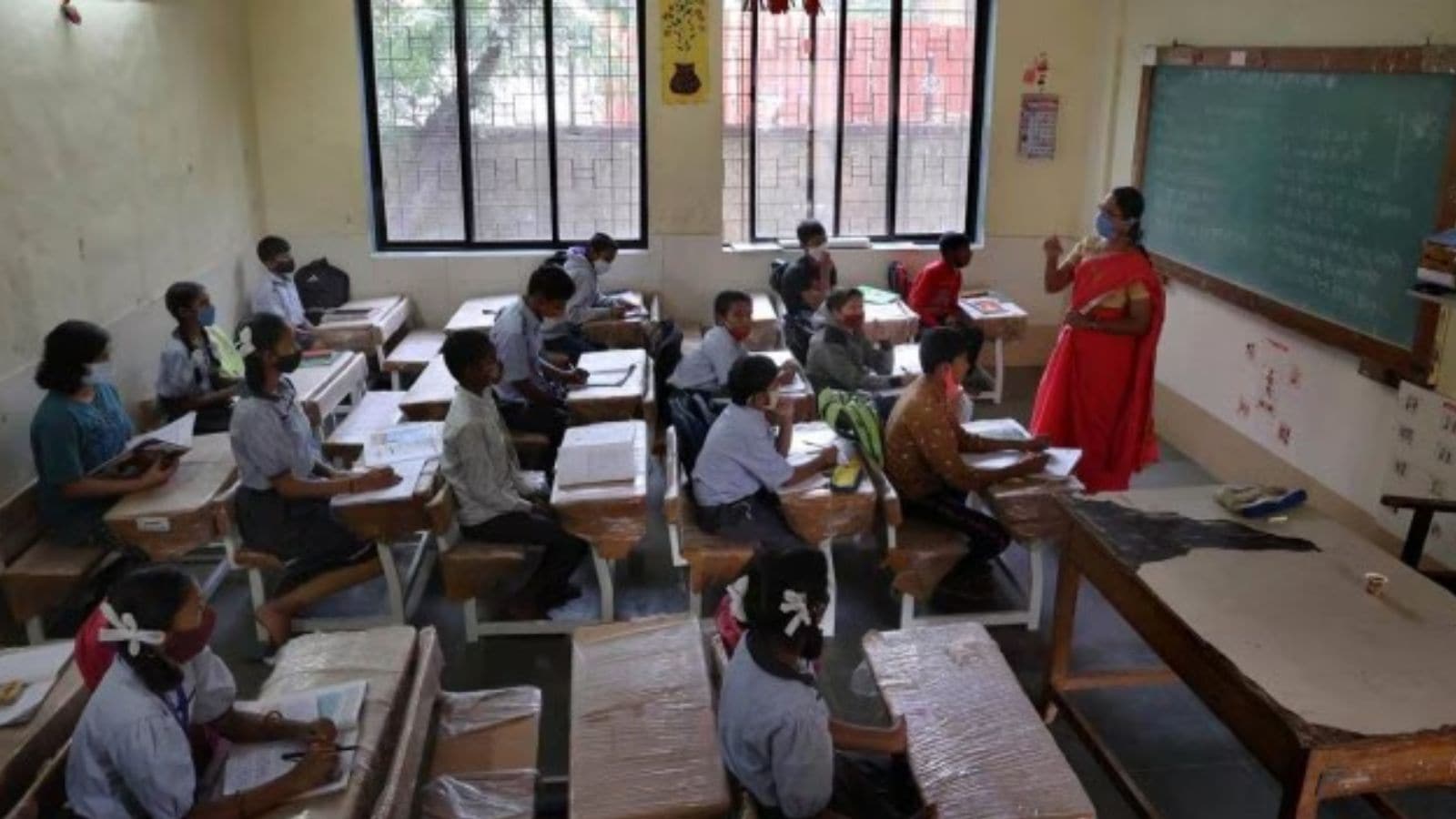

Campuses in Revolt: How the UGC Equity Stay and Criminalised Dissent Have Ignited Student Protests Across India

When a student at Allahabad University was arrested and warned for uttering the word “Brahmanvaad”, the message was unmistakable: in today’s university, critique itself can be treated as a crime. A term long embedded in academic, sociological, and constitutional discourse was transformed overnight into a provocation warranting police action. This was not an aberration, nor a matter of hurt sentiments. It was a signal moment—one that revealed how quickly Indian universities are sliding from spaces of inquiry into zones of ideological enforcement.

What followed has only deepened that concern. Across campuses, students protesting the Supreme Court stay on UGC (Promotion of Equity in Higher Education Institutions) Regulations, 2026 have faced intimidation, surveillance, violence, and criminal process. Instead of debate, there has been policing. Instead of institutional introspection, securitisation. And instead of engagement with the substance of caste discrimination, there has been an aggressive narrowing of what may even be spoken.

Together, these developments mark a dangerous convergence: the criminalisation of speech, the judicial suspension of equity safeguards, and the shrinking of democratic space within institutions meant to nurture critical thought.


A judicial stay that did not calm campuses—but exposed a fault line

The immediate trigger for nationwide student mobilisation was the Supreme Court’s decision to stay the UGC Equity Regulations 2026, observing that the framework appeared “too sweeping” and required closer scrutiny. The stay was framed as a neutral act of caution. On campuses, it was experienced as something else entirely: a sudden withdrawal of long-awaited recognition.

As reported by India Today, students argued that the regulations were halted before they could even be tested. No implementation, no data, no demonstrated misuse—only a speculative fear that accountability mechanisms might be abused. The contrast was striking. In a legal system where far-reaching executive actions are often allowed to operate while constitutional challenges remain pending for years, a framework designed to protect marginalised students was frozen at inception.

The context matters. The 2026 regulations did not emerge in a vacuum. They were the product of years of litigation, including the long-pending petition filed by the mothers of Rohith Vemula and Payal Tadvi, both of whom died by suicide after alleged caste-based harassment. Over time, the Supreme Court itself sought reports, monitored compliance, and pressed for reform. A Parliamentary Standing Committee reviewed the draft regulations in late 2025, recommending substantive changes—many of which were incorporated.

Yet, at the very first hearing after notification, the framework was stayed.

For students already navigating hostile campuses, the implication was stark: caste discrimination may be acknowledged rhetorically, but meaningful institutional safeguards remain deeply contested.

Campuses Respond: Different languages, the same demand for justice

The response to the stay has varied across universities, shaped by institutional histories and student politics. But taken together, protests at JNU, BHU, and Delhi University reveal a shared insistence that equity cannot remain a matter of administrative goodwill.

JNU: The defence of ideological space

At Jawaharlal Nehru University, students organised torchlight processions demanding immediate implementation of the regulations and renewed calls for a statutory Rohith Act—a central anti-discrimination law for higher education.

Placards and slogans opposing Brahmanism and Manusmriti dominated the march. Defending the language used, JNUSU representatives told PTI that the slogans were ideological critiques, not attacks on any caste group—an important distinction grounded in established free-speech jurisprudence. Political critique, even when sharp or unsettling, lies at the heart of constitutional democracy.

Student leaders also raised a pointed question: why was extraordinary urgency shown in staying these regulations when countless cases involving civil liberties remain pending for years? The warning from the campus was clear—if justice is indefinitely deferred within universities, it will not remain confined there.


BHU: Evidence, reports, and institutional failure

At Banaras Hindu University, the protest took a different form. Hundreds of SC, ST, and OBC students marched carrying letters, official reports, and citations, demanding Equal Opportunity Centres, Equity Committees, transparency in grievance redressal, and public disclosure of compliance.

As reported by India Today, students cited the Thorat Committee Report (2007) and the IIT Delhi study (2019), both of which document systemic discrimination and its links to mental health crises, dropouts, and suicides. The emphasis here was not symbolic resistance but institutional accountability.

A heavy police presence and alert proctorial boards accompanied the march—an unsettling reminder of how quickly claims of discrimination are met with securitisation rather than reform.

Delhi University: From regulation to law

At Delhi University, Left-backed student groups led an “Equity March” through North Campus, framing the issue as a legislative and constitutional question. According to The Times of India, speakers argued that without statutory backing, grievance mechanisms remain fragile, easily diluted, and subject to withdrawal.

The demand for the Rohith Act surfaced repeatedly—reflecting a growing consensus that enforceable rights, not discretionary guidelines, are essential to address structural caste discrimination.

Violence, policing, and the price of naming caste

Even as students mobilised, reports of violence and intimidation surfaced from multiple campuses. As per reports, a BHU student allegedly being beaten by upper-caste peers for sharing a poster supporting the UGC protests in a WhatsApp group. At Allahabad University, students discussing equity regulations were reportedly attacked, with allegations pointing to ABVP-linked groups.

Most chilling was the Allahabad University episode itself: students allegedly assaulted, and one student arrested or warned for speech alone. If the use of the word “Brahminism”—a staple of academic critique—can invite police action, the boundary between maintaining order and enforcing ideological conformity has all but vanished.

For many protesters, these incidents crystallised the argument for equity regulations: without enforceable safeguards, marginalised students are left vulnerable not just to bureaucratic neglect, but to physical and legal harm.


Faculty Unease and the Limits of the Framework

Faculty responses have complicated the picture rather than resolved it. The JNUTA noted that the regulations fail to address the deep-rooted and systemic nature of discrimination. At protest gatherings, faculty speakers acknowledged these limitations—pointing to the absence of punitive provisions, excessive power vested in principals, and the exclusion of elite institutions like IITs and IIMs.

Yet the consensus among many educators was striking: even an imperfect framework represented a rare institutional acknowledgment that caste discrimination exists on campuses. To halt it before implementation was not correction—it was erasure.

Media silence, political quiet, and democratic erosion

A recurring concern across protests has been the muted response of large sections of the mainstream media and the conspicuous absence of sustained parliamentary debate. Students questioned how a nationwide mobilisation demanding discrimination-free campuses could unfold without political engagement at the highest levels.

When speech is criminalised, safeguards are stayed, and violence is normalised or ignored, trust in democratic institutions begins to fracture—not through apathy, but through lived experience.

More Than a Regulation: A test of university democracy

As highlighted by the incidents above, the battle over the UGC Equity Regulations has outgrown the regulations themselves. It has become a test of whether universities will remain spaces of critique or instruments of control; whether caste can be named without punishment; and whether equality will be treated as a constitutional obligation or an administrative inconvenience.

When students are arrested for words, protections are suspended before they are tried, and dissent is met with force rather than reason, the crisis is no longer confined to campuses. It speaks to the health of the republic itself.

The question now confronting India’s universities is no longer about guidelines or committees. It is about whether democracy—messy, uncomfortable, and argumentative—still has a place in the classroom.

.Related:

Hate Speech Before the Supreme Court: From judicial activism to institutional closure

When Protest becomes a “Threat”: Inside the Supreme Court hearing on Sonam Wangchuk’s NSA detention

Another Campus, Another Death: Student suicides continue unabated across India

My birth is my fatal accident, remembering Rohith Vemula’s last letter

‘Diluted Existing Rules’: Rohith Vemula, Payal Tadvi’s Mothers Slam UGC’s Draft Equity Regulations

The stay of UGC Equity Regulations, 2026: The interim order, the proceedings, and the constitutional questions raised


When Protest becomes a “Threat”: Inside the Supreme Court hearing on Sonam Wangchuk’s NSA detention

As the Supreme Court continues to hear the habeas corpus challenge to the preventive detention of Ladakh-based social activist, educationist, and climate campaigner Sonam Wangchuk, the Union Government has advanced an extraordinary case: that Wangchuk’s speeches sought to inspire Ladakhi youth by invoking protest movements in Nepal, Bangladesh, Sri Lanka, and the Arab Spring, thereby posing a grave threat to public order and national security in a sensitive border region.

Wangchuk was detained on September 26, 2025, under the National Security Act, 1980 (NSA), following weeks of protests in Ladakh demanding statehood and Sixth Schedule protection—a movement that later spiralled into violence, leading to the deaths of four civilians.

A Bench of Justice Aravind Kumar and Justice P. B. Varale is hearing the Article 32 habeas corpus petition filed by Wangchuk’s wife, Dr Gitanjali Angmo, which challenges the legality of his continued detention. Proceedings have been closely tracked by LiveLaw and other media.

Union’s core defence

  1. Court’s review is procedural, not substantive

Opening arguments for the Union, Solicitor General Tushar Mehta emphasised that judicial scrutiny in preventive detention matters is narrowly circumscribed. The Court, he argued, is not entitled to examine whether the detention was “justified”, but only whether statutory and constitutional procedures were followed so as to ensure fairness to the detenue.

Mehta relied on established precedent to submit that once the detaining authority records subjective satisfaction, courts must exercise restraint.

He further underscored the “inbuilt safeguards” within the NSA:

  • The District Magistrate’s detention order must be confirmed by the State Government; and
  • The detenue has a right to make a representation before an Advisory Board headed by a former High Court judge.

Crucially, Mehta pointed out that Wangchuk has not independently challenged either the confirmation order or the Advisory Board’s opinion, a submission clearly aimed at narrowing the scope of judicial interference.

  1. Dispute Over Supply of Materials: Union calls allegations an “afterthought”

Responding to the petitioner’s contention that four video clips relied upon in the detention order were not supplied to Wangchuk, Mehta rejected the claim as factually incorrect and a belated fabrication.

According to the Union, the service of the detention order itself took nearly four hours, during which a senior police officer personally went through each page of the grounds and the video material, a process that was videographed.

“The DIG Ladakh sits with him, shows him every page, every clip, and asks if he is satisfied. He answers in the affirmative,” Mehta told the Court, offering to place the recording on record if required.

  1. “Borrowed satisfaction” argument rejected

When the Bench raised the argument that the detention order was based on borrowed or mechanically reproduced material, Mehta countered that this misunderstands the nature of preventive detention.

He argued that a District Magistrate is not expected to personally witness each incident but is entitled—indeed required—to rely on inputs placed before him by law enforcement agencies to arrive at subjective satisfaction.

“What the authority must assess is the speech as a whole,” Mehta said, warning against isolating references to non-violence or Gandhian philosophy while ignoring the allegedly inflammatory core.

  1. Union alleges “hope for riot-like situation” in Ladakh

The centrepiece of the Union’s case lies in its reading of Wangchuk’s speeches. According to Mehta, Wangchuk deliberately invoked foreign protest movements to emotionally mobilise young people in Ladakh—a region that shares borders with volatile and geopolitically sensitive areas.

He referred to Wangchuk’s alleged references to:

  • Nepal’s youth-led protests,
  • Political upheavals in Bangladesh and Sri Lanka, and
  • The Arab Spring, where multiple governments were overthrown following mass unrest.

“What is the relevance of Nepal and Ladakh?” Mehta asked. “You are not addressing Gen-Z in isolation—you are hoping for a Nepal-like situation.”

The Solicitor General dismissed Wangchuk’s invocation of Mahatma Gandhi as a rhetorical façade. “Gandhi was resisting an imperial power. He was not instigating violence against his own democratic government,” Mehta argued.

  1. Alleged security concerns and references to self-immolation

The Union further alleged that Wangchuk attempted to create distance between civilians and Indian security forces by lamenting the deployment of armed personnel in Ladakh.

“Security forces become ‘they’, and the people become ‘we’—this is dangerous in a border region,” Mehta submitted.

The most serious allegation concerned Wangchuk’s references to self-immolation, drawn from the Arab Spring narrative.

“This is an invitation to bloodshed,” Mehta claimed, arguing that such examples could incite impressionable youth to extreme and irreversible acts.

Petitioner’s response

  1. Non-consideration of crucial exculpatory material

On behalf of the petitioner, Senior Advocate Kapil Sibal mounted a systematic dismantling of the detention order in earlier hearings.

Sibal argued that the September 24 speech, in which Wangchuk broke his hunger strike and publicly appealed for peace after violence erupted, was the most proximate and relevant material—yet was never placed before the detaining authority.

Its suppression, he argued, vitiates the very foundation of subjective satisfaction, particularly when the speech was publicly available and known to authorities.

  1. Failure to supply relied-upon materials violates Article 22(5)

Sibal further submitted that four key videos, explicitly relied upon in the detention order, were never supplied to Wangchuk along with the grounds of detention, in violation of Article 22(5) of the Constitution and Section 8 of the NSA.

Without access to the complete material, Wangchuk was denied the right to make an effective representation—not merely before the Advisory Board, but also before the government itself.

  1. Section 5A cannot rescue a composite detention order

Rejecting the Union’s reliance on Section 5A of the NSA, Sibal argued that the provision applies only where distinct and independent grounds of detention exist.

Here, he said, the detention rests on a single composite ground, stitched together through selective videos, stale FIRs, and allegedly distorted interpretations.

Relying on Attorney General of India v. Amratlal Prajivandas (1994), Sibal submitted that a chain of events cannot be artificially severed to salvage an otherwise unlawful detention.

  1. Stale FIRs, copy-paste orders, and non-application of mind

Sibal also pointed out that:

  • Several FIRs relied upon date back to 2024,
  • Many are against unknown persons, and
  • Even the FIR registered after the Ladakh violence does not name Wangchuk.

He further demonstrated that the District Magistrate reproduced the Superintendent of Police’s recommendation verbatim, betraying a mechanical exercise of power rather than independent application of mind.

  1. Allegations of anti-army rhetoric and plebiscite “completely false”

Addressing allegations that Wangchuk discouraged civilians from assisting the Indian Army during wartime, Sibal said the claim was entirely false, arising from mistranslation or deliberate distortion.

He quoted Wangchuk as urging Ladakhis not to mix political grievances with national defence, and to stand by the country during any external conflict.

Similar distortions, Sibal argued, were made regarding:

  • Alleged support for plebiscite, and
  • Claims of disrespect toward a Hindu goddess—both of which he described as manufactured narratives, widely debunked by fact-checkers.

Health, custody, and court-ordered medical care

Amidst these proceedings, concerns over Wangchuk’s health have also engaged the Court’s attention.

On January 29, the Supreme Court directed that Wangchuk be examined by a specialist gastroenterologist at a government hospital, after he complained of persistent stomach pain during his detention.

He was subsequently taken to AIIMS Jodhpur on January 31, where he underwent medical tests. While jail authorities claimed he had been examined 21 times, the Court accepted that specialist care was warranted and sought a report by February 2.

Voices Outside Court: Gitanjali Angmo speaks

Speaking to The News Minute at the Mathrubhumi International Festival of Letters in Thiruvananthapuram, Dr Gitanjali Angmo framed her husband’s detention as an attempt to silence a sustained and principled critique of how Ladakh is being governed after the abrogation of Article 370. She suggested that Sonam Wangchuk’s insistence on environmental safeguards and public participation in decision-making had increasingly placed him at odds with a governance model driven by centralised authority rather than local consent.

Dr Angmo emphasised that Ladakh’s demands for statehood and Sixth Schedule protection were neither sudden nor radical, but rooted in the region’s fragile ecology, high-altitude geography, and distinct cultural identity. With temperatures plunging to sub-zero levels and ecosystems highly vulnerable to disruption, she argued that policies designed for the rest of India cannot be mechanically applied to Ladakh without severe consequences for both people and environment.

She cautioned against what she described as a “one-size-fits-all” approach to governance, warning that excessive centralisation risks erasing India’s constitutional commitment to diversity and federal balance. India, she noted, has historically functioned as a plural federation, united not by uniformity but by accommodation of difference—a principle she fears is being steadily undermined.

Rejecting any suggestion that Wangchuk’s activism was anti-national, Dr Angmo characterised his work as firmly anchored in constitutional values and long-term national interest. She alleged that his speeches were selectively excerpted and stripped of context, while his repeated appeals for peace and unity were ignored, creating a distorted narrative that portrayed dissent as a security threat.

In Dr Angmo’s account, the case transcends the legality of one preventive detention and raises a deeper question about the health of Indian democracy. When region-specific political demands and environmental concerns are met with the extraordinary power of preventive detention, she suggested, it signals a troubling intolerance for dissent—particularly from India’s geographic and political margins.

A growing constitutional unease

As the hearings unfold, the case has come to symbolise a broader constitutional tension: the use of preventive detention laws against political dissent, particularly in regions demanding greater autonomy and constitutional safeguards.

At its core lies a troubling question—can references to global protest movements, stripped of context and divorced from subsequent calls for peace, justify the extraordinary power of preventive detention?

Wangchuk, notably, was detained two days after publicly calling for calm, breaking his fast, and dissociating himself from violence. The leap from that moment to the conclusion that he posed an imminent threat to national security remains at the heart of the Court’s scrutiny.

In a constitutional democracy, where preventive detention is meant to be the exception rather than the rule, the outcome of this case may well define the line between legitimate security concerns and the impermissible criminalisation of dissent.

Further hearings are awaited.

Orders of the said case may be read below.

[viewpdf 45821]

[viewpdf 45822]


Related:

How the Centre used a ‘Draconian’ law to silence Sonam Wangchuk and Ladakh’s aspirations

A victory for Ladakh’s voices: Sonam Wangchuk and Ladakhi activists break 16-day fast as union government agrees to renew talks on demands

Centre cancels FCRA licence of Sonam Wangchuk’s NGO, cites violations including study on ‘sovereignty’

Gen‑Z’s furious stand for Ladakh statehood, centre blames Sonam Wangchuk for violence incitement


Peaceful street protest in Mumbai condemns Christmas-time attacks on Christians across India

Amid growing reports of attacks, intimidation, and disruptions targeting Christian communities during the Christmas season across several states, a peaceful protest was held on Friday, December 26, evening in Mumbai’s Goregaon West to condemn what organisers described as a “systematic assault on constitutional freedoms.”

The peaceful gathering of about 100 people was organised by the Samvidhan Jagar Yatra Samiti (SJYS)  in collaboration with The Bombay Catholic Sabha (BCS), one of the city’s oldest Catholic lay organisations. The protest took place outside Hotel Ratna on S.V. Road, drawing community members, civil society representatives, and concerned citizens who stood silently with placards denouncing hate and religious violence.

[gallery size="medium" td_select_gallery_slide="slide" ids="45248,45247,45249"]

“An attack on the Constitution itself”

Organisers said the protest was not merely about individual incidents, but about a broader pattern of hostility against Christians during one of their most significant religious periods.

“Such attacks are not isolated law-and-order issues. They strike at the heart of our Constitution — at the freedom of conscience, the right to profess and practise religion, and the right to worship without fear,” wrote Dolphy D’Souza, spokesperson of the Bombay Catholic Sabha, while inviting people to join the protest. President BCS Norbert Mendonca said it was the beginning of a systematic campaign on the issue. Norbert Mendonca, president, BCS said that this was the start of a campaign on the issue.

Placards at the site referenced constitutional values, religious freedom, and the need for state accountability, while deliberately avoiding slogans or speeches, underscoring the silent and dignified nature of the protest.

Among the prominent faces present were Prof Arvind Nigle, Sridhar Shelar and Iqbal Shaikh, convenors of SJYS, former corporator, Shiv Sena (UBT), Samir Desai and Teesta Setalvad, human rights activist.

[gallery size="medium" td_select_gallery_slide="slide" ids="45250,45251,45252"]

Passersby stop, read, respond

What made the protest particularly striking was the spontaneous engagement it drew from the public. Women on scooters slowed down, pedestrians stopped mid-walk, commuters paused to read the placards, and several expressed solidarity with the cause.

[gallery size="medium" td_select_gallery_slide="slide" ids="45253,45254,45255"]

According to organisers, many passersby quietly acknowledged the protesters, some offering words of encouragement, others simply folding their hands or nodding in approval. The peaceful street protest of the demonstrators appeared to invite reflection rather than confrontation — a deliberate choice, organisers said, in a climate increasingly marked by polarising rhetoric.

Photographs from the protest capture these moments: about a 100 citizens standing still in a bustling Mumbai street withmessages against hate, as some passerby seemed visibly moved by the gravity of the issue.

Christmas season under shadow

Over the past week, multiple reports from different parts of the country have documented disruptions of Christmas prayers, vandalism of churches, intimidation of worshippers, and threats issued in the name of preventing “forced conversions.” Christian groups have warned that such actions are becoming increasingly normalised, often occurring with little immediate intervention.

Detailed reports of these attacks may be read here and here.

Friday’s protest sought to draw attention to this pattern, emphasising that religious freedom is not a concession granted by the state, but a fundamental right guaranteed to every citizen. The organisers stressed that the protest was as much a call to citizens as it was to authorities.


Related:

Free Speech in India 2025: What the Free Speech Collective report reveals about a year of silencing

The ‘Shastra Poojan’ Project: How the ritual of weapon worship is being recast as a tool of power and hate propaganda

Kerala: Protests erupt after RSS-BJP man’s alleged attack on children’s Christmas carol group in Palakkad

MP, Odisha, Delhi, Rajasthan: Right-wing outfits barge into 2 churches ahead of Christmas, attack vendors selling X’mas goodies, tensions run high


Protest outside Delhi HC gate over bail in Unnao rape case, survivor's mother asks for maximum punishment

Women staged a protest outside the Delhi high court on Friday amid outrage over the court’s December 19 decision to grant conditional bail to expelled Bharatiya Janata Party (BJP) leader Kuldeep Singh Sengar in the Unnao rape case. Outrage had been mounting since earlier this week when the verdict was pronounced. Details of the conditional bail and temporary suspension of sentence may be read here. Dozens of protesters gathered near the court premises, raising slogans and expressing opposition to the bail order.


These protests have taken place amid grave concerns expressed by the Unnao rape survivor and her family over the suspension of the BJP politician, Sengar’s jail term. Responding to the high court order, the survivor told Hindustan Times, “I am extremely upset by what has happened today in the court.” She also said she felt “extremely unsafe” after learning about the bail conditions granted to Sengar.

Additionally, speaking to ANI news agency on Friday, the victim’s mother expressed strong objection to the bail, saying, “His bail should be rejected... We will knock on the doors of the Supreme Court. We have lost faith in the high court... If we don't get justice in the Supreme Court, we will go to another country... The person guilty of my husband's murder should be hanged immediately.”

It is only after this determined expression of the need for justice, public outrage and protests from December 21-24 that the Central Bureau of Investigation (CBI), announced its late evening decision on December 25, 2025 to appeal this suspension of sentence and bail to Sengar, BJP leader and former MLA.

Photographs shared by the news agency showed security personnel asking protesters to put an end the demonstration immediately, warning that legal action would be taken if they did not disperse within five minutes. Women’s rights activist Yogita Bhayana, who was present at the protest, said, “Women across India are deeply hurt that the sentence of a rapist has been overturned. This happened in this very court. So, we will seek justice from the same place where the injustice occurred,” ANI reported.

[caption id="attachment_45241" align="alignnone" width="300"] Image: @yogitabhayana / X[/caption]

Yet another protester told ANI, “On what grounds was Kuldeep Sengar granted bail, when it was declared that he had committed rapes and murders? If a life sentence was given to him, then why is he out?... We demand that the rapist should go behind bars so women feel safe.”

Kuldeep Sengar was convicted and sentenced to life imprisonment in December 2019 for the rape of a 17-year-old girl in Uttar Pradesh’s Unnao in 2017. On Tuesday, the Delhi High Court suspended the expelled Bharatiya Janata Party (BJP) leader’s life sentence, noting that he had already served more than the maximum punishment prescribed under the Protection of Children from Sexual Offences (POCSO) Act.

An earlier protest in the capital was also met with forcible eviction by the Delhi police.


CRPF Intimidation?

The court’s judgement has triggered fresh fears within the survivor’s family, despite the order barring Sengar from coming within a five-kilometre radius of her. The survivor’s family has also been granted protection by the Central Reserve Police Force (CRPF). However, controversy has also been generated over the politicisation of this para-military protection including political interference, when earlier this week, the survivor and her family were trying to travel by road to Delhi to meet with advocates. According to an interview played out on social media she told activist and supporter Yogita Bhayana that initially the CRPF tried actively to prevent her travelling to Delhi for legal advice and redressal and only when she raised her voice in objection “was she allowed.” This raises serious questions on the active monitoring and interference in witness protection ordered by the court especially since the para-military forces like the CRPF come under the union home ministry.

Listen to the video on this tweet

The survivor cited past incidents to explain her concerns, saying, “He is a powerful man. He would get his men to do his dirty work for him. When my car met with an accident in which two of my relatives and my lawyer died in 2019, Sengar didn’t do it himself. His henchmen did. Now that he is out, we are all unsafe.”

Now 24, the survivor is a resident of Delhi. Following the grant of conditional bail to Sengar, she has been provided court-ordered protection and is accompanied by five to 11 Central Reserve Police Force (CRPF) personnel at all times. However, her mother has said that security cover provided to her and her three children until March this year (2025) was subsequently withdrawn.

Related:

Delhi HC grants bail pending appeal to Unnao rape convict Kuldeep Singh Sengar

Unnao rape case: Kuldeep Singh Sengar convicted

Ex-BJP MLA Kuldeep Sengar, brother convicted in Unnao rape survivor’s father’s death


Kerala: Protests erupt after RSS-BJP man’s alleged attack on children’s Christmas carol group in Palakkad

Kerala saw widespread protests that erupted following an alleged attack on a children’s Christmas carol by an RSS-BJP worker at Kalandithara, Pudussery, in Palakkad district of Kerala on Sunday (December 21, 2025) night reported The Hindu.

Clearly emboldened by some recent poll gains by the Bharatiya Janata Party (BJP) in local elections in the state, RSS-BJP worker Aswin Raj allegedly assaulted the children who participated in the carol and damaged their musical instrument. The band used by the carol group belonged to the CPI (M) area committee. The state police have promptly arrested Mr. Raj following a complaint.

This attack on Christians follows a ghastly incident of lynching of a Muslim migrant labour in Kerala on December 13. Reports of this may be read here.

Protest carols by DYFI

In a strong condemnation of the attack, the Democratic Youth Federation of India (DYFI) –affiliated to the CPI-M- has announced that it would organise protest carols across the district. All 2,500 DYFI units celebrate through protest carols, the youth organisation said. Challenging the RSS and the BJP to prevent or disrupt the protest carols, the DYFI warned that it would “respond in an appropriate manner.”

In a questionable reaction, the BJP State vice-president C. Krishnakumar justified the attack, claiming that the carol was organised by the CPI (M) area committee and that the participants were intoxicated. He alleged that the members of the carol group had “deliberately attempted to create trouble.” The BJP leader’s remarks have drawn sharp criticism. Describing Krishnakumar as “the Praveen Togadia of Palakkad,” the DYFI said he had “exposed his true communal face.”

Meanwhile, Palakkad Bishop Mar Peter Kochupurackal condemned the attack, saying he hoped that “those responsible will handle the matter legally.”

The Congress—at loggerheads with the CPI-M otherwise, has described the attack as the BJP’s “natural response to its failure to secure the expected support from the Christian community” in the recent civic body elections. It termed the incident “an attack on communal harmony” and demanded that those responsible be brought to book.

The police said Mr. Raj was already facing charges under the Kerala Anti-Social Activities (Prevention) Act (KAAPA). He has now been booked under various sections, including those relating to causing hurt and promoting communal violence.

Related:

MP, Odisha, Delhi, Rajasthan: Right-wing outfits barge into 2 churches ahead of Christmas, attack vendors selling X’mas goodies, tensions run high

No right to live, or die: Christians in Chhattisgarh, and India under attack

‘Brutal intimidation of Christians’ all India condemned: Bombay Catholic Sabha


Solidarity with protests of locals against projects facilitating coal transportation (Goa to Karnataka): NAPM

The National Alliance of People’s Movements (NAPM) expresses its full solidarity with the people and communities of Goa, standing up against coal handling and transportation and related mega infrastructure through the small state. NAPM notes that recent Government of India announcements have confirmed the concerns of people that the three linear projects of electrical transmission, road widening, and double tracking of railways, and the Sagarmala programme, are designed to facilitate corridors, which further the transportation of coal from Mormugao Port to Hospet in Karnataka, which is part of the larger initiative of steel corridors in Karnataka and development corridors that are being set up all over the country.

There is evidence that the Government is now going ahead full steam to pander to the advancement of these corridors, which have no demonstrated benefit to people at large, whether in Goa or in Karnataka. For a small state like Goa to have to lose its resources and become a ‘corridor’ towards the Corridor, spells complete disaster. Its air, waters, its rivers, its agriculture, its fishing and fish-drying spaces, its forests, its peoples’ health and livelihoods, are all under threat from coal dust and infrastructure being set up to make coal transportation through the port, roads, railways and waterways of Goa possible.   

The NAPM has also condemned the questionable legal architecture systematically introduced to facilitate these plans that enable corporate expansionism, even as existing laws and regulations around environmental protection, social impacts, land acquisition and rehabilitation are being violated.

In a statement issued yesterday, the NAPM has also joined the active people’s movements of Goa and Karnataka in resisting the reduction of the region to a coal transportation and corridors hub, and in their struggles to safeguard the ecology, livelihoods and people’s well-being, for current and future generations.

Goans have been demanding the de-notification of the rivers of Goa, which have been declared as National Waterways under the National Waterways Act, 2016. Similarly protesters have been demanding stoppage of the railway double-tracking project and return of lands acquired through draconian legislation.

NAPM further calls for an immediate halt to port expansion, by respecting the will of the people as even articulated in the public hearings in Mormugao taluka.

The people of Goa held a Chalo Lohia Maidan mass protest on Sunday November 9 in Goa.


Related:

NAPM condemns Delhi authorities for deserting over 700 Dhobi Ghat residents

NAPM condemns Delhi authorities for deserting over 700 Dhobi Ghat residents


'We Were Promised Rehabilitation': Gurugram's oldest Dalit settlement bulldozed after decade long battle; police violently beat and detain residents for protesting

October 8, 2025, Gurugram, Haryana: On Wednesday in Gurugram's Sector 12, on Old Delhi Road, homes were razed down after residents were forcibly dragged out by a massive police force, in yet another case of demolition and forced evictions in India following the 2024 Supreme Court judgement that deemed them "totally unconstitutional".

The Premnagar Basti, also known as the Chick-Chatai Wali Basti, is an at least 45-year-old settlement of BPL migrant labourers, most of which has now been destroyed. 86 of the 250 or so jhuggi-jhopdis that made up the urban village remain protected, entitled to rehabilitation in a 2-decade old low-income housing project called the Ashiana Scheme, as per the state government.

[caption id="attachment_44171" align="alignnone" width="696"] A bulldozer tears through homes in Gurugram’s Premnagar settlement during a demolition drive, leaving behind collapsed bamboo and brick structures. October 2025/MOULI SHARMA[/caption]
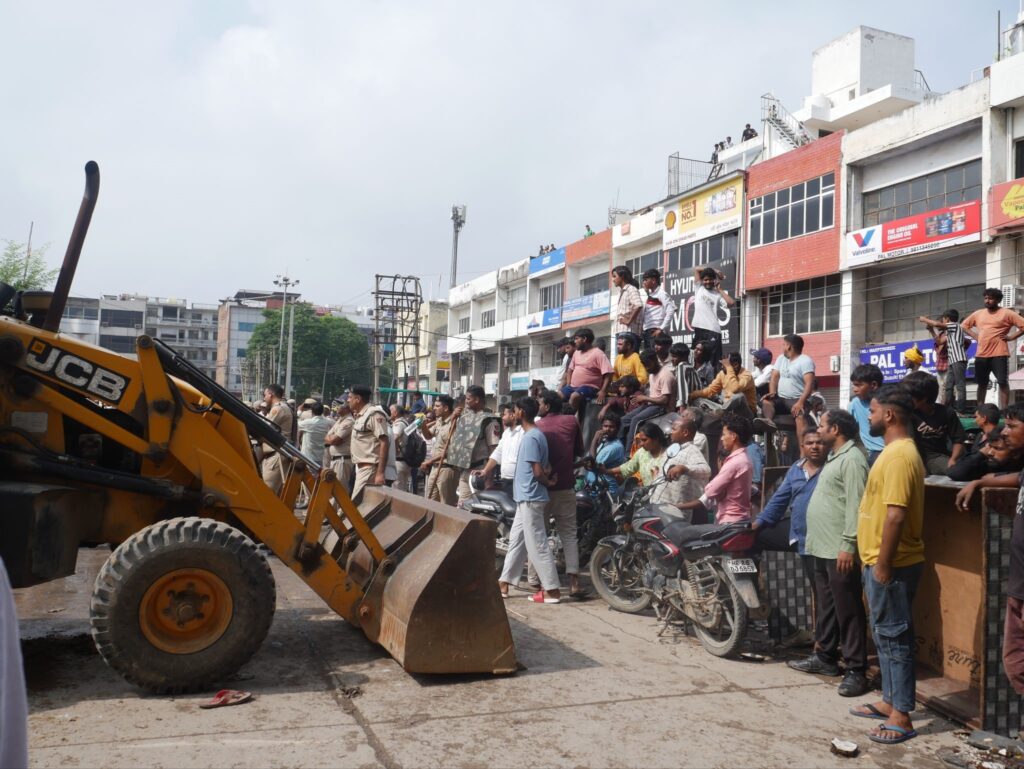
Unlike many similar demolitions of marginalised populations' homes, the demolition of the Premnagar Basti was initiated not for the purpose of clearing public land, but at the behest of local industrialist Gulaab Singh. In 2013, the Central Market Welfare Association (CMWA) of the market complex opposite the basti filed a lawsuit against the Haryana government and its urban development authority, Haryana Shehri Vikas Pradhikaran (HSVP), complaining that the very existence of the Premnagar Basti was affecting their business adversely. Singh is the president of this association, and also the owner of the Sector 12 market complex.

The same year that the CMWA filed the lawsuit demanding Premnagar's demolition, the Right to Fair Compensation and Transparency in Land Acquisition, Rehabilitation and Resettlement Bill was passed in Parliament, repealing 1894's Land Acquisition Act such that every acquisition would require the government to pay compensation to its occupants, or rehabilitate them. Essentially, it meant that there is no such thing in Indian law as a 'legal forced eviction' or a 'legal forced demolition'.

The act was enforced the following year in 2014, but the CMWA's case was temporarily dismissed by the Punjab and Haryana High Court at the time, as the occupied land in question was not public property at all, but disputed private property that the government had been attempting to acquire for three decades.

[caption id="attachment_44170" align="alignnone" width="696"] Residents and onlookers gather as police and earthmovers carry out the demolition in Gurugram’s Sector 12, displacing scores of families. October 2025/MOULI SHARMA[/caption]
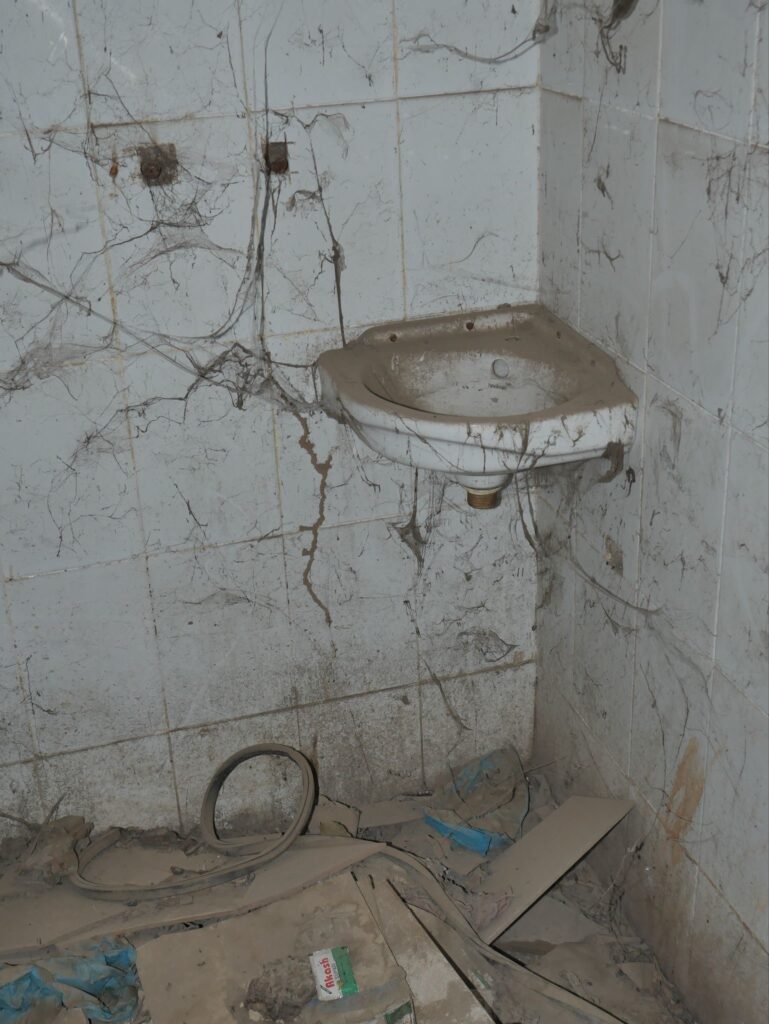
Premnagar's impending demolition has terrorised its residents through much of the last decade, ever since HSVP acquired the land in the mid 2010s (HSVP's present estate officer, Rakesh Saini, alongside GMDA Nodal Officer and Town Planner R.S. Batth declined comment on the exact date, or any other technical or legal details). Wednesday marked the end of a decade long battle, despite the fact that till date, not a single family has been rehabilitated or compensated by the HSVP as required by the 2013 Act.

In fact, the Ashiana Scheme apartments in sector 47, where the HSVP now promises to house 86 families currently protected from demolition, have sat empty for 15 years. These flats are in a state of utter disrepair, with the HSVP having failed to allot even one of 1,088 flats since the project's completion in 2010. In 2023, the HSVP announced that these flats would be demolished! The land was set to be resold for high-end commercial use, which the HSVP felt better suited its 'premium value'; just this year, it was announced that they would not be demolished after all, and Rs. 9 crores  were then allotted for their repair!

[caption id="attachment_44169" align="alignnone" width="696"] A dilapidated bathroom sink in Sector 47's abandoned Ashiana Scheme apartments where the HSVP has promised to rehabilitate '86' families—without committing to the same in writing—much like it had done to 204 families in 2018, 118 of whose homes are now going to be bulldozed.  April 2025/MOULI SHARMA[/caption]
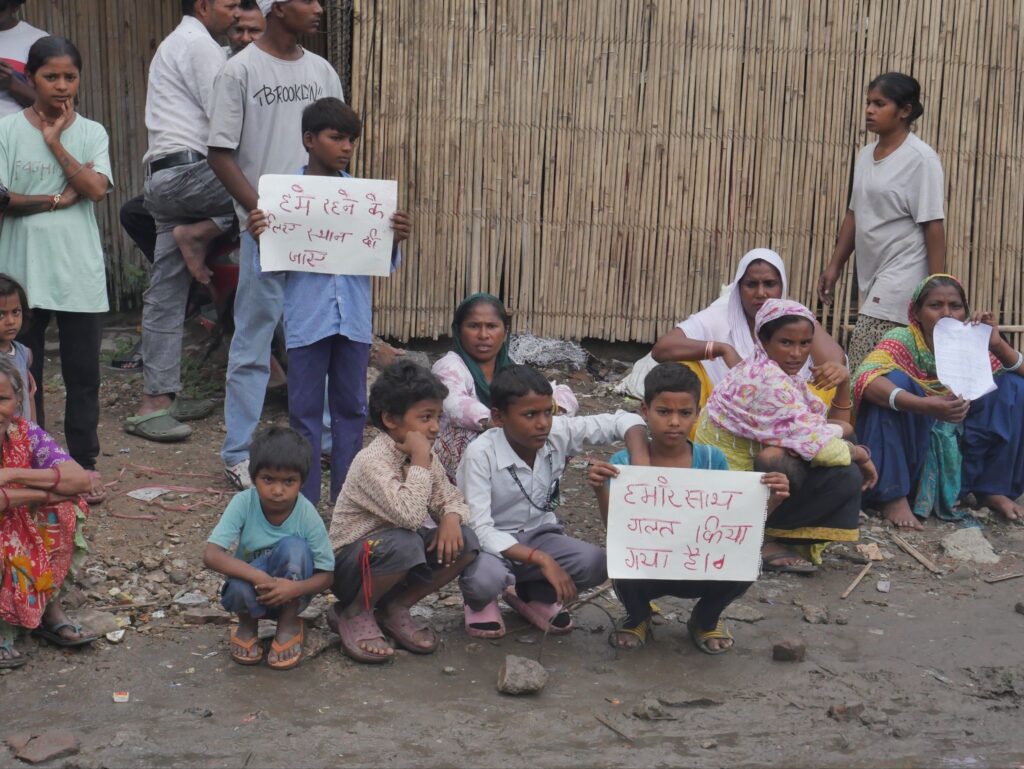
In the High Court's final judgement regarding Premnagar given in January earlier this year, 204 families had been marked as eligible for rehabilitation in these inhospitable Ashiana Scheme apartments. Now, this number has arbitrarily shrunk to 86, and not a single allotment letter has been given to any of them either.

The demolition drive, which employed the use of a massive armed police force, water cannons, detention vans and a bulldozer—blocking Old Delhi Road for regular commuters through the hours of 10 and 6—was overseen by GMDA's Nodal Officer for 'removal of illegal encroachments', R. S. Batth, a somewhat notorious figure for his attempts at internet fame—through the act of demolition itself.

Batth's Instagram account, @r_s_batth_dtp, consists largely of vertical short-form videos of himself overseeing various demolition drives in addition to participation in Savarna religious events, with the former ranging from the destruction of street food vendor stalls to the huts and homes of slum dwellers. Batth has built a loyal Instagram following, with over 2,71,000 followers and at least 6 fan pages, and a corresponding internet infamy within less than a year of taking office, seemingly entirely at the cost of Gurugram's urban poor.

[caption id="attachment_44168" align="alignnone" width="696"] Children of the Premnagar Basti protest on Old Delhi Road with handmade posters. The first (left) reads, "We should be given a place to stay," and the second (right) reads, "We are being wronged." At the end of the demolition drive, these posters could be found crushed to the ground, covered in dirt. October 2025/MOULI SHARMA[/caption]
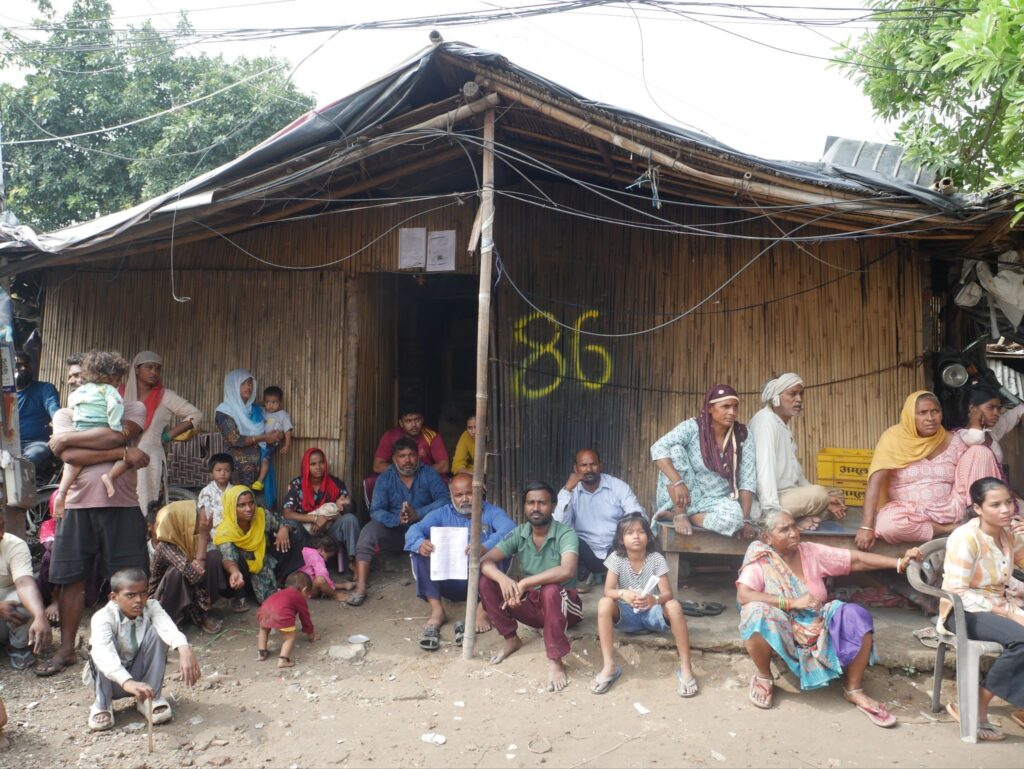
On the 8th of October, as sick children were dragged from their homes and men and women beaten with sticks as they were made to watch their homes being razed to the ground, Batth could be seen recording videos of requesting victims of demolition to have tea or water to calm themselves down. These videos, along with closeups of bulldozer action, were then quickly uploaded to his Instagram page, receiving applause from his following.

Surprisingly though, there are forms of attention that Batth does not in fact, enjoy. When reporters from Sabrang India asked him about the legality of the demolition with reference to the 2013 Act, how, if at all, he planned to rehabilitate the people whose homes he'd demolished as constitutionally required, or why the 120 remaining families earlier promised rehabilitation were suddenly dropped from the list. Batth declined comment on each question, and requested that 'technical questions' be directed to HSVP's Estate Officer, Rakesh Saini instead.

"I am not questioning your legal knowledge. Please ask all these technical questions to the Estate Officer and not me," said Batth. Saini himself also declined comment on the matter, saying that he would prefer if the matter were discussed with him privately instead.

Interestingly, both authorities also failed to answer how many homes it was that they'd set out to demolish. "It is not possible to say the exact number," said Saini. "It is somewhere around a hundred and fifty."

[caption id="attachment_44167" align="alignnone" width="696"] Residents of a protected house, no. 86 of 86 houses whose families the HSVP now promises rehabilitation, sit outside the home with the official list of protected homes in case the bulldozers move toward them. October 2025/MOULI SHARMA[/caption]
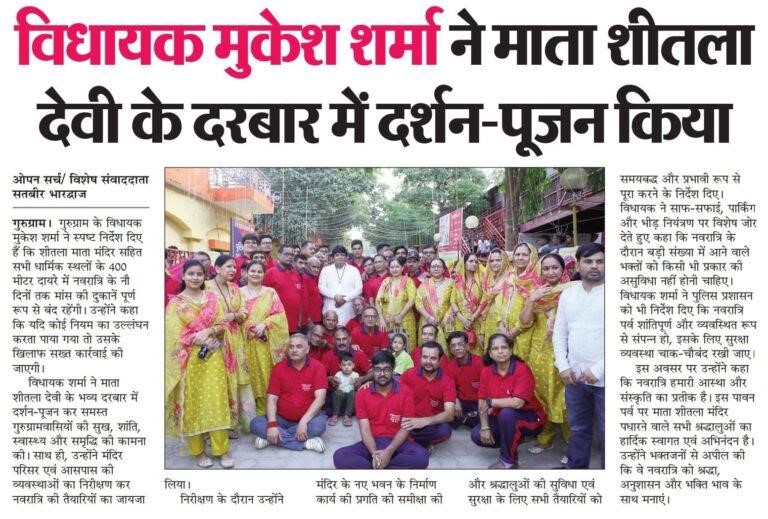
Barring the 86 protected homes, marked out by yellow spray paint on bamboo walls and notices pasted everywhere the eye could see, at least 170 homes would have been planned to be demolished. Till the evening, 50 or so homes were destroyed by the Haryana government, with many families not even being permitted to retrieve their belongings.

"That is 50 year’s worth of possessions," said Reema Devi, resident of one such home, weeping on the street with her granddaughters beside her. "They expect us to get rid of it in a day."

"This is all the fault of Mukesh Sharma," she then added. The BJP MLA had campaigned around Premnagar intensely, promising an end to the battle for Premnagar which had begun during Congress' tenure." He promised us this wouldn't happen. That we would be rehabilitated within two months of his taking office," said Reema Devi.

While Sharma has never since revisited Premnagar,  nor had he replied to the petition sent to him by residents of the basti informing him of the unjust processes of demolition being carried out over there and seeking remedy for the same, he has come very close: On 25th September, Sharma visited the popular Sheetla Mata Mandir merely 2km away from the Premnagar basti, to inaugurate a new building within the temple, and to ensure that no one would sell meat within a four-hundred metre radius of it. These achievements are boasted of on his very own website, mukeshsharma.in.

[caption id="attachment_44166" align="alignnone" width="768"] Haryana MLA Mukesh Sharma, who won from Ward 6—in which the Premnagar Basti falls—recently visited Gurugram's famous Sheetla Mata Mandir to ensure that meat would not be sold within 400 metres of the temple, and inaugurate a new building for it. Meanwhile, he hasn't yet responded to the basti residents' petition demanding review of the matter of their rehabilitation.  September 2025/MUKESHSHARMA.IN, NAVODAY TIMES[/caption]
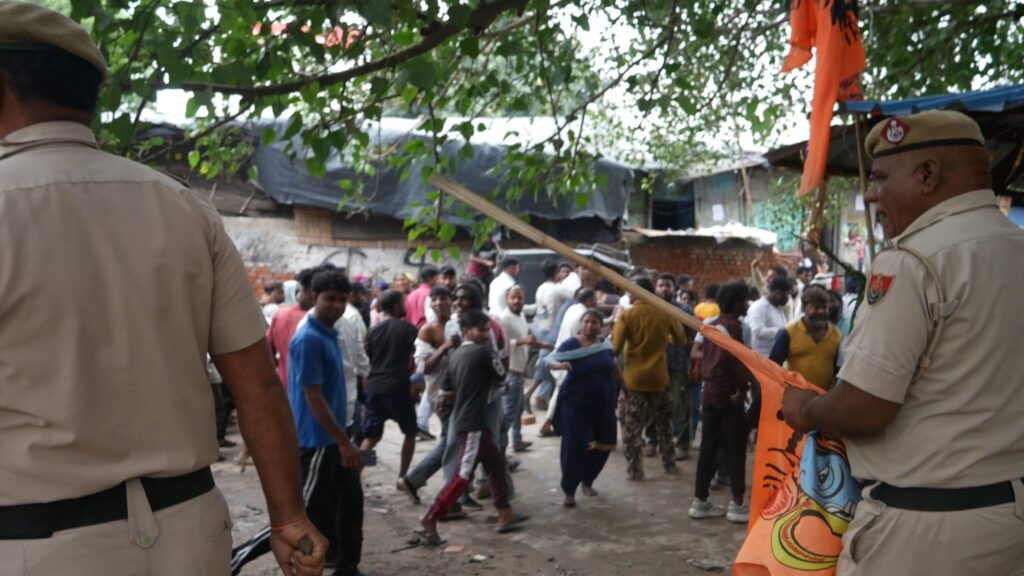
The following day, the police and demolition authorities were set to return to finish their incomplete task of razing over a hundred more homes, but as of 9th October, at time of writing, no further action is taking place. It seems as if now that Batth's videos have gone viral, the urgency to 'clean up' the streets of Gurugram has ceased.

The homes of a few poor Dalit families have little value to the incumbent government beyond cheap publicity stunts and monkey-fights with the opposition; Congress' mayoral candidate, alongside their advocate, Abhay Jain were both present at the sight of demolition and spoke vehemently against the drive, requesting that the government at least 'let Diwali pass' in peace for the families, most of whom make livings through artisan work and seasonal employment. Both left immediately after the police lathi-charged the basti's protesting crowd, gathered protectively around the urban village.

[caption id="attachment_44165" align="alignnone" width="696"] As police begin to lathi charge the basti residents gathered outside to protest the demolition, a policeman grabs a nearby religious flag of Hindu God Ram to repurpose as a weapon. October 2025/MOULI SHARMA[/caption]
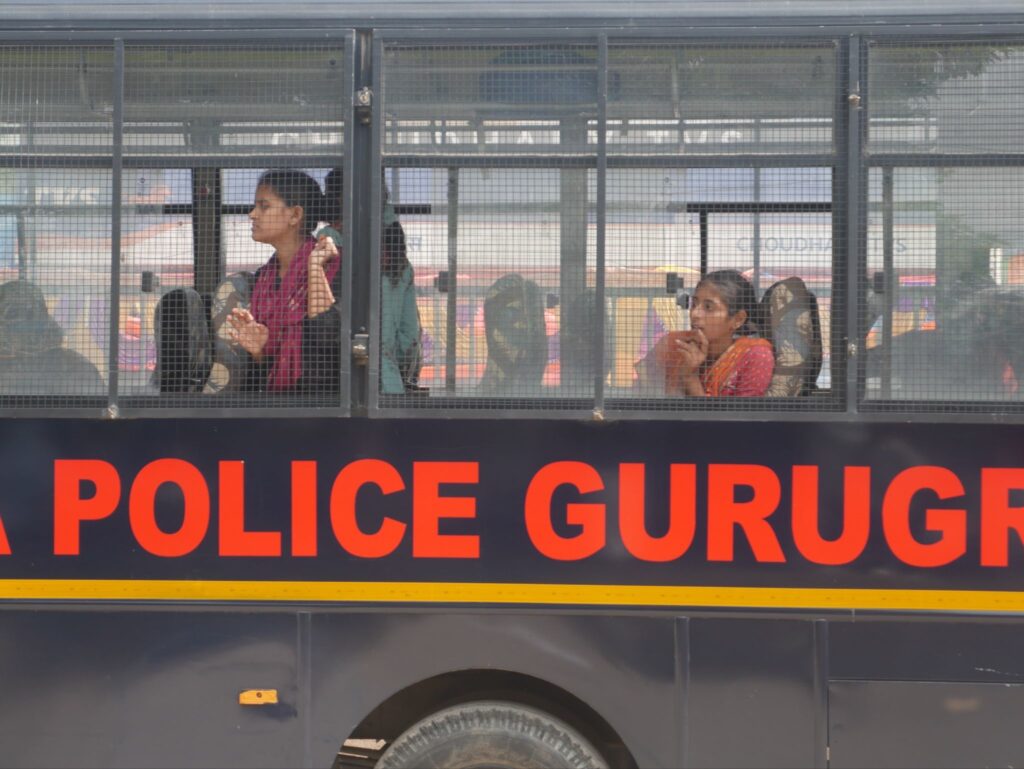
"At this point, I don't understand anything. I don't know what to do," said Muskan, an 18-year-old preparing to become a software engineer, who was one of the key voices among the basti's youth who have been fighting the demolition threats since the judgment of January 16.

"After today, it feels like nothing we can do matters."

Muskan was among many young women who very nearly escaped violent detention as police forcefully cleared the homes on the outer periphery of the basti. Her friend, a young girl named Shivani was among five people falsely imprisoned without food or water in a detention van outside for the entire duration of the demolition drive, which continued from early afternoon till the evening. Four of these five detainees were women.

"We did nothing. We weren't violent, we weren't obstructing anything.  We just asked them not to raze our homes," said Shivani from behind the grills of the detention van. All the detainees were released past sunset.

[caption id="attachment_44164" align="alignnone" width="696"] Shivani (left) was one of five people arbitrarily detained from the demolition site, four of whom were women. She claimed that none of them protested violently or caused any disturbance to the police except protesting the demolition. October 2025/MOULI SHARMA[/caption]
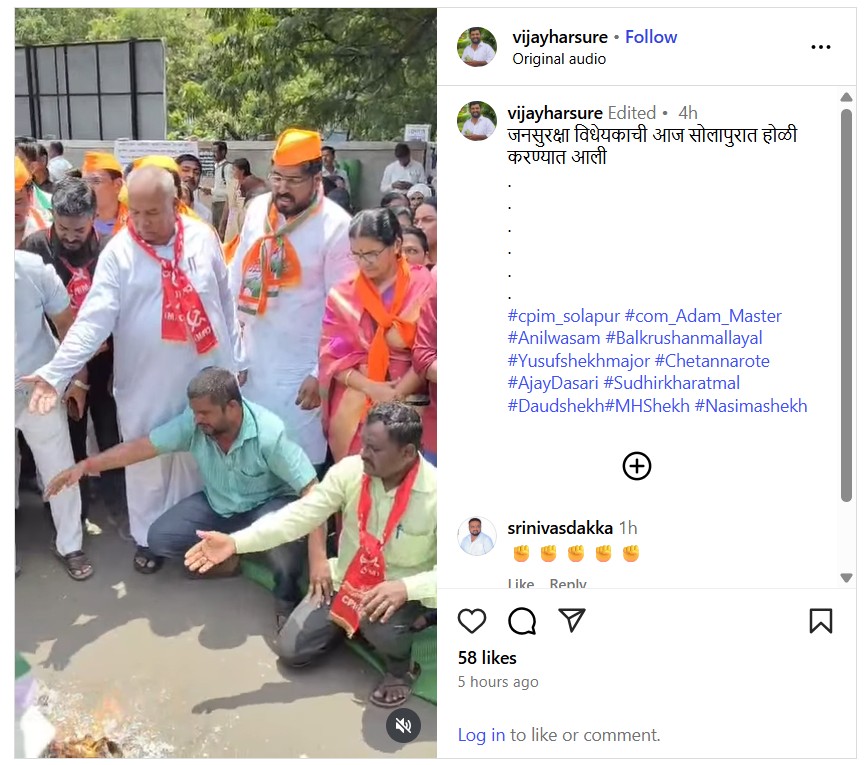
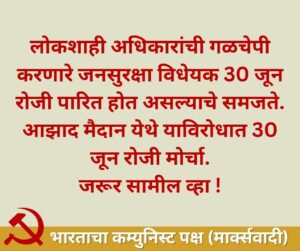
For now, the 86 families marked for rehabilitation wait in limbo — their allotted homes in the Ashiana Scheme still locked, decaying, and unfit for habitation. With no timeline or written assurance from the HSVP, uncertainty looms large. Many fear that once the media attention fades, their protection too will quietly dissolve, leaving them next in line for eviction.

(The author is a scholar of religion at Jamia Millia Islamia and a freelance journalist from New Delhi. Additional fieldwork by Vishnu Khanawalia, a reporter and activist from New Delhi.)


Protests across Maharashtra denounce the Public Security Act as unconstitutional and anti-democratic

A wave of protests swept across Maharashtra today as opposition parties, civil society organizations, and grassroots groups came together to denounce the recently passed Maharashtra Public Security Bill, branding it a “Public Oppression Bill.” Demonstrations took place in Mumbai, Pune, Kolhapur, Solapur, Palghar, Beed, Hingoli, Dhule, Gadchiroli, Gondia, and several other districts, marking one of the largest coordinated state-wide agitations in recent years.

Ever since the introduction and passage of the controversial law, a unique alliance of people’s organisations and opposition political parties have come together, on four separate occasions to protest this law that spells doom for free expression, the right to protest and dissent. In April 2025 and then again in July 2025, there have been protests around this legislation.

Pune: Call to resist “state repression”

In Pune, under the leadership of Supriya Sule (MP), National Working President of the NCP (Sharad Pawar faction), a mass gathering was organized at the Babasaheb Ambedkar Memorial near Pune Station. City NCP president Prashant Jagtap called on citizens to resist the law, warning that it empowers the state to directly imprison dissenters and silence public opposition.

[gallery size="large" td_select_gallery_slide="slide" ids="43455,43456,43457,43458,43459,43460,43461"]

Mumbai: Opposition Action Committee leads joint protest

In Mumbai, the Janasuraksha Bill Opposition Action Committee led a protest at Chhatrapati Shivaji Maharaj Maidan, Dadar, from 4–8 pm. The meeting was chaired by Com. Prakash Reddy (CPI) and attended by leaders across the political spectrum:

  • Congress – Dhananjay Shinde
  • NCP (Sharad Pawar faction) – Rupesh Khandke
  • CPI(M) – Com. Shailendra Kamble
  • CPI – Com. S.K. Rege, Amir Kazi, Com. Nana Parab
  • Peasants and Workers Party – Com. Rajendra Korde
  • Hum Bharat Ke Log – Feroze Mithiborwala
  • CPI(ML) – Com. Vijay Kulkarni
  • APCR – Shakir Shaikh, Adv. Inamdar
  • Autonomous women’s organisations and civil liberty activists from Forum against Oppression of Women among others.

A message of solidarity was also sent by MLA Sachin Ahir (Shiv Sena–UBT). Multiple people’s organisations pledged participation.

[gallery size="large" td_select_gallery_slide="slide" ids="43462,43463,43464,43465,43466,43467,43468"]

Loh and Rural Maharashtra: Constitution and democracy defended

In Loh, a demonstration began with floral tributes at the statue of Dr. B.R. Ambedkar, followed by slogans:

  • “Long Live the Constitution”
  • “Repeal the Anti-People Public Security Act”
  • “Down with the Fadnavis-Shinde-Ajit Pawar Government”

Leaders including Com. Rameshwar Pawal (CPI-M), Milind Sawant (Congress), Rameshwar Bahirat (Shiv Sena–UBT), and Bhai U.R. Thombal (Shetkari Kamgar Paksha) condemned the Act as an assault on democratic rights. Protesters reminded that 10 lakh signatures and over 1.24 lakh written objections were submitted to the Governor, but the government still “bulldozed” the Bill through the Assembly.

[gallery size="large" td_select_gallery_slide="slide" ids="43470,43471,43472,43473"]

Other District Actions

  • Kolhapur: Maha Vikas Aghadi held a sit-in at the Collector’s office, led by Congress’s Harshvardhan Sapkal and district leaders; a memorandum was submitted.

  • Solapur: Protesters burnt an effigy of the Act in a symbolic rejection.

[gallery size="large" td_select_gallery_slide="slide" ids="43474,43475,43476,43477"]

  • Manchar: A large gathering under MVA banner denounced the Act.

  • Palghar district: Demonstrations were staged at Dahanu, Palghar, Vasai, Wada, Vikramgad, Jawhar, and Mokhada.

[gallery size="large" td_select_gallery_slide="slide" ids="43479,43480"]

  • Beed, Shevgaon (Ahmednagar), Hingoli, Dhule, Gadchiroli, Gondia: District-level agitations with party workers and civil society activists submitting memoranda.

[gallery size="large" td_select_gallery_slide="slide" ids="43481,43482,43483,43484,43485,43486,43487,43488,43489,43490,43491,43492,43493,43494,43495,43496,43497,43498,43499,43500,43501,43502"]


Opposition’s Stand

Across locations, including Shahada, Nandurbar, Shambhajinagar and Satara, western Maharashtra, speakers reiterated that the MSPS Act violates Articles 14, 19, and 21 of the Constitution, criminalises dissent, and grants unchecked powers to the state. They demanded its immediate repeal, warning that Maharashtra risks becoming a “police state.”

Slogan on everyone’s lips was: Not Public Security, but Public Oppression Bill!”

Related:

Azad Maidan erupts in protest as Maharashtra set to enact sweeping law aimed at silencing dissent

From Sindhudurg to Mumbai, Maharashtra erupts in protest against repressive public safety bill

Maharashtra Rises in Protest: State-wide agitation against draconian Maharashtra Public Safety Bill on April 22


Power, Patronage, and Protest: The Making of AMUSU’s Opportunism

A former student of AMU

[Note: Before proceeding, I should situate myself: I studied Literature at AMU between 2015–2018 and lived in one of its hostels. This is not to claim privileged insight, but to underline that my reflections come from lived proximity rather than distant observation.]

The recently aborted student protest at Aligarh Muslim University (AMU)—ostensibly about reviving the Students’ Union (AMUSU) rather than resisting the fee hike—offers a troubling yet instructive window into the nature of campus politics at AMU.

A Legitimate Beginning

At the outset, it must be remembered that the agitation began on a legitimate plank: the arbitrary and unjustified fee hike. For many students from modest backgrounds, AMU’s subsidized education is their only ladder to upward mobility. Their resistance was therefore natural and justified. The protest was marked by determination and—crucially—visible leadership from female students who camped at Bab-e-Syed. Their resilience forced the administration to roll back the hike to 20%.

But soon, the focus shifted.

The Twist

Before engaging with this shift, a brief background is essential. AMUSU—short for Aligarh Muslim University Students’ Union—was, in principle, meant to bridge the administration and the student community by offering effective representation. In practice, however, its history paints a sorry picture.

Supporters romanticise AMUSU as a “nursery for leadership,” pointing to names like Azam Khan and Arif Mohammad Khan. Yet, since 2017, when the University suspended it on the flimsy pretext of law and order, AMU has remained without an elected student body. The suspension was arbitrary and undemocratic, contradicting the very spirit of a university as a space for debate, dissent, and contrarian thought.

Reality, however, diverges sharply from the romanticism. Over the past decade, AMUSU has drifted far from its founding purpose. Most office-bearers—barring rare exceptions—have been academic underperformers or regional strongmen who treated the Union as a launchpad for failed political careers or as a network for contracts, patronage, and admissions. Regionalism thrived through collusion with faculty members from their own provinces, while the welfare of the broader student body remained a mere veneer. Unsurprisingly, AMUSU enjoys little respect among ordinary students.

Against this backdrop, the fee hike protest had nothing to do with AMUSU elections. Yet, seeing a readymade platform for mobilization, the AMUSU lobby opportunistically inserted itself. For a few days, they kept the rollback of fees as the visible agenda and AMUSU revival as a secondary one. But when their chances dimmed, anxiety set in. Their desperation

was rooted in past failures—one prominent activist had even approached the Supreme Court with a contempt petition citing the Lyngdoh Committee, only to have it dismissed in July 2025, a fact he concealed from fellow students. With the fee protest gaining momentum, the lobby saw its golden chance: a mass movement they could never build on their own was suddenly available to hijack.

How AMUSU Aspirants Hijacked the Fee-Hike Protest

Sections of students who had long lobbied for AMUSU elections—despite lacking credibility among peers—seized the protest as a platform to advance their agenda. History shows that AMUSU has ceased to represent students in any meaningful sense. Much like Ambedkar’s critique of Indian villages as “sink of localism, a den of ignorance, narrow mindedness, caste and communalism,” AMUSU has degenerated into a den of factionalism, patronage, and regressiveness.

Rather than critiquing, confronting and exposing systemic issues—declining academic standards, nepotistic faculty and administrative recruitments, inbreeding in admissions, or entrenched elites’ dominance—the AMUSU camp staged hunger strikes and moral dramas, allegedly under the blessings of a Law professor and the Eastern UP faction. These theatrics were less about student welfare and more about arm-twisting the administration.

Gender Insensitivity and Hypocrisy

Equally glaring is the hypocrisy. The same AMUSU hopefuls who now cloak themselves in the language of student rights were absent when female students were mishandled by the Proctorial team during protests over electricity shortages. Their selective silence exposes a deep gender insensitivity. Worse, when the fee hike protesters—mostly girls—refused to be co-opted, they were abused, branded “dalals,” and smeared on social media.

A movement that cannot respect women within its own ranks stands discredited- and rightly so.

The Deal with the Administration: Regional Politics at Play

Perhaps the most disturbing development was the timing of the administration’s assurance to the hunger striker: elections in December, after semester exams. This timing was no coincidence. By then, most outstation students—from Bihar, Bengal, the Kerala, and Kashmir

—would have left, leaving the electoral field to Western UP students and their Azamgarh allies.

Why not hold elections in August–September, when all students are present? Neither the administration nor the hunger striker offered a convincing answer. Their silence reeks of sub- regional opportunism.

What Went Off the Agenda?

Equally telling is what disappeared from the protesters led by hunger striker’s list of demands:

  1. School fee hikes—despite RTE 2009 and the active role of Ahmadi School students— were quietly dropped, even though they had kept Centenary Gate closed till 19 August
  2. Administrative accountability—the demand for replacing the Proctor, Director (Schools), and Controller of Exams was abandoned. The moment students pressed for the removal of the long-serving ad hoc Controller (a local appointee with entrenched clout), the entire protest was abruptly called off before sunrise on 19

This sequence exposes the deeper malaise: protests shaped less by genuine grievances than by the compulsions of entrenched elites.

The Larger Picture: Opportunism of the Muslim Elite

This episode raises uncomfortable questions not only about AMU but about India’s Muslim elites more broadly:

  1. Why do entrenched cliques, clouts, lobbies monopolize university offices and student bodies?
  2. Why is regional dominance—particularly of Western UP and Azamgarh—normalized, while voices from other provinces are systematically muted?
  • Why do organizations like SIO or IYF remain silent on nepotism, gender insensitivity, or ad hoc appointments, yet selectively speak up when AMUSU’s revival is at stake?

The answer is crude opportunism. These elites are less invested in reform than in safeguarding their own hegemony.

Conclusion

The August 2025 AMU protests reveal a painful truth: genuine student concerns—fee hikes, gender justice, transparent governance, fair examinations—were eclipsed by the opportunism of a narrow faction bent on reviving AMUSU for self-interest.

The December election timeline, the abandonment of school fee issues, the silence on the ad hoc   appointments of high administrative officers/directors that too from within the internal teachers , and the abuse of female protesters expose the agitation for what it was: a cynical power       play.   Far      from sacrifice,               the    hunger    strike    was    political theatre. And the administration, complicit through opaque bargains, stands equally discredited.

In the end, one is left asking: was this agitation ever meant to empower students, or was it always designed to pressure the Hon’ble Supreme Court, which heard the case of VC’s appointed on 18 August 2025; the Petitioners, too, in the said case are insiders; and protect sub-regional dominance?

The anatomy of this protest leaves little doubt: AMUSU and the AMU administration mirror each other’s failures. Together, they embody what is wrong with entrenched elite politics of Muslims—visionless, opportunistic, and hostile to the aspirations of common students.

(The author of this article known to the Editors chooses to remain anonymous)


Protest decision of Union Government to Scrap 11% Import Duty on Raw Cotton: AIKS

The All India Kisan Sabha (AIKS) has condemned the decision of the RSS-BJP led union government to scrap the 11% import duty on raw cotton. The decision, notified by the Central Board of Indirect Taxes and Customs (CBIC) is valid from August 19 until September 30, 2025. According to the AIKS, this decision will result in a reduction in the price of imported cotton which, in turn, will push prices of domestic cotton downwards. Small cotton producers in India cannot compete with large, industrial-scale cotton farmers of the United States who have historically received massive government subsidies.

According to the CPI-M affiliated mass organisation of farmers, the AIKS, the immediate impact of this decision will be particularly severe as farmers in most cotton-growing areas have already sown their crops almost two months back and have sunk significant costs in anticipation of getting remunerative prices for their produce. This move to scrap import duties comes at a particularly bad time as farmers prepare to harvest their crop. Cotton-growing regions of India are notorious for agrarian distress and death by suicides by farmers. The latest policy decision will further push cotton farmers into indebtedness and aggravate the economic distress.

The statement also states that it is ironic that this anti farmer decision was followed by Prime Minister Modi’s Independence Day speech in which he said that he is “standing like a wall against any adverse policy that could impact Indian farmers, fisherfolk and cattle keepers” and “India will never compromise the interests of Indian farmers, fisherfolk and cattle keepers”. Modi’s consistent pro imperialist policies couldn’t ensure the protection of India’s interests in the tariff war initiated by Trump. The US has declared a more than 50% tariff on India’s textile exports. To manage the situation, Modi has decided to punish Indian cotton farmers who are the weakest links in the global supply chain.

Finally, the AIKS states that “the neoliberal era has witnessed the squeezing of Indian cotton farmers from the input and output side by the state-capital nexus. In his 11 year tenure as the prime minister, Modi never gave MSP to the cotton farmers at the recommended rate of C2+50. For instance, the Commission for Agricultural Costs and Prices (CACP) announced MSP for cotton in the 2025 Kharif season is Rs.7710 per quintal. If the C2+50 formula was used, it would have been Rs.10075 per quintal. To put it in a simpler way, Indian cotton farmers are currently receiving Rs.2365 less per quintal as MSP. This itself is a clear betrayal of the farmers. If the cotton price is further declining, it will be outright looting of the farmers.”

“The duplicity of US lobbying with the Indian government to reduce state support to the Indian cotton farmers is well documented. It has been estimated that, in the US, government subsidies are as high as 12 per cent of the total value of production of cotton while in India, government support to cotton farmers is about 2.37 per cent of the value of production. This massive disparity in levels of state support is at the core of the advantage US cotton farmers have over cotton producers in developing countries.”

It is the massive disparity in levels of government support and the large difference in scale of production of farmers in the US and India combine to put Indian farmers at a huge disadvantage, explains the statement by the AIKS released by its President, Ashok Dhawale and General Secretary, Vijoo Krishnan.

The AIKS also points out that it is crucial to remember that the US government is putting pressure on India to similarly open Indian markets to other farm products from the US. Unless farmers make it clear to the Indian government that such anti-farmer decisions will not be tolerated, it is likely that the Modi government will succumb to the US pressure and take such decisions for other crops as well. Hence, the AIKS has called upon all farmers to come together and launch an intense agitation to force the government to reverse this decision.

Related:

A Silent Emergency: Farmer suicides surge in Maharashtra amid apathy, debt, and systemic collapse

As 30 crore workers, farmers join July 9 strike against govt.’s policies, will there be media coverage of the shut down?

TN: Sugarcane Farmers Protest, Demand Better FRP, Reintroduction of SAP

Farmers’ leader detained forcefully on Constitution Day as protests for delivering guarantee on legal MSP intensify

Unseasonal Rains: Over 80 Dead, Huge Damage to Crops, Orchards; AIKS Demands Ex-Gratia

Gene-edited rice sparks alarms: Scientists back activists, warn of hidden dangers


Azad Maidan erupts in protest as Maharashtra set to enact sweeping law aimed at silencing dissent

Azad Maidan turned into a powerful site of resistance today, June 30, as thousands gathered under the banner of people’s movements, left parties, to oppose the Maharashtra Special Public Safety Bill, 2024. The protest was also supported by the opposition parties, that is the Maha Vikas Aghadi (MVA). With the bill expected to be tabled in the monsoon session of the Assembly, the protest marked one of the most unified public mobilisations in recent years against what is widely perceived as a legal weapon against dissent.

The mobilisation was, in large part, organised by the Communist Party of India (Marxist) and the Communist Party of India, with support from people’s organisations. Key MVA constituents—the Shiv Sena (Uddhav Balasaheb Thackeray), Indian National Congress, and the Nationalist Congress Party (Sharad Pawar faction) turned out in support. The turnout reflected a broad political front, including working-class organisations, students, farmers’ unions, and civil liberties groups.

State Secretary of the CPI (M), Dr. Ajit Nawale, had issued an open call for participation across Maharashtra, urging district units to treat this as a “decisive stand against authoritarianism.” Protesters arrived from across the state—by bus, train, and private vehicles—responding to the call to defend democratic rights.

Opposition and civil society leaders stand together

Several prominent leaders stood in solidarity at the protest. Shiv Sena (UBT) leader Uddhav Thackeray, Supriya Sule of the NCP (SP), CPI state secretary and labour organiser Subhash Lande and senior social activist Ulka Mahajan joined demonstrators at Azad Maidan, expressing serious concern about the implications of the bill.

[gallery td_select_gallery_slide="slide" ids="42519,42520,42521,42522,42523,42524,42525,42526,42535"]

These leaders and activists highlighted how the Bill, under the pretext of “public safety,” could be used to suppress dissent, criminalise activism, and target opposition voices. They noted that terms such as “radical Left-wing organisations” and “urban Naxal” remain undefined and dangerously broad in the amended draft, leaving space for arbitrary interpretation.

Other speakers also pointed out that the bill’s provisions—such as unchecked powers to evict communities (Section 9), seize properties (Section 10), and deny lower court remedies (Section 12)—mirror the most draconian aspects of laws like the UAPA and NSA.

From every corner of Maharashtra, a message of resistance

The crowd was a mix of students, youth, farmers, trade unionists, and senior citizens. Red flags and protest banners filled the grounds of Azad Maidan. Many held up pamphlets circulated by the organising groups, breaking down the bill’s most dangerous provisions and urging complete withdrawal—not mere amendments. Visuals from the ground show the scale and intensity of the crowd gathered at the ground. Protesters emphasised that the Joint Committee’s amendments are superficial and leave intact the state’s power of surveillance, to prosecute, and punish under vaguely defined offences (Detailed report on earlier protests may be viewed here)

Backdrop: The Bill’s imminent passage in the Monsoon Session

The Maharashtra government had invited public comments and criticisms on the Bill, to be submitted by April 1. Among thousands of others, Citizens for Justice and Peace had also submitted an elaborate critique. This may be read here. The protest coincides with the start of the Maharashtra Assembly’s monsoon session, where the revised Maharashtra Special Public Safety Bill is likely to be introduced. Although the Joint Committee proposed some changes—such as limiting the bill’s applicability to organisations and raising the investigation officer’s rank—rights groups and opposition parties have argued that these are cosmetic changes that do not alter the repressive core of the legislation.

The continued use of ideological terms, the lack of statutory definitions, and the shielding of officials from prosecution (Sections 14 and 15) have all been flagged as severe threats to constitutional safeguards. The committee’s refusal to hold public hearings with those who submitted objections has also drawn sharp criticism.

The joint coalition of activists, people’s organisations and the left front have strongly critiqued the published ‘report of the Joint Committee.’ Citizens for Justice and Peace presents its critique here:

Note on Joint Committee Report on the Maharashtra Special Public Safety Bill, 2024: Superficial amendments, structural repression intact

June 30, 2025

What has been termed as the Joint Committee’s report on the Maharashtra Special Public Safety Bill, 2024 (Assembly Bill No. 33), appears to be a clear whitewash of the actual discussions that took place with members of the Opposition over five sittings since the Committee was formed. The obvious motive of this government is not even to record or allow the dissent and voices that were raised by members of the Opposition (Maha Vikas Aghadi) on key aspects of the Bill which includes definitions, seizure and arrest powers, superintendence of investigations, constitution of the Advisory Board and also the denial of one tier of justice, the district courts for first appeals.

Fundamentally, the very insistence of this regime and administration for the passage of a fourth law to ostensibly counter terrorism (or Naxal-caused terror) when Maharashtra already has the Maharashtra Control of Organised Crimes Act (MCOCA) since 1999, the Unlawful Practices (Prevention) Act since its inception –first 1967 and post 2004 with multiple amendments since it’s a central law—and finally the 2023 Bharatiya Nyaya Samhita (BNS) Sections 113-119 that have incorporated all draconian sections of the UAPA in everyday criminal law. [The justification, therefore that ‘other states have such a law’ is nullified by the facts: these states had enacted these legislations before the UAPA in amended form applied to the entire country and also the BNS, 2023.]

What can be the reasons (or the motive) to bring in a fourth such legislation when the above stringent provisions are already in force? Except to use it as a sword over the heads of activists (political and social), writers, dissenters, political opponents—in fact any person/s who are “inconvenient” to the regime or administration? A fourth law with draconian provisions will make bail impossible!

The press note by the government on behalf of the Committee clearly reveal that the discussions and deliberations notwithstanding, the attitude of the state government has not changed and the final Bill (in few form) when it will be tabled, will continue to be riddled with core constitutional defects.

Changes outlined in the Press Note June 26, 2025 on “Committee’s Findings:

The changes made are cosmetic, rhetorical, and deliberately evasive. The bill retains its unconstitutional structure, vague terminology, and legal architecture that allows for the criminalisation of dissent, targeting of political opponents, and violation of fundamental rights.

Despite widespread opposition, extensive written objections, and participation from multiple political formations and civil society organisations, the Committee has made only three formal amendments:

  1. Rewording the objective clause to target “radical Left-wing organisations or similar organisations”;
  2. Recasting the composition of the Advisory Board;
  3. Raising the investigating officer’s rank from Sub-Inspector to Deputy Superintendent of Police.

None of these changes address the key concerns raised regarding the need for multiplicity of counter terror laws, wide definitions, unchecked executive power, procedural violations, denial of legal remedy, and institutional impunity. This report, therefore, must be categorically rejected. The bill remains a direct attack on India’s constitutional order.

I. Title and Objective: Politically weaponised language, vague in law

Original title:

“A Bill to provide for the more effective prevention of certain unlawful acts of persons and organizations…”

Amended title:

“A Bill to effectively prevent certain illegal activities of radical Left-wing organisations or similar organisations…”

Analysis:

  • The rewording does not narrow the scope. It simply replaces generic terms with ideologically charged and undefined phrases.
  • The inclusion of “radical Left-wing organisations or similar organisations” is deliberately vague. No legal definition of “radical” is provided. The phrase “similar organisations” creates infinite elasticity, allowing any ideological formation—even peaceful or democratic—to be labelled a threat. [Note: Radical Right-Wing Organisations have escaped all consideration or mention!]
  • The justification for this framing lies in the invocation of “urban Naxalism”—a politically loaded term with no statutory definition. Its continued use codifies the state’s ideological hostility to dissent.

Conclusion: This amendment intensifies the bill’s politically motivated purpose. Here is not a law to main peace or law and order, but a tool to terrorise and silent dissent. It reinforces a narrative in which civil society actors, trade unions, student groups, and political opponents can be branded as subversive. The bill’s objective remains a tool of ideological surveillance, not a legitimate legal safeguard. 

II. Advisory Board: Erosion of judicial independence

Original Clause 5(2):

The Advisory Board was to comprise individuals who “are or have been judges of a High Court or are eligible for appointment.”

Amended Clause:

Now allows appointment of:

  • Retired High Court Judges
  • Retired District Judges
  • Government Advocates of the High Court

Analysis:

  • This amendment is a deliberate dilution of judicial independence.
  • Government advocates are functionaries of the executive. Their inclusion on a body meant to evaluate the legality of state actions obliterates the principle of neutral oversight.
  • Retired district judges do not carry the constitutional status or independence of High Court judges.
  • The executive retains unchecked power to choose pliant members, turning the Advisory Board into a formal rubber stamp.

Conclusion: The Advisory Board, which was supposed to serve as a procedural check, has now been structurally compromised. The amendment institutionalises executive capture of oversight mechanisms. 

III. Investigating Officer Rank: Cosmetic bureaucratic adjustment

Original Clause 15(1):

Police officers not below the rank of Sub-Inspector to investigate offences under the Act.

Amended Clause:

Investigation restricted to officers of the rank of Deputy Superintendent of Police or above.

Analysis:

  • Raising the rank of the investigating officer is an administrative change. It does not alter the grounds, process, or criteria of investigation.
  • The real issue is not who conducts the investigation, but what can be investigated.
  • The law allows vague, subjective interpretation of terms like “association,” “support,” or “membership” of radical groups.
  • The UAPA and NSA demonstrate that higher rank officers have been equally complicit in abuse and arbitrary arrests.

Conclusion: This amendment is a public relations manoeuvre, not a safeguard. It creates the illusion of due process while leaving arbitrary detention and criminalisation of dissent fully operational.

IV. Structural defects the Committee has deliberately ignored

The most dangerous provisions of the original bill, identified in detailed submissions by multiple groups including CJP, remain untouched. The committee has not even acknowledged, let alone amended, the following especially:

Section 2(f): Overbroad definition of “Unlawful Activity”

  • No revision made.
  • The section allows any form of protest, critique, or public mobilisation to be interpreted as a threat to public order.

Section 9: Arbitrary eviction and property seizure

  • District Magistrates and Police Commissioners retain absolute powers to seize properties and evict residents from notified areas.
  • Only a vague promise of “reasonable time” to vacate is offered to women and children.

Section 10(1): Confiscation of moveable property

  • No legal safeguards introduced.
  • Entire homes, records, belongings, and finances can be seized on executive suspicion.

Section 12: Bar on district-level legal remedy

  • Individuals can only approach the High Court or Supreme Court to challenge state action.
  • This provision deliberately denies access to justice for economically weaker citizens and violates the principle of accessible legal redress.

Sections 14 & 15: Blanket immunity to officials

  • Officers and magistrates acting under the law are granted total immunity, even when they violate constitutional rights.
  • No mechanisms for accountability or independent review have been introduced.

Conclusion: The bill continues to function as an extra-constitutional regime. It merges preventive detention, ideological policing, and property seizure into a legal framework shielded from public accountability and judicial review.

V. Committee’s Ideological Closing Statement: Criminalising youth and dissent

The report ends with a “recommendation” urging the state to act against the “growing attraction” of youth to Naxalism and to implement policies to “discourage” them and “bring them into the mainstream.”

Analysis:

  • This ideological framing reinforces that the law is designed to monitor, control, and neutralise student movements, political education, and grassroots activism.
  • The state’s role is redefined not as a guarantor of rights, but as a censor of ideas.

Conclusion: The bill is not preventive security legislation. It is a state doctrine against dissent, designed to criminalise political education, intellectual opposition, and mobilisation.

This report must be rejected in its entirety!

The Joint Committee has failed in its legislative duty to protect constitutional values. It has whitewashed a draconian bill under the guise of minor technical amendments. What remains is a legal instrument of political repression.

The bill:

  • Treats opposition as extremism
  • Treats mobilisation as subversion
  • Treats dissent as treason

This is a dangerous precedent. Not just that the Maharashtra government has reduced the functioning of a democratically set up Committee with Members of the Opposition in the State Assembly to tokenism but is proceeding –riding roughshod over critiques of such a law—with a statute that will have dangerous consequences. If enacted, it will be used to target civil society, demolish protest movements, paralyse unions, and intimidate the political opposition across Maharashtra.

Note prepared by Team Citizens for Justice and Peace


Related:

Maharashtra Unites: State-wide protests to take place against controversial MSPS Bill on April 22

Understanding the Maharashtra Special Public Security (MSPS) Bill, 2024 | Threat to Civil Liberties?

Maharashtra’s redrafted Public Security Bill narrows scope — but concerns about suppression of dissent persist

CJP sends objections against Maharashtra Special Public Security Bill, 2024, citing grave threats to civil liberties

Press Release: Experts warn, Maharashtra Special Public Security Bill a threat to civil liberties


TN: Sugarcane Farmers Protest, Demand Better FRP, Reintroduction of SAP

Sugarcane farmers of Tamil Nadu recently held a protest in Chennai on demands including a fair and remunerative price (FRP) of Rs 5,500 per tonne and state advisory price (SAP) of Rs 4,000 per tonne by withdrawing the revenue sharing formula (RSF) introduced in 2018 by the state government.

The farmers have also been demanding the implementation of M S Swaminathan Commission recommendation to ensure a minimum support price (MSP) to protect the farmers from increasing input costs.

The Tamil Nadu Sugarcane Farmers Association (TNSFA) accused the policies of the Union government for the reduction in sugarcane cultivation and sugar production.

The other major demands included revamping of cooperative sugar mills and disbursal of Rs 1,217 crore due to farmers from 24 private sugar mills for sugarcane procurement during 2014-17.

INCREASE FRP AND SCRAP RSF

The farmers organisations have been demanding an MSP of C2+50% of C2 for all agricultural products. The Union government has recently announced an FRP of Rs 355 per quintal (Rs 3,550 per tonne), for 10.25% sugar recovery rate, which the sugarcane farmers association has termed insufficient.

The TNSFA, affiliated to the All-India Kisan Sabha (AIKS), has been demanding a minimum of Rs 5,500 per tonne, even though the Union government has claimed to have increased by FRP by 4.41%.

Speaking with Newsclick, D Raveendran, general secretary, TNSFA, said, “We are demanding an FRP of Rs 5,500 per tonne for a 9.5% sugar recovery rate. The state government should scrap the RSF and reintroduce the SAP and ensure Rs 4,000 per tonne as promised”.

The ruling Dravida Munnetra Kazhagam (DMK) had promised to announce Rs 4,000 as SAP during the 2021 Assembly election campaign.

DISBURSE SAP DUES

The sugarcane farmers face the task of being tricked by mills which procure sugarcane from them, by inordinately delaying the payment.

In a detailed memorandum submitted to the Director of Sugar, government of Tamil Nadu, during the protest, the association has demanded the distribution of Rs 1,217 crore for sugar procurement by private sugar mills for four seasons of 2013-14, 2014-15, 2015-16 and 2016-17.

The association has won a legal battle for a share in profit from the procurers as per Section 5A of the Sugar Control Order, 1966. The association has urged the director to expedite the implementation of the order.

REOPEN CLOSED MILLS

Several cooperative and public sector sugar mills are closed due to mismanagement and wrong policies of the successive state governments, besides several private mills are closed citing losses. The association accused some mills of betraying the farmers despite their financial stability.

“The state government must reopen several cooperative mills across the state to ensure the farmers receive a fair deal for procurement and increase the sugarcane cultivation. This will ensure employment in the government sector and the welfare of the farmers”, Raveendran said.

Courtesy: Newsclick


From Sindhudurg to Mumbai, Maharashtra erupts in protest against repressive public safety bill

A day of resolute resistance unfolded across Maharashtra on April 22, 2025, as citizens, civil society organisations, and political parties came together for a coordinated state-wide agitation demanding the immediate withdrawal of the Maharashtra Special Public Security Bill (MSPS), 2024. With over 78 protests held across 36 districts—from remote tehsils to urban collectorates—the message was unambiguous: the people reject what they describe as a draconian and anti-democratic law.

In Sindhudurg, a formal memorandum was submitted to the District Collector by Shri Bhaskar Kasar, representing the coordinated anti-bill movement. Addressed to DM Walawalkar, the memorandum called for the scrapping of the MSPS Act, citing its unconstitutional overreach and misuse of the term ‘public security’ to suppress dissent and target marginalised communities.

In Nanded, members of the Jan Suraksha Vidhayak Virodhi Samiti staged a Satyagraha, sitting in peaceful protest under a banner demanding the immediate withdrawal of the Bill. Community leaders and activists took turns addressing the gathering, warning of the chilling implications of this law for citizens' rights and democratic discourse.

Symbolic acts of protest also marked the day’s events. In a striking demonstration held in Goregaon (West), protesters staged a dharna to denounce what they called the “insidious intention of the State” in introducing a bill “mischievously titled” as a Jan Suraksha (Public Security) Act. One protester commented that “even canines have understood the threat to democracy,” referencing the presence of a protest dog draped in a sloganed banner—a biting visual critique of the government’s attempt to silence criticism.

At Beed district, part of the Chhatrapati Sambhaji Nagar (Aurangabad) division, a mass sit-in was held outside the Collector’s Office. People’s movements and Left front parties jointly led the action, warning that the Bill aims to usher in an era of “autocratic rule” by robbing citizens of their constitutionally guaranteed freedoms. Placards and speeches throughout the day declared: “Under the guise of Jan Suraksha, they are snatching away our right to speak, to organise, to protest. This is not security—this is suppression.”

In Raigad, parallel protests took place both at the District Collector’s Office and the Tehsildar’s Office in Uran.

While Mumbai’s Bandra Collectorate saw a gathering of progressive groups rallying under the slogan: “Awaken, progressive society of Mumbai! Join the protest against the anti-people Maharashtra Public Security Act on April 22nd at 3 PM in front of the Bandra Collector’s Office. Scrap the Jan Suraksha Act. Inquilab Zindabad!”

In Nanded, the Jan Suraksha Vidhayak Virodhi Samiti held a Satyagraha demanding the scrapping of the Maharashtra Public Security Bill 2024. Protesters gathered under a large tent bearing banners that read “Jan Suraksha Vidhayak Radd Karo”, asserting that the law was aimed at silencing dissent and eroding constitutional freedoms.

Speeches were delivered by Comrade Sanjay Nangare (Shiv Sena UBT), Adv. Avinash Magre (Congress), Dr. Amol Phadke (Congress), and Dattatray Funde (Swabhimani Shetkari Sanghatana), all sharply criticising the Bill’s provisions and the threat they pose to democracy. A memorandum was submitted to Tehsildar Prashant Sangade during the demonstration.

Key attendees included Com. Adv. Subhash Lande (CPI), Bhagwanrao Gaikwad, Babanrao Pawar, Dattatray Are, Vaibhav Shinde, Ram Lande, Vishnu Gore, Balasaheb Mhaske, Ashok Najan, Adv. Afroz Shaikh, Babulal Sayyed, Geeta Thorve, Anjali Bhujbal, Mrs. Sable, and others.

In Thane, members of the Bharat Jodo Abhiyan and the Maharashtra State Workers' Union (Thane district) staged a protest outside the District Collector’s office, decrying the Maharashtra Public Security Bill 2024 as anti-democratic and anti-worker.

The diverse and decentralised nature of these protests reflects the intensity of opposition to the MSPS Bill across Maharashtra.

Critics of the Bill have raised serious constitutional and legal objections. The Maharashtra Special Public Security Bill, 2024 allows the state to declare any organisation “unlawful” for acting against the “security of the state” or “public order”—terms that remain undefined and dangerously vague. The Bill gives sweeping powers to the police, including warrantless searches and seizures, extended pre-trial detention, and immunity from prosecution. It also empowers the government to seize the property of those accused, even before conviction, and criminalises ‘support’ to unlawful organisations in ways that can encompass mere association, speech, or financial transactions.

Legal experts and rights defenders have warned that the legislation mirrors the most repressive features of central laws like the UAPA and the erstwhile TADA, but with weaker procedural safeguards. It also bypasses judicial scrutiny by allowing the executive to set up “Public Security Councils” to take punitive action. These measures, protestors argue, are not about ensuring safety but about consolidating power and shrinking democratic space.

As the protests continue to gather momentum and testimonies of resistance pour in from across the state, the message is clear: the people of Maharashtra are not willing to cede their rights in the name of a security paradigm that criminalises dissent.


Related:


Maharashtra Rises in Protest: State-wide agitation against draconian Maharashtra Public Safety Bill on April 22

Understanding the Maharashtra Special Public Security (MSPS) Bill, 2024 | Threat to Civil Liberties?

CJP sends objections against Maharashtra Special Public Security Bill, 2024, citing grave threats to civil liberties

Press Release: Experts warn, Maharashtra Special Public Security Bill a threat to civil liberties

Maharashtra Special Public Security Bill: Bogey of “urban naxals” invoked to legitimise clamping down of dissent?


Maharashtra Rises in Protest: State-wide agitation against draconian Maharashtra Public Safety Bill on April 22

On April 22, 2025, a coordinated and widespread agitation will take place across the state of Maharashtra under the banner of the Maharashtra Public Safety Bill Anti-Conflict Committee. The protests demand the complete withdrawal and repeal of the Maharashtra Special Public Safety Bill, 2024, a controversial legislative proposal that has drawn criticism from civil society, legal experts, and political parties for its sweeping powers and potential for misuse.

For the past six weeks, an unprecedented coordination effort has been underway, uniting left parties, progressive organisations, human rights groups, and people’s movements across the state. This united front—comprising the CPI, CPI(M), Shetkari Kamgar Paksh, CPIML, Lal Nishan Party, Satyashodhak Communist Party, Shramik Mukti Dal, Citizens for Justice and Peace (CJP), PUCL, and Sarvahara Jan Andolan, among others—has culminated in this planned day of state-wide action. Major opposition parties including the Maha Vikas Aghadi and its constituents—Shiv Sena (Uddhav Balasaheb Thackeray), Indian National Congress, and NCP (Sharad Pawar)—have also publicly extended their support to these protests.

Thousands of pamphlets have been disseminated across the state, particularly those authored by CJP, outlining the bill’s draconian provisions and urging citizens to join the resistance. The agitation on April 22 will span virtually every major district in Maharashtra, covering district collectorates, tehsil and taluka offices, and important public squares. In Mumbai, demonstrators will gather outside the Collectorate in Bandra. In Pune, protests will take place at the Collectorate and in Ambegaon and Junnar. In Nagpur, the protest will take place around Samvidhan Chowk. Thane district will see action at the Collector’s Office, as well as in Vikramgad, Dahanu, Talasari, Jawhar, and Palghar tehsils. Additional protest locations in Thane include Shahapur tehsil.

Planned protests across Maharashtra

On April 22, widespread demonstrations, dharnas, and sit-ins will be held at government offices, district collectorates, and tehsil headquarters across multiple districts of the state. The key protest sites include:

  • Mumbai – At the Collector’s Office, Bandra
  • Pune – Collectorate and Ambegaon, Junnar offices
  • Nashik – Collectorate and Tehsildar Offices in Surgana, Kalwan, Dindori, Chandwad, Peth, Trimbak, Nandgaon, Malegaon, Malegaonshahar, and Niphad
  • Thane – Vikramgad, Dahanu, Talasari, Jawhar, Palghar, Shahapur Tehsildar’s Office and District Collectorate
  • Ahmednagar (Ahilyanagar) – Collectorate, Sangamner Provincial Office, Shevgaon Tehsil Office
  • Nagpur – Samvidhan Chowk
  • Wardha – Collector’s Office
  • Amravati – Collector’s Office and Tehsildar’s Office
  • Chhatrapati Sambhaji Nagar – Divisional Commissioner’s Office
  • Jalna – Collector’s Office and Partur Provincial Office
  • Nanded, Satara, Sangli, Jalgaon, Solapur, Dhule, Chandrapur, Akola, Gondiya, Bhandara – Collector’s Offices
  • Parbhani – Collector’s Office and Tehsil Offices at Shelu, Manawat, Pathri, and Purna
  • Buldhana – Tehsildar Offices at Khamgaon, Malkapur, Sangrampur
  • Gadchiroli – Tehsildar’s Office, Armori
  • Raigad – Uran Tehsildar’s Office
  • Kolhapur District – Protests coordinated by the Left Front at multiple locations: Collector’s Office, Ichalkaranji, Gadhinglaj, Kagal, Ajra, Radhanagari, Bhudargad, and Shahuwadi Tehsildar’s Offices

These demonstrations are expected to bring together thousands of protestors, including workers, farmers, students, lawyers, and community organisers. The agitation has witnessed an unprecedented unification of ideological and political forces.

Attk on social political movements threa their survival n existence CPI
Democratic Freedoms Threatened, Right to ques govt policies curtailed CPI
Poster of 22 april protest
Threat to Inde Media Free Speech CPI one
Vague Definitions Open Door for Authorities’ Abuse threaten Funda Freedoms CPI TWO
Vague Definitions Open Door for Authorities’ Abuse threaten Funda Freedoms CPI

Concerns about the bill

The scale and intensity of the agitation reflect the deep concern that the Maharashtra Special Public Safety Bill, 2024 poses a grave threat to democratic freedoms and civil liberties. Although framed by the state as a public safety initiative, the bill has been widely criticised for granting the government extensive powers to enable surveillance, detain, and suppress dissent. Civil liberties groups, including CJP and other rights organisations, warn that the legislation empowers the state to criminalise peaceful protest and legitimate political expression under vague definitions of “unlawful activity.”

Incidentally, the Maharashtra government had invited public comments and criticisms on the Bill, to be submitted by April 1. Among thousands of others, Citizens for Justice and Peace had also submitted an elaborate critique. This may be read here.

Problematic sections

The Advisory Board envisaged under Section 5 is also problematic. Unlike earlier legal frameworks which mandated sitting or retired High Court judges, this Bill allows for individuals merely qualified to be appointed judges, diluting judicial independence and creating scope for politically aligned appointments.

The Bill also provides for arbitrary seizure and eviction powers. Section 9 empowers District Magistrates or Police Commissioners to take over any notified area and evict its residents with little to no legal oversight. Section 10 further extends this to allow the confiscation of moveable property, which could be used to cripple individuals or organisations financially.

Perhaps most shockingly, Section 12 bars those detained under this law from seeking redress in district courts, forcing them to approach only the High Court or Supreme Court. This effectively removes a critical layer of legal protection for common citizens and disproportionately affects the poor and marginalised who may lack the means to access higher courts.

Finally, Sections 14 and 15 grant blanket immunity to police officers and bureaucrats, even in cases where they are found to have abused the law. This creates a culture of impunity, with no accountability for misuse or excesses.

A direct threat to Constitutional freedoms

Legal experts and rights groups assert that the MSPS Bill poses a serious threat to several constitutional rights, including:

  • Article 19 – Freedom of speech, assembly, and association
  • Article 21 – Right to life and personal liberty
  • Article 14 – Right to equality before the law

By granting unchecked powers to the executive and removing essential judicial safeguards, the Bill represents an alarming shift toward authoritarian governance. The concerns raised go beyond legal technicalities—this is a battle to preserve the democratic ethos of Maharashtra and, by extension, India.

In response, this April 22 protest will serve as a powerful expression of public resistance. It is not just a symbolic protest, but a collective demand for the preservation of democracy, civil liberties, and constitutional values in Maharashtra. The coming together of political parties, civil society groups, and grassroots organisations is a rare but urgent show of unity against legislation that threatens to fundamentally alter the relationship between the state and its citizens.

Related:

Understanding the Maharashtra Special Public Security (MSPS) Bill, 2024 | Threat to Civil Liberties?

CJP sends objections against Maharashtra Special Public Security Bill, 2024, citing grave threats to civil liberties

Press Release: Experts warn, Maharashtra Special Public Security Bill a threat to civil liberties

Maharashtra Special Public Security Bill: Bogey of “urban naxals” invoked to legitimise clamping down of dissent?


Protests over Waqf (Amendment) Act escalate into violence in West Bengal; Calcutta HC intervenes

The violence that erupted in Murshidabad, West Bengal, in early April 2025, was a direct result of growing unrest linked to the Waqf (Amendment) Act, 2024, which had sparked protests across various parts of the state. Initially, the protests were peaceful demonstrations against the Act, which critics argue undermines the autonomy of Muslim religious endowments. However, on April 8, 2025, the situation escalated, with the protests quickly turning violent, particularly in the districts of Suti, Dhulian, and Jangipur. Tensions allegedly reached a breaking point following Friday prayers on April 11, when protesters clashed with security forces, leading to stone pelting, vandalism, and widespread destruction of public property.

The violence resulted in the tragic deaths of three individuals, including a father-son duo, who were found brutally stabbed in their home, and a young protester who succumbed to bullet wounds inflicted during clashes with the police. None of the deceased – Ijaz Ahmed, a student, and a father and son of one Das family, Haragovinda and Chandan – were actively instigating violence or part of any political outfit, as their friends and neighbours claimed, and yet they were killed. The escalation of violence saw public outrage and large-scale disruptions, with protesters blocking roads, attacking police vehicles, and intensifying confrontations with security personnel. Despite the assurances from West Bengal's Chief Minister Mamata Banerjee that the law would not be implemented in the state, the unrest continued to spread, further exacerbating the already sensitive political situation.

In response to the deteriorating law-and-order situation, the Calcutta High Court intervened on April 12, 2025, following a petition filed by BJP leader Suvendu Adhikari. The court directed the deployment of Central Armed Police Forces (CAPF) to restore order in Murshidabad and other affected areas. The court’s intervention highlighted the inability of local authorities to handle the violent protests effectively, leading to heightened concerns over the implications of the Waqf Amendment Act and the potential long-term consequences of the violence on the region’s communal harmony. The Murshidabad incident, along with the subsequent unrest in various districts, underscores the complex intersection of religion, politics, and law in India, further fuelling a sense of uncertainty among the state’s population.

Calcutta High Court orders deployment of central forces in Murshidabad

In an urgent hearing convened on April 12, the Calcutta High Court directed the deployment of Central Armed Police Forces (CAPF) in West Bengal’s Murshidabad district, following violent clashes during protests against the recently enacted Waqf Amendment Act. The unrest, which has left at least three people dead, prompted swift judicial intervention in response to a plea moved by Bharatiya Janata Party (BJP) leader Suvendu Adhikari.

Chief Justice T.S. Sivagnanam constituted a special division bench comprising Justices Soumen Sen and Raja Basu Chowdhury to hear the matter. The petition, filed by Adhikari and lawyer Tarun Jyoti, sought the immediate deployment of central forces in view of the escalating violence and deteriorating law and order in the region.

During the hearing, the court was informed that the protests in Murshidabad — particularly in areas like Jangipur and Dhulian — had descended into chaos, with violent mobs clashing with the police, pelting stones, setting police vehicles on fire, and injuring several personnel. The violence also disrupted railway services, as protestors damaged infrastructure and blocked tracks, leading to the cancellation and diversion of multiple trains. A railway crossing gate between Dhulianganga and Nimtita was also vandalised.

Acknowledging the gravity of the situation, the bench criticised the inadequacy of the state government’s response, stating that the measures undertaken so far were insufficient to contain the violence. “Action had to be taken on a war footing to arrest the rioters,” the court observed, as per the Scroll. It added that had central forces been deployed earlier, the escalation of violence could potentially have been avoided.

The High Court made it unequivocally clear that constitutional courts could not remain passive observers in the face of such internal disturbances. “Constitutional courts cannot be a mute spectator and embroil itself in technical defences when the safety and security of the people are at danger,” the bench remarked, as quoted by Bar and Bench.

Accordingly, the court directed the deployment of CAPF in Murshidabad district, with instructions that the forces coordinate closely with the state’s civil administration to restore peace and normalcy. Significantly, the bench clarified that this direction was not limited solely to Murshidabad — should similar situations arise in other districts, the central forces must be promptly deployed there as well.

In addition, the High Court instructed both the West Bengal government and the Union government to file detailed reports outlining the steps taken to manage the situation. The matter has been posted for further hearing on April 17, 2025.

The protests stem from widespread discontent with the Waqf Amendment Act, 2024, which was passed by Parliament on April 4 and received Presidential assent on April 5, coming into effect on April 8. The law introduces sweeping changes to the original Waqf Act of 1995, including amendments to 44 sections. Among its controversial provisions are the inclusion of non-Muslims on Waqf boards, restrictions on property donations, and changes to the functioning of Waqf tribunals — measures that many critics argue significantly dilute the autonomy of Muslim religious endowments and increase governmental control.

Despite the state government’s assertion that the plea was politically motivated and that law enforcement agencies had already taken adequate measures — including the deployment of six companies of the Border Security Force (BSF) — the High Court found that the reality on the ground indicated otherwise. It noted the persistence of unrest in multiple districts, underlining the need for urgent and coordinated action.

The full order may be viewed here.

[viewpdf 41160]

Incidentally, Murshidabad has more than 66 percent Muslim population, as per the 2011 census, and TMC bagged all three parliamentary seats in 2024, including Jangipur at the epicentre of the weekend’s violence. Of the district's 22 assembly seats, TMC has 20; the party controls all 26 Panchayat Samitis and nearly all of the 250 Gram Panchayats. Out of eight Municipalities of the district, TMC has seven, and the one that is left out – Domkal – is run by a TMC-appointed administrator. With such a heavy police domination, representatives of the party in power in the state do have questions to answer.

The Congress, the All India Majlis-e-Ittehadul Muslimeen (AIMIM), and other parties have already approached the Supreme Court to challenge the constitutional validity of the amended legislation. Meanwhile, the situation in parts of West Bengal remains tense, with Murshidabad emerging as an epicentre of the protests and related violence.

Arrests mount amid continued tensions

The situation in West Bengal’s Murshidabad district remained tense but relatively calm on April 13 following days of violent protests against the controversial Waqf Amendment Act. According to PTI, the West Bengal Police confirmed that 12 more individuals were arrested overnight in connection with the unrest, raising the total number of arrests to 150. Officials stated that prohibitory orders were still in effect and internet services had been suspended in the affected areas.

Police officers, quoted anonymously, reported that areas like Suti, Dhulian, Samserganj, and Jangipur—previously at the epicentre of the unrest—were under close surveillance and had seen no fresh outbreaks of violence. “Raids continued through the night, and 12 more people were taken into custody,” said one officer, as per the Hindustan Times. “The situation is currently peaceful.”

The protests began on April 8 and intensified after Friday prayers on April 11. Even as Chief Minister Mamata Banerjee had stated on April 10 that the amended Waqf Act would not be implemented in West Bengal, violence struck again in the state. “I know you are aggrieved because of the enactment of the Waqf Act,” said CM Banerjee, as per Times of India.Have faith, nothing will happen in Bengal by which one can divide and rule.”

On April 11, violent protests erupted in West Bengal’s Murshidabad district following Friday prayers, primarily centred around opposition to the Waqf (Amendment) Act. Protesters argue that the Act has been imposed without sufficient consultation or consideration of the socio-economic priorities of the community, such as employment and healthcare. Tensions escalated when large gatherings defied prohibitory orders and blocked National Highway-12 from Dakbanglo More in Shamsherganj to Sajur More in Suti. Police reports indicate that the situation turned violent after stones were hurled at a police van, resulting in injuries to at least ten personnel. Security forces resorted to lathi charge and later used tear gas to control the situation. In some instances, officers were forced to take shelter in nearby mosques.

Fresh violence erupted in Dhulian under the Samserganj block on April 12. Police confirmed that one person suffered a bullet injury during the clash, though senior officials said they were still verifying the full details. The unrest also disrupted public infrastructure. Protesters damaged a railway crossing gate between Dhulianganga and Nimtita, forcing the cancellation and diversion of several trains, according to Eastern Railway officials.

In total, at least 18 police personnel were injured, and scores of civilians, including women and children, have been displaced. The district administration suspended internet services and imposed prohibitory orders under Section 163 of the BNSS, equivalent to Section 144 of the CrPC, to contain the situation.

In response, the state administration had deployed six companies of the Border Security Force (BSF).

Political fallout and government response

The political fallout has been swift. BJP leaders, including Suvendu Adhikari and state president Sukanta Majumdar, criticised the Trinamool Congress government for allegedly soft-pedalling on violence by "a section of minorities." Majumdar asserted that a future BJP government would crush such "vandalism" within minutes and accused the current regime of appeasement politics.

Chief Minister Mamata Banerjee responded by stating that the Waqf (Amendment) Act would not be implemented in West Bengal, asserting that the state government would not allow any attempt to "divide and rule". She urged for unity and calm, but her remarks did little to quieten the situation on the ground.

Opposition parties, particularly the Bharatiya Janata Party (BJP), were quick to capitalise on the unrest. Adhikari also alleged that over 400 Hindus were displaced and forced to flee to Malda district out of fear. He described the violence as "jihadist terror" and accused the Trinamool Congress (TMC) government of indulging in "appeasement politics", further fuelling communal polarisation.

Current situation and outlook

The Murshidabad violence is a grim reminder of the fragility of communal harmony in politically polarised and socio-economically marginalised regions. The protests highlight growing discontent within sections of the Muslim community, who feel unheard in national policymaking. At the same time, the BJP’s sharp rhetoric and the high-pitched calls for action raise concerns about communal profiling and the danger of deepening divides.

As of April 13, 150 people have been arrested, and no fresh incidents have been reported. Police are conducting continuous raids, and security personnel are maintaining a tight vigil in the affected areas. However, the damage has already been done. Markets were looted, homes vandalised, and families displaced. Videos have emerged of victims recounting how mobs entered their homes and destroyed property, as residents now demand a permanent BSF presence in these vulnerable areas.


The State’s response has been reactive rather than proactive. The Chief Minister’s refusal to implement the law appears more a political manoeuvre than a principled stand. Meanwhile, the High Court’s intervention underscores a judicial acknowledgement of the failure of local law enforcement.

Ultimately, the incident points to a confluence of legislative opacity, administrative failure, and political opportunism, turning a policy dispute into a tragic episode of communal violence. It is also essential to highlight here that West Bengal will be seeing Lok Sabha elections in 2026, Murshidabad might not just be a law-and-order flashpoint but a symbol of a larger crisis in India's secular fabric.

It is essential to note here that a different angle has also emerged regarding the violence in Murshidabad, with the locals of the area saying that there was a presence of unidentified young men during the violence who were not from the area. Several residents recounted that a group of boys, aged around 15 to 18, dressed in black hoodies and armed with rods and sticks, appeared just before the unrest broke out. “These were not our boys,” one person said, adding that both Hindu and Muslim youth from the locality had been working together to safeguard nearby temples. This observation has fuelled concerns that the violence may not have been entirely organic, but instead instigated by external elements with a vested interest in disrupting communal harmony. This lesser-reported aspect of the violence is now being brought to light by residents of the area. Questions are now being raised about who these young men were, who brought them into the area, and what their intentions were—an angle that demands serious attention amid the rush to communalise the incident.


A political fault-line exposed

The recent eruption of violence in Murshidabad, West Bengal, over the amended Waqf Act lays bare the volatile intersection of religion, law, and politics that continues to define India's communal landscape. The April 11 unrest, which claimed three lives and left scores injured, has reignited political tensions ahead of the 2026 Assembly elections. At the centre of the conflict is the controversial Waqf (Amendment) Act, passed by the Union government — a piece of legislation that critics, including West Bengal Chief Minister Mamata Banerjee, have denounced as a deliberate attempt to sow division and inflame religious sensitivities.

Banerjee, in a strongly worded statement, reaffirmed that Bengal would not implement the amended law. Urging for calm, she cautioned against “irreligious behaviour in the name of religion” and accused unnamed political actors of weaponising faith for electoral gain. Emphasising that the legislation was passed by the union — not the state — she distanced her government from the violence and warned of legal action against those spreading misinformation. Her message was unequivocal: the Waqf Amendment is not only unconstitutional but dangerously incendiary, and the Union government must be held accountable for its fallout.

The Bharatiya Janata Party (BJP), however, presented a starkly different narrative. State leaders alleged that Hindu families were being driven out of Murshidabad’s Dhulian area, citing “religious persecution” and accusing the TMC of “appeasement politics.” Leader of the Opposition Suvendu Adhikari claimed that over 400 Hindus had fled across the Ganga, while state BJP president Sukanta Majumdar criticised TMC MPs for remaining silent in the face of the crisis. Their rhetoric, framing the incident as the outcome of the TMC’s so-called minority appeasement, was in line with the BJP’s broader electoral messaging in Bengal.

Amid this escalating blame game, both the Congress and the Left mounted a scathing critique of the TMC and BJP, accusing them of exploiting the unrest for political gain. Congress MP Adhir Ranjan Chowdhury accused the state administration of being “asleep at the wheel,” while the CPI(M) condemned the police for being “mute spectators” and demanded Army deployment.

Caught in the middle of these political crossfires are the people of Murshidabad — whose lives have been turned upside down. Even if claims of a mass exodus remain unverified, the devastation on the ground is undeniable. Homes have been vandalised, shops looted, property destroyed, and public trust shattered. Three people have died, civilians and police personnel have been injured, and daily life has come to a standstill in many parts of the district. Children have missed school, local businesses have suffered, and fear has spread across communities. As politicians argue over narratives, it is ordinary citizens who continue to pay the highest price.

The violence in Murshidabad is more than a law-and-order issue — it is a stark reminder of how religious identity continues to be manipulated in Bengal’s political theatre. As national and regional parties jostle to control the narrative, what gets lost is the constitutional promise of justice, accountability, and equal protection under the law — regardless of religion.

Detailed story on the previous incident of violence in Murshidabad may be read here.


Related:

Amid rumours blaming Muslims, drunk café owner Siddharth Singh arrested for vandalising Veer Tejaji idol in Jaipur

In Congress-ruled Himachal, Hindutva goons ask minorities to leave state, saying ‘Don’t pollute Himachal’

Mob violence, police torture justifiable practices feel a significant section of India’s police: Study

22 arrested, internet suspended as Murshidabad recovers from Waqf Act protest violence


22 arrested, internet suspended as Murshidabad recovers from Waqf Act protest violence

Twenty-two individuals have been arrested following violent protests in West Bengal’s Murshidabad district against the newly enacted Waqf (Amendment) Act, police confirmed on April 9, 2025. The administration stated that the situation is now under control, with prohibitory orders under Section 163 of the Bharatiya Nagarik Suraksha Sanhita (BNSS)—equivalent to the old Section 144 of the CrPC—remaining in place around the Raghunathganj and Suti police station areas until 6 pm on April 10. Internet services in the Jangipur sub-division will remain suspended until 6 pm on April 11.

A heavy police deployment, including the Rapid Action Force, continues to maintain vigil across sensitive areas, particularly in and around Jangipur town, where the worst of the violence unfolded on April 8. Authorities have also intensified patrolling and naka-checking to prevent further unrest.

How the violence unfolded

The violence erupted on the afternoon of April 8, 2025, in Omarpur, under Raghunathganj police limits, when hundreds of protesters blocked National Highway-12 (NH-12) demanding a rollback of the Waqf (Amendment) Act, 2025. Clashes began after police attempted to disperse the crowd, leading to widespread stone-pelting and arson. At least five police vehicles were vandalised—two of which were set ablaze—and a firearm was reportedly snatched from a policeman.

According to official reports, nine people, including four police personnel, were injured in the violence. The mob allegedly shattered windows of vehicles and ransacked shops and houses near the protest site. Protesters refused to clear the highway despite repeated police warnings. In response, police resorted to lathi-charges and tear gas to disperse the crowd and regain control.

Government measures and public safety

In response to the unrest, Murshidabad District Magistrate Rajarshi Mitra passed an executive order imposing restrictions under Section 163 BNSS, prohibiting gatherings of five or more people in areas where there is a perceived threat to public order. State Home Secretary Nandini Chakraborty later issued an order suspending internet services in the entire Jangipur region until April 11 to prevent the spread of misinformation and communal tension.

Superintendent of Police Ananda Roy, who visited the violence-hit areas, confirmed detentions and ongoing operations to identify more suspects. “Some policemen were injured, including a deputy superintendent. Legal proceedings will follow against those involved in the violence and rumour-mongering,” he said, as per Hindustan Times.

Political fallout and divided reactions

The incident has sparked sharp political reactions. West Bengal Governor C V Ananda Bose condemned the violence and urged the state government to take "bold action" against those disturbing law and order. “Attempts to disturb public peace must be crushed with an iron hand,” he said, as per Times of India.

The opposition BJP was quick to blame the Mamata Banerjee-led state government for "minority appeasement" and deteriorating law and order. BJP state president Sukanta Majumdar claimed "violent Islamist mobs" were behind the riots and accused the administration of suppressing the truth by suspending internet services. He further alleged that Hindus were being targeted under the garb of protests.

Congress leader Adhir Ranjan Chowdhury held both the BJP and TMC responsible, accusing them of politicising the issue for communal gain. He criticised the police for their excessive force and demanded a more sensitive approach in a region where over 70 percent of the population is Muslim. Chowdhury warned against stoking further unrest in Murshidabad’s communally fragile landscape.

In contrast, Siddiqullah Chowdhury, a senior TMC leader and state minister, criticised the police crackdown. “Even during the Left rule, police never baton-charged minorities. If there was violence, action must be taken against the guilty. But lathi-charging an entire rally is unacceptable,” he said.

The Waqf (Amendment) Act and its wider impact

The Waqf (Amendment) Act, 2025—passed by the Lok Sabha and the Rajya Sabha after extended debates and signed into law by President Droupadi Murmu—officially came into effect on April 8. The law aims to allegedly modernise the governance of Waqf properties by enhancing transparency, ensuring better coordination between Waqf boards and local authorities, and safeguarding heritage assets.

However, it has been met with opposition from several Muslim organisations and political parties, who argue that the new provisions, especially the inclusion of non-Muslim members in Waqf boards, amount to undue interference in religious affairs. The opposition has labelled the law "anti-democratic" and accused the union of undermining the rights of religious minorities.

The Murshidabad incident is the most violent among a string of protests that have taken place in West Bengal and other states like Tamil Nadu. As per a report of Mint, BJP leaders circulated unverified videos allegedly showing protesters rejecting the Indian Constitution—claims that have been strongly contested by local groups.

Conclusion: Calm returns, but tensions linger

As of April 9, the police report that normalcy has been restored, with traffic on NH-12 resuming and no further incidents reported. However, prohibitory orders and internet restrictions continue to ensure preventive security. Authorities have promised strict legal action against those who instigated violence and against anyone spreading misinformation online.

The political and communal overtones of the protest continue to reverberate across West Bengal, revealing the deep polarisation around religious legislation. While the law has been enacted, the resistance to it—and the state’s handling of dissent—signals that tensions are far from resolved in Murshidabad and beyond.

Related:

Mob violence, police torture justifiable practices feel a significant section of India’s police: Study

A Judgement of Conscience: Bombay High Court orders SIT Probe into alleged fake encounter in Badlapur

Supreme Court slams UP police for criminalising civil disputes, calls it a ‘complete breakdown of rule of law’

Amid rumours blaming Muslims, drunk café owner Siddharth Singh arrested for vandalising Veer Tejaji idol in Jaipur

In Congress-ruled Himachal, Hindutva goons ask minorities to leave state, saying ‘Don’t pollute Himachal’


Black Armbands, State Crackdown: UP targets Muslims for peaceful protest against Waqf Act

On March 28, 2025—Jumat-ul-Vida, the last Friday of Ramzan—hundreds of Muslims in Muzaffarnagar, Uttar Pradesh, wore black armbands during congregational prayers to register a peaceful and symbolic protest against the newly passed Waqf (Amendment) Act, 2024. At the time of the protest, the Act was a bill. The bill has now been passed by both the houses of the Parliament, with Lok Sabha passing it on April 2, 2025 and Rajya Sabha on April 3, 2025, and has received the assent of the President of India.

This protest was in line with an open call by the All India Muslim Personal Law Board (AIMPLB) urging Muslims across the country to express their opposition to the Act by donning black armbands. While similar demonstrations occurred without incident in other states, including Karnataka and Bihar—where even ministers participated—Uttar Pradesh responded with an unprecedented show of state power and repression. The administration has accused hundreds of Muslim men in Muzaffarnagar of “disrupting peace” and “inciting the public,” even though there were no reports of violence, disruption, or unlawful assembly during or after the prayers.

The Charges: Disrupting peace by wearing armbands

On April 5, the City Magistrate of Muzaffarnagar issued notices under Section 130 of the Indian Civil Defence Code to more than 300 Muslims, accusing them of “inciting the general public and endangering law and order.” The sole basis for this accusation, as per the notice, was that they wore black armbands inside the mosque while offering prayers—a constitutionally protected form of expression.

The notices demand that each of the accused appear in court on April 16, 2025 and furnish a surety bond of ₹2 lakh, failing which further legal consequences may follow. The language of the notice makes sweeping and speculative claims, stating that “it is believed that in the future, the respondents may incite the general public and spread misinformation,” thereby justifying pre-emptive action against individuals who have not violated any law.

This use of Section 130—a preventive provision meant to maintain peace in times of actual threat—is being grossly misapplied here to punish individuals for peaceful, symbolic dissent. The invocation of such provisions in the absence of any violence or disorder raises serious questions about the arbitrary use of executive power to criminalise protest.

Lack of evidence, arbitrary targeting

What makes the state’s action even more alarming is the complete absence of individualised inquiry or due process. Notices have been issued not only to those who participated in the protest, but also to people who weren’t even present or aware of the protest.

According to Maktoob Media, Naeem Tyagi, principal of Madrasa Mahmudiya, is among those who received a notice. He categorically stated that he did not wear a black armband and only learned of the protest after arriving at the mosque. "Thousands came for Friday prayers—some wore armbands, many did not. No slogans were raised. There was no demonstration, no speech, no incident," he said.

Similarly, Shabbir, a resident of Sarwat village, received a notice and has declared his intention to challenge it in court. “If MPs can wear black clothes to protest inside Parliament, how is our peaceful action at a mosque any different?” he questioned, as per a report in Maktoob Media. Shabbir also noted that some people listed in the notices haven’t lived in the village for years—suggesting a blanket, communalised approach rather than a lawful, fact-based response.

The local police, when contacted by journalists, failed to offer any explanation or legal justification for their actions and instead disconnected calls—a disturbing reflection of the lack of transparency and accountability that surrounds this crackdown.

Selective policing and disproportionate response

The administration’s action in Muzaffarnagar cannot be seen in isolation. It comes in the context of heightened policing and surveillance across Muslim-majority districts in Uttar Pradesh. Following the passage of the Waqf Amendment Act in Parliament, alerts were issued in districts such as Lucknow, Moradabad, Rampur, Bareilly, Meerut, Amroha, Aligarh, Firozabad, and Shamli, and large contingents of police and paramilitary forces were deployed. Flag marches were conducted by senior police and administrative officers to “maintain peace.”

This alleged militarised response to a symbolic protest smacks of disproportion and is deeply telling of the communal mind-set that governs state action in Uttar Pradesh. In other parts of the country—such as Karnataka—people peacefully offered Eid prayers wearing black armbands, including elected officials and government representatives. States in cities such as Delhi, Mumbai, Lucknow, Bhopal, Kolkata, Jaipur, Ranchi, Nuh, and Coimbatore, and in smaller towns like Baran, Tonk, Bhagwanpur, Mandya, Belagavi, and Bidar, scores of Muslim men and clerics were seen with black bands tied to their sleeves—a show of unity and political expression from a community often vilified for its protest. No such action was taken against them. Only in Uttar Pradesh was this peaceful and silent protest by Muslims was met with threats, intimidation, and legal coercion.

The Act, the right to dissent and the criminalisation of Muslim expression

The Waqf (Amendment) Act, 2024, introduced by Minority Affairs Minister Kiren Rijiju, has sparked nationwide concern among citizens. The Act, which got the President’s assent on April 6, claims to “streamline administration” and “increase transparency,” but many have argued that it allows greater state control over Waqf properties and undermines the autonomy of religious endowments managed by the Muslim community.

Opposition to the Act is not only legitimate but rooted in constitutional freedoms. Protest—particularly peaceful protest—is a cornerstone of democratic expression. To wear a black armband is a time-honoured form of dissent. It has been used globally—from the Vietnam War protests in the US to anti-CAA movements in India—as a non-violent signal of disagreement with state policy.

Criminalising this form of protest by branding it a security threat is not only constitutionally untenable, but morally bankrupt and politically motivated. Additionally, this is not an isolated incident. It fits a larger pattern in many BJP ruled states, especially the state of Uttar Pradesh, where Muslims have routinely been penalised for protest—whether it was the anti-CAA movement, the Friday prayers after incidents of lynching, or even expressions of solidarity with global Muslim causes. Protesters have been met with FIRs, house demolitions, mass arrests, and police violence, while calls for violence from other quarters are often ignored or legitimised.

Remarkably, this show of peaceful resistance came even as state agencies in some BJP-ruled states issued veiled threats and warnings.  In Sambhal, Uttar Pradesh, local police had earlier warned that offering Eid prayers on public pavements could result in revocation of arms licences or passports. Nonetheless, young men in the town were seen participating in the armband protest during Friday prayers, stitching their own bands or using pieces of cloth—demonstrating that grassroots mobilisation continues despite intimidation.

In Bhopal, clerics clarified that the black armband protest was strictly tied to Jumat-ul-Vida, not Eid, to avoid conflating it with religious celebrations. Bhopal Qazi Syed Mustak Ali Nadvi reiterated that the AIMPLB had called for a solemn, prayerful protest—not for confrontation or public disruption.

As per ANI, Maulana Khalid Rasheed Farangi Mahali, who led the Friday prayers at Aishbagh Eidgah in Lucknow, joined the protest by wearing a black armband himself. Addressing the community, he reiterated the Board’s concerns, stating that the now passed legislation was not in the interest of Muslims and urging Parliament to withdraw it

The current episode in Muzaffarnagar is another stark reminder of how law is used as a tool of political repression, especially against Muslims in the state. The government’s message is clear: any form of Muslim political expression, however peaceful, is suspect. Dissent is not just discouraged—it is actively punished.

A silent resistance with powerful symbolism

Despite the limited time between the announcement and the day of prayer, participation was widespread. In many mosques, the Friday khutbah (sermon) included references to the implications of the now passed legislation, which the Board and its supporters believe poses a grave threat to the autonomy and sanctity of religious endowments managed under Waqf. At Delhi’s historic Jama Masjid, hundreds of worshippers participated in the armband protest. A worshipper there remarked that the turnout might have been even higher had senior clerics like Imam Ahmed Bukhari publicly endorsed the call.

Prominent figures in the community did, however, lend their weight to the demonstration. In Lucknow, Maulana Khalid Rasheed Farangi Mahali, Imam of Aishbagh Eidgah and chairman of the Islamic Centre of India, led Alvida prayers while wearing a black armband. He reiterated the community’s concerns and appealed for justice not just regarding the Act but also in the context of Palestinian suffering, which was observed in tandem with International Quds Day—another global protest against Israeli occupation.

The AIMPLB had clarified that their call for protest was intended specifically for Jumu’atul Wida and not for Eid, although some Eid congregations across the country did see black armband-wearing worshippers as well. In historic locations such as Jama Masjid in Delhi, hundreds joined the protest in silence, reflecting both unity and urgency in the face of what the Board described as a legislative attack on community assets.

“Today’s protest is a message to Parliament that Indian Muslims are united in their opposition to this Bill. We are deeply worried about its consequences on our mosques, madrasas, dargahs, and graveyards,” said Maulana Mahali, as per a report in The Hindu.

In public statements and on social media, the Board has described the Act as “controversial, discriminatory, and damaging,” and warned that it would pave the way for the state to arbitrarily appropriate or interfere in the functioning of Waqf institutions under the guise of reform and transparency.

AIMPLB spokesperson S.Y.R. Ilyas hailed the response to the black armband protest as a sign of growing political awareness within the Muslim community. “We issued the call very late, but the overwhelming turnout reflects the desperation of the community to protect its institutions. This is only the beginning,” he said, as per Free Press Journal.

The protest was part of AIMPLB’s broader strategy to mobilise constitutional and democratic resistance to the Act. The Board’s 31-member Action Committee has resolved to continue using peaceful and lawful methods to oppose the recently passed amendments, which they have labelled as “controversial, discriminatory, and damaging”.

On social media, the AIMPLB declared the Act to be a “sinister conspiracy” designed to strip the Muslim community of its historical religious and charitable properties—mosques, Eidgahs, madrasas, graveyards, dargahs, khanqahs, and more. In its official statement, the Board called upon every Muslim to treat resistance to the Act as a collective responsibility, urging them to take part in silent yet visible protest.


Beyond Armbands: Solidarity with Palestine and political resistance

In addition to the black armbands, some worshippers also carried Palestinian flags and placards, expressing solidarity with residents of Gaza and aligning the protest with broader concerns about justice and human rights. The overlap with Quds Day, observed globally on the last Friday of Ramzan to protest Israeli actions in Palestine, added to the emotional and political tenor of the day.

Meanwhile, the AIMPLB’s campaign to oppose the Waqf Act has not been limited to symbolic gestures. In recent months, it has organised multi-party dharnas in Patna and New Delhi, drawing support from political parties like the Rashtriya Janata Dal (RJD). Leaders such as Lalu Prasad Yadav and Tejashwi Yadav have publicly backed the protests, amplifying the message that the legislation is viewed not just as a communal issue, but as a constitutional and democratic concern.

Conclusion: A call for accountability and Constitutionalism

In an age where peaceful protest is frequently met with surveillance, criminalisation, or suppression—particularly when it comes from Muslims—the success of the black armband demonstration is both symbolic and substantial. It shows that people across the country are willing to unite in the defence of their institutions and rights.

The UP-government’s action against black armband protesters is legally unsound, constitutionally indefensible, and morally reprehensible. It undermines the very principles of democracy by punishing individuals not for what they did, but for who they are and what they might do in the future. It reflects a regime that is less interested in public order and more invested in silencing minority dissent through intimidation and fear.

The judiciary must intervene to uphold the constitutional rights of those targeted and ensure that the right to peaceful protest is protected. Civil society, too, must speak out and stand in solidarity with the victims of this arbitrary state action. If wearing a black band in protest is a crime in today’s India, then democracy itself is in peril.


Related:

Uttarakhand HC orders unsealing of Madrassa, SC steps in to hear Jamiat’s petition against Dhami govt’s crackdown against Madrassa

CJP submits objections to Maharashtra Special Public Security Bill, 2024 over serious threats to civil liberties

SC: Recent judgment in the Imran Pratapgarhi case, what are police powers under section 173 (3) BNS?

Was the Waqf Beneficial for Muslim Society?


Mass Deforestation, Protests, Detentions: Supreme Court halts Telangana’s reckless tree felling at Kancha Gachibowli, questions permissions

The Supreme Court’s intervention in the Kancha Gachibowli land dispute on April 3, 2025 has cast a harsh spotlight on the Telangana government’s aggressive push for urban development at the cost of environmental destruction. Taking suo-moto cognisance of the large-scale tree felling, the top court halted all activities in the 400-acre area and demanded answers from the state government. A bench comprising Justices B.R. Gavai and A.G. Masih found the extent of deforestation “alarming,” with images showing peacocks and deer fleeing as heavy machinery flattened the land. The court questioned the government’s urgency, lack of environmental clearances, and disregard for statutory forest land identification processes, warning that the state’s Chief Secretary would be held personally liable for non-compliance.

The Telangana government’s handling of the situation has been marked by opacity, brute force, and suppression of dissent. Despite the Hyderabad Central University’s historical claim over the land and the petitions pending to be heard by Constitutional Courts, the Congress-led administration bulldozed ahead with its plans, using police to clamp down on protests. Students and environmental activists were detained for attempting to join the agitation, while the government dismissed the outcry as “misinformation” and "political opportunism." Meanwhile, the opposition BRS, led by K.T. Rama Rao, has accused Chief Minister Revanth Reddy’s administration of hypocrisy, recalling Congress’s past stance on Aarey forest in Mumbai. Yet, even Congress’s student wing, NSUI, has taken a cautious approach, criticising the government’s failure to secure the land while stopping short of outright opposition.

The administration’s justifications—promises of Rs 50,000 crore in investments and five lakh jobs—fail to address the reckless environmental destruction underway. Officials insist that the land is not classified as forest, yet the Supreme Court’s observations suggest otherwise, raising concerns about procedural violations and potential contempt of court. The government’s relentless push for rapid development, without transparency or public consultation, has turned the issue into a flashpoint of governance failure. Now, with the highest court stepping in, the Telangana government finds itself cornered—forced to defend its actions in what has become a battle between unchecked urbanisation and judicial oversight.

Supreme Court proceedings on Kancha Gachibowli tree felling on April 3, 2025

Post-Lunch Developments: Expressing shock over the large-scale deforestation in the Kancha Gachibowli area of Hyderabad, the Supreme Court issued an immediate order halting all development activities in the region. The bench, comprising Justice B.R. Gavai and Justice A.G. Masih, took suo-moto cognisance of the matter on the same day and directed that no activity, except measures to protect the remaining trees, should take place until further notice.

The court strongly emphasised compliance, warning that any violation of its directive would lead to the personal liability of the Chief Secretary of Telangana. To ensure transparency, the bench ordered the Chief Secretary to submit a detailed affidavit addressing the following concerns:

  1. What was the compelling urgency that necessitated the developmental activities, including large-scale tree removal, in the disputed area?
  2. Did the state government obtain the mandatory Environmental Impact Assessment (EIA) certification before commencing the project?
  3. Were the requisite permissions from forest authorities or any other relevant local bodies obtained before felling the trees?
  4. What was the rationale behind including specific officers in the committee constituted by the Telangana government, particularly those who seemingly have no role in identifying forest areas?
  5. What is the state government’s plan for the felled trees?

Earlier in the day, the court had passed an interim order staying further tree felling and directed the Telangana High Court’s Registrar (Judicial) to conduct an on-site inspection and submit a report by 3:30 PM. When the case was resumed at 3:45 PM, the Supreme Court reviewed the report and found it to be deeply alarming. The inspection revealed that large-scale deforestation was underway, with heavy machinery such as JCBs being used to clear hundreds of acres. The court also noted images showing peacocks and deer fleeing from the destruction, suggesting that the area was an active habitat for wildlife.

Referring to its previous orders in the Ashok Kumar Sharma, IFS (Retd) & Ors. v. Union of India & Ors case, the court emphasised on its March 4 directive that held state Chief Secretaries personally accountable for the failure to constitute statutory committees tasked with identifying forest lands. It also cited its February 3 order in the same case, which prohibited states from reducing forest cover without providing compensatory afforestation land. The court was particularly critical of the Telangana government’s actions, questioning why the deforestation was carried out with such urgency when the statutory process to determine forest land status had not even begun.

Senior Advocate Gaurav Agarwal, representing the State of Telangana, argued before the Supreme Court that the disputed land did not fall under the category of forest. However, the bench remained unconvinced. Justice B.R. Gavai pointedly questioned whether the government had obtained the necessary permissions for tree felling, emphasising that the classification of the land was secondary to the legal requirements for environmental clearances.

"Forest or not, did you secure the requisite approvals before cutting down the trees?" Justice Gavai asked, as per a report in LiveLaw, expressing dismay over the rapid deforestation. "Clearing 100 acres in just two to three days is alarming… We must remind you of a simple principle—no matter how powerful, no one is above the law."

Meanwhile, Senior Advocate Gopal Sankaranarayanan, appearing on behalf of certain intervenors, informed the bench that students protesting the destruction were being detained, highlighting the Telangana government’s heavy-handed approach in suppressing opposition to the project.

Morning proceedings and initial stay order: In the morning session, the Supreme Court had issued an interim order staying the tree-felling activities in Kancha Gachibowli, acting on an urgent oral mention by Senior Advocate K. Paremeshwar, the amicus curiae in the broader forest conservation case (TN Godavarman matter).

The bench took cognisance of media reports highlighting rapid deforestation over the extended weekend, suggesting that authorities had deliberately accelerated the process to avoid public scrutiny. The reports further indicated that the forest area housed at least eight species of scheduled wildlife. Concerned by these developments, the court ordered an immediate site inspection by the Telangana High Court’s Registrar (Judicial), directing that an interim report be submitted by 3:30 PM on the same day.

The directive was communicated to the Telangana High Court’s Registrar (Judicial) by the Supreme Court’s Registrar (Judicial) to ensure prompt compliance. Additionally, the court instructed the Chief Secretary of Telangana to prevent any further tree felling until further orders were issued.

As per Live Law, the order was dictated as follows:

"News reports indicate extensive deforestation is taking place in the Kancha Gachibowli forest. A vast number of trees are reportedly being felled, and it appears that authorities have taken advantage of the long weekend to expedite the destruction. Reports also suggest that the area is home to multiple scheduled wildlife species. We direct the Registrar (Judicial) of the Telangana High Court to conduct an immediate site visit and submit an interim report by 3:30 PM today. The Registrar (Judicial) of this court is directed to communicate this order forthwith. Furthermore, the Chief Secretary of Telangana shall ensure that no further tree felling is permitted in Kancha Gachibowli until this court issues further directions."

During the hearing, Senior Advocate Dr. Abhishek Manu Singhvi, appearing for the Telangana government, informed the court that the Telangana High Court was also hearing a related matter. In response, the Supreme Court clarified that while it was taking suo-moto cognisance of the issue, it had not placed any restrictions on the proceedings before the High Court.

The Supreme Court's strong intervention signals its deep concern over environmental degradation and the failure of state authorities to adhere to legal and procedural safeguards before undertaking large-scale deforestation. The matter is expected to be closely monitored in the coming days.

Telangana High Court proceedings on Kancha Gachibowli forest case

Hearing on April 3, 2025: On Thursday, the Telangana High Court extended its interim order directing a status quo concerning the large-scale felling of trees in the Kancha Gachibowli forest area, located near the Hyderabad Central University (HCU) campus. The bench, comprising Acting Chief Justice Sujoy Paul and Justice Renuka Yara, also granted the State government time until April 7, 2025 to submit its counter affidavit in the matter. The court’s intervention followed an earlier directive issued on April 2, wherein it had explicitly restrained the State from taking any coercive steps until further deliberations. During the said hearing, the court was informed that the Supreme Court had also taken cognisance of the matter earlier in the day and had required for a site inspection to take place.

Senior Advocate Dr. Abhishek Manu Singhvi, representing the Telangana government, argued that the Supreme Court’s directive requiring a site inspection should not be misinterpreted as a restriction on the High Court’s jurisdiction to proceed with the case. He contended that the land in question had been subject to litigation for decades, yet no claims or legal documents had ever categorised it as a forest. According to him, the absence of such claims over the last 30 years underscored that the area was never formally recognised as forest land. Singhvi further claimed that several institutions in the vicinity, including a botanical garden and a golf course, demonstrated the region’s long-standing allocation for non-forest purposes. He insisted that the land had been assigned to a private entity nearly 20 years ago, and the State’s actions were in line with established policies.

In response, Senior Advocate S. Niranjan Reddy, appearing for the Vata Foundation, strongly refuted the State’s assertions. He informed the court that despite the Supreme Court’s order staying tree felling, the destruction had continued until Thursday morning. Reddy submitted an interim application (IA) containing newspaper reports and timestamped photographic evidence substantiating his claim. Additionally, he alerted the court to alleged police repression, revealing that a student who had been documenting the tree felling through video recordings was detained at a local police station. Reddy emphasised that the petitioners were now shielded by the Supreme Court’s intervention but urged the High Court to scrutinise the State’s conduct in its upcoming hearing on April 7.

Another counsel representing a student union underscored the alarming pattern of police atrocities against students peacefully protesting the destruction. He further argued that the land in question belonged to the University of Hyderabad, strengthening the case against its allocation for commercial IT development. Acknowledging these submissions, the High Court directed the State’s legal representatives to formally respond to these serious allegations and scheduled the matter for further hearing on April 7.

The High Court’s order summarised the joint submission made by Senior Advocate Singhvi and the Advocate General, wherein they requested that the matter be heard on April 7 to allow the State sufficient time to file a counter affidavit. The court recorded that the petitioners had no objection to this timeline, provided that the interim relief against tree felling remained in place. Senior Advocate Niranjan Reddy reiterated that since the Supreme Court had already imposed a stay, the High Court should simply proceed with the scheduled hearing on April 7. The court accepted these arguments and directed the State to file its response to all interim applications submitted by the petitioners.

Hearing on April 2, 2025: On Wednesday, the Telangana High Court had imposed a temporary stay on the felling of trees in the disputed Kancha Gachibowli land. The matter was heard following an urgent plea against the Telangana government’s issuance of a Government Order (GO) that sought to alienate 400 acres of green cover for the development of IT infrastructure.

The matter arose from a petition filed by the environmental non-profit Vata Foundation, which challenged a contentious government order facilitating the alienation of 400 acres of green land in the region for IT infrastructure development. The petitioners argued that the GO violated the Forest Conservation Act, 1980, and demanded that all government actions undertaken pursuant to the order be annulled. They further urged the court to designate the land as a ‘National Park.’ Additionally, the court heard a similar Public Interest Litigation (PIL) filed by retired scientist Kalapala Babu Rao, who sought equivalent relief.

The Vata Foundation’s plea asserted that the land, which had remained untouched for centuries, was home to 237 bird species, spotted deer, wild boars, star tortoises, snakes, and ancient rock formations and lakes. The petitioners contended that the Telangana State Industrial Infrastructure Corporation (TSIIC), which acquired the land in 2012, issued the GO in 2024 intending to divert the land for commercial purposes. The rapid deforestation prompted the petitioners to approach the High Court, highlighting that the area also encompassed land belonging to the University of Hyderabad, which needed urgent protection.

The court had originally scheduled the matter for April 7 but was forced to intervene earlier after the petitioners reported that 40 JCB machines had been deployed for large-scale tree felling. Following urgent lunch motion requests, the High Court took up the matter on April 2 and imposed a stay.

During the hearing, Senior Advocate L. Ravichander, appearing for the petitioner Kalapala Babu Rao, highlighted the blatant disregard for judicial precedents by the Telangana government. He pointed out that the government’s actions flouted two crucial Supreme Court judgments—T.N. Godavarman Thirumulpad v. Union of India and Ashok Kumar Sharma v. Union of India & Others—which mandated the identification and preservation of forests, including areas not officially designated as such but qualifying under the dictionary definition. He further argued that the region’s unique rock formations, estimated to be nearly 2 billion years old, harboured rare flora and exotic bird species that warranted urgent protection.

Conversely, the State’s Advocate General A. Sudharshan Reddy dismissed the petitioners’ case as being based solely on “Google images” rather than official records. He argued that the government held clear revenue records indicating that the land had always been designated for industrial use. Attempting to trivialise the issue, he remarked that if the presence of peacocks, mongooses, and snakes were to determine forest status, then large parts of Hyderabad, including the city’s golf course, should also be declared forests. The High Court, however, refused to accept this line of reasoning and reiterated the need for a thorough examination of the matter.

Union government’s intervention

The Union Ministry of Environment, Forest & Climate Change officially intervened in the contentious clearing of 400 acres of forest land in Kancha Gachibowli, Hyderabad, which has been earmarked for auction by the Telangana government. Expressing serious concern over the alleged large-scale deforestation and environmental damage, the ministry has demanded an immediate factual report from the State government regarding the ongoing developments on April 2, 2025.

In a formal communication addressed to the Additional Chief Secretary (Forests) of Telangana on Wednesday, Assistant Inspector General of Forests S. Sundar stated that the ministry had been alerted to reports of "illegal felling and removal of vegetation" in the Kancha Gachibowli area. The Telangana Industrial Infrastructure Corporation Limited (TGIIC), the entity responsible for the land’s auction, was identified as carrying out these activities. The letter noted that widespread news coverage in both print and digital media had highlighted concerns over ecological destruction, particularly regarding harm to the region’s wildlife, water bodies, and distinctive rock formations.

Further amplifying the gravity of the situation, the letter revealed that the Union Minister for Environment, Forest & Climate Change, Bhupender Yadav, had received multiple representations from Members of Parliament and various public representatives, urging immediate action to prevent irreversible environmental damage.

In light of these alarming concerns, the ministry directed the Telangana government to submit a detailed factual report on the matter without delay. Additionally, the State was instructed to initiate legal proceedings as per the relevant statutes, including the Indian Forest Act, the Wildlife Protection Act, and the Van (Sanrakshan Evam Samvardhan) Adhiniyam, among other applicable laws. The letter also stressed the necessity of ensuring strict adherence to judicial directives issued by courts and tribunals concerning forest conservation and land protection.

Reacting to the Union’s intervention, Union Minister for Coal and Mines G. Kishan Reddy publicly expressed his gratitude to Bhupender Yadav for taking decisive action in the matter. Reddy emphasised that the Union’s response was a crucial step towards ensuring governmental accountability, preventing further environmental degradation, and safeguarding the region’s green cover. He further remarked that the intervention would help ensure that all actions related to the disputed land remain within legal boundaries and undergo the necessary scrutiny through proper consultation processes.

Environmental devastation and rising concerns

Student groups and environmental activists have warned that the destruction of the Kancha Gachibowli Forest will have dire ecological consequences. Researcher Arun Vasireddy, in a report on the area's environmental significance, highlighted that deforestation in Kancha Gachibowli Forest could lead to a rise in local temperatures by 1 to 4 degrees Celsius, worsening heat conditions in the Gachibowli region. As Hyderabad’s IT corridor continues to expand, activists argue that the loss of such a crucial green space will further degrade air quality, threaten biodiversity, and contribute to climate instability.

Despite mounting protests, the state government has shown little willingness to engage with environmental concerns, opting instead for heavy-handed police action against students and journalists alike.

Congress government’s crackdown on student protest at University of Hyderabad

The University of Hyderabad (UoH) has erupted in protest as students launched an indefinite boycott of classes, condemning the Telangana government’s decision to auction 400 acres of Kancha Gachibowli through the TGIIC for the development of an IT park. The protests gained momentum amid allegations of state overreach, police repression, and environmental destruction.

According to Akash Kumar, vice president of the UoH Students’ Union, students are being forcibly restricted within the campus premises by the police, preventing them from taking their protest to the streets. “The ongoing deforestation by TGIIC is leading to irreversible ecological damage. Kancha Gachibowli is home to diverse flora and fauna, and we demand an immediate halt to these reckless land-clearing activities. We have launched an indefinite strike today and will continue until the deforestation stops,” Kumar stated while conversing with reporters of The Hindustan Times. He further demanded the removal of the heavy police presence and the more than 50 earthmoving machines that have been systematically razing down the land.

Protesting students emphasised that Kancha Gachibowli is not merely an empty piece of land but an ecological hotspot that harbours over 734 plant species, 220 bird species, and vulnerable wildlife, including the Indian Star Tortoise. The land’s unique rock formations and lakes contribute to the biodiversity of the region, and its destruction for an IT park is seen as an act of environmental vandalism.

Despite widespread public outrage, TGIIC has persisted with the clearing activities since Sunday. The Telangana police, on the other hand, attempted to whitewash their role by releasing a statement on Monday denying the use of force. According to their version, students were not subjected to lathi charges but had instead “attacked officials and workers with sticks and stones.” On Monday and Tuesday, the state police detained 55 students in what has been described as a preventive measure, later releasing 53 of them. However, as per Telangana Today, two students—B. Rohit Kumar and Erram Naveen Kumar—were arrested and remanded to judicial custody, having been booked under multiple sections related to criminal trespassing and rioting.

Escalation of State Repression: Police brutality and arbitrary detentions

As protests entered their fourth consecutive day on April 2, 2025, the situation on campus turned increasingly tense. Students and faculty members, led by the University of Hyderabad Teachers’ Association and the Joint Action Committee, intensified their agitation, rallying inside the campus and condemning both the government’s actions and the university administration’s inaction. However, in a move reminiscent of authoritarian crackdowns on student movements, the state responded with force.

On Tuesday, police had resorted to lathi charges as demonstrators attempted to march towards the main gate. Several students sustained injuries as scuffles broke out at the East Campus, further fuelling resentment against the state’s heavy-handed tactics. Videos circulating on social media show police officers beating students and forcibly dragging them away, despite peaceful protest being a fundamental democratic right.

NSUI-HCU General Secretary Prabhakar Singh spoke to the media and lambasted the university administration for what he called “facilitating” police brutality. “The administration has completely failed us. They enabled the police to enter the campus and allowed JCB machines to continue their destruction. They have not even disclosed the details of the executive council meeting held on March 20, which would have clarified their stance on the land issue,” he said.

The demonstrations have united an unusual mix of political and student groups. Left-wing and Dalit-Bahujan student organisations, along with the Akhil Bharatiya Vidyarthi Parishad (ABVP), the BJP’s student wing, are all opposing the auction. Student unions from institutions such as Jawaharlal Nehru University (JNU) and Osmania University have also extended their support. Meanwhile, the Congress’s student wing, the National Students’ Union of India (NSUI), has taken a more neutral stance, criticising the university’s failure to protect the land while advocating for discussions on securing its ownership.

A Legacy of Encroachments: The larger struggle for campus land

For many within the university community, this battle is not just about the 400 acres at Kancha Gachibowli but about a continued history of state encroachments on university land. Over the years, multiple projects have chipped away at the university’s territory, including the establishment of the IIIT campus, Gachibowli Stadium, a bus depot, a power station, a school, and even a shooting range. “The state has systematically grabbed land from the university for years. Now, this last remaining stretch, which we consider part of our campus, is also being taken away,” said a protesting student, as per the Hindustan Times.

The faculty and students fear that if this land is lost, the university’s expansion will be severely hampered, undermining its status as an Institution of Eminence. More importantly, they stress that the encroachment of green spaces in favour of commercial ventures sets a dangerous precedent, where corporate interests are prioritised over public welfare and environmental sustainability.

While the Telangana government continues to claim sole ownership of the 400-acre land, its narrative has been met with stiff resistance. The state maintains that a survey conducted on July 19, 2024, in the presence of university officials, confirmed that the University of Hyderabad holds no legal claim to the land. However, the university administration has refuted these claims, stating that no such survey ever took place. The institution insists that it has been repeatedly requesting the state for proper demarcation, only to be ignored.

Regardless of the state’s legal claims, protesting students claim that the issue at hand is not mere ownership but environmental conservation and academic autonomy. The land is an irreplaceable green lung for Hyderabad’s IT corridor and must be preserved rather than handed over to corporate interests.

As the protests persist, students remain resolute in their demands: immediate withdrawal of police forces and bulldozers from the campus vicinity, a written assurance from the university administration that it will fight for the land’s legal registration under its name, and transparency in land-related documents and executive decisions.

Journalist detained amid crackdown on protest coverage

Bharat Rashtra Samithi (BRS) working president K.T. Rama Rao has strongly criticised the Congress-led Telangana government for allegedly detaining a journalist covering the ongoing student protests at the University of Hyderabad. KTR condemned the police action, describing it as an excessive use of state power to silence dissent. He accused the government of suppressing press freedom and stifling critical voices. “The draconian police overreach in Telangana is alarming! Journalists are being detained & dissenting voices arrested. This blatant suppression of free speech & expression is unacceptable. And Rahul Gandhi goes to town preaching about democracy and free speech The double standards is beyond sickening.,” he stated in a post on X (formerly Twitter).

The detained journalist, identified as Sumit, was documenting the arrests of students protesting the destruction of greenery on the university campus. He later posted a video on social media showing his detention by the police, sparking outrage among press freedom advocates. BRS spokesperson Krishank also slammed the Congress government, arguing that arresting a journalist for doing their job was an attack on the fundamental role of the media in a democracy.

Political opposition intensifies

Bharat Rashtra Samithi (BRS) working president and former Telangana minister K.T. Rama Rao has called on Congress leader Rahul Gandhi to intervene in the ongoing land dispute at the University of Hyderabad. Citing Gandhi’s past opposition to the destruction of Mumbai’s Aarey forest, KTR questioned the Congress’s silence on deforestation in Telangana.

Amidst growing tensions, Telangana police on April 1 had detained several BJP leaders, including MLAs Payal Shankar and Dhanpal Suryanarayana Gupta, as they attempted to join student protests at the university. The BJP has escalated the matter at the national level, with Telangana BJP president G. Kishan Reddy, Union Minister Bandi Sanjay, and BJP MPs meeting Union Education Minister Dharmendra Pradhan in Delhi to seek his intervention.

KTR, in a series of posts on X, accused the Congress-led state government of suppressing student voices, harming the environment, and even displacing wildlife. He alleged that police were preventing BRS leaders, including himself, from visiting the protest site. Drawing a comparison, he recalled how Rahul Gandhi was given full security and access when he visited Hyderabad Central University twice during K. Chandrashekar Rao’s tenure to support justice for Rohith Vemula. “Why this hypocrisy, Rahul Ji? What is your government trying to hide from the world?” KTR asked.

There have been no social media posts from senior Congress leaders regarding the issue. Leaders such as Rahul Gandhi, Jairam Ramesh, and Priyanka Gandhi have not made any public statements about the protests, arrests, detentions, or the deforestation.

Telangana government defends land auction and development plans

Despite the mounting opposition, the Telangana government is pushing ahead with its plans. Heavy machinery has been deployed to level the land, removing trees and shrubbery over the past few days. Chief Minister A. Revanth Reddy has defended the project, arguing that developing the 400-acre site will spur economic growth, attract investments worth ₹50,000 crore, and generate five lakh jobs. He dismissed opposition leaders as “cunning foxes” attempting to obstruct progress.

On March 31, Telangana’s Revenue Minister Ponguleti Srinivas Reddy had asserted that the state holds full legal ownership of the land. “We took possession of this land after winning legal battles in both the high court and the Supreme Court. Not a single inch belongs to Hyderabad Central University. Any attempt to dispute this is contempt of court,” he declared.

Deputy Chief Minister Mallu Bhatti Vikramarka, an alumnus of the university, clarified that HCU had long assumed the land was under its jurisdiction. He explained that when the Telugu Desam Party (TDP) government allocated 400 acres to a private firm in the past, an alternative 397-acre plot in Gopanpally was provided to the university in exchange.

Accompanied by fellow HCU alumnus and IT Minister Sridhar Babu, Bhatti presented evidence of agreements signed between the university’s former registrar and state revenue officials. Sridhar Babu assured that the auction and development would not harm the ecosystem, including landmarks like Peacock Lake and Mushroom Rock, and that students would continue to have access to these sites.

The ministers also accused opposition parties, particularly the BRS, of spreading misinformation by using old images—such as pictures of a dead deer—to mislead students. TGIIC and Chief Minister’s Office (CMO) officials stated that revenue records confirm the 400-acre plot is not classified as forest land, countering BJP claims that it falls under a protected zone. Officials further revealed that a survey was conducted in July 2024 with the consent of the university registrar, and boundary demarcations were finalised in the presence of university and government officials.

Background: The 400-acre land dispute at Hyderabad University

The 400-acre land parcel at the centre of the controversy is part of the approximately 2,500 acres originally allocated to the University of Hyderabad (Hyderabad Central University) when it was established through an Act of Parliament in 1974. The undivided Andhra Pradesh government had granted this land, which was then a remote area about 20 km from Hyderabad’s city centre. Over the years, with the expansion of Hyderabad’s financial district, the land has become highly valuable, particularly due to the growth of the IT sector and corporate developments.

Located in survey number 25 of Kanche Gachibowli village, Serilingampally mandal, Ranga Reddy district, the land is now surrounded by key institutions, including the university, the International Institute of Information Technology (IIIT), the Indian School of Business (ISB), and major technology campuses such as Microsoft.

In January 2004, following the successful hosting of the 2003 Afro-Asian Games at the nearby Gachibowli sports complex, the then Chandrababu Naidu-led government allotted these 400 acres to IMG Academies Bharat Private Limited for the development of sports facilities. However, the project never took off, leading to the cancellation of the allotment in November 2006 by Naidu’s successor, Y.S. Rajasekhara Reddy. The land was subsequently transferred to the state’s youth advancement, tourism, and culture department.

IMG challenged the cancellation in court, resulting in a prolonged legal battle that lasted nearly two decades. When the Revanth Reddy-led government came to power in December 2023, it pursued the case aggressively. In March 2024, the Telangana High Court ruled in favour of the state government. IMG then appealed to the Supreme Court, but the petition was dismissed in May 2024. Following the court’s decision, the Telangana government formally took possession of the land.

In June 2024, the TGIIC submitted a proposal to utilise the 400-acre plot for IT and commercial projects. Subsequently, on July 1, 2024, the revenue department officially transferred the land to TGIIC, paving the way for its auction and development.


Related:

Supreme Court slams Prayagraj demolitions, awards Rs. 10 lakh compensation to each six victims for violation of due process

Adivasi Land Rights Erosion: The effects of the 2023 Forest Conservation Amendment Act

Record number of forest diversion took place in 2023 amidst decline in spend of CAMPA funds, MoEF data reveals

With less than two weeks for polling, how concerned are national parties on land and forest rights for Adivasis?


Assam: Journalist Dilwar Hussain Mozumdar detained for 12 hours, arrested after covering protest against an alleged recruitment scam involving key BJP leaders

The Assam government has come under heavy criticism following the arrest of senior journalist Dilwar Hussain Mozumdar, who was taken into custody by the state police late on Tuesday night after being detained for nearly 12 hours. On March 25, Mozumdar, the chief reporter at The CrossCurrent, a Guwahati-based digital news portal known for its investigative reporting, was arrested under various charges, including alleged violations of the Scheduled Caste and Scheduled Tribe (Prevention of Atrocities) Act. His arrest is widely being viewed as a blatant attack on press freedom and an attempt to silence critical reporting.

Arbitrary detention and arrest

As per multiple media reports, Mozumdar was covering a protest organised by the youth wing of the Assam Jatiya Parishad (AJP), which was demonstrating against an alleged recruitment scam at the Assam Co-operative Apex Bank (ACAB). The protest was directed at the involvement of key political figures, including Assam Chief Minister Himanta Biswa Sarma, who serves as the bank's director, and BJP MLA Biswajit Phukan, the bank’s chairman.

While carrying out his journalistic duties, Mozumdar questioned the bank’s managing director, Dambaru Saikia, about the allegations. A video clip later released by The CrossCurrent shows Mozumdar attempting to engage Saikia, who then invited him to his office. However, once inside, Saikia allegedly asked him to convince the protesters to leave—a demand Mozumdar rightfully refused, asserting his role as an independent journalist. Shortly after exiting the bank premises, he received a call from the Pan Bazar police station, instructing him to report immediately. Upon arrival, he was detained without any explanation for nearly half a day.

During his detention, Mozumdar’s family had alleged that they were denied access to him, and his diabetic medication, along with iftar provisions during Ramadan, was initially withheld. It was only after repeated insistence from fellow journalists that his wife was allowed to meet him late at night. At around midnight, as per Hindustan Times, the police finally revealed that he had been arrested under the SC/ST (Prevention of Atrocities) Act based on an unspecified complaint. The arrest slip, given to his wife, lacked the complainant's name and specific details of the alleged offence, further fuelling suspicions of a politically motivated crackdown.

Manufactured charges to suppress journalism

The police later claimed that a security guard at the bank, a member of the Bodo community, had lodged a complaint against Mozumdar for allegedly making derogatory remarks. The FIR reportedly cited a single sentence attributed to Mozumdar: “Boro jati hoi tumi besi kora” (being from the Bodo tribe, you do too much). This claim has been widely ridiculed as an excuse to criminalise a journalist for asking uncomfortable questions about alleged financial mismanagement at the bank.

The flimsy nature of the allegations, combined with the prolonged detention without justification, indicates that this is not about protecting any community but about intimidating the press. The selective application of the SC/ST Act in this case is particularly disturbing, as it appears to be a tool for silencing a journalist rather than ensuring justice for marginalised communities. This kind of misuse only serves to delegitimise important legal protections meant to safeguard oppressed groups.

Widespread condemnation and protests

Mozumdar’s arrest has sparked widespread outrage among journalists, civil society groups, and opposition political parties. The Guwahati Press Club held an emergency meeting condemning the arrest, with members wearing black badges in solidarity. Prominent journalists and activists have decried the Assam government’s actions as an egregious assault on press freedom.

Senior journalist Sushanta Talukdar pointed out that Mozumdar’s “biggest crime” was attempting to present a balanced report by seeking answers from the bank’s management. The Editors' Guild of India issued a strong statement condemning the arrest, highlighting that such actions reinforce the growing perception that press freedom is under siege in India. The Press Club of India (PCI) also denounced the police’s refusal to inform Mozumdar’s family and colleagues about the reasons for his detention, calling it a grave infringement of constitutional rights under Article 19(1)(a).

Political leaders have also spoken out against the arrest. AJP president Lurinjyoti Gogoi called it an attempt to establish “Jungle Raj” in Assam, while the Assam Pradesh Congress Committee described it as a direct attack on press freedom. The North East Media Forum urged Chief Minister Sarma to intervene and prevent the misuse of the SC/ST Act to settle political scores.

A pattern of media suppression

Press freedom is not a privilege—it is a cornerstone of democracy, and its systematic erosion threatens the very foundation of civil liberties in India. The detention and arrest of Dilwar Hussain Mozumdar is a dangerous escalation in the Assam government’s hostility towards independent journalism. It sends a chilling message to other reporters: question the state at your own peril. If Mozumdar is not released unconditionally, it will set a troubling precedent where fabricated charges can be used to silence journalists, ultimately eroding democratic accountability.

The fact that Mozumdar had previously reported on irregularities at ACAB raises serious questions about whether this was a pre-planned action to silence a journalist who had become inconvenient for the government. Notably, earlier this month, the Assam Cooperation Department had ordered an inquiry into the bank’s alleged financial mismanagement following a complaint sent to the Central Vigilance Commission. Instead of addressing these allegations transparently, the government appears to be prioritising retribution against those who expose them.


Related:

‘High-Handed, violation of the SC orders’: Bombay HC pulls up Nagpur Civic Body for demolishing homes of accused in communal violence

Comedian Kunal Kamra faces state-sponsored intimidation over satirical remarks on Deputy CM Eknath Shinde

KIIT Suicide Case: Nepalese student’s harassment complaint ignored for 11 months before tragic suicide


Arresting dissent: Punjab Government’s U-turn on farmer protests, protest site bulldozed, farmer leaders detained

In a controversial move, the Punjab Police cleared the Shambhu and Khanauri border protest sites on the evening of March 20, abruptly dismantling a demonstration that had lasted over 13 months. The crackdown came just hours after Punjab’s state authorities had reportedly assured farmer leaders that no such action was being planned. The operation, which included detaining the movement’s key leaders, Sarvan Singh Pandher and Jagjit Singh Dallewal amongst many others, has drawn sharp criticism, raising questions about the Aam Aadmi Party (AAP) government’s changing stance on the farmers' agitation and the role of economic pressures in shaping its decisions.

The Arrests: a pre-planned action to neutralise leadership

Kisan Mazdoor Morcha (KMM) leader Sarvan Singh Pandher and Samyukta Kisan Morcha (Non-Political) leader Jagjit Singh Dallewal were detained while they were en-route back to their respective protest sites after a meeting with the union government in Chandigarh. The meeting, which involved Union Ministers Piyush Goyal, Shivraj Singh Chouhan, and Pralhad Joshi, ended inconclusively as the Union had dismissed the farmers’ data supporting their demand for a Minimum Support Price (MSP) law.

The Punjab police, which had been trailing the farmer leaders since their departure from the meeting, acted swiftly as soon as they entered the state. Dallewal, who has been on a hunger strike since November 2023, was detained from his ambulance near Zirakpur, while Pandher was taken into custody in Mohali. Other farmer leaders, including Abhimanyu Kohar, Kaka Singh Kotra, and Manjit Singh Rai, were also detained and transported to separate locations. The decision to apprehend them away from the protest sites was a calculated move by the authorities to prevent an immediate backlash at the encampments.

A government under pressure: The industrial factor behind the crackdown

Until recently, the Punjab government had refrained from using force against the protesting farmers, despite multiple rounds of failed negotiations. However, the tide turned after former chief minister, Arvind Kejriwal, who was in Punjab at the time, reportedly received strong pushback from industrialists in Ludhiana. Traders and business leaders warned that the prolonged blockade at Shambhu and Khanauri was causing significant economic disruptions,  potentially jeopardising AAP’s chances in the upcoming Ludhiana West Assembly by-elections.

On the night of March 20, top functionaries of the Punjab government and AAP had met industry leaders, after which the decision to remove the protest sites was finalised. As per a report of the Tribune, this sequence of events suggests that economic interests played a pivotal role in the sudden shift in Punjab’s handling of the protests. Rather than standing firm in support of the farmers, as it had done in the past, the AAP government chose to prioritise the concerns of businesses over the demands of agricultural workers, effectively betraying a constituency that had largely supported the party in previous elections.

Police operation: dispersal under the cover of darkness

By late Wednesday, the police moved in with a heavily coordinated strategy. As per multiple media reports, over 7,000 officers from various districts, along with riot control vehicles, water cannons, and cranes, were deployed to execute the operation. Authorities also cut off electricity at both protest sites, forcing officers to use torches for visibility. Protesters at the Khanauri site reported that they had no means to communicate as internet services had been curtailed, preventing them from sharing images or videos of the police action.

Despite the heavy police presence, farmers initially remained defiant. However, faced with overwhelming numbers, many eventually boarded buses voluntarily, while others were forcibly removed. As per the report of The Indian Express, Patiala Deputy Inspector General of Police Mandeep Singh Sidhu addressed the protesters, stating, “We are over 3,000, and you are only a few hundred. We have to clear the sites, come what may.”

Political reactions: AAP faces backlash for its 'betrayal'

The opposition wasted no time in condemning the AAP government for its actions. Congress MP Amarinder Singh Raja Warring accused both the Punjab and union governments of deliberately isolating Punjab’s farmers. Former Chief Minister Charanjit Singh Channi and Union Minister of State Ravneet Singh Bittu also criticised the heavy-handed approach, with Bittu questioning why AAP, which had earlier claimed to stand with the farmers, had now turned against them.

Interestingly, while political leaders criticised the crackdown, industrialists hailed it. A report of The Tribune provided that Badish Jindal, president of the World MSME Forum, described the police action as a “welcome step,” arguing that punishing the farmers for disrupting business was necessary. This contrast in reactions further underscores the economic motivations behind the Punjab government’s sudden crackdown.

The farmers’ perspective: broken trust and continued struggle

For the protesting farmers, the crackdown represents a deep betrayal. Their demands—including a legal guarantee for MSP, debt waivers, and pensions for farm labourers—have been repeatedly dismissed or delayed by the union government. Despite over a year of protests, the union government has yet to take decisive action. Instead of meaningful engagement, the latest negotiations ended with the union questioning the legitimacy of the farmers’ financial estimates, while a next round of talks was scheduled for May 4.

A report in the Hindustan Times suggests that, the Punjab government’s narrative that the farmers should protest in Delhi rather than in Punjab, has also been met with scepticism. When the Punjab Finance Minister Harpal Singh Cheema defended the police action by stating that the protests were hurting Punjab’s economy, farmers pointed out that their grievances were ignored even when they attempted to engage in talks. The real issue, they argue, is not the location of the protests but the government’s unwillingness to implement structural reforms that would secure their livelihoods.

What beholds the future of the farmers’ movement?

The Punjab government’s crackdown may have cleared the protest sites, but it has also ignited a deeper resentment among farmers, whose trust in AAP has been severely shaken. Far from ending the movement, the heavy-handed action could strengthen resistance in the coming months, especially with crucial negotiations looming. If the government believes that force and industry-backed coercion will silence the demands of Punjab’s farmers, history suggests otherwise.

This episode underscores a troubling pattern: when economic and electoral pressures mount, governments—regardless of their professed allegiance to farmers—quickly abandon them in favour of more influential interests. By choosing to align with industrialists over the agrarian community, the AAP government has not only exposed its shifting priorities but has also set a dangerous precedent where dissent is managed through suppression rather than dialogue.

Related:

Fight far from over: Punjab farmers bring State to a standstill with Bandh amid hunger strike, a chakka jam, disruptions in road and rail transport

Farmers Declare Punjab Bandh on Dec 30 amid Deteriorating Health of Dallewal

Candlelight protests in Greater Noida demand immediate release of jailed farmers

SKM: Condemns the arrest of farmers of Greater Noida

Farmers’ leader detained forcefully on Constitution Day as protests for delivering guarantee on legal MSP intensify

Adverse impact of climate change? 43% of farmers found half of their standing crops damaged


TN: Samsung Workers Continue Protest, Accuse Management of Vindictive Action

Labour unrest in the Samsung India Electronics Limited (SIEL) manufacturing facility in Kancheepuram is continuing, with workers holding a sit-in protest that entered its 15th day on February 19, 2025. The protest was launched after the management suspended three office-bearers of the Samsung India Workers Union (SIWU) affiliated to the Centre of Indian Trade Unions (CITU).

The workers are protesting, citing two major issues, namely, the suspension of three union office-bearers on ‘false’ charges and against the company using contract workers in the manufacturing process.

The workers set up a new protest pandal (tent) in front of the manufacturing unit on February 18, as they gear up for a series of agitation programmes against the “illegal measures” of the management and the “inaction” of the labour department of the government of Tamil Nadu.

Family Members Join Protest

On February 17, the workers of SIEL, along with their family members, held a protest in Kancheepuram after the management failed to break the deadlock even after 14 days of the sit-in protest.

The three office-bearers were suspended after they attempted to meet the managing director of the South Korean electronics major during the lunch hour break to appraise him of the “anti-worker policies” pursued by the Indian management.

“After turning away the office-bearers with the promise of arranging a meeting with the MD within 15 days, the management suspended the three office-bearers on February 4 without any show cause notice or enquiry”, E Muthukumar, president, SIWU, and a CITU leader told this reporter.

The union has decided to hold a protest in front of the SIPCOT unit on February 20 and serve a strike notice on February 21, if the talks scheduled on February 19 do not bring any positive outcome.

Attempts to ‘Weaken the Union’

The action of the management to suspend the office-bearers of the union, which was registered by the state labour welfare department after a 38-day strike and 212 days of legal battle, is to weaken the union and form a puppet union, the workers allege.

The management has been accused of forcing the workers, reinstated after the strike, to join the ‘puppet union’ formed by the management by deserting the CITU-affiliated one.

“The management has been compelling the workers to leave the CITU union and join the management-sponsored union. It has even opened an office for their puppet union. This shows their utter disregard to the existing laws”, Muthukumar said.

The union also accused the management of issuing show cause notices to 39 workers alleging that they plan to suspend 15 workers in their “attempt to weaken the union.”

3 Memoranda Submitted to Labour Department

The CITU has submitted three memoranda to the Assistant Commissioner of Labour against the “illegal actions” of SIEL. The management backtracked from the promises made while the previous strike was withdrawn in September 2024, it said.

The management took back the last batch of workers who joined the strike only after 45 days following the withdrawal of the strike, against their promise made in the talks held with the union facilitated by the labour department.

The management also failed to revise the wages within the stipulated time, internally transferred 40 workers and continued to force the workers to desert CITU, all against the promises made, the union alleged.

“The company is now engaging contract workers in the manufacturing process which is against the Factories Act. Even though the labour commissioner has issued a show cause notice, the management has not submitted any explanation. This shows that they do not respect the law of the land”, Muthukumar added.

Labour Welfare Department Faces Criticism

The labour welfare department of the government of Tamil Nadu has come under strong criticism for their “lethargic handling” of the disputes, particularly in the automobile hub across Chennai and Kancheepuram districts.

“The government of Tamil Nadu and the labour welfare department are acting in favour of the big corporates, betraying the interests of the workers. The police too joined hands by resorting to illegal detention of the workers and union leaders during the previous strike. The DMK government must change its policies to ensure the rights of the workers are protected”, Muthukumar said.

Courtesy: Newsclick


Crackdown on Student Dissent: Jamia Millia Islamia’s heavy-handed response to peaceful protests

Fourteen students from Jamia Millia Islamia (JMI) were detained by the Delhi Police early Thursday morning, February 13, following three days of protest against show-cause notices issued to student activists by the university. The detentions occurred just hours after the university administration suspended six students, accusing them of vandalising university property.

The protest, which had been ongoing since February 10, was triggered by the administration’s disciplinary action against students who participated in a December 2024 demonstration marking the fifth anniversary of the Citizenship Amendment Act (CAA) protests and the brutal police crackdown on JMI students in 2019. Protesters argued that the show-cause notices were a blatant attempt to silence student activism on campus.

University’s allegations and student denials

In a statement, the JMI administration accused the protesters of damaging university property, including the central canteen and the security advisor’s office, as well as defacing walls with slogans. The administration further alleged that the protesters carried “contraband objects” and disrupted academic activities.

Official statement of JMI

A handful of students called for a protest, unlawfully gathering in the academic block since the evening of 10 Feb 2025. Since then, they have not only disturbed the peaceful conduct of classes in the academic block of the university but also prevented other students from accessing the Central Library, attending classes at a time when mid semester exams are about to begin at JMI campus.

These handful of students have in the last two days vandalised university property, including the central canteen and also broken the gate of the security advisor forcing the JMI administration to take action. They have violated other university rules and found carrying objectionable contraband items. The university administration taking a strong view of the damage to university property and defacement of the wall and the obstruction of the classes, has taken preventive measures so that the university continues to conduct classes and other academic activities as normal.

Despite the University administration has given open offer to discuss their demands in the committee, they refused to listen and talk to the administration including supervisor, head and Dean.

Taking preventive measures, today morning the university administration and the Proctorial team removed the students from the site of the protest and they have been evicted from the campus. The police have been requested to maintain law and order situation.”

However, students have vehemently denied these allegations, calling them an excuse to suppress dissent. A student speaking to The Hindustan Times refuted the administration’s claims, stating, “I visited the canteen during the day, and everything was intact. There was no damage whatsoever.”

Despite the administration’s claim that the police never entered the campus, multiple students recounted being forcibly evicted by security guards and subsequently handed over to the police. Students alleged that their phones were snatched, preventing them from contacting anyone during the detentions.

Detention and alleged police brutality

As per multiple media reports, around 5:30 am on Thursday, security personnel dragged sleeping protesters from their site near the central canteen before handing them over to the Delhi Police. The detained students were then taken to multiple police stations across South East Delhi, including Bawana, Badarpur, and Fatehpur Beri. They were held in custody for nearly nine hours before being released at 3:00 pm.

Several students accused the police of manhandling them and confiscating their phones. Uthara UR, a 22-year-old MA Sociology student, told The Hindustan Times reporters that “Our protest was peaceful. I was asleep when I was carried away by security guards. We were not allowed to call anyone. The police took our phones and treated us like criminals.”

The police, however, denied allegations of misconduct. Deputy Commissioner of Police (Southeast) Ravi Kumar Singh claimed that the detentions were carried out lawfully after the university administration brought the students outside campus.

The Broader Context: systematic repression at JMI

The protest stemmed from mounting frustration over what students describe as the systematic suppression of dissent at JMI. The administration has repeatedly cracked down on activism, issuing prohibitive guidelines against demonstrations and public gatherings. A 2022 office memorandum effectively banned student protests by mandating prior administrative approval for any gathering of more than five people. Student organisations argue that this rule is being weaponised to curtail freedom of expression and even basic academic discussions on campus.

Tensions escalated in December 2024 when the administration issued show-cause notices to students who participated in a candlelight march commemorating the 2019 CAA protests. This march, led by leftist student groups such as the Students’ Federation of India (SFI) and the All India Students’ Association (AISA), was met with disciplinary action. Protesters demanded the immediate withdrawal of these notices, viewing them as a continuation of the administration’s efforts to erase Jamia’s long-standing culture of student activism.

Student unions argue that the administration’s actions are not only undemocratic but also hypocritical. While citing academic disruptions as justification for the crackdown, JMI itself has failed to conduct student union elections for nearly two decades, effectively depriving students of institutional representation.

Condemnation from rights groups and student organisations

The response to the administration’s actions has been swift and critical. The All India Forum for Right to Education (AIFRTE), a coalition of students, teachers, and democratic organisations, issued a strong statement condemning what it called an “undemocratic intervention by police and university administration in the democratic struggles of students.” It demanded the immediate and unconditional revocation of all suspensions and disciplinary actions.

The detained students, once released, were met with an outpouring of solidarity from fellow students. Hundreds gathered on Thursday evening, defying administrative warnings, to continue their protest. AISA, in a statement, declared, “This day will go down in Jamia’s history as both a day of shame and resistance.” Protesters have given the administration a 24-hour ultimatum to withdraw all disciplinary actions or face intensified demonstrations.

An escalating crackdown on student dissent

JMI’s actions fit into a broader pattern of increasing authoritarianism on Indian campuses, where student voices are being systematically stifled. From the 2019 police brutality against Jamia students during the anti-CAA movement to the present crackdown on peaceful protest, the administration has repeatedly acted in a manner that prioritises control over democratic engagement.

The university’s latest disciplinary measures not only violate fundamental rights to protest and assemble but also undermine the spirit of academic freedom. By branding student activism as misconduct and deploying police force against its own students, JMI is sending a clear message: dissent will not be tolerated.

As the administration continues its repressive tactics, the question remains—how far will it go to silence its students? And more importantly, how long will the students of Jamia, and the wider academic community, allow this erosion of campus democracy to continue?


Related:

India’s Hate Speech Crisis: 1,165 cases recorded in 2024, up 74.4% from 2023

DU 2025 crackdown: Students detained, allegedly tortured

BHU students granted bail 17 days after Manusmriti protest arrests

BHU students arrested for allegedly trying to burn Manusmriti remain in jail as advocates push for removal of false charges

Muslim student denied exam for wearing beard in Ahmedabad: A disturbing reflection of rising intolerance


BHU students granted bail 17 days after Manusmriti protest arrests

Thirteen students who were arrested on charges of attempting to burn the Manusmriti at Banaras Hindu University (BHU) were granted bail on January 11, 2025. The following day, on Sunday, the students organised a press conference under the banner of the Bhagat Singh Students Morcha at Paradkar Bhawan in Maidagin. It is to be noted that the arrested students were The arrested individuals—Mukesh Kumar, Sandeep Jaiswal, Amar Sharma, Arvind Pal, Anupam Kumar, Lakshman Kumar, Avinash, Arvind, Shubham Kumar, Adarsh, Ipsita Agarwal, Siddhi Tiwari, and Katyayani B. Reddy.

During the event, advocate Prem Prakash Singh Yadav criticised the arrests, stating that the detention of the students was entirely illegal. As per the report of Amar Ujala, Advocate Yadav alleged that their incarceration violated Supreme Court guidelines and fundamental human rights. Advocate Yadav further highlighted discrepancies in the police records, pointing out that while three female students were apprehended on the evening of December 25, the first information report (FIR) misleadingly listed the arrest date as December 26. He assured that legal action against the officers involved in the arrest would be pursued.

Akanksha Azad, the president of the Bhagat Singh Students Morcha, addressed the press, emphasising the organisation’s long-standing commitment to fighting for democratic rights and challenging the unjust policies of the BHU administration over the past decade. She recalled an incident from the previous year, where the university and district administration allegedly shielded the accused in a gang rape case involving an IIT-BHU student. She stated that the Morcha’s persistent efforts had led to the arrest of all three perpetrators, which had exposed their organisation to retaliation. Azad argued that the recent arrests in the Manusmriti case were a part of this vendetta by the authorities.

Civil society representative SP Rai questioned the university’s apparent contradiction, noting that while BHU grants fellowships for research on the Manusmriti, it penalises discussions around the text within its premises. Rai expressed solidarity with the students, affirming that civil society stands firmly by their side. Several activists and supporters, including Ipsita, Siddhi, Katyayani, Sandeep, and Mukesh, also participated in the press conference.

The Bhagat Singh Students Morcha had announced plans for another press conference to further address the fabricated charges levelled against the students. Advocate Prem Prakash Yadav reiterated that the allegations were baseless and made with malicious intent.

Background of the incident

The arrests of 13 individuals, including three women, associated with the Bhagat Singh Students Morcha (BSM), stem from an incident at Banaras Hindu University (BHU) on December 26, 2024. The BSM, a Marxist student organisation, had convened a discussion on December 25 to observe Manusmriti Dahan Divas, commemorating Dr. B.R. Ambedkar’s symbolic burning of the Manusmriti in 1927 as a stand against caste discrimination. This event, held at the Arts Faculty, was disrupted by university officials and security personnel, leading to a confrontation. The students were accused of planning to burn copies of the Manusmriti and were forcibly detained.

The following day, an FIR (No. 523/2024) was filed against 13 BSM members by BHU Security Officer Omprakash Tiwari and Assistant Security Officer Hasan Abbas Zaidi. The FIR alleged that the students engaged in violent and disruptive activities, including pushing and assaulting security staff, during their gathering near the Arts Faculty Square. Among those arrested were nine current students and four alumni. They were charged under multiple sections of the Bharatiya Nyaya Sanhita (BNS), 2023, including assault or use of criminal force to deter a public servant, outraging religious feelings through deliberate acts, rioting and attempting to commit culpable homicide.

The complaint had alleged that on December 25, a group of 20–25 BSM members gathered near the Arts Faculty at 5:30 PM with the intent to burn the Manusmriti. When approached by security personnel, the students reportedly misbehaved, assaulted guards, and caused injuries to two women security staff, Shipra Mishra and Shikha Mishra, who were hospitalised at the BHU Trauma Centre. The FIR further claims the students’ actions disrupted public harmony.

The arrested individuals were taken into custody by the Lanka Police Station. They were subsequently sent to 14-day judicial custody by the Varanasi District Court and are currently held at District Jail, Chaukaghat.

Reports from students had alleged significant misconduct during their detention. It is claimed that participants were physically assaulted, their clothing torn, and personal belongings damaged. The Proctorial Board and police allegedly issued threats, warning of repercussions for their academic and professional futures. Detainees were held overnight without access to legal counsel and reportedly beaten in custody, sustaining injuries.

As they were transported to the jail, the students protested by chanting slogans such as “Manusmriti Murdabad,” “Inquilab Zindabad,” “Jai Bhim,” and “Stop violence against students,” underscoring their resistance to what they described as state repression. The charges against the 13 individuals carried a maximum sentence of 10 years in prison.

A detailed report may be read here.


Related:

BHU students arrested for allegedly trying to burn Manusmriti remain in jail as advocates push for removal of false charges

13 BHU students arrested and interrogated by ATS over allegation of burning Manusmriti

Sexual assault at BHU: Dalit student alleged abuse, assault and attempts of forced sex against another student in hostel

IIT-BHU gangrape: 3 accused arrested, at least 2 associated with BJP IT cell of Varanasi


Related Themes