Beyond the Border: Detention deportation and the right to belong

A growing body of cases involving detention, deportation and alleged pushbacks reveals the human cost of determining nationality through suspicion rather than a transparent and lawful process.

When Suspicion Becomes Deportation: The case of Sahida Fakir and the dangerous criminalisation of Bengali identity

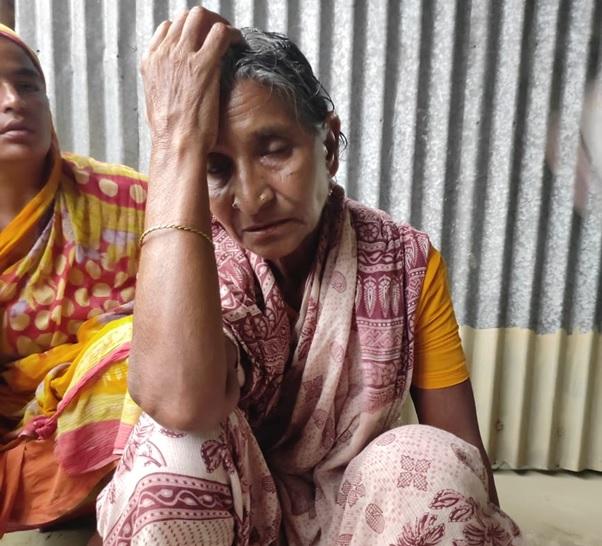
On the evening of July 19, 40-year-old Sahida Fakir stepped out of her home in Sanpada, Navi Mumbai, to buy food for dinner. Her 10-year-old son remained at home. It was an ordinary domestic errand in the life of a woman who had lived in Mumbai for nearly two decades. She never returned.

According to her husband, Jumman Fakir, the family soon received a call from the Mumbai Police's Chembur Crime Branch. Sahida had been detained on suspicion of being an "illegal immigrant". Within days, the family was told that she had been sent to Bangladesh. Her husband says he had repeatedly approached the authorities with documents establishing her identity and roots in West Bengal, but they were allegedly disregarded. Sahida eventually called her family from Satkhira, Bangladesh.

The story, first reported in detail by Scroll on August 11, is disturbing not merely because of what allegedly happened to one woman, but because of the larger question it raises: what happens when the State begins treating Bengali identity as evidence of foreignness?

The Indian Express separately reported that Sahida was detained on July 18 and that sources said she was taken to Assam before being pushed across the border along with others. The report also provided that her family was preparing to approach the Calcutta High Court and that a migrant workers' forum had written to the Ministry of External Affairs seeking intervention.

The facts, as reported, demand something more than administrative clarification. They demand scrutiny of the entire architecture through which a person can apparently move from being a resident of India to being labelled an "infiltrator", detained and ultimately expelled from the country without a meaningful opportunity to contest that determination.

A woman disappears, and the State's explanation is suspicion

Sahida's case is particularly troubling because her family says it did not merely possess one disputed identity document. They produced a birth certificate recording her birth in Swarupdaha village in West Bengal in 1988. They produced a school certificate, a voter identity card issued in 2008, documents relating to land in Gobindapur, and records concerning her family. Her parents' names, according to Scroll, also appeared in the 2002 electoral rolls.

None of these documents, individually, should be treated as an automatic and conclusive certificate of citizenship. That distinction matters. A voter ID, Aadhaar or land document cannot, by itself, settle every question concerning citizenship. But that is precisely why the State's obligation becomes more important, not less.  If citizenship is disputed, the answer cannot simply be deportation. The dispute must first be investigated.

Sahida's husband told Scroll that police asked for the birth certificates of her parents even after he had produced her own birth certificate and other documents. He said the family could not provide such certificates because they were from a generation in which birth registration was not common. That raises an obvious question: how much documentation must a poor citizen produce before the State believes that she belongs to the country in which she was born and has lived?

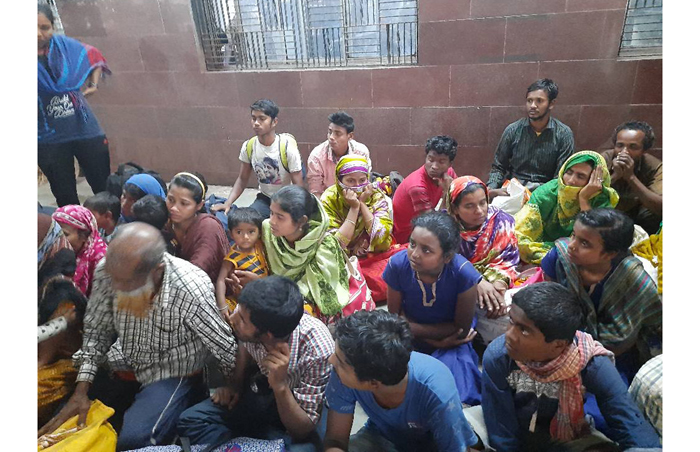
For months, instances of forced deportations and illegal pushbacks have surfaced from Assam, West Bengal, Gujarat, Rajasthan, Maharashtra and Delhi of individuals “suspected” of being Bangladeshi nationals. In many of these cases, the family of those deported have approached the courts alleging that the removals were carried out without any disclosed nationality verification, without travel documents, and without Bangladesh formally acknowledging or accepting the individuals concerned.

Detailed reports may be read herehereherehere and here.

The most dangerous word in this story is "suspected"

There is a profound legal difference between suspecting that someone may be a foreign national and establishing that they are one. The first is an investigative starting point. The second is a legal conclusion. Sahida's case, as reported, appears to collapse the two. Scroll reported that the family was not given documents relating to her arrest or detention and that the Mumbai and Navi Mumbai police did not respond to questions seeking clarification about the grounds for her detention.

When the State takes away a person's liberty, the burden of public accountability does not disappear merely because the allegation involves "illegal immigration". If anything, the stakes are higher because the consequence may ultimately be removal from the country itself. The Constitution does not create a zone of executive immunity around immigration enforcement.

Article 21 protects life and personal liberty. Article 14 demands non-arbitrariness and equality before the law. Article 22 contains safeguards concerning arrest and detention. These constitutional protections cannot become conditional upon whether the person is socially respectable, economically secure or perceived to "look Indian". And the constitutional question becomes particularly serious when a person is allegedly identified not through a properly adjudicated finding but through a combination of suspicion and social profiling.

The border cannot become a substitute for a hearing

Sahida's husband told Scroll that she was detained because she was Bengali. In Maharashtra, the crackdown has become increasingly expansive. Hindustan Times reported in March that the state government told the Legislative Council that more than 2,000 alleged illegal Bangladeshi nationals had been deported in 2025, compared with 202 in 2024, and that the state planned intensive "combing operations" in slums, construction sites and other areas. There is nothing inherently unlawful about a State identifying and removing foreign nationals who are illegally present. Immigration control is a legitimate governmental function. The danger begins when the hunt for foreigners becomes a hunt for people who appear foreign.

The physical act of pushing someone across an international border has consequences that are fundamentally different from ordinary detention. Once a person is in Bangladesh, an Indian court's ability to protect her becomes substantially more complicated. Access to lawyers, family members and documents becomes difficult. The very act of deportation can therefore create a second legal problem out of the first. This is exactly what makes Sahida's account so alarming. According to the Indian Express, she said she was taken to the Assam border and pushed into Bangladesh at around 1 a.m. She reportedly walked for hours through muddy fields before local residents helped her and a family in Satkhira provided her shelter.

A precedent already exists for bringing people back

The danger of mistaken deportation is no longer theoretical. In 2025, several Bengali-speaking residents working outside West Bengal were detained and sent across the Bangladesh border amid claims that they were Bangladeshi nationals. One of the most consequential cases involved Sunali Khatun, her husband and their son. The Calcutta High Court's September 2025 judgment in Bhodu Sekh v. Union of India is particularly relevant. The court examined the deportation of Sunali Khatun, Danish and their son Sabir. The authorities had argued that the family had failed to establish Indian citizenship. But the court also considered the procedure prescribed by the Union’s May 2, 2025 memorandum for persons suspected of being Bangladeshi or Myanmar nationals who claimed Indian citizenship in another State.

The memorandum contemplated verification by the State or district from which the person claimed to originate. Where a person claimed Indian citizenship and residence in another State, the concerned authorities were required to seek verification from that State and district administration. The judgment records that such verification was to be undertaken within a specified period, during which the person could be kept in a holding centre.

The Calcutta High Court ultimately held that the procedure had not been followed and described the authorities' action as being undertaken in "hot haste". It set aside the detention and deportation orders concerning Sunali, Danish and Sabir and directed the authorities to take steps to bring them back to India. In May 2026, the Union told the Supreme Court that it would bring back people deported to Bangladesh and verify their citizenship claims. All those six deported in this case are now back in India.

Detailed reports may be read here and here.

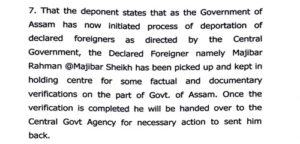
Notably, a separate affidavit was filed by the Union Ministry of Home Affairs (MHA) on July 31, 2026 in Rajubala Das v. Union of India pursuant to the Supreme Court’s order dated March 21, 2025. The affidavit sought to explain the legal and administrative framework governing deportation where the nationality of a declared foreigner remains unknown or unverified. In doing so, the Union makes one of its clearest judicial admissions to date: deportation cannot even be initiated unless the individual’s nationality has first been verified by the receiving State, appropriate travel documents have been obtained, and the receiving country has agreed to accept the individual.

The affidavit fundamentally distinguishes between being declared a foreigner and being legally deportable. While a declaration by a Foreigners Tribunal may settle a person’s legal status within India, it does not, the Union now accepts, authorise the State to physically remove that individual from Indian territory. Deportation remains contingent upon a separate process involving diplomatic engagement, nationality verification, issuance of travel documents and, most importantly, the consent of another sovereign State. In other words, the executive cannot unilaterally deport a person merely because Indian authorities believe them to be a foreign national.

Detailed report may be read here.

The SIR connection makes the situation even more sensitive

Sahida's case also comes amid intense scrutiny of electoral citizenship verification in West Bengal. According to Scroll, Sahida's parents appeared on the 2002 electoral roll, while Sahida herself was marked "under adjudication" in the recent Special Intensive Revision process, with an appeal pending before the relevant tribunal. The fact that an electoral-roll dispute exists cannot itself establish whether Sahida is or is not an Indian citizen. But it does reinforce why administrative processes must remain separate and carefully bounded. Being excluded from an electoral roll is not the same thing as being declared a foreign national.

Indeed, in August 2025, the Supreme Court sought clarity from the Centre on the standard operating procedure governing deportation drives and specifically raised concerns about allegations that Bengali-speaking minorities were being singled out. The Court observed that while persons attempting to illegally cross into India could be dealt with at the border, once a person was already inside the country, the law prescribed a procedure.

Over the past few months, multiple petitions before the Supreme Court and High Courts have alleged that persons suspected of being Bangladeshi nationals were taken across the international border without any publicly disclosed deportation process. In several cases, families have alleged that individuals were picked up without prior notice, denied access to lawyers or relatives, and removed without any disclosed deportation order or travel documents.

Detailed report may be read hereherehere and here.


Related:

‘Deportation Cannot Begin without Nationality Verification’: Union’s Rajubala affidavit clarifies legal limits on executive power

Aadhaar, Voter ID and PAN Cannot Prove Citizenship: Calcutta High Court’s Foreigners Order and the burden of belonging

They Belong Here: An elderly couple’s victory for citizenship

Another CJP Victory: Barpeta Tribunal declares Alam Khan ‘not a foreigner’

When a narrow reading of documents decide citizenship: GHC in Aminul Hoque

‘Fairness & reason ‘: SC rules that due process is a must for citizenship determination

Gauhati High Court upholds foreigner declaration, rejects mental illness plea


Supreme Court comes to the aid of woman facing deportation in Assam

SC

On September 23, the Supreme Court ordered that no action be taken to deport a woman whose name was excluded from the final National Register of Citizens (NRC) and who was designated a foreigner. The Supreme Court has sought comments from the Centre and the Assam government in response to the woman's petition.

The woman who is contesting the Gauhati High Court's judgment from June 2019 submitted a petition, and a bench of justices D Y Chandrachud and Hima Kohli consented to hear her argument. As reported by LiveLaw, the bench ordered, "Issue notice returnable in three weeks. Till next date of listing no steps shall be taken for deportation of the petitioner."

Advocate Pijush Kanti Roy, who was representing the woman, informed the judges that every member of her family had been granted Indian citizenship. However, the Foreigners Tribunal determined that she had entered the country unlawfully and ordered the authorities to take appropriate measures, according to Live Law. Advocate Pijush Kanti Roy with advocates Kalki Roy and Tushar Alok appeared for the petitioner. The petition was filed through advocate Rajan Chourasia.

The judges took this reasoning into account and decided to postpone the woman's deportation until the next hearing of the case, which would take place three weeks. They also instructed the Center and the Assam government to submit replies to the petition.

About the case:

The petitioner received a notice from the Foreigner's Tribunal, Bongaigaon, in the year 2012 inviting her to appear before it on February 19, 2013. The petitioner had submitted her written remarks and the necessary paperwork to prove her citizenship on May 20, 2013.

On June 4, 2015, the secretary of Kacheripety Gaon Panchayat, Bongaigaon, issued a Linkage Certificate confirming her relationship with her father and her husband. She failed to provide her affidavit-in-chief and supporting papers to meet her burden under Section 9. Additionally, her brother submitted an affidavit-in-chief to the tribunal, attesting to the petitioner's sisterhood and attesting to her marriage to her spouse.

On June 7, 2017, the panel dismissed the petitioner's plea and determined that she had entered India illegally from Bangladesh after March 25, 1971.

The panel gave the Deputy Commission in Bongaigaon the go-ahead to take the necessary actions against the petitioner, such as removing her name from the electoral rolls.

The Guwahati High Court heard the appeal of the order. The High Court had admitted the plea and given the petitioner bail. Her name was not included in the NRC when it was released in 2018, despite the fact that her entire family had been given Indian citizenship.

On June 13, 2019, the high court rejected the case and revoked the temporary bail that had been given to the petitioner at the time of writ petition admission.

About the plea submitted before the Supreme Court:

According to the woman, who asserts that she is an Indian citizen by birth, the petitioner's husband, parents, and siblings are all valid Indian nationals. The petitioner is an Indian citizen by birth, and the competent government has recognized every member of the petitioner's family—including her parents and her in-laws—as an Indian citizen. However, it also stated that the woman had been wrongly labeled as a foreigner by the tribunal and the division bench of the Gauhati High Court without considering a number of displayed papers.

According to the plea, the petitioner's name and the names of every member of her family were present in the draft NRC. However, all of her family members' names—aside from her own—have been included in the final NRC released by the appropriate government, designating them as Indian citizens. The woman had submitted several documents proving her Indian citizenship, but neither the tribunal nor the Gauhati High Court accepted them and dismissed the woman's plea, it said.

The order of the Supreme Court can be read here.

About the NRC and the current situation in Assam:

The controversial NRC, compiled finally in 2019 (August 31, 2019)has excluded as many as 19 lakh persons. Those rejected from the NRC, have three years down, not been served with reasons for the rejections. on. This exclusion of 1.9 million persons that include indiogenous persons, Dalits (Namoshudras) and Bengalis, both Muslim and Hindu, has left them potentially stateless unless proven otherwise.

As CJP’s onground work in Assam has shown, establishing one's citizenship is an onerous task,. Even if a person possesses the necessary paperwork, they are still in a limbo since the Indian government has postponed the appeals procedure for anyone who has been denied citizenship due to the NRC. Given the linguistic and cultural differences between Assamese and Bengalis, the determination of citizenship in the state of Assam has long been a divisive political issue. The British imported Bengalis from the adjacent state of Bengal in the 19th century to labor the state's rice fields. As a result of the massive migration of people over the border during the partition of India in 1947 and the establishment of Bangladesh in 1971, disputes over identity and citizenship have only grown. Some Assamese say that Bengalis from Bangladesh or other outsiders are currently residing on their land.

During the conduct of the NRC exercise, more than 32 million people's paperwork had to be looked into, which cost 12.2 billion rupees and included 50,000 government employees. The Foreigners Tribunal, a quasi-judicial court, is the sole option for those who didn't make the cut; failing to do so might result in imprisonment or expulsion. Assam launched a National Register of Citizens in August 2019 with the intention of separating Indian citizens from unauthorized immigrants residing in the state. Around 6% of Assam's population, or more than 19 lakh people, were excluded from the final list of the National Register of Citizens.

The state administration claimed that the National Register of Citizens' final draft was "faulty" and left out a number of Assamese indigenous people. Their pleas against exclusion were heard by Foreigners' Tribunals. Those whose claims are denied risk being detained.

Assam's NRC may have ethnic Bengalis as its main objective, but like with many other similar initiatives, its impacts have been disproportionately harmful to women and the poor. Women Against Sexual Violence and State Repression, a grassroots initiative by a national network of women from different backgrounds, visited Assam in November 2019. They discovered that the burden of producing documentation was significantly more difficult for women, who have historically been denied entitlements to land and lineage.[1]

The predicament of Bhanu is only made worse by her financial situation. Bhanu reportedly remarked, "If [the police] come for me, I'll tell my children to tell them I'm dead," as quoted by the Foreign Policy Magazine. How will I provide for my family if I spend all of this money on legal expenses during the coronavirus, when no one has a job? Bhanu would not have to be arrested or go through the hassle of attempting to verify her citizenship because she was a "dead" person. However, it would also prevent her from ever using government social services, which is a right of every citizen.[2] Even though 37 years have gone since the Assam Accord and Assam residents like Bhanu have suffered as a result, the government instead of letting the citizenship issue die down has decided to use it for political benefit.

Are these deportations a violations of law?

The aim, scope, and procedure of Article 21 are all extremely apparent. The resounding assertion that no individual in India—and we stress that there are no special advantages here for Indian nationals—can be deprived of their right to life and liberty without due process binds all duty-holders and citizens. With Bangladesh, there is no deportation agreement. According to international law, such deportations can only be carried out with the approval of the country of origin. Bangladesh has persistently refused to acknowledge that a significant portion of its population has migrated to India. In fact, Bangladesh sees these unilateral actions as detrimental to a bilateral relationship that is essential to the security and stability of both nations, particularly in our eastern area.

India also ratified the Universal Declaration of Human Rights, where its delegates were instrumental in crafting the terminology for equality, non-discrimination, and gender that is now widely accepted. Our obligations on a global scale on the rights of those impacted in such circumstances are quite obvious. Additionally, it would be intolerable for any Indian of any religious affiliation to suffer damage as a result of carelessness, intentional bias, unjust detention, or criminal prosecution. Failure to appropriately and fairly address this serious problem will be viewed worldwide as a flagrant violation of human rights and a stain on India's reputation.


Concerns rise along Assam’s escalating pushbacks, 33 additional alleged Bangladeshis “pushed back”

On August 30, 2025, Assam Chief Minister Himanta Biswa Sarma announced that the state police had pushed back 33 alleged “infiltrators” to Bangladesh, and vowed that such operations would continue in the coming months. Sarma described these actions as part of the government’s broader campaign against “illegal foreigners.”

Taking to X, CM Sarma wrote “Now playing on illegal infiltrators playlist

Assam Police take me home, to the place I belong..

33 new infiltrators have been PUSHED BACK to where they belong — Bangladesh.

BEWARE: Our stringent efforts continue and will further intensify in the coming days.”

This official acknowledgement marks another significant escalation. In May 2025, civil society groups had already documented attempted and unlawful pushbacks of Bengali-speaking Muslim women from Assam, several of whom were subsequently rescued and brought back after widespread outcry. Now, CM Sarma has warned that the crackdown would only intensify. It is crucial to note that CM Sarma did not specify the exact entry point for this latest batch.

As per The Assam Tribune. Law enforcement claims a steady weekly removal of 70 to 100 individuals, enforced by Assam Police and BSF, now on heightened alert across the 1,885 km border with Bangladesh.

Due process bypassed

Revived from dormancy, the Immigrants (Expulsion from Assam) Act, 1950 grants district commissioners the authority to expel individuals entering after March 24, 1971, without tribunal intervention. This draconian tool bypasses due legal process, enabling swift deportations both of long-resident undocumented immigrants and fresh entrants

Since mid-2025, Assam has reported weekly pushbacks ranging between 70 to 100 individuals—a ramped-up, relentless enforcement effort. Surveillance along the 1,885 km Indo–Bangladesh border has been beefed up by the Assam Police and BSF, particularly in historically vulnerable stretches.

Notable, as per Times of India, on multiple occasions, Dhaka has publicly denied accepting individuals pushed across the border by Indian authorities, insisting that only documented Bangladeshi citizens with verified proof can be received. In this context, the Assam government’s claim of pushing back “33 infiltrators” raises unresolved questions: Who verified their nationality? On what legal basis were they expelled? Were Bangladeshi authorities even informed?

Under Indian law, Foreigners Tribunals are the only quasi-judicial bodies authorised to determine questions of citizenship and foreigner status. Deportation requires central government sanction, diplomatic coordination, and formal handover to the other state. By contrast, “pushbacks” involve physically expelling people across the border without judicial or diplomatic procedure. Such actions therefore bypass both due process and constitutional safeguards, undermining the principle of rule of law.

Political messaging vs constitutional duty

Arguments have been raised against Assam government’s repeated claims of “success” in pushing back alleged infiltrators serve a political narrative rather than a legal process. Branding individuals as “illegal foreigners” without tribunal adjudication or central authorisation weaponises citizenship disputes, heightening insecurity among minority communities. This approach stands in sharp contrast to India’s constitutional guarantee of equality before law and due process, as well as its obligations under international human rights law prohibiting arbitrary expulsion.

Yet, legal resistance is growing. Habeas corpus petitions in Gauhati High Court and the Supreme Court challenge the constitutionality of such pushbacks. Families of deportees allege disappearances and forcible handovers without documentation, raising fears of statelessness.

Meanwhile, according to a report of Times of India, opposition leader Debabrata Saikia has called on the Union government to review BSF’s monitoring framework, warning of diplomatic tensions with Dhaka if India persists with unilateral expulsions.

Ultimately, while Sarma’s expulsions play well as a populist performance of strength, they expose deep fractures in Assam’s legal regime—trading due process for political spectacle, and risking human rights violations in the name of security.


Related:

Not a Foreigner! Foreigners’ Tribunal declares Sukumar Baishya Indian citizen

Assam government to withdraw ‘Foreigner’ cases against Non-Muslims under Citizenship Amendment Act

Assam’s Citizenship Crisis: How Foreigners Tribunals construct an architecture of exclusion and rights violations


“Humans Cannot Just Disappear”: Gauhati High Court told in Doyjan Bibi case as State fails to produce pushback documents

What We Know So Far: July 25, 2025

In a writ petition case that continues to spotlight the shadowy and undocumented removal of Bengali-speaking Muslim women from Assam, the Gauhati High Court was, on July 25, 2025, confronted with an admission from the State: Doyjan Bibi has been pushed back into Bangladesh. But even as officials claimed the act was carried out by the Border Security Force (BSF) at the request of Assam Police, they failed to produce any certificate, documentation, or acknowledgement showing that the Bangladeshi authorities ever received her.

The matter was being heard in the petition filed by Abdul Rejjak, who has been seeking answers on the whereabouts of his wife, Doyjan Bibi, ever since she was allegedly picked up from their home in Chirang district on the night of May 25, 2025 — without an arrest memo, warrant, or production before a magistrate. The legal aid in this case is being provided by Citizens for Justice and Peace.

On Friday, the FT counsel presented a fresh set of documents from the Assam BSF, purporting to show that Doyjan Bibi, declared a foreigner earlier by a Foreigners Tribunal, had been handed over by the SP (Border), Goalpara to the BSF Sector Headquarters at Panbari on May 26. She was then “pushed back” into Bangladesh the next day, on May 27, from the area of responsibility (AOR) of the 2503 BSF Battalion.

But the documents contained a discrepancy: they identified Doyjan Bibi as the wife of Abdul Munnaf. This triggered renewed alarm. The petitioner, Abdul Rejjak, has consistently identified himself by that name — no alias, no variations.

The Court, during the hearing today, noted that the BSF documents suggested Rejjak’s alias was Abdul Munnaf. But petitioner’s counsel Mrinmoy Dutta categorically denied this:

“I do not use or acknowledge any other name. In earlier court filings, including petitions filed by Doyjan Bibi herself, she clearly stated that her husband is Abdul Rejjak. There is no alias.”

The Bench then confirmed that all identifying information, Doyjan’s name, her father’s name, and her Foreigners Tribunal case number, fully matched the petitioner’s claim. The conclusion was unavoidable: the woman declared a foreigner and pushed back was indeed the petitioner’s wife.

That led to the core issue — one that the State has failed to answer since the case began in June: Where is the proof that Doyjan Bibi was handed over to any Bangladeshi official?

Petitioners: “This is not deportation, this is disappearance”

With mounting frustration, Advocate Dutta confronted the State’s silence: “If they have handed over Doyjan Bibi, they must produce the handover certificate. This is the procedure — a person who is pushed back or deportation must be documented. Otherwise, this is not deportation, this is disappearance. It amounts to human trafficking.”

He continued: “Pushback is a term used for people apprehended while crossing borders illegally — not for detainees removed from detention. In this case, the woman was allegedly in custody and removed. That cannot be called pushback, especially without any formal records.”

The FT counsel admitted, on record, that no such certificate of handover existed. There was no documentation from Bangladeshi authorities confirming receipt. There was no record of the border handover. This, despite the fact that in other cases, the May 2, 2025 Ministry of Home Affairs notification and the Ministry’s own deportation SOP, which lays down that full records must be maintained for every such action.

Dutta underscored this contradiction: “They are not following their own rules. In their own guidelines, deportation must be documented. If they say they have removed someone across the international border, they must show to whom. Otherwise, the person is simply missing.”

Bench: “If there is an illegality, then you must make that challenge in your petition”

The Bench observed that if the petitioner wished to contest the legality of the procedure followed for the pushback, a separate prayer would have to be made: “You will have to file a fresh petition, or amend this one. We cannot decide the legality of pushback unless you specifically challenge it.”

Dutta pushed back: “But the petition is the challenge. The case is that the petitioner’s wife was picked up and has not been seen since. The State now says they pushed her back, but can produce no document to show to whom. That itself proves disappearance.”

Bench: “But that is not the present prayer. You must frame it clearly that the pushback was illegal and the procedure is being challenged.”

Petitioner’s counsel asked for time to consider whether to amend the writ petition or move a fresh one.  The Court recorded the State’s version that Doyjan Bibi was “sent back to Bangladesh” but granted the petitioner two weeks to respond. In doing so, the Court did not accept that the State’s failure to follow procedure extinguishes the claim being raised by the petitioner. Instead, it left the door open for legal escalation.

Background: A case of vanishing in plain sight

This case has unfolded through disturbing phases of State inconsistency. At the June 16 hearing, the State initially claimed, based on telephonic instruction, that Doyjan Bibi was in Kokrajhar Holding Centre. But that turned out to be false. By June 25, the State admitted she had been handed over to the BSF. The BSF later said she was “pushed back,” but until today, no certificate of deportation, no arrest memo, no handover documentation, and no FIR or judicial oversight has been placed on record. The only thing the State has submitted are internal letters stating that Doyjan Bibi was “handed over”.

Constitutional Stakes: Is the State Above Its Own Procedure?

The issue now is no longer just Doyjan Bibi — but whether the Indian State can pick up a person it has labelled a “foreigner,” and push them across an international border without any formal deportation order, without any certificate of receipt, and without leaving behind even a scrap of documentation.

The Gauhati High Court has already noted in previous cases that “foreigners” are still entitled to fundamental rights under Article 21. The State’s own 2025 guidelines require recorded and certified deportation through diplomatic channels.

The petitioner has rightly asked: “If there is no record of where she was sent, or to whom she was handed, how can this be called legal deportation?”

The Court will now hear the matter again after two weeks. But until then, the core question remains: Can a woman in State custody simply vanish without a trace — and the system call that deportation?

Details of the previous hearings may be read here.

Related:

Gauhati High Court seeks Centre’s May 2025 deportation notification as legality of re-detention of Abdul Shiekh and Majibur Rehman is scrutinised

Confusion over identity clouds ‘pushback case’ of Doyjan Bibi, Gauhati High Court directs state to verify true identity and whereabouts

A Targeted Campaign: The orchestrated crackdown on Bengali Migrants and the rising pushback from courts, Bengal government, and civil society


Gauhati HC orders clarity after state cites deportation of ‘Wrong Doyjan’ in alleged ‘pushback’ case, demands specific reply on her whereabouts

In a troubling turn in the ongoing writ petition filed by Abdul Rejjak, the Gauhati High Court on July 18, 2025, directed the State authorities to clarify the actual identity and whereabouts of the petitioner’s wife, Doyjan Bibi, after conflicting reports emerged about whether she had been deported across the Indo-Bangladesh border in late May. The Gauhati High Court (GHC) pulled up the State authorities for failing to provide a clear answer on the whereabouts of Doyjan Bibi.

At the last hearing on June 25, the State had informed the Court, based on written instructions from the Senior Superintendent of Police, Dhubri, that Doyjan Bibi had been handed over to the BSF Sector Headquarters, Panbari, on May 26, 2025 for the purpose of deportation to Bangladesh. This reversal in the claim had come after the Court had been informed, based on verbal instructions received by the counsel of Foreigner Tribunal, that Doyjan Bibi is kept in Kokrajhar Holding Centre. During the June 25 hearing, the State had also sought time to obtain further information from the BSF regarding her current status and location. The Court had then directed the State to provide a specific update on her whereabouts, and if she had been deported, to clarify the location and circumstances of such deportation. However, in the present hearing, the State produced BSF records showing that “a Doyjan Bibi, wife of Abdul Munnaf” had been handed over by Assam Police and pushed back to Bangladesh on May 27, 2025.

However, as the Court pointedly noted that this was not the woman whose custody is being questioned before them. Notably, Citizens for Justice and Peace has been providing legal aid in this case.

Background: A trail of changing claims

Doyjan Bibi’s disappearance has become emblematic of the growing allegations of illegal deportation without due process in Assam. Her family had alleged that she was picked up from their home in Chatabari Gaon, Dhubri district, at approximately 1:00 AM on May 25, by local police. No arrest memo was given. No FIR was registered. No magistrate produced her.

Following this, Abdul Rejjak filed a writ petition in the Gauhati High Court seeking disclosure of her whereabouts and immediate relief.

At the first hearing on June 16, the FT counsel for the State claimed, based only on a verbal telephonic update, that Doyjan was in the Kokrajhar Holding Centre. On this basis alone, the Court allowed the petitioner and one family member to visit the centre and obtain her signature on a vakalatnama.

But when the family reached Kokrajhar, she was not there.

At the next hearing on June 25, the State made a completely different submission—now in writing. It stated that Doyjan Bibi had, in fact, been handed over to the BSF Sector Headquarters, Panbari, on May 26, 2025, for deportation to Bangladesh. No prior notice of this alleged transfer had been issued to the family, nor had she been produced before any magistrate for judicial authorisation of the deportation.

The Court, alarmed by these developments, had directed the State to obtain formal confirmation from the BSF regarding the whereabouts and status of Doyjan Bibi and provide this to the Court by the next date.

Details of the previous hearings may be read here.

Hearing of July 18: The 'wrong Doyjan'?

At the hearing on July 18, counsel for the State produced a copy of the official communication received from the Frontier Headquarters of the BSF, Guwahati. The document stated that “on the request of Assam Police, amongst others, Doyjan Bibi, wife of Abdul Munnaf, was handed over to them and sent back to Bangladesh from the area of responsibility of the 2503 Battalion BSF, Dhubri, on May 27, 2025.”

However, this update led to immediate confusion in court. Advocate Mrinmoy Dutta, appearing for the petitioner, clarified that the Doyjan Bibi is the wife of Abdul Rejjak—not of Abdul Munnaf. He submitted that there is no such alias in use and that the identity of the petitioner’s husband is well established as Abdul Rejjak alone. He further requested that the State clarify the true identity of the woman who was handed over to the BSF and allegedly pushed back into Bangladesh.

Taking note of the confusion and the unresolved issue of identity, the Court stated on record that if the BSF’s communication relates to a different person—i.e., the wife of Abdul Munnaf—it does not answer the petitioner's prayer, which concerns the whereabouts of the wife of Abdul Rejjak.

In a stern observation, the Bench told the State that it was their duty to establish the whereabouts of the woman named in the petition—Doyjan Bibi, wife of Abdul Rejjak.

In its order, the Court noted: “The instructions produced by the State pertain to a different individual — Doyjan Bibi, wife of Abdul Munnaf — and are therefore returned. The counsel for FT matters is directed to obtain relevant instructions in this particular case concerning Doyjan Bibi, wife of Abdul Rejjak.”

The matter has now been listed for further hearing on July 25, 2025.

Sharp legal and ethical questions

The case of Doyjan Bibi underscores the wider pattern of irregular and possibly unlawful deportations currently under judicial scrutiny. In similar cases like those of Samsul Ali, Abdul Sheikh, and Majibur Rehman—also argued by Advocate Mrinmoy Dutta with their legal aid being provided by CJP—the Court has taken note of detentions and disappearances of individuals released under long-standing COVID-era bail orders, only to resurface in detention camps or in BSF custody, with no formal arrest documentation.

In the present matter, what began as a disappearance has now escalated into a possible case of mistaken identity, or worse—an undocumented pushback of a woman without verification, paperwork, or judicial authorisation.

The Gauhati High Court, in earlier orders, had made it clear that deportation must follow proper procedures, including production before a magistrate and intimation to the family. That none of these were followed in Doyjan’s case, and that her location is still unknown despite two months having passed, places a constitutional spotlight on the lack of procedural accountability in Assam’s deportation apparatus.

The order may be read here:

[viewpdf 42869]


Related:

A Targeted Campaign: The orchestrated crackdown on Bengali Migrants and the rising pushback from courts, Bengal government, and civil society

Gauhati HC closes writ petition in Bakkar Ali case after his detained father, Samsul Ali, was recovered and not rearrested

Another Pushback Halted: SC stays deportation of woman declared foreigner, issues notice on challenge to Gauhati HC order

After incorrect detention claim, Gauhati HC was informed that Doyjan Bibi was handed over to BSF

“Bail once granted can’t be ignored”: Gauhati HC seeks legal basis for re-detentions of COVID-era released detainees


Under Siege for Speaking Bengali: Detentions, deportations and a rising pushback against the targeting of Bengali migrant workers across India

In recent weeks, a chilling pattern has emerged across multiple Indian states, including Odisha, Chhattisgarh, Maharashtra, Delhi, Gujarat, Madhya Pradesh, where Bengali-speaking migrant workers, most of them Indian citizens, have been rounded up in mass raids, detained without proper inquiry, denied recognition of valid Indian documentation, and in some cases, forcibly deported to Bangladesh. These sweeping actions, occurring under the alleged guise of cracking down on “illegal Bangladeshi immigrants”, have sparked alarm across affected communities, their support groups, civil rights organisations and provoked political outrage from the West Bengal government, and prompted judicial scrutiny led by the Calcutta High Court. The resulting crisis raises urgent constitutional questions about citizenship, discrimination, and federalism in India.

Judicial Firewall: Calcutta High Court sounds the Constitutional alarm

On July 17, 2025, the Calcutta High Court issued a pointed rebuke to the Union government and state authorities over the sudden and widespread raids conducted in June to identify so-called “illegal Bangladeshis.” As per the report of Times of India, a division bench of Justices Tapabrata Chakraborty and Reetobroto Kumar Mitra posed blunt questions: “What were the reasons for these sudden nationwide raids? Were they pre-planned? On what intelligence were they based?” The Court, hearing habeas corpus petitions concerning the alleged illegal detention and deportation of Bengali-speaking migrants, including a family of three from Birbhum allegedly pushed into Bangladesh, emphasised that such actions, if based solely on language or appearance, risk sending a “wrong and dangerous message.”

The Court directed the West Bengal government, the Delhi Police, and the Union government to file detailed affidavits regarding the legality of the detentions and deportations. As per the report of LiveLaw, State counsel Kalyan Bandopadhyay submitted that it was outrageous to detain or deport any individual solely because they spoke Bengali. “The constable is not the competent authority. You cannot criminalize language. There is a procedure, a legal standard, that must be met to question someone’s citizenship,” he said, demanding data on the number of detainees and those deported.

In response, senior Union government counsel Asoke Kumar Chakraborty questioned whether habeas corpus petitions were maintainable after deportation, revealing that a parallel case had been filed in the Delhi High Court—information which the Calcutta HC had not been told earlier. The Court came down harshly on the petitioners’ lawyer for this procedural suppression. “This is not expected from a senior advocate. Do not try to play tricks with the court,” Justice Chakraborty warned according to the LiveLaw report. Yet, despite these procedural hiccups, the Court refused to dismiss the matter and insisted on detailed disclosures, recognizing the larger human rights issues at stake.

Odisha: Mass detentions, arbitrary identification, and partial relief

The largest cluster of arrests took place in Odisha, where between June and July 2025, 447 Bengali-speaking migrant workers, most of them masons, daily-wage labourers, or street vendors from districts such as Birbhum, Murshidabad, and South 24 Parganas, were rounded up by police, particularly in Jharsuguda, Khurda, and nearby districts. According to a Scroll report, at least 403 detainees have since been released after sustained legal, political, and administrative pressure—but dozens remain in custody, often on specious grounds.

Multiple detainees testified that police refused to accept Aadhaar, voter ID, or even ration cards as legitimate identification. Instead, they were asked to produce birth and school certificates, often impossible for migrant workers who left their villages as teenagers. Others were detained simply for having Bangladeshi phone numbers saved on their mobile phones, which the police used as an alleged indicator of foreign nationality.

As provided in the TOI report, Ajimuddin Sheikh, 22, from Birbhum, was one such migrant detained during a 1 a.m. police raid near Brajarajnagar. “They seized our phones. Even when we showed voter ID and Aadhaar, they said it was not enough,” he recounted, while speaking to the TOI. His 18-year-old cousin, Nijamuddin Sheikh, added that they were interrogated repeatedly, their phones scanned for Bangladeshi contacts, and only released after producing additional documentation and being vouched for by a local guarantor.

Trinamool MP Samirul Islam, who chairs the West Bengal Migrant Workers Welfare Board, confirmed that most of those detained had been working in Odisha legally for several years. He lambasted the Odisha Police for refusing to accept Indian documents and treating labourers like foreign infiltrators. “There is no law that says a Bengali-speaking labourer cannot work in another Indian state,” he said, as per The Indian Express.

Despite some relief after the High Court sought explanations, Islam and MP Mahua Moitra warned that the mass profiling of Bengali-speaking workers is far from over—and that several youth still remain in custody.

Chhattisgarh: From detention to forced repatriation

In Kondagaon, Chhattisgarh, nine Bengali-speaking masons, residents of Krishnanagar in West Bengal, were picked up on July 12 from a school construction site, The Hindu reported. Trinamool MP Mahua Moitra revealed that despite possessing valid documents and being recruited through a verified contractor, the men were detained, denied contact with their families, and allegedly put on buses and sent back to Bengal—without any court order authorizing their removal, reported by TOI.

The Chhattisgarh Police claimed that the men failed to register with local authorities and were detained under preventive sections of the Bharatiya Nagarik Suraksha Sanhita (BNSS), India's new criminal procedure code. However, according to IE, Moitra questioned why they were not given access to legal counsel, why their phones were confiscated, and why families were not informed. A habeas corpus petition has now been filed in the Chhattisgarh High Court.

Maharashtra: Matua community targeted, identity cards ignored

In Pune, members of the Matua community, a Dalit religious minority of Bengali origin, were detained by Maharashtra Police on suspicions of being undocumented migrants, according to TOI. Samirul Islam reported that despite furnishing Aadhaar, voter ID, and certificates from the All India Matua Mahasangha, detainees were not released.

Shockingly, even children were among those picked up, and police reportedly refused to recognize documents issued by the AIMM, as per the report. TMC leaders expressed dismay that Santanu Thakur, a BJP MP and Union Minister who himself belongs to the Matua community, remained silent in the face of persecution of his own constituents.

Delhi and Gurugram: Crackdown in the capital

In Delhi, as reported by India Today, the TMC has led a series of protests in Jai Hind Colony, Vasant Kunj, a settlement housing hundreds of Bengali-speaking migrant workers. Despite valid documentation, residents say they have been targeted with evictions, electricity and water cutoffs, and routine harassment by police.

Meanwhile, in Gurugram, at least 26 Bengali-speaking workers from Assam were detained and interrogated over two days. Though eventually released, they alleged that voter ID and Aadhaar cards were rejected and that Muslim workers were disproportionately targeted.

Forced pushbacks and international law violations

Civil rights groups and legal experts have expressed alarm at what appears to be a coordinated “pushback” policy being implemented quietly across multiple states, allegedly under a Union-led directive. According to investigative reports, more than 2,000 persons have been forced across the Indo-Bangladesh border since the initiation of “Operation Sindoor”, which was a military operation ostensibly targeting cross-border terror camps but now being linked to mass civilian expulsions.

These deportations, without legal adjudication, without access to lawyers or courts, and based on profiling, stand in clear violation of Article 21 of the Indian Constitution and India’s obligations under international human rights law, particularly the principle of non-refoulement.

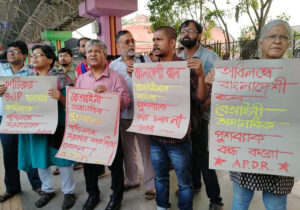
West Bengal Pushes Back: Legal action, street protests, and a linguistic defiance campaign

The West Bengal government, led by Chief Minister Mamata Banerjee, has mounted one of the strongest political and legal responses yet to the ongoing crackdown on Bengali-speaking migrants across BJP-ruled states. Calling it a “coordinated campaign to erase Bengali identity from the Indian Union,” Banerjee’s administration has launched a multi-pronged resistance: taking the fight to the courts, to Parliament, to civil society, and most strikingly, to the streets.

  1. Legal interventions and habeas petitions

West Bengal’s legal machinery was among the first to intervene after news broke in late May and June that Indian citizens, including women and minors, had allegedly been pushed across the Indo-Bangladesh border by Assam and Maharashtra Police.

According to The Telegraph, Maktoob, and Indian Express, the State of West Bengal has taken a proactive legal and administrative stance in ongoing cases concerning the wrongful detention and deportation of Bengali-speaking migrants. It has challenged detentions and deportations carried out without Foreigners Tribunal orders or judicial oversight, particularly in cases where individuals possessed valid Indian documents. The Calcutta High Court has repeatedly flagged these incidents as potentially illegal and directed the State to respond. In compliance, the West Bengal government has dispatched state police and administrative teams to states such as Odisha and Maharashtra to trace missing persons, facilitate their release, and assist with documentation, including the recording of victim testimonies. The State has also filed multiple status reports before the Calcutta High Court, detailing repatriation efforts and procedural violations. Acting on judicial direction, the Chief Secretary has appointed a nodal officer to liaise with the governments of other states and the Union Ministry of Home Affairs to ensure coordinated response mechanisms and prevent further unlawful detentions.

  1. Political Leadership: Mamata’s “I will speak more in Bengali” challenge

Mamata Banerjee has not only condemned the raids as unconstitutional but also reframed the issue as a battle for linguistic dignity. On July 16, during a mass rally in central Kolkata, she declared: "I dare you to send me to a detention camp, I will speak more in Bengali," and "Altogether 1,000 migrant workers have been arrested and detained in BJP-ruled states and many have been pushed back to Bangladesh. People from Birbhum, Cooch Behar, Nadia and other districts are being detained in Odisha and BJP-ruled states," she said, according to the Economic Times.

Addressing a massive public gathering during the protest march, as reported by Hindustan Times, Mamata Banerjee said, "The BJP calls all Bengali-speaking people Bangladeshi Rohingyas... Rohingyas live in Myanmar. Here, all citizens of West Bengal have proper ID cards and identification. The labourers who have gone outside Bengal have not gone on their own. They have been employed because they have skills... Anyone who speaks Bengali is being arrested and put behind bars. Why? Is West Bengal not a part of India?"

  1. Administrative support for victims and families

The West Bengal government has taken several concrete steps to support affected families and challenge interstate detentions:

  • Interstate coordination mandated by Court: On direction from the Calcutta High Court, the West Bengal Chief Secretary has appointed a nodal officer to liaise with states like Odisha and Delhi, ensuring the identification and release of Bengali-speaking migrants detained without due process, according to LiveLaw.
  • Chief Secretary's objection to profiling: Chief Secretary Manoj Pant sent a formal letter to the Odisha government objecting to the detention of migrants who had valid Indian documents and condemning demands for ancestral land records as arbitrary and discriminatory, as per Indian Express.
  • Verification of migrants across states: Bengal Police has undertaken a large-scale verification drive across multiple states, including Odisha, Maharashtra, and Delhi, covering over 750 cases of suspected wrongful detention. Officials have relied on a mix of local documentation (e.g., ration cards, land deeds, school certificates) to authenticate identity, according to the reports of TOI.
  • Interstate legal cell under consideration: According to government officials cited in press briefings, the Home Department may establish a dedicated interstate legal response cell to track migrant-related detentions, deportations, and facilitate legal aid across borders, as provided by New Indian Express.
  1. National advocacy

Senior Congress leader Adhir Ranjan Chowdhury submitted a memorandum to President Droupadi Murmu, demanding her intervention in the said situation. In the said memorandum, as reported by IE, the former Congress MP wrote: “It’s very sad and cruel fact that Bengali-speaking daily wage labourers, who are bonafide Indian citizens, are being targeted due to their physical appearance and accent, which is being mistaken for that of Bangladeshis. This similarity is being used as a pretext to harass, humiliate, physically assault, and hold these innocent people in detention.”

Chowdhury emphasised that these labourers are not only Indian citizens, but also contributors to the national economy. “Now, they are being rendered unemployed, homeless, and stateless,” he said, urging the President to step in to protect citizens from communal profiling and unlawful deportations.

Conclusion: Language on trial, citizenship in crisis

The targeting of Bengali-speaking migrants across Indian states has transformed from isolated administrative excesses into a full-blown constitutional crisis. At its core, this moment tests the strength of India’s federal framework, the sanctity of citizenship, and the basic right to dignity regardless of region, religion, or language. When Indian citizens with valid documents are detained, deported, or denied recognition simply for speaking Bengali, it sets a dangerous precedent—not just for Bengalis, but for all linguistic and regional minorities.

The pushback from the Calcutta High Court, the West Bengal government, and sections of civil society has sparked a vital resistance against arbitrary profiling and extra-legal state action. Yet the broader question remains: will the Union government address the growing pattern of exclusionary policies, or allow language and identity to become fault lines for discrimination?

India was envisioned as a pluralistic democracy where diversity is a foundation, not a fault. The events unfolding today demand urgent legal, political, and moral clarity. The road ahead will determine whether that vision endures—or whether silence enables a slow erosion of constitutional protections, starting with those who speak Bengali.


Related:

Gauhati HC closes Bakkar Ali writ petition as missing detainee Samsul Ali is found, not rearrested

‘Define Special Intensive Revision scope… make it clear not linked to citizenship’: BJP ally TDP writes to CEC Gyanesh Kumar

Bengali Migrant Workers Detained in Odisha: Calcutta High Court demands answers, seeks coordination between states

Bengali-Speaking Migrants Detained En Masse in Odisha: National security or targeted persecution?

Bordering on illegality? 18 alleged Bangladeshis “pushed back” without due process, Legal challenge filed in High Court

SC: ECI’s ‘wisdom’ on revision of electoral rolls challenged, does a disenfranchisement crisis loom over Bihar, with thousands being declared ‘‘D’ (doubtful) voters?


Vanished Without a Trace: CJP writes to NHRC detailing Assam’s secret detentions and illegal pushbacks

In an urgent memorandum to the National Human Rights Commission (NHRC), the Mumbai-based human rights organisation Citizens for Justice and Peace (CJP), in collaboration with the Forum for Social Harmony and its Assam legal team, has appealed to the apex human rights body to intervene in what it describes as an “unprecedented human rights emergency” in Assam. On May 31, 2025, CJP submitted a detailed, evidence-backed memorandum alleging that, between May 23 and May 31, at least 300 individuals—mostly Bengali-speaking Muslims—were secretively detained –without arrest memo or warrant — and approximately 145 have now “disappeared” under highly suspicious and unlawful circumstances.

As detailed in the memorandum, this entire move by the Assam Border Police from May 23 onwards shrouded in secrecy, and executed with flagrant disregard for constitutional safeguards, legal procedures, and even ongoing court cases. The most chilling claim: many of those missing may have been forcibly pushed across the Indo-Bangladesh border—a move that amounts to extra-legal expulsion and, potentially, statelessness.

Last Monday, May 26, CJP’s Team Assam had spent the entire day outside the Matia Detention Centre with legal aid volunteers and advocates in a bid to get information from the authorities on the identities of those detained. They found not the Jailor but the Assam Police in charge. Efforts were also made to submit a detailed memorandum to the Detention Centre authorities, citing judicial precedents and NHRC guidelines on procedures of detention and rights of detainees and families, advocate. When authorities refused to accept this, in flagrant violation of the Constitution and the law, this memorandum too has been despatched to the authorities by email and speed post. The exclusive ground report, published two days later may be read here.

The crackdown: Fear, silence, and disappearances

The CJP’s memorandum presents a grim chronology. Night raids by Assam’s Border Police reportedly swept across 33 districts from May 23 onwards, detaining individuals from their homes without warrants, memos, or explanations amounting to a form of abduction. No legal counsel was allowed. Families were left in the dark about their whereabouts or safety.

Approximately 150 detainees were later released, but at least 145 people reportedly remain untraceable—many suspected to have been dumped into “no man’s land” between India and Bangladesh.

(Note-Since the memorandum was sent on Saturday, reports of at least six persons being brought back by the BSF to the homes of the distraught, after the Bangladesh Ground Guard (BGB) refuted claims that they were Bangladeshi. Mal treatment however was meted out in the interim, and several dozen are still untraceable)

The detained include:

  • Individuals who had been released on temporary bail by courts on the orders of the Supreme Court in 2021
  • Citizens who were still litigating their status before Foreigners Tribunals, the Gauhati High Court, or even the Supreme Court
  • People who had lived in Assam for generations and whose names appear in the National Register of Citizens (NRC)

One particularly egregious case is that of Khairul Islam, a retired government schoolteacher from Morigaon. Despite his ongoing petition in the Supreme Court, Islam was picked up by police on May 23. Days later, he appeared in a video from Bangladesh’s Kurigram district, confirming he had been forcibly expelled at 4 AM—an act tantamount to extra-judicial deportation. (Subsequent local reports on Sunday, June 1 reveal that Khairul Islam was also among one of those fortunate to have been brought back home).

Personal tragedies in the shadows of state power

CJP’s memorandum documents the lives behind the numbers, providing intimate profiles of individuals who vanished in the sweep. Among them:

  • Doyjan Bibi, detained despite NRC inclusion, released on temporary bail in 2021, and now missing since May 24.
  • Abdul Sheikh, a senior citizen displaced multiple times by communal violence, disappeared after the May 24 crackdown.
  • Mojibor Sheikh, a daily wage labourer whose minor son was forced to drop out of school to support the family after Mojibor’s detention; now untraceable.
  • Samsul Ali, 67, with valid legacy documents from 1951, disappeared despite suffering from chronic health conditions.

All of these had been legally temporarily released in prior years and actively engaging with the justice system, but were now forcibly removed without notice—rendered voiceless and invisible.

A legal, constitutional, and humanitarian catastrophe

CJP’s memorandum is not just a plea for redress—it is a devastating indictment of what it calls a “stealth administrative purge” targeting a vulnerable minority community.

Key legal violations identified:

  • Constitutional Rights:
    • Article 21: Right to life and personal liberty
    • Article 22: Right to be informed of the grounds of arrest and access to legal counsel
  • Supreme Court Precedents:
    • D.K. BasuJoginder KumarVihaan Kumar: All mandating transparency, legal access, and procedural safeguards during arrests and detentions
  • Statutory Breaches:
    • Numerous provisions of the Bharatiya Nagarik Suraksha Sanhita (BNSS) and the former CrPC, including rights to bail, medical care, and judicial oversight, were reportedly flouted
  • NHRC’s Own Arrest Guidelines (2000):
    • Not followed—no arrest registers, no medical checks, no access to families or advocates, no transparency
  • International Law:
    • ICCPRUDHR, and customary international law explicitly prohibit arbitrary detention, expulsion without due process, and pushbacks—particularly under the principle of non-refoulement

CJP warns that these acts not only violate India’s international legal obligations but may amount to collective punishment and ethnic profiling—practices wholly antithetical to a constitutional democracy.

Justice denied: Non-exhaustion of legal remedies

A central legal concern raised is that many individuals had not exhausted judicial remedies. Some, like Khairul Islam, had active cases in the Supreme Court. Others were in the process of securing permanent bail or challenging ex-parte FT orders.

By detaining and disappearing them before legal processes concluded, the State effectively:

  • Short-circuited the rule of law
  • Undermined court jurisdiction
  • Violated natural justice

This, CJP argues, is not just “procedural impropriety” but an act of executive overreach and constitutional breakdown.

Breach of Supreme Court directives in Rajubala Das

CJP points to the Supreme Court’s 2024 ruling in Rajubala Das v. Union of India, which directed strict compliance with legal procedures before deportation—such as:

  • Submission of Nationality Verification Requests (NVRs) to Bangladesh
  • Issuance of travel permits
  • Public documentation of deportation orders

The memorandum demands that NHRC urgently verify whether these formalities were observed in any of the 145+ suspected pushbacks. If not, the Assam government may be in contempt of court, and liable for gross human rights violations.

CJP’s prayers: Urgent action, transparency, and accountability

CJP has called on the NHRC to:

  1. Demand full disclosure within 72 hours from the Assam government and Ministry of Home Affairs, including:
    • Names and details of all detainees, released persons, and those missing
    • Legal basis and authority under which arrests were made
    • Detention orders, FT case numbers, and status of deportation procedures
  2. Constitute a fact-finding committee to visit Matia Detention Centre and affected villages, record testimonies, and report publicly within 10 days
  3. Issue binding guidelines against arbitrary detentions and mass expulsions
  4. Initiate legal and disciplinary action against officers responsible
  5. Restore liberty to all unlawfully detained individuals
  6. Create a real-time detainee tracking system and helpline

The memorandum closes with a stirring reminder: The Constitution does not allow governments to extinguish liberty in silence, nor abandon citizens to exile without due process. If confirmed, these disappearances and pushbacks mark a turning point not only for Assam but for Indian democracy itself.

CJP’s urgent appeal is as much a legal petition as it is a moral alarm bell. It demands that India’s institutions act now—firmly and transparently—to restore faith in the rule of law before irreparable damage is done.

The complete memorandum may be read below.


Related:

CJP Exclusive: Homeland to No Man’s Land! Assam police’s unlawful crackdown on residents still battling for restoration of citizenship rights?

Supreme Court and the Rofiqul Hoque Judgment: Evolving jurisprudence on documentary evidence in Assam citizenship cases

From Detention to Deportation: The mass deportations and detention crisis at Assam’s Matia centre

Indian again! Matleb Ali’s fight to prove Indian identity ends with CJP’s intervention


Assam: Slamming Sarma’s actions as discriminatory & unlawful, LOP, Assam Assembly Debabrata Saikia calls for an urgent stop to “pushback” of citizens

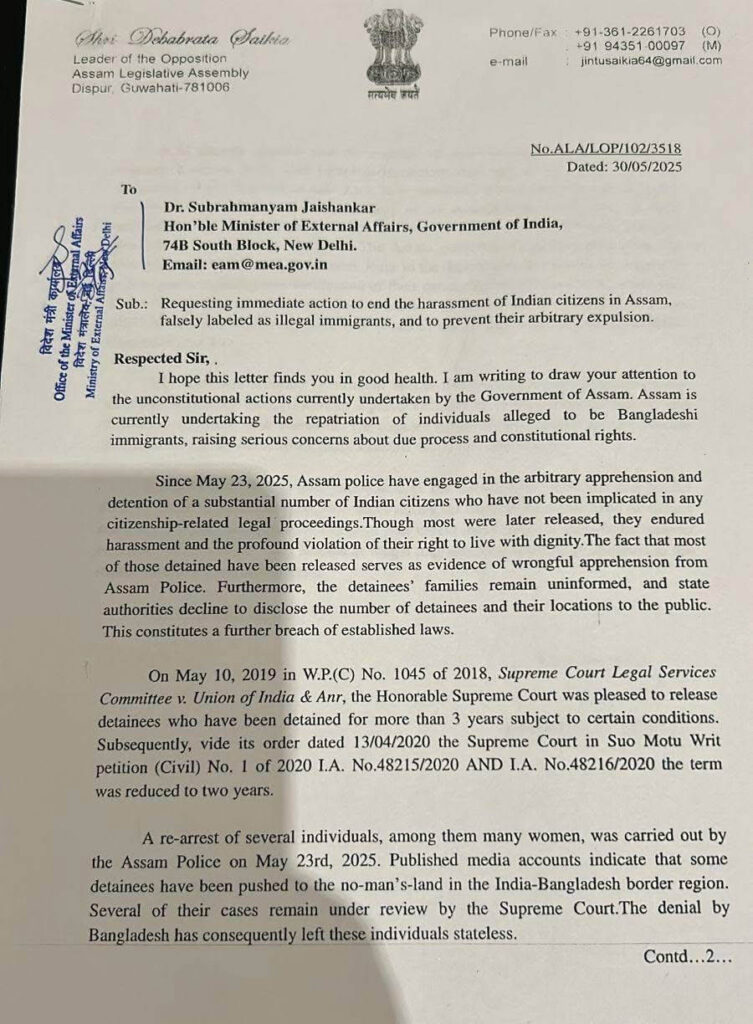
Debabrata Saikia, the Leader of the Opposition in the Assam Legislative Assembly, has raised serious concerns on the state government’s recent actions of illegally detaining, without due process or law, legitimate Assamese citizens in the name of “pushing back” allegedly undocumented migrants to Bangladesh.  In a letter to External Affairs Minister S Jaishankar, he has also stated that the actions of the state authorities clearly appear to disproportionately target Muslims, undermining India’s secular fabric.

On May 30, last Friday, late evening, Saikia released this letter in a social media post on Meta-Facebook. He wrote:

“BJP government has created a new conspiracy against minority society in the name of foreign deportation in Assam. Under the leadership of the new BJP Himanta Biswa Sharma, RSS is taking care to terrorize the Muslim society. Let foreigners be deported. This is what I want for sure. Assam is first for the people of Assam - this is my total belief. But I am totally against the “Muslim means Bangladeshi” ethnicity which has been created. India is famous as Assam Shankar-Ajan country. BJP is trying today to start a brotherhood conflict. That's why hand-in-hand guns now. We want to see the books in the hands of our young Sam, not the grenades. They are trying to enforce the situation in Bihar and Uttar Pradesh in Assam. The Chief Minister is now like a Sasemira, whoever does not ask, he says Pakistan in the answer. I am expressing all these things through two memorandum in the Ministry of Foreign Affairs and Home Department yesterday. Read it.”

The letter sent by Saikia may be read below.

Saikia has, in this communication, accused the Assam Police of violating constitutional rights and due process in these operations. The All India United Democratic Front (AIUDF) has also petitioned the Governor, protesting the “continued” harassment of Indian Muslims on the pretext of identifying “illegal immigrants.”

Saikia claimed that since May 23, hundreds of Indian citizens, including some not involved in any citizenship-related legal proceedings, have been “arbitrarily detained.” While some have been released, these detentions highlight “serious procedural lapses.”

Citing media reports, Saikia alleged that several detainees, including women, were forcibly pushed into the “no man’s land” along the Indo-Bangladesh border, leaving them stateless as Bangladesh refuses to accept them. One such case involves Khairul Islam, a former government school teacher whose citizenship case is still pending before the Supreme Court, yet he was allegedly picked up from a detention centre and forced across the border.

Saikia emphasized that since several citizenship cases are pending before the apex court, these detentions and pushbacks constitute a “clear violation of the judicial process.” The Supreme Court itself has previously issued interim directions stating that no coercive steps should be taken against individuals whose cases are sub judice.

While most detainees were eventually released, their wrongful apprehension itself points to serious procedural lapses. Families remain uninformed about the whereabouts of detainees, violating basic transparency norms. Media reports confirm that many detainees, including women, have been forcibly pushed into the no-man’s-land at the India-Bangladesh border, leaving them stateless as Bangladesh refuses to accept them.

In this letter dated May 30 May Saikia highlighted several serious violations of constitutional rights and due process in what is being termed as Assam’s “push back drive.”

Saikia reminded the EAM that this action directly contradicts India’s stated position on deportation, quoting Dr. Jaishankar’s own parliamentary statement that emphasized the necessity of “unambiguous verification of nationality” before any repatriation. The letter notes with concern that these operations appear to target Muslim communities, undermining India’s secular fabric. It also points out that several cases are still pending before the Supreme Court, making these detentions and pushbacks a clear violation of the judicial process.

Saikia has urgently appealed for central intervention to immediately halt these unconstitutional actions, ensure proper nationality verification before any deportation, release all wrongly detained Indian citizens, and make detainee information publicly available.

He stressed that pushing people in the no-man’s-land without proper legal procedure is both illegal and fundamentally inhumane. Saikia said,“Pushing Indian citizens into no-man’s-land without verification is unconstitutional and fundamentally inhumane. The repatriation during the pendency of a Supreme Court case constitutes a grave breach of the judicial process. This further violates international human rights standards."

Assam Chief Minister Himanta Biswa Sarma, who has been accused of late for aggressive hate speeches against minorities has been reported to have stated that the state is “duty-bound to protect the interests” of Assam and “expel all illegal immigrants from the state through any means and as per directions of the Supreme Court.”

The CM also claimed that persons with pending citizenship cases are not being detained. The state government has adopted a “push back” route as a solution to its long struggle for deporting “illegal migrants.”

Human rights organizations and affected families express deep concerns about the humanitarian consequences of these actions, including prolonged detention, family separation, and the risk of statelessness. The Supreme Court has also previously criticized the indefinite detention of declared “foreigners” and urged the state to expedite deportations.

Assam chief minister Himanta Biswa Sarma on Friday said that only declared foreigners are being pushed back as per the law.

However media reports, and an exclusive Ground Report by Citizens for Justice and Peace, suggests to the country. This may be read here.

First, a video has emerged in the 'no man’s land' along the Indo-Bangladesh border in Assam’s South Salmara Mankachar district, Where Khairul Islam’s claimed that he is an Indian national and being deported to Bangladesh. Islam was among nine persons arrested by Morigaon police on May 24 in a crackdown on illegal immigrants declared by the Foreigners’ Tribunal, but who had been avoiding deportation.

Himanto Biswas Sarma, Chief Minister, Assam, was reported to have said on May 30, “The Supreme Court has directed us declared foreign nationals must be sent back. Declared foreigners who did not appeal in the court we had been pushed back. On Thursday we apprehended 35 Bangladeshi nationals along the Meghalaya and Silchar border. They came some days back and we instantly pushed them back.”

He added, “In meeting with SPs in Dergaon we have decided that we will fast track the process of detection of foreigners. As the National Register of Citizens (NRC) process was underway, detection of foreigners was temporarily suspended. So in the days to come detection will take place, push back will be done and the government of India after talks with the Bangladesh government will send some foreigners. So these three ways will continue.”

Chief Minister said, “Whoever has not gone to higher judiciary despite being declared a foreigner, and not preferred appeal against the tribunal order, they must go. We have 30,000 people who despite being declared foreigners have disappeared, if we find somewhere we have to take action against them. Whatever is done is as per law.”

However ground level claims contradict what Sarma has stated. For example, Khairul Islam was declared a foreigner by the Foreigners Tribunal in 2016, a decision he challenged in the Gauhati High Court. The High Court upheld the FT’s ruling, leading to his detention in 2018. Documents reveal that the appeal against the FT decision is pending before the Supreme Court and the last hearing was in December 2024.

[viewpdf 41981]


Related:

Assam Border Police cracks down on residents battling citizenship rights without due process, pushes 145 locals over the border?


'Deportation Cannot Begin without Nationality Verification': Union's Rajubala affidavit clarifies legal limits on executive power

For years, the debate surrounding persons declared to be “foreigners” in India has largely revolved around one question: who can be declared a foreigner? The proceedings before Foreigners Tribunals, the burden of proof under Section 9 of the Foreigners Act, 1946, and the evidentiary standards required to establish citizenship have dominated constitutional litigation. Comparatively little judicial attention had been devoted to the equally important question that arises after a person has been declared a foreigner—what does the Constitution require before the State can deport that individual?

The affidavit filed by the Union Ministry of Home Affairs (MHA) on July 31, 2026 in Rajubala Das v. Union of India marks an important intervention in that debate. Filed pursuant to the Supreme Court’s order dated March 21, 2025, the affidavit seeks to explain the legal and administrative framework governing deportation where the nationality of a declared foreigner remains unknown or unverified. In doing so, the Union makes one of its clearest judicial admissions to date: deportation cannot even be initiated unless the individual’s nationality has first been verified by the receiving State, appropriate travel documents have been obtained, and the receiving country has agreed to accept the individual. This is no ordinary procedural clarification.

The affidavit fundamentally distinguishes between being declared a foreigner and being legally deportable. While a declaration by a Foreigners Tribunal may settle a person’s legal status within India, it does not, the Union now accepts, authorise the State to physically remove that individual from Indian territory. Deportation remains contingent upon a separate process involving diplomatic engagement, nationality verification, issuance of travel documents and, most importantly, the consent of another sovereign State. In other words, the executive cannot unilaterally deport a person merely because Indian authorities believe them to be a foreign national. That proposition carries consequences far beyond the Rajubala case.

For months, instances of forced deportations and illegal pushbacks have surfaced from Assam, West Bengal, Gujarat, Rajasthan, Maharashtra and Delhi of individuals “suspected” of being Bangladeshi nationals. In many of these cases, the family of those deported have approached the courts alleging that the removals were carried out without any disclosed nationality verification, without travel documents, and without Bangladesh formally acknowledging or accepting the individuals concerned.

Detailed reports may be read herehereherehere and here.

Against this backdrop, the Union’s affidavit assumes a significance that extends well beyond the immediate dispute before the Court. By placing on record the legal prerequisites for deportation, the Government has simultaneously articulated a benchmark against which its own recent executive actions may now be tested. If nationality verification and acceptance by the receiving State are indeed indispensable legal requirements, as the affidavit repeatedly states, the obvious constitutional question is whether recent deportations and border removals have consistently adhered to those very standards.

The case of Rajubala Das

What began in 2020 as a challenge to the continued detention of one individual has gradually transformed into the Supreme Court’s most comprehensive examination of India’s detention and deportation regime. The litigation traces its origins to Rajendra Das, who was declared a foreigner by a Foreigners Tribunal in Morigaon, Assam, in 2011 under the Foreigners Act, 1946, on the allegation that he was a Bangladeshi national. Following that declaration, he was eventually detained in 2018 and remained incarcerated for years despite there being little indication that his deportation was imminent. His wife, Rajubala Das, approached the Supreme Court through the present Writ Petition, arguing that the State’s inability to deport him could not constitutionally justify his indefinite detention. The petition did not primarily dispute the Foreigners Tribunal’s declaration. Instead, it raised a deeper constitutional challenge. If deportation was not realistically possible because nationality remained disputed, travel documents were unavailable, or Bangladesh had not accepted the individual, could the State continue to deprive a person of liberty indefinitely? That question went to the heart of Article 21. For several years, the proceedings remained relatively limited. However, from 2024 onwards, the litigation underwent a remarkable transformation.

2024: The scrutiny of Matia Detention Centre- The case assumed far greater constitutional significance in 2024 when the Supreme Court considered reports of deplorable conditions inside Assam’s Matia detention centre. A report submitted by the Assam State Legal Services Authority documented severe shortages of drinking water, poor sanitation and prolonged detention of hundreds of individuals in conditions raising serious Article 21 concerns.

The Court’s inquiry consequently expanded beyond Rajendra Das’ detention to the functioning of the entire deportation regime. It directed the Assam Government to disclose the legal basis of every detainee’s incarceration, the documents supporting their detention and, crucially, the concrete steps taken towards their deportation. The Court was no longer prepared to accept broad assertions that deportation was “under process.” It demanded documentary proof that deportation was legally and practically feasible.

January–March 2025: Contradictions exposed- The affidavits filed by Assam only deepened the Court’s concerns. The State failed to explain the continued detention of nearly 270 individuals, many of whom had spent close to a decade in detention, while offering little evidence of meaningful diplomatic efforts to secure their deportation. The absence of information regarding nationality verification, travel documents and communication with Bangladesh prompted the Court to observe on January 22, 2025 that prolonged detention without any demonstrable prospect of deportation raised serious concerns under Article 21.

When the matter was heard again on February 4, 2025, Assam attributed the delays to the inability to ascertain addresses in Bangladesh. The Supreme Court was unconvinced. It directed the State to produce complete records of every detainee, explain the absence of a deportation roadmap and required the Chief Secretary to personally oversee compliance.

The contradictions became even more apparent in March 2025. Although Assam informed the Court that thirteen individuals had been deported after nationality verification through Nationality Verification Requests (NVRs), the same affidavit disclosed that 33 of the 63 persons earlier identified for deportation were simultaneously challenging the Foreigners Tribunal orders against them before the Gauhati High Court and the Supreme Court. One such detainee, Ajabha Khatun, had already secured protection against deportation from the Gauhati High Court. Even more strikingly, the thirteen persons ultimately deported were reportedly not from the original list of sixty-three individuals the State had earlier claimed were awaiting deportation. These contradictions exposed the absence of a coherent and transparent deportation framework and significantly undermined the State’s earlier assertions.

Detailed report may be read here and here.

CJP’s legal intervention in Ajabha Khatun’s matter may be read here.

The March 21, 2025 order- Faced with these inconsistencies, the Supreme Court shifted its focus from Assam to the Union Government. Recognising that deportation ultimately depends upon diplomatic engagement through the Ministries of Home Affairs and External Affairs, the Court, by its order dated March 21, 2025, directed the Union to explain the legal procedure applicable where a declared foreigner’s nationality remains unknown or unverified. The July 31, 2026 affidavit is the Union’s response to that direction.

Detailed report may be read here.

The Union’s Affidavit: A judicial admission that deportation cannot occur without nationality verification

If the earlier phases of the Rajubala Das litigation exposed the constitutional deficiencies of India’s detention regime, the Union Government’s affidavit dated July 31, 2026 seeks to explain the legal framework governing deportation itself. Filed pursuant to the Supreme Court’s order of March 21, 2025, the affidavit is, on its face, an attempt to answer a seemingly straightforward question: what happens when a person has been declared a foreigner but their nationality cannot be verified?

The answer offered by the Union is strikingly clear. According to the affidavit, such a person cannot be deported. More importantly, the Union goes a step further and states that the deportation process itself cannot even be initiated until nationality verification is complete. This is perhaps the single most important legal proposition emerging from the affidavit. It is also one that may have consequences extending far beyond the Rajubala case and Assam.

Deportation is not a unilateral exercise of sovereign power: Public discourse often treats deportation as though it were entirely within the executive’s control—that once Indian authorities conclude that someone is a foreign national, they may simply escort that individual across the international border. The Union’s own affidavit rejects that understanding. Instead, it recognises that deportation is an exercise involving two sovereign States, not one.

The affidavit explains that where a foreign national possesses valid travel documents, the concerned State Government, Union Territory Administration or the Foreigners Regional Registration Office may proceed with deportation after criminal proceedings conclude and provided no other criminal case remains pending. However, the affidavit makes it equally clear that this represents only one category of cases.

A much larger legal problem arises where the individual possesses no passport, travel document or proof of nationality. In such situations, deportation cannot simply proceed on the basis of India’s unilateral determination. Instead, the receiving State must first verify that the individual is indeed its national, and only thereafter can travel documents be issued and deportation can legally occur.

A declaration by a Foreigners Tribunal answer only one question—whether, under Indian law, the person has established lawful citizenship or lawful residence. It does not determine whether another sovereign country recognises that individual as its citizen. That determination belongs exclusively to the receiving State.

The three preconditions the Union says are indispensable: Coming to the legal prerequisites for deportation, the affidavit effectively recognises three cumulative conditions.

  • First, the individual’s nationality must be verified.
  • Secondly, the concerned foreign government must issue or facilitate the issuance of appropriate travel documents.
  • Thirdly, the receiving country must agree to receive that person.

The Union leaves little ambiguity. It states:

 That, a foreign national whose nationality is unknown/unverified can be deported to their home country only upon confirmation of their nationality/possession of a valid travel document/ acceptance by the home country concerned. The deportation procedure cannot be initiated without nationality verification.” (Point 10)

The Union’s formulation is significant because it elevates nationality verification from a mere procedural formality to a legal precondition for deportation. By stating that the deportation process “cannot be initiated” without nationality verification, the affidavit makes clear that verification is not simply one step in the process but the foundation upon which any lawful deportation rests. In effect, the Union acknowledges that, until nationality is confirmed and the receiving State agrees to accept the individual, there is no legally valid deportation process that can commence.

The Ministry of External Affairs emerges as the central actor: The affidavit also clarifies an aspect of deportation that has often remained opaque in public discourse. It explains that nationality verification is not undertaken directly by State Governments. Instead, once an individual is apprehended—or, in certain cases, once an FIR is registered—the concerned State Government or Foreigners Regional Registration Office is required to immediately forward the individual’s particulars, including photographs, to the Ministry of External Affairs.

The Ministry of External Affairs then engages with the Embassy or High Commission of the country believed to be the person’s home State. Only after the foreign government examines the material, verifies nationality and agrees to issue travel documents can the deportation process move forward. This explanation is legally significant because it reveals that deportation is not merely an exercise under the Foreigners Act; it is simultaneously an exercise in diplomacy.

“That, in case the foreigner does not have a valid travel document/passport, it is necessary to obtain the requisite travel document from the Embassy/High Commission ofthe country concerned through the process of nationality verification before he/she can be deported in accordance with Clause 12(4) of the Immigration & Foreigners Order, 2025.” (Point 8)

“That, in such cases, the State Government/UT Administration/FRRO/FRO concerned may take up the matter regarding issuance of travel document in favour of the foreigner with the Ministry of External Affairs (Consular Division), with detailed particulars and photograph of the said foreigner immediately on arrest of the foreign national or on filing of FIR, whichever is earlier.” (Point 9)

The affidavit acknowledges the limits of Indian sovereignty: The Union expressly states that no time limit can ever be prescribed for nationality verification because the process is entirely within the domain of the foreign government. This is a significant concession as it amounts to an acknowledgment that India cannot compel another sovereign State to decide whether a particular individual is its citizen. Nor can India dictate the speed with which that determination must be made.

That, since verification of nationality is a sovereign function of the foreign government, no time limit can be fixed for completion of the process of nationality verification. Consequently, until such time as nationality is duly verified and deportation is effected, the movement of the illegal migrant, must remain restricted within a designated holding centre to ensure his/her physical availability for deportation.” (Point 12)

Yet this admission also exposes a constitutional dilemma. The affidavit acknowledges that nationality verification is entirely dependent on the receiving State, over which India has no control, and that no timeline can be prescribed for its completion. If so, on what constitutional basis can the State continue to detain a person for an indeterminate period while awaiting a process whose duration is uncertain and potentially indefinite? The affidavit offers no limiting principle. It merely states that such individuals should remain in holding centres until verification is completed, without addressing what Article 21 requires if that process takes years—or never concludes at all.

The affidavit attempts to justify continued detention: To address this obvious constitutional concern, the Union argues that persons awaiting nationality verification should remain in designated holding centres. According to the affidavit, restricting their movement is necessary to prevent absconding, protect national security and ensure that deportation can be carried out once nationality is verified. While these are familiar justifications for immigration detention, they do not fully answer the concerns raised by the Supreme Court in Rajubala. Article 21 may permit temporary restrictions on liberty, but it does not sanction detention for an indefinite period. The affidavit assumes that detention can continue until nationality verification is complete, without addressing the constitutional question of how long such detention can remain lawful if deportation continues to be uncertain or remote. The Court’s concern has consistently been not merely whether deportation is pending, but whether continued detention remains proportionate when there is no foreseeable prospect of removal.

That, in pursuance of the orders of the Hon’ble Supreme Court of India dated 28.02.2012 in the matter of Bhim Singh vs Union of India & Ors. the Ministry has advised State Govt/UT Administrations to ensure that all foreign nationals who have completed their sentence but whose deportation/repatriation is awaited due to nonconfirmation of nationality/issue of travel documents by the country concerned may  be réleased from jails immediately and may be kept at appropriate place outside the 4 jail premises with restricted movements pending their repatriation. State Govts/UT Administrations have also been advised to ensure that the places where such foreign nationals are being kept must have basic facilities of electricity, water and hygiene.” (Point 13)

The reliance on Bhim Singh is both important and incomplete: To support its position, the Union relies upon the Supreme Court’s decision in Bhim Singh v. Union of India. The affidavit notes that, following that judgment, the Ministry of Home Affairs advised States and Union Territories that persons who had completed their criminal sentence but whose deportation remained delayed due to non-confirmation of nationality or non-issuance of travel documents should ordinarily not continue inside prisons. Instead, they could be accommodated in designated places outside prison premises where their movement could remain restricted pending deportation. The Union cites this advisory as demonstrating that the present practice of housing such individuals in detention or holding centres has judicial support. That reliance is only partly persuasive.

The Bhim Singh framework sought to distinguish immigration detention from ordinary criminal incarceration. It recognised that individuals who had completed their sentences should not continue to be treated as convicted prisoners merely because deportation had become difficult. However, Bhim Singh did not answer the larger constitutional question now arising in Rajubal, which is how long can a person remain in such a holding centre before the detention itself becomes arbitrary?

The July 31 affidavit reproduces the administrative framework flowing from Bhim Singh, but it does not confront its constitutional limits. That omission becomes especially significant given the Supreme Court’s repeated observations since 2024 that Article 21 cannot permit indefinite executive detention unsupported by a realistic prospect of deportation.

The affidavit and the question of recent deportation practices

The Union’s affidavit is notable not only for the legal framework it sets out, but also for what it does not address. It repeatedly states that deportation is contingent upon three conditions: verification of nationality by the receiving State, issuance of travel documents, and acceptance by that State. Yet, it is silent on how these requirements align with the recent allegations of “push back” operations reported from Assam and other States, where individuals were allegedly taken across the border without any publicly disclosed process of nationality verification or acceptance by the receiving country.

This omission is significant because the affidavit is a sworn statement before the Supreme Court, setting out the Union’s own understanding of the law. The Government does not describe nationality verification as a matter of administrative convenience; it states in categorical terms that the deportation process “cannot be initiated” without it. The affidavit also recognises that verification is a sovereign function of the receiving country and that deportation is possible only after that country confirms the individual’s nationality and agrees to accept them. These are presented as legal prerequisites, not procedural formalities.

Against this backdrop, the affidavit inevitably invites comparison with recent events. The Supreme Court is already seized of petitions alleging that several persons from West Bengal were forcibly pushed into Bangladesh without due process. One such case came to forefront in November 2025, wherein Sunali and her husband, Danish Sheikh, along with their son, were apprehended in Delhi’s K.N. Katju Marg in June, labelled as illegal immigrants. Their deportation was ordered by the Foreigners Regional Registration Office (FRRO) and executed despite Sunali’s family presenting Aadhaar and PAN documents. The petitioners further argued that the authorities had ignored the Ministry of Home Affairs’ own guidelines dated May 2, 2025, which required verification from the individual’s home State before deportation. They contended that no meaningful opportunity of hearing had been provided and that the deportations violated both statutory procedure and the constitutional guarantee of fairness. In the case of Bhodu Sheikh v. Union of India, the Union ultimately was made to undertake the decision of bringing these six people back, on humanitarian grounds, after they had allegedly been pushed across the border.

Detailed reports may be read here and here.

Similarly, in the Rajubala proceedings themselves, the Court has repeatedly insisted that deportation must follow nationality verification through Nationality Verification Requests (NVRs), issuance of travel permits and other documented procedures. The affidavit, however, does not explain whether these safeguards were followed in the recent removals that have become the subject of litigation.

The affidavit also has significant implications for how constitutional courts scrutinise deportation cases. Once the Union itself has stated on oath that deportation cannot even be initiated without nationality verification, travel documents and acceptance by the receiving State, courts can no longer be satisfied with bare assertions that an individual has been “deported” or “repatriated”. The legality of deportation necessarily turns on whether these mandatory procedural steps were actually followed.

This issue was focussed on by the CJP legal team in Gauhati Court after the illegal deportation of Doyjan Bibi in May 2025. CJP’s legal intervention in Doyjan’s case may be read herehere and here.

This shifts the focus of judicial review. It will no longer be sufficient for the State to merely state that a person has been deported. Courts will increasingly have to insist on the underlying record: when the Nationality Verification Request (NVR) was sent, whether the receiving country confirmed the person’s nationality, whether travel documents were issued, whether the receiving State formally agreed to accept the individual, and whether the deportation was carried out pursuant to a lawful order after the individual had exhausted or waived available legal remedies.

Indeed, this is precisely the direction in which the Rajubala litigation has already moved. Dissatisfied with vague assertions of impending deportation, the Supreme Court repeatedly sought detailed data from the Assam Government on detainees, nationality verification, pending litigation and the actual steps taken towards deportation. The Union’s July 31 affidavit reinforces that approach. If compliance with these procedural safeguards is what makes a deportation lawful, then those safeguards cannot remain matters of executive assertion—they must be demonstrated through documentary evidence capable of judicial verification.

In that sense, the affidavit has implications beyond the immediate case. It raises the evidentiary threshold for the State in future deportation litigation. Courts will have to examine not only whether a person was deported, but how the deportation was carried out and whether it conformed to the legal framework that the Union itself has now placed before the Supreme Court.

The affidavit leaves little room for informal “push back” operations

Perhaps the most significant implication of the affidavit lies in what it suggests about the legality of the recent “push back” operations reported from Assam and other States. Over the past few months, multiple petitions before the Supreme Court and High Courts have alleged that persons suspected of being Bangladeshi nationals were taken across the international border without any publicly disclosed deportation process. In several cases, families have alleged that individuals were picked up without prior notice, denied access to lawyers or relatives, and removed without any disclosed deportation order or travel documents.

Detailed report may be read hereherehere and here.

The Union’s affidavit describes only one legally recognised route to deportation. According to it, removal can take place only after the receiving country verifies the individual’s nationality, issues the necessary travel documents and agrees to accept them. Significantly, the affidavit states that the deportation process itself cannot be initiated before nationality verification. It does not recognise any separate category of “push back” operations or explain the legal basis on which such removals could take place outside this framework.

That omission is important. If “push back” is treated as a form of deportation, it would necessarily have to satisfy the procedural safeguards outlined in the affidavit. If it is not deportation, the affidavit offers no explanation of the statutory or constitutional authority under which such cross-border removals are carried out. The affidavit therefore leaves unresolved a question that is already before constitutional courts: whether recent removals complied with the legal process that the Union itself now says is mandatory.

Beyond Nationality Verification: The missing due process framework

While the affidavit sets out the broad mechanics of deportation, it is noticeably thin on the procedural safeguards that accompany the process. It explains how nationality verification is to be initiated but says almost nothing about the rights of the individual who is its subject.

For instance, the affidavit does not clarify whether a person is informed when a Nationality Verification Request (NVR) is sent to a foreign government, whether they have access to the material relied upon for such verification, or whether they have any opportunity to contest incorrect or incomplete information before it is acted upon. Equally, it is silent on what follows once nationality is confirmed. Is a formal deportation order issued? Is the individual notified that the receiving State has accepted them? Can that decision be challenged before a constitutional court? None of these questions are addressed.

These are not peripheral procedural details. They go to the heart of procedural fairness under Article 21. Deportation is among the most coercive powers the State can exercise—it results in the physical removal of a person from the territory of India. Such a power necessarily requires a transparent legal process, one that affords notice, an opportunity to be heard where appropriate, and meaningful judicial oversight before the final act of removal.

The significance of these omissions becomes even more pronounced in light of recent litigation concerning alleged “push back” operations. If the Union’s own position is that deportation cannot commence without nationality verification and acceptance by the receiving State, the procedural steps connecting those two stages assume constitutional importance. Without clarity on how those decisions are communicated, documented and implemented, it becomes difficult for courts to effectively scrutinise whether the legal requirements identified by the Union have actually been followed in an individual case.

The affidavit therefore provides only part of the legal architecture. It explains the prerequisites for deportation, but not the due process safeguards that ensure those prerequisites are fairly implemented. That gap is likely to assume increasing significance as constitutional courts continue to examine the legality of detention and deportation in the Rajubala proceedings and in the growing number of cases challenging recent removals across the country.

Beyond Rajubala: Why this affidavit reinforces the constitutional limits of deportation

The significance of the Union Government’s July 31 affidavit extends well beyond the immediate dispute in Rajubala Das. Rather than introducing an entirely new legal framework, the affidavit reiterates and reinforces the procedural safeguards that the Supreme Court has been examining throughout the proceedings. In doing so, it re-emphasises a central constitutional question: what constitutes a lawful deportation?

For years, courts have largely focused on whether an individual was correctly declared a foreigner under the Foreigners Act, 1946. The Rajubala case has broadened that inquiry by examining the legality of what follows—the process of detention and eventual deportation. The Union’s affidavit continues that shift by setting out the legal conditions that, according to the Government itself, must precede any deportation.

A key takeaway from the affidavit is that deportation is not a unilateral executive act. While Indian authorities may identify a person as a foreign national and initiate the process, deportation ultimately depends on nationality verification by the receiving State, issuance of travel documents and that State’s willingness to accept the individual. Until these steps are completed, the Union says, deportation cannot be initiated.

The affidavit therefore re-emphasises that executive power under the Foreigners Act is not unfettered. Declaring a person to be a foreigner may establish that they have no legal right to remain in India, but it does not automatically authorise their physical removal from the country. Deportation remains a separate legal process governed by procedural safeguards and diplomatic engagement.

This is an important clarification because it places legal limits on the State’s deportation powers. Those limits arise not only from constitutional guarantees under Article 21 but also from the Union’s own understanding of the deportation process, as placed before the Supreme Court. In that sense, the affidavit is significant not because it creates a new legal standard, but because it reaffirms one before the country’s highest court. That reaffirmation is likely to shape future judicial scrutiny of deportation cases, particularly where allegations are made that individuals were removed without following the safeguards that the Union itself now says are mandatory.

Related:

Aadhaar, Voter ID and PAN Cannot Prove Citizenship: Calcutta High Court’s Foreigners Order and the burden of belonging

They Belong Here: An elderly couple’s victory for citizenship

Another CJP Victory: Barpeta Tribunal declares Alam Khan ‘not a foreigner’

When a narrow reading of documents decide citizenship: GHC in Aminul Hoque

‘Fairness & reason ‘: SC rules that due process is a must for citizenship determination

Gauhati High Court upholds foreigner declaration, rejects mental illness plea


Who decides who belongs? Detention, deportation and the crisis of due process

The Bharatiya Janata Party's (BJP) return to power in Assam and its historic electoral breakthrough in West Bengal have transformed a decades-old political campaign against alleged illegal migration from Bangladesh into one of the most extensive citizenship and deportation drives seen in recent years. Across these Border States, thousands of people have been detained, hundreds have reportedly been deported, detention infrastructure is rapidly expanding, and a new national policy framework seeks to institutionalise the identification, confinement and removal of alleged undocumented migrants.

The government presents the exercise as a necessary response to illegal immigration, demographic change and national security concerns. Yet mounting evidence from court proceedings, media investigations, government directives and testimonies from affected families raises a more troubling picture: one in which due process protections appear increasingly fragile, citizenship verification procedures are often opaque, and Bengali-speaking Muslims bear the overwhelming burden of suspicion.

Detailed report may be read here.

At the heart of the controversy, lies a fundamental constitutional question: can the Indian state pursue such detention and immigration enforcement while bypassing the procedural safeguards that protect individuals from arbitrary detention, wrongful deportation and statelessness? Two, without this due process of either established legal norms or procedures not enquiries/investigations into who these illegal immigrants are, is such action not arbitrary and without foundation?

The missing data and the transparency deficit

Perhaps the most troubling aspect of the current deportation drive is not merely the scale of the exercise but the extraordinary lack of transparency surrounding it. Across Assam, West Bengal, Gujarat and other states, governments have announced deportations, detention drives and large-scale verification exercises. Yet even today, there is no publicly available dataset identifying who has been classified as an undocumented migrant, from which districts they were picked up, what evidence was relied upon, whether nationality was independently verified, how many individuals challenged those determinations, how many continue to remain in detention centres, and how many have ultimately been deported.

This absence of information is particularly striking because the consequences of these decisions are so severe. Deportation is among the most coercive powers exercised by the state. It can separate families, extinguish livelihoods, result in prolonged detention and, in some cases, leave individuals stranded in a country they insist is not their own. Yet the public is being asked to accept the legitimacy of the process without access to even the most basic information about how it is being carried out.

The opacity is all the more difficult to justify because the Union governments own deportation policy appears to contemplate extensive record keeping and reporting requirements. The policy submitted by the Ministry of Home Affairs before the Supreme Court requires state governments to maintain records of individuals handed over for deportation, submit mandatory reports to the Union government, and provides that the Bureau of Immigration shall publish information relating to deported Bangladeshi nationals and Rohingyas on a public portal for verification purposes.

Yet little of this information is publicly accessible. Speaking to Al Jazeera, civil rights activist and CJP Secretary Teesta Setalvad argued that the present campaign appears to be driven more by political rhetoric than publicly available evidence. "Even today the authorities have not made available exactly who, which families, from which locations have been identified as illegal immigrants, on what basis and assessment and then sent back," she said. "There is also an element of targeting specific sections, particular communities."

Her criticism points to a fundamental problem: In the absence of publicly available data, independent scrutiny becomes nearly impossible. It is impossible to assess whether those being detained and deported are in fact undocumented migrants, whether particular communities are being disproportionately targeted, whether established procedures are being followed, or whether wrongful deportations are taking place.

The demand for transparency is therefore not a procedural technicality. It lies at the heart of democratic accountability. If governments are confident that deportations are being carried out lawfully, after proper verification and in accordance with due process, then there is a compelling public interest in releasing comprehensive data regarding those detained, those housed in holding centres, those whose nationality has been verified, and those who have ultimately been deported.

Until such information is made available, one of the most far-reaching citizenship and deportation exercises in recent Indian history will continue to operate largely beyond meaningful public scrutiny.

From political slogan to state policy

For decades, the BJP has built its political narrative in eastern India around the issue of "illegal infiltration" from Bangladesh. The party has repeatedly argued that large-scale migration has altered the demographic composition of border states, strained public resources and created security vulnerabilities.

The issue has occupied a central place in BJP campaigns in Assam, West Bengal and Tripura. Senior BJP leaders, including Union Home Minister Amit Shah, have frequently described undocumented migrants from Bangladesh as a threat to national security and demographic stability. During previous election campaigns, Shah famously referred to illegal migrants as "termites", a phrase that drew widespread criticism from civil society groups and human rights organisations. Report in The Hindu.

Following the BJP's victory in West Bengal, these political commitments quickly evolved into administrative action. Chief Minister Suvendu Adhikari announced the implementation of a "detect, delete and deport" framework under which individuals identified as illegal migrants would be detained by state authorities and transferred directly to the Border Security Force (BSF) for deportation, as per Hindustan Times. The announcement was accompanied by instructions to establish holding centres across districts and create a streamlined mechanism for identifying and removing alleged infiltrators. What was once campaign rhetoric had become state policy.

The creation of a national deportation architecture

The developments in West Bengal are not occurring in isolation. According to documents reported by The Hindu, the Union Ministry of Home Affairs has formulated a comprehensive deportation policy requiring states to establish district-level special task forces for the identification, detention and deportation of alleged illegal migrants from Bangladesh and Myanmar. However, before the Supreme Court of India, in the ongoing Rajubala Das v. Union of India case, the deportation policy submitted before the Courts hays down more tested procedures. The same has been explained below.

The policy directs states to:

  • Create dedicated holding centres or camps for undocumented migrants awaiting deportation.
  • Establish a time-bound mechanism for identification and nationality verification.
  • Upload biometric information and demographic data onto the Foreigners Identification Portal.
  • Cancel government-issued identity documents obtained by individuals determined to be illegal migrants.
  • Maintain monthly reports regarding foreigners who are untraceable, detained or awaiting deportation.
  • Coordinate with central agencies to facilitate removals.

The guidelines envision a nationwide infrastructure capable of processing large numbers of suspected migrants. Holding centres are to be enclosed by ten-foot boundary walls and barbed-wire fencing. Detainees are to remain confined pending verification of nationality and completion of deportation procedures.

Although the policy states that these facilities should provide humane living conditions, medical care, educational facilities for children, communication access and recreational space, rights groups argue that the rapid expansion of detention infrastructure signals a shift towards normalising large-scale administrative detention.

A policy contradiction at the heart of the deportation drive

One of the most striking aspects of the current deportation campaign is the apparent tension between the procedures explained above and the deportation framework that the Union Ministry of Home Affairs itself placed on record before the Supreme Court.

In the Rajubala Das v. Union of India proceedings before the Supreme Court, the MHA submitted an affidavit setting out a detailed deportation policy governing the treatment of alleged undocumented Bangladeshi nationals and Rohingyas. That policy envisages a structured process involving coordination between state governments, the Ministry of Home Affairs, the Ministry of External Affairs, foreign missions and designated border-guarding forces. Crucially, it recognises that nationality cannot be assumed unilaterally and that nationality verification is a necessary component of the deportation process.

The policy specifically provides that where an alleged undocumented Bangladeshi national or Rohingya is arrested, their details are to be furnished to the Ministry of External Affairs so that the matter can be taken up with the Bangladesh High Commission or the Myanmar Embassy for nationality verification. The stated purpose is to enable the foreign government concerned to process and verify the individual's nationality before deportation is carried out.

The same policy also requires state governments to maintain records of all individuals handed over for deportation and submit mandatory monthly reports to the Ministry of Home Affairs. It further provides that the Bureau of Immigration shall publish a list of deported Bangladeshi nationals and Rohingyas on a public portal for verification purposes.

This raises a serious question: If the deportation policy submitted before the Supreme Court contemplates nationality verification through diplomatic channels, maintenance of detailed records, mandatory reporting and publication of deportation data, how do these safeguards square with reports of alleged pushbacks, summary removals and immediate send-backs at the border?

The question becomes even more pressing in light of report that Bangladeshi and Myanmar nationals intercepted at land or maritime borders may be "immediately sent back" after their biometrics are recorded. The apparent gap between the procedures described before the Supreme Court and practices now being reported on the ground deserves far greater public scrutiny.

Detailed report on the Rajubala case may be read here.

Holding centres become operational

The practical implementation of this framework is already underway. Malda became the first district in West Bengal to operationalise a holding centre under the new policy. The facility initially housed nine individuals identified as suspected Bangladeshi nationals, including women and children.

Officials, as per The Indian Express, described the centre as a temporary facility where detainees would remain while their nationality and immigration status were verified.

However, rights advocates point out that detention itself can become punitive when individuals are confined before citizenship disputes are conclusively resolved. This concern is especially significant in border regions where documentation is often incomplete, where migration has historically occurred across fluid borders, and where linguistic and cultural similarities between Indians and Bangladeshis complicate nationality determinations.

West Bengal

West Bengal is the epicentre of the current drive. According to Chief Minister Suvendu Adhikari, the state has already deported 4,800 alleged undocumented Bangladeshi migrants through newly established holding centres in border districts. Another 836 people were reportedly being held awaiting deportation as of early June 2026, as per The Times of India.

The government has also established an expanding network of detention facilities. Initial reports indicated that 11 holding centres had been created across the state and were housing at least 335 detainees, while later reports from Malda alone suggested more than 150 detainees had already been transferred there from North 24 Parganas district.

Government officials have presented these numbers as evidence of successful enforcement. However, the figures raise significant questions. If nearly 5,000 people have been removed within weeks of the BJP assuming office, it remains unclear how many cases involved completed nationality verification by Bangladesh, how many individuals received access to legal representation, and how many removals were subject to judicial scrutiny.

Gujarat

The largest publicly reported operation outside eastern India occurred in Gujarat. Under "Operation Delta Hunt", authorities investigated approximately 6,200 individuals and identified 362 people as alleged illegal Bangladeshi immigrants, as per The Hindu. Of these, 166 were identified in Ahmedabad alone, including women and children. Authorities also stated that investigations into hundreds of additional cases were continuing.

The Gujarat government has further indicated that it intends to prosecute employers and landlords accused of sheltering undocumented migrants.

Assam

Unlike West Bengal and Gujarat, the Assam story is not primarily reflected through new numerical announcements but through litigation. Throughout 2025 and 2026, several habeas corpus petitions before the Gauhati High Court and the Supreme Court challenged alleged "pushback" operations involving Bengali-speaking Muslims who claimed Indian citizenship. The significance of Assam lies not merely in the number of people detained but in the emergence of documented allegations that Indian citizens were wrongly identified as foreigners and transported towards the Bangladesh border.

Citizens for Justice and Peace provides legal aid in some cases, details may be read here, here and here.

The Assam cases effectively became the warning sign for what now may happen on a larger scale in West Bengal.

The May 2025 Assam crisis report may be read here.

National figures

At the national level, according to The Hindu, the Ministry of External Affairs has confirmed that India has asked Bangladesh to verify the nationality of more than 2,860 individuals whom Indian authorities believe to be Bangladeshi nationals residing illegally in India.

Simultaneously, the Union Ministry of Home Affairs has directed states to establish district-level mechanisms for the identification, detention and deportation of alleged undocumented migrants from Bangladesh and Myanmar, suggesting that the campaign is being institutionalised nationwide rather than remaining confined to border states.

The human cost of wrongful deportation

Few cases illustrate the dangers of inadequate verification more clearly than that of Sunali Khatun. Reported extensively by BBC News, Khatun, a Bengali-speaking Muslim woman from West Bengal, was detained in Delhi alongside her husband and young son on suspicion of being an undocumented migrant. Authorities alleged that she lacked proof of lawful residence and initiated deportation proceedings. According to her account, officials failed to properly verify her claim that she was an Indian citizen from West Bengal. She, her husband and child were subsequently transported to Bangladesh. Once there, Bangladeshi authorities treated them as illegal entrants and imprisoned them. The family spent months in detention.

Detailed report on this case may be read here.

Only after intervention by the Supreme Court was Sunali permitted to return to India on humanitarian grounds while her citizenship claims continue to be examined. Her husband remains stranded in Bangladesh.  The case exposed the potentially catastrophic consequences of administrative errors in citizenship determination. A mistaken deportation is not simply an immigration decision. It can separate families, result in imprisonment in another country and effectively strip individuals of their nationality.

Due process concerns

The central criticism of the current deportation campaign is not that states lack authority to remove foreign nationals. Every sovereign state possesses the power to regulate immigration and deport individuals who are unlawfully present. The issue instead concerns the process by which such determinations are being made.

Under established principles of administrative fairness and constitutional governance, individuals facing deportation should ordinarily have:

  • Notice of the allegations against them.
  • Access to documentary evidence.
  • An opportunity to challenge adverse findings.
  • Legal representation.
  • Independent verification of nationality.
  • Judicial oversight where fundamental rights are implicated.

The recent practices, however, often fall short of these standards. Reports from Assam and West Bengal suggest that detention frequently precedes verification rather than following it. In several cases, families have alleged that individuals were forced to prove citizenship after already being taken into custody. Such an approach effectively reverses the burden of proof and creates significant risks of wrongful exclusion.

Detailed report on deportation process may be read here.

Religious selectivity and the Citizenship Amendment Act

The controversy is further complicated by the interaction between deportation policy and the Citizenship (Amendment) Act. The CAA provides a pathway to citizenship for Hindus, Sikhs, Buddhists, Jains, Parsis and Christians from Afghanistan, Bangladesh and Pakistan who entered India before the prescribed cut-off date. Muslims are excluded.

Chief Minister Suvendu Adhikari has repeatedly emphasised that communities covered by the CAA will not face action under the deportation framework. Those outside its protection, however, remain vulnerable to detention and deportation. Two individuals entering India under similar circumstances may face radically different legal consequences depending upon their religious identity.

This concern is particularly acute because the overwhelming majority of those targeted by current deportation drives are Bengali-speaking Muslims.

Bangladesh pushes back

The crackdown has also generated significant diplomatic friction. Bangladesh has repeatedly objected to what it describes as attempts by Indian authorities to push individuals across the border without completing formal nationality verification procedures.

As per The Indian Express, Border Guard Bangladesh (BGB) officials have publicly stated that they blocked numerous attempts by Indian authorities to send individuals into Bangladesh without prior verification.

Bangladesh's Foreign Affairs Adviser, Shama Obaid, has stated that Dhaka has repeatedly communicated its concerns to New Delhi and insisted that existing bilateral mechanisms must be followed. The position of Bangladesh is straightforward: no person should be accepted unless their nationality has first been verified. India officially maintains that deportations occur only through established procedures.

Ministry of External Affairs spokesperson Randhir Jaiswal has stated that India has submitted details of more than 2,860 suspected Bangladeshi nationals to Dhaka for verification. Yet the persistence of Bangladeshi objections suggests continuing disagreements regarding implementation.

The demography committee

The deportation drive is now being supplemented by a broader effort to study demographic change. The Union Government recently established a high-level committee chaired by retired Supreme Court judge Justice Prakash Prabhakar Naolekar to examine demographic shifts allegedly caused by illegal migration and other factors. The committee's mandate extends beyond research.

It has been tasked with recommending systems for identifying, detaining and deporting undocumented migrants and proposing mechanisms for strengthening border management and population monitoring. Its creation fulfils a commitment made by Prime Minister Narendra Modi and reflects the growing centrality of demographic concerns within government policy.

However, the language surrounding the committee has generated concern. Government statements describe demographic change arising from migration as an "unnatural" phenomenon and a "monumental challenge". Such framing risks treating entire communities as demographic threats rather than as individuals possessing rights and legal protections.

Detailed report may be read here.

A constitutional test

India unquestionably has the authority to regulate immigration and remove foreign nationals who have entered or remained unlawfully. But citizenship determination is among the most consequential exercises of state power.

A mistaken arrest can be corrected. A mistaken deportation can leave a person stateless, imprisoned in a foreign country or permanently separated from family members. The experiences documented in Assam, the wrongful deportation allegations, Bangladesh's repeated protests over alleged pushbacks, the establishment of detention infrastructure across West Bengal and the government's push towards a nationwide deportation architecture collectively point to a deeper concern. The issue is no longer merely immigration enforcement.

It is whether the Indian state can pursue that objective while respecting the constitutional guarantees of fairness, equality and due process. As detention centres multiply, deportations accelerate and citizenship verification becomes increasingly securitised, the challenge confronting India is not simply identifying who belongs. It is ensuring that, in the process of deciding who does not, the state does not abandon the rule of law itself.


Related:

India’s Silent Push-Out: Courts, states, and the deportation of Bengali-Speaking Muslims

Gauhati HC orders clarity after state cites deportation of ‘Wrong Doyjan’ in alleged ‘pushback’ case, demands specific reply on her whereabouts

SC stays deportation of woman declared foreigner, issues notice on challenge to Gauhati HC Order

Contradictory Calls: SC halts one Tamil refugee’s deportation, denies another citing ‘not a Dharamshala’

Gauhati HC directs State to confirm custody or deportation of two men detained in midnight police action in Assam

Assam govt to SC: 33/63 of those marked for ‘deportation’ are contesting ‘foreigner’ status in courts


The cost of a wrongful deportation

The return of four Bengali-speaking Muslims from Bangladesh to India marks a critical moment in one of the most troubling citizenship disputes to emerge in recent years. Their repatriation, secured only after sustained judicial intervention by the Calcutta High Court and the Supreme Court, has reignited concerns over the manner in which citizenship verification exercises have been conducted and the consequences of deporting individuals before conclusively establishing their nationality.

The four, Danish Sheikh, Sweety Bibi and her two sons, re-entered India through the Mahadipur border in West Bengal's Malda district after spending months stranded in Bangladesh following their deportation in June 2025. This was the period (May-June 2025) when huge such undocumented “push out” efforts were carried out by the authorities under some instructions issued by the union government at the centre. Their return comes months after Sunali Khatun, who was pregnant at the time of her deportation, and her young son Sabir were allowed to return to India on humanitarian grounds. Together, the cases have become emblematic of the risks posed by administrative errors in citizenship determination and the constitutional imperative of ensuring that no individual is deprived of liberty without due process.

Detailed piece on Khatun’s deportation may be read here.

According to Scroll, residents of Paikar village in West Bengal's Birbhum district confirmed that Danish Sheikh, Sweety Bibi and her two sons returned to the state after the Union Government complied with judicial directions requiring their repatriation. The families have consistently maintained that they are Indian citizens from Birbhum and had been living and working in Delhi when they were detained during an identity-verification exercise.

The deportations formed part of a wider crackdown that followed the April 2025 terror attack in Pahalgam, Jammu and Kashmir. In the weeks that followed, police in several Bharatiya Janata Party-ruled states reportedly detained large numbers of Bengali-speaking persons, predominantly Muslims, and demanded documentary proof of Indian citizenship. Several individuals who allegedly failed to immediately establish their nationality were deported to Bangladesh. Subsequent investigations and court proceedings revealed that, in multiple cases, Indian citizens had been caught in the sweep.

Detailed report may be read here.

Few cases illustrate the devastating consequences of such errors more starkly than that of Sunali Khatun and her family. As reported by BBC News, Khatun, her husband Danish Sheikh and their young son were detained in Delhi after officials suspected that they were undocumented migrants. The family maintained throughout that they were Indian citizens from West Bengal. According to Khatun's account, authorities failed to adequately verify the family's claims or examine available evidence before initiating deportation proceedings.

The family was transported across the border into Bangladesh, where Bangladeshi authorities treated them as undocumented entrants and detained them. Instead of returning to the country of which they claimed to be citizens, they found themselves imprisoned in a foreign nation, separated from relatives and stripped of the protections ordinarily available under Indian law. What began as an administrative decision soon evolved into a humanitarian crisis.

The case exposed the extraordinary consequences of mistaken deportation. Unlike routine immigration enforcement, an erroneous determination of citizenship can sever families, deprive individuals of their nationality in practice, expose them to detention in another country and leave them without any effective legal protection. For those wrongfully deported, the consequences extend far beyond the loss of physical liberty—they amount to the denial of identity, dignity and constitutional safeguards.

The legality of these deportations soon came under judicial scrutiny. In September 2025, the Calcutta High Court, while deciding Bhodu Sekh v. Union of India & Ors. and the connected matter Amir Khan v. Union of India & Ors., delivered a strongly worded judgment directing the Union Government to bring back the deported families within four weeks.

The Division Bench of Justices Tapabrata Chakraborty and Reetobroto Kumar Mitra held that the authorities had acted in "hot haste" and failed to comply with basic procedural safeguards before deporting individuals who had asserted Indian citizenship. The Court found that the actions of the Delhi Police and the Foreigners Regional Registration Office (FRRO) raised serious concerns under Articles 14 and 21 of the Constitution and underscored that executive action, even in matters concerning illegal migration, must remain subject to constitutional limitations.

The Court directed the Union Government, through the Ministry of Home Affairs and the Indian High Commission in Dhaka, to facilitate the return of Sunali Khatun, Danish Sheikh and their son Sabir, along with Sweety Bibi and her two sons. In doing so, it reaffirmed that constitutional guarantees cannot be displaced by administrative expediency.

Detailed report may be read here.

The facts before the High Court painted a disturbing picture. According to the petitions, Sunali Khatun's family was picked up by Delhi Police on June 24, 2025, during an identity-verification drive. Within forty-eight hours—and without any meaningful inquiry into their citizenship claims—they were deported to Bangladesh under orders issued by the FRRO under the Foreigners Act, 1946.

The petitioner's case was that the family had longstanding roots in West Bengal. They possessed family members, land records and other documentary evidence linking them to Birbhum district. Significantly, Sunali's Aadhaar and Permanent Account Number (PAN) records reflected her year of birth as 2000, directly contradicting the authorities' assertion that she had entered India illegally in 1998—a claim that was factually impossible if the official records were accurate.

The petitioners further argued that the authorities had ignored the Ministry of Home Affairs' own guidelines dated May 2, 2025, which required verification from the individual's home State before deportation. They contended that no meaningful opportunity of hearing had been provided and that the deportations violated both statutory procedure and the constitutional guarantee of fairness.

The Union Government defended its actions by relying on Section 9 of the Foreigners Act, 1946, arguing that the burden of proving Indian citizenship rested upon the individuals concerned. It claimed that the detainees had failed to produce sufficient documents establishing their nationality and asserted that statements recorded during interrogation indicated that they were Bangladeshi nationals who had entered India illegally. The High Court, however, found that such disputed claims required proper verification and could not justify immediate deportation without following the prescribed legal process.

Supreme Court intervention and the government's assurance

The Union Government challenged the Calcutta High Court's directions before the Supreme Court, questioning both the High Court's jurisdiction and its order directing the return of the deported individuals. However, the proceedings before the apex court marked a significant shift in the Centre's position.

On May 22, 2026, the Union Government informed the Supreme Court that it would facilitate the return of the deported individuals to India and conduct a proper inquiry into their citizenship claims before taking any further action. Appearing before a Bench comprising Chief Justice Surya Kant and Justices Joymalya Bagchi and Vipul Pancholi, Solicitor General Tushar Mehta submitted that, "keeping in view the peculiar facts and circumstances of the case," the Government had decided to bring the individuals back and verify their citizenship status in accordance with law.

Detailed report may be read here.

Senior Advocate Sanjay Hegde, appearing for the affected families, requested that the Government's assurance be formally recorded. Accepting the submission, the Supreme Court directed that the deported individuals be brought back to India and clarified that their continued stay would depend upon the outcome of a lawful inquiry into their citizenship claims. At the same time, the Court recorded the Government's submission that the undertaking was being made in the peculiar facts of the case and should not be treated as a precedent for future deportation disputes.

The Centre informed the Court that the process of bringing the individuals back from Bangladesh would take approximately eight to ten days. The undertaking marked a notable departure from its earlier stand, under which it had defended the deportations as lawful exercises of executive power under the Foreigners Act.

The Supreme Court had, in fact, intervened even earlier in December 2025 in respect of Sunali Khatun. At the time, she was in an advanced stage of pregnancy and remained stranded in Bangladesh along with her young son. Considering the humanitarian dimensions of the case, the Court permitted their return to India while the dispute regarding citizenship remained pending. During those proceedings, the Bench observed that certain situations required "law to bend to humanity"—a remark that underscored the Court's attempt to reconcile immigration enforcement with constitutional compassion.

Detailed report may be read here.

Constitutional questions beyond individual cases

The litigation has raised issues that extend far beyond the fate of a handful of families. At its core lies a fundamental constitutional question: can the State deport a person claiming Indian citizenship without first conducting a fair, thorough and lawful determination of that claim?

The Calcutta High Court answered this question emphatically in the negative. The Court observed that documentary material placed before it, including electoral records relating to members of the deportees' families, prima facie indicated Indian lineage and warranted a detailed inquiry before any coercive action could be taken. Instead, the authorities acted with what the Court described as "hot haste", deporting individuals within days of detention and without adhering to procedural safeguards contained in the Ministry of Home Affairs' own guidelines.

The proceedings also highlighted the constitutional significance of Articles 14 and 21. Even where the State suspects an individual to be a foreign national, executive action must satisfy the requirements of fairness, reasonableness and due process. Citizenship disputes cannot be resolved through hurried administrative action that disregards evidence or deprives individuals of an effective opportunity to establish their identity.

The Government relied heavily on Section 9 of the Foreigners Act, 1946, which places the burden of proving citizenship upon the person concerned. However, the High Court made it clear that the statutory burden cannot justify dispensing with procedural fairness. Where credible evidence exists supporting an individual's claim to Indian citizenship, authorities are required to conduct a meaningful verification before resorting to the irreversible step of deportation.

The cases have also revived discussion around the principle of non-refoulement—the international law norm prohibiting the forcible return of individuals to territories where they may face persecution, arbitrary detention or other serious harm. Although India is not a signatory to the 1951 Refugee Convention, Indian courts have repeatedly read elements of this principle into Article 21's guarantee of life and personal liberty. The petitioners argued that deporting individuals without adequately determining their nationality violated these constitutional protections.

It is crucial to note that in the month of October 2025, a Bangladesh court had ruled that these six individuals were forcibly deported from Delhi as “illegal Bangladeshis”, and are in fact Indian citizens citing their Aadhaar and home addresses. Even pursuant to this, the Union government challenged the Calcutta HC order in the Supreme Court

Detailed report may be read here and here.

A reminder of the cost of administrative error

The legal battle reached an important milestone when Danish Sheikh, Sweety Bibi and her two sons finally returned to West Bengal through the Mahadipur border crossing in Malda district. Their return followed months of litigation and judicial scrutiny that ultimately compelled the Union Government to revisit its position.

Political and legal advocacy around the issue was not confined to the courtroom. Even before the present litigation reached the Supreme Court, the Trinamool Congress (TMC) had repeatedly raised concerns over the treatment of Bengali-speaking migrant workers and alleged instances of wrongful detention and deportation. In May 2025, Rajya Sabha MP Samirul Islam wrote to Union Home Minister Amit Shah seeking immediate intervention against the reported harassment, detention and violence faced by Bengali-speaking workers in BJP-ruled states. Around the same time, Berhampore MP Yusuf Pathan also expressed concern over reports that migrant labourers from his constituency were being systematically targeted in Odisha, calling for measures to ensure their safety and protection.

The issue soon reached the Supreme Court in a broader constitutional challenge. In August 2025, the Court sought responses from the Union Government and nine States on a petition filed by the West Bengal Migrant Welfare Board alleging that migrant labourers from West Bengal were being detained on unverified allegations of being illegal Bangladeshi immigrants. As reported by The Hindu, a Bench of Justices Surya Kant and Joymalya Bagchi acknowledged the State's legitimate concern over illegal infiltration but observed that there must be a mechanism to identify and protect "bona fide workers." The petition challenged the implementation of the Ministry of Home Affairs' May 2, 2025 circular, contending that inter-state verification drives had resulted in arbitrary detention of genuine Indian citizens.

The party also remained actively involved after the deportations of the Birbhum families. In September 2025, TMC Rajya Sabha MP Samirul Islam visited the families of Sunali Khatun and Sweety Bibi in Murarai, Birbhum, after the two women and their children were allegedly pushed into Bangladesh despite claiming Indian citizenship. In a post on X, Islam described them as "bona fide Indian citizens" whose families had lived in Birbhum for generations and said the party, under Chief Minister Mamata Banerjee, was pursuing the matter before both the Calcutta High Court and the Supreme Court. He assured the families that every possible legal and institutional assistance would be extended, including enrolment in the State government's Shramshree welfare scheme once the women returned to India.

Speaking to Scroll, Trinamool Congress MP Samirul Islam remarked that it was "only because of the judiciary's intervention" that the Government ultimately brought back what he described as "poor Indian citizens." While affirming that genuine foreign nationals could lawfully be deported, he questioned why Indian citizens should be subjected to harassment, detention and expulsion before their citizenship was properly verified.

For the affected families, the return to India represents only partial relief. Their citizenship claims are yet to be conclusively determined, and the litigation continues. Nevertheless, their repatriation serves as an acknowledgement that irreversible executive action cannot precede a lawful determination of nationality.

The episode also carries wider implications for citizenship verification exercises across the country. Since the Pahalgam terror attack, numerous reports by SabrangIndia and Citizens for Justice and Peace have documented allegations of Bengali-speaking Muslims being detained, questioned and, in some cases, deported without adequate verification. The present litigation demonstrates the serious constitutional consequences of such practices and reinforces the judiciary's role as a safeguard against arbitrary executive action.

Detailed reports may be read here, here, here and here.

CJP has also been providing legal aid in cases of forced and illegal deportations. Details may be read here.

Ultimately, the case is not merely about immigration enforcement or citizenship documentation. It is about the constitutional obligation of the State to exercise its powers fairly, cautiously and in accordance with due process. A mistaken deportation is not a routine administrative error—it can separate families, expose individuals to imprisonment in a foreign country and effectively deprive them of their nationality. The return of these families, secured through persistent judicial intervention, stands as a reminder that constitutional guarantees acquire their greatest significance precisely when the State exercises its most coercive powers.


Related:

The Battle of Belonging: Why India’s Passport Controversy Matters

IR 2025-2026: A backdoor exercise to bring in the NRC?

SIR 2025-26: Dismantling the very Idea of India?

“They were once sent back”: Court refrains from probing State’s claim as Assam seeks to justify continued detention

The Uneasy Calm in Assam: The Limits of Control of a Nervous Government


Bhodu Sekh Case: Union agrees before Supreme Court to repatriate deported Bengali-speaking individuals pending citizenship inquiry

In a significant development in the ongoing litigation over the alleged deportation of Bengali-speaking individuals to Bangladesh, the Union Government on Friday informed the Supreme Court that it would bring back certain persons who had been deported and conduct a proper inquiry into their citizenship status before taking any further action.

Appearing before a Bench comprising Chief Justice of India Surya Kant, Justice Joymalya Bagchi and Justice Vipul Pancholi, Solicitor General Tushar Mehta stated that the Union had decided, “keeping in view the peculiar facts and circumstances of the case,” to facilitate the return of the deported individuals and examine their claims to Indian citizenship in accordance with law.

“My instructions are, the Government will bring them back, and thereafter will examine their status, and depending on the outcome, will take steps accordingly,” the Solicitor General submitted before the Court, reported LiveLaw.

Senior Advocate Sanjay Hegde, appearing for the affected individuals, urged the Court to formally record the Union’s assurance. The Solicitor General agreed, while clarifying that the statement was being made in the exceptional circumstances of the present case and should not be treated as a precedent for future matters involving deportation or citizenship disputes.

As per LiveLaw, recording the submission, the Supreme Court passed an order stating: “The Solicitor General of India submits that keeping in view the peculiar facts and circumstances of the case, and by not treating it as a precedent to be followed in other instances, the Government of India has decided to bring the respondents back to India and to verify the claim of Indian citizenship. Their continuation in India will depend on the outcome of such enquiry.”

The Solicitor General informed the Bench that the process of bringing the individuals back from Bangladesh could take approximately eight to ten days.

The proceedings arise out of a series of habeas corpus petitions concerning Bengali-speaking families who were deported to Bangladesh in June 2025 during identity-verification operations allegedly conducted under a Ministry of Home Affairs directive. In September 2025, the Calcutta High Court had directed the repatriation of several deported persons, including Sunali Khatun, her husband Danish Sekh and their minor son Sabir Sekh, as well as Sweety Bibi and her two sons, Kurban and Imam. The High Court had sharply criticised the “hot haste” with which the deportations were carried out, observing that the affected individuals were removed without adequate inquiry, without a meaningful opportunity of hearing, and in apparent violation of procedural safeguards contained in the Union Government’s own guidelines.

The present development marks a substantial shift in the Union’s position. Earlier, in December 2025, the Centre had agreed to facilitate the return of Sunali Khatun—who was then in an advanced stage of pregnancy—and her young son on what it described as “purely humanitarian grounds.” At the time, the Supreme Court had underscored the need to balance legal enforcement with humanitarian considerations, remarking that some situations required “law to bend to humanity.”

That earlier intervention had followed disturbing findings by the Calcutta High Court regarding the manner in which the deportations were executed. According to the pleadings before the High Court, the affected families, originally from West Bengal but residing in Delhi for livelihood, were detained during an identity-verification exercise and deported to Bangladesh within five days. The High Court had noted that documentary material, including electoral records relating to the deportees’ family members, prima facie indicated Indian lineage and warranted a fuller inquiry before any coercive action could be taken.

While the Union Government has consistently maintained that the deportations were lawful and that the citizenship claims remain disputed, Friday’s undertaking before the Supreme Court indicates that the affected individuals will now be given an opportunity to establish their nationality status within India before any further steps are contemplated.


Related:

SC secures return of pregnant woman and child deported to Bangladesh, says ‘law must bend to humanity’

“All I Wanted Was Peace”: How 55-year-old widow Aklima Sarkar won back her citizenship

From Despair to Dignity: How CJP helped Elachan Bibi win back her identity, prove her citizenship

Calcutta High Court strikes down arbitrary deportations of West Bengal residents, orders return from Bangladesh

Gauhati High Court seeks Centre’s May 2025 deportation notification as legality of re-detention of Abdul Shiekh and Majibur Rehman is scrutinised

Another Pushback Halted: SC stays deportation of woman declared foreigner, issues notice on challenge to Gauhati HC order

CJP Win! Gauhati HC stays deportation of Ajabha Khatun, will address bail demand on April 4


Gauhati High Court issues notice in Abdul Sheikh Citizenship case, continues protection from deportation

The Gauhati High Court on May 11, 2026, issued notice in the writ petition filed by Abdul Sheikh @ Abdul Gafar challenging an ex parte Foreigners Tribunal opinion passed in 2018, while continuing interim protection against deportation. The matter came up before a Division Bench of Justice Sanjay Kumar Medhi and Justice Pranjal Das. Although the hearing was largely procedural, the exchanges in court centred on significant questions relating to the ex-parte nature of the Tribunal opinion, the absence of legal aid, the reasons behind the delayed challenge, and the State’s position regarding the petitioner’s alleged “pushback.”

Citizens for Justice and Peace is providing legal aid in this case.

Details of the proceedings

Court examines how the Tribunal opinion became ex-parte: At the outset, counsel appearing for the Foreigners Tribunal authorities prayed for time to file an affidavit in the matter. The Bench then asked what the case concerned. Appearing for the petitioner, Senior Advocate Mrinmoy Dutta submitted that the writ petition challenges an ex parte opinion passed by the Foreigners Tribunal in 2018.

Seeking clarification, the Bench asked what exactly was meant by the opinion being “ex-parte.”

Senior Advocate Mrinmoy Dutta explained that the petitioner had initially appeared before the Tribunal but was unable to continue contesting the proceedings because he could not afford the advocate’s fees. As a result, although appearance had been entered before the Tribunal, the matter eventually proceeded ex-parte.

The Bench then specifically asked whether legal aid had been provided at any stage. In response, Senior Advocate Mrinmoy Dutta also submitted that no legal aid had been extended to the petitioner despite his financial condition. He further informed the Court that the absence of legal aid constitutes one of the central grounds in the present writ petition. According to him, legal aid could have been made available, but there was no effort on the part of the authorities or the system to ensure representation after it became clear that the petitioner was unable to sustain private legal counsel.

The Court then asked till what stage the petitioner had participated in the Tribunal proceedings. Senior Advocate Mrinmoy Dutta clarified that although appearance had been entered before the Tribunal, no written statement had ultimately been filed.

State introduces allegation of “pushback” during hearing: The Bench then turned to counsel appearing for the Foreigners Tribunal authorities and asked whether the State’s case was that the petitioner had simply neglected to file the written statement.

In response, counsel for the Tribunal authorities stated before the Court that it was “not a case of neglect,” and further alleged that the petitioner had been “pushed back” and had thereafter “again entered India.”

The statement appeared to take the petitioner’s side by surprise. Senior Advocate Mrinmoy Dutta immediately responded that this was entirely new information to him and had never previously surfaced in the proceedings or records available to the petitioner. The Bench remarked to him that he was “a veteran in the field.”

Senior Advocate Mrinmoy Dutta clarified that no allegation regarding any pushback had ever been disclosed earlier and that this was the first time such a statement had been made in court. He submitted that nothing on record available to him suggested that the petitioner had been pushed back and had subsequently re-entered India.

Following this exchange, counsel for the Tribunal authorities reiterated the request for time to place the State’s stand on affidavit.

Court questions why notice had not been issued earlier: The Bench then asked whether notice had formally been issued in the writ petition. Senior Advocate Mrinmoy Dutta explained that notice had not yet been issued because, during the earlier hearing, the State had sought time to address the question of delay by filing an affidavit. In the meantime, however, interim protection against deportation had already been granted by the Court.

The Bench also enquired whether the petitioner continued to remain in detention. Senior Advocate Mrinmoy Dutta informed the Court that, to his knowledge, the petitioner remained lodged in the detention camp. When asked since when, he submitted that the petitioner had been in custody since May 25, 2025, on the basis of the 2018 Foreigners Tribunal opinion. He further reminded the Court that the present writ petition had been filed pursuant to liberty granted by the Supreme Court to challenge the Tribunal’s opinion.

Notice issued; Court observes fresh hearing may be considered

After hearing the parties, the Bench observed that notice ought now to be formally issued so that the State would be required to place its stand on affidavit.

The Court accordingly issued notice in the matter, making it returnable by June 15, 2026. The Bench also directed that the interim protection against deportation shall continue.

Significantly, while dictating the order, the Court observed that if the petitioner succeeds in making out a case for remanding the matter to the Foreigners Tribunal for a fresh hearing, such a course should be considered immediately.

The observation assumes significance in light of the petitioner’s argument that the Tribunal proceedings culminated in an ex parte opinion after he became unable to afford legal representation and despite no legal aid being provided.

Background of the Case

The writ petition challenges the ex-parte opinion dated June 13, 2018, passed by the Foreigners Tribunal, Chirang, declaring Abdul Sheikh @ Abdul Gafar to be a foreigner who had allegedly entered India after March 25, 1971.

According to the petition, the petitioner had initially contested the proceedings through counsel but could not continue because of severe financial constraints. The petition states that the ex-parte nature of the opinion was therefore not the result of deliberate non-participation, but the petitioner’s inability to continue private legal representation.

The petition further records that the petitioner was detained in 2019 and released in 2021 pursuant to prevailing directions governing prolonged detention of declared foreigners. It states that he was again taken into custody on May 25, 2025.

The present challenge before the High Court has been filed after the Supreme Court, while disposing of earlier proceedings in December 2025, clarified that the petitioner would remain at liberty to challenge the Foreigners Tribunal opinion.

The petition attributes the delay in filing the present challenge to prolonged detention, financial hardship, lack of legal aid, restricted access while in custody, and the practical difficulty of preparing legal proceedings without direct communication with the detenue.

The matter will next be heard on June 15, 2026.

Details of the previous proceedings may be read here.

Related:

“They were once sent back, awaiting deportation”: State’s new claim deepens uncertainty over fate of Abdul Sheikh and Majibur Rehman

Gauhati HC defers final hearing in Majibur Rehman and Abdul Sheikh petitions; Questions state on justification for continued detention

CJP scores big win! Citizenship restored to Mazirun Bewa, a widowed daily wage worker from Assam

Victory in Dhubri FT: Jarina Bibi declared Indian after years of ordeal

Assam’s New SOP Hands Citizenship Decisions to Bureaucrats: Executive overreach or legal necessity?


Policing Identity: Maharashtra’s birth certificate crackdown and the politics of belonging

In recent months, what might have remained an internal administrative audit of municipal record-keeping has been recast in Mumbai and across Maharashtra as a high-voltage political campaign against alleged “illegal Bangladeshis.” A series of announcements — suspension of civic officials, cancellation of hundreds of birth certificates, constitution of a Special Investigation Team, and sweeping retrospective scrutiny of records — has been presented as a decisive strike against document fraud. Yet the scale, tone, and targeting of these measures suggest that this is no routine bureaucratic correction. It reflects a deeper and more troubling shift: the transformation of a civil registration regime into a site of securitised governance, where identity documentation becomes entangled with migration politics and communal suspicion.

According to Mid-Day, the Maharashtra government, through Revenue Minister Chandrashekhar Bawankule, announced stricter norms for issuing birth and death certificates, particularly targeting “foreign nationals residing illegally.” The move followed allegations — amplified by BJP leader Kirit Somaiya — that thousands of birth certificates had been “fraudulently issued to Bangladeshi nationals.” A Special Investigation Team (SIT) was constituted, and a three-tier verification process introduced for delayed applications. Criminal prosecution was promised for those submitting allegedly “fake” documents.

On its face, preventing document fraud is a legitimate administrative objective. However, the framing of the issue — repeatedly tethered to “illegal Bangladeshis” — suggests that what is unfolding is not merely procedural tightening, but a securitised response to migration anxieties. More than anything else, privileging ruling party (read BJP) presence or dominance in the exercise makes it already suspect given the shrill (and brazenly anti-minority tones) in the party’s sloganeering on the question.

From administrative reform to political theatre

Reporting by CNBC-TV18 details that the BJP-led Brihanmumbai Municipal Corporation cancelled 237 allegedly fake birth certificates and registered eight FIRs. Mayor Ritu Tawde publicly warned –on the very day of her election as Mayor of Mumbai--of a crackdown on “illegal Bangladeshis,” linking document irregularities to encroachment drives and street vendor verification.

The rhetorical shift is telling. What began as an investigation into possible irregularities in ward-level issuance of certificates has evolved into a broader political narrative about infiltration, encroachment, and demographic anxiety. Opposition leaders, including Uddhav Thackeray, questioned whether immigration enforcement falls within the municipal corporation’s mandate — a point also noted in CNBC-TV18’s coverage. Under India’s constitutional scheme, immigration control is squarely within the Union’s domain. The municipal body’s sweeping pronouncements risk conflating administrative lapses with nationality-based suspicion.

The Times of India reported that suspended civic officials had issued birth certificates for children older than one year without court orders — clearly beyond their statutory authority. That administrative overreach requires accountability. But the same report also highlighted systemic issues: hospitals failing to submit birth details within 21 days, procedural ambiguity at the ward level, and the absence of a standard operating procedure. These institutional gaps complicate –and even lay bare--the over-simplistic narrative of organised “infiltration mafias.”

Legal obligations under the registration regime

As The Indian Express clarified, under the Registration of Births and Deaths Act, all births in civic, government, or private hospitals must be registered irrespective of nationality. This is not a discretionary welfare benefit — it is a statutory obligation tied to identity, dignity, and access to rights. The same report noted that adult applicants require background verification, but infants born in hospitals must be registered without regard to citizenship.

This distinction is critical. Birth registration is a matter of civil documentation, not immigration adjudication. Blurring the two risks undermining India’s obligations under domestic law and international human rights standards, including the child’s right to identity.

The state government’s resolution — reported by Hindustan Times — now prohibits issuance of birth certificates based solely on documents such as school-leaving certificates, Aadhaar cards, or PAN cards, and mandates police verification, talathi reports, and multi-level scrutiny for delayed applications. While greater scrutiny for delayed registrations may be justified in cases of demonstrable fraud, the cumulative effect of police involvement, publication requirements, and criminal prosecution threatens to convert a civil registration process into a quasi-criminal proceeding.

The risk of overreach and chilling effects

Sweeping reviews of all birth records since 2016, as reported by The Indian Express, represent an extraordinary administrative exercise. Such retrospective scrutiny risks casting suspicion over entire communities, particularly those already subject to profiling. The political language accompanying the drive — references to “mafia raj,” “infiltrators,” and demographic threat — compounds that risk.

In constitutional democracies, administrative reform must be proportionate and evidence-based. If specific officers exceeded their authority or accepted forged hospital documentation, targeted disciplinary and criminal action is appropriate. But when enforcement rhetoric singles out a nationality or ethnic category, it veers toward collective suspicion.

There is also a structural danger here: by insisting on police verification and multiple layers of approval for delayed registrations, the state may inadvertently make birth registration inaccessible to vulnerable populations — including internal migrants, the urban poor, and those born outside formal medical settings. The more onerous the process, the greater the incentive to remain undocumented — a perverse outcome for a system ostensibly designed to ensure accurate records.

Most critically, such subjective and selective pressures over what must be a routine and compulsory exercise, runs the risk of pushing Mumbai and Maharashtra back on registration compliance. India has not yet reached a 100 per cent mark in birth registration. Besides as UNICEF tells us “Birth registration is an essential prerequisite for legal identity and the fulfilment of children’s rights. By registering children at birth and providing a birth certificate – a passport to lifelong protection – their exposure to rights violations are minimized and their access to essential services are enabled.” Moreover, a “Functioning civil registration systems are the main vehicles through which a legal identity for all can be achieved. Such systems produce vital statistics, including those on birth registration, which are foundational for achieving sustained human and economic development. While most countries have mechanisms in place for registering births, systematic recording remains a serious challenge, highlighting the urgent need to improve and strengthen civil registration and vital statistics.”

Governance failure reframed as security crisis

Several media reports note technical glitches in the central registration portal and backlog accumulation during certain periods. Administrative dysfunction, however, is being reframed as evidence of organised foreign infiltration. This shift deflects attention from institutional reform toward securitised spectacle.

If undocumented migration is indeed a pressing concern, the responsibility for border management lies with the Union government. Municipal cancellation of certificates does not resolve border control failures. It cannot be ignored that the political spotlight on alleged “illegal Bangladeshis” coincides with the BJP’s control of the civic body — raising questions about whether document fraud is being instrumentalised as a governance narrative.

The constitutional stakes

Birth certificates are foundational identity documents. They enable access to education, healthcare, property rights, and citizenship documentation. When the state transforms their issuance into a policing exercise infused with demographic suspicion, it risks eroding procedural fairness and equal protection.

Fraud must be investigated. Officials who acted beyond their statutory authority must face consequences. But the line between lawful scrutiny and discriminatory overreach is thin — and easily crossed when political messaging foregrounds nationality rather than administrative integrity.

The current measures in Maharashtra, as reflected across reporting by press and media mentioned above, reveal more than a crackdown on paperwork irregularities. They illustrate how bureaucratic processes can become sites of political contestation — and how civil documentation regimes, if weaponised, can deepen rather than resolve anxieties around migration and belonging.

In the long term, the integrity of the registration system will depend not on securitised rhetoric, but on transparent procedures, clear statutory limits, accountability mechanisms, and a firm commitment to non-discrimination. Without these safeguards, the tightening of norms risks tightening something far more fragile: the constitutional promise of equal protection under law.


Related:

Concerns rise along Assam’s escalating pushbacks, 33 additional alleged Bangladeshis “pushed back”

Harassment by Delhi Police, blatant extortion & human rights’ violation in process of identification of “illegal Bangladeshi immigrants”: Brinda Karat to HM Amit Shah

Former MP Kirit Somaiya labels Mumbai’s Muslim community as ‘Bangladeshi’

Bordering on illegality? 18 alleged Bangladeshis “pushed back” without due process, Legal challenge filed in High Court

Deported in Silence: India’s mass expulsions of alleged Bangladeshis without due process


From D-Voter Tagging to Citizenship Declaration: Anowara Khatun’s case before the foreigners’ tribunal

Citizens for Justice and Peace (CJP) has secured a favourable Foreigners’ Tribunal order for Anowara Khatun, a resident of Sidhabari Part-II (Nigam Shantipur), Goalpara district, Assam, who had been marked as a “Doubtful Citizen” by the state authorities.

By an opinion dated November 27, 2025, Foreigners’ Tribunal No. 5, Goalpara, presided over by Member N.K. Nath, declared that Anowara Khatun is an Indian citizen, answering the reference made by the Superintendent of Police (Border), Goalpara, in the negative.

The order brings to a close the said proceedings that originated over two decades ago and highlights persistent structural issues in Assam’s citizenship determination framework, particularly its impact on poor and marginalized women.


Team CJP Assam sits to discuss the case with Anowara Khatun and family outside their home in Assam

From IMDT to Foreigners’ Tribunal: A case born of institutional suspicion

Anowara’s case originated as far back as 2004, when the Superintendent of Police (Border), Goalpara referred her name under the now-defunct Illegal Migrants (Determination by Tribunals) Act, 1983, alleging that she had illegally entered India between 1966 and 1971. The referral admitted that the “doubt” arose because she could not immediately produce documents during verification — a familiar and deeply flawed basis used against the poor and illiterate.

Following the Supreme Court’s judgment in Sarbananda Sonowal v. Union of India (2005), which struck down the IMDT Act as unconstitutional, Anowara’s case was mechanically transferred to Foreigners’ Tribunal No. 5, Goalpara under the Foreigners Act, 1946, shifting the entire burden of proof onto her under Section 9.

Who is Anowara Khatun?

Anowara Khatun was born and raised in Kharda Manikpur (also recorded as Kharija Manikpur), Goalpara, Assam. She is the daughter of Late Alom Shah, a lifelong resident of Assam, and Korimon Nessa, and the granddaughter of Late Rose Mamud Shah. Documentary evidence showed that her father, Alom Shah, purchased land in Assam in 1947, 1952, and 1959. His name, along with that of Anowara’s mother, appears in the electoral rolls of 1966 and 1970, demonstrating their presence in Assam prior to the relevant cut-off dates.

Anowara studied up to Lower Primary level at Majgaon LP School, married Saiful Hussain of Mamudpur Part-I, and later settled in Sidhabari Part-II, where she has lived for decades. She first voted in 1985, and her name consistently appears in electoral rolls for 1985, 1997, 2005, 2011, and 2015.

Despite this, she was eventually marked a “D-Voter”, stripped of voting rights, and subjected to relentless suspicion — a fate shared by thousands of Bengali-speaking Muslims in Assam.

Her personal circumstances make the cruelty of this process even more stark. Anowara suffers from mental imbalance and chronic health issues, lives in extreme poverty, has no proper bedding, and struggles daily for food and medical care. She and her husband survive on daily labour, entirely unequipped to navigate a legal system designed to break the poor.

CJP Steps In: Building a case where the State saw only suspicion

Recognising the grave injustice involved, Assam Team CJP took up Anowara’s case, committing to pursue it despite the enormous evidenti and procedural hurdles.

On behalf of Anowara, Advocate Ashim Mubarak, assisted by Advocate Shofior Rahman, and supported by CJP’s para-legal and community teams, presented a meticulous defence before the Tribunal.

Four defence witnesses were examined:

  • DW-1: Anowara Khatun herself
  • DW-2: Her brother, Kurban Ali
  • DW-3: Her sister, Ambia Bibi
  • DW-4: The Land Record Assistant, Matia Revenue Circle

CJP placed before the Tribunal a comprehensive documentary trail, including:

  • Three registered land sale deeds executed in 1947, 1952, and 1959 in her father’s name
  • Electoral rolls of 1966 and 1970, recording her parents as Indian voters
  • Subsequent voter lists (1979, 1985, 1997, 2005, 2011, 2015) showing uninterrupted electoral presence
  • Jamabandi and citha records proving inheritance of ancestral land in Assam

The Tribunal explicitly accepted that the land deeds were over 30 years old and required no further proof, and relied heavily on the voter lists of 1966 and 1970 to establish her father’s citizenship.

Even when Anowara’s deteriorating mental health made her continued presence difficult, CJP persisted with evidence and arguments, ensuring the case did not collapse under procedural cruelty.


Anowara Khatun with her husband and CJP Team Assam outside her home in Assam

The Tribunal’s Finding: Citizenship proven, suspicion rejected

After a detailed appreciation of evidence, the Tribunal held that:

  • Alom Shah, Anowara’s father, was conclusively established as an Indian citizen, present in Assam since at least 1947
  • Anowara, being his daughter, cannot be treated as a foreigner
  • The state failed to rebut the overwhelming documentary record

The reference was therefore answered in the negative, and Anowara Khatun was declared not a foreigner, with directions issued to inform the Superintendent of Police (Border), Goalpara.


Anowara Khatun holding up the FT order outside her home in Assam

A system designed to break the poor

Anowara Khatun’s case is not an aberration — it is a window into a larger architecture of state oppression. Instruments such as D-Voter tagging, Foreigners’ Tribunals, NRC, detention camps, “push-backs,” the Passport Act, SR and SIR exercises operate together to produce statelessness among workers, farmers, minorities, and Bengali-speaking communities.

Assam has long served as a pilot project for citizenship stripping, but the same logic is now visible across India. Behind this bureaucratic machinery lie document-wars, midnight detentions, suicides, custodial deaths, and families torn apart — all in the name of identifying “Bangladeshis.”

India’s constitutional promise of secularism, dignity, and equality collapses when impoverished citizens are tortured for papers they were never equipped to preserve.

CJP’s Role: Law as resistance

At a time when the Chief Minister of Assam openly targets Muslims, spreads communal suspicion, and legitimises exclusion under the rhetoric of “illegal migration,” CJP continues to fight case by case, restoring citizenship through evidence, law, and persistence.

In the first week of February, members of Team CJP — State In-Charge Nanda Ghosh, DVM Goalpara Zeshmin Sultana, Community Volunteer Hasunir Rahman, and Office Driver Ashikul Hussain — stood by Anowara and her family, reaffirming that justice is not charity, but resistance.

Anowara Khatun’s victory is not just hers. It is a reminder that citizenship in India is increasingly something the poor must fight to prove, and that without sustained legal intervention, countless others will disappear into detention camps, deportation attempts, or silent graves.

This case stands as another testament to what determined legal solidarity can achieve — even in the face of a system designed to erase.

The complete order may be read here.


Related:

CJP flags Zee News broadcast ‘Kalicharan Maharaj vs 4 Maulanas’ for communal framing before NBDSA

The case of “pushback” of Doyjan Bibi and the quiet normalisation of undocumented deportations

Communal Dog-Whistles in an Election Season: CJP flags hate speech by BJP’s Ameet Satam to election authorities

From Hate Speech to State Action: How communal vigilantism at Malabar Hill continues unchecked


Removed Without Process: The Doyjan Bibi case and the Gauhati High Court’s Retreat from demanding deportation records

On January 6, 2026, the Gauhati High Court delivered its judgment in Abdul Rejjak v. Union of India & Ors. (W.P.(Crl.) No. 60 of 2025), dismissing a petition arising from the disappearance and claimed deportation of Doyjan Bibi. The case, in which legal aid was provided by Citizens for Justice and Peace (CJP), did not ask the Court to reopen questions of citizenship or to restrain the State’s power to deport. Instead, it raised a far more limited—and constitutionally unavoidable—question: whether the State could lawfully deport a person without producing any record of how that deportation was carried out.

The petitioners did not dispute that Doyjan Bibi had once been declared a foreigner by a Foreigners Tribunal. What they questioned was the legality of the State’s subsequent conduct. When a person who had been living on bail pursuant to judicial orders suddenly disappears from custody, and the State claims that she has been “sent back” to another country, the most basic requirement of constitutional governance is that the State demonstrate, through documents and procedure, that this removal was lawful. The petition asked the Court to insist on that minimum. Besides, the petition pointed out that it was only economic marginalisation that had precluded Doyjan from appealing the verdict of the Foreigner Tribunal. She had been granted bail post Covid-19 and as per conditions appeared regularly before the police station to record her presence for years.

Every week, CJP’s dedicated team in Assam, comprising community volunteers, district volunteer motivators, and lawyers, provides vital paralegal support, counseling, and legal aid to many affected by the citizenship crisis in over 24 districts in Assam.  Through our hands-on approach, 12,00,000 people successfully submitted completed NRC forms (2017-2019). We fight Foreigner Tribunal cases monthly at the district level.  Through these concerted efforts, we have achieved an impressive success rate of 20 cases annually, with individuals successfully obtaining their Indian citizenship. This ground level data ensures informed interventions by CJP in our Constitutional Courts. Your support fuels this crucial work. Stand with us for Equal Rights for All #HelpCJPHelpAssam. Donate NOW!

From Tribunal declaration to sudden disappearance

Doyjan Bibi’s legal trajectory was typical of thousands of cases in Assam. She was declared a foreigner through an ex-parte opinion of the Foreigners Tribunal, Dhubri, in August 2017. That opinion was later interfered with by the Gauhati High Court, which granted her a final opportunity to contest the proceedings. When she failed to appear within the stipulated time, the ex-parte declaration revived. Yet, this declaration did not result in immediate deportation. Like many others, she was released on bail pursuant to directions issued by the Supreme Court and the Gauhati High Court during the COVID-19 period, when constitutional courts ordered the release of long-term detainees to decongest detention centres.

For years thereafter, she remained at liberty. There was no allegation on record that she violated bail conditions or absconded. Her sudden re-arrest on May 24, 2025 therefore marked a decisive rupture. When her husband approached the Court, the State initially stated that she had been lodged in a holding centre in Kokrajhar. Acting on that representation, the Court even permitted the petitioner to meet her and obtain her signature for the purposes of legal proceedings. However, when the petitioner went to the holding centre on June 25, 2025, he was informed that she was no longer there.

The explanation offered by the State was that she had been handed over to the Border Security Force and “sent back to Bangladesh” on May 27, 2025 from an area under the control of an ad hoc BSF battalion. No contemporaneous record of this process was placed before the Court.

What the Petition sought—and what the state did not produce

The petition did not proceed on conjecture. It identified a glaring evidentiary vacuum and asked the Court to address it. If Doyjan Bibi had indeed been deported, the petitioners argued, there ought to exist some documentary trail—proof of nationality verification, a deportation order, a record of handover, or at the very least, an acknowledgment of acceptance by Bangladeshi authorities. In the absence of such records, the only plausible inference was that she may have been illegally pushed across the border.

The State’s response did not deny the absence of documentation. Instead, it relied on affidavits asserting that she had been deported. The judgment records these assertions and accepts them as sufficient. At no stage does the Court direct the State to produce any material to substantiate its claim. The legal question—whether a court can be satisfied about the legality of deportation without seeing a single document—remains unanswered.

The Judgment’s Core Move: Executive assertion as conclusive proof

The fulcrum of the judgment is its treatment of executive power as effectively unreviewable once a person has been declared a foreigner. Drawing extensively on Hans Muller of Nurenburg v. Superintendent, Presidency Jail (1955), the Court reiterates that the power of the State to expel foreigners is “absolute and unfettered.” From this premise, it proceeds to hold that the Court need not inquire into the manner in which that power is exercised.

What the judgment does not confront is that Hans Muller itself imposed limits. The Supreme Court made it clear that an expelled person must leave the country as a free person and cannot be handed over in custody to another State. Nor did Hans Muller suggest that deportation could take place without procedure, documentation, or accountability. By extracting the language of plenary power while discarding the safeguards that accompany it, the judgment converts executive authority into something approaching discretion without record.

Deportation without documents, “pushback” without consequence

One of the most troubling aspects of the judgment is its refusal to meaningfully distinguish between formal deportation and informal pushback. Deportation, in law, is a structured process involving identification, verification, communication with the receiving State, and a documented handover. Pushback, by contrast, is an informal and often violent practice in which individuals are forced across borders without acknowledgment or acceptance.

The petition explicitly raised the spectre of pushback. The judgment, however, treats the State’s use of the word “deportation” as dispositive. Once that label is accepted, the absence of documents is treated as immaterial. This approach effectively collapses the distinction between deportation and pushback, granting judicial cover to practices that would otherwise be legally indefensible.

Bail, judicial protection, and executive override

Another unresolved tension in the judgment concerns the status of judicial bail. Doyjan Bibi had been released pursuant to directions of constitutional courts. Her liberty, fragile though it was, was judicially sanctioned. Yet she was re-arrested and removed without any application for cancellation of bail or judicial oversight.

The Court acknowledges that COVID-era bail orders were temporary in nature, but this observation sidesteps the real issue. The question was not whether deportation was permissible in principle, but whether the executive could override subsisting judicial protection without returning to court. On this, the judgment is silent.

Neither does the Guwahati High Court, a constitutional court, question what it means for an individual not to be able to access all four tiers of justice, available for all. True that the Foreigner Tribunal order of 2017 had not been adequately agitated by Doyjanbi in the High Court, but can this lapse –given the Indian judiciary’s overall approach on delays and condonation thereof—be enough to seize from a woman her very right to agitate citizenship?

From legal adjudication to ideological framing

The judgment goes far beyond what was required to decide the petition. It contains extended references to demographic change, migration narratives, national security concerns, and alleged misinformation about persecution. These observations, while politically charged, do little legal work. Their presence, however, is not neutral. They shift the frame of the case from one about individual liberty and State accountability to one about perceived civilisational threat.

Once that shift occurs, procedural safeguards appear expendable. The petitioner’s wife is no longer a person whose liberty demands justification, but an abstract figure within a larger narrative of migration and security. In such a frame, asking the State for documents begins to look unnecessary, even indulgent.

The Consequence: Petition emptied of content

By dismissing the petition without demanding proof of deportation, the Gauhati High Court sets a troubling precedent. It signals that in cases involving declared foreigners, executive assertion will suffice; records are optional; judicial scrutiny is limited; and families may never know how or where a person was removed.

Habeas corpus petitions have historically existed to prevent precisely this situation—to ensure that the State cannot answer the question “where is this person?” with little more than an affidavit. When courts stop asking for proof, the writ loses its meaning.

Perhaps the most consequential aspect of the judgment is the degree of deference it accords to the executive.

The Court accepts:

  • Executive affidavits as conclusive proof
  • Absence of documentation as immaterial
  • Non-production of records as inconsequential

This transforms habeas corpus from a searching judicial inquiry into a ritualistic exercise. Once the State says “we have deported her,” the Court treats the matter as closed.

Is there an established procedure for deportation?

Deportation in India, though grounded in statutory powers, was largely operationalised through internal administrative mechanisms and Standard Operating Procedures (SOPs) by state authorities. (See here, here and here) following directions from the Centre.

Typical deportation process is as follows:

  1.  Identification/Completion of Sentence: A foreign national is declared a foreigner or completes a prison term for violating applicable laws.
  2.  Notification: Jail authorities notify relevant police officials (e.g., Superintendent of Police) about the impending release.
  3.  Custody and order:
  • If the government decides on deportation, a formal order is issued.
  • Upon release, the individual is taken into police custody and served with the deportation order.
  1.  Physical Removal: Arrangements are made for their removal from the country, often under police escort. The serving officer reports the execution of the order back to the government.
  2.  Consular notification (Vienna Convention):
  • As per Article 36 of the Vienna Convention on Consular Relations, Indian authorities must inform the consular representatives of the foreign national’s country about their arrest or detention.
  • Indian practice (MEA Office Memorandum No. T.4415/1/91 (CPO/CIR/9)) requires:
    • Asking the arrested foreign national if they wish their consulate to be informed.
    • Immediately notifying the Ministry of External Affairs (MEA) and the Ministry of Home Affairs (MHA).
    • Providing detailed particulars (name, nationality, passport details, offence, arrest details, location) to Joint Secretaries at MEA and MHA, and state authorities.
  1.  Deportation for minor violations: In cases of brief overstays or delayed registration, prosecution might be withdrawn with court approval, and the individual directly deported under delegated powers of Section 3(2)(c) of the (now-repealed) Foreigners Act. A record is submitted to the MEA.

Detailed report may be read here.

Conclusion: A quiet but profound Constitutional retreat

This judgment will reverberate far beyond one case. It lowers the threshold of accountability in deportation proceedings and normalises undocumented removals. In border regimes, where power is most concentrated and individuals most vulnerable, such a retreat from scrutiny is especially dangerous.

If this reasoning is followed, it means:

  • Deportations can occur without paperwork
  • Families need never be informed
  • Courts need not verify State claims
  • Pushbacks acquire judicial cover
  • Habeas corpus becomes ineffective precisely where it is most needed

This is not a minor doctrinal shift. It is a structural weakening of constitutional oversight. The Constitution does not cease to operate at the border, nor does it become optional when the person involved is labelled a foreigner. By refusing to insist on legality through proof, the Court has allowed executive power to move beyond effective constitutional control.

That is the enduring, and deeply unsettling, legacy of this decision.

Details of the proceedings of the said case in Gauhati High Court may be read hereherehere and here.

The order of the High Court may be read here:


Related:

CJP scores big win! Citizenship restored to Mazirun Bewa, a widowed daily wage worker from Assam

Assam’s New SOP Hands Citizenship Decisions to Bureaucrats: Executive overreach or legal necessity?

Assam government to withdraw ‘Foreigner’ cases against Non-Muslims under Citizenship Amendment Act

Assam’s Citizenship Crisis: How Foreigners Tribunals construct an architecture of exclusion and rights violations

No Warrants, No Answers: The Disappeared of Assam


SC secures return of pregnant woman and child deported to Bangladesh, says ‘law must bend to humanity’

In a significant intervention underscoring the primacy of humanitarian considerations over bureaucratic rigidity, the Supreme Court on Wednesday, December 4, directed the Union Government to bring back Sunali (Sonali) Khatoon, a heavily pregnant woman, and her eight-year-old son, Sabir, who were deported to Bangladesh in June following an identity-verification sweep in Delhi. The Union Government, appearing before a Bench led by Chief Justice of India Surya Kant and Justice Joymalya Bagchi, conceded that the repatriation would be carried out “purely on humanitarian grounds” and without prejudice to its stance on the merits of the deportation, according to Livelaw.

The decision came during the hearing of special leave petitions filed by the Union challenging two Calcutta High Court orders of September 26–27, which had directed the return of six individuals deported to Bangladesh and mandated an opportunity to them to establish their Indian citizenship. Sunali and her child are among those six deportees, whose removal from India has since raised troubling questions of due process, legality, and the treatment of vulnerable individuals caught in verification drives.

A family caught in a deportation sweep

The case originated from a habeas corpus plea filed by Bhodu Sekh, Sunali’s father, who told the High Court that his family hailed from West Bengal but had migrated to Delhi for better livelihood opportunities. According to Sekh, Sunali, her husband, and their son were detained on June 21 during an identity-verification campaign initiated under a Ministry of Home Affairs (MHA) notification dated May 2. Within five days, the family was produced before the Foreigners Regional Registration Office (FRRO) and deported to Bangladesh on June 26.

In its September rulings, the Calcutta High Court noted the “hot haste” of the proceedings and criticised the Union and Delhi Police for effecting deportation without a fair hearing or adequate inquiry. The court observed that the names of the deportees’ grandfathers appeared in the electoral rolls of West Bengal—an important indication of Indian lineage. It also highlighted that the May 2025 MHA memo allows immediate deportation only under emergent circumstances following proper inquiry, finding that such procedural safeguards were “conspicuously absent.”

Detailed reports on the said case may be read here, here and here.

Humanitarian Intervention by the Supreme Court

At the recent hearing, Solicitor General Tushar Mehta informed the Supreme Court that the Union had, after consultations, agreed to bring back Sunali and her child because of her advanced pregnancy and the need to avoid separation between mother and minor child. He clarified that the gesture:

  • was not an admission concerning their citizenship,
  • would not set a precedent,
  • and would be accompanied by appropriate surveillance upon their return.

As the deportation was conducted formally through official channels, Mehta requested that the court incorporate the Union’s undertaking into its written order to expedite diplomatic coordination with Bangladeshi authorities. The Bench complied, ensuring that the repatriation process could begin without administrative obstacles.

Significantly, as per the report of Livelaw, the court remarked: “These are cases where law has to bend to humanity. Some of these cases require a different outlook.”

The order marks a crucial assertion of judicial discretion in situations where rigid enforcement risks inflicting disproportionate harm on vulnerable individuals.

Directions ensuring medical and social support

Accepting requests from senior advocates Kapil Sibal (appearing for the State of West Bengal) and Sanjay Hegde (for Bhodu Sekh), the Supreme Court directed that Sunali be allowed to reside temporarily in Birbhum district, where her family lives. As per Livelaw report, the Bench further ordered:

  • Free and comprehensive medical care for Sunali, including all delivery-related services;
  • Full assistance and day-to-day care for her minor son;
  • Immediate coordination between the Union, West Bengal authorities, and medical officials to ensure safe return and treatment.

The Bench noted that since Sunali was picked up from Delhi, she may initially be brought back to the national capital before being shifted to her native district.

Citizenship Inquiry: Biological link may be pivotal

Justice Bagchi raised a crucial legal issue: if Bhodu Sekh is indeed an Indian citizen—as the High Court record suggests—then Sunali, as his biological daughter, and Sabir, as her child, would also qualify as Indian citizens. The Court urged the Union to undertake an inquiry into Sekh’s citizenship in accordance with principles of natural justice, signalling that the broader dispute over nationality remains very much alive.

Contempt proceedings and Union’s concerns

The Solicitor General informed the Court that a contempt petition was pending before the Calcutta High Court against the Union Government for non-compliance with the repatriation directions. While Mehta requested protection, the Bench said that since the Supreme Court was now seized of the matter, the High Court would not proceed independently. It declined to formally stay the contempt proceedings but indicated that the issue would not trouble the Union in light of ongoing Supreme Court supervision.

Remaining Deportees: Union maintains they are Bangladeshis

The Supreme Court also took note of the fact that four other deportees named in the High Court’s September orders remain in Bangladesh. Senior advocate Kapil Sibal requested that the Union take instructions regarding their return as well. The Solicitor General resisted, insisting that the remaining individuals were “Bangladeshi nationals” and that the Union had a serious contest to their claims of Indian citizenship.

The Bench has directed the Union to return with its instructions at the next hearing, signalling that the nationality dispute for the remaining individuals is far from settled.

Backdrop of procedural lapses

The High Court’s criticism of the June 2025 deportations remains a crucial backdrop. The Delhi Police, FRRO and central agencies executed the arrest-to-deportation timeline in five days, a speed the High Court deemed incompatible with fair procedure. It held that:

  • no adequate inquiry was conducted,
  • no meaningful opportunity to be heard was given,
  • and the exercise violated the Union’s own procedural guidelines.

Although the Supreme Court has not yet ruled on these legal defects, its present orders focus on preventing further harm while preserving the Union’s right to contest the High Court’s findings.

A limited but crucial relief

While emphasising that its directions do not prejudice the Union’s legal arguments on the merits of the deportation, the Supreme Court made clear that humanitarian imperatives could not be ignored. The Court will resume hearing the matter on December 12, when it will also consider the status of the remaining deported individuals.

For now, the Court’s intervention ensures that a heavily pregnant woman and her young child will not be left without medical care or family support across an international border—sending a powerful message that judicial oversight remains vital where citizenship, deportation and human dignity intersect.

Order can be read here.

[viewpdf 44934]

Related:

“All I Wanted Was Peace”: How 55-year-old widow Aklima Sarkar won back her citizenship

From Despair to Dignity: How CJP helped Elachan Bibi win back her identity, prove her citizenship

Calcutta High Court strikes down arbitrary deportations of West Bengal residents, orders return from Bangladesh

Gauhati High Court seeks Centre’s May 2025 deportation notification as legality of re-detention of Abdul Shiekh and Majibur Rehman is scrutinised

Another Pushback Halted: SC stays deportation of woman declared foreigner, issues notice on challenge to Gauhati HC order

CJP Win! Gauhati HC stays deportation of Ajabha Khatun, will address bail demand on April 4


‘They Have a Right to Be Heard’: Supreme Court suggests Union brings back alleged deportees from Bangladesh “at least as a temporary measure”

In a significant intervention that cuts to the heart of due-process failures in India’s deportation regime, the Supreme Court on November 27 suggested that the Union government bring back several West Bengal residents who were allegedly deported to Bangladesh on suspicion of being “foreigners.” The Court emphasised that the deportees — who claim Indian citizenship — had a fundamental right to be heard and to present their documents before the authorities.

A Bench of CJI Surya Kant and Justice Joymalya Bagchi made the observation while hearing the Union’s challenge to a Calcutta High Court order directing the repatriation of six persons who were pushed across the border in June 2025. Representing the petitioners, Senior Advocates Kapil Sibal and Sanjay Hegde argued that the Union had delayed compliance and initiated its challenge only when the families moved for contempt.

During the hearing, Hegde pointed out that the Union had allowed the High Court order to “lie in defect” for nearly a month. “These are Indian citizens who have been thrown across,” he submitted, according to a report of LiveLaw.

“What prevents you?” — CJI questions Union’s resistance

After examining the record, the CJI noted that substantial documentary material had emerged: birth certificates, land records, Aadhaar and PAN details of the deportees or their family members. These, he said, constituted “evidence of probability” that warranted a proper enquiry — something the authorities had “hardly” undertaken before deportation.

According to the LiveLaw report, the CJI observed: “If somebody has something to show you — that wait, I belong to India, I am born and brought up here — he has a right to plead before you. Earlier you hardly held any enquiry. The allegation is that the deportee was never heard.”

He then posed the central question to the Union: “So what prevents you? Why don’t you, at least as a temporary measure, bring them back, give them an opportunity of hearing, verify all these documents and take a holistic view?”

The Court directed the Union to obtain instructions by Monday, indicating that the government may consider facilitating their return while the enquiry is reopened.

Background of the case

The High Court order the Union has not complied with: This Supreme Court hearing stems from the Calcutta High Court’s September 26, 2025 judgment in Bhudu Sheikh v. Union of India, which quashed the deportation of six persons, including:

  • Eight-month pregnant Sunali (Sonali) Khatun,
  • Her husband Danish Sheikh,
  • Their eight-year-old son Sabir,
  • Sweety Bibi, and
  • Her two minor sons.

The individuals had been picked up in Delhi during an “identity verification drive” and deported within 48 hours, allegedly without inquiry or notice to the West Bengal authorities. The petitioner — Sunali’s father, Bhudu Sheikh, a resident of Birbhum — maintained that all six were Indian citizens.

HC finds “hot haste,” disregard of MHA rules: The Division Bench of Justice Tapabrata Chakraborty and Justice Reetobroto Kumar Mitra held that:

  • The deportation violated the MHA memo dated May 2, 2025, which requires a 30-day verification through the home State.
  • Statements allegedly made by the detainees admitting they were Bangladeshis were inadmissible, since statements to police “without procedural safeguards” carry no presumption of voluntariness.
  • Aadhaar and PAN records established that Sunali was born in 2000, making it impossible for her to have “entered India illegally in 1998,” as claimed.

Observing that “suspicion, however grave, cannot replace proof,” the Court declared the deportation unconstitutional and held that the executive’s conduct had “crippled the constitutional grant of fairness and reasonableness.”

HC ordered repatriation in 4 weeks: The High Court directed the Union, FRRO Delhi, and Delhi Police to repatriate the six individuals within four weeks, via the Indian High Commission in Dhaka. It refused to stay its own order, noting that:

Liberty once lost must be swiftly restored.”

The four-week deadline expired on October 24, 2025, without compliance. Instead, the Centre filed a Special Leave Petition in the Supreme Court on October 22 — two days before the deadline.

Bangladesh Court also found them to be Indian citizens: In a development with diplomatic implications, the Senior Judicial Magistrate, Sadar Court, Chapainawabganj (Bangladesh) on September 30, 2025, also held that all six deportees were Indian citizens.

The Magistrate cited:

  • Their Aadhaar details,
  • Proof of residence in Birbhum,
  • And the absence of evidence that they were Bangladeshi nationals.

The Court concluded that they had been “wrongfully pushed across the border,” directing that its order be transmitted to the Indian High Commission in Dhaka for appropriate action.

This created an extraordinary situation: both Indian and Bangladeshi courts had recognised the deportees’ Indian citizenship, while the Union government declined to bring them back.

Union’s defence of jurisdiction, suppression, and “confessional” statements: Before the Supreme Court, the Union contended that:

  • The Calcutta High Court lacked jurisdiction as similar matters were pending before the Delhi High Court.
  • The petitioner had allegedly suppressed this fact.
  • The detainees had confessed to being Bangladeshi nationals during interrogation.

However, the High Court had already rejected these assertions, holding that:

  • Jurisdiction for a habeas petition lies where the petitioner resides or where the effect of the detention is felt.
  • Statements to police cannot form the basis of deportation under Articles 14, 20(3), and 21.

Detailed report on this may be read here.

Related:

Calcutta High Court strikes down arbitrary deportations of West Bengal residents, orders return from Bangladesh

Gauhati High Court seeks Centre’s May 2025 deportation notification as legality of re-detention of Abdul Shiekh and Majibur Rehman is scrutinised

Another Pushback Halted: SC stays deportation of woman declared foreigner, issues notice on challenge to Gauhati HC order

CJP Win! Gauhati HC stays deportation of Ajabha Khatun, will address bail demand on April 4

Assam’s New SOP Hands Citizenship Decisions to Bureaucrats: Executive overreach or legal necessity?


Union government challenges Calcutta High Court repatriation order, moves Supreme Court instead even as Bangladesh declares six deported Bengalis Indian citizens

In a troubling escalation that exposes serious procedural lapses and defiance of judicial authority, the Union government has refused to comply with a binding Calcutta High Court order directing it to bring back six Indian citizens who were wrongfully deported to Bangladesh in June 2025. According to The Times of India, instead of initiating their repatriation within the four-week deadline that ended on October 24, the Union government chose to challenge the order in the Supreme Court on October 22, raising questions about its commitment to due process, constitutional safeguards, and inter-institutional accountability.

This came after the Calcutta High Court had quashed the deportation orders against six persons — including eight-month pregnant Sunali (Sonali) Khatun, her husband Danish Sheikh, and their eight-year-old son Sabir — and directed that all six be brought back to India within four weeks. The deadline expired on October 24, 2025, but the Union government moved the Supreme Court on October 22, just two days before the compliance period ended. Reports indicate that the families of the deported persons were preparing to seek contempt proceedings in the High Court to ensure the order’s enforcement.

Detailed report of the Calcutta High Court order may be read here.

In its plea before the apex court, the Union government has reportedly questioned the jurisdiction of the Calcutta High Court to hear the case, arguing that similar matters were already pending before the Delhi High Court. As per TOI, appearing for the Union, Additional Solicitor General Asok Kumar Chakrabarti contended that the petitioner, Bhodu Sheikh — Sunali’s father and resident of Birbhum — had suppressed this fact when filing the habeas corpus petition.

In brief: Calcultta HC order of repatriation

Earlier, in response to the Calcutta High Court’s direction to disclose the details of the deportation process, the Union had maintained that the six detainees were Bangladeshi nationals. However, the affidavit failed to clarify from which location or under whose authority the pushback occurred.

The High Court had taken a stern view of this omission. In its September 26 judgment in Bhodu Sheikh v. Union of India & Ors., a Division Bench comprising Justice Tapabrata Chakraborty and Justice Reetobroto Kumar Mitra observed that the deportation had been carried out in “hot haste,” in complete disregard of the Ministry of Home Affairs memo dated May 2, 2025, which mandates that no deportation can occur without a 30-day verification process through the home State.

Rejecting the Union’s claim that the deportees had “confessed” to being Bangladeshi nationals, the Court held that such statements made before police officers “without any procedural safeguards” violated Articles 14, 20(3), and 21 of the Constitution. The Bench noted that Sunali’s Aadhaar and PAN cards proved she was born in 2000 — making it factually impossible for her to have “entered India illegally in 1998,” as claimed by authorities.

Emphasising that “suspicion, however grave, cannot replace proof,” the judges declared the deportation and detention orders of June 24 and 26, 2025, unconstitutional. They ruled that the executive’s conduct had “crippled the constitutional grant of fairness and reasonableness” and ordered the Union government, FRRO Delhi, and Delhi Police to repatriate the six persons within four weeks via the Indian High Commission in Dhaka. A plea by the Union government to stay the order was rejected outright, with the Bench observing that “liberty once lost must be swiftly restored.”

Bangladesh Court recognition of the six victims as Indian Citizens

In a parallel and extraordinary development, a Bangladeshi court also ruled in favour of the deported families. On September 30, 2025, the Senior Judicial Magistrate of the Sadar Court in Chapainawabganj declared that all six persons — Sunali Khatun, Danish Sheikh, their minor son Sabir, Sweety Bibi (32), and her two sons aged six and sixteen — were Indian citizens, not Bangladeshis.

Citing their Aadhaar numbers and residential proof from Birbhum, the Magistrate concluded that they were “wrongfully pushed across the border” by Indian authorities. The court directed that the order be transmitted to the Indian High Commission in Dhaka for “appropriate diplomatic action,” effectively placing the onus on New Delhi to initiate their repatriation.

Detailed report may be read here.

Political Reactions: Trinamool Congress accuses Union of defiance

As the Union’s deadline to comply with the High Court’s order expired on October 24, the Trinamool Congress (TMC) accused the Union government of “brazenly defying” a judicial directive and “abandoning” its own citizens.

On October 24, according to the report of The Hindu, TMC alleged that the BJP-led Union government had “flouted the Calcutta High Court’s order with arrogance and indifference.” The party questioned: “Does being in power give BJP the licence to flout a High Court order? To ignore the suffering of women and children? To turn ordinary citizens into bargaining chips in a vindictive, performative game of power?”

According to The Hindu, the statement further said: “First these hapless people were branded Bangladeshis and dumped across the border. Then, after a long legal battle, the court found otherwise and ordered their repatriation. But the Centre has shown no urgency, no humanity, and no basic decency to bring them home.”

TMC leaders Sashi Panja (Minister for Women and Child Development) and Samirul Islam (Rajya Sabha MP and Chairman, Migrant Workers Welfare Board) condemned the Union’s inaction. As per The Hindu, Ms. Panja said that “The deportation was wrong. The Trinamool fought this battle. The central government did not take a single step to bring them back. They continued to label them as Bangladeshis so that they remain in Bangladesh.”

Mr. Islam told The Hindu that the government’s failure to act was “unconstitutional and inhuman,” noting that the Bangladesh court had already recognised the deportees as Indian citizens. He added that the West Bengal government was struggling to establish any communication with the six persons stranded across the border and that Sunali Bibi had not yet delivered her child.

Broader Context: Crackdown on Bengali-Speaking Workers

This controversy unfolds amid reports that thousands of Bengali-speaking migrant workers have been detained, interrogated, or expelled from BJP-ruled states since May 2025, under suspicion of being undocumented immigrants. As Citizens for Justice and Peace has noted, several workers were declared “foreigners” within days of their detention and pushed across the Bangladesh border, often without inquiry or notice to their home States. Human rights groups and lawyers have described these deportations as “undocumented, unconstitutional, and xenophobic.”

The Sunali Khatun deportation case — now at the centre of legal and diplomatic tensions between India and Bangladesh — has come to symbolise the dangers of executive overreach and ethnic profiling, raising critical questions about citizenship, due process, and accountability under India’s constitutional framework.

Detailed reports on such illegal deportations may be read here, here and here.


Related:

Calcutta High Court strikes down arbitrary deportations of West Bengal residents, orders return from Bangladesh

Gauhati High Court seeks Centre’s May 2025 deportation notification as legality of re-detention of Abdul Shiekh and Majibur Rehman is scrutinised

Another Pushback Halted: SC stays deportation of woman declared foreigner, issues notice on challenge to Gauhati HC order

CJP Win! Gauhati HC stays deportation of Ajabha Khatun, will address bail demand on April 4

Assam’s New SOP Hands Citizenship Decisions to Bureaucrats: Executive overreach or legal necessity?


Gauhati HC orders affidavit from State on alleged deportation of Doyjan Bibi without due process

At the hearing on October 15, 2025, in the petition filed by Abdul Rejjak concerning the disappearance and alleged deportation of his wife, Doyjan Bibi, the Gauhati High Court directed the State to file a detailed affidavit clarifying the circumstances under which she was reportedly “pushed back” to Bangladesh. The Court noted that the petitioner’s grievance — that Doyjan Bibi was taken from lawful custody and sent across the border without any documented handover or receipt — raised serious procedural and legal questions.

Appearing for the petitioner, Advocate Mrinmoy Dutta reiterated that Doyjan Bibi had been picked up by police and subsequently declared as “deported” without any formal record of transfer, handover certificate, or receipt from Bangladeshi authorities. He reminded the Bench that throughout the proceedings, no evidence had been produced to show compliance with the established protocol of “handing over and taking over” mandated in cross-border transfer cases. “The wife had been picked up. Then it was informed that she had been deported. We have not been given any letter of handing over or any details,” he submitted.

The Bench, taking note of these submissions, asked whether notice had been issued earlier in the case, to which counsel confirmed that it had. The Court observed that the State’s current position — that Doyjan Bibi had been deported back to Bangladesh — was being challenged on the ground of lack of due process. The Bench therefore directed the FT counsel to obtain instructions from the authorities and to file a detailed affidavit addressing the allegations.

The order records:

In view of the nature of the grievance raised in this petition, the respondents will file an affidavit two days prior to the next date of listing.”

The matter has been listed for further hearing on October 29, 2025. CJP has been providing legal aid in the said case.

Background of the case

The petition concerns the disappearance of Doyjan Bibi, wife of petitioner Abdul Rejjak, who was allegedly picked up by police on May 25, 2025, without any formal documentation, and subsequently reported as “handed over to the BSF” for deportation to Bangladesh.

In the June 25 hearing, the State had produced written instructions from the Frontier Headquarters, BSF Guwahati, claiming that Doyjan Bibi — identified as the wife of Abdul Munnaf — had been handed over to Bangladeshi authorities on May 27, 2025. However, the petitioner had clarified that his wife’s name and all case particulars matched, and that she was indeed “Doyjan Bibi, wife of Abdul Rejjak,” not “Abdul Munnaf.” The Court had then directed the FT counsel to obtain clarification regarding the manner of her handover.

In the July 25 hearing, when a further set of documents was produced, the petitioner’s counsel raised strong objections, pointing out that no handover certificate, no Bangladeshi acknowledgment, and no procedural record of deportation had been placed on record. The Bench observed that if the State’s position was that Doyjan Bibi had been pushed back, the petitioner could challenge the legality of that act. “Human beings cannot just disappear like that,” Advocate Dutta had argued, stressing that pushback procedures are meant for persons intercepted at the border — not those already in custody.

The present direction, therefore, stems from the continuing absence of any formal proof or procedural compliance in the alleged deportation of a woman who had been under police custody, not caught at the border.

The High Court’s October 15 order marks a crucial development as the Court has now required the State to formally defend its actions through affidavit.

Details of previous hearings may be read here.

Related:

Calcutta High Court strikes down arbitrary deportations of West Bengal residents, orders return from Bangladesh

Bangladeshi Court declares deported Bengal families as Indians, orders their return

Gauhati HC defers final hearing in Majibur Rehman and Abdul Sheikh petitions; Questions state on justification for continued detention

Assam BJP’s AI video a manufactured dystopia, Congress files complaint, myths exposed

CJP scores big win! Citizenship restored to Mazirun Bewa, a widowed daily wage worker from Assam

Victory in Dhubri FT: Jarina Bibi declared Indian after years of ordeal

Assam’s New SOP Hands Citizenship Decisions to Bureaucrats: Executive overreach or legal necessity?


Bangladesh Court declares six deported Bengalis as Indian citizens, orders their repatriation

In a significant reversal that exposes the perils of India’s ongoing anti-migrant crackdown, a Bangladeshi court has officially declared six persons pushed across the border by Indian authorities as Indian citizens, directing the Indian High Commission in Dhaka to ensure their safe repatriation.

The order, issued by the Senior Judicial Magistrate of the Sadar Court in Chapainawabganj on September 30, pertains to two families from Birbhum district, West Bengal, including 26-year-old Sunali (Sonali) Khatun, who is in her final trimester of pregnancy, her husband Danish Sheikh, their eight-year-old son Sabir, Sweety Bibi (32), and her two sons aged six and sixteen.

According to The Indian Express, the magistrate concluded that all six individuals are Indian citizens, citing their Aadhaar card numbers and residential addresses in West Bengal as documentary proof. The order was transmitted to the Indian High Commission in Dhaka for “appropriate diplomatic action.”

Families pushed out after police sweep in Delhi

As The Quint and The Times of India reported, the families were detained from Delhi’s Rohini area in June 2025, during a police drive against “illegal Bangladeshi immigrants.” Despite presenting identity documents, Delhi Police allegedly ignored their Aadhaar cards and work records, branding them as foreigners. They were then forcibly pushed across the border in Assam on June 26, where they were arrested for “unlawful entry” and have since remained in Chapai Nawabganj jail.

Sunali’s father, Bhodu Sheikh, had filed a habeas corpus petition before the Calcutta High Court, expressing fear that his daughter’s unborn child would be rendered stateless. On September 26, a Division Bench of Justices Tapabrata Chakraborty and Reetobroto Kumar Mitra held that the Centre’s deportation order was illegal, castigating authorities for acting in “hot haste” and ordering the government to bring the families back within four weeks.

In Bhodu Sheikh v. Union of India & Ors., the Calcutta High Court quashed the deportation of three West Bengal residents — Sunali Khatun, her husband Danish Sheikh, and their minor son Sabir — who had been picked up by the Delhi Police during an “identity verification drive” on June 24, 2025, and deported to Bangladesh within forty-eight hours. The petitioner, Bhodu Sheikh, a resident of Birbhum, argued that his daughter and her family were Indian citizens by birth with roots and landholdings in West Bengal, and that Sunali was pregnant when she was detained. He alleged that the deportation was carried out without any inquiry, in violation of the Ministry of Home Affairs memo dated May 2, 2025, which mandates a 30-day verification process through the home State before any repatriation.

The Union of India, through the Additional Solicitor General, contended that the detainees had confessed to being Bangladeshi nationals who had entered India illegally in 1998 and had failed to produce documents proving citizenship. Rejecting this defence, the Bench of Justices Tapabrata Chakraborty and Reetobroto Kumar Mitra held that “suspicion, howsoever high, cannot be a substitute of actual proof,” and that a confession before a police officer “without any safeguards would be a direct infringement of Articles 14, 20(3), and 21 of the Constitution.” The Court pointed out glaring contradictions in the interrogation reports, noting that Sunali’s Aadhaar and PAN cards showed she was born in 2000, making it impossible for her to have entered India “illegally” in 1998.

Holding that the MHA memo was blatantly disregarded, the Court described the deportation as having been carried out “in hot haste,” and ruled that such acts “cripple the constitutional grant of fairness and reasonableness.” It emphasised that “the lifestyle of the people shapes the profile of the law and not vice versa,” and warned that executive discretion cannot be unfettered or whimsical. Consequently, the Court set aside the detention and deportation orders dated 24.06.2025 and 26.06.2025, directing the Union, FRRO Delhi, and Delhi Police to repatriate the family within four weeks through the Indian High Commission in Dhaka. A plea for stay was considered and rejected outright, underscoring the Bench’s message that liberty once lost must be swiftly restored.

Details of the said case may be read here.

“The People We Branded Bangladeshi Have Been Declared Indian by Bangladesh”

Reacting to the Bangladesh court’s decision, Trinamool Congress Rajya Sabha MP Samirul Islam, who also heads the West Bengal Migrant Workers’ Welfare Board, said the verdict exposed the Central government’s anti-Bengal bias and linguistic profiling.

The very people whom our own country tried so hard to brand as Bangladeshi have now been proven to be Indians — not by us, but by Bangladesh. In a landmark verdict, a Bangladeshi court has not only declared them Indian citizens but even cited their Aadhaar card numbers and residential addresses as proof. The court’s order has been officially sent to the Indian High Commission in Dhaka, directing that all of them — including the pregnant woman from Birbhum, Sonali Khatun — be safely sent back to India” Islam wrote on X, sharing a copy of the judgment.

His social media post may be read below:

Islam confirmed that his office arranged legal aid for the families in Bangladesh and that a copy of the judgment has already reached the Indian High Commission in Dhaka. However, he noted that the six remain jailed despite the clear directive for repatriation.

Pregnant woman’s plight deepens

Social worker Mofijul Sk, who has been coordinating their case from Chapainawabganj, told The Times of India that Sunali Khatun has been crying and pleading to return home. “She kept asking, ‘How long will I have to stay here? What is our fault? Please tell them I have a daughter waiting at home,’” Mofijul recounted.

Sunali reportedly fell and injured herself in jail but was denied an ultrasound since the prison hospital lacked adequate facilities. “She is depressed and physically weak,” said Mofijul, adding that the local Indian Deputy High Commission in Rajshahi has been informed of her condition.

Diplomatic delays and legal tangles

An Indian government official told TOI that repatriation may take time, arguing that “an Aadhaar card is not proof of Indian citizenship” and that a flag meeting between the Border Security Force (BSF) and the Border Guard Bangladesh (BGB) will be necessary before the transfer.

However, lawyer Saikat Thakurata, representing Sunali’s family in the Calcutta High Court, said the process cannot be delayed on “technical excuses,” as a Bangladeshi court itself has verified their Indian nationality. “Diplomatic coordination is needed, but every day of delay worsens their suffering,” he said (TOI, Scroll).

Pattern of targeting Bengali-speaking migrants

As Citizens for Justice and Peace has noted, this case forms part of a broader pattern since May 2025 when thousands of Bengali-speaking workers—mostly Muslims—were rounded up across BJP-ruled states, including Delhi, Gujarat, Maharashtra, and Madhya Pradesh, and asked to prove citizenship. Many were detained and deported without due process, based solely on linguistic identity.

Advocate Prashant Bhushan, appearing before the Supreme Court, had earlier described these deportations as “grossly unconstitutional.”

This lady has been pushed out forcibly from the country while pregnant, without any proof that she is a foreigner,” Bhushan had argued before a bench of Justices Surya Kant, Joymalya Bagchi, and Vipul Pancholi. “Authorities are treating the Bengali language itself as evidence of foreignness.”

Detailed reports on such illegal deportations may be read here, here and here.

Families await return amid bureaucratic silence

Meanwhile, Sweety Bibi’s brother Amir Khan told The Quint that the families have not heard any official update. “All she does is cry helplessly. No one from our village now dares to go to Delhi for work. But if we stay here, there is no work either,” he said.

Civil society activists, including Arnab Pal of the Migrant Workers’ Unity Forum, have urged the Indian government to expedite the repatriation, warning that delay could amount to criminal negligence, especially with Sunali nearing childbirth.


Related:

Calcutta High Court strikes down arbitrary deportations of West Bengal residents, orders return from Bangladesh

Gauhati High Court seeks Centre’s May 2025 deportation notification as legality of re-detention of Abdul Shiekh and Majibur Rehman is scrutinised

Another Pushback Halted: SC stays deportation of woman declared foreigner, issues notice on challenge to Gauhati HC order

CJP Win! Gauhati HC stays deportation of Ajabha Khatun, will address bail demand on April 4

Assam’s New SOP Hands Citizenship Decisions to Bureaucrats: Executive overreach or legal necessity?


India’s Silent Push-Out: Courts, states, and the deportation of Bengali-Speaking Muslims

Since May 2025, India has seen a disturbing rise in what human rights groups call “illegal deportations” or “push-out” — forced expulsions of Bengali-speaking Muslims to Bangladesh. The people targeted are largely poor migrant workers from West Bengal who moved to cities such as Mumbai, Delhi, and Ahmedabad in search of jobs. Families say that men and women are being suddenly picked up in raids, flown or bused to Assam, and then coerced across unguarded sections of the border by the Border Security Force (BSF).

On July 25, The Hindu reported that Human Rights Watch had documented expulsions being carried out without any verification of citizenship. Bangladesh’s own border guards confirmed that more than 1,500 people had been pushed out in just five weeks. The report of Deutsche Welle amplified these findings with testimonies of workers whose Aadhaar cards were torn up, who were beaten, and then forced across the border at gunpoint.

Article 14 described the atmosphere in Ahmedabad’s Chandola area, where residents say their neighbours vanish overnight. As one woman put it: “They’re taken, and we don’t even get to see them again.”

The Courts: Cautious but engaged

For weeks, the deportations took place largely outside the gaze of the judiciary. That shifted in August.

On August 14, LiveLaw reported that the Supreme Court had issued notice to the Union government and nine states on a petition filed by the West Bengal Migrant Workers’ Welfare Board. The Board alleged that under a May directive of the Ministry of Home Affairs, arbitrary deportations were being carried out by multiple state police forces, targeting Bengali-speaking workers.

A bench of Justices Surya Kant and Joymalya Bagchi pressed the Centre to respond. While the Solicitor General denied any targeting based on language, the Court reminded him that “action cannot be on the basis of language.” The bench stopped short of granting interim relief, but hinted at the need for a central coordination mechanism.

Meanwhile, the Calcutta High Court has taken a more pointed approach. On July 17, Scroll reported that the Court had sought answers about the case of Sunali Bibi, allegedly deported from Delhi while eight months pregnant. The petition was filed by her family, who say she was detained in Delhi despite showing Aadhaar and other documents.

According to the report of Madhyamam, it was revealed that the Delhi FRRO had issued an order on June 24 and executed it two days later. Delhi Police maintained that due process was followed. The Calcutta High Court, however, has asked the Union to explain why deportations suddenly escalated in June. The case is listed for hearing on August 20.

States push ahead

Even as courts are probing these deportations, state governments are moving aggressively.

  • Maharashtra: On August 8, the Indian Express reported that Mumbai Police deported 112 people in a single operation using an Indian Air Force aircraft to the Assam–Bangladesh border. This brought the 2025 tally in Mumbai to 719 deportations — a staggering jump from 152 in all of 2024. Officials said they relied on call records, bank transactions, and site visits to identify foreigners. But the same report showed troubling patterns: entire families being targeted, and mothers with minor children deported without clarity about the children’s citizenship.
  • Tamil Nadu: On August 12, the New Indian Express reported that the Attur district jail in Salem has been designated as a special camp for nearly 200 Bangladeshi nationals awaiting deportation. With existing camps overcrowded, Tamil Nadu’s move reflects how states are formalising and expanding detention infrastructure for cross-border removals.
  • West Bengal: By contrast, West Bengal is resisting. On June 17, The Telegraph reported that three of five workers who had been pushed into Bangladesh were repatriated after the state government pressed the BSF to raise the matter with its Bangladeshi counterparts. Chief Minister Mamata Banerjee has publicly accused BJP-ruled states of using deportations to harass Bengali-speaking Indians. On July 19, The Hindu reported her charge that this is part of a political campaign. That same day, The Hindu carried the testimony of Sweety Bibi, who said she and her family were picked up in Delhi’s Rohini area and deported despite holding Aadhaar cards.

Anatomy of a “push-out”

What distinguishes these deportations is their method. Reports by Citizens for Justice and Peace have previously detailed how people are detained in distant cities, transported under guard to Assam, and then forced across informal stretches of the border by the BSF — sometimes through river channels. There are no FIRs, no magistrates, and no tribunal hearings. Families are often not informed, and the individuals vanish from Indian legal records.

As The Indian Express explained, the Foreigners Act, 1946, places the burden on individuals to prove citizenship, but it still mandates a legal process — notice, inquiry, and tribunal adjudication. Many have argued that skipping these steps transforms deportations into unlawful expulsions.

The human cost

Behind the legal arguments are human tragedies. Deutsche Welle carried accounts of men in Mumbai who were beaten, stripped of their IDs, and loaded onto buses for Assam. In Delhi, the case of Sunali Bibi raises urgent questions about the rights of her unborn child if she gives birth in Bangladesh.

In Ahmedabad, Article 14 reported that residents of Chandola — branded as “Bangladeshis” after a demolition drive — have been cut off from rentals, water supply, and even schools for their children. Fear of deportation now pervades everyday life.

The emotional fallout can be as devastating as the legal consequences. In a deeply tragic case documented by India Today, The Indian Express, NDTV, and The Telegraph, a 63-year-old Kolkata man named Dilip Kumar Saha—who had lived in the city since 1972 after migrating from Dhaka—died by suicide amid intense fear over being targeted by the proposed NRC. His family said that even though he possessed valid voter ID and other documentation, he was increasingly anxious about the possibility of being detained or “pushed out” to Bangladesh. No explicit mention of NRC appeared in his note, but his wife and local politicians blamed the atmosphere of uncertainty for driving him to depression

The bottom line

India is in the middle of a deportation surge unlike anything seen in decades. State governments like Maharashtra and Tamil Nadu are expanding infrastructure and accelerating deportations; West Bengal is contesting them and even securing the return of deported workers. The Supreme Court and High Courts are beginning to engage but have yet to halt the practice.

As documented across multiple media reports as well as the ground reports of CJP, what unites these cases is a disturbing absence of due process. Citizens and migrants alike are being swept up, disappeared across the border, and left to fight for recognition.

The months ahead will show whether India’s judiciary reasserts constitutional safeguards — or whether the “push-out” becomes an entrenched, silent feature of governance at the border.


Related:

India’s New Immigration Order 2025: Consolidation or continuity of exclusion?

Banasha Bibi, Bengali-speaking Muslim woman with disability, declared Indian in CJP-Led Legal Win

Assam’s Citizenship Crisis: How Foreigners Tribunals construct an architecture of exclusion and rights violations

“She Can’t Just Disappear”: Gauhati High Court told as state fails to produce handover certificate in Doyjan Bibi “pushback” case


CJP-Led Legal Victory: Bengali-speaking Muslim woman with limited mobility declared Indian

In a landmark victory for Citizens for Justice and Peace (CJP), 56-year-old Banasha Bibi, a Bengali-speaking Muslim woman from Assam’s Bongaigaon district, was officially declared an Indian citizen by the Foreigners’ Tribunal No. 1, Bongaigaon on June 25, 2025. This decision comes after a 22-year-old illegal foreigners’ case, filed in 2002, was finally heard following CJP’s intervention in 2023.

For Banasha Bibi, a paralysis patient who has lived her entire life in Assam, the declaration is more than a legal win. It is a validation of identity long denied and a hard-won end to state-inflicted trauma that began when a notice suddenly arrived accusing her of being a Bangladeshi.


Banasha Bibi along with her husband, outside their home

The Case: A forgotten reference resurfaces

Banasha Bibi was born in 1968 in Barbakhara village, Manikpur police station, Bongaigaon district, to Batalu Sardar (also known as Batasu Sardar) and Ajufa Khatun. She married Rafijal Ali in 1980 and has resided in Assam her entire life, raising thirteen children. Despite possessing valid Indian documents across decades, Banasha Bibi was suddenly served a notice in 2022, twenty years after a reference was made in 2002 (Ref. No. IM(D)T/Case No. 761/2002), accusing her of being an illegal migrant from Bangladesh.

For twenty years, Banasha was unaware that her citizenship had been challenged. The tribunal admitted that the delay itself raised serious concerns, and that the investigation violated basic legal norms. Despite this, she was forced to prove her citizenship—an overwhelming task for someone with no legal training, limited mobility, and minimal resources. That’s when CJP stepped in with full legal, paralegal, and logistical support.

A deeply flawed investigation

CJP’s legal team, led by Advocate Dewan Abdur Rahim, junior advocate Sahidur Rahman, and state in-charge Nanda Ghosh, methodically dismantled the case against Banasha by submitting robust documentation and witness testimony to the Tribunal. The CJP legal team exposed the severe procedural violations and falsehoods underpinning the reference against her:

  • No investigation was conducted: The Investigating Officer (I.O.) submitted a fabricated report. He never visited her home, never issued a notice, and never examined any witnesses. Statements supposedly recorded from Banasha Bibi and others were concocted without interaction.
  • No documentary evidence seized: The I.O. failed to seize or produce any document—passport, identification, or otherwise—to substantiate the claim that Banasha Bibi was a foreigner.
  • No proof of foreign origin: The inquiry report lacked the name or address of any foreign country, and did not trace any alleged cross-border movement.
  • Violation of legal procedure: There was no compliance with the procedure mandated under the Foreigners Act or principles of natural justice. Crucially, the notice reached Banasha only in 2022—20 years after the case was registered, making the very reference barred by limitation.

[caption id="attachment_43031" align="alignnone" width="491"] CJP’s Assam Team with Banasha Bibi outside her home[/caption]

CJP’s Legal Defence: Documents, testimony, and due process

CJP provided comprehensive legal and paralegal support, filing affidavits, marshalling evidence, and presenting multiple witnesses. CJP placed on record a comprehensive set of documents that proved Banasha Bibi's deep roots in Assam, including:

  • Voter lists:
    • Her father, Batalu Sardar, appeared in the 1959, 1966, and 1970 rolls—long before the March 25, 1971 cut-off.
    • Banasha herself was listed as a voter in 1989, 1993, 1997, 2006, 2010, 2019, and 2022.
  • Identity documents:
    • Elector Photo Identity Card (EPIC) 
    • Aadhaar Card 
    • PAN Card
    • Ration Card
    • One from Secretary, Nowapara Gaon Panchayat, affirming her identity and parentage.
    • A second confirming her marriage to Rafijal Ali and her family lineage from the same locality.
  • Gaon panchayat certificates:
    • One from Secretary, Nowapara Gaon Panchayat, affirming her identity and parentage.
    • A second confirming her marriage to Rafijal Ali and her family lineage from the same locality.

Oral Testimony:

  • DW-2 (GP Secretary Mrinendra Sarma) authenticated the certificates issued from GP records.
  • DW-3 (Rajab Ali) testified as her brother, identifying Batalu Sardar as their father and confirming their shared familial history.
  • DW-4 (Sahalam Ali), a neighbour, corroborated that Banasha was born and raised in Barbakhara.

These testimonies met the standard under Section 50 of the Indian Evidence Act, proving her parentage and longstanding community recognition.

The Tribunal’s Verdict: Citizenship proven beyond doubt

In his reasoned order, Tribunal Member Dulal Saha accepted the documentary and oral evidence, affirming that Banasha Bibi was born in Assam, had lived there continuously, and had cast votes for decades. On July 25, 2025, CJP’s Assam team formally handed over the tribunal’s certified order to Banasha Bibi’s family at Barbakhara. Her family expressed deep gratitude to CJP for their unwavering support in the face of state negligence and intimidation.

Banasha Bibi’s acquittal is a personal victory, a legal triumph, and a moral indictment of Assam’s discriminatory foreigner detection regime. Her case underscores how citizenship trials have become tools of marginalisation, not justice. 

It also reveals the essential role of civil society organisations like CJP in safeguarding constitutional rights when the state fails its own people.

Banasha’s courage, despite her health condition, and CJP’s tireless advocacy have restored one woman’s legal identity—but thousands remain entangled in similar, unjust proceedings. As Assam continues to witness arbitrary detentions and foreigner references, the case of Banasha Bibi stands as both a victory and a warning: the Constitutional promise of equality and due process must not be hollowed out by bureaucratic callousness or prejudice.

The order may be read here.

[viewpdf 43032]


Related:

“She Can’t Just Disappear”: Gauhati High Court told as state fails to produce handover certificate in Doyjan Bibi “pushback” case

Gauhati High Court seeks Centre’s May 2025 deportation notification as legality of re-detention of Abdul Shiekh and Majibur Rehman is scrutinised

Confusion over identity clouds ‘pushback case’ of Doyjan Bibi, Gauhati High Court directs state to verify true identity and whereabouts


Under Suspicion: Bengali Migrant workers face mass detentions, fear, and statelessness in Gurugram crackdown

In recent weeks, slum demolitions and detentions targeting Bengali-speaking migrants, most of them Muslim, have intensified across Indian cities, with Gurugram emerging as a grim epicentre. Under the pretext of weeding out "illegal immigrants," police in BJP-ruled Haryana have rounded up hundreds of domestic workers, ragpickers, cleaners, and sanitation workers — vital cogs in the city’s infrastructure — and held them in what authorities euphemistically call “holding centres”

According to The Wire, on July19 the police detained at least 74 migrant workers — 11 from West Bengal and 63 from Assam — whom they suspected were undocumented Bangladeshis. These numbers just kept rising as the days proceeded. While nearly all have since been released following sustained public outcry, Hindustan Times reported that ten individuals remain in custody, alleged to be “confirmed Bangladeshis,” with deportation proceedings underway. Gurugram Police PRO Sandeep Kumar, according to Hindustan Times, said these ten are "confirmed Bangladeshis" and immigration proceedings have begun. However, officials have failed to provide clarity on the basis for these designations or the total number detained beyond the approximate figures.

“They said we are from Bangladesh. I had my Aadhaar card and voter ID, but they didn’t care,” said HafizurSheikh, as reported by Kashmir Media Service, a cleaner from West Bengal’s Nadia district, who was taken into custody on July19 despite offering to procure physical copies of his documentation.

A campaign marked by fear and prejudice

The operation has induced widespread panic in migrant-dense neighbourhoods. NewsLaundry and other outlets documented how nearly 400 out of 500 Bengali-speaking workers in Sector49’s “Bengali Market” fled the area in fear of police action, many carrying luggage by their doors in case they were detained at night.

In interviews, detainees described being picked up solely due to language or origin — Bengali speakers from Assam or Bengal targeted, held for days, denied legal counsel or phone access, forced to sign unexplained documents, and often stripped of mobile phones permanently, as per the reports of The Wire and Hindustan Times.

Fatima Begum, a domestic worker detained en route to work, recounts evenings of her children crying unanswered in the absence of her. “No one told us why we were held,” she said. According to the report of Hindustan Times, Aisha Khatun added: “Even after being released, we are scared to step outside”.

The drive has also sown panic in migrant-dense neighbourhoods. The Wire found that Khatola village, home to nearly 2,000 Assamese Muslim workers, was eerily deserted, with only a handful of women left. “We stayed because our husbands are inside [detention centres],” said Rohima. “But most have fled to Dhubri in Assam.”

In interviews with The Wire, detainees described being picked up based solely on their language or place of origin. Some said they were held for days, denied access to communication or legal aid, and forced to sign papers before being released without explanation. Mobile phones were confiscated and, in many cases, never returned.

In Palam Vihar, landlords have started evicting Bengali-speaking tenants under police pressure. Migrants are boarding buses to Murshidabad, Malda, Barpeta, and Karimganj, afraid that their turn will come next, according to The Tribune.

A drive rooted in Delhi’s directives

The detentions align with a May2, 2025 directive from the Union Ministry of Home Affairs mandating states to identify and deport undocumented Bangladeshis and Rohingyas, granting a 30-day window for verification under specified guidelines, according to the report of Times of India. In keeping, Gurugram set up four operational holding centres, a move confirmed by Deputy Commissioner Ajay Kumar in the Kashmir Media Service report, though detailed detainee counts and procedural transparency remain undisclosed.

Gurugram police have claimed the drive was part of ongoing verification operations and that most detainees were released after district-level identity confirmation. Arpit Jain, DCP (Headquarters), said suspects were “kept in holding areas till verification completed,” though he did not define the exact criteria or process for such determinations, as reported in The Week.

Voices of Resistance and Anguish

West Bengal Chief Minister Mamata Banerjee condemned the crackdown, calling it targeted, discriminatory and an attack on Bengalis across India. 


TMC MP Mahua Moitra, likened the situation to “living in Nazi Germany.” 


Asaduddin Owaisi, MP from Hyderabad, called the mass detentions illegal and classist: “This government acts strong with the weak, and weak with the strong. Most of those who are accused of being “illegal immigrants” are the poorest of the poor: slum-dwellers, cleaners, domestic workers, rag-pickers, etc.”


On July 21, CPI-ML’s Supanta Sinha visited one of the Gurugram detention centres and described conditions as “inhumane.” The party has threatened legal action, calling the entire operation unconstitutional. Sinha told The Wire that “These are illegal detentions, people are being held with no charges, no legal counsel, and no due process - only because they speak Bengali or are Muslims from Assam or Bengal.”

Cases of coercion and corruption

Multiple families report coerced release only after bribes or influence. In Khandsa’s ragpicker colony, Mijanur Molla claimed his father-in-law was released only after paying 6,000, despite valid documentation. He alleged beatings occurred in custody, as reported by Hindustan Times.

Another case involved Ashraful Islam, son of an Assam Industrial Security Force constable, detained on July 19 along with eight others. Despite presenting Aadhaar, PAN, school certificates, and even his father’s service ID, they were called “Bangladeshi” and held on suspicion — though local officials later intervened to seek his release, as per the report of Scroll.

‘We’re cooked for their kids, now we’re criminals’

Physical and psychological trauma continues: “This wasn’t just about legality — it was about dignity. We cook for their children, clean their houses, but they treat us like criminals,” reflected Aisha Khatun while speaking to Hindustan Times.

Meanwhile, Hindustan Times reported at least 10 trucks hauling migrants' belongings out of Gurugram slum clusters — signalling early signs of a labour shortage in domestic and sanitation services.

Data Denied, Rights Denied

The entire operation also reveals a systemic absence of reliable migrant data. In Parliament, TMC MP Samirul Islam raised pressing questions to the Union Ministry of Labour and Employment on the status and deaths of migrant workers in the last five years. The Ministry failed to provide comprehensive data. “I sought data from the last five years, and we all know about the plight of migrant workers who were forced to walk long distances during the COVID-19-induced lockdown. There was no data available — or perhaps the BJP government is deliberately trying to hide its inefficiencies in protecting the rights of these migrants.” he wrote on X.

Islam also accused BJP-ruled states like Odisha, Maharashtra, and Delhi of unlawfully detaining and deporting Bengali migrants, with zero coordination with West Bengal. “I just want to warn the BJP: you cannot conceal your anti-Bengali attitude by hiding the data. Under the leadership of Mamata Banerjee, we will continue to fight for the rights of these people.,” he said.


Conclusion

This is not the first such episode of mass detention in India. In recent weeks, a chilling pattern has emerged across multiple Indian states, including Odisha, Chhattisgarh, Maharashtra, Delhi, Gujarat, Madhya Pradesh, where Bengali-speaking migrant workers, most of them Indian citizens, have been rounded up in mass raids, detained without proper inquiry, denied recognition of valid Indian documentation, and in some cases, forcibly deported to Bangladesh. (Detailed report may be read here.)

What began as a bureaucratic drive for “verification” has morphed into a surveillance campaign against linguistic and religious identity, disproportionately targeting poor Bengali-speaking Muslims. The absence of legal transparency, arbitrary detentions, and disregard for basic rights reveal deep fissures in the fabric of India’s constitutional promise.

Until procedural safeguards, accountability, and respect for dignity are restored, those who migrate for work risk living in a perpetual state of suspicion — their citizenship conditional, their humanity contested.

Related:

Gauhati High Court demands Centre’s deportation order amid mounting legal questions over re-detention of bail-compliant individuals

Under Siege for Speaking Bengali: Detentions, deportations and a rising pushback against the targeting of Bengali migrant workers across India

No breach, no recall, yet detained again: Gauhati HC seeks affidavit from State for re-detentions of COVID-era released detainees

“Illegal detention cannot be allowed even for a minute”: Gauhati HC orders release of Goalpara man picked up despite complying with bail conditions

Foreigner in Life, Indian in Death: The cruel end of Abdul Matleb in assam’s detention camp

Pushed Out of Sight: The covert deportation and detention crisis at Assam’s Matia detention centre


Gauhati High Court demands Centre’s deportation order amid mounting legal questions over re-detention of bail-compliant individuals

On July 23, 2025, the Gauhati High Court continued to closely examine the legality of the re-detention of Abdul Sheikh and Majibur Rehman, both of whom were declared foreigners by Foreigners Tribunals and had been released in 2021 under the Supreme Court’s April 2020 order in Suo Motu W.P. (C) No. 1 of 2020. Both had spent over two years in detention and had been regularly complying with weekly police reporting until May 2025, when they were –without due process or notice-- suddenly picked up again and sent to the Kokrajhar Holding Centre.

At the hearing, the petitioners strongly contested the justification for re-detention, calling the State’s affidavit “vague” and insufficient, particularly in light of the fact that no bail cancellation was ever sought. The Court, signalling its concern, directed that the Union Government’s May 2, 2025 notification on deportation procedures, cited by the State as the basis for renewed custody, must be placed on record before any further hearing. The matter is now listed for July 25. CJP has been providing legal aid for these two cases.

Petitioner’s Counsel: Detention is illegal, affidavit vague

Appearing for both petitioners, Advocate Mrinmoy Dutta argued that the State’s latest affidavit, submitted pursuant to earlier directions, was “as vague as it can be”, particularly pointing to paragraph 7, which failed to provide any specific grounds or documentation justifying why the two men were re-detained.

Dutta submitted that the issue was not verification, but detention; that factual or documentary verification for deportation could easily have been undertaken without arresting and detaining individuals who were already on court-sanctioned bail. He stressed that the men had been released not merely due to COVID, but on the explicit ground of prolonged detention and that the Supreme Court order under which they were released was still binding.

“The SC order is not just a COVID-related release, it applies to those who have completed more than 2 or 3 years in detention. That order has not been recalled. This is a clear violation of that binding direction,” Dutta submitted before the division bench comprising Justices Kalyan Rai Surana and Susmita Phukan Khaund.

State Counsel: COVID-era bail was temporary, deportation now underway

Opposing the petitioners’ challenge, the FT counsel reiterated the State’s position that the detainees were previously released while they awaited deportation, but deportation was stalled due to the pandemic. With the situation having now changed, the Government of India and Assam are “initiating deportations”, and for that, verification of identity and nationality is underway.

He claimed that the individuals were “not in detention centres but in holding centres”, and that such custody was merely to complete verification before deportation could be effected.

However, the Court appeared unconvinced.

Bench seeks clarity: “Where is the notification?”

The Division pressed the State on its failure to produce any official notification along with the affidavit that would justify treating these detentions as part of a lawful deportation process.

Where is the notification? You’ve not annexed anything to support this position,” the Court remarked during the hearing.

The Bench observed that as per UN Conventions and principles of international law, some form of verification may be necessary before deportation. However, the counsel for the petitioners emphasised that verification alone does not authorise detention, especially when the person is on standing bail under a court order.

The Court directed the Ministry of Home Affairs’ (MHA) May 2, 2025 notification on deportation to be brought on record. Advocate Dutta was also asked to prepare submissions specifically addressing the State’s claim that deportation proceedings justify the detention of bail-compliant individuals. The matter is now listed for July 25, 2025.

Previous hearings may be referred here.

Background

Both Abdul Sheikh and Majibur Rehman were declared foreigners by FTs in Assam and detained for more than two years. In 2021, they were released under the Supreme Court’s April 2020 directions, which permitted conditional release of detainees who had completed prolonged detention terms and were not facing imminent deportation.

From the time of their release, both men had been consistently appearing before their respective police stations, as required by the bail conditions. Their last attendance was recorded in May 2025, shortly before they were suddenly picked up again by police and transferred to the Kokrajhar Holding Centre — without any order cancelling their bail or citing violation of its terms.

The ongoing hearings raise a serious constitutional question — can individuals, released on binding bail orders, be re-detained without cancellation of bail, merely because the State has decided to restart deportation processes?

In earlier hearings on June 25 and June 26, the Court had already recorded the State’s admission that both Abdul Sheikh and Majibur Rehman had been fully compliant with their bail conditions. Despite this, the State continued to defend its action on the ground that deportation is now feasible, and detention is part of the “preparatory process”.

The petitioners have argued that such detentions, without any recall of prior judicial orders, are a direct breach of Article 21, and threaten to render the judicial system meaningless if State agencies can override court orders without due process.

Related:

Confusion over identity clouds ‘pushback case’ of Doyjan Bibi, Gauhati High Court directs state to verify true identity and whereabouts

Gauhati HC closes writ petition in Bakkar Ali case after his detained father, Samsul Ali, was recovered and not rearrested

India’s Stealthy Pushback: Thousands of alleged “Bangladeshi immigrants” deported without due process across states


Bengali-Speaking Migrants Detained En Masse in Odisha: National security or targeted persecution?

In what may be called as an orchestrated crackdown targeting Bengali-speaking migrant labourers, Odisha’s Jharsuguda district police have detained 444 individuals for “verification” under suspicion of being undocumented Bangladeshi and Rohingya nationals, according to Superintendent of Police Smit Parmar. Acting on directives issued by the Union Ministry of Home Affairs (MHA), a Special Task Force (STF) was constituted in the district and the detainees have been shifted to two designated holding centres for further scrutiny.

“We are verifying their proof of Indian citizenship and other details like how they came to Odisha,” Parmar stated, as per the report of The Hindu.

The individuals detained are primarily engaged in construction, mining, and industrial labour, and have been residing in various parts of western Odisha. Police sources admit that many of these workers are long-time residents, while others have migrated recently for work, according to The New Indian Express.

MHA-led crackdown, coastal surveillance, and STF deployment

Citing an internal MHA directive, state authorities have activated STFs in all districts — each headed by the respective Superintendent of Police and assisted by a Foreigners Registration Officer (FRO). Their mandate is unambiguous: detect, identify, and deport any individual who fails to furnish documentation proving Indian citizenship.

The Odisha government has gone further by identifying a disused jail in Athagarh as a state-level holding centre. Districts have also been instructed to locate additional temporary holding centres for those detained pending verification.

This sweeping action aligns with the priorities of the newly elected BJP government in Odisha, led by Chief Minister Mohan Charan Majhi, who has made the “removal of illegal immigrants” a central plank of his administration. During a recent visit to Kendrapada, Majhi ordered district officials to coordinate with central intelligence agencies and “take strict legal action” against undocumented Bangladeshi nationals, calling the move essential for “national security”, as reported by The New Indian Express.

Odisha’s 480-km coastline is frequently cited by state authorities as a vulnerability point for unauthorized maritime entry, especially into coastal districts such as Kendrapada, Jagatsinghpur, Bhadrak, and Balasore. Officials allege that many undocumented persons arrive via the sea route and gradually disperse inland for employment.

West Bengal Slams Odisha for “Barbaric Attitude” Towards Migrants

The detentions have triggered sharp political reactions from West Bengal, where many of the detained workers hail from. A significant number reportedly belong to districts such as Murshidabad, Nadia, Malda, Birbhum, Purba Bardhaman, and South 24 Parganas.

Samirul Islam, Trinamool Congress MP and migrant rights advocate, publicly accused the Odisha BJP government of engaging in linguistic and ethnic profiling: “Once again, atrocities against Bengali-speaking migrant workers continue in Odisha's Jharsuguda district. The BJP-ruled Odisha government recently detained over 200 migrant workers from various districts of Bengal — including Murshidabad, Birbhum,Malda, Nadia, Purba Burdwan, and South 24 Parganas — on suspicion of being Bangladeshi nationals. This is a fresh round of detentions by the BJP-ruled Odisha government, following the earlier confinement of hundreds of migrant workers from Bengal. What is their fault? That they speak Bengali? What grudge do @narendramodi and @AmitShah hold against these poor Bengalis? Despite our repeated appeals, the top BJP leadership seems least bothered to address the plight of these Bengali-speaking individuals. Will they at least consult with @Odisha_CMO to understand their situation? We have already moved the court. If this barbaric attitude continues, we will launch a larger movement against such practices. Our Chief Secretary has also written to Chief Secretary Odisha regarding the plight of the Bengali speaking migrant population Our Chief Minister, @MamataOfficial, has already made it clear: Bengal will not tolerate any move that causes suffering to our people working in other states.”


He confirmed that West Bengal’s Chief Secretary has written to his Odisha counterpart, seeking clarity and intervention. Islam also warned of legal and mass mobilization if detentions continue without justification.

Echoing the outrage, senior TMC MP Mahua Moitra wrote: “23 workers from Nadia being held in illegal detention in Jharsuguda. I urge @SecyChief @DGPOdisha to release immediately. Never happened in 24 years of @Naveen_Odisha & now it is daily occurrence.”

In another tweet, Moitra cited a clearance report from the Krishnanagar Police Department confirming the Indian identity of many of those detained, and appealed for their immediate release: “@himanshulalips verification report of all persons given by @KrishnanagarPD. Full check completed. Please release asap. Delay is denial.”

Paradip detention of a reportedly Bangladeshi family raises coastal security questions

Separately, four individuals from a single family, reportedly Bangladeshi nationals, were detained by Paradip Police in Jagatsinghpur district on July 8. Identified as Kirati Sardar (40), his wife Simili (38), daughter Jaya (19) and son Jay (17), the family allegedly arrived by sea from Khulna, Bangladesh, in May and entered West Bengal via Babughat. After a brief stay in Piali, they travelled to Paradip in search of work.

Paradip police, led by IIC Rasmiranjan Das, detained them from the home of a local resident following a tip-off. Officials confirmed that the family lacked Aadhaar or any Indian identity documentation, and they are now slated for deportation via the Border Security Force (BSF), pending district-level approval.

Local resident Kamla Gayana, as reported by The New Indian Express, who had sheltered the family, told reporters: “They said they were living under miserable conditions in Bangladesh and preferred death over deportation.”

The case has intensified scrutiny over coastal surveillance systems. Despite Odisha’s repeated assurances about enhanced naval, Coast Guard, marine police, and fisheries department patrols, such sea entries continue, prompting questions about enforcement gaps.

The numbers and the silence

While an official March 2025 Assembly reply pegged the number of undocumented Bangladeshi migrants in Odisha at 3,740, senior officials admit the actual figure is likely far higher. However, questions need to be raised regarding the criteria and process being used to declare people as “illegal”, especially when detentions overwhelmingly affect poor, Bengali-speaking labourers. Critics argue that linguistic profiling, rather than concrete evidence, is being used as a blunt tool for mass detentions and potential deportations.

What remains deeply concerning is the complete absence of legal representation, independent verification, or human rights oversight in these processes. Most detainees are held without access to legal aid, family contact, or due process.

Conclusion: Law enforcement or linguistic witch-hunt?

As the Jharsuguda crackdown widens and detentions continue across coastal districts like Paradip, Odisha's BJP government faces growing accusations of turning the question of undocumented immigration into a communal and ethnic flashpoint.

While the state cites MHA directives and “national security” to justify its actions, the lack of procedural safeguards, combined with overwhelming political targeting of Bengali-speaking migrants, threatens to escalate into a full-blown constitutional crisis, one that pits federalism and fundamental rights against a rising tide of xenophobic enforcement.

The Odisha government now faces a choice: transparent verification rooted in law or a descent into detention-driven populism.


Related:

Bordering on illegality? 18 alleged Bangladeshis “pushed back” without due process, Legal challenge filed in High Court

other Pushback Halted: SC stays deportation of woman declared foreigner, issues notice on challenge to Gauhati HC order

After incorrect detention claim, Gauhati HC was informed that Doyjan Bibi was handed over to BSF

“Bail once granted can’t be ignored”: Gauhati HC seeks legal basis for re-detentions of COVID-era released detainees
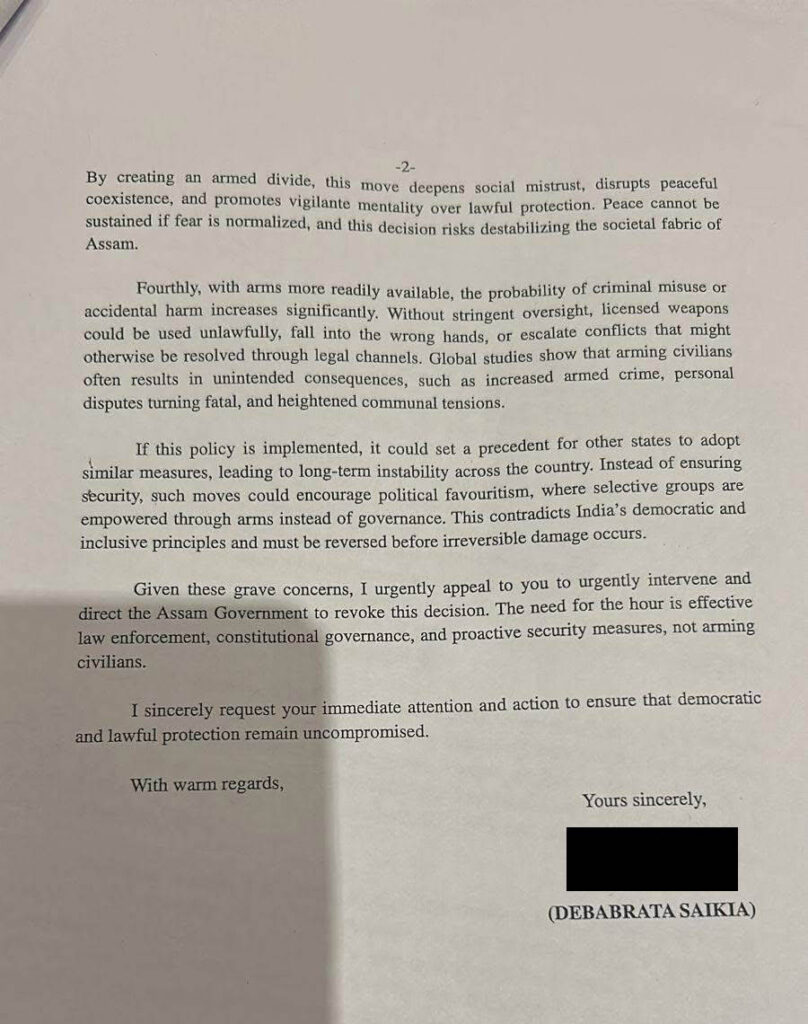

Bordering on illegality? 18 alleged Bangladeshis “pushed back” without due process, Legal challenge filed in High Court

On July 5, Assam Chief Minister Himanta Biswa Sarma announced that 18 alleged Bangladeshi nationals were deported from the Cachar and Sribhumi districts in what he termed a “special gesture of pushback”


In his social media post, Sarma reiterated the state’s position: while Assam welcomes guests, illegal residents would not be permitted to stay. The early-morning operation, executed by Assam Police, was part of an intensified campaign against undocumented immigrants, with Sarma stating that nearly 330 such individuals have been expelled from the state in the past month alone.


Security officials, however, have raised red flags. As per India Today NE, it has been reported that many individuals deported under this policy managed to return shortly after being expelled, some allegedly through porous borders in Meghalaya. Several were reportedly refused entry by the Border Guards Bangladesh (BGB), particularly those identified as Muslims, due to lack of coordination or documentation.

These individuals are believed to have been pushed into no man’s land by the Border Security Force (BSF), often during night hours, without proper documentation or adjudication through Foreigners Tribunals, raising serious concerns about violation of national and international legal norms.

July 7: CM Sarma Defends Crackdown, Announces Expansion of Eviction Drive

Speaking to reporters in Kokrajhar on July 7, Sarma defended the state’s actions and promised to expand the eviction campaign. He alleged that individuals from areas such as Karimganj, Dhubri, Chappar, and Silchar had begun settling in Lakhimpur, leading to their eviction to “protect the land rights of the indigenous people.”

If anyone has a problem with the removal of 350 illegal Bangladeshis, they will have to bear it. Many people have been martyred in the fight to drive Bangladeshis out,” said Sarma, according to the report of India Today NE.

The Chief Minister further stated that the campaign would not be halted due to political criticism. “Now they [opposition parties] are doing politics in the name of this girl to provide security to Bangladeshis,” he added, as reported by India Today NE, alleging that the real intent was to sabotage the BJP-led government’s campaign.

Sarma also announced that evictions would soon be carried out in Chappar, Dhubri, and Bodoland, stating, “No outsider should be allowed to enter Bodoland”.

PIL in Gauhati High Court: Pushback policy challenged as unconstitutional

These aggressive deportation measures have now come under judicial scrutiny. A Public Interest Litigation (PIL) filed by the All BTC Minority Students Association in the Gauhati High Court alleges that the Assam government’s “push-back policy” is being implemented arbitrarily and in violation of Articles 14, 21, and 22 of the Constitution.

According to the report of LiveLaw, when the matter came up on June 27, a division bench comprising Justices Manish Choudhury and Mitali Thakuria was informed that several individuals had been detained and pushed back without any formal process. The petitioner's counsel said he had collected the particulars of such individuals, whose whereabouts remain unknown after being picked up by the police.

According to the LiveLAw report, the PIL stated that “Deportation without notice, adjudication or opportunity to appeal constitutes a grave violation of constitutional due process... The State of Assam has undertaken an arbitrary policy of ‘push back’, which is bereft of the principles of natural justice.”

The matter is next listed for July 22, 2025. The petitioners had earlier moved the Supreme Court, but withdrew their plea after the Court expressed its inclination to dismiss it, opting instead to approach the High Court.

What does the petition entail?

  1. No Tribunal Orders, No Deportation Proceedings: Violations of Foreigners Act alleged by petitioners

The plea highlights that the pushbacks are being carried out without any judicial declaration from the Foreigners Tribunals, as required under the Foreigners Act, 1946. It argues that such practices lack legal backing and amount to arbitrary and extrajudicial expulsions.

It also refers to the Supreme Court’s ruling in Sarbananda Sonowal v. Union of India (2005), where the Court underscored the necessity of following due process in identifying and deporting foreign nationals, warning against wrongful deprivation of citizenship, particularly for vulnerable populations.

As per a report in Bar&Bench, the PIL also challenges the state’s interpretation of the Rajubala Das v. Union of India judgment dated February 4, 2025, which directed deportation of only 63 specific individuals with verified foreign nationalities. The petition contends that the state has wrongly used this order as a blanket licence to detain and push back many more without following legal procedures.

  1. Pattern of Abuse: Allegations of Muslim profiling and secret detentions

According to the petition and supporting media reports, more than 50 individuals have been picked up from different districts and transferred to the Matia Detention Centre in Goalpara. These individuals were later handed over to BSF and allegedly expelled at night, without access to lawyers or family. The PIL also refers to the case of a government school teacher who was deported, indicating a pattern of wrongful identification and profiling.

The petition emphasises that once a person has entered Indian territory, pushbacks without a tribunal order or civil authority clearance are illegal under both domestic and international law, including Article 33 of the 1951 Refugee Convention, which India, though not a signatory, is bound to uphold in spirit as part of its constitutional commitment to human rights.

Aadhaar Under Watch: Assam moves to limit access for ‘fresh entrants’

In a related policy development, the Assam Cabinet is considering restricting Aadhaar card issuance. On July 5, Sarma announced that the government may introduce a law empowering only District Commissioners to approve Aadhaar applications for individuals over 18. He claimed that most adults already have Aadhaar, and limiting new issuances would prevent alleged illegal immigrants from gaining documentation.

Fresh people coming from Bangladesh will not be able to take them,” Sarma said, as provided in the report of The Hindu, adding that the move would serve as an administrative filter against infiltration.

Experts, however, have warned that such restrictions could result in exclusion of genuine Indian citizens, particularly the poor, marginalised, and illiterate, many of whom struggle to prove documentation under existing mechanisms like the NRC or Aadhaar enrolment.

Assam’s aggressive deportation campaign, framed by the state as a defence of indigenous identity, is fast becoming a legal and human rights crisis. The ongoing PIL, multiple media exposés, and testimonies from affected communities point to a systematic subversion of constitutional protections and established legal processes.


Related:

Another Pushback Halted: SC stays deportation of woman declared foreigner, issues notice on challenge to Gauhati HC order

After incorrect detention claim, Gauhati HC was informed that Doyjan Bibi was handed over to BSF

“Bail once granted can’t be ignored”: Gauhati HC seeks legal basis for re-detentions of COVID-era released detainees
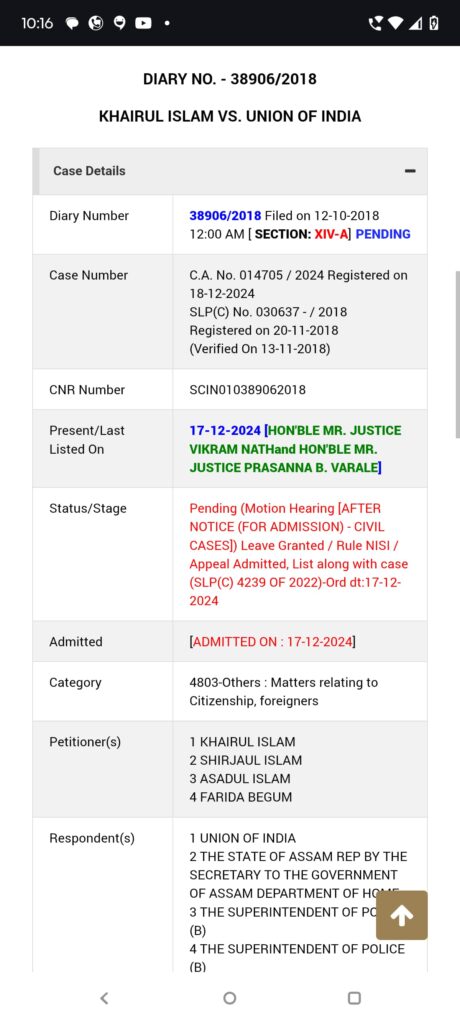


Justice Deferred: J&K High Court stays repatriation of 63-year-old woman deported after Pahalgam attack, following MHA appeal

In a move that starkly undermines constitutional protections and judicial urgency, the Ministry of Home Affairs (MHA) has secured a stay order from the Division Bench of the Jammu & Kashmir High Court, suspending the June 6 directive to repatriate 63-year-old Rakshanda Rashid, a Pakistani-origin woman who was deported in April despite having lived in Jammu for nearly four decades on a long-term visa (LTV).

The MHA filed a Letters Patent Appeal (LPA) on July 1, challenging the single-judge order passed by Justice Rahul Bharti, which had strongly criticised Rashid’s removal as a violation of her legal status and fundamental rights. On July 3, the Division Bench led by Chief Justice Arun Palli admitted the appeal and granted an interim stay, halting the enforcement of the repatriation order until further hearing.

The stay now places the continued suffering of a woman already rendered vulnerable, alone in a country she has no ties to, on procedural pause, despite the gravity of findings already made by the High Court in her favour.

Justice Bharti’s June 6 order: “A case of constitutional SOS”

Justice Bharti’s order had framed Rashid’s deportation as not only procedurally flawed but morally and constitutionally indefensible. Rashid had arrived in India in the late 1980s, married an Indian citizen, and lived in Jammu ever since. Her LTV had been renewed annually, and she had applied for Indian citizenship in 1996, which remains pending to this day.

On April 29, in the aftermath of the April 22 Pahalgam terror attack, in which 26 people were killed. The MHA issued an order cancelling visas of Pakistani nationals, but explicitly exempted LTV holders and Pakistani women married to Indian citizens. Rashid fell under both protected categories. Yet, early that morning, local police took her from her home and drove her to the Attari border, from where she was deported without a court order, without legal representation, and despite ongoing processing of her LTV renewal.

Justice Bharti took note of this in harsh terms, noting that Rashid’s deportation:

“This Court is bearing in mind background that the reference that the petitioner was having LTV status at relevant point of time which per-se may not have warranted her deportation but without examining her case in better perspective and coming up with a proper order with respect to her deportation from the authorities concerned, still she came to be forced out.” (Para 4)

He went on to declare that the Ministry of Home Affairs must retrieve her from Pakistan, stating:

“Human rights are the most sacrosanct component of a human life and, therefore, there are occasions when a constitutional court is supposed to come up with SOS like indulgence notwithstanding the merits and demerits of a case which can be adjudicated only upon in due course of time and therefore, this Court is coming up with a direction to the Ministry of Home Affairs, Government of India to bring back the petitioner from her deportation.” (Para 3)

Given the exceptional nature of facts and circumstances of the case whereby the petitioner-Rakshanda Rashid wife of Sheikh Zahoor Ahmed has been purportedly deported to Pakistan in the recent drive undertaken by the Government of India post Pahalgam carnage, this Court is constrained to direct the Secretary, Ministry of Home Affairs, Government of India to retrieve the petitioner back to J&K, India so as to facilitate the reunion of the petitioner with her husband-Sheikh Zahoor Ahmed in Jammu.” (Para 5)

The order gave the Union Government ten days to comply, listing the matter for July 1 for a compliance update. (Detailed piece may be read here.)

MHA’s Appeal: Technical objections, procedural deflection

Instead of complying, the MHA filed an appeal just as the deadline approached. In its Letters Patent Appeal, the MHA did not contest the humanitarian facts of the case or the petitioner’s prolonged residence in India. Instead, it advanced technical objections that sought to side-line the substance of the June 6 order.

Key arguments made by the MHA in the appeal included:

  • LTV not valid at time of deportation: The MHA claimed that as of April 29, 2025, Ms. Rashid’s long-term visa had expired, and therefore she was no longer under legal protection. They argued that the exemption granted post-Pahalgam was not applicable, since the LTV “did not exist” on the date of deportation.
  • Delay in filing LTV renewal application: The Ministry alleged that the LTV renewal application had been filed on March 8, not January as claimed by the petitioner. This discrepancy was used to argue that the application was late and hence invalid.
  • Order interferes with sovereign deportation powers: The MHA asserted that the single-judge order unlawfully encroaches upon the sovereign and executive powers of the Union Government to determine immigration and deportation matters, particularly in the wake of a serious national security incident.
  • Judicial overreach in “retrieving” a foreign national: The Ministry argued that the High Court had exceeded its jurisdiction by directing the Union Government to bring a foreign national back into Indian Territory—an act, they claimed, that rests exclusively with the executive under foreign and immigration law.

These arguments, framed as legal proceduralism, evaded the central concern raised by Justice Bharti: that even the deportation of a foreign national must conform to constitutional safeguards, especially when the person in question has lived in India for 38 years and has not committed any offence.

Facts that contradict the MHA’s version

The MHA’s factual claims are sharply contradicted by documentary evidence provided in the original writ petition:

  • Email dated April 26 from the FRRO acknowledged that the LTV renewal application was under process.
  • Email dated May 9 confirmed that the application had been forwarded to higher authorities for approval.
  • These emails undermine the MHA’s claim that no valid application existed at the time of deportation.

Further, Ms. Rashid’s daughter, Fatima Sheikh, told The Hindu that the application was filed in January, not March, and that the March 8 date was deliberately misrepresented by police to justify a pre-planned removal. She also said her mother was denied access to lawyers, given no notice, and is now struggling alone in Pakistan, with no relatives, no income, and deteriorating health, as provided by the report.

The Division Bench’s Stay: A reversal of urgency and rights

On July 3, without examining these contradictions or addressing the humanitarian stakes of the matter, the Division Bench granted an interim stay on the repatriation order, delaying relief without a finding of fault.

The stay has effectively nullified the urgency recognised by the single-judge bench. No timeline for repatriation. No safeguard for Rashid in Pakistan. Just indefinite suspension, as the case winds its way through another round of legal arguments.

This raises pressing constitutional and ethical concerns:

  • Can the state correct an illegal act (a forcible deportation without process) by citing procedural technicalities in retrospect?
  • Should courts allow such technicalities to override basic rights and urgent judicial directions rooted in justice and dignity?
  • Does the judicial system recognise the harm caused by delay itself, especially when the person harmed is elderly, sick, and stateless in practice?

The appeal has been admitted and will now be heard on merits. Until then, Rakshanda Rashid remains stranded in Pakistan, in legal limbo, without family or resources. The SOS call issued by the Court has been muted by procedure, and a woman who never should have been deported in the first place is forced to wait for her humanity to be re-recognised.

What the High Court gave with one hand, compassion, clarity, and courage, the system has now taken away, at least for the moment. And the message it sends is deeply worrying: that even in clear cases of wrongful state action, relief can be stayed, and rights can be delayed, if not denied.


Related:

India’s Stealthy Pushback: Thousands of alleged “Bangladeshi immigrants” deported without due process across states

Gauhati HC again grants visitation in Torap Ali petition challenging re-detention of uncle as affidavit opposing claims of regular police reporting is filed

Gauhati HC seeks verification of bail compliance in writ petition filed by Reijya Khatun for detained husband Majibur Rehman

Gauhati HC closes habeas corpus petition after release of bail-compliant detainee, declines prayer for compensation

“State says handed over to BSF, Found Unconscious in Bijni” Gauhati HC demands answers after Samsul Ali returns home unconscious

How the Rajubala case in the Supreme Court, its genesis and context has now become the ground for ‘state expulsion”


Deported in Silence: India's mass expulsions of alleged Bangladeshis without due process

Since May 7, when the Union Government launched Operation Sindoor, a massive, coordinated crackdown has led to the detention and covert deportation of over 2,000 individuals suspected of being undocumented Bangladeshi immigrants. These so-called “pushbacks” — many reportedly carried out without any judicial oversight or deportation orders — have spanned across the country, raising grave questions about legality and human rights.

According to sources in The Indian Express, the operation began following a nationwide verification exercise and has seen immigrants rounded up from states as far apart as Gujarat, Delhi, Haryana, Assam, Maharashtra, Rajasthan, Uttar Pradesh, and Goa. Most of them are then flown by Indian Air Force aircraft to border states such as Tripura, Meghalaya, and Assam — where they are held in makeshift camps, handed over to the Border Security Force (BSF), and “pushed back” across the border into Bangladesh, often within hours.

A senior government official confirmed to The Indian Express that Gujarat initiated the first round of detentions and currently accounts for nearly half of all deportations. “All states with major economic hubs are identifying such illegal immigrants after document verification. The instructions from the Ministry of Home Affairs are clear — the states are complying,” the official said, noting that the crackdown accelerated after the April Pahalgam attacks.

But the scale and method of these deportations suggest clear departures from legal norms. Under Indian law and international obligations, deportation must follow due process — including formal orders, access to legal aid, and verification by Foreigners Tribunals or equivalent mechanisms. None of this appears to be happening in these pushbacks.

The BSF, according to reports in The Hindu, has pushed back over 1,200 people from just one sector of the West Bengal-Bangladesh border. Delhi Police alone has deported at least 120 people since January, followed by Maharashtra (110), Haryana (80), Rajasthan (70), Uttar Pradesh (65), Gujarat (65), and Goa (10). Many of these individuals were transported in secrecy and denied access to legal representation.

Several were reportedly handed some Bangladeshi currency and food before being left at the border, a practice that not only flouts legal protections for non-citizens but also risks statelessness and chain deportations. Alarmingly, a significant number of people, fearing arrest, are voluntarily approaching border regions in panic, indicating the deep fear triggered by the nationwide campaign.

These coordinated actions across states, in the absence of transparent procedures, point to a disturbing trend: a pan-India, informal deportation regime operating outside the bounds of the law, with little accountability or oversight.

  1. Uttar Pradesh: 90 alleged Bangladeshi Nationals detained from Mathura kilns amid state-wide deportation drive

On May 17, police in Uttar Pradesh’s Mathura district detained 90 individuals—suspected Bangladeshi nationals—including 35 men, 27 women, and 28 children, from Khajpur village under the Nauhjheel police station. The detentions were part of an identity verification drive targeting migrant labourers working in the area’s brick kilns.

According to Mathura SSP Shlok Kumar, the detainees claimed they had been living in Mathura for the past 3–4 months and had migrated there from a neighbouring state. “All of them are being interrogated, and other investigative agencies have also been roped in,” he told ANI, suggesting that legal proceedings may follow. However, no clarity has been provided on whether these individuals were produced before a magistrate or allowed access to legal aid, raising due process concerns.

The detentions align with a larger, intensified campaign launched by the Uttar Pradesh government to identify and deport what it calls “infiltrators” — targeting primarily Bangladeshi and Rohingya communities residing in the state. Officials have also indicated that action had earlier been taken against Pakistani nationals, and similar efforts are now directed at undocumented Bangladeshi and Rohingya residents.

According to the report of Indian Express, state-wide directive from the Chief Minister’s Office has instructed all District Magistrates, SSPs, and Police Commissioners to accelerate the identification and removal of undocumented migrants, particularly in areas where many are believed to be living under changed or forged identities. Simultaneously, authorities have begun operations against so-called illegal settlements and unauthorised structures, especially in districts bordering Nepal.

The Uttar Pradesh government has publicly claimed to be the first in the country to achieve the deportation of all undocumented Pakistani nationals. “The Chief Minister himself oversees the process,” said a CMO statement, as per the ANI report.

While the state presents this as a national security achievement, rights advocates warn that such sweeping actions, especially those involving families with children, may sidestep critical legal safeguards, including the right to a fair hearing, protections under the Foreigners Act, and India’s obligations under international human rights law.

Uttar Pradesh’s operation is just one piece in a growing national trend that appears to be functioning as a shadow deportation regime, with opaque procedures, little to no judicial oversight, and significant risk of wrongful or arbitrary expulsions.

  1. Delhi: 700 alleged undocumented migrants deported under 'pushback' drive

In the last six months, nearly 700 undocumented migrants have been deported from Delhi to Bangladesh as part of the Union government’s intensified “pushback” strategy, according to a report by The Indian Express. The pace of deportations notably accelerated in the wake of the April Pahalgam terror attack, triggering a capital-wide verification and detention campaign.

Following the attack, the Delhi Police launched a coordinated drive and identified around 470 individuals as undocumented Bangladeshi nationals, along with 50 foreigners who had overstayed their visas, The Indian Express reported. These individuals were then flown from the Hindon Air Base in Ghaziabad to Agartala in Tripura, from where they were deported via land routes across the Bangladesh border.

Police sources revealed that 3–4 special flights were used over the past month for transporting the detainees. According to The Indian Express, Delhi Police also set up around five makeshift detention centres, coordinated with the Foreigners Regional Registration Office (FRRO), and arranged the transfers with the Border Security Force (BSF).

On May 16, thirteen Bangladeshi nationals, including five minors, were detained in Auchandi village in outer Delhi for allegedly living without valid documents, according to an ANI report. They were apprehended during a targeted operation following intelligence inputs, said Deputy Commissioner of Police (Crime) Aditya Gautam. On interrogation, the detainees reportedly admitted to being Bangladeshi citizens without any legal documentation permitting them to stay in India.

A week later, on May 23, the Delhi Police detained 121 Bangladeshi nationals suspected of unlawful residence in the capital and initiated deportation proceedings through the FRRO, according to The Hindu. In the same operation, five Indian nationals were questioned for allegedly facilitating the illegal entry and stay of these foreign nationals. A case was registered at Narela Industrial Area police station under provisions of the Bharatiya Nyaya Sanhita (BNS) and Sections 14 and 14C of the Foreigners Act, 1946.

A Special Investigation Team (SIT) has been formed to probe a suspected syndicate that is believed to have assisted in providing accommodation, jobs, and forged Indian identity documents to the immigrants. Authorities are now examining suspected fabrication of Aadhaar cards, voter IDs, and electricity meter connections, and have issued notices to relevant departments. Legal action has been promised against any official found complicit.

These developments mark a sharp escalation in Delhi’s deportation efforts and reflect the broader national push under Operation Sindoor to track, detain, and remove undocumented migrants, often through processes lacking judicial oversight.

  1. Delhi-Ghaziabad: Mass deportations continue as government allegedly sidesteps due process

On Sunday, May 25, around 160 undocumented Bangladeshi migrants, including women and children detained from outer Delhi, were airlifted from Ghaziabad’s Hindon Air Base to Agartala in Tripura to be deported to Bangladesh, according to a report by The Hindu.

Officials told the newspaper that the transfer was in line with the Indian government’s directive to expedite deportations without waiting for formal processes, which are often “lengthy.” This reflects a growing trend of informal and accelerated removals, especially following the April 22 Pahalgam terror attack.

Since the attack, more than 500 individuals have reportedly been sent back through India’s eastern border. Across the country, police forces have been conducting verification drives to identify alleged undocumented immigrants. Once detained, the migrants’ biometrics are recorded, and any Indian identity documents, such as Aadhaar cards, are cancelled. These biometrics are reportedly used to prevent re-entry and re-enrolment in Indian systems.

After biometric capture, the migrants are handed over to the Border Security Force (BSF) and pushed back across the border. The Bangladesh Ministry of Foreign Affairs, in a letter sent on May 8, raised concerns over these forced entries and called on India to respect formal repatriation mechanisms.

Earlier, on May 4, two Air India planes transported around 300 undocumented migrants, including 200 women and children who had been detained in Gujarat, to Agartala. They were subsequently sent across the border to Bangladesh.

At a press conference on May 26 in Dhaka, Brigadier General Md. Nazim-ud-Daula of the Bangladesh Army condemned these deportations as unacceptable “push-ins.”

In just one month since the Pahalgam incident, Delhi Police identified and deported 470 undocumented Bangladeshi nationals and 50 foreign overstayers, flying them from Hindon to Tripura before pushing them across the land border.

An officer from Delhi Police told The Hindu that the Ministry of Home Affairs had instructed city police as early as late 2024 to begin verification drives targeting Bangladeshi and Rohingya migrants. Between November 15, 2024, and April 20, 2025, about 220 undocumented migrants and 30 overstayers were identified, taken by train and road to eastern states, and deported via land borders through the FRRO.

However, after the Pahalgam attack, the process intensified. “Over the last one month, around 3–4 special flights went from Hindon air base to Agartala,” a senior officer said. In total, about 700 individuals have been deported from Delhi over the past six months, he added.

Initially, Deputy Commissioners of Police (DCPs) from all 15 districts were tasked with identifying undocumented Bangladeshi and Rohingya migrants. A first battalion of Delhi Police, along with FRRO officials, would accompany detainees via rail and road to West Bengal, from where the BSF completed the deportation process, according to a government source cited by The Hindu.

  1. Gujarat: Over 1,000 detained in state’s largest crackdown, hundreds airlifted and pushed back across border

On April 26, Gujarat Police executed what officials described as the state's largest-ever operation targeting undocumented migrants, detaining 1,024 suspected Bangladeshi nationals, 890 in Ahmedabad and 134 in Surat, amid allegations of fake documents and criminal activity, as per Deccan Herald. The state Home Minister hailed the operation as a “historic victory,” warning that those harbouring such individuals would face strict action, and confirming plans to swiftly deport the detainees, as per the report of Hindustan Times.

Just over a week later, on May 4, two Air India flights carried some 300 of the detained migrants, including around 200 women and children, to Agartala in Tripura. From there, they were “pushed back” across the land border into Bangladesh, bypassing lengthy legal deportation procedures, as per the HT report.

These actions followed a directive from the Ministry of Home Affairs after the Pahalgam terror attack, streamlining mass deportations with rapid airlifts and border pushbacks, according to Times of India report. Authorities have flagged concerns about detainees’ alleged links to drug and human trafficking ring, and even extremist sleeper cells, as justification for the sweeping operation, as per the New Indian Express.

The Gujarat operation, which involved specialized units from Ahmedabad Crime Branch, SOG, EOW, and local police divisions, also uncovered widespread use of forged IDs sourced from West Bengal, a network that is now under investigation as per the Indian Express report.

These developments underscore a troubling trend: a coordinated and expedient deportation campaign that circumvents due process, with authorities opting for air-bridge removals and cross-border pushbacks in lieu of formal court procedures.

  1. Rajasthan: 1,000 marked for deportation as Indian migrant workers from Bengal detained for “Speaking Bengali”

On May 14, 2025, Rajasthan’s Law and Parliamentary Affairs Minister Jogaram Patel announced that around 1,000 suspected Bangladeshi nationals had been identified across the state. Speaking in Jaipur, he confirmed that the first group of 148 detainees had been moved to Jodhpur and then flown to Kolkata, from where they would be deported to Bangladesh. According to The Hindu, most of these individuals were originally detained in Sikar district, and the Village Development Officers’ Training Centre in Jodhpur had been temporarily converted into a holding facility for the deportation process.

As per the report, Patel further stated that the state would continue similar operations in the coming days to facilitate further removals.

However, the state’s aggressive crackdown also resulted in wrongful detentions. On May 13, Rajasthan Police released 13 migrant workers, including children and two families from Cooch Behar, West Bengal, who had been held for nine days on suspicion of being Bangladeshi infiltrators, solely because they spoke Bengali. The group had been picked up by personnel from the Patan Police Station in Sikar district, and were detained in a guest house under police watch, despite being Indian citizens.

According to The Telegraph, their release came only after sustained communication from West Bengal government officials, who intervened when alerted by concerned families and local leaders. Samirul Islam, a TMC Rajya Sabha MP and head of the Bengal government’s migrant worker welfare board, confirmed that state officials had been in touch with their counterparts in Rajasthan to secure the workers’ release. A senior Cooch Behar official reportedly called Rajasthan Police directly, following which the detainees were let go.

Obaydul Khandakar, a resident of Purba Jaigir Balabari village in Cooch Behar’s Dinhata-II block, who had been detained along with his wife Beauty Bibi, told the newspaper: “Despite being Indian citizens, we were detained for nine days just because we spoke Bengali.” The families had been working at a brick kiln near Sikar and returned there after their release. Khandakar said he planned to settle his dues and was now uncertain about returning to Rajasthan for work, shaken by the experience.

  1. Tripura: Over 2,800 arrested for illegal entry since 2022 amid ongoing crackdown

On June 9, the Government Railway Police (GRP) in Tripura arrested one Bangladeshi national and one Indian tout during separate operations at Agartala railway station, according to a report by EastMojo. In the first incident, Pranajit Ray (35), a resident of Sylhet district in Bangladesh, was intercepted during a joint operation conducted by the GRP, Railway Protection Force (RPF), Border Security Force (BSF), and other agencies. Police said he had illegally crossed the border and was planning to travel to Kolkata. “We seized some documents and Indian currency. We are examining these,” an officer told the outlet.

In a separate case, an Indian trafficker from Chanipur in West Tripura district was also arrested as part of a similar joint operation.

The arrests come amid a growing number of detentions in the state. Between January 1 and February 28, 2024, a total of 816 Bangladeshi nationals, 79 Rohingya, and two Nigerians were arrested in Tripura, according to the Tripura Police's own data cited by EastMojo.

Additionally, Chief Minister Dr. Manik Saha, who also holds the Home portfolio, recently informed the Assembly that 2,815 Bangladeshi nationals were arrested for illegally entering Tripura between 2022 and October 31, 2024. Out of these, 1,746 were “pushed back” across the border, while 1,069 remained either in jail, temporary detention centres, shelter homes, or out on bail, as per a report by The Indian Express.

  1. Maharashtra: Four alleged Bangladeshi nationals held in Pune following military intelligence tip-off

In Maharashtra, four suspected Bangladeshi nationals were detained from a labour camp in Pune’s Khondwa area on June 13 in a joint operation conducted by the police and Military Intelligence, according to a report by The Hindu. The arrests were made following a tip-off from the Southern Command of Military Intelligence, which led authorities to intercept the individuals as they were allegedly attempting to flee the area.

Upon preliminary verification, the four men were identified as Swapan Mandal, Mithun Kumar, Ranodhir Mandal, and Dilip Mondal, and were found to be citizens of Bangladesh. Defence sources cited in the report confirmed that the individuals will undergo joint interrogation by multiple agencies.

  1. West Bengal: Seven alleged Bangladeshi nationals caught trying to return home after years in India

On Saturday, seven alleged Bangladeshi nationals, including three women, were apprehended by police in Nadia district of West Bengal while attempting to cross back into Bangladesh after reportedly spending four years working in various Indian cities, according to a report by Hindustan Times.

“These individuals had entered India illegally through the North 24 Parganas border around four years ago and have since worked in Mumbai, Delhi, and several cities in Gujarat,” said Somnath Jha, Deputy Superintendent of Police (Border), Ranaghat Divisionm as per the HT report. They were caught in the Hanskhali police station area, the same location where another Bangladeshi woman was arrested earlier last week. She had reportedly entered India in 2024 and also worked in Mumbai.

The arrested individuals are said to be from Khulna, Jessore, Cox’s Bazar, and Kushtia districts in Bangladesh. According to officials, the group was attempting to return to Bangladesh with the help of an agent who is currently absconding.

With these arrests, the total number of alleged Bangladeshi nationals detained in various districts of West Bengal since December 2023 has reached approximately 100, as per police estimates. The Border Security Force (BSF) and other agencies have stepped up surveillance along the Indo-Bangladesh border since 2024 in response to the ongoing political unrest in Bangladesh.

State Pushback: When governments step in to stop unlawful deportations

While the Union government’s crackdown on undocumented migrants has unfolded across states with unprecedented coordination and speed, a few state governments have pushed back, not against migrants, but against what they allege are unlawful deportations of Indian citizens. In rare but telling instances, state authorities have intervened to halt or reverse deportations, particularly where those detained turned out to be bona fide Indian nationals. Most notably, the West Bengal government has led efforts to trace, verify, and bring back its residents who were mistakenly or illegally pushed into Bangladesh, raising urgent questions about due process, documentation, and the risks of communal or linguistic profiling in the ongoing campaign.

  1. West Bengal Government brings back seven men wrongly deported to Bangladesh

In a striking instance of state-level intervention against what is being called unlawful deportation, the West Bengal government has successfully facilitated the return of at least seven Indian citizens who were allegedly picked up by Maharashtra Police during anti-immigration drives and pushed across the Bangladesh border, despite holding valid Indian documents.

The men, most of whom are residents of Murshidabad district, were working as daily wage labourers or masons in Mumbai and Thane. They were detained between June 9 and 11, and within days, without due legal process, transported across the border and abandoned in Bangladesh, according to The Indian Express.

One of the deportees, 36-year-old Mehbub Sheikh, who worked as a mason in Thane, was detained on June 11 and pushed into Bangladesh from a BSF camp in Siliguri by the early hours of June 14, despite his family and local police submitting documentation, including Aadhaar, voter ID, and land records, to prove his Indian citizenship. Another youth, Shamim Khan, also from Murshidabad, was picked up around the same time and met the same fate.

Following urgent appeals from families and local authorities, the West Bengal Migrant Workers’ Welfare Board, under instructions from Chief Minister Mamata Banerjee, intervened. The Board’s chairman and TMC Rajya Sabha MP Samirul Islam told The Indian Express that the state government had taken the matter up directly with the Union government and the BSF. “Our government coordinated with central agencies and ensured five individuals were brought back by Sunday, and two more by Monday. We are continuing efforts to identify if others from Bengal have also been wrongfully deported,” he said.

According to a statement by Murshidabad SP Kumar Sunny Raj, upon receiving alerts from families, district police initiated local verification and coordinated with the BSF. Once the individuals’ Indian nationality was confirmed through supporting documents, the BSF held a flag meeting with Border Guard Bangladesh (BGB) and repatriated the youths. “They were handed over to Raiganj police station by the BSF and will be taken back to their respective villages,” added SP Md Sana Akhtar of Uttar Dinajpur as per the report.

The deported men include Mehbub Sheikh (Bhagwangola), Shamim Khan (Hariharpara), Minarul Sheikh (Beldanga), Nazimuddin Mondal (Hariharpara), and Mostafa Kamal Sheikh (Monteswar, Purba Bardhaman). Additionally, Fazer Sheikh and his wife Taslima from Bagda in North 24 Parganas were also returned. All were among the over 130 people transported by BSF aircraft from Pune to Agartala, and then dropped off at the border with minimal belongings, a packet of food, and 300 Bangladeshi Taka, according to multiple returnees.

Speaking to The Hindu, Nazimuddin Mondal, 34, recalled: “We were herded like cattle. At 3 am, the BSF jawans drove us toward the border, told us not to return. We walked into complete darkness.” After being chased away by Bangladeshi locals and beaten by BGB personnel, the group wandered for hours in paddy fields with mud up to their knees, before the BSF called them back the following evening and took them to Kokrajhar.

Nazimuddin’s brother Musarraf Mondal said the family had frantically submitted documentation to both local police in Murshidabad and the authorities in Mumbai, but were ignored. “Only after my brother managed to call from Bangladesh did, we know what had happened,” he said.

According to Samirul Islam, this is not an isolated event. “There is growing concern that Bengali-speaking Indian citizens, especially migrant workers, are being wrongly profiled and deported in BJP-ruled states like Maharashtra,” he told The Telegraph. “This is illegal, and our Chief Minister has written to the Centre about this.”

The return of these individuals was made possible through urgent coordination between state police, BSF, and BGB, as confirmed by Mekhliganj Police Station OC Mani Bhusan Sarkar, who received prior alerts from Murshidabad and Bardhaman police about missing residents. After verifying identities, a flag meeting at the Mekhliganj border enabled their return on Sunday afternoon.

As The Hindu reports, these cases come amid a wider trend of the Indian government “pushing back” undocumented migrants across the Bangladesh border, especially following Operation Sindoor, launched in the wake of the Pahalgam terror attack in April. The Border Guard Bangladesh (BGB) has officially raised objections, stating such pushbacks violate diplomatic protocols.

For the seven men from Bengal, the ordeal has left lasting scars. “We were taken from one police station to another in Mumbai. We had no phones, no belongings. No one listened to us,” said Nazimuddin, still shaken after returning to his village in Taratipur, Murshidabad. “Only the state government listened.”

Here is a detailed and paraphrased version of the UP detention and Bengal police intervention story, rewritten with improved flow and source attribution:

  1. West Bengal police intervene to secure release of six detainees from UP, wrongly suspected as Bangladeshis

In yet another instance that underscores growing concerns around the profiling of Bengali-speaking migrant workers, six residents of West Bengal, including two drivers, were detained by the Uttar Pradesh Police on May 5 in Deoria district, allegedly on suspicion of being Bangladeshi nationals. The detainees, five from Beldanga in Murshidabad and one from Krishnaganj in Nadia, were travelling by bus when they were stopped and taken to Lar police station, according to a report in The Telegraph.

The situation was resolved only after swift intervention by Murshidabad Superintendent of Police Kumar Sunny Raj, who contacted senior UP officials and facilitated the release of the group. A police officer in Bengal, speaking to the media, confirmed that local authorities had been alerted to the detentions around noon. “As soon as we were informed, our SP reached out to his counterparts in Uttar Pradesh. The issue was resolved the same day,” the officer stated.

Family members of the detainees said they were advised to keep their local police stations informed while travelling outside the state, especially in light of recent incidents of wrongful detention. “We had notified the Beldanga Inspector-in-Charge as a precaution. The prompt response of our local police ensured the group was not subjected to further harassment,” said Din Muhammad, a relative of one of the men, while speaking to The Telegraph.

Samirul Islam, Trinamool MP and chairman of the West Bengal Migrant Workers’ Welfare Board, condemned the incident, calling it part of a worrying trend of systemic suspicion and profiling of Bengali-speaking Indians in BJP-ruled states. “This has to stop. Speaking Bengali does not make someone a Bangladeshi,” Islam said. He further noted that despite the six men producing valid photo ID cards, they were still detained, an act he described as “deeply discriminatory.” He added that Chief Minister Mamata Banerjee had already written to the Centre raising concern about the growing frequency of such incidents.

Police confirmed that the group was released by the evening of May 5 and arrangements were made for them to return to their homes in Bengal the following day. (Detailed report may be read here.)

When the Courts Intervene: Stays and interim protection

Amid a wave of detentions and swift deportations, many allegedly carried out without due process, constitutional courts across India have intervened to halt or question such actions. In several instances, the Supreme Court and High Courts have granted interim protection or stay orders, preventing the deportation of individuals flagged as "illegal migrants" or declared foreigners under the Foreigners Act. These judicial interventions have not only delayed state action but have, in some cases, forced authorities to re-examine the legality and fairness of their deportation processes.

  1. Supreme Court grants interim protection to woman declared 'foreigner' amid concerns over opaque deportation processes in Assam

Amid growing judicial scrutiny of arbitrary deportation practices in Assam, the Supreme Court on June 24, 2025, granted interim protection from deportation to Jaynab Bibi, a woman declared a foreigner by a Foreigners Tribunal under Section 2(a) of the Foreigners Act, 1946. The Tribunal’s two-page 2017 order had summarily dismissed her extensive documentary evidence, including the 1951 NRC, multiple electoral rolls, land records, and local certificates, on grounds of minor inconsistencies in names and testimonies. The Gauhati High Court upheld this finding in February 2025 and revoked her interim protection, but the Supreme Court has now stayed all coercive steps against her, including deportation, while issuing notice in her special leave petition. The case is next listed for August 25.

Represented by Advocates Fuzail Ahmad Ayyubi and Akanksha Rai, Jaynab’s petition relies heavily on the Supreme Court’s own observations in Mohd. Rahim Ali v. State of Assam (July 2024), where the Court cautioned against opaque and suspicion-based declarations under the Foreigners Act. Jaynab, who claims Indian citizenship by birth and residence in Nagaon district, contends that her identity was rejected without due process. The Court’s intervention, though interim, sends a strong signal against mechanical adjudications and underscores the central role of constitutional safeguards in proceedings that could result in loss of nationality and expulsion. (Detailed report may be read here.)

  1. Bombay High Court grants bail over custodial rights violation

In a significant judicial intervention affirming procedural safeguards even in cases involving alleged undocumented immigrants, the Bombay High Court on May 7, 2025, granted bail to 34-year-old Sabnam Suleman Ansari, accused of entering India illegally, after finding that she was produced before a magistrate well beyond the constitutionally permitted 24-hour window following her arrest. Justice Milind Jadhav, while granting her bail on a surety of ₹5,000, observed that Ansari was arrested on January 28 at 12:30 PM and produced only on January 29 at 4:30 PM. The delay, the judge ruled, constituted a prima facie breach of her fundamental rights under Articles 21 and 22 of the Constitution. According to the order, “It is the duty of the Bail Court to step in,” when such violations are apparent.

The prosecution alleged Ansari had entered India through an unauthorised route from Bangladesh and lacked valid travel documents. However, Justice Jadhav rejected the State’s reliance on an earlier division bench ruling in Karan Ratan Rokade v. State of Maharashtra, distinguishing the facts and affirming the Supreme Court’s position in Vihaan Kumar v. State of Haryana, which emphasized the judiciary’s obligation to grant bail in cases of illegal detention. The Court also noted the indifference of police authorities toward elementary but statutory safeguards under Section 50 of the CrPC and Section 58 of the Bharatiya Nagarik Suraksha Sanhita, 2023, underscoring that constitutional protections remain non-negotiable, even in immigration-related prosecutions.

  1. Bombay High Court intervenes in detention of Indian teen following father’s deportation

In another crucial instance of judicial scrutiny over policing under the Foreigners Act, the Bombay High Court on June 3, 2025, ordered the immediate release of 18-year-old Ruksar Dadamiya Khan, who had been detained by Mumbai’s Mankhurd police following her father's deportation to Bangladesh on allegations of illegal migration. Despite being born in India and possessing valid Indian documents, Ruksar was held in custody without any independent proceedings initiated against her. A vacation bench comprising Justices Dr. Neela Gokhale and Firdosh P. Pooniwalla passed the order while hearing a habeas corpus petition filed on behalf of Ruksar and her two younger siblings, aged 16 and 8, seeking protection from coercive state action and possible deportation.

According to the petition, while the younger siblings were released to their mother soon after it was filed, Ruksar remained confined at the Nirbhaya Cell in Mankhurd, prompting the Court’s urgent intervention. The bench observed that her continued detention was unwarranted and violative of Article 21 of the Constitution, which guarantees personal liberty, especially when she was not the subject of any conclusive or independent inquiry under the Foreigners Act, 1946. The ruling serves as a reminder that procedural fairness cannot be dispensed with, particularly in cases involving minors or Indian-born individuals whose rights risk being subsumed by broad and indiscriminate enforcement drives.

  1. Gauhati High Court orders immediate release of bail-compliant man detained as 'Foreigner'

In a forceful assertion of constitutional liberty, the Gauhati High Court on June 16, 2025, ordered the immediate release of Hachinur @ Hasinur, a resident of Goalpara, who had been unlawfully detained by the Assam Border Police despite being out on High Court–granted bail since 2021. The Court declared his detention “expressly illegal,” noting that no bail cancellation had been obtained and the Foreigners Tribunal’s declaration against him remained sub judice. Rejecting the State’s plea for adjournment due to lack of instructions, the bench of Justices Kalyan Rai Surana and Malasri Nandi stated, “Illegal detention cannot be allowed even for a minute,” and reminded the State that liberty cannot wait for bureaucratic coordination. The order came in response to a habeas corpus petition filed by the detainee’s mother, Mozida Begum, which documented the detainee’s weekly police reporting and absence of any new judicial order justifying re-arrest.

The Court had earlier stayed any deportation and verified that Hachinur was held at the Kokrajhar Holding Centre. His arrest on May 25, 2025, triggered widespread concern, especially as he had regularly reported to Goalpara Police Station per the conditions of his 2021 bail, granted under the Supreme Court’s COVID-19 guidelines. During the hearing, Advocate A.R. Sikdar emphasised that no fresh legal proceedings had been initiated, and the arrest was both unconstitutional and unjustified. The Court agreed, holding that the State should have sought a judicial order if it believed fresh grounds existed. “Once there is bail, if they do not give you instructions, it is their lookout,” Justice Surana said. With that, the Court directed immediate release, reinforcing that executive action cannot override existing judicial protections or suspend liberty at will. (Detailed report may be read here.)


Related:

Another Pushback Halted: SC stays deportation of woman declared foreigner, issues notice on challenge to Gauhati HC order

After incorrect detention claim, Gauhati HC was informed that Doyjan Bibi was handed over to BSF

Gauhati HC again grants visitation in Torap Ali petition challenging re-detention of uncle as affidavit opposing claims of regular police reporting is filed

“Bail once granted can’t be ignored”: Gauhati HC seeks legal basis for re-detentions of COVID-era released detainees
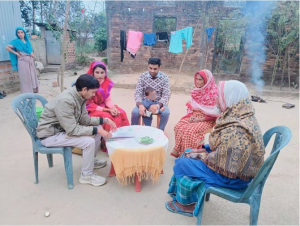

J&K High court orders repatriation of 63-year-old woman deported to Pakistan without due process

In a powerful reaffirmation of constitutional compassion and the primacy of human rights, the High Court of Jammu and Kashmir and Ladakh has directed the Union Ministry of Home Affairs to repatriate Rakshanda Rashid, a 63-year-old woman who was deported to Pakistan following a counter-terrorism drive in the aftermath of the Pahalgam terrorist attack.

The Court, presided over by Justice Rahul Bharti, observed that Rashid’s deportation appeared arbitrary and in violation of her legal status as a Long-Term Visa (LTV) holder who had resided in India for nearly four decades. The matter came before the Court through a writ petition filed by her daughter, Falak Zahoor.

The petitioner’s husband, Sheikh Zahoor Ahmed, informed the Court that Rakshanda had no family or support in Pakistan and was suffering from multiple serious ailments. Her deportation, he submitted, had left her vulnerable, abandoned, and at grave risk.

The Court took serious note of these submissions, underscoring that in matters where human life and dignity are imperilled, the judiciary is obligated to act as a constitutional protector—even in the absence of a full adjudication on the merits.

“Human rights are the most sacrosanct component of a human life and, therefore, there are occasions when a constitutional court is supposed to come up with SOS like indulgence notwithstanding the merits and demerits of a case which can be adjudicated only upon in due course of time and therefore, this Court is coming up with a direction to the Ministry of Home Affairs, Government of India to bring back the petitioner from her deportation.” (Para 3)

Justice Bharti noted that at the time of her deportation, Rashid was a documented LTV holder—a status that ought to have protected her from arbitrary removal. Yet, without any formal deportation order or due process, she was allegedly “forced out” of the country as part of a broader post-carnage operation by government authorities.

This Court is bearing in mind background that the reference that the petitioner was having LTV status at relevant point of time which per-se may not have warranted her deportation but without examining her case in better perspective and coming up with a proper order with respect to her deportation from the authorities concerned, still she came to be forced out.” (Para 4)

Referring to the “exceptional nature of facts and circumstances,” the Court issued extraordinary directions to the Ministry of Home Affairs:

Given the exceptional nature of facts and circumstances of the case whereby the petitioner-Rakshanda Rashid wife of Sheikh Zahoor Ahmed has been purportedly deported to Pakistan in the recent drive undertaken by the Government of India post Pahalgam carnage, this Court is constrained to direct the Secretary, Ministry of Home Affairs, Government of India to retrieve the petitioner back to J&K, India so as to facilitate the reunion of the petitioner with her husband-Sheikh Zahoor Ahmed in Jammu.” (Para 5)

The Ministry has been given ten days from the date of the order (June 6, 2025) to ensure compliance. The matter is now listed for July 1, 2025, when a compliance report is to be submitted before the Court.

The order, marked by urgency and empathy, sets a significant precedent in cases involving the deportation of foreign nationals long-residing in India under legal permits. It highlights the responsibility of the state to uphold due process, especially when fundamental rights and humanitarian considerations intersect.

The complete order may be read below.

[viewpdf 42425]


A judicial pushback amid rising arbitrary deportations

This order comes at a crucial moment. Across the country, particularly in the state of Assam, there has been a surge in the deportation of Bengali-speaking individuals, most of whom are Muslims, many of them declared “foreigners” by opaque and controversial Foreigners Tribunals. Numerous cases have been documented where individuals have been picked up and sent across the Bangladesh border without any written deportation order, legal representation, or family notification.

In several instances, courts and commissions have been bypassed altogether. Women, children, and elderly persons have been subjected to these clandestine removals, often despite having ongoing legal cases, bail orders, or valid documents. The pattern has alarmed civil liberties groups, who describe it as a systemic erosion of constitutional guarantees like due process, dignity, and the right to be heard.

Against this grim national backdrop, the Jammu & Kashmir High Court’s order stands out for upholding the principle that even those classified as “foreigners” or “non-citizens” are entitled to basic constitutional protections. The judgment affirms that deportation—when carried out without transparency, legal backing, or humanitarian consideration—amounts to a violation of both law and conscience.

This order sends a strong message: that constitutional protections do not end at the margins of nationality, and that humanitarian justice must prevail where executive action falters.

Related:

Gauhati HC again grants visitation in Torap Ali petition challenging re-detention of uncle as affidavit opposing claims of regular police reporting is filed

Gauhati HC seeks verification of bail compliance in writ petition filed by Reijya Khatun for detained husband Majibur Rehman

Gauhati HC closes habeas corpus petition after release of bail-compliant detainee, declines prayer for compensation

“State says handed over to BSF, Found Unconscious in Bijni” Gauhati HC demands answers after Samsul Ali returns home unconscious

How the Rajubala case in the Supreme Court, its genesis and context has now become the ground for ‘state expulsion”


M’tra: Three West Bengal residents pushed into Bangladesh by BSF, return after WB state govt.’s intervention

Three West Bengal residents working in Mumbai were allegedly pushed into Bangladesh by the Border Security Force (BSF) earlier this week and on Sunday (June 15, 2025) returned to the country from the state’s Cooch Behar district.

Minajul Sheikh, a resident of Beldanga in Murshidabad district, told The Hindu that his brother Minarul Sheikh was picked up from Mumbai where he was working and subsequently forced into Bangladesh. Apart from Minarul Sheikh, at least two other workers were pushed into Bangladesh. The three workers — Minraul Sheikh and Nizamuddin Sheikh from Murshidabad and Mostafa Kamal Sheikh from Purba Bardhaman — also sent a video message to their relatives where they can be heard pleading before Chief Minister Mamata Banerjee and other public representatives of the State to ensure their return to India.

It was only after the West Bengal government raised the issue, the workers were repatriated to India through the Mekhliganj border in Bangladesh on Sunday afternoon. Trinamool Congress Rajya Sabha member and chairperson of West Bengal Migrant Welfare Board Samirul Islam said when the workers were picked up by the police in Mumbai, all necessary documents were provided by the State government.

“What has happened is very unfortunate and illegal. These are citizens of India and cannot be illegally pushed into Bangladesh in such a manner,” Mr. Islam said.

On X he said,Under the leadership and active intervention of our Chief Minister @MamataOfficial, we were finally able to repatriate seven Indian citizens who were illegally pushed back to Bangladesh by the BSF. The Maharashtra Police first detained them on suspicion of being Bangladeshis and then handed them over to the BSF, which carried out the final act of deporting these poor migrant workers to Bangladesh—only because they spoke Bengali. They were deported to Bangladesh despite they showed all relevant proof of being an Indian. 

I have some questions:

  1. How did the Maharashtra Police hand over these migrant workers to the BSF without informing the West Bengal government?
  2. Why didn’t the BSF contact the local administration to verify their identities before forcibly deporting them to another country?
  3. Is there a larger plan by these BJP-ruled states and the BSF to target and harass Bengali-speaking migrant workers?

We will not let this issue go. We will expose the dark forces behind this misdeed and ensure justice.”

The officer-in-charge of the Mekhliganj Police Station Mani Bhusan Sarkar said that after he received information from police stations in Murshidabad and Bardhaman about the Indian nationals in Bangladesh, he informed authorities of the BSF and Border Guard Bangladesh. “The three men were handed over to us [Mekhliganj police station] after a flag meeting at the border,” the Officer-in-Charge said. According to sources, the three men were pushed into Bangladesh on Friday night somewhere along North Bengal and Bangladesh border.

Since mid-May 2025, in a cloak and dagger operation, without any public disclosure, some administrations in India have been “pushing back” undocumented Bangladeshi migrants detained across the country through the eastern border. The Border Guard Bangladesh (BGB) has expressed concern to India about the “push back” of individuals across the border, particularly undocumented migrants. Interestingly, there is no official word about the “push back” from the BSF. While instances of the “push back” of Bangladeshi nationals has come to the fore in Assam and Tripura, on this occasion, nationals of West Bengal were pushed into Bangladesh.

Meanwhile, Assam has seen the most aggressive of this policy in action. Citizens for Justice and Peace has been at the forefront of documenting and agitating the issue, both with the National Human Rights Commission (NHRC) and the Gauhati High Court. The memorandums to the NHRC may be referred to here. No evidence of due process has been followed by the Assam police in detaining without notice, persons who have every reason to state –with documents—that they are Indian. The last month’s coverage of the crisis may be read here, here and here. 

Related:

Assam: Academics, lawyers, activists condemn ‘push back’ of persons to Bangladesh

Assam: When six ordinary Indian women were forcibly pushed out from India–No Man’s land– Bangladesh & then back

Assam: Slamming Sarma’s actions as discriminatory & unlawful, LOP, Assam Assembly Debabrata Saikia calls for an urgent stop to “pushback” of citizens


Union Govt admits handover of Samsul Ali to BSF, Gauhati High Court grants family visitation rights if not yet deported

In the hearings of the petition filed by Bakkar Ali regarding the recent allegedly secret detention of his father Samsul Ali, the counsel for Union of India today –June 10– told Gauhati High Court the father was formally handed over by Assam Police to the Border Security Force (BSF) Sector Headquarters at Panbari on May 26, 2025. The disclosure came nearly two weeks after Samsul Ali was allegedly picked up from his residence in Chirang district during a late-night operation on May 25, without any arrest memo, warrant, or court production — prompting his family to move the High Court under Article 226 of the Constitution. The last hearing in the matter was yesterday, June 9, and a report on the last hearing may be read here.

In the most recent order passed today by the bench of Justices Kalyan Rai Surana and N. Unni Krishnan Nair, the Court directed that, if Samsul Ali has not yet been deported, the head of the BSF Sector Headquarters shall permit the petitioner and one family member to visit him, and facilitate the execution of a vakalatnama to allow continued legal representation. In the event that deportation has already taken place, the authorities have been instructed to disclose the exact location from which the deportation occurred.

The case — in which legal aid is being provided by Citizens for Justice and Peace (CJP) — is part of a growing number of petitions being filed in the Gauhati High Court, where families allege that Bengali-speaking Muslims previously released on bail after FT declarations are being secretly re-detained and, in some cases, deported without judicial oversight. These cases share a recurring pattern: midnight pickups, non-disclosure of custody, denial of access to legal remedies, and procedural opacity in handovers to BSF or other agencies.

Today’s order builds on yesterday’s hearing in the matter, which took place on June 9, in which the High Court had criticised the State’s failure to provide any documentation about the transfer to BSF. While it has declined, for now, to direct the Union of India to file a formal affidavit, the Court has kept the petition alive — leaving open the door for further relief if deportation is confirmed or if any adverse development occurs. The matter is next listed for June 20, 2025. (Details of the earlier proceeding may be read here.)

Meanwhile, through independent social media sources, CJP has found Samsul Ali in a distraught condition may be in No Man’s land between the two countries. See the memorandums submitted to the National Human Rights Commission (NHRC) on the question here and here.

From Secrecy to Disclosure: The three-stage legal timeline of the case

This case has seen incremental disclosures over successive hearings:

  • May 25, 2025: Samsul Ali, a declared foreigner who had been released on conditional bail since 2020, was picked up from his residence in Goraimari No. 2, Chirang, around 11:30 PM, without a warrant, memo of arrest, or cancellation of bail.
  • June 9, 2025: The State counsel submitted for the first time that Samsul Ali had been “handed over to the BSF,” but failed to provide any documentation, location, or handover memorandum. The Court criticised this procedural opacity and ordered the SP (Border), Chirang to cooperate with the FT counsel and supply all relevant information via WhatsApp. (Details of the said proceeding may be read here.)
  • June 10, 2025: The State confirmed in court that Samsul Ali was handed over to the BSF Sector HQ at Panbari on May 26. On this basis, the Court passed a direction that, if Samsul Ali has not yet been deported, the head of the Sector Headquarters shall permit the petitioner and one family member to visit him and obtain his signature on a vakalatnama. If he has been deported, the authorities must inform the petitioner of the exact location from which the deportation took place.

Petition remains pending, keeps door open for further relief

During today’s hearing, Advocate Mrinmoy Dutta, appearing for the petitioner, requested that the Union of India be directed to file an affidavit detailing whether Samsul Ali has been deported and, if so, on what legal and factual basis. The Court, however, declined to issue such a direction at this stage, noting that a large number of similar cases are now being filed, and that such a step would not be feasible in every matter.

That said, the petition has not been dismissed. The Court clarified that if the petitioner faces any adverse consequence — such as confirmed deportation — the said may be informed to the Court immediately. It also indicated that a report would be called for if deportation has indeed taken place, keeping the petition procedurally alive and legally relevant.

The matter is now listed for further hearing on June 20, 2025.

Background: Bail compliance, FT order, and the alleged procedural bypass

Samsul Ali was declared a foreigner by the Foreigners Tribunal, Chirang in 2016. He spent more than three years in detention before being released in February 2020 under the bail regime outlined by the Supreme Court in SCLSC v. Union of India (2019). Since his release, he had been reporting weekly to the Police Station, with his last appearance logged on May 21, 2025 — just four days before his pickup.

His family maintains that he was detained without documentation, never produced before a magistrate, and that police allegedly refused to accept an FIR, forcing them to send complaints by registered post. When no official information was forthcoming, the family had filed the said habeas corpus petition — which has since led to successive disclosures culminating in today’s order.

The FT order under which he was declared a foreigner is not based on any proof of border crossing or foreign documentation, and does not establish nationality in any other country. The family alleges that Samsul Ali has been rendered stateless, and that deportation without formal diplomatic clearance and nationality verification would be illegal.

Visitation to BSF: A notable legal step

While courts have regularly granted visitation rights to families of detainees held in civil detention centres, today’s order granting visitation rights to a person in BSF custody at a Sector Headquarters is notable. It affirms that even in border security operations, access to family and legal counsel cannot be arbitrarily denied, especially when the legal status of the person’s custody or deportation is under judicial review.

It also sets a precedent for ensuring access and due process even in cases where the handover to BSF is claimed, but documentation is missing or incomplete — a frequent concern raised in recent petitions alleging pushbacks across the Indo-Bangladesh border.

The petition will be taken up again on June 20, by which time it may become clear whether:

  • Samsul Ali remains within the jurisdiction of Indian authorities;
  • He has been deported, and if so, under what procedures;
  • His family has been permitted to meet him and secure his legal signature.

The case remains a significant test of procedural safeguards, executive accountability, and the right to challenge arbitrary detention and removal, particularly in Assam’s fraught citizenship regime.

The order may be read below.

[viewpdf 42185]

Related:

Gauhati High Court directs Assam Government to disclose whereabouts of two men secretly detained by the police in May

CJP Exclusive from Assam: Six Indian women, six torturous nights, and the ordeal of being dubbed “Bangladeshi” by the State

“Disappeared in the night”: CJP’s memorandum to NHRC on Assam’s secretive detentions and illegal pushbacks

CJP Exclusive: Homeland to No Man’s Land! Assam police’s unlawful crackdown on residents still battling for restoration of citizenship rights?


Petitions multiply in Gauhati High Court as “Declared Foreigners” out on bail go missing; 4 out of 5 reported to be in holding centre, 1 “handed over” to BSF

What We Know So Far: June 9, 2025

The Gauhati High Court on Monday, June 9, heard four separate writ petitions invoking Article 226 of the Constitution of India, each seeking urgent relief and accountability in the cases of individuals who were allegedly picked up by Assam Police from their homes in Chirang and Dhubri districts between May 24–25, 2025, without any arrest memo, warrant, or formal production before a magistrate.

All four individuals — Doyjan Bibi, Samsul Ali, Majibur Rehman, and Abdul Sheikh — had previously been declared foreigners by Foreigners Tribunals (FTs), and were later released from detention under bail regimes notified by the State in accordance with Supreme Court directions during the COVID-19 period. All of these individuals are being provided legal aid by Citizens for Justice and Peace. They had all been regularly reporting to police as part of their bail conditions until the date of their sudden and unexplained apprehension. Advocate Mrinmoy Dutta appeared in these matters.

Every week, CJP’s dedicated team in Assam, comprising community volunteers, district volunteer motivators, and lawyers, provides vital paralegal support, counseling, and legal aid to many affected by the citizenship crisis in over 24 districts in Assam.  Through our hands-on approach, 12,00,000 people successfully submitted completed NRC forms (2017-2019). We fight Foreigner Tribunal cases monthly at the district level.  Through these concerted efforts, we have achieved an impressive success rate of 20 cases annually, with individuals successfully obtaining their Indian citizenship. This ground level data ensures informed interventions by CJP in our Constitutional Courts. Your support fuels this crucial work. Stand with us for Equal Rights for All #HelpCJPHelpAssam. Donate NOW!

In the hearings, the High Court addressed key factual developments in each case, including the revival of FT orders, lack of procedural documentation in alleged deportation, and confirmation of detainees’ custody in holding centres. While the Court granted limited relief — such as visitation rights and directions to trace detainees — the legality of the State’s actions and procedural safeguards during or prior to deportation remain under ongoing judicial scrutiny. The matters are being heard since Friday, June 6, 2025.

Meanwhile, through independent social media sources, CJP has found that Doyjan Bibi, a woman from India may be currently lodged in a jail in Bangladesh and Samsul Ali in a similarly distraught condition in No Man’s land between the two countries. See the memorandums submitted to the National Human Rights Commission (NHRC) here and here.

The matters are next listed between June 10 and June 20, 2025.

Case 1: Abdul Rejjak v. Union of India (Re: Doyjan Bibi)

Bench: Justices Kalyan Rai Surana and N. Unni Krishnan Nair

Status: Revival of FT Order due to non-compliance

Next hearing: June 16

The first case involved the petition filed by Abdul Rejjak, husband of Doyjan Bibi, who was picked up from her residence in Gauripur, Dhubri district on the night of May 24, 2025. She had previously been declared a foreigner by FT No. 4, Dhubri in 2017, and was detained for over two years before being released in 2021.

Notably, in 2021, a coordinate bench of the Gauhati High Court had set aside the ex parte FT opinion that declared her a foreigner — subject to the condition that she reappear before the Tribunal to file her written statement and participate in fresh proceedings. According to the State’s submissions, Doyjan Bibi failed to appear before the FT on the reappointed date, leading to the revival of the original FT declaration and cancellation of bail.

The petitioner has argued that the non-appearance was due to a delay in receiving the court’s 2021 order and not due to wilful default. The Court took note of these circumstances and listed the matter for continued hearing on June 16, where it may further assess the legal consequences of non-compliance and whether any further relief is appropriate in light of the revived foreigner opinion.

The order may be viewed below:


Case 2: Bakkar Ali v. Union of India (Re: Samsul Ali)

Bench: Justices Kalyan Rai Surana and N. Unni Krishnan Nair

Status: BSF handover admitted; procedural details missing

Next hearing: June 10

In this petition, Bakkar Ali, a resident of Goraimari No. 2, sought a writ of habeas corpus for his father, Samsul Ali, who had been declared a foreigner in 2016 (FT Case No. BNGN/FT(CHR)2039/08), detained for over three years, and released in February 2020 in accordance with Supreme Court-mandated bail conditions. Since then, he had faithfully reported weekly to Panbari Police Station, with his last appearance recorded on May 21, 2025.

According to the petition, Samsul Ali was picked up by police around 11:30 PM on May 25 without any arrest memo, warrant, or judicial order. Despite efforts by the family to trace his whereabouts, the authorities refused to accept an FIR and provided no information.

During the hearing, the State admitted that Samsul Ali was handed over to the BSF, reportedly pursuant to a Government of India notification. However, no documentation or particulars of the handover — such as the BSF post, time, or any memorandum — were provided.

The Court expressed serious displeasure with the lack of procedural information and stated that the incomplete information was not at all appreciated. In the order, the bench noted that “The Superintendent of Police (Border), Chirang should have provided appropriate particulars.”

The Court directed that the SP (Border) Chirang must communicate with the FT counsel and transmit all relevant details via WhatsApp, including any official memorandum of handover. The matter has been listed for immediate hearing on June 10, with the Court expected to examine whether the deportation complied with legal procedures, including those outlined in the State’s own affidavit before the Supreme Court in Rajubala Das v. Union of India.

The order may be viewed below:


Case 3: Rejiya Khatun v. Union of India (Re: Majibur Rehman)

Bench: Justices Kalyan Rai Surana and N. Unni Krishnan Nair

Status: Detention in Holding Centre confirmed; visitation rights granted

Next hearing: June 20

In the third case, the Court heard a habeas corpus petition filed by Rejiya Khatun, wife of Majibur Rehman (also known as Majibur Sheikh), who had been declared a foreigner by FT Chirang in 2019. After completing two years in detention, he was released on November 15, 2021, under COVID-19 bail guidelines, and had been consistently reporting to Kajolgaon Police Station every week — his last recorded visit being May 21, 2025.

The petition alleged that he was picked up from his home in Salijhora at night on May 25, without any documentation or court order. For over two weeks, no information about his custody was shared with the family. Attempts to file an FIR were refused, and a complaint had to be sent by post.

In Court, the counsel for FT matters confirmed that Majibur Rehman is currently being held at the Kokrajhar Holding Centre. In response, the Court granted visitation rights to the petitioner and a maximum of two others and directed that his signature be obtained on the vakalatnama authorising legal representation. The petitioner’s counsel is to update the Court on the outcome of the visit. The case is listed for further hearing on June 20.

Details of the previous hearing may be read here.

The order may be viewed below:


Case 4: Sanidul Sheikh v. Union of India (Re: Abdul Sheikh)

Bench: Justices Kalyan Rai Surana and N. Unni Krishnan Nair

Status: Detention in Holding Centre confirmed; visitation rights granted

Next hearing: June 20

Similar in fact and structure to the previous matter, this petition was filed by Sanidul Sheikh, son of Abdul Sheikh, who was declared a foreigner ex parte in 2018 (FT Case No. BNGN/FT/CHR/220/07), detained for two years, and released in April 2021 under Supreme Court guidelines.

He had been reporting weekly to Kajolgaon Police Station, and was last seen signing the register on May 21, 2025. The family claims he was picked up by police from their residence in Chatibargaon at 11:30 PM on May 25 without any documentation, and subsequently disappeared. As in other cases, the family’s attempts to file an FIR were rebuffed.

During the hearing, the State submitted that Abdul Sheikh is detained at the Kokrajhar Holding Centre. The Court granted visitation rights, allowed up to two family members to accompany the petitioner, and instructed that his signature on a vakalatnama be collected. The matter is also listed for June 20, alongside the Majibur Rehman matter.

Details of the previous hearing may be read here.

The order may be viewed below:


Other such similar cases

While four of the habeas corpus petitions currently before the Gauhati High Court are being pursued with legal aid support from Citizens for Justice and Peace, they are by no means the only such instances. The case of Mozida Begum, who approached the Court independently regarding the sudden detention of her son Hachinur @ Hasinur, reflects that similar patterns of late-night police pick-ups, denial of access to legal process, and prolonged non-disclosure of whereabouts are affecting others beyond the immediate CJP-supported cases. Her case — involving a person released on bail and complying with reporting obligations — reinforces that these are not isolated incidents, but rather part of a larger trend impacting multiple families across Assam, raising shared concerns about procedural fairness, transparency, and the potential misuse of FT declarations to bypass due process protections.

Case: Mozida Begum v. Union of India (Re: Hachinur @ Hasinur)

Bench: Justices Kalyan Rai Surana and Malasri Nandi

Status: Court issues interim stay on deportation of detainee; confirms he is held at Kokrajhar Holding Centre

Next hearing: June 11

On June 6, 2025, the Gauhati High Court heard the petition filed by Mozida Begum, mother of Hachinur @ Hasinur, a resident of Milan Nagar, Baladmari, Goalpara district. The petitioner moved the High Court after her son — a declared “foreigner” previously released on conditional bail — was suddenly picked up by the Border Police of Goalpara on May 25, 2025, despite regular compliance with bail conditions, including weekly reporting to the local police station.

The petitioner, represented by Advocate A.R. Sikdar, submitted that her son had been faithfully reporting to Goalpara Police Station, with his last three appearances logged on May 5, May 12, and May 19, 2025. These were duly acknowledged by the Officer-in-Charge, and an extract of the attendance register was annexed to the writ petition.

According to the petition, Hachinur was taken into custody on May 25 by personnel from the Border Police wing of Goalpara without prior notice, arrest memo, warrant, or any cancellation of his bail order. He was initially taken to the Goalpara Police Reserve, then transferred to the Transit Camp in Matia, where family members were told he was no longer in custody. Multiple inquiries by the family failed to elicit any information about his present location.

During the hearing on June 6, the counsel for the Foreigners Tribunal submitted that Hachinur is currently lodged at the Kokrajhar Holding Centre, located at the 7th Assam Police Battalion complex in Charaikhola. This was the first official confirmation of his whereabouts, nearly two weeks after he had been picked up.

Given the serious apprehensions of unlawful deportation expressed in the petition — especially in light of recent alleged “pushback” cases across the Indo-Bangladesh border — the Court issued the following interim directions:

No deportation of Hachinur shall be carried out without express orders of the Court;

The Deputy Commissioner of Police (Border), Kamrup (Metro) shall be informed of this order via email or WhatsApp by the FT standing counsel;

A copy of the order must also be forwarded to the Kokrajhar Holding Centre, and proof of such communication shall be placed before the Court on the next date;

The matter is next listed for June 11, 2025, when the State is expected to file its response, and the Court will consider further directions, including on the issue of bail.

The case has highlighted not only procedural irregularities in the manner of detention but also a lack of transparency in the custodial transfer of declared foreigners, even when they are under judicially approved bail protection.

The complete order may be read below.

Conclusion: A worrying pattern of secret detentions, procedural evasion, and statelessness risks in Assam

The five above-mentioned habeas corpus cases brought before the Gauhati High Court between June 4 and June 9, 2025, taken together, reveal more than isolated procedural lapses — they reflect a systemic pattern of disregard for constitutional safeguards, legal process, and transparency in Assam’s handling of individuals declared as “foreigners” under the Foreigners Act.

In each of these cases — whether it was Abdul Sheikh, Majibur Rehman, Doyjan Bibi, Samsul Ali, or Hachinur @ Hasinur — the individuals were:

Declared foreigners years ago by Foreigner Tribunals, often on ex parte or minimally reasoned orders;

Released from long-term detention under Supreme Court-mandated bail conditions during the COVID-19 period;

Complying regularly with all reporting obligations, including weekly appearances at police stations;

Then suddenly picked up between May 24–25, 2025, without arrest memos, warrants, or production before a magistrate;

With no information provided to families for days or weeks, forcing them to approach the High Court for basic disclosure;

And in at least one case (Samsul Ali), possibly deported without any official record of nationality verification or BSF handover protocol.

The Court, to its credit, has taken some necessary remedial steps: ordering disclosure of detainees’ locations, granting visitation rights, requiring vakalatnamas, staying deportation in one case, and demanding that missing procedural records (such as BSF handover documents) be produced. But the underlying pattern remains deeply concerning.

These are not instances of absconding or violation of bail — in fact, all five individuals were in regular contact with police authorities up to the week of their detention. Their sudden re-arrest — without formal notice, and in some cases without revocation of their bail — suggests a shadow system of policing that bypasses the courts, leaves families uninformed, and raises serious questions about executive overreach in matters of citizenship and detention.

What’s more, most of these Foreigners Tribunal opinions failed to establish even a prima facie case of alternative nationality. In several cases, the individuals were never shown to have crossed a border or held documents of any other country. Yet, the assumption of “foreignness” — once declared — now operates with a finality and force that can lead to detention, disappearance, and possible expulsion — even years later, and even after bail has been granted.

These cases expose a deeply troubling legal vacuum:

  • The Foreigners Tribunals continue to deliver life-altering orders without establishing key facts — such as where the individual is allegedly from.
  • Police and border authorities act without judicial oversight — detaining individuals with no fresh order, often in complete secrecy.
  • Families are denied access, both physically and legally, until they invoke the extraordinary jurisdiction of the High Court.
  • And in the background looms the risk of statelessness — where a person is stripped of recognition in India, but not acknowledged as a citizen by any other country.

In a constitutional democracy, the deprivation of liberty must be backed by law, transparency, and due process. The five cases heard this week suggest those principles are being routinely bypassed in Assam’s implementation of the Foreigners Act.

As the matters come up again between June 10 and June 20, the Court has an opportunity not only to remedy individual violations, but to ask the larger question: Can a person be deprived of their freedom — and potentially their country — without judicial scrutiny, without nationality verification, and without a legal process the public can see and challenge?

So far, the answer has been far from clear.

Related:

Gauhati High Court directs Assam Government to disclose whereabouts of two men secretly detained by the police in May

CJP Exclusive from Assam: Six Indian women, six torturous nights, and the ordeal of being dubbed “Bangladeshi” by the State

“Disappeared in the night”: CJP’s memorandum to NHRC on Assam’s secretive detentions and illegal pushbacks

CJP Exclusive: Homeland to No Man’s Land! Assam police’s unlawful crackdown on residents still battling for restoration of citizenship rights?


Does India have a lawfully established procedure on ‘deportation’, or are actions governed by Executive secrecy and overreach?

On Monday, June 2, the Supreme Court refused to entertain a plea challenging the Assam Government’s move to indiscriminately detain and deport persons, without due process since May 23, 2025. Not all those thus being “picked” up and pushed out are even Bangladeshis who have entered the country illegally, many being legitimate Assamese citizens with documentation, even though many have been at the receiving end of adverse, non-reasoned orders from the state’s notorious Foreigner’s Tribunals (FTs). The petition was filed by the All BTC Minority Students Union (ABMSU); they were asked to approach the High Court for their relief.

These events, including the rather brazen assertion by Assam Chief Minister Himanta Biswa Sarma of a “push-back” policy for undocumented immigrants from Bangladesh and Myanmar (including Rohingyas), have brought the issue of deportation and refugee rights into sharp focus. A report by the Indian Express stated that approximately 2,000 individuals have been forcibly returned under “Operation Sindhoor.” People from states like GujaratRajasthan and Maharashtra have been reportedly detained and taken to Bangladesh border.

A top officer of the Bangladesh Army has termed the forcible expulsion or so called “push-back” policy unacceptable. A woman—Shona Bhanu— was pushed into Bangladesh at gun point. She has lived in Assam all her life.

As in all matters related to citizenship, Assam and its people, especially the marginalised, have faced the brunt. Citizens for Justice and Peace (cjp.org,in)  with its vibrant on ground team in the state, has been closely involved in not just monitoring and documenting this humanitarian tragedy but also intervened with para legal aid, counselling and actual legal interventions. See here and here. Comprehensive memorandums to the National Human Rights Commission (NHRC) may be read here and here.

Much of the recent action (s) of the authorities, in states ruled, interestingly by the far right Bharatiya Janata Party (BJP), have been experienced as executive overreach, with no public disclosures on procedures and documents to legally and constitutionally justify the process. Sudden demolitions of entire bastis, the forcible detention of families, backed by over-hyped and exaggerated statements on purging the country of illegal immigrants have even put the judiciary on the defensive. That these actions have been launched in a coordinated manner after the Pahalgam terror attack (April 22) and the military face-off between India-Pakistan (May 7-10, 2025), squarely plays into public sentiment that remains silent or “allows” such unlawful actions.

Given that India remains a constitutional republic, bound to a process of law, procedure and even international obligations, it is crucial to ask, what is the law and procedure, on ‘deportation’ and how important it is that this be rendered in the public consciousness and meticulously followed?

In this extensive legal resource (in two parts) CJP’s legal team examines this sticklish question.

A common, yet simplistic, view is that individuals who are not Indian citizens and have entered India illegally should be sent back. This perspective often overlooks the complex legal and humanitarian dimensions involved. This document aims to provide a comprehensive analysis of the legal framework governing deportation in India. It will explore:

  1. The rights of refugees and illegal migrants under the Indian Constitution.
  2. How various court judgments have upheld these fundamental rights, including the right to due process, thereby shaping the law of the land?

This analysis will primarily focus on the legal aspects, with a subsequent part that deals with the broader societal and humanitarian considerations for treating refugees with not just greater compassion but adherence to constitutional jurisprudence and international obligations.

  1. Legal Regime—Immigration and deportation in India

The management of immigration and the deportation of foreign nationals is a complex and often contentious domain within Indian law and policy. The “push-back” strategy, characterised by the forcible return of individuals without adherence to established legal procedures, starkly contrasts with the human rights guarantees enshrined in the Indian Constitution and affirmed by its judiciary. The recent enactment of The Immigration and Foreigners Act, 2025 (hereinafter “the 2025 Act”), which consolidates and replaces previous legislation, further shapes this landscape, necessitating a thorough examination of its provisions and implications.

2.1.          The legislative framework (Foreigners Act, 1946—Pre-2025 Act)

Prior to the 2025 Act, the deportation process in India was primarily governed by the Foreigners Act, 1946, and the Foreigners (Tribunals) Order, 1964.

  • Definition of a “Foreigner”: Section 2(a) of the Foreigners Act, 1946, defined a “foreigner” as a person who is not a citizen of India.
  • Foreigners Tribunals: Established under the 1964 Order, these tribunals were empowered to determine if an individual was a foreigner.
  • Expulsion: Once declared a foreigner, an individual was liable for expulsion from Indian territory under Section 3(2)(c) of the Foreigners Act, 1946.
  • Saving Provision: The Foreigners Act, 1946 was repealed by the 2025 Act, but a saving provision ensured that rules made under the 1946 Act continue to be valid.

2.2.          Role of the Citizenship Act, 1955, and Special Provisions (Assam-Specific)

The Citizenship Act, 1955, contains crucial provisions, particularly relevant in the context of Assam:

  • Section 6A (Assam Accord): This section provides special provisions for persons of Indian origin who entered Assam between January 1, 1966, and March 25, 1971. If declared foreigners, they may still be permitted to register for citizenship after a 10-year waiting period from the date of detection. During this period, they cannot vote but enjoy other citizenship rights. Entrants post-March 25, 1971, if found to be foreigners, are liable for expulsion.
  • Section 9 (Burden of Proof): This section places the burden of proving Indian citizenship on the individual when questioned by authorities, rather than the state having to prove they are not a citizen.
  • Referral to Tribunals (Assam): For individuals in Assam or those covered under special notifications, cases with inadequate documentation or unclear citizenship are referred to Foreigners Tribunals. This is mandated by the Citizenship (Registration of Citizens and Issue of National Identity Cards) Rules, 2003, and Paragraph 2 of the Foreigners (Tribunals) Order, 1964.

2.3.       The Passports Act, 1967

The Passports Act, 1967, while not directly providing for deportation, plays a significant role in the identification and apprehension of individuals liable for deportation:

  • Powers of Passport Authorities (Sections 6 & 10): Authorities can refuse, impound, or revoke passports if the applicant is not an Indian citizen, or if issuance is contrary to public interest, national security, or foreign relations.
  • Penalties (Section 12): Prescribes penalties for obtaining or using passports through false information or by foreigners masquerading as Indian citizens.
  • Arrest Powers (Sections 13 & 14): Law enforcement can arrest individuals with fraudulent passports or without valid documentation, often a preliminary step towards deportation.
  • Complementary Legislation: The Passports Act, 1967, operates alongside the Foreigners Act, 1946 (now repealed), and the Registration of Foreigners Act, 1939(also repealed by the 2025 Act).

Foreigners staying illegally in India risk violating provisions of both the (now-repealed) Foreigners Act, 1946, and the Passports Act, 1967, potentially leading to imprisonment of up to 5 years. The question of what happens after such a foreigner is released from jail often involves arbitrary administrative discretion.

2.4.         Procedure for deportation

Deportation in India, though grounded in statutory powers, was largely operationalised through internal administrative mechanisms and Standard Operating Procedures (SOPs) by state authorities (See herehere and here) following directions from the Centre.

Typical deportation process:

  • Identification/Completion of Sentence: A foreign national is declared a foreigner or completes a prison term for violating applicable laws.
  • Notification: Jail authorities notify relevant police officials (e.g., Superintendent of Police) about the impending release.
  • Custody and Order:
    • If the government decides on deportation, a formal order is issued.
    • Upon release, the individual is taken into police custody and served with the deportation order.
  • Physical Removal: Arrangements are made for their removal from the country, often under police escort. The serving officer reports the execution of the order back to the government.
  • Consular notification (Vienna Convention):
    • As per Article 36 of the Vienna Convention on Consular Relations, Indian authorities must inform the consular representatives of the foreign national’s country about their arrest or detention.
    • Indian practice (MEA Office Memorandum No. T.4415/1/91 (CPO/CIR/9)) requires:
      • Asking the arrested foreign national if they wish their consulate to be informed.
      • Immediately notifying the Ministry of External Affairs (MEA) and the Ministry of Home Affairs (MHA).
      • Providing detailed particulars (name, nationality, passport details, offence, arrest details, location) to Joint Secretaries at MEA and MHA, and state authorities.
      • Deportation for minor violations: In cases of brief overstays or delayed registration, prosecution might be withdrawn with court approval, and the individual directly deported under delegated powers of Section 3(2)(c) of the (now-repealed) Foreigners Act. A record is submitted to the MEA.

2.5.          The Immigration and Foreigners Act, 2025: A New Consolidated Regime

The Immigration and Foreigners Act, 2025, received Presidential assent. It aims to consolidate and modernise India’s immigration laws by repealing four key statutes:

  1. The Passport (Entry into India) Act, 1920
  2. The Registration of Foreigners Act, 1939
  3. The Foreigners Act, 1946
  4. The Immigration (Carriers’ Liability) Act, 2000

2.5.1.     Key Provisions of the 2025 Act

  • Definition of “Foreigner” (Section 2(f)): A person who is not a citizen of India (consistent with the 1946 Act).
  • Entry, Exit, and Registration:
    • Section 3: Mandates valid passports/travel documents for all entering/exiting India. Foreigners additionally require a valid visa, unless exempted.
    • Section 6: Requires foreigners to register with a designated Registration Officer upon arrival, subject to prescribed conditions.
    • Section 5: Provides for notification of designated immigration posts and establishes a Bureau of Immigration.
  • Powers of Immigration Authorities:
    • Section 3: Immigration Officers can examine travel documents/visas and deny entry on grounds specified by the Central Government (national security, sovereignty, public order, public health, foreign relations).
    • Section 26: Police officers (not below Head Constable rank) can arrest without a warrant individuals suspected of contravening entry requirements or other Act provisions.
  • Powers of the Central Government:
    • Section 7: Empowers the Central Government to issue orders/instructions to prohibit, regulate, or restrict entry, departure, or continued presence of any foreigner or class of foreigners. This can include directives on residence, movement restrictions, proof of identity, and reporting presence.
  • Tracking and Monitoring:
    • Sections 10, 12, and 17: Impose reporting obligations on carriers, accommodation providers (hotels, etc.), educational institutions, and medical institutions treating foreign patients to furnish prescribed information to registration authorities.
  • Penalties:
    • Section 18: Carriers liable for fines up to ₹50,000 for contravening Section 17. If a carrier brings an illegal foreigner, the fine can be ₹2-5 lakhs.
    • Section 21: Entering India without a valid passport/visa can attract imprisonment up to five years and a fine up to ₹500,000.
    • Section 22: Using forged documents can lead to imprisonment for two to seven years and fines from ₹100,000 to ₹1,000,000.
    • Section 23: Overstaying, violating visa conditions, or trespassing in restricted areas can result in imprisonment up to three years and a fine up to ₹300,000.
  • Mechanisms for Identification, Detention, and Deportation:
    • Section 29: Authorizes the Central Government to order the removal of any foreigner from India if they have contravened the Act/orders or if there is an “adverse security report” against them. “Adverse security report” is not defined in the Act.
    • Government officers are granted reasonable powers to enforce removal.
    • Foreigners may be required to bear the cost of their removal and maintenance pending removal.
    • The Act does not detail pre-deportation detention facilities or conditions, suggesting these could be in rules framed under the Act meaning that they are left to executive discretion.
    • The term “illegal immigrant” is not explicitly defined, though actions constituting illegal entry/stay are penalised.

(Note: “illegal migrant” is defined in Section 2(1)(b) of The Citizenship Act, 1955 as a person entering the Country without valid documents or overstaying permitted time in country despite having entered with valid documents).

2.5.2.     Concerns Regarding the 2025 Act

While presented as a modernising step, the 2025 Act appears to consolidate and potentially amplify executive dominance:

  • Vague grounds for removal (Section 29): The term “adverse security report” is undefined, allowing for potentially unfettered discretion without a clear, independent review mechanism within the Act.
  • Absence of adequate appellate mechanism: No statutory appellate mechanism within the Act to challenge deportation orders, forcing individuals to approach constitutional courts.
  • Silence on refugees/asylum seekers: The Act lacks explicit classifications or special provisions for refugees and asylum seekers.
  • Expansive power of removal and use of force:
    • Section 29: Grants broad power for removal.
    • Section 27 (Use of Force):
  • Subsection (1): Allows any authority to take steps and use force “as may, in its opinion, be reasonably necessary” for compliance or effective exercise of power.
  • Subsection (2): Extends similar powers to police (Head Constable and above) to use force “as may, in his opinion, be reasonably necessary.” The subjective nature of “reasonably necessary” provides wide latitude.
  • Subsection (3): Grants a “right of access to any land or other property whatsoever,” potentially facilitating removals.
  • These provisions could legitimize forcible “push-back” operations with limited procedural review.
  • Delegation and immunity:
    • Section 28 (Delegation of Powers): Allows the Central Government to delegate its powers widely (to subordinate officers/authorities, State Governments, or their subordinates). This could lead to decentralized and less scrutinized implementation of removal directives, including “push-backs.”
    • Section 32 (Protection of action taken in good faith): Protects individuals from legal proceedings for actions “done, or intended to be done in good faith” under the Act. In the context of vague terms and broad force powers, this may shield authorities in “push-back” operations.
  • Rule-making power and continuity of previous regime:
    • Section 30 (Power to make rules): Grants extensive rule-making power to the Central Government. Significant aspects of the deportation process (detention, removal specifics, and safeguards) will be determined by executive rule-making rather than direct legislative scrutiny.

Overall Concern: The 2025 Act solidifies executive dominance. Vague removal grounds, sanctioned use of force based on officer opinion, wide delegation, and protective clauses create a framework where policies like “push-back” can be implemented with a veneer of legality. The Act’s silence on specific protections for refugees means these broad powers can apply to vulnerable individuals without distinction, potentially lacking robust procedural safeguards and independent oversight.

2.6.          The “Push-Back” Policy: Assam’s approach to undocumented citizens/immigration

Against this new legal backdrop, the Assam Chief Minister has publicly announced the state’s adoption of a “push-back” policy for undocumented immigrants, primarily targeting individuals from Bangladesh and Myanmar (including Rohingyas). This policy is framed as an expedient alternative to established legal deportation procedures, citing national security.

  • Verify credentials of suspected illegal immigrants within a 30-day deadline, failing which deportation is to proceed.
  • Establish special district-level task forces for detection, identification, and deportation.
  • Risks of MHA’s 30-Day Deadline: High risk of wrongful deportations, as nationality verification is often complex and cannot realistically be completed in such a short timeframe, especially for vulnerable individuals. This could lead to violations of the principle of non-refoulement if asylum seekers are erroneously deported.
  • Legal Ambiguity: The “push-back” policy operates in a legally ambiguous, if not outright unlawful, space. It flouts the procedural protections required by the Constitution and affirmed by the Courts. What are these protections?

3.       The Judicial Bulwark – Constitutional Rights and Deportation Jurisprudence

While legislation grants the state powers to regulate foreigners, the Indian judiciary has consistently intervened to ensure these powers are exercised in conformity with constitutional principles.

3.1.          Constitutional Protections for Non-Citizens

The Constitution of India extends certain fundamental rights to all persons within its territory, not just citizens.

  • Article 21 (Protection of Life and Personal Liberty): “No person shall be deprived of his life or personal liberty except according to procedure established by law.”
    • The Supreme Court in Maneka Gandhi v. Union of India established that “life” means the right to live with human dignity, and “personal liberty” has been broadly interpreted.
    • Critically, the “procedure established by law” must be just, fair, and reasonable. This is fundamental to any deportation process.
  • Article 14 (Equality before the Law): “The State shall not deny to any person equality before the law or the equal protection of the laws within the territory of India.”
    • This acts as a bulwark against arbitrary state action. Any differential treatment for deportation must be based on an intelligible differentia with a rational nexus to the objective.

Policies like “push-backs,” which bypass due process, are prima facie incompatible with Article 21. If such policies disproportionately target specific ethnic or national groups without a non-discriminatory legal basis, they could also be challenged under Article 14.

3.2.          Judgements on Deportation and Rights of Foreigners

A nuanced judicial landscape has emerged regarding the treatment of foreign nationals.

3.2.1.     Right to Life and Liberty (Article 21)

The Supreme Court in Louis De Raedt & Ors vs Union Of India And Ors, 1991 (3) SCC 554 firmly stated that a foreigner’s fundamental right is confined to Article 21 for life and liberty. It “does not include the right to reside and settle in this country, as mentioned in Article 19(1) (e), which is applicable only to the citizens of this country.”

3.2.2.     State’s Power to Expel

The Supreme Court, in Louis De Raedt, referencing an earlier Constitution Bench decision, held that “the power of the Government in India to expel foreigners is absolute and unlimited and there is no provision in the Constitution fettering this discretion.” This power is typically exercised under the Foreigners Act, 1946 (now the 2025 Act).

3.2.3.     Principle of Non-Refoulement

This international law principle prohibits a state from returning a refugee to a country where their life or freedom would be threatened.

Although India is not a signatory to the 1951 Refugee Convention, courts have drawn inspiration from international instruments like the Universal Declaration of Human Rights (UDHR) and the International Covenant on Civil and Political Rights (ICCPR) (to which India is a party) to interpret domestic fundamental rights.

In Ktaer Abbas Habib Al Qutaifi And Anr. vs Union Of India  (Gujarat High Court),  (1998) SCC OnLine Guj 304, concerning Iraqi refugees, the Court declared that the principle of non-refoulement “is encompassed in Article 21 of the Constitution, so long as the presence of refugee is not prejudicial to the law and order and security of India.” It noted India’s UN membership and Article 51(c) of the Constitution (fostering respect for international law). The Court directed authorities to release the detained foreigners and decide on their handover to the UNHCR rather than deporting them to Iraq.

In Nandita Haksar v State of Manipur (Manipur High Court), (2021) SCC OnLine Mani 176,
dealing with Myanmarese asylum seekers, the Court held that Article 21 “would indubitably encompass the right of non-refoulement, albeit subject to the condition that the presence of such asylum seeker or refugee is not prejudicial or adverse to the security of this country.” It distinguished ‘migrants’ from ‘asylum seekers’ who fled imminent threats and directed facilitation of their travel to the UNHCR in New Delhi.

In a recent case being heard by the Bombay High Court, a vacation bench of justices Neela Gokhale and Firdosh P Pooniwalla ordered the Mumbai police to release immediate an 18-year old daughter of a Bangladeshi national from detention. Her father, reportedly a Bangladeshi national was initially detained by the Mankhurd police in Mumbai ‘for an inquiry regarding his citizenship and was later deported to the neighbouring country.The court was hearing a petition filed by the 18-year-old girl and her two younger siblings aged 16 and 8 years, who contended that they were born in India and had all requisite documents to prove their Indian citizenship. According to their petition, their father, Dadamiya Khan, had been residing in India for over 37 years. He had married an Indian woman named Mariyam Khan and was working as a cab driver. While all three children were detained by Mankhurd police following a special drive to identify foreign nationals staying illegally in India, the two younger siblings were handed over to their mother after they filed the Habeas Corpus petition.

3.2.4.     Supreme Court on Rohingya Deportation

In Mohammad Salimullah vs Union Of India, (2021) 19 SCC 191, the Supreme Court, while acknowledging Articles 14 and 21 are available to non-citizens, denied interim relief against deportation for Rohingya refugees. It cited “threat to internal security of the country” and “agents and touts providing a safe passage into India for illegal immigrants.” However, even in this context, the Court stipulated that deportation must follow the “procedure prescribed for such deportation.”

3.2.5.     Natural Justice and Right to be Heard

Louis De Raedt: The Supreme Court noted that while there’s no hard and fast rule, an opportunity to present one’s case is relevant.

In State Of Arunachal Pradesh vs Khudiram Chakma, 1994 (1) SCC (SUPP) 615, involving the proposed shifting of Chakmas, multiple notices and representations over time were deemed sufficient opportunity for a hearing. Interestingly, despite upholding state power, the Court allowed the Chief Minister to afford a post-decisional hearing on humanitarian grounds.

3.2.6.     State’s Duty to Protect

In National Human Rights Commission vs State Of Arunachal Pradesh & Anr, (1996) 1 SCC 742, the Supreme Court directed the state government to protect the life and liberty of Chakma refugees facing threats and ‘quit notices’ from organised groups. This affirmed the state’s constitutional and statutory obligation to safeguard all human beings, citizens or otherwise.

3.2.7.     Judicial Essence

While the Indian judiciary acknowledges the executive’s broad power to regulate foreigners and deport illegal entrants, it has consistently emphasized that any such deportation must follow the prescribed procedure, aligning with the principles of natural justice and constitutional safeguards under Article 21.

4.       Conclusion

In the case of Maja Daruwala v. State of West Bengal, the Supreme Court passed an order on January 30, 2025, and posed some questions to respondents (Centre and West Bengal) regarding what their stance was on deportation of illegal migrants. The Court expressed a confusion and said as follows:

“The pivotal issue that falls for our consideration is that if an illegal immigrant from Bangladesh after being apprehended and proceeded under Section 14A(b) of the Foreigners Act, 1946 is convicted and sentenced to undergo a particular term of imprisonment then after he completes his term of sentence should be immediately repatriated/deported to his own country or should he be kept for an indefinite period in the Correctional Homes in India.

The only confusion in our mind is that once an illegal immigrant is put to trial and is held guilty then what is the requirement for further verification of his nationality at the end of the Ministry of External Affairs.”

On May 16, 2025, the two-judge bench of the Supreme Court comprising of Justices J.B. Pardiwala and R. Mahadevan transferred the issues in this case to be heard along with another case— Jaffar Ullah & Ors. v. Union of India & Ors—dealt by a larger bench.

The latest order—in Jaffar Ullah— was the Supreme Court refusing to interfere in deportation until it finally hears the case which it is set to hear on July 31, 2025. This was done after the Union drew the Court’s attention to the Mohammad Salimullah order which mandated that government follow the procedure before deportation.

One clear conclusion from the above happening is that a specific well thought out law on deportation does not exist. All we have are some memorandums and executive decided processes. The Supreme Court’s expression of confusion is a testament to that.

This means that the current policy being followed, involving pushback, does not take into account things like lack of documentation etc. especially in poor Bengali speaking communities. And in the absence of a set law, the pushbacks reported are happening in a legally dubious manner putting vulnerable people including those that fled persecution at risk.

In essence, while the legislative framework, particularly the new 2025 Act, appears to strengthen the executive’s hand in managing immigration and effecting deportations, this power is not unfettered. It is limited by constitutional safeguards and a body of judicial precedent that insists on procedural fairness, non-arbitrariness, and respect for human dignity. The ongoing challenge lies in ensuring that administrative practices and the implementation of laws like The Immigration and Foreigners Act, 2025, rigorously adhere to these judicially reinforced standards.

Whether the Supreme Court will herald a new era in human rights law by mandating better procedures for deportation or not is a question that will be answered after July 31. The second part of this explainer will explore the broader humanitarian and societal arguments for why refugees should be treated with greater compassion and why upholding such principles is vital for India as a civilization.

(The author is part of the legal research team of the organisation)

Related:

From Detention to Deportation: The mass deportations and detention crisis at Assam’s Matia centre

Restoring Citizenship, Rebuilding Lives: CJP continues its journey in Assam

Declared Foreigner, buried Indian: The tragic death of Abdul Matleb in Assam’s detention camp

A jumla or a concrete step? Assam CM’s announcement on Koch Rajbongshi cases raises more questions than answers

SC: Only 10 deported, 33 of 63 contest foreigner status from the Matia Transit Camp, Assam


Bombay High Court stays SC/ST/OBC reservations in minority-run junior colleges for FYJC admissions

In a significant interim order, the Bombay High Court has, on June 12, stayed the application of Scheduled Castes (SC), Scheduled Tribes (ST), and Other Backward Classes (OBC) reservations in First Year Junior College (FYJC) admissions at minority-run junior colleges across Maharashtra. The bench held that such reservations cannot be imposed on minority institutions, even for unfilled seats under the minority quota.

The Division Bench of Justices M.S. Karnik and N.R. Borkar passed the stay order in a batch of petitions filed by several minority educational institutions, including prominent South Mumbai colleges like St. Xavier’s, Jai Hind, KC, and HR College, as well as institutions from Solapur. The Maharashtra Association of Minority Educational Institutions (MAMEI) also joined the petitioners in challenging the State’s move. The petitions contested a clause introduced through a Government Resolution (GR) dated May 6, 2025, issued by the School Education Department.

Clause 11 of the May 6 GR lies at the heart of the controversy. It permits unfilled seats under the minority quota to be surrendered for allotment through the centralised admission process, making them subject to applicable social and parallel reservations. The State government contended that this mechanism was devised to ensure optimal utilisation of seats and claimed it was introduced in response to requests made by the institutions themselves.

Historically, minority colleges in Maharashtra have followed a well-established formula: 50% of seats reserved for the respective minority community, 5% for the management quota, and the remaining 45% kept open and unreserved. However, for the academic year 2025–26, the centralized FYJC admission portal began reflecting the application of SC/ST/OBC reservations on this 45% open category, prompting the current legal challenge.

Arguments for the petitioner: Senior Advocate Milind Sathe, appearing for the petitioners, argued that the GR violates constitutional protections granted to minority institutions under Articles 15(5) and 30 of the Constitution. Article 15(5) specifically carves out an exception for minority educational institutions from the scope of affirmative action policies, including caste-based reservations, while Article 30 protects their right to establish and administer institutions without State interference. Sathe emphasised that even unfilled minority quota seats must revert to open category admissions, and not be diverted to socially reserved categories.

Arguments for the defence: The Government Pleader Neha Bhide submitted that the clause did not infringe on the autonomy or rights of minority institutions. She argued that once minority seats were voluntarily surrendered to the centralized pool, applying social reservations to those seats was a legitimate policy tool aimed at promoting social equity. "Social reservation is the obligation of the State," she contended.

Order of the court: the Court found substance in the petitioners' arguments and held that an earlier judgment of the Bombay High Court—which had quashed a similar attempt by Mumbai University to enforce social reservations in minority institutions—was directly applicable in this case. The Bench observed, as per the report in BarandBench “Prima facie, we find that there is substance in the submissions advanced by the petitioners for the grant of interim relief.”

Consequently, the Court directed that, for the purpose of FYJC admissions, the mandate of SC/ST/OBC reservation shall not be enforced in any seats of minority educational institutions. The State government has been directed to file its reply within four weeks. The matter is slated for the next hearing on August 6, 2025.


Related:

Bowing to outrage, Delhi University V-C says that Manusmriti removed from curriculum, won’t teach in future

Bombay High Court orders immediate release of 18-year-old detained for father’s citizenship status

Mumbai Walks for Peace | Citizens Unite Against Hate


Assam: Academics, lawyers, activists condemn ‘push back’ of persons to Bangladesh

New Delhi: In an open letter sharply condemning the detention and alleged expulsion to Bangladesh of a number of people declared foreigners by tribunals in Assam as a violation of their rights, a group of activists, lawyers and academics has urged the government to stop such expulsions and allow the return of those sent across the border. Dozens of those expelled to Bangladesh reportedly have appeals against their declaration as foreigners pending in the Supreme Court, the letter noted.

“Pushbacks,” said the letter using the term being used by the government for these expulsions, “fall on the wrong side of constitutionality” and violate the rights to life and equality of those expelled.

“Pushbacks also risk putting the people into grave peril by putting them in the line of fire of Bangladeshi border guards or at risk of being detained by Bangladeshi authorities for illegal border crossing,” thereby placing them in “double jeopardy”, the letter said.

Following their late night detentions without due process, these persons were allegedly forced into the ‘no man’s land’ between Indian and Bangladeshi posts along the border. There are reports of some of them experiencing violence in Bangladesh as well as having been transported back to Assam since.

Some have alleged that in many cases, due process – part of which would involve Indian officials cooperating with their Bangladeshi counterparts in expelling people – was not followed.

Assam chief minister Himanta Biswa Sarma has confirmed that the state is ‘pushing’ people into Bangladesh. He also claimed that “we are not troubling” those persons who have appealed their declaration as foreigners in court.

Bangladeshi officials have meanwhile expressed their unhappiness to the local press.

The open letter also said that the regime of the quasi-judicial foreigners’ tribunals of Assam that have declared these people not to be genuine citizens of India “itself rejects all logic of documentation, evidence and due process” and functions as a “Damocles sword” that jeopardises the security of many Indians.

The communication also called on the state to end pushbacks and allow those expelled to Bangladesh to return to India; to end the detention of declared foreigners in Assam’s Matia detention centre; and to provide free legal aid and compensation to the families of those ‘pushed’ into Bangladesh.

The state must stop detaining those declared foreigners who are out on bail and adhering to their conditions of release “until and unless [the] nationality and addresses of the said individual is verified by Bangladesh”, it added.

The entire statement is appended below.

Public Statement condemning the pushback of Indian citizens by the state in Assam

As concerned citizens, activists, lawyers, academics, and human beings, we strongly condemn the recent pushback by the Indian government of Indian citizens from Assam to Bangladesh. On May 27, 2025, the collective conscience of the nation was shaken as fourteen Indian citizens were deported by the Border Security Force to Bangladesh, against all known human rights norms and constitutional protections guaranteed to all the citizens of this country. Shamefully, this group of 14 includes Khairul Islam, a middle-aged government school teacher who has done nothing but dedicate his life to the service of the nation and its children. As per reports Khairul Islam’s case challenging his status as a declared foreigner is pending in the Supreme Court. In another case Manikjan Begum and her 8-month-old child were deported. In some cases, as in the case of Monowara Bewa, even those who had their appeals pending in the Supreme Court were deported.

Pushbacks fall on the wrong side of constitutionality. They are in clear violation of Article 21 of the Indian Constitution, which protects the right to life of all persons, and not merely citizens. Further, in the absence of any opportunity to be heard before being arbitrarily sent ‘back’ to Bangladesh, there is a clear contravention of the procedural rights of these citizens, including under Article 14 of the Indian Constitution. Pushbacks also risk putting the people into grave peril by putting them in the line of fire of Bangladeshi border guards or at risk of being detained by Bangladeshi authorities for illegal border crossing. The India-Bangladeh border is one of the most dangerous borders in the world. Therefore, by pushing back marginalised people, the Indian government have put them in double jeopardy.

Reports in the media suggest that most of those who have been subject to this inhumane act of state violence have at some point been declared a ‘foreigner’ through Assam’s dangerous and arbitrary Foreigners’ Tribunal (FT) regime, and subject to detention. In several cases, time and again, FT orders declaring a person foreigner have been overturned by the higher courts. The Supreme Court has held that the state cannot randomly pick a person charge him a foreigner on mere suspicion. Deportation of DFNs without allowing them to challenge in the higher courts FT orders declaring them foreigners are actions based on suspicion and a violation of human rights.

The Matia transit camp in Goalpara, where these declared foreigners are detained, stands for a disturbing erosion of constitutional rights, where individuals are confined in conditions that undermine both human dignity and fundamental rights. The regime of the FT itself rejects all logic of documentation, evidence and due process, and places Indian citizens with strong ties to the land at the mercy of the bias of the state. This underlying quasi-judicial Damocles sword has threatened the security of hundreds of thousands of Indians. We firmly denounce the travesty of the FTs’ arbitrariness and express our firm opposition to the State’s pushback policy based on such a broken system.

We call on the state to:

  1. Completely and immediately end all pushbacks , and allow the return of those citizens who have already been forcibly deported to Bangladesh;
  2. End the detention of individuals marked as ‘declared foreigner nationals’ (DFN) at the Matia Transit camp;
  3. Provide free legal aid and compensation to families of those deported to challenge deportation and disenfranchisement of the person concerned.
  4. Immediately stop arresting, let alone deporting, DFNs who have been released on bail from the detention center and have been adhering to the terms of the bail, until and unless nationality and addresses of the said individual is verified by Bangladesh.

Signatories:

  1. Pakeezeh (Padmini) Baruah, National Law School of India University, Bangalore
  2. Debasreeta Deb, University of Hyderabad.
  3. Shaheed Ahmed Alomgir, Advocate
  4. Ravi Hemadri, Development and Justice Initiative, New Delhi
  5. Hena Naaz, University of Hyderabad
  6. Arshad Ahmed, Independent Journalist
  7. Shagufta Ahmed, PhD Scholar, Rabindranath Tagore University, Hojai
  8. Prasant Paikray, Spoke Person, Anti-Jindal & Anti-POSCO Movement (JPPSS), Odisha
  9. Syeda Hameed
  10. Apsana Begum
  11. Manzoor Ahmed khan
  12. Habibul Bepari, Social Activist, CJP
  13. Imdadul Islam
  14. Jabir A A Choudhury, Law Student and State Vice President, AAP Students Wing  15, SUBRATA ROY, Centre of Medical & Sales Representatives’ Union, Silchar.
  15. Kalparnab Gupta, Research Scholar, IIT Bombay and Chief Coordinator, Barak Union for Civil Liberties
  16. Pankaj Kumar Das, Secretariat member of Assam State Committee, CPI(ML) Liberation


Related:

CJP’s submits supplementary memo to NHRC revealing returnee testimonies after Assam’s allegedly unlawful expulsion of persons to Bangladesh

Assam: When six ordinary Indian women were forcibly pushed out from India–No Man’s land– Bangladesh & then back

Assam: Slamming Sarma’s actions as discriminatory & unlawful, LOP, Assam Assembly Debabrata Saikia calls for an urgent stop to “pushback” of citizens


CJP’s submits supplementary memo to NHRC revealing returnee testimonies after Assam’s allegedly unlawful expulsion of persons to Bangladesh

What We Know So Far: June 5, 2025

In a deeply unsettling supplementary memorandum submitted to the National Human Rights Commission (NHRC) on June 4, 2025, Citizens for Justice and Peace (CJP) have presented new evidence of a systematic campaign of detentions and cross-border expulsions of Bengali-speaking Muslim persons from Assam, without following due legal process. Based on over a dozen first-person testimonies and verified field documentation, the memorandum alleges that Assam Police and Border Security forces allegedly forcibly deported individuals—including elderly women, children, the chronically ill, and individuals previously granted legal relief—without following any lawful process or judicial sanction.

The original memo submitted to NHRC may be accessed here.

Survivors Speak: “They took our documents and our names”

The memorandum’s comprises six testimonies from women—aged between 35 and 65—who were picked up from their homes, detained incommunicado, stripped of identity papers, and forcibly pushed into Bangladeshi territory by Indian authorities between May 25 and May 30, 2025. These testimonies were collected in the first week of June by CJP’s ground team in Assam.

Among them is Hajera Khatun, a frail diabetic woman protected by a Gauhati High Court stay order. She recounts being summoned to the SP office and then disappearing into a nightmarish journey through detention, alleged beatings, and abandonment in “no man’s land.” Another survivor, Sona Bhanu, whose deportation had been stayed by the Supreme Court since 2018, was allegedly blindfolded, given Bangladeshi currency, and dumped across the border under threat. “We thought they would shoot us,” she recalled.

The other four—Rahima Begum, Jahanara Begum, Ashifa Begum, and Sahera Khatun—shared eerily similar experiences: fingerprinted without consent, denied food and water, mocked, allegedly beaten, and pushed through swamps under cover of darkness. Some were later discovered by Bangladeshi villagers and sent back. Several suffer from trauma and health complications, with no support provided by Indian authorities upon return. (Details may be read here.)

The Kin Left Behind: “We found her in a Facebook video from Bangladesh”

CJP also documented testimonies from the families of the disappeared. In many cases, relatives were given no information for days, left to guess at the fate of their loved ones through viral videos or social media posts from across the border.

  • Barek Ali, son of Manikjan Begum, said: “We went to the SP office to give her the baby. After that—nothing. Then someone sent us a video from a Bangladeshi news channel. She was standing in a field with my baby sister.”
  • Imran Ali Khan searched for his mother, Maleka Begum, across detention camps after she was taken on May 25. He finally saw her face in a social media post from Bangladesh.
  • Babul Hussain, son of stroke-afflicted Altap Hussain, described how police dragged his paralyzed father away at 2:30 AM. “I brought his medicines, but no one told me where he was.”

In each case, the pattern is consistent: unannounced detention, no arrest records, no legal procedure, no communication—and families left begging for scraps of information.

The four released

Perhaps the most shocking revelation is that four individuals previously released through CJP’s legal efforts—after being declared “foreigners” and spending years in detention—have once again been similarly expelled. Their names:

  • Doyjan Bibi
  • Abdul Sheikh
  • Mojibur Sheikh
  • Samsul Ali

Each had been released from Goalpara or other detention camps through court-monitored bail proceedings and had been complying with all conditions—regular police appearances, and possession of valid documentation. Despite this, all four were re-detained and forcibly removed from Indian Territory without any deportation orders, legal notice, or due process.

Doyjan Bibi, for example, was allegedly pushed across the border and is now in Mymensingh District Jail in Bangladesh, facing criminal charges under Section 4 of the Bangladesh Control of Entry Act. Her forcible expulsion into foreign territory while her citizenship case remains pending in India amounts to being driven by questionable acts of the Assam Border Police into a state of statelessness.

Abdul Sheikh and Mojibur Sheikh have been located via social media posts stranded in No Man’s Land, cut off from aid, legal recourse, or repatriation. Samsul Ali has reportedly been taken into custody by Bangladeshi police at Patgram Police Station. All had been under legal supervision and yet were disappeared and dumped across borders in a blatant violation of laws.

Stolen identities, and violated rights

CJP’s memorandum lays out an expansive account of unlawful conduct:

  • Detentions without warrant or disclosure
  • Fingerprinting and biometric data collection without consent
  • Seizure and destruction of legal identity documents
  • Transport to detention centres in secrecy
  • Abandonment in dangerous, unsheltered border terrain
  • Mistreatment by Bangladeshi guards and villagers
  • Denial of medical care and separation of mothers from infants

A call for action

CJP have urged the NHRC to:

  • Launch an urgent, independent inquiry into these operations
  • Summon senior Assam officials to account for each disappearance and expulsion
  • Provide legal, medical, and psychological support to all survivors
  • Cease all illegal deportations and protect vulnerable minorities
  • Prosecute and punish officials responsible for these violations
  • Locate and ensure the safe return of all missing persons

The memorandum closes with a stark warning: This is an unprecedented human rights and humanitarian crisis/ emergency. The Constitution does not permit any government to extinguish liberty, ignore judicial process, and abandon citizens to the peril of statelessness or exile. We urge the NHRC to take strong, immediate, and public action to halt these abuses and restore the rule of law in Assam.

The complete supplementary memo may be read here.


Related:

Gauhati High Court directs Assam Government to disclose whereabouts of two men secretly detained by the police in May

CJP Exclusive from Assam: Six Indian women, six torturous nights, and the ordeal of being dubbed “Bangladeshi” by the State

“Disappeared in the night”: CJP’s memorandum to NHRC on Assam’s secretive detentions and illegal pushbacks

CJP Exclusive: Homeland to No Man’s Land! Assam police’s unlawful crackdown on residents still battling for restoration of citizenship rights? 


Gauhati HC directs State to confirm custody or deportation of two men detained in midnight police action in Assam

On June 4, 2025, the Gauhati High Court directed the State of Assam to inform the families of two men — Abdul Sheikh and Majibar Rahman — about their present whereabouts. Both men, who had previously been declared “foreigners” by Foreigner Tribunals (FTs) and released from detention during the COVID-19 period, were reportedly picked up by police from their homes in Chirang district on the night of May 25, 2025. (Detailed reports of such illegal detentions may be read herehere and here.)

In hearings on two separate writ petitions, filed with the legal aid of Citizens for Justice and Peace, the High Court bench of Justices Kalyan Rai Surana and Malasri Nandi directed the State and FT counsel to place on record whether the two individuals are currently in custody or have been deported. The matter is listed for further hearing on June 9. During the hearing of the case, the bench had orally remarked that the families of the individuals detained must be made aware about their current status, barring the fact whether they are citizens or not.

Yet for the moment, the Court refused to examine whether these detentions and potential deportations were lawful — putting aside concerns raised in the petitions about the arbitrary nature of the arrests, the absence of legal safeguards, and the broader climate of impunity surrounding forced deportations in Assam.

Background to the cases

Abdul Sheikh and Majibar Rahman were both declared “foreigners” in FT proceedings in 2018 and 2019 respectively. The orders, annexed with the petitions filed by their family members, contain minimal reasoning and do not identify any specific alternative nationality. Both individuals were subsequently detained in a detention centre but were released after completing two years in custody, in line with Supreme Court directions issued during the pandemic.

For context, the Supreme Court, in Writ Petition (Civil) No.1045 of 2018 (Supreme Court Legal Services Committee v. Union of India & Anr.), passed an order dated on May 10, 2019 directing the conditional release of such detainees who had completed more than three years of detention. Subsequently, in Suo Motu Writ Petition (Civil) No. 1 of 2020, the Supreme Court in its April 13, 2020 order further reduced the mandatory detention period to two years, permitting release subject to bond, sureties, and biometric submission.

Following their release, both men had been complying with the conditions imposed — including weekly reporting to the police station. As per the petition filed by both the petitioners, it has been indicated that both last signed the register at Kajolgaon Police Station on May 21, just four days before they were picked up.

Both Abdul Sheikh, a father from Chatibargaon village, and Majibar Rahman, a daily wage labourer from Madhyam Salijhora, were forcibly picked up from their homes by police personnel from Kajolgaon Police Station at around 11:30 PM on May 25, 2025. There was no arrest memo, no warrant, no formal cancellation of their earlier release on bail. The families’ petitions — filed by their son and wife respectively — describe how the next morning, when family members rushed to the police station, they were refused information, not allowed to meet the men, and turned away without explanation.

When the families attempted to file an FIR, the police refused to accept it. Only after mailing complaints by registered post to senior police officials did, they create a paper trail. Enquiries at Matia Detention Centre yielded no information. In the days that followed, disturbing reports began emerging — of individuals declared “foreigners” being secretly pushed into Bangladesh in alleged violation of international law and the Constitution.

It has been emphasised in their petitions that they were arrested from their homes without any formal warrant, arrest memo, or cancellation of bail. Family members claim they were not informed of the men’s whereabouts and were not permitted to file an FIR in person — ultimately resorting to registered post to communicate their complaints to senior officials.

Legal relief sought by the families

Both petitions — filed by Sanidul Sheikh (son of Abdul) and Rejiya Khatun (wife of Majibar) — assert that the men are Indian citizens by birth. They own property, were enrolled as voters in Assam, and have never left the country. Their parents too were Indian by birth and long-time residents of Assam. But due to poverty, illiteracy, and lack of legal support, they never challenged the FT opinions. And as their petitions point out, India’s citizenship law does not require Indian-born citizens to carry specific “citizenship documents.”

The families, through their petitions, had sought a writ of habeas corpus or similar direction, requiring the State to produce the two individuals before a competent court or magistrate. They also sought an injunction against any deportation action without following due legal process, including the verification of nationality in accordance with established procedures.

The petitions specifically cited the Rajubala Das v. Union of India matter pending before the Supreme Court, in which the State of Assam has filed an affidavit outlining the procedural steps for deportation (September 2023), including diplomatic verification and coordination with the Ministry of External Affairs. Importantly, neither Abdul Sheikh nor Majibar Rahman were named among those individuals alleged to have violated bail or absconded. Additionally, their release orders were never cancelled. They remained fully compliant — until they were suddenly made to disappear.

The petitions also argued that the FT declarations lacked substantive reasoning and did not conclusively establish particular foreign nationality — raising concerns about possible statelessness in the event of deportation. However, the High Court did not entertain this line of argument in today’s hearing.

Court’s observations

In both matters, the Gauhati High Court acknowledged the families’ right to be informed of the current status of their relatives. It directed the State and FT counsel to submit details regarding their location and, if applicable, the fact of deportation. In both cases, the bench directed the State and FT counsel to “provide information regarding the current position of the person” — and “if deported, information for the same shall be provided.”

However, the Court declined to issue notice to the Union of India or pass any interim order restraining deportation. It observed that the FT orders had not been appealed or set aside and thus stood as the operative legal determination of the individuals’ status.

The matter has been listed for further hearing on Monday, June 9, 2025.

These cases highlight an increasingly common scenario in Assam, where individuals declared as “foreigners” by FTs — often based on limited evidence or ex parte proceedings — are at risk of removal from the country even years after release on bail. The petitions raise procedural questions around arrest, detention, and deportation, particularly in situations where nationality remains unverified and legal safeguards appear to have been bypassed.

While today’s direction provides some relief to the families in terms of official disclosure, the High Court’s refusal to examine the legality of potential deportations or procedural lapses may leave broader concerns unresolved.

The order in Sanidul Sheikh vs UOI and Ors may be read below.

The order in Rejiya Khatun vs UOI and Ors may be read below.

Supreme Court’s recent directives in Rajubala vs Union of India case

In an Order passed in this matter on March 21, 2025, the SC had inter alia stated that:

“Under the Order dated 4th February, 2025, a direction was issued to the Union of India to deal with the second category of persons where the Tribunal has declared that the persons are not Indian nationals but their nationality is not known. We grant time till end of April, 2025 to Union of India to respond on the issue of second category of persons highlighted in order dated 4th February, 2025 which will be considered on 6th May, 2025. 

Those persons who are detained in the detention camp desire to challenge orders declaring their nationality, the Assam State Legal Service Authority shall provide necessary assistance to them.”

  1. The above Order was passed after the Affidavit of the State of Assam filed with details of 63 Detainees on March 20, 2025. Deportation, following due procedure, was outlined in an earlier affidavit in the same case dated September 5, 2023. The said affidavit had been filed by of Arvind Sharma, Director, Ministry of Home Affairs in which the procedure for deportation was outlined.

A previous detailed Order of the Supreme Court on February 4, 2025, had made strong observations on the fact that addresses and nationality of several persons detailed by them were not available with the union government. Dates of the National Verification Status purportedly sent to the Ministry of External Affairs (MEA) and other details are also vague, states the order.

These issues become relevant given the public declarations of the Assam authorities that the current sweep on residents (in the guise of calling them “illegal immigrants”) has been undertaken following a recent Order of the Supreme Court.

The SC Orders dated March 21 and February 4 may be read here and here.

Related:

CJP Exclusive from Assam: Six Indian women, six torturous nights, and the ordeal of being dubbed “Bangladeshi” by the State

“Disappeared in the night”: CJP’s memorandum to NHRC on Assam’s secretive detentions and illegal pushbacks

CJP Exclusive: Homeland to No Man’s Land! Assam police’s unlawful crackdown on residents still battling for restoration of citizenship rights?


Disregarding Due Process: Debunking the justification of push-outs in Assam

1)  Disregarding Due Process

Since May 23, 2025 individuals declared to be Foreigners (Bangladeshi) (DFN) by the Foreigners Tribunals (FT), which are quasi-judicial bodies tasked with citizenship determination in Assam, have been arrested without any stated cause or any prior intimation and some of these individuals were pushed back into Bangladesh. This push back can more appropriately be defined as push out, as, none of the standard operating procedures related to deportation, like nationality status verification, had been carried out before these individuals were pushed out to Bangladeshi territory. Under these circumstances there was no obligation on part of Bangladesh to accept these people and resultantly these individuals were confined to the no man’s land between the two nations. This resulted in an absurd situation where individuals who had been arrested and pushed out have been, latter, found in Indian Territory. In one such case, Bakkar Ali vs. Union of India (UOI),  the Guwahati High Court (GHC) clearly stated that if the individual is again apprehended and sought to be deported, the proper procedure (is to) be followed in the process.

Few of the individuals who were pushed out had cases pending in the GHC and the Supreme Court (SC). Few of these individuals, according to the Chief Minister of Assam, were brought back through diplomatic dialogues with Bangladesh. Even more alarmingly, most of the individuals arrested and pushed out under this operation, had already been granted conditional bail by the Supreme Court orders dated May, 10, 2019 in WP(C) 1045/2018 -Supreme Court Legal Services Committee Vs. The Union of India and Ors and on April 15, 2020 passed in WP(C) (Suo Motu) 1/ 2020 during the Covid-19 pandemic. These orders granted conditional bail to DFNs who had spent more than either three or two years in detention centres. The government had not made any application or prayer, either in the GHC or the SC, relating to the cancellation of the bail granted. This was flagged by Justice Kalyan Rai Surana, speaking for the division bench comprising Justice Malsari Nandi during the hearing in the Sanidul Sheikh vs. UOI case, who stated:

‘You have not prayed before the court to recall all those orders granting bail. Once they are on bail, you will have to follow due process in order to take them into custody again. So somebody must have been overlooking this. Nobody thought that the order of a court needed to be cancelled or recalled before arresting them’.              

This observation by the division bench of Guwahati High Court clearly exposes the arbitrary and illegal nature of these arrests/detentions. At this point it is abundantly clear that the government can neither justify the arbitrary arrest of these individuals, as seen in Sanidul Sheikh vs. UOI, nor can they justify the practice of push back, as seen in Bakkar Ali vs. UOI. Hence the actions of the Assam government in since May 23, clearly appear to be entirely unjustified and were carried out in disregard to the due process. Detailed coverage of recent proceedings in the Gauhati High Court may be read here.

2) Deportation not ‘Push-Back’

Despite these visible procedural lapses in the arrest, detention and push back of DFNs, the   Chief Minister, Himanta Biswas Sarma has strongly defended the actions of his government in his speech during the special session of the Assam legislative assembly held on June 9, 2025. These justifications were based on his interpretation of judgements/orders given by the Supreme Court. The first court directive, cited by the Chief Minister, was made through a (misreading) of the orders passed in the Rajubal Das vs. UOI case. Sarma stated: ‘There is pressure on the state government from the Supreme Court also to act on expulsion of foreigners.”

While this statement is technically true, it also important that look into the orders passed by the court in the Rajubala Das case.  In this case, the apex court criticised the central and Assam government’s inability to deport individuals declared to be foreigners. The court especially criticised the government for not deporting four individuals who had been held in detention centres for more than three years. This not only violated the Supreme Court orders referred to earlier, but also violated article 21 of the Indian constitution which protects the live and liberty of an individual from arbitrary state action. Similarly the court was also unhappy with delay in Nationality Status Verification of the detainees, as this is an essential step in the process of deportation. Hence, the court directed both the Assam and the central governments to speed up the process of nationality status verification so that these individuals could be deported. The court did not, in any way, ask the Assam government to push individuals into Bangladesh without nationality status verification, as any action like this would itself be a violation of article 21 as it would endanger the lives of the individuals being pushed back. Hence the Chief Minister’s justification of his government’s actions is based on a very narrow reading of the court’s orders. A detailed analysis of the orders in the Rajubala case undertaken by Citizens for Justice and Peace, may be read here.

3) Misreading the 6a Judgement

The Chief Minister also cited the judgement given by the Supreme Court’s constitutional bench on the constitutional validity of section 6a of the Citizenship Act (1955). He stated:

The section 6a verdict affirms that the Immigrant (Expulsion from Assam) Act (1950) (IEAA) remains valid and operative. This means that to expel foreigners the government need not go to the tribunals. The 1950 act says that if the DC (Deputy Commissioner) prima facie thinks someone is a foreigner, they can be evicted from the state of Assam’

Based on this, he surmised: ‘Now that the state is empowered to evict people under the Immigrant (Expulsion from Assam) Act (1950), hence push back is normal’

While it is true that the IEAA allows the government to order the expulsion of certain immigrants from Assam and it is similarly true that the Supreme Court affirmed the validity of the IEAA, the claims made by the Chief Minister are, fortunately, unjustified. To better understand the role of IEAA within the broader field of citizenship determination in Assam one needs to refer to the relevant paragraphs of the constitutional bench’s majority judgement, i.e. 368- 382. Within these paragraphs it becomes apparent that the petitioners had contended that IEAA, being an enactment specific to the immigrants in Assam, should apply to the exclusion of the Foreigners Act (1946). In essence, the contention of the petitioners was that only the provisions of the IEAA should apply to Assam, overriding the Foreigners Act and its subsequent orders.

This contention was rejected by the constitutional bench as it saw no conflict between the two statutes and held that both of them supplement and complement each other under the framework of section 6a. In simpler terms, according to the 6a judgement, even if an individual is charged under the provisions of IEAA they will still have to be presented in front of the Foreigners Tribunals where due process will be followed. Hence the Chief Minister’s claims that the state is empowered to evict people, without referring the cases to the Foreigners tribunals is entirely unfounded and also directly contradictory to the Supreme Court’s judgement.

Lastly, even if we accept the Assam government’s interpretation of the 6a judgement, it still would not justify the expulsion of individuals as they were already out on bail, as mentioned earlier. The actions of the Assam government since May 23, 2025 are full of procedural lapses and seem to be based on flawed interpretations of Supreme Court judgements/ orders. These oversights seem to be a result of the regime’s eagerness to expel DNFs, which may be admirable to many, but; the government should be wary of the fact that any negation of due process, irrespective of the cause, drains the public’s trust on institutions.

(The authors: Samik Roy Chowdhury is a PhD Scholar at the Institute of Development Studies Kolkata, Nargis Choudhury, a PhD Scholar, The Assam Royal Global University and Gorky Chakraborty, an Associate Professor, Institute of Development Studies Kolkata)

Related:

SC stays deportation of woman declared foreigner, issues notice on challenge to Gauhati HC Order

No breach, no recall, yet detained again: Gauhati HC seeks affidavit from State for re-detentions of COVID-era released detainees

Pushed Back, Let Down: How the state has let down the marginalised in Assam


Assam: When six ordinary Indian women were forcibly pushed out from India--No Man’s land-- Bangladesh & then back

What We Know So Far: June 3, 2025

It has been ten days of trauma and sleepless nights for thousands of working class citizens in the north eastern state of Assam. When the Assam Border Police, backed by no legal authority, no warrants, simply swept down on all 33 districts and selectively picked up women, women with babes in arms, men and illegally detained them before many of them were allegedly pushed across the international border into Bangladesh. CJP’s first exclusive report may be read here.

A week later, yesterday, Sunday June 1, some respite was felt, even as anger and trauma reigned. News and accounts of several such illegally detained citizens being “dumped back” in different locales in Assam, with no explanation trickled in. There is of course no talk, not a murmur even of reparation or compensation, for what they had been put through.

CJP’s team members met with and interviewed six such women. Whom fate had rescued. Dozens of those detained still remain untraceable, an approximate figure of those who were initially untraceable, as per unconfirmed reports is 145.

Hajera Khatun:

Over 60 years old, Hajera Khatun, is the daughter of Kurpan Ali, and wife of Sangser Ali from village Bhalluki under Barpeta road police Station of Barpeta District. This Bengali-speaking Muslim women who is a diabetic patient was allegedly forcefully and illegally detained by the Assam Border Police on May 25. She was taken to an entirely unknown place.

Hajera Khatun was not unfamiliar with being detained. She was once detained in one of Assam’s dreaded detention camps –women are kept at Kokhrajhar—and was released on temporary bail in 2021. Her case is pending in the Gauhati High Court and it is of significance that under directives of the Gauhati HC she could not have been deported. Yet she was. CJP has accessed a copy of her documents.

Like dozens of others from different parts of Assam, this poor Indian woman was taken away by the police on May 25. She was not found since. Her family members searched desperately for her for over a week, seeking assistance from CJP’s legal and paralegal team too. However she could not be traced. Finally, when she reached home on May 30 (Friday), CJP volunteers including CJP’s state-in-charge, Nanda Ghosh and advocate Abhijeet Choudhary met and interviewed her.

When the team first reached her home she was found to be ill due to high blood pressure and had been taken for medical assistance and treatment by her family members. After about an hour, Hajera share her pain, "The police simply came and told me –without giving reasons--to go to the office of the Superintendent of Police (SP) on May 25. I got terrified, and asked, 'Why would I go to the SP office?”

She continued, "They took me away from here saying, ‘How many more days will you have to appear like this? It's hard on you, and it's hard on us too.’" They said they'd make some arrangement today so that you wouldn't have to come (to report regular presence) anymore and that thereafter we wouldn't have to do anything. That is only how and why I went with them."

"From the office of the SP at Barpeta, ---I'm not exactly sure---but there were three-four busloads of people. Later, they took only two buses and left two behind. So many people just did not want to go, but they were beaten and forced into the bus and the doors shut. Then, they took us to the Matia Detention Camp (in Goalpara district) (This is about 91 kilometres, about a three hour drive from Barpeta). We spent the whole day and night without food. The next day, around 10 am, we were still sitting in the bus. Then they took us out and gave us a little bit of rice, after some time. We were so frightened, we could not even eat properly. After that, we thought we'd be allowed to sit inside the room where we were, for a bit. As soon as we sat down, they called us again, saying they needed to take our photos. We went, leaving our bags and money in the room where we had sat, thinking we would reclaim them after the photo session. But, after taking photos, they closed the gate of the Detention Centre, again. Then they began herding us into the bus like cattle, and one person, a teacher amongst us was protesting loudly, asking why the women were being treated so harshly and why they were being subjected to such suffering. He was even trying to stop the women from being taken away like that. However, despite his efforts, we were still forced onto the bus by police. The teacher who was resisting and trying to intervene was brutally beaten in front of our eyes, his eyes were covered, and his hands were tied behind his back," she fearfully described to us.

Hajera trembled, saying, "Khairul Master [Khairul Islam, the teacher] was beaten so severely that he lost consciousness." She continued, "The (Assam Border Police) gave each of us a packet, which contained two notes of that country's currency (Bangladeshi currency). Then we were taken to the border, they made us get off the bus and cross the border, it was so terrifying and horrible."

"They told us, ‘don’t say a word, don't talk ", Hajera cried as she recounted the pain of a week ago.

She stopped and then said, "We stood there, in that dreadful place all night, drenched in the rain, hungry, at the border."

"In the morning, Bangladeshi people and police found us and they asked us why we Indians had entered Bangladesh. Then they brought us back to the BSF (Border Security Force), the police of the two countries talked all day, but no one was there for us, to speak for us. They just physically pushed us around. We just kept crying and weeping in fear being tossed between the borders of the two countries border (No Man’s Land). Just like this, the last few days have been spent in terror. Then, the police caught us and put us in a camp. The next morning, the police from both countries talked about us, but reached no agreement; no one agreed to take us!" Hajera added. “We don’t know how or why but suddenly we were driven back.”

Hajera's son added, "Last night around 11 pm, that is the night of (May 31, Saturday) we received news that my mother (Hajera) and a woman named Sona Bhanu were both found on the Goalpara highway. I then called Jubbar bhai (local student leader, AAMSU) here, we took a car and rescued my mother. "

Sona Bhanu:

Sona Bhanu is a 59-year-old widow from Burikumar village in Barpeta district, who was similarly allegedly “taken away” by the Assam police on May 25 and went missing. She suddenly reappeared on the Goalpara highway around 11:30 pm on June 1. Sona Bhanu's journey to this point has been marked by a long-standing dispute over her citizenship. In 2013, the Barpeta Foreigners' Tribunal declared her a foreigner, a decision upheld by the Gauhati High Court in 2016. However, the Supreme Court intervened in 2018, staying the Gauhati high court's order. CJP has accessed a copy of her documents.

Her younger brother, Asraf Ali, expressed his frustration with the CJP team; "We have all the necessary documents, including our presence recorded in the 1951 NRC. Our parents are Indian, and all of us siblings are Indian citizens. How can my sister be considered Bangladeshi?" He highlighted a potential case of mistaken identity, explaining that a notice from the border police was initially issued in the name of "Kamala Bhanu" but was later altered to "Sona Bhanu" without explanation.

Asraf Ali recounted Sona Bhanu's ordeal; "The Barpeta Tribunal declared my sister a foreigner and confined her to the Kokrajhar detention camp. After spending 3 years, 3 months, and 13 days in detention, she was released on bail and has since been required to report to the local police station weekly."

Sona Bhanu herself described the terrifying events that unfolded, her voice trembling with fear. She recounted being forced towards Bangladesh by the police or force, spending a harrowing night in No Man's Land. "I was bitten by leeches and mosquitoes all night, and I got a fever from getting wet in the rain," she said, adding, "We were afraid they would shoot us dead in the dark of night, who knows?"

As per Bhanu's account, she was driven back to India as part of the same group of people as Khatun.

Rahima Begum:

About 51 years old, Rahima, a Muslim women from the Padumoni village of Golaghat returned to her home from the No Man's land between India and Bangladesh with the same batch of people, Hajera and Sona.

In a telephonic interview with team CJP, Rahima and her son Rakib Uddin Choudhury described the harrowing experience. Just like Sona and Hajera, Rahima was also pushed out to Bangladesh forcefully. Her son described her ordeal, “On 25 May the Assam Border Police told my mother to go to the police station to answer some questions. After spending the morning there, they took her to the Golaghat SP office. "He continued, "They then took my mother documents, and they collected fingerprints with those of some others."

"My sisters and family members were there the whole day. But they were not allowed to meet my mother. Late night they took my Mother to Goalpara detention camp and then Border."

Rahima's son went on to describe the ordeal, “The Police who were with my mother and others, they gave them Bangladeshi notes (currency) and directed them to cross the border" Rahima added, "All we could see was paddy fields, mud and water. We just did not know what to do."

She continued, "The others and I just walked between the paddy fields until we reached a village. But the people there chased us away and their border forces called us, beat us up a lot and told us to go back to where we came from.” Her son even claimed that his mother was subjected to violence by the Bangladeshi police.

Jahanara Begum-Ashifa Begum- Sahera Khatun:

Jahanara Begum of Diring Pathar Village under Biswanath Charali police Station of Sonipur Police Station was detained by the Assam police on May 25 and was fortunate to be back home –after a traumatic experience –on May 29. On May 27 one of her family members even went to the Matia Detention Centre and there met team CJP (including  Nanda Ghosh, Habibul Bepari, advocate Ashim Mubarak and advocate Dewan Abdur Rahim). When Jahanara fortuitously reached home, family members informed CJP.

In a telephonic interview with CJP, Jahanara was attempting to describe the unimaginable experience, even though she was quite unwell. She recounted that two other women, Ashifa Begum and Sahera Khatun of Dhekiajuli were also allegedly forced out of their homeland into ‘No Man’s Land’ before reaching back home. Their story is similar to Hajera and Shona’s account.

Unaccounted others: Also as per per Hajera and Sona Bhanu account to CJP, when they were “returned to Goalpara at night, there were five other men with them, meaning there were seven people in their group including Hajera and Sona. However they do not have any idea of their name or identity.

Meanwhile CJP has confirmed reports that Khairul Islam the teacher from Morigaon who was allegedly brutalised by the Assam Border Police at Matia Detention Centre was initially part of the group of 14 that had been pushed over into No Man’s Land but after that action the group was “divided” --by the Bangladeshi Security forces-- into two parts of seven and seven and Khairul Islam was then in the other group. Rahima also told CJP that with her, one more woman had been brought back to Jorhat police station from no man's land but she did not know her name.

With the level of unaccountability of the state authorities, human rights organisations and survivors have to use community methods to calculate the extent of the trauma.

Release from Matia detention camp:

Meawnhile, CJP team member, Zesmin Sultana has informed us that one similar victim of arbitrary detention, Rahim Ali back was sent back to his home in Goalapra District after being kept at the Matia Detention camp from May 29 and released on May 31, a detention period of two days. His identity is Rohim (Rahim) Ali, son of Dobiram Sangma, mother Jelmish Marak belonging to the Christian Garo trive from village Paikan pt-1, Krishnai.

Background of the Incident:

From the night of May 23, 2025, the Assam police initiated a widespread crackdown across all 33 districts, detaining approximately 300 individuals in many cases without notice or legal justification. Families and advocates were left uninformed about the detainees' whereabouts, violating constitutional and legal norms. While around 150 were reportedly released, unconfirmed reports suggest 145 individuals—still fighting for their citizenship rights—were forcibly pushed across the border into 'no man's land' between India and Bangladesh. These individuals include those declared foreigners by tribunals, those released on bail, even those litigating for restoration of citizenship. Notably, no formal deportation orders or bilateral repatriation agreements have been disclosed, leaving the affected families in uncertainty.

On one hand, many people are missing, and on the other hand, neither the police nor other administrative authorities are providing clarification to the families about the missing people who were taken away by the police.

Many victims’ families complain, saying they attempted to have an FIR registered at the police station but that the cops did not register one, following which they sent their complaint by post to the local SP

It is noteworthy that the CJP Assam team submitted this memorandum to the National Human Rights Commission, which was signed by the CJP Assam team members and legal team members and the chief convener of the Forum for Social Harmony.

Meanwhile, although there has been no major protest, there is anger among many people in Assam.  There is also a lot of discussion among people about who issued the orders and why were Indian citizens –even those with contested citizenship-- sent to Bangladesh in such a cloak and dagger fashion. If some of them were actually Bangladeshi, why were deportation norms as detailed by the union government in the recent Rajubala proceedings not followed? Why did Bangladesh then not accept them? Most critically, where are those who are still missing? And who will pay for the trauma and torture subjected on ordinary Indians?


Related:

“Disappeared in the night”: CJP’s memorandum to NHRC on Assam’s secretive detentions and illegal pushbacks

CJP Exclusive: Homeland to No Man’s Land! Assam police’s unlawful crackdown on residents still battling for restoration of citizenship rights?


Pushed Out of Sight: The covert deportation and detention crisis at Assam’s Matia detention centre

In recent weeks, a significant but opaque operation has been underway in Assam involving the mass removal of detained foreign nationals — including the Rohingya refugee community — from India’s largest detention centre at Matia, Goalpara. Multiple reports emerging from Bangladeshi media and border officials confirm that at least 123 individuals, comprising Rohingyas and Bengali-speaking persons, were forcibly pushed back across the international border into Bangladesh. These deportations were reportedly executed without formal diplomatic protocols or transparent deportation procedures.

This operation starkly highlights India’s growing use of extrajudicial “pushbacks” as a tool to circumvent the complexities of refugee protection, legal detention, and diplomatic engagement. Such actions potentially violate both India’s obligations under international refugee and human rights law, as well as its own legal safeguards for stateless persons and asylum seekers. The refusal of Bangladesh and Myanmar to accept these vulnerable individuals formally has seemingly led India to adopt a policy of indirect expulsion—placing the burden of care onto its neighbours.

The scale of the deportations and the lack of public disclosure by Indian authorities raise profound concerns about accountability and due process. No official confirmation has been made public regarding the exact number deported, the legal status of these persons at the time of removal, or whether they were deported through the involvement of their respective governments or international bodies.

Assam Chief Minister Himanta Biswa Sarma’s public endorsement

The clandestine nature of the deportations was partially lifted when Assam Chief Minister Himanta Biswa Sarma confirmed that detainees—including Rohingya refugees and other declared foreigners without pending appeals—were indeed “pushed back” to Bangladesh. Sarma explicitly described the removals as a Government of India “operation” in which Assam was a stakeholder.

As per a report in Deccan Herald, May 12,  Assam Chief Minister Himanta Biswa Sarma has openly confirmed that these pushbacks are not isolated incidents but part of a deliberate and planned “operation” by the Government of India. Speaking to media in Guwahati on May 10, Saturday last, Sarma had said that Rohingyas and other “declared foreigners” without pending legal appeals were sent from the Matia detention centre to cross into Bangladesh.

“Matia is almost free now, with 30–40 people left,” he said according to Deccan Herald, indicating a drastic reduction in the population of the largest detention facility in India, without explaining the mechanisms or legality of these removals. His statement validates what activists and border watchers had feared: that India is undertaking silent deportations of stateless or vulnerable populations, particularly Rohingya, who neither Myanmar nor Bangladesh has agreed to take back formally.

His framing of the pushbacks as an operational success obscures the severe humanitarian and legal questions at stake—particularly the forced expulsion of stateless persons who have neither been formally recognised as refugees nor granted safe resettlement options. Sarma’s statement also reflects a broader policy shift in Assam and India, characterised by increasingly punitive approaches toward those labelled “foreigners,” with little regard for rights or rehabilitative processes.

What does the on-the-ground data say?

Independent data gathered by the Citizens for Justice and Peace (CJP) Assam team sheds important light on the evolving reality at the Matia detention centre:

  • According to local investigation by our CJP team, all but one of the Convicted Foreign Nationals (CFNs) previously held at Matia have been “pushed back” or deported, leaving only a single Nigerian national, namely Kamardeen Oaladeji Oladimeji, still detained.
  • The precise number of deportees remains undisclosed by authorities; however, earlier records indicated 203 CFNs held in Matia. Excluding the one Nigerian detainee, this implies that 202 individuals have been ‘removed’ (read deported)—presumably without transparent, lawful deportation procedures. Details of those in Matia deportation centre may be read here.
  • In addition to CFNs, there remain 46 Declared Foreign Nationals (DFNs) at Matia, individuals who have been declared foreigners by Assam’s Foreigners Tribunals but who currently have appeals pending in the High Court or Supreme Court.
  • Importantly, our experience at CJP, through ground level investigations, notes that most DFNs are Indian citizens who have been wrongfully declared foreigners, often due to flawed tribunal proceedings or inadequate documentation. These persons should not be treated as deportable foreigners but must be reintegrated into Indian society through proper legal mechanisms.
  • One case being fought in the High Court by CJP involves Ajabha Khatoun, a woman wrongly declared a foreigner who faces deportation despite her Indian citizenship claims. On March 3, 2025, the Gauhati High Court’s issued stayed the deportation of Ajabha Khatun, currently lodged in the Matia detention camp of Assam after she was arrested in September 2024.
  • The CJP team’s human rights works and humanitarian work, raises critical doubts over whether these pushbacks constitute official deportations involving diplomatic channels, or instead represent unlawful forced expulsions. No public confirmation has been found that these CFNs were formally repatriated through their respective embassies or governments.

This information underlines a troubling reality: India’s deportation machinery at Matia appears to prioritise mass removals over legal protections, transparency, or rehabilitation.

The Case of the Nigerian languishing in Matia: Illegal detention and judicial intervention

In the midst of the mass deportations, the protracted detention of the remaining one Nigerian national, Kamardeen Oaladeji Oladimeji, stands as a stark symbol of systemic failure. Oladimeji has been held at the Matia detention centre for 1,457 days beyond his legally mandated sentence.

Therefore, it is seen that by the time the order and sentence was passed, the petitioner had already served his sentence as on 13.05.2021. Thus, as on the date of this order, the petitioner has spent 1457 days in illegal detention.” (Para 3)

Convicted in 2021 for offences under the Foreigners Act and the Passports (Entry into India) Rules, Oladimeji had served his six-month imprisonment and paid the fines by May 2021. Yet the state continued to detain him unlawfully without initiating repatriation or granting release, as per a report of LiveLaw.

Recognising the gross illegality, a division bench of the Gauhati High Court issued a strong order directing Assam and central authorities to facilitate his immediate repatriation on May 9, 2025. The Court noted that failure to do so would compel it to release Oladimeji unconditionally, at the risk and cost of the state.

“The State as well as the appropriate authorities in the Home & Political (B) Department, Govt. of Assam; Secretary to the Govt. of India, Ministry of Home Affairs; and the Secretary to the Govt. of India, Ministry of External Affairs shall specifically take note of the fact that the sentence of the petitioner was served on 13.05.2021 and therefore, the petitioner is in illegal detention for 1457 days. Therefore, if the appropriate actions are not taken within the due time, the said authorities are put to notice that the Court would be compelled to release the petitioner unconditionally, which would be at the risk and cost of the said authorities.” (Para 9)

Significantly, the Nigerian Embassy has shown readiness to issue an Emergency Travel Certificate upon a video interview, which could be facilitated by the Matia camp authorities. Despite this, bureaucratic inertia and inter-agency delay have perpetuated his illegal incarceration.

Oladimeji’s case starkly illustrates the human cost of systemic indifference and the breakdown of procedural justice in India’s detention centres—where individuals are trapped beyond their sentences due to administrative paralysis and policy neglect.

The complete order may be read below.


A Legal and ethical red Line: The risk of violating non-refoulement

The secrecy and speed of deportations from Matia detention centre raise serious concerns about India’s compliance with international legal obligations, particularly the principle of non-refoulement — a norm that prohibits returning individuals to territories where they may face threats to life, liberty, or persecution.

Although India is not a party to the 1951 Refugee Convention or its 1967 Protocol, non-refoulement is widely recognised as a principle of customary international law, binding on all nations irrespective of ratification. Moreover, India is a state party to the International Covenant on Civil and Political Rights (ICCPR), which under Article 7 prohibits cruel, inhuman or degrading treatment — a protection that logically extends to any deportation that risks exposing someone to such harm.

Indian Constitutional courts have historically affirmed these principles:

  • In Ktaer Abbas Habib Al Qutaifi v. Union of India (1999), the Gujarat High Court held that Article 21 of the Constitution, which guarantees the right to life and liberty, protects refugees and asylum seekers from being forcibly returned to unsafe conditions.
  • In Dongh Lian Kham v. Union of India (Delhi High Court, 2010), the Court explicitly recognised the principle of non-refoulement as part of the constitutional guarantee under Article 21.
  • In Nandita Haksar v. State of Manipur (2021), the Manipur High Court permitted Myanmarese nationals fleeing a coup to meet the UNHCR in Delhi, reaffirming India’s obligations under international humanitarian law and its adherence to non-refoulement even outside the refugee treaty framework.

However, recent developments signal a regression.

In May 2025, the Supreme Court of India, while hearing petitions challenging the detention and deportation of Rohingya refugees from Delhi in the case of Jaffar Ullah and Anr. v. U.O.I And Ors, refused to stay their removal. The Court stated that the right to reside in India belongs only to citizens, and thus deportation of non-citizens did not infringe on fundamental rights. The ruling echoed earlier observations in Mohammad Salimullah v. Union of India, where the Court maintained that while non-citizens are entitled to certain constitutional protections (like Articles 14 and 21), they do not have a guaranteed right against deportation — even if the risks upon return are well-documented.

This narrowing interpretation of constitutional protections in cases involving stateless persons and asylum seekers directly undermines the spirit of non-refoulement, and sets a dangerous precedent. It opens the door for the executive to expel individuals without fully evaluating the risk of persecution, torture, or arbitrary detention — outcomes that are extremely likely for groups like the Rohingyas, or individuals expelled without nationality documents.

The situation unfolding in Assam, with individuals being pushed across the border without diplomatic coordination or legal review, cannot be seen as lawful deportation. It is closer to extrajudicial expulsion, and when applied to stateless or persecuted communities, it may constitute a violation of international law, constitutional rights, and basic principles of justice.

The Broader implications: Statelessness, human rights, and the erosion of due process

Together, these developments expose a deeply troubling pattern in India’s approach to foreigners and refugees in Assam, especially Rohingya and Bengali-speaking Muslims:

  • The conflation of statelessness with criminality leads to indefinite detention and mass pushbacks that violate fundamental human rights and international legal standards.
  • The Foreigners Tribunals in Assam, widely criticised for lack of due process, continue to declare hundreds of individuals foreigners—many wrongfully—subjecting them to detention and the risk of forcible removal.
  • Deportations executed without diplomatic agreements or proper notifications amount to illegal “pushbacks”, shifting responsibility onto neighbouring countries ill-equipped to absorb such persons.
  • The opacity and lack of accountability in these processes undermines public trust, violates constitutional guarantees of liberty, and renders invisible the suffering of those caught in legal limbo.
  • The Government’s eagerness to “empty” Matia detention centre is a hollow metric if it rests on forced expulsion rather than lawful deportation or rehabilitation.
  • The persistence of cases like Oladimeji’s reflects systemic failures to honour judicial mandates, international obligations, and the rights of detainees.

As Assam’s Matia detention centre becomes a symbol of secrecy, cruelty, and administrative impunity, the urgent need for transparency and judicial oversight cannot be overstated. The stories emerging from behind its high walls—of coerced deportations, prolonged illegal detentions, and disregard for basic human rights—reveal a deeper rot in India’s treatment of migrants and refugees. Upholding the Constitution means more than rhetoric; it requires an unwavering commitment to legal due process, dignity, and non-discrimination. Civil society, courts, and the media must refuse to look away. What is at stake is not just the fate of a few individuals, but the very soul of a democracy that claims to abide by the rule of law. Ultimately, the crisis at Matia detention centre is not merely an administrative issue. It is emblematic of a broader crisis of justice, humanity, and the rule of law—where the most vulnerable populations become collateral damage in nationalist and securitisation agendas.

Related:

Restoring Citizenship, Rebuilding Lives: CJP continues its journey in Assam

Declared Foreigner, buried Indian: The tragic death of Abdul Matleb in Assam’s detention camp

A jumla or a concrete step? Assam CM’s announcement on Koch Rajbongshi cases raises more questions than answers

SC: Only 10 deported, 33 of 63 contest foreigner status from the Matia Transit Camp, Assam


Suspected Bangladeshi sent to Bengal by Karnataka police without trial clueless about their future

Kolkata: At 3.30 pm when Howrah Express (22832) chugged into Howrah Station, a protest erupted in the station. Human Right Activists were seen holding placards stating – “Why is West Bengal Government supporting illegal push back?”; “Immediately stop the illegal and inhuman push back of Bangladeshi” and “Just because they are Bangladeshi, doesn’t mean that you can illegally pushback these people.”

The train in question has brought in 59 detainees, all allegedly Bangladeshis from Karnataka, escorted by 30 police officials, to be deported back to their country.

According to an India Today report, Bengaluru City Police Commissioner Bhaskar Rao, said, “We had confirmed data/information about the presence of these immigrants in the city. Hence, we followed up and conducted this operation, identified them and took them into custody. The police have decided not to file cases because then these illegal people will spend time in local jails in the city rather they are seeking deportation orders at the earliest.”

And it is this point – police not filing a case against the alleged illegal migrants, that the human right activists in Kolkata are objecting to.

He does, have a point, according to earlier media reports, 61 detainees were to reach Kolkata, however, only 59 reached. Some of the immigrants were seen raising questions about the two detainees, kept back in Karnataka – one a minor boy and the other a girl called Roshan Ara.

Speaking to eNewsroom, Altaf Ahmed, Assistant Secretary, Association for Protection of Democratic Rights, said, “The fact that these Bengali speaking people are being sent back to Bangladesh, without any legal work or documentation is illegal.” According to Human Right Activists, out of the 59 people, 15 are minors, while 25 are women and remaining men.

When asked, what would the legal procedure be, he replied, ” Going by what the Karnata Police is claiming that these 59 people who have been brought to Kolkata are Bangladeshi nationals, then a case should be registered against them and the entire procedure should be documented. This is needed to keep a total headcount of those being sent back. With no proper paperwork, there is a huge risk of trafficking involved.”

He does, have a point, according to earlier media reports, 61 detainees were to reach Kolkata, however, only 59 reached. Some of the immigrants were seen raising questions about the two detainees, kept back in Karnataka – one a minor boy and the other a girl called Roshan Ara.

Suspected Bangladeshi deportation illegal immigrants Karnataka Bangladesh Kolkata
Members of civil society protest at Howrah on the deportation of suspected Bangladeshi immigrants

Ahmed, claimed, “This deportation was clandestinely taking place. However, a tip-off made us come over here. We have even filed a proper FIR with the GRP demanding a proper procedure to access the nationality of these people, some of whom even have Adhaar cards. This needs to done so that these individuals are safely sent back to where ever they belong.”

Interestingly, the detainees along with Karnataka Police had to wait from 3:30 pm till 9:30 pm, to decide on the next move. According to a source, Howrah DM has taken the initiative to provide accommodation to these people, however, there is no clarity on where they would be housed in – a home or jail.

B.M Jamal Hossain, Head of Chancery, Bangladesh Deputy High Commission Kolkata to know about the same. Hossain, said, “We have no official communication on this case either by the Karnataka or West Bengal Government. However, we have come to know regarding this case from other sources.”

There seems to be a sense of fear among the 59 detainees, who are clueless of their immediate future – of being sent back to Bangladesh or detention centre.

Meanwhile, eNewsroom contacted B.M Jamal Hossain, Head of Chancery, Bangladesh Deputy High Commission Kolkata to know about the same. Hossain, said, “We have no official communication on this case either by the Karnataka or West Bengal Government. However, we have come to know regarding this case from other sources.”

On being asked if they would be doing anything to help the detainees, he said, “If the government of India officially contacts us regarding the same, then we will follow the prescribed procedure to have them verified. If we find that they indeed are Bangladeshi citizens, then we will have them sent back.”

He then added that this deportation or branding of people as Bangladeshi needs to be done officially and legally.


Courtesy: eNewsroom


A growing body of cases involving detention, deportation and alleged pushbacks reveals the human cost of determining nationality through suspicion rather than a transparent and lawful process.

When Suspicion Becomes Deportation: The case of Sahida Fakir and the dangerous criminalisation of Bengali identity

On the evening of July 19, 40-year-old Sahida Fakir stepped out of her home in Sanpada, Navi Mumbai, to buy food for dinner. Her 10-year-old son remained at home. It was an ordinary domestic errand in the life of a woman who had lived in Mumbai for nearly two decades. She never returned.

According to her husband, Jumman Fakir, the family soon received a call from the Mumbai Police's Chembur Crime Branch. Sahida had been detained on suspicion of being an "illegal immigrant". Within days, the family was told that she had been sent to Bangladesh. Her husband says he had repeatedly approached the authorities with documents establishing her identity and roots in West Bengal, but they were allegedly disregarded. Sahida eventually called her family from Satkhira, Bangladesh.

The story, first reported in detail by Scroll on August 11, is disturbing not merely because of what allegedly happened to one woman, but because of the larger question it raises: what happens when the State begins treating Bengali identity as evidence of foreignness?

The Indian Express separately reported that Sahida was detained on July 18 and that sources said she was taken to Assam before being pushed across the border along with others. The report also provided that her family was preparing to approach the Calcutta High Court and that a migrant workers' forum had written to the Ministry of External Affairs seeking intervention.

The facts, as reported, demand something more than administrative clarification. They demand scrutiny of the entire architecture through which a person can apparently move from being a resident of India to being labelled an "infiltrator", detained and ultimately expelled from the country without a meaningful opportunity to contest that determination.

A woman disappears, and the State's explanation is suspicion

Sahida's case is particularly troubling because her family says it did not merely possess one disputed identity document. They produced a birth certificate recording her birth in Swarupdaha village in West Bengal in 1988. They produced a school certificate, a voter identity card issued in 2008, documents relating to land in Gobindapur, and records concerning her family. Her parents' names, according to Scroll, also appeared in the 2002 electoral rolls.

None of these documents, individually, should be treated as an automatic and conclusive certificate of citizenship. That distinction matters. A voter ID, Aadhaar or land document cannot, by itself, settle every question concerning citizenship. But that is precisely why the State's obligation becomes more important, not less.  If citizenship is disputed, the answer cannot simply be deportation. The dispute must first be investigated.

Sahida's husband told Scroll that police asked for the birth certificates of her parents even after he had produced her own birth certificate and other documents. He said the family could not provide such certificates because they were from a generation in which birth registration was not common. That raises an obvious question: how much documentation must a poor citizen produce before the State believes that she belongs to the country in which she was born and has lived?

For months, instances of forced deportations and illegal pushbacks have surfaced from Assam, West Bengal, Gujarat, Rajasthan, Maharashtra and Delhi of individuals “suspected” of being Bangladeshi nationals. In many of these cases, the family of those deported have approached the courts alleging that the removals were carried out without any disclosed nationality verification, without travel documents, and without Bangladesh formally acknowledging or accepting the individuals concerned.

Detailed reports may be read herehereherehere and here.

The most dangerous word in this story is "suspected"

There is a profound legal difference between suspecting that someone may be a foreign national and establishing that they are one. The first is an investigative starting point. The second is a legal conclusion. Sahida's case, as reported, appears to collapse the two. Scroll reported that the family was not given documents relating to her arrest or detention and that the Mumbai and Navi Mumbai police did not respond to questions seeking clarification about the grounds for her detention.

When the State takes away a person's liberty, the burden of public accountability does not disappear merely because the allegation involves "illegal immigration". If anything, the stakes are higher because the consequence may ultimately be removal from the country itself. The Constitution does not create a zone of executive immunity around immigration enforcement.

Article 21 protects life and personal liberty. Article 14 demands non-arbitrariness and equality before the law. Article 22 contains safeguards concerning arrest and detention. These constitutional protections cannot become conditional upon whether the person is socially respectable, economically secure or perceived to "look Indian". And the constitutional question becomes particularly serious when a person is allegedly identified not through a properly adjudicated finding but through a combination of suspicion and social profiling.

The border cannot become a substitute for a hearing

Sahida's husband told Scroll that she was detained because she was Bengali. In Maharashtra, the crackdown has become increasingly expansive. Hindustan Times reported in March that the state government told the Legislative Council that more than 2,000 alleged illegal Bangladeshi nationals had been deported in 2025, compared with 202 in 2024, and that the state planned intensive "combing operations" in slums, construction sites and other areas. There is nothing inherently unlawful about a State identifying and removing foreign nationals who are illegally present. Immigration control is a legitimate governmental function. The danger begins when the hunt for foreigners becomes a hunt for people who appear foreign.

The physical act of pushing someone across an international border has consequences that are fundamentally different from ordinary detention. Once a person is in Bangladesh, an Indian court's ability to protect her becomes substantially more complicated. Access to lawyers, family members and documents becomes difficult. The very act of deportation can therefore create a second legal problem out of the first. This is exactly what makes Sahida's account so alarming. According to the Indian Express, she said she was taken to the Assam border and pushed into Bangladesh at around 1 a.m. She reportedly walked for hours through muddy fields before local residents helped her and a family in Satkhira provided her shelter.

A precedent already exists for bringing people back

The danger of mistaken deportation is no longer theoretical. In 2025, several Bengali-speaking residents working outside West Bengal were detained and sent across the Bangladesh border amid claims that they were Bangladeshi nationals. One of the most consequential cases involved Sunali Khatun, her husband and their son. The Calcutta High Court's September 2025 judgment in Bhodu Sekh v. Union of India is particularly relevant. The court examined the deportation of Sunali Khatun, Danish and their son Sabir. The authorities had argued that the family had failed to establish Indian citizenship. But the court also considered the procedure prescribed by the Union’s May 2, 2025 memorandum for persons suspected of being Bangladeshi or Myanmar nationals who claimed Indian citizenship in another State.

The memorandum contemplated verification by the State or district from which the person claimed to originate. Where a person claimed Indian citizenship and residence in another State, the concerned authorities were required to seek verification from that State and district administration. The judgment records that such verification was to be undertaken within a specified period, during which the person could be kept in a holding centre.

The Calcutta High Court ultimately held that the procedure had not been followed and described the authorities' action as being undertaken in "hot haste". It set aside the detention and deportation orders concerning Sunali, Danish and Sabir and directed the authorities to take steps to bring them back to India. In May 2026, the Union told the Supreme Court that it would bring back people deported to Bangladesh and verify their citizenship claims. All those six deported in this case are now back in India.

Detailed reports may be read here and here.

Notably, a separate affidavit was filed by the Union Ministry of Home Affairs (MHA) on July 31, 2026 in Rajubala Das v. Union of India pursuant to the Supreme Court’s order dated March 21, 2025. The affidavit sought to explain the legal and administrative framework governing deportation where the nationality of a declared foreigner remains unknown or unverified. In doing so, the Union makes one of its clearest judicial admissions to date: deportation cannot even be initiated unless the individual’s nationality has first been verified by the receiving State, appropriate travel documents have been obtained, and the receiving country has agreed to accept the individual.

The affidavit fundamentally distinguishes between being declared a foreigner and being legally deportable. While a declaration by a Foreigners Tribunal may settle a person’s legal status within India, it does not, the Union now accepts, authorise the State to physically remove that individual from Indian territory. Deportation remains contingent upon a separate process involving diplomatic engagement, nationality verification, issuance of travel documents and, most importantly, the consent of another sovereign State. In other words, the executive cannot unilaterally deport a person merely because Indian authorities believe them to be a foreign national.

Detailed report may be read here.

The SIR connection makes the situation even more sensitive

Sahida's case also comes amid intense scrutiny of electoral citizenship verification in West Bengal. According to Scroll, Sahida's parents appeared on the 2002 electoral roll, while Sahida herself was marked "under adjudication" in the recent Special Intensive Revision process, with an appeal pending before the relevant tribunal. The fact that an electoral-roll dispute exists cannot itself establish whether Sahida is or is not an Indian citizen. But it does reinforce why administrative processes must remain separate and carefully bounded. Being excluded from an electoral roll is not the same thing as being declared a foreign national.

Indeed, in August 2025, the Supreme Court sought clarity from the Centre on the standard operating procedure governing deportation drives and specifically raised concerns about allegations that Bengali-speaking minorities were being singled out. The Court observed that while persons attempting to illegally cross into India could be dealt with at the border, once a person was already inside the country, the law prescribed a procedure.

Over the past few months, multiple petitions before the Supreme Court and High Courts have alleged that persons suspected of being Bangladeshi nationals were taken across the international border without any publicly disclosed deportation process. In several cases, families have alleged that individuals were picked up without prior notice, denied access to lawyers or relatives, and removed without any disclosed deportation order or travel documents.

Detailed report may be read hereherehere and here.


Related:

‘Deportation Cannot Begin without Nationality Verification’: Union’s Rajubala affidavit clarifies legal limits on executive power

Aadhaar, Voter ID and PAN Cannot Prove Citizenship: Calcutta High Court’s Foreigners Order and the burden of belonging

They Belong Here: An elderly couple’s victory for citizenship

Another CJP Victory: Barpeta Tribunal declares Alam Khan ‘not a foreigner’

When a narrow reading of documents decide citizenship: GHC in Aminul Hoque

‘Fairness & reason ‘: SC rules that due process is a must for citizenship determination

Gauhati High Court upholds foreigner declaration, rejects mental illness plea


Supreme Court comes to the aid of woman facing deportation in Assam

SC

On September 23, the Supreme Court ordered that no action be taken to deport a woman whose name was excluded from the final National Register of Citizens (NRC) and who was designated a foreigner. The Supreme Court has sought comments from the Centre and the Assam government in response to the woman's petition.

The woman who is contesting the Gauhati High Court's judgment from June 2019 submitted a petition, and a bench of justices D Y Chandrachud and Hima Kohli consented to hear her argument. As reported by LiveLaw, the bench ordered, "Issue notice returnable in three weeks. Till next date of listing no steps shall be taken for deportation of the petitioner."

Advocate Pijush Kanti Roy, who was representing the woman, informed the judges that every member of her family had been granted Indian citizenship. However, the Foreigners Tribunal determined that she had entered the country unlawfully and ordered the authorities to take appropriate measures, according to Live Law. Advocate Pijush Kanti Roy with advocates Kalki Roy and Tushar Alok appeared for the petitioner. The petition was filed through advocate Rajan Chourasia.

The judges took this reasoning into account and decided to postpone the woman's deportation until the next hearing of the case, which would take place three weeks. They also instructed the Center and the Assam government to submit replies to the petition.

About the case:

The petitioner received a notice from the Foreigner's Tribunal, Bongaigaon, in the year 2012 inviting her to appear before it on February 19, 2013. The petitioner had submitted her written remarks and the necessary paperwork to prove her citizenship on May 20, 2013.

On June 4, 2015, the secretary of Kacheripety Gaon Panchayat, Bongaigaon, issued a Linkage Certificate confirming her relationship with her father and her husband. She failed to provide her affidavit-in-chief and supporting papers to meet her burden under Section 9. Additionally, her brother submitted an affidavit-in-chief to the tribunal, attesting to the petitioner's sisterhood and attesting to her marriage to her spouse.

On June 7, 2017, the panel dismissed the petitioner's plea and determined that she had entered India illegally from Bangladesh after March 25, 1971.

The panel gave the Deputy Commission in Bongaigaon the go-ahead to take the necessary actions against the petitioner, such as removing her name from the electoral rolls.

The Guwahati High Court heard the appeal of the order. The High Court had admitted the plea and given the petitioner bail. Her name was not included in the NRC when it was released in 2018, despite the fact that her entire family had been given Indian citizenship.

On June 13, 2019, the high court rejected the case and revoked the temporary bail that had been given to the petitioner at the time of writ petition admission.

About the plea submitted before the Supreme Court:

According to the woman, who asserts that she is an Indian citizen by birth, the petitioner's husband, parents, and siblings are all valid Indian nationals. The petitioner is an Indian citizen by birth, and the competent government has recognized every member of the petitioner's family—including her parents and her in-laws—as an Indian citizen. However, it also stated that the woman had been wrongly labeled as a foreigner by the tribunal and the division bench of the Gauhati High Court without considering a number of displayed papers.

According to the plea, the petitioner's name and the names of every member of her family were present in the draft NRC. However, all of her family members' names—aside from her own—have been included in the final NRC released by the appropriate government, designating them as Indian citizens. The woman had submitted several documents proving her Indian citizenship, but neither the tribunal nor the Gauhati High Court accepted them and dismissed the woman's plea, it said.

The order of the Supreme Court can be read here.

About the NRC and the current situation in Assam:

The controversial NRC, compiled finally in 2019 (August 31, 2019)has excluded as many as 19 lakh persons. Those rejected from the NRC, have three years down, not been served with reasons for the rejections. on. This exclusion of 1.9 million persons that include indiogenous persons, Dalits (Namoshudras) and Bengalis, both Muslim and Hindu, has left them potentially stateless unless proven otherwise.

As CJP’s onground work in Assam has shown, establishing one's citizenship is an onerous task,. Even if a person possesses the necessary paperwork, they are still in a limbo since the Indian government has postponed the appeals procedure for anyone who has been denied citizenship due to the NRC. Given the linguistic and cultural differences between Assamese and Bengalis, the determination of citizenship in the state of Assam has long been a divisive political issue. The British imported Bengalis from the adjacent state of Bengal in the 19th century to labor the state's rice fields. As a result of the massive migration of people over the border during the partition of India in 1947 and the establishment of Bangladesh in 1971, disputes over identity and citizenship have only grown. Some Assamese say that Bengalis from Bangladesh or other outsiders are currently residing on their land.

During the conduct of the NRC exercise, more than 32 million people's paperwork had to be looked into, which cost 12.2 billion rupees and included 50,000 government employees. The Foreigners Tribunal, a quasi-judicial court, is the sole option for those who didn't make the cut; failing to do so might result in imprisonment or expulsion. Assam launched a National Register of Citizens in August 2019 with the intention of separating Indian citizens from unauthorized immigrants residing in the state. Around 6% of Assam's population, or more than 19 lakh people, were excluded from the final list of the National Register of Citizens.

The state administration claimed that the National Register of Citizens' final draft was "faulty" and left out a number of Assamese indigenous people. Their pleas against exclusion were heard by Foreigners' Tribunals. Those whose claims are denied risk being detained.

Assam's NRC may have ethnic Bengalis as its main objective, but like with many other similar initiatives, its impacts have been disproportionately harmful to women and the poor. Women Against Sexual Violence and State Repression, a grassroots initiative by a national network of women from different backgrounds, visited Assam in November 2019. They discovered that the burden of producing documentation was significantly more difficult for women, who have historically been denied entitlements to land and lineage.[1]

The predicament of Bhanu is only made worse by her financial situation. Bhanu reportedly remarked, "If [the police] come for me, I'll tell my children to tell them I'm dead," as quoted by the Foreign Policy Magazine. How will I provide for my family if I spend all of this money on legal expenses during the coronavirus, when no one has a job? Bhanu would not have to be arrested or go through the hassle of attempting to verify her citizenship because she was a "dead" person. However, it would also prevent her from ever using government social services, which is a right of every citizen.[2] Even though 37 years have gone since the Assam Accord and Assam residents like Bhanu have suffered as a result, the government instead of letting the citizenship issue die down has decided to use it for political benefit.

Are these deportations a violations of law?

The aim, scope, and procedure of Article 21 are all extremely apparent. The resounding assertion that no individual in India—and we stress that there are no special advantages here for Indian nationals—can be deprived of their right to life and liberty without due process binds all duty-holders and citizens. With Bangladesh, there is no deportation agreement. According to international law, such deportations can only be carried out with the approval of the country of origin. Bangladesh has persistently refused to acknowledge that a significant portion of its population has migrated to India. In fact, Bangladesh sees these unilateral actions as detrimental to a bilateral relationship that is essential to the security and stability of both nations, particularly in our eastern area.

India also ratified the Universal Declaration of Human Rights, where its delegates were instrumental in crafting the terminology for equality, non-discrimination, and gender that is now widely accepted. Our obligations on a global scale on the rights of those impacted in such circumstances are quite obvious. Additionally, it would be intolerable for any Indian of any religious affiliation to suffer damage as a result of carelessness, intentional bias, unjust detention, or criminal prosecution. Failure to appropriately and fairly address this serious problem will be viewed worldwide as a flagrant violation of human rights and a stain on India's reputation.


Concerns rise along Assam’s escalating pushbacks, 33 additional alleged Bangladeshis “pushed back”

On August 30, 2025, Assam Chief Minister Himanta Biswa Sarma announced that the state police had pushed back 33 alleged “infiltrators” to Bangladesh, and vowed that such operations would continue in the coming months. Sarma described these actions as part of the government’s broader campaign against “illegal foreigners.”

Taking to X, CM Sarma wrote “Now playing on illegal infiltrators playlist

Assam Police take me home, to the place I belong..

33 new infiltrators have been PUSHED BACK to where they belong — Bangladesh.

BEWARE: Our stringent efforts continue and will further intensify in the coming days.”

This official acknowledgement marks another significant escalation. In May 2025, civil society groups had already documented attempted and unlawful pushbacks of Bengali-speaking Muslim women from Assam, several of whom were subsequently rescued and brought back after widespread outcry. Now, CM Sarma has warned that the crackdown would only intensify. It is crucial to note that CM Sarma did not specify the exact entry point for this latest batch.

As per The Assam Tribune. Law enforcement claims a steady weekly removal of 70 to 100 individuals, enforced by Assam Police and BSF, now on heightened alert across the 1,885 km border with Bangladesh.

Due process bypassed

Revived from dormancy, the Immigrants (Expulsion from Assam) Act, 1950 grants district commissioners the authority to expel individuals entering after March 24, 1971, without tribunal intervention. This draconian tool bypasses due legal process, enabling swift deportations both of long-resident undocumented immigrants and fresh entrants

Since mid-2025, Assam has reported weekly pushbacks ranging between 70 to 100 individuals—a ramped-up, relentless enforcement effort. Surveillance along the 1,885 km Indo–Bangladesh border has been beefed up by the Assam Police and BSF, particularly in historically vulnerable stretches.

Notable, as per Times of India, on multiple occasions, Dhaka has publicly denied accepting individuals pushed across the border by Indian authorities, insisting that only documented Bangladeshi citizens with verified proof can be received. In this context, the Assam government’s claim of pushing back “33 infiltrators” raises unresolved questions: Who verified their nationality? On what legal basis were they expelled? Were Bangladeshi authorities even informed?

Under Indian law, Foreigners Tribunals are the only quasi-judicial bodies authorised to determine questions of citizenship and foreigner status. Deportation requires central government sanction, diplomatic coordination, and formal handover to the other state. By contrast, “pushbacks” involve physically expelling people across the border without judicial or diplomatic procedure. Such actions therefore bypass both due process and constitutional safeguards, undermining the principle of rule of law.

Political messaging vs constitutional duty

Arguments have been raised against Assam government’s repeated claims of “success” in pushing back alleged infiltrators serve a political narrative rather than a legal process. Branding individuals as “illegal foreigners” without tribunal adjudication or central authorisation weaponises citizenship disputes, heightening insecurity among minority communities. This approach stands in sharp contrast to India’s constitutional guarantee of equality before law and due process, as well as its obligations under international human rights law prohibiting arbitrary expulsion.

Yet, legal resistance is growing. Habeas corpus petitions in Gauhati High Court and the Supreme Court challenge the constitutionality of such pushbacks. Families of deportees allege disappearances and forcible handovers without documentation, raising fears of statelessness.

Meanwhile, according to a report of Times of India, opposition leader Debabrata Saikia has called on the Union government to review BSF’s monitoring framework, warning of diplomatic tensions with Dhaka if India persists with unilateral expulsions.

Ultimately, while Sarma’s expulsions play well as a populist performance of strength, they expose deep fractures in Assam’s legal regime—trading due process for political spectacle, and risking human rights violations in the name of security.


Related:

Not a Foreigner! Foreigners’ Tribunal declares Sukumar Baishya Indian citizen

Assam government to withdraw ‘Foreigner’ cases against Non-Muslims under Citizenship Amendment Act

Assam’s Citizenship Crisis: How Foreigners Tribunals construct an architecture of exclusion and rights violations


“Humans Cannot Just Disappear”: Gauhati High Court told in Doyjan Bibi case as State fails to produce pushback documents

What We Know So Far: July 25, 2025

In a writ petition case that continues to spotlight the shadowy and undocumented removal of Bengali-speaking Muslim women from Assam, the Gauhati High Court was, on July 25, 2025, confronted with an admission from the State: Doyjan Bibi has been pushed back into Bangladesh. But even as officials claimed the act was carried out by the Border Security Force (BSF) at the request of Assam Police, they failed to produce any certificate, documentation, or acknowledgement showing that the Bangladeshi authorities ever received her.

The matter was being heard in the petition filed by Abdul Rejjak, who has been seeking answers on the whereabouts of his wife, Doyjan Bibi, ever since she was allegedly picked up from their home in Chirang district on the night of May 25, 2025 — without an arrest memo, warrant, or production before a magistrate. The legal aid in this case is being provided by Citizens for Justice and Peace.

On Friday, the FT counsel presented a fresh set of documents from the Assam BSF, purporting to show that Doyjan Bibi, declared a foreigner earlier by a Foreigners Tribunal, had been handed over by the SP (Border), Goalpara to the BSF Sector Headquarters at Panbari on May 26. She was then “pushed back” into Bangladesh the next day, on May 27, from the area of responsibility (AOR) of the 2503 BSF Battalion.

But the documents contained a discrepancy: they identified Doyjan Bibi as the wife of Abdul Munnaf. This triggered renewed alarm. The petitioner, Abdul Rejjak, has consistently identified himself by that name — no alias, no variations.

The Court, during the hearing today, noted that the BSF documents suggested Rejjak’s alias was Abdul Munnaf. But petitioner’s counsel Mrinmoy Dutta categorically denied this:

“I do not use or acknowledge any other name. In earlier court filings, including petitions filed by Doyjan Bibi herself, she clearly stated that her husband is Abdul Rejjak. There is no alias.”

The Bench then confirmed that all identifying information, Doyjan’s name, her father’s name, and her Foreigners Tribunal case number, fully matched the petitioner’s claim. The conclusion was unavoidable: the woman declared a foreigner and pushed back was indeed the petitioner’s wife.

That led to the core issue — one that the State has failed to answer since the case began in June: Where is the proof that Doyjan Bibi was handed over to any Bangladeshi official?

Petitioners: “This is not deportation, this is disappearance”

With mounting frustration, Advocate Dutta confronted the State’s silence: “If they have handed over Doyjan Bibi, they must produce the handover certificate. This is the procedure — a person who is pushed back or deportation must be documented. Otherwise, this is not deportation, this is disappearance. It amounts to human trafficking.”

He continued: “Pushback is a term used for people apprehended while crossing borders illegally — not for detainees removed from detention. In this case, the woman was allegedly in custody and removed. That cannot be called pushback, especially without any formal records.”

The FT counsel admitted, on record, that no such certificate of handover existed. There was no documentation from Bangladeshi authorities confirming receipt. There was no record of the border handover. This, despite the fact that in other cases, the May 2, 2025 Ministry of Home Affairs notification and the Ministry’s own deportation SOP, which lays down that full records must be maintained for every such action.

Dutta underscored this contradiction: “They are not following their own rules. In their own guidelines, deportation must be documented. If they say they have removed someone across the international border, they must show to whom. Otherwise, the person is simply missing.”

Bench: “If there is an illegality, then you must make that challenge in your petition”

The Bench observed that if the petitioner wished to contest the legality of the procedure followed for the pushback, a separate prayer would have to be made: “You will have to file a fresh petition, or amend this one. We cannot decide the legality of pushback unless you specifically challenge it.”

Dutta pushed back: “But the petition is the challenge. The case is that the petitioner’s wife was picked up and has not been seen since. The State now says they pushed her back, but can produce no document to show to whom. That itself proves disappearance.”

Bench: “But that is not the present prayer. You must frame it clearly that the pushback was illegal and the procedure is being challenged.”

Petitioner’s counsel asked for time to consider whether to amend the writ petition or move a fresh one.  The Court recorded the State’s version that Doyjan Bibi was “sent back to Bangladesh” but granted the petitioner two weeks to respond. In doing so, the Court did not accept that the State’s failure to follow procedure extinguishes the claim being raised by the petitioner. Instead, it left the door open for legal escalation.

Background: A case of vanishing in plain sight

This case has unfolded through disturbing phases of State inconsistency. At the June 16 hearing, the State initially claimed, based on telephonic instruction, that Doyjan Bibi was in Kokrajhar Holding Centre. But that turned out to be false. By June 25, the State admitted she had been handed over to the BSF. The BSF later said she was “pushed back,” but until today, no certificate of deportation, no arrest memo, no handover documentation, and no FIR or judicial oversight has been placed on record. The only thing the State has submitted are internal letters stating that Doyjan Bibi was “handed over”.

Constitutional Stakes: Is the State Above Its Own Procedure?

The issue now is no longer just Doyjan Bibi — but whether the Indian State can pick up a person it has labelled a “foreigner,” and push them across an international border without any formal deportation order, without any certificate of receipt, and without leaving behind even a scrap of documentation.

The Gauhati High Court has already noted in previous cases that “foreigners” are still entitled to fundamental rights under Article 21. The State’s own 2025 guidelines require recorded and certified deportation through diplomatic channels.

The petitioner has rightly asked: “If there is no record of where she was sent, or to whom she was handed, how can this be called legal deportation?”

The Court will now hear the matter again after two weeks. But until then, the core question remains: Can a woman in State custody simply vanish without a trace — and the system call that deportation?

Details of the previous hearings may be read here.

Related:

Gauhati High Court seeks Centre’s May 2025 deportation notification as legality of re-detention of Abdul Shiekh and Majibur Rehman is scrutinised

Confusion over identity clouds ‘pushback case’ of Doyjan Bibi, Gauhati High Court directs state to verify true identity and whereabouts

A Targeted Campaign: The orchestrated crackdown on Bengali Migrants and the rising pushback from courts, Bengal government, and civil society


Gauhati HC orders clarity after state cites deportation of ‘Wrong Doyjan’ in alleged ‘pushback’ case, demands specific reply on her whereabouts

In a troubling turn in the ongoing writ petition filed by Abdul Rejjak, the Gauhati High Court on July 18, 2025, directed the State authorities to clarify the actual identity and whereabouts of the petitioner’s wife, Doyjan Bibi, after conflicting reports emerged about whether she had been deported across the Indo-Bangladesh border in late May. The Gauhati High Court (GHC) pulled up the State authorities for failing to provide a clear answer on the whereabouts of Doyjan Bibi.

At the last hearing on June 25, the State had informed the Court, based on written instructions from the Senior Superintendent of Police, Dhubri, that Doyjan Bibi had been handed over to the BSF Sector Headquarters, Panbari, on May 26, 2025 for the purpose of deportation to Bangladesh. This reversal in the claim had come after the Court had been informed, based on verbal instructions received by the counsel of Foreigner Tribunal, that Doyjan Bibi is kept in Kokrajhar Holding Centre. During the June 25 hearing, the State had also sought time to obtain further information from the BSF regarding her current status and location. The Court had then directed the State to provide a specific update on her whereabouts, and if she had been deported, to clarify the location and circumstances of such deportation. However, in the present hearing, the State produced BSF records showing that “a Doyjan Bibi, wife of Abdul Munnaf” had been handed over by Assam Police and pushed back to Bangladesh on May 27, 2025.

However, as the Court pointedly noted that this was not the woman whose custody is being questioned before them. Notably, Citizens for Justice and Peace has been providing legal aid in this case.

Background: A trail of changing claims

Doyjan Bibi’s disappearance has become emblematic of the growing allegations of illegal deportation without due process in Assam. Her family had alleged that she was picked up from their home in Chatabari Gaon, Dhubri district, at approximately 1:00 AM on May 25, by local police. No arrest memo was given. No FIR was registered. No magistrate produced her.

Following this, Abdul Rejjak filed a writ petition in the Gauhati High Court seeking disclosure of her whereabouts and immediate relief.

At the first hearing on June 16, the FT counsel for the State claimed, based only on a verbal telephonic update, that Doyjan was in the Kokrajhar Holding Centre. On this basis alone, the Court allowed the petitioner and one family member to visit the centre and obtain her signature on a vakalatnama.

But when the family reached Kokrajhar, she was not there.

At the next hearing on June 25, the State made a completely different submission—now in writing. It stated that Doyjan Bibi had, in fact, been handed over to the BSF Sector Headquarters, Panbari, on May 26, 2025, for deportation to Bangladesh. No prior notice of this alleged transfer had been issued to the family, nor had she been produced before any magistrate for judicial authorisation of the deportation.

The Court, alarmed by these developments, had directed the State to obtain formal confirmation from the BSF regarding the whereabouts and status of Doyjan Bibi and provide this to the Court by the next date.

Details of the previous hearings may be read here.

Hearing of July 18: The 'wrong Doyjan'?

At the hearing on July 18, counsel for the State produced a copy of the official communication received from the Frontier Headquarters of the BSF, Guwahati. The document stated that “on the request of Assam Police, amongst others, Doyjan Bibi, wife of Abdul Munnaf, was handed over to them and sent back to Bangladesh from the area of responsibility of the 2503 Battalion BSF, Dhubri, on May 27, 2025.”

However, this update led to immediate confusion in court. Advocate Mrinmoy Dutta, appearing for the petitioner, clarified that the Doyjan Bibi is the wife of Abdul Rejjak—not of Abdul Munnaf. He submitted that there is no such alias in use and that the identity of the petitioner’s husband is well established as Abdul Rejjak alone. He further requested that the State clarify the true identity of the woman who was handed over to the BSF and allegedly pushed back into Bangladesh.

Taking note of the confusion and the unresolved issue of identity, the Court stated on record that if the BSF’s communication relates to a different person—i.e., the wife of Abdul Munnaf—it does not answer the petitioner's prayer, which concerns the whereabouts of the wife of Abdul Rejjak.

In a stern observation, the Bench told the State that it was their duty to establish the whereabouts of the woman named in the petition—Doyjan Bibi, wife of Abdul Rejjak.

In its order, the Court noted: “The instructions produced by the State pertain to a different individual — Doyjan Bibi, wife of Abdul Munnaf — and are therefore returned. The counsel for FT matters is directed to obtain relevant instructions in this particular case concerning Doyjan Bibi, wife of Abdul Rejjak.”

The matter has now been listed for further hearing on July 25, 2025.

Sharp legal and ethical questions

The case of Doyjan Bibi underscores the wider pattern of irregular and possibly unlawful deportations currently under judicial scrutiny. In similar cases like those of Samsul Ali, Abdul Sheikh, and Majibur Rehman—also argued by Advocate Mrinmoy Dutta with their legal aid being provided by CJP—the Court has taken note of detentions and disappearances of individuals released under long-standing COVID-era bail orders, only to resurface in detention camps or in BSF custody, with no formal arrest documentation.

In the present matter, what began as a disappearance has now escalated into a possible case of mistaken identity, or worse—an undocumented pushback of a woman without verification, paperwork, or judicial authorisation.

The Gauhati High Court, in earlier orders, had made it clear that deportation must follow proper procedures, including production before a magistrate and intimation to the family. That none of these were followed in Doyjan’s case, and that her location is still unknown despite two months having passed, places a constitutional spotlight on the lack of procedural accountability in Assam’s deportation apparatus.

The order may be read here:

[viewpdf 42869]


Related:

A Targeted Campaign: The orchestrated crackdown on Bengali Migrants and the rising pushback from courts, Bengal government, and civil society

Gauhati HC closes writ petition in Bakkar Ali case after his detained father, Samsul Ali, was recovered and not rearrested

Another Pushback Halted: SC stays deportation of woman declared foreigner, issues notice on challenge to Gauhati HC order

After incorrect detention claim, Gauhati HC was informed that Doyjan Bibi was handed over to BSF

“Bail once granted can’t be ignored”: Gauhati HC seeks legal basis for re-detentions of COVID-era released detainees
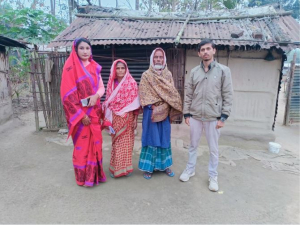

Under Siege for Speaking Bengali: Detentions, deportations and a rising pushback against the targeting of Bengali migrant workers across India

In recent weeks, a chilling pattern has emerged across multiple Indian states, including Odisha, Chhattisgarh, Maharashtra, Delhi, Gujarat, Madhya Pradesh, where Bengali-speaking migrant workers, most of them Indian citizens, have been rounded up in mass raids, detained without proper inquiry, denied recognition of valid Indian documentation, and in some cases, forcibly deported to Bangladesh. These sweeping actions, occurring under the alleged guise of cracking down on “illegal Bangladeshi immigrants”, have sparked alarm across affected communities, their support groups, civil rights organisations and provoked political outrage from the West Bengal government, and prompted judicial scrutiny led by the Calcutta High Court. The resulting crisis raises urgent constitutional questions about citizenship, discrimination, and federalism in India.

Judicial Firewall: Calcutta High Court sounds the Constitutional alarm

On July 17, 2025, the Calcutta High Court issued a pointed rebuke to the Union government and state authorities over the sudden and widespread raids conducted in June to identify so-called “illegal Bangladeshis.” As per the report of Times of India, a division bench of Justices Tapabrata Chakraborty and Reetobroto Kumar Mitra posed blunt questions: “What were the reasons for these sudden nationwide raids? Were they pre-planned? On what intelligence were they based?” The Court, hearing habeas corpus petitions concerning the alleged illegal detention and deportation of Bengali-speaking migrants, including a family of three from Birbhum allegedly pushed into Bangladesh, emphasised that such actions, if based solely on language or appearance, risk sending a “wrong and dangerous message.”

The Court directed the West Bengal government, the Delhi Police, and the Union government to file detailed affidavits regarding the legality of the detentions and deportations. As per the report of LiveLaw, State counsel Kalyan Bandopadhyay submitted that it was outrageous to detain or deport any individual solely because they spoke Bengali. “The constable is not the competent authority. You cannot criminalize language. There is a procedure, a legal standard, that must be met to question someone’s citizenship,” he said, demanding data on the number of detainees and those deported.

In response, senior Union government counsel Asoke Kumar Chakraborty questioned whether habeas corpus petitions were maintainable after deportation, revealing that a parallel case had been filed in the Delhi High Court—information which the Calcutta HC had not been told earlier. The Court came down harshly on the petitioners’ lawyer for this procedural suppression. “This is not expected from a senior advocate. Do not try to play tricks with the court,” Justice Chakraborty warned according to the LiveLaw report. Yet, despite these procedural hiccups, the Court refused to dismiss the matter and insisted on detailed disclosures, recognizing the larger human rights issues at stake.

Odisha: Mass detentions, arbitrary identification, and partial relief

The largest cluster of arrests took place in Odisha, where between June and July 2025, 447 Bengali-speaking migrant workers, most of them masons, daily-wage labourers, or street vendors from districts such as Birbhum, Murshidabad, and South 24 Parganas, were rounded up by police, particularly in Jharsuguda, Khurda, and nearby districts. According to a Scroll report, at least 403 detainees have since been released after sustained legal, political, and administrative pressure—but dozens remain in custody, often on specious grounds.

Multiple detainees testified that police refused to accept Aadhaar, voter ID, or even ration cards as legitimate identification. Instead, they were asked to produce birth and school certificates, often impossible for migrant workers who left their villages as teenagers. Others were detained simply for having Bangladeshi phone numbers saved on their mobile phones, which the police used as an alleged indicator of foreign nationality.

As provided in the TOI report, Ajimuddin Sheikh, 22, from Birbhum, was one such migrant detained during a 1 a.m. police raid near Brajarajnagar. “They seized our phones. Even when we showed voter ID and Aadhaar, they said it was not enough,” he recounted, while speaking to the TOI. His 18-year-old cousin, Nijamuddin Sheikh, added that they were interrogated repeatedly, their phones scanned for Bangladeshi contacts, and only released after producing additional documentation and being vouched for by a local guarantor.

Trinamool MP Samirul Islam, who chairs the West Bengal Migrant Workers Welfare Board, confirmed that most of those detained had been working in Odisha legally for several years. He lambasted the Odisha Police for refusing to accept Indian documents and treating labourers like foreign infiltrators. “There is no law that says a Bengali-speaking labourer cannot work in another Indian state,” he said, as per The Indian Express.

Despite some relief after the High Court sought explanations, Islam and MP Mahua Moitra warned that the mass profiling of Bengali-speaking workers is far from over—and that several youth still remain in custody.

Chhattisgarh: From detention to forced repatriation

In Kondagaon, Chhattisgarh, nine Bengali-speaking masons, residents of Krishnanagar in West Bengal, were picked up on July 12 from a school construction site, The Hindu reported. Trinamool MP Mahua Moitra revealed that despite possessing valid documents and being recruited through a verified contractor, the men were detained, denied contact with their families, and allegedly put on buses and sent back to Bengal—without any court order authorizing their removal, reported by TOI.

The Chhattisgarh Police claimed that the men failed to register with local authorities and were detained under preventive sections of the Bharatiya Nagarik Suraksha Sanhita (BNSS), India's new criminal procedure code. However, according to IE, Moitra questioned why they were not given access to legal counsel, why their phones were confiscated, and why families were not informed. A habeas corpus petition has now been filed in the Chhattisgarh High Court.

Maharashtra: Matua community targeted, identity cards ignored

In Pune, members of the Matua community, a Dalit religious minority of Bengali origin, were detained by Maharashtra Police on suspicions of being undocumented migrants, according to TOI. Samirul Islam reported that despite furnishing Aadhaar, voter ID, and certificates from the All India Matua Mahasangha, detainees were not released.

Shockingly, even children were among those picked up, and police reportedly refused to recognize documents issued by the AIMM, as per the report. TMC leaders expressed dismay that Santanu Thakur, a BJP MP and Union Minister who himself belongs to the Matua community, remained silent in the face of persecution of his own constituents.

Delhi and Gurugram: Crackdown in the capital

In Delhi, as reported by India Today, the TMC has led a series of protests in Jai Hind Colony, Vasant Kunj, a settlement housing hundreds of Bengali-speaking migrant workers. Despite valid documentation, residents say they have been targeted with evictions, electricity and water cutoffs, and routine harassment by police.

Meanwhile, in Gurugram, at least 26 Bengali-speaking workers from Assam were detained and interrogated over two days. Though eventually released, they alleged that voter ID and Aadhaar cards were rejected and that Muslim workers were disproportionately targeted.

Forced pushbacks and international law violations

Civil rights groups and legal experts have expressed alarm at what appears to be a coordinated “pushback” policy being implemented quietly across multiple states, allegedly under a Union-led directive. According to investigative reports, more than 2,000 persons have been forced across the Indo-Bangladesh border since the initiation of “Operation Sindoor”, which was a military operation ostensibly targeting cross-border terror camps but now being linked to mass civilian expulsions.

These deportations, without legal adjudication, without access to lawyers or courts, and based on profiling, stand in clear violation of Article 21 of the Indian Constitution and India’s obligations under international human rights law, particularly the principle of non-refoulement.

West Bengal Pushes Back: Legal action, street protests, and a linguistic defiance campaign

The West Bengal government, led by Chief Minister Mamata Banerjee, has mounted one of the strongest political and legal responses yet to the ongoing crackdown on Bengali-speaking migrants across BJP-ruled states. Calling it a “coordinated campaign to erase Bengali identity from the Indian Union,” Banerjee’s administration has launched a multi-pronged resistance: taking the fight to the courts, to Parliament, to civil society, and most strikingly, to the streets.

  1. Legal interventions and habeas petitions

West Bengal’s legal machinery was among the first to intervene after news broke in late May and June that Indian citizens, including women and minors, had allegedly been pushed across the Indo-Bangladesh border by Assam and Maharashtra Police.

According to The Telegraph, Maktoob, and Indian Express, the State of West Bengal has taken a proactive legal and administrative stance in ongoing cases concerning the wrongful detention and deportation of Bengali-speaking migrants. It has challenged detentions and deportations carried out without Foreigners Tribunal orders or judicial oversight, particularly in cases where individuals possessed valid Indian documents. The Calcutta High Court has repeatedly flagged these incidents as potentially illegal and directed the State to respond. In compliance, the West Bengal government has dispatched state police and administrative teams to states such as Odisha and Maharashtra to trace missing persons, facilitate their release, and assist with documentation, including the recording of victim testimonies. The State has also filed multiple status reports before the Calcutta High Court, detailing repatriation efforts and procedural violations. Acting on judicial direction, the Chief Secretary has appointed a nodal officer to liaise with the governments of other states and the Union Ministry of Home Affairs to ensure coordinated response mechanisms and prevent further unlawful detentions.

  1. Political Leadership: Mamata’s “I will speak more in Bengali” challenge

Mamata Banerjee has not only condemned the raids as unconstitutional but also reframed the issue as a battle for linguistic dignity. On July 16, during a mass rally in central Kolkata, she declared: "I dare you to send me to a detention camp, I will speak more in Bengali," and "Altogether 1,000 migrant workers have been arrested and detained in BJP-ruled states and many have been pushed back to Bangladesh. People from Birbhum, Cooch Behar, Nadia and other districts are being detained in Odisha and BJP-ruled states," she said, according to the Economic Times.

Addressing a massive public gathering during the protest march, as reported by Hindustan Times, Mamata Banerjee said, "The BJP calls all Bengali-speaking people Bangladeshi Rohingyas... Rohingyas live in Myanmar. Here, all citizens of West Bengal have proper ID cards and identification. The labourers who have gone outside Bengal have not gone on their own. They have been employed because they have skills... Anyone who speaks Bengali is being arrested and put behind bars. Why? Is West Bengal not a part of India?"

  1. Administrative support for victims and families

The West Bengal government has taken several concrete steps to support affected families and challenge interstate detentions:

  • Interstate coordination mandated by Court: On direction from the Calcutta High Court, the West Bengal Chief Secretary has appointed a nodal officer to liaise with states like Odisha and Delhi, ensuring the identification and release of Bengali-speaking migrants detained without due process, according to LiveLaw.
  • Chief Secretary's objection to profiling: Chief Secretary Manoj Pant sent a formal letter to the Odisha government objecting to the detention of migrants who had valid Indian documents and condemning demands for ancestral land records as arbitrary and discriminatory, as per Indian Express.
  • Verification of migrants across states: Bengal Police has undertaken a large-scale verification drive across multiple states, including Odisha, Maharashtra, and Delhi, covering over 750 cases of suspected wrongful detention. Officials have relied on a mix of local documentation (e.g., ration cards, land deeds, school certificates) to authenticate identity, according to the reports of TOI.
  • Interstate legal cell under consideration: According to government officials cited in press briefings, the Home Department may establish a dedicated interstate legal response cell to track migrant-related detentions, deportations, and facilitate legal aid across borders, as provided by New Indian Express.
  1. National advocacy

Senior Congress leader Adhir Ranjan Chowdhury submitted a memorandum to President Droupadi Murmu, demanding her intervention in the said situation. In the said memorandum, as reported by IE, the former Congress MP wrote: “It’s very sad and cruel fact that Bengali-speaking daily wage labourers, who are bonafide Indian citizens, are being targeted due to their physical appearance and accent, which is being mistaken for that of Bangladeshis. This similarity is being used as a pretext to harass, humiliate, physically assault, and hold these innocent people in detention.”

Chowdhury emphasised that these labourers are not only Indian citizens, but also contributors to the national economy. “Now, they are being rendered unemployed, homeless, and stateless,” he said, urging the President to step in to protect citizens from communal profiling and unlawful deportations.

Conclusion: Language on trial, citizenship in crisis

The targeting of Bengali-speaking migrants across Indian states has transformed from isolated administrative excesses into a full-blown constitutional crisis. At its core, this moment tests the strength of India’s federal framework, the sanctity of citizenship, and the basic right to dignity regardless of region, religion, or language. When Indian citizens with valid documents are detained, deported, or denied recognition simply for speaking Bengali, it sets a dangerous precedent—not just for Bengalis, but for all linguistic and regional minorities.

The pushback from the Calcutta High Court, the West Bengal government, and sections of civil society has sparked a vital resistance against arbitrary profiling and extra-legal state action. Yet the broader question remains: will the Union government address the growing pattern of exclusionary policies, or allow language and identity to become fault lines for discrimination?

India was envisioned as a pluralistic democracy where diversity is a foundation, not a fault. The events unfolding today demand urgent legal, political, and moral clarity. The road ahead will determine whether that vision endures—or whether silence enables a slow erosion of constitutional protections, starting with those who speak Bengali.


Related:

Gauhati HC closes Bakkar Ali writ petition as missing detainee Samsul Ali is found, not rearrested

‘Define Special Intensive Revision scope… make it clear not linked to citizenship’: BJP ally TDP writes to CEC Gyanesh Kumar

Bengali Migrant Workers Detained in Odisha: Calcutta High Court demands answers, seeks coordination between states

Bengali-Speaking Migrants Detained En Masse in Odisha: National security or targeted persecution?

Bordering on illegality? 18 alleged Bangladeshis “pushed back” without due process, Legal challenge filed in High Court

SC: ECI’s ‘wisdom’ on revision of electoral rolls challenged, does a disenfranchisement crisis loom over Bihar, with thousands being declared ‘‘D’ (doubtful) voters?


Vanished Without a Trace: CJP writes to NHRC detailing Assam’s secret detentions and illegal pushbacks

In an urgent memorandum to the National Human Rights Commission (NHRC), the Mumbai-based human rights organisation Citizens for Justice and Peace (CJP), in collaboration with the Forum for Social Harmony and its Assam legal team, has appealed to the apex human rights body to intervene in what it describes as an “unprecedented human rights emergency” in Assam. On May 31, 2025, CJP submitted a detailed, evidence-backed memorandum alleging that, between May 23 and May 31, at least 300 individuals—mostly Bengali-speaking Muslims—were secretively detained –without arrest memo or warrant — and approximately 145 have now “disappeared” under highly suspicious and unlawful circumstances.

As detailed in the memorandum, this entire move by the Assam Border Police from May 23 onwards shrouded in secrecy, and executed with flagrant disregard for constitutional safeguards, legal procedures, and even ongoing court cases. The most chilling claim: many of those missing may have been forcibly pushed across the Indo-Bangladesh border—a move that amounts to extra-legal expulsion and, potentially, statelessness.

Last Monday, May 26, CJP’s Team Assam had spent the entire day outside the Matia Detention Centre with legal aid volunteers and advocates in a bid to get information from the authorities on the identities of those detained. They found not the Jailor but the Assam Police in charge. Efforts were also made to submit a detailed memorandum to the Detention Centre authorities, citing judicial precedents and NHRC guidelines on procedures of detention and rights of detainees and families, advocate. When authorities refused to accept this, in flagrant violation of the Constitution and the law, this memorandum too has been despatched to the authorities by email and speed post. The exclusive ground report, published two days later may be read here.

The crackdown: Fear, silence, and disappearances

The CJP’s memorandum presents a grim chronology. Night raids by Assam’s Border Police reportedly swept across 33 districts from May 23 onwards, detaining individuals from their homes without warrants, memos, or explanations amounting to a form of abduction. No legal counsel was allowed. Families were left in the dark about their whereabouts or safety.

Approximately 150 detainees were later released, but at least 145 people reportedly remain untraceable—many suspected to have been dumped into “no man’s land” between India and Bangladesh.

(Note-Since the memorandum was sent on Saturday, reports of at least six persons being brought back by the BSF to the homes of the distraught, after the Bangladesh Ground Guard (BGB) refuted claims that they were Bangladeshi. Mal treatment however was meted out in the interim, and several dozen are still untraceable)

The detained include:

  • Individuals who had been released on temporary bail by courts on the orders of the Supreme Court in 2021
  • Citizens who were still litigating their status before Foreigners Tribunals, the Gauhati High Court, or even the Supreme Court
  • People who had lived in Assam for generations and whose names appear in the National Register of Citizens (NRC)

One particularly egregious case is that of Khairul Islam, a retired government schoolteacher from Morigaon. Despite his ongoing petition in the Supreme Court, Islam was picked up by police on May 23. Days later, he appeared in a video from Bangladesh’s Kurigram district, confirming he had been forcibly expelled at 4 AM—an act tantamount to extra-judicial deportation. (Subsequent local reports on Sunday, June 1 reveal that Khairul Islam was also among one of those fortunate to have been brought back home).

Personal tragedies in the shadows of state power

CJP’s memorandum documents the lives behind the numbers, providing intimate profiles of individuals who vanished in the sweep. Among them:

  • Doyjan Bibi, detained despite NRC inclusion, released on temporary bail in 2021, and now missing since May 24.
  • Abdul Sheikh, a senior citizen displaced multiple times by communal violence, disappeared after the May 24 crackdown.
  • Mojibor Sheikh, a daily wage labourer whose minor son was forced to drop out of school to support the family after Mojibor’s detention; now untraceable.
  • Samsul Ali, 67, with valid legacy documents from 1951, disappeared despite suffering from chronic health conditions.

All of these had been legally temporarily released in prior years and actively engaging with the justice system, but were now forcibly removed without notice—rendered voiceless and invisible.

A legal, constitutional, and humanitarian catastrophe

CJP’s memorandum is not just a plea for redress—it is a devastating indictment of what it calls a “stealth administrative purge” targeting a vulnerable minority community.

Key legal violations identified:

  • Constitutional Rights:
    • Article 21: Right to life and personal liberty
    • Article 22: Right to be informed of the grounds of arrest and access to legal counsel
  • Supreme Court Precedents:
    • D.K. BasuJoginder KumarVihaan Kumar: All mandating transparency, legal access, and procedural safeguards during arrests and detentions
  • Statutory Breaches:
    • Numerous provisions of the Bharatiya Nagarik Suraksha Sanhita (BNSS) and the former CrPC, including rights to bail, medical care, and judicial oversight, were reportedly flouted
  • NHRC’s Own Arrest Guidelines (2000):
    • Not followed—no arrest registers, no medical checks, no access to families or advocates, no transparency
  • International Law:
    • ICCPRUDHR, and customary international law explicitly prohibit arbitrary detention, expulsion without due process, and pushbacks—particularly under the principle of non-refoulement

CJP warns that these acts not only violate India’s international legal obligations but may amount to collective punishment and ethnic profiling—practices wholly antithetical to a constitutional democracy.

Justice denied: Non-exhaustion of legal remedies

A central legal concern raised is that many individuals had not exhausted judicial remedies. Some, like Khairul Islam, had active cases in the Supreme Court. Others were in the process of securing permanent bail or challenging ex-parte FT orders.

By detaining and disappearing them before legal processes concluded, the State effectively:

  • Short-circuited the rule of law
  • Undermined court jurisdiction
  • Violated natural justice

This, CJP argues, is not just “procedural impropriety” but an act of executive overreach and constitutional breakdown.

Breach of Supreme Court directives in Rajubala Das

CJP points to the Supreme Court’s 2024 ruling in Rajubala Das v. Union of India, which directed strict compliance with legal procedures before deportation—such as:

  • Submission of Nationality Verification Requests (NVRs) to Bangladesh
  • Issuance of travel permits
  • Public documentation of deportation orders

The memorandum demands that NHRC urgently verify whether these formalities were observed in any of the 145+ suspected pushbacks. If not, the Assam government may be in contempt of court, and liable for gross human rights violations.

CJP’s prayers: Urgent action, transparency, and accountability

CJP has called on the NHRC to:

  1. Demand full disclosure within 72 hours from the Assam government and Ministry of Home Affairs, including:
    • Names and details of all detainees, released persons, and those missing
    • Legal basis and authority under which arrests were made
    • Detention orders, FT case numbers, and status of deportation procedures
  2. Constitute a fact-finding committee to visit Matia Detention Centre and affected villages, record testimonies, and report publicly within 10 days
  3. Issue binding guidelines against arbitrary detentions and mass expulsions
  4. Initiate legal and disciplinary action against officers responsible
  5. Restore liberty to all unlawfully detained individuals
  6. Create a real-time detainee tracking system and helpline

The memorandum closes with a stirring reminder: The Constitution does not allow governments to extinguish liberty in silence, nor abandon citizens to exile without due process. If confirmed, these disappearances and pushbacks mark a turning point not only for Assam but for Indian democracy itself.

CJP’s urgent appeal is as much a legal petition as it is a moral alarm bell. It demands that India’s institutions act now—firmly and transparently—to restore faith in the rule of law before irreparable damage is done.

The complete memorandum may be read below.


Related:

CJP Exclusive: Homeland to No Man’s Land! Assam police’s unlawful crackdown on residents still battling for restoration of citizenship rights?

Supreme Court and the Rofiqul Hoque Judgment: Evolving jurisprudence on documentary evidence in Assam citizenship cases

From Detention to Deportation: The mass deportations and detention crisis at Assam’s Matia centre

Indian again! Matleb Ali’s fight to prove Indian identity ends with CJP’s intervention


Assam: Slamming Sarma’s actions as discriminatory & unlawful, LOP, Assam Assembly Debabrata Saikia calls for an urgent stop to “pushback” of citizens

Debabrata Saikia, the Leader of the Opposition in the Assam Legislative Assembly, has raised serious concerns on the state government’s recent actions of illegally detaining, without due process or law, legitimate Assamese citizens in the name of “pushing back” allegedly undocumented migrants to Bangladesh.  In a letter to External Affairs Minister S Jaishankar, he has also stated that the actions of the state authorities clearly appear to disproportionately target Muslims, undermining India’s secular fabric.

On May 30, last Friday, late evening, Saikia released this letter in a social media post on Meta-Facebook. He wrote:

“BJP government has created a new conspiracy against minority society in the name of foreign deportation in Assam. Under the leadership of the new BJP Himanta Biswa Sharma, RSS is taking care to terrorize the Muslim society. Let foreigners be deported. This is what I want for sure. Assam is first for the people of Assam - this is my total belief. But I am totally against the “Muslim means Bangladeshi” ethnicity which has been created. India is famous as Assam Shankar-Ajan country. BJP is trying today to start a brotherhood conflict. That's why hand-in-hand guns now. We want to see the books in the hands of our young Sam, not the grenades. They are trying to enforce the situation in Bihar and Uttar Pradesh in Assam. The Chief Minister is now like a Sasemira, whoever does not ask, he says Pakistan in the answer. I am expressing all these things through two memorandum in the Ministry of Foreign Affairs and Home Department yesterday. Read it.”

The letter sent by Saikia may be read below.

Saikia has, in this communication, accused the Assam Police of violating constitutional rights and due process in these operations. The All India United Democratic Front (AIUDF) has also petitioned the Governor, protesting the “continued” harassment of Indian Muslims on the pretext of identifying “illegal immigrants.”

Saikia claimed that since May 23, hundreds of Indian citizens, including some not involved in any citizenship-related legal proceedings, have been “arbitrarily detained.” While some have been released, these detentions highlight “serious procedural lapses.”

Citing media reports, Saikia alleged that several detainees, including women, were forcibly pushed into the “no man’s land” along the Indo-Bangladesh border, leaving them stateless as Bangladesh refuses to accept them. One such case involves Khairul Islam, a former government school teacher whose citizenship case is still pending before the Supreme Court, yet he was allegedly picked up from a detention centre and forced across the border.

Saikia emphasized that since several citizenship cases are pending before the apex court, these detentions and pushbacks constitute a “clear violation of the judicial process.” The Supreme Court itself has previously issued interim directions stating that no coercive steps should be taken against individuals whose cases are sub judice.

While most detainees were eventually released, their wrongful apprehension itself points to serious procedural lapses. Families remain uninformed about the whereabouts of detainees, violating basic transparency norms. Media reports confirm that many detainees, including women, have been forcibly pushed into the no-man’s-land at the India-Bangladesh border, leaving them stateless as Bangladesh refuses to accept them.

In this letter dated May 30 May Saikia highlighted several serious violations of constitutional rights and due process in what is being termed as Assam’s “push back drive.”

Saikia reminded the EAM that this action directly contradicts India’s stated position on deportation, quoting Dr. Jaishankar’s own parliamentary statement that emphasized the necessity of “unambiguous verification of nationality” before any repatriation. The letter notes with concern that these operations appear to target Muslim communities, undermining India’s secular fabric. It also points out that several cases are still pending before the Supreme Court, making these detentions and pushbacks a clear violation of the judicial process.

Saikia has urgently appealed for central intervention to immediately halt these unconstitutional actions, ensure proper nationality verification before any deportation, release all wrongly detained Indian citizens, and make detainee information publicly available.

He stressed that pushing people in the no-man’s-land without proper legal procedure is both illegal and fundamentally inhumane. Saikia said,“Pushing Indian citizens into no-man’s-land without verification is unconstitutional and fundamentally inhumane. The repatriation during the pendency of a Supreme Court case constitutes a grave breach of the judicial process. This further violates international human rights standards."

Assam Chief Minister Himanta Biswa Sarma, who has been accused of late for aggressive hate speeches against minorities has been reported to have stated that the state is “duty-bound to protect the interests” of Assam and “expel all illegal immigrants from the state through any means and as per directions of the Supreme Court.”

The CM also claimed that persons with pending citizenship cases are not being detained. The state government has adopted a “push back” route as a solution to its long struggle for deporting “illegal migrants.”

Human rights organizations and affected families express deep concerns about the humanitarian consequences of these actions, including prolonged detention, family separation, and the risk of statelessness. The Supreme Court has also previously criticized the indefinite detention of declared “foreigners” and urged the state to expedite deportations.

Assam chief minister Himanta Biswa Sarma on Friday said that only declared foreigners are being pushed back as per the law.

However media reports, and an exclusive Ground Report by Citizens for Justice and Peace, suggests to the country. This may be read here.

First, a video has emerged in the 'no man’s land' along the Indo-Bangladesh border in Assam’s South Salmara Mankachar district, Where Khairul Islam’s claimed that he is an Indian national and being deported to Bangladesh. Islam was among nine persons arrested by Morigaon police on May 24 in a crackdown on illegal immigrants declared by the Foreigners’ Tribunal, but who had been avoiding deportation.

Himanto Biswas Sarma, Chief Minister, Assam, was reported to have said on May 30, “The Supreme Court has directed us declared foreign nationals must be sent back. Declared foreigners who did not appeal in the court we had been pushed back. On Thursday we apprehended 35 Bangladeshi nationals along the Meghalaya and Silchar border. They came some days back and we instantly pushed them back.”

He added, “In meeting with SPs in Dergaon we have decided that we will fast track the process of detection of foreigners. As the National Register of Citizens (NRC) process was underway, detection of foreigners was temporarily suspended. So in the days to come detection will take place, push back will be done and the government of India after talks with the Bangladesh government will send some foreigners. So these three ways will continue.”

Chief Minister said, “Whoever has not gone to higher judiciary despite being declared a foreigner, and not preferred appeal against the tribunal order, they must go. We have 30,000 people who despite being declared foreigners have disappeared, if we find somewhere we have to take action against them. Whatever is done is as per law.”

However ground level claims contradict what Sarma has stated. For example, Khairul Islam was declared a foreigner by the Foreigners Tribunal in 2016, a decision he challenged in the Gauhati High Court. The High Court upheld the FT’s ruling, leading to his detention in 2018. Documents reveal that the appeal against the FT decision is pending before the Supreme Court and the last hearing was in December 2024.

[viewpdf 41981]


Related:

Assam Border Police cracks down on residents battling citizenship rights without due process, pushes 145 locals over the border?


'Deportation Cannot Begin without Nationality Verification': Union's Rajubala affidavit clarifies legal limits on executive power

For years, the debate surrounding persons declared to be “foreigners” in India has largely revolved around one question: who can be declared a foreigner? The proceedings before Foreigners Tribunals, the burden of proof under Section 9 of the Foreigners Act, 1946, and the evidentiary standards required to establish citizenship have dominated constitutional litigation. Comparatively little judicial attention had been devoted to the equally important question that arises after a person has been declared a foreigner—what does the Constitution require before the State can deport that individual?

The affidavit filed by the Union Ministry of Home Affairs (MHA) on July 31, 2026 in Rajubala Das v. Union of India marks an important intervention in that debate. Filed pursuant to the Supreme Court’s order dated March 21, 2025, the affidavit seeks to explain the legal and administrative framework governing deportation where the nationality of a declared foreigner remains unknown or unverified. In doing so, the Union makes one of its clearest judicial admissions to date: deportation cannot even be initiated unless the individual’s nationality has first been verified by the receiving State, appropriate travel documents have been obtained, and the receiving country has agreed to accept the individual. This is no ordinary procedural clarification.

The affidavit fundamentally distinguishes between being declared a foreigner and being legally deportable. While a declaration by a Foreigners Tribunal may settle a person’s legal status within India, it does not, the Union now accepts, authorise the State to physically remove that individual from Indian territory. Deportation remains contingent upon a separate process involving diplomatic engagement, nationality verification, issuance of travel documents and, most importantly, the consent of another sovereign State. In other words, the executive cannot unilaterally deport a person merely because Indian authorities believe them to be a foreign national. That proposition carries consequences far beyond the Rajubala case.

For months, instances of forced deportations and illegal pushbacks have surfaced from Assam, West Bengal, Gujarat, Rajasthan, Maharashtra and Delhi of individuals “suspected” of being Bangladeshi nationals. In many of these cases, the family of those deported have approached the courts alleging that the removals were carried out without any disclosed nationality verification, without travel documents, and without Bangladesh formally acknowledging or accepting the individuals concerned.

Detailed reports may be read herehereherehere and here.

Against this backdrop, the Union’s affidavit assumes a significance that extends well beyond the immediate dispute before the Court. By placing on record the legal prerequisites for deportation, the Government has simultaneously articulated a benchmark against which its own recent executive actions may now be tested. If nationality verification and acceptance by the receiving State are indeed indispensable legal requirements, as the affidavit repeatedly states, the obvious constitutional question is whether recent deportations and border removals have consistently adhered to those very standards.

The case of Rajubala Das

What began in 2020 as a challenge to the continued detention of one individual has gradually transformed into the Supreme Court’s most comprehensive examination of India’s detention and deportation regime. The litigation traces its origins to Rajendra Das, who was declared a foreigner by a Foreigners Tribunal in Morigaon, Assam, in 2011 under the Foreigners Act, 1946, on the allegation that he was a Bangladeshi national. Following that declaration, he was eventually detained in 2018 and remained incarcerated for years despite there being little indication that his deportation was imminent. His wife, Rajubala Das, approached the Supreme Court through the present Writ Petition, arguing that the State’s inability to deport him could not constitutionally justify his indefinite detention. The petition did not primarily dispute the Foreigners Tribunal’s declaration. Instead, it raised a deeper constitutional challenge. If deportation was not realistically possible because nationality remained disputed, travel documents were unavailable, or Bangladesh had not accepted the individual, could the State continue to deprive a person of liberty indefinitely? That question went to the heart of Article 21. For several years, the proceedings remained relatively limited. However, from 2024 onwards, the litigation underwent a remarkable transformation.

2024: The scrutiny of Matia Detention Centre- The case assumed far greater constitutional significance in 2024 when the Supreme Court considered reports of deplorable conditions inside Assam’s Matia detention centre. A report submitted by the Assam State Legal Services Authority documented severe shortages of drinking water, poor sanitation and prolonged detention of hundreds of individuals in conditions raising serious Article 21 concerns.

The Court’s inquiry consequently expanded beyond Rajendra Das’ detention to the functioning of the entire deportation regime. It directed the Assam Government to disclose the legal basis of every detainee’s incarceration, the documents supporting their detention and, crucially, the concrete steps taken towards their deportation. The Court was no longer prepared to accept broad assertions that deportation was “under process.” It demanded documentary proof that deportation was legally and practically feasible.

January–March 2025: Contradictions exposed- The affidavits filed by Assam only deepened the Court’s concerns. The State failed to explain the continued detention of nearly 270 individuals, many of whom had spent close to a decade in detention, while offering little evidence of meaningful diplomatic efforts to secure their deportation. The absence of information regarding nationality verification, travel documents and communication with Bangladesh prompted the Court to observe on January 22, 2025 that prolonged detention without any demonstrable prospect of deportation raised serious concerns under Article 21.

When the matter was heard again on February 4, 2025, Assam attributed the delays to the inability to ascertain addresses in Bangladesh. The Supreme Court was unconvinced. It directed the State to produce complete records of every detainee, explain the absence of a deportation roadmap and required the Chief Secretary to personally oversee compliance.

The contradictions became even more apparent in March 2025. Although Assam informed the Court that thirteen individuals had been deported after nationality verification through Nationality Verification Requests (NVRs), the same affidavit disclosed that 33 of the 63 persons earlier identified for deportation were simultaneously challenging the Foreigners Tribunal orders against them before the Gauhati High Court and the Supreme Court. One such detainee, Ajabha Khatun, had already secured protection against deportation from the Gauhati High Court. Even more strikingly, the thirteen persons ultimately deported were reportedly not from the original list of sixty-three individuals the State had earlier claimed were awaiting deportation. These contradictions exposed the absence of a coherent and transparent deportation framework and significantly undermined the State’s earlier assertions.

Detailed report may be read here and here.

CJP’s legal intervention in Ajabha Khatun’s matter may be read here.

The March 21, 2025 order- Faced with these inconsistencies, the Supreme Court shifted its focus from Assam to the Union Government. Recognising that deportation ultimately depends upon diplomatic engagement through the Ministries of Home Affairs and External Affairs, the Court, by its order dated March 21, 2025, directed the Union to explain the legal procedure applicable where a declared foreigner’s nationality remains unknown or unverified. The July 31, 2026 affidavit is the Union’s response to that direction.

Detailed report may be read here.

The Union’s Affidavit: A judicial admission that deportation cannot occur without nationality verification

If the earlier phases of the Rajubala Das litigation exposed the constitutional deficiencies of India’s detention regime, the Union Government’s affidavit dated July 31, 2026 seeks to explain the legal framework governing deportation itself. Filed pursuant to the Supreme Court’s order of March 21, 2025, the affidavit is, on its face, an attempt to answer a seemingly straightforward question: what happens when a person has been declared a foreigner but their nationality cannot be verified?

The answer offered by the Union is strikingly clear. According to the affidavit, such a person cannot be deported. More importantly, the Union goes a step further and states that the deportation process itself cannot even be initiated until nationality verification is complete. This is perhaps the single most important legal proposition emerging from the affidavit. It is also one that may have consequences extending far beyond the Rajubala case and Assam.

Deportation is not a unilateral exercise of sovereign power: Public discourse often treats deportation as though it were entirely within the executive’s control—that once Indian authorities conclude that someone is a foreign national, they may simply escort that individual across the international border. The Union’s own affidavit rejects that understanding. Instead, it recognises that deportation is an exercise involving two sovereign States, not one.

The affidavit explains that where a foreign national possesses valid travel documents, the concerned State Government, Union Territory Administration or the Foreigners Regional Registration Office may proceed with deportation after criminal proceedings conclude and provided no other criminal case remains pending. However, the affidavit makes it equally clear that this represents only one category of cases.

A much larger legal problem arises where the individual possesses no passport, travel document or proof of nationality. In such situations, deportation cannot simply proceed on the basis of India’s unilateral determination. Instead, the receiving State must first verify that the individual is indeed its national, and only thereafter can travel documents be issued and deportation can legally occur.

A declaration by a Foreigners Tribunal answer only one question—whether, under Indian law, the person has established lawful citizenship or lawful residence. It does not determine whether another sovereign country recognises that individual as its citizen. That determination belongs exclusively to the receiving State.

The three preconditions the Union says are indispensable: Coming to the legal prerequisites for deportation, the affidavit effectively recognises three cumulative conditions.

  • First, the individual’s nationality must be verified.
  • Secondly, the concerned foreign government must issue or facilitate the issuance of appropriate travel documents.
  • Thirdly, the receiving country must agree to receive that person.

The Union leaves little ambiguity. It states:

 That, a foreign national whose nationality is unknown/unverified can be deported to their home country only upon confirmation of their nationality/possession of a valid travel document/ acceptance by the home country concerned. The deportation procedure cannot be initiated without nationality verification.” (Point 10)

The Union’s formulation is significant because it elevates nationality verification from a mere procedural formality to a legal precondition for deportation. By stating that the deportation process “cannot be initiated” without nationality verification, the affidavit makes clear that verification is not simply one step in the process but the foundation upon which any lawful deportation rests. In effect, the Union acknowledges that, until nationality is confirmed and the receiving State agrees to accept the individual, there is no legally valid deportation process that can commence.

The Ministry of External Affairs emerges as the central actor: The affidavit also clarifies an aspect of deportation that has often remained opaque in public discourse. It explains that nationality verification is not undertaken directly by State Governments. Instead, once an individual is apprehended—or, in certain cases, once an FIR is registered—the concerned State Government or Foreigners Regional Registration Office is required to immediately forward the individual’s particulars, including photographs, to the Ministry of External Affairs.

The Ministry of External Affairs then engages with the Embassy or High Commission of the country believed to be the person’s home State. Only after the foreign government examines the material, verifies nationality and agrees to issue travel documents can the deportation process move forward. This explanation is legally significant because it reveals that deportation is not merely an exercise under the Foreigners Act; it is simultaneously an exercise in diplomacy.

“That, in case the foreigner does not have a valid travel document/passport, it is necessary to obtain the requisite travel document from the Embassy/High Commission ofthe country concerned through the process of nationality verification before he/she can be deported in accordance with Clause 12(4) of the Immigration & Foreigners Order, 2025.” (Point 8)

“That, in such cases, the State Government/UT Administration/FRRO/FRO concerned may take up the matter regarding issuance of travel document in favour of the foreigner with the Ministry of External Affairs (Consular Division), with detailed particulars and photograph of the said foreigner immediately on arrest of the foreign national or on filing of FIR, whichever is earlier.” (Point 9)

The affidavit acknowledges the limits of Indian sovereignty: The Union expressly states that no time limit can ever be prescribed for nationality verification because the process is entirely within the domain of the foreign government. This is a significant concession as it amounts to an acknowledgment that India cannot compel another sovereign State to decide whether a particular individual is its citizen. Nor can India dictate the speed with which that determination must be made.

That, since verification of nationality is a sovereign function of the foreign government, no time limit can be fixed for completion of the process of nationality verification. Consequently, until such time as nationality is duly verified and deportation is effected, the movement of the illegal migrant, must remain restricted within a designated holding centre to ensure his/her physical availability for deportation.” (Point 12)

Yet this admission also exposes a constitutional dilemma. The affidavit acknowledges that nationality verification is entirely dependent on the receiving State, over which India has no control, and that no timeline can be prescribed for its completion. If so, on what constitutional basis can the State continue to detain a person for an indeterminate period while awaiting a process whose duration is uncertain and potentially indefinite? The affidavit offers no limiting principle. It merely states that such individuals should remain in holding centres until verification is completed, without addressing what Article 21 requires if that process takes years—or never concludes at all.

The affidavit attempts to justify continued detention: To address this obvious constitutional concern, the Union argues that persons awaiting nationality verification should remain in designated holding centres. According to the affidavit, restricting their movement is necessary to prevent absconding, protect national security and ensure that deportation can be carried out once nationality is verified. While these are familiar justifications for immigration detention, they do not fully answer the concerns raised by the Supreme Court in Rajubala. Article 21 may permit temporary restrictions on liberty, but it does not sanction detention for an indefinite period. The affidavit assumes that detention can continue until nationality verification is complete, without addressing the constitutional question of how long such detention can remain lawful if deportation continues to be uncertain or remote. The Court’s concern has consistently been not merely whether deportation is pending, but whether continued detention remains proportionate when there is no foreseeable prospect of removal.

That, in pursuance of the orders of the Hon’ble Supreme Court of India dated 28.02.2012 in the matter of Bhim Singh vs Union of India & Ors. the Ministry has advised State Govt/UT Administrations to ensure that all foreign nationals who have completed their sentence but whose deportation/repatriation is awaited due to nonconfirmation of nationality/issue of travel documents by the country concerned may  be réleased from jails immediately and may be kept at appropriate place outside the 4 jail premises with restricted movements pending their repatriation. State Govts/UT Administrations have also been advised to ensure that the places where such foreign nationals are being kept must have basic facilities of electricity, water and hygiene.” (Point 13)

The reliance on Bhim Singh is both important and incomplete: To support its position, the Union relies upon the Supreme Court’s decision in Bhim Singh v. Union of India. The affidavit notes that, following that judgment, the Ministry of Home Affairs advised States and Union Territories that persons who had completed their criminal sentence but whose deportation remained delayed due to non-confirmation of nationality or non-issuance of travel documents should ordinarily not continue inside prisons. Instead, they could be accommodated in designated places outside prison premises where their movement could remain restricted pending deportation. The Union cites this advisory as demonstrating that the present practice of housing such individuals in detention or holding centres has judicial support. That reliance is only partly persuasive.

The Bhim Singh framework sought to distinguish immigration detention from ordinary criminal incarceration. It recognised that individuals who had completed their sentences should not continue to be treated as convicted prisoners merely because deportation had become difficult. However, Bhim Singh did not answer the larger constitutional question now arising in Rajubal, which is how long can a person remain in such a holding centre before the detention itself becomes arbitrary?

The July 31 affidavit reproduces the administrative framework flowing from Bhim Singh, but it does not confront its constitutional limits. That omission becomes especially significant given the Supreme Court’s repeated observations since 2024 that Article 21 cannot permit indefinite executive detention unsupported by a realistic prospect of deportation.

The affidavit and the question of recent deportation practices

The Union’s affidavit is notable not only for the legal framework it sets out, but also for what it does not address. It repeatedly states that deportation is contingent upon three conditions: verification of nationality by the receiving State, issuance of travel documents, and acceptance by that State. Yet, it is silent on how these requirements align with the recent allegations of “push back” operations reported from Assam and other States, where individuals were allegedly taken across the border without any publicly disclosed process of nationality verification or acceptance by the receiving country.

This omission is significant because the affidavit is a sworn statement before the Supreme Court, setting out the Union’s own understanding of the law. The Government does not describe nationality verification as a matter of administrative convenience; it states in categorical terms that the deportation process “cannot be initiated” without it. The affidavit also recognises that verification is a sovereign function of the receiving country and that deportation is possible only after that country confirms the individual’s nationality and agrees to accept them. These are presented as legal prerequisites, not procedural formalities.

Against this backdrop, the affidavit inevitably invites comparison with recent events. The Supreme Court is already seized of petitions alleging that several persons from West Bengal were forcibly pushed into Bangladesh without due process. One such case came to forefront in November 2025, wherein Sunali and her husband, Danish Sheikh, along with their son, were apprehended in Delhi’s K.N. Katju Marg in June, labelled as illegal immigrants. Their deportation was ordered by the Foreigners Regional Registration Office (FRRO) and executed despite Sunali’s family presenting Aadhaar and PAN documents. The petitioners further argued that the authorities had ignored the Ministry of Home Affairs’ own guidelines dated May 2, 2025, which required verification from the individual’s home State before deportation. They contended that no meaningful opportunity of hearing had been provided and that the deportations violated both statutory procedure and the constitutional guarantee of fairness. In the case of Bhodu Sheikh v. Union of India, the Union ultimately was made to undertake the decision of bringing these six people back, on humanitarian grounds, after they had allegedly been pushed across the border.

Detailed reports may be read here and here.

Similarly, in the Rajubala proceedings themselves, the Court has repeatedly insisted that deportation must follow nationality verification through Nationality Verification Requests (NVRs), issuance of travel permits and other documented procedures. The affidavit, however, does not explain whether these safeguards were followed in the recent removals that have become the subject of litigation.

The affidavit also has significant implications for how constitutional courts scrutinise deportation cases. Once the Union itself has stated on oath that deportation cannot even be initiated without nationality verification, travel documents and acceptance by the receiving State, courts can no longer be satisfied with bare assertions that an individual has been “deported” or “repatriated”. The legality of deportation necessarily turns on whether these mandatory procedural steps were actually followed.

This issue was focussed on by the CJP legal team in Gauhati Court after the illegal deportation of Doyjan Bibi in May 2025. CJP’s legal intervention in Doyjan’s case may be read herehere and here.

This shifts the focus of judicial review. It will no longer be sufficient for the State to merely state that a person has been deported. Courts will increasingly have to insist on the underlying record: when the Nationality Verification Request (NVR) was sent, whether the receiving country confirmed the person’s nationality, whether travel documents were issued, whether the receiving State formally agreed to accept the individual, and whether the deportation was carried out pursuant to a lawful order after the individual had exhausted or waived available legal remedies.

Indeed, this is precisely the direction in which the Rajubala litigation has already moved. Dissatisfied with vague assertions of impending deportation, the Supreme Court repeatedly sought detailed data from the Assam Government on detainees, nationality verification, pending litigation and the actual steps taken towards deportation. The Union’s July 31 affidavit reinforces that approach. If compliance with these procedural safeguards is what makes a deportation lawful, then those safeguards cannot remain matters of executive assertion—they must be demonstrated through documentary evidence capable of judicial verification.

In that sense, the affidavit has implications beyond the immediate case. It raises the evidentiary threshold for the State in future deportation litigation. Courts will have to examine not only whether a person was deported, but how the deportation was carried out and whether it conformed to the legal framework that the Union itself has now placed before the Supreme Court.

The affidavit leaves little room for informal “push back” operations

Perhaps the most significant implication of the affidavit lies in what it suggests about the legality of the recent “push back” operations reported from Assam and other States. Over the past few months, multiple petitions before the Supreme Court and High Courts have alleged that persons suspected of being Bangladeshi nationals were taken across the international border without any publicly disclosed deportation process. In several cases, families have alleged that individuals were picked up without prior notice, denied access to lawyers or relatives, and removed without any disclosed deportation order or travel documents.

Detailed report may be read hereherehere and here.

The Union’s affidavit describes only one legally recognised route to deportation. According to it, removal can take place only after the receiving country verifies the individual’s nationality, issues the necessary travel documents and agrees to accept them. Significantly, the affidavit states that the deportation process itself cannot be initiated before nationality verification. It does not recognise any separate category of “push back” operations or explain the legal basis on which such removals could take place outside this framework.

That omission is important. If “push back” is treated as a form of deportation, it would necessarily have to satisfy the procedural safeguards outlined in the affidavit. If it is not deportation, the affidavit offers no explanation of the statutory or constitutional authority under which such cross-border removals are carried out. The affidavit therefore leaves unresolved a question that is already before constitutional courts: whether recent removals complied with the legal process that the Union itself now says is mandatory.

Beyond Nationality Verification: The missing due process framework

While the affidavit sets out the broad mechanics of deportation, it is noticeably thin on the procedural safeguards that accompany the process. It explains how nationality verification is to be initiated but says almost nothing about the rights of the individual who is its subject.

For instance, the affidavit does not clarify whether a person is informed when a Nationality Verification Request (NVR) is sent to a foreign government, whether they have access to the material relied upon for such verification, or whether they have any opportunity to contest incorrect or incomplete information before it is acted upon. Equally, it is silent on what follows once nationality is confirmed. Is a formal deportation order issued? Is the individual notified that the receiving State has accepted them? Can that decision be challenged before a constitutional court? None of these questions are addressed.

These are not peripheral procedural details. They go to the heart of procedural fairness under Article 21. Deportation is among the most coercive powers the State can exercise—it results in the physical removal of a person from the territory of India. Such a power necessarily requires a transparent legal process, one that affords notice, an opportunity to be heard where appropriate, and meaningful judicial oversight before the final act of removal.

The significance of these omissions becomes even more pronounced in light of recent litigation concerning alleged “push back” operations. If the Union’s own position is that deportation cannot commence without nationality verification and acceptance by the receiving State, the procedural steps connecting those two stages assume constitutional importance. Without clarity on how those decisions are communicated, documented and implemented, it becomes difficult for courts to effectively scrutinise whether the legal requirements identified by the Union have actually been followed in an individual case.

The affidavit therefore provides only part of the legal architecture. It explains the prerequisites for deportation, but not the due process safeguards that ensure those prerequisites are fairly implemented. That gap is likely to assume increasing significance as constitutional courts continue to examine the legality of detention and deportation in the Rajubala proceedings and in the growing number of cases challenging recent removals across the country.

Beyond Rajubala: Why this affidavit reinforces the constitutional limits of deportation

The significance of the Union Government’s July 31 affidavit extends well beyond the immediate dispute in Rajubala Das. Rather than introducing an entirely new legal framework, the affidavit reiterates and reinforces the procedural safeguards that the Supreme Court has been examining throughout the proceedings. In doing so, it re-emphasises a central constitutional question: what constitutes a lawful deportation?

For years, courts have largely focused on whether an individual was correctly declared a foreigner under the Foreigners Act, 1946. The Rajubala case has broadened that inquiry by examining the legality of what follows—the process of detention and eventual deportation. The Union’s affidavit continues that shift by setting out the legal conditions that, according to the Government itself, must precede any deportation.

A key takeaway from the affidavit is that deportation is not a unilateral executive act. While Indian authorities may identify a person as a foreign national and initiate the process, deportation ultimately depends on nationality verification by the receiving State, issuance of travel documents and that State’s willingness to accept the individual. Until these steps are completed, the Union says, deportation cannot be initiated.

The affidavit therefore re-emphasises that executive power under the Foreigners Act is not unfettered. Declaring a person to be a foreigner may establish that they have no legal right to remain in India, but it does not automatically authorise their physical removal from the country. Deportation remains a separate legal process governed by procedural safeguards and diplomatic engagement.

This is an important clarification because it places legal limits on the State’s deportation powers. Those limits arise not only from constitutional guarantees under Article 21 but also from the Union’s own understanding of the deportation process, as placed before the Supreme Court. In that sense, the affidavit is significant not because it creates a new legal standard, but because it reaffirms one before the country’s highest court. That reaffirmation is likely to shape future judicial scrutiny of deportation cases, particularly where allegations are made that individuals were removed without following the safeguards that the Union itself now says are mandatory.

Related:

Aadhaar, Voter ID and PAN Cannot Prove Citizenship: Calcutta High Court’s Foreigners Order and the burden of belonging

They Belong Here: An elderly couple’s victory for citizenship

Another CJP Victory: Barpeta Tribunal declares Alam Khan ‘not a foreigner’

When a narrow reading of documents decide citizenship: GHC in Aminul Hoque

‘Fairness & reason ‘: SC rules that due process is a must for citizenship determination

Gauhati High Court upholds foreigner declaration, rejects mental illness plea


Who decides who belongs? Detention, deportation and the crisis of due process

The Bharatiya Janata Party's (BJP) return to power in Assam and its historic electoral breakthrough in West Bengal have transformed a decades-old political campaign against alleged illegal migration from Bangladesh into one of the most extensive citizenship and deportation drives seen in recent years. Across these Border States, thousands of people have been detained, hundreds have reportedly been deported, detention infrastructure is rapidly expanding, and a new national policy framework seeks to institutionalise the identification, confinement and removal of alleged undocumented migrants.

The government presents the exercise as a necessary response to illegal immigration, demographic change and national security concerns. Yet mounting evidence from court proceedings, media investigations, government directives and testimonies from affected families raises a more troubling picture: one in which due process protections appear increasingly fragile, citizenship verification procedures are often opaque, and Bengali-speaking Muslims bear the overwhelming burden of suspicion.

Detailed report may be read here.

At the heart of the controversy, lies a fundamental constitutional question: can the Indian state pursue such detention and immigration enforcement while bypassing the procedural safeguards that protect individuals from arbitrary detention, wrongful deportation and statelessness? Two, without this due process of either established legal norms or procedures not enquiries/investigations into who these illegal immigrants are, is such action not arbitrary and without foundation?

The missing data and the transparency deficit

Perhaps the most troubling aspect of the current deportation drive is not merely the scale of the exercise but the extraordinary lack of transparency surrounding it. Across Assam, West Bengal, Gujarat and other states, governments have announced deportations, detention drives and large-scale verification exercises. Yet even today, there is no publicly available dataset identifying who has been classified as an undocumented migrant, from which districts they were picked up, what evidence was relied upon, whether nationality was independently verified, how many individuals challenged those determinations, how many continue to remain in detention centres, and how many have ultimately been deported.

This absence of information is particularly striking because the consequences of these decisions are so severe. Deportation is among the most coercive powers exercised by the state. It can separate families, extinguish livelihoods, result in prolonged detention and, in some cases, leave individuals stranded in a country they insist is not their own. Yet the public is being asked to accept the legitimacy of the process without access to even the most basic information about how it is being carried out.

The opacity is all the more difficult to justify because the Union governments own deportation policy appears to contemplate extensive record keeping and reporting requirements. The policy submitted by the Ministry of Home Affairs before the Supreme Court requires state governments to maintain records of individuals handed over for deportation, submit mandatory reports to the Union government, and provides that the Bureau of Immigration shall publish information relating to deported Bangladeshi nationals and Rohingyas on a public portal for verification purposes.

Yet little of this information is publicly accessible. Speaking to Al Jazeera, civil rights activist and CJP Secretary Teesta Setalvad argued that the present campaign appears to be driven more by political rhetoric than publicly available evidence. "Even today the authorities have not made available exactly who, which families, from which locations have been identified as illegal immigrants, on what basis and assessment and then sent back," she said. "There is also an element of targeting specific sections, particular communities."

Her criticism points to a fundamental problem: In the absence of publicly available data, independent scrutiny becomes nearly impossible. It is impossible to assess whether those being detained and deported are in fact undocumented migrants, whether particular communities are being disproportionately targeted, whether established procedures are being followed, or whether wrongful deportations are taking place.

The demand for transparency is therefore not a procedural technicality. It lies at the heart of democratic accountability. If governments are confident that deportations are being carried out lawfully, after proper verification and in accordance with due process, then there is a compelling public interest in releasing comprehensive data regarding those detained, those housed in holding centres, those whose nationality has been verified, and those who have ultimately been deported.

Until such information is made available, one of the most far-reaching citizenship and deportation exercises in recent Indian history will continue to operate largely beyond meaningful public scrutiny.

From political slogan to state policy

For decades, the BJP has built its political narrative in eastern India around the issue of "illegal infiltration" from Bangladesh. The party has repeatedly argued that large-scale migration has altered the demographic composition of border states, strained public resources and created security vulnerabilities.

The issue has occupied a central place in BJP campaigns in Assam, West Bengal and Tripura. Senior BJP leaders, including Union Home Minister Amit Shah, have frequently described undocumented migrants from Bangladesh as a threat to national security and demographic stability. During previous election campaigns, Shah famously referred to illegal migrants as "termites", a phrase that drew widespread criticism from civil society groups and human rights organisations. Report in The Hindu.

Following the BJP's victory in West Bengal, these political commitments quickly evolved into administrative action. Chief Minister Suvendu Adhikari announced the implementation of a "detect, delete and deport" framework under which individuals identified as illegal migrants would be detained by state authorities and transferred directly to the Border Security Force (BSF) for deportation, as per Hindustan Times. The announcement was accompanied by instructions to establish holding centres across districts and create a streamlined mechanism for identifying and removing alleged infiltrators. What was once campaign rhetoric had become state policy.

The creation of a national deportation architecture

The developments in West Bengal are not occurring in isolation. According to documents reported by The Hindu, the Union Ministry of Home Affairs has formulated a comprehensive deportation policy requiring states to establish district-level special task forces for the identification, detention and deportation of alleged illegal migrants from Bangladesh and Myanmar. However, before the Supreme Court of India, in the ongoing Rajubala Das v. Union of India case, the deportation policy submitted before the Courts hays down more tested procedures. The same has been explained below.

The policy directs states to:

  • Create dedicated holding centres or camps for undocumented migrants awaiting deportation.
  • Establish a time-bound mechanism for identification and nationality verification.
  • Upload biometric information and demographic data onto the Foreigners Identification Portal.
  • Cancel government-issued identity documents obtained by individuals determined to be illegal migrants.
  • Maintain monthly reports regarding foreigners who are untraceable, detained or awaiting deportation.
  • Coordinate with central agencies to facilitate removals.

The guidelines envision a nationwide infrastructure capable of processing large numbers of suspected migrants. Holding centres are to be enclosed by ten-foot boundary walls and barbed-wire fencing. Detainees are to remain confined pending verification of nationality and completion of deportation procedures.

Although the policy states that these facilities should provide humane living conditions, medical care, educational facilities for children, communication access and recreational space, rights groups argue that the rapid expansion of detention infrastructure signals a shift towards normalising large-scale administrative detention.

A policy contradiction at the heart of the deportation drive

One of the most striking aspects of the current deportation campaign is the apparent tension between the procedures explained above and the deportation framework that the Union Ministry of Home Affairs itself placed on record before the Supreme Court.

In the Rajubala Das v. Union of India proceedings before the Supreme Court, the MHA submitted an affidavit setting out a detailed deportation policy governing the treatment of alleged undocumented Bangladeshi nationals and Rohingyas. That policy envisages a structured process involving coordination between state governments, the Ministry of Home Affairs, the Ministry of External Affairs, foreign missions and designated border-guarding forces. Crucially, it recognises that nationality cannot be assumed unilaterally and that nationality verification is a necessary component of the deportation process.

The policy specifically provides that where an alleged undocumented Bangladeshi national or Rohingya is arrested, their details are to be furnished to the Ministry of External Affairs so that the matter can be taken up with the Bangladesh High Commission or the Myanmar Embassy for nationality verification. The stated purpose is to enable the foreign government concerned to process and verify the individual's nationality before deportation is carried out.

The same policy also requires state governments to maintain records of all individuals handed over for deportation and submit mandatory monthly reports to the Ministry of Home Affairs. It further provides that the Bureau of Immigration shall publish a list of deported Bangladeshi nationals and Rohingyas on a public portal for verification purposes.

This raises a serious question: If the deportation policy submitted before the Supreme Court contemplates nationality verification through diplomatic channels, maintenance of detailed records, mandatory reporting and publication of deportation data, how do these safeguards square with reports of alleged pushbacks, summary removals and immediate send-backs at the border?

The question becomes even more pressing in light of report that Bangladeshi and Myanmar nationals intercepted at land or maritime borders may be "immediately sent back" after their biometrics are recorded. The apparent gap between the procedures described before the Supreme Court and practices now being reported on the ground deserves far greater public scrutiny.

Detailed report on the Rajubala case may be read here.

Holding centres become operational

The practical implementation of this framework is already underway. Malda became the first district in West Bengal to operationalise a holding centre under the new policy. The facility initially housed nine individuals identified as suspected Bangladeshi nationals, including women and children.

Officials, as per The Indian Express, described the centre as a temporary facility where detainees would remain while their nationality and immigration status were verified.

However, rights advocates point out that detention itself can become punitive when individuals are confined before citizenship disputes are conclusively resolved. This concern is especially significant in border regions where documentation is often incomplete, where migration has historically occurred across fluid borders, and where linguistic and cultural similarities between Indians and Bangladeshis complicate nationality determinations.

West Bengal

West Bengal is the epicentre of the current drive. According to Chief Minister Suvendu Adhikari, the state has already deported 4,800 alleged undocumented Bangladeshi migrants through newly established holding centres in border districts. Another 836 people were reportedly being held awaiting deportation as of early June 2026, as per The Times of India.

The government has also established an expanding network of detention facilities. Initial reports indicated that 11 holding centres had been created across the state and were housing at least 335 detainees, while later reports from Malda alone suggested more than 150 detainees had already been transferred there from North 24 Parganas district.

Government officials have presented these numbers as evidence of successful enforcement. However, the figures raise significant questions. If nearly 5,000 people have been removed within weeks of the BJP assuming office, it remains unclear how many cases involved completed nationality verification by Bangladesh, how many individuals received access to legal representation, and how many removals were subject to judicial scrutiny.

Gujarat

The largest publicly reported operation outside eastern India occurred in Gujarat. Under "Operation Delta Hunt", authorities investigated approximately 6,200 individuals and identified 362 people as alleged illegal Bangladeshi immigrants, as per The Hindu. Of these, 166 were identified in Ahmedabad alone, including women and children. Authorities also stated that investigations into hundreds of additional cases were continuing.

The Gujarat government has further indicated that it intends to prosecute employers and landlords accused of sheltering undocumented migrants.

Assam

Unlike West Bengal and Gujarat, the Assam story is not primarily reflected through new numerical announcements but through litigation. Throughout 2025 and 2026, several habeas corpus petitions before the Gauhati High Court and the Supreme Court challenged alleged "pushback" operations involving Bengali-speaking Muslims who claimed Indian citizenship. The significance of Assam lies not merely in the number of people detained but in the emergence of documented allegations that Indian citizens were wrongly identified as foreigners and transported towards the Bangladesh border.

Citizens for Justice and Peace provides legal aid in some cases, details may be read here, here and here.

The Assam cases effectively became the warning sign for what now may happen on a larger scale in West Bengal.

The May 2025 Assam crisis report may be read here.

National figures

At the national level, according to The Hindu, the Ministry of External Affairs has confirmed that India has asked Bangladesh to verify the nationality of more than 2,860 individuals whom Indian authorities believe to be Bangladeshi nationals residing illegally in India.

Simultaneously, the Union Ministry of Home Affairs has directed states to establish district-level mechanisms for the identification, detention and deportation of alleged undocumented migrants from Bangladesh and Myanmar, suggesting that the campaign is being institutionalised nationwide rather than remaining confined to border states.

The human cost of wrongful deportation

Few cases illustrate the dangers of inadequate verification more clearly than that of Sunali Khatun. Reported extensively by BBC News, Khatun, a Bengali-speaking Muslim woman from West Bengal, was detained in Delhi alongside her husband and young son on suspicion of being an undocumented migrant. Authorities alleged that she lacked proof of lawful residence and initiated deportation proceedings. According to her account, officials failed to properly verify her claim that she was an Indian citizen from West Bengal. She, her husband and child were subsequently transported to Bangladesh. Once there, Bangladeshi authorities treated them as illegal entrants and imprisoned them. The family spent months in detention.

Detailed report on this case may be read here.

Only after intervention by the Supreme Court was Sunali permitted to return to India on humanitarian grounds while her citizenship claims continue to be examined. Her husband remains stranded in Bangladesh.  The case exposed the potentially catastrophic consequences of administrative errors in citizenship determination. A mistaken deportation is not simply an immigration decision. It can separate families, result in imprisonment in another country and effectively strip individuals of their nationality.

Due process concerns

The central criticism of the current deportation campaign is not that states lack authority to remove foreign nationals. Every sovereign state possesses the power to regulate immigration and deport individuals who are unlawfully present. The issue instead concerns the process by which such determinations are being made.

Under established principles of administrative fairness and constitutional governance, individuals facing deportation should ordinarily have:

  • Notice of the allegations against them.
  • Access to documentary evidence.
  • An opportunity to challenge adverse findings.
  • Legal representation.
  • Independent verification of nationality.
  • Judicial oversight where fundamental rights are implicated.

The recent practices, however, often fall short of these standards. Reports from Assam and West Bengal suggest that detention frequently precedes verification rather than following it. In several cases, families have alleged that individuals were forced to prove citizenship after already being taken into custody. Such an approach effectively reverses the burden of proof and creates significant risks of wrongful exclusion.

Detailed report on deportation process may be read here.

Religious selectivity and the Citizenship Amendment Act

The controversy is further complicated by the interaction between deportation policy and the Citizenship (Amendment) Act. The CAA provides a pathway to citizenship for Hindus, Sikhs, Buddhists, Jains, Parsis and Christians from Afghanistan, Bangladesh and Pakistan who entered India before the prescribed cut-off date. Muslims are excluded.

Chief Minister Suvendu Adhikari has repeatedly emphasised that communities covered by the CAA will not face action under the deportation framework. Those outside its protection, however, remain vulnerable to detention and deportation. Two individuals entering India under similar circumstances may face radically different legal consequences depending upon their religious identity.

This concern is particularly acute because the overwhelming majority of those targeted by current deportation drives are Bengali-speaking Muslims.

Bangladesh pushes back

The crackdown has also generated significant diplomatic friction. Bangladesh has repeatedly objected to what it describes as attempts by Indian authorities to push individuals across the border without completing formal nationality verification procedures.

As per The Indian Express, Border Guard Bangladesh (BGB) officials have publicly stated that they blocked numerous attempts by Indian authorities to send individuals into Bangladesh without prior verification.

Bangladesh's Foreign Affairs Adviser, Shama Obaid, has stated that Dhaka has repeatedly communicated its concerns to New Delhi and insisted that existing bilateral mechanisms must be followed. The position of Bangladesh is straightforward: no person should be accepted unless their nationality has first been verified. India officially maintains that deportations occur only through established procedures.

Ministry of External Affairs spokesperson Randhir Jaiswal has stated that India has submitted details of more than 2,860 suspected Bangladeshi nationals to Dhaka for verification. Yet the persistence of Bangladeshi objections suggests continuing disagreements regarding implementation.

The demography committee

The deportation drive is now being supplemented by a broader effort to study demographic change. The Union Government recently established a high-level committee chaired by retired Supreme Court judge Justice Prakash Prabhakar Naolekar to examine demographic shifts allegedly caused by illegal migration and other factors. The committee's mandate extends beyond research.

It has been tasked with recommending systems for identifying, detaining and deporting undocumented migrants and proposing mechanisms for strengthening border management and population monitoring. Its creation fulfils a commitment made by Prime Minister Narendra Modi and reflects the growing centrality of demographic concerns within government policy.

However, the language surrounding the committee has generated concern. Government statements describe demographic change arising from migration as an "unnatural" phenomenon and a "monumental challenge". Such framing risks treating entire communities as demographic threats rather than as individuals possessing rights and legal protections.

Detailed report may be read here.

A constitutional test

India unquestionably has the authority to regulate immigration and remove foreign nationals who have entered or remained unlawfully. But citizenship determination is among the most consequential exercises of state power.

A mistaken arrest can be corrected. A mistaken deportation can leave a person stateless, imprisoned in a foreign country or permanently separated from family members. The experiences documented in Assam, the wrongful deportation allegations, Bangladesh's repeated protests over alleged pushbacks, the establishment of detention infrastructure across West Bengal and the government's push towards a nationwide deportation architecture collectively point to a deeper concern. The issue is no longer merely immigration enforcement.

It is whether the Indian state can pursue that objective while respecting the constitutional guarantees of fairness, equality and due process. As detention centres multiply, deportations accelerate and citizenship verification becomes increasingly securitised, the challenge confronting India is not simply identifying who belongs. It is ensuring that, in the process of deciding who does not, the state does not abandon the rule of law itself.


Related:

India’s Silent Push-Out: Courts, states, and the deportation of Bengali-Speaking Muslims

Gauhati HC orders clarity after state cites deportation of ‘Wrong Doyjan’ in alleged ‘pushback’ case, demands specific reply on her whereabouts

SC stays deportation of woman declared foreigner, issues notice on challenge to Gauhati HC Order

Contradictory Calls: SC halts one Tamil refugee’s deportation, denies another citing ‘not a Dharamshala’

Gauhati HC directs State to confirm custody or deportation of two men detained in midnight police action in Assam

Assam govt to SC: 33/63 of those marked for ‘deportation’ are contesting ‘foreigner’ status in courts


The cost of a wrongful deportation

The return of four Bengali-speaking Muslims from Bangladesh to India marks a critical moment in one of the most troubling citizenship disputes to emerge in recent years. Their repatriation, secured only after sustained judicial intervention by the Calcutta High Court and the Supreme Court, has reignited concerns over the manner in which citizenship verification exercises have been conducted and the consequences of deporting individuals before conclusively establishing their nationality.

The four, Danish Sheikh, Sweety Bibi and her two sons, re-entered India through the Mahadipur border in West Bengal's Malda district after spending months stranded in Bangladesh following their deportation in June 2025. This was the period (May-June 2025) when huge such undocumented “push out” efforts were carried out by the authorities under some instructions issued by the union government at the centre. Their return comes months after Sunali Khatun, who was pregnant at the time of her deportation, and her young son Sabir were allowed to return to India on humanitarian grounds. Together, the cases have become emblematic of the risks posed by administrative errors in citizenship determination and the constitutional imperative of ensuring that no individual is deprived of liberty without due process.

Detailed piece on Khatun’s deportation may be read here.

According to Scroll, residents of Paikar village in West Bengal's Birbhum district confirmed that Danish Sheikh, Sweety Bibi and her two sons returned to the state after the Union Government complied with judicial directions requiring their repatriation. The families have consistently maintained that they are Indian citizens from Birbhum and had been living and working in Delhi when they were detained during an identity-verification exercise.

The deportations formed part of a wider crackdown that followed the April 2025 terror attack in Pahalgam, Jammu and Kashmir. In the weeks that followed, police in several Bharatiya Janata Party-ruled states reportedly detained large numbers of Bengali-speaking persons, predominantly Muslims, and demanded documentary proof of Indian citizenship. Several individuals who allegedly failed to immediately establish their nationality were deported to Bangladesh. Subsequent investigations and court proceedings revealed that, in multiple cases, Indian citizens had been caught in the sweep.

Detailed report may be read here.

Few cases illustrate the devastating consequences of such errors more starkly than that of Sunali Khatun and her family. As reported by BBC News, Khatun, her husband Danish Sheikh and their young son were detained in Delhi after officials suspected that they were undocumented migrants. The family maintained throughout that they were Indian citizens from West Bengal. According to Khatun's account, authorities failed to adequately verify the family's claims or examine available evidence before initiating deportation proceedings.

The family was transported across the border into Bangladesh, where Bangladeshi authorities treated them as undocumented entrants and detained them. Instead of returning to the country of which they claimed to be citizens, they found themselves imprisoned in a foreign nation, separated from relatives and stripped of the protections ordinarily available under Indian law. What began as an administrative decision soon evolved into a humanitarian crisis.

The case exposed the extraordinary consequences of mistaken deportation. Unlike routine immigration enforcement, an erroneous determination of citizenship can sever families, deprive individuals of their nationality in practice, expose them to detention in another country and leave them without any effective legal protection. For those wrongfully deported, the consequences extend far beyond the loss of physical liberty—they amount to the denial of identity, dignity and constitutional safeguards.

The legality of these deportations soon came under judicial scrutiny. In September 2025, the Calcutta High Court, while deciding Bhodu Sekh v. Union of India & Ors. and the connected matter Amir Khan v. Union of India & Ors., delivered a strongly worded judgment directing the Union Government to bring back the deported families within four weeks.

The Division Bench of Justices Tapabrata Chakraborty and Reetobroto Kumar Mitra held that the authorities had acted in "hot haste" and failed to comply with basic procedural safeguards before deporting individuals who had asserted Indian citizenship. The Court found that the actions of the Delhi Police and the Foreigners Regional Registration Office (FRRO) raised serious concerns under Articles 14 and 21 of the Constitution and underscored that executive action, even in matters concerning illegal migration, must remain subject to constitutional limitations.

The Court directed the Union Government, through the Ministry of Home Affairs and the Indian High Commission in Dhaka, to facilitate the return of Sunali Khatun, Danish Sheikh and their son Sabir, along with Sweety Bibi and her two sons. In doing so, it reaffirmed that constitutional guarantees cannot be displaced by administrative expediency.

Detailed report may be read here.

The facts before the High Court painted a disturbing picture. According to the petitions, Sunali Khatun's family was picked up by Delhi Police on June 24, 2025, during an identity-verification drive. Within forty-eight hours—and without any meaningful inquiry into their citizenship claims—they were deported to Bangladesh under orders issued by the FRRO under the Foreigners Act, 1946.

The petitioner's case was that the family had longstanding roots in West Bengal. They possessed family members, land records and other documentary evidence linking them to Birbhum district. Significantly, Sunali's Aadhaar and Permanent Account Number (PAN) records reflected her year of birth as 2000, directly contradicting the authorities' assertion that she had entered India illegally in 1998—a claim that was factually impossible if the official records were accurate.

The petitioners further argued that the authorities had ignored the Ministry of Home Affairs' own guidelines dated May 2, 2025, which required verification from the individual's home State before deportation. They contended that no meaningful opportunity of hearing had been provided and that the deportations violated both statutory procedure and the constitutional guarantee of fairness.

The Union Government defended its actions by relying on Section 9 of the Foreigners Act, 1946, arguing that the burden of proving Indian citizenship rested upon the individuals concerned. It claimed that the detainees had failed to produce sufficient documents establishing their nationality and asserted that statements recorded during interrogation indicated that they were Bangladeshi nationals who had entered India illegally. The High Court, however, found that such disputed claims required proper verification and could not justify immediate deportation without following the prescribed legal process.

Supreme Court intervention and the government's assurance

The Union Government challenged the Calcutta High Court's directions before the Supreme Court, questioning both the High Court's jurisdiction and its order directing the return of the deported individuals. However, the proceedings before the apex court marked a significant shift in the Centre's position.

On May 22, 2026, the Union Government informed the Supreme Court that it would facilitate the return of the deported individuals to India and conduct a proper inquiry into their citizenship claims before taking any further action. Appearing before a Bench comprising Chief Justice Surya Kant and Justices Joymalya Bagchi and Vipul Pancholi, Solicitor General Tushar Mehta submitted that, "keeping in view the peculiar facts and circumstances of the case," the Government had decided to bring the individuals back and verify their citizenship status in accordance with law.

Detailed report may be read here.

Senior Advocate Sanjay Hegde, appearing for the affected families, requested that the Government's assurance be formally recorded. Accepting the submission, the Supreme Court directed that the deported individuals be brought back to India and clarified that their continued stay would depend upon the outcome of a lawful inquiry into their citizenship claims. At the same time, the Court recorded the Government's submission that the undertaking was being made in the peculiar facts of the case and should not be treated as a precedent for future deportation disputes.

The Centre informed the Court that the process of bringing the individuals back from Bangladesh would take approximately eight to ten days. The undertaking marked a notable departure from its earlier stand, under which it had defended the deportations as lawful exercises of executive power under the Foreigners Act.

The Supreme Court had, in fact, intervened even earlier in December 2025 in respect of Sunali Khatun. At the time, she was in an advanced stage of pregnancy and remained stranded in Bangladesh along with her young son. Considering the humanitarian dimensions of the case, the Court permitted their return to India while the dispute regarding citizenship remained pending. During those proceedings, the Bench observed that certain situations required "law to bend to humanity"—a remark that underscored the Court's attempt to reconcile immigration enforcement with constitutional compassion.

Detailed report may be read here.

Constitutional questions beyond individual cases

The litigation has raised issues that extend far beyond the fate of a handful of families. At its core lies a fundamental constitutional question: can the State deport a person claiming Indian citizenship without first conducting a fair, thorough and lawful determination of that claim?

The Calcutta High Court answered this question emphatically in the negative. The Court observed that documentary material placed before it, including electoral records relating to members of the deportees' families, prima facie indicated Indian lineage and warranted a detailed inquiry before any coercive action could be taken. Instead, the authorities acted with what the Court described as "hot haste", deporting individuals within days of detention and without adhering to procedural safeguards contained in the Ministry of Home Affairs' own guidelines.

The proceedings also highlighted the constitutional significance of Articles 14 and 21. Even where the State suspects an individual to be a foreign national, executive action must satisfy the requirements of fairness, reasonableness and due process. Citizenship disputes cannot be resolved through hurried administrative action that disregards evidence or deprives individuals of an effective opportunity to establish their identity.

The Government relied heavily on Section 9 of the Foreigners Act, 1946, which places the burden of proving citizenship upon the person concerned. However, the High Court made it clear that the statutory burden cannot justify dispensing with procedural fairness. Where credible evidence exists supporting an individual's claim to Indian citizenship, authorities are required to conduct a meaningful verification before resorting to the irreversible step of deportation.

The cases have also revived discussion around the principle of non-refoulement—the international law norm prohibiting the forcible return of individuals to territories where they may face persecution, arbitrary detention or other serious harm. Although India is not a signatory to the 1951 Refugee Convention, Indian courts have repeatedly read elements of this principle into Article 21's guarantee of life and personal liberty. The petitioners argued that deporting individuals without adequately determining their nationality violated these constitutional protections.

It is crucial to note that in the month of October 2025, a Bangladesh court had ruled that these six individuals were forcibly deported from Delhi as “illegal Bangladeshis”, and are in fact Indian citizens citing their Aadhaar and home addresses. Even pursuant to this, the Union government challenged the Calcutta HC order in the Supreme Court

Detailed report may be read here and here.

A reminder of the cost of administrative error

The legal battle reached an important milestone when Danish Sheikh, Sweety Bibi and her two sons finally returned to West Bengal through the Mahadipur border crossing in Malda district. Their return followed months of litigation and judicial scrutiny that ultimately compelled the Union Government to revisit its position.

Political and legal advocacy around the issue was not confined to the courtroom. Even before the present litigation reached the Supreme Court, the Trinamool Congress (TMC) had repeatedly raised concerns over the treatment of Bengali-speaking migrant workers and alleged instances of wrongful detention and deportation. In May 2025, Rajya Sabha MP Samirul Islam wrote to Union Home Minister Amit Shah seeking immediate intervention against the reported harassment, detention and violence faced by Bengali-speaking workers in BJP-ruled states. Around the same time, Berhampore MP Yusuf Pathan also expressed concern over reports that migrant labourers from his constituency were being systematically targeted in Odisha, calling for measures to ensure their safety and protection.

The issue soon reached the Supreme Court in a broader constitutional challenge. In August 2025, the Court sought responses from the Union Government and nine States on a petition filed by the West Bengal Migrant Welfare Board alleging that migrant labourers from West Bengal were being detained on unverified allegations of being illegal Bangladeshi immigrants. As reported by The Hindu, a Bench of Justices Surya Kant and Joymalya Bagchi acknowledged the State's legitimate concern over illegal infiltration but observed that there must be a mechanism to identify and protect "bona fide workers." The petition challenged the implementation of the Ministry of Home Affairs' May 2, 2025 circular, contending that inter-state verification drives had resulted in arbitrary detention of genuine Indian citizens.

The party also remained actively involved after the deportations of the Birbhum families. In September 2025, TMC Rajya Sabha MP Samirul Islam visited the families of Sunali Khatun and Sweety Bibi in Murarai, Birbhum, after the two women and their children were allegedly pushed into Bangladesh despite claiming Indian citizenship. In a post on X, Islam described them as "bona fide Indian citizens" whose families had lived in Birbhum for generations and said the party, under Chief Minister Mamata Banerjee, was pursuing the matter before both the Calcutta High Court and the Supreme Court. He assured the families that every possible legal and institutional assistance would be extended, including enrolment in the State government's Shramshree welfare scheme once the women returned to India.

Speaking to Scroll, Trinamool Congress MP Samirul Islam remarked that it was "only because of the judiciary's intervention" that the Government ultimately brought back what he described as "poor Indian citizens." While affirming that genuine foreign nationals could lawfully be deported, he questioned why Indian citizens should be subjected to harassment, detention and expulsion before their citizenship was properly verified.

For the affected families, the return to India represents only partial relief. Their citizenship claims are yet to be conclusively determined, and the litigation continues. Nevertheless, their repatriation serves as an acknowledgement that irreversible executive action cannot precede a lawful determination of nationality.

The episode also carries wider implications for citizenship verification exercises across the country. Since the Pahalgam terror attack, numerous reports by SabrangIndia and Citizens for Justice and Peace have documented allegations of Bengali-speaking Muslims being detained, questioned and, in some cases, deported without adequate verification. The present litigation demonstrates the serious constitutional consequences of such practices and reinforces the judiciary's role as a safeguard against arbitrary executive action.

Detailed reports may be read here, here, here and here.

CJP has also been providing legal aid in cases of forced and illegal deportations. Details may be read here.

Ultimately, the case is not merely about immigration enforcement or citizenship documentation. It is about the constitutional obligation of the State to exercise its powers fairly, cautiously and in accordance with due process. A mistaken deportation is not a routine administrative error—it can separate families, expose individuals to imprisonment in a foreign country and effectively deprive them of their nationality. The return of these families, secured through persistent judicial intervention, stands as a reminder that constitutional guarantees acquire their greatest significance precisely when the State exercises its most coercive powers.


Related:

The Battle of Belonging: Why India’s Passport Controversy Matters

IR 2025-2026: A backdoor exercise to bring in the NRC?

SIR 2025-26: Dismantling the very Idea of India?

“They were once sent back”: Court refrains from probing State’s claim as Assam seeks to justify continued detention

The Uneasy Calm in Assam: The Limits of Control of a Nervous Government


Bhodu Sekh Case: Union agrees before Supreme Court to repatriate deported Bengali-speaking individuals pending citizenship inquiry

In a significant development in the ongoing litigation over the alleged deportation of Bengali-speaking individuals to Bangladesh, the Union Government on Friday informed the Supreme Court that it would bring back certain persons who had been deported and conduct a proper inquiry into their citizenship status before taking any further action.

Appearing before a Bench comprising Chief Justice of India Surya Kant, Justice Joymalya Bagchi and Justice Vipul Pancholi, Solicitor General Tushar Mehta stated that the Union had decided, “keeping in view the peculiar facts and circumstances of the case,” to facilitate the return of the deported individuals and examine their claims to Indian citizenship in accordance with law.

“My instructions are, the Government will bring them back, and thereafter will examine their status, and depending on the outcome, will take steps accordingly,” the Solicitor General submitted before the Court, reported LiveLaw.

Senior Advocate Sanjay Hegde, appearing for the affected individuals, urged the Court to formally record the Union’s assurance. The Solicitor General agreed, while clarifying that the statement was being made in the exceptional circumstances of the present case and should not be treated as a precedent for future matters involving deportation or citizenship disputes.

As per LiveLaw, recording the submission, the Supreme Court passed an order stating: “The Solicitor General of India submits that keeping in view the peculiar facts and circumstances of the case, and by not treating it as a precedent to be followed in other instances, the Government of India has decided to bring the respondents back to India and to verify the claim of Indian citizenship. Their continuation in India will depend on the outcome of such enquiry.”

The Solicitor General informed the Bench that the process of bringing the individuals back from Bangladesh could take approximately eight to ten days.

The proceedings arise out of a series of habeas corpus petitions concerning Bengali-speaking families who were deported to Bangladesh in June 2025 during identity-verification operations allegedly conducted under a Ministry of Home Affairs directive. In September 2025, the Calcutta High Court had directed the repatriation of several deported persons, including Sunali Khatun, her husband Danish Sekh and their minor son Sabir Sekh, as well as Sweety Bibi and her two sons, Kurban and Imam. The High Court had sharply criticised the “hot haste” with which the deportations were carried out, observing that the affected individuals were removed without adequate inquiry, without a meaningful opportunity of hearing, and in apparent violation of procedural safeguards contained in the Union Government’s own guidelines.

The present development marks a substantial shift in the Union’s position. Earlier, in December 2025, the Centre had agreed to facilitate the return of Sunali Khatun—who was then in an advanced stage of pregnancy—and her young son on what it described as “purely humanitarian grounds.” At the time, the Supreme Court had underscored the need to balance legal enforcement with humanitarian considerations, remarking that some situations required “law to bend to humanity.”

That earlier intervention had followed disturbing findings by the Calcutta High Court regarding the manner in which the deportations were executed. According to the pleadings before the High Court, the affected families, originally from West Bengal but residing in Delhi for livelihood, were detained during an identity-verification exercise and deported to Bangladesh within five days. The High Court had noted that documentary material, including electoral records relating to the deportees’ family members, prima facie indicated Indian lineage and warranted a fuller inquiry before any coercive action could be taken.

While the Union Government has consistently maintained that the deportations were lawful and that the citizenship claims remain disputed, Friday’s undertaking before the Supreme Court indicates that the affected individuals will now be given an opportunity to establish their nationality status within India before any further steps are contemplated.


Related:

SC secures return of pregnant woman and child deported to Bangladesh, says ‘law must bend to humanity’

“All I Wanted Was Peace”: How 55-year-old widow Aklima Sarkar won back her citizenship

From Despair to Dignity: How CJP helped Elachan Bibi win back her identity, prove her citizenship

Calcutta High Court strikes down arbitrary deportations of West Bengal residents, orders return from Bangladesh

Gauhati High Court seeks Centre’s May 2025 deportation notification as legality of re-detention of Abdul Shiekh and Majibur Rehman is scrutinised

Another Pushback Halted: SC stays deportation of woman declared foreigner, issues notice on challenge to Gauhati HC order

CJP Win! Gauhati HC stays deportation of Ajabha Khatun, will address bail demand on April 4


Gauhati High Court issues notice in Abdul Sheikh Citizenship case, continues protection from deportation

The Gauhati High Court on May 11, 2026, issued notice in the writ petition filed by Abdul Sheikh @ Abdul Gafar challenging an ex parte Foreigners Tribunal opinion passed in 2018, while continuing interim protection against deportation. The matter came up before a Division Bench of Justice Sanjay Kumar Medhi and Justice Pranjal Das. Although the hearing was largely procedural, the exchanges in court centred on significant questions relating to the ex-parte nature of the Tribunal opinion, the absence of legal aid, the reasons behind the delayed challenge, and the State’s position regarding the petitioner’s alleged “pushback.”

Citizens for Justice and Peace is providing legal aid in this case.

Details of the proceedings

Court examines how the Tribunal opinion became ex-parte: At the outset, counsel appearing for the Foreigners Tribunal authorities prayed for time to file an affidavit in the matter. The Bench then asked what the case concerned. Appearing for the petitioner, Senior Advocate Mrinmoy Dutta submitted that the writ petition challenges an ex parte opinion passed by the Foreigners Tribunal in 2018.

Seeking clarification, the Bench asked what exactly was meant by the opinion being “ex-parte.”

Senior Advocate Mrinmoy Dutta explained that the petitioner had initially appeared before the Tribunal but was unable to continue contesting the proceedings because he could not afford the advocate’s fees. As a result, although appearance had been entered before the Tribunal, the matter eventually proceeded ex-parte.

The Bench then specifically asked whether legal aid had been provided at any stage. In response, Senior Advocate Mrinmoy Dutta also submitted that no legal aid had been extended to the petitioner despite his financial condition. He further informed the Court that the absence of legal aid constitutes one of the central grounds in the present writ petition. According to him, legal aid could have been made available, but there was no effort on the part of the authorities or the system to ensure representation after it became clear that the petitioner was unable to sustain private legal counsel.

The Court then asked till what stage the petitioner had participated in the Tribunal proceedings. Senior Advocate Mrinmoy Dutta clarified that although appearance had been entered before the Tribunal, no written statement had ultimately been filed.

State introduces allegation of “pushback” during hearing: The Bench then turned to counsel appearing for the Foreigners Tribunal authorities and asked whether the State’s case was that the petitioner had simply neglected to file the written statement.

In response, counsel for the Tribunal authorities stated before the Court that it was “not a case of neglect,” and further alleged that the petitioner had been “pushed back” and had thereafter “again entered India.”

The statement appeared to take the petitioner’s side by surprise. Senior Advocate Mrinmoy Dutta immediately responded that this was entirely new information to him and had never previously surfaced in the proceedings or records available to the petitioner. The Bench remarked to him that he was “a veteran in the field.”

Senior Advocate Mrinmoy Dutta clarified that no allegation regarding any pushback had ever been disclosed earlier and that this was the first time such a statement had been made in court. He submitted that nothing on record available to him suggested that the petitioner had been pushed back and had subsequently re-entered India.

Following this exchange, counsel for the Tribunal authorities reiterated the request for time to place the State’s stand on affidavit.

Court questions why notice had not been issued earlier: The Bench then asked whether notice had formally been issued in the writ petition. Senior Advocate Mrinmoy Dutta explained that notice had not yet been issued because, during the earlier hearing, the State had sought time to address the question of delay by filing an affidavit. In the meantime, however, interim protection against deportation had already been granted by the Court.

The Bench also enquired whether the petitioner continued to remain in detention. Senior Advocate Mrinmoy Dutta informed the Court that, to his knowledge, the petitioner remained lodged in the detention camp. When asked since when, he submitted that the petitioner had been in custody since May 25, 2025, on the basis of the 2018 Foreigners Tribunal opinion. He further reminded the Court that the present writ petition had been filed pursuant to liberty granted by the Supreme Court to challenge the Tribunal’s opinion.

Notice issued; Court observes fresh hearing may be considered

After hearing the parties, the Bench observed that notice ought now to be formally issued so that the State would be required to place its stand on affidavit.

The Court accordingly issued notice in the matter, making it returnable by June 15, 2026. The Bench also directed that the interim protection against deportation shall continue.

Significantly, while dictating the order, the Court observed that if the petitioner succeeds in making out a case for remanding the matter to the Foreigners Tribunal for a fresh hearing, such a course should be considered immediately.

The observation assumes significance in light of the petitioner’s argument that the Tribunal proceedings culminated in an ex parte opinion after he became unable to afford legal representation and despite no legal aid being provided.

Background of the Case

The writ petition challenges the ex-parte opinion dated June 13, 2018, passed by the Foreigners Tribunal, Chirang, declaring Abdul Sheikh @ Abdul Gafar to be a foreigner who had allegedly entered India after March 25, 1971.

According to the petition, the petitioner had initially contested the proceedings through counsel but could not continue because of severe financial constraints. The petition states that the ex-parte nature of the opinion was therefore not the result of deliberate non-participation, but the petitioner’s inability to continue private legal representation.

The petition further records that the petitioner was detained in 2019 and released in 2021 pursuant to prevailing directions governing prolonged detention of declared foreigners. It states that he was again taken into custody on May 25, 2025.

The present challenge before the High Court has been filed after the Supreme Court, while disposing of earlier proceedings in December 2025, clarified that the petitioner would remain at liberty to challenge the Foreigners Tribunal opinion.

The petition attributes the delay in filing the present challenge to prolonged detention, financial hardship, lack of legal aid, restricted access while in custody, and the practical difficulty of preparing legal proceedings without direct communication with the detenue.

The matter will next be heard on June 15, 2026.

Details of the previous proceedings may be read here.

Related:

“They were once sent back, awaiting deportation”: State’s new claim deepens uncertainty over fate of Abdul Sheikh and Majibur Rehman

Gauhati HC defers final hearing in Majibur Rehman and Abdul Sheikh petitions; Questions state on justification for continued detention

CJP scores big win! Citizenship restored to Mazirun Bewa, a widowed daily wage worker from Assam

Victory in Dhubri FT: Jarina Bibi declared Indian after years of ordeal

Assam’s New SOP Hands Citizenship Decisions to Bureaucrats: Executive overreach or legal necessity?


Policing Identity: Maharashtra’s birth certificate crackdown and the politics of belonging

In recent months, what might have remained an internal administrative audit of municipal record-keeping has been recast in Mumbai and across Maharashtra as a high-voltage political campaign against alleged “illegal Bangladeshis.” A series of announcements — suspension of civic officials, cancellation of hundreds of birth certificates, constitution of a Special Investigation Team, and sweeping retrospective scrutiny of records — has been presented as a decisive strike against document fraud. Yet the scale, tone, and targeting of these measures suggest that this is no routine bureaucratic correction. It reflects a deeper and more troubling shift: the transformation of a civil registration regime into a site of securitised governance, where identity documentation becomes entangled with migration politics and communal suspicion.

According to Mid-Day, the Maharashtra government, through Revenue Minister Chandrashekhar Bawankule, announced stricter norms for issuing birth and death certificates, particularly targeting “foreign nationals residing illegally.” The move followed allegations — amplified by BJP leader Kirit Somaiya — that thousands of birth certificates had been “fraudulently issued to Bangladeshi nationals.” A Special Investigation Team (SIT) was constituted, and a three-tier verification process introduced for delayed applications. Criminal prosecution was promised for those submitting allegedly “fake” documents.

On its face, preventing document fraud is a legitimate administrative objective. However, the framing of the issue — repeatedly tethered to “illegal Bangladeshis” — suggests that what is unfolding is not merely procedural tightening, but a securitised response to migration anxieties. More than anything else, privileging ruling party (read BJP) presence or dominance in the exercise makes it already suspect given the shrill (and brazenly anti-minority tones) in the party’s sloganeering on the question.

From administrative reform to political theatre

Reporting by CNBC-TV18 details that the BJP-led Brihanmumbai Municipal Corporation cancelled 237 allegedly fake birth certificates and registered eight FIRs. Mayor Ritu Tawde publicly warned –on the very day of her election as Mayor of Mumbai--of a crackdown on “illegal Bangladeshis,” linking document irregularities to encroachment drives and street vendor verification.

The rhetorical shift is telling. What began as an investigation into possible irregularities in ward-level issuance of certificates has evolved into a broader political narrative about infiltration, encroachment, and demographic anxiety. Opposition leaders, including Uddhav Thackeray, questioned whether immigration enforcement falls within the municipal corporation’s mandate — a point also noted in CNBC-TV18’s coverage. Under India’s constitutional scheme, immigration control is squarely within the Union’s domain. The municipal body’s sweeping pronouncements risk conflating administrative lapses with nationality-based suspicion.

The Times of India reported that suspended civic officials had issued birth certificates for children older than one year without court orders — clearly beyond their statutory authority. That administrative overreach requires accountability. But the same report also highlighted systemic issues: hospitals failing to submit birth details within 21 days, procedural ambiguity at the ward level, and the absence of a standard operating procedure. These institutional gaps complicate –and even lay bare--the over-simplistic narrative of organised “infiltration mafias.”

Legal obligations under the registration regime

As The Indian Express clarified, under the Registration of Births and Deaths Act, all births in civic, government, or private hospitals must be registered irrespective of nationality. This is not a discretionary welfare benefit — it is a statutory obligation tied to identity, dignity, and access to rights. The same report noted that adult applicants require background verification, but infants born in hospitals must be registered without regard to citizenship.

This distinction is critical. Birth registration is a matter of civil documentation, not immigration adjudication. Blurring the two risks undermining India’s obligations under domestic law and international human rights standards, including the child’s right to identity.

The state government’s resolution — reported by Hindustan Times — now prohibits issuance of birth certificates based solely on documents such as school-leaving certificates, Aadhaar cards, or PAN cards, and mandates police verification, talathi reports, and multi-level scrutiny for delayed applications. While greater scrutiny for delayed registrations may be justified in cases of demonstrable fraud, the cumulative effect of police involvement, publication requirements, and criminal prosecution threatens to convert a civil registration process into a quasi-criminal proceeding.

The risk of overreach and chilling effects

Sweeping reviews of all birth records since 2016, as reported by The Indian Express, represent an extraordinary administrative exercise. Such retrospective scrutiny risks casting suspicion over entire communities, particularly those already subject to profiling. The political language accompanying the drive — references to “mafia raj,” “infiltrators,” and demographic threat — compounds that risk.

In constitutional democracies, administrative reform must be proportionate and evidence-based. If specific officers exceeded their authority or accepted forged hospital documentation, targeted disciplinary and criminal action is appropriate. But when enforcement rhetoric singles out a nationality or ethnic category, it veers toward collective suspicion.

There is also a structural danger here: by insisting on police verification and multiple layers of approval for delayed registrations, the state may inadvertently make birth registration inaccessible to vulnerable populations — including internal migrants, the urban poor, and those born outside formal medical settings. The more onerous the process, the greater the incentive to remain undocumented — a perverse outcome for a system ostensibly designed to ensure accurate records.

Most critically, such subjective and selective pressures over what must be a routine and compulsory exercise, runs the risk of pushing Mumbai and Maharashtra back on registration compliance. India has not yet reached a 100 per cent mark in birth registration. Besides as UNICEF tells us “Birth registration is an essential prerequisite for legal identity and the fulfilment of children’s rights. By registering children at birth and providing a birth certificate – a passport to lifelong protection – their exposure to rights violations are minimized and their access to essential services are enabled.” Moreover, a “Functioning civil registration systems are the main vehicles through which a legal identity for all can be achieved. Such systems produce vital statistics, including those on birth registration, which are foundational for achieving sustained human and economic development. While most countries have mechanisms in place for registering births, systematic recording remains a serious challenge, highlighting the urgent need to improve and strengthen civil registration and vital statistics.”

Governance failure reframed as security crisis

Several media reports note technical glitches in the central registration portal and backlog accumulation during certain periods. Administrative dysfunction, however, is being reframed as evidence of organised foreign infiltration. This shift deflects attention from institutional reform toward securitised spectacle.

If undocumented migration is indeed a pressing concern, the responsibility for border management lies with the Union government. Municipal cancellation of certificates does not resolve border control failures. It cannot be ignored that the political spotlight on alleged “illegal Bangladeshis” coincides with the BJP’s control of the civic body — raising questions about whether document fraud is being instrumentalised as a governance narrative.

The constitutional stakes

Birth certificates are foundational identity documents. They enable access to education, healthcare, property rights, and citizenship documentation. When the state transforms their issuance into a policing exercise infused with demographic suspicion, it risks eroding procedural fairness and equal protection.

Fraud must be investigated. Officials who acted beyond their statutory authority must face consequences. But the line between lawful scrutiny and discriminatory overreach is thin — and easily crossed when political messaging foregrounds nationality rather than administrative integrity.

The current measures in Maharashtra, as reflected across reporting by press and media mentioned above, reveal more than a crackdown on paperwork irregularities. They illustrate how bureaucratic processes can become sites of political contestation — and how civil documentation regimes, if weaponised, can deepen rather than resolve anxieties around migration and belonging.

In the long term, the integrity of the registration system will depend not on securitised rhetoric, but on transparent procedures, clear statutory limits, accountability mechanisms, and a firm commitment to non-discrimination. Without these safeguards, the tightening of norms risks tightening something far more fragile: the constitutional promise of equal protection under law.


Related:

Concerns rise along Assam’s escalating pushbacks, 33 additional alleged Bangladeshis “pushed back”

Harassment by Delhi Police, blatant extortion & human rights’ violation in process of identification of “illegal Bangladeshi immigrants”: Brinda Karat to HM Amit Shah

Former MP Kirit Somaiya labels Mumbai’s Muslim community as ‘Bangladeshi’

Bordering on illegality? 18 alleged Bangladeshis “pushed back” without due process, Legal challenge filed in High Court

Deported in Silence: India’s mass expulsions of alleged Bangladeshis without due process


From D-Voter Tagging to Citizenship Declaration: Anowara Khatun’s case before the foreigners’ tribunal

Citizens for Justice and Peace (CJP) has secured a favourable Foreigners’ Tribunal order for Anowara Khatun, a resident of Sidhabari Part-II (Nigam Shantipur), Goalpara district, Assam, who had been marked as a “Doubtful Citizen” by the state authorities.

By an opinion dated November 27, 2025, Foreigners’ Tribunal No. 5, Goalpara, presided over by Member N.K. Nath, declared that Anowara Khatun is an Indian citizen, answering the reference made by the Superintendent of Police (Border), Goalpara, in the negative.

The order brings to a close the said proceedings that originated over two decades ago and highlights persistent structural issues in Assam’s citizenship determination framework, particularly its impact on poor and marginalized women.


Team CJP Assam sits to discuss the case with Anowara Khatun and family outside their home in Assam

From IMDT to Foreigners’ Tribunal: A case born of institutional suspicion

Anowara’s case originated as far back as 2004, when the Superintendent of Police (Border), Goalpara referred her name under the now-defunct Illegal Migrants (Determination by Tribunals) Act, 1983, alleging that she had illegally entered India between 1966 and 1971. The referral admitted that the “doubt” arose because she could not immediately produce documents during verification — a familiar and deeply flawed basis used against the poor and illiterate.

Following the Supreme Court’s judgment in Sarbananda Sonowal v. Union of India (2005), which struck down the IMDT Act as unconstitutional, Anowara’s case was mechanically transferred to Foreigners’ Tribunal No. 5, Goalpara under the Foreigners Act, 1946, shifting the entire burden of proof onto her under Section 9.

Who is Anowara Khatun?

Anowara Khatun was born and raised in Kharda Manikpur (also recorded as Kharija Manikpur), Goalpara, Assam. She is the daughter of Late Alom Shah, a lifelong resident of Assam, and Korimon Nessa, and the granddaughter of Late Rose Mamud Shah. Documentary evidence showed that her father, Alom Shah, purchased land in Assam in 1947, 1952, and 1959. His name, along with that of Anowara’s mother, appears in the electoral rolls of 1966 and 1970, demonstrating their presence in Assam prior to the relevant cut-off dates.

Anowara studied up to Lower Primary level at Majgaon LP School, married Saiful Hussain of Mamudpur Part-I, and later settled in Sidhabari Part-II, where she has lived for decades. She first voted in 1985, and her name consistently appears in electoral rolls for 1985, 1997, 2005, 2011, and 2015.

Despite this, she was eventually marked a “D-Voter”, stripped of voting rights, and subjected to relentless suspicion — a fate shared by thousands of Bengali-speaking Muslims in Assam.

Her personal circumstances make the cruelty of this process even more stark. Anowara suffers from mental imbalance and chronic health issues, lives in extreme poverty, has no proper bedding, and struggles daily for food and medical care. She and her husband survive on daily labour, entirely unequipped to navigate a legal system designed to break the poor.

CJP Steps In: Building a case where the State saw only suspicion

Recognising the grave injustice involved, Assam Team CJP took up Anowara’s case, committing to pursue it despite the enormous evidenti and procedural hurdles.

On behalf of Anowara, Advocate Ashim Mubarak, assisted by Advocate Shofior Rahman, and supported by CJP’s para-legal and community teams, presented a meticulous defence before the Tribunal.

Four defence witnesses were examined:

  • DW-1: Anowara Khatun herself
  • DW-2: Her brother, Kurban Ali
  • DW-3: Her sister, Ambia Bibi
  • DW-4: The Land Record Assistant, Matia Revenue Circle

CJP placed before the Tribunal a comprehensive documentary trail, including:

  • Three registered land sale deeds executed in 1947, 1952, and 1959 in her father’s name
  • Electoral rolls of 1966 and 1970, recording her parents as Indian voters
  • Subsequent voter lists (1979, 1985, 1997, 2005, 2011, 2015) showing uninterrupted electoral presence
  • Jamabandi and citha records proving inheritance of ancestral land in Assam

The Tribunal explicitly accepted that the land deeds were over 30 years old and required no further proof, and relied heavily on the voter lists of 1966 and 1970 to establish her father’s citizenship.

Even when Anowara’s deteriorating mental health made her continued presence difficult, CJP persisted with evidence and arguments, ensuring the case did not collapse under procedural cruelty.


Anowara Khatun with her husband and CJP Team Assam outside her home in Assam

The Tribunal’s Finding: Citizenship proven, suspicion rejected

After a detailed appreciation of evidence, the Tribunal held that:

  • Alom Shah, Anowara’s father, was conclusively established as an Indian citizen, present in Assam since at least 1947
  • Anowara, being his daughter, cannot be treated as a foreigner
  • The state failed to rebut the overwhelming documentary record

The reference was therefore answered in the negative, and Anowara Khatun was declared not a foreigner, with directions issued to inform the Superintendent of Police (Border), Goalpara.


Anowara Khatun holding up the FT order outside her home in Assam

A system designed to break the poor

Anowara Khatun’s case is not an aberration — it is a window into a larger architecture of state oppression. Instruments such as D-Voter tagging, Foreigners’ Tribunals, NRC, detention camps, “push-backs,” the Passport Act, SR and SIR exercises operate together to produce statelessness among workers, farmers, minorities, and Bengali-speaking communities.

Assam has long served as a pilot project for citizenship stripping, but the same logic is now visible across India. Behind this bureaucratic machinery lie document-wars, midnight detentions, suicides, custodial deaths, and families torn apart — all in the name of identifying “Bangladeshis.”

India’s constitutional promise of secularism, dignity, and equality collapses when impoverished citizens are tortured for papers they were never equipped to preserve.

CJP’s Role: Law as resistance

At a time when the Chief Minister of Assam openly targets Muslims, spreads communal suspicion, and legitimises exclusion under the rhetoric of “illegal migration,” CJP continues to fight case by case, restoring citizenship through evidence, law, and persistence.

In the first week of February, members of Team CJP — State In-Charge Nanda Ghosh, DVM Goalpara Zeshmin Sultana, Community Volunteer Hasunir Rahman, and Office Driver Ashikul Hussain — stood by Anowara and her family, reaffirming that justice is not charity, but resistance.

Anowara Khatun’s victory is not just hers. It is a reminder that citizenship in India is increasingly something the poor must fight to prove, and that without sustained legal intervention, countless others will disappear into detention camps, deportation attempts, or silent graves.

This case stands as another testament to what determined legal solidarity can achieve — even in the face of a system designed to erase.

The complete order may be read here.


Related:

CJP flags Zee News broadcast ‘Kalicharan Maharaj vs 4 Maulanas’ for communal framing before NBDSA

The case of “pushback” of Doyjan Bibi and the quiet normalisation of undocumented deportations

Communal Dog-Whistles in an Election Season: CJP flags hate speech by BJP’s Ameet Satam to election authorities

From Hate Speech to State Action: How communal vigilantism at Malabar Hill continues unchecked


Removed Without Process: The Doyjan Bibi case and the Gauhati High Court’s Retreat from demanding deportation records

On January 6, 2026, the Gauhati High Court delivered its judgment in Abdul Rejjak v. Union of India & Ors. (W.P.(Crl.) No. 60 of 2025), dismissing a petition arising from the disappearance and claimed deportation of Doyjan Bibi. The case, in which legal aid was provided by Citizens for Justice and Peace (CJP), did not ask the Court to reopen questions of citizenship or to restrain the State’s power to deport. Instead, it raised a far more limited—and constitutionally unavoidable—question: whether the State could lawfully deport a person without producing any record of how that deportation was carried out.

The petitioners did not dispute that Doyjan Bibi had once been declared a foreigner by a Foreigners Tribunal. What they questioned was the legality of the State’s subsequent conduct. When a person who had been living on bail pursuant to judicial orders suddenly disappears from custody, and the State claims that she has been “sent back” to another country, the most basic requirement of constitutional governance is that the State demonstrate, through documents and procedure, that this removal was lawful. The petition asked the Court to insist on that minimum. Besides, the petition pointed out that it was only economic marginalisation that had precluded Doyjan from appealing the verdict of the Foreigner Tribunal. She had been granted bail post Covid-19 and as per conditions appeared regularly before the police station to record her presence for years.

Every week, CJP’s dedicated team in Assam, comprising community volunteers, district volunteer motivators, and lawyers, provides vital paralegal support, counseling, and legal aid to many affected by the citizenship crisis in over 24 districts in Assam.  Through our hands-on approach, 12,00,000 people successfully submitted completed NRC forms (2017-2019). We fight Foreigner Tribunal cases monthly at the district level.  Through these concerted efforts, we have achieved an impressive success rate of 20 cases annually, with individuals successfully obtaining their Indian citizenship. This ground level data ensures informed interventions by CJP in our Constitutional Courts. Your support fuels this crucial work. Stand with us for Equal Rights for All #HelpCJPHelpAssam. Donate NOW!

From Tribunal declaration to sudden disappearance

Doyjan Bibi’s legal trajectory was typical of thousands of cases in Assam. She was declared a foreigner through an ex-parte opinion of the Foreigners Tribunal, Dhubri, in August 2017. That opinion was later interfered with by the Gauhati High Court, which granted her a final opportunity to contest the proceedings. When she failed to appear within the stipulated time, the ex-parte declaration revived. Yet, this declaration did not result in immediate deportation. Like many others, she was released on bail pursuant to directions issued by the Supreme Court and the Gauhati High Court during the COVID-19 period, when constitutional courts ordered the release of long-term detainees to decongest detention centres.

For years thereafter, she remained at liberty. There was no allegation on record that she violated bail conditions or absconded. Her sudden re-arrest on May 24, 2025 therefore marked a decisive rupture. When her husband approached the Court, the State initially stated that she had been lodged in a holding centre in Kokrajhar. Acting on that representation, the Court even permitted the petitioner to meet her and obtain her signature for the purposes of legal proceedings. However, when the petitioner went to the holding centre on June 25, 2025, he was informed that she was no longer there.

The explanation offered by the State was that she had been handed over to the Border Security Force and “sent back to Bangladesh” on May 27, 2025 from an area under the control of an ad hoc BSF battalion. No contemporaneous record of this process was placed before the Court.

What the Petition sought—and what the state did not produce

The petition did not proceed on conjecture. It identified a glaring evidentiary vacuum and asked the Court to address it. If Doyjan Bibi had indeed been deported, the petitioners argued, there ought to exist some documentary trail—proof of nationality verification, a deportation order, a record of handover, or at the very least, an acknowledgment of acceptance by Bangladeshi authorities. In the absence of such records, the only plausible inference was that she may have been illegally pushed across the border.

The State’s response did not deny the absence of documentation. Instead, it relied on affidavits asserting that she had been deported. The judgment records these assertions and accepts them as sufficient. At no stage does the Court direct the State to produce any material to substantiate its claim. The legal question—whether a court can be satisfied about the legality of deportation without seeing a single document—remains unanswered.

The Judgment’s Core Move: Executive assertion as conclusive proof

The fulcrum of the judgment is its treatment of executive power as effectively unreviewable once a person has been declared a foreigner. Drawing extensively on Hans Muller of Nurenburg v. Superintendent, Presidency Jail (1955), the Court reiterates that the power of the State to expel foreigners is “absolute and unfettered.” From this premise, it proceeds to hold that the Court need not inquire into the manner in which that power is exercised.

What the judgment does not confront is that Hans Muller itself imposed limits. The Supreme Court made it clear that an expelled person must leave the country as a free person and cannot be handed over in custody to another State. Nor did Hans Muller suggest that deportation could take place without procedure, documentation, or accountability. By extracting the language of plenary power while discarding the safeguards that accompany it, the judgment converts executive authority into something approaching discretion without record.

Deportation without documents, “pushback” without consequence

One of the most troubling aspects of the judgment is its refusal to meaningfully distinguish between formal deportation and informal pushback. Deportation, in law, is a structured process involving identification, verification, communication with the receiving State, and a documented handover. Pushback, by contrast, is an informal and often violent practice in which individuals are forced across borders without acknowledgment or acceptance.

The petition explicitly raised the spectre of pushback. The judgment, however, treats the State’s use of the word “deportation” as dispositive. Once that label is accepted, the absence of documents is treated as immaterial. This approach effectively collapses the distinction between deportation and pushback, granting judicial cover to practices that would otherwise be legally indefensible.

Bail, judicial protection, and executive override

Another unresolved tension in the judgment concerns the status of judicial bail. Doyjan Bibi had been released pursuant to directions of constitutional courts. Her liberty, fragile though it was, was judicially sanctioned. Yet she was re-arrested and removed without any application for cancellation of bail or judicial oversight.

The Court acknowledges that COVID-era bail orders were temporary in nature, but this observation sidesteps the real issue. The question was not whether deportation was permissible in principle, but whether the executive could override subsisting judicial protection without returning to court. On this, the judgment is silent.

Neither does the Guwahati High Court, a constitutional court, question what it means for an individual not to be able to access all four tiers of justice, available for all. True that the Foreigner Tribunal order of 2017 had not been adequately agitated by Doyjanbi in the High Court, but can this lapse –given the Indian judiciary’s overall approach on delays and condonation thereof—be enough to seize from a woman her very right to agitate citizenship?

From legal adjudication to ideological framing

The judgment goes far beyond what was required to decide the petition. It contains extended references to demographic change, migration narratives, national security concerns, and alleged misinformation about persecution. These observations, while politically charged, do little legal work. Their presence, however, is not neutral. They shift the frame of the case from one about individual liberty and State accountability to one about perceived civilisational threat.

Once that shift occurs, procedural safeguards appear expendable. The petitioner’s wife is no longer a person whose liberty demands justification, but an abstract figure within a larger narrative of migration and security. In such a frame, asking the State for documents begins to look unnecessary, even indulgent.

The Consequence: Petition emptied of content

By dismissing the petition without demanding proof of deportation, the Gauhati High Court sets a troubling precedent. It signals that in cases involving declared foreigners, executive assertion will suffice; records are optional; judicial scrutiny is limited; and families may never know how or where a person was removed.

Habeas corpus petitions have historically existed to prevent precisely this situation—to ensure that the State cannot answer the question “where is this person?” with little more than an affidavit. When courts stop asking for proof, the writ loses its meaning.

Perhaps the most consequential aspect of the judgment is the degree of deference it accords to the executive.

The Court accepts:

  • Executive affidavits as conclusive proof
  • Absence of documentation as immaterial
  • Non-production of records as inconsequential

This transforms habeas corpus from a searching judicial inquiry into a ritualistic exercise. Once the State says “we have deported her,” the Court treats the matter as closed.

Is there an established procedure for deportation?

Deportation in India, though grounded in statutory powers, was largely operationalised through internal administrative mechanisms and Standard Operating Procedures (SOPs) by state authorities. (See here, here and here) following directions from the Centre.

Typical deportation process is as follows:

  1.  Identification/Completion of Sentence: A foreign national is declared a foreigner or completes a prison term for violating applicable laws.
  2.  Notification: Jail authorities notify relevant police officials (e.g., Superintendent of Police) about the impending release.
  3.  Custody and order:
  • If the government decides on deportation, a formal order is issued.
  • Upon release, the individual is taken into police custody and served with the deportation order.
  1.  Physical Removal: Arrangements are made for their removal from the country, often under police escort. The serving officer reports the execution of the order back to the government.
  2.  Consular notification (Vienna Convention):
  • As per Article 36 of the Vienna Convention on Consular Relations, Indian authorities must inform the consular representatives of the foreign national’s country about their arrest or detention.
  • Indian practice (MEA Office Memorandum No. T.4415/1/91 (CPO/CIR/9)) requires:
    • Asking the arrested foreign national if they wish their consulate to be informed.
    • Immediately notifying the Ministry of External Affairs (MEA) and the Ministry of Home Affairs (MHA).
    • Providing detailed particulars (name, nationality, passport details, offence, arrest details, location) to Joint Secretaries at MEA and MHA, and state authorities.
  1.  Deportation for minor violations: In cases of brief overstays or delayed registration, prosecution might be withdrawn with court approval, and the individual directly deported under delegated powers of Section 3(2)(c) of the (now-repealed) Foreigners Act. A record is submitted to the MEA.

Detailed report may be read here.

Conclusion: A quiet but profound Constitutional retreat

This judgment will reverberate far beyond one case. It lowers the threshold of accountability in deportation proceedings and normalises undocumented removals. In border regimes, where power is most concentrated and individuals most vulnerable, such a retreat from scrutiny is especially dangerous.

If this reasoning is followed, it means:

  • Deportations can occur without paperwork
  • Families need never be informed
  • Courts need not verify State claims
  • Pushbacks acquire judicial cover
  • Habeas corpus becomes ineffective precisely where it is most needed

This is not a minor doctrinal shift. It is a structural weakening of constitutional oversight. The Constitution does not cease to operate at the border, nor does it become optional when the person involved is labelled a foreigner. By refusing to insist on legality through proof, the Court has allowed executive power to move beyond effective constitutional control.

That is the enduring, and deeply unsettling, legacy of this decision.

Details of the proceedings of the said case in Gauhati High Court may be read hereherehere and here.

The order of the High Court may be read here:


Related:

CJP scores big win! Citizenship restored to Mazirun Bewa, a widowed daily wage worker from Assam

Assam’s New SOP Hands Citizenship Decisions to Bureaucrats: Executive overreach or legal necessity?

Assam government to withdraw ‘Foreigner’ cases against Non-Muslims under Citizenship Amendment Act

Assam’s Citizenship Crisis: How Foreigners Tribunals construct an architecture of exclusion and rights violations

No Warrants, No Answers: The Disappeared of Assam


SC secures return of pregnant woman and child deported to Bangladesh, says ‘law must bend to humanity’

In a significant intervention underscoring the primacy of humanitarian considerations over bureaucratic rigidity, the Supreme Court on Wednesday, December 4, directed the Union Government to bring back Sunali (Sonali) Khatoon, a heavily pregnant woman, and her eight-year-old son, Sabir, who were deported to Bangladesh in June following an identity-verification sweep in Delhi. The Union Government, appearing before a Bench led by Chief Justice of India Surya Kant and Justice Joymalya Bagchi, conceded that the repatriation would be carried out “purely on humanitarian grounds” and without prejudice to its stance on the merits of the deportation, according to Livelaw.

The decision came during the hearing of special leave petitions filed by the Union challenging two Calcutta High Court orders of September 26–27, which had directed the return of six individuals deported to Bangladesh and mandated an opportunity to them to establish their Indian citizenship. Sunali and her child are among those six deportees, whose removal from India has since raised troubling questions of due process, legality, and the treatment of vulnerable individuals caught in verification drives.

A family caught in a deportation sweep

The case originated from a habeas corpus plea filed by Bhodu Sekh, Sunali’s father, who told the High Court that his family hailed from West Bengal but had migrated to Delhi for better livelihood opportunities. According to Sekh, Sunali, her husband, and their son were detained on June 21 during an identity-verification campaign initiated under a Ministry of Home Affairs (MHA) notification dated May 2. Within five days, the family was produced before the Foreigners Regional Registration Office (FRRO) and deported to Bangladesh on June 26.

In its September rulings, the Calcutta High Court noted the “hot haste” of the proceedings and criticised the Union and Delhi Police for effecting deportation without a fair hearing or adequate inquiry. The court observed that the names of the deportees’ grandfathers appeared in the electoral rolls of West Bengal—an important indication of Indian lineage. It also highlighted that the May 2025 MHA memo allows immediate deportation only under emergent circumstances following proper inquiry, finding that such procedural safeguards were “conspicuously absent.”

Detailed reports on the said case may be read here, here and here.

Humanitarian Intervention by the Supreme Court

At the recent hearing, Solicitor General Tushar Mehta informed the Supreme Court that the Union had, after consultations, agreed to bring back Sunali and her child because of her advanced pregnancy and the need to avoid separation between mother and minor child. He clarified that the gesture:

  • was not an admission concerning their citizenship,
  • would not set a precedent,
  • and would be accompanied by appropriate surveillance upon their return.

As the deportation was conducted formally through official channels, Mehta requested that the court incorporate the Union’s undertaking into its written order to expedite diplomatic coordination with Bangladeshi authorities. The Bench complied, ensuring that the repatriation process could begin without administrative obstacles.

Significantly, as per the report of Livelaw, the court remarked: “These are cases where law has to bend to humanity. Some of these cases require a different outlook.”

The order marks a crucial assertion of judicial discretion in situations where rigid enforcement risks inflicting disproportionate harm on vulnerable individuals.

Directions ensuring medical and social support

Accepting requests from senior advocates Kapil Sibal (appearing for the State of West Bengal) and Sanjay Hegde (for Bhodu Sekh), the Supreme Court directed that Sunali be allowed to reside temporarily in Birbhum district, where her family lives. As per Livelaw report, the Bench further ordered:

  • Free and comprehensive medical care for Sunali, including all delivery-related services;
  • Full assistance and day-to-day care for her minor son;
  • Immediate coordination between the Union, West Bengal authorities, and medical officials to ensure safe return and treatment.

The Bench noted that since Sunali was picked up from Delhi, she may initially be brought back to the national capital before being shifted to her native district.

Citizenship Inquiry: Biological link may be pivotal

Justice Bagchi raised a crucial legal issue: if Bhodu Sekh is indeed an Indian citizen—as the High Court record suggests—then Sunali, as his biological daughter, and Sabir, as her child, would also qualify as Indian citizens. The Court urged the Union to undertake an inquiry into Sekh’s citizenship in accordance with principles of natural justice, signalling that the broader dispute over nationality remains very much alive.

Contempt proceedings and Union’s concerns

The Solicitor General informed the Court that a contempt petition was pending before the Calcutta High Court against the Union Government for non-compliance with the repatriation directions. While Mehta requested protection, the Bench said that since the Supreme Court was now seized of the matter, the High Court would not proceed independently. It declined to formally stay the contempt proceedings but indicated that the issue would not trouble the Union in light of ongoing Supreme Court supervision.

Remaining Deportees: Union maintains they are Bangladeshis

The Supreme Court also took note of the fact that four other deportees named in the High Court’s September orders remain in Bangladesh. Senior advocate Kapil Sibal requested that the Union take instructions regarding their return as well. The Solicitor General resisted, insisting that the remaining individuals were “Bangladeshi nationals” and that the Union had a serious contest to their claims of Indian citizenship.

The Bench has directed the Union to return with its instructions at the next hearing, signalling that the nationality dispute for the remaining individuals is far from settled.

Backdrop of procedural lapses

The High Court’s criticism of the June 2025 deportations remains a crucial backdrop. The Delhi Police, FRRO and central agencies executed the arrest-to-deportation timeline in five days, a speed the High Court deemed incompatible with fair procedure. It held that:

  • no adequate inquiry was conducted,
  • no meaningful opportunity to be heard was given,
  • and the exercise violated the Union’s own procedural guidelines.

Although the Supreme Court has not yet ruled on these legal defects, its present orders focus on preventing further harm while preserving the Union’s right to contest the High Court’s findings.

A limited but crucial relief

While emphasising that its directions do not prejudice the Union’s legal arguments on the merits of the deportation, the Supreme Court made clear that humanitarian imperatives could not be ignored. The Court will resume hearing the matter on December 12, when it will also consider the status of the remaining deported individuals.

For now, the Court’s intervention ensures that a heavily pregnant woman and her young child will not be left without medical care or family support across an international border—sending a powerful message that judicial oversight remains vital where citizenship, deportation and human dignity intersect.

Order can be read here.

[viewpdf 44934]

Related:

“All I Wanted Was Peace”: How 55-year-old widow Aklima Sarkar won back her citizenship

From Despair to Dignity: How CJP helped Elachan Bibi win back her identity, prove her citizenship

Calcutta High Court strikes down arbitrary deportations of West Bengal residents, orders return from Bangladesh

Gauhati High Court seeks Centre’s May 2025 deportation notification as legality of re-detention of Abdul Shiekh and Majibur Rehman is scrutinised

Another Pushback Halted: SC stays deportation of woman declared foreigner, issues notice on challenge to Gauhati HC order

CJP Win! Gauhati HC stays deportation of Ajabha Khatun, will address bail demand on April 4


‘They Have a Right to Be Heard’: Supreme Court suggests Union brings back alleged deportees from Bangladesh “at least as a temporary measure”

In a significant intervention that cuts to the heart of due-process failures in India’s deportation regime, the Supreme Court on November 27 suggested that the Union government bring back several West Bengal residents who were allegedly deported to Bangladesh on suspicion of being “foreigners.” The Court emphasised that the deportees — who claim Indian citizenship — had a fundamental right to be heard and to present their documents before the authorities.

A Bench of CJI Surya Kant and Justice Joymalya Bagchi made the observation while hearing the Union’s challenge to a Calcutta High Court order directing the repatriation of six persons who were pushed across the border in June 2025. Representing the petitioners, Senior Advocates Kapil Sibal and Sanjay Hegde argued that the Union had delayed compliance and initiated its challenge only when the families moved for contempt.

During the hearing, Hegde pointed out that the Union had allowed the High Court order to “lie in defect” for nearly a month. “These are Indian citizens who have been thrown across,” he submitted, according to a report of LiveLaw.

“What prevents you?” — CJI questions Union’s resistance

After examining the record, the CJI noted that substantial documentary material had emerged: birth certificates, land records, Aadhaar and PAN details of the deportees or their family members. These, he said, constituted “evidence of probability” that warranted a proper enquiry — something the authorities had “hardly” undertaken before deportation.

According to the LiveLaw report, the CJI observed: “If somebody has something to show you — that wait, I belong to India, I am born and brought up here — he has a right to plead before you. Earlier you hardly held any enquiry. The allegation is that the deportee was never heard.”

He then posed the central question to the Union: “So what prevents you? Why don’t you, at least as a temporary measure, bring them back, give them an opportunity of hearing, verify all these documents and take a holistic view?”

The Court directed the Union to obtain instructions by Monday, indicating that the government may consider facilitating their return while the enquiry is reopened.

Background of the case

The High Court order the Union has not complied with: This Supreme Court hearing stems from the Calcutta High Court’s September 26, 2025 judgment in Bhudu Sheikh v. Union of India, which quashed the deportation of six persons, including:

  • Eight-month pregnant Sunali (Sonali) Khatun,
  • Her husband Danish Sheikh,
  • Their eight-year-old son Sabir,
  • Sweety Bibi, and
  • Her two minor sons.

The individuals had been picked up in Delhi during an “identity verification drive” and deported within 48 hours, allegedly without inquiry or notice to the West Bengal authorities. The petitioner — Sunali’s father, Bhudu Sheikh, a resident of Birbhum — maintained that all six were Indian citizens.

HC finds “hot haste,” disregard of MHA rules: The Division Bench of Justice Tapabrata Chakraborty and Justice Reetobroto Kumar Mitra held that:

  • The deportation violated the MHA memo dated May 2, 2025, which requires a 30-day verification through the home State.
  • Statements allegedly made by the detainees admitting they were Bangladeshis were inadmissible, since statements to police “without procedural safeguards” carry no presumption of voluntariness.
  • Aadhaar and PAN records established that Sunali was born in 2000, making it impossible for her to have “entered India illegally in 1998,” as claimed.

Observing that “suspicion, however grave, cannot replace proof,” the Court declared the deportation unconstitutional and held that the executive’s conduct had “crippled the constitutional grant of fairness and reasonableness.”

HC ordered repatriation in 4 weeks: The High Court directed the Union, FRRO Delhi, and Delhi Police to repatriate the six individuals within four weeks, via the Indian High Commission in Dhaka. It refused to stay its own order, noting that:

Liberty once lost must be swiftly restored.”

The four-week deadline expired on October 24, 2025, without compliance. Instead, the Centre filed a Special Leave Petition in the Supreme Court on October 22 — two days before the deadline.

Bangladesh Court also found them to be Indian citizens: In a development with diplomatic implications, the Senior Judicial Magistrate, Sadar Court, Chapainawabganj (Bangladesh) on September 30, 2025, also held that all six deportees were Indian citizens.

The Magistrate cited:

  • Their Aadhaar details,
  • Proof of residence in Birbhum,
  • And the absence of evidence that they were Bangladeshi nationals.

The Court concluded that they had been “wrongfully pushed across the border,” directing that its order be transmitted to the Indian High Commission in Dhaka for appropriate action.

This created an extraordinary situation: both Indian and Bangladeshi courts had recognised the deportees’ Indian citizenship, while the Union government declined to bring them back.

Union’s defence of jurisdiction, suppression, and “confessional” statements: Before the Supreme Court, the Union contended that:

  • The Calcutta High Court lacked jurisdiction as similar matters were pending before the Delhi High Court.
  • The petitioner had allegedly suppressed this fact.
  • The detainees had confessed to being Bangladeshi nationals during interrogation.

However, the High Court had already rejected these assertions, holding that:

  • Jurisdiction for a habeas petition lies where the petitioner resides or where the effect of the detention is felt.
  • Statements to police cannot form the basis of deportation under Articles 14, 20(3), and 21.

Detailed report on this may be read here.

Related:

Calcutta High Court strikes down arbitrary deportations of West Bengal residents, orders return from Bangladesh

Gauhati High Court seeks Centre’s May 2025 deportation notification as legality of re-detention of Abdul Shiekh and Majibur Rehman is scrutinised

Another Pushback Halted: SC stays deportation of woman declared foreigner, issues notice on challenge to Gauhati HC order

CJP Win! Gauhati HC stays deportation of Ajabha Khatun, will address bail demand on April 4

Assam’s New SOP Hands Citizenship Decisions to Bureaucrats: Executive overreach or legal necessity?


Union government challenges Calcutta High Court repatriation order, moves Supreme Court instead even as Bangladesh declares six deported Bengalis Indian citizens

In a troubling escalation that exposes serious procedural lapses and defiance of judicial authority, the Union government has refused to comply with a binding Calcutta High Court order directing it to bring back six Indian citizens who were wrongfully deported to Bangladesh in June 2025. According to The Times of India, instead of initiating their repatriation within the four-week deadline that ended on October 24, the Union government chose to challenge the order in the Supreme Court on October 22, raising questions about its commitment to due process, constitutional safeguards, and inter-institutional accountability.

This came after the Calcutta High Court had quashed the deportation orders against six persons — including eight-month pregnant Sunali (Sonali) Khatun, her husband Danish Sheikh, and their eight-year-old son Sabir — and directed that all six be brought back to India within four weeks. The deadline expired on October 24, 2025, but the Union government moved the Supreme Court on October 22, just two days before the compliance period ended. Reports indicate that the families of the deported persons were preparing to seek contempt proceedings in the High Court to ensure the order’s enforcement.

Detailed report of the Calcutta High Court order may be read here.

In its plea before the apex court, the Union government has reportedly questioned the jurisdiction of the Calcutta High Court to hear the case, arguing that similar matters were already pending before the Delhi High Court. As per TOI, appearing for the Union, Additional Solicitor General Asok Kumar Chakrabarti contended that the petitioner, Bhodu Sheikh — Sunali’s father and resident of Birbhum — had suppressed this fact when filing the habeas corpus petition.

In brief: Calcultta HC order of repatriation

Earlier, in response to the Calcutta High Court’s direction to disclose the details of the deportation process, the Union had maintained that the six detainees were Bangladeshi nationals. However, the affidavit failed to clarify from which location or under whose authority the pushback occurred.

The High Court had taken a stern view of this omission. In its September 26 judgment in Bhodu Sheikh v. Union of India & Ors., a Division Bench comprising Justice Tapabrata Chakraborty and Justice Reetobroto Kumar Mitra observed that the deportation had been carried out in “hot haste,” in complete disregard of the Ministry of Home Affairs memo dated May 2, 2025, which mandates that no deportation can occur without a 30-day verification process through the home State.

Rejecting the Union’s claim that the deportees had “confessed” to being Bangladeshi nationals, the Court held that such statements made before police officers “without any procedural safeguards” violated Articles 14, 20(3), and 21 of the Constitution. The Bench noted that Sunali’s Aadhaar and PAN cards proved she was born in 2000 — making it factually impossible for her to have “entered India illegally in 1998,” as claimed by authorities.

Emphasising that “suspicion, however grave, cannot replace proof,” the judges declared the deportation and detention orders of June 24 and 26, 2025, unconstitutional. They ruled that the executive’s conduct had “crippled the constitutional grant of fairness and reasonableness” and ordered the Union government, FRRO Delhi, and Delhi Police to repatriate the six persons within four weeks via the Indian High Commission in Dhaka. A plea by the Union government to stay the order was rejected outright, with the Bench observing that “liberty once lost must be swiftly restored.”

Bangladesh Court recognition of the six victims as Indian Citizens

In a parallel and extraordinary development, a Bangladeshi court also ruled in favour of the deported families. On September 30, 2025, the Senior Judicial Magistrate of the Sadar Court in Chapainawabganj declared that all six persons — Sunali Khatun, Danish Sheikh, their minor son Sabir, Sweety Bibi (32), and her two sons aged six and sixteen — were Indian citizens, not Bangladeshis.

Citing their Aadhaar numbers and residential proof from Birbhum, the Magistrate concluded that they were “wrongfully pushed across the border” by Indian authorities. The court directed that the order be transmitted to the Indian High Commission in Dhaka for “appropriate diplomatic action,” effectively placing the onus on New Delhi to initiate their repatriation.

Detailed report may be read here.

Political Reactions: Trinamool Congress accuses Union of defiance

As the Union’s deadline to comply with the High Court’s order expired on October 24, the Trinamool Congress (TMC) accused the Union government of “brazenly defying” a judicial directive and “abandoning” its own citizens.

On October 24, according to the report of The Hindu, TMC alleged that the BJP-led Union government had “flouted the Calcutta High Court’s order with arrogance and indifference.” The party questioned: “Does being in power give BJP the licence to flout a High Court order? To ignore the suffering of women and children? To turn ordinary citizens into bargaining chips in a vindictive, performative game of power?”

According to The Hindu, the statement further said: “First these hapless people were branded Bangladeshis and dumped across the border. Then, after a long legal battle, the court found otherwise and ordered their repatriation. But the Centre has shown no urgency, no humanity, and no basic decency to bring them home.”

TMC leaders Sashi Panja (Minister for Women and Child Development) and Samirul Islam (Rajya Sabha MP and Chairman, Migrant Workers Welfare Board) condemned the Union’s inaction. As per The Hindu, Ms. Panja said that “The deportation was wrong. The Trinamool fought this battle. The central government did not take a single step to bring them back. They continued to label them as Bangladeshis so that they remain in Bangladesh.”

Mr. Islam told The Hindu that the government’s failure to act was “unconstitutional and inhuman,” noting that the Bangladesh court had already recognised the deportees as Indian citizens. He added that the West Bengal government was struggling to establish any communication with the six persons stranded across the border and that Sunali Bibi had not yet delivered her child.

Broader Context: Crackdown on Bengali-Speaking Workers

This controversy unfolds amid reports that thousands of Bengali-speaking migrant workers have been detained, interrogated, or expelled from BJP-ruled states since May 2025, under suspicion of being undocumented immigrants. As Citizens for Justice and Peace has noted, several workers were declared “foreigners” within days of their detention and pushed across the Bangladesh border, often without inquiry or notice to their home States. Human rights groups and lawyers have described these deportations as “undocumented, unconstitutional, and xenophobic.”

The Sunali Khatun deportation case — now at the centre of legal and diplomatic tensions between India and Bangladesh — has come to symbolise the dangers of executive overreach and ethnic profiling, raising critical questions about citizenship, due process, and accountability under India’s constitutional framework.

Detailed reports on such illegal deportations may be read here, here and here.


Related:

Calcutta High Court strikes down arbitrary deportations of West Bengal residents, orders return from Bangladesh

Gauhati High Court seeks Centre’s May 2025 deportation notification as legality of re-detention of Abdul Shiekh and Majibur Rehman is scrutinised

Another Pushback Halted: SC stays deportation of woman declared foreigner, issues notice on challenge to Gauhati HC order

CJP Win! Gauhati HC stays deportation of Ajabha Khatun, will address bail demand on April 4

Assam’s New SOP Hands Citizenship Decisions to Bureaucrats: Executive overreach or legal necessity?


Gauhati HC orders affidavit from State on alleged deportation of Doyjan Bibi without due process

At the hearing on October 15, 2025, in the petition filed by Abdul Rejjak concerning the disappearance and alleged deportation of his wife, Doyjan Bibi, the Gauhati High Court directed the State to file a detailed affidavit clarifying the circumstances under which she was reportedly “pushed back” to Bangladesh. The Court noted that the petitioner’s grievance — that Doyjan Bibi was taken from lawful custody and sent across the border without any documented handover or receipt — raised serious procedural and legal questions.

Appearing for the petitioner, Advocate Mrinmoy Dutta reiterated that Doyjan Bibi had been picked up by police and subsequently declared as “deported” without any formal record of transfer, handover certificate, or receipt from Bangladeshi authorities. He reminded the Bench that throughout the proceedings, no evidence had been produced to show compliance with the established protocol of “handing over and taking over” mandated in cross-border transfer cases. “The wife had been picked up. Then it was informed that she had been deported. We have not been given any letter of handing over or any details,” he submitted.

The Bench, taking note of these submissions, asked whether notice had been issued earlier in the case, to which counsel confirmed that it had. The Court observed that the State’s current position — that Doyjan Bibi had been deported back to Bangladesh — was being challenged on the ground of lack of due process. The Bench therefore directed the FT counsel to obtain instructions from the authorities and to file a detailed affidavit addressing the allegations.

The order records:

In view of the nature of the grievance raised in this petition, the respondents will file an affidavit two days prior to the next date of listing.”

The matter has been listed for further hearing on October 29, 2025. CJP has been providing legal aid in the said case.

Background of the case

The petition concerns the disappearance of Doyjan Bibi, wife of petitioner Abdul Rejjak, who was allegedly picked up by police on May 25, 2025, without any formal documentation, and subsequently reported as “handed over to the BSF” for deportation to Bangladesh.

In the June 25 hearing, the State had produced written instructions from the Frontier Headquarters, BSF Guwahati, claiming that Doyjan Bibi — identified as the wife of Abdul Munnaf — had been handed over to Bangladeshi authorities on May 27, 2025. However, the petitioner had clarified that his wife’s name and all case particulars matched, and that she was indeed “Doyjan Bibi, wife of Abdul Rejjak,” not “Abdul Munnaf.” The Court had then directed the FT counsel to obtain clarification regarding the manner of her handover.

In the July 25 hearing, when a further set of documents was produced, the petitioner’s counsel raised strong objections, pointing out that no handover certificate, no Bangladeshi acknowledgment, and no procedural record of deportation had been placed on record. The Bench observed that if the State’s position was that Doyjan Bibi had been pushed back, the petitioner could challenge the legality of that act. “Human beings cannot just disappear like that,” Advocate Dutta had argued, stressing that pushback procedures are meant for persons intercepted at the border — not those already in custody.

The present direction, therefore, stems from the continuing absence of any formal proof or procedural compliance in the alleged deportation of a woman who had been under police custody, not caught at the border.

The High Court’s October 15 order marks a crucial development as the Court has now required the State to formally defend its actions through affidavit.

Details of previous hearings may be read here.

Related:

Calcutta High Court strikes down arbitrary deportations of West Bengal residents, orders return from Bangladesh

Bangladeshi Court declares deported Bengal families as Indians, orders their return

Gauhati HC defers final hearing in Majibur Rehman and Abdul Sheikh petitions; Questions state on justification for continued detention

Assam BJP’s AI video a manufactured dystopia, Congress files complaint, myths exposed

CJP scores big win! Citizenship restored to Mazirun Bewa, a widowed daily wage worker from Assam

Victory in Dhubri FT: Jarina Bibi declared Indian after years of ordeal

Assam’s New SOP Hands Citizenship Decisions to Bureaucrats: Executive overreach or legal necessity?


Bangladesh Court declares six deported Bengalis as Indian citizens, orders their repatriation

In a significant reversal that exposes the perils of India’s ongoing anti-migrant crackdown, a Bangladeshi court has officially declared six persons pushed across the border by Indian authorities as Indian citizens, directing the Indian High Commission in Dhaka to ensure their safe repatriation.

The order, issued by the Senior Judicial Magistrate of the Sadar Court in Chapainawabganj on September 30, pertains to two families from Birbhum district, West Bengal, including 26-year-old Sunali (Sonali) Khatun, who is in her final trimester of pregnancy, her husband Danish Sheikh, their eight-year-old son Sabir, Sweety Bibi (32), and her two sons aged six and sixteen.

According to The Indian Express, the magistrate concluded that all six individuals are Indian citizens, citing their Aadhaar card numbers and residential addresses in West Bengal as documentary proof. The order was transmitted to the Indian High Commission in Dhaka for “appropriate diplomatic action.”

Families pushed out after police sweep in Delhi

As The Quint and The Times of India reported, the families were detained from Delhi’s Rohini area in June 2025, during a police drive against “illegal Bangladeshi immigrants.” Despite presenting identity documents, Delhi Police allegedly ignored their Aadhaar cards and work records, branding them as foreigners. They were then forcibly pushed across the border in Assam on June 26, where they were arrested for “unlawful entry” and have since remained in Chapai Nawabganj jail.

Sunali’s father, Bhodu Sheikh, had filed a habeas corpus petition before the Calcutta High Court, expressing fear that his daughter’s unborn child would be rendered stateless. On September 26, a Division Bench of Justices Tapabrata Chakraborty and Reetobroto Kumar Mitra held that the Centre’s deportation order was illegal, castigating authorities for acting in “hot haste” and ordering the government to bring the families back within four weeks.

In Bhodu Sheikh v. Union of India & Ors., the Calcutta High Court quashed the deportation of three West Bengal residents — Sunali Khatun, her husband Danish Sheikh, and their minor son Sabir — who had been picked up by the Delhi Police during an “identity verification drive” on June 24, 2025, and deported to Bangladesh within forty-eight hours. The petitioner, Bhodu Sheikh, a resident of Birbhum, argued that his daughter and her family were Indian citizens by birth with roots and landholdings in West Bengal, and that Sunali was pregnant when she was detained. He alleged that the deportation was carried out without any inquiry, in violation of the Ministry of Home Affairs memo dated May 2, 2025, which mandates a 30-day verification process through the home State before any repatriation.

The Union of India, through the Additional Solicitor General, contended that the detainees had confessed to being Bangladeshi nationals who had entered India illegally in 1998 and had failed to produce documents proving citizenship. Rejecting this defence, the Bench of Justices Tapabrata Chakraborty and Reetobroto Kumar Mitra held that “suspicion, howsoever high, cannot be a substitute of actual proof,” and that a confession before a police officer “without any safeguards would be a direct infringement of Articles 14, 20(3), and 21 of the Constitution.” The Court pointed out glaring contradictions in the interrogation reports, noting that Sunali’s Aadhaar and PAN cards showed she was born in 2000, making it impossible for her to have entered India “illegally” in 1998.

Holding that the MHA memo was blatantly disregarded, the Court described the deportation as having been carried out “in hot haste,” and ruled that such acts “cripple the constitutional grant of fairness and reasonableness.” It emphasised that “the lifestyle of the people shapes the profile of the law and not vice versa,” and warned that executive discretion cannot be unfettered or whimsical. Consequently, the Court set aside the detention and deportation orders dated 24.06.2025 and 26.06.2025, directing the Union, FRRO Delhi, and Delhi Police to repatriate the family within four weeks through the Indian High Commission in Dhaka. A plea for stay was considered and rejected outright, underscoring the Bench’s message that liberty once lost must be swiftly restored.

Details of the said case may be read here.

“The People We Branded Bangladeshi Have Been Declared Indian by Bangladesh”

Reacting to the Bangladesh court’s decision, Trinamool Congress Rajya Sabha MP Samirul Islam, who also heads the West Bengal Migrant Workers’ Welfare Board, said the verdict exposed the Central government’s anti-Bengal bias and linguistic profiling.

The very people whom our own country tried so hard to brand as Bangladeshi have now been proven to be Indians — not by us, but by Bangladesh. In a landmark verdict, a Bangladeshi court has not only declared them Indian citizens but even cited their Aadhaar card numbers and residential addresses as proof. The court’s order has been officially sent to the Indian High Commission in Dhaka, directing that all of them — including the pregnant woman from Birbhum, Sonali Khatun — be safely sent back to India” Islam wrote on X, sharing a copy of the judgment.

His social media post may be read below:

Islam confirmed that his office arranged legal aid for the families in Bangladesh and that a copy of the judgment has already reached the Indian High Commission in Dhaka. However, he noted that the six remain jailed despite the clear directive for repatriation.

Pregnant woman’s plight deepens

Social worker Mofijul Sk, who has been coordinating their case from Chapainawabganj, told The Times of India that Sunali Khatun has been crying and pleading to return home. “She kept asking, ‘How long will I have to stay here? What is our fault? Please tell them I have a daughter waiting at home,’” Mofijul recounted.

Sunali reportedly fell and injured herself in jail but was denied an ultrasound since the prison hospital lacked adequate facilities. “She is depressed and physically weak,” said Mofijul, adding that the local Indian Deputy High Commission in Rajshahi has been informed of her condition.

Diplomatic delays and legal tangles

An Indian government official told TOI that repatriation may take time, arguing that “an Aadhaar card is not proof of Indian citizenship” and that a flag meeting between the Border Security Force (BSF) and the Border Guard Bangladesh (BGB) will be necessary before the transfer.

However, lawyer Saikat Thakurata, representing Sunali’s family in the Calcutta High Court, said the process cannot be delayed on “technical excuses,” as a Bangladeshi court itself has verified their Indian nationality. “Diplomatic coordination is needed, but every day of delay worsens their suffering,” he said (TOI, Scroll).

Pattern of targeting Bengali-speaking migrants

As Citizens for Justice and Peace has noted, this case forms part of a broader pattern since May 2025 when thousands of Bengali-speaking workers—mostly Muslims—were rounded up across BJP-ruled states, including Delhi, Gujarat, Maharashtra, and Madhya Pradesh, and asked to prove citizenship. Many were detained and deported without due process, based solely on linguistic identity.

Advocate Prashant Bhushan, appearing before the Supreme Court, had earlier described these deportations as “grossly unconstitutional.”

This lady has been pushed out forcibly from the country while pregnant, without any proof that she is a foreigner,” Bhushan had argued before a bench of Justices Surya Kant, Joymalya Bagchi, and Vipul Pancholi. “Authorities are treating the Bengali language itself as evidence of foreignness.”

Detailed reports on such illegal deportations may be read here, here and here.

Families await return amid bureaucratic silence

Meanwhile, Sweety Bibi’s brother Amir Khan told The Quint that the families have not heard any official update. “All she does is cry helplessly. No one from our village now dares to go to Delhi for work. But if we stay here, there is no work either,” he said.

Civil society activists, including Arnab Pal of the Migrant Workers’ Unity Forum, have urged the Indian government to expedite the repatriation, warning that delay could amount to criminal negligence, especially with Sunali nearing childbirth.


Related:

Calcutta High Court strikes down arbitrary deportations of West Bengal residents, orders return from Bangladesh

Gauhati High Court seeks Centre’s May 2025 deportation notification as legality of re-detention of Abdul Shiekh and Majibur Rehman is scrutinised

Another Pushback Halted: SC stays deportation of woman declared foreigner, issues notice on challenge to Gauhati HC order

CJP Win! Gauhati HC stays deportation of Ajabha Khatun, will address bail demand on April 4

Assam’s New SOP Hands Citizenship Decisions to Bureaucrats: Executive overreach or legal necessity?


India’s Silent Push-Out: Courts, states, and the deportation of Bengali-Speaking Muslims

Since May 2025, India has seen a disturbing rise in what human rights groups call “illegal deportations” or “push-out” — forced expulsions of Bengali-speaking Muslims to Bangladesh. The people targeted are largely poor migrant workers from West Bengal who moved to cities such as Mumbai, Delhi, and Ahmedabad in search of jobs. Families say that men and women are being suddenly picked up in raids, flown or bused to Assam, and then coerced across unguarded sections of the border by the Border Security Force (BSF).

On July 25, The Hindu reported that Human Rights Watch had documented expulsions being carried out without any verification of citizenship. Bangladesh’s own border guards confirmed that more than 1,500 people had been pushed out in just five weeks. The report of Deutsche Welle amplified these findings with testimonies of workers whose Aadhaar cards were torn up, who were beaten, and then forced across the border at gunpoint.

Article 14 described the atmosphere in Ahmedabad’s Chandola area, where residents say their neighbours vanish overnight. As one woman put it: “They’re taken, and we don’t even get to see them again.”

The Courts: Cautious but engaged

For weeks, the deportations took place largely outside the gaze of the judiciary. That shifted in August.

On August 14, LiveLaw reported that the Supreme Court had issued notice to the Union government and nine states on a petition filed by the West Bengal Migrant Workers’ Welfare Board. The Board alleged that under a May directive of the Ministry of Home Affairs, arbitrary deportations were being carried out by multiple state police forces, targeting Bengali-speaking workers.

A bench of Justices Surya Kant and Joymalya Bagchi pressed the Centre to respond. While the Solicitor General denied any targeting based on language, the Court reminded him that “action cannot be on the basis of language.” The bench stopped short of granting interim relief, but hinted at the need for a central coordination mechanism.

Meanwhile, the Calcutta High Court has taken a more pointed approach. On July 17, Scroll reported that the Court had sought answers about the case of Sunali Bibi, allegedly deported from Delhi while eight months pregnant. The petition was filed by her family, who say she was detained in Delhi despite showing Aadhaar and other documents.

According to the report of Madhyamam, it was revealed that the Delhi FRRO had issued an order on June 24 and executed it two days later. Delhi Police maintained that due process was followed. The Calcutta High Court, however, has asked the Union to explain why deportations suddenly escalated in June. The case is listed for hearing on August 20.

States push ahead

Even as courts are probing these deportations, state governments are moving aggressively.

  • Maharashtra: On August 8, the Indian Express reported that Mumbai Police deported 112 people in a single operation using an Indian Air Force aircraft to the Assam–Bangladesh border. This brought the 2025 tally in Mumbai to 719 deportations — a staggering jump from 152 in all of 2024. Officials said they relied on call records, bank transactions, and site visits to identify foreigners. But the same report showed troubling patterns: entire families being targeted, and mothers with minor children deported without clarity about the children’s citizenship.
  • Tamil Nadu: On August 12, the New Indian Express reported that the Attur district jail in Salem has been designated as a special camp for nearly 200 Bangladeshi nationals awaiting deportation. With existing camps overcrowded, Tamil Nadu’s move reflects how states are formalising and expanding detention infrastructure for cross-border removals.
  • West Bengal: By contrast, West Bengal is resisting. On June 17, The Telegraph reported that three of five workers who had been pushed into Bangladesh were repatriated after the state government pressed the BSF to raise the matter with its Bangladeshi counterparts. Chief Minister Mamata Banerjee has publicly accused BJP-ruled states of using deportations to harass Bengali-speaking Indians. On July 19, The Hindu reported her charge that this is part of a political campaign. That same day, The Hindu carried the testimony of Sweety Bibi, who said she and her family were picked up in Delhi’s Rohini area and deported despite holding Aadhaar cards.

Anatomy of a “push-out”

What distinguishes these deportations is their method. Reports by Citizens for Justice and Peace have previously detailed how people are detained in distant cities, transported under guard to Assam, and then forced across informal stretches of the border by the BSF — sometimes through river channels. There are no FIRs, no magistrates, and no tribunal hearings. Families are often not informed, and the individuals vanish from Indian legal records.

As The Indian Express explained, the Foreigners Act, 1946, places the burden on individuals to prove citizenship, but it still mandates a legal process — notice, inquiry, and tribunal adjudication. Many have argued that skipping these steps transforms deportations into unlawful expulsions.

The human cost

Behind the legal arguments are human tragedies. Deutsche Welle carried accounts of men in Mumbai who were beaten, stripped of their IDs, and loaded onto buses for Assam. In Delhi, the case of Sunali Bibi raises urgent questions about the rights of her unborn child if she gives birth in Bangladesh.

In Ahmedabad, Article 14 reported that residents of Chandola — branded as “Bangladeshis” after a demolition drive — have been cut off from rentals, water supply, and even schools for their children. Fear of deportation now pervades everyday life.

The emotional fallout can be as devastating as the legal consequences. In a deeply tragic case documented by India Today, The Indian Express, NDTV, and The Telegraph, a 63-year-old Kolkata man named Dilip Kumar Saha—who had lived in the city since 1972 after migrating from Dhaka—died by suicide amid intense fear over being targeted by the proposed NRC. His family said that even though he possessed valid voter ID and other documentation, he was increasingly anxious about the possibility of being detained or “pushed out” to Bangladesh. No explicit mention of NRC appeared in his note, but his wife and local politicians blamed the atmosphere of uncertainty for driving him to depression

The bottom line

India is in the middle of a deportation surge unlike anything seen in decades. State governments like Maharashtra and Tamil Nadu are expanding infrastructure and accelerating deportations; West Bengal is contesting them and even securing the return of deported workers. The Supreme Court and High Courts are beginning to engage but have yet to halt the practice.

As documented across multiple media reports as well as the ground reports of CJP, what unites these cases is a disturbing absence of due process. Citizens and migrants alike are being swept up, disappeared across the border, and left to fight for recognition.

The months ahead will show whether India’s judiciary reasserts constitutional safeguards — or whether the “push-out” becomes an entrenched, silent feature of governance at the border.


Related:

India’s New Immigration Order 2025: Consolidation or continuity of exclusion?

Banasha Bibi, Bengali-speaking Muslim woman with disability, declared Indian in CJP-Led Legal Win

Assam’s Citizenship Crisis: How Foreigners Tribunals construct an architecture of exclusion and rights violations

“She Can’t Just Disappear”: Gauhati High Court told as state fails to produce handover certificate in Doyjan Bibi “pushback” case


CJP-Led Legal Victory: Bengali-speaking Muslim woman with limited mobility declared Indian

In a landmark victory for Citizens for Justice and Peace (CJP), 56-year-old Banasha Bibi, a Bengali-speaking Muslim woman from Assam’s Bongaigaon district, was officially declared an Indian citizen by the Foreigners’ Tribunal No. 1, Bongaigaon on June 25, 2025. This decision comes after a 22-year-old illegal foreigners’ case, filed in 2002, was finally heard following CJP’s intervention in 2023.

For Banasha Bibi, a paralysis patient who has lived her entire life in Assam, the declaration is more than a legal win. It is a validation of identity long denied and a hard-won end to state-inflicted trauma that began when a notice suddenly arrived accusing her of being a Bangladeshi.


Banasha Bibi along with her husband, outside their home

The Case: A forgotten reference resurfaces

Banasha Bibi was born in 1968 in Barbakhara village, Manikpur police station, Bongaigaon district, to Batalu Sardar (also known as Batasu Sardar) and Ajufa Khatun. She married Rafijal Ali in 1980 and has resided in Assam her entire life, raising thirteen children. Despite possessing valid Indian documents across decades, Banasha Bibi was suddenly served a notice in 2022, twenty years after a reference was made in 2002 (Ref. No. IM(D)T/Case No. 761/2002), accusing her of being an illegal migrant from Bangladesh.

For twenty years, Banasha was unaware that her citizenship had been challenged. The tribunal admitted that the delay itself raised serious concerns, and that the investigation violated basic legal norms. Despite this, she was forced to prove her citizenship—an overwhelming task for someone with no legal training, limited mobility, and minimal resources. That’s when CJP stepped in with full legal, paralegal, and logistical support.

A deeply flawed investigation

CJP’s legal team, led by Advocate Dewan Abdur Rahim, junior advocate Sahidur Rahman, and state in-charge Nanda Ghosh, methodically dismantled the case against Banasha by submitting robust documentation and witness testimony to the Tribunal. The CJP legal team exposed the severe procedural violations and falsehoods underpinning the reference against her:

  • No investigation was conducted: The Investigating Officer (I.O.) submitted a fabricated report. He never visited her home, never issued a notice, and never examined any witnesses. Statements supposedly recorded from Banasha Bibi and others were concocted without interaction.
  • No documentary evidence seized: The I.O. failed to seize or produce any document—passport, identification, or otherwise—to substantiate the claim that Banasha Bibi was a foreigner.
  • No proof of foreign origin: The inquiry report lacked the name or address of any foreign country, and did not trace any alleged cross-border movement.
  • Violation of legal procedure: There was no compliance with the procedure mandated under the Foreigners Act or principles of natural justice. Crucially, the notice reached Banasha only in 2022—20 years after the case was registered, making the very reference barred by limitation.

[caption id="attachment_43031" align="alignnone" width="491"] CJP’s Assam Team with Banasha Bibi outside her home[/caption]

CJP’s Legal Defence: Documents, testimony, and due process

CJP provided comprehensive legal and paralegal support, filing affidavits, marshalling evidence, and presenting multiple witnesses. CJP placed on record a comprehensive set of documents that proved Banasha Bibi's deep roots in Assam, including:

  • Voter lists:
    • Her father, Batalu Sardar, appeared in the 1959, 1966, and 1970 rolls—long before the March 25, 1971 cut-off.
    • Banasha herself was listed as a voter in 1989, 1993, 1997, 2006, 2010, 2019, and 2022.
  • Identity documents:
    • Elector Photo Identity Card (EPIC) 
    • Aadhaar Card 
    • PAN Card
    • Ration Card
    • One from Secretary, Nowapara Gaon Panchayat, affirming her identity and parentage.
    • A second confirming her marriage to Rafijal Ali and her family lineage from the same locality.
  • Gaon panchayat certificates:
    • One from Secretary, Nowapara Gaon Panchayat, affirming her identity and parentage.
    • A second confirming her marriage to Rafijal Ali and her family lineage from the same locality.

Oral Testimony:

  • DW-2 (GP Secretary Mrinendra Sarma) authenticated the certificates issued from GP records.
  • DW-3 (Rajab Ali) testified as her brother, identifying Batalu Sardar as their father and confirming their shared familial history.
  • DW-4 (Sahalam Ali), a neighbour, corroborated that Banasha was born and raised in Barbakhara.

These testimonies met the standard under Section 50 of the Indian Evidence Act, proving her parentage and longstanding community recognition.

The Tribunal’s Verdict: Citizenship proven beyond doubt

In his reasoned order, Tribunal Member Dulal Saha accepted the documentary and oral evidence, affirming that Banasha Bibi was born in Assam, had lived there continuously, and had cast votes for decades. On July 25, 2025, CJP’s Assam team formally handed over the tribunal’s certified order to Banasha Bibi’s family at Barbakhara. Her family expressed deep gratitude to CJP for their unwavering support in the face of state negligence and intimidation.

Banasha Bibi’s acquittal is a personal victory, a legal triumph, and a moral indictment of Assam’s discriminatory foreigner detection regime. Her case underscores how citizenship trials have become tools of marginalisation, not justice. 

It also reveals the essential role of civil society organisations like CJP in safeguarding constitutional rights when the state fails its own people.

Banasha’s courage, despite her health condition, and CJP’s tireless advocacy have restored one woman’s legal identity—but thousands remain entangled in similar, unjust proceedings. As Assam continues to witness arbitrary detentions and foreigner references, the case of Banasha Bibi stands as both a victory and a warning: the Constitutional promise of equality and due process must not be hollowed out by bureaucratic callousness or prejudice.

The order may be read here.

[viewpdf 43032]


Related:

“She Can’t Just Disappear”: Gauhati High Court told as state fails to produce handover certificate in Doyjan Bibi “pushback” case

Gauhati High Court seeks Centre’s May 2025 deportation notification as legality of re-detention of Abdul Shiekh and Majibur Rehman is scrutinised

Confusion over identity clouds ‘pushback case’ of Doyjan Bibi, Gauhati High Court directs state to verify true identity and whereabouts


Under Suspicion: Bengali Migrant workers face mass detentions, fear, and statelessness in Gurugram crackdown

In recent weeks, slum demolitions and detentions targeting Bengali-speaking migrants, most of them Muslim, have intensified across Indian cities, with Gurugram emerging as a grim epicentre. Under the pretext of weeding out "illegal immigrants," police in BJP-ruled Haryana have rounded up hundreds of domestic workers, ragpickers, cleaners, and sanitation workers — vital cogs in the city’s infrastructure — and held them in what authorities euphemistically call “holding centres”

According to The Wire, on July19 the police detained at least 74 migrant workers — 11 from West Bengal and 63 from Assam — whom they suspected were undocumented Bangladeshis. These numbers just kept rising as the days proceeded. While nearly all have since been released following sustained public outcry, Hindustan Times reported that ten individuals remain in custody, alleged to be “confirmed Bangladeshis,” with deportation proceedings underway. Gurugram Police PRO Sandeep Kumar, according to Hindustan Times, said these ten are "confirmed Bangladeshis" and immigration proceedings have begun. However, officials have failed to provide clarity on the basis for these designations or the total number detained beyond the approximate figures.

“They said we are from Bangladesh. I had my Aadhaar card and voter ID, but they didn’t care,” said HafizurSheikh, as reported by Kashmir Media Service, a cleaner from West Bengal’s Nadia district, who was taken into custody on July19 despite offering to procure physical copies of his documentation.

A campaign marked by fear and prejudice

The operation has induced widespread panic in migrant-dense neighbourhoods. NewsLaundry and other outlets documented how nearly 400 out of 500 Bengali-speaking workers in Sector49’s “Bengali Market” fled the area in fear of police action, many carrying luggage by their doors in case they were detained at night.

In interviews, detainees described being picked up solely due to language or origin — Bengali speakers from Assam or Bengal targeted, held for days, denied legal counsel or phone access, forced to sign unexplained documents, and often stripped of mobile phones permanently, as per the reports of The Wire and Hindustan Times.

Fatima Begum, a domestic worker detained en route to work, recounts evenings of her children crying unanswered in the absence of her. “No one told us why we were held,” she said. According to the report of Hindustan Times, Aisha Khatun added: “Even after being released, we are scared to step outside”.

The drive has also sown panic in migrant-dense neighbourhoods. The Wire found that Khatola village, home to nearly 2,000 Assamese Muslim workers, was eerily deserted, with only a handful of women left. “We stayed because our husbands are inside [detention centres],” said Rohima. “But most have fled to Dhubri in Assam.”

In interviews with The Wire, detainees described being picked up based solely on their language or place of origin. Some said they were held for days, denied access to communication or legal aid, and forced to sign papers before being released without explanation. Mobile phones were confiscated and, in many cases, never returned.

In Palam Vihar, landlords have started evicting Bengali-speaking tenants under police pressure. Migrants are boarding buses to Murshidabad, Malda, Barpeta, and Karimganj, afraid that their turn will come next, according to The Tribune.

A drive rooted in Delhi’s directives

The detentions align with a May2, 2025 directive from the Union Ministry of Home Affairs mandating states to identify and deport undocumented Bangladeshis and Rohingyas, granting a 30-day window for verification under specified guidelines, according to the report of Times of India. In keeping, Gurugram set up four operational holding centres, a move confirmed by Deputy Commissioner Ajay Kumar in the Kashmir Media Service report, though detailed detainee counts and procedural transparency remain undisclosed.

Gurugram police have claimed the drive was part of ongoing verification operations and that most detainees were released after district-level identity confirmation. Arpit Jain, DCP (Headquarters), said suspects were “kept in holding areas till verification completed,” though he did not define the exact criteria or process for such determinations, as reported in The Week.

Voices of Resistance and Anguish

West Bengal Chief Minister Mamata Banerjee condemned the crackdown, calling it targeted, discriminatory and an attack on Bengalis across India. 


TMC MP Mahua Moitra, likened the situation to “living in Nazi Germany.” 


Asaduddin Owaisi, MP from Hyderabad, called the mass detentions illegal and classist: “This government acts strong with the weak, and weak with the strong. Most of those who are accused of being “illegal immigrants” are the poorest of the poor: slum-dwellers, cleaners, domestic workers, rag-pickers, etc.”


On July 21, CPI-ML’s Supanta Sinha visited one of the Gurugram detention centres and described conditions as “inhumane.” The party has threatened legal action, calling the entire operation unconstitutional. Sinha told The Wire that “These are illegal detentions, people are being held with no charges, no legal counsel, and no due process - only because they speak Bengali or are Muslims from Assam or Bengal.”

Cases of coercion and corruption

Multiple families report coerced release only after bribes or influence. In Khandsa’s ragpicker colony, Mijanur Molla claimed his father-in-law was released only after paying 6,000, despite valid documentation. He alleged beatings occurred in custody, as reported by Hindustan Times.

Another case involved Ashraful Islam, son of an Assam Industrial Security Force constable, detained on July 19 along with eight others. Despite presenting Aadhaar, PAN, school certificates, and even his father’s service ID, they were called “Bangladeshi” and held on suspicion — though local officials later intervened to seek his release, as per the report of Scroll.

‘We’re cooked for their kids, now we’re criminals’

Physical and psychological trauma continues: “This wasn’t just about legality — it was about dignity. We cook for their children, clean their houses, but they treat us like criminals,” reflected Aisha Khatun while speaking to Hindustan Times.

Meanwhile, Hindustan Times reported at least 10 trucks hauling migrants' belongings out of Gurugram slum clusters — signalling early signs of a labour shortage in domestic and sanitation services.

Data Denied, Rights Denied

The entire operation also reveals a systemic absence of reliable migrant data. In Parliament, TMC MP Samirul Islam raised pressing questions to the Union Ministry of Labour and Employment on the status and deaths of migrant workers in the last five years. The Ministry failed to provide comprehensive data. “I sought data from the last five years, and we all know about the plight of migrant workers who were forced to walk long distances during the COVID-19-induced lockdown. There was no data available — or perhaps the BJP government is deliberately trying to hide its inefficiencies in protecting the rights of these migrants.” he wrote on X.

Islam also accused BJP-ruled states like Odisha, Maharashtra, and Delhi of unlawfully detaining and deporting Bengali migrants, with zero coordination with West Bengal. “I just want to warn the BJP: you cannot conceal your anti-Bengali attitude by hiding the data. Under the leadership of Mamata Banerjee, we will continue to fight for the rights of these people.,” he said.


Conclusion

This is not the first such episode of mass detention in India. In recent weeks, a chilling pattern has emerged across multiple Indian states, including Odisha, Chhattisgarh, Maharashtra, Delhi, Gujarat, Madhya Pradesh, where Bengali-speaking migrant workers, most of them Indian citizens, have been rounded up in mass raids, detained without proper inquiry, denied recognition of valid Indian documentation, and in some cases, forcibly deported to Bangladesh. (Detailed report may be read here.)

What began as a bureaucratic drive for “verification” has morphed into a surveillance campaign against linguistic and religious identity, disproportionately targeting poor Bengali-speaking Muslims. The absence of legal transparency, arbitrary detentions, and disregard for basic rights reveal deep fissures in the fabric of India’s constitutional promise.

Until procedural safeguards, accountability, and respect for dignity are restored, those who migrate for work risk living in a perpetual state of suspicion — their citizenship conditional, their humanity contested.

Related:

Gauhati High Court demands Centre’s deportation order amid mounting legal questions over re-detention of bail-compliant individuals

Under Siege for Speaking Bengali: Detentions, deportations and a rising pushback against the targeting of Bengali migrant workers across India

No breach, no recall, yet detained again: Gauhati HC seeks affidavit from State for re-detentions of COVID-era released detainees

“Illegal detention cannot be allowed even for a minute”: Gauhati HC orders release of Goalpara man picked up despite complying with bail conditions

Foreigner in Life, Indian in Death: The cruel end of Abdul Matleb in assam’s detention camp

Pushed Out of Sight: The covert deportation and detention crisis at Assam’s Matia detention centre


Gauhati High Court demands Centre’s deportation order amid mounting legal questions over re-detention of bail-compliant individuals

On July 23, 2025, the Gauhati High Court continued to closely examine the legality of the re-detention of Abdul Sheikh and Majibur Rehman, both of whom were declared foreigners by Foreigners Tribunals and had been released in 2021 under the Supreme Court’s April 2020 order in Suo Motu W.P. (C) No. 1 of 2020. Both had spent over two years in detention and had been regularly complying with weekly police reporting until May 2025, when they were –without due process or notice-- suddenly picked up again and sent to the Kokrajhar Holding Centre.

At the hearing, the petitioners strongly contested the justification for re-detention, calling the State’s affidavit “vague” and insufficient, particularly in light of the fact that no bail cancellation was ever sought. The Court, signalling its concern, directed that the Union Government’s May 2, 2025 notification on deportation procedures, cited by the State as the basis for renewed custody, must be placed on record before any further hearing. The matter is now listed for July 25. CJP has been providing legal aid for these two cases.

Petitioner’s Counsel: Detention is illegal, affidavit vague

Appearing for both petitioners, Advocate Mrinmoy Dutta argued that the State’s latest affidavit, submitted pursuant to earlier directions, was “as vague as it can be”, particularly pointing to paragraph 7, which failed to provide any specific grounds or documentation justifying why the two men were re-detained.

Dutta submitted that the issue was not verification, but detention; that factual or documentary verification for deportation could easily have been undertaken without arresting and detaining individuals who were already on court-sanctioned bail. He stressed that the men had been released not merely due to COVID, but on the explicit ground of prolonged detention and that the Supreme Court order under which they were released was still binding.

“The SC order is not just a COVID-related release, it applies to those who have completed more than 2 or 3 years in detention. That order has not been recalled. This is a clear violation of that binding direction,” Dutta submitted before the division bench comprising Justices Kalyan Rai Surana and Susmita Phukan Khaund.

State Counsel: COVID-era bail was temporary, deportation now underway

Opposing the petitioners’ challenge, the FT counsel reiterated the State’s position that the detainees were previously released while they awaited deportation, but deportation was stalled due to the pandemic. With the situation having now changed, the Government of India and Assam are “initiating deportations”, and for that, verification of identity and nationality is underway.

He claimed that the individuals were “not in detention centres but in holding centres”, and that such custody was merely to complete verification before deportation could be effected.

However, the Court appeared unconvinced.

Bench seeks clarity: “Where is the notification?”

The Division pressed the State on its failure to produce any official notification along with the affidavit that would justify treating these detentions as part of a lawful deportation process.

Where is the notification? You’ve not annexed anything to support this position,” the Court remarked during the hearing.

The Bench observed that as per UN Conventions and principles of international law, some form of verification may be necessary before deportation. However, the counsel for the petitioners emphasised that verification alone does not authorise detention, especially when the person is on standing bail under a court order.

The Court directed the Ministry of Home Affairs’ (MHA) May 2, 2025 notification on deportation to be brought on record. Advocate Dutta was also asked to prepare submissions specifically addressing the State’s claim that deportation proceedings justify the detention of bail-compliant individuals. The matter is now listed for July 25, 2025.

Previous hearings may be referred here.

Background

Both Abdul Sheikh and Majibur Rehman were declared foreigners by FTs in Assam and detained for more than two years. In 2021, they were released under the Supreme Court’s April 2020 directions, which permitted conditional release of detainees who had completed prolonged detention terms and were not facing imminent deportation.

From the time of their release, both men had been consistently appearing before their respective police stations, as required by the bail conditions. Their last attendance was recorded in May 2025, shortly before they were suddenly picked up again by police and transferred to the Kokrajhar Holding Centre — without any order cancelling their bail or citing violation of its terms.

The ongoing hearings raise a serious constitutional question — can individuals, released on binding bail orders, be re-detained without cancellation of bail, merely because the State has decided to restart deportation processes?

In earlier hearings on June 25 and June 26, the Court had already recorded the State’s admission that both Abdul Sheikh and Majibur Rehman had been fully compliant with their bail conditions. Despite this, the State continued to defend its action on the ground that deportation is now feasible, and detention is part of the “preparatory process”.

The petitioners have argued that such detentions, without any recall of prior judicial orders, are a direct breach of Article 21, and threaten to render the judicial system meaningless if State agencies can override court orders without due process.

Related:

Confusion over identity clouds ‘pushback case’ of Doyjan Bibi, Gauhati High Court directs state to verify true identity and whereabouts

Gauhati HC closes writ petition in Bakkar Ali case after his detained father, Samsul Ali, was recovered and not rearrested

India’s Stealthy Pushback: Thousands of alleged “Bangladeshi immigrants” deported without due process across states


Bengali-Speaking Migrants Detained En Masse in Odisha: National security or targeted persecution?

In what may be called as an orchestrated crackdown targeting Bengali-speaking migrant labourers, Odisha’s Jharsuguda district police have detained 444 individuals for “verification” under suspicion of being undocumented Bangladeshi and Rohingya nationals, according to Superintendent of Police Smit Parmar. Acting on directives issued by the Union Ministry of Home Affairs (MHA), a Special Task Force (STF) was constituted in the district and the detainees have been shifted to two designated holding centres for further scrutiny.

“We are verifying their proof of Indian citizenship and other details like how they came to Odisha,” Parmar stated, as per the report of The Hindu.

The individuals detained are primarily engaged in construction, mining, and industrial labour, and have been residing in various parts of western Odisha. Police sources admit that many of these workers are long-time residents, while others have migrated recently for work, according to The New Indian Express.

MHA-led crackdown, coastal surveillance, and STF deployment

Citing an internal MHA directive, state authorities have activated STFs in all districts — each headed by the respective Superintendent of Police and assisted by a Foreigners Registration Officer (FRO). Their mandate is unambiguous: detect, identify, and deport any individual who fails to furnish documentation proving Indian citizenship.

The Odisha government has gone further by identifying a disused jail in Athagarh as a state-level holding centre. Districts have also been instructed to locate additional temporary holding centres for those detained pending verification.

This sweeping action aligns with the priorities of the newly elected BJP government in Odisha, led by Chief Minister Mohan Charan Majhi, who has made the “removal of illegal immigrants” a central plank of his administration. During a recent visit to Kendrapada, Majhi ordered district officials to coordinate with central intelligence agencies and “take strict legal action” against undocumented Bangladeshi nationals, calling the move essential for “national security”, as reported by The New Indian Express.

Odisha’s 480-km coastline is frequently cited by state authorities as a vulnerability point for unauthorized maritime entry, especially into coastal districts such as Kendrapada, Jagatsinghpur, Bhadrak, and Balasore. Officials allege that many undocumented persons arrive via the sea route and gradually disperse inland for employment.

West Bengal Slams Odisha for “Barbaric Attitude” Towards Migrants

The detentions have triggered sharp political reactions from West Bengal, where many of the detained workers hail from. A significant number reportedly belong to districts such as Murshidabad, Nadia, Malda, Birbhum, Purba Bardhaman, and South 24 Parganas.

Samirul Islam, Trinamool Congress MP and migrant rights advocate, publicly accused the Odisha BJP government of engaging in linguistic and ethnic profiling: “Once again, atrocities against Bengali-speaking migrant workers continue in Odisha's Jharsuguda district. The BJP-ruled Odisha government recently detained over 200 migrant workers from various districts of Bengal — including Murshidabad, Birbhum,Malda, Nadia, Purba Burdwan, and South 24 Parganas — on suspicion of being Bangladeshi nationals. This is a fresh round of detentions by the BJP-ruled Odisha government, following the earlier confinement of hundreds of migrant workers from Bengal. What is their fault? That they speak Bengali? What grudge do @narendramodi and @AmitShah hold against these poor Bengalis? Despite our repeated appeals, the top BJP leadership seems least bothered to address the plight of these Bengali-speaking individuals. Will they at least consult with @Odisha_CMO to understand their situation? We have already moved the court. If this barbaric attitude continues, we will launch a larger movement against such practices. Our Chief Secretary has also written to Chief Secretary Odisha regarding the plight of the Bengali speaking migrant population Our Chief Minister, @MamataOfficial, has already made it clear: Bengal will not tolerate any move that causes suffering to our people working in other states.”


He confirmed that West Bengal’s Chief Secretary has written to his Odisha counterpart, seeking clarity and intervention. Islam also warned of legal and mass mobilization if detentions continue without justification.

Echoing the outrage, senior TMC MP Mahua Moitra wrote: “23 workers from Nadia being held in illegal detention in Jharsuguda. I urge @SecyChief @DGPOdisha to release immediately. Never happened in 24 years of @Naveen_Odisha & now it is daily occurrence.”

In another tweet, Moitra cited a clearance report from the Krishnanagar Police Department confirming the Indian identity of many of those detained, and appealed for their immediate release: “@himanshulalips verification report of all persons given by @KrishnanagarPD. Full check completed. Please release asap. Delay is denial.”

Paradip detention of a reportedly Bangladeshi family raises coastal security questions

Separately, four individuals from a single family, reportedly Bangladeshi nationals, were detained by Paradip Police in Jagatsinghpur district on July 8. Identified as Kirati Sardar (40), his wife Simili (38), daughter Jaya (19) and son Jay (17), the family allegedly arrived by sea from Khulna, Bangladesh, in May and entered West Bengal via Babughat. After a brief stay in Piali, they travelled to Paradip in search of work.

Paradip police, led by IIC Rasmiranjan Das, detained them from the home of a local resident following a tip-off. Officials confirmed that the family lacked Aadhaar or any Indian identity documentation, and they are now slated for deportation via the Border Security Force (BSF), pending district-level approval.

Local resident Kamla Gayana, as reported by The New Indian Express, who had sheltered the family, told reporters: “They said they were living under miserable conditions in Bangladesh and preferred death over deportation.”

The case has intensified scrutiny over coastal surveillance systems. Despite Odisha’s repeated assurances about enhanced naval, Coast Guard, marine police, and fisheries department patrols, such sea entries continue, prompting questions about enforcement gaps.

The numbers and the silence

While an official March 2025 Assembly reply pegged the number of undocumented Bangladeshi migrants in Odisha at 3,740, senior officials admit the actual figure is likely far higher. However, questions need to be raised regarding the criteria and process being used to declare people as “illegal”, especially when detentions overwhelmingly affect poor, Bengali-speaking labourers. Critics argue that linguistic profiling, rather than concrete evidence, is being used as a blunt tool for mass detentions and potential deportations.

What remains deeply concerning is the complete absence of legal representation, independent verification, or human rights oversight in these processes. Most detainees are held without access to legal aid, family contact, or due process.

Conclusion: Law enforcement or linguistic witch-hunt?

As the Jharsuguda crackdown widens and detentions continue across coastal districts like Paradip, Odisha's BJP government faces growing accusations of turning the question of undocumented immigration into a communal and ethnic flashpoint.

While the state cites MHA directives and “national security” to justify its actions, the lack of procedural safeguards, combined with overwhelming political targeting of Bengali-speaking migrants, threatens to escalate into a full-blown constitutional crisis, one that pits federalism and fundamental rights against a rising tide of xenophobic enforcement.

The Odisha government now faces a choice: transparent verification rooted in law or a descent into detention-driven populism.


Related:

Bordering on illegality? 18 alleged Bangladeshis “pushed back” without due process, Legal challenge filed in High Court

other Pushback Halted: SC stays deportation of woman declared foreigner, issues notice on challenge to Gauhati HC order

After incorrect detention claim, Gauhati HC was informed that Doyjan Bibi was handed over to BSF

“Bail once granted can’t be ignored”: Gauhati HC seeks legal basis for re-detentions of COVID-era released detainees
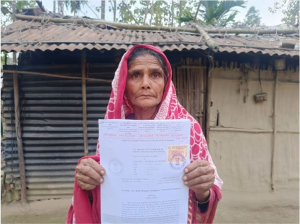

Bordering on illegality? 18 alleged Bangladeshis “pushed back” without due process, Legal challenge filed in High Court

On July 5, Assam Chief Minister Himanta Biswa Sarma announced that 18 alleged Bangladeshi nationals were deported from the Cachar and Sribhumi districts in what he termed a “special gesture of pushback”


In his social media post, Sarma reiterated the state’s position: while Assam welcomes guests, illegal residents would not be permitted to stay. The early-morning operation, executed by Assam Police, was part of an intensified campaign against undocumented immigrants, with Sarma stating that nearly 330 such individuals have been expelled from the state in the past month alone.


Security officials, however, have raised red flags. As per India Today NE, it has been reported that many individuals deported under this policy managed to return shortly after being expelled, some allegedly through porous borders in Meghalaya. Several were reportedly refused entry by the Border Guards Bangladesh (BGB), particularly those identified as Muslims, due to lack of coordination or documentation.

These individuals are believed to have been pushed into no man’s land by the Border Security Force (BSF), often during night hours, without proper documentation or adjudication through Foreigners Tribunals, raising serious concerns about violation of national and international legal norms.

July 7: CM Sarma Defends Crackdown, Announces Expansion of Eviction Drive

Speaking to reporters in Kokrajhar on July 7, Sarma defended the state’s actions and promised to expand the eviction campaign. He alleged that individuals from areas such as Karimganj, Dhubri, Chappar, and Silchar had begun settling in Lakhimpur, leading to their eviction to “protect the land rights of the indigenous people.”

If anyone has a problem with the removal of 350 illegal Bangladeshis, they will have to bear it. Many people have been martyred in the fight to drive Bangladeshis out,” said Sarma, according to the report of India Today NE.

The Chief Minister further stated that the campaign would not be halted due to political criticism. “Now they [opposition parties] are doing politics in the name of this girl to provide security to Bangladeshis,” he added, as reported by India Today NE, alleging that the real intent was to sabotage the BJP-led government’s campaign.

Sarma also announced that evictions would soon be carried out in Chappar, Dhubri, and Bodoland, stating, “No outsider should be allowed to enter Bodoland”.

PIL in Gauhati High Court: Pushback policy challenged as unconstitutional

These aggressive deportation measures have now come under judicial scrutiny. A Public Interest Litigation (PIL) filed by the All BTC Minority Students Association in the Gauhati High Court alleges that the Assam government’s “push-back policy” is being implemented arbitrarily and in violation of Articles 14, 21, and 22 of the Constitution.

According to the report of LiveLaw, when the matter came up on June 27, a division bench comprising Justices Manish Choudhury and Mitali Thakuria was informed that several individuals had been detained and pushed back without any formal process. The petitioner's counsel said he had collected the particulars of such individuals, whose whereabouts remain unknown after being picked up by the police.

According to the LiveLAw report, the PIL stated that “Deportation without notice, adjudication or opportunity to appeal constitutes a grave violation of constitutional due process... The State of Assam has undertaken an arbitrary policy of ‘push back’, which is bereft of the principles of natural justice.”

The matter is next listed for July 22, 2025. The petitioners had earlier moved the Supreme Court, but withdrew their plea after the Court expressed its inclination to dismiss it, opting instead to approach the High Court.

What does the petition entail?

  1. No Tribunal Orders, No Deportation Proceedings: Violations of Foreigners Act alleged by petitioners

The plea highlights that the pushbacks are being carried out without any judicial declaration from the Foreigners Tribunals, as required under the Foreigners Act, 1946. It argues that such practices lack legal backing and amount to arbitrary and extrajudicial expulsions.

It also refers to the Supreme Court’s ruling in Sarbananda Sonowal v. Union of India (2005), where the Court underscored the necessity of following due process in identifying and deporting foreign nationals, warning against wrongful deprivation of citizenship, particularly for vulnerable populations.

As per a report in Bar&Bench, the PIL also challenges the state’s interpretation of the Rajubala Das v. Union of India judgment dated February 4, 2025, which directed deportation of only 63 specific individuals with verified foreign nationalities. The petition contends that the state has wrongly used this order as a blanket licence to detain and push back many more without following legal procedures.

  1. Pattern of Abuse: Allegations of Muslim profiling and secret detentions

According to the petition and supporting media reports, more than 50 individuals have been picked up from different districts and transferred to the Matia Detention Centre in Goalpara. These individuals were later handed over to BSF and allegedly expelled at night, without access to lawyers or family. The PIL also refers to the case of a government school teacher who was deported, indicating a pattern of wrongful identification and profiling.

The petition emphasises that once a person has entered Indian territory, pushbacks without a tribunal order or civil authority clearance are illegal under both domestic and international law, including Article 33 of the 1951 Refugee Convention, which India, though not a signatory, is bound to uphold in spirit as part of its constitutional commitment to human rights.

Aadhaar Under Watch: Assam moves to limit access for ‘fresh entrants’

In a related policy development, the Assam Cabinet is considering restricting Aadhaar card issuance. On July 5, Sarma announced that the government may introduce a law empowering only District Commissioners to approve Aadhaar applications for individuals over 18. He claimed that most adults already have Aadhaar, and limiting new issuances would prevent alleged illegal immigrants from gaining documentation.

Fresh people coming from Bangladesh will not be able to take them,” Sarma said, as provided in the report of The Hindu, adding that the move would serve as an administrative filter against infiltration.

Experts, however, have warned that such restrictions could result in exclusion of genuine Indian citizens, particularly the poor, marginalised, and illiterate, many of whom struggle to prove documentation under existing mechanisms like the NRC or Aadhaar enrolment.

Assam’s aggressive deportation campaign, framed by the state as a defence of indigenous identity, is fast becoming a legal and human rights crisis. The ongoing PIL, multiple media exposés, and testimonies from affected communities point to a systematic subversion of constitutional protections and established legal processes.


Related:

Another Pushback Halted: SC stays deportation of woman declared foreigner, issues notice on challenge to Gauhati HC order

After incorrect detention claim, Gauhati HC was informed that Doyjan Bibi was handed over to BSF

“Bail once granted can’t be ignored”: Gauhati HC seeks legal basis for re-detentions of COVID-era released detainees
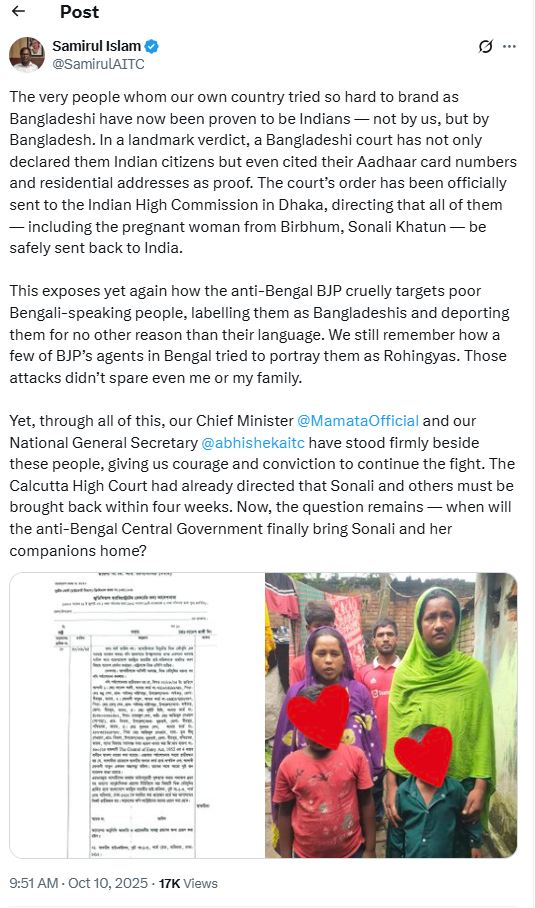


Justice Deferred: J&K High Court stays repatriation of 63-year-old woman deported after Pahalgam attack, following MHA appeal

In a move that starkly undermines constitutional protections and judicial urgency, the Ministry of Home Affairs (MHA) has secured a stay order from the Division Bench of the Jammu & Kashmir High Court, suspending the June 6 directive to repatriate 63-year-old Rakshanda Rashid, a Pakistani-origin woman who was deported in April despite having lived in Jammu for nearly four decades on a long-term visa (LTV).

The MHA filed a Letters Patent Appeal (LPA) on July 1, challenging the single-judge order passed by Justice Rahul Bharti, which had strongly criticised Rashid’s removal as a violation of her legal status and fundamental rights. On July 3, the Division Bench led by Chief Justice Arun Palli admitted the appeal and granted an interim stay, halting the enforcement of the repatriation order until further hearing.

The stay now places the continued suffering of a woman already rendered vulnerable, alone in a country she has no ties to, on procedural pause, despite the gravity of findings already made by the High Court in her favour.

Justice Bharti’s June 6 order: “A case of constitutional SOS”

Justice Bharti’s order had framed Rashid’s deportation as not only procedurally flawed but morally and constitutionally indefensible. Rashid had arrived in India in the late 1980s, married an Indian citizen, and lived in Jammu ever since. Her LTV had been renewed annually, and she had applied for Indian citizenship in 1996, which remains pending to this day.

On April 29, in the aftermath of the April 22 Pahalgam terror attack, in which 26 people were killed. The MHA issued an order cancelling visas of Pakistani nationals, but explicitly exempted LTV holders and Pakistani women married to Indian citizens. Rashid fell under both protected categories. Yet, early that morning, local police took her from her home and drove her to the Attari border, from where she was deported without a court order, without legal representation, and despite ongoing processing of her LTV renewal.

Justice Bharti took note of this in harsh terms, noting that Rashid’s deportation:

“This Court is bearing in mind background that the reference that the petitioner was having LTV status at relevant point of time which per-se may not have warranted her deportation but without examining her case in better perspective and coming up with a proper order with respect to her deportation from the authorities concerned, still she came to be forced out.” (Para 4)

He went on to declare that the Ministry of Home Affairs must retrieve her from Pakistan, stating:

“Human rights are the most sacrosanct component of a human life and, therefore, there are occasions when a constitutional court is supposed to come up with SOS like indulgence notwithstanding the merits and demerits of a case which can be adjudicated only upon in due course of time and therefore, this Court is coming up with a direction to the Ministry of Home Affairs, Government of India to bring back the petitioner from her deportation.” (Para 3)

Given the exceptional nature of facts and circumstances of the case whereby the petitioner-Rakshanda Rashid wife of Sheikh Zahoor Ahmed has been purportedly deported to Pakistan in the recent drive undertaken by the Government of India post Pahalgam carnage, this Court is constrained to direct the Secretary, Ministry of Home Affairs, Government of India to retrieve the petitioner back to J&K, India so as to facilitate the reunion of the petitioner with her husband-Sheikh Zahoor Ahmed in Jammu.” (Para 5)

The order gave the Union Government ten days to comply, listing the matter for July 1 for a compliance update. (Detailed piece may be read here.)

MHA’s Appeal: Technical objections, procedural deflection

Instead of complying, the MHA filed an appeal just as the deadline approached. In its Letters Patent Appeal, the MHA did not contest the humanitarian facts of the case or the petitioner’s prolonged residence in India. Instead, it advanced technical objections that sought to side-line the substance of the June 6 order.

Key arguments made by the MHA in the appeal included:

  • LTV not valid at time of deportation: The MHA claimed that as of April 29, 2025, Ms. Rashid’s long-term visa had expired, and therefore she was no longer under legal protection. They argued that the exemption granted post-Pahalgam was not applicable, since the LTV “did not exist” on the date of deportation.
  • Delay in filing LTV renewal application: The Ministry alleged that the LTV renewal application had been filed on March 8, not January as claimed by the petitioner. This discrepancy was used to argue that the application was late and hence invalid.
  • Order interferes with sovereign deportation powers: The MHA asserted that the single-judge order unlawfully encroaches upon the sovereign and executive powers of the Union Government to determine immigration and deportation matters, particularly in the wake of a serious national security incident.
  • Judicial overreach in “retrieving” a foreign national: The Ministry argued that the High Court had exceeded its jurisdiction by directing the Union Government to bring a foreign national back into Indian Territory—an act, they claimed, that rests exclusively with the executive under foreign and immigration law.

These arguments, framed as legal proceduralism, evaded the central concern raised by Justice Bharti: that even the deportation of a foreign national must conform to constitutional safeguards, especially when the person in question has lived in India for 38 years and has not committed any offence.

Facts that contradict the MHA’s version

The MHA’s factual claims are sharply contradicted by documentary evidence provided in the original writ petition:

  • Email dated April 26 from the FRRO acknowledged that the LTV renewal application was under process.
  • Email dated May 9 confirmed that the application had been forwarded to higher authorities for approval.
  • These emails undermine the MHA’s claim that no valid application existed at the time of deportation.

Further, Ms. Rashid’s daughter, Fatima Sheikh, told The Hindu that the application was filed in January, not March, and that the March 8 date was deliberately misrepresented by police to justify a pre-planned removal. She also said her mother was denied access to lawyers, given no notice, and is now struggling alone in Pakistan, with no relatives, no income, and deteriorating health, as provided by the report.

The Division Bench’s Stay: A reversal of urgency and rights

On July 3, without examining these contradictions or addressing the humanitarian stakes of the matter, the Division Bench granted an interim stay on the repatriation order, delaying relief without a finding of fault.

The stay has effectively nullified the urgency recognised by the single-judge bench. No timeline for repatriation. No safeguard for Rashid in Pakistan. Just indefinite suspension, as the case winds its way through another round of legal arguments.

This raises pressing constitutional and ethical concerns:

  • Can the state correct an illegal act (a forcible deportation without process) by citing procedural technicalities in retrospect?
  • Should courts allow such technicalities to override basic rights and urgent judicial directions rooted in justice and dignity?
  • Does the judicial system recognise the harm caused by delay itself, especially when the person harmed is elderly, sick, and stateless in practice?

The appeal has been admitted and will now be heard on merits. Until then, Rakshanda Rashid remains stranded in Pakistan, in legal limbo, without family or resources. The SOS call issued by the Court has been muted by procedure, and a woman who never should have been deported in the first place is forced to wait for her humanity to be re-recognised.

What the High Court gave with one hand, compassion, clarity, and courage, the system has now taken away, at least for the moment. And the message it sends is deeply worrying: that even in clear cases of wrongful state action, relief can be stayed, and rights can be delayed, if not denied.


Related:

India’s Stealthy Pushback: Thousands of alleged “Bangladeshi immigrants” deported without due process across states

Gauhati HC again grants visitation in Torap Ali petition challenging re-detention of uncle as affidavit opposing claims of regular police reporting is filed

Gauhati HC seeks verification of bail compliance in writ petition filed by Reijya Khatun for detained husband Majibur Rehman

Gauhati HC closes habeas corpus petition after release of bail-compliant detainee, declines prayer for compensation

“State says handed over to BSF, Found Unconscious in Bijni” Gauhati HC demands answers after Samsul Ali returns home unconscious

How the Rajubala case in the Supreme Court, its genesis and context has now become the ground for ‘state expulsion”


Deported in Silence: India's mass expulsions of alleged Bangladeshis without due process

Since May 7, when the Union Government launched Operation Sindoor, a massive, coordinated crackdown has led to the detention and covert deportation of over 2,000 individuals suspected of being undocumented Bangladeshi immigrants. These so-called “pushbacks” — many reportedly carried out without any judicial oversight or deportation orders — have spanned across the country, raising grave questions about legality and human rights.

According to sources in The Indian Express, the operation began following a nationwide verification exercise and has seen immigrants rounded up from states as far apart as Gujarat, Delhi, Haryana, Assam, Maharashtra, Rajasthan, Uttar Pradesh, and Goa. Most of them are then flown by Indian Air Force aircraft to border states such as Tripura, Meghalaya, and Assam — where they are held in makeshift camps, handed over to the Border Security Force (BSF), and “pushed back” across the border into Bangladesh, often within hours.

A senior government official confirmed to The Indian Express that Gujarat initiated the first round of detentions and currently accounts for nearly half of all deportations. “All states with major economic hubs are identifying such illegal immigrants after document verification. The instructions from the Ministry of Home Affairs are clear — the states are complying,” the official said, noting that the crackdown accelerated after the April Pahalgam attacks.

But the scale and method of these deportations suggest clear departures from legal norms. Under Indian law and international obligations, deportation must follow due process — including formal orders, access to legal aid, and verification by Foreigners Tribunals or equivalent mechanisms. None of this appears to be happening in these pushbacks.

The BSF, according to reports in The Hindu, has pushed back over 1,200 people from just one sector of the West Bengal-Bangladesh border. Delhi Police alone has deported at least 120 people since January, followed by Maharashtra (110), Haryana (80), Rajasthan (70), Uttar Pradesh (65), Gujarat (65), and Goa (10). Many of these individuals were transported in secrecy and denied access to legal representation.

Several were reportedly handed some Bangladeshi currency and food before being left at the border, a practice that not only flouts legal protections for non-citizens but also risks statelessness and chain deportations. Alarmingly, a significant number of people, fearing arrest, are voluntarily approaching border regions in panic, indicating the deep fear triggered by the nationwide campaign.

These coordinated actions across states, in the absence of transparent procedures, point to a disturbing trend: a pan-India, informal deportation regime operating outside the bounds of the law, with little accountability or oversight.

  1. Uttar Pradesh: 90 alleged Bangladeshi Nationals detained from Mathura kilns amid state-wide deportation drive

On May 17, police in Uttar Pradesh’s Mathura district detained 90 individuals—suspected Bangladeshi nationals—including 35 men, 27 women, and 28 children, from Khajpur village under the Nauhjheel police station. The detentions were part of an identity verification drive targeting migrant labourers working in the area’s brick kilns.

According to Mathura SSP Shlok Kumar, the detainees claimed they had been living in Mathura for the past 3–4 months and had migrated there from a neighbouring state. “All of them are being interrogated, and other investigative agencies have also been roped in,” he told ANI, suggesting that legal proceedings may follow. However, no clarity has been provided on whether these individuals were produced before a magistrate or allowed access to legal aid, raising due process concerns.

The detentions align with a larger, intensified campaign launched by the Uttar Pradesh government to identify and deport what it calls “infiltrators” — targeting primarily Bangladeshi and Rohingya communities residing in the state. Officials have also indicated that action had earlier been taken against Pakistani nationals, and similar efforts are now directed at undocumented Bangladeshi and Rohingya residents.

According to the report of Indian Express, state-wide directive from the Chief Minister’s Office has instructed all District Magistrates, SSPs, and Police Commissioners to accelerate the identification and removal of undocumented migrants, particularly in areas where many are believed to be living under changed or forged identities. Simultaneously, authorities have begun operations against so-called illegal settlements and unauthorised structures, especially in districts bordering Nepal.

The Uttar Pradesh government has publicly claimed to be the first in the country to achieve the deportation of all undocumented Pakistani nationals. “The Chief Minister himself oversees the process,” said a CMO statement, as per the ANI report.

While the state presents this as a national security achievement, rights advocates warn that such sweeping actions, especially those involving families with children, may sidestep critical legal safeguards, including the right to a fair hearing, protections under the Foreigners Act, and India’s obligations under international human rights law.

Uttar Pradesh’s operation is just one piece in a growing national trend that appears to be functioning as a shadow deportation regime, with opaque procedures, little to no judicial oversight, and significant risk of wrongful or arbitrary expulsions.

  1. Delhi: 700 alleged undocumented migrants deported under 'pushback' drive

In the last six months, nearly 700 undocumented migrants have been deported from Delhi to Bangladesh as part of the Union government’s intensified “pushback” strategy, according to a report by The Indian Express. The pace of deportations notably accelerated in the wake of the April Pahalgam terror attack, triggering a capital-wide verification and detention campaign.

Following the attack, the Delhi Police launched a coordinated drive and identified around 470 individuals as undocumented Bangladeshi nationals, along with 50 foreigners who had overstayed their visas, The Indian Express reported. These individuals were then flown from the Hindon Air Base in Ghaziabad to Agartala in Tripura, from where they were deported via land routes across the Bangladesh border.

Police sources revealed that 3–4 special flights were used over the past month for transporting the detainees. According to The Indian Express, Delhi Police also set up around five makeshift detention centres, coordinated with the Foreigners Regional Registration Office (FRRO), and arranged the transfers with the Border Security Force (BSF).

On May 16, thirteen Bangladeshi nationals, including five minors, were detained in Auchandi village in outer Delhi for allegedly living without valid documents, according to an ANI report. They were apprehended during a targeted operation following intelligence inputs, said Deputy Commissioner of Police (Crime) Aditya Gautam. On interrogation, the detainees reportedly admitted to being Bangladeshi citizens without any legal documentation permitting them to stay in India.

A week later, on May 23, the Delhi Police detained 121 Bangladeshi nationals suspected of unlawful residence in the capital and initiated deportation proceedings through the FRRO, according to The Hindu. In the same operation, five Indian nationals were questioned for allegedly facilitating the illegal entry and stay of these foreign nationals. A case was registered at Narela Industrial Area police station under provisions of the Bharatiya Nyaya Sanhita (BNS) and Sections 14 and 14C of the Foreigners Act, 1946.

A Special Investigation Team (SIT) has been formed to probe a suspected syndicate that is believed to have assisted in providing accommodation, jobs, and forged Indian identity documents to the immigrants. Authorities are now examining suspected fabrication of Aadhaar cards, voter IDs, and electricity meter connections, and have issued notices to relevant departments. Legal action has been promised against any official found complicit.

These developments mark a sharp escalation in Delhi’s deportation efforts and reflect the broader national push under Operation Sindoor to track, detain, and remove undocumented migrants, often through processes lacking judicial oversight.

  1. Delhi-Ghaziabad: Mass deportations continue as government allegedly sidesteps due process

On Sunday, May 25, around 160 undocumented Bangladeshi migrants, including women and children detained from outer Delhi, were airlifted from Ghaziabad’s Hindon Air Base to Agartala in Tripura to be deported to Bangladesh, according to a report by The Hindu.

Officials told the newspaper that the transfer was in line with the Indian government’s directive to expedite deportations without waiting for formal processes, which are often “lengthy.” This reflects a growing trend of informal and accelerated removals, especially following the April 22 Pahalgam terror attack.

Since the attack, more than 500 individuals have reportedly been sent back through India’s eastern border. Across the country, police forces have been conducting verification drives to identify alleged undocumented immigrants. Once detained, the migrants’ biometrics are recorded, and any Indian identity documents, such as Aadhaar cards, are cancelled. These biometrics are reportedly used to prevent re-entry and re-enrolment in Indian systems.

After biometric capture, the migrants are handed over to the Border Security Force (BSF) and pushed back across the border. The Bangladesh Ministry of Foreign Affairs, in a letter sent on May 8, raised concerns over these forced entries and called on India to respect formal repatriation mechanisms.

Earlier, on May 4, two Air India planes transported around 300 undocumented migrants, including 200 women and children who had been detained in Gujarat, to Agartala. They were subsequently sent across the border to Bangladesh.

At a press conference on May 26 in Dhaka, Brigadier General Md. Nazim-ud-Daula of the Bangladesh Army condemned these deportations as unacceptable “push-ins.”

In just one month since the Pahalgam incident, Delhi Police identified and deported 470 undocumented Bangladeshi nationals and 50 foreign overstayers, flying them from Hindon to Tripura before pushing them across the land border.

An officer from Delhi Police told The Hindu that the Ministry of Home Affairs had instructed city police as early as late 2024 to begin verification drives targeting Bangladeshi and Rohingya migrants. Between November 15, 2024, and April 20, 2025, about 220 undocumented migrants and 30 overstayers were identified, taken by train and road to eastern states, and deported via land borders through the FRRO.

However, after the Pahalgam attack, the process intensified. “Over the last one month, around 3–4 special flights went from Hindon air base to Agartala,” a senior officer said. In total, about 700 individuals have been deported from Delhi over the past six months, he added.

Initially, Deputy Commissioners of Police (DCPs) from all 15 districts were tasked with identifying undocumented Bangladeshi and Rohingya migrants. A first battalion of Delhi Police, along with FRRO officials, would accompany detainees via rail and road to West Bengal, from where the BSF completed the deportation process, according to a government source cited by The Hindu.

  1. Gujarat: Over 1,000 detained in state’s largest crackdown, hundreds airlifted and pushed back across border

On April 26, Gujarat Police executed what officials described as the state's largest-ever operation targeting undocumented migrants, detaining 1,024 suspected Bangladeshi nationals, 890 in Ahmedabad and 134 in Surat, amid allegations of fake documents and criminal activity, as per Deccan Herald. The state Home Minister hailed the operation as a “historic victory,” warning that those harbouring such individuals would face strict action, and confirming plans to swiftly deport the detainees, as per the report of Hindustan Times.

Just over a week later, on May 4, two Air India flights carried some 300 of the detained migrants, including around 200 women and children, to Agartala in Tripura. From there, they were “pushed back” across the land border into Bangladesh, bypassing lengthy legal deportation procedures, as per the HT report.

These actions followed a directive from the Ministry of Home Affairs after the Pahalgam terror attack, streamlining mass deportations with rapid airlifts and border pushbacks, according to Times of India report. Authorities have flagged concerns about detainees’ alleged links to drug and human trafficking ring, and even extremist sleeper cells, as justification for the sweeping operation, as per the New Indian Express.

The Gujarat operation, which involved specialized units from Ahmedabad Crime Branch, SOG, EOW, and local police divisions, also uncovered widespread use of forged IDs sourced from West Bengal, a network that is now under investigation as per the Indian Express report.

These developments underscore a troubling trend: a coordinated and expedient deportation campaign that circumvents due process, with authorities opting for air-bridge removals and cross-border pushbacks in lieu of formal court procedures.

  1. Rajasthan: 1,000 marked for deportation as Indian migrant workers from Bengal detained for “Speaking Bengali”

On May 14, 2025, Rajasthan’s Law and Parliamentary Affairs Minister Jogaram Patel announced that around 1,000 suspected Bangladeshi nationals had been identified across the state. Speaking in Jaipur, he confirmed that the first group of 148 detainees had been moved to Jodhpur and then flown to Kolkata, from where they would be deported to Bangladesh. According to The Hindu, most of these individuals were originally detained in Sikar district, and the Village Development Officers’ Training Centre in Jodhpur had been temporarily converted into a holding facility for the deportation process.

As per the report, Patel further stated that the state would continue similar operations in the coming days to facilitate further removals.

However, the state’s aggressive crackdown also resulted in wrongful detentions. On May 13, Rajasthan Police released 13 migrant workers, including children and two families from Cooch Behar, West Bengal, who had been held for nine days on suspicion of being Bangladeshi infiltrators, solely because they spoke Bengali. The group had been picked up by personnel from the Patan Police Station in Sikar district, and were detained in a guest house under police watch, despite being Indian citizens.

According to The Telegraph, their release came only after sustained communication from West Bengal government officials, who intervened when alerted by concerned families and local leaders. Samirul Islam, a TMC Rajya Sabha MP and head of the Bengal government’s migrant worker welfare board, confirmed that state officials had been in touch with their counterparts in Rajasthan to secure the workers’ release. A senior Cooch Behar official reportedly called Rajasthan Police directly, following which the detainees were let go.

Obaydul Khandakar, a resident of Purba Jaigir Balabari village in Cooch Behar’s Dinhata-II block, who had been detained along with his wife Beauty Bibi, told the newspaper: “Despite being Indian citizens, we were detained for nine days just because we spoke Bengali.” The families had been working at a brick kiln near Sikar and returned there after their release. Khandakar said he planned to settle his dues and was now uncertain about returning to Rajasthan for work, shaken by the experience.

  1. Tripura: Over 2,800 arrested for illegal entry since 2022 amid ongoing crackdown

On June 9, the Government Railway Police (GRP) in Tripura arrested one Bangladeshi national and one Indian tout during separate operations at Agartala railway station, according to a report by EastMojo. In the first incident, Pranajit Ray (35), a resident of Sylhet district in Bangladesh, was intercepted during a joint operation conducted by the GRP, Railway Protection Force (RPF), Border Security Force (BSF), and other agencies. Police said he had illegally crossed the border and was planning to travel to Kolkata. “We seized some documents and Indian currency. We are examining these,” an officer told the outlet.

In a separate case, an Indian trafficker from Chanipur in West Tripura district was also arrested as part of a similar joint operation.

The arrests come amid a growing number of detentions in the state. Between January 1 and February 28, 2024, a total of 816 Bangladeshi nationals, 79 Rohingya, and two Nigerians were arrested in Tripura, according to the Tripura Police's own data cited by EastMojo.

Additionally, Chief Minister Dr. Manik Saha, who also holds the Home portfolio, recently informed the Assembly that 2,815 Bangladeshi nationals were arrested for illegally entering Tripura between 2022 and October 31, 2024. Out of these, 1,746 were “pushed back” across the border, while 1,069 remained either in jail, temporary detention centres, shelter homes, or out on bail, as per a report by The Indian Express.

  1. Maharashtra: Four alleged Bangladeshi nationals held in Pune following military intelligence tip-off

In Maharashtra, four suspected Bangladeshi nationals were detained from a labour camp in Pune’s Khondwa area on June 13 in a joint operation conducted by the police and Military Intelligence, according to a report by The Hindu. The arrests were made following a tip-off from the Southern Command of Military Intelligence, which led authorities to intercept the individuals as they were allegedly attempting to flee the area.

Upon preliminary verification, the four men were identified as Swapan Mandal, Mithun Kumar, Ranodhir Mandal, and Dilip Mondal, and were found to be citizens of Bangladesh. Defence sources cited in the report confirmed that the individuals will undergo joint interrogation by multiple agencies.

  1. West Bengal: Seven alleged Bangladeshi nationals caught trying to return home after years in India

On Saturday, seven alleged Bangladeshi nationals, including three women, were apprehended by police in Nadia district of West Bengal while attempting to cross back into Bangladesh after reportedly spending four years working in various Indian cities, according to a report by Hindustan Times.

“These individuals had entered India illegally through the North 24 Parganas border around four years ago and have since worked in Mumbai, Delhi, and several cities in Gujarat,” said Somnath Jha, Deputy Superintendent of Police (Border), Ranaghat Divisionm as per the HT report. They were caught in the Hanskhali police station area, the same location where another Bangladeshi woman was arrested earlier last week. She had reportedly entered India in 2024 and also worked in Mumbai.

The arrested individuals are said to be from Khulna, Jessore, Cox’s Bazar, and Kushtia districts in Bangladesh. According to officials, the group was attempting to return to Bangladesh with the help of an agent who is currently absconding.

With these arrests, the total number of alleged Bangladeshi nationals detained in various districts of West Bengal since December 2023 has reached approximately 100, as per police estimates. The Border Security Force (BSF) and other agencies have stepped up surveillance along the Indo-Bangladesh border since 2024 in response to the ongoing political unrest in Bangladesh.

State Pushback: When governments step in to stop unlawful deportations

While the Union government’s crackdown on undocumented migrants has unfolded across states with unprecedented coordination and speed, a few state governments have pushed back, not against migrants, but against what they allege are unlawful deportations of Indian citizens. In rare but telling instances, state authorities have intervened to halt or reverse deportations, particularly where those detained turned out to be bona fide Indian nationals. Most notably, the West Bengal government has led efforts to trace, verify, and bring back its residents who were mistakenly or illegally pushed into Bangladesh, raising urgent questions about due process, documentation, and the risks of communal or linguistic profiling in the ongoing campaign.

  1. West Bengal Government brings back seven men wrongly deported to Bangladesh

In a striking instance of state-level intervention against what is being called unlawful deportation, the West Bengal government has successfully facilitated the return of at least seven Indian citizens who were allegedly picked up by Maharashtra Police during anti-immigration drives and pushed across the Bangladesh border, despite holding valid Indian documents.

The men, most of whom are residents of Murshidabad district, were working as daily wage labourers or masons in Mumbai and Thane. They were detained between June 9 and 11, and within days, without due legal process, transported across the border and abandoned in Bangladesh, according to The Indian Express.

One of the deportees, 36-year-old Mehbub Sheikh, who worked as a mason in Thane, was detained on June 11 and pushed into Bangladesh from a BSF camp in Siliguri by the early hours of June 14, despite his family and local police submitting documentation, including Aadhaar, voter ID, and land records, to prove his Indian citizenship. Another youth, Shamim Khan, also from Murshidabad, was picked up around the same time and met the same fate.

Following urgent appeals from families and local authorities, the West Bengal Migrant Workers’ Welfare Board, under instructions from Chief Minister Mamata Banerjee, intervened. The Board’s chairman and TMC Rajya Sabha MP Samirul Islam told The Indian Express that the state government had taken the matter up directly with the Union government and the BSF. “Our government coordinated with central agencies and ensured five individuals were brought back by Sunday, and two more by Monday. We are continuing efforts to identify if others from Bengal have also been wrongfully deported,” he said.

According to a statement by Murshidabad SP Kumar Sunny Raj, upon receiving alerts from families, district police initiated local verification and coordinated with the BSF. Once the individuals’ Indian nationality was confirmed through supporting documents, the BSF held a flag meeting with Border Guard Bangladesh (BGB) and repatriated the youths. “They were handed over to Raiganj police station by the BSF and will be taken back to their respective villages,” added SP Md Sana Akhtar of Uttar Dinajpur as per the report.

The deported men include Mehbub Sheikh (Bhagwangola), Shamim Khan (Hariharpara), Minarul Sheikh (Beldanga), Nazimuddin Mondal (Hariharpara), and Mostafa Kamal Sheikh (Monteswar, Purba Bardhaman). Additionally, Fazer Sheikh and his wife Taslima from Bagda in North 24 Parganas were also returned. All were among the over 130 people transported by BSF aircraft from Pune to Agartala, and then dropped off at the border with minimal belongings, a packet of food, and 300 Bangladeshi Taka, according to multiple returnees.

Speaking to The Hindu, Nazimuddin Mondal, 34, recalled: “We were herded like cattle. At 3 am, the BSF jawans drove us toward the border, told us not to return. We walked into complete darkness.” After being chased away by Bangladeshi locals and beaten by BGB personnel, the group wandered for hours in paddy fields with mud up to their knees, before the BSF called them back the following evening and took them to Kokrajhar.

Nazimuddin’s brother Musarraf Mondal said the family had frantically submitted documentation to both local police in Murshidabad and the authorities in Mumbai, but were ignored. “Only after my brother managed to call from Bangladesh did, we know what had happened,” he said.

According to Samirul Islam, this is not an isolated event. “There is growing concern that Bengali-speaking Indian citizens, especially migrant workers, are being wrongly profiled and deported in BJP-ruled states like Maharashtra,” he told The Telegraph. “This is illegal, and our Chief Minister has written to the Centre about this.”

The return of these individuals was made possible through urgent coordination between state police, BSF, and BGB, as confirmed by Mekhliganj Police Station OC Mani Bhusan Sarkar, who received prior alerts from Murshidabad and Bardhaman police about missing residents. After verifying identities, a flag meeting at the Mekhliganj border enabled their return on Sunday afternoon.

As The Hindu reports, these cases come amid a wider trend of the Indian government “pushing back” undocumented migrants across the Bangladesh border, especially following Operation Sindoor, launched in the wake of the Pahalgam terror attack in April. The Border Guard Bangladesh (BGB) has officially raised objections, stating such pushbacks violate diplomatic protocols.

For the seven men from Bengal, the ordeal has left lasting scars. “We were taken from one police station to another in Mumbai. We had no phones, no belongings. No one listened to us,” said Nazimuddin, still shaken after returning to his village in Taratipur, Murshidabad. “Only the state government listened.”

Here is a detailed and paraphrased version of the UP detention and Bengal police intervention story, rewritten with improved flow and source attribution:

  1. West Bengal police intervene to secure release of six detainees from UP, wrongly suspected as Bangladeshis

In yet another instance that underscores growing concerns around the profiling of Bengali-speaking migrant workers, six residents of West Bengal, including two drivers, were detained by the Uttar Pradesh Police on May 5 in Deoria district, allegedly on suspicion of being Bangladeshi nationals. The detainees, five from Beldanga in Murshidabad and one from Krishnaganj in Nadia, were travelling by bus when they were stopped and taken to Lar police station, according to a report in The Telegraph.

The situation was resolved only after swift intervention by Murshidabad Superintendent of Police Kumar Sunny Raj, who contacted senior UP officials and facilitated the release of the group. A police officer in Bengal, speaking to the media, confirmed that local authorities had been alerted to the detentions around noon. “As soon as we were informed, our SP reached out to his counterparts in Uttar Pradesh. The issue was resolved the same day,” the officer stated.

Family members of the detainees said they were advised to keep their local police stations informed while travelling outside the state, especially in light of recent incidents of wrongful detention. “We had notified the Beldanga Inspector-in-Charge as a precaution. The prompt response of our local police ensured the group was not subjected to further harassment,” said Din Muhammad, a relative of one of the men, while speaking to The Telegraph.

Samirul Islam, Trinamool MP and chairman of the West Bengal Migrant Workers’ Welfare Board, condemned the incident, calling it part of a worrying trend of systemic suspicion and profiling of Bengali-speaking Indians in BJP-ruled states. “This has to stop. Speaking Bengali does not make someone a Bangladeshi,” Islam said. He further noted that despite the six men producing valid photo ID cards, they were still detained, an act he described as “deeply discriminatory.” He added that Chief Minister Mamata Banerjee had already written to the Centre raising concern about the growing frequency of such incidents.

Police confirmed that the group was released by the evening of May 5 and arrangements were made for them to return to their homes in Bengal the following day. (Detailed report may be read here.)

When the Courts Intervene: Stays and interim protection

Amid a wave of detentions and swift deportations, many allegedly carried out without due process, constitutional courts across India have intervened to halt or question such actions. In several instances, the Supreme Court and High Courts have granted interim protection or stay orders, preventing the deportation of individuals flagged as "illegal migrants" or declared foreigners under the Foreigners Act. These judicial interventions have not only delayed state action but have, in some cases, forced authorities to re-examine the legality and fairness of their deportation processes.

  1. Supreme Court grants interim protection to woman declared 'foreigner' amid concerns over opaque deportation processes in Assam

Amid growing judicial scrutiny of arbitrary deportation practices in Assam, the Supreme Court on June 24, 2025, granted interim protection from deportation to Jaynab Bibi, a woman declared a foreigner by a Foreigners Tribunal under Section 2(a) of the Foreigners Act, 1946. The Tribunal’s two-page 2017 order had summarily dismissed her extensive documentary evidence, including the 1951 NRC, multiple electoral rolls, land records, and local certificates, on grounds of minor inconsistencies in names and testimonies. The Gauhati High Court upheld this finding in February 2025 and revoked her interim protection, but the Supreme Court has now stayed all coercive steps against her, including deportation, while issuing notice in her special leave petition. The case is next listed for August 25.

Represented by Advocates Fuzail Ahmad Ayyubi and Akanksha Rai, Jaynab’s petition relies heavily on the Supreme Court’s own observations in Mohd. Rahim Ali v. State of Assam (July 2024), where the Court cautioned against opaque and suspicion-based declarations under the Foreigners Act. Jaynab, who claims Indian citizenship by birth and residence in Nagaon district, contends that her identity was rejected without due process. The Court’s intervention, though interim, sends a strong signal against mechanical adjudications and underscores the central role of constitutional safeguards in proceedings that could result in loss of nationality and expulsion. (Detailed report may be read here.)

  1. Bombay High Court grants bail over custodial rights violation

In a significant judicial intervention affirming procedural safeguards even in cases involving alleged undocumented immigrants, the Bombay High Court on May 7, 2025, granted bail to 34-year-old Sabnam Suleman Ansari, accused of entering India illegally, after finding that she was produced before a magistrate well beyond the constitutionally permitted 24-hour window following her arrest. Justice Milind Jadhav, while granting her bail on a surety of ₹5,000, observed that Ansari was arrested on January 28 at 12:30 PM and produced only on January 29 at 4:30 PM. The delay, the judge ruled, constituted a prima facie breach of her fundamental rights under Articles 21 and 22 of the Constitution. According to the order, “It is the duty of the Bail Court to step in,” when such violations are apparent.

The prosecution alleged Ansari had entered India through an unauthorised route from Bangladesh and lacked valid travel documents. However, Justice Jadhav rejected the State’s reliance on an earlier division bench ruling in Karan Ratan Rokade v. State of Maharashtra, distinguishing the facts and affirming the Supreme Court’s position in Vihaan Kumar v. State of Haryana, which emphasized the judiciary’s obligation to grant bail in cases of illegal detention. The Court also noted the indifference of police authorities toward elementary but statutory safeguards under Section 50 of the CrPC and Section 58 of the Bharatiya Nagarik Suraksha Sanhita, 2023, underscoring that constitutional protections remain non-negotiable, even in immigration-related prosecutions.

  1. Bombay High Court intervenes in detention of Indian teen following father’s deportation

In another crucial instance of judicial scrutiny over policing under the Foreigners Act, the Bombay High Court on June 3, 2025, ordered the immediate release of 18-year-old Ruksar Dadamiya Khan, who had been detained by Mumbai’s Mankhurd police following her father's deportation to Bangladesh on allegations of illegal migration. Despite being born in India and possessing valid Indian documents, Ruksar was held in custody without any independent proceedings initiated against her. A vacation bench comprising Justices Dr. Neela Gokhale and Firdosh P. Pooniwalla passed the order while hearing a habeas corpus petition filed on behalf of Ruksar and her two younger siblings, aged 16 and 8, seeking protection from coercive state action and possible deportation.

According to the petition, while the younger siblings were released to their mother soon after it was filed, Ruksar remained confined at the Nirbhaya Cell in Mankhurd, prompting the Court’s urgent intervention. The bench observed that her continued detention was unwarranted and violative of Article 21 of the Constitution, which guarantees personal liberty, especially when she was not the subject of any conclusive or independent inquiry under the Foreigners Act, 1946. The ruling serves as a reminder that procedural fairness cannot be dispensed with, particularly in cases involving minors or Indian-born individuals whose rights risk being subsumed by broad and indiscriminate enforcement drives.

  1. Gauhati High Court orders immediate release of bail-compliant man detained as 'Foreigner'

In a forceful assertion of constitutional liberty, the Gauhati High Court on June 16, 2025, ordered the immediate release of Hachinur @ Hasinur, a resident of Goalpara, who had been unlawfully detained by the Assam Border Police despite being out on High Court–granted bail since 2021. The Court declared his detention “expressly illegal,” noting that no bail cancellation had been obtained and the Foreigners Tribunal’s declaration against him remained sub judice. Rejecting the State’s plea for adjournment due to lack of instructions, the bench of Justices Kalyan Rai Surana and Malasri Nandi stated, “Illegal detention cannot be allowed even for a minute,” and reminded the State that liberty cannot wait for bureaucratic coordination. The order came in response to a habeas corpus petition filed by the detainee’s mother, Mozida Begum, which documented the detainee’s weekly police reporting and absence of any new judicial order justifying re-arrest.

The Court had earlier stayed any deportation and verified that Hachinur was held at the Kokrajhar Holding Centre. His arrest on May 25, 2025, triggered widespread concern, especially as he had regularly reported to Goalpara Police Station per the conditions of his 2021 bail, granted under the Supreme Court’s COVID-19 guidelines. During the hearing, Advocate A.R. Sikdar emphasised that no fresh legal proceedings had been initiated, and the arrest was both unconstitutional and unjustified. The Court agreed, holding that the State should have sought a judicial order if it believed fresh grounds existed. “Once there is bail, if they do not give you instructions, it is their lookout,” Justice Surana said. With that, the Court directed immediate release, reinforcing that executive action cannot override existing judicial protections or suspend liberty at will. (Detailed report may be read here.)


Related:

Another Pushback Halted: SC stays deportation of woman declared foreigner, issues notice on challenge to Gauhati HC order

After incorrect detention claim, Gauhati HC was informed that Doyjan Bibi was handed over to BSF

Gauhati HC again grants visitation in Torap Ali petition challenging re-detention of uncle as affidavit opposing claims of regular police reporting is filed

“Bail once granted can’t be ignored”: Gauhati HC seeks legal basis for re-detentions of COVID-era released detainees
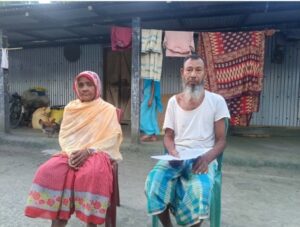

J&K High court orders repatriation of 63-year-old woman deported to Pakistan without due process

In a powerful reaffirmation of constitutional compassion and the primacy of human rights, the High Court of Jammu and Kashmir and Ladakh has directed the Union Ministry of Home Affairs to repatriate Rakshanda Rashid, a 63-year-old woman who was deported to Pakistan following a counter-terrorism drive in the aftermath of the Pahalgam terrorist attack.

The Court, presided over by Justice Rahul Bharti, observed that Rashid’s deportation appeared arbitrary and in violation of her legal status as a Long-Term Visa (LTV) holder who had resided in India for nearly four decades. The matter came before the Court through a writ petition filed by her daughter, Falak Zahoor.

The petitioner’s husband, Sheikh Zahoor Ahmed, informed the Court that Rakshanda had no family or support in Pakistan and was suffering from multiple serious ailments. Her deportation, he submitted, had left her vulnerable, abandoned, and at grave risk.

The Court took serious note of these submissions, underscoring that in matters where human life and dignity are imperilled, the judiciary is obligated to act as a constitutional protector—even in the absence of a full adjudication on the merits.

“Human rights are the most sacrosanct component of a human life and, therefore, there are occasions when a constitutional court is supposed to come up with SOS like indulgence notwithstanding the merits and demerits of a case which can be adjudicated only upon in due course of time and therefore, this Court is coming up with a direction to the Ministry of Home Affairs, Government of India to bring back the petitioner from her deportation.” (Para 3)

Justice Bharti noted that at the time of her deportation, Rashid was a documented LTV holder—a status that ought to have protected her from arbitrary removal. Yet, without any formal deportation order or due process, she was allegedly “forced out” of the country as part of a broader post-carnage operation by government authorities.

This Court is bearing in mind background that the reference that the petitioner was having LTV status at relevant point of time which per-se may not have warranted her deportation but without examining her case in better perspective and coming up with a proper order with respect to her deportation from the authorities concerned, still she came to be forced out.” (Para 4)

Referring to the “exceptional nature of facts and circumstances,” the Court issued extraordinary directions to the Ministry of Home Affairs:

Given the exceptional nature of facts and circumstances of the case whereby the petitioner-Rakshanda Rashid wife of Sheikh Zahoor Ahmed has been purportedly deported to Pakistan in the recent drive undertaken by the Government of India post Pahalgam carnage, this Court is constrained to direct the Secretary, Ministry of Home Affairs, Government of India to retrieve the petitioner back to J&K, India so as to facilitate the reunion of the petitioner with her husband-Sheikh Zahoor Ahmed in Jammu.” (Para 5)

The Ministry has been given ten days from the date of the order (June 6, 2025) to ensure compliance. The matter is now listed for July 1, 2025, when a compliance report is to be submitted before the Court.

The order, marked by urgency and empathy, sets a significant precedent in cases involving the deportation of foreign nationals long-residing in India under legal permits. It highlights the responsibility of the state to uphold due process, especially when fundamental rights and humanitarian considerations intersect.

The complete order may be read below.

[viewpdf 42425]


A judicial pushback amid rising arbitrary deportations

This order comes at a crucial moment. Across the country, particularly in the state of Assam, there has been a surge in the deportation of Bengali-speaking individuals, most of whom are Muslims, many of them declared “foreigners” by opaque and controversial Foreigners Tribunals. Numerous cases have been documented where individuals have been picked up and sent across the Bangladesh border without any written deportation order, legal representation, or family notification.

In several instances, courts and commissions have been bypassed altogether. Women, children, and elderly persons have been subjected to these clandestine removals, often despite having ongoing legal cases, bail orders, or valid documents. The pattern has alarmed civil liberties groups, who describe it as a systemic erosion of constitutional guarantees like due process, dignity, and the right to be heard.

Against this grim national backdrop, the Jammu & Kashmir High Court’s order stands out for upholding the principle that even those classified as “foreigners” or “non-citizens” are entitled to basic constitutional protections. The judgment affirms that deportation—when carried out without transparency, legal backing, or humanitarian consideration—amounts to a violation of both law and conscience.

This order sends a strong message: that constitutional protections do not end at the margins of nationality, and that humanitarian justice must prevail where executive action falters.

Related:

Gauhati HC again grants visitation in Torap Ali petition challenging re-detention of uncle as affidavit opposing claims of regular police reporting is filed

Gauhati HC seeks verification of bail compliance in writ petition filed by Reijya Khatun for detained husband Majibur Rehman

Gauhati HC closes habeas corpus petition after release of bail-compliant detainee, declines prayer for compensation

“State says handed over to BSF, Found Unconscious in Bijni” Gauhati HC demands answers after Samsul Ali returns home unconscious

How the Rajubala case in the Supreme Court, its genesis and context has now become the ground for ‘state expulsion”


M’tra: Three West Bengal residents pushed into Bangladesh by BSF, return after WB state govt.’s intervention

Three West Bengal residents working in Mumbai were allegedly pushed into Bangladesh by the Border Security Force (BSF) earlier this week and on Sunday (June 15, 2025) returned to the country from the state’s Cooch Behar district.

Minajul Sheikh, a resident of Beldanga in Murshidabad district, told The Hindu that his brother Minarul Sheikh was picked up from Mumbai where he was working and subsequently forced into Bangladesh. Apart from Minarul Sheikh, at least two other workers were pushed into Bangladesh. The three workers — Minraul Sheikh and Nizamuddin Sheikh from Murshidabad and Mostafa Kamal Sheikh from Purba Bardhaman — also sent a video message to their relatives where they can be heard pleading before Chief Minister Mamata Banerjee and other public representatives of the State to ensure their return to India.

It was only after the West Bengal government raised the issue, the workers were repatriated to India through the Mekhliganj border in Bangladesh on Sunday afternoon. Trinamool Congress Rajya Sabha member and chairperson of West Bengal Migrant Welfare Board Samirul Islam said when the workers were picked up by the police in Mumbai, all necessary documents were provided by the State government.

“What has happened is very unfortunate and illegal. These are citizens of India and cannot be illegally pushed into Bangladesh in such a manner,” Mr. Islam said.

On X he said,Under the leadership and active intervention of our Chief Minister @MamataOfficial, we were finally able to repatriate seven Indian citizens who were illegally pushed back to Bangladesh by the BSF. The Maharashtra Police first detained them on suspicion of being Bangladeshis and then handed them over to the BSF, which carried out the final act of deporting these poor migrant workers to Bangladesh—only because they spoke Bengali. They were deported to Bangladesh despite they showed all relevant proof of being an Indian. 

I have some questions:

  1. How did the Maharashtra Police hand over these migrant workers to the BSF without informing the West Bengal government?
  2. Why didn’t the BSF contact the local administration to verify their identities before forcibly deporting them to another country?
  3. Is there a larger plan by these BJP-ruled states and the BSF to target and harass Bengali-speaking migrant workers?

We will not let this issue go. We will expose the dark forces behind this misdeed and ensure justice.”

The officer-in-charge of the Mekhliganj Police Station Mani Bhusan Sarkar said that after he received information from police stations in Murshidabad and Bardhaman about the Indian nationals in Bangladesh, he informed authorities of the BSF and Border Guard Bangladesh. “The three men were handed over to us [Mekhliganj police station] after a flag meeting at the border,” the Officer-in-Charge said. According to sources, the three men were pushed into Bangladesh on Friday night somewhere along North Bengal and Bangladesh border.

Since mid-May 2025, in a cloak and dagger operation, without any public disclosure, some administrations in India have been “pushing back” undocumented Bangladeshi migrants detained across the country through the eastern border. The Border Guard Bangladesh (BGB) has expressed concern to India about the “push back” of individuals across the border, particularly undocumented migrants. Interestingly, there is no official word about the “push back” from the BSF. While instances of the “push back” of Bangladeshi nationals has come to the fore in Assam and Tripura, on this occasion, nationals of West Bengal were pushed into Bangladesh.

Meanwhile, Assam has seen the most aggressive of this policy in action. Citizens for Justice and Peace has been at the forefront of documenting and agitating the issue, both with the National Human Rights Commission (NHRC) and the Gauhati High Court. The memorandums to the NHRC may be referred to here. No evidence of due process has been followed by the Assam police in detaining without notice, persons who have every reason to state –with documents—that they are Indian. The last month’s coverage of the crisis may be read here, here and here. 

Related:

Assam: Academics, lawyers, activists condemn ‘push back’ of persons to Bangladesh

Assam: When six ordinary Indian women were forcibly pushed out from India–No Man’s land– Bangladesh & then back

Assam: Slamming Sarma’s actions as discriminatory & unlawful, LOP, Assam Assembly Debabrata Saikia calls for an urgent stop to “pushback” of citizens


Union Govt admits handover of Samsul Ali to BSF, Gauhati High Court grants family visitation rights if not yet deported

In the hearings of the petition filed by Bakkar Ali regarding the recent allegedly secret detention of his father Samsul Ali, the counsel for Union of India today –June 10– told Gauhati High Court the father was formally handed over by Assam Police to the Border Security Force (BSF) Sector Headquarters at Panbari on May 26, 2025. The disclosure came nearly two weeks after Samsul Ali was allegedly picked up from his residence in Chirang district during a late-night operation on May 25, without any arrest memo, warrant, or court production — prompting his family to move the High Court under Article 226 of the Constitution. The last hearing in the matter was yesterday, June 9, and a report on the last hearing may be read here.

In the most recent order passed today by the bench of Justices Kalyan Rai Surana and N. Unni Krishnan Nair, the Court directed that, if Samsul Ali has not yet been deported, the head of the BSF Sector Headquarters shall permit the petitioner and one family member to visit him, and facilitate the execution of a vakalatnama to allow continued legal representation. In the event that deportation has already taken place, the authorities have been instructed to disclose the exact location from which the deportation occurred.

The case — in which legal aid is being provided by Citizens for Justice and Peace (CJP) — is part of a growing number of petitions being filed in the Gauhati High Court, where families allege that Bengali-speaking Muslims previously released on bail after FT declarations are being secretly re-detained and, in some cases, deported without judicial oversight. These cases share a recurring pattern: midnight pickups, non-disclosure of custody, denial of access to legal remedies, and procedural opacity in handovers to BSF or other agencies.

Today’s order builds on yesterday’s hearing in the matter, which took place on June 9, in which the High Court had criticised the State’s failure to provide any documentation about the transfer to BSF. While it has declined, for now, to direct the Union of India to file a formal affidavit, the Court has kept the petition alive — leaving open the door for further relief if deportation is confirmed or if any adverse development occurs. The matter is next listed for June 20, 2025. (Details of the earlier proceeding may be read here.)

Meanwhile, through independent social media sources, CJP has found Samsul Ali in a distraught condition may be in No Man’s land between the two countries. See the memorandums submitted to the National Human Rights Commission (NHRC) on the question here and here.

From Secrecy to Disclosure: The three-stage legal timeline of the case

This case has seen incremental disclosures over successive hearings:

  • May 25, 2025: Samsul Ali, a declared foreigner who had been released on conditional bail since 2020, was picked up from his residence in Goraimari No. 2, Chirang, around 11:30 PM, without a warrant, memo of arrest, or cancellation of bail.
  • June 9, 2025: The State counsel submitted for the first time that Samsul Ali had been “handed over to the BSF,” but failed to provide any documentation, location, or handover memorandum. The Court criticised this procedural opacity and ordered the SP (Border), Chirang to cooperate with the FT counsel and supply all relevant information via WhatsApp. (Details of the said proceeding may be read here.)
  • June 10, 2025: The State confirmed in court that Samsul Ali was handed over to the BSF Sector HQ at Panbari on May 26. On this basis, the Court passed a direction that, if Samsul Ali has not yet been deported, the head of the Sector Headquarters shall permit the petitioner and one family member to visit him and obtain his signature on a vakalatnama. If he has been deported, the authorities must inform the petitioner of the exact location from which the deportation took place.

Petition remains pending, keeps door open for further relief

During today’s hearing, Advocate Mrinmoy Dutta, appearing for the petitioner, requested that the Union of India be directed to file an affidavit detailing whether Samsul Ali has been deported and, if so, on what legal and factual basis. The Court, however, declined to issue such a direction at this stage, noting that a large number of similar cases are now being filed, and that such a step would not be feasible in every matter.

That said, the petition has not been dismissed. The Court clarified that if the petitioner faces any adverse consequence — such as confirmed deportation — the said may be informed to the Court immediately. It also indicated that a report would be called for if deportation has indeed taken place, keeping the petition procedurally alive and legally relevant.

The matter is now listed for further hearing on June 20, 2025.

Background: Bail compliance, FT order, and the alleged procedural bypass

Samsul Ali was declared a foreigner by the Foreigners Tribunal, Chirang in 2016. He spent more than three years in detention before being released in February 2020 under the bail regime outlined by the Supreme Court in SCLSC v. Union of India (2019). Since his release, he had been reporting weekly to the Police Station, with his last appearance logged on May 21, 2025 — just four days before his pickup.

His family maintains that he was detained without documentation, never produced before a magistrate, and that police allegedly refused to accept an FIR, forcing them to send complaints by registered post. When no official information was forthcoming, the family had filed the said habeas corpus petition — which has since led to successive disclosures culminating in today’s order.

The FT order under which he was declared a foreigner is not based on any proof of border crossing or foreign documentation, and does not establish nationality in any other country. The family alleges that Samsul Ali has been rendered stateless, and that deportation without formal diplomatic clearance and nationality verification would be illegal.

Visitation to BSF: A notable legal step

While courts have regularly granted visitation rights to families of detainees held in civil detention centres, today’s order granting visitation rights to a person in BSF custody at a Sector Headquarters is notable. It affirms that even in border security operations, access to family and legal counsel cannot be arbitrarily denied, especially when the legal status of the person’s custody or deportation is under judicial review.

It also sets a precedent for ensuring access and due process even in cases where the handover to BSF is claimed, but documentation is missing or incomplete — a frequent concern raised in recent petitions alleging pushbacks across the Indo-Bangladesh border.

The petition will be taken up again on June 20, by which time it may become clear whether:

  • Samsul Ali remains within the jurisdiction of Indian authorities;
  • He has been deported, and if so, under what procedures;
  • His family has been permitted to meet him and secure his legal signature.

The case remains a significant test of procedural safeguards, executive accountability, and the right to challenge arbitrary detention and removal, particularly in Assam’s fraught citizenship regime.

The order may be read below.

[viewpdf 42185]

Related:

Gauhati High Court directs Assam Government to disclose whereabouts of two men secretly detained by the police in May

CJP Exclusive from Assam: Six Indian women, six torturous nights, and the ordeal of being dubbed “Bangladeshi” by the State

“Disappeared in the night”: CJP’s memorandum to NHRC on Assam’s secretive detentions and illegal pushbacks

CJP Exclusive: Homeland to No Man’s Land! Assam police’s unlawful crackdown on residents still battling for restoration of citizenship rights?


Petitions multiply in Gauhati High Court as “Declared Foreigners” out on bail go missing; 4 out of 5 reported to be in holding centre, 1 “handed over” to BSF

What We Know So Far: June 9, 2025

The Gauhati High Court on Monday, June 9, heard four separate writ petitions invoking Article 226 of the Constitution of India, each seeking urgent relief and accountability in the cases of individuals who were allegedly picked up by Assam Police from their homes in Chirang and Dhubri districts between May 24–25, 2025, without any arrest memo, warrant, or formal production before a magistrate.

All four individuals — Doyjan Bibi, Samsul Ali, Majibur Rehman, and Abdul Sheikh — had previously been declared foreigners by Foreigners Tribunals (FTs), and were later released from detention under bail regimes notified by the State in accordance with Supreme Court directions during the COVID-19 period. All of these individuals are being provided legal aid by Citizens for Justice and Peace. They had all been regularly reporting to police as part of their bail conditions until the date of their sudden and unexplained apprehension. Advocate Mrinmoy Dutta appeared in these matters.

Every week, CJP’s dedicated team in Assam, comprising community volunteers, district volunteer motivators, and lawyers, provides vital paralegal support, counseling, and legal aid to many affected by the citizenship crisis in over 24 districts in Assam.  Through our hands-on approach, 12,00,000 people successfully submitted completed NRC forms (2017-2019). We fight Foreigner Tribunal cases monthly at the district level.  Through these concerted efforts, we have achieved an impressive success rate of 20 cases annually, with individuals successfully obtaining their Indian citizenship. This ground level data ensures informed interventions by CJP in our Constitutional Courts. Your support fuels this crucial work. Stand with us for Equal Rights for All #HelpCJPHelpAssam. Donate NOW!

In the hearings, the High Court addressed key factual developments in each case, including the revival of FT orders, lack of procedural documentation in alleged deportation, and confirmation of detainees’ custody in holding centres. While the Court granted limited relief — such as visitation rights and directions to trace detainees — the legality of the State’s actions and procedural safeguards during or prior to deportation remain under ongoing judicial scrutiny. The matters are being heard since Friday, June 6, 2025.

Meanwhile, through independent social media sources, CJP has found that Doyjan Bibi, a woman from India may be currently lodged in a jail in Bangladesh and Samsul Ali in a similarly distraught condition in No Man’s land between the two countries. See the memorandums submitted to the National Human Rights Commission (NHRC) here and here.

The matters are next listed between June 10 and June 20, 2025.

Case 1: Abdul Rejjak v. Union of India (Re: Doyjan Bibi)

Bench: Justices Kalyan Rai Surana and N. Unni Krishnan Nair

Status: Revival of FT Order due to non-compliance

Next hearing: June 16

The first case involved the petition filed by Abdul Rejjak, husband of Doyjan Bibi, who was picked up from her residence in Gauripur, Dhubri district on the night of May 24, 2025. She had previously been declared a foreigner by FT No. 4, Dhubri in 2017, and was detained for over two years before being released in 2021.

Notably, in 2021, a coordinate bench of the Gauhati High Court had set aside the ex parte FT opinion that declared her a foreigner — subject to the condition that she reappear before the Tribunal to file her written statement and participate in fresh proceedings. According to the State’s submissions, Doyjan Bibi failed to appear before the FT on the reappointed date, leading to the revival of the original FT declaration and cancellation of bail.

The petitioner has argued that the non-appearance was due to a delay in receiving the court’s 2021 order and not due to wilful default. The Court took note of these circumstances and listed the matter for continued hearing on June 16, where it may further assess the legal consequences of non-compliance and whether any further relief is appropriate in light of the revived foreigner opinion.

The order may be viewed below:


Case 2: Bakkar Ali v. Union of India (Re: Samsul Ali)

Bench: Justices Kalyan Rai Surana and N. Unni Krishnan Nair

Status: BSF handover admitted; procedural details missing

Next hearing: June 10

In this petition, Bakkar Ali, a resident of Goraimari No. 2, sought a writ of habeas corpus for his father, Samsul Ali, who had been declared a foreigner in 2016 (FT Case No. BNGN/FT(CHR)2039/08), detained for over three years, and released in February 2020 in accordance with Supreme Court-mandated bail conditions. Since then, he had faithfully reported weekly to Panbari Police Station, with his last appearance recorded on May 21, 2025.

According to the petition, Samsul Ali was picked up by police around 11:30 PM on May 25 without any arrest memo, warrant, or judicial order. Despite efforts by the family to trace his whereabouts, the authorities refused to accept an FIR and provided no information.

During the hearing, the State admitted that Samsul Ali was handed over to the BSF, reportedly pursuant to a Government of India notification. However, no documentation or particulars of the handover — such as the BSF post, time, or any memorandum — were provided.

The Court expressed serious displeasure with the lack of procedural information and stated that the incomplete information was not at all appreciated. In the order, the bench noted that “The Superintendent of Police (Border), Chirang should have provided appropriate particulars.”

The Court directed that the SP (Border) Chirang must communicate with the FT counsel and transmit all relevant details via WhatsApp, including any official memorandum of handover. The matter has been listed for immediate hearing on June 10, with the Court expected to examine whether the deportation complied with legal procedures, including those outlined in the State’s own affidavit before the Supreme Court in Rajubala Das v. Union of India.

The order may be viewed below:


Case 3: Rejiya Khatun v. Union of India (Re: Majibur Rehman)

Bench: Justices Kalyan Rai Surana and N. Unni Krishnan Nair

Status: Detention in Holding Centre confirmed; visitation rights granted

Next hearing: June 20

In the third case, the Court heard a habeas corpus petition filed by Rejiya Khatun, wife of Majibur Rehman (also known as Majibur Sheikh), who had been declared a foreigner by FT Chirang in 2019. After completing two years in detention, he was released on November 15, 2021, under COVID-19 bail guidelines, and had been consistently reporting to Kajolgaon Police Station every week — his last recorded visit being May 21, 2025.

The petition alleged that he was picked up from his home in Salijhora at night on May 25, without any documentation or court order. For over two weeks, no information about his custody was shared with the family. Attempts to file an FIR were refused, and a complaint had to be sent by post.

In Court, the counsel for FT matters confirmed that Majibur Rehman is currently being held at the Kokrajhar Holding Centre. In response, the Court granted visitation rights to the petitioner and a maximum of two others and directed that his signature be obtained on the vakalatnama authorising legal representation. The petitioner’s counsel is to update the Court on the outcome of the visit. The case is listed for further hearing on June 20.

Details of the previous hearing may be read here.

The order may be viewed below:


Case 4: Sanidul Sheikh v. Union of India (Re: Abdul Sheikh)

Bench: Justices Kalyan Rai Surana and N. Unni Krishnan Nair

Status: Detention in Holding Centre confirmed; visitation rights granted

Next hearing: June 20

Similar in fact and structure to the previous matter, this petition was filed by Sanidul Sheikh, son of Abdul Sheikh, who was declared a foreigner ex parte in 2018 (FT Case No. BNGN/FT/CHR/220/07), detained for two years, and released in April 2021 under Supreme Court guidelines.

He had been reporting weekly to Kajolgaon Police Station, and was last seen signing the register on May 21, 2025. The family claims he was picked up by police from their residence in Chatibargaon at 11:30 PM on May 25 without any documentation, and subsequently disappeared. As in other cases, the family’s attempts to file an FIR were rebuffed.

During the hearing, the State submitted that Abdul Sheikh is detained at the Kokrajhar Holding Centre. The Court granted visitation rights, allowed up to two family members to accompany the petitioner, and instructed that his signature on a vakalatnama be collected. The matter is also listed for June 20, alongside the Majibur Rehman matter.

Details of the previous hearing may be read here.

The order may be viewed below:


Other such similar cases

While four of the habeas corpus petitions currently before the Gauhati High Court are being pursued with legal aid support from Citizens for Justice and Peace, they are by no means the only such instances. The case of Mozida Begum, who approached the Court independently regarding the sudden detention of her son Hachinur @ Hasinur, reflects that similar patterns of late-night police pick-ups, denial of access to legal process, and prolonged non-disclosure of whereabouts are affecting others beyond the immediate CJP-supported cases. Her case — involving a person released on bail and complying with reporting obligations — reinforces that these are not isolated incidents, but rather part of a larger trend impacting multiple families across Assam, raising shared concerns about procedural fairness, transparency, and the potential misuse of FT declarations to bypass due process protections.

Case: Mozida Begum v. Union of India (Re: Hachinur @ Hasinur)

Bench: Justices Kalyan Rai Surana and Malasri Nandi

Status: Court issues interim stay on deportation of detainee; confirms he is held at Kokrajhar Holding Centre

Next hearing: June 11

On June 6, 2025, the Gauhati High Court heard the petition filed by Mozida Begum, mother of Hachinur @ Hasinur, a resident of Milan Nagar, Baladmari, Goalpara district. The petitioner moved the High Court after her son — a declared “foreigner” previously released on conditional bail — was suddenly picked up by the Border Police of Goalpara on May 25, 2025, despite regular compliance with bail conditions, including weekly reporting to the local police station.

The petitioner, represented by Advocate A.R. Sikdar, submitted that her son had been faithfully reporting to Goalpara Police Station, with his last three appearances logged on May 5, May 12, and May 19, 2025. These were duly acknowledged by the Officer-in-Charge, and an extract of the attendance register was annexed to the writ petition.

According to the petition, Hachinur was taken into custody on May 25 by personnel from the Border Police wing of Goalpara without prior notice, arrest memo, warrant, or any cancellation of his bail order. He was initially taken to the Goalpara Police Reserve, then transferred to the Transit Camp in Matia, where family members were told he was no longer in custody. Multiple inquiries by the family failed to elicit any information about his present location.

During the hearing on June 6, the counsel for the Foreigners Tribunal submitted that Hachinur is currently lodged at the Kokrajhar Holding Centre, located at the 7th Assam Police Battalion complex in Charaikhola. This was the first official confirmation of his whereabouts, nearly two weeks after he had been picked up.

Given the serious apprehensions of unlawful deportation expressed in the petition — especially in light of recent alleged “pushback” cases across the Indo-Bangladesh border — the Court issued the following interim directions:

No deportation of Hachinur shall be carried out without express orders of the Court;

The Deputy Commissioner of Police (Border), Kamrup (Metro) shall be informed of this order via email or WhatsApp by the FT standing counsel;

A copy of the order must also be forwarded to the Kokrajhar Holding Centre, and proof of such communication shall be placed before the Court on the next date;

The matter is next listed for June 11, 2025, when the State is expected to file its response, and the Court will consider further directions, including on the issue of bail.

The case has highlighted not only procedural irregularities in the manner of detention but also a lack of transparency in the custodial transfer of declared foreigners, even when they are under judicially approved bail protection.

The complete order may be read below.

Conclusion: A worrying pattern of secret detentions, procedural evasion, and statelessness risks in Assam

The five above-mentioned habeas corpus cases brought before the Gauhati High Court between June 4 and June 9, 2025, taken together, reveal more than isolated procedural lapses — they reflect a systemic pattern of disregard for constitutional safeguards, legal process, and transparency in Assam’s handling of individuals declared as “foreigners” under the Foreigners Act.

In each of these cases — whether it was Abdul Sheikh, Majibur Rehman, Doyjan Bibi, Samsul Ali, or Hachinur @ Hasinur — the individuals were:

Declared foreigners years ago by Foreigner Tribunals, often on ex parte or minimally reasoned orders;

Released from long-term detention under Supreme Court-mandated bail conditions during the COVID-19 period;

Complying regularly with all reporting obligations, including weekly appearances at police stations;

Then suddenly picked up between May 24–25, 2025, without arrest memos, warrants, or production before a magistrate;

With no information provided to families for days or weeks, forcing them to approach the High Court for basic disclosure;

And in at least one case (Samsul Ali), possibly deported without any official record of nationality verification or BSF handover protocol.

The Court, to its credit, has taken some necessary remedial steps: ordering disclosure of detainees’ locations, granting visitation rights, requiring vakalatnamas, staying deportation in one case, and demanding that missing procedural records (such as BSF handover documents) be produced. But the underlying pattern remains deeply concerning.

These are not instances of absconding or violation of bail — in fact, all five individuals were in regular contact with police authorities up to the week of their detention. Their sudden re-arrest — without formal notice, and in some cases without revocation of their bail — suggests a shadow system of policing that bypasses the courts, leaves families uninformed, and raises serious questions about executive overreach in matters of citizenship and detention.

What’s more, most of these Foreigners Tribunal opinions failed to establish even a prima facie case of alternative nationality. In several cases, the individuals were never shown to have crossed a border or held documents of any other country. Yet, the assumption of “foreignness” — once declared — now operates with a finality and force that can lead to detention, disappearance, and possible expulsion — even years later, and even after bail has been granted.

These cases expose a deeply troubling legal vacuum:

  • The Foreigners Tribunals continue to deliver life-altering orders without establishing key facts — such as where the individual is allegedly from.
  • Police and border authorities act without judicial oversight — detaining individuals with no fresh order, often in complete secrecy.
  • Families are denied access, both physically and legally, until they invoke the extraordinary jurisdiction of the High Court.
  • And in the background looms the risk of statelessness — where a person is stripped of recognition in India, but not acknowledged as a citizen by any other country.

In a constitutional democracy, the deprivation of liberty must be backed by law, transparency, and due process. The five cases heard this week suggest those principles are being routinely bypassed in Assam’s implementation of the Foreigners Act.

As the matters come up again between June 10 and June 20, the Court has an opportunity not only to remedy individual violations, but to ask the larger question: Can a person be deprived of their freedom — and potentially their country — without judicial scrutiny, without nationality verification, and without a legal process the public can see and challenge?

So far, the answer has been far from clear.

Related:

Gauhati High Court directs Assam Government to disclose whereabouts of two men secretly detained by the police in May

CJP Exclusive from Assam: Six Indian women, six torturous nights, and the ordeal of being dubbed “Bangladeshi” by the State

“Disappeared in the night”: CJP’s memorandum to NHRC on Assam’s secretive detentions and illegal pushbacks

CJP Exclusive: Homeland to No Man’s Land! Assam police’s unlawful crackdown on residents still battling for restoration of citizenship rights?


Does India have a lawfully established procedure on ‘deportation’, or are actions governed by Executive secrecy and overreach?

On Monday, June 2, the Supreme Court refused to entertain a plea challenging the Assam Government’s move to indiscriminately detain and deport persons, without due process since May 23, 2025. Not all those thus being “picked” up and pushed out are even Bangladeshis who have entered the country illegally, many being legitimate Assamese citizens with documentation, even though many have been at the receiving end of adverse, non-reasoned orders from the state’s notorious Foreigner’s Tribunals (FTs). The petition was filed by the All BTC Minority Students Union (ABMSU); they were asked to approach the High Court for their relief.

These events, including the rather brazen assertion by Assam Chief Minister Himanta Biswa Sarma of a “push-back” policy for undocumented immigrants from Bangladesh and Myanmar (including Rohingyas), have brought the issue of deportation and refugee rights into sharp focus. A report by the Indian Express stated that approximately 2,000 individuals have been forcibly returned under “Operation Sindhoor.” People from states like GujaratRajasthan and Maharashtra have been reportedly detained and taken to Bangladesh border.

A top officer of the Bangladesh Army has termed the forcible expulsion or so called “push-back” policy unacceptable. A woman—Shona Bhanu— was pushed into Bangladesh at gun point. She has lived in Assam all her life.

As in all matters related to citizenship, Assam and its people, especially the marginalised, have faced the brunt. Citizens for Justice and Peace (cjp.org,in)  with its vibrant on ground team in the state, has been closely involved in not just monitoring and documenting this humanitarian tragedy but also intervened with para legal aid, counselling and actual legal interventions. See here and here. Comprehensive memorandums to the National Human Rights Commission (NHRC) may be read here and here.

Much of the recent action (s) of the authorities, in states ruled, interestingly by the far right Bharatiya Janata Party (BJP), have been experienced as executive overreach, with no public disclosures on procedures and documents to legally and constitutionally justify the process. Sudden demolitions of entire bastis, the forcible detention of families, backed by over-hyped and exaggerated statements on purging the country of illegal immigrants have even put the judiciary on the defensive. That these actions have been launched in a coordinated manner after the Pahalgam terror attack (April 22) and the military face-off between India-Pakistan (May 7-10, 2025), squarely plays into public sentiment that remains silent or “allows” such unlawful actions.

Given that India remains a constitutional republic, bound to a process of law, procedure and even international obligations, it is crucial to ask, what is the law and procedure, on ‘deportation’ and how important it is that this be rendered in the public consciousness and meticulously followed?

In this extensive legal resource (in two parts) CJP’s legal team examines this sticklish question.

A common, yet simplistic, view is that individuals who are not Indian citizens and have entered India illegally should be sent back. This perspective often overlooks the complex legal and humanitarian dimensions involved. This document aims to provide a comprehensive analysis of the legal framework governing deportation in India. It will explore:

  1. The rights of refugees and illegal migrants under the Indian Constitution.
  2. How various court judgments have upheld these fundamental rights, including the right to due process, thereby shaping the law of the land?

This analysis will primarily focus on the legal aspects, with a subsequent part that deals with the broader societal and humanitarian considerations for treating refugees with not just greater compassion but adherence to constitutional jurisprudence and international obligations.

  1. Legal Regime—Immigration and deportation in India

The management of immigration and the deportation of foreign nationals is a complex and often contentious domain within Indian law and policy. The “push-back” strategy, characterised by the forcible return of individuals without adherence to established legal procedures, starkly contrasts with the human rights guarantees enshrined in the Indian Constitution and affirmed by its judiciary. The recent enactment of The Immigration and Foreigners Act, 2025 (hereinafter “the 2025 Act”), which consolidates and replaces previous legislation, further shapes this landscape, necessitating a thorough examination of its provisions and implications.

2.1.          The legislative framework (Foreigners Act, 1946—Pre-2025 Act)

Prior to the 2025 Act, the deportation process in India was primarily governed by the Foreigners Act, 1946, and the Foreigners (Tribunals) Order, 1964.

  • Definition of a “Foreigner”: Section 2(a) of the Foreigners Act, 1946, defined a “foreigner” as a person who is not a citizen of India.
  • Foreigners Tribunals: Established under the 1964 Order, these tribunals were empowered to determine if an individual was a foreigner.
  • Expulsion: Once declared a foreigner, an individual was liable for expulsion from Indian territory under Section 3(2)(c) of the Foreigners Act, 1946.
  • Saving Provision: The Foreigners Act, 1946 was repealed by the 2025 Act, but a saving provision ensured that rules made under the 1946 Act continue to be valid.

2.2.          Role of the Citizenship Act, 1955, and Special Provisions (Assam-Specific)

The Citizenship Act, 1955, contains crucial provisions, particularly relevant in the context of Assam:

  • Section 6A (Assam Accord): This section provides special provisions for persons of Indian origin who entered Assam between January 1, 1966, and March 25, 1971. If declared foreigners, they may still be permitted to register for citizenship after a 10-year waiting period from the date of detection. During this period, they cannot vote but enjoy other citizenship rights. Entrants post-March 25, 1971, if found to be foreigners, are liable for expulsion.
  • Section 9 (Burden of Proof): This section places the burden of proving Indian citizenship on the individual when questioned by authorities, rather than the state having to prove they are not a citizen.
  • Referral to Tribunals (Assam): For individuals in Assam or those covered under special notifications, cases with inadequate documentation or unclear citizenship are referred to Foreigners Tribunals. This is mandated by the Citizenship (Registration of Citizens and Issue of National Identity Cards) Rules, 2003, and Paragraph 2 of the Foreigners (Tribunals) Order, 1964.

2.3.       The Passports Act, 1967

The Passports Act, 1967, while not directly providing for deportation, plays a significant role in the identification and apprehension of individuals liable for deportation:

  • Powers of Passport Authorities (Sections 6 & 10): Authorities can refuse, impound, or revoke passports if the applicant is not an Indian citizen, or if issuance is contrary to public interest, national security, or foreign relations.
  • Penalties (Section 12): Prescribes penalties for obtaining or using passports through false information or by foreigners masquerading as Indian citizens.
  • Arrest Powers (Sections 13 & 14): Law enforcement can arrest individuals with fraudulent passports or without valid documentation, often a preliminary step towards deportation.
  • Complementary Legislation: The Passports Act, 1967, operates alongside the Foreigners Act, 1946 (now repealed), and the Registration of Foreigners Act, 1939(also repealed by the 2025 Act).

Foreigners staying illegally in India risk violating provisions of both the (now-repealed) Foreigners Act, 1946, and the Passports Act, 1967, potentially leading to imprisonment of up to 5 years. The question of what happens after such a foreigner is released from jail often involves arbitrary administrative discretion.

2.4.         Procedure for deportation

Deportation in India, though grounded in statutory powers, was largely operationalised through internal administrative mechanisms and Standard Operating Procedures (SOPs) by state authorities (See herehere and here) following directions from the Centre.

Typical deportation process:

  • Identification/Completion of Sentence: A foreign national is declared a foreigner or completes a prison term for violating applicable laws.
  • Notification: Jail authorities notify relevant police officials (e.g., Superintendent of Police) about the impending release.
  • Custody and Order:
    • If the government decides on deportation, a formal order is issued.
    • Upon release, the individual is taken into police custody and served with the deportation order.
  • Physical Removal: Arrangements are made for their removal from the country, often under police escort. The serving officer reports the execution of the order back to the government.
  • Consular notification (Vienna Convention):
    • As per Article 36 of the Vienna Convention on Consular Relations, Indian authorities must inform the consular representatives of the foreign national’s country about their arrest or detention.
    • Indian practice (MEA Office Memorandum No. T.4415/1/91 (CPO/CIR/9)) requires:
      • Asking the arrested foreign national if they wish their consulate to be informed.
      • Immediately notifying the Ministry of External Affairs (MEA) and the Ministry of Home Affairs (MHA).
      • Providing detailed particulars (name, nationality, passport details, offence, arrest details, location) to Joint Secretaries at MEA and MHA, and state authorities.
      • Deportation for minor violations: In cases of brief overstays or delayed registration, prosecution might be withdrawn with court approval, and the individual directly deported under delegated powers of Section 3(2)(c) of the (now-repealed) Foreigners Act. A record is submitted to the MEA.

2.5.          The Immigration and Foreigners Act, 2025: A New Consolidated Regime

The Immigration and Foreigners Act, 2025, received Presidential assent. It aims to consolidate and modernise India’s immigration laws by repealing four key statutes:

  1. The Passport (Entry into India) Act, 1920
  2. The Registration of Foreigners Act, 1939
  3. The Foreigners Act, 1946
  4. The Immigration (Carriers’ Liability) Act, 2000

2.5.1.     Key Provisions of the 2025 Act

  • Definition of “Foreigner” (Section 2(f)): A person who is not a citizen of India (consistent with the 1946 Act).
  • Entry, Exit, and Registration:
    • Section 3: Mandates valid passports/travel documents for all entering/exiting India. Foreigners additionally require a valid visa, unless exempted.
    • Section 6: Requires foreigners to register with a designated Registration Officer upon arrival, subject to prescribed conditions.
    • Section 5: Provides for notification of designated immigration posts and establishes a Bureau of Immigration.
  • Powers of Immigration Authorities:
    • Section 3: Immigration Officers can examine travel documents/visas and deny entry on grounds specified by the Central Government (national security, sovereignty, public order, public health, foreign relations).
    • Section 26: Police officers (not below Head Constable rank) can arrest without a warrant individuals suspected of contravening entry requirements or other Act provisions.
  • Powers of the Central Government:
    • Section 7: Empowers the Central Government to issue orders/instructions to prohibit, regulate, or restrict entry, departure, or continued presence of any foreigner or class of foreigners. This can include directives on residence, movement restrictions, proof of identity, and reporting presence.
  • Tracking and Monitoring:
    • Sections 10, 12, and 17: Impose reporting obligations on carriers, accommodation providers (hotels, etc.), educational institutions, and medical institutions treating foreign patients to furnish prescribed information to registration authorities.
  • Penalties:
    • Section 18: Carriers liable for fines up to ₹50,000 for contravening Section 17. If a carrier brings an illegal foreigner, the fine can be ₹2-5 lakhs.
    • Section 21: Entering India without a valid passport/visa can attract imprisonment up to five years and a fine up to ₹500,000.
    • Section 22: Using forged documents can lead to imprisonment for two to seven years and fines from ₹100,000 to ₹1,000,000.
    • Section 23: Overstaying, violating visa conditions, or trespassing in restricted areas can result in imprisonment up to three years and a fine up to ₹300,000.
  • Mechanisms for Identification, Detention, and Deportation:
    • Section 29: Authorizes the Central Government to order the removal of any foreigner from India if they have contravened the Act/orders or if there is an “adverse security report” against them. “Adverse security report” is not defined in the Act.
    • Government officers are granted reasonable powers to enforce removal.
    • Foreigners may be required to bear the cost of their removal and maintenance pending removal.
    • The Act does not detail pre-deportation detention facilities or conditions, suggesting these could be in rules framed under the Act meaning that they are left to executive discretion.
    • The term “illegal immigrant” is not explicitly defined, though actions constituting illegal entry/stay are penalised.

(Note: “illegal migrant” is defined in Section 2(1)(b) of The Citizenship Act, 1955 as a person entering the Country without valid documents or overstaying permitted time in country despite having entered with valid documents).

2.5.2.     Concerns Regarding the 2025 Act

While presented as a modernising step, the 2025 Act appears to consolidate and potentially amplify executive dominance:

  • Vague grounds for removal (Section 29): The term “adverse security report” is undefined, allowing for potentially unfettered discretion without a clear, independent review mechanism within the Act.
  • Absence of adequate appellate mechanism: No statutory appellate mechanism within the Act to challenge deportation orders, forcing individuals to approach constitutional courts.
  • Silence on refugees/asylum seekers: The Act lacks explicit classifications or special provisions for refugees and asylum seekers.
  • Expansive power of removal and use of force:
    • Section 29: Grants broad power for removal.
    • Section 27 (Use of Force):
  • Subsection (1): Allows any authority to take steps and use force “as may, in its opinion, be reasonably necessary” for compliance or effective exercise of power.
  • Subsection (2): Extends similar powers to police (Head Constable and above) to use force “as may, in his opinion, be reasonably necessary.” The subjective nature of “reasonably necessary” provides wide latitude.
  • Subsection (3): Grants a “right of access to any land or other property whatsoever,” potentially facilitating removals.
  • These provisions could legitimize forcible “push-back” operations with limited procedural review.
  • Delegation and immunity:
    • Section 28 (Delegation of Powers): Allows the Central Government to delegate its powers widely (to subordinate officers/authorities, State Governments, or their subordinates). This could lead to decentralized and less scrutinized implementation of removal directives, including “push-backs.”
    • Section 32 (Protection of action taken in good faith): Protects individuals from legal proceedings for actions “done, or intended to be done in good faith” under the Act. In the context of vague terms and broad force powers, this may shield authorities in “push-back” operations.
  • Rule-making power and continuity of previous regime:
    • Section 30 (Power to make rules): Grants extensive rule-making power to the Central Government. Significant aspects of the deportation process (detention, removal specifics, and safeguards) will be determined by executive rule-making rather than direct legislative scrutiny.

Overall Concern: The 2025 Act solidifies executive dominance. Vague removal grounds, sanctioned use of force based on officer opinion, wide delegation, and protective clauses create a framework where policies like “push-back” can be implemented with a veneer of legality. The Act’s silence on specific protections for refugees means these broad powers can apply to vulnerable individuals without distinction, potentially lacking robust procedural safeguards and independent oversight.

2.6.          The “Push-Back” Policy: Assam’s approach to undocumented citizens/immigration

Against this new legal backdrop, the Assam Chief Minister has publicly announced the state’s adoption of a “push-back” policy for undocumented immigrants, primarily targeting individuals from Bangladesh and Myanmar (including Rohingyas). This policy is framed as an expedient alternative to established legal deportation procedures, citing national security.

  • Verify credentials of suspected illegal immigrants within a 30-day deadline, failing which deportation is to proceed.
  • Establish special district-level task forces for detection, identification, and deportation.
  • Risks of MHA’s 30-Day Deadline: High risk of wrongful deportations, as nationality verification is often complex and cannot realistically be completed in such a short timeframe, especially for vulnerable individuals. This could lead to violations of the principle of non-refoulement if asylum seekers are erroneously deported.
  • Legal Ambiguity: The “push-back” policy operates in a legally ambiguous, if not outright unlawful, space. It flouts the procedural protections required by the Constitution and affirmed by the Courts. What are these protections?

3.       The Judicial Bulwark – Constitutional Rights and Deportation Jurisprudence

While legislation grants the state powers to regulate foreigners, the Indian judiciary has consistently intervened to ensure these powers are exercised in conformity with constitutional principles.

3.1.          Constitutional Protections for Non-Citizens

The Constitution of India extends certain fundamental rights to all persons within its territory, not just citizens.

  • Article 21 (Protection of Life and Personal Liberty): “No person shall be deprived of his life or personal liberty except according to procedure established by law.”
    • The Supreme Court in Maneka Gandhi v. Union of India established that “life” means the right to live with human dignity, and “personal liberty” has been broadly interpreted.
    • Critically, the “procedure established by law” must be just, fair, and reasonable. This is fundamental to any deportation process.
  • Article 14 (Equality before the Law): “The State shall not deny to any person equality before the law or the equal protection of the laws within the territory of India.”
    • This acts as a bulwark against arbitrary state action. Any differential treatment for deportation must be based on an intelligible differentia with a rational nexus to the objective.

Policies like “push-backs,” which bypass due process, are prima facie incompatible with Article 21. If such policies disproportionately target specific ethnic or national groups without a non-discriminatory legal basis, they could also be challenged under Article 14.

3.2.          Judgements on Deportation and Rights of Foreigners

A nuanced judicial landscape has emerged regarding the treatment of foreign nationals.

3.2.1.     Right to Life and Liberty (Article 21)

The Supreme Court in Louis De Raedt & Ors vs Union Of India And Ors, 1991 (3) SCC 554 firmly stated that a foreigner’s fundamental right is confined to Article 21 for life and liberty. It “does not include the right to reside and settle in this country, as mentioned in Article 19(1) (e), which is applicable only to the citizens of this country.”

3.2.2.     State’s Power to Expel

The Supreme Court, in Louis De Raedt, referencing an earlier Constitution Bench decision, held that “the power of the Government in India to expel foreigners is absolute and unlimited and there is no provision in the Constitution fettering this discretion.” This power is typically exercised under the Foreigners Act, 1946 (now the 2025 Act).

3.2.3.     Principle of Non-Refoulement

This international law principle prohibits a state from returning a refugee to a country where their life or freedom would be threatened.

Although India is not a signatory to the 1951 Refugee Convention, courts have drawn inspiration from international instruments like the Universal Declaration of Human Rights (UDHR) and the International Covenant on Civil and Political Rights (ICCPR) (to which India is a party) to interpret domestic fundamental rights.

In Ktaer Abbas Habib Al Qutaifi And Anr. vs Union Of India  (Gujarat High Court),  (1998) SCC OnLine Guj 304, concerning Iraqi refugees, the Court declared that the principle of non-refoulement “is encompassed in Article 21 of the Constitution, so long as the presence of refugee is not prejudicial to the law and order and security of India.” It noted India’s UN membership and Article 51(c) of the Constitution (fostering respect for international law). The Court directed authorities to release the detained foreigners and decide on their handover to the UNHCR rather than deporting them to Iraq.

In Nandita Haksar v State of Manipur (Manipur High Court), (2021) SCC OnLine Mani 176,
dealing with Myanmarese asylum seekers, the Court held that Article 21 “would indubitably encompass the right of non-refoulement, albeit subject to the condition that the presence of such asylum seeker or refugee is not prejudicial or adverse to the security of this country.” It distinguished ‘migrants’ from ‘asylum seekers’ who fled imminent threats and directed facilitation of their travel to the UNHCR in New Delhi.

In a recent case being heard by the Bombay High Court, a vacation bench of justices Neela Gokhale and Firdosh P Pooniwalla ordered the Mumbai police to release immediate an 18-year old daughter of a Bangladeshi national from detention. Her father, reportedly a Bangladeshi national was initially detained by the Mankhurd police in Mumbai ‘for an inquiry regarding his citizenship and was later deported to the neighbouring country.The court was hearing a petition filed by the 18-year-old girl and her two younger siblings aged 16 and 8 years, who contended that they were born in India and had all requisite documents to prove their Indian citizenship. According to their petition, their father, Dadamiya Khan, had been residing in India for over 37 years. He had married an Indian woman named Mariyam Khan and was working as a cab driver. While all three children were detained by Mankhurd police following a special drive to identify foreign nationals staying illegally in India, the two younger siblings were handed over to their mother after they filed the Habeas Corpus petition.

3.2.4.     Supreme Court on Rohingya Deportation

In Mohammad Salimullah vs Union Of India, (2021) 19 SCC 191, the Supreme Court, while acknowledging Articles 14 and 21 are available to non-citizens, denied interim relief against deportation for Rohingya refugees. It cited “threat to internal security of the country” and “agents and touts providing a safe passage into India for illegal immigrants.” However, even in this context, the Court stipulated that deportation must follow the “procedure prescribed for such deportation.”

3.2.5.     Natural Justice and Right to be Heard

Louis De Raedt: The Supreme Court noted that while there’s no hard and fast rule, an opportunity to present one’s case is relevant.

In State Of Arunachal Pradesh vs Khudiram Chakma, 1994 (1) SCC (SUPP) 615, involving the proposed shifting of Chakmas, multiple notices and representations over time were deemed sufficient opportunity for a hearing. Interestingly, despite upholding state power, the Court allowed the Chief Minister to afford a post-decisional hearing on humanitarian grounds.

3.2.6.     State’s Duty to Protect

In National Human Rights Commission vs State Of Arunachal Pradesh & Anr, (1996) 1 SCC 742, the Supreme Court directed the state government to protect the life and liberty of Chakma refugees facing threats and ‘quit notices’ from organised groups. This affirmed the state’s constitutional and statutory obligation to safeguard all human beings, citizens or otherwise.

3.2.7.     Judicial Essence

While the Indian judiciary acknowledges the executive’s broad power to regulate foreigners and deport illegal entrants, it has consistently emphasized that any such deportation must follow the prescribed procedure, aligning with the principles of natural justice and constitutional safeguards under Article 21.

4.       Conclusion

In the case of Maja Daruwala v. State of West Bengal, the Supreme Court passed an order on January 30, 2025, and posed some questions to respondents (Centre and West Bengal) regarding what their stance was on deportation of illegal migrants. The Court expressed a confusion and said as follows:

“The pivotal issue that falls for our consideration is that if an illegal immigrant from Bangladesh after being apprehended and proceeded under Section 14A(b) of the Foreigners Act, 1946 is convicted and sentenced to undergo a particular term of imprisonment then after he completes his term of sentence should be immediately repatriated/deported to his own country or should he be kept for an indefinite period in the Correctional Homes in India.

The only confusion in our mind is that once an illegal immigrant is put to trial and is held guilty then what is the requirement for further verification of his nationality at the end of the Ministry of External Affairs.”

On May 16, 2025, the two-judge bench of the Supreme Court comprising of Justices J.B. Pardiwala and R. Mahadevan transferred the issues in this case to be heard along with another case— Jaffar Ullah & Ors. v. Union of India & Ors—dealt by a larger bench.

The latest order—in Jaffar Ullah— was the Supreme Court refusing to interfere in deportation until it finally hears the case which it is set to hear on July 31, 2025. This was done after the Union drew the Court’s attention to the Mohammad Salimullah order which mandated that government follow the procedure before deportation.

One clear conclusion from the above happening is that a specific well thought out law on deportation does not exist. All we have are some memorandums and executive decided processes. The Supreme Court’s expression of confusion is a testament to that.

This means that the current policy being followed, involving pushback, does not take into account things like lack of documentation etc. especially in poor Bengali speaking communities. And in the absence of a set law, the pushbacks reported are happening in a legally dubious manner putting vulnerable people including those that fled persecution at risk.

In essence, while the legislative framework, particularly the new 2025 Act, appears to strengthen the executive’s hand in managing immigration and effecting deportations, this power is not unfettered. It is limited by constitutional safeguards and a body of judicial precedent that insists on procedural fairness, non-arbitrariness, and respect for human dignity. The ongoing challenge lies in ensuring that administrative practices and the implementation of laws like The Immigration and Foreigners Act, 2025, rigorously adhere to these judicially reinforced standards.

Whether the Supreme Court will herald a new era in human rights law by mandating better procedures for deportation or not is a question that will be answered after July 31. The second part of this explainer will explore the broader humanitarian and societal arguments for why refugees should be treated with greater compassion and why upholding such principles is vital for India as a civilization.

(The author is part of the legal research team of the organisation)

Related:

From Detention to Deportation: The mass deportations and detention crisis at Assam’s Matia centre

Restoring Citizenship, Rebuilding Lives: CJP continues its journey in Assam

Declared Foreigner, buried Indian: The tragic death of Abdul Matleb in Assam’s detention camp

A jumla or a concrete step? Assam CM’s announcement on Koch Rajbongshi cases raises more questions than answers

SC: Only 10 deported, 33 of 63 contest foreigner status from the Matia Transit Camp, Assam


Bombay High Court stays SC/ST/OBC reservations in minority-run junior colleges for FYJC admissions

In a significant interim order, the Bombay High Court has, on June 12, stayed the application of Scheduled Castes (SC), Scheduled Tribes (ST), and Other Backward Classes (OBC) reservations in First Year Junior College (FYJC) admissions at minority-run junior colleges across Maharashtra. The bench held that such reservations cannot be imposed on minority institutions, even for unfilled seats under the minority quota.

The Division Bench of Justices M.S. Karnik and N.R. Borkar passed the stay order in a batch of petitions filed by several minority educational institutions, including prominent South Mumbai colleges like St. Xavier’s, Jai Hind, KC, and HR College, as well as institutions from Solapur. The Maharashtra Association of Minority Educational Institutions (MAMEI) also joined the petitioners in challenging the State’s move. The petitions contested a clause introduced through a Government Resolution (GR) dated May 6, 2025, issued by the School Education Department.

Clause 11 of the May 6 GR lies at the heart of the controversy. It permits unfilled seats under the minority quota to be surrendered for allotment through the centralised admission process, making them subject to applicable social and parallel reservations. The State government contended that this mechanism was devised to ensure optimal utilisation of seats and claimed it was introduced in response to requests made by the institutions themselves.

Historically, minority colleges in Maharashtra have followed a well-established formula: 50% of seats reserved for the respective minority community, 5% for the management quota, and the remaining 45% kept open and unreserved. However, for the academic year 2025–26, the centralized FYJC admission portal began reflecting the application of SC/ST/OBC reservations on this 45% open category, prompting the current legal challenge.

Arguments for the petitioner: Senior Advocate Milind Sathe, appearing for the petitioners, argued that the GR violates constitutional protections granted to minority institutions under Articles 15(5) and 30 of the Constitution. Article 15(5) specifically carves out an exception for minority educational institutions from the scope of affirmative action policies, including caste-based reservations, while Article 30 protects their right to establish and administer institutions without State interference. Sathe emphasised that even unfilled minority quota seats must revert to open category admissions, and not be diverted to socially reserved categories.

Arguments for the defence: The Government Pleader Neha Bhide submitted that the clause did not infringe on the autonomy or rights of minority institutions. She argued that once minority seats were voluntarily surrendered to the centralized pool, applying social reservations to those seats was a legitimate policy tool aimed at promoting social equity. "Social reservation is the obligation of the State," she contended.

Order of the court: the Court found substance in the petitioners' arguments and held that an earlier judgment of the Bombay High Court—which had quashed a similar attempt by Mumbai University to enforce social reservations in minority institutions—was directly applicable in this case. The Bench observed, as per the report in BarandBench “Prima facie, we find that there is substance in the submissions advanced by the petitioners for the grant of interim relief.”

Consequently, the Court directed that, for the purpose of FYJC admissions, the mandate of SC/ST/OBC reservation shall not be enforced in any seats of minority educational institutions. The State government has been directed to file its reply within four weeks. The matter is slated for the next hearing on August 6, 2025.


Related:

Bowing to outrage, Delhi University V-C says that Manusmriti removed from curriculum, won’t teach in future

Bombay High Court orders immediate release of 18-year-old detained for father’s citizenship status

Mumbai Walks for Peace | Citizens Unite Against Hate


Assam: Academics, lawyers, activists condemn ‘push back’ of persons to Bangladesh

New Delhi: In an open letter sharply condemning the detention and alleged expulsion to Bangladesh of a number of people declared foreigners by tribunals in Assam as a violation of their rights, a group of activists, lawyers and academics has urged the government to stop such expulsions and allow the return of those sent across the border. Dozens of those expelled to Bangladesh reportedly have appeals against their declaration as foreigners pending in the Supreme Court, the letter noted.

“Pushbacks,” said the letter using the term being used by the government for these expulsions, “fall on the wrong side of constitutionality” and violate the rights to life and equality of those expelled.

“Pushbacks also risk putting the people into grave peril by putting them in the line of fire of Bangladeshi border guards or at risk of being detained by Bangladeshi authorities for illegal border crossing,” thereby placing them in “double jeopardy”, the letter said.

Following their late night detentions without due process, these persons were allegedly forced into the ‘no man’s land’ between Indian and Bangladeshi posts along the border. There are reports of some of them experiencing violence in Bangladesh as well as having been transported back to Assam since.

Some have alleged that in many cases, due process – part of which would involve Indian officials cooperating with their Bangladeshi counterparts in expelling people – was not followed.

Assam chief minister Himanta Biswa Sarma has confirmed that the state is ‘pushing’ people into Bangladesh. He also claimed that “we are not troubling” those persons who have appealed their declaration as foreigners in court.

Bangladeshi officials have meanwhile expressed their unhappiness to the local press.

The open letter also said that the regime of the quasi-judicial foreigners’ tribunals of Assam that have declared these people not to be genuine citizens of India “itself rejects all logic of documentation, evidence and due process” and functions as a “Damocles sword” that jeopardises the security of many Indians.

The communication also called on the state to end pushbacks and allow those expelled to Bangladesh to return to India; to end the detention of declared foreigners in Assam’s Matia detention centre; and to provide free legal aid and compensation to the families of those ‘pushed’ into Bangladesh.

The state must stop detaining those declared foreigners who are out on bail and adhering to their conditions of release “until and unless [the] nationality and addresses of the said individual is verified by Bangladesh”, it added.

The entire statement is appended below.

Public Statement condemning the pushback of Indian citizens by the state in Assam

As concerned citizens, activists, lawyers, academics, and human beings, we strongly condemn the recent pushback by the Indian government of Indian citizens from Assam to Bangladesh. On May 27, 2025, the collective conscience of the nation was shaken as fourteen Indian citizens were deported by the Border Security Force to Bangladesh, against all known human rights norms and constitutional protections guaranteed to all the citizens of this country. Shamefully, this group of 14 includes Khairul Islam, a middle-aged government school teacher who has done nothing but dedicate his life to the service of the nation and its children. As per reports Khairul Islam’s case challenging his status as a declared foreigner is pending in the Supreme Court. In another case Manikjan Begum and her 8-month-old child were deported. In some cases, as in the case of Monowara Bewa, even those who had their appeals pending in the Supreme Court were deported.

Pushbacks fall on the wrong side of constitutionality. They are in clear violation of Article 21 of the Indian Constitution, which protects the right to life of all persons, and not merely citizens. Further, in the absence of any opportunity to be heard before being arbitrarily sent ‘back’ to Bangladesh, there is a clear contravention of the procedural rights of these citizens, including under Article 14 of the Indian Constitution. Pushbacks also risk putting the people into grave peril by putting them in the line of fire of Bangladeshi border guards or at risk of being detained by Bangladeshi authorities for illegal border crossing. The India-Bangladeh border is one of the most dangerous borders in the world. Therefore, by pushing back marginalised people, the Indian government have put them in double jeopardy.

Reports in the media suggest that most of those who have been subject to this inhumane act of state violence have at some point been declared a ‘foreigner’ through Assam’s dangerous and arbitrary Foreigners’ Tribunal (FT) regime, and subject to detention. In several cases, time and again, FT orders declaring a person foreigner have been overturned by the higher courts. The Supreme Court has held that the state cannot randomly pick a person charge him a foreigner on mere suspicion. Deportation of DFNs without allowing them to challenge in the higher courts FT orders declaring them foreigners are actions based on suspicion and a violation of human rights.

The Matia transit camp in Goalpara, where these declared foreigners are detained, stands for a disturbing erosion of constitutional rights, where individuals are confined in conditions that undermine both human dignity and fundamental rights. The regime of the FT itself rejects all logic of documentation, evidence and due process, and places Indian citizens with strong ties to the land at the mercy of the bias of the state. This underlying quasi-judicial Damocles sword has threatened the security of hundreds of thousands of Indians. We firmly denounce the travesty of the FTs’ arbitrariness and express our firm opposition to the State’s pushback policy based on such a broken system.

We call on the state to:

  1. Completely and immediately end all pushbacks , and allow the return of those citizens who have already been forcibly deported to Bangladesh;
  2. End the detention of individuals marked as ‘declared foreigner nationals’ (DFN) at the Matia Transit camp;
  3. Provide free legal aid and compensation to families of those deported to challenge deportation and disenfranchisement of the person concerned.
  4. Immediately stop arresting, let alone deporting, DFNs who have been released on bail from the detention center and have been adhering to the terms of the bail, until and unless nationality and addresses of the said individual is verified by Bangladesh.

Signatories:

  1. Pakeezeh (Padmini) Baruah, National Law School of India University, Bangalore
  2. Debasreeta Deb, University of Hyderabad.
  3. Shaheed Ahmed Alomgir, Advocate
  4. Ravi Hemadri, Development and Justice Initiative, New Delhi
  5. Hena Naaz, University of Hyderabad
  6. Arshad Ahmed, Independent Journalist
  7. Shagufta Ahmed, PhD Scholar, Rabindranath Tagore University, Hojai
  8. Prasant Paikray, Spoke Person, Anti-Jindal & Anti-POSCO Movement (JPPSS), Odisha
  9. Syeda Hameed
  10. Apsana Begum
  11. Manzoor Ahmed khan
  12. Habibul Bepari, Social Activist, CJP
  13. Imdadul Islam
  14. Jabir A A Choudhury, Law Student and State Vice President, AAP Students Wing  15, SUBRATA ROY, Centre of Medical & Sales Representatives’ Union, Silchar.
  15. Kalparnab Gupta, Research Scholar, IIT Bombay and Chief Coordinator, Barak Union for Civil Liberties
  16. Pankaj Kumar Das, Secretariat member of Assam State Committee, CPI(ML) Liberation


Related:

CJP’s submits supplementary memo to NHRC revealing returnee testimonies after Assam’s allegedly unlawful expulsion of persons to Bangladesh

Assam: When six ordinary Indian women were forcibly pushed out from India–No Man’s land– Bangladesh & then back

Assam: Slamming Sarma’s actions as discriminatory & unlawful, LOP, Assam Assembly Debabrata Saikia calls for an urgent stop to “pushback” of citizens


CJP’s submits supplementary memo to NHRC revealing returnee testimonies after Assam’s allegedly unlawful expulsion of persons to Bangladesh

What We Know So Far: June 5, 2025

In a deeply unsettling supplementary memorandum submitted to the National Human Rights Commission (NHRC) on June 4, 2025, Citizens for Justice and Peace (CJP) have presented new evidence of a systematic campaign of detentions and cross-border expulsions of Bengali-speaking Muslim persons from Assam, without following due legal process. Based on over a dozen first-person testimonies and verified field documentation, the memorandum alleges that Assam Police and Border Security forces allegedly forcibly deported individuals—including elderly women, children, the chronically ill, and individuals previously granted legal relief—without following any lawful process or judicial sanction.

The original memo submitted to NHRC may be accessed here.

Survivors Speak: “They took our documents and our names”

The memorandum’s comprises six testimonies from women—aged between 35 and 65—who were picked up from their homes, detained incommunicado, stripped of identity papers, and forcibly pushed into Bangladeshi territory by Indian authorities between May 25 and May 30, 2025. These testimonies were collected in the first week of June by CJP’s ground team in Assam.

Among them is Hajera Khatun, a frail diabetic woman protected by a Gauhati High Court stay order. She recounts being summoned to the SP office and then disappearing into a nightmarish journey through detention, alleged beatings, and abandonment in “no man’s land.” Another survivor, Sona Bhanu, whose deportation had been stayed by the Supreme Court since 2018, was allegedly blindfolded, given Bangladeshi currency, and dumped across the border under threat. “We thought they would shoot us,” she recalled.

The other four—Rahima Begum, Jahanara Begum, Ashifa Begum, and Sahera Khatun—shared eerily similar experiences: fingerprinted without consent, denied food and water, mocked, allegedly beaten, and pushed through swamps under cover of darkness. Some were later discovered by Bangladeshi villagers and sent back. Several suffer from trauma and health complications, with no support provided by Indian authorities upon return. (Details may be read here.)

The Kin Left Behind: “We found her in a Facebook video from Bangladesh”

CJP also documented testimonies from the families of the disappeared. In many cases, relatives were given no information for days, left to guess at the fate of their loved ones through viral videos or social media posts from across the border.

  • Barek Ali, son of Manikjan Begum, said: “We went to the SP office to give her the baby. After that—nothing. Then someone sent us a video from a Bangladeshi news channel. She was standing in a field with my baby sister.”
  • Imran Ali Khan searched for his mother, Maleka Begum, across detention camps after she was taken on May 25. He finally saw her face in a social media post from Bangladesh.
  • Babul Hussain, son of stroke-afflicted Altap Hussain, described how police dragged his paralyzed father away at 2:30 AM. “I brought his medicines, but no one told me where he was.”

In each case, the pattern is consistent: unannounced detention, no arrest records, no legal procedure, no communication—and families left begging for scraps of information.

The four released

Perhaps the most shocking revelation is that four individuals previously released through CJP’s legal efforts—after being declared “foreigners” and spending years in detention—have once again been similarly expelled. Their names:

  • Doyjan Bibi
  • Abdul Sheikh
  • Mojibur Sheikh
  • Samsul Ali

Each had been released from Goalpara or other detention camps through court-monitored bail proceedings and had been complying with all conditions—regular police appearances, and possession of valid documentation. Despite this, all four were re-detained and forcibly removed from Indian Territory without any deportation orders, legal notice, or due process.

Doyjan Bibi, for example, was allegedly pushed across the border and is now in Mymensingh District Jail in Bangladesh, facing criminal charges under Section 4 of the Bangladesh Control of Entry Act. Her forcible expulsion into foreign territory while her citizenship case remains pending in India amounts to being driven by questionable acts of the Assam Border Police into a state of statelessness.

Abdul Sheikh and Mojibur Sheikh have been located via social media posts stranded in No Man’s Land, cut off from aid, legal recourse, or repatriation. Samsul Ali has reportedly been taken into custody by Bangladeshi police at Patgram Police Station. All had been under legal supervision and yet were disappeared and dumped across borders in a blatant violation of laws.

Stolen identities, and violated rights

CJP’s memorandum lays out an expansive account of unlawful conduct:

  • Detentions without warrant or disclosure
  • Fingerprinting and biometric data collection without consent
  • Seizure and destruction of legal identity documents
  • Transport to detention centres in secrecy
  • Abandonment in dangerous, unsheltered border terrain
  • Mistreatment by Bangladeshi guards and villagers
  • Denial of medical care and separation of mothers from infants

A call for action

CJP have urged the NHRC to:

  • Launch an urgent, independent inquiry into these operations
  • Summon senior Assam officials to account for each disappearance and expulsion
  • Provide legal, medical, and psychological support to all survivors
  • Cease all illegal deportations and protect vulnerable minorities
  • Prosecute and punish officials responsible for these violations
  • Locate and ensure the safe return of all missing persons

The memorandum closes with a stark warning: This is an unprecedented human rights and humanitarian crisis/ emergency. The Constitution does not permit any government to extinguish liberty, ignore judicial process, and abandon citizens to the peril of statelessness or exile. We urge the NHRC to take strong, immediate, and public action to halt these abuses and restore the rule of law in Assam.

The complete supplementary memo may be read here.


Related:

Gauhati High Court directs Assam Government to disclose whereabouts of two men secretly detained by the police in May

CJP Exclusive from Assam: Six Indian women, six torturous nights, and the ordeal of being dubbed “Bangladeshi” by the State

“Disappeared in the night”: CJP’s memorandum to NHRC on Assam’s secretive detentions and illegal pushbacks

CJP Exclusive: Homeland to No Man’s Land! Assam police’s unlawful crackdown on residents still battling for restoration of citizenship rights? 


Gauhati HC directs State to confirm custody or deportation of two men detained in midnight police action in Assam

On June 4, 2025, the Gauhati High Court directed the State of Assam to inform the families of two men — Abdul Sheikh and Majibar Rahman — about their present whereabouts. Both men, who had previously been declared “foreigners” by Foreigner Tribunals (FTs) and released from detention during the COVID-19 period, were reportedly picked up by police from their homes in Chirang district on the night of May 25, 2025. (Detailed reports of such illegal detentions may be read herehere and here.)

In hearings on two separate writ petitions, filed with the legal aid of Citizens for Justice and Peace, the High Court bench of Justices Kalyan Rai Surana and Malasri Nandi directed the State and FT counsel to place on record whether the two individuals are currently in custody or have been deported. The matter is listed for further hearing on June 9. During the hearing of the case, the bench had orally remarked that the families of the individuals detained must be made aware about their current status, barring the fact whether they are citizens or not.

Yet for the moment, the Court refused to examine whether these detentions and potential deportations were lawful — putting aside concerns raised in the petitions about the arbitrary nature of the arrests, the absence of legal safeguards, and the broader climate of impunity surrounding forced deportations in Assam.

Background to the cases

Abdul Sheikh and Majibar Rahman were both declared “foreigners” in FT proceedings in 2018 and 2019 respectively. The orders, annexed with the petitions filed by their family members, contain minimal reasoning and do not identify any specific alternative nationality. Both individuals were subsequently detained in a detention centre but were released after completing two years in custody, in line with Supreme Court directions issued during the pandemic.

For context, the Supreme Court, in Writ Petition (Civil) No.1045 of 2018 (Supreme Court Legal Services Committee v. Union of India & Anr.), passed an order dated on May 10, 2019 directing the conditional release of such detainees who had completed more than three years of detention. Subsequently, in Suo Motu Writ Petition (Civil) No. 1 of 2020, the Supreme Court in its April 13, 2020 order further reduced the mandatory detention period to two years, permitting release subject to bond, sureties, and biometric submission.

Following their release, both men had been complying with the conditions imposed — including weekly reporting to the police station. As per the petition filed by both the petitioners, it has been indicated that both last signed the register at Kajolgaon Police Station on May 21, just four days before they were picked up.

Both Abdul Sheikh, a father from Chatibargaon village, and Majibar Rahman, a daily wage labourer from Madhyam Salijhora, were forcibly picked up from their homes by police personnel from Kajolgaon Police Station at around 11:30 PM on May 25, 2025. There was no arrest memo, no warrant, no formal cancellation of their earlier release on bail. The families’ petitions — filed by their son and wife respectively — describe how the next morning, when family members rushed to the police station, they were refused information, not allowed to meet the men, and turned away without explanation.

When the families attempted to file an FIR, the police refused to accept it. Only after mailing complaints by registered post to senior police officials did, they create a paper trail. Enquiries at Matia Detention Centre yielded no information. In the days that followed, disturbing reports began emerging — of individuals declared “foreigners” being secretly pushed into Bangladesh in alleged violation of international law and the Constitution.

It has been emphasised in their petitions that they were arrested from their homes without any formal warrant, arrest memo, or cancellation of bail. Family members claim they were not informed of the men’s whereabouts and were not permitted to file an FIR in person — ultimately resorting to registered post to communicate their complaints to senior officials.

Legal relief sought by the families

Both petitions — filed by Sanidul Sheikh (son of Abdul) and Rejiya Khatun (wife of Majibar) — assert that the men are Indian citizens by birth. They own property, were enrolled as voters in Assam, and have never left the country. Their parents too were Indian by birth and long-time residents of Assam. But due to poverty, illiteracy, and lack of legal support, they never challenged the FT opinions. And as their petitions point out, India’s citizenship law does not require Indian-born citizens to carry specific “citizenship documents.”

The families, through their petitions, had sought a writ of habeas corpus or similar direction, requiring the State to produce the two individuals before a competent court or magistrate. They also sought an injunction against any deportation action without following due legal process, including the verification of nationality in accordance with established procedures.

The petitions specifically cited the Rajubala Das v. Union of India matter pending before the Supreme Court, in which the State of Assam has filed an affidavit outlining the procedural steps for deportation (September 2023), including diplomatic verification and coordination with the Ministry of External Affairs. Importantly, neither Abdul Sheikh nor Majibar Rahman were named among those individuals alleged to have violated bail or absconded. Additionally, their release orders were never cancelled. They remained fully compliant — until they were suddenly made to disappear.

The petitions also argued that the FT declarations lacked substantive reasoning and did not conclusively establish particular foreign nationality — raising concerns about possible statelessness in the event of deportation. However, the High Court did not entertain this line of argument in today’s hearing.

Court’s observations

In both matters, the Gauhati High Court acknowledged the families’ right to be informed of the current status of their relatives. It directed the State and FT counsel to submit details regarding their location and, if applicable, the fact of deportation. In both cases, the bench directed the State and FT counsel to “provide information regarding the current position of the person” — and “if deported, information for the same shall be provided.”

However, the Court declined to issue notice to the Union of India or pass any interim order restraining deportation. It observed that the FT orders had not been appealed or set aside and thus stood as the operative legal determination of the individuals’ status.

The matter has been listed for further hearing on Monday, June 9, 2025.

These cases highlight an increasingly common scenario in Assam, where individuals declared as “foreigners” by FTs — often based on limited evidence or ex parte proceedings — are at risk of removal from the country even years after release on bail. The petitions raise procedural questions around arrest, detention, and deportation, particularly in situations where nationality remains unverified and legal safeguards appear to have been bypassed.

While today’s direction provides some relief to the families in terms of official disclosure, the High Court’s refusal to examine the legality of potential deportations or procedural lapses may leave broader concerns unresolved.

The order in Sanidul Sheikh vs UOI and Ors may be read below.

The order in Rejiya Khatun vs UOI and Ors may be read below.

Supreme Court’s recent directives in Rajubala vs Union of India case

In an Order passed in this matter on March 21, 2025, the SC had inter alia stated that:

“Under the Order dated 4th February, 2025, a direction was issued to the Union of India to deal with the second category of persons where the Tribunal has declared that the persons are not Indian nationals but their nationality is not known. We grant time till end of April, 2025 to Union of India to respond on the issue of second category of persons highlighted in order dated 4th February, 2025 which will be considered on 6th May, 2025. 

Those persons who are detained in the detention camp desire to challenge orders declaring their nationality, the Assam State Legal Service Authority shall provide necessary assistance to them.”

  1. The above Order was passed after the Affidavit of the State of Assam filed with details of 63 Detainees on March 20, 2025. Deportation, following due procedure, was outlined in an earlier affidavit in the same case dated September 5, 2023. The said affidavit had been filed by of Arvind Sharma, Director, Ministry of Home Affairs in which the procedure for deportation was outlined.

A previous detailed Order of the Supreme Court on February 4, 2025, had made strong observations on the fact that addresses and nationality of several persons detailed by them were not available with the union government. Dates of the National Verification Status purportedly sent to the Ministry of External Affairs (MEA) and other details are also vague, states the order.

These issues become relevant given the public declarations of the Assam authorities that the current sweep on residents (in the guise of calling them “illegal immigrants”) has been undertaken following a recent Order of the Supreme Court.

The SC Orders dated March 21 and February 4 may be read here and here.

Related:

CJP Exclusive from Assam: Six Indian women, six torturous nights, and the ordeal of being dubbed “Bangladeshi” by the State

“Disappeared in the night”: CJP’s memorandum to NHRC on Assam’s secretive detentions and illegal pushbacks

CJP Exclusive: Homeland to No Man’s Land! Assam police’s unlawful crackdown on residents still battling for restoration of citizenship rights?


Disregarding Due Process: Debunking the justification of push-outs in Assam

1)  Disregarding Due Process

Since May 23, 2025 individuals declared to be Foreigners (Bangladeshi) (DFN) by the Foreigners Tribunals (FT), which are quasi-judicial bodies tasked with citizenship determination in Assam, have been arrested without any stated cause or any prior intimation and some of these individuals were pushed back into Bangladesh. This push back can more appropriately be defined as push out, as, none of the standard operating procedures related to deportation, like nationality status verification, had been carried out before these individuals were pushed out to Bangladeshi territory. Under these circumstances there was no obligation on part of Bangladesh to accept these people and resultantly these individuals were confined to the no man’s land between the two nations. This resulted in an absurd situation where individuals who had been arrested and pushed out have been, latter, found in Indian Territory. In one such case, Bakkar Ali vs. Union of India (UOI),  the Guwahati High Court (GHC) clearly stated that if the individual is again apprehended and sought to be deported, the proper procedure (is to) be followed in the process.

Few of the individuals who were pushed out had cases pending in the GHC and the Supreme Court (SC). Few of these individuals, according to the Chief Minister of Assam, were brought back through diplomatic dialogues with Bangladesh. Even more alarmingly, most of the individuals arrested and pushed out under this operation, had already been granted conditional bail by the Supreme Court orders dated May, 10, 2019 in WP(C) 1045/2018 -Supreme Court Legal Services Committee Vs. The Union of India and Ors and on April 15, 2020 passed in WP(C) (Suo Motu) 1/ 2020 during the Covid-19 pandemic. These orders granted conditional bail to DFNs who had spent more than either three or two years in detention centres. The government had not made any application or prayer, either in the GHC or the SC, relating to the cancellation of the bail granted. This was flagged by Justice Kalyan Rai Surana, speaking for the division bench comprising Justice Malsari Nandi during the hearing in the Sanidul Sheikh vs. UOI case, who stated:

‘You have not prayed before the court to recall all those orders granting bail. Once they are on bail, you will have to follow due process in order to take them into custody again. So somebody must have been overlooking this. Nobody thought that the order of a court needed to be cancelled or recalled before arresting them’.              

This observation by the division bench of Guwahati High Court clearly exposes the arbitrary and illegal nature of these arrests/detentions. At this point it is abundantly clear that the government can neither justify the arbitrary arrest of these individuals, as seen in Sanidul Sheikh vs. UOI, nor can they justify the practice of push back, as seen in Bakkar Ali vs. UOI. Hence the actions of the Assam government in since May 23, clearly appear to be entirely unjustified and were carried out in disregard to the due process. Detailed coverage of recent proceedings in the Gauhati High Court may be read here.

2) Deportation not ‘Push-Back’

Despite these visible procedural lapses in the arrest, detention and push back of DFNs, the   Chief Minister, Himanta Biswas Sarma has strongly defended the actions of his government in his speech during the special session of the Assam legislative assembly held on June 9, 2025. These justifications were based on his interpretation of judgements/orders given by the Supreme Court. The first court directive, cited by the Chief Minister, was made through a (misreading) of the orders passed in the Rajubal Das vs. UOI case. Sarma stated: ‘There is pressure on the state government from the Supreme Court also to act on expulsion of foreigners.”

While this statement is technically true, it also important that look into the orders passed by the court in the Rajubala Das case.  In this case, the apex court criticised the central and Assam government’s inability to deport individuals declared to be foreigners. The court especially criticised the government for not deporting four individuals who had been held in detention centres for more than three years. This not only violated the Supreme Court orders referred to earlier, but also violated article 21 of the Indian constitution which protects the live and liberty of an individual from arbitrary state action. Similarly the court was also unhappy with delay in Nationality Status Verification of the detainees, as this is an essential step in the process of deportation. Hence, the court directed both the Assam and the central governments to speed up the process of nationality status verification so that these individuals could be deported. The court did not, in any way, ask the Assam government to push individuals into Bangladesh without nationality status verification, as any action like this would itself be a violation of article 21 as it would endanger the lives of the individuals being pushed back. Hence the Chief Minister’s justification of his government’s actions is based on a very narrow reading of the court’s orders. A detailed analysis of the orders in the Rajubala case undertaken by Citizens for Justice and Peace, may be read here.

3) Misreading the 6a Judgement

The Chief Minister also cited the judgement given by the Supreme Court’s constitutional bench on the constitutional validity of section 6a of the Citizenship Act (1955). He stated:

The section 6a verdict affirms that the Immigrant (Expulsion from Assam) Act (1950) (IEAA) remains valid and operative. This means that to expel foreigners the government need not go to the tribunals. The 1950 act says that if the DC (Deputy Commissioner) prima facie thinks someone is a foreigner, they can be evicted from the state of Assam’

Based on this, he surmised: ‘Now that the state is empowered to evict people under the Immigrant (Expulsion from Assam) Act (1950), hence push back is normal’

While it is true that the IEAA allows the government to order the expulsion of certain immigrants from Assam and it is similarly true that the Supreme Court affirmed the validity of the IEAA, the claims made by the Chief Minister are, fortunately, unjustified. To better understand the role of IEAA within the broader field of citizenship determination in Assam one needs to refer to the relevant paragraphs of the constitutional bench’s majority judgement, i.e. 368- 382. Within these paragraphs it becomes apparent that the petitioners had contended that IEAA, being an enactment specific to the immigrants in Assam, should apply to the exclusion of the Foreigners Act (1946). In essence, the contention of the petitioners was that only the provisions of the IEAA should apply to Assam, overriding the Foreigners Act and its subsequent orders.

This contention was rejected by the constitutional bench as it saw no conflict between the two statutes and held that both of them supplement and complement each other under the framework of section 6a. In simpler terms, according to the 6a judgement, even if an individual is charged under the provisions of IEAA they will still have to be presented in front of the Foreigners Tribunals where due process will be followed. Hence the Chief Minister’s claims that the state is empowered to evict people, without referring the cases to the Foreigners tribunals is entirely unfounded and also directly contradictory to the Supreme Court’s judgement.

Lastly, even if we accept the Assam government’s interpretation of the 6a judgement, it still would not justify the expulsion of individuals as they were already out on bail, as mentioned earlier. The actions of the Assam government since May 23, 2025 are full of procedural lapses and seem to be based on flawed interpretations of Supreme Court judgements/ orders. These oversights seem to be a result of the regime’s eagerness to expel DNFs, which may be admirable to many, but; the government should be wary of the fact that any negation of due process, irrespective of the cause, drains the public’s trust on institutions.

(The authors: Samik Roy Chowdhury is a PhD Scholar at the Institute of Development Studies Kolkata, Nargis Choudhury, a PhD Scholar, The Assam Royal Global University and Gorky Chakraborty, an Associate Professor, Institute of Development Studies Kolkata)

Related:

SC stays deportation of woman declared foreigner, issues notice on challenge to Gauhati HC Order

No breach, no recall, yet detained again: Gauhati HC seeks affidavit from State for re-detentions of COVID-era released detainees
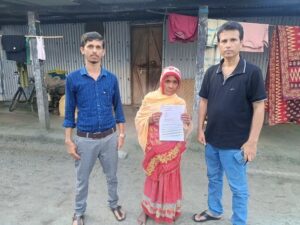
Pushed Back, Let Down: How the state has let down the marginalised in Assam


Assam: When six ordinary Indian women were forcibly pushed out from India--No Man’s land-- Bangladesh & then back

What We Know So Far: June 3, 2025

It has been ten days of trauma and sleepless nights for thousands of working class citizens in the north eastern state of Assam. When the Assam Border Police, backed by no legal authority, no warrants, simply swept down on all 33 districts and selectively picked up women, women with babes in arms, men and illegally detained them before many of them were allegedly pushed across the international border into Bangladesh. CJP’s first exclusive report may be read here.

A week later, yesterday, Sunday June 1, some respite was felt, even as anger and trauma reigned. News and accounts of several such illegally detained citizens being “dumped back” in different locales in Assam, with no explanation trickled in. There is of course no talk, not a murmur even of reparation or compensation, for what they had been put through.

CJP’s team members met with and interviewed six such women. Whom fate had rescued. Dozens of those detained still remain untraceable, an approximate figure of those who were initially untraceable, as per unconfirmed reports is 145.

Hajera Khatun:

Over 60 years old, Hajera Khatun, is the daughter of Kurpan Ali, and wife of Sangser Ali from village Bhalluki under Barpeta road police Station of Barpeta District. This Bengali-speaking Muslim women who is a diabetic patient was allegedly forcefully and illegally detained by the Assam Border Police on May 25. She was taken to an entirely unknown place.

Hajera Khatun was not unfamiliar with being detained. She was once detained in one of Assam’s dreaded detention camps –women are kept at Kokhrajhar—and was released on temporary bail in 2021. Her case is pending in the Gauhati High Court and it is of significance that under directives of the Gauhati HC she could not have been deported. Yet she was. CJP has accessed a copy of her documents.

Like dozens of others from different parts of Assam, this poor Indian woman was taken away by the police on May 25. She was not found since. Her family members searched desperately for her for over a week, seeking assistance from CJP’s legal and paralegal team too. However she could not be traced. Finally, when she reached home on May 30 (Friday), CJP volunteers including CJP’s state-in-charge, Nanda Ghosh and advocate Abhijeet Choudhary met and interviewed her.

When the team first reached her home she was found to be ill due to high blood pressure and had been taken for medical assistance and treatment by her family members. After about an hour, Hajera share her pain, "The police simply came and told me –without giving reasons--to go to the office of the Superintendent of Police (SP) on May 25. I got terrified, and asked, 'Why would I go to the SP office?”

She continued, "They took me away from here saying, ‘How many more days will you have to appear like this? It's hard on you, and it's hard on us too.’" They said they'd make some arrangement today so that you wouldn't have to come (to report regular presence) anymore and that thereafter we wouldn't have to do anything. That is only how and why I went with them."

"From the office of the SP at Barpeta, ---I'm not exactly sure---but there were three-four busloads of people. Later, they took only two buses and left two behind. So many people just did not want to go, but they were beaten and forced into the bus and the doors shut. Then, they took us to the Matia Detention Camp (in Goalpara district) (This is about 91 kilometres, about a three hour drive from Barpeta). We spent the whole day and night without food. The next day, around 10 am, we were still sitting in the bus. Then they took us out and gave us a little bit of rice, after some time. We were so frightened, we could not even eat properly. After that, we thought we'd be allowed to sit inside the room where we were, for a bit. As soon as we sat down, they called us again, saying they needed to take our photos. We went, leaving our bags and money in the room where we had sat, thinking we would reclaim them after the photo session. But, after taking photos, they closed the gate of the Detention Centre, again. Then they began herding us into the bus like cattle, and one person, a teacher amongst us was protesting loudly, asking why the women were being treated so harshly and why they were being subjected to such suffering. He was even trying to stop the women from being taken away like that. However, despite his efforts, we were still forced onto the bus by police. The teacher who was resisting and trying to intervene was brutally beaten in front of our eyes, his eyes were covered, and his hands were tied behind his back," she fearfully described to us.

Hajera trembled, saying, "Khairul Master [Khairul Islam, the teacher] was beaten so severely that he lost consciousness." She continued, "The (Assam Border Police) gave each of us a packet, which contained two notes of that country's currency (Bangladeshi currency). Then we were taken to the border, they made us get off the bus and cross the border, it was so terrifying and horrible."

"They told us, ‘don’t say a word, don't talk ", Hajera cried as she recounted the pain of a week ago.

She stopped and then said, "We stood there, in that dreadful place all night, drenched in the rain, hungry, at the border."

"In the morning, Bangladeshi people and police found us and they asked us why we Indians had entered Bangladesh. Then they brought us back to the BSF (Border Security Force), the police of the two countries talked all day, but no one was there for us, to speak for us. They just physically pushed us around. We just kept crying and weeping in fear being tossed between the borders of the two countries border (No Man’s Land). Just like this, the last few days have been spent in terror. Then, the police caught us and put us in a camp. The next morning, the police from both countries talked about us, but reached no agreement; no one agreed to take us!" Hajera added. “We don’t know how or why but suddenly we were driven back.”

Hajera's son added, "Last night around 11 pm, that is the night of (May 31, Saturday) we received news that my mother (Hajera) and a woman named Sona Bhanu were both found on the Goalpara highway. I then called Jubbar bhai (local student leader, AAMSU) here, we took a car and rescued my mother. "

Sona Bhanu:

Sona Bhanu is a 59-year-old widow from Burikumar village in Barpeta district, who was similarly allegedly “taken away” by the Assam police on May 25 and went missing. She suddenly reappeared on the Goalpara highway around 11:30 pm on June 1. Sona Bhanu's journey to this point has been marked by a long-standing dispute over her citizenship. In 2013, the Barpeta Foreigners' Tribunal declared her a foreigner, a decision upheld by the Gauhati High Court in 2016. However, the Supreme Court intervened in 2018, staying the Gauhati high court's order. CJP has accessed a copy of her documents.

Her younger brother, Asraf Ali, expressed his frustration with the CJP team; "We have all the necessary documents, including our presence recorded in the 1951 NRC. Our parents are Indian, and all of us siblings are Indian citizens. How can my sister be considered Bangladeshi?" He highlighted a potential case of mistaken identity, explaining that a notice from the border police was initially issued in the name of "Kamala Bhanu" but was later altered to "Sona Bhanu" without explanation.

Asraf Ali recounted Sona Bhanu's ordeal; "The Barpeta Tribunal declared my sister a foreigner and confined her to the Kokrajhar detention camp. After spending 3 years, 3 months, and 13 days in detention, she was released on bail and has since been required to report to the local police station weekly."

Sona Bhanu herself described the terrifying events that unfolded, her voice trembling with fear. She recounted being forced towards Bangladesh by the police or force, spending a harrowing night in No Man's Land. "I was bitten by leeches and mosquitoes all night, and I got a fever from getting wet in the rain," she said, adding, "We were afraid they would shoot us dead in the dark of night, who knows?"

As per Bhanu's account, she was driven back to India as part of the same group of people as Khatun.

Rahima Begum:

About 51 years old, Rahima, a Muslim women from the Padumoni village of Golaghat returned to her home from the No Man's land between India and Bangladesh with the same batch of people, Hajera and Sona.

In a telephonic interview with team CJP, Rahima and her son Rakib Uddin Choudhury described the harrowing experience. Just like Sona and Hajera, Rahima was also pushed out to Bangladesh forcefully. Her son described her ordeal, “On 25 May the Assam Border Police told my mother to go to the police station to answer some questions. After spending the morning there, they took her to the Golaghat SP office. "He continued, "They then took my mother documents, and they collected fingerprints with those of some others."

"My sisters and family members were there the whole day. But they were not allowed to meet my mother. Late night they took my Mother to Goalpara detention camp and then Border."

Rahima's son went on to describe the ordeal, “The Police who were with my mother and others, they gave them Bangladeshi notes (currency) and directed them to cross the border" Rahima added, "All we could see was paddy fields, mud and water. We just did not know what to do."

She continued, "The others and I just walked between the paddy fields until we reached a village. But the people there chased us away and their border forces called us, beat us up a lot and told us to go back to where we came from.” Her son even claimed that his mother was subjected to violence by the Bangladeshi police.

Jahanara Begum-Ashifa Begum- Sahera Khatun:

Jahanara Begum of Diring Pathar Village under Biswanath Charali police Station of Sonipur Police Station was detained by the Assam police on May 25 and was fortunate to be back home –after a traumatic experience –on May 29. On May 27 one of her family members even went to the Matia Detention Centre and there met team CJP (including  Nanda Ghosh, Habibul Bepari, advocate Ashim Mubarak and advocate Dewan Abdur Rahim). When Jahanara fortuitously reached home, family members informed CJP.

In a telephonic interview with CJP, Jahanara was attempting to describe the unimaginable experience, even though she was quite unwell. She recounted that two other women, Ashifa Begum and Sahera Khatun of Dhekiajuli were also allegedly forced out of their homeland into ‘No Man’s Land’ before reaching back home. Their story is similar to Hajera and Shona’s account.

Unaccounted others: Also as per per Hajera and Sona Bhanu account to CJP, when they were “returned to Goalpara at night, there were five other men with them, meaning there were seven people in their group including Hajera and Sona. However they do not have any idea of their name or identity.

Meanwhile CJP has confirmed reports that Khairul Islam the teacher from Morigaon who was allegedly brutalised by the Assam Border Police at Matia Detention Centre was initially part of the group of 14 that had been pushed over into No Man’s Land but after that action the group was “divided” --by the Bangladeshi Security forces-- into two parts of seven and seven and Khairul Islam was then in the other group. Rahima also told CJP that with her, one more woman had been brought back to Jorhat police station from no man's land but she did not know her name.

With the level of unaccountability of the state authorities, human rights organisations and survivors have to use community methods to calculate the extent of the trauma.

Release from Matia detention camp:

Meawnhile, CJP team member, Zesmin Sultana has informed us that one similar victim of arbitrary detention, Rahim Ali back was sent back to his home in Goalapra District after being kept at the Matia Detention camp from May 29 and released on May 31, a detention period of two days. His identity is Rohim (Rahim) Ali, son of Dobiram Sangma, mother Jelmish Marak belonging to the Christian Garo trive from village Paikan pt-1, Krishnai.

Background of the Incident:

From the night of May 23, 2025, the Assam police initiated a widespread crackdown across all 33 districts, detaining approximately 300 individuals in many cases without notice or legal justification. Families and advocates were left uninformed about the detainees' whereabouts, violating constitutional and legal norms. While around 150 were reportedly released, unconfirmed reports suggest 145 individuals—still fighting for their citizenship rights—were forcibly pushed across the border into 'no man's land' between India and Bangladesh. These individuals include those declared foreigners by tribunals, those released on bail, even those litigating for restoration of citizenship. Notably, no formal deportation orders or bilateral repatriation agreements have been disclosed, leaving the affected families in uncertainty.

On one hand, many people are missing, and on the other hand, neither the police nor other administrative authorities are providing clarification to the families about the missing people who were taken away by the police.

Many victims’ families complain, saying they attempted to have an FIR registered at the police station but that the cops did not register one, following which they sent their complaint by post to the local SP

It is noteworthy that the CJP Assam team submitted this memorandum to the National Human Rights Commission, which was signed by the CJP Assam team members and legal team members and the chief convener of the Forum for Social Harmony.

Meanwhile, although there has been no major protest, there is anger among many people in Assam.  There is also a lot of discussion among people about who issued the orders and why were Indian citizens –even those with contested citizenship-- sent to Bangladesh in such a cloak and dagger fashion. If some of them were actually Bangladeshi, why were deportation norms as detailed by the union government in the recent Rajubala proceedings not followed? Why did Bangladesh then not accept them? Most critically, where are those who are still missing? And who will pay for the trauma and torture subjected on ordinary Indians?


Related:

“Disappeared in the night”: CJP’s memorandum to NHRC on Assam’s secretive detentions and illegal pushbacks

CJP Exclusive: Homeland to No Man’s Land! Assam police’s unlawful crackdown on residents still battling for restoration of citizenship rights?


Pushed Out of Sight: The covert deportation and detention crisis at Assam’s Matia detention centre

In recent weeks, a significant but opaque operation has been underway in Assam involving the mass removal of detained foreign nationals — including the Rohingya refugee community — from India’s largest detention centre at Matia, Goalpara. Multiple reports emerging from Bangladeshi media and border officials confirm that at least 123 individuals, comprising Rohingyas and Bengali-speaking persons, were forcibly pushed back across the international border into Bangladesh. These deportations were reportedly executed without formal diplomatic protocols or transparent deportation procedures.

This operation starkly highlights India’s growing use of extrajudicial “pushbacks” as a tool to circumvent the complexities of refugee protection, legal detention, and diplomatic engagement. Such actions potentially violate both India’s obligations under international refugee and human rights law, as well as its own legal safeguards for stateless persons and asylum seekers. The refusal of Bangladesh and Myanmar to accept these vulnerable individuals formally has seemingly led India to adopt a policy of indirect expulsion—placing the burden of care onto its neighbours.

The scale of the deportations and the lack of public disclosure by Indian authorities raise profound concerns about accountability and due process. No official confirmation has been made public regarding the exact number deported, the legal status of these persons at the time of removal, or whether they were deported through the involvement of their respective governments or international bodies.

Assam Chief Minister Himanta Biswa Sarma’s public endorsement

The clandestine nature of the deportations was partially lifted when Assam Chief Minister Himanta Biswa Sarma confirmed that detainees—including Rohingya refugees and other declared foreigners without pending appeals—were indeed “pushed back” to Bangladesh. Sarma explicitly described the removals as a Government of India “operation” in which Assam was a stakeholder.

As per a report in Deccan Herald, May 12,  Assam Chief Minister Himanta Biswa Sarma has openly confirmed that these pushbacks are not isolated incidents but part of a deliberate and planned “operation” by the Government of India. Speaking to media in Guwahati on May 10, Saturday last, Sarma had said that Rohingyas and other “declared foreigners” without pending legal appeals were sent from the Matia detention centre to cross into Bangladesh.

“Matia is almost free now, with 30–40 people left,” he said according to Deccan Herald, indicating a drastic reduction in the population of the largest detention facility in India, without explaining the mechanisms or legality of these removals. His statement validates what activists and border watchers had feared: that India is undertaking silent deportations of stateless or vulnerable populations, particularly Rohingya, who neither Myanmar nor Bangladesh has agreed to take back formally.

His framing of the pushbacks as an operational success obscures the severe humanitarian and legal questions at stake—particularly the forced expulsion of stateless persons who have neither been formally recognised as refugees nor granted safe resettlement options. Sarma’s statement also reflects a broader policy shift in Assam and India, characterised by increasingly punitive approaches toward those labelled “foreigners,” with little regard for rights or rehabilitative processes.

What does the on-the-ground data say?

Independent data gathered by the Citizens for Justice and Peace (CJP) Assam team sheds important light on the evolving reality at the Matia detention centre:

  • According to local investigation by our CJP team, all but one of the Convicted Foreign Nationals (CFNs) previously held at Matia have been “pushed back” or deported, leaving only a single Nigerian national, namely Kamardeen Oaladeji Oladimeji, still detained.
  • The precise number of deportees remains undisclosed by authorities; however, earlier records indicated 203 CFNs held in Matia. Excluding the one Nigerian detainee, this implies that 202 individuals have been ‘removed’ (read deported)—presumably without transparent, lawful deportation procedures. Details of those in Matia deportation centre may be read here.
  • In addition to CFNs, there remain 46 Declared Foreign Nationals (DFNs) at Matia, individuals who have been declared foreigners by Assam’s Foreigners Tribunals but who currently have appeals pending in the High Court or Supreme Court.
  • Importantly, our experience at CJP, through ground level investigations, notes that most DFNs are Indian citizens who have been wrongfully declared foreigners, often due to flawed tribunal proceedings or inadequate documentation. These persons should not be treated as deportable foreigners but must be reintegrated into Indian society through proper legal mechanisms.
  • One case being fought in the High Court by CJP involves Ajabha Khatoun, a woman wrongly declared a foreigner who faces deportation despite her Indian citizenship claims. On March 3, 2025, the Gauhati High Court’s issued stayed the deportation of Ajabha Khatun, currently lodged in the Matia detention camp of Assam after she was arrested in September 2024.
  • The CJP team’s human rights works and humanitarian work, raises critical doubts over whether these pushbacks constitute official deportations involving diplomatic channels, or instead represent unlawful forced expulsions. No public confirmation has been found that these CFNs were formally repatriated through their respective embassies or governments.

This information underlines a troubling reality: India’s deportation machinery at Matia appears to prioritise mass removals over legal protections, transparency, or rehabilitation.

The Case of the Nigerian languishing in Matia: Illegal detention and judicial intervention

In the midst of the mass deportations, the protracted detention of the remaining one Nigerian national, Kamardeen Oaladeji Oladimeji, stands as a stark symbol of systemic failure. Oladimeji has been held at the Matia detention centre for 1,457 days beyond his legally mandated sentence.

Therefore, it is seen that by the time the order and sentence was passed, the petitioner had already served his sentence as on 13.05.2021. Thus, as on the date of this order, the petitioner has spent 1457 days in illegal detention.” (Para 3)

Convicted in 2021 for offences under the Foreigners Act and the Passports (Entry into India) Rules, Oladimeji had served his six-month imprisonment and paid the fines by May 2021. Yet the state continued to detain him unlawfully without initiating repatriation or granting release, as per a report of LiveLaw.

Recognising the gross illegality, a division bench of the Gauhati High Court issued a strong order directing Assam and central authorities to facilitate his immediate repatriation on May 9, 2025. The Court noted that failure to do so would compel it to release Oladimeji unconditionally, at the risk and cost of the state.

“The State as well as the appropriate authorities in the Home & Political (B) Department, Govt. of Assam; Secretary to the Govt. of India, Ministry of Home Affairs; and the Secretary to the Govt. of India, Ministry of External Affairs shall specifically take note of the fact that the sentence of the petitioner was served on 13.05.2021 and therefore, the petitioner is in illegal detention for 1457 days. Therefore, if the appropriate actions are not taken within the due time, the said authorities are put to notice that the Court would be compelled to release the petitioner unconditionally, which would be at the risk and cost of the said authorities.” (Para 9)

Significantly, the Nigerian Embassy has shown readiness to issue an Emergency Travel Certificate upon a video interview, which could be facilitated by the Matia camp authorities. Despite this, bureaucratic inertia and inter-agency delay have perpetuated his illegal incarceration.

Oladimeji’s case starkly illustrates the human cost of systemic indifference and the breakdown of procedural justice in India’s detention centres—where individuals are trapped beyond their sentences due to administrative paralysis and policy neglect.

The complete order may be read below.


A Legal and ethical red Line: The risk of violating non-refoulement

The secrecy and speed of deportations from Matia detention centre raise serious concerns about India’s compliance with international legal obligations, particularly the principle of non-refoulement — a norm that prohibits returning individuals to territories where they may face threats to life, liberty, or persecution.

Although India is not a party to the 1951 Refugee Convention or its 1967 Protocol, non-refoulement is widely recognised as a principle of customary international law, binding on all nations irrespective of ratification. Moreover, India is a state party to the International Covenant on Civil and Political Rights (ICCPR), which under Article 7 prohibits cruel, inhuman or degrading treatment — a protection that logically extends to any deportation that risks exposing someone to such harm.

Indian Constitutional courts have historically affirmed these principles:

  • In Ktaer Abbas Habib Al Qutaifi v. Union of India (1999), the Gujarat High Court held that Article 21 of the Constitution, which guarantees the right to life and liberty, protects refugees and asylum seekers from being forcibly returned to unsafe conditions.
  • In Dongh Lian Kham v. Union of India (Delhi High Court, 2010), the Court explicitly recognised the principle of non-refoulement as part of the constitutional guarantee under Article 21.
  • In Nandita Haksar v. State of Manipur (2021), the Manipur High Court permitted Myanmarese nationals fleeing a coup to meet the UNHCR in Delhi, reaffirming India’s obligations under international humanitarian law and its adherence to non-refoulement even outside the refugee treaty framework.

However, recent developments signal a regression.

In May 2025, the Supreme Court of India, while hearing petitions challenging the detention and deportation of Rohingya refugees from Delhi in the case of Jaffar Ullah and Anr. v. U.O.I And Ors, refused to stay their removal. The Court stated that the right to reside in India belongs only to citizens, and thus deportation of non-citizens did not infringe on fundamental rights. The ruling echoed earlier observations in Mohammad Salimullah v. Union of India, where the Court maintained that while non-citizens are entitled to certain constitutional protections (like Articles 14 and 21), they do not have a guaranteed right against deportation — even if the risks upon return are well-documented.

This narrowing interpretation of constitutional protections in cases involving stateless persons and asylum seekers directly undermines the spirit of non-refoulement, and sets a dangerous precedent. It opens the door for the executive to expel individuals without fully evaluating the risk of persecution, torture, or arbitrary detention — outcomes that are extremely likely for groups like the Rohingyas, or individuals expelled without nationality documents.

The situation unfolding in Assam, with individuals being pushed across the border without diplomatic coordination or legal review, cannot be seen as lawful deportation. It is closer to extrajudicial expulsion, and when applied to stateless or persecuted communities, it may constitute a violation of international law, constitutional rights, and basic principles of justice.

The Broader implications: Statelessness, human rights, and the erosion of due process

Together, these developments expose a deeply troubling pattern in India’s approach to foreigners and refugees in Assam, especially Rohingya and Bengali-speaking Muslims:

  • The conflation of statelessness with criminality leads to indefinite detention and mass pushbacks that violate fundamental human rights and international legal standards.
  • The Foreigners Tribunals in Assam, widely criticised for lack of due process, continue to declare hundreds of individuals foreigners—many wrongfully—subjecting them to detention and the risk of forcible removal.
  • Deportations executed without diplomatic agreements or proper notifications amount to illegal “pushbacks”, shifting responsibility onto neighbouring countries ill-equipped to absorb such persons.
  • The opacity and lack of accountability in these processes undermines public trust, violates constitutional guarantees of liberty, and renders invisible the suffering of those caught in legal limbo.
  • The Government’s eagerness to “empty” Matia detention centre is a hollow metric if it rests on forced expulsion rather than lawful deportation or rehabilitation.
  • The persistence of cases like Oladimeji’s reflects systemic failures to honour judicial mandates, international obligations, and the rights of detainees.

As Assam’s Matia detention centre becomes a symbol of secrecy, cruelty, and administrative impunity, the urgent need for transparency and judicial oversight cannot be overstated. The stories emerging from behind its high walls—of coerced deportations, prolonged illegal detentions, and disregard for basic human rights—reveal a deeper rot in India’s treatment of migrants and refugees. Upholding the Constitution means more than rhetoric; it requires an unwavering commitment to legal due process, dignity, and non-discrimination. Civil society, courts, and the media must refuse to look away. What is at stake is not just the fate of a few individuals, but the very soul of a democracy that claims to abide by the rule of law. Ultimately, the crisis at Matia detention centre is not merely an administrative issue. It is emblematic of a broader crisis of justice, humanity, and the rule of law—where the most vulnerable populations become collateral damage in nationalist and securitisation agendas.

Related:

Restoring Citizenship, Rebuilding Lives: CJP continues its journey in Assam

Declared Foreigner, buried Indian: The tragic death of Abdul Matleb in Assam’s detention camp

A jumla or a concrete step? Assam CM’s announcement on Koch Rajbongshi cases raises more questions than answers

SC: Only 10 deported, 33 of 63 contest foreigner status from the Matia Transit Camp, Assam


Suspected Bangladeshi sent to Bengal by Karnataka police without trial clueless about their future

Kolkata: At 3.30 pm when Howrah Express (22832) chugged into Howrah Station, a protest erupted in the station. Human Right Activists were seen holding placards stating – “Why is West Bengal Government supporting illegal push back?”; “Immediately stop the illegal and inhuman push back of Bangladeshi” and “Just because they are Bangladeshi, doesn’t mean that you can illegally pushback these people.”

The train in question has brought in 59 detainees, all allegedly Bangladeshis from Karnataka, escorted by 30 police officials, to be deported back to their country.

According to an India Today report, Bengaluru City Police Commissioner Bhaskar Rao, said, “We had confirmed data/information about the presence of these immigrants in the city. Hence, we followed up and conducted this operation, identified them and took them into custody. The police have decided not to file cases because then these illegal people will spend time in local jails in the city rather they are seeking deportation orders at the earliest.”

And it is this point – police not filing a case against the alleged illegal migrants, that the human right activists in Kolkata are objecting to.

He does, have a point, according to earlier media reports, 61 detainees were to reach Kolkata, however, only 59 reached. Some of the immigrants were seen raising questions about the two detainees, kept back in Karnataka – one a minor boy and the other a girl called Roshan Ara.

Speaking to eNewsroom, Altaf Ahmed, Assistant Secretary, Association for Protection of Democratic Rights, said, “The fact that these Bengali speaking people are being sent back to Bangladesh, without any legal work or documentation is illegal.” According to Human Right Activists, out of the 59 people, 15 are minors, while 25 are women and remaining men.

When asked, what would the legal procedure be, he replied, ” Going by what the Karnata Police is claiming that these 59 people who have been brought to Kolkata are Bangladeshi nationals, then a case should be registered against them and the entire procedure should be documented. This is needed to keep a total headcount of those being sent back. With no proper paperwork, there is a huge risk of trafficking involved.”

He does, have a point, according to earlier media reports, 61 detainees were to reach Kolkata, however, only 59 reached. Some of the immigrants were seen raising questions about the two detainees, kept back in Karnataka – one a minor boy and the other a girl called Roshan Ara.

Suspected Bangladeshi deportation illegal immigrants Karnataka Bangladesh Kolkata
Members of civil society protest at Howrah on the deportation of suspected Bangladeshi immigrants

Ahmed, claimed, “This deportation was clandestinely taking place. However, a tip-off made us come over here. We have even filed a proper FIR with the GRP demanding a proper procedure to access the nationality of these people, some of whom even have Adhaar cards. This needs to done so that these individuals are safely sent back to where ever they belong.”

Interestingly, the detainees along with Karnataka Police had to wait from 3:30 pm till 9:30 pm, to decide on the next move. According to a source, Howrah DM has taken the initiative to provide accommodation to these people, however, there is no clarity on where they would be housed in – a home or jail.

B.M Jamal Hossain, Head of Chancery, Bangladesh Deputy High Commission Kolkata to know about the same. Hossain, said, “We have no official communication on this case either by the Karnataka or West Bengal Government. However, we have come to know regarding this case from other sources.”

There seems to be a sense of fear among the 59 detainees, who are clueless of their immediate future – of being sent back to Bangladesh or detention centre.

Meanwhile, eNewsroom contacted B.M Jamal Hossain, Head of Chancery, Bangladesh Deputy High Commission Kolkata to know about the same. Hossain, said, “We have no official communication on this case either by the Karnataka or West Bengal Government. However, we have come to know regarding this case from other sources.”

On being asked if they would be doing anything to help the detainees, he said, “If the government of India officially contacts us regarding the same, then we will follow the prescribed procedure to have them verified. If we find that they indeed are Bangladeshi citizens, then we will have them sent back.”

He then added that this deportation or branding of people as Bangladeshi needs to be done officially and legally.


Courtesy: eNewsroom


Related Themes