
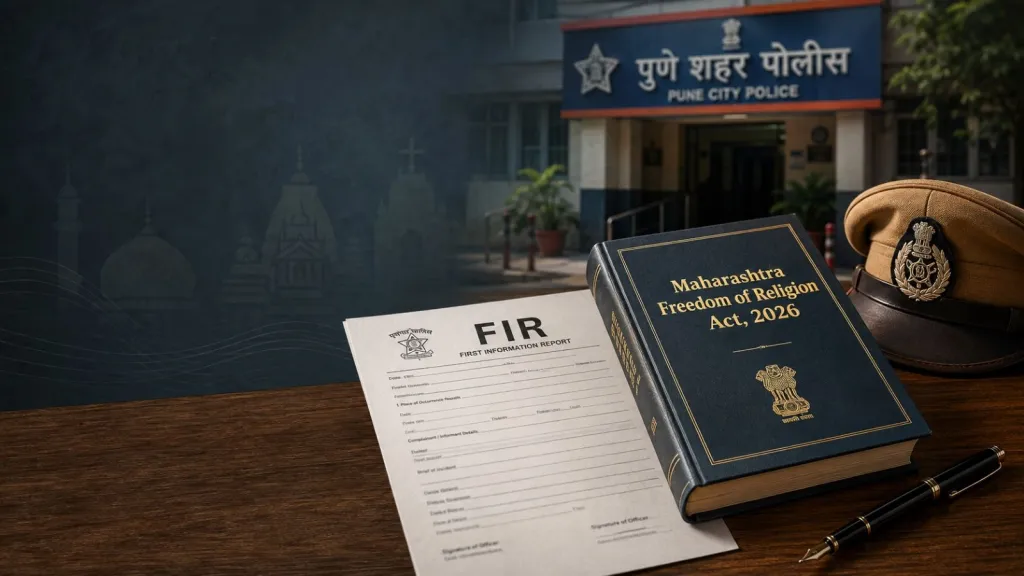
Maharashtra’s newly enacted Freedom of Religion Act, 2026 has already been invoked by the police, barely days after it came into force. Pune City Police have registered two cases under the legislation—one against a 22-year-old man accused of asking a minor girl with whom he was in a relationship to convert, and another against a British national and Overseas Citizen of India (OCI) cardholder accused of attempting to induce people to embrace Christianity.
The first FIR was registered on August 5, just four days after the law came into force. According to The Indian Express, the 22-year-old, originally from Uttar Pradesh, was allegedly in a relationship with a minor from his village. The two subsequently moved to Karnataka and then Pune. Police allege that he asked the girl to convert from her religion. He has been booked under Sections 3 and 9(2) of the new Act, along with provisions of the POCSO Act, and is currently in judicial custody.
Section 3 prohibits conversion or attempts to convert through coercion, fraud, allurement, misrepresentation, force, threat or undue influence. Where a minor is involved, Section 9(2) permits punishment of up to seven years’ imprisonment and a fine of up to ₹5 lakh.
The allegation, however, still has to be established. The FIR itself does not establish that an offence under Section 3 occurred, particularly since the prosecution will have to demonstrate the specific means allegedly used to induce the conversion. The distinction matters in a law where ordinary interpersonal conduct could potentially come under scrutiny if the statutory ingredients are interpreted expansively.
Second FIR widens the scope of concern
The second case concerns a British national and OCI cardholder. Pune Police allege that he participated in prayer meetings and religious gatherings and attempted to persuade people to embrace Christianity. Police have also alleged that he spoke about following Jesus and made statements concerning Hindu temples and deities that were intended to mislead people and induce conversion, The Indian Express reported.
The police have reportedly invoked both the Maharashtra Freedom of Religion Act and provisions of the Immigration and Foreigners Act, 2025, arguing that the OCI cardholder was not authorised to preach or deliver religious discourses without permission. This case raises a more fundamental question about the boundary between religious propagation and unlawful inducement. Participation in a religious gathering or expressing one’s religious beliefs, by itself, does not establish coercion, fraud, force or undue influence. Whether the alleged conduct crosses that statutory threshold will ultimately have to be determined through evidence and judicial scrutiny.
A law with wide-reaching provisions
The Maharashtra Act does more than criminalise forced or fraudulent conversion. It introduces a prior-notice regime for persons intending to convert, permits complaints by specified relatives, regulates conversions connected with marriage or promises of marriage, and places the burden of establishing that a conversion was voluntary on the person conducting it. It also provides enhanced punishment where the alleged conversion involves minors, women, members of Scheduled Castes or Scheduled Tribes, or persons of unsound mind.
The breadth of terms such as “allurement”, “undue influence” and “misrepresentation” is likely to be central to the misuse of the law. A law intended to prevent coercive conversion cannot, constitutionally, become a mechanism for policing voluntary religious belief, expression or association.
The concern is particularly relevant because the legislation operates in an area closely connected with individual autonomy, freedom of conscience and the right to profess, practise and propagate religion under Article 25 of the Constitution. This is one of the key substantive points argued by the CJP in its constitutional challenge to the Himachal Pradesh law. Report may be read here.
The speed with which the legislation moved through the state legislature had itself become a point of criticism. Citizens for Justice and Peace (CJP), in its dissent note, highlighted that the Bill was introduced and passed within days, with limited scope for public consultation or legislative scrutiny, despite the fact that similar anti-conversion laws enacted by other states are already under examination before the Supreme Court. CJP is the lead petitioner in the constitutional challenge to the first batch of such laws passed by five states between the years, 2020-2023. This challenge has been pending in the Supreme Court, despite pleas for interim stays on the most egregious provisions for over five years now. [1]
Details on the interim applications urging stay on the most egregious provisions, filed by CJP on April 16, 2025 may be read here.
In early 2026, while the batch of petitions challenging the constitutional validity of these state laws were listed before the court of the Chief Justice of India (CJI), they were once again deferred. Reports may be read here. Thereafter, first on May 13, 2026 the matters were listed to be heard after which the next date that appears on the Supreme Court calendar is August 12, 2026.
Related:
‘Faith Is Not a Crime’: Mumbai’s Christians rise against Maharashtra’s proposed anti-conversion bill
Maharashtra’s Proposed Anti-Conversion Law: Manufacturing moral panic to criminalise personal choice