
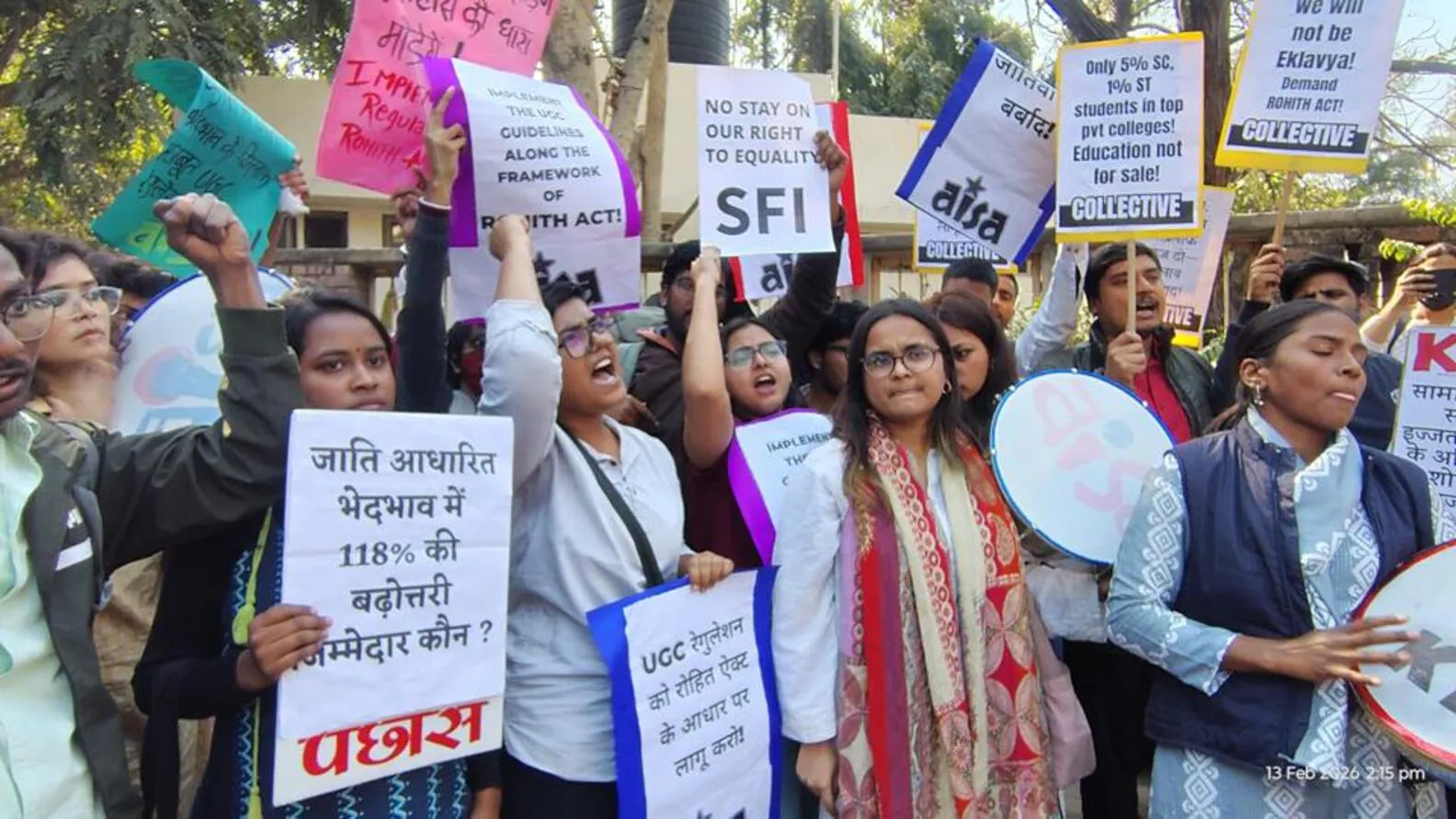
What began as a mobilisation demanding the restoration of the stayed UGC Social Equity Regulations at the University of Delhi has now spiralled into a deeply polarised anti-caste confrontation — one in which allegations of sexualised abuse against women student leaders have revealed the face of persistent and prevalent caste discrimination on campus. Meanwhile an obviously right-wing YouTuber has made claims of “mob-assault” during the protest.
At the centre of the controversy are two distinct but intertwined developments:
- AISA women leaders alleging verbal sexual abuse and threats inside and outside a police station. There are videos of this abuse circulating online
- YouTuber Ruchi Tiwari claiming she was attacked by a mob of nearly 500 people while covering the protest.
As FIRs have been registered and political leaders have entered the fray, the struggle has increasingly shifted from what happened on campus to who controls the narrative of victimhood.
The Protest: UGC equity regulations and campus tensions
The protest on February 13 was organised by the All India Students’ Association (AISA) and allied groups demanding implementation of the University Grants Commission’s (Promotion of Equity in Higher Education Institutions) Regulations, 2026.
The regulations — intended to strengthen safeguards against caste discrimination affecting SC, ST and OBC students — were recently stayed by the Supreme Court of India, which observed prima facie concerns of vagueness, particularly in the definitional scope of caste-based discrimination, and directed that the 2012 framework would remain in force pending further hearings.
Details may be read here.
Students supporting the regulations have emphatically argued they are essential to address structural caste bias within higher education. Opponents –many who have led aggressive and violent protests against their implementation –claim certain provisions are “vulnerable to misuse.”
This mobilisation was framed as part of a broader “Adhikar” campaign asserting dignity and institutional accountability.
The Flashpoint: Ruchi Tiwari’s presence and the confrontation
According to reports in The Print, tensions escalated when Ruchi Tiwari, who runs the YouTube channel Breaking Opinion, arrived at the site to cover the protest.
Tiwari describes herself as an “independent ground reporter”. Her channel, which has over 59,000 subscribers and more than 460 uploaded videos, frequently features a privileged caste lens depicting confrontational campus coverage, particularly around reservation, caste debates and identity politics. One of her recent YouTube Shorts is titled: “They want reservation but say don’t indulge in casteism.”
She has alleged that before she could begin reporting, individuals began calling out her name, asking her full identity and caste, after which a crowd surrounded and assaulted her. In statements to ANI (an agency that has increasingly been called out for its right-wing bias) , she claimed nearly 500 people attacked her, that she was held by the neck and arms, subjected to rape threats, and that there was an attempt to push her into a vehicle with its door open — which she described as an attempted abduction and “mob lynching.”
Videos online show pushing and scuffling. However, the full sequence remains disputed.
AISA’s Counter-Version: Provocation, altercation and selective framing
AISA has rejected Tiwari’s allegations as “false and motivated.”
According to statements cited by The Print, AISA leaders allege that the confrontation began when Tiwari engaged in provocative questioning and allegedly made casteist remarks referencing the Mahad Satyagraha led by Dr. B.R. Ambedkar. AISA further claims she harassed a Dalit journalist named Naveen and attempted to snatch his camera.
Some circulating videos, according to AISA, show Tiwari striking Naveen and later pushing or punching AISA activist Anjali during the confrontation. Another clip shows activists holding Tiwari while attempting to escort her toward police presence.
AISA has argued that several clips being widely shared omit audio or preceding events and therefore reshape public perception.
It is at this point, AISA claims, that the narrative began to shift — from a protest demanding caste equity to a viral storyline of a “woman journalist attacked by Left mobs.”
Another video from the February 13 incident at Delhi University exposes the conspiracy of Sanghi-Casteist-Feudal goons against students demanding equity and social justice. These goons threatened AISA activists and DU students with vulgar abuses inside the Maurice Nagar Police… pic.twitter.com/ObROzq3H4r
— CPIML Liberation (@cpimlliberation) February 14, 2026
Condemn the right-wing assault and hooliganism against Comrade Anjali in DU! Today, AISA DU Secretary Anjali was physically assaulted by a right wing group. Despite the heavy presence of Delhi Police and CRPF, the attackers were given a free hand.
This violence is the clearest… pic.twitter.com/0AS2xYOyIZ
— CPIML Liberation (@cpimlliberation) February 13, 2026
Statement of Communist Party of India -Marxist Leninist- Liberation:
The Police Station Incident: Allegations of sexualised abuse
The most serious allegations, however, concern what happened later at Maurice Nagar Police Station.
AISA leaders Anjali and Neha allege that when they went to file complaints, a right-wing mob gathered outside the police station premises. According to AISA, the crowd swelled from dozens to hundreds, shouting slogans and issuing rape and death threats.
AAP MP Sanjay Singh publicly condemned the episode on X, sharing a video and alleging that in the presence of police personnel, AISA women leaders were abused with explicit insults directed at their mother and were told to “remove their clothes.”
देश की राजधानी दिल्ली में थाने के अंदर, पुलिस वालों के सामने AISA की महिला नेता अंजली और नेहा को मां की गाली देते हुए कहा गया, “कपड़े निकाल।” एक बिहार की बेटी, दूसरी उत्तराखंड की — दोनों सवर्ण हैं, लेकिन वंचितों के हक की आवाज उठाना उनका गुनाह हो गया। अगर यह घटना पंजाब या बंगाल… pic.twitter.com/JgRZ9cgf99
— Sanjay Singh AAP (@SanjayAzadSln) February 15, 2026
Singh questioned how such an incident could occur in the national capital and linked it to broader concerns about women’s safety. He alleged that the targeting of the two women leaders was connected to their vocal advocacy for marginalised communities.
AISA has termed the episode “state-sponsored hooliganism,” alleging that activists were effectively confined inside a room for hours while threats were issued outside. Anjali was reportedly taken for a medico-legal examination.
Delhi Police, according to ANI, has registered two FIRs — one based on Tiwari’s complaint and another based on a complaint by a female AISA student — under sections relating to assault, voluntarily causing hurt, wrongful restraint and common intention under the Bharatiya Nyaya Sanhita.
UGC का समर्थन कर रही दिल्ली यूनिवर्सिटी कि छात्राओं को दिल्ली पुलिस के सामने थाने में भद्दी-भद्दी गालियां दी जा रही हैं। UGC के नए प्रावधानो का महत्व इसी बात से लगाया जा सकता है कि दलित और पिछड़ों के हुकूक का उलंघन ना हो… pic.twitter.com/Qs8e7eew71
— Ashraf Hussain (@AshrafFem) February 15, 2026
ABVP, DUSU and administrative responses
The Akhil Bharatiya Vidyarthi Parishad (ABVP) has maintained that Tiwari was present in her professional capacity and was attacked for asking questions. Its Delhi state secretary described the episode as an attack on media freedom and characterised Left-affiliated campus politics as violent.
Aryan Maan, President of the Delhi University Students’ Union, condemned the alleged assault on Tiwari and called for a fair and impartial investigation. DUSU leaders have stated that violence has no place in campus politics.
Meanwhile, Vice-Chancellor Yogesh Singh described the incident as a matter of concern and urged the university community to maintain social harmony. He confirmed having spoken with student and teacher groups as well as police authorities.
मैं दिल्ली विश्वविद्यालय के सभी शिक्षकों और विद्यार्थियों से अनुरोध करता हूं कि वह आपस में सौहार्द बनाए रखें। कोई भी ऐसा काम न करें जिससे आपसी मनमुटाव बढ़े और राष्ट्र व विश्वविद्यालय की छवि को नुकसान हो।
दिल्ली विश्वविद्यालय में कल जो घटना हुई वह चिंता का विषय है।…
— University of Delhi (@UnivofDelhi) February 14, 2026
The Larger Question: When violence becomes a narrative weapon
What unfolded at Delhi University is no longer simply a dispute about who pushed whom in a scuffle.
It is a case study in how protests over caste equity are rapidly reframed into spectacles of disorder; how women activists alleging sexualised abuse must compete for credibility against viral video clips; and how digital ecosystems determine which injury becomes the “real” one.
At stake is not merely the credibility of AISA or the veracity of Ruchi Tiwari’s claims. It is the deeper question of whose victimhood travels faster, and why.
When allegations of rape threats and sexualised slurs inside or outside a police station struggle to command sustained outrage — while a competing claim of assault dominates headlines within hours — it reveals something structural about public discourse. Gendered abuse against politically inconvenient women often dissolves into “partisan noise.” Caste-based mobilisation is quickly recast as mob aggression. And campus politics becomes content.
This is not to prejudge the outcome of the FIRs. Due process must determine individual liability. But focusing exclusively on the procedural neutrality of “both sides have filed complaints” risks obscuring the larger asymmetry: narrative power in the digital age is unevenly distributed.
A protest demanding the restoration of equity regulations meant to protect SC, ST and OBC students has been displaced by a battle over viral footage. The structural issue — caste discrimination in higher education — has receded behind the spectacle of confrontation.
This shift is not accidental.
Related:
Higher Education: How Centre is Undermining State Autonomy & Politicising UGC
‘Diluted Existing Rules’: Rohith Vemula, Payal Tadvi’s Mothers Slam UGC’s Draft Equity Regulations
Academic Freedoms at Risk: Federalism and autonomy challenged by UGC’s VC appointment guidelines