
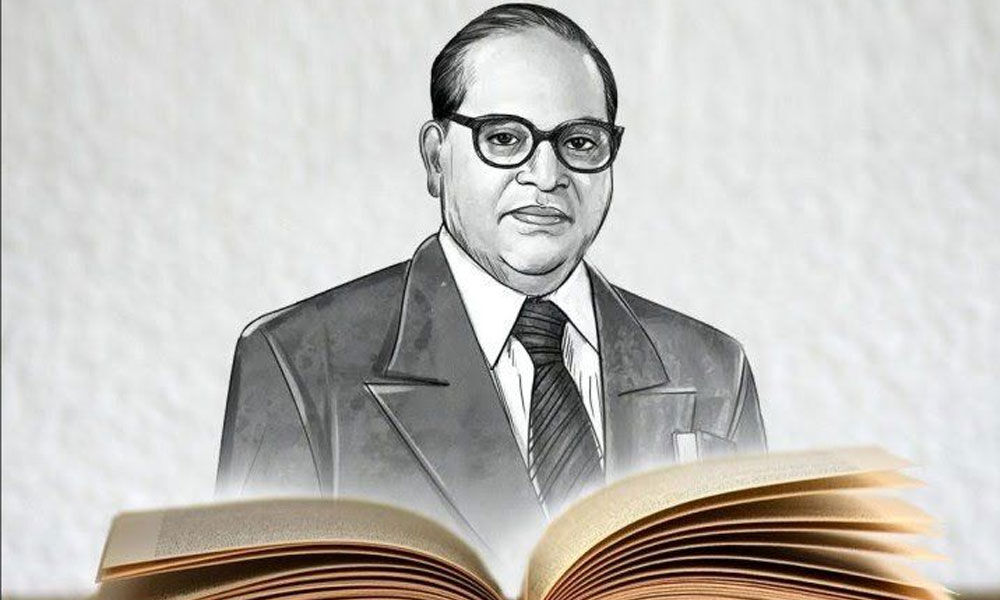
Dr. B. R. Ambedkar wrote on a wide range of subjects, from caste and religion to economy and polity. While he has left behind a large corpus of writings, his closing speech in the Constituent Assembly still remains a very significant sociological analysis of law and the Indian Constitution.
His speech in the Constituent Assembly is significant because it forcefully argues that a good constitution cannot function well if it is handled by bad people. Similarly, even a bad constitution can yield good results if it is used by good people.
In other words, much more than formal rules and procedures, the social location, interests, and intentions of those who interpret or implement them are important—a point which is often missed by liberal scholars but not by Dr. Ambedkar.
The first meeting of the Constituent Assembly, with the aim of drafting the Constitution, was held on December 9, 1946, and it continued to function for around three years, with B. R. Ambedkar, as Chairman of the Drafting Committee, bearing a major share of the responsibility. When the work of drafting the Constitution was completed, Dr. Ambedkar delivered his closing speech on November 25, 1949, a day before the Constitution was formally adopted. November 26 was later celebrated as Constitution Day to mark this historic event.
Giving his closing speech in the Constituent Assembly, Babasaheb put it: “… however good a Constitution may be, it is sure to turn out bad because those who are called to work it, happen to be a bad lot. However bad a Constitution may be, it may turn out to be good if those who are called to work it, happen to be a good lot. The working of a Constitution does not depend wholly upon the nature of the Constitution.”
In his speech, Dr. Ambedkar argued that rules, laws, or the Constitution are not sufficient in themselves, nor do they guarantee justice, however well they may be framed. Beyond the law, the persons who interpret and implement it are the critical factor.
In the context of the Constitution, Ambedkar takes a critical sociological view and said that mere having good rules are not enough, if the person interpreting or implanting it has a bad intention. His argument is directly linked with his political movement to fight for the proportionate and effective representation for Dalits and other marginalised castes and communities.
The opponents of affirmative action, including reservation, often invoke the logic of meritocracy. However, anti-reservationists are not willing to accept the fact that merit is often defined through caste interests.
For example, the skills acquired by rich, upper-caste males are taken as the benchmark and imposed on the rest of society, ignoring the geographical, cultural, and linguistic diversity of the country, as well as the social and economic backgrounds of the people. Unlike such Brahminical logic, B. R. Ambedkar argued for bringing every caste and community within the process of decision-making so that they could not only make laws but also interpret and implement them in their own interests.
Dr. Ambedkar was of the view that if power is not shared and remains concentrated in a few hands, the interests of marginalised castes and communities are bound to be compromised. The same logic extends to the field of law, where mere formal rules cannot ensure justice for marginalised castes; rather, they must be in a position to interpret and implement them to ensure justice in society.
To illustrate B. R. Ambedkar’s argument, let us take the analogy of a car. A new car is not a guarantee of safe driving if it is handled carelessly. Conversely, even if a car has some technical faults, there is a greater chance that the journey will be safe if the driver is experienced and careful. In the context of law, Ambedkar is not merely satisfied with having a good constitution; rather, he is concerned about the misuse of a good constitution in the hands of bad people. But even if the constitution is not perfect, if those implementing it have good intentions, there is a greater possibility of bringing about justice in society.
Although Dr. Ambedkar, in his speech, disagreed with the Indian communists and socialists over their “condemnation” of the Constitution, Babasaheb’s sociological understanding of law comes very close to the Marxist critique of law. While liberal jurisprudence emphasizes rules and procedures and the idea of providing a level playing field to everyone seeking justice in a court of law, Marxist philosophers foreground the political dimension of law. Radicals argue that, in the absence of a genuine level playing field in society—where a few monopolise wealth and shape culture, religion, and other institutions to perpetuate their dominance—the judiciary and law cannot remain neutral zones of freedom and rational deliberation.
While the class character of society is central to Marxist thinking, it does not get displaced in Dr. Ambedkar’s analysis. While Ambedkar was a firm supporter of state socialism and of the state taking greater responsibility for people’s welfare, he strongly disagreed with the communists over their support for the “dictatorship of the proletariat.” Dr. Ambedkar, on the other hand, was a strong advocate of bringing about equality and reconstructing an egalitarian order through democratic and constitutional means.
Having acknowledged these differences, Ambedkarite scholars and Marxists converge on the point that, unlike liberal scholars, they do not ignore the social reality and deep-seated inequalities that exist beyond the formal and legal structures of the state. While class and property relations are central to classical Marxist analysis, Dr. Ambedkar’s primary focus is on the caste-based graded inequality of Indian society. While Dr. Ambedkar does not ignore class contradictions in society, he, unlike Marxist scholars, explains class inequality through a caste-based analysis.
Since caste-based inequality remains deeply entrenched in society and the post-Independence state did not go much beyond providing formal equality to the lower castes and other marginalised communities, Dr. Ambedkar was acutely aware of the continuing presence of upper-caste hegemony from society to politics and from culture to the economy. That is why he was concerned that a good law in itself is not a guarantee of justice unless marginalised castes and communities are in a position to interpret and implement it in their own interests. These sociological insights of Dr. Ambedkar are crucial not only for understanding our judicial system but also for analysing other institutions of the state.
[The author is the author of the recently published book Muslim Personal Law: Definitions, Sources and Contestations (Manohar, 2026).]
Related:
Caste Shadow on Ambedkar Jayanti: From campus censorship to temple exclusion
On his 135th birth anniversary, we ask, would Ambedkar be allowed free speech in India today?
A principled PM, a determined law minister: Nehru, Ambedkar & Opposition in Indian Politics