
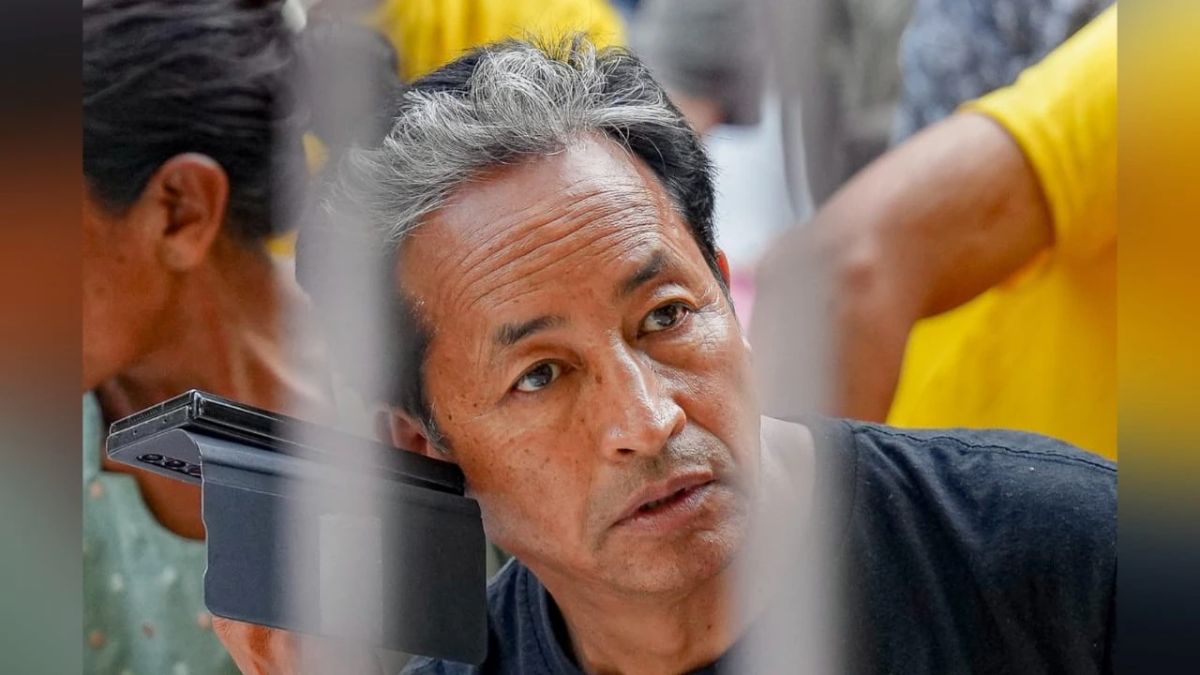
In a significant development, the Union government on Saturday, March 14, revoked the detention of Ladakhi climate activist and educationist Sonam Wangchuk under the National Security Act, 1980 (NSA), bringing to an end nearly six months of preventive custody that had drawn national attention and sparked legal challenges.
The Ministry of Home Affairs (MHA) announced that the decision was taken “after due consideration” and in order to create an atmosphere conducive to dialogue and stability in the Union Territory of Ladakh. The order revoking Wangchuk’s detention was issued with immediate effect, according to The Hindu.
In its official statement, the MHA said the government remains committed to “fostering an environment of peace, stability, and mutual trust in Ladakh so as to facilitate constructive and meaningful dialogue with all stakeholders.” The ministry also noted that Wangchuk had already served nearly half of the maximum detention period permitted under the NSA, which allows authorities to detain individuals without trial for up to 12 months, as per Hindustan Times.
The activist had been lodged in Jodhpur Central Jail in Rajasthan since September 26, 2025.
Arrest followed violent protests in Leh
Wangchuk’s detention followed widespread protests in Leh on September 24, 2025. The protests were for demanding greater political autonomy for Ladakh. Unfounded allegations about protests turning “violent” were made by government, claims contested by video footage and other evidence. However, when demonstrators clashed with security personnel, who were trying to stop protests, the police firing left four people dead and dozens injured.
Authorities subsequently accused Wangchuk of instigating the protests and described him as a “chief provocateur”. Two days after the violence, he was detained under the NSA and transferred from Ladakh to Rajasthan. This decision too has been widely criticised.
The detention by a widely acclaimed climate activist was after he, that is Sonam Wangchuk had announced a second hunger fast after the Centre had ‘broken its promise” to accord Leh/Ladhakh autonomy in 2020. Previously in March of 2024, Wangchuk had led a 21-day ‘climate fast’ that had drawn nationwide attention and support. His strong words of criticism against Prime Minister Narendra Modi and Home Minister, Amit Shah had found an echo among millions. This hunger fast too was for a demand of statehood for Ladakh and its inclusion in the Sixth Schedule of the Constitution.
The September 2025 sudden detention was justified by the Modi government. The government maintained that the detention was necessary to restore order in a sensitive border region. During proceedings before the Supreme Court, the Centre argued that Wangchuk had attempted to incite younger protesters by invoking movements such as those in Nepal and Bangladesh and had spoken about an “Arab Spring-like” mobilisation.
The government also opposed his release on medical grounds, telling the court that claims about deteriorating health were “manufactured and synthetic”. According to the Union government, Wangchuk had undergone multiple medical examinations during his detention and was medically stable.
Detailed reports may be read here and here.
Legal challenge before the Supreme Court
Wangchuk’s detention was being challenged in the Supreme Court through a habeas corpus petition filed by his wife, Gitanjali Angmo under Article 32 of the Constitution. The case was being heard by a bench comprising Justices Aravind Kumar and P.B. Varale.
Senior advocate Kapil Sibal, appearing for the petitioner, argued that the detention order relied on vague allegations, “stale FIRs”, and selective interpretations of Wangchuk’s speeches. He contended that authorities had relied on “borrowed, selective videos” that were inaccurately translated and did not demonstrate incitement to violence.
The Supreme Court had been scheduled to review video recordings of Wangchuk’s speeches during the Holi recess and was expected to consider the matter again on March 17. The government’s decision to revoke the detention has effectively pre-empted that hearing.
Angmo had also alleged that the detention was part of a wider pattern of pressure against Wangchuk and his institutions. According to her, authorities cancelled the lease of the Himalayan Institute of Alternatives Ladakh, initiated a CBI inquiry, withdrew permissions for his NGO, and issued income tax notices during the period surrounding his arrest,
Movement for constitutional safeguards in Ladakh
Wangchuk, a globally recognised education reformer and environmental innovator, has been one of the most prominent voices in Ladakh’s ongoing movement seeking constitutional protections for the region.
The agitation intensified after 2019, when the Union government abrogated Article 370 and reorganised the former state of Jammu and Kashmir into two Union Territories — Jammu and Kashmir, with a legislature, and Ladakh, which remains directly governed by the Union government.
The movement led by the Leh Apex Body and the Kargil Democratic Alliance has articulated a four-point agenda:
- Statehood for Ladakh
- Inclusion of the region under the Sixth Schedule of the Constitution
- Creation of a Ladakh Public Service Commission
- Separate Lok Sabha seats for Leh and Kargil districts (Hindustan Times)
Leaders argue that Ladakh’s Union Territory status has left residents with little democratic representation, as administrative authority is largely exercised by centrally appointed bureaucrats.
Prior to the reorganisation, the region had four elected representatives in the Jammu and Kashmir Assembly. Since the bifurcation, Ladakh has no legislative assembly of its own.
Why Sixth Schedule status is being demanded
A key demand of the movement is the extension of the Sixth Schedule of the Constitution to Ladakh. The Sixth Schedule currently provides special administrative protections for tribal-majority regions in Assam, Meghalaya, Mizoram, and Tripura.
Autonomous District Councils created under the schedule have powers to legislate on matters such as land, forests, agriculture, village administration and local governance.
Protestors argued that such protections are essential for Ladakh because more than 90 percent of its population belongs to Scheduled Tribes, and the region’s fragile ecology and distinct cultural identity require legal safeguards (The Indian Express).
While Ladakh already has two autonomous hill councils — the Ladakh Autonomous Hill Development Council (Leh) and the Ladakh Autonomous Hill Development Council (Kargil) — they are not backed by constitutional protections and have limited administrative powers.
Government officials have previously suggested that extending the Sixth Schedule beyond the Northeast may require a constitutional amendment, though the final decision rests with Parliament.
Reaction from Ladakh leaders
The revocation of Wangchuk’s detention has been welcomed by leaders associated with the Ladakh movement, though many emphasised that the broader political demands remain unresolved.
Sajjad Kargili, founder member of the Kargil Democratic Alliance, described the move as a “welcome step” and expressed hope that it would pave the way for renewed negotiations with the Union government, according to The Indian Express.
He said the region continues to seek statehood, Sixth Schedule protections, and institutional mechanisms such as a public service commission to address concerns about employment and governance.
Kargili also pointed out that Ladakh had previously enjoyed some degree of political representation within the Jammu and Kashmir Assembly, whereas the present administrative arrangement offers residents limited avenues for democratic accountability.
Wangchuk’s response
Even while in detention, Wangchuk indicated that he would continue his activism but emphasised the need for dialogue. In a social media message earlier this week, he said the movement for Ladakh’s rights required “clarity, unity, and sincere dialogue”, as reported by The Hindu.
His wife also stated in an interview that Wangchuk intends to remain part of the broader campaign for constitutional safeguards but does not plan to pursue confrontation or agitation after his release.
At the same time, Angmo criticised the government’s claim that Ladakh had remained peaceful during Wangchuk’s detention. In a post on social media, she argued that the apparent calm was the result of curfews, internet shutdowns, and arrests of more than 100 youth following the September 2025 protests.
“The dreaded silence of the graveyard is not equal to the sacred peace of the temple that Ladakh was known for,” she wrote, as per Hindustan Times.
Related:
When Protest becomes a “Threat”: Inside the Supreme Court hearing on Sonam Wangchuk’s NSA detention
Crushing voices: The detention of Sonam Wangchuk and supporters at Ladakh Bhawan
Ladakh’s fight for autonomy: Sonam Wangchuk leads foot march to Delhi