
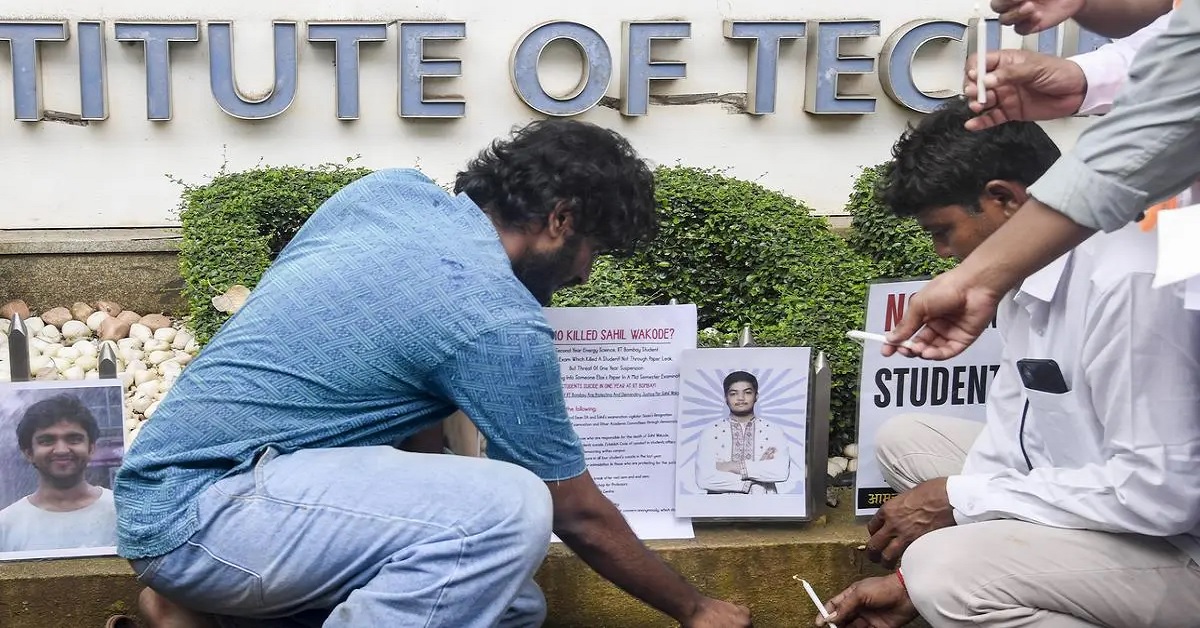
Sahil Wakode, a second-year B.Tech student at IIT Bombay, died by suicide on September 18, 2026. The institute’s initial statement framed his death around an incident of alleged cheating in an exam earlier that day, a framing it later retracted, issuing an apology for pushing a narrative before any investigation had concluded. Sahil’s parents, meanwhile, alleged that their son had been subjected to caste-based harassment and demanded the arrest of Professor Suryanarayana Doolla. It is against this backdrop that Professor V. Ramgopal Rao, former Director of IIT Delhi, wrote a post in X in support of Professor Doolla.
We were disheartened to see media outlets amplify his post without context or critique, so we have unpacked his argument in depth here. His post is merely an illustrative case. In our time in so-called elite institutions, we have seen many professors share similar attitudes, and this analysis draws on that lived experience of the system as much as on his words. With this critique of a public argument, we hope to prompt reflection on the individual and institutional biases that harm students from marginalised groups in elite institutions.
I am disturbed to see Prof. Suryanarayana Doola being vilified over the recent controversy at IIT Bombay. I know Surya personally. He is one of the finest faculty members I have known in the IIT system, and a gentleman of the highest integrity. Whatever concerns have been raised… pic.twitter.com/PwlAWQWvW9
— V. Ramgopal Rao, Ph.D. (@ramgopal_rao) September 23, 2026
This post is veiled but vile. It is hard to spot unless one recognises casteism not merely in visceral acts but as structural and systemic, deeply embedded in elite institutions as much as in society at large. The post invokes casteist prejudices within the reader without saying the quiet part aloud, leaving room for deniability. The argument leans on this prejudice so heavily that it doesn’t even bother hiding its own contradictions.
He says “With students coming through an intensive coaching culture, and classrooms bringing together students whose JEE Advanced ranks range from single digits to five digits (in the same class -for example CSE in IIT Delhi), we now have highly heterogeneous classrooms across the IIT system. Language also further adds to the challenge.
The question to ask therefore is, with such heterogeneity, can we expect every student to learn at the same pace?”
He invokes two kinds of heterogeneity, ability and background, and seamlessly equates them, which is itself casteist. He further laments that a teacher cannot teach effectively to such a heterogenous class properly.
What heterogeneity in ability could he possibly be referring to at IITs, which are defined above all, by their exclusivity? IIT intake is about 1% of those who appear for the JEE, and JEE aspirants themselves are only about a tenth of those who sit the Class 12 boards.
The question to ask, therefore, is this: what does it say about your competence as a teacher if you cannot cater to the brightest 1% of the country, by your own institute’s standard? Why shouldn’t we question the merit of a teacher who makes excuses about supposed heterogeneity in the country’s most exclusive and selective classrooms?
JEE Advanced is scored out of 360 marks, yet those few hundred points are stretched into ranks running into the tens of thousands. A difference of a handful of marks, often within the margin of error of any exam, can separate ranks by hundreds or thousands of places.
As Pierre Bourdieu argued, competitive exams do not measure pre-existing differences in ability so much as manufacture them, forcing a largely undifferentiated pool into an ordinal hierarchy where marginal, often arbitrary gaps in marks are treated as real, stable differences in ‘ability’.
The heterogeneity in ability that the professor describes is not a fact, but an artifact manufactured by the ranking system. When educators talk about ability solely in terms of these ranks, as if they were an absolute, hierarchical measure of ability across the cohort, this serves a narrative that justifies discrimination and shields educators from scrutiny.
He claims, “We now have highly heterogenous classrooms across the IIT system.” What does he mean by “now”? Does he mean after the implementation of reservations? He never says so outright, but he implies it to any reader who already carries that prejudice.
He says “There is nothing wrong with opening the doors of our best institutions to students from different backgrounds. The question is whether we have addressed this heterogeneity in our teaching-learning methods.”
This statement, by itself, is a valid goal if the question is an invitation to introspect whether the pedagogy in IIT classrooms is sensitive to the diversity of students in it.
However, he follows it up with, “A faculty member cannot pitch every class at several levels at once. Move too slowly, and some students lose interest. Move too quickly, and others are left behind.”, where he is talking about heterogeneity in learning achievement levels or ability.
He seamlessly jumps from heterogeneity in (caste) backgrounds to heterogeneity in ability, equating the two. This sleight of hand lets him imply, to a prejudiced audience, that students who enter through reservation lack ability, without saying it openly.
He contradicts himself: he says those with lower JEE Advanced ranks cannot learn at the same pace as top rankers yet also claims that even top rankers struggle because coaching trained them for familiar questions and not independent thinking.
If JEE rank is such an accurate arbiter of merit and ranks people by ability so precisely that a difference of a few thousand ranks makes them incompatible in ability to share a classroom, and by those very standards, the toppers are struggling too.
The top rankers struggle and the bottom rankers struggle, In other words, the ‘less meritorious’ struggle and the ‘more meritorious’ struggle. Perhaps, then, the problem is not the students. Perhaps it is the teaching.
If you reject that explanation, the alternative is that the JEE selection system itself is biased toward coachability rather than independent thinking, so much so that even top rankers struggle once they enter college. The skills required to win a filtering system are not directly relevant to college, nor is rank an absolute arbiter of merit. That would mean the system was never a ‘pure selector’ of ability whose function is ‘compromised’ by reservation; it did not select for merit in the first place.
Despite this glaring contradiction and the casteism underlying it, people still fail to consider the obvious possibility that the teacher is incompetent, or the system is. This lazy, contradictory narrative stokes anti-reservation prejudice only because a prejudiced reader is blind to the holes in it.
He assumes throughout that the teacher is competent, and that the only real difficulty is the heterogeneity in ability among students. What about the heterogeneity in the ability of teachers? Or is that assumed not to exist, because of the lack of heterogeneity in the backgrounds of IIT faculty, by his logic?
In reality, many professors at elite institutes like IITs are not selected for their ability to teach, but for their research record. Many take pride in identifying primarily as researchers and openly detest teaching. Not every good researcher is a good teacher. But because teaching is systematically undervalued, the hierarchy between research and teaching lets the system excuse its own failure to prioritise teaching skills in the selection and appointment of these faculty. Teaching skill includes sensitivity to students, something fundamentally incompatible with the meritocratic logic that reduces them to their ranks.
Hence, unless these issues are addressed, extending the programme from four to five years only prolongs students’ time under a system that fails them.
Notably, Prof. Rao, who now defends a colleague accused of casteism by a deceased student’s parents, chaired the 2020 committee that recommended IITs be exempt from reservation in faculty recruitment.
“A public campaign against an individual serves no one” he says. Except, that’s precisely what IIT Bombay and the media did to Sahil, and he shows no comparable concern for that trial of a student who can no longer defend himself.
Any real solution to the crisis of student deaths in elite institutions like IITs must begin with confronting and dismantling the prejudices that kill. Diversifying the faculty by effectively implementing reservation norms is one concrete way forward. It further requires faculty and institutions to introspect on their biases and unlearn them, with a commitment to equality, and to recognise that equality is not at odds with excellence but a condition of it.
(Authors: Sulochana R is a research scholar in Science Education in Homi Bhabha Centre for Science Education, TIFR Mumbai; Pranav Jeevan P holds a PhD in Artificial Intelligence from IIT Bombay. He has earlier studied quantum computing in IIT Madras and Robotics at IIT Kanpur.)
Disclaimer: The views expressed here are the author’s personal views, and do not necessarily represent the views of Sabrangindia.
Related:
Mumbai Dharna for Darshan Solanki makes calls for law against caste discrimination
The Normalisation of Suicide at IITs: Institutional blindness and failure
A Long Battle, A Swift Stay: The Fight for Equitable Campuses
The Anatomy of Humiliation: Defining caste violence in the Constitutional era