
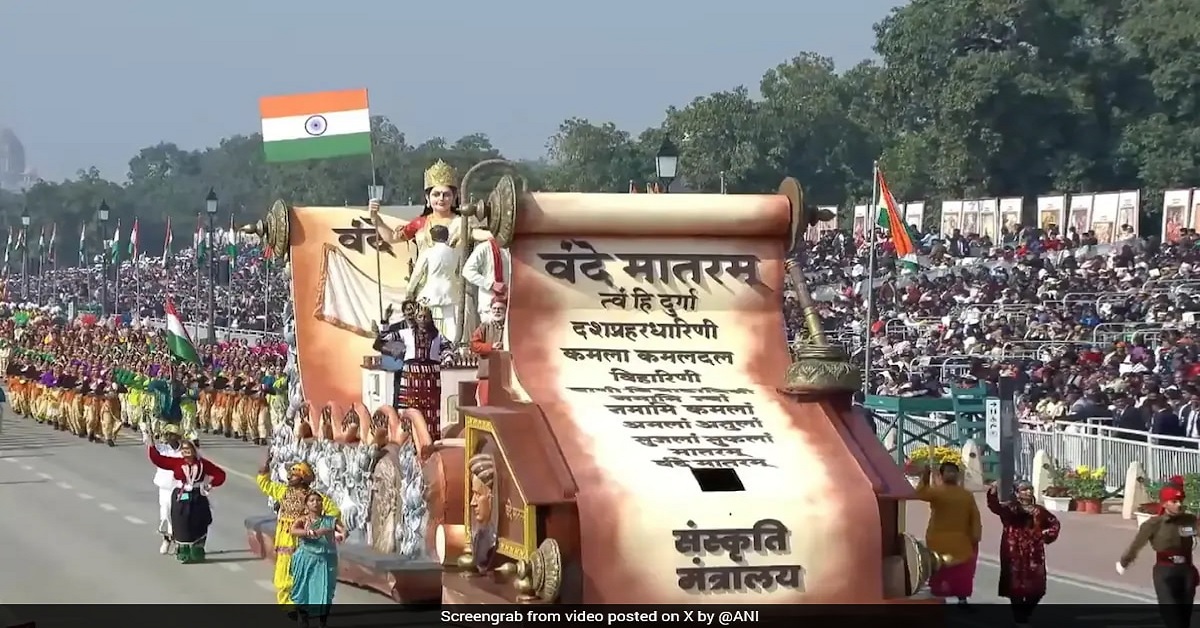
There is a popular expression in Malayalam: when the bull lifts its tail, one is certain what will follow. It is a rustic metaphor, blunt yet precise, used to describe events whose consequences are entirely predictable. Two months back, when the Central government devoted an entire day in Parliament to commemorating 150 years of Vande Mataram, one did not need the gift of prophecy to foresee what lay ahead.
Predictably, on February 11, the Centre issued a nationwide protocol prescribing how the national song, written by Bankim Chandra Chatterjee, should be sung. At one level, the move may appear innocuous—after all, what harm can there be in honouring a patriotic hymn? Yet, when placed in the larger political context, it raises troubling questions about the direction in which the Narendra Modi government is steering the republic.
The protocol makes it clear that Vande Mataram is to be given precedence over Jana Gana Mana, written and composed by Rabindranath Tagore and adopted as the national anthem. If both are sung, the national song must come first. It also mandates that everyone present must stand in respectful attention when it is sung, with an exception only when the song forms part of a film or documentary. Symbolism, in politics, is never accidental.
This development must be viewed alongside a broader pattern. When the Prime Minister “consecrated” the Ram temple at Ayodhya—on the very site where the Babri Masjid once stood—he blurred the constitutional line separating state and religion. Today, he appears more occupied with temple visits and meetings with religious figures than with addressing the anxieties of citizens grappling with unemployment, inflation and social discord.
There was a time when visiting dignitaries were taken to Bengaluru’s Infosys campus to showcase India’s strides in information technology—a confident, forward-looking nation presenting its modern achievements. Today, they are escorted to Varanasi, the Prime Minister’s constituency, to witness the Ganga aarti. Civilisational heritage has its place, but when spectacle substitutes substance, the message to the world changes.
I have heard Vande Mataram sung at functions organised by RSS veterans such as R. Balashankar. I was once invited to a function hosted by the builders of the Indira Gandhi International Airport in New Delhi, where the chief guest was RSS chief Mohan Bhagwat. On such occasions, only the first two stanzas were rendered—the very portions historically accepted as inclusive.
The February 11 circular, however, insists on singing the entire poem, including portions that were consciously set aside to accommodate the sensitivities of religious minorities. During the parliamentary debate, the Prime Minister asserted that Vande Mataram was the one song that united Indians during the freedom struggle. This is simply not true.
The freedom movement resonated with a chorus of slogans and songs, each reflecting diverse ideological streams and regional energies: Jai Hind, popularised by Subhas Chandra Bose; Inquilab Zindabad, immortalised by Bhagat Singh and his comrades; Quit India; Bharat Mata ki Jai; Jai Bharat; and yes, Vande Mataram. To claim that a single chant alone stirred the nationalist soul is to rewrite history through the lens of contemporary politics.
Modi had accused the Congress of “mutilating” Vande Mataram by adopting only its first two stanzas. The charge is historically untenable. Tagore’s Bharoto Bhagyo Bidhata, originally comprising five stanzas, was similarly abridged when the Constituent Assembly adopted only the first stanza as the national anthem on January 24, 1950. It was chosen for its brevity, inclusiveness and suitability for formal occasions. No one accused the Assembly of disrespecting Tagore.
Likewise, the Indian National Congress adopted only the first two stanzas of Vande Mataram in 1937 because later verses contain explicit references to Durga, Lakshmi and other Hindu deities. Leaders of the freedom movement—deeply conscious of India’s plural character—feared that adopting the entire song might alienate non-Hindus. Tagore himself recommended these two stanzas for their “unobjectionable evocation of the beauty of the motherland.”
Nor was this the decision of Jawaharlal Nehru alone, as is often alleged. It emerged from a unanimous Congress Working Committee resolution passed on October 30, 1937, in Calcutta. Among those present were Nehru, Sardar Patel, Dr Rajendra Prasad, Maulana Azad, Bhulabhai Desai, Jamnalal Bajaj, J.B. Kripalani, Pattabhi Sitaramayya, Rajaji, Acharya Narendra Dev, Jayaprakash Narayan and Subhas Chandra Bose. Mahatma Gandhi, though not a formal member, was a special invitee and assisted in drafting the resolution. Moved by Rajendra Prasad and seconded by Patel, it represented consensus—not mutilation.
It is also worth recalling that the Rashtriya Swayamsevak Sangh, founded in 1925—half a century after Vande Mataram was written—did not adopt it as its anthem. Instead, it chose Namaste Sada Vatsale Matrubhume, composed by Narhar Narayan Bhide. Now, the RSS does sing Vande Mataram, but it does not sing Jana Gana Mana. Those curious may consult old issues of its mouthpiece, Organiser.
In its early years, the RSS and allied publications derided Jana Gana Mana as a supposed paean to the British monarch, misreading Tagore’s lyrics as loyalty to empire. This claim, long debunked by historians, ignored Tagore’s own clarification that the song hailed the divine guide of India’s destiny, not any earthly ruler.
I recently watched an RSS shakha meeting in Delhi. It began with the RSS anthem and concluded with Vande Mataram, followed by boisterous slogan-shouting. I am not sure whether they sang the full version or the historically accepted two stanzas.
This raises an interesting question. If the government now insists that Vande Mataram take precedence over all else, will the RSS accord it precedence over its own Namaste Sada Vatsale? Or will protocol, like history, prove to be selectively applied?
The deeper unease surrounding the present directive is not confined to Jana Gana Mana alone. The RSS had, for decades, objected even to the national flag, arguing that the Tricolour did not reflect India’s “civilisational ethos.” For years, it declined to hoist the flag at its shakhas. Only after the Modi government launched a hyper-enthusiastic flag-waving campaign did the saffron brotherhood warm up to the Tricolour.
Returning to Vande Mataram, it is important to recall that objections to it were not solely Muslim. The charge of idolatry—of venerating the nation as a goddess—troubled other reformist traditions as well.
I was reminded of this during the funeral of my former colleague at The Hindustan Times, Harish Bhanot, in Chandigarh. His daughter, Neerja Bhanot, remains etched in national memory. On September 5, 1986, during the hijacking of Pan Am Flight 73, the 22-year-old flight attendant laid down her life saving hundreds. She became the first woman and the youngest recipient of the Ashok Chakra.
Bhanot was a follower of the Arya Samaj, and through him I had my first glimpse into that reformist tradition. It was the first time I entered an Arya Samaj temple. The walls bore inscriptions—Vedic verses rendered in bold script—but there was no idol, no sculpted deity, no ritual paraphernalia of worship. The austerity was striking, almost disarming. Swami Agnivesh, who belonged to this movement, was a friend. He later spoke at the Maramon Convention. We know who brutally attacked him for his views.
The point bears emphasis: opposition to idolatry is not confined to Islam. Arya Samajists, too, consider it a deviation from true monotheism. When the state elevates a song that personifies the nation as a goddess, it inadvertently places such citizens—Muslim and Hindu alike—in a moral quandary.
The Centre’s directive mandating the full six-stanza, three-minute-and-ten-second rendition of Vande Mataram at official occasions—during flag unfurling, the President’s arrival, and before and after her addresses—effectively pushes Jana Gana Mana to the margins. For all practical purposes, the national anthem risks being reduced to a ceremonial afterthought. It bears recalling that Sri Aurobindo, who rendered the song into English, viewed it as an anthem of a united Bengal in its struggle against colonial rule, not as a national song for the whole of India.
The text itself is rooted in a specific historical moment: its landscape is regional, its imagery sectarian to many, and even its demographic references belong to an era when India, as we know it today, did not exist. Protocol, once a matter of dignified brevity, now threatens to become an endurance test. Elderly citizens, people with arthritis, and those unable to stand for prolonged periods may find patriotism measured not by feeling but by stamina.
A word about the poet, Bankim was among the earliest architects of the Bengal Renaissance—scholar, novelist, satirist, administrator. His prose reshaped Bengali literature and stirred cultural self-awareness among Hindu Bengalis. Yet his nationalism was not the inclusive vision later articulated by Mahatma Gandhi or Jawaharlal Nehru.
His 1882 novel Anandmath forms the backdrop of Vande Mataram. It depicts ascetic warriors—the Sannyasis—fighting Muslim rule. Muslims are portrayed as foreign invaders and oppressors; the narrative closes not with reconciliation but with ascendancy.
Historians S. M. Burke and Salim Al-Din Quraishi, in The British Raj in India: An Historical Review, note that even colonial authorities viewed the song with suspicion. Sir Henry Craik objected that it originated as a hymn of hate against Muslims and had become a war cry of militants in Bengal. In one exchange from Anandamath, a character declares that Hinduism cannot survive unless “the bearded drunkards are expelled”—and, when asked how, replies: “By killing.”
Given such a history, the Congress leadership’s decision to adopt only the nonsectarian stanzas was not cowardice but statesmanship.
Bankim himself was not always a nationalist in the modern sense. In his early writings, he admired Europe’s scientific method, governance, and culture, describing it as a “more perfect type of civilisation,” while lamenting India’s “arrested development.” He praised Europe’s inductive method—systematic observation, experiment, and application of knowledge into power. By the time he wrote Anandamath, he had transformed into a cultural revivalist.
That transformation mirrors our own national journey: from self-doubt to assertion, from reform to revival, from pluralism to a more brittle uniformity.
My grandson Nehemiah once had an unusual hobby. In Class 2 or 3, he delighted in listening to national anthems of different countries. He could identify them by tune and lyric. Among his favourites was the Russian anthem; he admired its martial music.
He informed me—authoritatively, as only children could—that Greece had the longest anthem but uses a shortened version; the Netherlands had the oldest; the American anthem was the most difficult to sing; and Japan’s could be rendered in under 45 seconds. The only anthem he could sing flawlessly, he said, was that of Bahrain. Why? Because it had no words—only sound.
His innocent observations carry a profound lesson: an anthem’s power lies in its brevity, clarity, and inclusiveness. Over three minutes is an eternity when symbolism overshadows sentiment.
Vande Mataram proclaims:
Mother, I praise thee!
Rich with thy hurrying streams,
Bright with thy orchard gleams…
One cannot help asking: Is today’s India—where rivers like the Yamuna in Delhi run dark with sewage and foam—the landscape Bankim praised? Should not the government focus first on making the country worthy of such hymns? Clean rivers, breathable air, and dignified living conditions would inspire spontaneous patriotism far more effectively than mandated recitations.
Instead, we risk compelling citizens—particularly Muslims and Christians—to sing praises that resemble devotion to a Hindu goddess. Patriotism, when coerced, curdles into compliance; when inclusive, it blossoms into belonging.
Nations are not sustained by songs alone. They endure through shared values: justice, dignity, equality, and mutual respect. Symbols matter, but they must unite rather than divide. The framers of the Republic understood this when they chose Jana Gana Mana—brief, inclusive, geographically expansive—as the anthem, while according Vande Mataram an honoured but limited place.
To elevate one by diminishing the other is to reopen settled questions and unsettle fragile harmonies. The real test of nationalism is not how loudly we sing, how long we stand, or how many flags we wave. It lies in whether every citizen—Hindu, Muslim, Sikh, Christian, believer, reformist, or atheist—feels equally at home in the Republic.
If a song must be sung, let it be one that all can sing without hesitation. If a flag must be waved, let it be one that all embrace without qualification. And if a nation must be worshipped, let it be through service—clean rivers, just laws, and compassionate governance—rather than through enforced hymns. Only then will patriotism cease to be performance and become, once again, a shared and silent pride.
Courtesy: Indian Currents