
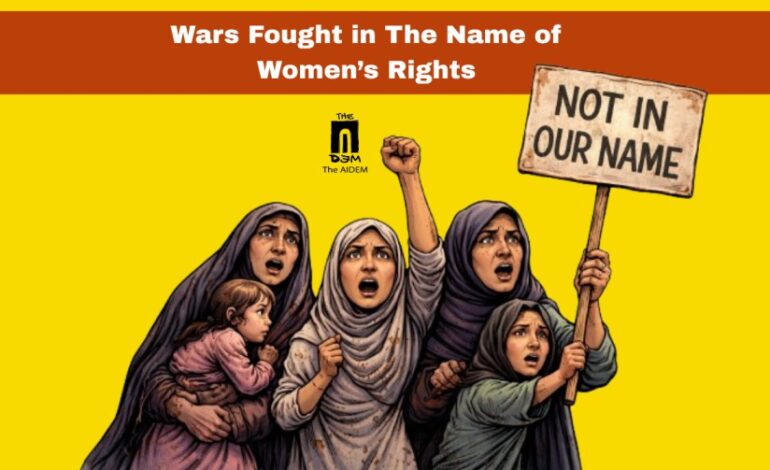
Can bombs liberate women? Can missiles deliver freedom? From Afghanistan to Iraq, and now Iran, the language of women’s rights has repeatedly marched alongside war drums. Even as the liberal international order frays and a new, blunt imperial calculus emerges, the moral script remains eerily familiar: rescue, liberation, democracy. Leaders promise freedom while fighter jets take flight. But who truly benefits from these wars waged “for women”? And what happens when feminism itself becomes a geopolitical tool? As new conflicts unfold and old justifications return, a difficult question resurfaces: are women being saved or simply invoked to sanctify violence?

Human rights—especially the liberation of women—have long been invoked as moral justification for military interventions aimed at regime change in countries deemed hostile to the West’s vision of global order. As we witness the slow demise of the liberal international global order, with the retreat of USA from multilateral internationalism and the implementation of Trump’s grand plan of a US-led imperial order where both war and peace will be orchestrated by the same actors (especially with Trump’s favourite genocide-loving buddy state, Israel), one realises some vestiges of the moral rhetoric of the dying order persist. While Trump himself appeared unsure which rationale to foreground for the unlawful war on Iran, he nevertheless echoed his predecessors—who cloaked interventions in the faux benevolence of democracy—by announcing that for Iranians, “the hour of their freedom is near”. His friend, Bibi Netanyahu, in Israel’s 2025 attack on Iran, had more clearly invoked the rights of Iranian women to justify the unjustifiable. In an interview with Iran International, he had said, “They have impoverished you, they have given you misery. They have given you death, They shoot down your women, leaving this brave, unbelievable woman, Mahsa Amini, to bleed on the sidewalk for not covering her hair”. In the brutal genocide committed by Israel on Gaza, we had seen how ‘pinkwashing’ was deployed as a justification to attack the Palestinians, which led queer Palestinians to assert that ‘there is no pride in occupation’.

The ‘Us vs Them’ rhetoric, which Netanyahu had used against Palestine, terming them as modern-day Amalek, the nation which is depicted in Torah as having gone to war against the Israelites, is now extended to describe Iran. However, the ‘Us Vs them’ rhetoric was also deployed in his address to the protesting Iranians as a decoy to incite support for regime change through foreign invasion. Women’s rights have now reemerged in discussions and debates on the legitimacy of the war. There is widespread reporting in American media on the celebrations by Iranian women on Supreme Leader, Ayatollah Ali Khamenei’s death. However, Iranian activists are also putting forward nuanced arguments that refuse to couple their struggle for rights in Iran with the US-Israel-led invasion. Recently, the video of Spanish politician Manuela Bergerot, vehemently arguing against the depiction of war on Iran as being a magnificent victory for feminism, has been shared widely by feminists and others alike. She asserts that her position against the war is being put forward as a feminist. She joins a long line of feminists who have opposed the “imperialist feminist” position—the claim that certain wars are morally justified because they supposedly rescue women in the “rest” of the world from oppressive states. The imperialist feminist position, which coopts the conceptual language of feminism to justify the current war on Iran as saving the Iranian women from a repressive government, is by no means a new strategy. It was used with disastrous results in Iraq and Afghanistan, wars which had grossly misused the rhetoric of human rights, especially women’s rights and democracy promotion, to justify invasions. This rhetoric of rescuing women is a close corollary of the practice of terming countries as ‘failed’ states and ‘rogue’ states, as well as the earlier colonial use of the ‘Women’s Question’ to justify colonialism, which Gayatri Chakravorty Spivak had described as “white men saving brown women from brown men.”

It is useful to remember the ‘War Against Terrorism’ launched against Afghanistan with huge domestic support in the US, support which was garnered by the use of the rhetoric of women’s rights and the support of women’s organisations in the US. In a widely cited Radio address, Laura Bush had announced that “The fight against terrorism is also a fight for the rights and dignity of women”. Such ‘Rescue’ narratives tend to depict women in non-Western societies as passive, non-agential beings who need to be saved. Anthropologist and feminist scholar Lila Abu Lughod wrote, questioning this logic in her influential article ‘Do Muslim Women Really Need Saving?’, which went on to become a prescribed text in most courses on feminism and gender studies. She urges us in her work to move beyond the rhetoric of saving and instead pay attention to and appreciate the differences among women in the world, including their different conceptions of freedom, choice, and justice. To assess how deceptive the rhetoric of women’s rights was in justifying the war in Afghanistan, one just has to look at the contemporary condition of Afghan women’s rights, most recently further eroded by the new Criminal Procedural Regulation. The war fought, citing the presence of active Weapons of Mass Destruction in Iraq (active only in the imagination of the USA), was no different. Bush had back then exhorted the Iraqi women to be the midwives of a new liberated Iraq. After more than twenty years of the invasion, as Nadje Al- Ali, Iraqi feminist and scholar, describes, women have come out as the biggest losers of the invasion. While before the invasion, Iraqi women had enjoyed the highest levels of education, labour force participation, and a certain degree of political involvement, women in post-invasion Iraq have seen a steady erosion of their rights along with a rise in conservatism.

The selective nature of caring for women’s rights in countries where the USA wants regime change is no coincidence. Also, the saving women rhetoric is a strategic diversion from not dealing with women’s rights within the USA. Like Bush who talked about the rights of women in Iraq and Afghanistan, but cut off funding to international family planning organisations that offered abortion and counselling services, Trump who talks about caring for Iranians, announcing to Iranians in his social account about ‘Making Iran Great Again’ has systematically cut down the rights of many American citizens under the guise of ‘Making America Great Again’. In In the Name of Women’s Rights: The Rise of Femonationalism, Sara Farris shows how women’s rights have been co-opted by anti-Islam, anti-migration, and xenophobic campaigns to justify exclusionary policies—diverting attention from the real violence faced by women and the erosion of their autonomy. The withheld Epstein files that incriminate Trump have been released and are beyond horrific in what it reveals, while ICE has detained immigrant women in detention in deplorable conditions. In contrast, feminists who have spoken against the stereotyping of non-Western women have not been silent on the issues of women or held back in their criticism of repressive regimes they live in, but as Abu-Lughod has written, “is mindful of complex entanglements in which we are all implicated, in sometimes surprising alignments.” Iranian activists who were on protests deserved support and engagement from around the world, including from the USA, but they definitely didn’t need a US-Israel invasion that ended up bombing an elementary school for girls. Egyptian feminist Nawal el Saadawi had famously suggested, when asked what the people in the US can do to support the revolution in Egypt, “Make your own revolution and change your government for us”. It is perhaps time feminists and citizens in the United States heed her advice.
Courtesy: The AIDEM