
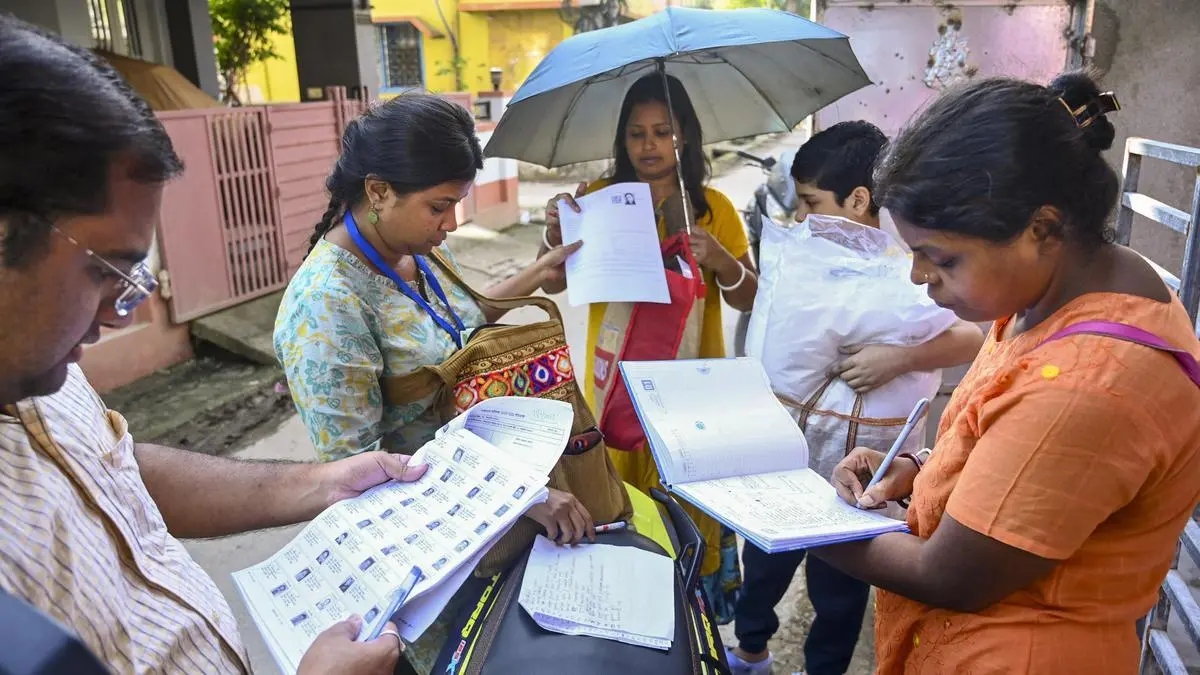
On December 16, the State Electoral Officer (SEO) for West Bengal published the draft electoral rolls which interestingly showed that the state’s electorate had shrunk from 7.66 crore to 7.08, with a substantial 58 lakh names struck off the voters’ list on grounds ranging from death and permanent migration to duplication and enumeration forms not being submitted.
With these deletions, West Bengal’s electoral rolls now have the names of 7,08,16,631 voters, as against 7,66,37,529 earlier, The Hindu reported. All voters (citizens) can search for their names on the voter roll on the Election Commission of India’s portal eci.gov.in or the website of the West Bengal Chief Electoral Officer at ceowestbengal.wb.gov.in. Besides, physical copies of the draft rolls will also be available with booth-level officers, who have been asked to remain present at polling stations on the day of publication. The press note issued by the CEO West Bengal may be read below.
The Election Commission has stressed, in a press release issues yesterday, December 16, that deletion from the draft roll is provisional, and that citizens can object to their names being removed from the list. Voters (citizens) still have until January 15, 2026 for the Claims and Objections Period and then (December 16, 2025-February 7, 2026) for the Notice & Verification period. The question is does the State CEO or the ECI have such a robust infrastructure in place to service/handle Claims or Objections of a potential (over) 58 lakh deletions in the state?
West Bengal is expected to head for Assembly elections in the first half of 2026.
Digital copies have also been shared with representatives of the state’s eight recognised political parties. The Election Commission also stated that the list of deleted names includes names that appeared in the January 2025 rolls but do not feature in the draft rolls prepared after the revision exercise, which ran from November 4 to December 11, PTI reported. Last week, data released by the office of the chief electoral officer showed that over 24.1 lakh voters were marked as dead, 19.8 lakh as permanently shifted and 12.2 lakh as missing or untraceable at their registered addresses.
Besides, an additional 1.38 lakh voters were identified as having duplicate entries, 1.8 lakh were classified as “ghost” voters, and more than 57,000 names were removed under other discrepancies detected during enumeration.
In fact, it is Muslim-dominated Assembly seats have recorded marginal or negligible deletions. In both Murshidabad and Malda districts, where Muslims comprise 66.3% and 51.6% of the population as per the 2011 Census, only 4.84% and 6.31% of the electorate have been struck off the electoral rolls. In none of the Assembly seats in these districts have the deletion figures crossed 10%
The Draft Voter’s list released on December 16 debunks Home Minister Amit Shah’s favourite “Bengal is overrun by infiltrators” script has just been blown to pieces by the Election Commission’s own SIR data for the 2025 rolls. Minority‑dominated border blocks show some of the lowest documentation gaps, while the worst “no‑mapping” and deletions are among Matua refugees, migrant workers and urban renters – not Muslims sneaking across the border. So the SIR quietly certifies what Bengal has been saying all along: this is not an infiltration crisis, it’s a BJP propaganda project built on refugees’ pain and workers’ precarity.
Preliminary Analysis debunks hysteria over “infiltration”
A preliminary analysis of the draft rolls –which are provisional in nature and subject to change following the next phase of claims and objections — reveals that Assembly seats with a sizable number of Hindi speakers are among the top 10 constituencies that saw the most deletions, ranging from 15%-36% of the electorate. In contrast, several Muslim-dominated constituencies saw a marginal number of deletions. Chief Minister Mamata Banerjee’s constituency Bhabanipur and Mayor Firhad Hakim’s seat Kolkata Port among 10 seats with most deletions.
The Indian Express has analysed and reported that among the 10 seats with the maximum deletions are Jorasanko (36.66% of the electorate removed), Chowringhee (35.45%), Kolkata Port (26.09%), which is the constituency of TMC leader and Kolkata Mayor Firhad Hakim, and Chief Minister Mamata Banerjee’s constituency Bhabanipur (21.55%). These constituencies in Kolkata have a significant Hindi-speaking population and though the TMC won all in the 2021 Assembly polls and led in the 2024 Lok Sabha polls, the BJP has been attempting to expand its base there. Assembly constituencies in and around Kolkata have also seen a large number of deletions, with the Kolkata North and Kolkata South districts registering the most deletions at 25.92% and 23.82%, respectively.
Incidentally, constituencies where the BJP is a strong political force have also seen high deletion rates. These include Howrah Uttar (26.89% deletion); Asansol Dakshin (13.68%) and Asansol Uttar (14.71%) in Paschim Bardhaman district; and Barrackpore (19.01%) in North 24 Parganas district. Of these seats, though the BJP has an MLA only in Asansol Dakshin, it is just behind the TMC in the rest and has a robust organisational footprint in those constituencies. Constituencies dominated by the electorally influential Matua community, a key BJP voter base, also recorded significant deletions in the first phase. These include Kasba (17.95%) and Sonarpur Dakshin (11.29%) in South 24 Parganas district and Bongaon Uttar (9.71%) in North 24 Parganas.
Least deletions
In fact, it is Muslim-dominated Assembly seats have recorded marginal or negligible deletions. In both Murshidabad and Malda districts, where Muslims comprise 66.3% and 51.6% of the population as per the 2011 Census, only 4.84% and 6.31% of the electorate have been struck off the electoral rolls. In none of the Assembly seats in these districts have the deletion figures crossed 10% says the Indian Express.
In Murshidabad, constituencies such as Domkal (3.4%), Rejinagar (5.04%), and Shamsherganj (6.86%) did not see high deletion rates, while the number was low in a Muslim-dominated constituency such as Manikchowk in Malda (6.08%). Even before the Special Intensive Revision (SIR) exercise began, people had started queueing up outside local bodies and Block offices for identity documents and other papers.
In Uttar Dinajpur, with a 49.92% Muslim population as per the 2011 Census, minority-dominated seats such as Chopra (7.44%), Goalpokhar (7.03%), Islampur (8.17%), and Chakulia (8.55%) have not seen high deletions. This pattern also holds in Muslim-dominated constituencies such as Hassan (4.95%) and Nanur (5.24%) in Birbhum district.
Besides West Bengal, the special intensive revision of electoral rolls is underway in 11 other states and Union Territories.
Scroll.in reported that in Bihar, where the revision was completed ahead of the Assembly polls in November, at least 47 lakh voters were excluded from the final electoral roll published on September 30.
Related:
‘Designed to Exclude’: The ongoing enumeration phase of the SIR